

Luke 1:72
Greek (Tischendorf 8th ed.) Luke 1:72 appears in the Greek New Testament. The text above is from the Tischendorf 8th edition. Each word links to its Strong’s number and a concise gloss. Click any word for its full Thayer’s Greek Lexicon entry.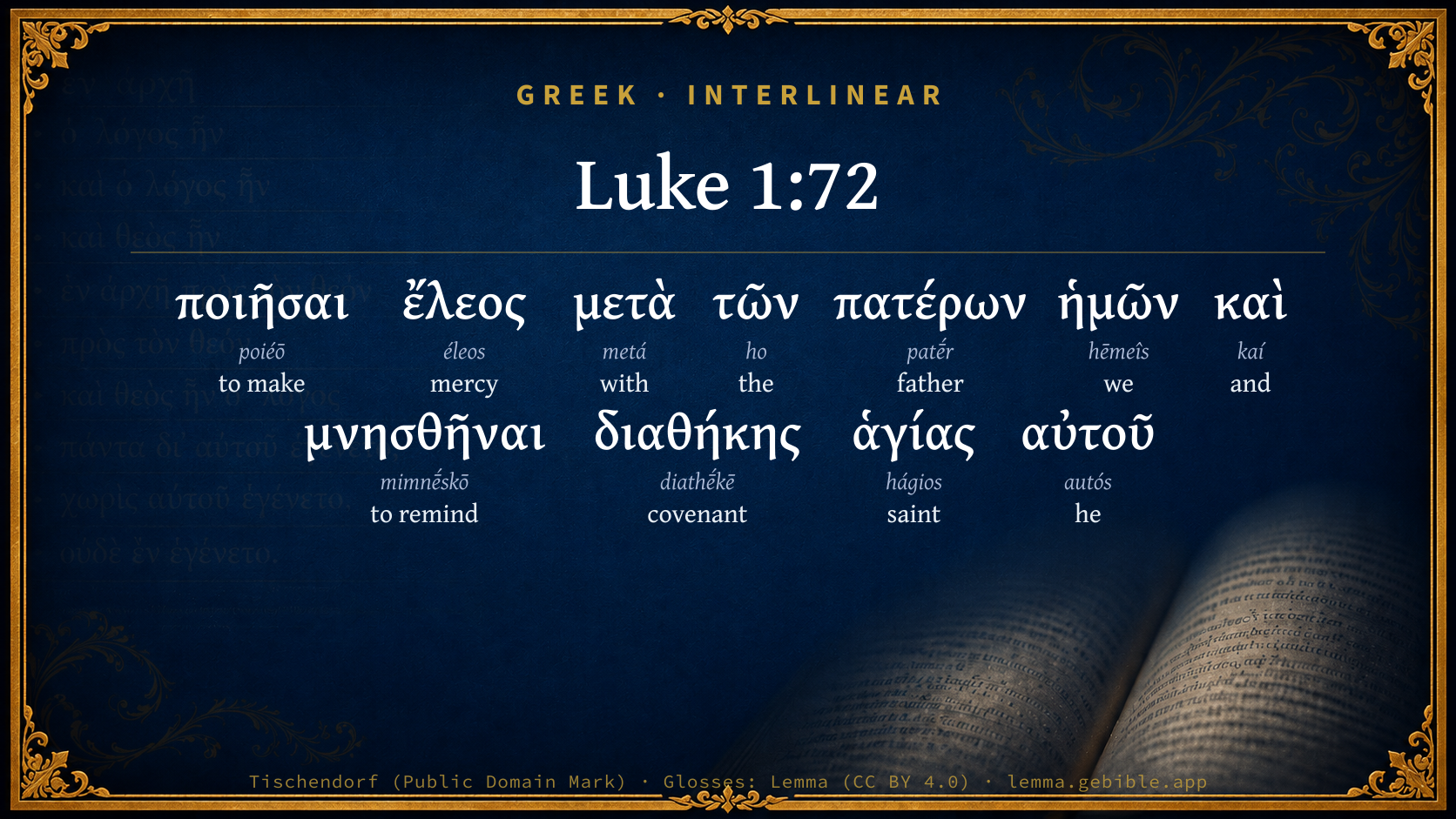
To show mercy towards our fathers, To remember his holy covenant,
Download a study sheet
One document with this verse’s original text, its word-by-word gloss line, the meaning frame, cross-references with their text, attributed commentary, and full source and license credits — printable, and it pastes into notes with its structure intact.
This verse Autodidact and up
A passage Seminary Student
Up to 50 verses in one chapter. A passage sheet keeps up to 6 commentary sources and 12 cross-references per verse, in the order this page ranks them, and says so on the sheet whenever that leaves anything out. Ask for a single verse and you get the Autodidact verse sheet above.
Everything on this page stays free to read, with no account — the sheet is a download of what is already on screen, not access to it.
Compare translations 3
The same verse in 3 English versions, stacked beneath the original-language interlinear above. Click any original word for its lexicon entry.
Each is an independent rendering of the whole verse — the interlinear is not word-aligned to these translations.
Highlighted words mark where these versions differ — a whole-verse word diff, not a word-by-word alignment.
-
World English Bible Public Domain
To show mercy towards our fathers, To remember his holy covenant,
-
King James Version Public Domain
To perform the mercy promised to our fathers, and to remember his holy covenant;
-
unfoldingWord Literal Text CC BY-SA 4.0
to show mercy to our fathers and to remember his holy covenant,
unfoldingWord Literal Text — © unfoldingWord, licensed CC BY-SA 4.0. Word-aligned USFM3 via Door43 (git.door43.org/unfoldingWord/en_ult).
Show all 19 translations
Every available English version of this verse, each an independent rendering of the whole verse.
-
World English Bible Public Domain
To show mercy towards our fathers, To remember his holy covenant,
-
Berean Standard Bible Public Domain
to show mercy to our fathers and to remember His holy covenant,
-
Majority Standard Bible Public Domain
to show mercy to our fathers and to remember His holy covenant,
-
King James Version Public Domain
To perform the mercy promised to our fathers, and to remember his holy covenant;
-
American Standard Version (1901) Public Domain
To show mercy towards, our fathers, And to remember his holy covenant;
-
Revised Version (1885) Public Domain
To shew mercy towards our fathers, And to remember his holy covenant;
-
Geneva Bible (1599) Public Domain
That he might shewe mercie towards our fathers, and remember his holy couenant,
-
Douay-Rheims (1899) Public Domain
To perform mercy to our fathers, and to remember his holy testament,
-
Young's Literal Translation Public Domain
To do kindness with our fathers, And to be mindful of His holy covenant,
-
Literal Standard Version CC BY-SA 4.0
To do kindness with our fathers, || And to be mindful of His holy covenant,
-
Unlocked Literal Bible CC BY-SA 4.0
He will do this to show mercy to our fathers and to remember his holy covenant,
-
unfoldingWord Literal Text CC BY-SA 4.0
to show mercy to our fathers and to remember his holy covenant,
-
Darby Bible Public Domain
to fulfil mercy with our fathers and remember his holy covenant,
-
World Messianic Bible Public Domain
to show mercy toward our fathers, to remember his holy covenant,
-
Webster's Bible Public Domain
To perform the mercy promised to our fathers, and to remember his holy covenant:
-
Free Bible Version CC BY-SA 4.0
He was merciful to our fathers, remembering his holy agreement—
-
Bible in Basic English Public Domain
To do acts of mercy to our fathers and to keep in mind his holy word,
-
Text-Critical English NT CC BY 4.0
to deal mercifully with our fathers and to remember his holy covenant,
-
Tyndale New Testament (1534) Public Domain
To fulfill the mercy promised to oure fathers and to remember his holy covenaunt.
Literal Standard Version (2020), Covenant Press — licensed CC BY-SA 4.0. Text via the HelloAO Bible API (eBible.org). Unlocked Literal Bible (unfoldingWord) — licensed CC BY-SA 4.0. Text via the HelloAO Bible API (eBible.org). unfoldingWord Literal Text — © unfoldingWord, licensed CC BY-SA 4.0. Word-aligned USFM3 via Door43 (git.door43.org/unfoldingWord/en_ult). Free Bible Version, Dr. Jonathan Gallagher — licensed CC BY-SA 4.0. Text via the HelloAO Bible API (eBible.org).
Word by word
More ways to search: Search by grammar → Find every occurrence → Compare this word →
Practice this passage: Drill this verse → Learn its vocabulary →
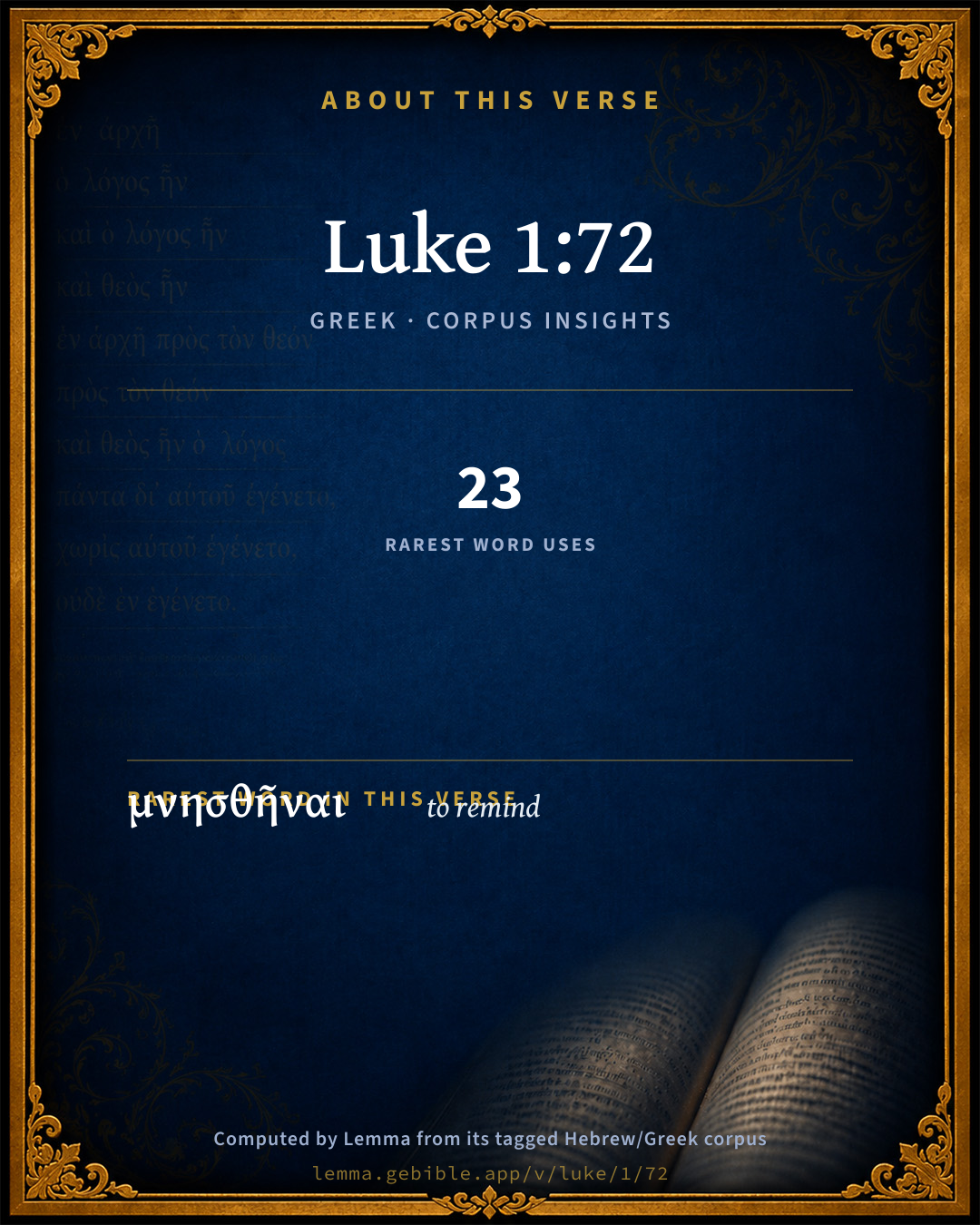
- Appears 23× in the Greek New Testament
- First appears at Matthew 5:23
- Part of Speech
- Verb
- Tense
- Aorist
- Voice
- Passive
- Mood
- Infinitive
Full Thayer's Definition
- ποιῆσαι poiéō G4160 “to make” Verb, Aorist, Active, Infinitive
- ἔλεος éleos G1656 “mercy” Noun, Accusative, Singular, Neuter
- μετὰ metá G3326 “with” Preposition
- τῶν ho G3588 “the” Article, Genitive, Plural, Masculine
- πατέρων patḗr G3962 “father” Noun, Genitive, Plural, Masculine
- ἡμῶν hēmeîs G2249 “we” Personal pronoun, 1st person, Genitive, Plural
- καὶ kaí G2532 “and” Conjunction
- μνησθῆναι mimnḗskō G3403 “to remind” Verb, Aorist, Passive, Infinitive
- διαθήκης diathḗkē G1242 “covenant” Noun, Genitive, Singular, Feminine
- ἁγίας hágios G40 “saint” Adjective, Genitive, Singular, Feminine
- αὐτοῦ autós G846 “he” Personal pronoun, Genitive, Singular, Masculine
About this verse
These counts appear in no published source. They are computed here, from the morphology-tagged text and Lemma’s own curated glosses. What Lemma adds →
- 11
- words
- 11
- distinct lemmas
- Gospels
- section
Cross-references
18Topical passages linked to Luke 1:72 in the Treasury of Scripture Knowledge — connected by theme and wording, ordered by reader-vote popularity; previews shown in the World English Bible.
- Leviticus 26:42 then I will remember my covenant with Jacob; and also my covenant with Isaac, and also my covenant with Abraham; and I will remember the land.
- Hebrews 6:13–18 For when God made a promise to Abraham, since he could swear by none greater, he swore by himself,
- Psalms 106:45 He remembered for them his covenant, And repented according to the multitude of his loving kindnesses.
- Micah 7:20 You will give truth to Jacob, and mercy to Abraham, As you have sworn to our fathers from the days of old.
- Genesis 26:4 I will multiply your seed as the stars of the sky, and will give to your seed all these lands. In your seed will all the nations of the earth be blessed,
- Genesis 28:14 Your seed will be as the dust of the earth, and you will spread abroad to the west, and to the east, and to the north, and to the south. In you and in your seed will all the families of the earth be blessed.
- Ezekiel 16:60 Nevertheless I will remember my covenant with you in the days of your youth, and I will establish to you an everlasting covenant.
- Luke 1:54–55 He has given help to Israel, his servant, that he might remember mercy,
- Romans 11:28 Concerning the Gospel, they are enemies for your sake. But concerning the election, they are beloved for the fathers' sake.
- Genesis 22:18 In your seed will all the nations of the earth be blessed, because you have obeyed my voice."
- Psalms 105:8–10 He has remembered his covenant forever, The word which he commanded to a thousand generations,
- Acts 3:25–26 You are the children of the prophets, and of the covenant which God made with our fathers, saying to Abraham, 'In your seed will all the families of the earth be blessed.'
- Genesis 12:3 I will bless those who bless you, and I will curse him who curses you. In you will all of the families of the earth be blessed."
- Genesis 17:4–9 "As for me, behold, my covenant is with you. You will be the father of a multitude of nations.
- Psalms 98:3 He has remembered his loving kindness and his faithfulness toward the house of Israel. All the ends of the earth have seen the salvation of our God.
- Psalms 111:5 He has given food to those who fear him. He always remembers his covenant.
- Ezekiel 16:8 Now when I passed by you, and looked at you, behold, your time was the time of love; and I spread my skirt over you, and covered your nakedness: yes, I swore to you, and entered into a covenant with you, says the Lord Yahweh, and you became mine.
- Galatians 3:15–17 Brothers, I speak like men. Though it is only a man's covenant, yet when it has been confirmed, no one makes it void, or adds to it.
Cross-references courtesy of OpenBible.info (CC BY 4.0).
Lesson kit
Teaching starters — assembled from the data on this page, not authored interpretation. Every prompt links to the verse data it draws on. Edit before teaching.
Luke, in the Gospels, opens this verse with 11 words (11 distinct Greek lemmas). Its most distinctive word is mimnḗskō (“to remind”). A historical commentator’s framing appears above. Read the whole chapter for the surrounding context.
Discussion questions
- What does “to remind” (mimnḗskō) contribute to the verse as a whole?
- How does Matthew 5:23, which shares the word «to remind», read alongside this verse?
- These translations render this verse differently; the difference is in the English rendering, not the original. What questions does that raise?
- Compare how Bengel's Gnomon and Expositor's Greek Testament read this verse. Where do they agree or differ?
Things to notice
- These translations choose different wording for 4 words in this verse.
- 11 distinct Greek lemmas span 11 words in this verse.
Commentary
Notes on Luke 1:72 from classic Christian and Jewish commentators (each source and its license shown beneath its notes). The classic Christian expositions comment on the surrounding passage and are grouped to its opening verse, so a note may address several verses; the Jewish commentaries on the Tanakh (Rashi and others) are per-verse, so they appear only where the commentator wrote on this verse.
Lemma curates 59 commentaries, every one of them public domain or Creative Commons licensed, each selected and text-cleaned for this edition rather than reprinted as found. About our sources →
Bengel's Gnomon
Johann Albrecht Bengel
Bengel's Gnomon of the New Testament — English translation (T&T Clark, Edinburgh, 1860) — public domain. Text from a community e-Sword module.
Expositor's Greek Testament
ed. W. Robertson Nicoll
The Expositor's Greek Testament, edited by W. Robertson Nicoll (1897–1910) — public domain. Text from a community e-Sword module.
Geneva Bible (1599)
Geneva Bible translators
Geneva Bible (1599) marginal notes — public domain. Text via Bolls.life.
Jamieson, Fausset & Brown
Robert Jamieson, A. R. Fausset & David Brown
Jamieson, Fausset & Brown — Commentary Critical and Explanatory on the Whole Bible (1871) — public domain (CC PDM 1.0). Text via the HelloAO Bible API.
Adam Clarke's Commentary
Adam Clarke's Commentary on the Bible (1810–1826) — public domain. Text from a community e-Sword/MySword module.
Ellicott's Commentary for English Readers
A Bible Commentary for English Readers, edited by Charles John Ellicott (1878–1897) — public domain. Text from a community e-Sword module.
The Cambridge Bible for Schools and Colleges
gen. ed. J. J. S. Perowne
The Cambridge Bible for Schools and Colleges (gen. ed. J. J. S. Perowne; Cambridge University Press, 1878–1918) — public domain. Text from a community e-Sword module.
John Gill's Exposition
John Gill's Exposition of the Whole Bible (1746–1763) — public domain (CC PDM 1.0). Text via the HelloAO Bible API.
Trapp's Complete Commentary
John Trapp
John Trapp, A Commentary or Exposition upon All the Books of the Old and New Testament (1647–1656) — public domain. Text from a community e-Sword module.
Albert Barnes' Notes on the Bible
Albert Barnes' Notes on the Bible (1834–1885) — public domain. Text from a community e-Sword/MySword module.
Haydock's Catholic Bible Commentary
George Leo Haydock (1774–1849), Haydock's Catholic Family Bible and Commentary, 1859 edition — public domain. Excludes Psalms (Douay-Rheims chapter numbering differs from Protestant) and Deuterocanonical books (Catholic canon only).
Whedon's Commentary on the Bible
Daniel D. Whedon
Daniel D. Whedon (gen. ed.), Commentary on the Old and New Testaments (1874–1909) — public domain. Text from a community e-Sword module.
unfoldingWord translationNotes
Door43 World Missions Community
unfoldingWord translationNotes — © Distant Shores Media and the Door43 World Missions Community, licensed CC BY-SA 4.0. Source: git.door43.org/Door43/en_tn.
Cambridge Greek Testament for Schools and Colleges
Cambridge Greek Testament for Schools and Colleges (Cambridge University Press, 1896; 21 vols, various authors incl. Carr, Maclear, Plummer, Farrar, Lumby, Moule, M. R. James, Simcox) — public domain. Text from a community e-Sword module.
Alford’s Greek Testament
Henry Alford
Henry Alford, The Greek Testament (1849–1861) — public domain. Text from a community e-Sword module.
International Critical Commentary
International Critical Commentary — older volumes (1896–1929), various authors — public domain. Text from a community e-Sword module.