
Luke 11:47

Greek (Tischendorf 8th ed.) Luke 11:47 appears in the Greek New Testament. The text above is from the Tischendorf 8th edition. Each word links to its Strong’s number and a concise gloss. Click any word for its full Thayer’s Greek Lexicon entry.
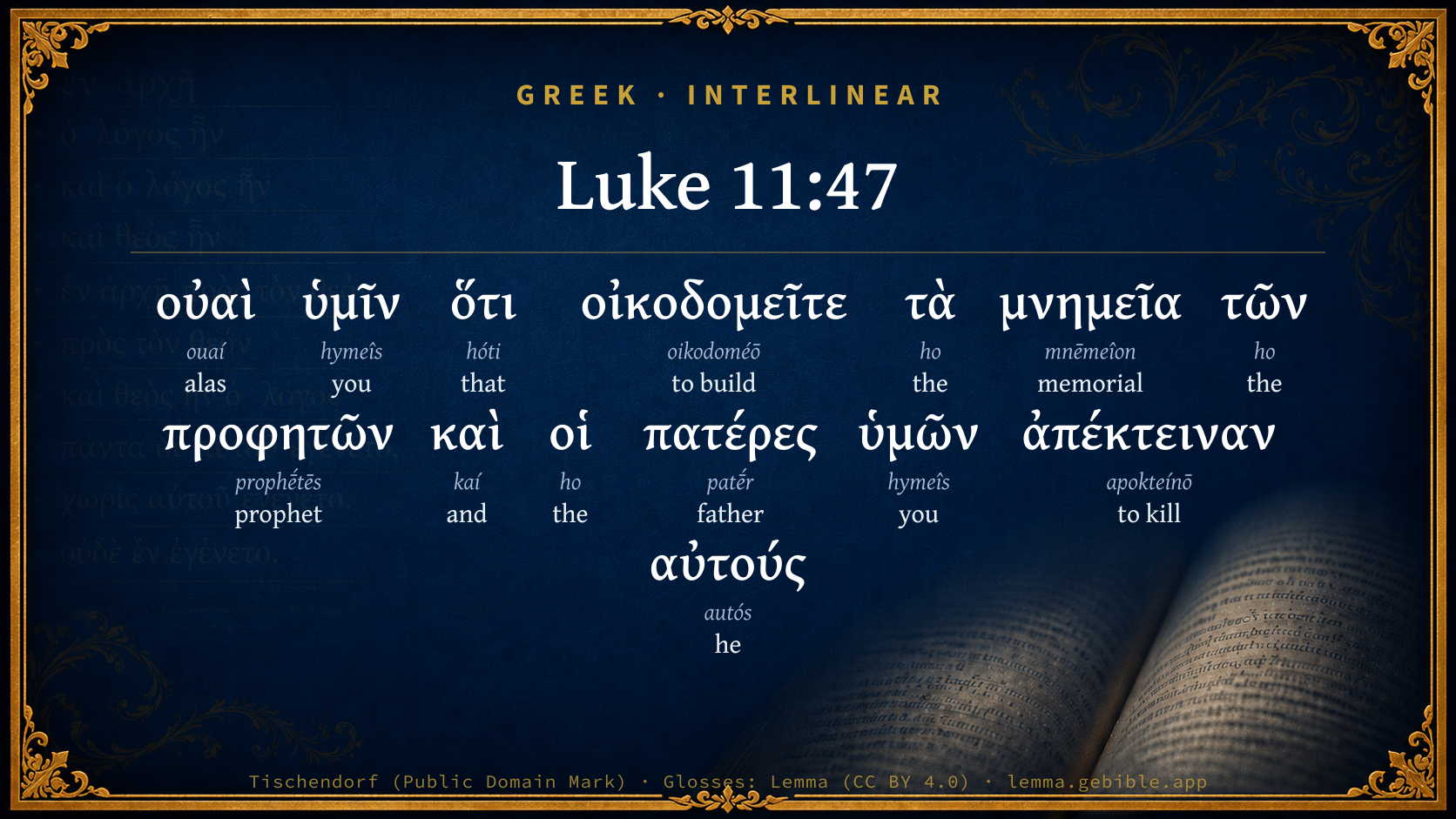
Download image
Cite this verse

Luke 11:47 (World English Bible). Public Domain. Lemma interlinear Bible study tool, https://lemma.gebible.app/v/luke/11/47.

Show BibTeX & RIS
BibTeX
RIS
English Translation
Woe to you! For you build the tombs of the prophets, and your fathers killed them.
World English Bible · Public Domain
Download a study sheet

One document with this verse’s original text, its word-by-word gloss line, the meaning frame, cross-references with their text, attributed commentary, and full source and license credits — printable, and it pastes into notes with its structure intact.

This verse Autodidact and up

Study sheet (.html) Plain text (.txt)

A passage Seminary Student

Up to 50 verses in one chapter. A passage sheet keeps up to 6 commentary sources and 12 cross-references per verse, in the order this page ranks them, and says so on the sheet whenever that leaves anything out. Ask for a single verse and you get the Autodidact verse sheet above.

Everything on this page stays free to read, with no account — the sheet is a download of what is already on screen, not access to it.

Want to remove ads? Support Godless Engineer
Compare translations 3

The same verse in 3 English versions, stacked beneath the original-language interlinear above. Click any original word for its lexicon entry.

Each is an independent rendering of the whole verse — the interlinear is not word-aligned to these translations.

Highlighted words mark where these versions differ — a whole-verse word diff, not a word-by-word alignment.

  • World English Bible Public Domain
    Woe to you! For you build the tombs of the prophets, and your fathers killed them.
  • King James Version Public Domain
    Woe unto you! for ye build the sepulchres of the prophets, and your fathers killed them.
  • unfoldingWord Literal Text CC BY-SA 4.0
    Woe to you, because you build the tombs of the prophets, but your fathers killed them.

unfoldingWord Literal Text — © unfoldingWord, licensed CC BY-SA 4.0. Word-aligned USFM3 via Door43 (git.door43.org/unfoldingWord/en_ult).

Versions to compare (up to 4)

3 of 4 selected

Show all 19 translations

Every available English version of this verse, each an independent rendering of the whole verse.

  • World English Bible Public Domain
    Woe to you! For you build the tombs of the prophets, and your fathers killed them.
  • Berean Standard Bible Public Domain
    Woe to you! You build tombs for the prophets, but it was your fathers who killed them.
  • Majority Standard Bible Public Domain
    Woe to you! For you build tombs for the prophets, but it was your fathers who killed them.
  • King James Version Public Domain
    Woe unto you! for ye build the sepulchres of the prophets, and your fathers killed them.
  • American Standard Version (1901) Public Domain
    Woe unto you! for ye build the tombs of the prophets, and your fathers killed them.
  • Revised Version (1885) Public Domain
    Woe unto you! for ye build the tombs of the prophets, and your fathers killed them.
  • Geneva Bible (1599) Public Domain
    Wo be to you: for ye builde the sepulchres of the Prophetes, and your fathers killed them.
  • Douay-Rheims (1899) Public Domain
    Woe to you who build the monuments of the prophets: and your fathers killed them.
  • Young's Literal Translation Public Domain
    `Wo to you, because ye build the tombs of the prophets, and your fathers killed them.
  • Literal Standard Version CC BY-SA 4.0
    Woe to you, because you build the tombs of the prophets, and your fathers killed them.
  • Unlocked Literal Bible CC BY-SA 4.0
    Woe to you, because you build tombs for the prophets, and it was your ancestors who killed them.
  • unfoldingWord Literal Text CC BY-SA 4.0
    Woe to you, because you build the tombs of the prophets, but your fathers killed them.
  • Darby Bible Public Domain
    Woe unto you, for ye build the sepulchres of the prophets, but your fathers killed them.
  • World Messianic Bible Public Domain
    Woe to you! For you build the tombs of the prophets, and your fathers killed them.
  • Webster's Bible Public Domain
    Woe to you! for ye build the sepulchers of the prophets, and your fathers killed them.
  • Free Bible Version CC BY-SA 4.0
    Shame on you! You build memorial tombs to honor the prophets, but it was your own fathers who killed them in the first place!
  • Bible in Basic English Public Domain
    A curse is on you! for you make resting-places for the bodies of the prophets, but your fathers put them to death.
  • Text-Critical English NT CC BY 4.0
    Woe to you! For you build the tombs of the prophets, but it was your fathers who killed them.
  • Tyndale New Testament (1534) Public Domain
    Wo be to you: ye bylde the sepulchres of the Prophetes and youre fathers killed them:

Literal Standard Version (2020), Covenant Press — licensed CC BY-SA 4.0. Text via the HelloAO Bible API (eBible.org). Unlocked Literal Bible (unfoldingWord) — licensed CC BY-SA 4.0. Text via the HelloAO Bible API (eBible.org). unfoldingWord Literal Text — © unfoldingWord, licensed CC BY-SA 4.0. Word-aligned USFM3 via Door43 (git.door43.org/unfoldingWord/en_ult). Free Bible Version, Dr. Jonathan Gallagher — licensed CC BY-SA 4.0. Text via the HelloAO Bible API (eBible.org).

Word by word

More ways to search: Search by grammar → Find every occurrence → Compare this word →

Practice this passage: Drill this verse → Learn its vocabulary →

μνημεῖα
mnēmeîon
G3419
“memorial”
Noun, Accusative, Plural, Neuter
Part of Speech
Noun
Case
Accusative
Number
Plural
Gender
Neuter
Full Thayer's Definition

Origin: from G3420

TDNT: 15:20,6

1. any visible object for preserving or recalling the memory of any person or thing a. a memorial, monument, specifically, a sepulchral monument 2. a sepulchre, a tomb
  1. οὐαὶ ouaí G3759 “alas” Interjection
  2. ὑμῖν hymeîs G5210 “you” Personal pronoun, 2nd person, Dative, Plural
  3. ὅτι hóti G3754 “that” Conjunction
  4. οἰκοδομεῖτε oikodoméō G3618 “to build” Verb, Present, Active, Indicative, 2nd person, Plural
  5. τὰ ho G3588 “the” Article, Accusative, Plural, Neuter
  6. τῶν ho G3588 “the” Article, Genitive, Plural, Masculine
  7. προφητῶν prophḗtēs G4396 “prophet” Noun, Genitive, Plural, Masculine
  8. καὶ kaí G2532 “and” Conjunction
  9. οἱ ho G3588 “the” Article, Nominative, Plural, Masculine
  10. πατέρες patḗr G3962 “father” Noun, Nominative, Plural, Masculine
  11. ὑμῶν hymeîs G5210 “you” Personal pronoun, 2nd person, Genitive, Plural
  12. ἀπέκτειναν apokteínō G615 “to kill” Verb, Aorist, Active, Indicative, 3rd person, Plural
  13. αὐτούς autós G846 “he” Personal pronoun, Accusative, Plural, Masculine

About this verse

These counts appear in no published source. They are computed here, from the morphology-tagged text and Lemma’s own curated glosses. What Lemma adds →

14
words
11
distinct lemmas
Gospels
section

Shared distinctive vocabulary

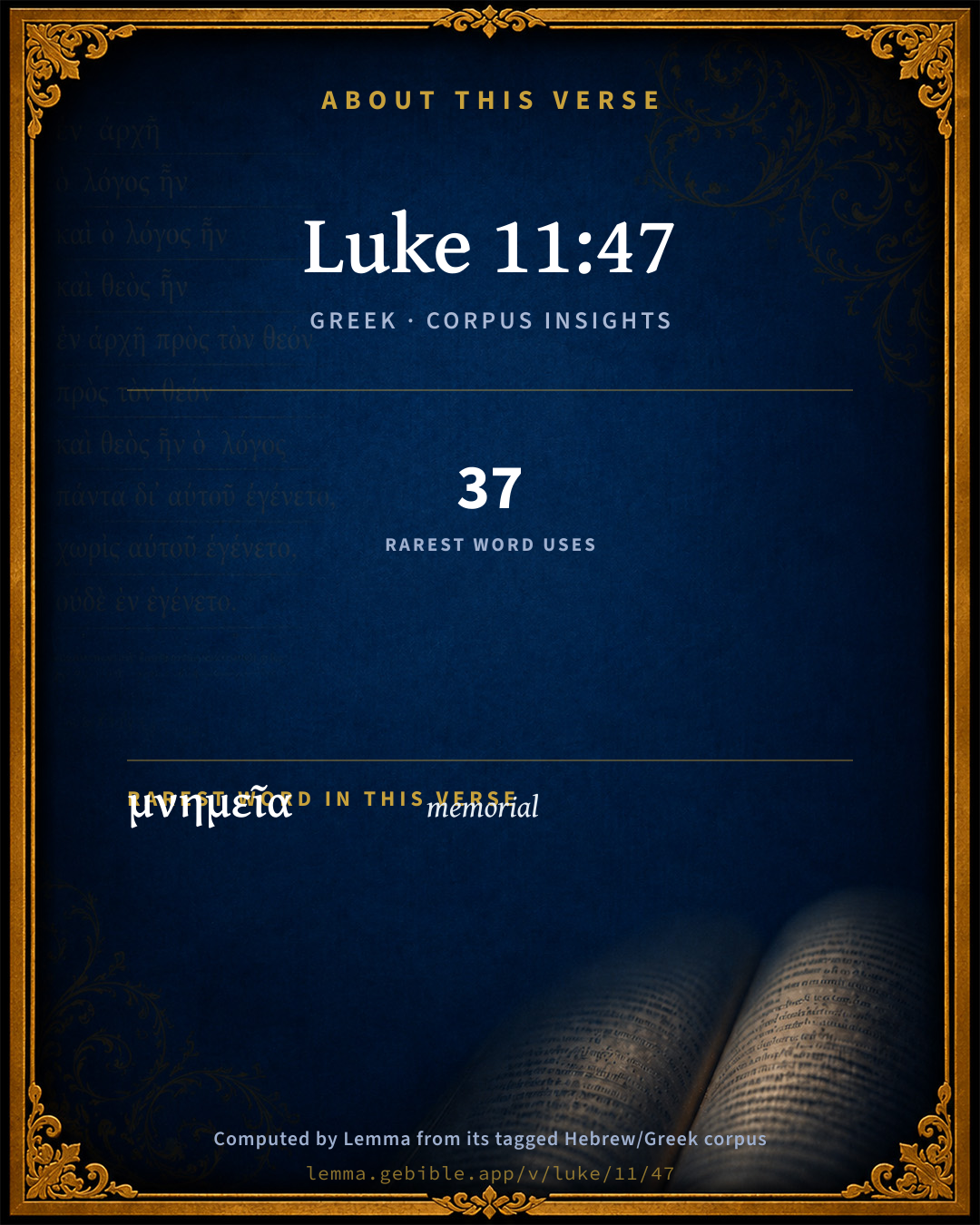
μνημεῖα memorial G3419 occurs in 34 verses of the Greek New Testament. Also found in:
Repetition

Words recur within this verse:

Cross-references

3

Topical passages linked to Luke 11:47 in the Treasury of Scripture Knowledge — connected by theme and wording, ordered by reader-vote popularity; previews shown in the World English Bible.

  • Acts 7:51 "You stiff-necked and uncircumcised in heart and ears, you always resist the Holy Spirit! As your fathers did, so you do.
  • 1 Thessalonians 2:15 who killed both the Lord Jesus and their own prophets, and drove us out, and didn't please God, and are contrary to all men;
  • Matthew 23:29–33 "Woe to you, scribes and Pharisees, hypocrites! For you build the tombs of the prophets, and decorate the tombs of the righteous,

Cross-references courtesy of OpenBible.info (CC BY 4.0).

Commentary

Notes on Luke 11:47 from classic Christian and Jewish commentators (each source and its license shown beneath its notes). The classic Christian expositions comment on the surrounding passage and are grouped to its opening verse, so a note may address several verses; the Jewish commentaries on the Tanakh (Rashi and others) are per-verse, so they appear only where the commentator wrote on this verse.

Lemma curates 59 commentaries, every one of them public domain or Creative Commons licensed, each selected and text-cleaned for this edition rather than reprinted as found. About our sources →

The Biblical Illustrator

Joseph S. Exell

Luk_11:47-48

Ye build the sepulchres of the prophets

Building the tombs of the prophets

The Jews, whilst honouring the prophets and reproaching their fathers, were flattering themselves that they could never have done the like.

Would they not indeed? were they not at the very moment thirsting for the blood of Christ and contriving His destruction? Alas for the fatal facility with which those who are quick in discerning the faults of others can blind themselves to their own I Here was the fault of the Jews. They were the descendants of men who had persecuted and slain the prophets of God. But they themselves were ready to do the very same: they were plotting the death of the greatest Prophet, the greatest in all the signs or evidences of a prophet that had ever arisen in their land. And, nevertheless they could see well enough how wrong their fathers had been, and could join in showing honour to the righteous persons whom they had treated so ill; but it does not seem to have struck them that they were closely treading in their steps, and were about to imitate, or rather far surpass, what they so loudly condemned. But is there no lesson here for ourselves? Let us first fix attention on the singular fact, that what is admired in the dead may be execrated in the living. There was no essential difference between the preaching of Christ, which excited the fierce anger of the Jews, and that of the prophets, which had similarly displeased and irritated their fathers. In both cases the preaching was that of the necessity of repentance, and of the certainty of vengeance, if not averted through the forsaking of sin. And the Jews, in the time of our Lord, could profess a high admiration of the preachers who had pressed these truths on their fathers, though, all the while, they were full of indignation against those who laboured to press them on them selves. The same takes place in our own day and generation. Call to mind the names of martyrs, and confessors, and preachers, who, whilst they lived, drew on themselves almost universal detestation by their zeal in the publication of truth and the exposure of error. Gather opinions as to these martyrs, confessors, and preachers, and you will obtain well nigh an unqualified verdict, pronouncing them amongst the worthiest of men, ornaments to their own age, and examples to every succeeding. Open a subscription for some testimonial in their honour; and money will flow in for the building their tombs and garnishing their sepulchres, just as though there were a general anxiety to evince a sense of their worth, and of the injustice of their contemporaries. But now go on to examine what the principles were which these dead worthies upheld, what the doctrines which they published, what the practices which they denounced. And do you think you will find that these principles are in general repute, these doctrines generally esteemed, these practices generally shunned? Oh, not so. The principles are still those which excite opposition, the doctrines are disliked, the practices are cherished. And it is by the feelings entertained towards the things taught, and not by those expressed towards the dead who were their teachers, that we are to judge whether men would have joined in persecuting the prophets. I care nothing for the stately mausoleum. I have no faith in the laboured panegyric. I am not to be persuaded, because sculpture and painting may devote themselves to the representing the magnanimous dead, or poetry consecrate its richest melodies to the story of their deeds and their wrongs. If the truth for which the dead died be not beloved by the living, there is no evidence that the living would not have aided in their destruction. But we may identify our own case yet more closely with that of the Jews. There is perhaps no more common feeling than that of amazement and indignation at the treatment which our Lord received from His countrymen. If ever there moved upon the earth the Being who seemed likely to disarm all enmity, and attract towards Himself universal affection, that Being undoubtedly was Jesus of Nazareth. He had so evidently no object but that of benefiting ethers, and He gave such evidences of ability to compass this object, that we might have supposed that all classes would have eagerly welcomed Him as a Prophet and Deliverer. And the apparent improbability of the rejection of Christ may easily induce a persuasion that, had we been in the days of the Jews, we could never have shared in their crime. But how ought such passages as our text to stagger us, showing us, as they do, that the Jews equally flattered themselves that they were incapable of the sin of putting a great Prophet to death! We make no doubt that, had we been contemporary with Christ, had we beheld His miracles and listened to His preaching, we should never have been of the number of those who sought His destruction. But what is this persuasion but the very persuasion of the Jews, who sat in judgment on their fathers as slayers of the prophets, and determined that they could never have joined them in their crime, and this too at the moment when they thirsted for Christs blood, and bent themselves to compass His death? It may seem to me almost impossible that I should have conspired against Christ, that I should have helped to weave the crown of thorns and to drive the nails into His hands and His feet. But am I so unlike the Jew, is there any such radical difference between myself and the Jew, that I am warranted in believing that his wickedness could never have been mine? Ah, there is at least one point of similarity between us; and this ought to make me fearful of hastily concluding that there cannot be more. And what is this point? why, that the Jew and myself are equally ready to plead too much goodness to allow of joining in killing a prophet, My way of judging and deciding was precisely his, the reference to a crime which others committed, and determining against the possibility of any participation. And where there is the same assurance of inability to perpetrate a sin there is probably the same ability. Let us trust to no verdict of acquittal which we may be disposed to pass on ourselves after listening to that which the murderers of Christ so complacently uttered. So far, therefore, we may safely take the text, and give it as descriptive of what occurs amongst ourselves. But may we also denounce the woe which it contains? That woe is evidently denounced on account of the hypocrisy of those whose actions are described, on account of their conspiring against the living Christ, whilst joining to do honour to the murdered prophets. And is there anything parallel to this amongst ourselves? Indeed there is; for it is very easy to be indignant against those who put Jesus to death and all the while to overlook our own share in the guilty transaction. It is very easy to give up to universal execration the Roman and the Jew, and to be unmindful of the causes which brought round the Crucifixion. It is very easy to take the narrative of Christs sufferings, just as you would the narrative of some doleful occurrence that happened in a remote age, and which has little more than its sadness to give it interest with your feelings. But who slew the Lamb of God? who drove the nails? who reared the cross? Not the Roman and the Jew. These were but agents and instruments. Christ died for the sins of the world: the sins of the world were really His murderers, though they used the Roman and the Jew as His executioners. And no man regards the death of Christ under a just point of view who does not charge himself with a share in the perpetration. He who does not make himself one of the murderers can scarcely have faith in the propitiation. And who will dare to assert that he is innocent of the blood of Jesus Christ? The Son of God is now virtually crucified afresh, whenever men turn away from the Redeemer, refusing to accept the mercy which He proffers, because they will not quit the sins which He abhors. It is virtually done by every wilful act of rebellion, by unbelief, by pride, by hardness of heart, by resistance to the strivings of the Spirit, by disobedience to the precepts of the gospel. The wilful transgressor does all which he can do towards rendering necessary a second crucifixion: he commits more and more of that which crucified Christ, and therefore, so far as his own guiltiness is concerned, may literally be charged with crucifying Him again. And, over and above this, you are to consider that Christ is continually coining to the impenitent and obdurate in and through the ordinances of religion, presenting Himself to them as their Redeemer, and beseeching them to receive Him, as they would hope to escape eternal destruction. But they treat Him with contempt. He calls, but they refuse: He stretches out His hand, but they will not regard. And what is all this if not the repetition of the Jewish denial and rejection of Christ. (H. Melvill, B. D.)

Ignorance of our own depravity

The Jews may have believed and boasted themselves incapable of taking part in the killing a prophet, little suspecting that they needed only the being placed in the same circumstances as their fathers in order to their imitating their crimes. And this is but the illustration of a general truth that, whilst men are not tempted to a sin, they cannot judge whether or act they would commit it if they were. With singular propriety are we instructed to pray, Lead us not into temptation; for only temptation may be needed to our perpetrating the worst crimes that disgrace human nature. They say that the earth contains varieties of seed, and that according to concurrent circumstances is there one production at one time and another at another. And this I am sure is the case with the heart, out of which, according to Christ, proceed evil thoughts, murders, adulteries, fornications, thefts, false witness, blasphemies. The seeds of all these iniquities are deposited in the heart; and a certain state, so to speak, of the moral atmosphere, or a certain combination of exciting causes, is all that is required to develop them in the practice. It does, therefore, but argue great ignorance of ourselves to suppose that this or that sin is too bad for us to commit. And the persuasion that we could not commit it is but an evidence of the likelihood of our being betrayed into the commission; for it shows a measure of self-confidence, as well as of ignorance, which God may be expected to punish by withdrawing His grace--and if that be withdrawn, where is human virtue? We are bound, as believers in Revelation, to believe that nothing of evil is beyond our power, and nothing of good within it, if we be left to ourselves, and are not acted on by an influence from above. And our only security against becoming perpetrators of crimes at whose very mention we perhaps shudder, lies in such a consciousness of our own depravity as leads to a prayerful, continual dependence on the preventing and restraining grace of God. (H. Melvill, B. D.)

The tombs of the prophets

I. THESE PHARISAIC WORTHIES DID CHEAP AND OSTENTATIOUS HOMAGE TO DEAD AND DISTANT VIRTUE. They built the tombs of the prophets, and garnished the sepulchres of the righteous. Monuments of the illustrious and pious dead were common in Jerusalem. These memorials the Pharisees held in most officious veneration, repairing, ornamenting, or building them anew. Pious acts, one might deem. Could such grave-visaged votaries be other than God-fearing men? Alas for poor human nature! A certain homage to virtue it doubtless was, this rearing of monumental honours to prophets long dead. Even in the worst of men, such acts are not without their value in testifying to a conscience within them, and a God above them. We blame not the instinct for monuments, nor need we, for it is as deep as human nature, as old as history: witness the pyramids, Assyria, Egypt, Greece, Rome. We see it in the rude stone or cairn that marks some hard-fought field, or the spot where some old mailed king grimly bit the ground. It continues to fill our squares with statues, our graveyards with sculptures, our cathedrals with storied urn and animated bust. Yea, it fills our houses with portraits and other relics of the dear departed, over whom memory contests it stoutly with the very grave, and makes it give us back the dead, even in the loveliest looks they wore. Need I add that Christianity, too, which has a true and kindly side for everything natural, has its monumental institutions? But, with all this, monumental zeal is but a cheap, and often vulgar homage. Stone memorials may be projected and erected by very stony hearts. The tomb-building rage is often symptomatic of a degenerate time, in which the nation has passed its zenith, has stopped producing heroes, and now produces only their statues, or it may be, like Jerusalem, their persecutors and killers. Illustrations of this tendency are not far to seek, though we are very far from calling ours a degenerate age. In one of our minor capitals, any visitor may find in a certain spacious street, standing in a row, the express image of royal sensuality, supported on the one side by that of political tyranny, and on the other by that of political corruption. Some years ago, twenty-five thousand pounds were subscribed to erect a statue to a public person whose only known accomplishment was railway gambling, and whose only public virtue was success. The old prophets, persecuted through life, and at last stoned out of it, did come, in a future age, to get recognition. The memory of the just is blessed, while the memory of the wicked shall rot; and thus, even from foes, the good may get posthumous instalments of the honours that await them in full measure before assembled worlds. But this homage they never get till they are fairly out of the way. A dead prophets tomb called only for the cheap surrender of a little pelf. The living prophet himself would have demanded the right hand or the right eye, the immolation of the darling lust, the consecration of the whole man. To deny due honour to the prophet, and pay mock honours to his tomb, was truly a lie in livery. So is it still. Wesley is lauded by many in our day who, were he alive, would brand him, as did even his pious contemporary Toplady, as an inveterate troubler of Israel. Why? Because Wesley is out of their way--he has ceased from troubling; and thus be whom, living, men classed among troublers, may, now that he is dead, be enrolled among the saints. Thus death or distance lends enchantment to the view. The noblest monument we can rear to a prophet, is to gather up his teachings into our experience, and reproduce his character in our life. For the real monument of the heroes and martyrs that founded Englands greatness--circumspice!--if you ask where it is, we answer, Where is it not? The true Wallace monument is not the rock-dwarfed thing which, under that name, disfigures a picturesque and memorable spot, but is seen in a nation of patriots who had the good sense to be indifferent to that structural anachronism, and who have often contributed many times its cost, in one of their cities alone, for modern patriotic objects common and dear to the United Kingdom. No tribute to such men as Watt and the Stephensons could equal that which thunders in every factory and steams on every sea.

II. THOSE PHARISEES BORE CHEAP AND OSTENTATIOUS TESTIMONY AGAINST DEAD AND DISTANT SIN. They said, If we had been in the days of our fathers, we would not have been partakers with them in the blood of the prophets. Pious men! Blushing crimson for being sons of prophet-murdering sires! Such was their profession in regard to the dead. What now was their actual practice in regard to the living? You may read it here (Luk_11:33) in the words serpents, vipers. Our Lord thereby describes them as men whose hearts were venom-bags, whose mouths were open sepulchres, whose tongues were rooted, and floated, in the poison of asps. There had already come among them a prophet, yea, and more than a prophet, even the Son of the Highest. And how did those saintly tomb-builders receive Him? It is certain that a Herod and a Herodias to John the Baptist, would have been an Ahab and a Jezebel to Elijah. Let this bring home to us the humiliating lesson of our fatal proneness to glide into the delusive persuasion that this or that sin is what we, for our parts, are wholly incapable of committing--that, though all men should fall into it, yet will not we. Where is the Bible reading youth who has not in his inexperience marvelled at Israels murmurings in the desert, and at the sad falls of some of the most eminent of the Old Testament saints? But riper views, and deeper spiritual experiences, not only correct this mistake, but let us see in the very facts we once deemed so stumbling, striking evidence of the truth and divinity of the book that records them. The holiest man will be the least disposed to declare himself incapable of this or that sin.

III. BY ALL THIS THESE PHARISEES EXPOSED AND CONDEMNED THEMSELVES (see Luk_11:30-31). In conclusion, note one thing they ought to have done, but left undone; nay, did the opposite; that of humbly owning their oneness with the prophet-killing fathers. Paradoxical as it may sound, this was the first step to standing out from their fathers crime. (T. Guthrie, D. D.)

The vanity and wickedness of honouring dead saints, and persecuting the living

I. WHAT IS HERE MEANT BY THE WISDOM OF GOD. Therefore also said the wisdom of God, I will send them prophets and apostles, &c. In St. Matthew, our Saviour speaks this in His own name--Wherefore, behold I send unto you prophets : for which reason, some think that by the wisdom of God our Saviour here designed Himself; as if He had said, Therefore I, who am the wisdom of God, declare unto you. But this is not very probable, our Saviour nowhere else in the Gospel speaking of Himself in any such style; though St. Paul calls Him the power of God, and the wisdom of God. Others think that our Saviour here refers to some prophecy of the Old Testament to this purpose: Therefore, the Wisdom of God hath said; that is, the Holy Spirit of wisdom, which inspired the prophets in the Old Testament. But this conceit is utterly without ground, for we find no such passage. But the most plain and simple interpretation is this: Therefore hath the wisdom of God said; that is, the most wise God hath determined to send among you such messengers and holy men, and I foresee that ye will thus abuse them, and thereby bring wrath and destruction upon yourselves. And whereas our Saviour says, in St. Matthew, behold I send unto yon prophets; it is very probable He speaks in Gods name, and that it is to be understood, Behold, says God, I send unto you. By apostles is here meant all sorts of Divine messengers; for so St. Matthew expresseth it, I send unto you prophets, and wise men, and scribes; that is, several holy and excellent men, endowed with all sorts of Divine gifts.

II. WHO THIS ZACHARIAS WAS HERE MENTIONED BY OUR SAVIOUR.

III. IN WHAT SENSE, AND WITH WHAT REASON AND JUSTICE IT IS HERE THREATENED, THAT THE BLOOD OF ALL THE PROPHETS AND RIGHTEOUS MEN, SHED FROM THE FOUNDATION OF THE WORLD, SHOULD BE REQUIRED OF THAT GENERATION.

1. That it hath been the lot of holy and righteous men, in most ages of the world, to meet with very bad usage, to be persecuted and slain. The devil began this work early.

2. We may observe likewise, hence, how great a sin they are guilty of who persecute the righteous, and how terrible a vengeance from God waits on them.

3. From this whole passage of our Saviour, which I have been explaining to you, we may learn how vain it is for men to pretend to honour the dead saints, when they persecute the living. (Archbishop Tillotson.)

The worlds treatment of its guides

Hannibal, the Carthaginian conqueror, when sailing from Italy to Carthage, suspected his pilot of treachery, and when the latter told him that a high mountain which appeared in the distance was a promontory of Sicily, believing himself imposed upon, he killed him on the spot, but afterwards buried him splendidly, and called the promontory by his name. Thus he illustrated the way of the world with its true prophets.

Unique tombs

The tombs of Egypt are among the grandest and most striking of its monuments. The pyramids were tombs, and they are still wonders of the world. The rock-hewn sepulchres, however, which surround the pyramids, and which dot the mountain gorges of Thebes and Bene-Hassan, are now probably the most instructive. Their chambers are so many museums, containing not merely the embalmed remains, but, on the inscribed and sculptured walls, the whole history of the mighty dead. Nothing is overlooked or forgotten that would throw light on their lives and labours. In this way we have a most vivid picture of ancient Egypt; the victories of kings; processes in law courts; the building of cities; the hewing and transport of colossal statues and obelisks; the embalming of the dead; funeral rites and processions; marriage ceremonies; every department of household work and family life, such as cooking, washing, dressing, shaving the head and beard, eating; trades of all kinds--goldsmiths, painters, potters, glass-blowers, bakers, weavers; games and amusements--jugglers, music, dancing; tilling the soil; irrigating the fields; feeding andmilking cows; watering flax, reaping, threshing, grinding--all these and many other things are delineated with singular, and not unfrequently amusing, minuteness of detail. In examining those unique tombs one can study the manners and customs, the private life and public acts, the religious rites and ceremonies, the features and dress of those who lived in cottage and palace in that country from three to four thousand years ago, with almost as much advantage as if he had lived among them. The perfect preservation of the paintings and papyri is astonishing. In this Western land of rain and frost half a century of neglect would destroy them; hut in Upper Egypt rain and frost are unknown. The dry and equable climate is the grand curator; and this has been materially assisted by the desert sand, which has partially covered some of the monuments, and for long ages hermetically sealed many of the finest tombs. The figures and brilliant colouring on the walls, and written characters upon the papyrus have been thus preserved as fresh as if only finished yesterday. Looking at them one can scarcely believe that their age has to be reckoned by thousands of years. (Cassells Family Magazine.)

Costly posthumous offerings

At the entrance are two sentry-box looking constructions with glass windows. These are lamps kept perpetually lighted, the flame not having been allowed to die out for many years. The sanctum is very splendid, the roofs and walls being lined with gold brocade, and the frames of the door inlaid with carved ivory. The air is oppressive with the perfume of flowers and spices. Flowers especially are a favourite offering at Buddhas shrine, and are always present in great profusion. On one occasion no less than 6,480,320 flowers were counted at the shrine, and it is recorded that in the fifteenth century a royal devotee sent 100,000 flowers a day for a considerable time, and each day the flowers were of a different kind. The karundua, or vessel containing the tooth, stands covered on a table of massive silver, richly chased, in the midst of a profusion of valuable articles of jeweilery, which are either relies or offerings. The most beautiful in the collection is a bird with wings spread. It is formed entirely of diamonds, rubies, blue sapphires, &c., set in gold, which is hid by a profusion of gems. While we were all admiring this magnificent offering, the priests or monks removed several folds of muslin from the karundua, and discovered a sort of dome of gilded silver, about five feet high, studded with a few gems. When this was removed, another was found underneath, made of beautifully carved gold. This was festooned with jewelled chains, and literally incrusted with all the glittering gems for which Ceylon is so celebrated--sapphires and emeralds of extraordinary size, cats eyes (much prized), rubies, amethysts, and pearls. Another similar covering, and still another, were taken off, when at last was reached a small case of gold, covered externally with rubies, emeralds, and diamonds, in which, resting on the leaves of a gold lotus, was the tooth itself. (Cassells Family Magazine.)

The hypocrisy of posthumous honours

I never saw the honours of this world in their hollowness and hypocrisy so much as I have seen them within the last few days, as I have been looking over the life and death of that wonderful man just departed, Charles Sumner. Now that he is dead the whole nation takes off the hat. The flags are at half-mast and the minute-guns on Boston Common throb, now that his heart has ceased to beat. Was it always so? While he lived, how censured of legislative resolutions, how caricatured of the pictorials, how charged with every motive mean and ridiculous; how, when struck down in Senate-chamber, there were hundreds of thousands of people who said, Good for him, served him right! O Commonwealth of Massachusetts I who is that man that sleeps to-night in your public hall, covered with garlands and wrapped in the stars and stripes? Is that the man whom, only a few months ago, you denounced as the foe of Republican and Democratic institutions? Is that the same man? You were either wrong then or you are wrong now--a thing most certain, O Commonwealth of Massachusetts! When I see a man like that pursued by all the hounds of the political kennel so long as he lives, and then buried under garlands almost mountain high, and amid the lamentations of a whole nation, I say to myself, What an unutterably hypocritical thing is all human applause and all human favour! You took twenty-five years in trying to pull down his fame, and now you will take twenty-five years in trying to build his monument. You were either wrong then, or you are wrong now. My friends, was there ever a better commentary on the hollowness of all earthly favour? (Dr. Talmage.)

The Biblical Illustrator, edited by Joseph S. Exell (c. 1880s–1900s) — public domain. Text from a community e-Sword module.

Bengel's Gnomon

Johann Albrecht Bengel

Luk 11:47. Οἰκοδομεῖτε, ye build) This in itself does not seem to have been wrong; but what was wrong was, that they imitated their fathers.

Bengel's Gnomon of the New Testament — English translation (T&T Clark, Edinburgh, 1860) — public domain. Text from a community e-Sword module.

Meyer's Critical & Exegetical Commentary

Heinrich August Wilhelm Meyer

Luk_11:47-48. See on Mat_23:29-31. The sting of the discourse is in Matthew keener and sharper.

ὅτι οἰκοδομεῖτε … οἱ δὲ πατέρες κ.τ.λ.] because ye build … but your fathers slew them. By this building, which renews the remembrance of the murder of the prophets, ye actually give testimony and consent to the deeds of your fathers, Luk_11:48. Otherwise ye would leave to ruin and forgetfulness those graves which recall these deeds of shame! It is true the graves were built for the purpose of honouring the prophets, but the conduct of the builders was such that their way of regarding the prophets, as proved by this hostile behaviour, was reasonably and truly declared by Jesus to be a practical contradiction of that purpose. He declares how, in accordance with this behaviour, the matter objectively and actually stood. Consequently, there is neither any deeper meaning to be supposed as needing to be introduced, as Lange, L. J. II. 2, p. 840, has unhappily enough attempted; nor is ἄρα to be taken as interrogative (Schleiermacher). The second clause of the contrast, οἱ δὲ πατέρες κ.τ.λ., is introduced without any preparation (without a previous μέν; otherwise at Luk_11:48), but just with so much the greater force, and hence no μέν is to be supplied (Kuinoel; see, on the other hand, Klotz, ad Devar. p. 356 f.; Fritzsche, ad Rom. II. p. 423).

In view of the reading ὑμεῖς δὲ οἰκοδομεῖτε, Luk_11:48 (without αὐτῶν τὰ μνημεῖα, see the critical remarks), we must translate: but ye build! ye carry on buildings. That this building had reference to the tombs of the prophets is self-evident. The brief expression is more passionate, pregnant, incisive.

Meyer — Critical and Exegetical Commentary on the New Testament — English translation by Peter Christie, edited by Frederick Crombie (T&T Clark, 1880) — public domain. Text from a community e-Sword module.

Expositor's Greek Testament

ed. W. Robertson Nicoll

Luk 11:47 . καὶ οἱ πατέρες ὑ ., and your fathers. This reading of [110] [111] is to be preferred on internal grounds to οἱ δὲ , as implying that the two acts were not contrasted but kindred = they killed, you build, worthy sons of such fathers.

[110] Codex Sinaiticus (sæc. iv.), now at St. Petersburg, published in facsimile type by its discoverer, Tischendorf, in 1862.

[111] Codex Ephraemi

The Expositor's Greek Testament, edited by W. Robertson Nicoll (1897–1910) — public domain. Text from a community e-Sword module.

Geneva Bible (1599)

Geneva Bible translators

Hypocrites honor those saints when they are dead, whom they most cruelly persecute, when they were alive.

Geneva Bible (1599) marginal notes — public domain. Text via Bolls.life.

Jamieson, Fausset & Brown

Robert Jamieson, A. R. Fausset & David Brown

ye build, &c.--Out of pretended respect and honor, they repaired and beautified the sepulchres of the prophets, and with whining hypocrisy said, "If we had been in the days of our fathers, we should not have been partakers with them in the blood of the prophets," while all the time they "were witnesses to themselves that they were the children of them that killed the prophets" (Mat 23:29-30); convicting themselves daily of as exact a resemblance in spirit and character to the very classes over whose deeds they pretended to mourn, as child to parent.

Jamieson, Fausset & Brown — Commentary Critical and Explanatory on the Whole Bible (1871) — public domain (CC PDM 1.0). Text via the HelloAO Bible API.

Adam Clarke's Commentary

Verse 47. Ye build the sepulchres] That is, ye rebuild and beautify them. See Clarke on Mt 23:29.

Adam Clarke's Commentary on the Bible (1810–1826) — public domain. Text from a community e-Sword/MySword module.

Ellicott's Commentary for English Readers

(47) Ye build the sepulchres of the prophets.—See Note on Mat_23:29. St. Luke omits the reference, which we find in St. Matthew, to the “sepulchres of the righteous.”

A Bible Commentary for English Readers, edited by Charles John Ellicott (1878–1897) — public domain. Text from a community e-Sword module.

The Cambridge Bible for Schools and Colleges

gen. ed. J. J. S. Perowne

47. your fathers killed them] This is holy sarcasm. They boasted that they would not have done as their fathers had done to the Prophets (Mat_23:30), yet they rejected John, the greatest of the Prophets, and crucified the Just One, Act_7:51-52.

The Cambridge Bible for Schools and Colleges (gen. ed. J. J. S. Perowne; Cambridge University Press, 1878–1918) — public domain. Text from a community e-Sword module.

John Gill's Exposition

Therefore also said the wisdom of God,..... The Syriac version only reads "wisdom"; by which seems to be meant not the perfection of God's wisdom: though it is usual with the Jews to represent the divine perfections as speaking, as the justice and mercy of God. They say (b), that

"when the holy blessed God sought to make Hezekiah the Messiah, and Sennacherib, Gog, and Magog, , "the property of judgment", or "justice, said" before the holy, blessed God, Lord of the world, &c.''

and so the sense may be here, that the infinite wisdom of God said within himself, determined in his own breast, to do what follows. But I rather think that Christ is intended, who, as God, is the essential wisdom of God; and, as man and mediator, has the spirit of wisdom resting on him, and the treasures of wisdom and knowledge hid in him; since this is said by Christ, Mat 23:34 though the words here seem to be the words of the evangelist relating what Christ had said. Some have thought, that some book, under the name of "The Wisdom of God", is here cited, which had in it the following words,

I will send them prophets and apostles; which, in Matthew, are called prophets, wise men, and Scribes; and by whom are meant the apostles of Christ, and the ministers of the Gospel. The Persic version reads, "lo, I send to you", as in Mat 23:34,

and some of them they shall slay and persecute; some of them they shall put to death, and others they shall persecute from one place to another; See Gill on Mat 23:34.

(b) T. Bab. Sanhedrin, fol. 94. 1. Vid. Targum in Eccl. x. 8. & in Lam. i. 1. & ii. 20.

John Gill's Exposition of the Whole Bible (1746–1763) — public domain (CC PDM 1.0). Text via the HelloAO Bible API.

Trapp's Complete Commentary

John Trapp

47 Woe unto you! for ye build the sepulchres of the prophets, and your fathers killed them.

Ver. 47. See Mat 23:29.

John Trapp, A Commentary or Exposition upon All the Books of the Old and New Testament (1647–1656) — public domain. Text from a community e-Sword module.

Albert Barnes' Notes on the Bible

See the notes at Mat 23:29-36.

Luk 11:49

The wisdom of God - By the “wisdom of God,” here, is undoubtedly meant the Saviour himself. What he immediately says is not written in the Old Testament. Jesus is called “the word of God” Joh 1:1, because he is the medium by which God “speaks” or makes his will known. He is called “the wisdom of God,” because by him God makes his wisdom known in creation (Col 1:13-18 and in redemption 1Co 1:30. Many have also thought that the Messiah was referred to in the Pro 8:1 of Proverbs, under the name of Wisdom.

I will send ... - See Luk 10:3; Mat 10:16.

Shall slay ... - Compare Joh 16:2; Act 7:52, Act 7:59; Jam 5:10; Act 12:2; Act 22:19; 2Co 11:24-25; 2Ch 36:15-16.

Albert Barnes' Notes on the Bible (1834–1885) — public domain. Text from a community e-Sword/MySword module.

Haydock's Catholic Bible Commentary

Woe to you who build, &c. Not that the building of the monuments of the prophets was in itself blameworthy, but only the intention of these unhappy men, who made use of this outward shew of religion and piety, as a means to carry on their wicked designs against the prince of prophets. (Challoner)

George Leo Haydock (1774–1849), Haydock's Catholic Family Bible and Commentary, 1859 edition — public domain. Excludes Psalms (Douay-Rheims chapter numbering differs from Protestant) and Deuterocanonical books (Catholic canon only).

Matthew Poole's English Annotations

See Poole on "Mat 23:29" and following verses to Mat 23:36. The Pharisees, like a company of wretched hypocrites, under a pretence of their honouring the memories of the prophets under the Old Testament, took great care to repair and to adorn their sepulchres, while in the mean time their hearts were as full of malice against the truth, and against Christ and those who came to reveal God’s will to them, as ever were their fathers against the prophets; and, saith our Saviour, I, who am the Wisdom of God, tell you, that I shall send you apostles, and prophets, and some of them you shall kill, others you shall persecute; that all the righteous blood that hath been shed on the earth, from the blood of Abel to the blood of Zacharias, may come on you; which mind being in you, the same as in your persecuting predecessors, your building and adorning the old prophets’ tombs is not (as you would have it thought) any testimony of your honour to the prophets, but rather to your fathers that killed them, a kind of trophy for the victory your fathers got over the prophets of the Lord; so as by that act you give a testimony that you own them as your fathers who killed the prophets, and glory in what they did, for if you truly honoured their memory, you would not retain the same malicious, bloody mind. It is gross hypocrisy for men to magnify the servants of God in former ages, and in the mean time to malign and persecute the servants of the same God in a present age, owning but the same truths, and living up to the same rule. See Poole on "Mat 23:29", and following verses to Mat 23:36, where the same things are said with larger circumstances. They truly honour martyrs, that live the same lives they did, and adhere to the same truths of God, in a testimony to which they died.

Matthew Poole's English Annotations on the Holy Bible (1683–1685) — public domain. Text from a community e-Sword/MySword module.

Whedon's Commentary on the Bible

Daniel D. Whedon

47. Build the sepulchres… killed them—They build sepulchres to show how unlike they are to those who killed; whereas, in our Lord’s view, it would show that they are the moral as well as the bodily descendants of the murderers. Dr. Thomson remarks that, even now, were the apostles and Jesus himself alive, those who worship at the tombs would be ready to slay them or him.

Daniel D. Whedon (gen. ed.), Commentary on the Old and New Testaments (1874–1909) — public domain. Text from a community e-Sword module.

The Pulpit Commentary

Vers. 47, 48. Ye build the sepulchres of the prophets, and your fathers killed them. Truly ye bear witness that ye allow the deeds of your fathers: for they indeed killed them, and ye build their sepulchres. There are still existing four singular tombs at the foot of Olivet, in the Valley of Jehoshaphat. Remarkable objects now to the modern traveler at Jerusalem, in all their fresh beauty they would be still more striking in the days of our Lord. The peculiar composite nature of the architecture of these great tombs has decided antiquaries to ascribe the building of these to the days of the later Herods. It is, therefore, not improbable that these conspicuous objects in the landscape, seen from the temple platform, and possibly others like them, which have since perished, were the tombs and sepulchres especially in our Lord"s mind when he was speaking to the lawyer, and later at Jerusalem, when he" repeated, with some slight variations, the same awful woe. (Mat_23:29) It was, indeed, a speech of awful and cutting irony, these words of Jesus. Your fathers," he said, "killed the prophets; you complete their evil work by building tombs for these slain men of God. In other words, you pretend to make amends for the crimes of past generations by this show of ostentatious piety; but if you really differed from your wicked fathers in spirit, if you indeed honored, as you profess to do by this gorgeous tomb-building, the holy men of God whom they slew, would you be acting as you now are doing trying, as you know you are, to take my life? Is not my life like the lives of those old murdered prophets? are not my words resembling theirs?"

The Pulpit Commentary (1880–1919), ed. H.D.M. Spence-Jones & Joseph S. Exell — public domain. Text from a community e-Sword module.

Burkitt's Expository Notes on the New Testament

William Burkitt

The second crime which Christ reproves in these men, is their grand hypocrisy, in pretending great honor to the saints departed, building their tombs, and garnishing their sepulchres, declaiming against their fathers’ impiety, that had they lived in their days, they would not have been partakers with them in their sins.

Now their hypocrisy appeared in three particulars:

1. In that they continued in their own wickedness, and yet commended the saints departed; they magnify the saints, but multiply their sins, and instead of imitating their virtues, they content themselves with garnishing their sepulchres.

2. In professing great respect to the dead saints, and at the same time, persecuting the living. Palpable hypocrisy! And yet, as gross as it is, it prevails to this day. The church of Rome, which magnifies martyrs, canonizes saints departed, have added to their number, by shedding of their blood.

3. In taking false measures of their love to the saints departed, from their building their tombs, and garnishing their sepulchres. Whereas the best evidence of our love to them, is the imitating their virtues, and cherishing their followers. It is gross hypocrisy to pay respect to the relics of saints, and veneration to their images, and at the same time to persecute and hate their followers.

From the whole, note, 1. That the world has all along loved dead saints better than living ones. The dead saint’s example, how bright soever, is not scorching and troublesome at a distance, and he himself stands no longer in other men’s light; whereas the living saint’s example is a cutting reproof to sin and vice.

Note, 2. That there is a certain civility in human nature, which leads men to a just commendation of the dead; and to due estimation of their worth. The Pharisees here, though they persecuted the prophets while alive, yet did they pretend to a mighty veneration for their piety and virtue after they were dead, and thought no honor too great to be done unto them.

Note, 3. That it is the greatest hypocrisy imaginable to pretend to love goodness, and at the same time to hate and persecute good men. These Pharisees and lawyers pretended high to piety and religion, and at the same time killed the prophets.

Note, 4. That the highest honor we can pay to the saints departed, is not by raising monuments, and building tombs to their memory, but by a careful imitation of their piety and virtue, following the holiness of their lives, and their patience and constancy at their death.

Lastly learn, that it is a righteous thing with God to punish children for the impiety of their parents when they walk in their ungodly parents’ footsteps: upon you shall come the blood of all the prophets, from the blood of Abel to the blood of Zacharias: yet must this be understood of temporal evils, not of eternal punishments; no man for his father’s sins shall lie down in everlasting burnings: as our fathers; faith will not let us into heaven, so neither will their impiety shut us into hell. At the day ofjudgement every man shall be separately considered according to his own deeds.

William Burkitt's Expository Notes on the New Testament (1700–1703) — public domain. Text from a community e-Sword module.

unfoldingWord translationNotes

Door43 World Missions Community

So you are witnesses and you consent

Jesus is rebuking the Pharisees and teachers of the law. They know about the murder of the prophets, but do not condemn their ancestors for killing them. AT: "So, rather than denouncing them, you confirm and agree" (See: Assumed Knowledge and Implicit Information)

translationWords

woe

prophet

grave

testimony

unfoldingWord translationNotes — © Distant Shores Media and the Door43 World Missions Community, licensed CC BY-SA 4.0. Source: git.door43.org/Door43/en_tn.

Cambridge Greek Testament for Schools and Colleges

47. οἱ δὲ πατέρες ὑμῶν ἀπέκτειναν αὐτούς. This is holy sarcasm. They boasted that they would not have done as their fathers had done to the Prophets (Mat 23:30), yet they rejected John, the greatest of the Prophets, and crucified the Just One, Act 7:51-52. Thus they proved their moral as well as their literal affiliation to the murderers of the prophets.

Cambridge Greek Testament for Schools and Colleges (Cambridge University Press, 1896; 21 vols, various authors incl. Carr, Maclear, Plummer, Farrar, Lumby, Moule, M. R. James, Simcox) — public domain. Text from a community e-Sword module.

Alford’s Greek Testament

Henry Alford

47.] See on Matt. vv. 29-32.

Henry Alford, The Greek Testament (1849–1861) — public domain. Text from a community e-Sword module.

International Critical Commentary

47. Comp. Mat 23:30; Act 7:52.

οἰκοδομεῖτε τὰ μνημεῖα τῶν προφητῶν οἱ δὲ πατέρες ὑμῶν. “Ye build the tombs of the prophets, while your fathers.” The “Tombs, of the Prophets,” near the top of the Mount of Olives, are still “an enigma to travellers and antiquarians.” All that can safely be asserted is that they are not the “tombs of the prophets” mentioned here. Robinson, Res. in Pal. iii. P. 254.

International Critical Commentary — older volumes (1896–1929), various authors — public domain. Text from a community e-Sword module.

Vincent's Word Studies in the New Testament

Marvin R. Vincent

Ye build. Or are building, carrying on the work now. See on Mt 23:29.

Tombs of the prophets. See on Mt 23:29.

Marvin R. Vincent, Word Studies in the New Testament (1887–1900) — public domain. Text from a community e-Sword/MySword module.

Godet's Commentaries

Frédéric Louis Godet

Vers. 47-51. Persecuting Orthodoxy.—“Woe unto you! for ye build the sepulchres of the prophets, and your fathers killed them. 48. Truly ye are witnesses that ye allow the deeds of your fathers: for they indeed killed them, and ye build their sepulchres. 49. Therefore also said the wisdom of God, I will send them prophets and apostles, and some of them they shall slay and persecute: 50. That the blood of all the prophets, which was shed from the foundation of the world, may be required of this generation; 51. From the blood of Abel, unto the blood of Zacharias, which perished between the altar and the temple: verily I say unto you, it shall be required of this generation.” Head religion is almost always connected with hatred of living piety, or spiritual religion, and readily becomes persecuting.

All travellers, and particularly Robinson, mention the remarkable tombs, called tombs of the prophets, which are seen in the environs of Jerusalem. It was perhaps at that time that the Jews were busied with those structures; they thought thereby to make amends for the injustice of their fathers. By a bold turn, which translates the external act into a thought opposed to its ostensible object, but in accordance with its real spirit, Jesus says to them: “Your fathers killed; ye bury; therefore ye continue and finish their work.” In the received reading, μαρτυρεῖτε, ye bear witness, signifies: “When ye bury, ye give testimony to the reality of the bloodshed committed by your fathers.” But the Alex. reading μάρτυρές ἐστε, ye are witnesses, is undoubtedly preferable. It includes an allusion to the official part played by witnesses in the punishment of stoning (Deu 17:7; Act 7:58). It is remarkable that the two terms μάρτυς, witness, and συνευδοκεῖν, to approve, are also found united in the description of Stephen’s martyrdom. They seem to have had a technical significance. Thus: “Ye take the part of witnesses and consummators of your fathers’ crimes.” The reading of the Alex., which omit αὐτῶν τὰ μνημεῖα, their graves, at the end of Luk 11:48, has a forcible conciseness. Unfortunately those MSS. with the T. R. read αὐτούς after ἀπέκτειναν; and this regimen of the first verb appears to settle that of the second.

In connection with the conduct of the Jews toward their prophets, whom they slew, and honoured immediately after their death, the saying has been rightly quoted: sit licet divus, dummodo non vivus.

The parallel passage in Matthew (Mat 23:29-31) has a rather different sense: “Ye say, If we had been in the days of our fathers, we would not have been partakers with them in the blood of the prophets; Wherefore ye witness against yourselves, that ye are the children of them which killed the prophets.” The oneness of sentiment is here proved, not by the act of building the tombs, but by the word children. The two forms show such a difference, that they could not proceed from one and the same document. That of Luke appears every way preferable. In Matthew, the relation between the words put by Jesus into the mouth of the Jews, Luk 11:30, and the building of the tombs, Luk 11:29, is not clear.

Διὰ τοῦτο καί: “And because the matter is really so, notwithstanding appearances to the contrary, the wisdom of God hath said.” What does Jesus understand by the wisdom of God? Ewald, Bleek, etc., think that Jesus is here quoting a lost book, which assigned this saying to the wisdom of God, or which itself bore this title. Bleek supposes that the quotation from this book does not go further than to the ναί, Luk 11:51; the discourse of Jesus is resumed at the words, Verily I say unto you. But, 1. The discourses of Jesus present no other example of an extra-canonical quotation; 2. The term apostle, in what follows, seems to betray the language of Jesus Himself; 3. The thought of Luk 11:50-51 is too profound and mysterious to be ascribed to any human source whatever. According to Meyer, we have indeed a saying of Jesus here; but as it was repeated in oral tradition, it had become a habit, out of reverence for Jesus, to quote it in this form: The wisdom of God (Jesus) said, I send...Comp. Mat 23:34: I send (ἐγὼ ἀποστέλλω). This form of quotation was mistakenly regarded by Luke as forming part of the discourse of Jesus. But Luke has not made us familiar thus far with such blunders; and the διὰ τοῦτο, on account of this,—which falls so admirably into the context of Luke, and which is found identically in Matthew, where it has, so to speak, no meaning (as Holtzmann acknowledges, p. 228),—is a striking proof in favour of the exactness of the document from which Luke draws. Baur thinks that by the word, the wisdom of God, Luke means to designate the Gospel of Matthew, itself already received in the Church as God’s word at the time when Luke wrote. But it must first be proved that Luke knew and used the Gospel of Matthew. Our exegesis at every step has proved the contrary; besides, we have no example of an apostolical author having quoted the writing of one of his colleagues with such a formula of quotation. Neander and Gess think that here we have a mere parenthesis inserted by Luke, in which he reminds us in passing of a saying which Jesus in point of fact did not utter till later (Matthew 23). An interpolation of this kind is far from natural. The solitary instance which could possibly be cited (Luk 7:29-30) seems to us more than doubtful.

Olshausen asserts that Jesus intends an allusion to the words (2Ch 24:19): “He sent prophets to them, to bring them again unto Him; but they would not receive them.” But the connection between those two sayings is very indirect. I think there is a more satisfactory solution. The book of the O. T. which in the primitive Church as well as among the Jews, in common with the books of Jesus Sirach and Wisdom, bore the name of σοφία, or wisdom of God, was that of Proverbs. Now here is the passage which we find in that book (Luk 1:20-31): “Wisdom uttereth her voice in the streets, and crieth in the chief places of concourse...Behold, I will pour out my Spirit upon you (LXX., ἐμῆς πνοῆς ῥῆσιν), and I will make known my words unto you...But ye have set at nought all my counsel, and would none of my reproof. Therefore I will laugh at your calamity, I will mock when your fear cometh...(and I shall say), Let them eat of the fruit of their works!” This is the passage which Jesus seems to me to quote. For the breath of His Spirit, whom God promises to send to His people to instruct and reprove them, Jesus substitutes the living organs of the Spirit

His apostles, the new prophets; then He applies to the Jews of the day (Luk 11:49 b) the sin of obstinate resistance proclaimed in the same passage; finally (Luk 11:50-51), He paraphrases the idea of final punishment, which closes this prophecy. The parallelism seems to us to be complete, and justifies in the most natural manner the use of the term, the wisdom of God. By the words prophets and apostles Jesus contrasts this new race of the Spirit’s agents, which is to continue the work of the old, with the men of the dead letter, with those scribes whom He is now addressing. The lot which lies before them at the hands of the latter, will be precisely the same as the prophets had to meet at the hands of their fathers; thus to the sin of the fathers there will be justly added that of the children, until the measure be full. It is a law of the Divine government, which controls the lot of societies as well as that of individuals, that God does not correct a development once commenced by premature judgment. While still warning the sinner, He leaves his sin to ripen; and at the appointed hour He strikes, not for the present wickedness only, but for all which preceded. The continuous unity of the sin of the fathers involves their descendants, who, while able to change their conduct, persevere and go all the length of the way opened up by the former. This continuation on the part of the children includes an implicit assent, in virtue of which they become accomplices, responsible for the entire development. A decided breaking away from the path followed was the only thing which could avail to rid them of this terrible implication in the entire guilt. According to this law it is that Jesus sees coming on the Israel round about Him the whole storm of wrath which has gathered from the torrents of innocent blood shed since the beginning of the human race. Comp. the two threatenings of St. Paul, which look like a commentary on this passage (Rom 2:3-5; 1Th 2:15-16).

Jesus quotes the first and last examples of martyrdoms mentioned in the canonical history of the old covenant. Zacharias, the son of the high priest Jehoiada, according to 2Ch 24:20, was stoned in the temple court by order of King Joash. As Chronicles probably formed the last book of the Jewish canon, this murder, the last related in the O. T., was the natural counterpart to that of Abel. Jesus evidently alludes to the words of Genesis (Luk 4:10), “The voice of thy brother’s blood crieth from the ground,” and to those of the dying Zacharias, “The Lord look upon it, and require it.” Comp. ἐκζητηθῆ, Luk 11:50, and ἐκζητηθήσεται, Luk 11:51 (in Luke). If Matthew calls Zacharias the son of Barachias, it may be reconciled with 2 Chronicles 24 by supposing that Jehoiada, who must then have been 130 years of age, was his grandfather, and that the name of his father Barachias is omitted because he had died long before. Anyhow, if there was an error, it must be charged against the compiler of the first Gospel (as is proved by the form of Luke), not against Jesus.

Frédéric Louis Godet — Commentaries on Luke, John, Romans, and 1 Corinthians — English translation (T&T Clark, Edinburgh, 1870s–1890s) — public domain. Text from a community e-Sword module.

Lesson kit

Teaching starters — assembled from the data on this page, not authored interpretation. Every prompt links to the verse data it draws on. Edit before teaching.

Luke, in the Gospels, opens this verse with 14 words (11 distinct Greek lemmas). Its most distinctive word is mnēmeîon (“memorial”). A historical commentator’s framing appears above. Read the whole chapter for the surrounding context.

Discussion questions

  1. What does “memorial” (mnēmeîon) contribute to the verse as a whole?
  2. Matthew 8:28 shares the word «memorial» with this verse. How do the two illuminate each other?
  3. “the” occurs 3× in this one verse. What is the effect of the repetition?
  4. These translations render this verse differently; the difference is in the English rendering, not the original. What questions does that raise?
  5. Reading how The Biblical Illustrator and Bengel's Gnomon read this verse, where do the two commentators agree and where do they part?

Things to notice

Reading settings

Reading text

Shown beneath each verse's original-language words.

Old Testament
Old Testament edition

Read the OT as the Masoretic Hebrew (MT) or the Greek Septuagint (LXX).

English shown for the Greek Septuagint (in the Hebrew ↔ Greek comparison).

Comparing translations? Open the Compare panel on any verse page to stack up to four side by side.