
Matthew 11:27

Greek (Tischendorf 8th ed.) Matthew 11:27 appears in the Greek New Testament. The text above is from the Tischendorf 8th edition. Each word links to its Strong’s number and a concise gloss. Click any word for its full Thayer’s Greek Lexicon entry.
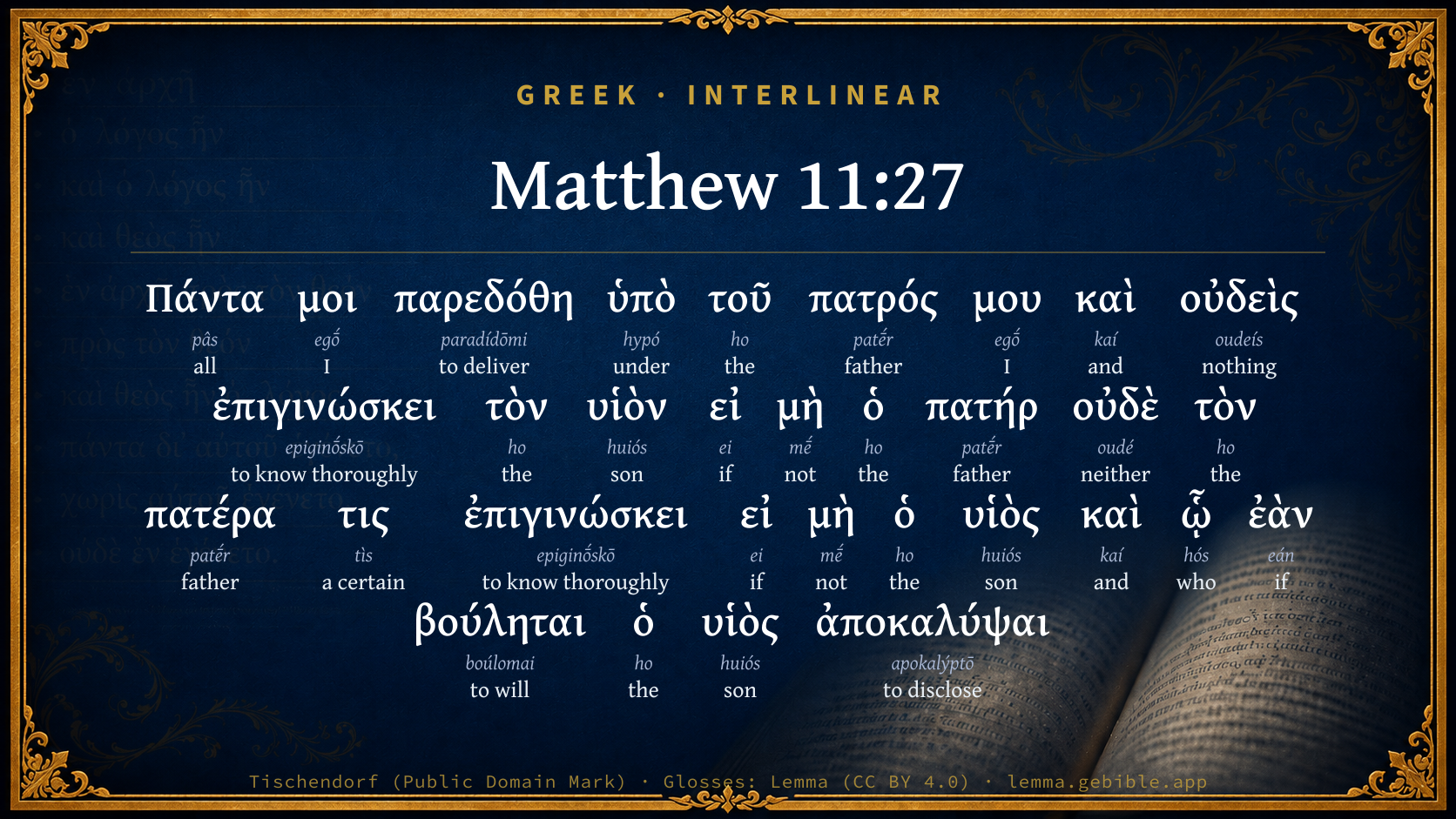
Download image
Cite this verse

Matthew 11:27 (World English Bible). Public Domain. Lemma interlinear Bible study tool, https://lemma.gebible.app/v/matthew/11/27.

Show BibTeX & RIS
BibTeX
RIS
English Translation
All things have been delivered to me by my Father. No one knows the Son, except the Father; neither does anyone know the Father, except the Son, and he to whom the Son desires to reveal him.
World English Bible · Public Domain
Download a study sheet

One document with this verse’s original text, its word-by-word gloss line, the meaning frame, cross-references with their text, attributed commentary, and full source and license credits — printable, and it pastes into notes with its structure intact.

This verse Autodidact and up

Study sheet (.html) Plain text (.txt)

A passage Seminary Student

Up to 50 verses in one chapter. A passage sheet keeps up to 6 commentary sources and 12 cross-references per verse, in the order this page ranks them, and says so on the sheet whenever that leaves anything out. Ask for a single verse and you get the Autodidact verse sheet above.

Everything on this page stays free to read, with no account — the sheet is a download of what is already on screen, not access to it.

Want to remove ads? Support Godless Engineer
Compare translations 3

The same verse in 3 English versions, stacked beneath the original-language interlinear above. Click any original word for its lexicon entry.

Each is an independent rendering of the whole verse — the interlinear is not word-aligned to these translations.

Highlighted words mark where these versions differ — a whole-verse word diff, not a word-by-word alignment.

  • World English Bible Public Domain
    All things have been delivered to me by my Father. No one knows the Son, except the Father; neither does anyone know the Father, except the Son, and he to whom the Son desires to reveal him.
  • King James Version Public Domain
    All things are delivered unto me of my Father: and no man knoweth the Son, but the Father; neither knoweth any man the Father, save the Son, and he to whomsoever the Son will reveal him.
  • unfoldingWord Literal Text CC BY-SA 4.0
    All things have been handed over to me by my Father; and no one knows the Son except the Father, and no one knows the Father except the Son, and to whomever the Son desires to reveal him.

unfoldingWord Literal Text — © unfoldingWord, licensed CC BY-SA 4.0. Word-aligned USFM3 via Door43 (git.door43.org/unfoldingWord/en_ult).

Versions to compare (up to 4)

3 of 4 selected

Show all 19 translations

Every available English version of this verse, each an independent rendering of the whole verse.

  • World English Bible Public Domain
    All things have been delivered to me by my Father. No one knows the Son, except the Father; neither does anyone know the Father, except the Son, and he to whom the Son desires to reveal him.
  • Berean Standard Bible Public Domain
    All things have been entrusted to Me by My Father. No one knows the Son except the Father, and no one knows the Father except the Son and those to whom the Son chooses to reveal Him.
  • Majority Standard Bible Public Domain
    All things have been entrusted to Me by My Father. No one knows the Son except the Father, and no one knows the Father except the Son and those to whom the Son chooses to reveal Him.
  • King James Version Public Domain
    All things are delivered unto me of my Father: and no man knoweth the Son, but the Father; neither knoweth any man the Father, save the Son, and he to whomsoever the Son will reveal him.
  • American Standard Version (1901) Public Domain
    All things have been delivered unto me of my Father: and no one knoweth the Son, save the Father; neither doth any know the Father, save the Son, and he to whomsoever the Son willeth to reveal `him.'
  • Revised Version (1885) Public Domain
    All things have been delivered unto me of my Father: and no one knoweth the Son, save the Father; neither doth any know the Father, save the Son, and he to whomsoever the Son willeth to reveal him.
  • Geneva Bible (1599) Public Domain
    All things are giuen vnto me of my Father: and no man knoweth the Sonne, but ye Father: neither knoweth any man ye Father, but the Sonne, and he to whom ye Sonne will reueile him.
  • Douay-Rheims (1899) Public Domain
    All things are delivered to me by my Father. And no one knoweth the Son, but the Father: neither doth any one know the Father, but the Son, and he to whom it shall please the Son to reveal him.
  • Young's Literal Translation Public Domain
    `All things were delivered to me by my Father, and none doth know the Son, except the Father, nor doth any know the Father, except the Son, and he to whom the Son may wish to reveal `Him'.
  • Literal Standard Version CC BY-SA 4.0
    All things were delivered to Me by My Father, and none know the Son, except the Father, nor does any know the Father, except the Son, and he to whom the Son may resolve to reveal [Him].
  • Unlocked Literal Bible CC BY-SA 4.0
    All things have been entrusted to me from my Father; and no one knows the Son except the Father and no one knows the Father except the Son, and anyone to whom the Son chooses to reveal him.
  • unfoldingWord Literal Text CC BY-SA 4.0
    All things have been handed over to me by my Father; and no one knows the Son except the Father, and no one knows the Father except the Son, and to whomever the Son desires to reveal him.
  • Darby Bible Public Domain
    All things have been delivered to me by my Father, and no one knows the Son but the Father, nor does any one know the Father, but the Son, and he to whom the Son may be pleased to reveal [him].
  • World Messianic Bible Public Domain
    All things have been delivered to me by my Father. No one knows the Son, except the Father; neither does anyone know the Father, except the Son and he to whom the Son desires to reveal him.
  • Webster's Bible Public Domain
    All things are delivered to me by my Father; and no man knoweth the Son, but the Father; neither knoweth any man the Father, save the Son, and he to whomsoever the Son will reveal him.
  • Free Bible Version CC BY-SA 4.0
    Everything has been entrusted to me by my Father, and no one really understands the Son, except the Father, and no one really understands the Father, except the Son, and those to whom the Son chooses to reveal him.
  • Bible in Basic English Public Domain
    All things have been given to me by my Father; and no one has knowledge of the Son, but the Father; and no one has knowledge of the Father, but the Son, and he to whom the Son will make it clear.
  • Text-Critical English NT CC BY 4.0
    All things have been delivered to me by my Father. No one knows the Son except the Father, and no one knows the Father except the Son, and anyone to whom the Son chooses to reveal him.
  • Tyndale New Testament (1534) Public Domain
    All thinges are geve vnto me of my father. And noma knoweth the sonne but the father: nether knoweth eny man the father save the sonne and he to whome the sonne will open him.

Literal Standard Version (2020), Covenant Press — licensed CC BY-SA 4.0. Text via the HelloAO Bible API (eBible.org). Unlocked Literal Bible (unfoldingWord) — licensed CC BY-SA 4.0. Text via the HelloAO Bible API (eBible.org). unfoldingWord Literal Text — © unfoldingWord, licensed CC BY-SA 4.0. Word-aligned USFM3 via Door43 (git.door43.org/unfoldingWord/en_ult). Free Bible Version, Dr. Jonathan Gallagher — licensed CC BY-SA 4.0. Text via the HelloAO Bible API (eBible.org).

Word by word

More ways to search: Search by grammar → Find every occurrence → Compare this word →

Practice this passage: Drill this verse → Learn its vocabulary →

ἀποκαλύψαι
apokalýptō
G601
“to disclose”
Verb, Aorist, Active, Infinitive
Part of Speech
Verb
Tense
Aorist
Voice
Active
Mood
Infinitive
Full Thayer's Definition

Origin: from G575 and G2572

TDNT: 12:23,4

1. to uncover, lay open what has been veiled or covered up a. disclose, make bare 2. to make known, make manifest, disclose what before was unknown
  1. Πάντα pâs G3956 “all” Adjective, Nominative, Plural, Neuter
  2. μοι egṓ G1473 “I” Personal pronoun, 1st person, Dative, Singular
  3. παρεδόθη paradídōmi G3860 “to deliver” Verb, Aorist, Passive, Indicative, 3rd person, Singular
  4. ὑπὸ hypó G5259 “under” Preposition
  5. τοῦ ho G3588 “the” Article, Genitive, Singular, Masculine
  6. πατρός patḗr G3962 “father” Noun, Genitive, Singular, Masculine
  7. μου egṓ G1473 “I” Personal pronoun, 1st person, Genitive, Singular
  8. καὶ kaí G2532 “and” Conjunction
  9. οὐδεὶς oudeís G3762 “nothing” Adjective, Nominative, Singular, Masculine, Negative
  10. ἐπιγινώσκει epiginṓskō G1921 “to know thoroughly” Verb, Present, Active, Indicative, 3rd person, Singular
  11. τὸν ho G3588 “the” Article, Accusative, Singular, Masculine
  12. υἱὸν huiós G5207 “son” Noun, Accusative, Singular, Masculine
  13. εἰ ei G1487 “if” Conditional
  14. μὴ mḗ G3361 “not” Particle, Negative
  15. ὁ ho G3588 “the” Article, Nominative, Singular, Masculine
  16. πατήρ patḗr G3962 “father” Noun, Nominative, Singular, Masculine
  17. οὐδὲ oudé G3761 “neither” Conjunction, Negative
  18. τὸν ho G3588 “the” Article, Accusative, Singular, Masculine
  19. πατέρα patḗr G3962 “father” Noun, Accusative, Singular, Masculine
  20. τις tìs G5100 “a certain” Indefinite pronoun, Nominative, Singular, Masculine
  21. ἐπιγινώσκει epiginṓskō G1921 “to know thoroughly” Verb, Present, Active, Indicative, 3rd person, Singular
  22. εἰ ei G1487 “if” Conditional
  23. μὴ mḗ G3361 “not” Particle, Negative
  24. ὁ ho G3588 “the” Article, Nominative, Singular, Masculine
  25. υἱὸς huiós G5207 “son” Noun, Nominative, Singular, Masculine
  26. καὶ kaí G2532 “and” Conjunction
  27. ᾧ hós G3739 “who” Relative pronoun, Dative, Singular, Masculine
  28. ἐὰν eán G1437 “if” Conditional
  29. βούληται boúlomai G1014 “to will” Verb, Present, Middle or Passive deponent, Subjunctive, 3rd person, Singular
  30. ὁ ho G3588 “the” Article, Nominative, Singular, Masculine
  31. υἱὸς huiós G5207 “son” Noun, Nominative, Singular, Masculine

About this verse

These counts appear in no published source. They are computed here, from the morphology-tagged text and Lemma’s own curated glosses. What Lemma adds →

32
words
18
distinct lemmas
Gospels
section

Shared distinctive vocabulary

ἀποκαλύψαι to disclose G601 occurs in 26 verses of the Greek New Testament. Also found in:
Repetition

Words recur within this verse:

  • πατρός father G3962 ×3
  • υἱὸν son G5207 ×3
  • ἐπιγινώσκει to know thoroughly G1921 ×2
  • τοῦ the G3588 ×6
  • μοι I G1473 ×2
  • καὶ and G2532 ×2
  • εἰ if G1487 ×2
  • μὴ not G3361 ×2

Cross-references

21

Topical passages linked to Matthew 11:27 in the Treasury of Scripture Knowledge — connected by theme and wording, ordered by reader-vote popularity; previews shown in the World English Bible.

  • John 14:6–9 Jesus said to him, "I am the way, the truth, and the life. No one comes to the Father, except through me.
  • Matthew 28:18 Jesus came to them and spoke to them, saying, "All authority has been given to me in heaven and on earth.
  • Luke 10:22 Turning to the disciples, he said, "All things have been delivered to me by my Father. No one knows who the Son is, except the Father, and who the Father is, except the Son, and he to whomever the Son desires to reveal him."
  • 2 John 1:9 Whoever transgresses and doesn't remain in the teaching of Christ, doesn't have God. He who remains in the teaching, the same has both the Father and the Son.
  • John 17:25–26 Righteous Father, the world hasn't known you, but I knew you; and these knew that you sent me.
  • 1 John 2:23 Whoever denies the Son, the same doesn't have the Father. He who confesses the Son has the Father also.
  • John 10:15 even as the Father knows me, and I know the Father. I lay down my life for the sheep.
  • 1 John 5:19–20 We know that we are of God, and the whole world lies in the power of the evil one.
  • John 3:35 The Father loves the Son, and has given all things into his hand.
  • John 6:46 Not that anyone has seen the Father, except he who is from God. He has seen the Father.
  • Philippians 2:10–11 that at the name of Jesus every knee should bow, of those in heaven, those on earth, and those under the earth,
  • John 1:18 No one has seen God at any time. The one and only Son, who is in the bosom of the Father, he has declared him.
  • John 7:29 I know him, because I am from him, and he sent me."
  • John 17:2–3 even as you gave him authority over all flesh, he will give eternal life to all whom you have given him.
  • John 17:6 I revealed your name to the people whom you have given me out of the world. They were yours, and you have given them to me. They have kept your word.
  • John 5:21–29 For as the Father raises the dead and gives them life, even so the Son also gives life to whom he desires.
  • John 13:3 Jesus, knowing that the Father had given all things into his hands, and that he came forth from God, and was going to God,
  • 1 Corinthians 15:25–27 For he must reign until he has put all his enemies under his feet.
  • Hebrews 2:8–10 You have put all things in subjection under his feet." For in that he subjected all things to him, he left nothing that is not subject to him. But now we don't see all things subjected to him, yet.
  • 1 Peter 3:22 who is at the right hand of God, having gone into heaven, angels and authorities and powers being made subject to him.
  • Ephesians 1:20–23 which he worked in Christ, when he raised him from the dead, and made him to sit at his right hand in the heavenly places,

Cross-references courtesy of OpenBible.info (CC BY 4.0).

Commentary

Notes on Matthew 11:27 from classic Christian and Jewish commentators (each source and its license shown beneath its notes). The classic Christian expositions comment on the surrounding passage and are grouped to its opening verse, so a note may address several verses; the Jewish commentaries on the Tanakh (Rashi and others) are per-verse, so they appear only where the commentator wrote on this verse.

Lemma curates 59 commentaries, every one of them public domain or Creative Commons licensed, each selected and text-cleaned for this edition rather than reprinted as found. About our sources →

The Biblical Illustrator

Joseph S. Exell

Mat_11:27

All things are delivered unto Me of My Father.

All thing delivered unto Christ

I. The important declaration here made.

1. All nations of the earth are delivered to Him.

2. All power in heaven and earth is given to Him.

3. All hearts are His.

4. The gifts and graces of the Spirit are His.

5. Principalities and powers are His.

II. The ground on which this declaration was made. His mediatorial character-Wherefore God hath highly exalted Him, etc.

III. To make a practical application of the subject. We may think that if all things are given to Christ, He does not need our puny efforts.

1. That the command of God on this point is imperative and binding upon every one who professes to know His name.

2. God works in and by the use of means.

3. A principle of gratitude will constrain the real Christian to engage, and that heartily, in this glorious work.

4. The Christian will not only be influenced by love to his Saviour, but also by a deep and tender compassion to the souls of his fellow creatures.

5. A dreadful curse is denounced against those who refuse to lend a helping hand to the cause of God.

6. There is encouragement to active exertion in that Christ has promised a reward to every effort made to promote His glory. (W. Bolland, M. A.)

A striking declaration

I. Of our Lords personal and mediatorial dignity. His personal dignity-the Son of God. All the fulness of the Godhead dwelt in Him. His mediatorial dignity as the Son of Man. All things are delivered unto Him.

II. Of the standing method of the divine dispensations. It is indispensable to the safety and happiness of man that he should become acquainted with God. God, abstractedly considered, is absolutely unintelligible and unapproachable to guilty man, except through a Mediator. Learn: the need of Divine teaching; the importance of humility; the encouragement to the humble seeker. (J. Hirst.)

Christ officially delegated

In times of distress, every man is at liberty to do his best for the public welfare; but the officer commissioned by his sovereign is armed with a supreme right to give counsel or to exercise command. Away there in Bengal, if there are any dying of famine, and I have rice, I may distribute it of my own will at my own charge. But the commissioner of the district has a special warranty which I do not possess; he has a function to discharge; it is his business, his vocation; he is authorized by the government, and responsible to the government to do it. So the Lord Jesus Christ has not only a deep compassion of heart for the necessities of men, but he has Gods authority to support Him. The Father delivered all things into His hands, and appointed Him to be a Saviour. (C. H. Spurgeon.)

I. The inconceivable dignity of His person-no man knoweth the Son but the Father.

1. Nor the wisest man in a state of nature.

2. Neither do His own people know Him in the sense of the text. How little is plain because their love is so faint.

3. The glorified saints and holy angels, who behold as much of His glory as creature can bear, do not know Him as He is. A vessel east into the sea can but receive according to its capacity.

4. This proves His Divinity.

II. His authority.

III. His office-The Son will reveal Him. (Bishop Newton.)

The Biblical Illustrator, edited by Joseph S. Exell (c. 1880s–1900s) — public domain. Text from a community e-Sword module.

Joseph Benson's Commentary

Mat 11:27. All things are delivered unto me, &c. — Here our Lord seems to address, not so much his disciples, as those of the people that stood near him, with a reference to what he had last spoken. As if he had said, Do not be led, by the example of your great and learned men, to slight and despise me; for mean and humble as my circumstances now appear, all things relating to the salvation of mankind are delivered into my hands, even all authority, power, and judgment. And no man knoweth the Son, but the Father — No one knoweth the mystery of his person, his character, and dignity; no one knoweth what he has done, and what he is yet to do, for the salvation of the world; save the Father that sent him. “These words evidently declare that there is something inexplicably mysterious in the nature and person of Christ; which indeed appears in the most convincing manner, from the account elsewhere given of his Deity in Scripture.” Neither knoweth any man the Father, save the Son, &c. — Neither can any one savingly know God the Father, but the Son, by whom alone he is fully comprehended in his nature and attributes, his counsels and dispensations, his works and ways; and he to whomsoever the Son will reveal him — Or make him savingly known by the gospel, and the illumination of the Spirit. Thus John, The Son of God hath given us an understanding to know, (τον αληθινον,) the true one; and we are in the true one in, or through, his Son Jesus Christ. The worship, therefore, of the Jews, who reject Christ, and consequently do not receive the knowledge of the living and true God through him, of modern Deists, and of all unbelievers, is in fact rendered to an imaginary deity; the God and Father of our Lord Jesus Christ being to them an unknown God.

Joseph Benson's Commentary on the Old and New Testaments (1811–1818) — public domain. Text from a community e-Sword module.

Whedon's Commentary on the Bible

Daniel D. Whedon

§ 40. — JESUS, LORD OF ALL, INVITES ALL, Mat_11:27-30.

This passage, 25-30, and especially Mat_11:27, is so entirely in the style of John, that we might almost suppose Matthew to have inserted here a brief memorandum of our Saviour’s discoursing from that apostle’s hands. Alford more probably explains it as a momentary strain of a whole style of discourses of our Lord, reported by none of the evangelists but John alone.

27. All things — The whole system of salvation. Delivered unto me — Put into my hands as Lord of the hidden kingdom of God. No man knoweth the Son… neither… the Father — These are hid (Mat_11:25) as mysteries from all save Omniscience. Whomsoever the Son will reveal — So that the Son not only thanks the Father for the things hid and revealed, but is the agent in the accomplishment of the revelation.

And now having affirmed the exclusive mode in which the Gospel is by God revealed; and having, with an unspeakable sublimity, announced not only his consent and his unison, but his executive agency in that revelation, Jesus is ready to make proclamation to all; to all who will come and obtain that blessed Gospel revelation according to its own peculiar and exclusive method. For though the method be exclusive, the power and possibility of assenting, coming, and obtaining that Gospel are universal; and hence the call is justly universal. The call is addressed to a peculiar and exclusive class of character; yet all may join that class and come in that character. The wise and prudent may, if they choose, become the babes. And then they will cease to be those from whom the Gospel is hid.

Daniel D. Whedon (gen. ed.), Commentary on the Old and New Testaments (1874–1909) — public domain. Text from a community e-Sword module.

Tyndale Open Study Notes

Tyndale Open Resources

11:27 Jesus was revealing his intimate relationship to the Father. Everything he said and did was rooted in this Father–Son unity (see John 10:14-15; 14:6-7; 15:23-24; 16:15; 17:25-26).

Tyndale Open Study Notes — © Tyndale Open Resources, licensed CC BY-SA 4.0. Text via the HelloAO Bible API.

Bengel's Gnomon

Johann Albrecht Bengel

Mat 11:27. Πάντα, all things) Here our Lord changes the direction of His words, and accosts His human auditors. After His resurrection, He more expressly said that all things in heaven and in earth were delivered to Him; see ch. Mat 28:18; but in the present passage the same truth is implied; cf. Mat 11:25. All things are delivered unto Him; also the authority to reveal them. All things are delivered unto Him; and therefore all men. See Joh 13:3; Joh 17:2; 1Co 15:25; 1Co 15:27.—παρεδόθη, have been delivered) The Father reserved nothing for Himself which He did not give to the Son. Cf. Joh 13:3; Mat 28:18. The intimate relation of the Father and the Son is implied in Mat 11:25-27, Joh 6:39-40, and so throughout the Apocalypse. See my exposition of the Apocalypse, p. 65.—οὐδεὶς—οὐδὲ, no one—neither) On the order of the words, cf. Joh 8:19.—εἰ μὴ ὁ πατήρ, except the Father) He does not add, “and he to whomsoever the Father chooses to reveal Him,” because He has said that in Mat 11:25, and here He is teaching us what the Father has delivered to Him. The Holy Spirit is not excluded; He is not, however, mentioned here, because His office was not as yet so well known to men.—βούληται, may will) shall choose. To whom, however, He wishes to do so, is clear from the following verse.

Bengel's Gnomon of the New Testament — English translation (T&T Clark, Edinburgh, 1860) — public domain. Text from a community e-Sword module.

Meyer's Critical & Exegetical Commentary

Heinrich August Wilhelm Meyer

Mat_11:27. Here the prayer ends, and He turns to address the multitude (Mat_11:28),but, according to Luk_10:22, it is His disciples,still full of the great thought of the prayer, under a profound feeling of His peculiar fellowship with God.

πάντα μοι παρεδ.] It is quite as unwarrantable to limit πάντα in any way whatever, as it is to take παρεδόθη as referring to the revelation of the doctrine (Grotius, Kuinoel, and others), or to the representation of the highest spiritual truths (Keim), which Christ is supposed to have been appointed to communicate to mankind. It is not even to be restricted to all human souls (Gess). What Jesus indicates and has in view, is the full power with which, in sending Him forth, the Father is understood to have invested the Son, a power to dispose of everything so as to promote the object for which He came; Bengel: nihil sibi reservavit pater. Jesus speaks thus in the consciousness of the universal authority (Mat_28:18; Heb_2:8) conferred upon Him, from which nothing is excluded (Joh_13:3; Joh_16:15); for He means to say, that between Him and the Father there exists such a relation that no one knows the Son, and so on.[443] On both thoughts Christ founds the invitation in Mat_11:28. On the relation of the words πάντα μοι παρεδ. to Mat_28:18, see note on that passage.

ἘΠΙΓΙΝΏΣΚΕΙ] means more than the simple verb, viz. an adequate and full knowledge, which de Wette wrongly denies (see οὐδὲ τὸν πατέρα τις ἐπιγινώσκει). Comp. on 1Co_13:12. Nothing is to be inferred from this passage as to the supernatural origin of Jesus (in answer to Beyschlag, Christol. p. 60). The ἐπιγινώσκειν τὸν υἱόν applies to His whole nature and thinking and acting, not merely to His moral constitution, a limitation (in answer to Weiss) which, if necessary, would have been shown to be so in the context by means of the second correlative clause of the verse.

ᾧ ἐὰν βουλ. ὁ υἱὸς ἀποκαλ.] bears the impress of superhuman consciousness. According to the context, we have simply to regard τὸν πατέρα as the object of ἀποκαλ. For ἈΠΟΚΑΛ. with a personal object, comp. Gal_1:16.

[443] In this first clause, to supply the thought from the firstviz., and to whom the Father is willing to reveal it (de Wette, following the older expositors)is arbitrary, for Jesus has just said: πάντα μοι παρεδόθη, etc. To whomsoever the Son reveals the knowledge of the Father, to him He thereby reveals the knowledge of the Son likewise.Hilgenfeld adopts the Marcionite reading: οὐδεὶς ἔγνω τὸν πατέρα εἰ μὴ ὁ υἱὸς, καὶ τὸν υἱὸν εἰ μὴ ὁ πατὴρ καὶ ᾧ ἂν ὁ υἱὸς ἀποκαλύψῃ. This reading, being that of the Clementines, Justin, Marcion, has earlier testimony in its favour than that of the Received text, which first appears in Irenaeus in a duly authenticated form; Irenaeus, i. 20. 3, ascribes it to the Marcosians, though he elsewhere adopts it himself. However, an examination of the authorities leads to the conclusion (see Tischendorf) that it must be excluded from the text. Comp. also note on Luk_10:21.

Meyer — Critical and Exegetical Commentary on the New Testament — English translation by Peter Christie, edited by Frederick Crombie (T&T Clark, 1880) — public domain. Text from a community e-Sword module.

Expositor's Greek Testament

ed. W. Robertson Nicoll

Mat 11:27 . πάντα , all things necessary for the realisation of the kingdom (Holtz., H.C.). The πάντα need not be restricted to the hiding and revealing functions (Weiss, Nösgen). Hiding, indeed, was no function of Christ’s. He was always and only a revealer. For the present Jesus has only a few babes , but the future is His: Christianity the coming religion. παρεδόθη , aorist, were given. We might have expected the future. It may be another instance of the aorist used for the Hebrew prophetic future ( vide ad Mat 11:19 ). In Mat 28:18 ἐδόθη again to express the same thought. The reference probably is to the eternal purpose of God: on the use of the aorist in N. T., vide note on this passage in Camb. G. T. ἐπιγινώσκει , thoroughly knows. τὸν υἱὸν … πατήρ , Christ’s comfort amid the widespread unbelief and misunderstanding in reference to Himself is that His Father knows Him perfectly. No one else does, not even John. He is utterly alone in the world. Son here has a Godward reference, naturally arising out of the situation. The Son of Man is called an evil liver. He lifts up His heart to heaven and says: God my Father knows me, His Son. The thought in the first clause is connected with this one thus: the future is mine, and for the present my comfort is in the Father’s knowledge of me. οὐδὲ τὸν πατέρα … ὁ υἱὸς : a reflection naturally suggested by the foregoing statement. It is ignorance of the Father that creates misconception of the Son. Conventional, moral and religious ideals lead to misjudgment of one who by all He says and does is revealing God as He truly is and wills. The men who know least about God are those supposed to know most, and who have been most ready to judge Him, the “wise and understanding”. Hence the additional reflection, κοὶ ᾧ ἐὰν βούληται ὁ υ . ἀποκαλύψαι . Jesus here asserts His importance as the revealer of God, saying in effect: “The wise despise me, but they cannot do without me. Through me alone can they attain that knowledge of God which they profess to desire above all things.” This was there and then the simple historic fact. Jesus was the one person in Israel who truly conceived God. The use of βούληται is noticeable: not to whomsoever He reveals Him, but to whomsoever He is pleased to reveal Him. The emphasis seems to lie on the inclination , whereas in Mat 1:19 θέλων appears to express the wish, and ἐβουλήθη rather the deliberate purpose. Jesus meets the haughty contempt of the “wise” with a dignified assertion that it depends on his inclination whether they are to know God or not. On the distinction between βούλομαι and θέλω , vide Cremer, Wörterbuch, s. v. βούλομαι . According to him the former represents the direction of the will, the latter the will active (Affect, Trieb). Hence βουλ . can always stand for θελ ., but not vice versâ .

The Expositor's Greek Testament, edited by W. Robertson Nicoll (1897–1910) — public domain. Text from a community e-Sword module.

Geneva Bible (1599)

Geneva Bible translators

There is no true knowledge of God, nor quietness of mind, but only in Christ alone.

Geneva Bible (1599) marginal notes — public domain. Text via Bolls.life.

Jamieson, Fausset & Brown

Robert Jamieson, A. R. Fausset & David Brown

All things are delivered unto me of my Father--He does not say, They are revealed--as to one who knew them not, and was an entire stranger to them save as they were discovered to Him--but, They are "delivered over," or "committed," to Me of My Father; meaning the whole administration of the kingdom of grace. So in Joh 3:35, "The Father loveth the Son, and hath given all things into His hand" (see on Joh 3:35). But though the "all things" in both these passages refer properly to the kingdom of grace, they of course include all things necessary to the full execution of that trust--that is, unlimited power. (So Mat 28:18; Joh 17:2; Eph 1:22).

and no man knoweth the Son, but the Father; neither knoweth any man the Father, save the Son, and he to whomsoever the Son will--willeth

to reveal him--What a saying is this, that "the Father and the Son are mutually and exclusively known to each other!" A higher claim to equality with the Father cannot be conceived. Either, then, we have here one of the revolting assumptions ever uttered, or the proper divinity of Christ should to Christians be beyond dispute. "But, alas for me!" may some burdened soul, sighing for relief, here exclaim. If it be thus with us, what can any poor creature do but lie down in passive despair, unless he could dare to hope that he may be one of the favored class "to whom the Son is willing to reveal the Father." But nay. This testimony to the sovereignty of that gracious "will," on which alone men's salvation depends, is designed but to reveal the source and enhance the glory of it when once imparted--not to paralyze or shut the soul up in despair. Hear, accordingly, what follows:

Jamieson, Fausset & Brown — Commentary Critical and Explanatory on the Whole Bible (1871) — public domain (CC PDM 1.0). Text via the HelloAO Bible API.

Adam Clarke's Commentary

Verse 27. All things are delivered unto me of my Father] This is a great truth, and the key of the science of salvation. The man Christ Jesus receives from the Father, and in consequence of his union with the eternal Godhead becomes the Lord and sovereign Dispenser of all things. All the springs of the Divine favour are in the hands of Christ, as Priest of God, and atoning Sacrifice for men: all good proceeds from him, as Saviour, Mediator, Head, Pattern, Pastor, and sovereign Judge of the whole world.

No man knoweth the Son, but the Father; neither knoweth any man, c.] None can fully comprehend the nature and attributes of God, but Christ and none can fully comprehend the nature, incarnation, &c., of Christ, but the Father. The full comprehension and acknowledgment of the Godhead, and the mystery of the Trinity, belong to God alone.

Adam Clarke's Commentary on the Bible (1810–1826) — public domain. Text from a community e-Sword/MySword module.

Ellicott's Commentary for English Readers

(27) All things are delivered.—Literally, were delivered, as looking back on the moment of the gift. The “all things,” though not limited by the context, are shown by it to refer specially to the mysteries of the kingdom implied in the word “reveal.” The wider meaning of the words appears more clearly in Mat_28:18, and in both passages we may trace a formal denial of the claim of the Tempter resting on the assertion that the power and glory of the world had been committed to him (Luk_4:6).

Neither knoweth any man the Father.—The Greek implies full and complete knowledge, and in that sense it was true that no one knew the Son as such in all the ineffable mystery of His being and His work but the Father; that no one fully entered into the Fatherhood of God but He whose relation to Him had been from eternity one of Sonship. To those only who knew God in Christ was the Fatherhood of which Jews and Gentiles had had partial glimpses revealed in all its completeness.

To whomsoever the Son will reveal him.—The Greek gives more than the mere future—is willing to reveal.

A Bible Commentary for English Readers, edited by Charles John Ellicott (1878–1897) — public domain. Text from a community e-Sword module.

The Cambridge Bible for Schools and Colleges

gen. ed. J. J. S. Perowne

27. are delivered] Rather, were delivered.

The Cambridge Bible for Schools and Colleges (gen. ed. J. J. S. Perowne; Cambridge University Press, 1878–1918) — public domain. Text from a community e-Sword module.

John Gill's Exposition

Come unto me,.... Christ having signified, that the knowledge of God, and the mysteries of grace, are only to be come at through him; and that he has all things relating to the peace, comfort, happiness, and salvation of men in his hands, kindly invites and encourages souls to come unto him for the same: by which is meant, not a local coming, or a coming to hear him preach; for so his hearers, to whom he more immediately directed his speech, were come already; and many of them did, as multitudes may, and do, in this sense, come to Christ, who never knew him, nor receive any spiritual benefit by him: nor is it a bare coming under the ordinances of Christ, submission to baptism, or an attendance at the Lord's supper, the latter of which was not yet instituted; and both may be performed by men, who are not yet come to Christ: but it is to be understood of believing in Christ, the going of the soul to him, in the exercise of grace on him, of desire after him, love to him, faith and hope in him: believing in Christ, and coming to him, are terms synonymous, Joh 6:35. Those who come to Christ aright, come as sinners, to a full, suitable, able, and willing Saviour; venture their souls upon him, and trust in him for righteousness, life, and salvation, which they are encouraged to do, by this kind invitation; which shows his willingness to save, and his readiness to give relief to distressed minds. The persons invited, are not "all" the individuals of mankind, but with a restriction,

all ye that labour, and are heavy laden; meaning, not these who are labouring in the service of sin and Satan, are laden with iniquity, and insensible of it: these are not weary of sin, nor burdened with it; not do they want or desire any rest for their souls; but such who groan, being burdened with the guilt of sin upon their consciences, and are pressed down with the unsupportable yoke of the law, and the load of human traditions; and have been labouring till they are weary, in order to obtain peace of conscience, and rest for their souls, by the observance of these things, but in vain. These are encouraged to come to him, lay down their burdens at his feet, look to, and lay hold by faith on his person, blood, righteousness, and sacrifice; when they should enjoy that true spiritual consolation, which could never be attained to by the works of the law.

And I will give you rest; spiritual rest here, peace of conscience, ease of mind, tranquillity of soul, through an application of pardoning grace, a view of free justification by the righteousness of Christ, and full atonement of sin by his sacrifice; and eternal rest hereafter, in Abraham's bosom, in the arms of Jesus, in perfect and uninterrupted communion with Father, Son, and Spirit. The Jews say (y), that , "the law is rest"; and so explain Gen 49:15 of it: but a truly sensible sinner enjoys no rest, but in Christ; it is like Noah's dove, which could find no rest for the soles of its feet, until it returned to the ark; and they themselves expect perfect rest in the days of the Messiah, and call his world rest (z).

(y) Tzeror Hammor, fol. 39. 3. (z) Tzeror Hammor, fol. 150. 2.

John Gill's Exposition of the Whole Bible (1746–1763) — public domain (CC PDM 1.0). Text via the HelloAO Bible API.

Trapp's Complete Commentary

John Trapp

27 All things are delivered unto me of my Father: and no man knoweth the Son, but the Father; neither knoweth any man the Father, save the Son, and he to whomsoever the Son will reveal him.

Ver. 27. All thinys are delivered unto me] This the world’s wizards acknowledge not; hence they stand off. But Christ is the Father’s pleni-potentiary and privy counsellor, "unto all that are called, both Jews and Greeks, Christ the power of God, and the wisdom of God," 1Co 1:24, as light as the world makes of him. But the more men see into his worth, the more they will repair to him.

And he to whomsoever the Son will reveal him] Qui non habet Christum in horoscopo, non habet Deum in medio coeli. Who does not have Christ in time, does not have God in the midst of heaven.

John Trapp, A Commentary or Exposition upon All the Books of the Old and New Testament (1647–1656) — public domain. Text from a community e-Sword module.

Albert Barnes' Notes on the Bible

All things are delivered ... - The same doctrine is clearly taught often in the New Testament. See Joh 3:35; Joh 6:46; Joh 10:15; Col 1:16-17. It means that Christ has control over all things for the good of his church; that the government of the universe is committed to him “as Mediator,” that he may redeem his people and guide them to glory, Eph 1:20-22.

No man knoweth the Son - That is, such is the nature of the Son of God, such the mystery of the union between the divine and human nature, such his exalted character as “divine,” that no mortal can fully comprehend Jesus. None but God fully knows him. If he had been only a mere man, this language surely would not have been used of him.

Neither knoweth any man the Father ... - In the original this is, neither knoweth “anyone” the Father except the Son. That is, no man or angel clearly and fully comprehends the character of the infinite God; none but the Son - the Lord Jesus - and he to whom he makes him known, have any just apprehensions of his being and perfections.

Albert Barnes' Notes on the Bible (1834–1885) — public domain. Text from a community e-Sword/MySword module.

The Pulpit Commentary

And says that all his work is due to and conditioned by the Father.

All things. Not in the widest sense, for this would forestall Mat_28:18 but all things that are required for my work of manifesting the truth. The utterance is thus both closely parallel to Joh_8:28, and also in most intimate connexion with the preceding verses. God"s twofold action in hiding the truth from some and revealing it to others is, our Lord says, all of a piece with my whole work. This is all arranged by my Father, and the knowledge of God by any man is no chance matter. Are delivered unto me; have been delivered (Revised Version); rather, were delivered (paredoyh). Here also it is possible to interpret the aorist from the standpoint of the hereafter (ver. 25, note); but, as it is immediately followed by the present tense, it more probably refers to some time earlier than that at which our Lord was speaking. The time of his entrance on the world naturally suggests itself. Observe when bringing out his dependence upon his Father, our Lord lays stress on the notion of transmission (paredoyh); but in Mat_28:18, where he is bringing out his post-resurrection greatness, (Php_2:9) he merely mentions his authority as an absolute gift (edoyh). Notice the contrast implied in paredoyh to the Jewish paradosiv . The Pharisees boasted that their tradition came from God, though through many hands; Christ claimed to have received his from God himself. Of (upo). For the transmission was immediate; there were no links between the Giver and the Receiver (cf. Bishop Lightfoot, on Gal_1:12). My Father; me... my. Observe the double claim; his unique position as Teacher is due to his unique relation by nature. And no man knoweth; i.e. with a gradual, but at last complete, perception (epiginwskei). In the Gospels this word is used of the knowledge of God and of Christ in this verse alone, though such a reference is especially suited to its meaning of perfection of know. ledge (cf. Bishop Lightfoot, Col_1:9). The Son. Not "me," because Christ wished to bring out more clearly his unique relation to God, and thus to emphasize the impossibility of any one, even an advanced disciple, fully knowing him. But the Father. Not "his Father." It may be that Christ wishes to include the suggestion that after all there is a sense in which his Father is the Father of all men, but more probably, by making oo pathr completely parallel to o uiov , he wishes to suggest that the full idea of Sonship and Fatherhood is nowhere else so fully satisfied. Neither knoweth any man the Father, save the Son, and he to whomsoever the Son will reveal him. The connexion is You may think this (i.e. ver. 25) strange, but I alone have that knowledge of God which enables me to understand his ways; I alone, yet others also, if I reveal him to them. As St. Luke expressed it in his form of our ver. 19, "Wisdom is justified of her children". (comp. also Joh_14:9) To whomsoever. Though but a babe (ver. 25). Will reveal; willeth to reveal (Revised Version); boulhtai ... apokaluqai . Not "is commanded," for Christ claims equality (see Chrysostom). Notice the idea of plan and deliberation, and not that of mere desire, unable, perhaps, to assign a reason for its existence (yelw); cf. Phm_1:13, Phm_1:14.

The Son and the Father.

It is remarkable that Jesus almost always used the term "Father" when he spoke of God. And he used the term so constantly that it may even be treated as the key-note of the revelation which he brought. He came to earth in order to bring to men "good news of God;" and the good news may be gathered up into a sentence, "He is your Father. You ought to be anxious about standing in right relations with your Father." It is easy to show how that will open out into an answer to the questions, "How can we get back into right relations? And how can we keep in right relations?" Jesus says, "I am the Truth about the Father; I am the Way back to the Father; I am the Model Life of the Son with the Father." No man cometh unto the Father but by me." Then we see the meaning and point of the closing verses of the chapter. Jesus really says, "Come unto me, and I will teach you how to be a son with his Father; and you will find that is rest to your souls.

I THE RELATIONS OF THE SON AND THE FATHER. It would be to miss the point altogether to bring in ideas concerning what is called the "eternal Sonship." Our Lord is not thinking of his abstract and absolute Divine relationships. He was a Man; as a Man he was a Son; he was a model Son, a firstborn Son. His Sonship was a headship, a leadership; after him come a multitude of sons who, with him, call God their Father. In the expressions our Lord uses we can find two things characteristic of the relations between the Son and the Father; and representative-of the proper relations between every son and the Father.

1. Intimacy. "Truly our fellowship is with the Father." Observe, however, that our Lord speaks of it as a present intimacy, fullest confidence, mutual confidence, between the Father and the Son, though the Son was a Man in earthly spheres.

2. Trust. The Father fully gave all the earth-concerns, the redemptive earth-concerns, into the hands of his Son. In this, too, representing the trust he still puts in all who are sons in his Son.

II THE COMPETENCY OF THE SON TO REVEAL THE FATHER. "The Son will reveal him." This will open out simply by showing how Jesus reveals

(1) the Divine holiness;

(2) the Divine pitifulness;

(3) the Divine power;

(4) the Divine love.

But it needs to be seen that Christ reveals the Father by what he was, even more than by what he said or did. R.T.

The Pulpit Commentary (1880–1919), ed. H.D.M. Spence-Jones & Joseph S. Exell — public domain. Text from a community e-Sword module.

John Wesley's Explanatory Notes

All things are delivered to me - Our Lord, here addressing himself to his disciples, shows why men, wise in other things, do not know this: namely, because none can know it by natural reason: none but those to whom he revealeth it.

John Wesley, Explanatory Notes Upon the Whole Bible (1754–1765) — public domain. Text via the GEBible commentary corpus.

Scofield Reference Notes

C. I. Scofield

All things

Kingdom, (See Scofield "Mat 12:3").

The Scofield Reference Bible (1917 edition), notes by C. I. Scofield — public domain. Text from a community e-Sword module.

Kretzmann's Popular Commentary

Paul E. Kretzmann

A majestic assertion:

v. 27. All things are delivered unto Me of My Father: and no man knoweth the Son but the Father: neither knoweth any man the Father save the Son, and he to whomsoever the Son will reveal Him.

A most sweeping assertion: to Christ, according to His human nature, all things are given into His power. He is the sovereign dispenser of all things, all good things and gifts come from Him, Mat 28:18. And the relation between Him, even according to His human nature, and the heavenly Father, is a most intimate one. He alone thoroughly knows the Father, just as the Father thoroughly knows the Son. There is full comprehension, perfect understanding between the two persons of the Godhead, because they are one in essence. Whosoever acknowledges, knows, believes in the Father and the Son and in their counsel of salvation through the Son, receives this knowledge and belief from the Son, who revivals God and His love to the world. He wishes and He wills the salvation of men.

Paul E. Kretzmann, Popular Commentary of the Bible (1921–1924) — public domain. Text from a community e-Sword module.

Burkitt's Expository Notes on the New Testament

William Burkitt

In this verse our Saviour opens his commission, and declares, 1. His authority; that all power is committed to him, as a Mediator from God the Father.

2. His office; to reveal his Father’s mind and will to a lost world. No man knoweth the Father, but the Son; that is the essence and nature of the Father, the will and counsel of the Father, only as the Son reveals them.

Learn, That all our saving knowledge of God is in and through Jesus Christ; he, as the great Prophet of the church, reveals the mind and will of God unto us for our salvation; and no saving knowledge without him.

William Burkitt's Expository Notes on the New Testament (1700–1703) — public domain. Text from a community e-Sword module.

The People's New Testament

B. W. Johnson

27. All things have been delivered unto me of my Father. The Lord speaks, in part, in anticipation. It was the divine purpose, in sending the Son, to deliver “all things,” the gospel, salvation, judgment, the rule of heaven and earth, to him. No one knoweth the Father but the Son. He only is in the secret of the Divine counsels. And he to whom the Son willeth to reveal him. Christ is the revelation of God to man. “He that hath seen me hath seen the Father.” Those who “know” Christ by humble obedience and docility learn to know the Father also.

B. W. Johnson's The People's New Testament with Notes (1889–1891) — public domain. Electronic text from the Christian Classics Ethereal Library (CCEL) ThML edition.

Cambridge Greek Testament for Schools and Colleges

27. παρεδόθη. Strictly, ‘were delivered.’ The A.V. translates the aorist by a present in this passage, by a perfect definite the similar expression, ch. Mat 28:18, ἐδόθη μοι πᾶσα ἐξουσία ἐν οὐρανῷ καὶ ἐπὶ τῆς γῆς. It is not always easy to determine the force of the aorist in the N.T. (1) In classical Greek the aorist is occasionally used where the English idiom would require the perfect definite. But in such cases it is not correct to say that the English perfect and the Greek aorist denote precisely the same temporal idea, but rather that in some instances the Greeks marked an action only as past where our idiom connects the past action with the present by the use of the perfect definite. (2) Again, when the Greek aorist seems to be used for the present, the explanation is: (α) either that the action is past, but only just past—a point of time expressed by the English present, but more accurately indicated in Greek by the use of the aorist; e. g. the Greeks said accurately τί ἔλεξας; what didst thou say? when the words have scarcely passed the speaker’s lips; in English it is natural to translate this by the less exact ‘what sayest thou?’ (β) Or the action is one of indefinite frequency. Here again the English present takes the place of the Greek aorist. But in this idiom also the aorist retains its proper force. The Greeks only cared to express a single occurrence of the act, but from that single occurrence inferred the repetition of it. It will be observed that these usages are due to the singular (α) exactness and (β) rapidity of Greek thought.

In later Greek some of this exactness was doubtless lost, the aorist coming more and more into use, being an ‘aggressive tense,’ as Buttmann calls it, till in modern Greek the synthetic perfect has disappeared.

It is, however, possible probably in every instance in the N.T. to refer the aorist to one or other of the above-named classical uses, even where (1) the perfect and aorist are used in the same clause. As in Act 22:15, ἑώρακας = ‘hast seen’ (the image is still vividly present just now—past action connected with present time); καὶ ἤκουσας, ‘and didst hear’ (act regarded merely as past); so also in Jas 1:24, κατενόησεν γὰρ ἑαυτὸν καὶ ἀπελήλυθεν, the aorist marks the momentary act, the perfect the continuing effect. Cp. Medea, 293, οὐ νῦν με πρῶτον ἀλλὰ πολλάκις, Κρέον, | ἔβλαψε δόξα μεγάλα τʼ εἴργασται κακά, the effects of the evil remain now. Or (2) where the relation to the present is very close, as Luk 14:18, ἀγρὸν ἠγόρασα … γυναῖκα ἔγημα = ‘I have bought … married;’ see above (1). Or (3) where νῦν or νυνὶ is joined to the aorist. Here the temporal particle denotes the present order or state of things as contrasted with the past, not the present moment; as Col 1:21, νυνὶ δὲ ἀποκατηλλάγητε [or ἀποκατηλλαξεν]. See Bp. Lightfoot, ad loc. Cp. 1Pe 2:25.

In this passage and ch. Mat 28:18, the act indicated by the aorist is placed in the eternal past, where the notion of time is lost, but as an eternal fact may be regarded as ever present, this aspect of the aorist is properly represented by the English present tense.

ἐπιγινώσκει, as distinguished from the simple verb, implies a further and therefore a more perfect and thorough knowledge. ἵνα ἐπιγνῷς, Luk 1:4, ‘that thou mayest perfectly know.’ ἐπίγνωσις is used especially of the knowledge of God and of Christ as being the perfection of knowledge. Bp. Lightfoot, Col 1:9.

Cambridge Greek Testament for Schools and Colleges (Cambridge University Press, 1896; 21 vols, various authors incl. Carr, Maclear, Plummer, Farrar, Lumby, Moule, M. R. James, Simcox) — public domain. Text from a community e-Sword module.

Alford’s Greek Testament

Henry Alford

27.] In two other places only in the three first Gospels (besides the similar passage, Luk 10:22) does the expression ὁ υἱός occur: see reff. The spirit of this verse, and its form of expression, are quite those of the Gospel of John; and it serves to form a link of union between the three synoptic Gospels and the fourth, and to point to the vast and weighty mass of discourses of the Lord which are not related except by John. We may also observe another point of union:—this very truth (Joh 3:35) had been part of the testimony borne to Jesus by the Baptist—and its repetition here, in a discourse of which the character and office of the Baptist is the suggestive groundwork, is a coincidence not surely without meaning. The verse itself is in the closest connexion with the preceding and following, and is best to be understood in that connexion: πάντα μοι παρεδόθη ἀπεκάλυψας αὐτά in ver. 25 (on the tenses, see note above, ver. 25), only ἀπεκάλυψας could not be used of the Eternal Son, but παρεδόθη, for He is Himself the Revealer;—οὐδεὶς ἐπιγ. τ. υἱὸν …, none but the Almighty Father has full entire possession of the mystery of the Person and Office of the Son: it is a depth hidden from all being but His, Whose Purposes are evolved in and by it:—οὐδὲ τ. πατέρα.… nor does any fully apprehend, in the depths of his being, the love and grace of the Father, except the Son, and he to whom the Son, by the Eternal Spirit, proceeding from the Father and the Son, will reveal Him. (Certainly αὐτόν must be understood after ἀποκαλύψαι, as in E. V.; some, e.g. Stier, take ἀποκ. absolutely, ‘make His revelations.’ Luther supplies ‘it.’) See Col 2:2. Some (from ver. 25) understand the Father as the Revealer here also; and undoubtedly He is so, but mediately through the Son. See Joh 6:45, Joh 6:46. Then in close connexion with the ᾧ ἐὰν βούληται, which by itself might seem to bring in an arbitrariness into the divine counsel, follows, by the eternal Son Himself, the δεῦτε πρός με πάντες, the wonderful and merciful generalization of the call to wisdom unto salvation. In Luke this verse is introduced by καὶ στραφεὶς πρὸς τοὺς μαθητὰς εἶπεν. The words however are of doubtful genuineness: see there.

Henry Alford, The Greek Testament (1849–1861) — public domain. Text from a community e-Sword module.

International Critical Commentary

(L) 27. All things were delivered to Me by My Father. And no one understandeth the Son except the Father. Neither understandeth any one the Father except the Son, and he to whom the Son wills to reveal (Him).] Lk. has γινώσκει τίς ἐστιν for ἐπιγινώσκει, and καὶ τίς ἐστιν ὁ πατήρ for οὐδὲ τὸν πατέρα τις ἐπιγινώσκει. ἐπιγινώσκειν is used in 7:16, 20, 14:35, 17:12 in the sense “to recognise,” and so four times in Mk. Jn. uses γινώσκειν of the relationship between Father and Son. See Abbott, Johannine Vocabulary, 1626.

For the aorist παρεδόθη, cf. εὐδόκησα, 3:17; ἐδόθη, 28:18. The idea involved is of a pre-temporal act, and carries with it the conception of the pre-existence of the Messiah. The same thought probably underlies the ἦλθον of 5:17, 10:34, and the ἀποστείλαντα of 10:40. For the belief in the pre-existence of the Messiah, cf: Enoch 48:3 “Before the sun and the signs were created, before the stars of heaven were made, His name was named before the Lord of Spirits,” 48:6 “He has been chosen and hidden before Him before the creation of the world, and for evermore”; and see Charles on Enoch 48:3; Schürer, II. ii. 160; Bousset, Rel. Jüd. pp. 250 ff.; Volz, Jüd. Esch. pp. 217 ff.; Weber, Jüd. Theol. p. 355; Dalm. Words, pp. 129 ff., 299 ff. Dalman endeavours to show that “Judaism has never known anything of a pre-existence peculiar to the Messiah antecedent to His birth as a human being”; but however true this may be of Rabbinical Judaism, traces of a conception of a premundane existence of the Messiah or Son of Man in the Apocalyptic literature cannot be altogether explained away. For traces of this idea in the LXX., see Bousset.—τὸν υἱόν] The remarkable antithesis, the Son—the Father, is found only here in this Gospel. But see note on 24:36 and Intro. p. lxvi, note 1. It is a reminiscence of a side of Christ’s teaching which is prominent in the Fourth Gospel. The occurrence of this verse in both Mt. and Lk., even if the two Evangelists borrow from a single source, proves that this saying reaches back to an early stage of the Gospel tradition. If, as is probable, the two writers drew from different sources, this tradition was widespread. If we add the fact that a similar use of the Son—the Father occurs in Mar 13:32, this usage as a traditional saying of Christ is as strongly supported as any saying in the Gospels. It implies consciousness of a unique relationship to God, and that relationship, as the context suggests, consisted in part of fulness of revelation, “all things were delivered,” and in part of pre-existence with God. Whether the words as originally uttered involved consciousness of pre-existence is, no doubt, open to question. But it is difficult not to suppose that the editor of this Gospel interpreted them in this sense. The Messiah was supernaturally born of a virgin, 1:18-25. His return from Egypt fulfilled the words, “Out of Egypt I called My Son,” 2:15. The devil challenged Him upon this point: “If Thou be God’s Son,” 4:3, 6. At His baptism the divine voice proclaimed Him to be “My Son, the Messiah, elected by divine choice from all eternity,” 3:17. In His teaching He spoke of having come, “I came” (5:17, 10:34), and of having been “sent” (10:40). In accordance with this line of thought, 11:25-27 are most easily explained if the tenses be treated as aorists referring to pre-temporal acts of God wrought in the prehistoric “beginning” or eternity: “Thou didst conceal—didst reveal—all things were delivered.” Since the Son was pre-existent with God, it follows that no one knows the Son (i.e. knows fully) except the Father; and the reverse is equally true.

ᾧ ἐάν] ἐάν is found after relatives for ἄν in the LXX., in MSS of the N.T., and in the papyri; cf. Blass, pp. 60 f.; Deissm. Bibl. Stud. 202 ff.; and Moulton, Class. Rev. 1901, p. 32, Gram. PP. 42 f., who speaks of it as “a fashion of the first and second centuries.” “It seems fair to conclude that, ἄν in cents. 1 and 2 was written by those who were particular about correctness, and that N.T. writers, therefore, used predominantly the popular ἐάν.”

27. We should expect: “And no one understandeth the Father save the Son, and he to whom the Son will reveal Him.” The insertion of the words relating to the knowledge of the Son by the Father do not seem in place in the context, and the order “the Son,” “the Father” is unexpected. Iren. i. 13, 2 has the reverse order, but in iv. 11. 1 he ascribes this order to “those who wish to be more skilful than the Apostles.” The same order is, given by Just. Dial. 100 and Apol. i. 63, and by Tertullian, Adv. Marc. iv. 25. But the difficulty is not removed by reversal of the order of the clauses. Even if placed second, the clause relating to knowledge of the Son by the Father seems irrelevant to the context. But it occurs also in Lk., and is no doubt genuine in Mt. The connection seems to be as follows: “All things were delivered to Me by My Father,” i.e. “I was appointed as the agent of His revelation of Himself.” “And no one understands the Son save the Father,” i.e. “My true nature and functions are known to God alone.” “Nor does any one understand the Father save the Son, and he to whom the Son wishes to reveal Him,” i.e. “As the appointed representative of the Father, I alone have full knowledge of Him, which I can impart to whom I will.” But there does not seem to be any clear connection of thought with vv. 25-26.,where the Father is the revealer of things hidden from the wise. The link of “revelation” (ἀπεκάλυψας, v. 25; ἀποκαλύψαι, v. 27) may have brought together detached sayings in a source lying behind our two Evangelists.

E editorial passages.

L the Matthæan Logia.

LXX. The Septuagint Version.

1 ἐστίν need not compel us to suppose that the kingdom is here thought of as a present condition of things in any other sense than that the good news of its near advent and of its nature was after a fashion a present foretaste of its future blessedness. The verb would not be represented to the original Aramaic. See note on 5:3.

Deissm. Deissmann.

Ditt. Dittenberger Sylloge.

Dalm. Dalman.

B. Babylonian Talmud.

al i.e. with other uncial MSS.

S Syriac version: Sinaitic MS.

S Syriac version: Curetonian.

S Syriac version: Peshitta.

S Syriac version: Harclean.

O quotations from the Old Testament borrowed from a collection of Messianic prophecies. See pp.61 f.

Class. Rev. Classical Review.

Ps.-Sol. The Psalms of Solomon.

Iren. Irenæus.

International Critical Commentary — older volumes (1896–1929), various authors — public domain. Text from a community e-Sword module.

Vincent's Word Studies in the New Testament

Marvin R. Vincent

Are delivered [παρεδοθη] . More lit., were delivered, as of a single act at a given time, as in this case, where the Son was sent forth by the Father, and clothed with authority. Compare Mt 28:18.

Knoweth [επιγινωσκει] . The compound indicating full knowledge. Other behold only in part, "through a glass, darkly."

Marvin R. Vincent, Word Studies in the New Testament (1887–1900) — public domain. Text from a community e-Sword/MySword module.

Lesson kit

Teaching starters — assembled from the data on this page, not authored interpretation. Every prompt links to the verse data it draws on. Edit before teaching.

Matthew, in the Gospels, opens this verse with 32 words (18 distinct Greek lemmas). Its most distinctive word is apokalýptō (“to disclose”). A historical commentator’s framing appears above. Read the whole chapter for the surrounding context.

Discussion questions

  1. How does “to disclose” (apokalýptō) shape what this verse is saying?
  2. How does Matthew 10:26, which shares the word «to disclose», read alongside this verse?
  3. What does the repetition of “father” (3× in this one verse) do in this verse?
  4. The translations on this page render this verse differently — a whole-verse word diff, not a word-by-word alignment. What might account for the different wordings?
  5. Compare how The Biblical Illustrator and Joseph Benson's Commentary read this verse. Where do they agree or differ?

Things to notice

Reading settings

Reading text

Shown beneath each verse's original-language words.

Old Testament
Old Testament edition

Read the OT as the Masoretic Hebrew (MT) or the Greek Septuagint (LXX).

English shown for the Greek Septuagint (in the Hebrew ↔ Greek comparison).

Comparing translations? Open the Compare panel on any verse page to stack up to four side by side.