John 11:41

Greek (Tischendorf 8th ed.) John 11:41 appears in the Greek New Testament. The text above is from the Tischendorf 8th edition. Each word links to its Strong’s number and a concise gloss. Click any word for its full Thayer’s Greek Lexicon entry.
Download image
Cite this verse

John 11:41 (World English Bible). Public Domain. Lemma interlinear Bible study tool, https://lemma.gebible.app/v/john/11/41.

Show BibTeX & RIS
BibTeX
RIS
English Translation
So they took away the stone from the place where the dead man was lying. Jesus lifted up his eyes, and said, "Father, I thank you that you listened to me.
World English Bible · Public Domain
Download a study sheet

One document with this verse’s original text, its word-by-word gloss line, the meaning frame, cross-references with their text, attributed commentary, and full source and license credits — printable, and it pastes into notes with its structure intact.

This verse Autodidact and up

Study sheet (.html) Plain text (.txt)

A passage Seminary Student

Up to 50 verses in one chapter. A passage sheet keeps up to 6 commentary sources and 12 cross-references per verse, in the order this page ranks them, and says so on the sheet whenever that leaves anything out. Ask for a single verse and you get the Autodidact verse sheet above.

Everything on this page stays free to read, with no account — the sheet is a download of what is already on screen, not access to it.

Want to remove ads? Support Godless Engineer
Compare translations 3

The same verse in 3 English versions, stacked beneath the original-language interlinear above. Click any original word for its lexicon entry.

Each is an independent rendering of the whole verse — the interlinear is not word-aligned to these translations.

Highlighted words mark where these versions differ — a whole-verse word diff, not a word-by-word alignment.

  • World English Bible Public Domain
    So they took away the stone from the place where the dead man was lying. Jesus lifted up his eyes, and said, "Father, I thank you that you listened to me.
  • King James Version Public Domain
    Then they took away the stone from the place where the dead was laid. And Jesus lifted up his eyes, and said, Father, I thank thee that thou hast heard me.
  • unfoldingWord Literal Text CC BY-SA 4.0
    Therefore, they took away the stone. Then Jesus lifted up his eyes and said, “Father, I thank you that you heard me.

unfoldingWord Literal Text — © unfoldingWord, licensed CC BY-SA 4.0. Word-aligned USFM3 via Door43 (git.door43.org/unfoldingWord/en_ult).

Versions to compare (up to 4)

3 of 4 selected

Show all 19 translations

Every available English version of this verse, each an independent rendering of the whole verse.

  • World English Bible Public Domain
    So they took away the stone from the place where the dead man was lying. Jesus lifted up his eyes, and said, "Father, I thank you that you listened to me.
  • Berean Standard Bible Public Domain
    So they took away the stone. Then Jesus lifted His eyes upward and said, “Father, I thank You that You have heard Me.
  • Majority Standard Bible Public Domain
    So they took away the stone from where the dead man was lying. Then Jesus lifted His eyes upward and said, “Father, I thank You that You have heard Me.
  • King James Version Public Domain
    Then they took away the stone from the place where the dead was laid. And Jesus lifted up his eyes, and said, Father, I thank thee that thou hast heard me.
  • American Standard Version (1901) Public Domain
    So they took away the stone. And Jesus lifted up his eyes, and said, Father, I thank thee that thou heardest me.
  • Revised Version (1885) Public Domain
    So they took away the stone. And Jesus lifted up his eyes, and said, Father, I thank thee that thou heardest me.
  • Geneva Bible (1599) Public Domain
    Then they tooke away the stone from the place where the dead was layde. And Iesus lift vp his eyes, and saide, Father, I thanke thee, because thou hast heard me.
  • Douay-Rheims (1899) Public Domain
    They took therefore the stone away. And Jesus lifting up his eyes said: Father, I give thee thanks that thou hast heard me.
  • Young's Literal Translation Public Domain
    They took away, therefore, the stone where the dead was laid, and Jesus lifted his eyes upwards, and said, `Father, I thank Thee, that Thou didst hear me;
  • Literal Standard Version CC BY-SA 4.0
    Therefore they took away the stone where the dead was laid, and Jesus lifted His eyes upwards, and said, “Father, I thank You that You heard Me;
  • Unlocked Literal Bible CC BY-SA 4.0
    So they took away the stone. Jesus lifted up his eyes and said, “Father, I thank you that you listened to me.
  • unfoldingWord Literal Text CC BY-SA 4.0
    Therefore, they took away the stone. Then Jesus lifted up his eyes and said, “Father, I thank you that you heard me.
  • Darby Bible Public Domain
    They took therefore the stone away. And Jesus lifted up his eyes on high and said, Father, I thank thee that thou hast heard me;
  • World Messianic Bible Public Domain
    So they took away the stone from the place where the dead man was lying. Yeshua lifted up his eyes and said, “Father, I thank you that you listened to me.
  • Webster's Bible Public Domain
    Then they took away the stone from the place where the dead was laid. And Jesus lifted up his eyes, and said, Father, I thank thee that thou hast heard me:
  • Free Bible Version CC BY-SA 4.0
    So they removed the stone. Jesus looked heavenwards, and said, “Father, thank you for listening to me.
  • Bible in Basic English Public Domain
    So they took away the stone. And Jesus, looking up to heaven, said, Father, I give praise to you for hearing me.
  • Text-Critical English NT CC BY 4.0
    So they took away the stone from where the dead man was lying. Then Jesus lifted up his eyes and said, “Father, I thank yoʋ that yoʋ have heard me.
  • Tyndale New Testament (1534) Public Domain
    Then they toke awaye the stone from the place where the deed was layde. And Iesus lyfte vp his eyes and sayde: Father I thanke the because that thou hast hearde me.

Literal Standard Version (2020), Covenant Press — licensed CC BY-SA 4.0. Text via the HelloAO Bible API (eBible.org). Unlocked Literal Bible (unfoldingWord) — licensed CC BY-SA 4.0. Text via the HelloAO Bible API (eBible.org). unfoldingWord Literal Text — © unfoldingWord, licensed CC BY-SA 4.0. Word-aligned USFM3 via Door43 (git.door43.org/unfoldingWord/en_ult). Free Bible Version, Dr. Jonathan Gallagher — licensed CC BY-SA 4.0. Text via the HelloAO Bible API (eBible.org).

Word by word

More ways to search: Search by grammar → Find every occurrence → Compare this word →

Practice this passage: Drill this verse → Learn its vocabulary →

ἄνω
ánō
G507
“up”
Adverb
Part of Speech
Adverb
Full Thayer's Definition

Origin: from G473

TDNT: 07:16,6

1. up, upwards, above, on high 2. of the quarters of the heaven, northward 3. of countries, inland, up from the coast 4. of time, formerly In Gal. 4:26 the word could refer to either place or time, i.e. place - the Jerusalem which is above - in the heavens time - the eternal Jerusalem which preceded the earthly one
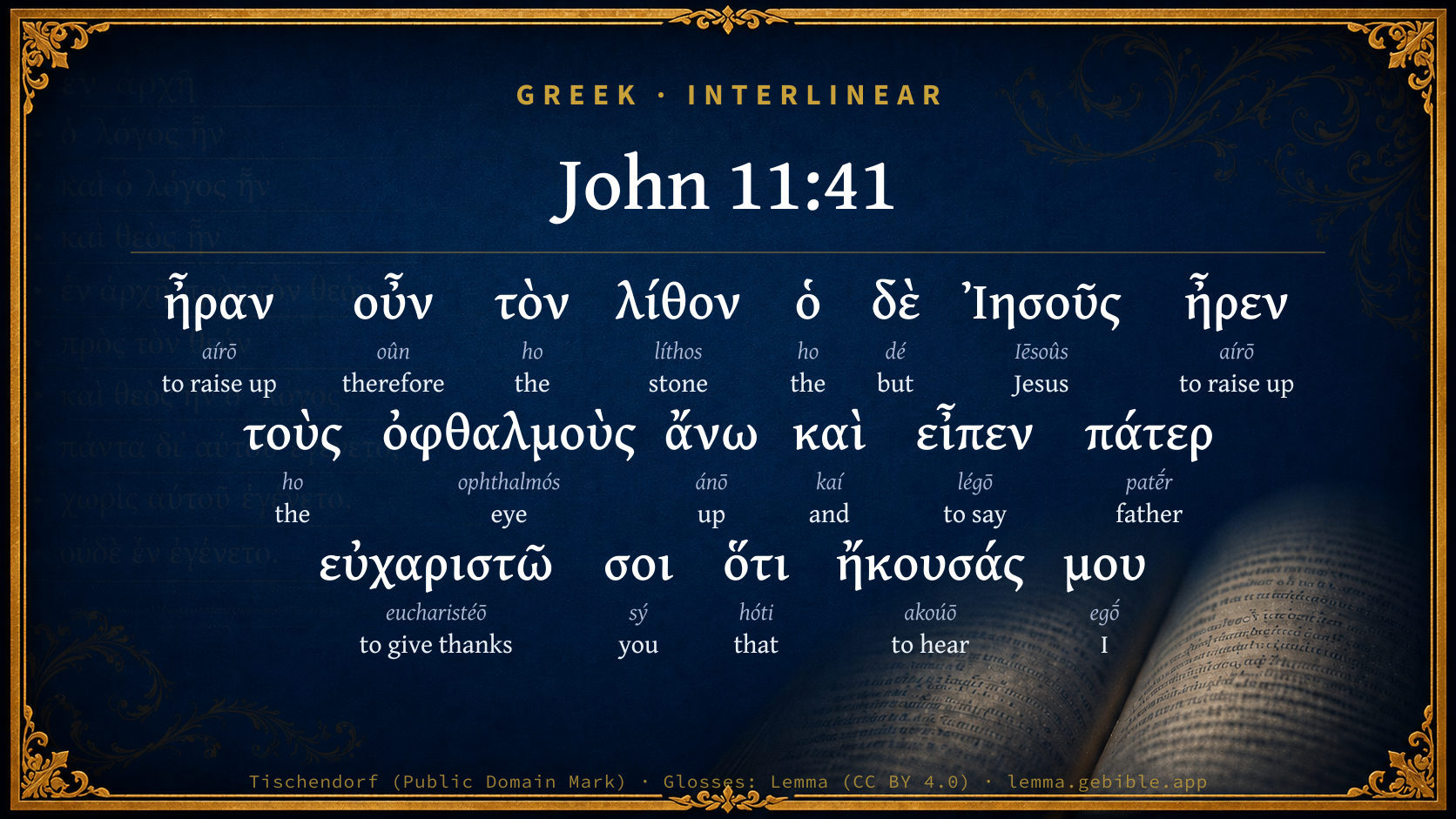
  1. ἦραν aírō G142 “to raise up” Verb, Aorist, Active, Indicative, 3rd person, Plural
  2. οὖν oûn G3767 “therefore” Conjunction
  3. τὸν ho G3588 “the” Article, Accusative, Singular, Masculine
  4. λίθον líthos G3037 “stone” Noun, Accusative, Singular, Masculine
  5. ὁ ho G3588 “the” Article, Nominative, Singular, Masculine
  6. δὲ dé G1161 “but” Conjunction
  7. Ἰησοῦς Iēsoûs G2424 “Jesus” Noun, Nominative, Singular, Masculine
  8. ἦρεν aírō G142 “to raise up” Verb, Aorist, Active, Indicative, 3rd person, Singular
  9. τοὺς ho G3588 “the” Article, Accusative, Plural, Masculine
  10. ὀφθαλμοὺς ophthalmós G3788 “eye” Noun, Accusative, Plural, Masculine
  11. καὶ kaí G2532 “and” Conjunction
  12. εἶπεν légō G3004 “to say” Verb, Aorist, Active, Indicative, 3rd person, Singular
  13. πάτερ patḗr G3962 “father” Noun, Vocative, Singular, Masculine
  14. εὐχαριστῶ eucharistéō G2168 “to give thanks” Verb, Present, Active, Indicative, 1st person, Singular
  15. σοι sý G4771 “you” Personal pronoun, 2nd person, Dative, Singular
  16. ὅτι hóti G3754 “that” Conjunction
  17. ἤκουσάς akoúō G191 “to hear” Verb, Aorist, Active, Indicative, 2nd person, Singular
  18. μου egṓ G1473 “I” Personal pronoun, 1st person, Genitive, Singular

About this verse

These counts appear in no published source. They are computed here, from the morphology-tagged text and Lemma’s own curated glosses. What Lemma adds →

19
words
16
distinct lemmas
Gospels
section

Notable vocabulary

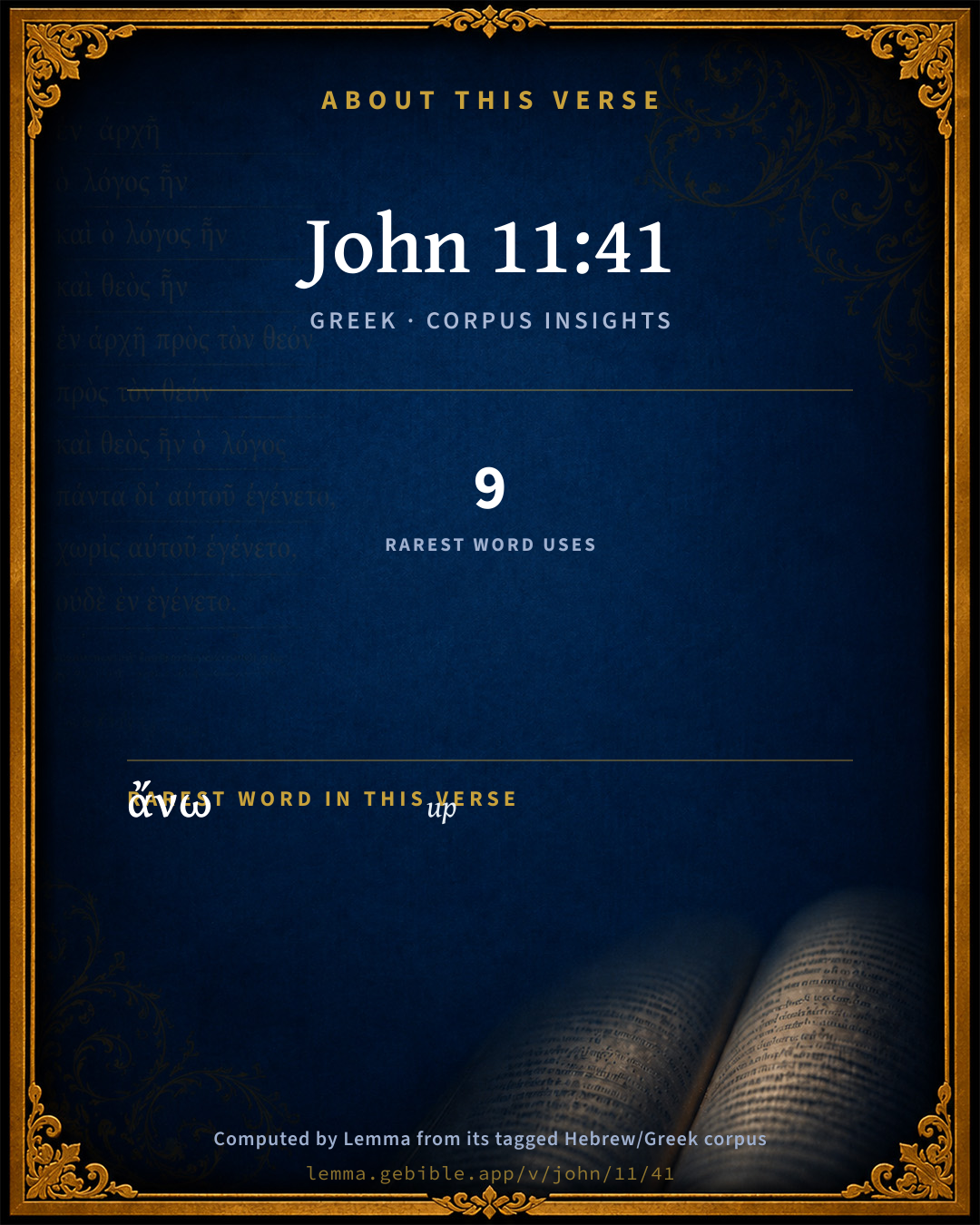
The rarest word here is ἄνω up G507 — appearing just 9 times in the whole Greek New Testament.

Shared distinctive vocabulary

ἄνω up G507 occurs in 9 verses of the Greek New Testament. Also found in:

Repetition

Words recur within this verse:

  • ἦραν to raise up G142 ×2
  • τὸν the G3588 ×3

Cross-references

7

Topical passages linked to John 11:41 in the Treasury of Scripture Knowledge — connected by theme and wording, ordered by reader-vote popularity; previews shown in the World English Bible.

  • Matthew 11:25 At that time, Jesus answered, "I thank you, Father, Lord of heaven and earth, that you hid these things from the wise and understanding, and revealed them to infants.
  • John 17:1 Jesus said these things, and lifting up his eyes to heaven, he said, "Father, the time has come. Glorify your Son, that your Son may also glorify you;
  • Psalms 123:1 To you I do lift up my eyes, You who sit in the heavens.
  • Luke 10:21 In that same hour Jesus rejoiced in the Holy Spirit, and said, "I thank you, O Father, Lord of heaven and earth, that you have hidden these things from the wise and understanding, and revealed them to little children. Yes, Father, for so it was well-pleasing in your sight."
  • Philippians 4:6 In nothing be anxious, but in everything, by prayer and petition with thanksgiving, let your requests be made known to God.
  • John 12:28–30 Father, glorify your name!" Then there came a voice out of the sky, saying, "I have both glorified it, and will glorify it again."
  • Luke 18:13 But the tax collector, standing far away, wouldn't even lift up his eyes to heaven, but beat his breast, saying, 'God, be merciful to me, a sinner!'

Cross-references courtesy of OpenBible.info (CC BY 4.0).

Where the printed editions differ

1 variant

Places in this verse where the major printed Greek editions disagree on the wording in a way that affects the translation — a comparison of editions, not a manuscript-by-manuscript collation. The editions are the modern critical texts (Nestlé-Aland 28/27, SBL, Westcott-Hort, Tregelles, Tyndale House) and the traditional texts behind the KJV (the Textus Receptus and the Byzantine/Majority text). It is not a claim about which reading is original.

  1. Extra text
    οὗ ἦν ὁ τεθνηκὼς κειμένος.

    “where was who having died laid.”

    In TRByz Not in NA28NA27TynSBLWHTreg

    οὗ ἦν ὁ τεθνηκὼς κειμένος. (hou ēn ho tethnēkōs keimenos) 'where was who having died laid.' is only in traditional manuscripts (TR+Byz)

Textual data: Translators Amalgamated Greek New Testament (STEPBible TAGNT) · CC BY 4.0.

Commentary

Notes on John 11:41 from classic Christian and Jewish commentators (each source and its license shown beneath its notes). The classic Christian expositions comment on the surrounding passage and are grouped to its opening verse, so a note may address several verses; the Jewish commentaries on the Tanakh (Rashi and others) are per-verse, so they appear only where the commentator wrote on this verse.

Lemma curates 59 commentaries, every one of them public domain or Creative Commons licensed, each selected and text-cleaned for this edition rather than reprinted as found. About our sources →

The Biblical Illustrator

Joseph S. Exell

Joh_11:41-44

Jesus lifted up His eyes and said

The words of Christ at the grave of Lazarus

I.

THOSE HE ADDRESSED TO HEAVEN (Joh_11:41-42). In these we have

1. His recognition of God as His Father. He was the Son of God in a higher sense than any other has been or will be.

(1) In mutual resemblance. The express image of His Person.

(2) In mutual love. This is my beloved Son.

2. His consciousness of the Fathers regard. Ever in close communion with the Father, to every aspiration He felt the Fathers response always. No true word of prayer is ever lost.

3. His consideration of the people in His devotions. Because of the people. Audible words, though not essential, and having no influence on God, are often useful to our fellow men.

II. THOSE HE ADDRESSED TO THE DEAD (Joh_11:43). These were

1. Personal. Lazarus.

2. Earnest. He could have done it by a whisper or volition, but He raised His voice to the highest pitch to startle bystanders into solemn thought.

3. Mighty. They struck life into the dead.

III. THOSE HE ADDRESSED TO THE LIVING (Joh_11:44). Here again is the human cooperating with the Divine. Conclusion: This resurrection is an illustration of that of a dead soul which can be effected only by Christ, may still be entangled with old associations, habits, etc., and requires in order to its freedom the help of the living. The work of a living church and ministry is to loose encumbered souls. (D. Thomas, D. D.)

Christs prayer and thanksgiving

I. THE PRAYER WHICH JESUS HAD EVIDENTLY OFFERED. It is unrecorded, doubtless because silent.

1. Probably His first feeling on hearing of the sickness of Lazarus was one of sadness (Joh_11:5).

2. This sadness it would seem soon relieved itself through prayer. By a natural filial instinct His heart rose out of its depression into confident communion with His Father.

3. The practical lesson for us is not to measure the force of prayer by its elaborateness or audibleness. The most effective are frequently unuttered. This should not discourage public, but encourage private devotion.

II. CHRISTS ASSURANCE THAT HIS PRAYER WAS ANSWERED.

1. To hear prayer in Scripture means to answer, he miracle was not wrought, but the Saviour was conscious of His own adequacy and its accomplishment.

2. This hearing was no rare favour. Always (Heb_5:7).

3. The secret of this was the perfect oneness of Christs will with the Fathers. Many of our prayers are unanswered for the opposite reason 1Jn_5:14).

III. CHRISTS THANKSGIVING FOR GODS RESPONSE. Nothing is more noticeable in Christs prayers than His sense of filial obligation. Although not inferior to the Father He will not stand on His prerogatives, but as mans representative shows His sense of need and His trustful dependence.

1. Let us rejoice in this proof of Christs complete assumption of our humanity.

2. Let us learn to gratefully acknowledge Gods goodness in answering our prayers (Psa_116:1-2).

IV. CHRISTS PURPOSE IN THIS THANKSGIVING. Had Christ wished simply to thank God audible words would have been unnecessary. That were as pleasing to God as the unspoken prayer. But Christ wanted to show others that His claim to be the Son of God was no arrogant assumption, and that His works were wrought by no diabolical aid. In this also Jesus is our exemplar. We must not only have the thankful feeling, but express it Psa_66:16-17). We should be careful as to

1. The sincerity of our praises.

2. Their propriety.

3. Their earnestness. (B. Wilkinson.)

The force of the prayer and thanksgiving

By addressing His Father Christ put God into the position of either granting or withholding His cooperation. If Lazarus remained in the tomb let Jesus be acknowledged an impostor, and all His other miracles be attributed to Beelzebub! If God, who was thus solemnly invoked, should manifest His arm, let Jesus be acknowledged as sent by Him! Thus this act before the still occupied sepulchre made this moment one of solemn ordeal, like that of Elijah on Carmel, and imparted to this miracle a supreme and unique character in the life of Jesus. (F. Godet, D. D.)

Because of the people which stand by

The folly of merely standing by

It would seem to all who knew you a very odd thing if you were seen loafing about a certain shop for an hour and a half one day in the week for twenty years, and yet you never bought a pennyworth of goods. Why do you hang about the gospel shop and yet purchase nothing? On your own showing you are a fool. I do not like using a hard word, still it is used in Scripture for such as you are. He who believes a thing to be so important that he spends one day in the week in hearing about it, and yet does not think it important enough to accept it as a gift, stultifies himself by his own actions. How will you answer for it at the last great day when the Judge shall say, You believed enough to go and hear about salvation; why did you not believe enough to accept it? (C. H.Spurgeon.)

The Biblical Illustrator, edited by Joseph S. Exell (c. 1880s–1900s) — public domain. Text from a community e-Sword module.

Joseph Benson's Commentary

Joh 11:41-43. Then they took away the stone — As Jesus had directed; from the place where the dead was laid — From the mouth of the tomb. And Jesus lifted up his eyes, &c. — To show them who stood by, and viewed him as a mere man, from whence he derived his power; and that he did not do his miracles by any ability in his mere human nature. Thus he says, Mat 12:28, that he cast out devils by the Spirit of God; and, Luk 12:20, by the finger, or power, of God; and, Joh 14:10, that the Father, who dwelt in him, namely, the eternal Word and Spirit of the Father, did the works. And said, Father, I thank thee — “On many occasions Jesus had publicly appealed to his own miracles, as the proofs of his mission; but he did not ordinarily make a formal address to his Father before he wrought them; though to have done so, would have showed from whence he derived his authority. Nevertheless, being about to raise Lazarus from the dead, he prayed for his resurrection, to make the persons present sensible that in working his miracles, he [as man] acted by the assistance, not of devils, as his enemies maliciously affirmed, but of God; and that this miracle, in particular, could not be effected without an immediate interposition of the divine power. The evangelist, it is true, does not say directly, either that Jesus prayed, or that he prayed for this end. But the thanksgiving, which he tells us he offered up, implies both.” — Macknight. I know that thou hearest me always — And art most ready to answer all my petitions. Jesus had access to his Father on every occasion, and success with him in every errand. And we may be sure his interest with God is not the less for his going to heaven; which may encourage us to depend on his intercession for us, and to put all our petitions into his hand, for we are sure that the Father hears him always. Because of the people which stand by I said it, &c. — I did not pray for my own sake, as if I had entertained any doubt of having power to do this miracle; (see Joh 5:19-26;) but I prayed for the people’s sake, to make them sensible that thou lovest me, hast sent me, and art continually with me; and that I do all in union with thee, and nothing of myself, without, or separate from thee. And when he had thus spoken, he cried with a loud voice — Suitable to the majestic part which he was now acting, and the dominion he had, even in the empire of death itself, as well as that it might appear to all present, that even the dead were subject to his voice; Lazarus, come forth — He could have raised Lazarus by a silent exertion of his will and power, and the undiscernible operation of the Spirit of life; but he did it by a call, a loud call, to signify the power then put forth for the raising of Lazarus, and the greatness of the work.

Joseph Benson's Commentary on the Old and New Testaments (1811–1818) — public domain. Text from a community e-Sword module.

Bengel's Gnomon

Johann Albrecht Bengel

Joh 11:41. Ἄνω, upwards) He turned His eyes off from the object, which was now the prey of mortality, to heaven.[302]—εὐχαριστῶ σοι, I give Thee thanks) Jesus proceeds to this, His greatest miracle by far, most sure of the event.—ἤκουσάς μου, thou hast heard Me) Therefore Jesus [it seems] had prayed, when He had heard of the sickness of Lazarus, Joh 11:4, [and so He said at that time] “This sickness is not unto death, but for the glory of God, that the Son of God might be glorified thereby.”

[302] Πάτερ, Father) A short but pre-eminently choice prayer.—V. g.

Bengel's Gnomon of the New Testament — English translation (T&T Clark, Edinburgh, 1860) — public domain. Text from a community e-Sword module.

Meyer's Critical & Exegetical Commentary

Heinrich August Wilhelm Meyer

Joh_11:41-42. Jesus knows that His prayer, that God would suffer Him to raise Lazarus to life,a prayer which He had previously offered up in stillness, perhaps only in the inarticulate yearnings of His heart,has been heard, and He thanks God for hearing it. Petition and thanksgiving are not to be conceived as blended in one (Merz in die Wurtemberg. Stud. 1844, 2, p. 65; Tholuck); nor is the latter to be regarded as anticipatory (Hengstenberg), as though He offered thanks in the certain anticipation of the hearing of His prayer (Ewald, comp. Godet). Not that He offers thanks because the hearing of His prayer was unexpected and unhoped for (εἶπον); no, He for His part (ἐγώ) knew, even whilst He was asking God in stillness, that God always heard Him;[89] but because of the people standing by, etc.

Some have stumbled at Joh_11:42, and looked on it either as spurious (Dieffenbach in Bertholdts Krit. Journ. vol. i. p. 8), or as a reflection of the evangelist who puts this show-prayer (Weisse), or even sham-prayer (Baur), into the mouth of Christ for the purpose of supplying an argument for the story (De Wette; see, on the other hand, Brückner), or for the divinity of Christ (Strauss, Scholten). But it is just He, the One who is most intimate with the Father, who may indulge in reflection even in prayer, if His reflections relate to God, and are prayer. The opposite judgment applies an arbitrary standard to the subject. Moreover, if it had been his own reflection, John would probably have said: διὰ τοὺς Ἰουδαίους instead of ΔΙᾺ Τ. ὌΧΛΟΝ. Comp. Joh_11:45.

ΕἾΠΟΝ] as in Joh_6:36 : I will have said it, namely the εὐχαριστῶ σοι, etc. To refer to Joh_11:4 (Ewald) is inadmissible even on account of ΔΙᾺ Τ. ὌΧΛΟΝ alone.

ΣΙ] Thou and no other. They shall be convinced of it by learning from my thanksgiving that my working takes place in Thy strength, in the full certainty of a victory of Thy sending.

[89] Correct reason for this: πάντοτε θέλεις ἃ θέλω (Euth. Zigabenus); but also conversely, πάντοτε θέλω ἃ θέλεις; see Joh_5:30, Joh_12:27.

Meyer — Critical and Exegetical Commentary on the New Testament — English translation by Peter Christie, edited by Frederick Crombie (T&T Clark, 1880) — public domain. Text from a community e-Sword module.

Expositor's Greek Testament

ed. W. Robertson Nicoll

Joh 11:41 . Accordingly, notwithstanding her remonstrance, and because it was now perceived that Jesus had some end in view that was hidden from them, they lifted the stone, ἦραν οὖν τὸν λίθον . Ὁ δὲ Ἰησοῦς … ἀπέστειλας . “But Jesus lifted His eyes upwards and said, Father, I thank Thee that Thou hast heard me.” No pomp of incantation, no wrestling in prayer even; but simple words of thanksgiving, as if already Lazarus was restored. [Origen thinks that the spirit of Lazarus had already returned. Ἀντὶ εὐχῆς ηὐχαρίστησε , κατανοήσας τὴν Λαζάρου ψυχὴν εἰσελθοῦσαν εἰς τὸ σῶμα .] The prayer which He thanks the Father for hearing had been offered during the two days in Peraea. And the thanksgiving was more likely to impress the crowd now than in the excitement following the resurrection of Lazarus. Therefore He thanks the Father because it was essential that the miracle should be referred to its real source, and that all should recognise that it was the Father who had sent this power among men.

The Expositor's Greek Testament, edited by W. Robertson Nicoll (1897–1910) — public domain. Text from a community e-Sword module.

Jamieson, Fausset & Brown

Robert Jamieson, A. R. Fausset & David Brown

Jesus lifted up his eyes--an expression marking His calm solemnity. (Compare Joh 17:1).

Father, I thank thee that thou hast heard me--rather, "heardest Me," referring to a specific prayer offered by Him, probably on intelligence of the case reaching Him (Joh 11:3-4); for His living and loving oneness with the Father was maintained and manifested in the flesh, not merely by the spontaneous and uninterrupted outgoing of Each to Each in spirit, but by specific actings of faith and exercises of prayer about each successive case as it emerged. He prayed (says LUTHARDT well) not for what He wanted, but for the manifestation of what He had; and having the bright consciousness of the answer in the felt liberty to ask it, and the assurance that it was at hand, He gives thanks for this with a grand simplicity before performing the act.

Jamieson, Fausset & Brown — Commentary Critical and Explanatory on the Whole Bible (1871) — public domain (CC PDM 1.0). Text via the HelloAO Bible API.

Adam Clarke's Commentary

Verse 41. Where the dead was laid.] These words are wanting in BC*DL, three others; Syriac, Persic, Arabic, Sahidic, AEthiopic, Armenian, Vulgate, Saxon, and in all the Itala. Griesbach leaves them out of the text.

Father, I thank thee] As it was a common opinion that great miracles might be wrought by the power and in the name of the devil, Jesus lifted up his eyes to heaven, and invoked the supreme God before these unbelieving Jews, that they might see that it was by his power, and by his only, that this miracle was done; that every hinderance to this people's faith might be completely taken out of the way, and that their faith might stand, not in the wisdom of man, but in the power of the Most High. On this account our Lord says, he spoke because of the multitude, that they might see there was no diabolic influence here, and that God in his mercy had visited his people.

Adam Clarke's Commentary on the Bible (1810–1826) — public domain. Text from a community e-Sword/MySword module.

John Calvin's Commentaries

41. And Jesus again raised his eyes. This was the token of a mind truly prepared for prayer; for before any one calls on God aright, he must be brought into communication with him, and this can only be done when, raised above the earth, he ascends even to heaven. True, this is not done by the eyes; for hypocrites, who are plunged in the deep filth of their flesh, appear to draw down heaven to them by their stern aspect; but what they only pretend to do must be sincerely accomplished by the children of God. And yet he who raises his eyes to heaven ought not, in his thoughts, to limit God to heaven; for He is present everywhere, and fills heaven and earth, (Jeremiah 23:24.) But as men can never free themselves from gross imaginations, so as not to form some low and earthly conception about God, unless when they are raised above the world, Scripture sends them to heaven, and declares that heaven is the habitation of God, (Isaiah 66:1.)

So far as relates to the eyes, it is not a custom that must be perpetually observed, so that without it prayer is not lawful; for the publican, who prays with his face cast down to the ground, does not the less, on this account, pierce heaven by his faith, (Luke 18:13.) Yet this exercise is profitable, because men are aroused by it to seek God; and not only so, but the ardor of prayer often affects the body in such a manner that, without thinking of it, the body follows the mind of its own accord. Certainly, we cannot doubt that, when Christ raised his eyes to heaven, he was carried towards it with extraordinary vehemence. Besides, as all his thoughts were with the Father, so he also wished to bring others to the Father along with him.

Father, I thank thee. He begins with thanksgiving, though he has asked nothing; but though the Evangelist does not relate that he prayed in a form of words, yet there can be no doubt whatever that, before this, there was a prayer, for otherwise it could not have been heard. And there is reason to believe that he prayed amidst those groanings which the Evangelist mentions; for nothing could be more absurd than to suppose that he was violently agitated within himself, as stupid men are wont to be. Having obtained the life of Lazarus, he now thanks the Father By saying that he has received this power from the Father, and by not ascribing it to himself, he does nothing more than acknowledge that he is the servant of the Father For, accommodating himself to the capacity of men, he at one time openly proclaims his Divinity, and claims for himself whatever belongs to God; and, at another time, he is satisfied with sustaining the character of a man, and yields to the Father the whole glory of Divinity. Here both are admirably brought together by the Evangelist in one word, when he says that the Father heard Christ, but that he gives thanks, that men may know that he was sent by the Father, that is, that they may acknowledge him to be the Son of God. The majesty of Christ being incapable of being perceived in its true elevation, the power of God, which appeared in his flesh, gradually raised to this elevation the gross and dull senses of men. For since he intended to be wholly ours, we need not wonder if he accommodates himself to us in various ways; and as he even allowed himself to be emptied (Philippians 2:7) for us, there is no absurdity in saying that he abases himself on our account.

John Calvin's Commentaries (1540-1563) — public domain. Text from the Calvin Translation Society English edition (1840s-50s) via the Christian Classics Ethereal Library (ccel.org). Calvin's coverage is partial (roughly two-thirds of the Bible); uncommented books and verses are honest gaps, never fabricated. The 19th-century editor's footnotes and remarks are omitted so the notes are faithfully Calvin's own voice.

Ellicott's Commentary for English Readers

(41) Then they took away the stone.—This could be done without difficulty, for it would be nothing more than a rough slab placed at the entrance of the cave, to prevent the approach of jackals or other beasts of prey.

From the place where the dead was laid is omitted by all the better MSS. It is an unnecessary gloss, to explain what stone is meant.

And Jesus lifted up his eyes, and said . . .—His attitude, as well as His words, is meant to express that the work which He is about to do, is one of the works from His Father.

I thank thee that thou hast heard me.—Better, I thank Thee that Thou didst hear Me; the time referred to being that of the offering of the prayer. Of this we have no notice. It was the will of the Son expressing itself in moral harmony with the will of the Father. “I seek not Mine own will, but the will of the Father which hath sent Me” (Joh_5:30; comp. Joh_12:27-28), and therefore in the expression receiving the answer. The promise of Joh_11:4 was the utterance of the divine will to the disciples and the messengers, and we are, it may be, to think of that moment as the time of its realisation by the Son.

This thanksgiving for the answer to His prayer has been uttered aloud in the presence of the multitude. The verse which follows was spoken to prevent a misunderstanding on the part of the disciples and in all times.

A Bible Commentary for English Readers, edited by Charles John Ellicott (1878–1897) — public domain. Text from a community e-Sword module.

The Cambridge Bible for Schools and Colleges

gen. ed. J. J. S. Perowne

41. from the place where the dead was laid] These words, are omitted by an overwhelming number of authorities. They are a needless explanation added by a later hand.

And Jesus lift] The verb is identical with that translated ‘took away’ in the preceding clause. Both should be translated alike; moreover, ‘and’ should be ‘but.’ They lifted therefore the stone. But Jesus lifted His eyes upwards.

Father, I thank thee] Jesus thanks the Father as a public acknowledgment that the Son can do ‘nothing of Himself,’ but that the power which He is about to exhibit is from the Father (Joh_5:19-26).

that thou hast heard] Better, that Thou didst hear. The prayer to which this refers is not recorded.

The Cambridge Bible for Schools and Colleges (gen. ed. J. J. S. Perowne; Cambridge University Press, 1878–1918) — public domain. Text from a community e-Sword module.

John Gill's Exposition

Then they took away the stone,.... "From the door of the sepulchre", as the Arabic version adds;

from the place where the dead was laid: this clause is left out in the Alexandrian copy, and in the Vulgate Latin, and all the Oriental versions:

and Jesus lift up his eyes; to heaven; this is a praying gesture, as in Joh 17:1,

and said, Father, I thank thee that thou hast heard me; which cannot refer to the resurrection of Lazarus from the dead, or to any assistance given him in performing that miracle, because that as yet was not done; and when it was done, was done by his own power, as all the circumstances of it show; but it relates to everything in which he had before heard him, and was a foundation for him, as man, to believe he still would, in whatever was to come; and particularly to the present opportunity of showing his power in so remarkable a manner, and before so many witnesses.

John Gill's Exposition of the Whole Bible (1746–1763) — public domain (CC PDM 1.0). Text via the HelloAO Bible API.

Trapp's Complete Commentary

John Trapp

41 Then they took away the stone from the place where the dead was laid. And Jesus lifted up his eyes, and said, Father, I thank thee that thou hast heard me.

Ver. 41. Father, I thank thee that, &c.] Beginning to pray, he brings his thanks in his hand, as sure to speed. So must we, Php 4:6. And therefore in the law, whatever request they had to God, they must be sure to come with their peace offerings, in token of thankfulness: that they might sing with the Psalmist, "Praise waiteth for thee, O God, in Sion," Psa 65:1. It is said of Tiberius the emperor, that he never denied his favourite Sejanus anything, and oftentimes anticipated his request, so that he needed only to ask and give thanks. (Tacitus.) All God’s people are his favourites, and may have anything that heart can wish or need require.

John Trapp, A Commentary or Exposition upon All the Books of the Old and New Testament (1647–1656) — public domain. Text from a community e-Sword module.

Albert Barnes' Notes on the Bible

Lifted up his eyes - In an attitude of prayer. See Luk 18:13; Mat 14:19.

I thank thee that thou hast heard me - It is possible that John has recorded only the sum or substance of the prayer on this occasion. The thanks which Jesus renders here are evidently in view of the fact that power had been committed to him to raise up Lazarus. On account of the people, and the signal proof which would be furnished of the truth of his mission, he expressed his thanks to God. In all his actions, he recognized his union to the Father, and his dependence upon him as Mediator.

Albert Barnes' Notes on the Bible (1834–1885) — public domain. Text from a community e-Sword/MySword module.

Haydock's Catholic Bible Commentary

Father, I give thee thanks, that thou hast heard me. He knew that what he asked, even as man, must needs be granted; but he prayed for our instruction. (Witham) --- Christ was about to pray for the resurrection of Lazarus; but his eternal Father, who alone is good, prevented his petition, and heard it before he presented it. Therefore does Christ begin his prayer, by returning his almighty Father thanks for having granted his request. (Origen, tract. 18. in Joan.)

George Leo Haydock (1774–1849), Haydock's Catholic Family Bible and Commentary, 1859 edition — public domain. Excludes Psalms (Douay-Rheims chapter numbering differs from Protestant) and Deuterocanonical books (Catholic canon only).

Matthew Poole's English Annotations

The servants, or friends, about the grave, removeth the stone from the mouth of the cave, within which the dead corpse of Lazarus lay. Christ, before his thanksgiving to his Father, is said to have

lifted up his eyes; a posture often used in men’s addresses to God, Psa 121:1, and Psa 123:1, as an indication of their belief that heaven is God’s throne: though he filleth heaven and earth, yet heaven is his court, where he most gloriously showeth himself, the earth but his footstool. We read here of nothing that Christ had said before, yet he giveth thanks here to his Father that he had heard him. The meaning is, thou hast willed, or pleased to grant, those things which I desired. It is very hard to determine, whether Christ had used some audible words before this, upon this occasion, in prayer to his Father, which the evangelist could not or did not set down; or whether he only groaned in his spirit, as was said before, by those groans not only expressing his sorrow for Lazarus’s death, or rather sympathy with the afflictions of Mary and Martha, but also his desires to his Father, that he might be again restored to life; and his second groaning, Joh 11:38, was of that nature: which groanings in the saints God understandeth, knowing the mind of the Spirit, making intercession for the saints according to the will of God (as the apostle teacheth us, Rom 8:27); much more did the Father, who was one in nature, essence, and will with the Son, understand them in him. Nothing in these cases can be determined, much less can any conclude from hence, that there is no need of our using any words in our prayers; for although there be no simple, absolute necessity that we should use them in order to God’s knowledge of what we need, and would have; for he that searcheth the heart, knows what we need, and what we desire, Mat 6:8; yet there is a necessity for our words, in order to our obeying God’s command, Hos 14:2; Luk 11:2. There is a great deal of difference between God’s hearing of Christ, and hearing us: Christ and his Father have one essence, one nature, and will.

Matthew Poole's English Annotations on the Holy Bible (1683–1685) — public domain. Text from a community e-Sword/MySword module.

Whedon's Commentary on the Bible

Daniel D. Whedon

41. Father—In the very act of the miracle he repeats in this word Father the very claim of being Son of God, for which the Jews had threatened to stone and driven him from Jerusalem, (Joh_10:29-40.)

Hast heard me—Jesus here intimates: 1. That his miracles, as man, are in answer to his prayer. Yea, doubtless, that prayer, being the ceaseless act and position of his soul, was ceaselessly heard, as no mere man’s Isaiah 2. His prayer for this miracle had been previously offered, and the assurance of fulfilment received. This was clearly as early as Joh_11:4.

Daniel D. Whedon (gen. ed.), Commentary on the Old and New Testaments (1874–1909) — public domain. Text from a community e-Sword module.

The Pulpit Commentary

Then they took away the stone from the place where the dead was laid. They lifted the stone, and Jesus lifted up his eyes to heaven. This is not to be taken as an ordinary prayer, but a thanksgiving for prayer already heard. "Jesus lifted up his eyes," i.e. to heaven to that sublime symbol of the infinite activity of God, which surrounds us day and night, and which is in numerous religious systems made a type and image of the Divine Being himself; nor does our modern conception of the universe dethrone it from this high place. Christ"s language is thanksgiving that God has already heard him. Godet and Hengstenberg say that Jesus thanked God in anticipation of the miracle, as though it were already done. Meyer and Alford look back to some earlier prayers. But surely there is some reason for the thanksgiving. The stone is lifted, or removed; there lies the corpse, but no dank sepulchral vapor issues from it; rather some sign is given that prayer offered by Christ had been already heard, and that death has not made the havoc with the frame which would otherwise have occurred. Father, I thank thee that thou heardest me. When he uttered the prayer we cannot say; but we know that his mind was greatly exercised concerning his friend before he left Peraea. His words confess that his wishes have been in harmony with the Divine eternal will. So elsewhere the Lord tells his disciples, "If ye abide in me, and my words abide in you, ye shall ask what ye will, and it shall be done unto you;" i.e. "your desires will be in harmony with the Divine purpose; you will not be able to pray for anything either temporal or spiritual which God will not bestow, has not indeed prepared himself to bestow and you to receive." This is the true mystery and meaning of prayer. The hypothesis of the twofold nature of Christ, instead of being shipwrecked on the fact of his prayers and intercessions, throws light on the very nature of prayer itself.

The Pulpit Commentary (1880–1919), ed. H.D.M. Spence-Jones & Joseph S. Exell — public domain. Text from a community e-Sword module.

John Wesley's Explanatory Notes

Jesus lifted up his eyes - Not as if he applied to his Father for assistance. There is not the least show of this. He wrought the miracle with an air of absolute sovereignty, as the Lord of life and death. But it was as if he had said, I thank thee, that by the disposal of thy providence, thou hast granted my desire, in this remarkable opportunity of exerting my power, and showing forth thy praise.

John Wesley, Explanatory Notes Upon the Whole Bible (1754–1765) — public domain. Text via the GEBible commentary corpus.

The People's New Testament

B. W. Johnson

41, 42. And Jesus lifted up his eyes. The Son always sought to honor the Father and to show that the Father was in him as he was in the Father. I thank thee that thou hast heard me. Constantly in communion with the Father, he had the Father's answer already and assent to what he was about to do.

Thou hearest me always. Even in Gethsemane, when the cup was not taken away.

B. W. Johnson's The People's New Testament with Notes (1889–1891) — public domain. Electronic text from the Christian Classics Ethereal Library (CCEL) ThML edition.

unfoldingWord translationNotes

Door43 World Missions Community

Jesus lifted up his eyes

This is an idiom that means to look up. AT: "Jesus looked up toward heaven" (See: Idiom)

Father, I thank you that you listened to me

Jesus prays directly to the Father so that others around him will hear his prayer. AT: "Father, I thank you that you have heard me" or "Father, I thank you that you have heard my prayer"

Father

This is an important title for God. (See: Translating Son and Father)

so that they may believe that you have sent me

"I want them to believe that you have sent me"

translationWords

God the Father

believe

unfoldingWord translationNotes — © Distant Shores Media and the Door43 World Missions Community, licensed CC BY-SA 4.0. Source: git.door43.org/Door43/en_tn.

Cambridge Greek Testament for Schools and Colleges

41. Omit οὖ ἦν ὁ τεθνηκὼς κείμενος (explanatory gloss) after λίθον.

41. ἦραν οὖν τ. λίθον. ὁ δὲ Ἰ. ἦρεν τ. ὀφθ. They lifted therefore the stone. But Jesus lifted up His eyes: comp. Joh 17:1.

ὅτι ἤκουσάς μου. That Thou didst hear Me. The prayer to which this refers is not recorded. He thanks the Father as a public acknowledgment that the Son can do nothing of Himself; the power which He is about to exhibit is from the Father (Joh 5:19-26).

Cambridge Greek Testament for Schools and Colleges (Cambridge University Press, 1896; 21 vols, various authors incl. Carr, Maclear, Plummer, Farrar, Lumby, Moule, M. R. James, Simcox) — public domain. Text from a community e-Sword module.

International Critical Commentary

41. ἦραν οὖν τὸν λίθον, as Jesus had bidden them (v. 39). The rec. text adds after λίθον the explanatory gloss οὗ ἦν ὁ τεθνηκὼς κείμενος: om. אBC*LD.

ἦρεν τοὺς ὀφθαλμοὺς ἄνω. This is a natural prelude to prayer or thanksgiving: cf. Psa 121:1 ἦρα τοὺς ὀφθαλμούς μου εἰς τὰ ὄρη, and Luk 18:13. So, again, did Jesus “lift up His eyes” before His great high-priestly prayer (17:1); and, as the Synoptists tell (Mar 6:41), before the blessing of the loaves, although Jn. omits this detail (see note on 6:11). “To lift the eyes” is used more generally of any careful or deliberate gaze (see on 4:35, 6:5).

καὶ εἶπεν πάτερ. It was thus that Jesus began His own prayers or thanksgivings, even as He taught men to begin with “Our Father.” Other instances in Jn. are 12:27, 17:1; and in the Synoptists, Mar 14:36, Luk 22:42 (cf. Mat 26:39), Luk 10:21 (Mat 11:25), and Luk 23:34, Luk 23:46. He does not say “Our Father,” but “My Father” (see on 5:17), or “Father,” simply, as here; for His relation to the Eternal Godhead is different from that of men in general. Bengel’s comment on the simple invocation πάτερ (at 17:1) is suggestive: “nomina dei non sunt cumulanda in oratione.”

εὐχαριστῶ σοι. For εὐχαριστεῖν in Jn., see on 6:11.

ὅτι ἤκουσάς μου, “because Thou didst hear me,” the aor. indicating some definite act of prayer, whether spoken or only mental, perhaps before v. 4. He gives thanks before the visible answer to His prayer, because He is in no doubt as to the issue. His prayers were always directed to the realisation of the Father’s will (5:30), and this cannot be frustrated (see on 12:28).

For ἀκούειν with a gen. case as connoting sympathetic or appreciative hearing, see on 3:8.

International Critical Commentary — older volumes (1896–1929), various authors — public domain. Text from a community e-Sword module.

Vincent's Word Studies in the New Testament

Marvin R. Vincent

From the place where the dead was laid. Omit.

Marvin R. Vincent, Word Studies in the New Testament (1887–1900) — public domain. Text from a community e-Sword/MySword module.

Lesson kit

Teaching starters — assembled from the data on this page, not authored interpretation. Every prompt links to the verse data it draws on. Edit before teaching.

John, in the Gospels, opens this verse with 19 words (16 distinct Greek lemmas). Its most distinctive word is ánō (“up”). A historical commentator’s framing appears above. Read the whole chapter for the surrounding context.

Discussion questions

  1. What does “up” (ánō) contribute to the verse as a whole?
  2. John 2:7 shares the word «up» with this verse. How do the two illuminate each other?
  3. “to raise up” occurs 2× in this one verse. What is the effect of the repetition?
  4. These translations render this verse differently; the difference is in the English rendering, not the original. What questions does that raise?
  5. Reading how The Biblical Illustrator and Joseph Benson's Commentary read this verse, where do the two commentators agree and where do they part?

Things to notice

  • These translations choose different wording for 10 words in this verse.
  • “to raise up” occurs 2× in this single verse.
  • 16 distinct Greek lemmas span 19 words in this verse.

Reading settings

Reading text

Shown beneath each verse's original-language words.

Old Testament
Old Testament edition

Read the OT as the Masoretic Hebrew (MT) or the Greek Septuagint (LXX).

English shown for the Greek Septuagint (in the Hebrew ↔ Greek comparison).

Comparing translations? Open the Compare panel on any verse page to stack up to four side by side.