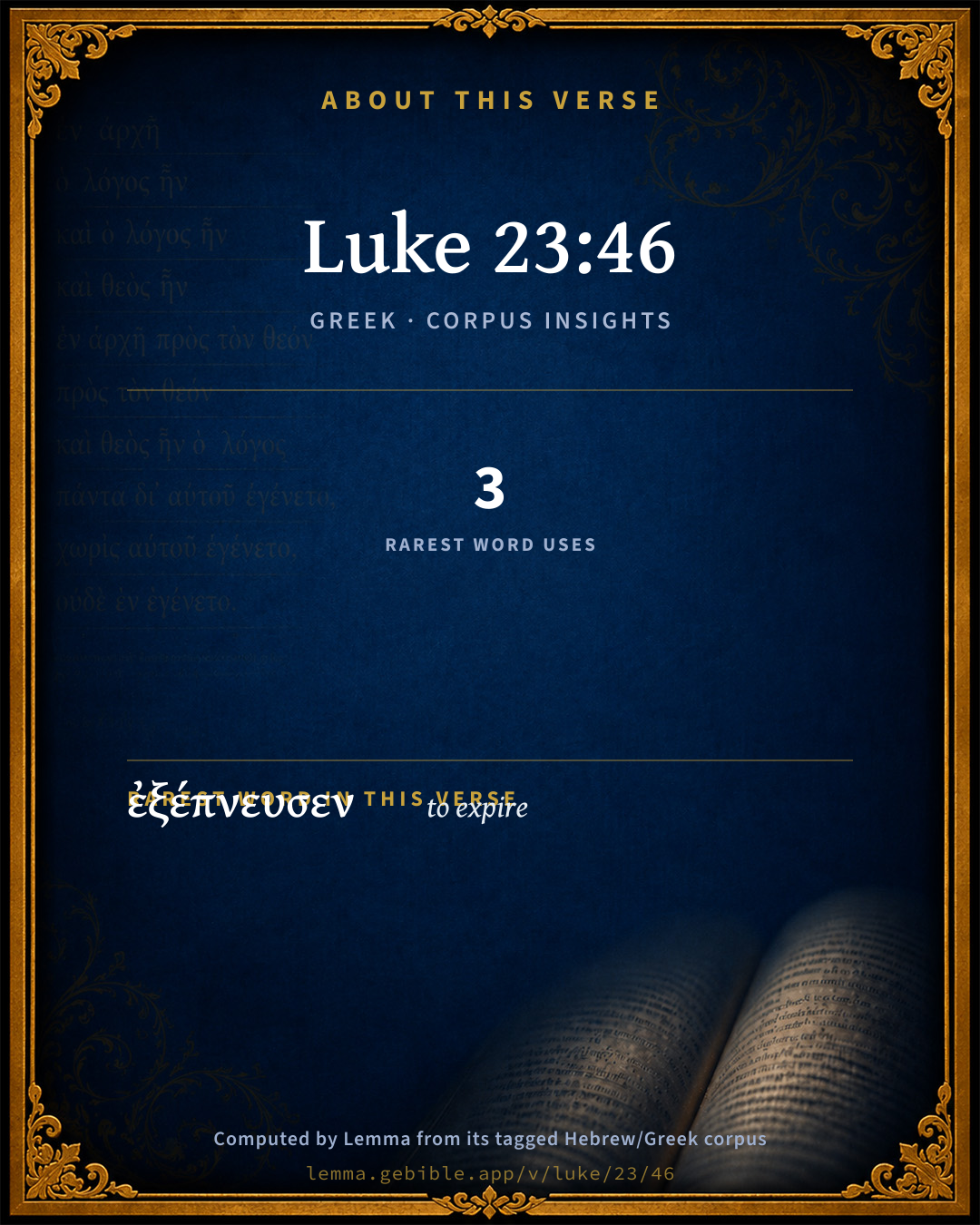
Luke 23:46

Greek (Tischendorf 8th ed.) Luke 23:46 appears in the Greek New Testament. The text above is from the Tischendorf 8th edition. Each word links to its Strong’s number and a concise gloss. Click any word for its full Thayer’s Greek Lexicon entry.
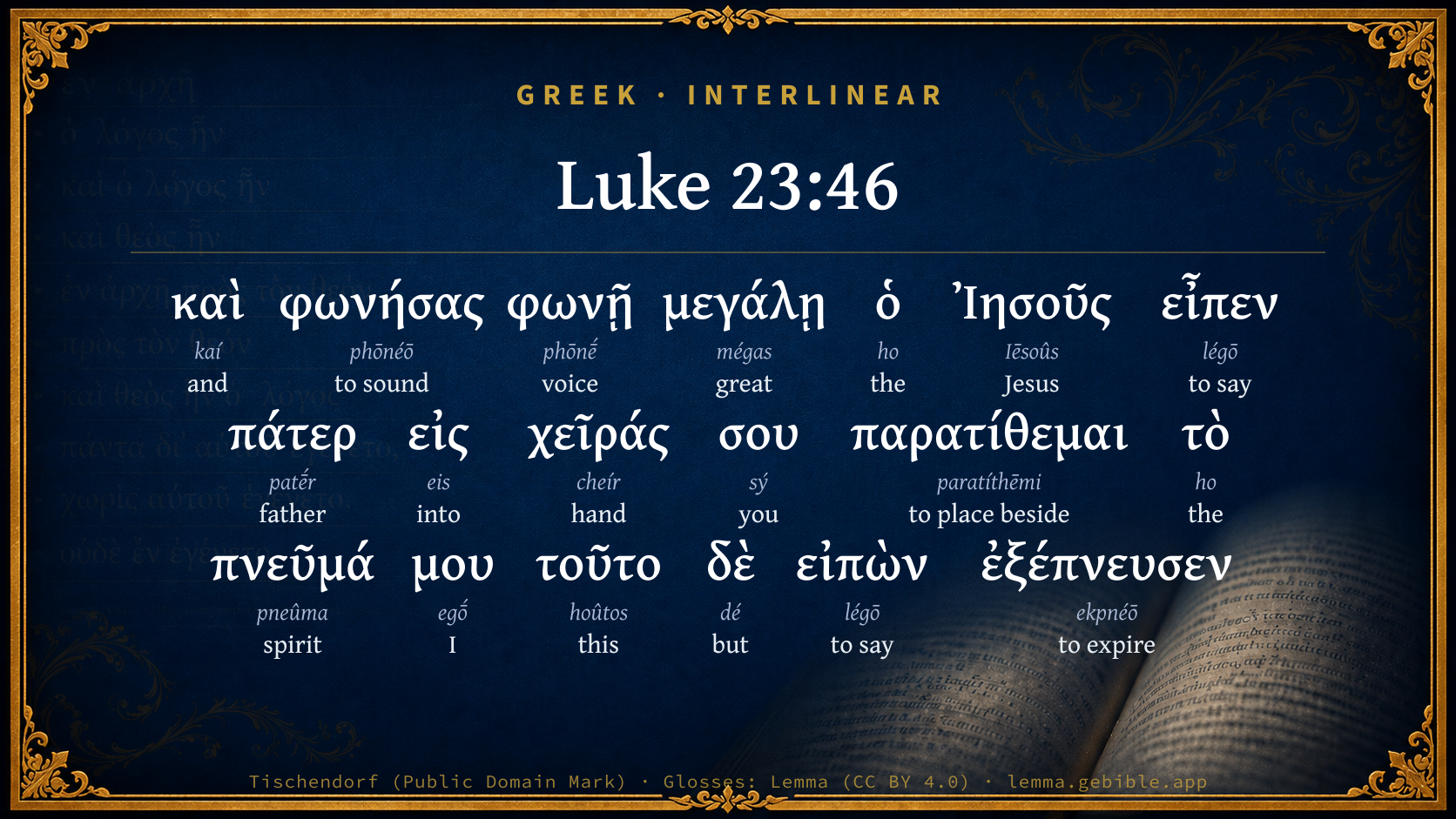
Download image
Cite this verse

Luke 23:46 (World English Bible). Public Domain. Lemma interlinear Bible study tool, https://lemma.gebible.app/v/luke/23/46.

Show BibTeX & RIS
BibTeX
RIS
English Translation
Jesus, crying with a loud voice, said, "Father, into your hands I commit my spirit!" Having said this, he breathed his last.
World English Bible · Public Domain
Download a study sheet

One document with this verse’s original text, its word-by-word gloss line, the meaning frame, cross-references with their text, attributed commentary, and full source and license credits — printable, and it pastes into notes with its structure intact.

This verse Autodidact and up

Study sheet (.html) Plain text (.txt)

A passage Seminary Student

Up to 50 verses in one chapter. A passage sheet keeps up to 6 commentary sources and 12 cross-references per verse, in the order this page ranks them, and says so on the sheet whenever that leaves anything out. Ask for a single verse and you get the Autodidact verse sheet above.

Everything on this page stays free to read, with no account — the sheet is a download of what is already on screen, not access to it.

Want to remove ads? Support Godless Engineer
Compare translations 3

The same verse in 3 English versions, stacked beneath the original-language interlinear above. Click any original word for its lexicon entry.

Each is an independent rendering of the whole verse — the interlinear is not word-aligned to these translations.

Highlighted words mark where these versions differ — a whole-verse word diff, not a word-by-word alignment.

  • World English Bible Public Domain
    Jesus, crying with a loud voice, said, "Father, into your hands I commit my spirit!" Having said this, he breathed his last.
  • King James Version Public Domain
    And when Jesus had cried with a loud voice, he said, Father, into thy hands I commend my spirit: and having said thus, he gave up the ghost.
  • unfoldingWord Literal Text CC BY-SA 4.0
    And crying out with a loud voice, Jesus said, “Father, into your hands I entrust my spirit.” And having said this, he expired.

unfoldingWord Literal Text — © unfoldingWord, licensed CC BY-SA 4.0. Word-aligned USFM3 via Door43 (git.door43.org/unfoldingWord/en_ult).

Versions to compare (up to 4)

3 of 4 selected

Show all 19 translations

Every available English version of this verse, each an independent rendering of the whole verse.

  • World English Bible Public Domain
    Jesus, crying with a loud voice, said, "Father, into your hands I commit my spirit!" Having said this, he breathed his last.
  • Berean Standard Bible Public Domain
    Then Jesus called out in a loud voice, “Father, into Your hands I commit My Spirit.” And when He had said this, He breathed His last.
  • Majority Standard Bible Public Domain
    Then Jesus called out in a loud voice, “Father, into Your hands I commit My Spirit.” And when He had said this, He breathed His last.
  • King James Version Public Domain
    And when Jesus had cried with a loud voice, he said, Father, into thy hands I commend my spirit: and having said thus, he gave up the ghost.
  • American Standard Version (1901) Public Domain
    And Jesus, crying with a loud voice, said, Father, into thy hands I commend my spirit: and having said this, he gave up the ghost.
  • Revised Version (1885) Public Domain
    And when Jesus had cried with a loud voice, he said, Father, into thy hands I commend my spirit: and having said this, he gave up the ghost.
  • Geneva Bible (1599) Public Domain
    And Iesus cryed with a loude voyce, and sayd, Father, into thine hands I commend my spirit. And when hee thus had sayd, hee gaue vp the ghost.
  • Douay-Rheims (1899) Public Domain
    And Jesus crying out with a loud voice, said: Father, into thy hands I commend my spirit. And saying this, he gave up the ghost.
  • Young's Literal Translation Public Domain
    and having cried with a loud voice, Jesus said, `Father, to Thy hands I commit my spirit;' and these things having said, he breathed forth the spirit.
  • Literal Standard Version CC BY-SA 4.0
    and having cried with a loud voice, Jesus said, “Father, into Your hands I commit My spirit”; now having said this, He breathed His last.
  • Unlocked Literal Bible CC BY-SA 4.0
    Crying with a loud voice, Jesus said, “Father, into your hands I commit my spirit.” Having said this, he died.
  • unfoldingWord Literal Text CC BY-SA 4.0
    And crying out with a loud voice, Jesus said, “Father, into your hands I entrust my spirit.” And having said this, he expired.
  • Darby Bible Public Domain
    And Jesus, having cried with a loud voice, said, Father, into thy hands I commit my spirit. And having said this, he expired.
  • World Messianic Bible Public Domain
    Yeshua, crying with a loud voice, said, “Father, into your hands I commit my spirit!” Having said this, he breathed his last.
  • Webster's Bible Public Domain
    And when Jesus had cried with a loud voice, he said, Father, into thy hands I commend my spirit: and having said thus, he expired.
  • Free Bible Version CC BY-SA 4.0
    Jesus called out in a loud voice, “Father, I place myself in your hands.” Having said this he breathed his last.
  • Bible in Basic English Public Domain
    And Jesus gave a loud cry and said, Father, into your hands I give my spirit: and when he had said this, he gave up his spirit.
  • Text-Critical English NT CC BY 4.0
    Then Jesus cried out with a loud voice, “Father, into yoʋr hands I commit my spirit.” After saying this, he breathed his last breath.
  • Tyndale New Testament (1534) Public Domain
    And Iesus cryed with a greate voyce and sayd: Father into thy hondes I comende my sprete. And when he thus had sayd he gave vp the goost.

Literal Standard Version (2020), Covenant Press — licensed CC BY-SA 4.0. Text via the HelloAO Bible API (eBible.org). Unlocked Literal Bible (unfoldingWord) — licensed CC BY-SA 4.0. Text via the HelloAO Bible API (eBible.org). unfoldingWord Literal Text — © unfoldingWord, licensed CC BY-SA 4.0. Word-aligned USFM3 via Door43 (git.door43.org/unfoldingWord/en_ult). Free Bible Version, Dr. Jonathan Gallagher — licensed CC BY-SA 4.0. Text via the HelloAO Bible API (eBible.org).

Word by word

More ways to search: Search by grammar → Find every occurrence → Compare this word →

Practice this passage: Drill this verse → Learn its vocabulary →

ἐξέπνευσεν
ekpnéō
G1606
“to expire”
Verb, Aorist, Active, Indicative, 3rd person, Singular
Part of Speech
Verb
Tense
Aorist
Voice
Active
Mood
Indicative
Person
3rd person
Number
Singular
Full Thayer's Definition

Origin: from G1537 and G4154

TDNT: 13:32,9

1. to breathe out, breathe out one's life, breathe one's last, expire
  1. καὶ kaí G2532 “and” Conjunction
  2. φωνήσας phōnéō G5455 “to sound” Verb, Aorist, Active, Participle, Nominative, Singular, Masculine
  3. φωνῇ phōnḗ G5456 “voice” Noun, Dative, Singular, Feminine
  4. μεγάλῃ mégas G3173 “great” Adjective, Dative, Singular, Feminine
  5. ὁ ho G3588 “the” Article, Nominative, Singular, Masculine
  6. Ἰησοῦς Iēsoûs G2424 “Jesus” Noun, Nominative, Singular, Masculine
  7. εἶπεν légō G3004 “to say” Verb, Aorist, Active, Indicative, 3rd person, Singular
  8. πάτερ patḗr G3962 “father” Noun, Vocative, Singular, Masculine
  9. εἰς eis G1519 “into” Preposition
  10. χεῖράς cheír G5495 “hand” Noun, Accusative, Plural, Feminine
  11. σου sý G4771 “you” Personal pronoun, 2nd person, Genitive, Singular
  12. παρατίθεμαι paratíthēmi G3908 “to place beside” Verb, Present, Middle, Indicative, 1st person, Singular
  13. τὸ ho G3588 “the” Article, Accusative, Singular, Neuter
  14. πνεῦμά pneûma G4151 “spirit” Noun, Accusative, Singular, Neuter
  15. μου egṓ G1473 “I” Personal pronoun, 1st person, Genitive, Singular
  16. τοῦτο hoûtos G3778 “this” Demonstrative pronoun, Accusative, Singular, Neuter
  17. δὲ dé G1161 “but” Conjunction
  18. εἰπὼν légō G3004 “to say” Verb, Aorist, Active, Participle, Nominative, Singular, Masculine

About this verse

These counts appear in no published source. They are computed here, from the morphology-tagged text and Lemma’s own curated glosses. What Lemma adds →

19
words
17
distinct lemmas
Gospels
section

Notable vocabulary

The rarest word here is ἐξέπνευσεν to expire G1606 — appearing just 3 times in the whole Greek New Testament.

Shared distinctive vocabulary

ἐξέπνευσεν to expire G1606 occurs in 3 verses of the Greek New Testament. Also found in:

Repetition

Words recur within this verse:

Cross-references

6

Topical passages linked to Luke 23:46 in the Treasury of Scripture Knowledge — connected by theme and wording, ordered by reader-vote popularity; previews shown in the World English Bible.

  • Psalms 31:5 Into your hand I commend my spirit. You redeem me, Yahweh, God of truth.
  • Acts 7:59 They stoned Stephen as he called out, saying, "Lord Jesus, receive my Spirit!"
  • John 19:30 When Jesus therefore had received the vinegar, he said, "It is finished." He bowed his head, and gave up his spirit.
  • 1 Peter 2:23 Who, when he was cursed, didn't curse back. When he suffered, didn't threaten, but committed himself to him who judges righteously;
  • Mark 15:34–41 At the ninth hour Jesus cried with a loud voice, saying, "Eloi, Eloi, lama sabachthani?" which is, being interpreted, "My God, my God, why have you forsaken me?"
  • Matthew 27:46–56 About the ninth hour Jesus cried with a loud voice, saying, "Eli, Eli, lima sabachthani?" That is, "My God, my God, why have you forsaken me?"

Cross-references courtesy of OpenBible.info (CC BY 4.0).

Commentary

Notes on Luke 23:46 from classic Christian and Jewish commentators (each source and its license shown beneath its notes). The classic Christian expositions comment on the surrounding passage and are grouped to its opening verse, so a note may address several verses; the Jewish commentaries on the Tanakh (Rashi and others) are per-verse, so they appear only where the commentator wrote on this verse.

Lemma curates 59 commentaries, every one of them public domain or Creative Commons licensed, each selected and text-cleaned for this edition rather than reprinted as found. About our sources →

The Biblical Illustrator

Joseph S. Exell

Luk_23:46

Father, into Thy hands I commend My spirit

That dying believers are both warranted, and encouraged, by Christs example, believingly to commend their souls into the hands of God

I.

WHAT IS IMPLIED IN A BELIEVERS COMMENDING OR COMMITTING HIS SOUL INTO THE HAND OF GOD AT DEATH?

1. That the soul outlives the body.

2. That the souls true rest is in God.

3. The great value believers have for their souls. He thinks but little of his body comparatively.

4. These words imply the deep sense that dying believers have of the great change that is coming upon them by death; when all visible and sensible things are shrinking away from them and failing. They feel the world and the best comforts in it failing; every creature and creature-comfort failing: For at death we are said to fail (Luk_16:9). Hereupon the soul clasps the closer about its God, cleaves more close than ever to Him: Father, into Thy hands I commend My spirit.

5. It implies the atonement of God, and His full reconciliation to believers, by the blood of the great Sacrifice; else they durst never commit their souls into His hands: For it is a fearful thing to fall into the hands of the living Heb_12:29).

6. It implies both the efficacy and excellency of faith, in supporting and relieving the soul at a time when nothing else is able to do it.

II. WHAT WARRANT OR ENCOURAGEMENT HAVE GRACIOUS SOULS TO COMMIT THEMSELVES, AT DEATH, INTO THE HANDS OF GOD? I answer, much every way; all things encourage and warrant its so doing: for--

1. This God, to whom the believer commits himself at death, is its Creator; the Father of its being: He created and inspired it, and so it hath relation of a creature to a Creator; yea, of a creature now in distress, to a faithful Creator (1Pe_4:19).

2. As the gracious soul is His creature, so it is His redeemed creature; one that He hath bought, and that with a great price, even with the precious blood of Jesus Christ (1Pe_1:18). This greatly encourages the departing soul to commit itself into the hands of God; so you find Psa_31:5).

3. The gracious soul may confidently and securely commit itself into the hands of God when it parts with its body at death; not only because it is His creature, His redeemed creature, but because it is His renewed creature also. All natural excellency and beauty goes away at death (Job_4:1-21. ult.), but grace ascends with the soul; it is a sanctified, when a separate soul; and can God shut the door of glory upon such a soul, that by grace is made meet for the inheritance? Oh, it cannot be!

4. As the gracious soul is a renewed soul, so it is also a sealed soul; God hath sealed it in this world for that glory, into which it is now to enter at death. Surely, if God have sealed, He will not refuse you; if He have given His earnest, He will not shut you out; Gods earnest is not given in jest.

5. Moreover, every gracious soul may confidently cast itself into the arms of its God, when it goes hence, with Father, into Thy hands I commit my spirit. Forasmuch as every gracious soul is a soul in covenant with God, and God stands obliged, by His covenant and promise to such, not to cast them out, when they come unto Him. As soon as ever thou became His, by regeneration, that promise became thine (Heb_13:5).

6. But this is not all; the gracious soul sustains many intimate and dear relations to that God into whose hands it commends itself at death. It is His spouse, and the consideration of such a day of espousals may well encourage it to cast itself into the bosom of Christ, its head and husband. It is a member of His body, flesh and bones (Eph_5:30). It is His child, and He its everlasting Father (Isa_9:6). It is His friend.Henceforth, saith Christ, I call you not servants, but friends (Joh_15:15). What confidence may these, and all other the dear relations Christ owns to the renewed soul, beget, in such an hour as this is!

7. The unchangeableness of Gods love to His people gives confidence they shall in no wise be cast out. They know Christ is the same to them at last as He was at first the same in the pangs of death as He was in the comforts of life. Having loved His own which were in the world, He loved them to the Joh_13:1). He doth not love as the world loves, only in prosperity; but they are as dear to Him when their beauty and strength are gone, as when they were in the greatest flourishing. If we live, we live to the Lord; and if we die, we die to the Lord. So then, whether we live or die, we are the Lords (Rom_14:8).

Deduction

1. Are dying believers, only, warranted and encouraged thus to commend their souls into the hands of God? What a sad strait, then, must all dying unbelievers be in about their souls? Such souls will fall into the hands of God, but thats their misery, not their privilege. They are not put by faith into the bands of mercy, but fall by sin into the hands of justice.

2. Will God graciously accept, and faithfully keep what the saints commit to Him at death? How careful then should they be to keep what God commits to them, to be kept for Him while they live.

3. If believers may safely commit their souls into the hands of God, how confidently may they commit all lesser interests, and lower concernments into the same hand.

4. Is this the privilege of believers, that they can commit their souls to God in a dying hour? Then how precious, how useful grace is faith to the people of God, both living and dying?

5. Do the souls of dying believers commend themselves into the hands of God? Then let not the surviving relations of such sorrow as men that have no hope (J. Flavel.)

The last words of Christ

Jesus Christ did not die for Himself, any more than He lived for Himself; and He not only died, the Just for the unjust, to bring us to God, but the manner of His dying was a lesson and a pattern for us. That is the Christian way of dying--the way for all to die; and who would wish, or could imagine, any fitter or happier way? Who would not, in this sense, say, Let me die the death of my Saviour, and let my last end be like His! And how it disarms our helplessness of its terrors! I am powerless, it seems to say, and therefore I commend to Thine omnipotence this frail and sensitive soul, which came at first from Thy creating hand. I do so reverently, but I do so confidently, for I do so as a child who calls Thee, My Father. I have said it expresses dependence--and so it does; but in Christs case, and even in our own, the confidence expressed is more prominent still. In His case there seems a suggestion of the words, No man taketh My life from Me, but I lay it down of Myself; I, as My own act, commend it, Father, to Thee. We do not possess that power; our souls are required of us. But, more than that, we are accustomed to think of dying as the most terrible crisis of our history; the hour of supreme peril to our souls; the appalling event which decides our fate for ever. It is a great mistake. Our dying does not decide our future fate: it is our living which does that; the course we have taken, the choices we have made when opportunities were in our hands, and we used them, or threw them away! And therefore, I say, the peril of living is greater far than any peril there can be in dying. I commend My spirit into Thy hands to be delivered. Consider any human spirit now; consider your own. Before it are great possibilities of good and of evil. It must be so. If we can be Gods true children, and live with, and become like our Father, it is terrible to fail of this; and it is more dreadful still--it is an indescribable degradation--not even to care about it. Since, then, we are in this case; capable of being Gods children, but hindered and prevented from being so by our evil, there is supreme need for us each to cry, Father, hear met deliver me! Into Thy hands I commend my spirit--my sin-stained spirit. I am Thine. Save me! I commend my spirit into Thy hands, to be made pure. The deliverance and reformation which the Scriptures say that we require, they describe by the strong expressions a new birth, a new creation. They say that is needed in order that we may stand without blame before God. Does not our sad experience say the same? God prescribes it. God promises to perform it, and on us. (T. M. Herbert, M. A.)

Soul-resignation into the hands of God

Yea, and it is a very profitable thing for us to do it hereby we make a virtue of necessity; and where can we lodge our souls in safer hands? If a man cannot keep a thing himself, but must betrust and deposit it in other hands, will he not do it in the safest hands that he can find? Now three things there are that are required to a safe hand: power, wisdom, and love. If I deposit a thing in a mans hand to keep, he must be able to keep it for me against violence, else his hand is no safe hand; though he be able and have power to keep it for me, yet if he be prodigal and lavish, and not wise, I shall not count his hand a safe hand to keep my depositum: but though he be never so wise, yet if he be not my friend, I shall not betrust him with any great matter: but if a man be able, wise and friendly, then his hand is a safe hand to keep my depositum. And again if we do not commend, commit, and resign ourselves and souls into His hands, we must be responsible for them ourselves. What benefit shall we get thereby? Much every way. This resignation of our souls and selves unto God is an inlet to many mercies, graces, and comforts. As for mercies and blessings; what greater blessing can there be in in this world than to enjoy ones-self; under God to enjoy ones-self, and to be free from all things? As it is an inlet unto many blessings, so it is an inlet unto many graces and duties. What grace or duty will ye instance in? Will ye instance in prayer? It opens the sluices of prayer; and, as one speaks well, though you pray never so long or loud, yet if you do not resign up your soul and will unto God, your prayer is but nonsense, and a contradiction in re. As it is an inlet unto many graces, so it is an inlet also unto many comforts; yea, indeed, unto all our comforts: for what comfort can a man have in himself or condition, till he hath truly resigned and given up himself and soul and will unto God? but being done, ye may freely go about your business. If a man have a suit in law, and have left his cause in the hand of an able, careful friend and lawyer, he is quiet; much more may we be quiet, when we have left and lodged our case and way and soul with God. Well, but then how is this work to be done that we may truly resign and give up ourselves, our souls, and our wills unto God? It is not to be done slightly and overly, but seriously and solemnly. It is an ordinary thing with men to say, The will of the Lord be done. As this work is not to be done slightly and overly, so neither is it to be done forcedly and lastly, but freely and firstly. As it is not to be done lastly and forcedly, so it is not to be done partially, and by halves, but fully and totally. I am Thine, saith David to God, Oh, save me (Psa_119:94). As this resignation must not be done partially, and by halves, so it must not be done conditionally, but absolutely. As this resignation is not to be done conditionally, so it is not to be done passively, and in a way of submission only, but actively. It is one thing for a man to submit unto Gods will, and another thing to resign up himself and will to the will of God. As this resignation is not to be done passively, so it is not to be done deceitfully and feignedly, but in all plainness and sincerity. Well, but when is this work to be done? It is to be done daily. There are some special times and seasons which do call for this work. I will name five. When a man doth convert and turn unto God. When a man is called forth unto any great work, or service, or employment, especially if it be beyond his own strength and power. When a man is in any great danger, distress, and affliction, then he is to resign and give up himself and will unto God. And if you would be able to do this work of soul-resignation in the day of your death rightly, then use yourself to do it every day. That is easily done which is often done. (W. Bridge, M. A.)

The soul given to God

Be sure that you do not give away your soul from God to anything else whilst you live. If you have given away your soul unto other things whilst you live, it will be a vain thing for you to say Christs words when you come to die. When men come to their death, ye know they do ordinarily make their wills; and in the first place they say, I give my soul unto God; then if they have lands, or houses, or money, they give them to their wives, children, relations and friends, according to their pleasure. But suppose, now, that a man shall give land or house to such or such a child or friend, which he hath sold or given away before, shall his will stand in force? Will not all men say, This he could not give away, for he had sold that or given that before? So in regard of ones soul; though upon my death I say, As for my soul, I give that to God; yet if I have sold away my soul before, for unjust gain, or have given away my soul before unto filthy pleasures, how can I resign and give that to God when I die; will not the Lord say, Nay, this is none of yours to give, this you had sold or given away before? Oh, then, be sure of this, that whilst you live, you do not sell or give away your soul from God, for then death-bed resignation will be but as the act and deed of a man that makes his will when he is not compos mentis. (W. Bridge, M. A.)

The Biblical Illustrator, edited by Joseph S. Exell (c. 1880s–1900s) — public domain. Text from a community e-Sword module.

Joseph Benson's Commentary

Luk 23:46-49. Father, into thy hands I commend my spirit — The Father receives the spirit of Jesus; Jesus himself the spirits of the faithful. See on Mat 27:50. When the centurion — The Roman officer, who stood over against him and guarded the execution; saw what was done — In so miraculous a manner, in those amazing prodigies that attended Christ’s death; he glorified God — By a free confession of his persuasion of the innocence of Jesus; saying, Certainly this was a righteous man — Notwithstanding all the vile reproaches which have been cast upon him. And all the people that came together — On this remarkable occasion, among whom, doubtless, were some of those who, but a little before, had been insulting him in his dying agonies; beholding, the things that were done, smote their breasts — For sorrow and remorse; in terrible expectation that some sad calamity would speedily befall them and their country, for the indignities and cruelties they had offered to a person, for whom God had expressed so high a regard even in his greatest distress. See these verses elucidated at large on Mat 27:54-56. And all his acquaintance — Who these were, Matthew and Mark inform us, in the verses just referred to.

Joseph Benson's Commentary on the Old and New Testaments (1811–1818) — public domain. Text from a community e-Sword module.

Whedon's Commentary on the Bible

Daniel D. Whedon

§ 142.—JESUS’S DEATH, EMBALMMENT, AND ENTOMBMENT, Luk_23:46-56.

See notes on Joh_19:31-42; Mat_27:51-61; Mar_15:38-47.

Daniel D. Whedon (gen. ed.), Commentary on the Old and New Testaments (1874–1909) — public domain. Text from a community e-Sword module.

Tyndale Open Study Notes

Tyndale Open Resources

23:46 Father, I entrust my spirit into your hands! See Ps 31:5; Ps 31 is another psalm about a righteous sufferer (see study note on Luke 23:35).

Tyndale Open Study Notes — © Tyndale Open Resources, licensed CC BY-SA 4.0. Text via the HelloAO Bible API.

Bengel's Gnomon

Johann Albrecht Bengel

Luk 23:46. Πάτερ, Father) The Father received the Spirit of Jesus; Jesus “receives the spirits” of believers: Act 7:59 [Stephen’s last prayer, “Lord Jesus, receive my spirit”].—παραθήσομαι) I will commend, in the very act.[264] [As a deposit committed to Him at death. It was at this point of time, the most precious truly of all, that the atonement was made.—V. g.]

[264] So Rec. Text and LΔ. But παρατίθεμαι in ABCPQ Orig. 3,726e; ‘commendo,’ in abcd Vulg. Hil. 1074, Syr. and Memph. Versions. So Engl. Vers.—E. and T.

Bengel's Gnomon of the New Testament — English translation (T&T Clark, Edinburgh, 1860) — public domain. Text from a community e-Sword module.

Expositor's Greek Testament

ed. W. Robertson Nicoll

Luk 23:46 . φωνῇ μεγάλῃ : this expression is used in Mt. and Mk. in connection with the “My God, My God,” which Lk. omits. In its place comes the “Father, into Thy hands”. Here as in the agony in the garden Lk.’s account fails to sound the depths of Christ’s humiliation. It must not be inferred that he did not know of the “Eli, Eli”. Either he personally, or his source, or his first readers, could not bear the thought of it. παρατίθεμαι τ . π . μ .: an echo of Psa 31:6 , and to be understood in a similar sense, as an expression of trust in God in extremis . Various shades of meaning have been put on the words, among which is that Jesus died by a free act of will, handing over His soul to God as a deposit to be kept safe (Grotius, Bengel, Hahn, etc.).

The Expositor's Greek Testament, edited by W. Robertson Nicoll (1897–1910) — public domain. Text from a community e-Sword module.

Adam Clarke's Commentary

Verse 46. Into thy hands I commend my spirit] Or, I will commit my spirit - I deposit my soul in thy hands. Another proof of the immateriality of the soul, and of its separate existence when the body is dead.

Adam Clarke's Commentary on the Bible (1810–1826) — public domain. Text from a community e-Sword/MySword module.

Ellicott's Commentary for English Readers

(46) And when Jesus had cried with a loud voice, he said. . . .—Better. And Jesus cried with a loud voice, and said . . . The English text emphasises too strongly the distinctness of the act, possibly with the implied suggestion that the cry might have consisted of the words which St. Luke does not report. On the other hand, the other Gospels make the “great cry” immediately precede death.

He gave up the ghost.—Better, He expired, or breathed out His spirit, the verb containing the root from which the Greek for “spirit” is derived. The Greek of St. John, which appears in English as though it were the same as St. Luke’s, corresponds more closely to the final utterance, “He delivered up His spirit.”

A Bible Commentary for English Readers, edited by Charles John Ellicott (1878–1897) — public domain. Text from a community e-Sword module.

The Cambridge Bible for Schools and Colleges

gen. ed. J. J. S. Perowne

46. And when Jesus had cried with a loud voice, he said] Rather, And, crying with a loud voice, Jesus said. St Luke here omits the Eli, Eli, lama sabachthani, and the effect of that cry on the multitude (Mat_27:46-50); the “I thirst,” which was the sole word of physical suffering wrung from Him in all His agonies; and the one word (Tete- lestai) in which He expressed the sense that His work was finished.

Father, into thy hands I commend my spirit] A reference to Psa_31:5; comp. Act_7:59; 1Pe_2:23. These words have been among the dying utterances of St Polycarp, St Augustine, St Bernard, John Huss, Jerome of Prague, Luther, Melancthon and Columbus.

he gave up the ghost] None of the Evangelists use the word “He died” (ethanen), but exepneusen (literally, ‘He breathed forth,’ here and Mar_15:37), and ‘He sent forth’ or ‘gave up His spirit’ (aphekcn, paredoken to pneuma, Mat_27:50; Joh_19:30); probably because they wish to indicate the truth stated in Joh_10:18, that He gave up His life “because He willed, when He willed, how He willed.” Aug. Comp. Eph_5:2; Gal_2:20.

The Cambridge Bible for Schools and Colleges (gen. ed. J. J. S. Perowne; Cambridge University Press, 1878–1918) — public domain. Text from a community e-Sword module.

John Gill's Exposition

This man went unto Pilate,.... Mark says, he went "boldly" to him; See Gill on Mar 15:43.

and begged the body of Jesus; knowing he was dead; that he might bury it, as the Ethiopic version adds, and prevent its being inferred with the two malefactors, or abused by the mob.

John Gill's Exposition of the Whole Bible (1746–1763) — public domain (CC PDM 1.0). Text via the HelloAO Bible API.

Trapp's Complete Commentary

John Trapp

46 And when Jesus had cried with a loud voice, he said, Father, into thy hands I commend my spirit: and having said thus, he gave up the ghost.

Ver. 46. See Mat 27:50.

John Trapp, A Commentary or Exposition upon All the Books of the Old and New Testament (1647–1656) — public domain. Text from a community e-Sword module.

The Pulpit Commentary

And when Jesus had cried with a loud voice, he said. This is better rendered, and Jesus cried with a loud voice and said. The cry with the loud voice is the solemn dismissal of his spirit when he commended it to his Father. The object of the receiving the refreshment of the vinegar the sour wine (Joh_19:30) was that his natural forces, weakened by the long suffering, should be restored sufficiently for him to render audible the last two sayings the "It is finished!" of St. John, and the commending his soul to his Father, of St. Luke. Father, into thy hands I commend my spirit. St. John (Joh_19:30) has related now already Jesus had uttered the triumphal cry, Tetelestai ! "It is finished!" This was his farewell to earth. St. Luke records the words which seem almost immediately to have followed the "It is finished!" This commending his spirit to his Father has been accurately termed his entrance greeting to heaven. This placing his spirit as a trust in the Father"s hands is, as Stier phrases it, an expression of the profoundest and most blessed repose after toil. "It is finished!" has already told us that the struggling and combat were sealed and closed for ever. Doctrinally it is a saying of vast importance; for it emphatically asserts that the soul will exist apart from the body in the hands of God. This at least is its proper home. The saying has been echoed on many a saintly death-bed. Stephen, full of the Holy Ghost, in his great agony shows us the form of this blessed prayer we should properly use for ourselves at that supreme hour, when he asked the Lord Jesus to receive his spirit, and then fell asleep. Thus coming to the Son, we come through him to the Father. Huss, on his way to the stake, when his enemies were triumphantly giving over his soul to devils, said with no less theological accuracy than with sure, calm faith, "But I commit my spirit into thy hand, O Lord Jesus Christ, who hast redeemed it." And having said thus, he gave up the ghost. This setting his spirit free was his own voluntary act. He already told his disciples of his own independent power to lay down and take up his life. (Joh_10:17, Joh_10:18) The great teachers of the early Church evidently lay stress on; his (see Tertullian, "Apol.," ch. 21). Augustine"s words are striking: "Quis ita dormit quando voluerit, sicut Jesus mortuus est quando voluit? Quis ita vestem ponit quando voluerit, sieur se came exuit quando writ? Quis ita cum voluerit abit, quomodo tile cure voluit obiit?" and he ends with this practical conclusion: Quanta speranda vel timenda potestas est judicantis, si apparuit tanta morientis?" "Under these circumstances," writes Dr. Westeott, "it may not be fitting to speculate on the physical cause of the Lord"s death, but it h,s been argued that the symptoms agree with a rupture of the heart, such as might i.e. produced by intense mental agony.

How to die and to live.

Our text treats of the dying of our Lord. We may distinguish between death and dying. All men die, but all men have not a dying experience. Those who are killed instantaneously in war or by accident, those who are attacked by fatal apoplexy, those who die in their sleep, have no such experience. It is probable that we shall have to face the fact that we are passing away from life, that when a few more hours have come and gone we shall have entered the unseen world. It is therefore of no small value to us that our great Exemplar underwent not only death, but the conscious act of dying, and that in this respect also he "left us an example that we should follow his steps." We look at

I THE DYING OF OUR LORD IN THE LIGHT OF THESE WORDS. The words he uttered just as his end drew near indicate:

1. Deep serenity of spirit. They show nothing of agitation or anxiety; they breathe a calm stillness of soul; they are fragrant of peace and tranquility. They begin with that word, "Father," which all along had been a name of strength and peace; he was evidently resting in the assurance of parental love. And the words that follow are in a strain of entire spiritual composure.

2. True and living faith. Jesus was resigning his spirit to God"s gracious charge, knowing that in his holy and mighty keeping it would be safe and blessed. Here was fullest confidence in God and in immortality.

3. Holy resignation. As a Son of man, Jesus felt still subject to the Divine Father of all; and as he came to do and bear his will, and had done and had borne it perfectly in every hour and act of life, so now in this last volition he yielded himself to God. Thus with a soul tranquil to its profoundest depths, realizing the unseen and eternal world, resigning his spirit to the Divine Father, he bowed his head in death.

II OUR OWN DEPARTURE. Having found in the death of Jesus Christ that which is the ground of our pardon, our peace, our life before God; having lived in the love and in the service of a once crucified and now ever-living Savior; there is no reason to doubt that we shall die as he died, breathing the spirit he breathed, if we do not use the very language that was upon his lips.

1. Our departure will be tranquil. We shall not be terrified, alarmed, agitated; our spirit will look calmly forward to the moment of departure from this world and of entrance into another. We shall face the very near future with a smile.

2. For we shall be sustained by a living faith.

(1) We shall feel that we are only going into the nearer presence of our own Father of him before whom we have been living and in whom we have been rejoicing; only passing from one room to another in our Father"s house.

(2) We shall have faith in Jesus Christ himself. That death upon the cross constitutes him a Divine Savior, in whom we hide; and we shall die in the calm assurance that we shall be "found in him," and accepted through him. We shall say, with deeper and fuller meaning than the psalmist could, "Into thine hand I commit my spirit: thou hast redeemed me, O Lord God of truth". (Psa_31:5)

(3) We shall yield ourselves to God in the spirit of consecration, assured that in that new and unknown realm which we are entering we may spend our time and our powers, liberated and enlarged, in his holy and blessed service: and the spirit of consecration is the spirit of confidence and hope. And while these words are particularly appropriate to dying lips, and very probably suggested the last utterance of the first Christian martyr, (Act_7:59) they need not be held in reserve for that occasion; they admirably express our true attitude in

III OUR DAILY LIFE. SO David evidently felt, (Psa_31:5) and so we may feel. In faith and in self-surrender we should be continually commending our spirit to Our heavenly Father"s charge:

1. When the day is done and we enter the nightly darkness and unconsciousness, during which we can take no charge of ourselves.

2. As we go forth each morning to duties, trials, temptations, opportunities, to which our own unaided strength is quite unequal.

3. If we feel that we are entering some dark cloud of adversity and trial in which we shall have peculiar need of Divine support.

4. When we are called to new spheres and weightier responsibilities, wherein other graces will be required than any that have yet been demanded of us. At all such times should we, in faith and consecration, commit the keeping of our souls to our heavenly Father, to be sheltered in his faithfulness, to be enriched by his love and his power. C.

The Pulpit Commentary (1880–1919), ed. H.D.M. Spence-Jones & Joseph S. Exell — public domain. Text from a community e-Sword module.

John Wesley's Explanatory Notes

Father, into thy hands - The Father receives the Spirit of Jesus: Jesus himself the spirits of the faithful.

John Wesley, Explanatory Notes Upon the Whole Bible (1754–1765) — public domain. Text via the GEBible commentary corpus.

Scofield Reference Notes

C. I. Scofield

gave up

(See Scofield "Mat 27:50").

The Scofield Reference Bible (1917 edition), notes by C. I. Scofield — public domain. Text from a community e-Sword module.

unfoldingWord translationNotes

Door43 World Missions Community

Crying with a loud voice

"Shouting loudly." It may be helpful to show how this is related to the events of the previous verses. AT: "When that happened, Jesus shouted loudly"

Father

This is an important title for God. (See: Translating Son and Father)

into your hands I commit my spirit

"The phrase "into your hands" refers to God's care. AT: "I entrust my spirit to your care" or "I give my spirit to you, knowing you will care for it" (See: Metonymy)

Having said this

"After Jesus said this"

he died

"Jesus died"

the centurion

This was the title for the Roman officer who was in charge of the other Roman soldiers. He supervised the crucifixion.

what was done

This can be stated in active form. AT: "all the things that had happened" (See: Active or Passive)

this was a righteous man

"this man did nothing wrong" or "this man did not do anything wrong"

translationWords

voice

God the Father

hand

spirit

die

centurion

glory

righteous

unfoldingWord translationNotes — © Distant Shores Media and the Door43 World Missions Community, licensed CC BY-SA 4.0. Source: git.door43.org/Door43/en_tn.

Cambridge Greek Testament for Schools and Colleges

46. καὶ φωνήσας φωνῇ μεγάλῃ. ‘And, crying with a loud voice’ (not “when he had cried,” A. V[411]). St Luke here omits the Eli, Eli, lama sabachthani, and the effect of that cry on the multitude (Mat 27:46-50); the “I thirst,” which was the sole word of physical suffering wrung from Him in all His agonies; and the one word (τετέλεσται) in which He expressed the sense that His work was finished.

[411] A. V. Authorised Version.

πάτερ, εἰς χεῖράς σου. A reference to Psa 31:5; comp. Act 7:59; 1Pe 2:23. These words have been among the dying utterances of St Polycarp, St Augustine, St Bernard, John Huss, Jerome of Prague, Luther, Melancthon and Columbus.

ἐξέπνευσεν. None of the Evangelists use the word “He died” (ἔθανεν), but ἐξέπνευσεν (literally, ‘He breathed forth,’ here and Mar 15:37), and ‘He sent forth’ or ‘gave up His spirit’ (ἀφῆκεν, παρέδωκεν τὸ πνεῦμα, Mat 27:50; Joh 19:30); probably because they wish to indicate the truth stated in Joh 10:18, that He gave up His life “because He willed, when He willed, how He willed.” Aug. Comp. Eph 5:2; Gal 2:20.

Cambridge Greek Testament for Schools and Colleges (Cambridge University Press, 1896; 21 vols, various authors incl. Carr, Maclear, Plummer, Farrar, Lumby, Moule, M. R. James, Simcox) — public domain. Text from a community e-Sword module.

Alford’s Greek Testament

Henry Alford

46.] The use of φωνῇ μεγάλῃ shews that this was the cry to which Matt. and Mark allude. The words are from the LXX, varying however from the common reading παραθήσομαι, and giving the verb in the present, which is also the rendering of the Hebrew (אַפְקִיד).

These words have in them an important and deep meaning. They accompany that, which in our Lord’s case was strictly speaking the act of death. It was His own act—not ‘feeling the approach of death,’ as some, not apprehending the matter, have commented; but a determinate delivering up of His spirit to the Father.—παρέδωκεν τὸ πνεῦμα, John: see Joh 10:18—οὐδεὶς αἴρει αὐτὴν ἀπʼ ἐμοῦ, ἀλλʼ ἐγὼ τίθημι αὐτὴν ἀπʼ ἐμαυτοῦ. None of the Evangelists say ‘He died:’ although that expression is ever after used of His death stated as one great fact:—but it is, ἀφῆκεν τὸ πν., Matt.; ἐξέπνευσεν, Mark, Luke; παρέδωκεν τὸ πνεῦμα, John.

The πνεῦμα here is the Personality—the human soul informed by the Spirit, in union: not separated, so that His soul went to Hades, and His spirit to the Father (Olshausen). Both are delivered into the hand of the Father—by Whom quickened (but ζωοποιηθεὶς πνεύματι of 1Pe 3:18 is to be rendered ‘quickened in the spirit’—by the Father is understood in ζωοποιηθείς) He worked His great victory over death and Hell.

See again 1Pe 3:18, 1Pe 3:19, and notes, and Rom 8:10, Rom 8:11.

The latter part of the verse in Psa_31, ‘for Thou hast redeemed me, O Lord, thou God of truth,’ is not applicable here. The whole Psalm is not strictly prophetic, but is applied by the Lord to Himself.

Henry Alford, The Greek Testament (1849–1861) — public domain. Text from a community e-Sword module.

International Critical Commentary

46. φωνήσας φωνῇ μεγάλῃ. All three mention this loud voice, which seems to indicate that Jesus did not die of exhaustion. Comp. Stephen’s cry (Act 7:60). But here the fondness of Lk. for cognate words is conspicuous. While he has φωνήσας φωνῇ, Mt. has κράξας φωνῇ, and Mk. ἀφεὶς φωνήν: comp. 2:8 and 9, 7:29, 12:50, 17:24, 22:15: and see on 11:46. The aorist does not prove that φωνήσας is not to be taken with εἶπεν, and we may suppose that what was uttered with a loud voice was the saying, “Father, into Thy hands,” etc. Comp. the freq. ἀποκριθεὶς εἶπεν. But it is admissible to make the φωνήσας refer to “It is finished,” or to some separate inarticulate cry. It is quite unnecessary to suppose that Lk. has here taken the words of Psa 31:6 and attributed them to Jesus, in order to express His submissive trust in God at the moment of death. Are we to suppose that Jesus did not know Psa_31? or that, if He did not, such a thought as this could not occur to Him?

εἰς χεῖράς σου παρατίθεμαι τ. πν. μ. The psalmist, thinking of a future death, has παραθήσομαι, which L and inferior MSS. read here. The voluntary character of Christ’s death is very clearly expressed in this last utterance, as in ἀφῆκεν τὸ πνεῦμα (Mt.) and παρέδωκεν τὸ πνεῦμα (Jn.). None of the four says ἀπέθανεν, or ἐκοιμήθη, or ἐτελεύτησεν. Quis ita dormit quando voluerit, sicut Jesus mortuus est quando voluit? Quis ita vestem ponit quando voluerit, sicut se carne exuit quando voluit? Quis ita cum voluerit abit quomodo cum voluit obiit? (Aug. Tr. in Job. xix. 30). To urge that this utterance is not consistent with ver. 43 is futile, unless we believe that God is excluded from paradise(Psa 16:10, 139:8; Act 11:27).

Strauss, Renan, and others are unwilling to decide whether all the Seven Words from the Cross are to be rejected as unhistorical. Keim will commit himself to no more than “the two probable facts, that shortly before His death Jesus uttered a cry of lamentation, and when on the point of dying a death-cry” (vi. p. 162). One asks once more, Who was capable of inventing such words? Compare the inventions in the apocryphal gospels.

International Critical Commentary — older volumes (1896–1929), various authors — public domain. Text from a community e-Sword module.

Vincent's Word Studies in the New Testament

Marvin R. Vincent

I commend [παρατιθεμαι] . See on ch. Luk 9:16.

Gave up the ghost [εξεπνευσεν] . Lit., breathed out (his life). Wyc., sent out the spirit. See on Mt 27:50.

47 - 49. Compare Mt 27:51 - 56; Mr 14:38 - 41.

Marvin R. Vincent, Word Studies in the New Testament (1887–1900) — public domain. Text from a community e-Sword/MySword module.

Lesson kit

Teaching starters — assembled from the data on this page, not authored interpretation. Every prompt links to the verse data it draws on. Edit before teaching.

Luke, in the Gospels, opens this verse with 19 words (17 distinct Greek lemmas). Its most distinctive word is ekpnéō (“to expire”). A historical commentator’s framing appears above. Read the whole chapter for the surrounding context.

Discussion questions

  1. How does “to expire” (ekpnéō) shape what this verse is saying?
  2. Mark 15:37 shares the word «to expire» with this verse. How do the two illuminate each other?
  3. “to say” occurs 2× in this one verse. What is the effect of the repetition?
  4. The translations on this page render this verse differently — a whole-verse word diff, not a word-by-word alignment. What might account for the different wordings?
  5. Reading how The Biblical Illustrator and Joseph Benson's Commentary read this verse, where do the two commentators agree and where do they part?

Things to notice

Reading settings

Reading text

Shown beneath each verse's original-language words.

Old Testament
Old Testament edition

Read the OT as the Masoretic Hebrew (MT) or the Greek Septuagint (LXX).

English shown for the Greek Septuagint (in the Hebrew ↔ Greek comparison).

Comparing translations? Open the Compare panel on any verse page to stack up to four side by side.