
Matthew 7:11

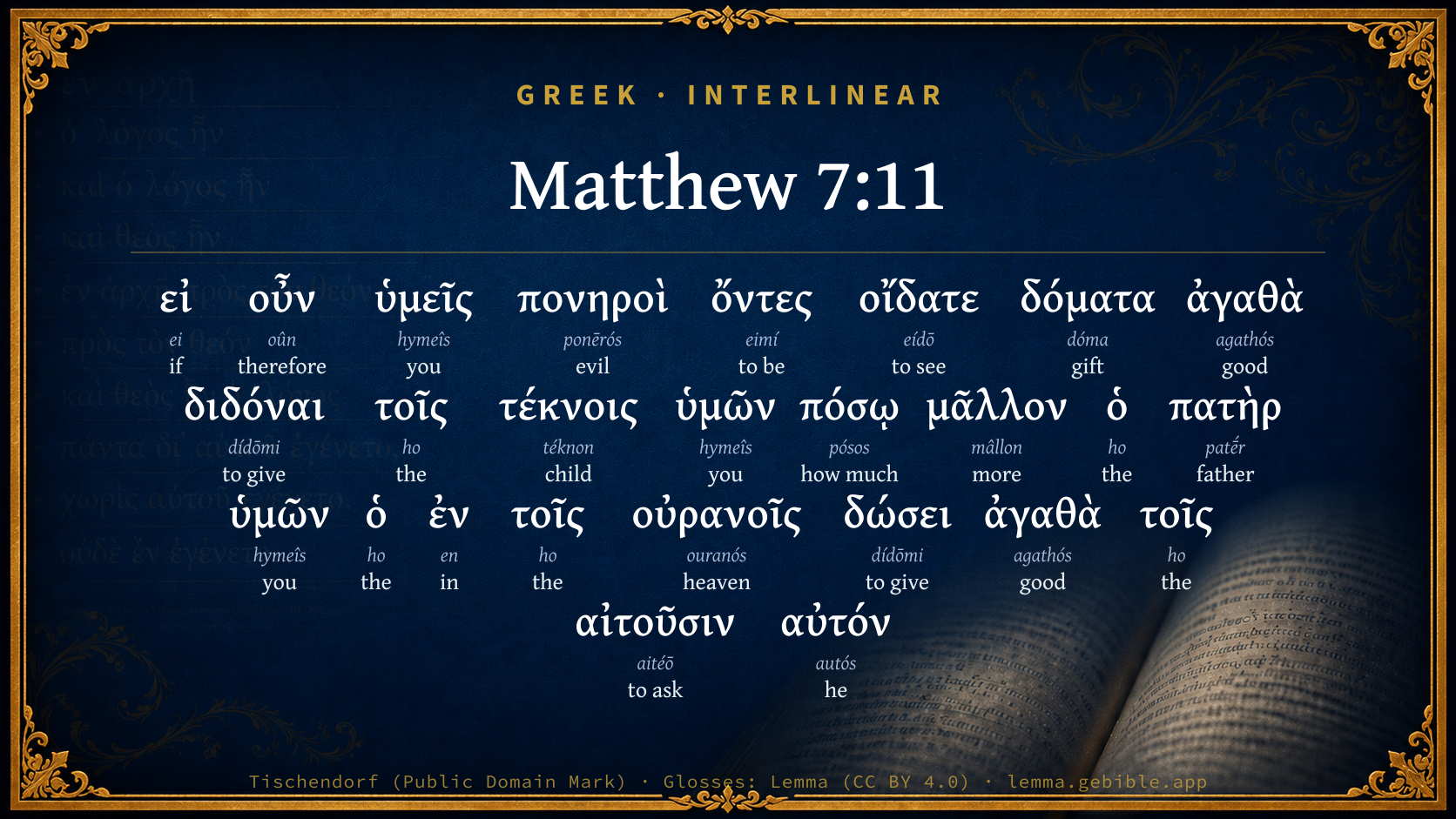
Greek (Tischendorf 8th ed.) Matthew 7:11 appears in the Greek New Testament. The text above is from the Tischendorf 8th edition. Each word links to its Strong’s number and a concise gloss. Click any word for its full Thayer’s Greek Lexicon entry.
Download image
Cite this verse

Matthew 7:11 (World English Bible). Public Domain. Lemma interlinear Bible study tool, https://lemma.gebible.app/v/matthew/7/11.

Show BibTeX & RIS
BibTeX
RIS
English Translation
If you then, being evil, know how to give good gifts to your children, how much more will your Father who is in heaven give good things to those who ask him!
World English Bible · Public Domain
Highlights
  • 1 first appearance in the Greek New Testament
Full analysis ↓
Download a study sheet

One document with this verse’s original text, its word-by-word gloss line, the meaning frame, cross-references with their text, attributed commentary, and full source and license credits — printable, and it pastes into notes with its structure intact.

This verse Autodidact and up

Study sheet (.html) Plain text (.txt)

A passage Seminary Student

Up to 50 verses in one chapter. A passage sheet keeps up to 6 commentary sources and 12 cross-references per verse, in the order this page ranks them, and says so on the sheet whenever that leaves anything out. Ask for a single verse and you get the Autodidact verse sheet above.

Everything on this page stays free to read, with no account — the sheet is a download of what is already on screen, not access to it.

Want to remove ads? Support Godless Engineer
Compare translations 3

The same verse in 3 English versions, stacked beneath the original-language interlinear above. Click any original word for its lexicon entry.

Each is an independent rendering of the whole verse — the interlinear is not word-aligned to these translations.

Highlighted words mark where these versions differ — a whole-verse word diff, not a word-by-word alignment.

  • World English Bible Public Domain
    If you then, being evil, know how to give good gifts to your children, how much more will your Father who is in heaven give good things to those who ask him!
  • King James Version Public Domain
    If ye then, being evil, know how to give good gifts unto your children, how much more shall your Father which is in heaven give good things to them that ask him?
  • unfoldingWord Literal Text CC BY-SA 4.0
    Therefore, if you, being evil, know how to give good gifts to your children, how much more will your Father in the heavens give good things to the ones asking him?

unfoldingWord Literal Text — © unfoldingWord, licensed CC BY-SA 4.0. Word-aligned USFM3 via Door43 (git.door43.org/unfoldingWord/en_ult).

Versions to compare (up to 4)

3 of 4 selected

Show all 19 translations

Every available English version of this verse, each an independent rendering of the whole verse.

  • World English Bible Public Domain
    If you then, being evil, know how to give good gifts to your children, how much more will your Father who is in heaven give good things to those who ask him!
  • Berean Standard Bible Public Domain
    So if you who are evil know how to give good gifts to your children, how much more will your Father in heaven give good things to those who ask Him!
  • Majority Standard Bible Public Domain
    So if you who are evil know how to give good gifts to your children, how much more will your Father in heaven give good things to those who ask Him!
  • King James Version Public Domain
    If ye then, being evil, know how to give good gifts unto your children, how much more shall your Father which is in heaven give good things to them that ask him?
  • American Standard Version (1901) Public Domain
    If ye then, being evil, know how to give good gifts unto your children, how much more shall your Father who is in heaven give good things to them that ask him?
  • Revised Version (1885) Public Domain
    If ye then, being evil, know how to give good gifts unto your children, how much more shall your Father which is in heaven give good things to them that ask him?
  • Geneva Bible (1599) Public Domain
    If ye then, which are euill, can giue to your children good giftes, howe much more shall your Father which is in heauen, giue good thinges to them that aske him?
  • Douay-Rheims (1899) Public Domain
    If you then being evil, know how to give good gifts to your children: how much more will your Father who is in heaven, give good things to them that ask him?
  • Young's Literal Translation Public Domain
    if, therefore, ye being evil, have known good gifts to give to your children, how much more shall your Father who `is' in the heavens give good things to those asking him?
  • Literal Standard Version CC BY-SA 4.0
    If, therefore, you being evil, have known to give good gifts to your children, how much more will your Father who [is] in the heavens give good things to those asking Him?
  • Unlocked Literal Bible CC BY-SA 4.0
    Therefore, if you who are evil know how to give good gifts to your children, how much more will your Father in heaven give good things to those who ask him?
  • unfoldingWord Literal Text CC BY-SA 4.0
    Therefore, if you, being evil, know how to give good gifts to your children, how much more will your Father in the heavens give good things to the ones asking him?
  • Darby Bible Public Domain
    If therefore *ye*, being wicked, know [how] to give good gifts to your children, how much rather shall your Father who is in the heavens give good things to them that ask of him?
  • World Messianic Bible Public Domain
    If you then, being evil, know how to give good gifts to your children, how much more will your Father who is in heaven give good things to those who ask him!
  • Webster's Bible Public Domain
    If ye then being evil know how to give good gifts to your children, how much more shall your Father who is in heaven give good things to them that ask him?
  • Free Bible Version CC BY-SA 4.0
    So if even you who are evil know to give good things to your children, how much more will your heavenly Father give good things to those who ask him.
  • Bible in Basic English Public Domain
    If you, then, being evil, are able to give good things to your children, how much more will your Father in heaven give good things to those who make requests to him?
  • Text-Critical English NT CC BY 4.0
    If you then, being evil, know how to give good gifts to your children, how much more will your Father in heaven give good things to those who ask him!
  • Tyndale New Testament (1534) Public Domain
    yf ye then which are evyll cane geve to youre chyldren good gyftes: how moche moore shall youre father which is in heven geve good thynges to them that axe hym?

Literal Standard Version (2020), Covenant Press — licensed CC BY-SA 4.0. Text via the HelloAO Bible API (eBible.org). Unlocked Literal Bible (unfoldingWord) — licensed CC BY-SA 4.0. Text via the HelloAO Bible API (eBible.org). unfoldingWord Literal Text — © unfoldingWord, licensed CC BY-SA 4.0. Word-aligned USFM3 via Door43 (git.door43.org/unfoldingWord/en_ult). Free Bible Version, Dr. Jonathan Gallagher — licensed CC BY-SA 4.0. Text via the HelloAO Bible API (eBible.org).

Word by word

More ways to search: Search by grammar → Find every occurrence → Compare this word →

Practice this passage: Drill this verse → Learn its vocabulary →

δόματα
dóma
G1390
“gift”
Noun, Accusative, Plural, Neuter
Part of Speech
Noun
Case
Accusative
Number
Plural
Gender
Neuter
Full Thayer's Definition

Origin: from the base of G1325

TDNT: None

1. a gift
  1. εἰ ei G1487 “if” Conditional
  2. οὖν oûn G3767 “therefore” Conjunction
  3. ὑμεῖς hymeîs G5210 “you” Personal pronoun, 2nd person, Nominative, Plural
  4. πονηροὶ ponērós G4190 “evil” Adjective, Nominative, Plural, Masculine
  5. ὄντες eimí G1510 “to be” Verb, Present, Active, Participle, Nominative, Plural, Masculine
  6. οἴδατε eídō G1492 “to see” Verb, Perfect, Active, Indicative, 2nd person, Plural
  7. ἀγαθὰ agathós G18 “good” Adjective, Accusative, Plural, Neuter
  8. διδόναι dídōmi G1325 “to give” Verb, Present, Active, Infinitive
  9. τοῖς ho G3588 “the” Article, Dative, Plural, Neuter
  10. τέκνοις téknon G5043 “child” Noun, Dative, Plural, Neuter
  11. ὑμῶν hymeîs G5210 “you” Personal pronoun, 2nd person, Genitive, Plural
  12. πόσῳ pósos G4214 “how much” Correlative/interrogative pronoun, Dative, Singular, Neuter
  13. μᾶλλον mâllon G3123 “more” Adverb
  14. ὁ ho G3588 “the” Article, Nominative, Singular, Masculine
  15. πατὴρ patḗr G3962 “father” Noun, Nominative, Singular, Masculine
  16. ὑμῶν hymeîs G5210 “you” Personal pronoun, 2nd person, Genitive, Plural
  17. ὁ ho G3588 “the” Article, Nominative, Singular, Masculine
  18. ἐν en G1722 “in” Preposition
  19. τοῖς ho G3588 “the” Article, Dative, Plural, Masculine
  20. οὐρανοῖς ouranós G3772 “heaven” Noun, Dative, Plural, Masculine
  21. δώσει dídōmi G1325 “to give” Verb, Future, Active, Indicative, 3rd person, Singular
  22. ἀγαθὰ agathós G18 “good” Adjective, Accusative, Plural, Neuter
  23. τοῖς ho G3588 “the” Article, Dative, Plural, Masculine
  24. αἰτοῦσιν aitéō G154 “to ask” Verb, Present, Active, Participle, Dative, Plural, Masculine
  25. αὐτόν autós G846 “he” Personal pronoun, Accusative, Singular, Masculine

About this verse

These counts appear in no published source. They are computed here, from the morphology-tagged text and Lemma’s own curated glosses. What Lemma adds →

26
words
18
distinct lemmas
Gospels
section

Notable vocabulary

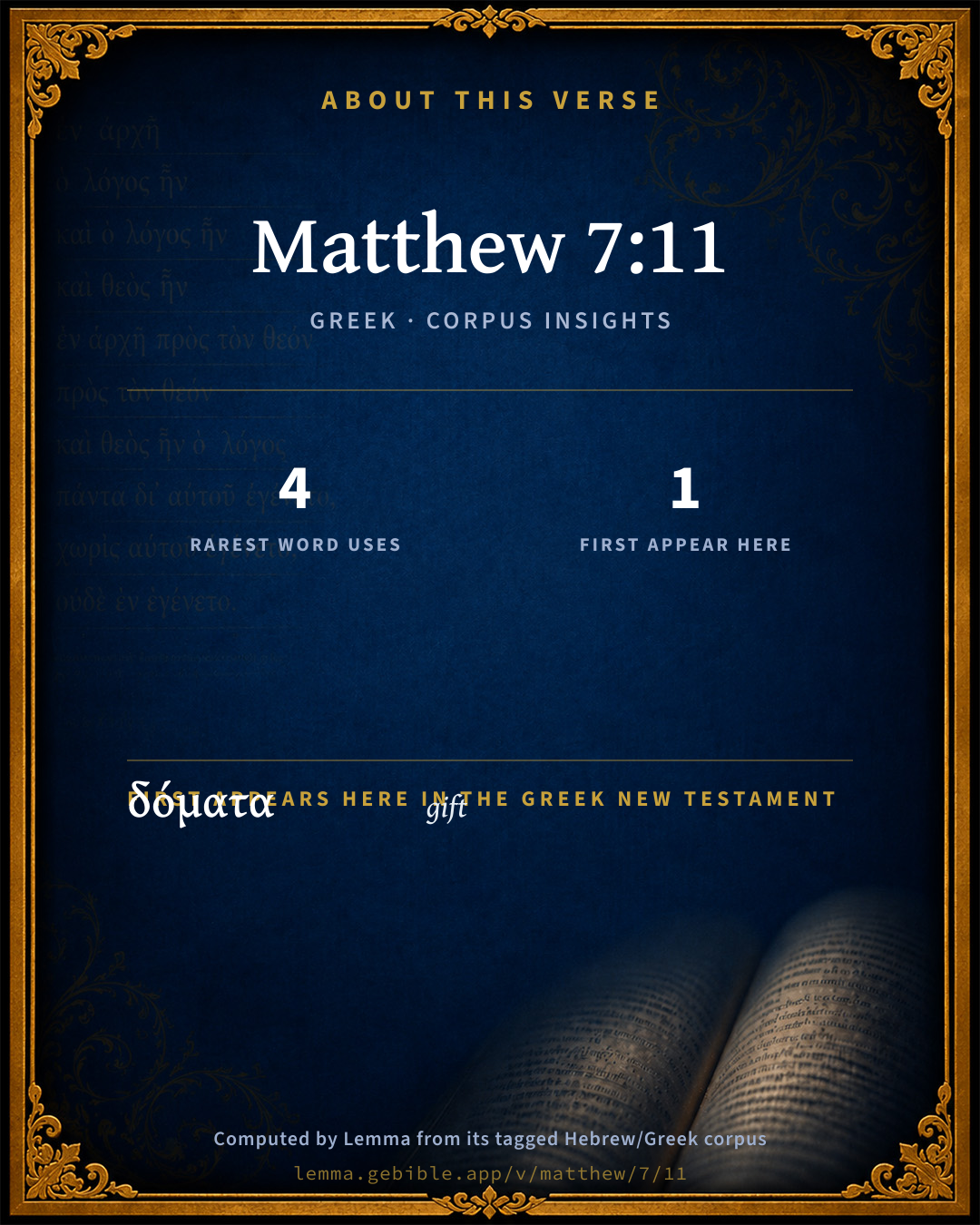
The rarest word here is δόματα gift G1390 — appearing just 4 times in the whole Greek New Testament.

First appearance in Scripture

This word makes its first canonical appearance in the Greek New Testament here:

  • δόματα gift G1390

Shared distinctive vocabulary

δόματα gift G1390 occurs in 4 verses of the Greek New Testament. Also found in:
Repetition

Words recur within this verse:

  • ἀγαθὰ good G18 ×2
  • διδόναι to give G1325 ×2
  • τοῖς the G3588 ×5
  • ὑμεῖς you G5210 ×3

Cross-references

32

Topical passages linked to Matthew 7:11 in the Treasury of Scripture Knowledge — connected by theme and wording, ordered by reader-vote popularity; previews shown in the World English Bible.

  • Luke 11:11–13 "Which of you fathers, if your son asks for bread, will give him a stone? Or if he asks for a fish, he won't give him a snake instead of a fish, will he?
  • James 1:17 Every good gift and every perfect gift is from above, coming down from the Father of lights, with whom can be no variation, nor turning shadow.
  • Romans 8:32 He who didn't spare his own Son, but delivered him up for us all, how would he not also with him freely give us all things?
  • Psalms 84:11 For Yahweh God is a sun and a shield. Yahweh will give grace and glory. He withholds no good thing from those who walk blamelessly.
  • Isaiah 49:15 Can a woman forget her sucking child, that she should not have compassion on the son of her womb? yes, these may forget, yet I will not forget you.
  • John 3:16 For God so loved the world, that he gave his one and only Son, that whoever believes in him should not perish, but have eternal life.
  • Psalms 86:15 But you, Lord, are a merciful and gracious God, Slow to anger, and abundant in loving kindness and truth.
  • Ephesians 2:1–5 You were made alive when you were dead in transgressions and sins,
  • 1 John 4:10 In this is love, not that we loved God, but that he loved us, and sent his Son as the atoning sacrifice for our sins.
  • Genesis 8:21 Yahweh smelled the sweet savor. Yahweh said in his heart, "I will not again curse the ground any more for man's sake, because the imagination of man's heart is evil from his youth; neither will I ever again strike everything living, as I have done.
  • Psalms 86:5 For you, Lord, are good, and ready to forgive; Abundant in loving kindness to all those who call on you.
  • 1 John 3:1 Behold, how great a love the Father has bestowed on us, that we should be called children of God! For this cause the world doesn't know us, because it didn't know him.
  • Genesis 6:5 Yahweh saw that the wickedness of man was great in the earth, and that every imagination of the thoughts of his heart was only evil continually.
  • Isaiah 55:8–9 For my thoughts are not your thoughts, neither are your ways my ways, says Yahweh.
  • 2 Corinthians 9:8–15 And God is able to make all grace abound to you, that you, always having all sufficiency in everything, may abound to every good work.
  • Micah 7:18 Who is a God like you, who pardons iniquity, And passes over the disobedience of the remnant of his heritage? He doesn't retain his anger forever, Because he delights in loving kindness.
  • Psalms 85:12 Yes, Yahweh will give that which is good. Our land will yield its increase.
  • Psalms 103:11–13 For as the heavens are high above the earth, So great is his loving kindness toward those who fear him.
  • Malachi 1:6 "A son honors his father, and a servant his master. If I am a father, then where is my honor? And if I am a master, where is the respect due me? Says Yahweh of Hosts to you, priests, who despise my name. You say, 'How have we despised your name?'
  • Luke 2:10–11 The angel said to them, "Don't be afraid, for behold, I bring you good news of great joy which will be to all the people.
  • Titus 3:3–7 For we were also once foolish, disobedient, deceived, serving various lusts and pleasures, living in malice and envy, hateful, and hating one another.
  • Romans 3:19 Now we know that whatever things the law says, it speaks to those who are under the law, that every mouth may be closed, and all the world may be brought under the judgment of God.
  • Romans 5:8–10 But God commends his own love toward us, in that while we were yet sinners, Christ died for us.
  • Exodus 34:6–7 Yahweh passed by before him, and proclaimed, "Yahweh! Yahweh, a merciful and gracious God, slow to anger, and abundant in loving kindness and truth,
  • 2 Samuel 7:19 This was yet a small thing in your eyes, Lord Yahweh; but you have spoken also of your servant's house for a great while to come; and this [too] after the manner of men, Lord Yahweh!
  • Jeremiah 33:14 Behold, the days come, says Yahweh, that I will perform that good word which I have spoken concerning the house of Israel and concerning the house of Judah.
  • Hosea 11:8–9 "How can I give you up, Ephraim? How can I hand you over, Israel? How can I make you like Admah? How can I make you like Zeboiim? My heart is turned within me, My compassion is aroused.
  • Galatians 3:22 But the Scriptures shut up all things under sin, that the promise by faith in Jesus Christ might be given to those who believe.
  • Job 15:16 How much less one who is abominable and corrupt, A man who drinks iniquity like water!
  • Jeremiah 17:9 The heart is deceitful above all things, and it is exceedingly corrupt: who can know it?
  • Hosea 14:2 Take words with you, and return to Yahweh. Tell him, "Forgive all our sins, And accept that which is good: So we offer like bulls our lips.
  • Romans 3:9 What then? Are we better than they? No, in no way. For we previously charged both Jews and Greeks, that they are all under sin.

Cross-references courtesy of OpenBible.info (CC BY 4.0).

Commentary

Notes on Matthew 7:11 from classic Christian and Jewish commentators (each source and its license shown beneath its notes). The classic Christian expositions comment on the surrounding passage and are grouped to its opening verse, so a note may address several verses; the Jewish commentaries on the Tanakh (Rashi and others) are per-verse, so they appear only where the commentator wrote on this verse.

Lemma curates 59 commentaries, every one of them public domain or Creative Commons licensed, each selected and text-cleaned for this edition rather than reprinted as found. About our sources →

Bengel's Gnomon

Johann Albrecht Bengel

Mat 7:11. Ὑμεῖς, you) Christ rightly excepts Himself, and no one else.[311]—The ὑμεὶς; here refers to ἐξ ὑμῶν, of you, in Mat 7:9.—πονηροὶ, evil) An illustrious testimony to the doctrine of original sin. Cf. the evil one,[312] Mat 6:13. The Panegyric of Gregory[313] Thaumaturgus (p. 20, 146), has a similar confession of the evilness of human nature, with an emphasis rare in that age. Man is addressed as evil in the Scriptures. See ch. Mat 10:17, and Joh 2:25.[314] It is wonderful therefore that Holy Scripture should have ever been received by the human race. Bread and fish are good things; man is evil, prompt to commit injury.[315]—οἴδατε, ye know) Distinguishing bread from a stone, etc. It is wonderful that this understanding (intelligentiam) has remained in us. We are so evil. Cf. Job 39:17[316] with the preceding verses.—ἀγαθὰ, good things) both harmless and profitable things.[317]—τοῖς τέκνοις ὑμῶν, to your children) especially when they ask you.—ὁ ἐν τοῖς οὐρανοῖς, which is in the heavens) In whom there is no evil.—τοῖς αἰτοῦσιν, to them that ask) sc. His children; for where true prayer begins, there is Divine sonship.

[311] What man of you, Mat 7:9, implies that all but Himself are included in His words.—(ED.)

[312] Men who are devoid of a godly disposition imitate him.—B. G. V.

[313] GREGORY, surnamed THAUMATURGUS, or the wonder-worker, was born at Neo-Cæsarea, in Cappadocia. He was originally a heathen, and highly educated, in the learning of the ancients. He afterwards embraced Christianity, and studied under Origen. Having taken orders, he was ordained Bishop of his native city about 239. He died between 264 and 271. He was a man of high attainments and great piety. Several valuable works of his are still in existence; that alluded to here, is his Panegyric on his master Origen, edited by Bengel, A.D. 1722.—(I. B.)

[314] E. B. and the later editions add Mat 16:23, Rom 3:4, etc.—(I. B.)

[315] It is in fact wonderful that a human father, when his son asks him for a fish, does not offer him a serpent.—V. g.

[316] Where the Vulgate has—Privavit enim eam Deus sapientiâ nec dedit illi intelligentiam—and E. V. “Because God hath deprived her of wisdom, neither hath He imparted to her understanding”—(I. B.)

[317] And therefore also the Good Spirit Himself. V. g.

In the original the expressions used are, Malus, malitiam, male audit.—As the first of these = the Evil One, I have rendered the others so as to correspond with it.—(I. B)

Bengel's Gnomon of the New Testament — English translation (T&T Clark, Edinburgh, 1860) — public domain. Text from a community e-Sword module.

Meyer's Critical & Exegetical Commentary

Heinrich August Wilhelm Meyer

Mat_7:11. Πονηροὶ ὄντες] although ye, as compared with God, are morally evil.[427] Comp. Mat_19:17. Even Kuinoel has given up the false rendering, niggardly (in conformity with Pro_23:6; Sir_14:5).

οἴδατε διδόναι] not soletis dare (Maldonatus, Wetstein, Kuinoel), but ye know, understand, how to give (1Ti_3:5, and see note on Php_4:12), not as referring, however, to the disposition (de Wette, Fritzsche), which in so doing is rather presupposed, but appropriately pointing to the thoughtful nature of paternal love, which, in spite of the πονηρία, understands how to render possible the giving of good gifts to children.

δόματα ἀγαθά] wholesome gifts, in contrast to the stone and the serpent. For the second ἀγαθά, Luk_11:13 has πνεῦμα ἅγιονa later substitution of the particular for the general. For the inference a minori ad majus, comp. Isa_49:15.

[427] Chrysostom appropriately says: ταῦτα δὲ ἔλεγεν οὐ διαβάλλων τὴν ἀνθρωπίνην φύσιν, οὐδὲ κακίζων τὸ γένος, ἀλλὰ πρὸς ἀντιδιαστολὴν τῆς ἀγαθότητος τῆς αὐτοῦ (of God) τὴν φιλοστοργίαν τὴν πατρικὴν πονηρίαν καλῶν. It is not original sin, but the historical manifestation of the sin of all men, which is spoken of, of which, however, original sin is the internal, natural root. Comp. Mat_15:19; Joh_3:6.

Meyer — Critical and Exegetical Commentary on the New Testament — English translation by Peter Christie, edited by Frederick Crombie (T&T Clark, 1880) — public domain. Text from a community e-Sword module.

Expositor's Greek Testament

ed. W. Robertson Nicoll

Mat 7:11 , πονηροὶ , morally evil, a strong word, the worst fathers being taken to represent the class, the point being that hardly the worst will treat their children as described. There is no intention to teach a doctrine of depravity, or, as Chrysostom says, to calumniate human nature ( οὐ διαβάλλων τὴν ἀνθρωπίνην φύσιν ). The evil specially in view, as required by the connection, is selfishness, a grudging spirit: “If ye then, whose own nature is rather to keep what you have than to bestow it on others, etc.” (Hatch, Essays in [48] . Gr., p. 81). οἴδατε διδόναι soletis dare, Maldon. Wetstein; rather, have the sense to give; with the infinitive as in Php 4:12 , 1Ti 3:5 . Perhaps we should take the phrase as an elegant expression for the simple δίδοτε . So Palairet. δόματα , four times in N. T. for the attic δῶρον , δώρημα ; δομ . ἀγαθὰ , gifts good not only in quality (bread not stone, etc.) but even in measure, generous, giving the children more than they ask. πόσῳ μᾶλλον , a fortiori argument. ὁ πατὴρ , etc., the Father whose benignant nature has already been declared, Mat 5:45 . ἀγαθὰ , good things emphatically, insignia dona , Rosenm., and only good (Jas 1:17 , an echo of this utterance). This text is classic for Christ’s doctrine of the Fatherhood of God.

[48] Codex Vaticanus (sæc. iv.), published in photographic facsimile in 1889 under the care of the Abbate Cozza-Luzi.

The Expositor's Greek Testament, edited by W. Robertson Nicoll (1897–1910) — public domain. Text from a community e-Sword module.

Jamieson, Fausset & Brown

Robert Jamieson, A. R. Fausset & David Brown

If ye then, being evil, know how to give good gifts unto your children, how much more shall your Father which is in heaven give good things to them that ask him!--Bad as our fallen nature is, the father in us is not extinguished. What a heart, then, must the Father of all fathers have towards His pleading children! In the corresponding passage in Luke (see on Luk 11:13), instead of "good things," our Lord asks whether He will not much more give the Holy Spirit to them that ask Him. At this early stage of His ministry, and before such an audience, He seems to avoid such sharp doctrinal teaching as was more accordant with His plan at the riper stage indicated in Luke, and in addressing His own disciples exclusively.

Golden Rule (Mat 7:12).

Jamieson, Fausset & Brown — Commentary Critical and Explanatory on the Whole Bible (1871) — public domain (CC PDM 1.0). Text via the HelloAO Bible API.

Adam Clarke's Commentary

Verse 11. If ye, then, being evil] πονηροι οντες, who are radically and diabolically depraved, yet feel yourselves led, by natural affection, to give those things to your children which are necessary to support their lives, how much more will your Father who is in heaven, whose nature is infinite goodness, mercy, and grace, give good things - his grace and Spirit (πνευμα αγτον, the Holy Ghost, Lu 11:13,) to them who ask him? What a picture is here given of the goodness of God! Reader, ask thy soul, could this heavenly Father reprobate to unconditional eternal damnation any creature he has made? He who can believe that he has, may believe any thing: but still GOD IS LOVE.

Adam Clarke's Commentary on the Bible (1810–1826) — public domain. Text from a community e-Sword/MySword module.

Ellicott's Commentary for English Readers

(11) If ye then, being evil.—The words at once recognise the fact of man’s depravity, and assert that it is not total. In the midst of all our evil there is still that element of natural and pure affection which makes the fatherhood of men a fit parable of the Fatherhood of God. We mount from our love to His, abstracting from our thoughts the evil of which we cannot but be conscious.

Give good things to them that ask him.—The context shows that the “good things” are spiritual and not temporal gifts, the wisdom and insight which we all need, or rather (as in the parallel passage of Luk_11:13) the one gift of the Holy Spirit, which, in its sevenfold diversity, includes them all.

A Bible Commentary for English Readers, edited by Charles John Ellicott (1878–1897) — public domain. Text from a community e-Sword module.

The Cambridge Bible for Schools and Colleges

gen. ed. J. J. S. Perowne

11. good things] For this St Luke (Luk_11:13) has “the Holy Spirit,” shewing that spiritual rather than temporal “good things” are intended.

The Cambridge Bible for Schools and Colleges (gen. ed. J. J. S. Perowne; Cambridge University Press, 1878–1918) — public domain. Text from a community e-Sword module.

John Gill's Exposition

Therefore all things whatsoever,.... These words are the epilogue, or conclusion of our Lord's discourse; the sum of what he had delivered in the two preceding chapters, and in this hitherto, is contained in these words; for they not only respect the exhortation about judging and reproving; but every duty respecting our neighbour; it is a summary of the whole. It is a golden rule, here delivered, and ought to be observed by all mankind, Jews and Gentiles. So the Karaite Jews (l) say,

"all things that a man would not take to himself, , "it is not fit to do them to his brethren".''

And Maimonides (m) has expressed it much in the same words our Lord here does;

"all things whatsoever ye would that others should do to you, (says he,) do you the same to your brethren, in the law, and in the commandments:''

only there seems to be a restriction in the word "brethren"; the Jews, perhaps, meaning no other than Israelites; whereas our Lord's rule reaches to all without exception, "all things whatsoever"

ye would that men should do to you, do ye even so to them: let them be who they will, whether brethren, or kinsmen, according to the flesh, or what not; "for this is the law and the prophets": the sum of the law and the prophets; not the whole sum of them, or the sum of the whole law: but of that part of it which respects our neighbours. Remarkable is the advice given by Hillell (n) to one who came to be made a proselyte by him;

"whatsoever is hateful to thee, that do not thou to thy neighbour; , "this is all the whole law", and the rest is an explication of it, go and be perfect:''

yea, this rule is not only agreeable to the law of Moses, and the prophets, but even to the law and light of nature. Aristotle being asked, how we ought to carry ourselves to our friends, answered (o), as we would wish they would carry it to us. Alexander Severus, a Heathen emperor, so greatly admired this rule of Christ's, that he ordered it to be written on the walls of his closet.

(l) R. Eliahu Addaret, c. 3. apud Trigland de sect. Karaeorum, c. 10. p. 166. Vid. Tzeror Hammor, fol. 146. 4. (m) Hilch. Ebel. c. 14. sect. 1. (n) T. Bab. Sabbat, fol. 31. 1. Maimon. in Misn. Peah, c. 1. sect. 1. (o) Diog. Laert. in Vit. Aristotel. l. 5.

John Gill's Exposition of the Whole Bible (1746–1763) — public domain (CC PDM 1.0). Text via the HelloAO Bible API.

Trapp's Complete Commentary

John Trapp

11 If ye then, being evil, know how to give good gifts unto your children, how much more shall your Father which is in heaven give good things to them that ask him?

Ver. 11. If ye then being evil] Even ye my disciples also; for by nature there is never a better of us. But as the historian said that there were many Marii in one Caesar, so there are many Cains and Judases in the best of us all. Homo est inversus decalogus, saith one: whole evil is in man, and whole man in evil; yea, in the devil, whose works (even in the best of his saints) Christ came to destroy, to dissolve the old frame, and to drive out the prince of darkness, who hath there intrenched himself. And although sin in the saints hath received its death’s wound, yet there are still in the best continual stirrings and spruntings thereof (as in dying creatures it useth to be), which (without God’s greater grace, and the counter motion of the Holy Spirit within them) would certainly produce most shameful evils. This put St Paul to that pitiful outcry, Rom 7:24, and made him exhort Timothy (though he were a young man rarely mortified) to exhort the younger women with all pureness, or chastity; intimating, that through the corruption of his nature, even while he was exhorting them to chastity, some unchaste motions might steal upon him unawares. {a} A tree may have withered branches by reason of some deadly blow given to the root, and yet there may remain some sap within, which will bud and blossom forth again. Or as of some wild fig tree, saith a Father, that grows in the walls of a goodly building, and hides the beauty of it, the boughs and branches may be cut or broken off, but the root, which is wrapped into the stones of the building, cannot be taken away till the wall be thrown down and the stones cast one from another. So sin that dwelleth in us hath its roots so inwrapped and intertwined in our natures, that it can never be utterly extirpated; but pride will bud, Eze 7:10, and the fruits of the flesh will be manifest, Gal 5:19, though we be daily lopping off the branches, and labouring also at the root. Sin is an inmate that will not leave, do what we can, till the house fall upon the head of it; a hereditary disease, and that which is bred in the bone, will never leave the flesh; a pestilent hydra, somewhat akin to those beasts in Daniel, that had "their dominion taken away, yet were their lives prolonged for a time and a season," Dan 7:12.

How much more will your Father which is in heaven give good things] Give the Holy Spirit, saith St Luke; {Luk 11:13} for nihil bonum sine summo bone, saith St Austin; when God gives his Spirit, he gives all good things, and that which is more than all besides. For it is a spirit of judgment and of burning, of grace and of deprecation, of knowledge, and of the fear of the Lord, of strength and of might, enabling both to resist evil of sin, and to endure evil of sorrow, Isa 4:4; Isa 11:2; Zec 12:10. And for good things, temporal, to trample on them; spiritual, to reach after them. It is a free spirit, setting a man at liberty from the tyranny of sin and terror of wrath, 2Co 3:17; and oiling his joints, that he may be active and abundant in the Lord’s work. This Holy Spirit is signified by those two golden pipes, Zec 4:12, through which the two olive branches, the ordinances, empty out of themselves the golden oils of all precious graces into the candlestick, the Church. And how great a favour it is to have the Holy Spirit our inhabitant, see Joe 2:28-29, where, after God had promised the former and latter rain, floors full of wheat, and vats full of wine and oil, a confidence of all outward comforts and contentments; he adds this as more than all the rest, "I will also pour out my Spirit upon all flesh," Joe 2:23; Joe 2:28. He will pour out, not drop down only sparingly and pinchingly, as some penny father, but pour out like a liberal householder, as it were, by pails or bucketfuls. And what? my Spirit, that noble Spirit, as David calleth it, that Comforter, Counsellor, conduct into the land of the living. And upon whom? upon all flesh: spirit upon flesh, so brave a thing upon so base a subject. {b} Next to the love of Christ indwelling in our nature, we may well wonder at the love of the Holy Ghost that will dwell in our defiled souls; that this Spirit of glory and of God, 1Pe 4:14, will deign to rest upon us, as the cloud did upon the tabernacle. How glad was Lot of the angels, Micah of the Levite, Elisabeth of the mother of her Lord, Lydia of Paul, Zaccheus of Christ, Obededom of the ark! And shall not we be as joyful and thankful for the Holy Spirit, whereby we are sealed (as merchants set their seals upon their wares) until the day of redemption? Eph 4:30. If David for outward benefits brake out into, "What is man, that thou art mindful of him?" Psa 8:4; and Job {Job 7:17} for fatherly chastisements, "What is man, that thou shouldest magnify him?" &c., how should this best gift of his Holy Spirit affect and ravish us! since thereby all mercies are seasoned and all crosses sanctified; neither can any man say (experimentally and savingly), "that Jesus is the Lord, but by the Holy Ghost," 1Co 12:3.

Give good things to them that ask him] sc. If they ask in faith, bring honest hearts, and lawful petitions, and can wait God’s leisure. Let none say here, as the prophet in another case, "I have laboured in vain, and spent my strength for nought," Isa 49:4; I have prayed and sped not, the more I pray the worse it is with me. "The manner of our usage here in prison doth change" (saith Bishop Ridley in a letter to Bradford) "as sour ale doth in summer;" and yet who doubts but they prayed earn and earnestly, when they were in Bocardo, that college of Quondams, when those bishops were there prisoners? God is neither unmindful nor unfaithful, but waits the fittest time to show mercy, and will surely "avenge his own elect, which cry day and night unto him, though he bear long with them," Luk 18:7. The seed must have a time to grow downward before it grows upward. And as that seed which is longest covered riseth the first, with most increase; so those prayers which seem lost, are laid up in heaven, and will prove the surest grain. The more we sow of them into God’s bosom, the more fruit and comfort we shall reap and receive in our greatest need.

{a} εν παση αγνεια, 1Ti 5:2

{b} Psa 51:12, Opponitur carni spiritus, i.e. res praestantissima rei plane fragili et caducae: quam tamen Dominus dignetur excellenti spiritus sui munere. Beza.

John Trapp, A Commentary or Exposition upon All the Books of the Old and New Testament (1647–1656) — public domain. Text from a community e-Sword module.

Whedon's Commentary on the Bible

Daniel D. Whedon

11. Being evil — Evil of course, because human. What is man that he should be clean? Even in those tender relations and feelings that are supposed to be the best part of our nature, alas! we are still evil.

Daniel D. Whedon (gen. ed.), Commentary on the Old and New Testaments (1874–1909) — public domain. Text from a community e-Sword module.

The Pulpit Commentary

Parallel passage: Luk_11:13. If ye then being evil. Application of the thought of vers. 9, 10, with further emphasis on the evil of human nature. If you with your moral worthlessness, (Mat_6:13, note) etc.. (cf. also Mat_12:34) Being (gqrov). The presence here in the parallel passage of Luke of his common word uparcontev points to St. Matthew"s form of the sentence being the more original. Know; intuitively (oidate). Notwithstanding, then, the evil bent of fallen human nature, there is some good still remaining. How much more shall your Father which is in heaven. "In quo nulla est malitia" (Bengel). Give good things. Observe:

(1) In the parallel passage in Luke, "the Holy Spirit," or, more strictly, an outpouring of the Holy Spirit (Pneuma Agion)..The historian of the early Church not unnaturally singles out that gift which ultimately produces all others; but St. Matthew, keeping to the general subject of wisdom, etc., in the treatment of our brethren, uses a more distributive expression which yet includes the particular gift asked for.

(2) Is the omission of the word "gifts" in this clause to be accounted for by our Lord not wishing to suggest that the grace asked for is so given as that it can afterwards be possessed apart from the Giver?

Vers. 11, 12. The improvement upon the earthly pattern.

Although the "asking" in ver. 7 was pressed on to the further developments of "seeking" and "knocking," our Lord returns here to the most generic form of application on the part of one person to another in his use of the word "ask," when he speaks of "them that ask him." But, perhaps, not only because this is the most generic description of application from one to another is the word used in this connection, but because further it embodies least of the participation of the applicant, and when the answer comes to him, and, it may be, the rich gift falls into his lap, then least can he claim it as the result of his own work, merit, co-operation. He must acknowledge it the sovereign gift of sovereign grace. Notice in this passage

I THE CONDESCENDING USE OF THE EARTHLY PATTERN FOR THE THINGS OF THE HEAVENLY PATTERN.

II THE INCORRUPT FIDELITY OBSERVED IS THAT USE. The pattern is quoted, is used; but its imperfect adequacy is openly averred. The pattern is not only in a lower sphere, not only on a lower scale, but it is admittedly marred; it is a fallen pattern, a pattern obtaining indeed, subsisting indeed, actual; yet among the fallen, erring, faulty, and sinful, all in turn.

III THE UNSTINTED ENCOURAGEMENT (TO OFFER WHICH IS THE MANIFEST CENTRAL AIM OF THE PATTERN QUOTED, ITS FIDELITY AND ALL INCLUDED) TO THE APPLICANTS AND CANDIDATES OF GOD"S KINGDOM. The perfection alike of willingness and of wisdom combined is now the sovereign Dispenser, the universal impartial Distributor.

IV THE GRAND USE MADE OF AN OCCASION OF A PARTIAL SUMMARIZING (ver. 12) TO PROCLAIM THE NEW COVENANT FORM OF THE SECOND TABLE OF THE OLD AND VENERABLE AND UNIVERSAL TEN COMMANDMENTS. With our ver. 12 comp. Mat_5:17. From the kind of giving and the manner of giving (i.e. in reply to asking) of fathers in imperfect and "evil" human society, and from the supreme example of the perfection in both kind and manner of the Father which is in heaven, the grand dictum of most sacred heavenly lips utters itself forth for the regulating of men"s mutual relations, wide as the world stretches, and long as the world lasts. B.

Human and Divine fatherhoods.

God can only be apprehended by man through some relations that are familiar to man. It may be assumed that the highest, best, most universal, of human relations will be found most fittingly to represent him. The one relation which is universal, and universally esteemed the highest, is the parental. It is passing strange that any difficulty should be found in securing the thankful acceptance of the doctrine of the Divine Fatherhood. Probably men are hindered by the desire to attain abstract conceptions of the Divine Being; certainly they are hindered by observing the patent fact of the imperfection of human fatherhoods. But it is the ideal Fatherhood, which human fatherhoods do but suggest, which alone can be applied to God. We not only have references to God as the Father characteristic of our Lord"s teaching indeed, it is almost the only word he uses for God but in this text we have his own comparison of the human and Divine fatherhoods, giving a precedent of which we may confidently take advantage. Probably theology would become altogether more human and more attractive if this comparison were more freely made. Man in the image of God is the best revelation of God. And it should be easy to separate man as man from man the sinner.

I THE HUMAN FATHER IS A PRAYER-HEARER.

1. This he is by virtue of his relationship. A father has children; they are dependent on him. Dependence is the essence of prayer; it may be silent or it may be vocal.

2. This he is upon impulse of affection. His love inspires willingness to hear the needs of his children. Their good. is a personal interest to him.

3. This he is by the persuasion of duty. All relations involve responsibilities; and a father is under obligation to meet the wants of his children, whether he knows them upon fatherly observation, or they make them known to him by cry and prayer.

II THE DIVINE FATHER IS A PRAYER-HEARER.

1. He also has been pleased to sustain relations as the Author of our being. And our dependence on our Creator is prayer to which he must respond.

2. He also has declared his personal love to us; and love must be heedful of the needs of its objects.

3. We may even think of God as being placed under honourable obligations by the relations into which he has brought us. R.T.

The Pulpit Commentary (1880–1919), ed. H.D.M. Spence-Jones & Joseph S. Exell — public domain. Text from a community e-Sword module.

John Wesley's Explanatory Notes

To them that ask him - But on this condition, that ye follow the example of his goodness, by doing to all as ye would they should do to you. For this is the law and the prophets - This is the sum of all, exactly answering Chap. v, 17. The whole is comprised in one word, Imitate the God of love. Thus far proceeds the doctrinal part of the sermon. In the next verse begins the exhortation to practice it.

John Wesley, Explanatory Notes Upon the Whole Bible (1754–1765) — public domain. Text via the GEBible commentary corpus.

The People's New Testament

B. W. Johnson

11. If ye, then, being evil. Men who have the natural affection of parents, even though sinful men, will not do such things. Whoever believes that the term Father, as applied to God, is more than a figure of speech, must believe in prayer. Give good gifts. Luke 11:13, in the parallel passage, says, instead of “good gifts,” “the Holy Spirit,” as though this is heaven's greatest blessing.

B. W. Johnson's The People's New Testament with Notes (1889–1891) — public domain. Electronic text from the Christian Classics Ethereal Library (CCEL) ThML edition.

unfoldingWord translationNotes

Door43 World Missions Community

General Information:

Jesus is talking to a group of people about what they as individuals should or should not do. The instances of "you" and "your" are plural. (See: Forms of You)

how much more will your Father in heaven give ... him?

Jesus uses a question to teach the people. AT: "then your Father in heaven will most certainly give ... him." (See: Rhetorical Question)

Father

This is an important title for God. (See: Translating Son and Father)

whatever things you want people to do to you

"whatever way you want others to act toward you"

for this is the law and the prophets

Here "law" and "prophets" refer to what Moses and the prophets wrote. AT: "for this is what Moses and the prophets teach in the scriptures" (See: Metonymy)

translationWords

evil

good

gift

God the Father

heaven

law

prophet

unfoldingWord translationNotes — © Distant Shores Media and the Door43 World Missions Community, licensed CC BY-SA 4.0. Source: git.door43.org/Door43/en_tn.

Cambridge Greek Testament for Schools and Colleges

11. πονηροί. ‘Evil’ as compared with the perfect righteousness of God.

ἀγαθά. For this St Luke (Luk 11:13) has ‘the Holy Spirit,’ shewing that spiritual rather than temporal ‘good things’ are intended.

Cambridge Greek Testament for Schools and Colleges (Cambridge University Press, 1896; 21 vols, various authors incl. Carr, Maclear, Plummer, Farrar, Lumby, Moule, M. R. James, Simcox) — public domain. Text from a community e-Sword module.

Alford’s Greek Testament

Henry Alford

11. πονηροί] i.e. in comparison with God. It is not necessary to suppose a rebuke conveyed here, but only a general declaration of the corruption and infirmity of man. Augustine remarks, in accordance with this view, that the persons now addressed are the same who had been taught to say ‘Our Father’ just now. ταῦτα δὲ ἔλεγεν οὐ διαβάλλων τὴν ἀνθρωπίνην φύσιν οὐδὲ κακίζων τὸ γένος· ἀλλὰ πρὸς ἀντιδιαστολὴν τῆς ἀγαθότητος τῆς αὐτοῦ. Chrys. Hom. xxiii. 4, p. 290. Stier remarks, “This saying seems to me the strongest dictum probans for original sin in the whole of the Holy Scriptures.” R. J. i. 236.

ἀγαθά] principally, His Holy Spirit, Luk 11:13. The same argument à fortiori is used by our Lord in the parable of the unjust judge, Luk 18:6, Luk 18:7.

Henry Alford, The Greek Testament (1849–1861) — public domain. Text from a community e-Sword module.

International Critical Commentary

11. If ye therefore, who are evil, know how to give good gifts to your children, how much more will your Father who is in the heavens give good things to those who ask Him.] Lk. has: “If ye, therefore, who are (ὑπάρχοντες) evil, know how to give good gifts to your children; how much more will the Father who is from heaven give the Holy Spirit to those who ask Him?”

(L)

International Critical Commentary — older volumes (1896–1929), various authors — public domain. Text from a community e-Sword module.

Lesson kit

Teaching starters — assembled from the data on this page, not authored interpretation. Every prompt links to the verse data it draws on. Edit before teaching.

Matthew, in the Gospels, opens this verse with 26 words (18 distinct Greek lemmas). Its most distinctive word is dóma (“gift”). A historical commentator’s framing appears above. Read the whole chapter for the surrounding context.

Discussion questions

  1. How does “gift” (dóma) shape what this verse is saying?
  2. This is the first place “gift” appears in Scripture (first appears here). What does its debut here establish?
  3. How does Luke 11:13, which shares the word «gift», read alongside this verse?
  4. What does the repetition of “good” (2× in this one verse) do in this verse?
  5. These translations render this verse differently. What is at stake in choosing one wording over another?
  6. Compare how Bengel's Gnomon and Meyer's Critical & Exegetical Commentary read this verse. Where do they agree or differ?

Things to notice

  • 1 word makes its first canonical appearance in Scripture here.
  • These translations choose different wording for 11 words in this verse.
  • “good” occurs 2× in this single verse.
  • 18 distinct Greek lemmas span 26 words in this verse.

Reading settings

Reading text

Shown beneath each verse's original-language words.

Old Testament
Old Testament edition

Read the OT as the Masoretic Hebrew (MT) or the Greek Septuagint (LXX).

English shown for the Greek Septuagint (in the Hebrew ↔ Greek comparison).

Comparing translations? Open the Compare panel on any verse page to stack up to four side by side.