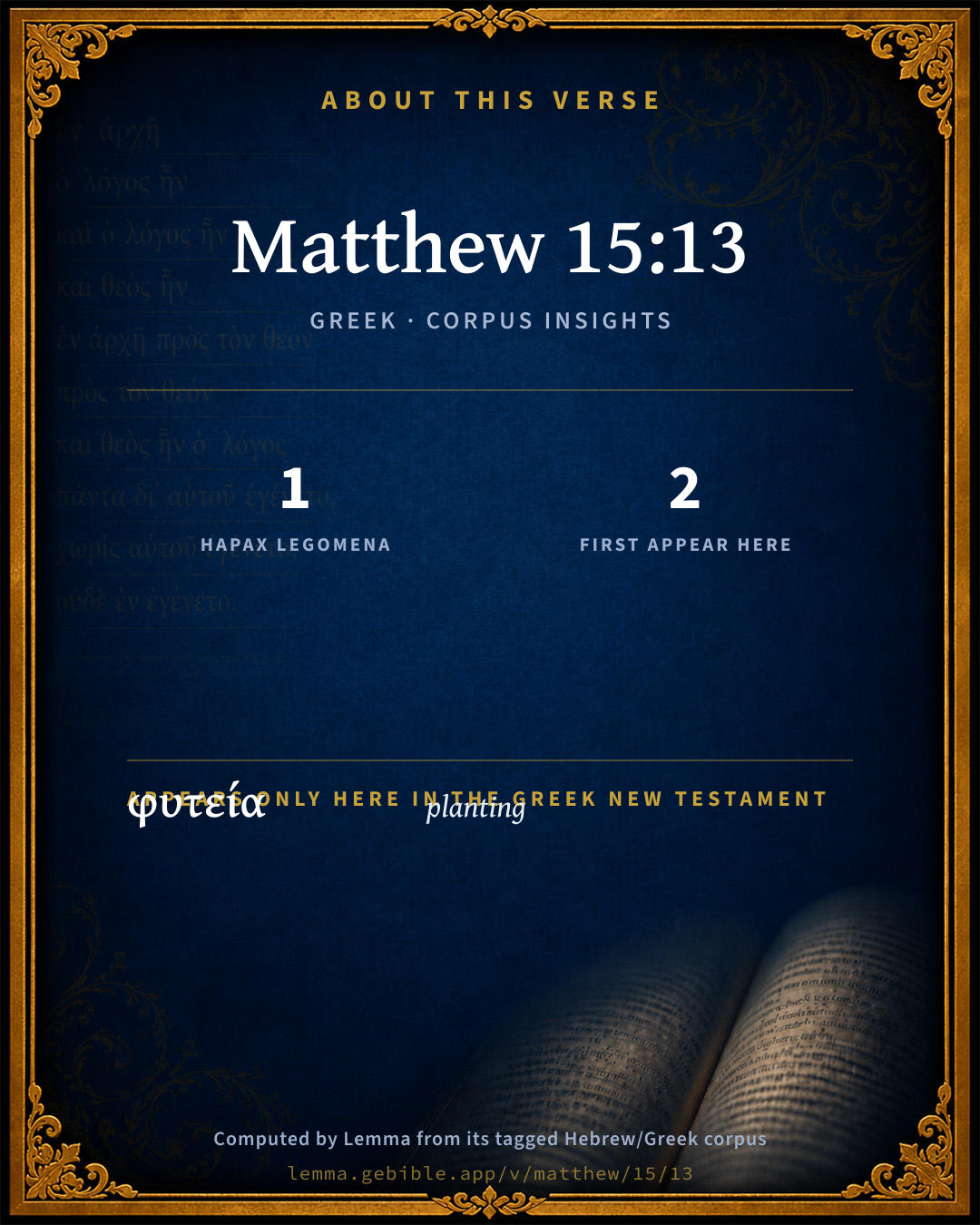
Matthew 15:13

Greek (Tischendorf 8th ed.) Matthew 15:13 appears in the Greek New Testament. The text above is from the Tischendorf 8th edition. Each word links to its Strong’s number and a concise gloss. Click any word for its full Thayer’s Greek Lexicon entry.
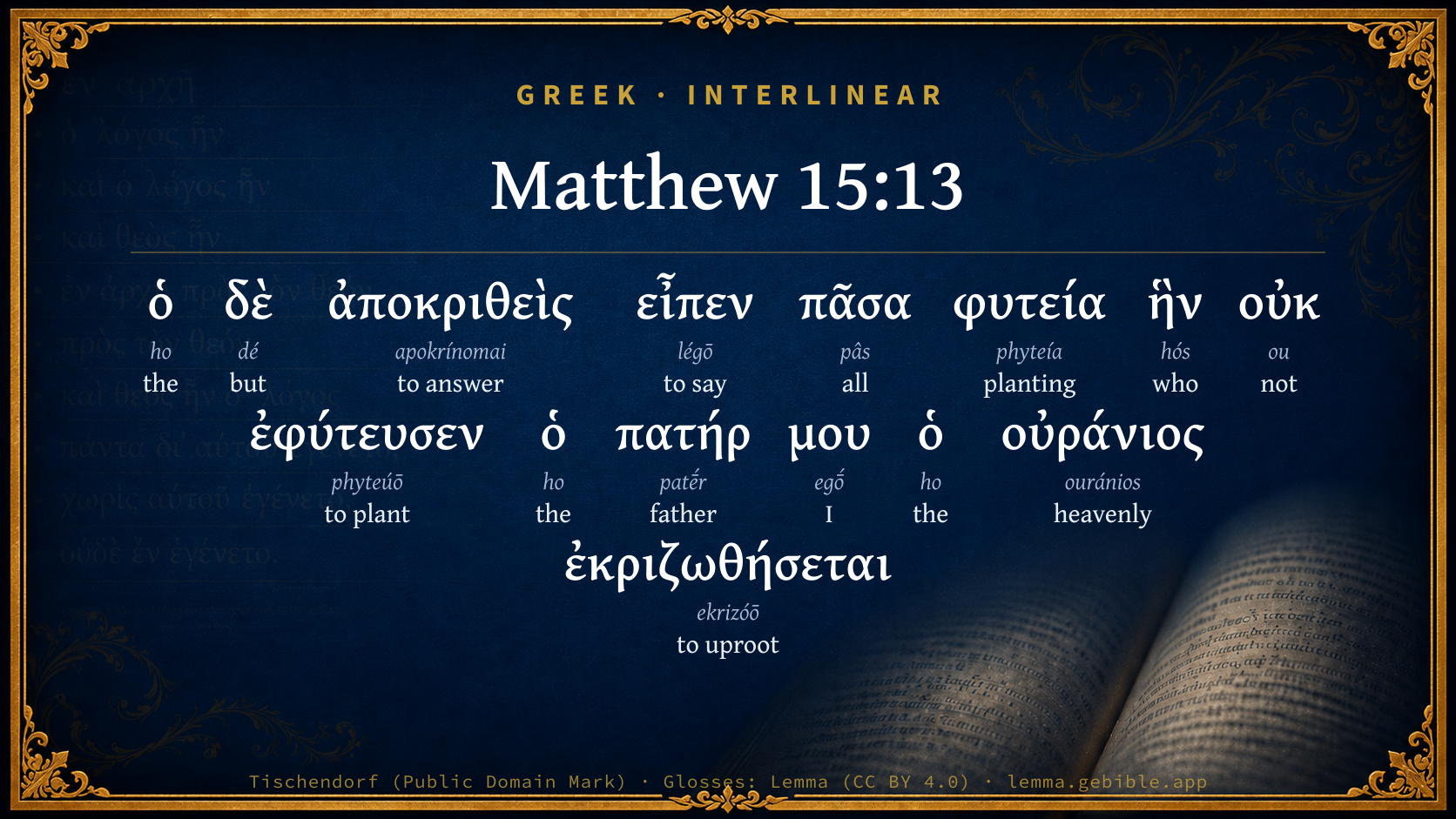
Download image
Cite this verse

Matthew 15:13 (World English Bible). Public Domain. Lemma interlinear Bible study tool, https://lemma.gebible.app/v/matthew/15/13.

Show BibTeX & RIS
BibTeX
RIS
English Translation
But he answered, "Every plant which my heavenly Father didn't plant will be uprooted.
World English Bible · Public Domain
Highlights
  • 1 hapax legomenon — only here in the Greek New Testament
  • 2 first appearances in the Greek New Testament
Full analysis ↓
Download a study sheet

One document with this verse’s original text, its word-by-word gloss line, the meaning frame, cross-references with their text, attributed commentary, and full source and license credits — printable, and it pastes into notes with its structure intact.

This verse Autodidact and up

Study sheet (.html) Plain text (.txt)

A passage Seminary Student

Up to 50 verses in one chapter. A passage sheet keeps up to 6 commentary sources and 12 cross-references per verse, in the order this page ranks them, and says so on the sheet whenever that leaves anything out. Ask for a single verse and you get the Autodidact verse sheet above.

Everything on this page stays free to read, with no account — the sheet is a download of what is already on screen, not access to it.

Want to remove ads? Support Godless Engineer
Compare translations 3

The same verse in 3 English versions, stacked beneath the original-language interlinear above. Click any original word for its lexicon entry.

Each is an independent rendering of the whole verse — the interlinear is not word-aligned to these translations.

Highlighted words mark where these versions differ — a whole-verse word diff, not a word-by-word alignment.

  • World English Bible Public Domain
    But he answered, "Every plant which my heavenly Father didn't plant will be uprooted.
  • King James Version Public Domain
    But he answered and said, Every plant, which my heavenly Father hath not planted, shall be rooted up.
  • unfoldingWord Literal Text CC BY-SA 4.0
    But he, answering, said, “Every plant that my heavenly Father has not planted will be uprooted.

unfoldingWord Literal Text — © unfoldingWord, licensed CC BY-SA 4.0. Word-aligned USFM3 via Door43 (git.door43.org/unfoldingWord/en_ult).

Versions to compare (up to 4)

3 of 4 selected

Show all 19 translations

Every available English version of this verse, each an independent rendering of the whole verse.

  • World English Bible Public Domain
    But he answered, "Every plant which my heavenly Father didn't plant will be uprooted.
  • Berean Standard Bible Public Domain
    But Jesus replied, “Every plant that My heavenly Father has not planted will be pulled up by its roots.
  • Majority Standard Bible Public Domain
    But Jesus replied, “Every plant that My heavenly Father has not planted will be pulled up by its roots.
  • King James Version Public Domain
    But he answered and said, Every plant, which my heavenly Father hath not planted, shall be rooted up.
  • American Standard Version (1901) Public Domain
    But he answered and said, Every plant which my heavenly Father planted not, shall be rooted up.
  • Revised Version (1885) Public Domain
    But he answered and said, Every plant which my heavenly Father planted not, shall be rooted up.
  • Geneva Bible (1599) Public Domain
    But hee answered and saide, Euery plant which mine heauenly Father hath not planted, shalbe rooted vp.
  • Douay-Rheims (1899) Public Domain
    But he answering them, said: Every plant which my heavenly Father hath not planted, shall be rooted up.
  • Young's Literal Translation Public Domain
    And he answering said, `Every plant that my heavenly Father did not plant shall be rooted up;
  • Literal Standard Version CC BY-SA 4.0
    And He answering said, “Every plant that My heavenly Father did not plant will be rooted up;
  • Unlocked Literal Bible CC BY-SA 4.0
    Jesus answered and said, “Every plant that my heavenly Father has not planted will be rooted up.
  • unfoldingWord Literal Text CC BY-SA 4.0
    But he, answering, said, “Every plant that my heavenly Father has not planted will be uprooted.
  • Darby Bible Public Domain
    But he answering said, Every plant which my heavenly Father has not planted shall be rooted up.
  • World Messianic Bible Public Domain
    But he answered, “Every plant which my heavenly Father didn’t plant will be uprooted.
  • Webster's Bible Public Domain
    But he answered and said, Every plant, which my heavenly Father hath not planted, shall be extirpated.
  • Free Bible Version CC BY-SA 4.0
    “Every plant my heavenly Father didn't plant will be uprooted,” Jesus replied.
  • Bible in Basic English Public Domain
    But he said in answer, Every plant which my Father in heaven has not put in the earth, will be taken up by the roots.
  • Text-Critical English NT CC BY 4.0
    Jesus answered, “Every plant that my heavenly Father has not planted will be uprooted.
  • Tyndale New Testament (1534) Public Domain
    He answered and sayde: all plantes which my hevely father hath not planted shalbe plucked vp by the rotes.

Literal Standard Version (2020), Covenant Press — licensed CC BY-SA 4.0. Text via the HelloAO Bible API (eBible.org). Unlocked Literal Bible (unfoldingWord) — licensed CC BY-SA 4.0. Text via the HelloAO Bible API (eBible.org). unfoldingWord Literal Text — © unfoldingWord, licensed CC BY-SA 4.0. Word-aligned USFM3 via Door43 (git.door43.org/unfoldingWord/en_ult). Free Bible Version, Dr. Jonathan Gallagher — licensed CC BY-SA 4.0. Text via the HelloAO Bible API (eBible.org).

Word by word

More ways to search: Search by grammar → Find every occurrence → Compare this word →

Practice this passage: Drill this verse → Learn its vocabulary →

φυτεία
phyteía
G5451
“planting”
Noun, Nominative, Singular, Feminine
Part of Speech
Noun
Case
Nominative
Number
Singular
Gender
Feminine
Full Thayer's Definition

Origin: from G5452

TDNT: None

1. a planting 2. the thing planted, a plant
  1. ὁ ho G3588 “the” Article, Nominative, Singular, Masculine
  2. δὲ dé G1161 “but” Conjunction
  3. ἀποκριθεὶς apokrínomai G611 “to answer” Verb, Aorist, Passive deponent, Participle, Nominative, Singular, Masculine
  4. εἶπεν légō G3004 “to say” Verb, Aorist, Active, Indicative, 3rd person, Singular
  5. πᾶσα pâs G3956 “all” Adjective, Nominative, Singular, Feminine
  6. ἣν hós G3739 “who” Relative pronoun, Accusative, Singular, Feminine
  7. οὐκ ou G3756 “not” Particle, Negative
  8. ἐφύτευσεν phyteúō G5452 “to plant” Verb, Aorist, Active, Indicative, 3rd person, Singular
  9. ὁ ho G3588 “the” Article, Nominative, Singular, Masculine
  10. πατήρ patḗr G3962 “father” Noun, Nominative, Singular, Masculine
  11. μου egṓ G1473 “I” Personal pronoun, 1st person, Genitive, Singular
  12. ὁ ho G3588 “the” Article, Nominative, Singular, Masculine
  13. οὐράνιος ouránios G3770 “heavenly” Adjective, Nominative, Singular, Masculine
  14. ἐκριζωθήσεται ekrizóō G1610 “to uproot” Verb, Future, Passive, Indicative, 3rd person, Singular

About this verse

These counts appear in no published source. They are computed here, from the morphology-tagged text and Lemma’s own curated glosses. What Lemma adds →

15
words
13
distinct lemmas
Gospels
section

Notable vocabulary

1 hapax legomenon — a word that appears only here in the entire Greek New Testament:

  • φυτεία planting G5451

First appearance in Scripture

These words make their first canonical appearance in the Greek New Testament here:

  • φυτεία planting G5451
  • ἐφύτευσεν to plant G5452

Shared distinctive vocabulary

ἐκριζωθήσεται to uproot G1610 occurs in 4 verses of the Greek New Testament. Also found in:

Repetition

A word recurs within this verse:

Cross-references

8

Topical passages linked to Matthew 15:13 in the Treasury of Scripture Knowledge — connected by theme and wording, ordered by reader-vote popularity; previews shown in the World English Bible.

  • John 15:2 Every branch in me that doesn't bear fruit, he takes away. Every branch that bears fruit, he prunes, that it may bear more fruit.
  • Isaiah 60:21 Your people also shall be all righteous; they shall inherit the land forever, the branch of my planting, the work of my hands, that I may be glorified.
  • John 15:6 If a man doesn't remain in me, he is thrown out as a branch, and is withered; and they gather them, throw them into the fire, and they are burned.
  • Isaiah 61:3 to appoint to those who mourn in Zion, to give to them a garland for ashes, the oil of joy for mourning, the garment of praise for the spirit of heaviness; that they may be called trees of righteousness, the planting of Yahweh, that he may be glorified.
  • Psalms 92:13 They are planted in Yahweh's house. They will flourish in our God's courts.
  • Matthew 13:40–41 As therefore the darnel is gathered up and burned with fire; so will it be at the end of this age.
  • 1 Corinthians 3:12–15 But if anyone builds on the foundation with gold, silver, costly stones, wood, hay, or stubble;
  • 1 Corinthians 3:9 For we are God's fellow workers. You are God's farming, God's building.

Cross-references courtesy of OpenBible.info (CC BY 4.0).

Commentary

Notes on Matthew 15:13 from classic Christian and Jewish commentators (each source and its license shown beneath its notes). The classic Christian expositions comment on the surrounding passage and are grouped to its opening verse, so a note may address several verses; the Jewish commentaries on the Tanakh (Rashi and others) are per-verse, so they appear only where the commentator wrote on this verse.

Lemma curates 59 commentaries, every one of them public domain or Creative Commons licensed, each selected and text-cleaned for this edition rather than reprinted as found. About our sources →

The Biblical Illustrator

Joseph S. Exell

Mat_15:13

Every plant, which My heavenly Father hath not planted, shall be rooted up.

Plants God has not planted

1. What is meant by plants.

(a) Every doctrine:

(b) Every practice:

(c) Every person.

2. Some plants God never planted.

(a) What is meant by planting? Planting is setting or putting things into the ground, as trees, herbs, flowers. So mystical planting denotes the transplanting (in a spiritual way) this or that person, from a course of open profaneness into a visible profession.

(b) Who is it that plants people in the gospel Church? God, and gospel ministers.

3. Run a parallel between an external planting; and a spiritual planting.

(a) A planter, as one instructed into the mystery of that art, has wisdom and skill in planting which others have not; so a minister of Christ is one God hath taught the mysteries of the gospel unto.

(b) A planter must have a call by the owner of the vineyard; so every minister must be called and regularly empowered.

(c) A planter must have fit and proper instruments for his work.

(d) A planter doth not know infallibly the difference there is in plants.

(e) A skilful planter knows that a wild, ungrateful tree never bears good fruit.

(f) A planter observes the proper season for planting.

(g) He doth not only plant, but water.

(h) He greatly rejoices to see his plants grow, thrive, and bear much fruit.

As to plants.

(a) They must be well-rooted.

(b) They must be pruned and purged.

(c) Some plants, who promised well, prove barren and good for nothing.

(d) Plants that prove utterly barren, are rooted up or cut down.

4. Why shall every plant God hath not planted be rooted up?

(a) Because they are wild plants.

(b) Because all plants that God hath not planted, have no right to be planted in his vineyard.

(c) Because they do but cumber the ground.

(d) Because they are good for nothing but the fire.

The plants which God Himself has planted shall stand and never be rooted up.

(a) Because they are ordained to bring forth fruit:

(b) They are planted into Christ:

(c) The love of God to them is everlasting and unchangeable. (B. Keach.)

On the efficacy of the Gospel in the extirpation of error

I. How far has this prophetic declaration been already accomplished?

II. There are certain circumstances which have impeded the progress of Christianity, and suspended its moral and sanctifying influence.

III. We have reason to believe that the final issue of the gospel kingdom will be very glorious indeed, and that the prediction of the text will then be fulfilled, in a sense hitherto unknown to the world. (Habakkuk Crabbe.)

Rooting up plants

I. That tis the heavenly Fathers own hand that plants every plant that must grow and prosper.

II. That every plant which is planted by any other hand or power, shall not prosper, but be rooted up.

III. That those which see not things so, and cannot leave them to God they bring upon themselves much trouble and unquietness. (John Webster.)

Difficult and questionable rules of conduct

When we speak of principles and rules of life, which every one knows and every one believes, by which the young and the old, the learned and the ignorant, the prince and the labourer, are regulated, and these principles and rules of life are false, or only true in part, the mischief thence arising is incalculable, is immense. These are plants which the heavenly Father hath not planted.

I. Most men are of opinion, that we cannot pass a day without sinning and acting wickedly.

II. We think we cannot be perfect; and with this we not unfrequently excuse all the sins and errors we commit, however various and gross.

III. We argue that we should merrily enjoy life, particularly youth, which so rapidly passes by; we should not embitter it by unseasonable gravity, by unnecessary sorrow or care. This may be true, but the consequences drawn from it with reference to virtue and religion are false.

IV. We say, We are after all, weak naturally corrupt beings, of whom not much is to be expected, and whom God, in His mercy, will not judge with rigour.

V. We say, We should not be particular; we should not aspire to be wiser and better than others. We should regulate ourselves by the persons and the societies, in which and with whom we live.

VI. We have false conceptions concerning daily repentance. How frequent we hear it said: If I sin every day, I however repent every day, and at any rate we must repent daily. VII. It is imagined that a certain devotion, or rather, certain acts of Divine worship can supply the defect of a virtuous life, or atone for the disorderly life we lead, and the sins which we commit. Or,

VIII. We rely upon Divine grace, and by it hope to be saved, though we are not so virtuous and holy as we ought to be. (Zollikoper.)

The weeding of the garden

I. Plants that God has not planted.

1. Some have been planted by the ministers hand. Some conversions are of human, not Divine, origin.

2. Some were planted by their fathers and mothers. They have got a kind of family religion.

3. Many professors of religion are self-planted.

II. Their uprooting. It sometimes comes in this life.

III. The work of self-examination. Am I a plant of Gods planting?

1. If I am of the Lords planting, there was a time when I had to be taken out of the place where I once grew.

2. If planted by God there will be sorrow that we were ever anything else.

3. We have learnt our utter helplessness.

4. We are all planted on one soil, and indeed on one rock. (C. H. Spurgeon.)

Gods plants grow everywhere

Other plants which the Heavenly Father hath not planted have their zones of vegetation, and die out of certain degrees of latitude, but the seed of the kingdom is like corn, an exotic nowhere, for wherever man lives it will grow, and yet an exotic everywhere, for it came down from heaven. (Dr. Maclaren.)

Plants not planted by God are very beautiful

If you go into the fields, there are many plants that grow there that are quite as lovely as those in the garden. Look at the foxglove and the dog rose; look at many of the blossoms we pass by as insignificant, they are really beautiful; but they are not plants that have ever been planted. Now, how many we have in our congregations that are really beautiful; yet they are none of Gods planting-men and women whose character is upright, whose manners ate amiable, whose life is irreproachable. They are not immoral, they neither cheat nor lie; but they are exemplary; their disposition is kind, tender-hearted, and affectionate. Yes, but there must be something more than this, for Jesus says, Every plant which My heavenly Father hath not planted, shall be rooted up. Though it be a lovely plant, though it seem to be a fair flower externally, yet since the root of it hath sucked its nourishment out of the wild wastes of sin, whether of infidelity or of lawlessness, it is evil in the eye of God, and it must be plucked up. (C. H. Spurgeon.)

Wild plants fruitful

Further, how many there are of our wild wood plants that even bring forth fruit. The schoolboy in the country can tell us that the wood is an orchard, and that often he has had many a luscious meal from those wild fruits that grew there. Yet, mark you, though the birds may come and satisfy their hunger from those wild fruits, and though the seeds may be in the winter the sparrows garner, and the linnets storehouse, yet they are not planted, and they do not come under the description of the text-plants that have been planted. So, too, there may be some of you who really do some good in the world. Without you a mothers wants might not be provided for; from your table many of the poor are fed. Oh! this is good, this is good; I would that all of you did more of it, but I pray you remember that this is not enough; there must be Gods planting in you, or else the fruits you bring forth will be selfish fruits. You will be like Israel who was denounced as being an empty vine, because, forsooth, he brought forth fruit unto himself. Charity is good. Noble charity, be thou honoured among men! But there must be faith, and if we have no faith in Christ, though we give our bodies to be burned, and bestow our goods to feed the poor, yet where Christ is, we certainly can never come. (C. H. Spurgeon.)

Many of those wild plants have very strong roots

If you were to go and try to dig them up, you would have a task before you not easily accomplished. Look at the wild dock: did you seek to pull it up? Piece after piece it breaks away, and you have to send some sharp instrument deep into the soil before you can root it out, and even then, if there be but a piece left, it springs up and thrives again. Oh how many there are who have as much tenacity of life in their false confidence, as there is in the dock-in its root! Some of you cannot shake. I never have a doubt, said one, I never had a doubt or a misgiving. You remember Robert Hall said, Allow me to doubt for you, sir, because he knew the man to be an ill-liver. And so we have some-they are not in trouble as other men, neither are they plagued like other men; they speak with an air of satisfaction: their language sounds like assurance, but it is presumption; it looks like confidence in Christ, but it is confidence in themselves. And such will strike their roots very deep, and they will be very strong indeed, so that you cannot shake them; yet, alas for them! they are not plants of the Lords right-hand planting, and therefore the sentence is passed; and ere long it shall be executed without pity-they shall be rooted up. (C. H. Spurgeon.)

Uprooted plants

1. That system of philosophy which ignores Divine Truth, or contradicts the plain statements of Gods Word, cannot endure.

2. In the various departments of science those views which are the offspring of glaring misconception or of uncertain hypothesis, necessarily possess the element of perishability.

3. A like course of reasoning may be applied to the different religions of the world. Consider some of the plants which the Father hath planted:-

1. Every disciple of Christ.

2. The Church.

3. The Bible.

4. In the garden there are also many tender little plants which, though not conspicuous, are equally the object of the Fathers solicitude.

5. God is pledged to establish the good and to eradicate the evil. The rose will not always have its thorn. (J. T. Lamont.)

The Biblical Illustrator, edited by Joseph S. Exell (c. 1880s–1900s) — public domain. Text from a community e-Sword module.

Tyndale Open Study Notes

Tyndale Open Resources

15:13 not planted by my heavenly Father: These Pharisees did not belong to the true people of God (see 3:9-12; Isa 5:1-7; Jer 45:4). They will be uprooted at the final judgment (see Matt 3:10; 8:12).

Tyndale Open Study Notes — © Tyndale Open Resources, licensed CC BY-SA 4.0. Text via the HelloAO Bible API.

Bengel's Gnomon

Johann Albrecht Bengel

Mat 15:13. Φυτεία, plant) Doctrine, or rather man. The φυτὸν is so by nature, the φυτεία by care.—Πατὴρ, κ.τ.λ., Father, etc.) See Joh 15:1-2.—ἐκριζωθήσεται, shall he rooted up) And this shall be the result of their being offended with Christ. Such a plant, however fair in appearance, is without Christ (extra Christum).

Bengel's Gnomon of the New Testament — English translation (T&T Clark, Edinburgh, 1860) — public domain. Text from a community e-Sword module.

Meyer's Critical & Exegetical Commentary

Heinrich August Wilhelm Meyer

Mat_15:13. The correct interpretation is the ordinary one (being also that of Ewald and Keim), according to which φυτεία is taken as a figurative way of expressing the teaching. The fact of Jesus having attacked their teaching, in Mat_15:11, had given offence to the Pharisees. Consequently He now explains why it is that He does not spare such teaching: every doctrine, He says, that is not of God, that is merely human in its origin, will pass away and perish, as the result, that is, of the Messianic reformation which is in the course of developing itself. Nothing is said about the Pharisees personally (whom Chrysostom supposes to be included in what is said about the teaching) till Mat_15:14. This in answer to Fritzsche, Olshausen, de Wette, Hilgenfeld, Bleek, who find in the words a prediction of the extirpation of the Pharisees (characters of this stamp will soon have played out their game, de Wette). What is expressed figuratively by means of πᾶσα φυτεία, ἣν οὐκ ἐφύτευσεν ὁ πατήρ μου, is the same thing that, in Mat_15:9, is designated literally as διδασκαλίας ἐντάλματα ἀνθρώπων.

On φυτεία, planting (Plat. Theag. p. 121 C; Xen. Oec. vii. 20, xix. 1), i.e. in this instance: something planted, comp. Ignatius, ad Philad. III. ad Trall. xi, where, however, it is not used with regard to false teaching, but with reference to false teachers. In classic Greek the form is φύτευμα, or φυτόν.

Meyer — Critical and Exegetical Commentary on the New Testament — English translation by Peter Christie, edited by Frederick Crombie (T&T Clark, 1880) — public domain. Text from a community e-Sword module.

Expositor's Greek Testament

ed. W. Robertson Nicoll

Mat 15:13 . ὁ δὲ ἀποκριθεὶς , etc.: the disciples were afraid, but Jesus was indignant, and took up high ground. φυτεία for φύτευμα , a plant, “not a wild flower but a cultivated plant” (Camb. G. T.), refers to the Rabbinical tradition; natural figure for doctrine, and so used both by Jesus and Greeks ( vide Schöttgen and Kypke). Kypke remarks: “pertinet huc parabola περὶ τοῦ σπείροντος ”. ὁ πατήρ μου : the statement in the relative clause is really the main point, that the tradition in question was a thing with which God as Jesus conceived Him had nothing to do. This is an important text for Christ’s doctrine of the Fatherhood as taught by discriminating use of the term πατήρ . The idea of God implied in the Corban tradition was that His interest was antagonistic to that of humanity. In Christ’s idea of God the two interests are coincident. This text should be set beside Mat 12:50 , which might easily be misunderstood as teaching an opposite view. ἐκριζωθήσεται . This is what will be, and what Jesus wishes and works for: uprooting, destruction, root and branch, no compromise, the thing wholly evil. The response of the traditionalists was crucifixion.

The Expositor's Greek Testament, edited by W. Robertson Nicoll (1897–1910) — public domain. Text from a community e-Sword module.

Jamieson, Fausset & Brown

Robert Jamieson, A. R. Fausset & David Brown

But he answered and said, Every plant, which my heavenly Father hath not planted, shall be rooted up--They are offended, are they? Heed it not: their corrupt teaching is already doomed: the garden of the Lord upon earth, too long cumbered with their presence, shall yet be purged of them and their accursed system: yea, and whatsoever is not of the planting of My heavenly Father, the great Husbandman (Joh 15:1), shall share the same fate.

Jamieson, Fausset & Brown — Commentary Critical and Explanatory on the Whole Bible (1871) — public domain (CC PDM 1.0). Text via the HelloAO Bible API.

Adam Clarke's Commentary

Verse 13. Every plant] Every plantation. So I render φυτεια, and so it is translated in the Itala version which accompanies the Greek text in the Codex Bezae, omnis plantatio, and so the word is rendered by Suidas. This gives a different turn to the text. The Pharisees, as a religious body, were now a plantation of trees, which God did not plant, water, nor own: therefore, they should be rooted up, not left to wither and die, but the fellers, and those who root up, (the Roman armies,) should come against and destroy them, and the Christian Church was to be planted in their place. Since the general dispersion of the Jews, this sect, I believe, has ceased to exist as a separate body, among the descendants of Jacob. The first of the apostolical constitutions begins thus: Θεου φυτεια η καθολικη εκκλησια, και αμπελων αυτου εκλεκτος. The Catholic Church is the plantation of God, and his chosen vineyard.

Adam Clarke's Commentary on the Bible (1810–1826) — public domain. Text from a community e-Sword/MySword module.

Ellicott's Commentary for English Readers

(13) Every plant, which my heavenly Father hath not planted.—The disciples could hardly fail to connect the words with the parable which they had heard so lately. The system and the men that they had been taught to regard as pre-eminently religious were, after all, in their Master’s judgment, as the tares and not as the wheat (Mat_13:37-38). So far as they were a sect or party, His Father had not planted them. They, too, were left, according to the teaching of that parable, to grow until the harvest, but their end was sure—they should be “rooted out.” The words which proclaim their doom were, however, intentionally general in their form. In that divine judgment which works through the world’s history, foreshadowing the issues of the last great day, that doom is written on every system, party, sect which originates in man’s zeal, in narrowness, in self-will. It has not been planted by the Father, and therefore it is doomed to perish.

A Bible Commentary for English Readers, edited by Charles John Ellicott (1878–1897) — public domain. Text from a community e-Sword module.

The Cambridge Bible for Schools and Colleges

gen. ed. J. J. S. Perowne

13. Every plant] Not a wild flower, but a cultivated plant or tree; the word occurs here only in N. T.; in LXX. version of O. T. it is used of the vine, the most carefully cultivated plant; 2Ki_19:29; Eze_17:7; Mic_1:6; and in one other passage, Gen_21:33, of the tamarisk. Here the plant cultivated by human hands—the vine that is not the true vine of Israel—is the doctrine of the Pharisees.

The Cambridge Bible for Schools and Colleges (gen. ed. J. J. S. Perowne; Cambridge University Press, 1878–1918) — public domain. Text from a community e-Sword module.

John Gill's Exposition

But he answered, and said,.... As being unconcerned at their rage, and having nothing to fear from them; and being well satisfied, that what he had said was right, and would produce proper effects, he gave his disciples this for answer:

every plant which my heavenly Father hath not planted, shall be rooted up; which may be understood either of things, or of persons: it may have regard to doctrines and ordinances; and the meaning be, that whatever doctrine is not delivered by God, or whatever ordinance is not instituted by him; whatever is not of heaven, but of man, of man's devising, and of human imposition, as the traditions of the elders, must be opposed and rejected; and sooner or later will be utterly rooted up, and destroyed; as will all the false notions, corrupt worship, and errors, and heresies of men, in God's own time: or it may respect persons. There are some plants, which are planted by Christ's Father, which is in heaven; these are the elect of God, who are trees of righteousness; the planting of the Lord, that he might be glorified. These are planted by the river of God's love, in the person of Christ, in the likeness of his death and resurrection; they are transplanted out of a state of nature, are ingrafted into Christ, have the graces of the Spirit implanted in their souls, and are themselves planted in the courts of the Lord, in a Gospel church state; and being watered with the dews of grace, appear to be choice plants, plants of renown, pleasant ones, very fruitful, and which shall never perish, or be rooted, and plucked up, but there are others, like these Pharisees, hypocrites, formal professors, and heretics, who pretend to much religion and holiness, make a show of the leaves of profession, but have not the fruit of grace; these get into churches, and are outwardly and ministerially planted there; but being never rooted in Christ, nor partake of his grace, in time they wither, and die away; or persecution arising because of the Word, or truth being dispensed in so clear and glaring a light, that they cannot bear it; they are offended with it, and so are detected, discovered, and rooted up and it is necessary that truth should be freely spoken, as it was here by Christ, that such plants might be rooted out; for these words are said by Christ in justification of his conduct. So the Jews speak of God, as a planter, and of rooting up what he does not like.

"The holy, blessed God (say they (e)), "plants" trees in this world; if they prosper, it is well; if they do not prosper, , "he roots them up", and plants them even many times.''

And elsewhere it is said (f),

"let the master of the vineyard come, and consume its thorns: the gloss on it is, the holy, blessed God; for the vineyard of the Lord of hosts, is the house of Israel, and he will consume, and take away the thorns of the vineyard.''

(e) Zohar in Gen. fol. 105. 3. (f) T. Bab. Bava Metzia, fol. 83. 2.

John Gill's Exposition of the Whole Bible (1746–1763) — public domain (CC PDM 1.0). Text via the HelloAO Bible API.

Trapp's Complete Commentary

John Trapp

13 But he answered and said, Every plant, which my heavenly Father hath not planted, shall be rooted up.

Ver. 13. Every plant which my heavenly Father hath not planted] viz. By election, and watered by vocation. These Pharisees were reprobates, designed to detection here, and to destruction hereafter. Therefore as it is no wonder, so it is no matter, though they "stumble at the word, being disobedient, since hereunto they were appointed," 1Pe 2:8. Let them "stumble, and fall, and be broken, and snared, and taken," Isa 8:15. Christ is to reprobates a "rock of offence;" but such a rock as that, Jdg 6:21, out of which goeth fire and consumeth them.

John Trapp, A Commentary or Exposition upon All the Books of the Old and New Testament (1647–1656) — public domain. Text from a community e-Sword module.

Matthew Poole's English Annotations

Every plant may be understood of doctrines, practices, or persons. These scribes and Pharisees are a wretched generation, that are got into the sheepfold not at the door; my Father never sent them, they are crept in at the windows, they are plants got into my garden, which my Father never planted there, and they must be rooted up.

Let them alone, they are incorrigible, and blinded by their own interest against any conviction or instruction: as, Hos 4:17, Ephraim is joined to idols; let him alone: so these men are joined to their superstitious traditions; I will not concern myself with them. They are pretended leaders of the blind, Rom 2:19, but themselves are blind. I pity the poor people, for while the blind lead the blind they both fall into a ditch. An ignorant and unfaithful ministry is the greatest plague God can send amongst a people.

Matthew Poole's English Annotations on the Holy Bible (1683–1685) — public domain. Text from a community e-Sword/MySword module.

Whedon's Commentary on the Bible

Daniel D. Whedon

13. Every plant — Every doctrine. These traditions are a plant not planted by God, but by men, and they will be rooted up. Tradition can never stand as God’s word, much less against God’s word.

Daniel D. Whedon (gen. ed.), Commentary on the Old and New Testaments (1874–1909) — public domain. Text from a community e-Sword module.

The Pulpit Commentary

Every plant, etc. The answer of Christ signifies Do not be alarmed by the displeasure of the Pharisees, and at my opposition to their teaching; the system which they support is ungodly and shall be soon destroyed. Christ, as often, puts the statement in a parabolic form, using two images, one derived from the vegetable kingdom in this verse, and one from human life in ver. 14. Plant (futeia); plantation. The act of planting, and then by metonymy the thing planted. It here signifies the sect and doctrine of the Pharisees, the persons themselves, and that which they taught. The comparison of men and trees, plant and doctrine, is a common biblical metaphor. (comp. Ps 1 Isa_5:7 Mat_7:16-20 Luk_6:43, Luk_6:44, etc.) The traditions of the rabbis were plants which my heavenly Father hath not planted. They were of human, not Divine, growth; and the men themselves, even though originally planted in holy soil, had degenerated, and become not only unfruitful, but pernicious. So the Lord speaks by Jeremiah, (Jer_2:21) "I had planted thee a noble vine, wholly a right seed: how then art thou turned into the degenerate plant of a strange vine unto me?" Shall be rooted up. Our Lord is not referring to the judgment of the last day, (Mat_3:10) nor to any forcible destruction effected by human agency; he means that the system must pass away entirely to make room for a better growth, even the gospel. The Jews would not see that the Law was a schoolmaster to bring men to Christ; they deemed that their ceremonies and rites were to be permanent and universal; and this, more than anything, impeded the reception of Christ"s claims, and made men utterly averse from his teaching. It was in vain that Jesus proclaimed, "If ye believed Moses, ye would believe me; for he wrote of me". (Joh_5:46) The very Law, as handled and obscured by the Pharisees, was made an obstacle to the truth.

The Pulpit Commentary (1880–1919), ed. H.D.M. Spence-Jones & Joseph S. Exell — public domain. Text from a community e-Sword module.

John Wesley's Explanatory Notes

Every plant - That is, every doctrine.

John Wesley, Explanatory Notes Upon the Whole Bible (1754–1765) — public domain. Text via the GEBible commentary corpus.

The People's New Testament

B. W. Johnson

13. Every plant. A general truth, but here refers to the doctrines not of God, like “the tradition of the elders.”

B. W. Johnson's The People's New Testament with Notes (1889–1891) — public domain. Electronic text from the Christian Classics Ethereal Library (CCEL) ThML edition.

Cambridge Greek Testament for Schools and Colleges

13. πᾶσα φυτεία. Not a wild flower, but a cultivated plant or tree; the word occurs here only in N.T.; in LXX. version of O.T. it is used of the vine, the most carefully cultivated of all plants; 2Ki 19:29; Eze 17:7; Mic 1:6; Aq. and Symm. have δένδρων φυτείαν in Gen 21:33, of the tamarisk. Here the plant cultivated by human hands—the vine that is not the true vine of Israel—is the doctrine of the Pharisees.

Cambridge Greek Testament for Schools and Colleges (Cambridge University Press, 1896; 21 vols, various authors incl. Carr, Maclear, Plummer, Farrar, Lumby, Moule, M. R. James, Simcox) — public domain. Text from a community e-Sword module.

Alford’s Greek Testament

Henry Alford

13.] The plant is the teaching of the Pharisees, altogether of human, and not of divine planting. That this is so, is clear by ἄφετε αὐτούς following, and by the analogy of our Lord’s parabolic symbolism, in which seed, plant, &c., are compared to doctrine, which however in its growth becomes identified with, and impersonated by, its recipients and disseminators. See this illustrated in notes on the parable of the sower, ch. 13 ‘φυτόν, naturâ: φυτεία, curâ.’ Bengel. On this verse see Joh 15:1, Joh 15:2.

Henry Alford, The Greek Testament (1849–1861) — public domain. Text from a community e-Sword module.

International Critical Commentary

13, 14. The editor here inserts three verses from the Logia:

(E) Then came the disciples, and said to Him, Dost Thou know that the Pharisees, when they heard the saying, were made to stumble? And He answered and said, Every plant, which my heavenly Father did not plant, shall be rooted up. Let them alone: they are blind guides. And if a blind man be leading a blind man, both will fall into a pit.]

τότε] see on 2:7.—προσελθόντες] see on 4:3.—ἐσκανδαλίσθησαν] see on 5:29. It is no wonder if the Pharisees were dismayed. For Christ’s saying, that what went into a man did not defile him, directly contravened the Mosaic distinction between clean and unclean meats. πᾶσα φυτεία, cf. 3:10, 12. The Pharisees and scribes were barren trees about to be cut down, chaff about to be burned, plants about to be uprooted. It is said of the heretic Acher that he uprooted plants by his false teaching, B. Chag. 15a.—ὁδηγοί εἰσιν τυφλοί] Lk. has a parallel in the Sermon, 6:39 μήτι δύναται τυφλὸς τυφλὸν ὁδηγεῖν; οὐχὶ ἀμφότεροι εἰς βόθυνον ἐμπεσοῦνται;

(M)

International Critical Commentary — older volumes (1896–1929), various authors — public domain. Text from a community e-Sword module.

Lesson kit

Teaching starters — assembled from the data on this page, not authored interpretation. Every prompt links to the verse data it draws on. Edit before teaching.

Matthew, in the Gospels, opens this verse with 15 words (13 distinct Greek lemmas). Its most distinctive word is phyteía (“planting”). A historical commentator’s framing appears above. Read the whole chapter for the surrounding context.

Discussion questions

  1. How does “planting” (phyteía) shape what this verse is saying?
  2. This verse holds 1 word here found nowhere else in the Greek New Testament. What might the rare word draw attention to?
  3. 2 words here appear for the first time in Scripture. What is being introduced at this debut?
  4. Matthew 13:29 shares the word «to uproot» with this verse. How do the two illuminate each other?
  5. “the” occurs 3× in this one verse. What is the effect of the repetition?
  6. These translations render this verse differently. What is at stake in choosing one wording over another?
  7. Reading how The Biblical Illustrator and Tyndale Open Study Notes read this verse, where do the two commentators agree and where do they part?

Things to notice

  • 1 word in this verse appears nowhere else in the Greek New Testament.
  • 2 words make their first canonical appearance in Scripture here.
  • These translations choose different wording for 12 words in this verse.
  • “the” occurs 3× in this single verse.
  • 13 distinct Greek lemmas span 15 words in this verse.

Reading settings

Reading text

Shown beneath each verse's original-language words.

Old Testament
Old Testament edition

Read the OT as the Masoretic Hebrew (MT) or the Greek Septuagint (LXX).

English shown for the Greek Septuagint (in the Hebrew ↔ Greek comparison).

Comparing translations? Open the Compare panel on any verse page to stack up to four side by side.