
John 14:10

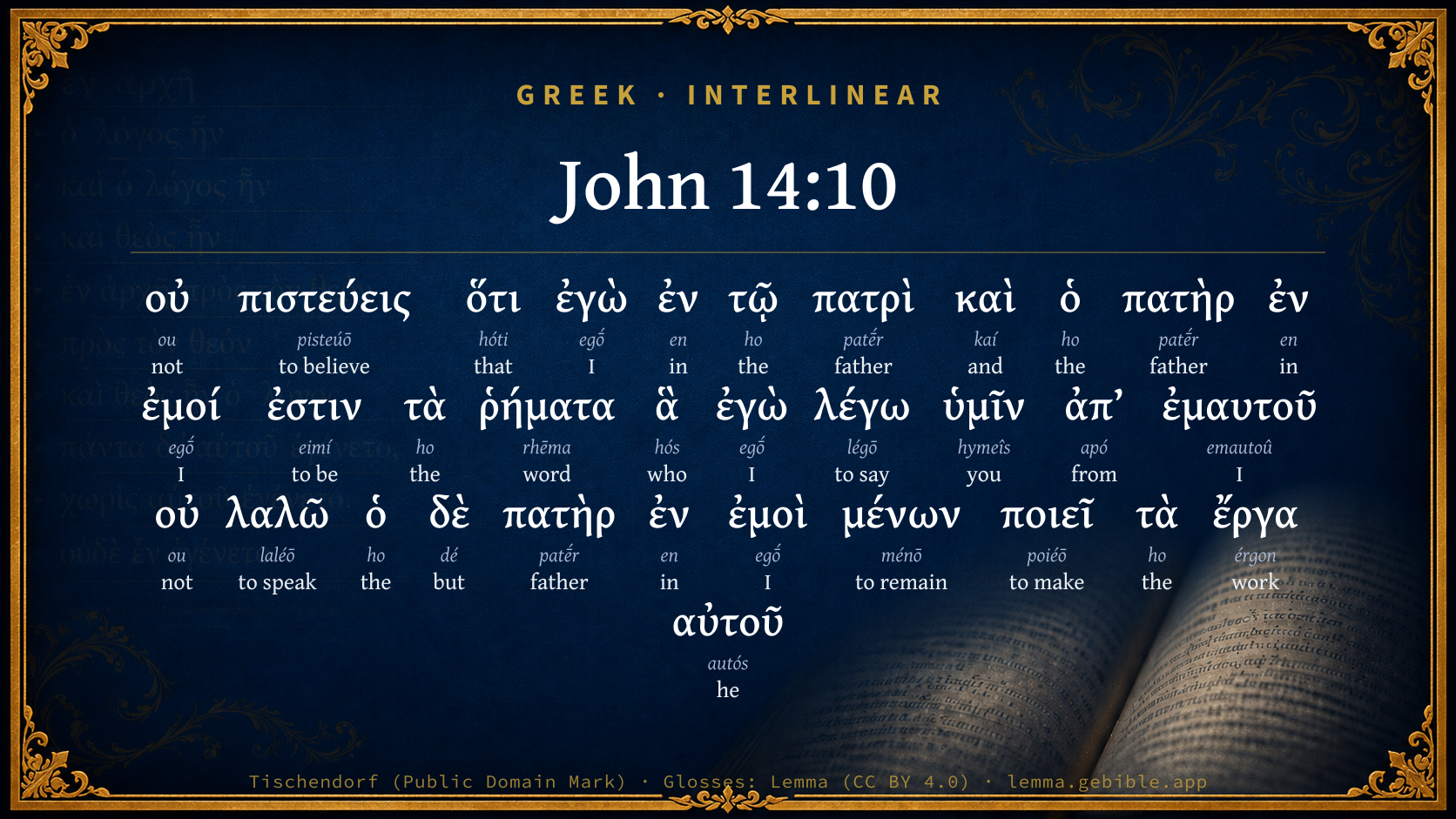
Greek (Tischendorf 8th ed.) John 14:10 appears in the Greek New Testament. The text above is from the Tischendorf 8th edition. Each word links to its Strong’s number and a concise gloss. Click any word for its full Thayer’s Greek Lexicon entry.
Download image
Cite this verse

John 14:10 (World English Bible). Public Domain. Lemma interlinear Bible study tool, https://lemma.gebible.app/v/john/14/10.

Show BibTeX & RIS
BibTeX
RIS
English Translation
Don't you believe that I am in the Father, and the Father in me? The words that I tell you, I speak not from myself; but the Father who lives in me does his works.
World English Bible · Public Domain
Download a study sheet

One document with this verse’s original text, its word-by-word gloss line, the meaning frame, cross-references with their text, attributed commentary, and full source and license credits — printable, and it pastes into notes with its structure intact.

This verse Autodidact and up

Study sheet (.html) Plain text (.txt)

A passage Seminary Student

Up to 50 verses in one chapter. A passage sheet keeps up to 6 commentary sources and 12 cross-references per verse, in the order this page ranks them, and says so on the sheet whenever that leaves anything out. Ask for a single verse and you get the Autodidact verse sheet above.

Everything on this page stays free to read, with no account — the sheet is a download of what is already on screen, not access to it.

Want to remove ads? Support Godless Engineer
Compare translations 3

The same verse in 3 English versions, stacked beneath the original-language interlinear above. Click any original word for its lexicon entry.

Each is an independent rendering of the whole verse — the interlinear is not word-aligned to these translations.

Highlighted words mark where these versions differ — a whole-verse word diff, not a word-by-word alignment.

  • World English Bible Public Domain
    Don't you believe that I am in the Father, and the Father in me? The words that I tell you, I speak not from myself; but the Father who lives in me does his works.
  • King James Version Public Domain
    Believest thou not that I am in the Father, and the Father in me? the words that I speak unto you I speak not of myself: but the Father that dwelleth in me, he doeth the works.
  • unfoldingWord Literal Text CC BY-SA 4.0
    Do you not believe that I am in the Father, and the Father is in me? The words that I say to you I do not speak from myself, but the Father remaining in me is doing his work.

unfoldingWord Literal Text — © unfoldingWord, licensed CC BY-SA 4.0. Word-aligned USFM3 via Door43 (git.door43.org/unfoldingWord/en_ult).

Versions to compare (up to 4)

3 of 4 selected

Show all 19 translations

Every available English version of this verse, each an independent rendering of the whole verse.

  • World English Bible Public Domain
    Don't you believe that I am in the Father, and the Father in me? The words that I tell you, I speak not from myself; but the Father who lives in me does his works.
  • Berean Standard Bible Public Domain
    Do you not believe that I am in the Father and the Father is in Me? The words I say to you, I do not speak on My own. Instead, it is the Father dwelling in Me, performing His works.
  • Majority Standard Bible Public Domain
    Do you not believe that I am in the Father and the Father is in Me? The words I say to you, I do not speak on My own. Instead, it is the Father dwelling in Me, performing His works.
  • King James Version Public Domain
    Believest thou not that I am in the Father, and the Father in me? the words that I speak unto you I speak not of myself: but the Father that dwelleth in me, he doeth the works.
  • American Standard Version (1901) Public Domain
    Believest thou not that I am in the Father, and the Father in me? the words that I say unto you I speak not from myself: but the Father abiding in me doeth his works.
  • Revised Version (1885) Public Domain
    Believest thou not that I am in the Father, and the Father in me? the words that I say unto you I speak not from myself: but the Father abiding in me doeth his works.
  • Geneva Bible (1599) Public Domain
    Beleeuest thou not, that I am in the Father, and the Father is in me? The wordes that I speake vnto you, I speake not of my selfe: but the Father that dwelleth in me, he doeth the workes.
  • Douay-Rheims (1899) Public Domain
    Do you not believe, that I am in the Father, and the Father in me? The words that I speak to you, I speak not of myself. But the Father who abideth in me, he doth the works.
  • Young's Literal Translation Public Domain
    Believest thou not that I `am' in the Father, and the Father is in me? the sayings that I speak to you, from myself I speak not, and the Father who is abiding in me, Himself doth the works;
  • Literal Standard Version CC BY-SA 4.0
    Do you not believe that I [am] in the Father, and the Father is in Me? The sayings that I speak to you, I do not speak from Myself, and the Father who is abiding in Me does the works Himself;
  • Unlocked Literal Bible CC BY-SA 4.0
    Do you not believe that I am in the Father and the Father is in me? The words that I say to you I do not speak from my own authority, but the Father living in me is doing his work.
  • unfoldingWord Literal Text CC BY-SA 4.0
    Do you not believe that I am in the Father, and the Father is in me? The words that I say to you I do not speak from myself, but the Father remaining in me is doing his work.
  • Darby Bible Public Domain
    Believest thou not that I [am] in the Father, and that the Father is in me? The words which I speak to you I do not speak from myself; but the Father who abides in me, he does the works.
  • World Messianic Bible Public Domain
    Don’t you believe that I am in the Father, and the Father in me? The words that I tell you, I speak not from myself; but the Father who lives in me does his works.
  • Webster's Bible Public Domain
    Believest thou not that I am in the Father, and the Father in me? the words that I speak to you, I speak not from myself: but the Father that dwelleth in me, he doeth the works.
  • Free Bible Version CC BY-SA 4.0
    Don't you believe that I live in the Father and the Father lives in me? The words I speak are not mine; it's the Father living in me who is doing his work.
  • Bible in Basic English Public Domain
    Have you not faith that I am in the Father and the Father is in me? The words which I say to you, I say not from myself: but the Father who is in me all the time does his works.
  • Text-Critical English NT CC BY 4.0
    Do yoʋ not believe that I am in the Father and the Father is in me? The words that I speak to you I do not speak on my own authority, but the Father who abides in me does his works.
  • Tyndale New Testament (1534) Public Domain
    Belevest thou not that I am in the father and the father in me? The wordes that I speake vnto you I speakee not of my selfe: but the father that dwelleth in me is he that doeth the workes.

Literal Standard Version (2020), Covenant Press — licensed CC BY-SA 4.0. Text via the HelloAO Bible API (eBible.org). Unlocked Literal Bible (unfoldingWord) — licensed CC BY-SA 4.0. Text via the HelloAO Bible API (eBible.org). unfoldingWord Literal Text — © unfoldingWord, licensed CC BY-SA 4.0. Word-aligned USFM3 via Door43 (git.door43.org/unfoldingWord/en_ult). Free Bible Version, Dr. Jonathan Gallagher — licensed CC BY-SA 4.0. Text via the HelloAO Bible API (eBible.org).

Word by word

More ways to search: Search by grammar → Find every occurrence → Compare this word →

Practice this passage: Drill this verse → Learn its vocabulary →

ἐμαυτοῦ
emautoû
G1683
“I”
Reflexive pronoun, 1st person, Genitive, Singular, Masculine
Part of Speech
Reflexive pronoun
Person
1st person
Case
Genitive
Number
Singular
Gender
Masculine
Full Thayer's Definition

Origin: genitive case compound of G1700 and G846

TDNT: None

1. I, me, myself etc.
  1. οὐ ou G3756 “not” Particle, Negative
  2. πιστεύεις pisteúō G4100 “to believe” Verb, Present, Active, Indicative, 2nd person, Singular
  3. ὅτι hóti G3754 “that” Conjunction
  4. ἐγὼ egṓ G1473 “I” Personal pronoun, 1st person, Nominative, Singular
  5. ἐν en G1722 “in” Preposition
  6. τῷ ho G3588 “the” Article, Dative, Singular, Masculine
  7. πατρὶ patḗr G3962 “father” Noun, Dative, Singular, Masculine
  8. καὶ kaí G2532 “and” Conjunction
  9. ὁ ho G3588 “the” Article, Nominative, Singular, Masculine
  10. πατὴρ patḗr G3962 “father” Noun, Nominative, Singular, Masculine
  11. ἐν en G1722 “in” Preposition
  12. ἐμοί egṓ G1473 “I” Personal pronoun, 1st person, Dative, Singular
  13. ἐστιν eimí G1510 “to be” Verb, Present, Active, Indicative, 3rd person, Singular
  14. τὰ ho G3588 “the” Article, Accusative, Plural, Neuter
  15. ῥήματα rhēma G4487 “word” Noun, Accusative, Plural, Neuter
  16. ἃ hós G3739 “who” Relative pronoun, Accusative, Plural, Neuter
  17. ἐγὼ egṓ G1473 “I” Personal pronoun, 1st person, Nominative, Singular
  18. λέγω légō G3004 “to say” Verb, Present, Active, Indicative, 1st person, Singular
  19. ὑμῖν hymeîs G5210 “you” Personal pronoun, 2nd person, Dative, Plural
  20. ἀπ’ apó G575 “from” Preposition
  21. οὐ ou G3756 “not” Particle, Negative
  22. λαλῶ laléō G2980 “to speak” Verb, Present, Active, Indicative, 1st person, Singular
  23. ὁ ho G3588 “the” Article, Nominative, Singular, Masculine
  24. δὲ dé G1161 “but” Conjunction
  25. πατὴρ patḗr G3962 “father” Noun, Nominative, Singular, Masculine
  26. ἐν en G1722 “in” Preposition
  27. ἐμοὶ egṓ G1473 “I” Personal pronoun, 1st person, Dative, Singular
  28. μένων ménō G3306 “to remain” Verb, Present, Active, Participle, Nominative, Singular, Masculine
  29. ποιεῖ poiéō G4160 “to make” Verb, Present, Active, Indicative, 3rd person, Singular
  30. τὰ ho G3588 “the” Article, Accusative, Plural, Neuter
  31. ἔργα érgon G2041 “work” Noun, Accusative, Plural, Neuter
  32. αὐτοῦ autós G846 “he” Personal pronoun, Genitive, Singular, Masculine

About this verse

These counts appear in no published source. They are computed here, from the morphology-tagged text and Lemma’s own curated glosses. What Lemma adds →

33
words
21
distinct lemmas
Gospels
section

Shared distinctive vocabulary

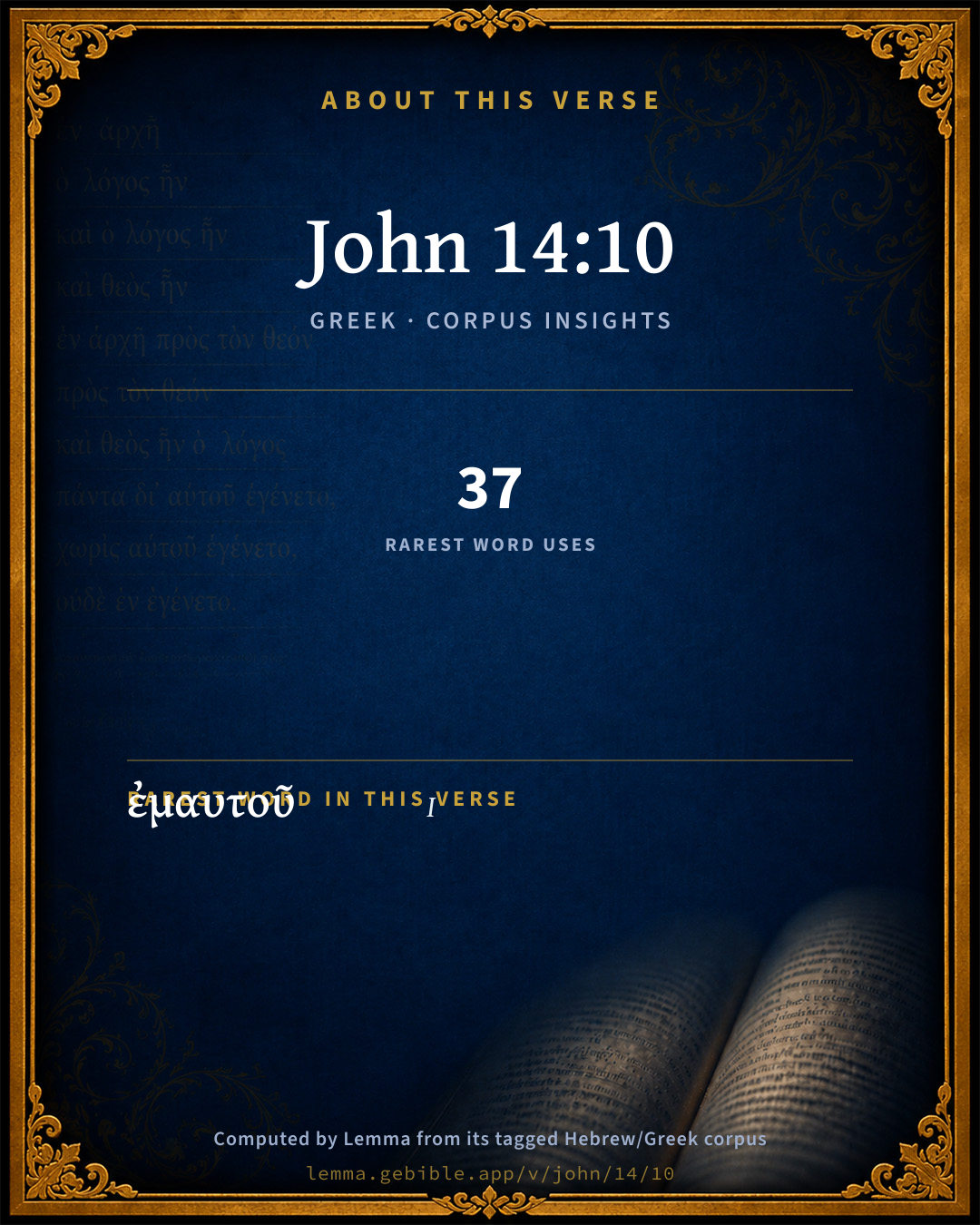
ἐμαυτοῦ I G1683 occurs in 37 verses of the Greek New Testament. Also found in:
Repetition

Words recur within this verse:

Cross-references

23

Topical passages linked to John 14:10 in the Treasury of Scripture Knowledge — connected by theme and wording, ordered by reader-vote popularity; previews shown in the World English Bible.

  • John 5:19 Jesus therefore answered them, "Most assuredly, I tell you, the Son can do nothing of himself, but what he sees the Father doing. For whatever things he does, these the Son also does likewise.
  • John 10:38 But if I do them, though you don't believe me, believe the works; that you may know and believe that the Father is in me, and I in the Father."
  • John 8:28 Jesus therefore said to them, "When you have lifted up the Son of Man, then you will know that I am he, and I do nothing of myself, but as my Father taught me, I say these things.
  • John 10:30 I and the Father are one."
  • John 12:49 For I spoke not from myself, but the Father who sent me, he gave me a commandment, what I should say, and what I should speak.
  • Acts 10:38 even Jesus of Nazareth, how God anointed him with the Holy Spirit and with power, who went about doing good and healing all who were oppressed by the devil, for God was with him.
  • John 6:38–40 For I have come down from heaven, not to do my own will, but the will of him who sent me.
  • Colossians 2:9 For in him all the fullness of the Godhead dwells bodily,
  • John 5:17 But Jesus answered them, "My Father is still working, so I am working, too."
  • John 17:8 for the words which you have given me I have given to them, and they received them, and knew for sure that I came forth from you, and they have believed that you sent me.
  • John 17:21–23 that they may all be one; even as you, Father, are in me, and I in you, that they also may be one in us; that the world may believe that you sent me.
  • John 1:1–3 In the beginning was the Word, and the Word was with God, and the Word was God.
  • John 3:32–34 What he has seen and heard, of that he testifies; and no one receives his witness.
  • John 7:16 Jesus therefore answered them, "My teaching is not mine, but his who sent me.
  • John 7:28–29 Jesus therefore cried out in the temple, teaching and saying, "You both know me, and know where I am from. I have not come of myself, but he who sent me is true, whom you don't know.
  • John 8:38 I say the things which I have seen with my Father; and you also do the things which you have seen with your father."
  • John 14:20 In that day you will know that I am in my Father, and you in me, and I in you.
  • 2 Corinthians 5:19 namely, that God was in Christ reconciling the world to himself, not reckoning to them their trespasses, and having committed to us the word of reconciliation.
  • Colossians 1:19 For all the fullness was pleased to dwell in him;
  • 1 John 5:7 For there are three who testify:
  • John 11:26 Whoever lives and believes in me will never die. Do you believe this?"
  • John 8:40 But now you seek to kill me, a man who has told you the truth, which I heard from God. Abraham didn't do this.
  • Psalms 68:16–18 Why do you look in envy, you rugged mountains, At the mountain where God chooses to reign? Yes, Yahweh will dwell there forever.

Cross-references courtesy of OpenBible.info (CC BY 4.0).

Where the printed editions differ

1 variant

Places in this verse where the major printed Greek editions disagree on the wording in a way that affects the translation — a comparison of editions, not a manuscript-by-manuscript collation. The editions are the modern critical texts (Nestlé-Aland 28/27, SBL, Westcott-Hort, Tregelles, Tyndale House) and the traditional texts behind the KJV (the Textus Receptus and the Byzantine/Majority text). It is not a claim about which reading is original.

  1. Extra text
    αὐτοῦ.

    “of Him.”

    In NA28NA27TynSBLWHTreg Not in TRByz

    αὐτοῦ. (autou) 'of Him.' is only in older manuscripts (NA28+NA27+Tyn+SBL+WH+Treg)

Textual data: Translators Amalgamated Greek New Testament (STEPBible TAGNT) · CC BY 4.0.

Commentary

Notes on John 14:10 from classic Christian and Jewish commentators (each source and its license shown beneath its notes). The classic Christian expositions comment on the surrounding passage and are grouped to its opening verse, so a note may address several verses; the Jewish commentaries on the Tanakh (Rashi and others) are per-verse, so they appear only where the commentator wrote on this verse.

Lemma curates 59 commentaries, every one of them public domain or Creative Commons licensed, each selected and text-cleaned for this edition rather than reprinted as found. About our sources →

Tyndale Open Study Notes

Tyndale Open Resources

14:10 Jesus’ claims were astonishing (10:30, 37-38). Yet true faith recognizes Jesus’ union with God the Father.

Tyndale Open Study Notes — © Tyndale Open Resources, licensed CC BY-SA 4.0. Text via the HelloAO Bible API.

Bengel's Gnomon

Johann Albrecht Bengel

Joh 14:10. Ὅτι) that.—ἐν τῷ Πατρὶ—ἐν ἐμοί, in the Father—in Me) This intimates the highest degree of unity: ch. Joh 17:21, “Thou, Father, art in Me, and I in Thee.”—ἔστι, is) This word contains the emphasis: for the consequent of this His Being [Esse] is His speaking and doing [loqui, facere: λαλῶ—ποιεῖ], and this His Being [Esse, ἔστι] is known by His words and deeds. Presently after comes the synonymous expression, that dwelleth in Me [μένων]. Hence from Their unity in operation, Their prior unity of essence shines forth the more apparent.—ῥήματα, the words) and, the works.—αὐτός) Himself.—ποιεῖ τὰ ἔργα, doeth the works) and speaketh the words. [What, in respect of those who were not on rather intimate terms with the Lord Jesus, are called signs and miracles, these, in conversation with His disciples, He simply calls works. No doubt to Christ Himself works of that sort were, as it were, ordinary and common.—V. g.]

Bengel's Gnomon of the New Testament — English translation (T&T Clark, Edinburgh, 1860) — public domain. Text from a community e-Sword module.

Meyer's Critical & Exegetical Commentary

Heinrich August Wilhelm Meyer

Joh_14:10-11. This language of thine amounts indeed to this: as though thou didst not believe that, etc.

ὅτι ἐγὼ ἐν τ. πατρὶ, κ.τ.λ.] On this mutual fellowship, which virtutis potius quam essentiae elogium est (Calvin), see on Joh_10:38. Comp. Joh_17:21. Here the ἐγὼ ἐν τ. πατ. stands first, because the matter in question is the way which the knowledge has to take from the Son to the Father.

τὰ ῥήματα … τὰ ἔργα αὐτοῦ] (see critical notes): the proof of this union of mine with the Father is, that I do not speak of myself; but the proof for that (for this ἀπʼ ἐμαυτοῦ οὐ λαλῶ) is, that the Father does His works through me. The δέ is therefore continuative (autem), not antithetical. Further, we must neither say that the ῥήματα are to be reckoned along with the ἔργα, nor that τὰ ἔργα signifies the business of teaching (Nösselt); but, from the fact that the Messianic works (see on Joh_5:36) are the works of the Father, it is inferred, with necessary dialectic certainty, from whom also the discourses of Jesus proceed; if the former are divine, the latter must be adequately related thereto. The first proposition is often arbitrarily supplemented from the second, and vice versâ.[145] This, however, does not agree with the Greek mode of allowing, in antithetic propositions, one clause to be completed from the other (Kühner, II. p. 603 f.; Bernhardy, p. 455), and would here run counter to the context, since Jesus, Joh_14:11, desires to have deduced from the ἔργα that which He had brought into light by τὰ ῥήματα … λαλῶ. Hence we are not to get out of the difficulty either by the assumption of an incongruity in the antithetic propositions (Tholuck), or, with Lange, pronounce that the words belong pre-eminently to the Son, the works pre-eminently to the Father, which is not contained in the expressions, and would be an un-Johannean halving of the thought (Joh_5:19, Joh_8:28, Joh_12:49); nor are we to assume, with Ewald, that a lesser significance is to be ascribed to the works in opposition to the words.

ὁ ἐν ἐμοὶ μένων] expressing the ὁ ἐν ἐμ. ὤν as enduring (he who does not depart from me). According to the reading ποιεῖ τ. ἔργα αὐτοῦ (see critical notes), the works of Jesus are set forth as the works of God, which the Father performs, that is, in virtue of His immanence in the Son, making them to operate in an outward direction.

Joh_14:11. From Philip, Jesus now turns to the disciples collectively, and that with an exhortation to the faith, in reference to which He had been obliged to question Philip in a manner implying doubt.

πιστεύετέ μοι] namely, without anything further, in addition to my personal assurance.

ὅτι] not because (Bengel), but that, as in Joh_14:10.

διὰ τὰ ἔργα αὐτά] On account of the works themselves (in and of themselves), irrespective of my oral testimony, believe me in this. The works are the actual proofs of that fellowship, Joh_5:19-20, Joh_10:37-38.

[145] The words which I speak to you, I speak not of myself; and the works which I do, I do not of myself, but the Father who is in me. He teaches me the words, and does the worksDe Wette, comp. Bengel.

Meyer — Critical and Exegetical Commentary on the New Testament — English translation by Peter Christie, edited by Frederick Crombie (T&T Clark, 1880) — public domain. Text from a community e-Sword module.

Expositor's Greek Testament

ed. W. Robertson Nicoll

Joh 14:10 . οὐ πιστεύεις … ἐστι ; This unbelief was involved in Philip’s question, but when the question of the mutual indwelling of the Father and Jesus was thus directly put to him, he would have no doubt as to the answer. Cf. Joh 10:38 . The fact of the union is indisputable; the mode is inexplicable; some of the results are indicated in the words: τὰ ῥήματα … τὰ ἔργα . See Joh 7:16-18 and Joh 5:19 . The mutual indwelling is such that everything Jesus says or does is the Father’s saying or doing. This was so obvious that Jesus could appeal to the works He did in case His assertion was disbelieved.

The Expositor's Greek Testament, edited by W. Robertson Nicoll (1897–1910) — public domain. Text from a community e-Sword module.

Geneva Bible (1599)

Geneva Bible translators

The majesty of God showeth itself most evidently, both in Christ’s doctrine and deeds.

Geneva Bible (1599) marginal notes — public domain. Text via Bolls.life.

Adam Clarke's Commentary

Verse 10. I am in the Father, and the Father in me?] We are essentially one; and those who have seen me have seen him who sent me.

He doeth the works.] We are not only one in nature, but one also in operation. The works which I have done bear witness of the infinite perfection of my nature. Such miracles as I have wrought could only be performed by unlimited power.

Adam Clarke's Commentary on the Bible (1810–1826) — public domain. Text from a community e-Sword/MySword module.

John Calvin's Commentaries

10. That I am in the Father, and the Father in me. I do not consider these words to refer to Christ’s Divine essence, but to the manner of the revelation; for Christ, so far as regards his hidden Divinity, is not better known to us than the Father. But he is said to be the lively Image, or Portrait, of God, because in him God has fully revealed himself, so far as God’s infinite goodness, wisdom, and power, are clearly manifested in him. And yet the ancient writers do not take an erroneous view of this passage, when they quote it as a proof for defending Christ’s Divinity; but as Christ does not simply inquire what he is in himself, but what we ought to acknowledge him to be, this description applies to his power rather than to his essence. The Father, therefore, is said to be in Christ, because full Divinity dwells in him, and displays its power; and Christ, on the other hand, is said to be in the Father, because by his Divine power he shows that he is one with the Father

The words which I speak to you. He proves from the effect that we ought not to seek God anywhere else than in him; for he maintains that his doctrine, being heavenly and truly Divine, is a proof and bright mirror of the presence of God. If it be objected, that all the Prophets ought to be accounted sons of God, because they speak divinely from the inspiration of the Spirit, and because God was the Author of their doctrine, the answer is easy. We ought to consider what their doctrine contains; for the Prophets send their disciples to another person, but Christ attaches them to himself. Besides, we ought to remember what the apostle declares, that now God speaketh from heaven (Hebrews 12:25) by the mouth of his Son, and that, when he spoke by Moses, he spoke, as it were, from the earth.

I do not speak, from myself; that is, as a man only, or after the manner of men; because the Father, exhibiting the power of his Spirit in Christ’s doctrine, wishes his Divinity to be recognized in him.

This must not be confined to miracles; for it is rather a continuation of the former statement, that the majesty of God is clearly exhibited in Christ’s doctrine; as if he had said, that his doctrine is truly a work of God, from which it may be known with certainty that God dwelleth in him. By the works, therefore, I understand a proof of the power of God.

Believe me that I am in the Father, and the Father in me. He first demands from the disciples to give credit to his testimony, when he asserts that he is the Son of God; but as they had hitherto been too lazy, he indirectly reproves their indolence. “If my assertion,” says he, “does not produce conviction, and if you have so mean an opinion of me, that you do not think that you ought to believe my words, consider, at least, that power which is a visible image of the presence of God.” It is very absurd in them, indeed, not to believe, entirely, the words which proceed from the mouth of the Lord Jesus, since they ought to have embraced, without any hesitation, every thing that he expressed, even by a single word. But here Christ reproves his disciples for having made so little progress, though they had received so many admonitions on the same subject. He does not explain what is the nature of faith, but declares that he has what is even sufficient for convicting unbelievers.

The repetition of the words, I am in the Father, and the Father in me, is not superfluous; for we know too well, by experience, how our nature prompts us to foolish curiosity. As soon as we have gone out of Christ, we shall have nothing else than the idols which we have formed, but in Christ, there is nothing but what is divine, and what keeps us in God

John Calvin's Commentaries (1540-1563) — public domain. Text from the Calvin Translation Society English edition (1840s-50s) via the Christian Classics Ethereal Library (ccel.org). Calvin's coverage is partial (roughly two-thirds of the Bible); uncommented books and verses are honest gaps, never fabricated. The 19th-century editor's footnotes and remarks are omitted so the notes are faithfully Calvin's own voice.

Ellicott's Commentary for English Readers

(10) Believest thou not that I am in the Father, and the Father in me?—Comp. Note on Joh_10:38. He had there taught this truth to the Jews; but Philip’s words seem to show that even the disciples did not fully receive it. The order of the clauses is reversed here, in accordance with the thought of the context, which is of knowledge of the Son, and of the Father through the Son.

The words that I speak unto you I speak not of myself.—This refers not to His present teaching only or chiefly, but to the whole of His manifestation of the character and attributes of God. All His words had been a revelation of the Father whom Philip now asks to see. (Comp. Joh_8:38.)

But the Father that dwelleth in me, he doeth the works.—The better reading is, but the Father that dwelleth in Me doeth His own works. This is the proof that He does not speak of Himself; and both clauses are together the proof of the indwelling of the Son in the Father and the Father in the Son. The works manifested in time in the power of the Incarnate Word are not His works, but those of the Father, who abides in the Son, and is revealed through Him. (Comp. Joh_8:28, and Note there.)

A Bible Commentary for English Readers, edited by Charles John Ellicott (1878–1897) — public domain. Text from a community e-Sword module.

The Cambridge Bible for Schools and Colleges

gen. ed. J. J. S. Perowne

10. Believest thou not] S. Philip’s question seemed to imply that he did not believe this truth, although Christ had taught it publicly (Joh_10:38). What follows is stated in an argumentative form. ‘That the Father is in Me is proved by the fact that My words do not originate with Myself; and this is proved by the fact that My works do not originate with Myself, but are really His.’ No proof is given of this last statement: Christ’s works speak for themselves; they are manifestly Divine. If matters little whether we regard the argument as à fortiori, the works being stronger evidence than the words; or as inclusive, the works covering and containing the words. The latter seems to agree best with Joh_8:28. On the whole statement that Christ’s words and works are not His own but the Father’s, comp. Joh_5:19; Joh_5:30, Joh_8:26-29, Joh_12:44.

the Father that dwelleth in me, he doeth the works] The better reading gives us, the Father abiding in Me doeth His works (in Me). And thus the saying ‘Ye have seen the Father’ (Joh_14:7) is justified: the Father is seen in the Son.

The Cambridge Bible for Schools and Colleges (gen. ed. J. J. S. Perowne; Cambridge University Press, 1878–1918) — public domain. Text from a community e-Sword module.

John Gill's Exposition

Believest thou not that I am in the Father?.... This surely is, as it must needs be, and ought to be, an article of your faith, "that I am in the Father",

and the Father in me; phrases which are expressive of the sameness of nature in the Father and the Son; of the Son's perfect equality with the Father, since the Son is as much in the Father, as the Father is in the Son; and also of the personal distinction there is between them; for nothing with propriety can be said to be in itself. The Father must be distinct from the Son who is in him, and the Son must be distinct from the Father, in whom he is; the Father and Son, though of one and the same nature, cannot be one, and the same person:

the words that I speak unto you, I speak not of myself. The doctrines which I preach among you are a proof of what I assert, and to them I appeal; for these are not of myself, as man,

but the Father that dwelleth in me; and so prove that I am truly God, of the same nature with my Father; that he is in me, and I in him; since they are such as none but the only begotten, who is in the bosom of the Father, could ever have declared and made known unto you; Likewise, the works which I do, as man, I do not of myself; but

he doth the works: for so this passage must be understood and supplied, in which Christ proceeds to another argument, taken from his works, proving the Father to be in him, and that he is in the Father, which, is enlarged on in Joh 14:11.

John Gill's Exposition of the Whole Bible (1746–1763) — public domain (CC PDM 1.0). Text via the HelloAO Bible API.

Trapp's Complete Commentary

John Trapp

10 Believest thou not that I am in the Father, and the Father in me? the words that I speak unto you I speak not of myself: but the Father that dwelleth in me, he doeth the works.

Ver. 10. The words that I speak] Our Saviour allegeth for himself the Divinity both of his word and works. He was mighty, saith Peter, both in word and deed. Ministers also must, in their measure, be able to argue and approve themselves to be men of God, by sound doctrine and good life. And not be, as our Saviour saith the Pharisees were, and as Epictetus saith many philosophers were such, ανευ του πραττειν, μεχρι του λεγειν, that is, as far as a few words would go.

John Trapp, A Commentary or Exposition upon All the Books of the Old and New Testament (1647–1656) — public domain. Text from a community e-Sword module.

Albert Barnes' Notes on the Bible

I am in the Father - See the notes at Joh 10:38.

The words that I speak ... - See the notes at Joh 7:16-17.

The Father that dwelleth in me - Literally, “The Father remaining in me.” This denotes most intimate union, so that the works which Jesus did might be said to be done by the Father. It implies a more intimate union than can subsist between a mere man and God. Had Jesus been a mere man, like the prophets, he would have said, “The Father who sent or commissioned me doeth the works;” but here there is reference, doubtless, to that mysterious and special union which subsists between the Father and the Son.

He doeth the works - The miracles which had been performed by Jesus. The Father could be said to do them on account of the intimate union between him and the Son. See Joh 5:17, Joh 5:19, Joh 5:36; Joh 10:30.

Albert Barnes' Notes on the Bible (1834–1885) — public domain. Text from a community e-Sword/MySword module.

Haydock's Catholic Bible Commentary

Do you not believe that I am in the Father, and the Father in me? These words confirm the equality of the Father and the Son: nor can they be expounded of an union of affection only, by what Christ told them before. (John v. 17. and 19.) As the Father worketh till now, so I work: and whatsoever things the Father worketh, these also in like manner the Son doth. (Witham) --- In the Son and in the Father, there is one and the same essence, the same wisdom, the same power; so that what the Son says, he does not say it of himself, and what the Son does, he does not do it of himself; but it is the Father, who abideth in the Son, who both acts and speaks.

George Leo Haydock (1774–1849), Haydock's Catholic Family Bible and Commentary, 1859 edition — public domain. Excludes Psalms (Douay-Rheims chapter numbering differs from Protestant) and Deuterocanonical books (Catholic canon only).

Matthew Poole's English Annotations

I am in the Father, and the Father in me. It is the opinion of Mr. Calvin, that these words are not here spoken so much to express his Divine nature and being, (for so Christ is no more known to us than his Father), as to express his manner of revealing it. Yet is the Divine nature of Christ fully proved from hence. Others judge, that these words do clearly signify both the distinction of persons, for nothing is in itself, and also the union of the persons in the Divine Being. He proveth his union with the Father, because he spake not those words which he spake of himself; that is, not of himself solely; he revealed but his Father’s will, and declared his Father’s mind; and because the works which he did, he did not by his own sole power, without the concurrence of his Father’s power in those operations.

Matthew Poole's English Annotations on the Holy Bible (1683–1685) — public domain. Text from a community e-Sword/MySword module.

Whedon's Commentary on the Bible

Daniel D. Whedon

10. I am in the Father—As Hooker says, “The Son is in the Father, as light is in that light out of which it floweth without separation. The Father is in the Son as light in that light which it causeth and leaveth not.” According to the modern theory of light we might say, the Father is as the luminiferous ether, which is the essence of light; and the Son is like the light which the other becomes by undulatory motion.

Daniel D. Whedon (gen. ed.), Commentary on the Old and New Testaments (1874–1909) — public domain. Text from a community e-Sword module.

The Pulpit Commentary

Believest thou not that I am in the Father, and the Father in me? Philip had heard in an inverted order these very words. (see Joh_10:38) He might have grasped their meaning; two aspects of the same Divine truth or reality the reciprocal fellowship between the Father and the Son, between the Father and the Effulgence of the Father"s glory who is now the God-Man. I am in the Father, I the God-Man am in the Father, as the Loges has ever been in him and proceeding from him. I, who was forever in the bosom of the Father in heaven though on earth, am in the Father now, as the sun dwells in its own effluent light; and the Father is in me, seeing I am the Image of his substance, the Agent of his purpose, the Speaker of his words, the Doer of his works. The words (rhmata) which I speak (legw , R.T.) unto you those words which are "spirit and life", (Joh_6:63) those "words of eternal life," according to Peter"s grand confession (Joh_6:68, Joh_6:69) I do not utter (lalw) from myself; i.e. they are the words of the Father, and also the proof that I am in the Father, but the Father worketh always and ever more in and through the Son, these works which may seem to be mine as the Son of man, but are the operation of the Father himself, he who abides in the Son. And the Father abiding in me, doeth his works. These works of mine (erga) are all signs (shmeia) of my relation to the Father. They are indications to Philip of the nature, and quality, and character, and feeling towards him of the Father himself.

The Pulpit Commentary (1880–1919), ed. H.D.M. Spence-Jones & Joseph S. Exell — public domain. Text from a community e-Sword module.

John Wesley's Explanatory Notes

I am in the Father - The words that I speak, &c. - That is, I am one with the Father, in essence, in speaking, and in acting.

John Wesley, Explanatory Notes Upon the Whole Bible (1754–1765) — public domain. Text via the GEBible commentary corpus.

The People's New Testament

B. W. Johnson

10. Believest thou not that I am in the Father, and the Father in me? There was the completest union of the personalities of the Son and the Father. We may never on earth comprehend fully its nature, but we can understand it to be so complete that he was the manifestation of God in the flesh (Col. 2:9).

B. W. Johnson's The People's New Testament with Notes (1889–1891) — public domain. Electronic text from the Christian Classics Ethereal Library (CCEL) ThML edition.

unfoldingWord translationNotes

Door43 World Missions Community

Connecting Statement:

Jesus asks Philip a question and then he continues to speak to all of his disciples.

Do you not believe ... in me?

This remark appears in the form of a question to emphasize Jesus' words to Philip. AT: "You really should believe ... in me." (See: Rhetorical Question)

Father

This is an important title for God. (See: Translating Son and Father)

The words that I say to you I do not speak from my own authority

"What I am telling you is not from me" or "The words I tell you are not from me"

The words that I say to you

Here "you" is plural. Jesus is now speaking to all of his disciples.

I am in the Father, and the Father is in me

This is an idiom that means God the Father and Jesus have a unique relationship. AT: "I am one with the Father, and the Father is one with me" or "my Father and I are just as though we were one" (See: Idiom)

translationWords

believe

God the Father

authority

life

works

unfoldingWord translationNotes — © Distant Shores Media and the Door43 World Missions Community, licensed CC BY-SA 4.0. Source: git.door43.org/Door43/en_tn.

Cambridge Greek Testament for Schools and Colleges

10. λέγω for λαλώ (correction for uniformity): and ποιεῖ τὰ ἔργα αὐτοῦ for αὐτὸς π. τ. ἔργα with אBD against ANQ.

10. οὐ πιστεύεις. S. Philip’s question seemed to imply that he did not believe this truth, although Christ had taught it publicly (Joh 10:38). What follows is stated in an argumentative form. ‘That the Father is in Me is proved by the fact that My words do not originate with Myself; and this is proved by the fact that My works do not originate with Myself, but are really His.’ No proof is given of this last statement: Christ’s works speak for themselves; they are manifestly Divine. It matters little whether we regard the argument as à fortiori, the works being stronger evidence than the words; or as inclusive, the works covering and containing the words. The latter seems to agree best with Joh 8:28. For τὰ ῥήματα see on Joh 3:34: λέγω refers to the substance, λαλῶ to the form of the utterances (Joh 12:49, Joh 16:18). On the whole statement that Christ’s words and works are not His own but the Father’s, comp. Joh 5:19; Joh 5:30, Joh 8:26-29, Joh 12:44: τὰ ἔργα αὐτοῦ are the Father’s works, done and seen in the Son.

Cambridge Greek Testament for Schools and Colleges (Cambridge University Press, 1896; 21 vols, various authors incl. Carr, Maclear, Plummer, Farrar, Lumby, Moule, M. R. James, Simcox) — public domain. Text from a community e-Sword module.

Alford’s Greek Testament

Henry Alford

10.] See ch. 10:30, 38, and for the latter clause ch. 8:28, where the contrast is, as here, purposely inexact in diction,—words being placed in one member and works in the other: and, as there, ἔργα and ῥήματα are taken as correlative and co-extensive;—all the working of the Lord Jesus being a λαλιά, a revelation of the Father. De Wette supposes both ἔργα and ῥήμ. to be understood in both places. Without the [ὁ], the sense will be, of course, the Father, abiding in Me.…

ποιεῖ τὰ ἔργα αὐτοῦ] doeth His works: they are not Mine, but His, done in and by Me: but ἐν ἐμοί, present and abiding, so that ὁ ἑωρακὼς ἐμὲ ἑώρακεν τὸν πατέρα.

Henry Alford, The Greek Testament (1849–1861) — public domain. Text from a community e-Sword module.

International Critical Commentary

10. οὐ πιστεύεις κτλ. This was to expect a greater faith than He asked of the blind man (9:35), or even of Martha (11:27). Jesus expected of the Eleven, who had enjoyed a longer and more intimate association with Him than others, that they should appreciate in some measure the deeper secrets of His being. The “evolution” of faith is always towards a larger faith.

ὅτι ἐγὼ ἐν τῷ πατρί κτλ. Here is the mystery of that oneness with the Father which is always prominent in Jn. Jesus had held this Divine coinherence up to the Jews as a belief which they might ultimately recognise as true (10:38), but He did not reproach them for not having reached it yet. Philip was in a different position, and ought to have learnt something of it before now. The two lines of testimony to which Jesus appeals in support of His claim to reciprocal communion with the Father, here as elsewhere, are His words and His works. See on 10:38, where the argument is almost identical with that of vv. 10, 11, and expressed in the same terms.

τὰ ῥήματα. See on 3:34 for the “words” of Jesus as divine.

τὰ ῥήματα ἃ ἐγὼ λέγω ὑμῖν. The rec., with אAΓΔΘ, has λαλῶ from the next clause, but B2LN have λέγω (which has been omitted in B* through misreading ἐγὼ λέγω). λέγω is often used in Jn. interchangeably with λαλῶ, as here. See on 3:11.

ἀπʼ ἐμαυτοῦ οὐ λαλῶ. This He had said several times. See the references given in the note on 7:17.

ὁ δὲ πατὴρ ὁ ἐν ἐμοὶ μένων The second ὁ is omitted in BL, but is preserved in אADNWΘ.

ποιεῖ τὰ ἔργα αὐτοῦ; So אBD but the rec., with AΓΔΘ, has αὐτὸς ποιεῖ τὰ ἔργα, a correction due to the tendency to describe the miracles as Christ’s rather than as the Father’s. But to distinguish thus is contrary to Johannine teaching. See especially on 5:19. The ἔργα of Jesus are also the ἔργα of God the Father.

In this verse the words of Jesus are treated as among his works. Both are, as it were, the λαλία of the Father. But they may be considered separately, His words appealing more directly to the conscience and spiritual insight of His hearers, His works appealing rather to their intellect, as indicative of His superhuman personality.

International Critical Commentary — older volumes (1896–1929), various authors — public domain. Text from a community e-Sword module.

Vincent's Word Studies in the New Testament

Marvin R. Vincent

Of myself [απ εμαυτου] . Rev., better, from myself. See on 7 17. The Father that dwelleth in me, He doeth the works [ο δε πατηρ ο εν εμοι μενων, αυτος ποιει τα εργα] . The best texts read, oJ de pathr ejn ejmoi menwn poiei ta erga autou; the Father abiding in me doeth His works. Philip doubts whether Christ is in the Father, and the Father in Him. The answer is twofold, corresponding to the two phases of the doubt. His words, spoken not from Himself, are from the Father, and therefore He utters them from within the Father, and is Himself in the Father. His works are the works of the Father abiding in Him; therefore the Father is in Him.

Marvin R. Vincent, Word Studies in the New Testament (1887–1900) — public domain. Text from a community e-Sword/MySword module.

Godet's Commentaries

Frédéric Louis Godet

Vv. 10, 11. “Believest thou not that I am in the Father, and that the Father is in me? The words that I speak unto you, I speak not of myself; and the Father, who dwells in me, he does the works. 11. Believe me when I say to you that I am in the Father, and that the Father is in me; and, if not, believe me because of the works.”

Jesus indicates to Philip two signs by which he ought to have recognized and may even at this moment recognize in Him the true appearance of God. He does not say that the Father and Himself are one and the same person. He constantly prays to the Father, saying: Thou. But it is a union by which they live the one in the other (comp. Gess), and this relation has as its background the life of the Logos. The words Believest thou not? show Philip that his prayer must be regarded as inconsistent with his faith.

There are in the union of Jesus with the Father two aspects:I in the Father: Jesus emptying Himself in order to transfer Himself to God; and the Father in me: God communicating to Jesus all His wealth of strength and wisdom. On one side, Jesus making a void in Himself; on the other, God filling this void.

After this, Jesus characterizes each of the two sides of this relation by that one of the manifestations of His life which is most fitted to bring it to light: the first by His words; the second, by His works. Not one of His words that He derives from Himself and does not receive from God! Not one of His works that is not wrought through Him by God Himself! Of His own wisdom, nothing! By the strength of God, everything. The negative clause is better suited to wisdom; the active form, to power. The following verse explains why the words are placed here before the works: comp. the reverse order in Joh 8:28, where Jesus is speaking to the unbelieving Jews. The first sign of the community of life and action between Jesus and God, for prepared hearts, is His teachings; for those less disposed, it is His works. We may hesitate between the readings λαλῶ and λέγω, in the first clause. In the second, the term λαλῶ, in any case, is perfectly suitable. Jesus is only the organ of the Father: God speaks; Jesus announces.

In Joh 14:11, Jesus demands from His disciples faith in His union with the Father on the authority of the testimony which He has borne to Himself. In the second clause, the imperative believe is without an object according to the reading of א B L: “Believe,” speaking absolutely, which seems logical.

Nevertheless, the reading me in the other authorities may also be defended: “Believe me, if not on the ground of my word, at least because of my works;” comp. Joh 10:38. Jesus evidently means by these His supernatural works, His miracles. The miracles are a proof for him who does not believe in the words, because this divine testimony, not passing through the mouth of Jesus Himself, has an objective character. By these words, Jesus assigns to miracles their true place in apologetics.

In the first editions of this work, I regarded the following passage as designed to add to the objective revelation of God, accomplished in the person of Jesus (Joh 14:8-11), the subjective, internal theophany, the work of the Spirit, which is about to be described in Joh 14:12-24. It seems to me now that another connection must be adopted (see on Joh 14:12).

Frédéric Louis Godet — Commentaries on Luke, John, Romans, and 1 Corinthians — English translation (T&T Clark, Edinburgh, 1870s–1890s) — public domain. Text from a community e-Sword module.

Lesson kit

Teaching starters — assembled from the data on this page, not authored interpretation. Every prompt links to the verse data it draws on. Edit before teaching.

John, in the Gospels, opens this verse with 33 words (21 distinct Greek lemmas). Its most distinctive word is emautoû (“I”). A historical commentator’s framing appears above. Read the whole chapter for the surrounding context.

Discussion questions

  1. The word emautoû carries the sense “I.” How does it shape the verse?
  2. How does Matthew 8:9, which shares the word «I», read alongside this verse?
  3. What does the repetition of “father” (3× in this one verse) do in this verse?
  4. These translations render this verse differently; the difference is in the English rendering, not the original. What questions does that raise?
  5. Compare how Tyndale Open Study Notes and Bengel's Gnomon read this verse. Where do they agree or differ?

Things to notice

Reading settings

Reading text

Shown beneath each verse's original-language words.

Old Testament
Old Testament edition

Read the OT as the Masoretic Hebrew (MT) or the Greek Septuagint (LXX).

English shown for the Greek Septuagint (in the Hebrew ↔ Greek comparison).

Comparing translations? Open the Compare panel on any verse page to stack up to four side by side.