John 14:9

Greek (Tischendorf 8th ed.) John 14:9 appears in the Greek New Testament. The text above is from the Tischendorf 8th edition. Each word links to its Strong’s number and a concise gloss. Click any word for its full Thayer’s Greek Lexicon entry.
Download image
Cite this verse

John 14:9 (World English Bible). Public Domain. Lemma interlinear Bible study tool, https://lemma.gebible.app/v/john/14/9.

Show BibTeX & RIS
BibTeX
RIS
English Translation
Jesus said to him, "Have I been with you such a long time, and do you not know me, Philip? He who has seen me has seen the Father. How do you say, 'Show us the Father?'
World English Bible · Public Domain
Download a study sheet

One document with this verse’s original text, its word-by-word gloss line, the meaning frame, cross-references with their text, attributed commentary, and full source and license credits — printable, and it pastes into notes with its structure intact.

This verse Autodidact and up

Study sheet (.html) Plain text (.txt)

A passage Seminary Student

Up to 50 verses in one chapter. A passage sheet keeps up to 6 commentary sources and 12 cross-references per verse, in the order this page ranks them, and says so on the sheet whenever that leaves anything out. Ask for a single verse and you get the Autodidact verse sheet above.

Everything on this page stays free to read, with no account — the sheet is a download of what is already on screen, not access to it.

Want to remove ads? Support Godless Engineer
Compare translations 3

The same verse in 3 English versions, stacked beneath the original-language interlinear above. Click any original word for its lexicon entry.

Each is an independent rendering of the whole verse — the interlinear is not word-aligned to these translations.

Highlighted words mark where these versions differ — a whole-verse word diff, not a word-by-word alignment.

  • World English Bible Public Domain
    Jesus said to him, "Have I been with you such a long time, and do you not know me, Philip? He who has seen me has seen the Father. How do you say, 'Show us the Father?'
  • King James Version Public Domain
    Jesus saith unto him, Have I been so long time with you, and yet hast thou not known me, Philip? he that hath seen me hath seen the Father; and how sayest thou then, Shew us the Father?
  • unfoldingWord Literal Text CC BY-SA 4.0
    Jesus says to him, “So long a time I am with you, and you do not know me, Philip? The one that has seen me has seen the Father. How do you say, ‘Show us the Father’?

unfoldingWord Literal Text — © unfoldingWord, licensed CC BY-SA 4.0. Word-aligned USFM3 via Door43 (git.door43.org/unfoldingWord/en_ult).

Versions to compare (up to 4)

3 of 4 selected

Show all 19 translations

Every available English version of this verse, each an independent rendering of the whole verse.

  • World English Bible Public Domain
    Jesus said to him, "Have I been with you such a long time, and do you not know me, Philip? He who has seen me has seen the Father. How do you say, 'Show us the Father?'
  • Berean Standard Bible Public Domain
    Jesus replied, “Philip, I have been with you all this time, and still you do not know Me? Anyone who has seen Me has seen the Father. How can you say, ‘Show us the Father’?
  • Majority Standard Bible Public Domain
    Jesus replied, “Philip, I have been with you all this time, and still you do not know Me? Anyone who has seen Me has seen the Father. How can you say, ‘Show us the Father’?
  • King James Version Public Domain
    Jesus saith unto him, Have I been so long time with you, and yet hast thou not known me, Philip? he that hath seen me hath seen the Father; and how sayest thou then, Shew us the Father?
  • American Standard Version (1901) Public Domain
    Jesus saith unto him, Have I been so long time with you, and dost thou not know me, Philip? he that hath seen me hath seen the Father; how sayest thou, Show us the Father?
  • Revised Version (1885) Public Domain
    Jesus saith unto him, Have I been so long time with you, and dost thou not know me, Philip? he that hath seen me hath seen the Father; how sayest thou, Shew us the Father?
  • Geneva Bible (1599) Public Domain
    Iesus sayd vnto him, I haue bene so long time with you, and hast thou not knowen mee, Philippe? he that hath seene me, hath seene my Father: how then sayest thou, Shewe vs thy Father?
  • Douay-Rheims (1899) Public Domain
    Jesus saith to him: Have I been so long a time with you; and have you not known me Philip, he that seeth me seeth the Father also. How sayest thou, Shew us the Father
  • Young's Literal Translation Public Domain
    Jesus saith to him, `So long time am I with you, and thou hast not known me, Philip? he who hath seen me hath seen the Father; and how dost thou say, Shew to us the Father?
  • Literal Standard Version CC BY-SA 4.0
    Jesus says to him, “Such [a] long time am I with you, and you have not known Me, Philip? He who has seen Me has seen the Father; and how do you say, Show to us the Father?
  • Unlocked Literal Bible CC BY-SA 4.0
    Jesus said to him, “I have been with you for so long and you still do not know me, Philip? Whoever has seen me has seen the Father. How can you say, 'Show us the Father'?
  • unfoldingWord Literal Text CC BY-SA 4.0
    Jesus says to him, “So long a time I am with you, and you do not know me, Philip? The one that has seen me has seen the Father. How do you say, ‘Show us the Father’?
  • Darby Bible Public Domain
    Jesus says to him, Am I so long a time with you, and thou hast not known me, Philip? He that has seen me has seen the Father; and how sayest thou, Shew us the Father?
  • World Messianic Bible Public Domain
    Yeshua said to him, “Have I been with you such a long time, and do you not know me, Philip? He who has seen me has seen the Father. How do you say, ‘Show us the Father’?
  • Webster's Bible Public Domain
    Jesus saith to him, Have I been so long time with you, and yet hast thou not known me Philip? he that hath seen me, hath seen the Father; and how sayest thou then, Show us the Father?
  • Free Bible Version CC BY-SA 4.0
    Jesus replied, “Have I been with you such a long time, Philip, and yet you still don't know me? Anyone who has seen me has seen the Father. How can you say, ‘Show us the Father’?
  • Bible in Basic English Public Domain
    Jesus said to him, Philip, have I been with you all this time, and still you have no knowledge of me? He who has seen me has seen the Father. Why do you say, Let us see the Father?
  • Text-Critical English NT CC BY 4.0
    Jesus said to him, “Have I been with you for so long and still yoʋ do not know me, Philip? Anyone who has seen me has seen the Father, so how can yoʋ say, ‘Show us the Father’?
  • Tyndale New Testament (1534) Public Domain
    Iesus sayde vnto him: have I bene so longe tyme with you: and yet hast thou not knowen me? Philip he that hath sene me hath sene the father. And how sayest thou then: shew vs the father?

Literal Standard Version (2020), Covenant Press — licensed CC BY-SA 4.0. Text via the HelloAO Bible API (eBible.org). Unlocked Literal Bible (unfoldingWord) — licensed CC BY-SA 4.0. Text via the HelloAO Bible API (eBible.org). unfoldingWord Literal Text — © unfoldingWord, licensed CC BY-SA 4.0. Word-aligned USFM3 via Door43 (git.door43.org/unfoldingWord/en_ult). Free Bible Version, Dr. Jonathan Gallagher — licensed CC BY-SA 4.0. Text via the HelloAO Bible API (eBible.org).

Word by word

More ways to search: Search by grammar → Find every occurrence → Compare this word →

Practice this passage: Drill this verse → Learn its vocabulary →

τοσούτῳ
tosoûtos
G5118
“so great”
Demonstrative pronoun, Dative, Singular, Masculine
Part of Speech
Demonstrative pronoun
Case
Dative
Number
Singular
Gender
Masculine
Full Thayer's Definition

Origin: from tosos (so much, apparently from G3588 and G3739 ) and G3778 (including its variations)

TDNT: None

1. of quantity: so great, so many 2. of time: so long
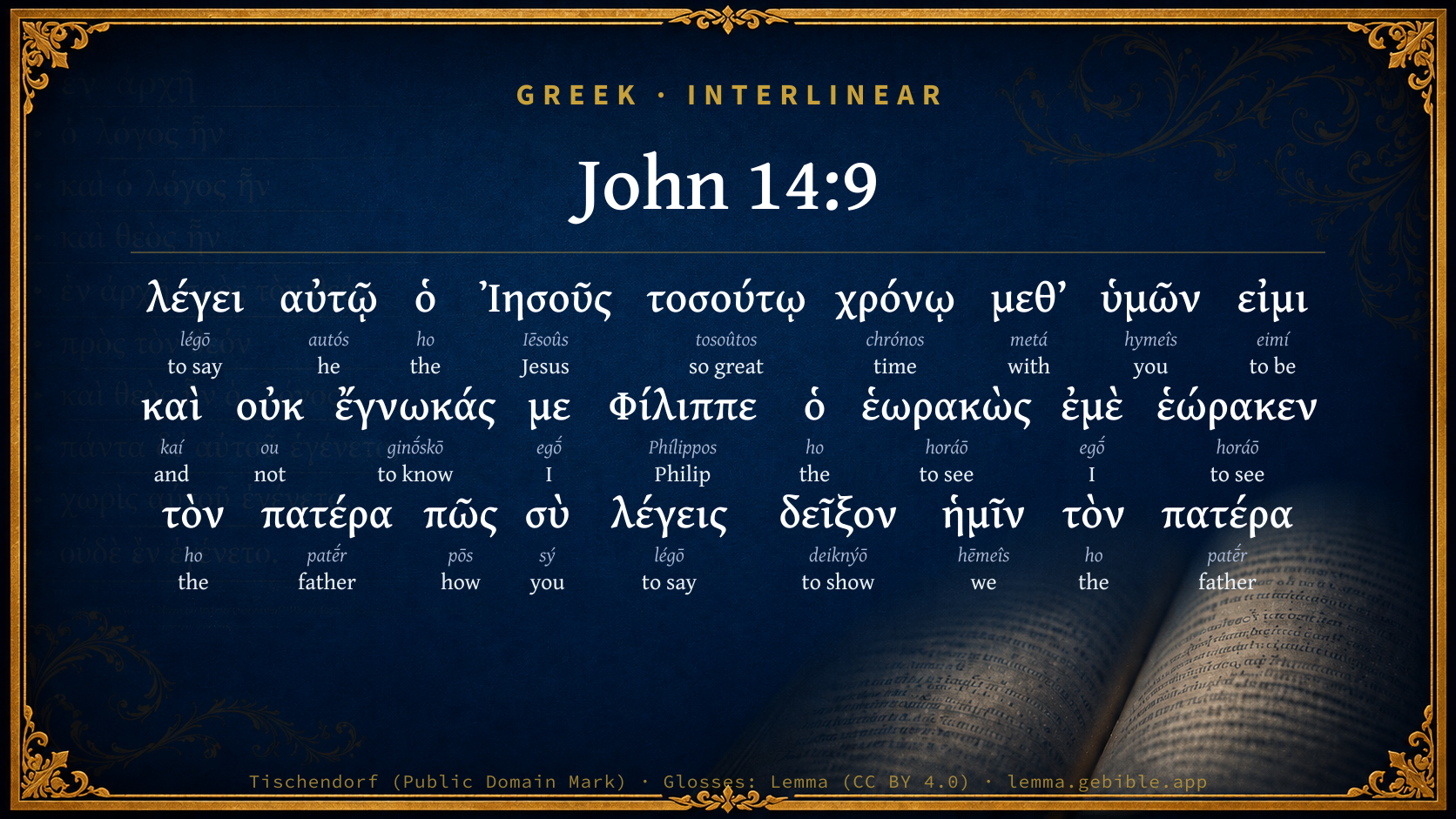
  1. λέγει légō G3004 “to say” Verb, Present, Active, Indicative, 3rd person, Singular
  2. αὐτῷ autós G846 “he” Personal pronoun, Dative, Singular, Masculine
  3. ὁ ho G3588 “the” Article, Nominative, Singular, Masculine
  4. Ἰησοῦς Iēsoûs G2424 “Jesus” Noun, Nominative, Singular, Masculine
  5. χρόνῳ chrónos G5550 “time” Noun, Dative, Singular, Masculine
  6. μεθ’ metá G3326 “with” Preposition
  7. ὑμῶν hymeîs G5210 “you” Personal pronoun, 2nd person, Genitive, Plural
  8. εἰμι eimí G1510 “to be” Verb, Present, Active, Indicative, 1st person, Singular
  9. καὶ kaí G2532 “and” Conjunction
  10. οὐκ ou G3756 “not” Particle, Negative
  11. ἔγνωκάς ginṓskō G1097 “to know” Verb, Perfect, Active, Indicative, 2nd person, Singular
  12. με egṓ G1473 “I” Personal pronoun, 1st person, Accusative, Singular
  13. Φίλιππε Phílippos G5376 “Philip” Noun, Vocative, Singular, Masculine
  14. ὁ ho G3588 “the” Article, Nominative, Singular, Masculine
  15. ἑωρακὼς horáō G3708 “to see” Verb, Perfect, Active, Participle, Nominative, Singular, Masculine, Attic form
  16. ἐμὲ egṓ G1473 “I” Personal pronoun, 1st person, Accusative, Singular
  17. ἑώρακεν horáō G3708 “to see” Verb, Perfect, Active, Indicative, 3rd person, Singular, Attic form
  18. τὸν ho G3588 “the” Article, Accusative, Singular, Masculine
  19. πατέρα patḗr G3962 “father” Noun, Accusative, Singular, Masculine
  20. πῶς pōs G4459 “how” Adverb, Interrogative
  21. σὺ sý G4771 “you” Personal pronoun, 2nd person, Nominative, Singular
  22. λέγεις légō G3004 “to say” Verb, Present, Active, Indicative, 2nd person, Singular
  23. δεῖξον deiknýō G1166 “to show” Verb, Aorist, Active, Imperative, 2nd person, Singular
  24. ἡμῖν hēmeîs G2249 “we” Personal pronoun, 1st person, Dative, Plural
  25. τὸν ho G3588 “the” Article, Accusative, Singular, Masculine
  26. πατέρα patḗr G3962 “father” Noun, Accusative, Singular, Masculine

About this verse

These counts appear in no published source. They are computed here, from the morphology-tagged text and Lemma’s own curated glosses. What Lemma adds →

27
words
20
distinct lemmas
Gospels
section

Notable vocabulary

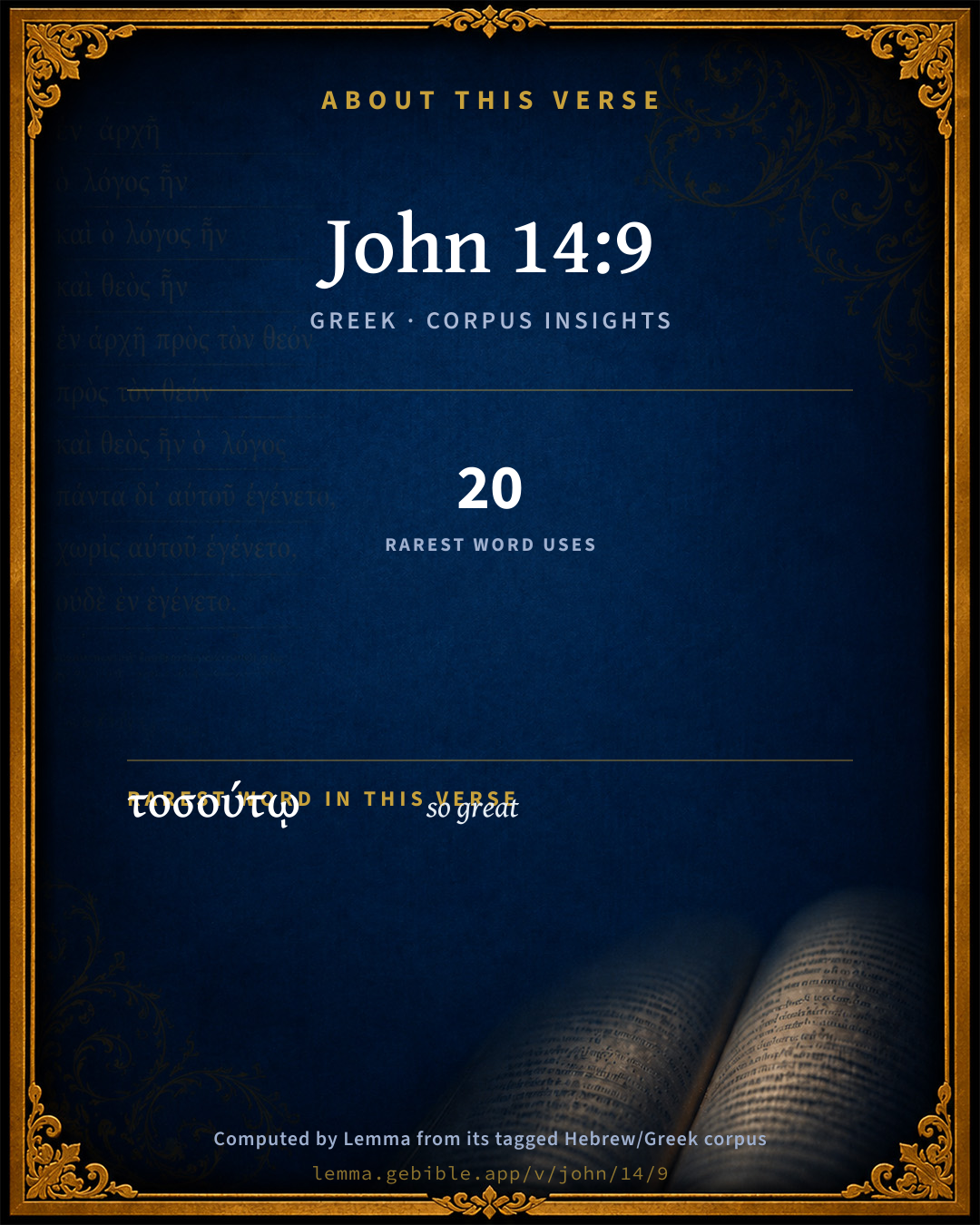
The rarest word here is τοσούτῳ so great G5118 — appearing just 20 times in the whole Greek New Testament.

Shared distinctive vocabulary

τοσούτῳ so great G5118 occurs in 18 verses of the Greek New Testament. Also found in:

Repetition

Words recur within this verse:

  • λέγει to say G3004 ×2
  • ἑωρακὼς to see G3708 ×2
  • πατέρα father G3962 ×2
  • ὁ the G3588 ×4
  • με I G1473 ×2

Cross-references

9

Topical passages linked to John 14:9 in the Treasury of Scripture Knowledge — connected by theme and wording, ordered by reader-vote popularity; previews shown in the World English Bible.

  • Colossians 1:15 who is the image of the invisible God, the firstborn of all creation.
  • John 12:45 He who sees me sees him who sent me.
  • John 14:7 If you had known me, you would have known my Father also. From now on, you know him, and have seen him."
  • Hebrews 1:3 His Son is the radiance of his glory, the very image of his substance, and upholding all things by the word of his power, when he had by himself made purification for our sins, sat down on the right hand of the Majesty on high;
  • John 10:30 I and the Father are one."
  • John 1:14 The Word became flesh, and lived among us. We saw his glory, such glory as of the one and only Son of the Father, full of grace and truth.
  • Philippians 2:6 who, existing in the form of God, didn't consider it robbery to be equal with God,
  • John 14:20 In that day you will know that I am in my Father, and you in me, and I in you.
  • Mark 9:19 He answered him, "Unbelieving generation, how long shall I be with you? How long shall I bear with you? Bring him to me."

Cross-references courtesy of OpenBible.info (CC BY 4.0).

Commentary

Notes on John 14:9 from classic Christian and Jewish commentators (each source and its license shown beneath its notes). The classic Christian expositions comment on the surrounding passage and are grouped to its opening verse, so a note may address several verses; the Jewish commentaries on the Tanakh (Rashi and others) are per-verse, so they appear only where the commentator wrote on this verse.

Lemma curates 59 commentaries, every one of them public domain or Creative Commons licensed, each selected and text-cleaned for this edition rather than reprinted as found. About our sources →

Tyndale Open Study Notes

Tyndale Open Resources

14:9 Anyone who has seen me has seen the Father! Cp. 1:1-2. Jesus Christ is God-in-the-flesh (1:14), which explains his capacity to accomplish divine works. Jesus did not simply teach about God; in him God can be found. Jesus’ remarkable statement echoed what he had said at Hanukkah: “The Father and I are one” (10:30). This claim is at the root of the world’s opposition to Christ (5:18).

Tyndale Open Study Notes — © Tyndale Open Resources, licensed CC BY-SA 4.0. Text via the HelloAO Bible API.

Bengel's Gnomon

Johann Albrecht Bengel

Joh 14:9. Λέγει, saith) The reply to, Show us, is contained in Joh 14:9-11; the answer to, it sufficeth us, is contained in Joh 14:12, etc., “The works that I do, shall ye do also—If ye ask anything in My name, I will do it.”—οὐκ ἔγνωκάς με, hast thou not known Me?) This is expressed by the consequent. Since thou dost deny that the Father is known to thee, thou virtually [by consequence] deniest that I am known to thee. But thou dost know Me, therefore by that very fact thou knowest the Father; by reason of the consummate unity which subsists between us.—ὁ ἑωρακὼς ἐμέ, ἑώρακε τὸν Πατέρα, he who hath seen Me, hath seen the Father) Just as the soul, which by itself is not perceived, is perceived by means of what it does through the instrumentality of the body: so he sees the Father, who sees Christ. In every thought concerning God, we ought to set Christ before us. See Col 1:15, note, “The image of the invisible God.” That expression, מַלְאַךְ פָּנָיו, Angel of His face, Bechai interprets מלאך שהוא פניו The Angel who is His face. Comp. Psa 139:7, “Whither shall I flee from Thy presence?” Chrysostom remarks, He who seeth the creature, doth not also see the essence of God (τὴν οὐσίαν). If any man seeth Me, saith He, he seeth My Father: but if He were of another and distinct essence, He would not have said this,—No one, who is ignorant of gold, can see the essence of gold in silver.—καὶ πῶς) καί appears to be repeated from Joh 14:5. N. I., almost all the Latin MSS., Iren. and Augustine, omit the καί in Joh 14:9.[346]

[346] BQabc Vulg. Iren. 200, Hil. 939, 941, omit the καί in ver. 9: AD and Rec. Text retain it. Also at ver. 5, Bab omit καί: D, with Vulg. and Rec. Text, retains it. AQc and Rec. Text and Vulg. read in ver. 5 (καὶ πῶς) δυνάμεθα τὴν ὁδὸν εἰδέναι; but BDab τἠν ὁδὸν οἴδαμεν.—E. and T.

Bengel's Gnomon of the New Testament — English translation (T&T Clark, Edinburgh, 1860) — public domain. Text from a community e-Sword module.

Expositor's Greek Testament

ed. W. Robertson Nicoll

Joh 14:9 . Jesus corrects the error, and guides the craving to its true satisfaction. Τοσοῦτον χρόνον … πατέρα [ τοσοῦτον χρόνον may be a gloss for the dative which is found in [85] [86] [87] . The manifestation which Philip craves had been made, and made continuously for some considerable time; for so long that it was matter of surprise and regret to Jesus that Philip needed still to be taught that he who saw Jesus saw the Father. It is implied that not to see the Father in Jesus was not to know Him.

[85] Codex Sinaiticus (sæc. iv.), now at St. Petersburg, published in facsimile type by its discoverer, Tischendorf, in 1862.

[86] Codex Bezae

[87] Codex Regius--eighth century, represents an ancient text, and is often in agreement with א and B.

The Expositor's Greek Testament, edited by W. Robertson Nicoll (1897–1910) — public domain. Text from a community e-Sword module.

Adam Clarke's Commentary

Verse 9. He that hath seen me hath seen the Father] Could any creature say these words? Do they not evidently imply that Christ declared himself to his disciples to be the everlasting God?

Adam Clarke's Commentary on the Bible (1810–1826) — public domain. Text from a community e-Sword/MySword module.

John Calvin's Commentaries

9. Have I been so long time with you? Christ justly reproves Philip for not having the eyes of his faith pure. He had God present in Christ, and yet he did not behold him. What prevented him but his own ingratitude? Thus, in the present day, they who, in consequence of not being satisfied with Christ alone, are hurried into foolish speculations, in order to seek God in them, make little progress in the Gospel. This foolish desire springs from the meanness of Christ’s low condition; and this is very unreasonable, for by that humiliation he exhibits the infinite goodness of God.

John Calvin's Commentaries (1540-1563) — public domain. Text from the Calvin Translation Society English edition (1840s-50s) via the Christian Classics Ethereal Library (ccel.org). Calvin's coverage is partial (roughly two-thirds of the Bible); uncommented books and verses are honest gaps, never fabricated. The 19th-century editor's footnotes and remarks are omitted so the notes are faithfully Calvin's own voice.

Ellicott's Commentary for English Readers

(9) Have I been so long time with you, and yet hast thou not known me, Philip?—More exactly, . . . hast thou not recognised Me, as in Joh_14:7. Comp. the reference in Joh_14:8, from which it will be seen that Philip was one of the first-called disciples, and had occupied a prominent position in the band of Apostles. There is in our Lord’s words a tone of sadness and of warning. They utter the loneliness of a holiness and greatness which is not understood. The close of life is at hand, and Philip, who had followed Him from the first, shows by this question that he did not even know what the work and purposes of that life had been. They speak to all Christian teachers, thinkers, workers. There is a possibility that men should be in the closest apparent nearness to Christ, and yet have never learnt the meaning of the words they constantly hear and utter; and have never truly known the purpose of Christ’s life.

He that hath seen me hath seen the Father.—Comp. Note on Joh_14:7, and Philip’s own answer to Nathanael, “Come and see” (Joh_1:46). The demand of Philip is one which is constantly being read, and the answer is one that constantly holds good. Men are ever thinking and saying, “Shew us the Father and it sufficeth us.” “Give us something in religion upon which the soul can rest. We are weary of the doubts, and strifes, and dogmas which are too often called religion. We want something which can be real food for the soul. We cannot feed upon the husks which the swine do eat; and we believe that in the Father’s house there is, even for the hired servants, bread enough and to spare. We are not irreligious, but we are impatient of what is put before us as religion. Give us truth! Give us life! Let it be free and open as the air of heaven, and we will gladly accept it, embrace it, live it.” All this is the heart of the child seeking the presence of the Father. That Father has been manifested in the person of the Son. In the Life and Truth revealed in Him is the full revelation of God. In Him is the Bread of Life to satisfy every want of every man. He that hath seen Him hath seen the Father. How then can men say, Shew us the Father? (Comp. Note on Joh_12:44-45.)

A Bible Commentary for English Readers, edited by Charles John Ellicott (1878–1897) — public domain. Text from a community e-Sword module.

The Cambridge Bible for Schools and Colleges

gen. ed. J. J. S. Perowne

9. so long time] Philip had been called among the first (Joh_1:43).

hast thou not known me] Or, hast not recognised Me, as in Joh_14:7. The Gospels are full of evidence of how little the Apostles understood of the life which they were allowed to share: and the candour with which this is confessed, confirms our trust in the narratives. Not until Pentecost were their minds fully enlightened. Comp. Joh_10:6, Joh_12:16; Mat_15:16; Mat_16:8; Mar_9:32; Luk_9:45; Luk_18:34; Luk_24:25; Act_1:6; Heb_5:12. Christ’s question is asked in sorrowful but affectionate surprise; hence the tender repetition of the name. Had S. Philip recognised Christ, he would have seen the revelation of God in Him, and would never have asked for a vision of God such as was granted to Moses. See notes on Joh_12:44-45. There is no reference to the Transfiguration, of which S. Philip had not yet been told; Mat_17:9.

and how sayest thou then] The ‘and’ is of doubtful authority; ‘then’ is an insertion of our translators.

The Cambridge Bible for Schools and Colleges (gen. ed. J. J. S. Perowne; Cambridge University Press, 1878–1918) — public domain. Text from a community e-Sword module.

John Gill's Exposition

Jesus saith unto him, have I been so long time with you,.... Conversing familiarly with you, instructing you by my ministry, and performing so many miraculous works among you, for so long a time; see Heb 5:11;

and yet hast thou not known me, Philip? Surely you cannot be so ignorant as this comes to; as you have seen me with your bodily eyes, as a man, you must, know that I am God by the doctrines I have taught you, and the miracles I have wrought among you: and

he that hath seen me; not with the eyes of his body, but with the eyes of his understanding; he that has beheld the perfections of the Godhead in me:

hath seen the Father; the perfections which are in him also; for the same that are in me are in him, and the same that are in him are in me: I am the very image of him, and am possessed of the same nature, attributes, and glory, that he is; so that he that sees the one, sees the other:

and how sayest thou then show us the Father? such a request is a needless one, and betrays great weakness and ignorance.

John Gill's Exposition of the Whole Bible (1746–1763) — public domain (CC PDM 1.0). Text via the HelloAO Bible API.

Trapp's Complete Commentary

John Trapp

9 Jesus saith unto him, Have I been so long time with you, and yet hast thou not known me, Philip? he that hath seen me hath seen the Father; and how sayest thou then, Shew us the Father?

Ver. 9. Have I been so long, &c.] May not Christ justly shame and shent us all for knowing no more of him all this while? Ignorance under means of knowledge is a blushful sin, 1Co 15:34.

John Trapp, A Commentary or Exposition upon All the Books of the Old and New Testament (1647–1656) — public domain. Text from a community e-Sword module.

Albert Barnes' Notes on the Bible

So long time - For more than three years Jesus had been with them. He had raised the dead, cast out devils, healed the sick, done those things which no one could have done who had not come from God. In that time they had had full opportunity to learn his character and his mission from God. Nor was it needful, after so many proofs of his divine mission, that God should “visibly manifest” himself to them in order that they might be convinced that he came from him.

He that hath seen me - He that has seen my works, heard my doctrines, and understood my character. He that has given “proper attention” to the proofs that I have afforded that I came from God.

Hath seen the Father - The word “Father” in these passages seems to be used with reference to the divine nature, or to God represented “as a Father,” and not particularly to the distinction in the Trinity of Father and Son. The idea is that God, as God, or as a Father, had been manifested in the incarnation, the works, and the teachings of Christ, so that they who had seen and heard him might be said to have had a real view of God. When Jesus says, “hath seen the Father,” this cannot refer to the essence or substance of God, for He is invisible, and in that respect no man has seen God at any time. All that is meant when it is said that God is seen, is that some manifestation of him has been made, or some such exhibition as that we may learn his character, his will, and his plans. In this case it cannot mean that he that had seen Jesus with the bodily eyes had in the same sense seen God; but he that had been a witness of his miracles and of his transfiguration - that had heard his doctrines and studied his character - had had full evidence of his divine mission, and of the will and purpose of the Father in sending him. The knowledge of the Son was itself, of course, the knowledge of the Father. There was such an intimate union in their nature and design that he who understood the one understood also the other. See the notes at Mat 11:27; also Luk 10:22; Joh 1:18.

Albert Barnes' Notes on the Bible (1834–1885) — public domain. Text from a community e-Sword/MySword module.

Haydock's Catholic Bible Commentary

He that seeth me, seeth the Father also:[2] that is, he seeth him, who is not a man only, but who also, by my divine nature, am one and the same with the Father: so that he who believes, and as it were sees, or knows by faith, who I am, cannot but know, that I am one with my eternal Father; not one person, as the Sabellians fancied, but one in nature and substance. The ancient Fathers take notice against the Arians, that these words, and others that follow in this chapter, could not be true, if Christ was no more than a creature, though ever so perfect, there being an infinite distance betwixt God and the highest of his creatures. (Witham)

===============================

[BIBLIOGRAPHY]

Qui videt me, videt & Patrem. See St. John Chrysostom, Greek: om od. p. 435. Nov. Ed. si alterius esset substantiæ, non hoc dixisset, Greek: ei de eteras ousias en, ouk an touto eipen. See St. Cyril, p. 777.

George Leo Haydock (1774–1849), Haydock's Catholic Family Bible and Commentary, 1859 edition — public domain. Excludes Psalms (Douay-Rheims chapter numbering differs from Protestant) and Deuterocanonical books (Catholic canon only).

Matthew Poole's English Annotations

Our Saviour still insists upon the oneness of himself with his Father, and the personal union of the Divine and human nature in him; for otherwise the apostles might have been with Christ a long time, and known him, and yet not have seen nor known the Father. But that supposed, none that had seen Christ, but must have seen the Father also, there being but one God.

Matthew Poole's English Annotations on the Holy Bible (1683–1685) — public domain. Text from a community e-Sword/MySword module.

Whedon's Commentary on the Bible

Daniel D. Whedon

9. Hath seen me hath seen the Father—For the reasons just above mentioned, that the Father dwells in the fulness of his attributes of power, wisdom, and goodness concentrated into the human person, and made as fully visible to man as man’s sense can grasp.

Daniel D. Whedon (gen. ed.), Commentary on the Old and New Testaments (1874–1909) — public domain. Text from a community e-Sword module.

The Pulpit Commentary

Christ"s reply is, Have I been so long a period (cronon) with you, and hast thou not come to know (egnwkav) me, Philip? (Compare the aorist deixon , suggesting one great complete sufficing act, with the perfect forms, egnwkav me ewrakwrake , implying a process continuing from the past into the present,) The revelation of the Father, rather than an unveiling of the absolute God whom no man hath ever yet seen, (see Joh_1:18) had been constantly going on before their eyes. Our Lord first of all appeals to that fact; and yet fact, reality as it was, the disciples had failed even to know him, inasmuch as they had not seen in him the Father. He thus confirms the statement of Ver. 7. There is an evident pathos in this personal appeal the only partial parallels in St. John are cf. Joh_20:16 (Mary); Joh_21:15 (Simon, etc.)" (Westcott). There is no right understanding of Jesus Christ until the Father is actually seen in him. He is not known in his humanity until the Divine Personality flashes through him on the eyes of faith. We do not know any man until we know the best of him. How far more true is it of God and of the Father-God revealed in the Christ? He that hath seen me hath seen the Father. The "seeing" here must be adequate, comprehensive vision. Howsayest thou emphaticShow us the Father? Philip, by the hints already given of him, might have discarded the Jewish and crude idea of a physical theophany. "How sayest thou?" reveals that sense of failure which Christ experienced when he sought to realize in the poor material of our human nature his own ideal.

Acquaintance and yet ignorance.

I PHILIP"S ACQUAINTANCE WITH JESUS. Philip would have spoken with the utmost sincerity and not without justification if he had said that certainly he knew Jesus. In Bethabara beyond Jordan he had heard the voice, "Follow me," and he had followed wherever he was allowed to follow. In a certain sense it was perfectly true that Philip knew Jesus. In the darkness he would have recognized the Master"s voice and even his footsteps. In that which is the mere surface of humanity the knowledge was ample enough, but the moment Jesus seeks the depths, Philip"s knowledge fails him. Philip says, "Show us the Father," in the simplicity of most utter and guileless ignorance. He is looking on the very thing he wants to see, and yet knows it not.

II HOW FAR ARE WE INCLINED TO MAKE PHILIP"S REQUEST? If it were possible for Philip to do so, we may be sure he would press on us the need of making this request. So far as we can judge, he was a man who delighted in bringing others to Jesus. Philip himself came to make the request because so very often he had heard Jesus speak concerning the Father. According to Jesus, so much depended upon the Father, and the Father had a right to ask so much. How, for instance, could the disciple pray, "Our Father which art in heaven," as a real prayer unless first of all the Father had been shown to him? Philip must often have used the words of the Lord"s Prayer. And yet here is proof of how little he had entered into the meaning. After the Father had been shown to Philip, only then would he begin to feel how great a thing true prayer is. There would be in it a power and a gladness it never had before. Thus it is clear we all need to have the Father shown to us. Not all our regularity in prayer and not all our importunity can bring down on us the highest blessings, if we know not to whom we are praying. Successful asking, successful seeking, successful knocking, implies that we ask from the right person, seek in the right place, and knock at the right door.

III HOW FAR ARE WE EXPOSED TO THE ANSWER OF JESUS? The word of Jesus, be it observed, is not a word of blame. The natural man is riot to be blamed that he cannot see what is only to be seen by the spiritual man. The answer is rather meant to make plain to us very important truth.

1. How easy it is to think we know Jesus! Know about him, at least. And it is easy to know a great deal, in a certain way.

2. But to know Jesus, as he wants to be known, is not easy. Philip"s experience proves that. If length of acquaintance and closeness of intimacy count for anything, Philip had enjoyed these. But time is only an element in real knowledge, when some part of the knowledge, at all events the alphabet and rudiments, is known from the beginning. Mere lapse of time by itself will not bring knowledge. Through what years of need and struggle some of us may have been ignorant of him, who came that he might help us in our need and struggle! Y.

The Pulpit Commentary (1880–1919), ed. H.D.M. Spence-Jones & Joseph S. Exell — public domain. Text from a community e-Sword module.

The People's New Testament

B. W. Johnson

9. He that hath seen me hath seen the Father. Philip wanted a literal sight of God with the natural eyes, when God incarnate had been present with him for three years, manifesting the mind, the purity, the saving power, the fatherly tenderness, the unutterable love of the Father.

B. W. Johnson's The People's New Testament with Notes (1889–1891) — public domain. Electronic text from the Christian Classics Ethereal Library (CCEL) ThML edition.

Cambridge Greek Testament for Schools and Colleges

9. τοσούτῳ χρόνῳ. Philip had been called among the first (Joh 1:44), and yet has not learned to know the Christ. Comp. Joh 8:19. The Gospels are full of evidence of how little the Apostles understood of the life which they were allowed to share: and the candour with which this is confessed confirms our trust in the narratives. Not until Pentecost were their minds fully enlightened. Comp. Joh 10:6, Joh 12:16; Mat 15:16; Mat 16:8; Mar 9:32; Luk 9:45; Luk 18:34; Luk 24:25; Act 1:6; Heb 5:12. Christ’s question is asked in sorrowful but affectionate surprise; hence the tender repetition of the name. Had S. Philip recognised Christ, he would have seen the revelation of God in Him, and would never have asked for a vision of God such as was granted to Moses. See notes on Joh 12:44-45. There is no reference to the Transfiguration, of which S. Philip had not yet been told; Mat 17:9. For the dative, a doubtful reading, see Winer, p. 273.

ὁ ἑωρακὼς ἐμὲ ἑωρ. τ. πατέρα. Again there is the majesty of Divinity in the utterance. What mere man would dare to say, ‘He that hath seen me hath seen God’? Comp. Joh 14:30, Joh 8:29; Joh 8:42, Joh 15:10.

Cambridge Greek Testament for Schools and Colleges (Cambridge University Press, 1896; 21 vols, various authors incl. Carr, Maclear, Plummer, Farrar, Lumby, Moule, M. R. James, Simcox) — public domain. Text from a community e-Sword module.

Alford’s Greek Testament

Henry Alford

9.] The Son is the only Exponent of the Father to men: see ch. 12:44, 45: Col 1:15: Heb 1:3: 1Ti 6:16. This seeing of the Father in Him, is not only seeing His bodily presence, but knowing Him (οὐκ ἔγνωκάς με).

Henry Alford, The Greek Testament (1849–1861) — public domain. Text from a community e-Sword module.

International Critical Commentary

9. τοσοῦτον χρόνον. So ABNΓΔΘ, but אDLW have the dative τοσούτῳ χρόνῳ.

There is something of pathos in the reproach, “Have I been so long with you all (μεθʼ ὑμῶν), and hast thou not learnt to know me, Philip?” the personal name (cf. 20:16, 21:15) suggesting affectionate regard. The sheep know (γινώσκουσιν) their shepherd (10:14), and Philip ought to have “known” Jesus by this time. But to fail to see God in Jesus was to fail to know Jesus.

ὁ ἑωρακὼς ἐμὲ ἑώρακεν τὸν πατέρα. See on v. 7 above; and cf. Col 1:15, Heb 1:3.

After πατέρα, the rec. ins. καί with ADLNΓΔΘ, but om. אB.

πῶς σὺ λέγεις κτλ., “how is that you say, etc.,” σύ being emphatic, “you who have followed me from the beginning” (1:43f.).

International Critical Commentary — older volumes (1896–1929), various authors — public domain. Text from a community e-Sword module.

Vincent's Word Studies in the New Testament

Marvin R. Vincent

Have I been [ειμι] . Literally, am I

Known [εγνωκας] . Come to know.

Sayest thou [συ] . Emphatic. Thou who didst say, "We have found him of whom Moses in the law and the prophets did write" (i. 46). Omit and before how sayest thou.

Marvin R. Vincent, Word Studies in the New Testament (1887–1900) — public domain. Text from a community e-Sword/MySword module.

Lesson kit

Teaching starters — assembled from the data on this page, not authored interpretation. Every prompt links to the verse data it draws on. Edit before teaching.

John, in the Gospels, opens this verse with 27 words (20 distinct Greek lemmas). Its most distinctive word is tosoûtos (“so great”). A historical commentator’s framing appears above. Read the whole chapter for the surrounding context.

Discussion questions

  1. What does “so great” (tosoûtos) contribute to the verse as a whole?
  2. How does Matthew 8:10, which shares the word «so great», read alongside this verse?
  3. What does the repetition of “to say” (2× in this one verse) do in this verse?
  4. These translations render this verse differently; the difference is in the English rendering, not the original. What questions does that raise?
  5. Compare how Tyndale Open Study Notes and Bengel's Gnomon read this verse. Where do they agree or differ?

Things to notice

Reading settings

Reading text

Shown beneath each verse's original-language words.

Old Testament
Old Testament edition

Read the OT as the Masoretic Hebrew (MT) or the Greek Septuagint (LXX).

English shown for the Greek Septuagint (in the Hebrew ↔ Greek comparison).

Comparing translations? Open the Compare panel on any verse page to stack up to four side by side.