
Luke 1:17

Greek (Tischendorf 8th ed.) Luke 1:17 appears in the Greek New Testament. The text above is from the Tischendorf 8th edition. Each word links to its Strong’s number and a concise gloss. Click any word for its full Thayer’s Greek Lexicon entry.
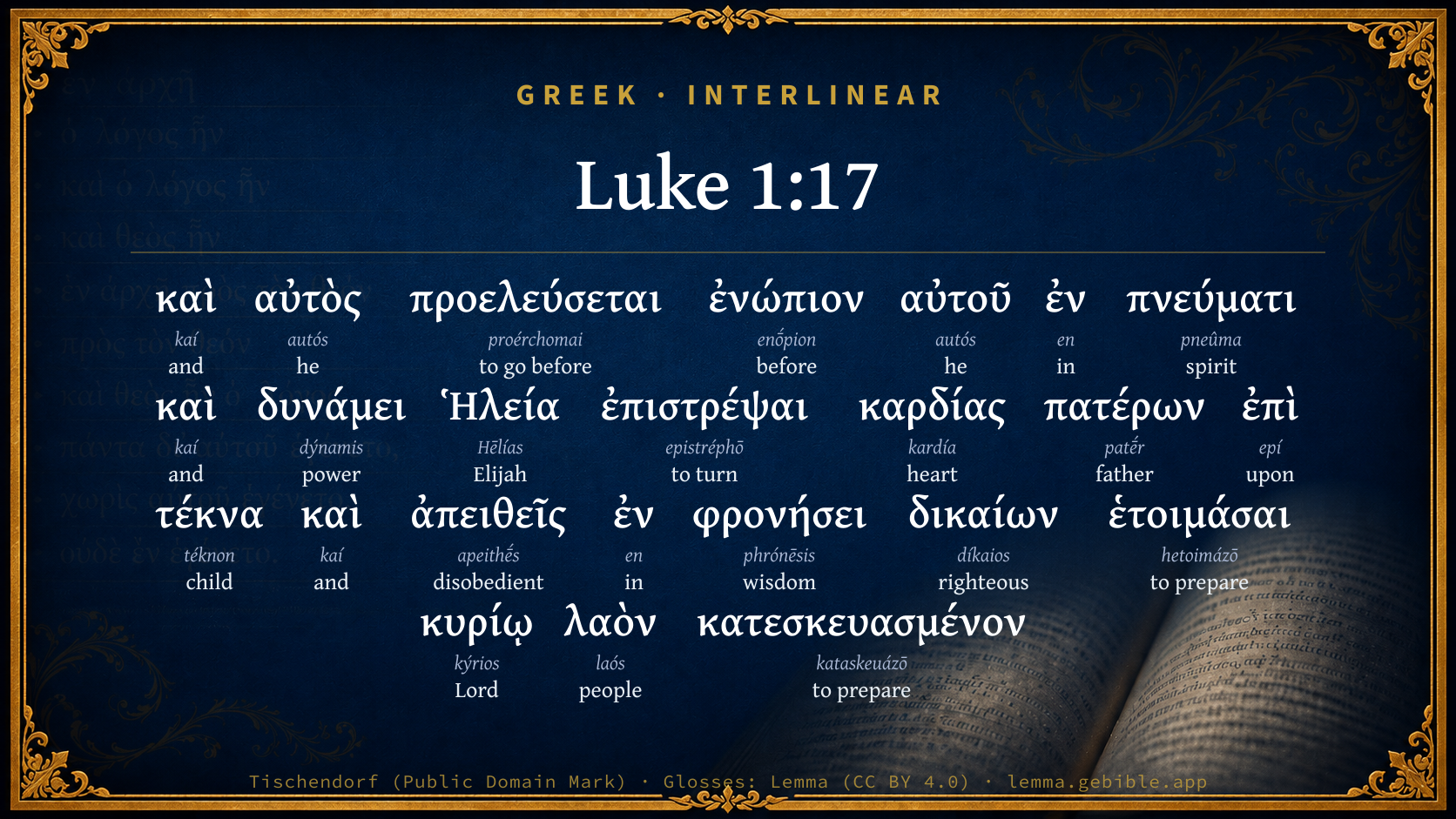
Download image
Cite this verse

Luke 1:17 (World English Bible). Public Domain. Lemma interlinear Bible study tool, https://lemma.gebible.app/v/luke/1/17.

Show BibTeX & RIS
BibTeX
RIS
English Translation
He will go before him in the spirit and power of Elijah, 'to turn the hearts of the fathers to the children,' and the disobedient to the wisdom of the just; to make ready a people prepared for the Lord."
World English Bible · Public Domain
Highlights
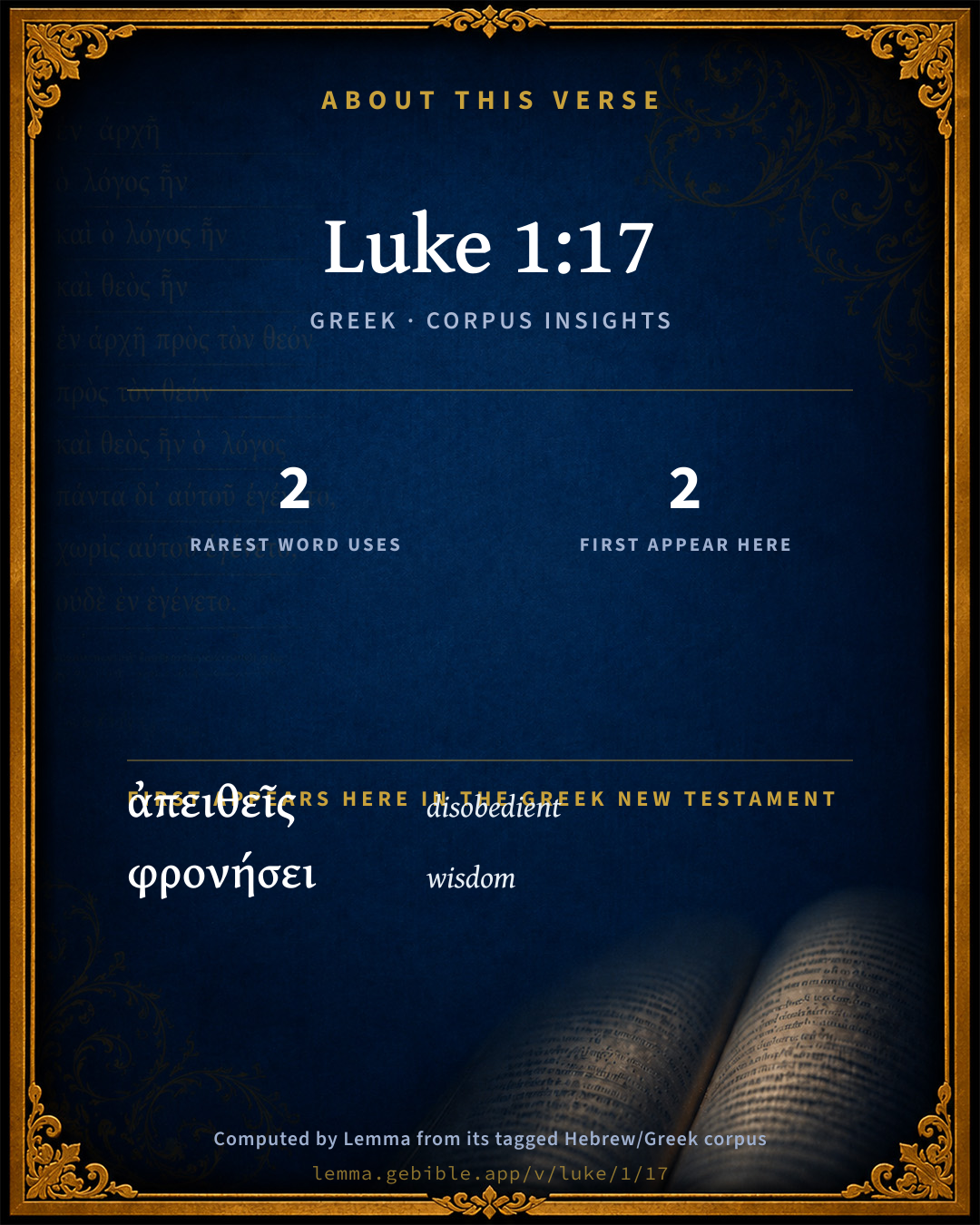
  • 2 first appearances in the Greek New Testament
Full analysis ↓
Download a study sheet

One document with this verse’s original text, its word-by-word gloss line, the meaning frame, cross-references with their text, attributed commentary, and full source and license credits — printable, and it pastes into notes with its structure intact.

This verse Autodidact and up

Study sheet (.html) Plain text (.txt)

A passage Seminary Student

Up to 50 verses in one chapter. A passage sheet keeps up to 6 commentary sources and 12 cross-references per verse, in the order this page ranks them, and says so on the sheet whenever that leaves anything out. Ask for a single verse and you get the Autodidact verse sheet above.

Everything on this page stays free to read, with no account — the sheet is a download of what is already on screen, not access to it.

Want to remove ads? Support Godless Engineer
Compare translations 3

The same verse in 3 English versions, stacked beneath the original-language interlinear above. Click any original word for its lexicon entry.

Each is an independent rendering of the whole verse — the interlinear is not word-aligned to these translations.

Highlighted words mark where these versions differ — a whole-verse word diff, not a word-by-word alignment.

  • World English Bible Public Domain
    He will go before him in the spirit and power of Elijah, 'to turn the hearts of the fathers to the children,' and the disobedient to the wisdom of the just; to make ready a people prepared for the Lord."
  • King James Version Public Domain
    And he shall go before him in the spirit and power of Elias, to turn the hearts of the fathers to the children, and the disobedient to the wisdom of the just; to make ready a people prepared for the Lord.
  • unfoldingWord Literal Text CC BY-SA 4.0
    And he will go before him in the spirit and power of Elijah, to turn the hearts of fathers back to their children and the disobedient to the wisdom of the righteous—to make ready for the Lord a people prepared.”

unfoldingWord Literal Text — © unfoldingWord, licensed CC BY-SA 4.0. Word-aligned USFM3 via Door43 (git.door43.org/unfoldingWord/en_ult).

Versions to compare (up to 4)

3 of 4 selected

Show all 19 translations

Every available English version of this verse, each an independent rendering of the whole verse.

  • World English Bible Public Domain
    He will go before him in the spirit and power of Elijah, 'to turn the hearts of the fathers to the children,' and the disobedient to the wisdom of the just; to make ready a people prepared for the Lord."
  • Berean Standard Bible Public Domain
    And he will go on before the Lord in the spirit and power of Elijah, to turn the hearts of the fathers to their children and the disobedient to the wisdom of the righteous—to make ready a people prepared for the Lord.”
  • Majority Standard Bible Public Domain
    And he will go on before the Lord in the spirit and power of Elijah, to turn the hearts of the fathers to their children and the disobedient to the wisdom of the righteous—to make ready a people prepared for the Lord.”
  • King James Version Public Domain
    And he shall go before him in the spirit and power of Elias, to turn the hearts of the fathers to the children, and the disobedient to the wisdom of the just; to make ready a people prepared for the Lord.
  • American Standard Version (1901) Public Domain
    And he shall go before his face in the spirit and power of Elijah, to turn the hearts of the fathers to the children, and the disobedient `to walk' in the wisdom of the just; to make ready for the Lord a people prepared `for him'.
  • Revised Version (1885) Public Domain
    And he shall go before his face in the spirit and power of Elijah, to turn the hearts of the fathers to the children, and the disobedient to walk in the wisdom of the just; to make ready for the Lord a people prepared for him.
  • Geneva Bible (1599) Public Domain
    For he shall goe before him in the spirite and power of Elias, to turne the hearts of the fathers to the children, and the disobedient to the wisedome of the iust men, to make ready a people prepared for the Lord.
  • Douay-Rheims (1899) Public Domain
    And he shall go before him in the spirit and power of Elias; that he may turn the hearts of the fathers unto the children, and the incredulous to the wisdom of the just, to prepare unto the Lord a perfect people.
  • Young's Literal Translation Public Domain
    and he shall go before Him, in the spirit and power of Elijah, to turn hearts of fathers unto children, and disobedient ones to the wisdom of righteous ones, to make ready for the Lord, a people prepared.'
  • Literal Standard Version CC BY-SA 4.0
    and he will go before Him, in the spirit and power of Elijah, to turn hearts of fathers to children, and disobedient ones to the wisdom of righteous ones, to make ready for the LORD, a people prepared.”
  • Unlocked Literal Bible CC BY-SA 4.0
    He will go before the face of the Lord in the spirit and power of Elijah, to turn the hearts of the fathers to the children and the disobedient to the wisdom of the righteous—to make ready for the Lord a people prepared for him.”
  • unfoldingWord Literal Text CC BY-SA 4.0
    And he will go before him in the spirit and power of Elijah, to turn the hearts of fathers back to their children and the disobedient to the wisdom of the righteous—to make ready for the Lord a people prepared.”
  • Darby Bible Public Domain
    And *he* shall go before him in [the] spirit and power of Elias, to turn hearts of fathers to children, and disobedient ones to [the] thoughts of just [men], to make ready for [the] Lord a prepared people.
  • World Messianic Bible Public Domain
    He will go before him in the spirit and power of Elijah, ‘to turn the hearts of the fathers to the children,’ and the disobedient to the wisdom of the just; to prepare a people prepared for the Lord.”
  • Webster's Bible Public Domain
    And he shall go before him in the spirit and power of Elijah, to turn the hearts of the fathers to the children, and the disobedient to the wisdom of the just; to make ready a people prepared for the Lord.
  • Free Bible Version CC BY-SA 4.0
    He will go ahead of the Lord in the spirit and power of Elijah, to turn the fathers back to thinking about their children, and to turn those who are rebellious back to a right understanding—to prepare a people ready for the Lord.”
  • Bible in Basic English Public Domain
    And he will go before his face in the spirit and power of Elijah, turning the hearts of fathers to their children, and wrongdoers to the way of righteousness; to make ready a people whose hearts have been turned to the Lord.
  • Text-Critical English NT CC BY 4.0
    And he will go before the Lord in the spirit and power of Elijah, to turn the hearts of fathers back to their children, and the disobedient to the wisdom of the righteous, to make ready a people prepared for the Lord.”
  • Tyndale New Testament (1534) Public Domain
    And he shall goo before him in the sprete and power of Helyas to tourne the hertes of the fathers to the chyldren and the vnbelevers to the wysdom of the iuste men: to make the people redy for the Lorde.

Literal Standard Version (2020), Covenant Press — licensed CC BY-SA 4.0. Text via the HelloAO Bible API (eBible.org). Unlocked Literal Bible (unfoldingWord) — licensed CC BY-SA 4.0. Text via the HelloAO Bible API (eBible.org). unfoldingWord Literal Text — © unfoldingWord, licensed CC BY-SA 4.0. Word-aligned USFM3 via Door43 (git.door43.org/unfoldingWord/en_ult). Free Bible Version, Dr. Jonathan Gallagher — licensed CC BY-SA 4.0. Text via the HelloAO Bible API (eBible.org).

Word by word

More ways to search: Search by grammar → Find every occurrence → Compare this word →

Practice this passage: Drill this verse → Learn its vocabulary →

φρονήσει
phrónēsis
G5428
“wisdom”
Noun, Dative, Singular, Feminine
Part of Speech
Noun
Case
Dative
Number
Singular
Gender
Feminine
Full Thayer's Definition

Origin: from G5426

TDNT: 12:40,1

1. understanding 2. knowledge and holy love of the will of God
  1. καὶ kaí G2532 “and” Conjunction
  2. αὐτὸς autós G846 “he” Personal pronoun, Nominative, Singular, Masculine
  3. προελεύσεται proérchomai G4281 “to go before” Verb, Future, Middle deponent, Indicative, 3rd person, Singular
  4. ἐνώπιον enṓpion G1799 “before” Adverb
  5. αὐτοῦ autós G846 “he” Personal pronoun, Genitive, Singular, Masculine
  6. ἐν en G1722 “in” Preposition
  7. πνεύματι pneûma G4151 “spirit” Noun, Dative, Singular, Neuter
  8. καὶ kaí G2532 “and” Conjunction
  9. δυνάμει dýnamis G1411 “power” Noun, Dative, Singular, Feminine
  10. Ἡλεία Hēlías G2243 “Elijah” Noun, Genitive, Singular, Masculine
  11. ἐπιστρέψαι epistréphō G1994 “to turn” Verb, Aorist, Active, Infinitive
  12. καρδίας kardía G2588 “heart” Noun, Accusative, Plural, Feminine
  13. πατέρων patḗr G3962 “father” Noun, Genitive, Plural, Masculine
  14. ἐπὶ epí G1909 “upon” Preposition
  15. τέκνα téknon G5043 “child” Noun, Accusative, Plural, Neuter
  16. καὶ kaí G2532 “and” Conjunction
  17. ἀπειθεῖς apeithḗs G545 “disobedient” Adjective, Accusative, Plural, Masculine
  18. ἐν en G1722 “in” Preposition
  19. δικαίων díkaios G1342 “righteous” Adjective, Genitive, Plural, Masculine
  20. ἑτοιμάσαι hetoimázō G2090 “to prepare” Verb, Aorist, Active, Infinitive
  21. κυρίῳ kýrios G2962 “Lord” Noun, Dative, Singular, Masculine
  22. λαὸν laós G2992 “people” Noun, Accusative, Singular, Masculine
  23. κατεσκευασμένον kataskeuázō G2680 “to prepare” Verb, Perfect, Passive, Participle, Accusative, Singular, Masculine

About this verse

These counts appear in no published source. They are computed here, from the morphology-tagged text and Lemma’s own curated glosses. What Lemma adds →

24
words
20
distinct lemmas
Gospels
section

Notable vocabulary

The rarest word here is φρονήσει wisdom G5428 — appearing just 2 times in the whole Greek New Testament.

First appearance in Scripture

These words make their first canonical appearance in the Greek New Testament here:

  • ἀπειθεῖς disobedient G545
  • φρονήσει wisdom G5428

Shared distinctive vocabulary

φρονήσει wisdom G5428 occurs in 2 verses of the Greek New Testament. Also found in:
Repetition

Words recur within this verse:

Cross-references

37

Topical passages linked to Luke 1:17 in the Treasury of Scripture Knowledge — connected by theme and wording, ordered by reader-vote popularity; previews shown in the World English Bible.

  • Malachi 4:5–6 Behold, I will send you Elijah the prophet before the great and terrible day of Yahweh comes.
  • Matthew 11:14 If you are willing to receive it, this is Elijah, who is to come.
  • Luke 1:76 And you, child, will be called a prophet of the Most High, For you will go before the face of the Lord to make ready his ways,
  • Matthew 17:11–12 Jesus answered them, "Elijah indeed comes first, and will restore all things,
  • John 1:21–30 They asked him, "What then? Are you Elijah?" He said, "I am not." "Are you the Prophet?" He answered, "No."
  • 1 Chronicles 29:18 Yahweh, the God of Abraham, of Isaac, and of Israel, our fathers, keep this forever in the imagination of the thoughts of the heart of your people, and prepare their heart to you;
  • Psalms 78:8 And might not be as their fathers, A stubborn and rebellious generation, A generation that didn't make their hearts loyal, Whose spirit was not steadfast with God.
  • Mark 9:11–13 They asked him, saying, "Why do the scribes say that Elijah must come first?"
  • John 3:28 You yourselves testify that I said, 'I am not the Christ,' but, 'I have been sent before him.'
  • Colossians 1:12 giving thanks to the Father, who made us fit to be partakers of the inheritance of the saints in light;
  • 1 Peter 2:9 But you are a chosen race, a royal priesthood, a holy nation, a people for God's own possession, that you may show forth the excellencies of him who called you out of darkness into his marvelous light:
  • Luke 3:7–14 He said therefore to the multitudes who went out to be baptized by him, "You offspring of vipers, who warned you to flee from the wrath to come?
  • Revelation 20:4 I saw thrones, and they sat on them, and judgment was given to them. I saw the souls of those who had been beheaded for the testimony of Jesus, and for the word of God, and such as didn't worship the beast nor his image, and didn't receive the mark on their forehead and on their hand. They lived, and reigned with Christ for the thousand years.
  • 1 Kings 17:1 Elijah the Tishbite, who was of the foreigners of Gilead, said to Ahab, As Yahweh, the God of Israel, lives, before whom I stand, there shall not be dew nor rain these years, but according to my word.
  • Psalms 111:10 The fear of Yahweh is the beginning of wisdom. All those who do his work have a good understanding. His praise endures forever!
  • Luke 1:16 He will turn many of the children of Israel to the Lord, their God.
  • 2 Timothy 2:21 If anyone therefore purges himself from these, he will be a vessel for honor, sanctified, and suitable for the master's use, prepared for every good work.
  • 1 Kings 21:20 Ahab said to Elijah, Have you found me, my enemy? He answered, I have found you, because you have sold yourself to do that which is evil in the sight of Yahweh.
  • 2 Chronicles 29:36 Hezekiah rejoiced, and all the people, because of that which God had prepared for the people: for the thing was done suddenly.
  • Isaiah 29:24 They also who err in spirit shall come to understanding, and those who murmur shall receive instruction.
  • Amos 4:12 "Therefore thus will I do to you, Israel; Because I will do this to you, Prepare to meet your God, Israel.
  • Matthew 14:4 For John said to him, "It is not lawful for you to have her."
  • Matthew 21:29–32 He answered, 'I will not,' but afterward he changed his mind, and went.
  • John 1:13 who were born not of blood, nor of the will of the flesh, nor of the will of man, but of God.
  • John 1:34 I have seen, and have testified that this is the Son of God."
  • Acts 10:33 Therefore I sent to you at once, and it was good of you to come. Now therefore we are all here present in the sight of God to hear all things that have been commanded you by God."
  • Romans 9:23 and that he might make known the riches of his glory on vessels of mercy, which he prepared beforehand for glory,
  • 2 Peter 3:11–14 Therefore since all these things are thus to be destroyed, what manner of persons ought you to be in holy living and godliness,
  • 1 Kings 18:18 He answered, I have not troubled Israel; but you, and your father's house, in that you have forsaken the commandments of Yahweh, and you have followed the Baals.
  • 2 Kings 1:4–6 Now therefore thus says Yahweh, You shall not come down from the bed where you are gone up, but shall surely die. Elijah departed.
  • 2 Kings 1:16 He said to him, Thus says Yahweh, Because you have sent messengers to inquire of Baal Zebub, the god of Ekron, is it because there is no God in Israel to inquire of his word? therefore you shall not come down from the bed where you are gone up, but shall surely die.
  • Psalms 10:17 Yahweh, you have heard the desire of the humble. You will prepare their heart. You will cause your ear to hear,
  • Matthew 3:4 Now John himself wore clothing made of camel's hair, with a leather belt around his waist. His food was locusts and wild honey.
  • Matthew 3:7–12 But when he saw many of the Pharisees and Sadducees coming for his baptism, he said to them, "You offspring of vipers, who warned you to flee from the wrath to come?
  • 1 Corinthians 6:9–11 Or don't you know that the unrighteous will not inherit the Kingdom of God? Don't be deceived. Neither the sexually immoral, nor idolaters, nor adulterers, nor male prostitutes, nor homosexuals,
  • 1 John 2:28 Now, little children, remain in him, that when he appears, we may have boldness, and not be ashamed before him at his coming.
  • 1 Samuel 7:5 Samuel said, Gather all Israel to Mizpah, and I will pray for you to Yahweh.

Cross-references courtesy of OpenBible.info (CC BY 4.0).

Commentary

Notes on Luke 1:17 from classic Christian and Jewish commentators (each source and its license shown beneath its notes). The classic Christian expositions comment on the surrounding passage and are grouped to its opening verse, so a note may address several verses; the Jewish commentaries on the Tanakh (Rashi and others) are per-verse, so they appear only where the commentator wrote on this verse.

Lemma curates 59 commentaries, every one of them public domain or Creative Commons licensed, each selected and text-cleaned for this edition rather than reprinted as found. About our sources →

The Biblical Illustrator

Joseph S. Exell

Luk_1:17

The hearts of the fathers to the children

Drawing lightning

Science tells us that the best defence against lightning in a thunderstorm is found, not in defiance of it, but in a silent discharge of it.

Go right towards it fearlessly with a pointed plantina wire, and it will follow a fixed law of harmless dispersion. Is there any way by which the power of one of Gods curses can be drawn, so as to avert the terrible stroke of Divine wrath? Let us see. This text refers us directly back to the final utterance of the Old Testament. There are four books in the Bible which end with a curse: Malachi, Lamentations, Isaiah, and Ecclesiastes. The Hebrew scribes were always accustomed to repeat the verse just before the last in these cases, so as to close the reading with something besides a malediction. It is not easy to see how that helps the matter in the present instance, for the preceding prediction seems to have been uttered merely to introduce the warning. And perhaps it is just as profitable to believe that the best way to avoid the judgments of God is to guard carefully against deserving them. After the last seer under the ancient dispensation had spoken the words which the evangelist quotes, the heavens were closed for four hundred years. Jehovah had not another message to send. His people had offended him. Justice comes almost fiercely forth, and bars the gate of revelation, because children are despised. And not until four centuries of silence had given time for repentance, would those bolts be withdrawn. Even then it is a little child who advances to turn the massive key. History wanders sadly in confusion among the captivities and Maccabean usurpations. Only an infant can join the Testaments. Luke is the next man to Malachi. The sternest of all Israels prophets reappears in the sternest of all heralds to the Church … A wild threat, four hundred years old, is suddenly removed in a flash of benediction. The curse of Malachi is omitted in Luke--the lightning is drawn. The gospel fulfils the law when it accepts children. God receives the fathers into favour and communion again, when their hearts are turned to their offspring … How much are you doing in this day of gospel privilege to bring the hearts of fathers back to their children? Do we need another prophet, with his hairy raiment and his leathern girdle, to come forth from the wilderness? (C. S. Robinson, D. D.)

The pioneer of the gospel

Whereas Matthew and Mark introduced John Baptist to the notice of their readers at the advanced period of his preaching in the wilderness of Judea, and his baptising his followers in Jordan, Luke commences with the Baptists genealogy and birth, and states many particulars relating to his early history, which, though they had been far less remarkable in themselves, would have been interesting in reference to one who afterwards became so conspicuous, but which are peculiarly important as additional evidences of the Divine mission, and additional illustrations of the office both of the Baptist himself, and of that illustrious Deliverer and King before whom he was to proceed as a pioneer to clear the way. (James Foote, M. A.)

The prepared people

All life is a preparation to meet God. This is the clue of lifes labyrinth. Preparations are often confused things. They are times of unsettling, full of noise and disorder, and apparent contradiction; till the end comes, and explains it all. So this world--it is made up of strange things, which move above us and within us, and seem to have little purpose and no concert. They range wildly. There are beginnings without endings; and there are endings without beginnings. A great many things do not fit. It is hard to tell what it all means. It is a pleasant thought to remember that your preparation, as it goes on, day by day, is only a reflection of what is going on in the other world. There, too, it is all preparation. The saints and the angels are all busy preparing. The preparations of earth are to meet the preparations of heaven. He has prepared His mercy, and He has prepared His truth. It is a prepared heaven; it is a prepared kingdom; a prepared city; a prepared throne; a prepared seat. And when both preparations are complete--a prepared soul, and a prepared heaven--what perfectness! what love! what rest! what quietness! What and if the Pure should come, and find impurity? What and if the Holy should come and find irreverence? What and if the Spirit come, and find nothing but flesh? What and if Wisdom come, and find ignorance? What and if Love come, and find selfishness and unkindness? First, you must be prepared to know your Lord when He comes. This John taught very expressly. He placed the people in a position that they should know and recognize Christ when He should arrive. You must have read Him in the prophecies--you must have walked with Him in the gospel--you must have sat with Him in all the manifestations of His grace--you must have traced Him in His reflections about the universe--you must have felt His inward dwelling in you by the Holy Ghost. Then He will be no new, strange Christ to you when He comes. And if you would be prepared for the Lord, you must have a deep sense of sin. Repent ye, for the kingdom of heaven is at hand. No one must stand there who has not learnt to stoop very low. Thirdly, you must be exact, faithful, diligent in your daily proper duties--doing whatever you do heartily--a man of large charities--a man of unselfish habits--a man of strict integrity in business--a man of self-government--a man of moderation--a man of content--a man of humility. Hethat hath two coats, let him impart to him that hath none; and he that hath meat, let him do likewise. Exact no more than that which is appointed you. Fourthly, you must be baptized--not with the baptism of water only, but with the baptism of the Spirit; and not with the baptism of water and of the Spirit only, but with the baptism of shame, of scorn, of suffering, of death--baptized with the Holy Ghost, and with fire. And fifthly, you must be much in the use of the ordinances--loving the shadows till the substance comes. (J. Vaughan, M. A.)

The spirit and power of the Baptist

The spirit and power of Elijah rested upon the Baptist, and the same gift is needed by us now. For, what is the end and purpose of all the religious activity we see abroad and at home, but to turn peoples hearts to wisdom, to make ready a people prepared for the Lord? Let us see, then, what was this spirit and power which made the Baptist so successful? And notice, to begin with, it was nothing wonderful, nothing out of the way. We are expressly told that John did no miracle. The spirit and power of the Baptist is, therefore, a gift within the reach of every one of us.

I. OBSERVE, FIRST, HIS DECISION FOR GOD. No halting between two opinions. The Baptist was not a reed shaken with the wind, but one who had considered matters well, and comes to a firm decision respecting the salvation of God.

II. NOTICE, NEXT, HIS SEPARATION FROM THE WORLD. He lived as much as possible in retirement, communing with his own soul and with God, While in the world, he was never of the world.

III. CONSIDER, ONCE MORE, HIS BOLD, CONSISTENT TESTIMONY TO THE TRUTH.

1. Before all classes of his countrymen, from the lowest to the highest.

2. In spite of opposition and persecution. Conclusion: Such qualities as these made the Baptist a power for good, and thus was he in the spirit and power of Elias.

Are we following in his steps? There must be found in us these same qualities, if our life is to be as grand a moral success as was his.

1. The same decision. Half-heartedness is of no use at all in what concerns the soul.

2. The same unworldliness. Not necessarily separation from the world--that is for the few; but (what is found by many to be a far harder thing) living in the world, doing its duties faithfully and well, and at the same time living the higher life that is hidden with Christ in God, and looking for the new heaven and the new earth wherein dwelleth righteousness.

3. The same stedfast witnessing to the truth.

(1) In heart.

(2) In word.

(3) In action.

An upright and honest life is the best testimony to the spirit and power in which we move, and it will carry us triumphantly over every obstacle and difficulty that we encounter, until we reach the peaceful haven where we would be, and bask in the perpetual sunshine of the presence of God. (George Low, M. A.)

The wisdom of the just

Let us try the wisdom of the religious choice by the happiness which follows.

I. There is a content and satisfaction in the mind, from the very consciousness and remembrance of our having listened to the voice from heaven.

II. I next observe, that the gospel brings happiness to every sincere believer, by giving him the blessing of peace in the assurance of pardon.

III. The wisdom of the just, however it may be called in question, however reviled, by unconverted or ungodly men, who cannot possibly appreciate or understand it, is manifested through the whole course of the believers life. He that walketh uprightly, walketh surely. The way of the wicked is as darkness: they know not at what they stumble: they are continually encompassed with evil, without ascertaining the cause or the cure. But the path of the just is as the shining light, which shineth more and more unto the perfect day.

IV. But the wisdom of the just is not to be fully known on this side the grave There will come a day, when it will appear even to the slowest of belief, without a shadow and without a doubt. When the Lord comes to make up His jewels, the preciousness of those jewels, and the joy of being gathered amongst them, will be perfectly manifest, both to friends and foes; to the one, by their admission into His heavenly kingdom; to the other, by their being cast away. (J. Slade, M. A.)

The spirit and power of Elias

whom John closely resembled in--

1. The endowments of his mind.

2. The habits of his life.

3. The exercise of his ministry. (C. Simeon.)

How, and in what sense, was Malachis prediction of the Messenger fulfilled in John the Baptist? To this question the New Testament furnishes a singularly full and abundant reply. It really seems as though, not only the mind of the Baptist, but also the minds of all who speak of him, were steeped in the prophecy of Malachi, and saturated with it. There is hardly a word said of or by him which does not take new meaning and force so soon as we read it in the light of Malachis lamp. In St. Matthews Gospel (chap. 3.), we have our fullest account of the Baptists appearance and ministry. We are there told that his first word, his master-word, was Repent, for the kingdom of heaven is at hand; that is, Take a new view; get a new mind; think; think back on your habits and ways, and mend them; for the King, long promised to your fathers, is about to appear. This was the very mission which Malachi ascribed to the messenger of the Lord. Johns peculiar mode of life, as described in the same chapter, tends to the same conclusion (Mat_3:4). Doubtless John assumed these outward marks of resemblance to the great Tishbite, in order to call attention to the inward resemblance between them as a sign that he had come in the spirit and power of Elijah. The same reason for a sad and austere life existed in both eases. The preacher of repentance should himself be a penitent. Elijah and John, each in his turn, came forth as a personification of repentance, showing the people, in his own conduct, what their conduct should be. Both these austere voices from the wilderness called men to repent, both sought to turn the hearts of men back again to God. (Samuel Cox, D. D.)

A father reconciled to his son

A mother in New York whose son had got into dissipated and abandoned habits, after repeated remonstrances and threats, was turned out of doors by his father, and he left vowing he would never return unless his father asked him, which the father said would never be. Grief over her son soon laid the mother on her dying bed, and when her husband asked if there was nothing he could do for her ere she departed this life, she said, Yes, you can send for my boy. The father was at first unwilling, but at length, seeing her so near her end, he sent for his son. The young man came, and as he entered the sick-room his father turned his back upon him. As the mother was sinking rapidly, the two stood on opposite sides of her bed, all love and sorrow for her, but not exchanging a word with each other. She asked the father to forgive the boy; no, he wouldnt until the son asked it. Turning to him, she begged of him to ask his fathers forgiveness; no, his proud heart would not let him take the first step. After repeated attempts she failed, but as she was just expiring, with one last effort she got hold of the fathers hand in one hand, and her sons in the other, and exerting all her feeble strength, she joined their hands, and, with one last appealing look, she was gone. Over her dead body they were reconciled, but it took the mothers death to bring it about. So, has not God made a great sacrifice that we might be reconciled--even the death of His own dear Son? (D. L. Moody.)

The Biblical Illustrator, edited by Joseph S. Exell (c. 1880s–1900s) — public domain. Text from a community e-Sword module.

Joseph Benson's Commentary

Luk 1:17. He shall go before him — Namely, before Christ; in the spirit and power of Elias — With the same integrity, courage, austerity, and fervour, and the same power of God attending his word. The son of Zacharias equalled, if not exceeded, Elijah in zeal for God, in severity of manners, in fortitude, and in sustaining persecutions. “For he was clad in a garment of camel’s hair, fed on locusts and wild honey, rebuked sinners of the highest distinction with great boldness, and was put to death on that account. He had the power also of Elijah; for though he did no miracle, he was honoured with the like success in restoring the lost spirit of true religion among his countrymen. Nay, he even excelled Elijah in that which is properly the power of a prophet, and to which all other gifts are subservient, the power of converting men; being in this more successful without miracles than Elijah had been with them.” To turn the hearts of the fathers to the children — To reconcile those that are at variance, to put an end to the most bitter quarrels, such as are very frequently those between the nearest relations; and the disobedient to the wisdom of the just — Or, the righteous. And the most obstinate sinners to true wisdom, which is only found among them that are righteous before God. Dr. Waterland reads, To turn the hearts of the fathers with the children, (thus also Dr. Hammond,) and the disobedient to a sense of righteousness; Greek, και απειθεις εν φρονησει δικαιων. Nearly to the same purpose is Dr. Doddridge’s paraphrase. “According to that prediction of Malachi with which the sacred canon concludes, he shall meet with such glorious success in his ministry, as to convert the hearts of the fathers with those of the children; that is, he shall bring many, both of the rising and the declining age, to that real piety toward God, which will be the surest band of their mutual duty toward each other: and many of those who have hitherto been disobedient to the wisdom of the just, that is, insensible of the obligations to real religion, which is the greatest wisdom, shall he make ready, as a people prepared for the Lord, raising in their minds an expectation of the Messiah, and a disposition to welcome him when he shall appear.” See the former clause more fully explained in the note on Mal 4:6.

Joseph Benson's Commentary on the Old and New Testaments (1811–1818) — public domain. Text from a community e-Sword module.

Tyndale Open Study Notes

Tyndale Open Resources

1:17 He will be a man with the spirit and power of Elijah: The prophet Malachi predicted that God would send Elijah before the time of God’s salvation (see Mal 3:1; 4:5-6). John fulfilled this role by preparing the way for the Lord’s coming.

Tyndale Open Study Notes — © Tyndale Open Resources, licensed CC BY-SA 4.0. Text via the HelloAO Bible API.

Bengel's Gnomon

Johann Albrecht Bengel

Luk 1:17. Αὐτὸς, himself) In antithesis to the others (πολλοὺς, many), Luk 1:16.—ἐνώπιον, before His face) in His immediate presence.—ἐπιστρέψαι, κ.τ.λ., to turn [convert], etc.) The language in this passage, as often in prophecies, is figurative, abbreviated, and as it were poetically with this sense: John shall effect that the parents as well as the children alike, the disobedient as well as the just alike, men of every age and character, may be prepared for the Lord. But it was not convenient to say: He will convert [turn] the disobedient and the unjust along with the obedient and just alike; for the just need no conversion. Therefore, instead of the concrete, the abstract is used: He will convert the disobedient to the state of mind of the just; i.e. those who disregard God’s law he will convert, or bring to such a state, that they will join themselves to the number of the just, putting on the docility and wisdom of these latter; and, just as the just are ready, so will the disobedient become ready for the Lord.—καρδίας, hearts) The heart is therefore the seat of conversion, of obedience, and of prudence.—πατέρων ἐπὶ τέκνα, of the fathers along with the children alike) Mal. 3:24, לב אבות על־בנים ולב בנים על־אבותם, LXX. καρδίαν πατρὸς πρὸς υἱὸν, καὶ καρδίαν ἀνθρώπου πρὸς τὸν πλήσιον αὐτοῦ. The expression is equivalent to a proverb, so as to signify the multitude—the ‘many’ converted (Luk 1:16). So Gen 32:11, μητέρα ἐπὶ τέκνοις. So decidedly πατέρων ἐπὶ τέκνα, Exo 20:5; Exo 34:7: also κνήμην ἐπὶ μηρὸν, Jdg 15:8. See also על, Amo 3:15; Jdg 12:1; and πρὸς, in the Son of Sir. (see the quotation below). At the same time there may be designed to be marked the care of the fathers for the salvation of their children, as opposed to what takes place in a flight such as Jer 47:3 describes, οὐκ ἐπέστρεψαν πατέρες, ἐφ ̓ υἱοὺς αὐτῶν.—καὶ ἀπειθεῖς ἐν φρονήσει δικαίων, and the disobedient in [to] the wisdom [prudence] of the just) This is set down instead of what is found in Malachi: and the heart of the children upon [super: but Engl. Vers. to] their fathers. Disobedience is especially the fault of youths: prudence [wisdom] and justice are especially becoming in fathers. The angel says, in the prudence, not into [to] the prudence. The feeling [sentiments] of those who are just, is immediately put on in conversion.—ἑτοιμάσαι Κυρίῳ λαὸν κατεσκευασμένον, to make ready a people prepared for the Lord) Asyndeton [absence of copulative between ἐπιστρέψαι and ἑτοιμάσαι]: to convert [turn], to make ready. The people is to be made ready, lest the Lord, finding the people not ready for Him, should crush them with His majesty [“Lest I come and smite the earth with a curse”], Mal 4:6. A people prepared, i.e. complying with the instructions of John, who makes them ready, and obedient to the Lord; no longer having such hearts as are described in Pro 15:7, ולב כסילים לא כן, LXX. καρδίαι ἀφρόνων οὐκ ἀσφαλεῖς, The hearts of fools are not safe [Engl. Vers. from Hebr., But the heart of the foolish doeth not so, i.e. do not disperse knowledge]. Let the antithetic terms be noted, ἀφρόνων and φρονήσει; and the kindred terms כן and ἑτοιμάσαι. Concerning Elias, see Sir 48:11, καὶ ἐπιστρέψαι καρδίαν πατρὸς προς υἱὸν, καὶ καταστῆσαι φυλὰς Ἰακώβ. That the work of the Son of Sirach is far from a low and common one, its accordance with the angel’s words proves. See also Mat 23:34, note.

Bengel's Gnomon of the New Testament — English translation (T&T Clark, Edinburgh, 1860) — public domain. Text from a community e-Sword module.

Expositor's Greek Testament

ed. W. Robertson Nicoll

Luk 1:17 . προελεύσεται ἐν . α .: not a reference to John’s function as forerunner of Messiah, but simply a description of his prophetic character. He shall go before God (and men) = be , in his career, an Elijah in spirit and power, and function; described in terms recalling Mal 4:6 .

The Expositor's Greek Testament, edited by W. Robertson Nicoll (1897–1910) — public domain. Text from a community e-Sword module.

Geneva Bible (1599)

Geneva Bible translators

By this figure Synecdoche, he showeth that he shall take away all kinds of enmities, which used to breed great troubles and turmoils amongst men.

Wisdom and goodness are two of the chiefest causes which make men to reverence and honor their fathers.

As they used to go before kings, and when you see them, you know the king is not far off.

This is spoken by the figure Metonymy, taking the spirit, for the gift of the spirit, as you would say, the cause, for that that cometh of the cause.

Geneva Bible (1599) marginal notes — public domain. Text via Bolls.life.

Jamieson, Fausset & Brown

Robert Jamieson, A. R. Fausset & David Brown

before him--before "the Lord their God" (Luk 1:16). By comparing this with Mal 3:1 and Isa 40:3, it is plainly "Jehovah" in the flesh of Messiah [CALVIN and OLSHAUSEN] before whom John was to go as a herald to announce His approach, and a pioneer o prepare His way.

in the spirit--after the model.

and power of Elias--not his miraculous power, for John did no miracle" (Joh 10:41), but his power "turning the heart," or with like success in his ministry. Both fell on degenerate times; both witnessed fearlessly for God; neither appeared much save in the direct exercise of their ministry; both were at the head of schools of disciples; the success of both was similar.

fathers to the children--taken literally, this denotes the restoration of parental fidelity [MEYER and others], the decay of which is the beginning of religious and social corruption--one prominent feature of the coming revival being put for the whole. But what follows, explanatory of this, rather suggests a figurative sense. If "the disobedient" be "the children," and to "the fathers" belongs "the wisdom of the just" [BENGEL], the meaning will be, "he shall bring back the ancient spirit of the nation into their degenerate children" [CALVIN, &c.]. So Elijah invoked "the God Abraham, Isaac, and Israel," when seeking to "turn their heart back again" (Kg1 18:36-37).

to make ready, &c.--more clearly, "to make ready for the Lord a prepared people," to have in readiness a people prepared to welcome Him. Such preparation requires, in every age and every soul, an operation corresponding to the Baptist's ministry.

Jamieson, Fausset & Brown — Commentary Critical and Explanatory on the Whole Bible (1871) — public domain (CC PDM 1.0). Text via the HelloAO Bible API.

Adam Clarke's Commentary

Verse 17. He shall go before him] Jesus Christ, in the spirit and power of Elijah; he shall resemble Elijah in his retired and austere manner of life, and in his zeal for the truth, reproving even princes for their crimes; compare 1Kg 21:17-24, with Mt 14:4. It was on these accounts that the Prophet Malachi, Mal 4:6, had likened John to this prophet. See also Isa 40:3; and Mal 4:5-6.

To turn the hearts of the fathers] Gross ignorance had taken place in the hearts of the Jewish people; they needed a Divine instructer: John is announced as such; by this preaching and manner of life, all classes among the people should be taught the nature of their several places, and the duties respectively incumbent upon them, See Lu 3:10, c. In these things the greatness of John, mentioned Lu 1:15, is pointed out, Nothing is truly great but what is so in the sight of God. John's greatness arose:

1st. From the plenitude of God's Spirit which dwelt in him.

2. From his continual self-denial, and taking up his cross.

3. From his ardent zeal to make Christ known.

4. From his fidelity and courage in rebuking vice.

5. From the reformation which he was the instrument of effecting among the people reviving among them the spirit of the patriarchs, and preparing their hearts to receive the Lord Jesus.

To turn the hearts of the fathers to their children. By a very expressive figure of speech, Abraham, Isaac, and Jacob, and the rest of the patriarchs, are represented here as having their hearts alienated from the Jews, their children, because of their unbelief and disobedience; but that the Baptist should so far succeed in converting them to the Lord their God, that these holy men should again look upon them with delight, and acknowledge them for their children. Some think that by the children, the Gentiles are meant, and by the fathers, the Jews.

The disobedient] Or unbelieving, απειθεις, the persons who would no longer credit the predictions of the prophets, relative to the manifestation of the Messiah. Unbelief and disobedience are so intimately connected, that the same word in the sacred writings often serves for both.

Adam Clarke's Commentary on the Bible (1810–1826) — public domain. Text from a community e-Sword/MySword module.

Ellicott's Commentary for English Readers

(17) To the wisdom of the just.—The margin, by the wisdom, is undoubtedly the right rendering.

A Bible Commentary for English Readers, edited by Charles John Ellicott (1878–1897) — public domain. Text from a community e-Sword module.

The Cambridge Bible for Schools and Colleges

gen. ed. J. J. S. Perowne

17. And he shall go before him] Shall go before the Messiah. The English version should have added, “in His (God’s) presence” (ἐνώπιον αὐτοῦ).

in the spirit and power of Elias] From the last words of Malachi (Luk_4:4-6, Luk_3:1), the Jews universally believed (as they do to this day) that Elijah would visibly return to earth as a herald of the Messiah. It required the explanation of our Lord to open the eyes of the Apostles on this subject. “This is Elias which was for to come,” Mat_11:14. “Elias truly shall first come and restore all things … Then the disciples understood that He spake unto them of John the Baptist,” Mat_17:10-14. The resemblance was partly in external aspect (2Ki_1:8; Mat_3:4); and partly in his mission of stern rebuke and invitation to repentance (1Ki_18:21; 1Ki_21:20).

to turn the hearts of the fathers to the children] Rather, of fathers to children; i. e. as in the original meaning of Malachi, to remedy disunion and restore family life.

to the wisdom] Rather, in or by the wisdom.

The Cambridge Bible for Schools and Colleges (gen. ed. J. J. S. Perowne; Cambridge University Press, 1878–1918) — public domain. Text from a community e-Sword module.

John Gill's Exposition

And he shall go before him,.... The Lord his God, the Lord Jesus Christ, whose forerunner he was; the messenger of him, that according to the prophecies in Isa 40:3 was to go before him, and prepare his ways; as he did by his wonderful conception and birth, which made way for the more easy belief of the conception and birth of the Messiah, by a virgin; and by his preaching the doctrine of repentance, and administering the ordinance of baptism; which, were done to awaken the people's expectation of the Messiah, and that he might be made manifest in Israel, and by pointing him out to them in his preaching:

in the spirit and power of Elias: or Elijah, the Syriac and Persic versions add, "the prophet"; John the Baptist, and Elijah, were men much of the same spirit and disposition, and of like power, life, and zeal in religion; and therefore the one goes by the name of the other: they both much conversed in the wilderness; agreed in the austerity of their lives; their habit and dress were much alike; they were both restorers of religion, when very low, and much decayed; were famous for their faithfulness in reproving the vices of kings, and for their warm zeal for true religion, and for the persecution they endured for the sake of it:

to turn the hearts of the fathers to the children in Mal 4:6 which is the prophecy referred to, it is added,

and the heart of the children to their fathers; which some understand, of his turning the degenerate offspring of the Jews, to the sentiments of their forefathers, and causing them to agree with them in their notions of the Messiah: others, of the turning of the Jews to Christ, and his apostles; and others, of his being a means, through his ministry and baptism, of reconciling Jews and Gentiles together, which is the great business of the Gospel dispensation, ushered in by John; and who preached that all men should believe in Christ, and baptized publicans and Roman soldiers, as well as Jews; and which sense pretty much agrees with the interpretation the Jews put upon the prophecy, as referring to Elijah the Tishbite, whom they expect in person, before the coming of the Messiah: say (u) they,

"Elijah comes to defile and to cleanse (i.e. to pronounce what things are clean or unclean), and to remove afar off, and to bring near (i.e. to determine what families are legitimate or illegitimate). R. Simeon says, "to compose differences"; and the wise men say, neither to remove, nor to bring near, but , "to make peace" in the world; as it is said, "behold, I send unto you Elijah the prophet", &c. "and he shall turn the heart of the fathers", &c.

But the true meaning is, that John the Baptist, who is meant by Elias, should be an instrument of turning fathers with their children, and children with their fathers, to the Lord; that he should be a means of converting both fathers and children, one as well as another; and to gather persons of every age and station; for the particle which we render "to", is the same as "with", as Kimchi on the text observes: "and the disobedient to the wisdom of the just". By the "disobedient" are meant, either Jews or Gentiles; some understand it of the Gentiles, who were children of disobedience, before the light of the Gospel came among them: but rather the former are meant, who were a disobedient, rebellious, and gainsaying people; who were gone off from the wisdom, knowledge, and religion, of the just, or righteous ones, their forefathers; who prophesied of Christ, rejoiced to see his day, longed for him, and believed in him: now John was to be an instrument of turning some of the unbelieving Jews, to the true knowledge of salvation by Christ; which their righteous progenitors waited for, had a right knowledge of, and an interest in: and of leading them either into the Gospel of Christ, that wisdom of God is a mystery; the manifold wisdom of God, in which he has abounded in all wisdom and prudence: and which the righteous men among the Jews, searched diligently into, attained some knowledge of, and which even the holy angels desire to look into; so the patriarchs were called just, or righteous; as righteous Abel, just Noah, &c. and so the Jewish fathers: hence in the Targum on Jer 12:5 mention is made of thy fathers, "the just", who were of old: or to Christ himself, who is the wisdom of God, and in whom are hid all the treasures of wisdom and knowledge, to know him, and believe in him; who in the same Targum on Jer 23:5 is called , "the Messiah of the just",

To make ready a people prepared for the Lord. The Vulgate Latin and Syriac versions read, "a perfect people"; and the Persic version, "all the people": not all the people of the Jews, but God's elect among them who from all eternity were "prepared", as a people in a covenant relation, as the portion of Christ, and as his spouse and bride, and as such, given to him; they were in electing grace, vessels of mercy, afore prepared for glory; and heaven, as a kingdom, was prepared for them from the foundation of the world: they were provided with all spiritual blessings, which were prepared for them, and bestowed on them in heavenly places, in Christ, before the foundation of the world; even all their grace, and all their glory; yea, even their good works are such, which God has foreordained, or foreprepared that they should walk in. Now, the work of John the Baptist, was "to make ready" this people, by pointing out to them, in a ministerial way, wherein their readiness lay, to meet the Lord, and be for ever with him in heaven; not in a civil, moral, or legal righteousness; or in outward humiliation for, and abstinence from sin; nor in a submission to Gospel ordinances, and in a mere profession of religion, and in an observance of a round of duties; but in justification by the righteousness of Christ, and in regeneration and sanctification, by his Spirit and grace; the one giving a right to, the other a meetness for the heavenly inheritance: and John; and so any other Gospel minister, may be said to make ready a people, in this sense; when they are the instruments of the regeneration and conversion of sinners, and of leading them to the righteousness of Christ, for their justification before God, and acceptance with him,

(u) Misn. Ediot, c. 8. sect. 7.

John Gill's Exposition of the Whole Bible (1746–1763) — public domain (CC PDM 1.0). Text via the HelloAO Bible API.

Trapp's Complete Commentary

John Trapp

17 And he shall go before him in the spirit and power of Elias, to turn the hearts of the fathers to the children, and the disobedient to the wisdom of the just; to make ready a people prepared for the Lord.

Ver. 17. In the spirit and power of Elias] There is a great agreement between the times of Elijah and John Baptist. Herod answereth to Ahab, Herodias to Jezebel, &c.

The disobedient to the wisdom of the just] i.e. By his preaching he shall turn the hearts of the Gentiles to the Jews, and by his baptism tie them up, as it were, together. He made them (according to the phrase that Josephus useth of him) to convent or knit together in baptism, εν βαπτισμω συνιεναι. (Joseph. Antiq., xviii. 7.)

John Trapp, A Commentary or Exposition upon All the Books of the Old and New Testament (1647–1656) — public domain. Text from a community e-Sword module.

Albert Barnes' Notes on the Bible

Shall go before him - Before the Messiah. The connection here leads us to suppose that the word “him” refers to the “Lord their God” in the previous verse. If so, then it will follow that the Messiah was the Lord God of Israel - a character abundantly given him in other parts of the New Testament.

In the spirit and power of Elias - See the notes at Mat 11:14.

To turn the hearts of the fathers to the children - In the time of John the Jews were divided into a number of different sects. See the notes at Mat 3:7. They were opposed violently to each other, and pursued their opposition with great animosity. It was impossible but that this opposition should find its way into families, and divide parents and children from each other. John came that he might allay these animosities and produce better feeling. By directing them all to “one Master,” the Messiah, he would divert their attention from the causes of their difference and bring them to union. He would restore peace to their families, and reconcile those parents and children who had chosen different sects, and who had suffered their attachment “to sect” to interrupt the harmony of their households. The effect of true religion on a family will always be to produce harmony. It attaches all the family to “one” great Master, and by attachment to him all minor causes of difference are forgotten.

And the disobedient to the wisdom of the just - The “disobedient” here are the unbelieving, and hence the impious, the wicked. These he would turn to the wisdom of the just, or to such wisdom as the “just” or pious manifest - that is, to true wisdom.

To make ready a people ... - To prepare them for his coming by announcing that the Messiah was about to appear, and by calling them to repentance. God has always required people to be pure in a special manner when he was about to appear among them. Thus, the Israelites were required to purify themselves for three days when he was about to come down on Mount Sinai, Exo 19:14-15. And so, when God the Son was about to appear as the Redeemer, he required that people should “prepare” themselves for his coming. So in view of the future judgment - the second coming of the Son of man - he requires that people should repent, believe, and be pure, 1Pe 4:7; 2Pe 3:11-12.

Albert Barnes' Notes on the Bible (1834–1885) — public domain. Text from a community e-Sword/MySword module.

Haydock's Catholic Bible Commentary

Turn the hearts of the fathers, &c. The angel applies these words (Malachias iv. 6.) to St. John the Baptist; telling his father, that he shall convert many of the children of Israel, &c. by bringing them to the knowledge of Christ. Secondly, that he shall go before him, or be his precursor and forerunner. --- In the spirit and power of Elias; i.e. St. John shall be the forerunner of Christ’s first coming to redeem mankind, as Elias shall be the forerunner of Christ’s second coming to judge the world. Thirdly, that St. John, by converting the Jews, shall also turn the hearts of the fathers to the children, &c. The meaning of which obscure words seems to be, that whereas Moses, Abraham, and the prophets, (whose souls were in a place of rest) knew by a revelation from God, that their children, the Jews, lived in sin and disobedience to the laws of God; and on this account were offended and displeased at them: now when they shall know that they have been converted by the preaching of St. John, they shall rejoice, and be reconciled to their children, the Jews: for as our Saviour tells us, (Luke xv. 7.) there is joy in heaven upon any one sinner that doth penance. The angel, to explain the foregoing words, adds, and the incredulous to the wisdom and prudence of the just; i.e. St. John’s preaching shall make them truly wise and just. (Witham) --- With reason is he said to precede Christ, who was his forerunner both in his birth and in his death. In the spirit of prophecy, and in the power of abstinence, and patience, and zeal, they resembled each other; Elias was in the desert, St. John was in the desert also. The one sought not the favour of king Achab, the other despised the favour of Herod. The one divided the Jordan, the other changed it into a laver of salvation. The one is to be the forerunner of Jesus Christ’s second coming, as the other was of his first. (St. Ambrose)

George Leo Haydock (1774–1849), Haydock's Catholic Family Bible and Commentary, 1859 edition — public domain. Excludes Psalms (Douay-Rheims chapter numbering differs from Protestant) and Deuterocanonical books (Catholic canon only).

Matthew Poole's English Annotations

God was last spoken of, he must therefore be the him mentioned here, before whom John the Baptist was to go, according to the prophecy, Mal 4:5,6; from whence is an evident proof that Christ was the Lord our God, before whom John the Baptist came,

in the spirit and power of Elias, and therefore he is called Elias, Mal 4:5, as expounded by Christ, Mat 11:14; Mar 9:13. The Jews’ not understanding this keeps them in a vain expectation of a Messiah to this day, and of a personal coming of Elias before him. It is the observation of some learned men, that where the word power is added to the Spirit, or Holy Ghost, it signifies a more than ordinary measure and influence of the Spirit, as in Luk 1:35; Act 10:38; 1Co 2:4; 1Th 1:5. But I rather think that by that phrase, in the spirit and power, here is meant, with the same zeal and frame of spirit that Elijah had. We have before, in our notes upon Matthew, showed in how many things John the Baptist was like Elijah, to say nothing of his habit and the severity of his life, in respect of the most corrupt time wherein they both lived, their faithfulness in their ministry, their warmth and zeal in their work, their boldness, not fearing to reprove princes for their errors, &c.

To turn the hearts of the fathers to the children. Malachi addeth, and the heart of the children to their fathers; instead of which Luke hath, and the disobedient to the wisdom of the just; that is, to bring both young and old to repentance: the hearts of the fathers amongst the Jews to the doctrine of Christ and his apostles, their children; and the hearts of the Jews, which, with respect to Abraham, Isaac, and Jacob, and David, are children, to the doctrine which they embraced, and the ways of God wherein those just men walked, which is the doctrine of wisdom: to reconcile many amongst the Jews to that which some of them own and profess, though others of them are yet apostatized, and yet led away with the superstitions of those degenerate and corrupt times.

To make ready a people prepared for the Lord; to acquaint this part of the world with the Messias, and to prepare them for receiving him and his doctrine, which is presently to be revealed by himself, taking off people’s prejudices, and discovering and commending Christ to them. Or, by bringing men to a true repentance for their sins, and a sense of them, till which they cannot believe, to prepare them for a more internal reception of the Lord Jesus Christ. For John is said to have preached the doctrine of repentance for the remission of sins; and to have preached, saying, Repent, for the kingdom of heaven is at hand. Also defaming the Pharisees, who were the great enemies of Christ, by detecting to the people their hypocrisy. Thus he made

ready a people prepared for the Lord.

Matthew Poole's English Annotations on the Holy Bible (1683–1685) — public domain. Text from a community e-Sword/MySword module.

Whedon's Commentary on the Bible

Daniel D. Whedon

17. He—John.

Go before him—That is, before the Lord their God. This seems to be a clear ascription of the divine title to the Messiah, before whom John was to go.

In the spirit and power of Elias—And hence he was predicted by Malachi under the name of Elijah. Mal_4:5.

Turn the heart of the fathers to the children—Not the heart of the children to the fathers, mark; but the heart of the fathers to the children. The fathers here are the holy ancestry of degenerate Israel, and they have, as it were, been offended with the apostacy of their descendants. But John shall so infuse a better spirit into this generation that a reconciliation shall take place between the holy olden time and the fallen

present. A people—A clear allusion to the admission of the Gentiles into the Church of God.

Daniel D. Whedon (gen. ed.), Commentary on the Old and New Testaments (1874–1909) — public domain. Text from a community e-Sword module.

The Pulpit Commentary

In the spirit and power of Elias. There was a confident hope among the Jews, dating frown the days of the prophecy of Malachi, some four hundred years before the vision of Zacharias, that the days of Messiah would be heralded by an appearance of the Prophet Elijah. The selfsame expectation is still cherished by every pious Jew. To turn the hearts of the fathers to the children, and the disobedient to the wisdom of the just.

The usual explanation of these words of the angel, who uses here the language of Malachi, (Mal_4:5, Mal_4:6) is that the result of the preaching of this new prophet, who is about to be raised up, will be to restore harmony to the broken and disturbed family life of Israel, whereas now the home life of the chosen race was split up the fathers, perhaps, siding with the foreign or Roman faction, as represented by Herod and his friends; the sons, on the other hand, being Zealots attached to the national party, bitterly hostile to the Herodians. So also in one house some would belong to the Pharisee, others to the Sadducee, sect. These fatal divisions would, in many cases, be healed by the influence of the coming one. There is, however, another interpretation far deeper and more satisfactory; for nothing in the preaching of the Baptist, as far as we are aware, bore specially on the domestic dissensions of the people; it had a much wider range. The true sense of the angel"s words here should be gathered from prophetic passages such as Isa_29:22, Isa_29:23, "Jacob shall no more be ashamed, neither shall his face wax pale, when he seeth (yKi wOtaorbi) his children become the work of my hands;" Isa_63:16, "Doubtless thou art our Father, though Abraham be ignorant of us, and Israel acknowledge us not: thou, O Lord, art our Father, our Redeemer!" -The patriarchs, the fathers of Israel, beholding from their abodes of rest the works and days of their degenerate children, mourned over their fall, and, to use earthly language, "were ashamed" of the conduct of their unworthy descendants. These would be glad and rejoice over the result of the preaching of the coming prophet. Godet well sums up the angel"s words: "It will be John"s mission then to reconstitute the moral unity of the people by restoring the broken relation between the patriarchs and their degenerate descendants."

The Pulpit Commentary (1880–1919), ed. H.D.M. Spence-Jones & Joseph S. Exell — public domain. Text from a community e-Sword module.

John Wesley's Explanatory Notes

He shall go before him, Christ, in the power and spirit of Elijah - With the same integrity, courage, austerity, and fervour, and the same power attending his word: to turn the hearts of the fathers to the children - To reconcile those that are at variance, to put an end to the most bitter quarrels, such as are very frequently those between the nearest relations: and the hearts of the disobedient to the wisdom of the just - And the most obstinate sinners to true wisdom, which is only found among them that are righteous before God.

John Wesley, Explanatory Notes Upon the Whole Bible (1754–1765) — public domain. Text via the GEBible commentary corpus.

Scofield Reference Notes

C. I. Scofield

shall go

See, Mal 4:5 (See Scofield "Mat 17:10")

The Scofield Reference Bible (1917 edition), notes by C. I. Scofield — public domain. Text from a community e-Sword module.

The People's New Testament

B. W. Johnson

17. In the spirit and power of Elijah. The likeness of John the Baptist to Elijah strikes us not only in his outward appearance, his clothing and way of living, but in his spirit and character as a preacher of repentance. Turn the hearts of the fathers. These are the last words of the Old Testament, there uttered by a prophet, here expounded by an angel; there concluding the law, and here beginning the gospel (Mal. 4:6). To make ready a people prepared for the Lord. This was his mission, but it was only partially successful. The common people, who heard him gladly, received with gladness the Messiah; the scribes and Pharisees, who rejected the forerunner, rejected also the King.

B. W. Johnson's The People's New Testament with Notes (1889–1891) — public domain. Electronic text from the Christian Classics Ethereal Library (CCEL) ThML edition.

Cambridge Greek Testament for Schools and Colleges

17. αὐτὸς προελεύσεται ἐνώπιον αὐτοῦ. He shall himself go before the Messiah. The αὐτοῦ is used in its most emphatic sense for Christ as in 1Jn 2:12; 2Pe 3:4. The English version should have added, “in His presence” (ἐνώπιον αὐτοῦ).

ἐν πνεύματι καὶ δυνάμει Ἡλία. From the last words of Malachi (Luk 4:4-6, Luk 3:1), the Jews universally believed (as they do to this day) that Elijah would visibly return to earth as a herald of the Messiah. It required the explanation of our Lord to open the eyes of the Apostles on this subject. “This is Elias which was for to come,” Mat 11:14. “Elias truly shall first come and restore all things … Then the disciples understood that He spake unto them of John the Baptist,” Mat 17:10-14. The resemblance was partly in external aspect (2Ki 1:8; Mat 3:4); and partly in his mission of stern rebuke and invitation to repentance (1Ki 18:21; 1Ki 21:20).

ἐπιστρέψαι. The infinitive, expressive of a fact or consequence, almost resembling a purpose as in ἤλθομεν προσκυνῆσαι Mat 2:2, where the supine would be used in Latin. Comp. ἤμισυ τοῦ στρατεύματος κατέλιπε φυλάττειν τὸ στρατόπεδον.

καρδίας πατέρων ἐπὶ τέκνα. ‘Of fathers to children;’ i.e. (as in the original meaning of Malachi,) to remedy disunion and restore family life. Kuinoel and others strangely follow St Augustine (De Civ. Dei, xx. 29) in explaining this to mean that John should make the Jews as pious as the Patriarchs were.

ἐν φρονήσει. (To walk) in or by wisdom. Φρόνησις (Eph 1:8) is the practical wisdom shewn by obedience. He shall turn them to wisdom so that they shall live in it. This is a constructio praegnans where a preposition of rest is placed after a verb of motion to imply the state produced. This ‘pregnant construction’ is one of the many signs of the agility of the Greek intellect. Compare

“Clarence, whom I indeed have cast in darkness.”

K. Rich. III. I. 3.

“And let the sounds of music | Creep in our ears.”

Merch. of Ven. Luk 1:1.

And in Latin In amicitia receptus, Sall. In aquam macerare, Cat. Brief Greek Syntax, § 89.

δικαίων. See Luk 1:6. The disobedient shall by his ministry begin to accept the δικαιώματα.

ἑτοιμάσαι … κατεσκευασμένον. The participle is proleptic—‘To prepare so that it may be ready.’ See Brief Greek Syntax, p. 82. (Comp. submersas obrues puppes, &c.) The reason why the R. V[29] renders this “to make ready for the Lord a people prepared for Him” is because St Luke is fond of placing a word like ‘for the Lord’ between two others, with either or both of which it may be connected. See Act 1:2 (Humphry, Rev. Version, p. 92).

[29] R. V. Revised Version.

Cambridge Greek Testament for Schools and Colleges (Cambridge University Press, 1896; 21 vols, various authors incl. Carr, Maclear, Plummer, Farrar, Lumby, Moule, M. R. James, Simcox) — public domain. Text from a community e-Sword module.

Alford’s Greek Testament

Henry Alford

17.] ἐνώπ. αὐτοῦ—i.e. κυρίου τοῦ θ. αὐτῶν, manifest in the flesh. De Wette denies this interpretation, as contrary to all analogy: and yet himself explains the expression by saying that what the Messiah does, is in Scripture ascribed to God as its doer (similarly Meyer). But why? because Messiah is God with us. This expression is besides used (see Zec 14:5) in places where the undoubted and sole reference is to the Messiah. See Bleek’s note, in which he decides for this view, as against that which refers αὐτοῦ directly to the Messiah as the Son of God.

ἐν πν. κ. δυν.] As a type, a partial fulfilment, of the personal coming of Elias in the latter days (see note on Mat 11:13, Mat 11:14). Bleek remarks that it was not in the wonder-working agency of Elias that John was like him, for “John did no miracle,”—but in the power of his uttered persuasion.

ἐπιστρ.…] The first member only of the sentence corresponds with Malachi, and that not verbatim. The angel gives the exposition of the second member,—καὶ καρδίαν ἀνθρώπου πρὸς τὸν πλησίον αὐτοῦ,—for of course that must be understood in the better sense, of the good prevailing, and the bad becoming like them.

ἀπειθής, as in reff., not unbelieving, but disobedient. On the verb ἀπειθεῖν, see note, Heb 3:18, and on ἀπείθεια, note, Eph 2:2.

ἐν is elliptic for εἰς τὸ εἶναι ἐν … see reff.

Augustine, De Civ. Dei, xx. 29, vol. vii.—‘est sensus, ut etiam filii sic intelligant legem, id est, Judæi, quemadmodum patres eam intellexerunt, id est Prophetæ, in quibus erat et ipse Moyses:’ so also Kuinoel, but erroneously, for both articles would be expressed,—τῶν πατέρων ἐπὶ τὰ τέκνα.

Henry Alford, The Greek Testament (1849–1861) — public domain. Text from a community e-Sword module.

Vincent's Word Studies in the New Testament

Marvin R. Vincent

Wisdom [φρονησει] . Wyc., prudence. This is a lower word than sofia, wisdom (see on Jas 3:13). It is an attribute or result of wisdom, and not necessarily in a good sense, though mostly so in the New Testament.. Compare, however, the use of the kindred word fronimov in Rom 11:25; Rom 12:16 : wise in your own conceits; and the adverb fronimwv, wisely, of the unjust steward, Luk 16:8. It is practical intelligence, which may or may not be applied to good ends. Appropriate here as a practical term corresponding to disobedient. Prepared [κατασκευασμενον] . Adjusted, disposed, placed in the right moral state.

Marvin R. Vincent, Word Studies in the New Testament (1887–1900) — public domain. Text from a community e-Sword/MySword module.

Lesson kit

Teaching starters — assembled from the data on this page, not authored interpretation. Every prompt links to the verse data it draws on. Edit before teaching.

Luke, in the Gospels, opens this verse with 24 words (20 distinct Greek lemmas). Its most distinctive word is phrónēsis (“wisdom”). A historical commentator’s framing appears above. Read the whole chapter for the surrounding context.

Discussion questions

  1. What does “wisdom” (phrónēsis) contribute to the verse as a whole?
  2. 2 words here appear for the first time in Scripture. What is being introduced at this debut?
  3. Ephesians 1:8 shares the word «wisdom» with this verse. How do the two illuminate each other?
  4. “and” occurs 3× in this one verse. What is the effect of the repetition?
  5. These translations render this verse differently. What is at stake in choosing one wording over another?
  6. Reading how The Biblical Illustrator and Joseph Benson's Commentary read this verse, where do the two commentators agree and where do they part?

Things to notice

  • 2 words make their first canonical appearance in Scripture here.
  • These translations choose different wording for 7 words in this verse.
  • “and” occurs 3× in this single verse.
  • 20 distinct Greek lemmas span 24 words in this verse.

Reading settings

Reading text

Shown beneath each verse's original-language words.

Old Testament
Old Testament edition

Read the OT as the Masoretic Hebrew (MT) or the Greek Septuagint (LXX).

English shown for the Greek Septuagint (in the Hebrew ↔ Greek comparison).

Comparing translations? Open the Compare panel on any verse page to stack up to four side by side.