
John 4:21

Greek (Tischendorf 8th ed.) John 4:21 appears in the Greek New Testament. The text above is from the Tischendorf 8th edition. Each word links to its Strong’s number and a concise gloss. Click any word for its full Thayer’s Greek Lexicon entry.
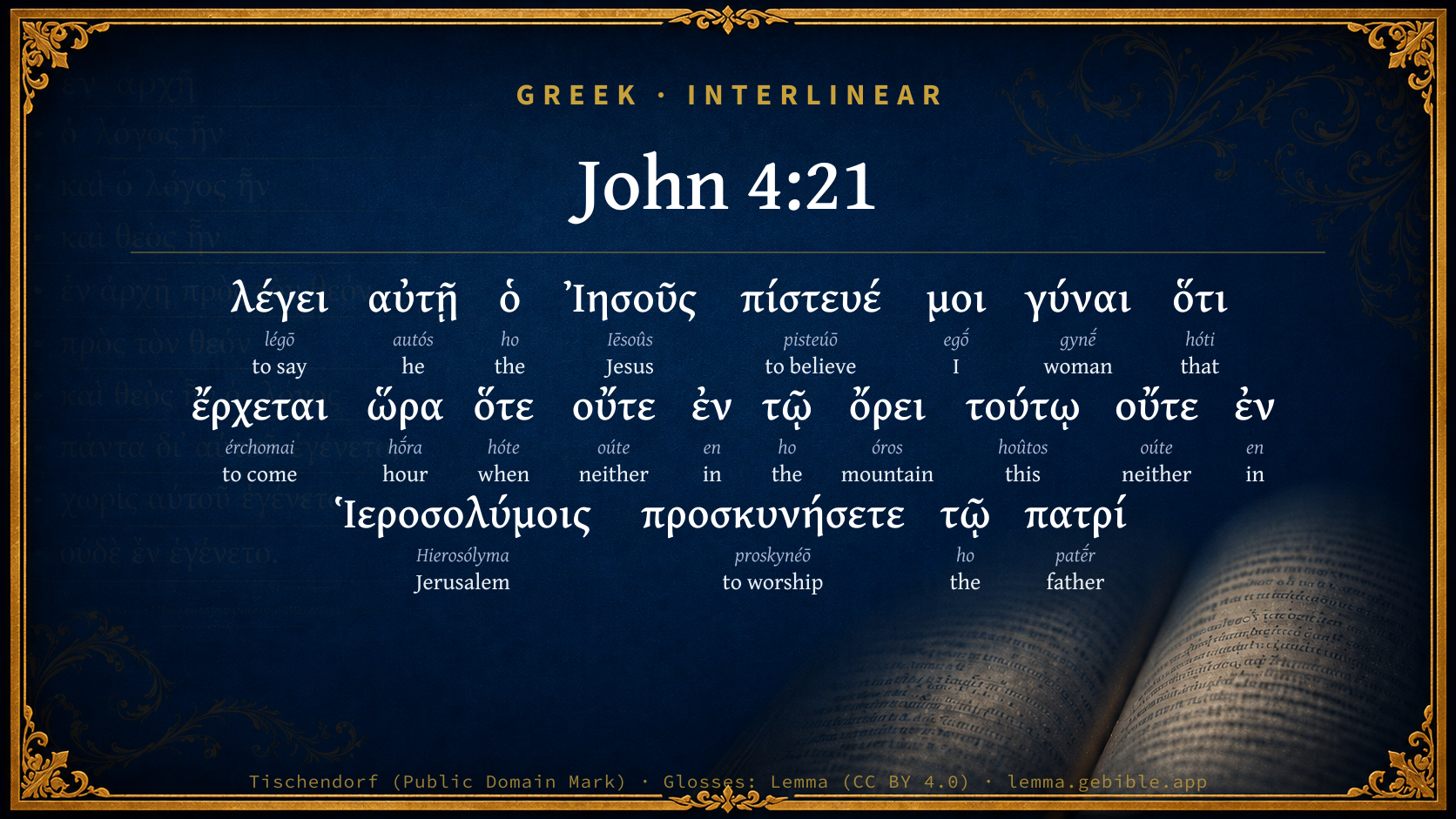
Download image
Cite this verse

John 4:21 (World English Bible). Public Domain. Lemma interlinear Bible study tool, https://lemma.gebible.app/v/john/4/21.

Show BibTeX & RIS
BibTeX
RIS
English Translation
Jesus said to her, "Woman, believe me, the hour comes, when neither in this mountain, nor in Jerusalem, will you worship the Father.
World English Bible · Public Domain
Download a study sheet

One document with this verse’s original text, its word-by-word gloss line, the meaning frame, cross-references with their text, attributed commentary, and full source and license credits — printable, and it pastes into notes with its structure intact.

This verse Autodidact and up

Study sheet (.html) Plain text (.txt)

A passage Seminary Student

Up to 50 verses in one chapter. A passage sheet keeps up to 6 commentary sources and 12 cross-references per verse, in the order this page ranks them, and says so on the sheet whenever that leaves anything out. Ask for a single verse and you get the Autodidact verse sheet above.

Everything on this page stays free to read, with no account — the sheet is a download of what is already on screen, not access to it.

Want to remove ads? Support Godless Engineer
Compare translations 3

The same verse in 3 English versions, stacked beneath the original-language interlinear above. Click any original word for its lexicon entry.

Each is an independent rendering of the whole verse — the interlinear is not word-aligned to these translations.

Highlighted words mark where these versions differ — a whole-verse word diff, not a word-by-word alignment.

  • World English Bible Public Domain
    Jesus said to her, "Woman, believe me, the hour comes, when neither in this mountain, nor in Jerusalem, will you worship the Father.
  • King James Version Public Domain
    Jesus saith unto her, Woman, believe me, the hour cometh, when ye shall neither in this mountain, nor yet at Jerusalem, worship the Father.
  • unfoldingWord Literal Text CC BY-SA 4.0
    Jesus says to her, “Believe me, woman, that an hour is coming when you will worship the Father neither on this mountain nor in Jerusalem.

unfoldingWord Literal Text — © unfoldingWord, licensed CC BY-SA 4.0. Word-aligned USFM3 via Door43 (git.door43.org/unfoldingWord/en_ult).

Versions to compare (up to 4)

3 of 4 selected

Show all 19 translations

Every available English version of this verse, each an independent rendering of the whole verse.

  • World English Bible Public Domain
    Jesus said to her, "Woman, believe me, the hour comes, when neither in this mountain, nor in Jerusalem, will you worship the Father.
  • Berean Standard Bible Public Domain
    “Believe Me, woman,” Jesus replied, “a time is coming when you will worship the Father neither on this mountain nor in Jerusalem.
  • Majority Standard Bible Public Domain
    “Believe Me, woman,” Jesus replied, “a time is coming when you will worship the Father neither on this mountain nor in Jerusalem.
  • King James Version Public Domain
    Jesus saith unto her, Woman, believe me, the hour cometh, when ye shall neither in this mountain, nor yet at Jerusalem, worship the Father.
  • American Standard Version (1901) Public Domain
    Jesus saith unto her, Woman, believe me, the hour cometh, when neither in this mountain, nor in Jerusalem, shall ye worship the Father.
  • Revised Version (1885) Public Domain
    Jesus saith unto her, Woman, believe me, the hour cometh, when neither in this mountain, nor in Jerusalem, shall ye worship the Father.
  • Geneva Bible (1599) Public Domain
    Iesus saide vnto her, Woman, beleeue me, the houre commeth, when ye shall neither in this mountaine, nor at Hierusalem worship ye Father.
  • Douay-Rheims (1899) Public Domain
    Jesus saith to her: Woman, believe me, that the hour cometh, when you shall neither on this mountain, not in Jerusalem, adore the Father.
  • Young's Literal Translation Public Domain
    Jesus saith to her, `Woman, believe me, that there doth come an hour, when neither in this mountain, nor in Jerusalem, shall ye worship the Father;
  • Literal Standard Version CC BY-SA 4.0
    Jesus says to her, “Woman, believe Me, that there comes an hour when neither in this mountain, nor in Jerusalem, will you worship the Father;
  • Unlocked Literal Bible CC BY-SA 4.0
    Jesus said to her, “Believe me, woman, that an hour is coming when you will worship the Father neither on this mountain nor in Jerusalem.
  • unfoldingWord Literal Text CC BY-SA 4.0
    Jesus says to her, “Believe me, woman, that an hour is coming when you will worship the Father neither on this mountain nor in Jerusalem.
  • Darby Bible Public Domain
    Jesus says to her, Woman, believe me, [the] hour is coming when ye shall neither in this mountain nor in Jerusalem worship the Father.
  • World Messianic Bible Public Domain
    Yeshua said to her, “Woman, believe me, the hour is coming when neither in this mountain nor in Jerusalem will you worship the Father.
  • Webster's Bible Public Domain
    Jesus saith to her, Woman, believe me, the hour cometh, when ye shall neither in this mountain, nor yet at Jerusalem, worship the Father.
  • Free Bible Version CC BY-SA 4.0
    Jesus replied, “Believe me the time is coming when you won't worship the Father either on this mountain or in Jerusalem.
  • Bible in Basic English Public Domain
    Jesus said to her, Woman, take my word for this; the time is coming when you will not give worship to the Father on this mountain or in Jerusalem.
  • Text-Critical English NT CC BY 4.0
    Jesus said to her, “Woman, believe me, an hour is coming when neither on this mountain nor in Jerusalem will you worship the Father.
  • Tyndale New Testament (1534) Public Domain
    Iesus sayde vnto her: woman beleve me the houre cometh when ye shall nether in this moutayne nor yet at Ierusalem worshippe the father.

Literal Standard Version (2020), Covenant Press — licensed CC BY-SA 4.0. Text via the HelloAO Bible API (eBible.org). Unlocked Literal Bible (unfoldingWord) — licensed CC BY-SA 4.0. Text via the HelloAO Bible API (eBible.org). unfoldingWord Literal Text — © unfoldingWord, licensed CC BY-SA 4.0. Word-aligned USFM3 via Door43 (git.door43.org/unfoldingWord/en_ult). Free Bible Version, Dr. Jonathan Gallagher — licensed CC BY-SA 4.0. Text via the HelloAO Bible API (eBible.org).

Word by word

More ways to search: Search by grammar → Find every occurrence → Compare this word →

Practice this passage: Drill this verse → Learn its vocabulary →

προσκυνήσετε
proskynéō
G4352
“to worship”
Verb, Future, Active, Indicative, 2nd person, Plural
Part of Speech
Verb
Tense
Future
Voice
Active
Mood
Indicative
Person
2nd person
Number
Plural
Full Thayer's Definition

Origin: from G4314 and a probable derivative of G2965 (meaning to kiss, like a dog licking his master's hand)

TDNT: 18:38,9

1. to kiss the hand to (towards) one, in token of reverence 2. among the Orientals, esp. the Persians, to fall upon the knees and touch the ground with the forehead as an expression of profound reverence 3. in the NT by kneeling or prostration to do homage (to one) or make obeisance, whether in order to express respect or to make supplication a. used of homage shown to men and beings of superior rank 1. to the Jewish high priests 2. to God 3. to Christ 4. to heavenly beings 5. to demons
  1. λέγει légō G3004 “to say” Verb, Present, Active, Indicative, 3rd person, Singular
  2. αὐτῇ autós G846 “he” Personal pronoun, Dative, Singular, Feminine
  3. ὁ ho G3588 “the” Article, Nominative, Singular, Masculine
  4. Ἰησοῦς Iēsoûs G2424 “Jesus” Noun, Nominative, Singular, Masculine
  5. πίστευέ pisteúō G4100 “to believe” Verb, Present, Active, Imperative, 2nd person, Singular
  6. μοι egṓ G1473 “I” Personal pronoun, 1st person, Dative, Singular
  7. γύναι gynḗ G1135 “woman” Noun, Vocative, Singular, Feminine
  8. ὅτι hóti G3754 “that” Conjunction
  9. ἔρχεται érchomai G2064 “to come” Verb, Present, Middle or Passive deponent, Indicative, 3rd person, Singular
  10. ὥρα hṓra G5610 “hour” Noun, Nominative, Singular, Feminine
  11. ὅτε hóte G3753 “when” Adverb
  12. οὔτε oúte G3777 “neither” Conjunction, Negative
  13. ἐν en G1722 “in” Preposition
  14. τῷ ho G3588 “the” Article, Dative, Singular, Neuter
  15. ὄρει óros G3735 “mountain” Noun, Dative, Singular, Neuter
  16. τούτῳ hoûtos G3778 “this” Demonstrative pronoun, Dative, Singular, Neuter
  17. οὔτε oúte G3777 “neither” Conjunction, Negative
  18. ἐν en G1722 “in” Preposition
  19. Ἱεροσολύμοις Hierosólyma G2414 “Jerusalem” Noun, Dative, Plural, Neuter
  20. τῷ ho G3588 “the” Article, Dative, Singular, Masculine
  21. πατρί patḗr G3962 “father” Noun, Dative, Singular, Masculine

About this verse

These counts appear in no published source. They are computed here, from the morphology-tagged text and Lemma’s own curated glosses. What Lemma adds →

22
words
18
distinct lemmas
Gospels
section

Shared distinctive vocabulary

προσκυνήσετε to worship G4352 occurs in 53 verses of the Greek New Testament. Also found in:
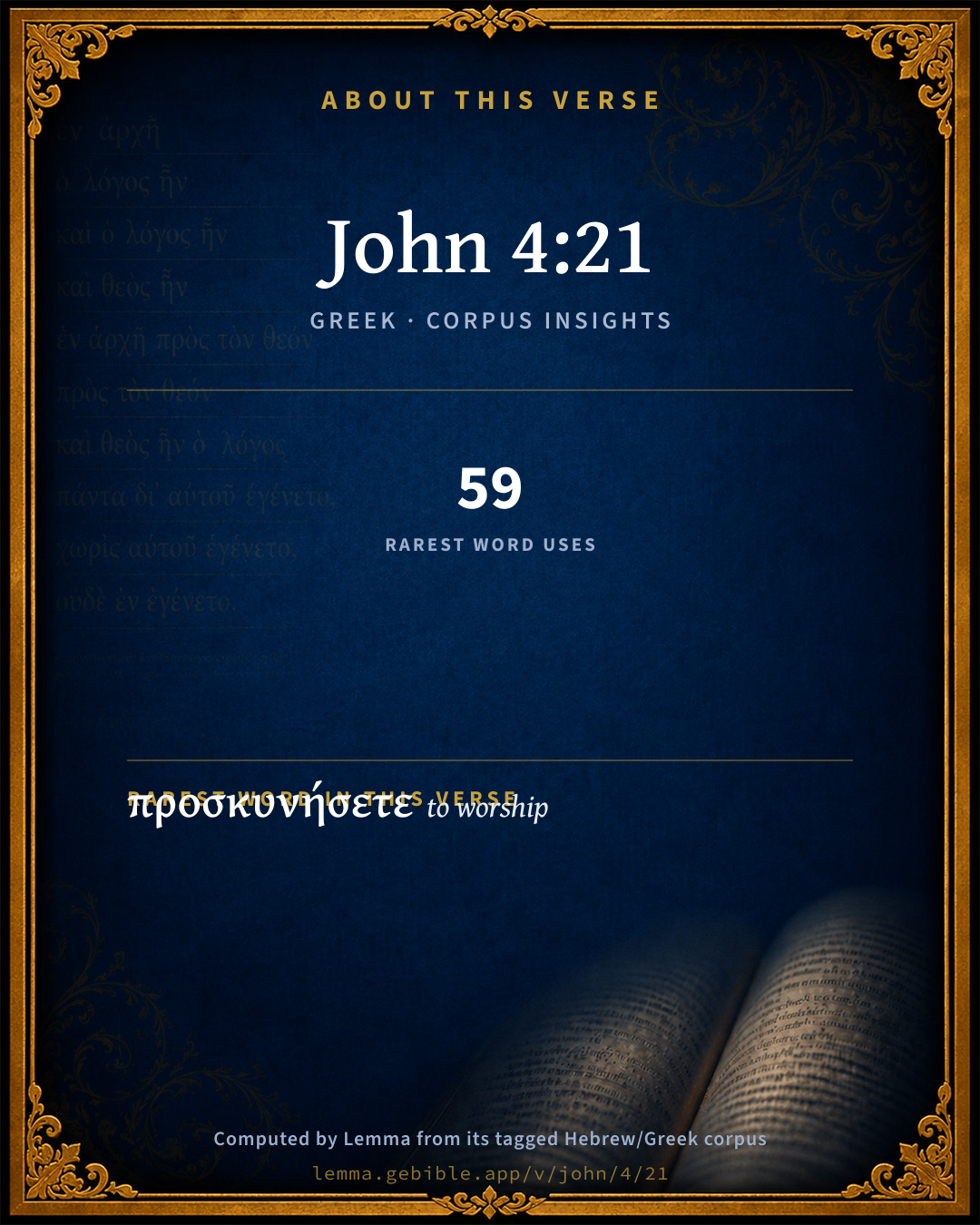
Repetition

Words recur within this verse:

Cross-references

18

Topical passages linked to John 4:21 in the Treasury of Scripture Knowledge — connected by theme and wording, ordered by reader-vote popularity; previews shown in the World English Bible.

  • 1 Timothy 2:8 I desire therefore that the men in every place pray, lifting up holy hands without wrath and doubting.
  • Malachi 1:11 For from the rising of the sun even to the going down of the same, my name is great among the nations, and in every place incense will be offered to my name, and a pure offering: for my name is great among the nations," says Yahweh of Hosts.
  • Ephesians 2:18 For through him we both have our access in one Spirit to the Father.
  • Matthew 18:20 For where two or three are gathered together in my name, there I am in the midst of them."
  • John 4:23 But the hour comes, and now is, when the true worshippers will worship the Father in spirit and truth, for the Father seeks such to be his worshippers.
  • Ezekiel 14:3 Son of man, these men have taken their idols into their heart, and put the stumbling block of their iniquity before their face: should I be inquired of at all by them?
  • John 5:28 Don't marvel at this, for the hour comes, in which all that are in the tombs will hear his voice,
  • John 16:2 They will put you out of the synagogues. Yes, the time comes that whoever kills you will think that he offers service to God.
  • John 16:32 Behold, the time is coming, yes, and has now come, that you will be scattered, everyone to his own place, and you will leave me alone. Yet I am not alone, because the Father is with me.
  • Ephesians 3:14 For this cause, I bow my knees to the Father of our Lord Jesus Christ,
  • Ezekiel 20:3 Son of man, speak to the elders of Israel, and tell them, Thus says the Lord Yahweh: Is it to inquire of me that you have come? As I live, says the Lord Yahweh, I will not be inquired of by you.
  • Matthew 28:19 Therefore go, and make disciples of all nations, baptizing them in the name of the Father and of the Son and of the Holy Spirit,
  • Luke 21:5–6 As some were talking about the temple and how it was decorated with beautiful stones and gifts, he said,
  • Luke 21:24 They will fall by the edge of the sword, and will be led captive into all the nations. Jerusalem will be trampled down by the Gentiles, until the times of the Gentiles are fulfilled.
  • John 5:25 Most assuredly, I tell you, the hour comes, and now is, when the dead will hear the Son of God's voice; and those who hear will live.
  • John 14:6 Jesus said to him, "I am the way, the truth, and the life. No one comes to the Father, except through me.
  • Acts 6:14 For we have heard him say that this Jesus of Nazareth will destroy this place, and will change the customs which Moses delivered to us."
  • 1 Peter 1:17 If you call on him as Father, who without respect of persons judges according to each man's work, pass the time of your living as strangers here in reverent fear:

Cross-references courtesy of OpenBible.info (CC BY 4.0).

Commentary

Notes on John 4:21 from classic Christian and Jewish commentators (each source and its license shown beneath its notes). The classic Christian expositions comment on the surrounding passage and are grouped to its opening verse, so a note may address several verses; the Jewish commentaries on the Tanakh (Rashi and others) are per-verse, so they appear only where the commentator wrote on this verse.

Lemma curates 59 commentaries, every one of them public domain or Creative Commons licensed, each selected and text-cleaned for this edition rather than reprinted as found. About our sources →

The Cambridge Bible for Schools and Colleges

gen. ed. J. J. S. Perowne

21. believe me] This formula occurs here only; the usual one is ‘I say unto you.’

the hour cometh] No article in the Greek; there cometh an hour. Christ decides neither for nor against either place. The utter ruin on Gerizim and the glorious building at Jerusalem will soon be on an equality. Those who would worship the Father must rise above such distinctions of place. A time is coming when all limitations of worship will disappear.

21–24. “We shall surely be justified in attributing the wonderful words of Joh_4:21; Joh_4:23-24, to One greater even than S. John. They seem to breathe the spirit of other worlds than ours—‘of worlds whose course is equable and pure;’ where media and vehicles of grace are unneeded, and the soul knows even as it is known. There is nothing so like them in their sublime infinitude of comprehension, and intense penetration to the deepest roots of things, as some of the sayings in the Sermon on the Mount (Mat_5:45; Mat_6:6). It is words like these that strike home to the hearts of men, as in the most literal sense Divine.” S. p. 95.

The Cambridge Bible for Schools and Colleges (gen. ed. J. J. S. Perowne; Cambridge University Press, 1878–1918) — public domain. Text from a community e-Sword module.

Joseph Benson's Commentary

Joh 4:21. Jesus saith to her — In answer to this case of conscience; Believe me — Our Lord uses this expression only once, and that to a Samaritan. To his own people, the Jews, his usual language is, I say unto you. The hour cometh — Which will put an entire end to this controversy; when ye — Both Jews and Samaritans; shall neither worship in this mountain, nor at Jerusalem — As preferable to any other place: nay, when an end will be put to the worship at both places; and the true worship shall be no longer confined to any one place or nation. As if our Lord had said, Thou art expecting the hour to come, when either by some divine revelation, or some signal providence, this matter shall be decided in favour of Jerusalem or mount Gerizim; but I tell thee, the hour is at hand when it shall be no more a question: that which thou hast been taught to lay so much stress on, shall be set aside as a thing indifferent. Our Lord meant that the approaching dissolution of the Jewish economy, and the erection of the evangelical dispensation, should set this matter at rest, and lay all things respecting it in common, so that it should be perfectly indifferent whether in either of those places, or any other, men should worship God. Observe, reader, the worship of God is not now, under the gospel, appropriated to any place, as it was under the law: but it is his will that men should pray, give thanks, and worship and serve him everywhere. Our reason teaches us, indeed, to consult decency and convenience with respect to the places of our worship; but our religion enjoins that we give no preference to one place above another, in respect of holiness and acceptableness to God. They who prefer any act of worship merely for the sake of the house or building in which it is performed, (though it were as magnificent, and as solemnly consecrated as ever Solomon’s temple was,) forget that the hour is come when there should be no difference put in God’s account; no, not between Jerusalem, which had been so famous for sanctity, and the mount of Samaria, which had been so infamous for impiety.

Joseph Benson's Commentary on the Old and New Testaments (1811–1818) — public domain. Text from a community e-Sword module.

Tyndale Open Study Notes

Tyndale Open Resources

4:21-22 Jesus affirmed that the Jews had preserved the right understanding of the one you worship. • salvation comes through the Jews: God gave the Jews a special relationship with him, and the Messiah was to be a Jew (see also Rom 9:4-5).

Tyndale Open Study Notes — © Tyndale Open Resources, licensed CC BY-SA 4.0. Text via the HelloAO Bible API.

Bengel's Gnomon

Johann Albrecht Bengel

Joh 4:21. Πίστευσόν μοι, believe Me) Christ often said to the Jews and His disciples, I say unto you, Joh 4:35. In this passage alone, to the Samaritan woman, He says, Believe Me, They were more bound to believe than she. The formulæ employed follow this proportion [i.e. are proportioned to their degree of religious privileges respectively].—ὥρα) It is called the hour, not because that whole time is short, but because its beginning is nigh: ch. Joh 5:25, “The hour is coming and now is when the dead shall hear the voice of the Son of God,” Joh 16:2, “The hour cometh, that whosoever killeth you will think that he doeth God service.”—οὔτε, οὔτε, neither, nor) He does not say, both there, and here; but, neither there, nor here. The Samaritans were not compelled to go to Jerusalem, Act 8:14, “When the apostles at Jerusalem had heard that Samaria had received the word of God, they sent unto them Peter and John:” and what need was there subsequently of the Cruciati?[84] What need is there of pilgrimages? Here all distinction of places is clearly abolished—a distinction which the ancients had strictly observed: Num 23:27, “Balak said unto Balaam, Come I pray thee, I will bring thee unto another place; peradventure it will please God that thou mayest curse me them from thence;” 1Ti 2:8, “I will therefore that men pray everywhere lifting up holy hands,” etc. If distinction there still be, these words intimate that our worship ought to be anywhere else rather than at Jerusalem.—προσχυιήσετε, ye shall worship) ye Samaritans and Jews. He fittingly speaks in the second person, not in the first; and there is a προθεραπεία [anticipatory caution], and, as it were, correction of His subsequent speech, which is framed in the first person, in order to suit the apprehension of the woman.—Τῷ ΠΑΤΡΊ, the Father) He admits the woman most familiarly into the stronghold of the faith. Comp. Mat 6:9, “After this manner pray ye, Our Father which art in heaven.” The antithesis to this is Joh 4:20-21, “Our fathers worshipped in this mountain: Art thou greater than our father Jacob?”

[84] The crusades to rescue Jerusalem were called from the French croises or cross-bearers, each soldier wearing a cross on his right shoulder.—E. and T.

Bengel's Gnomon of the New Testament — English translation (T&T Clark, Edinburgh, 1860) — public domain. Text from a community e-Sword module.

Meyer's Critical & Exegetical Commentary

Heinrich August Wilhelm Meyer

Joh_4:21. Jesus decides neither for the one place nor for the other; nor, on the other hand, does He pronounce both wrong (B. Crusius); but now that His aim is to give her the living water, divine grace and truth, He rises to the higher point of view of the future, whence both the local centres and limitations of Gods true worship disappear; and the question itself no longer arises, because with the triumph of His work all outward localizing of Gods worship comes to an end, not indeed absolutely, but as fettering the freedom of the outward service.

προσκυνήσ.] As spoken to the woman, this refers not to mankind generally (Godet), nor to the Israelites of both forms of religion (Hilgenfeld, comp. Hengstenberg), but to the future conversion of the Samaritans, who thus would be freed from the ritual on Mount Gerizim (which is therefore named first), but were not to be brought to the ritual in Jerusalem, and therefore ἐν Ἱεροσολ. has its warrant with reference to the Samaritans (against Hilgenfeld in the Theol. Jahrb. 1857, p. 517; and in his Zeitschr. 1863, p. 103). The divine ordainment of the temple service was educational. Christ was its aim and end, its πλήρωσις; the modern doctrine of the re-establishing of Jerusalem in its grandeur is a chiliastic dream (see Rom_11:27, note).

τῷ πατρί] spoken from the standing-point of the future converts, to whom God, through their faith in the Reconciler, would be Father: Tacite novi foederis suavitatem innuit, Grotius.

Meyer — Critical and Exegetical Commentary on the New Testament — English translation by Peter Christie, edited by Frederick Crombie (T&T Clark, 1880) — public domain. Text from a community e-Sword module.

Expositor's Greek Testament

ed. W. Robertson Nicoll

Joh 4:21 . Γύναι , πίστευσόν μοι … τῷ πατρί . One of the greatest announcements ever made by our Lord; and made to one sinful woman, cf. Joh 20:16 . ἔρχεται ὥρα a time is coming; in Joh 4:23 καὶ νῦν ἐστίν is added. A great religious revolution has arrived. Localism in worship is abolished, οὔτε ἐν τῷ ὄρει τούτῳ , etc., “neither in this mountain nor in Jerusalem,” exclusively or preferentially, “shall ye worship the Father”. What determines this “hour”? The manifestation of God in Christ, and the principle announced in Joh 4:24 and implied in τῷ πατρί ; for God being absolutely “the Father” all men in all places must have access to Him, and being of a like nature to man’s He can only receive a spiritual worship. Cf. Act 17:29 .

The Expositor's Greek Testament, edited by W. Robertson Nicoll (1897–1910) — public domain. Text from a community e-Sword module.

Cambridge Greek Testament for Schools and Colleges

21–24. “We shall surely be justified in attributing the wonderful words of Joh 4:21; Joh 4:23-24, to One greater even than S. John. They seem to breathe the spirit of other worlds than ours—‘of worlds whose course is equable and pure;’ where media and vehicles of grace are unneeded, and the soul knows even as it is known. There is nothing so like them in their sublime infinitude of comprehension, and intense penetration to the deepest roots of things, as some of the sayings in the Sermon on the Mount (Mat 5:45; Mat 6:6). It is words like these that strike home to the hearts of men, as in the most literal sense Divine”—(Sanday).

21. πίστευέ μοι, γύναι (אBL) for γύναι, πίστευσόν μοι, (A).

21. πίοτευέ μοι. See on Joh 1:12, Joh 6:30. This formula occurs here only; the usual one is ἀμὴν, ἀμὴν, λέγω σοι (Joh 3:3; Joh 3:5; Joh 3:11, Joh 13:38, Joh 21:18; comp. Joh 1:51, Joh 4:35, Joh 5:24-25, &c.). The present, as distinct from the aorist, means ‘believe, and continue to believe’ (Joh 10:38, Joh 12:36, Joh 14:1; Joh 14:11). T. R. here reads πίστευσον.

ἔρχεται ὥρα. There cometh an hour (Joh 5:25; Joh 5:28, Joh 16:2; Joh 16:4; Joh 16:25; Joh 16:32). He decides neither for nor against either place. The claims of both will ere long be lost in something higher. The ruin on Gerizim and the Temple at Jerusalem will soon be on an equality, but without any privileges being transferred from the one to the other. Those who worship ‘the Father’ must rise above distinctions of place; for a time is coming when limitations of worship will disappear. ‘The Father’ (ὁ πατήρ, never πατήρ) used absolutely of God is very common in S. John, very rare elsewhere in N.T. (Mat 11:27; Act 1:4; Act 1:7; Rom 6:4; Eph 2:18).

Cambridge Greek Testament for Schools and Colleges (Cambridge University Press, 1896; 21 vols, various authors incl. Carr, Maclear, Plummer, Farrar, Lumby, Moule, M. R. James, Simcox) — public domain. Text from a community e-Sword module.

Godet's Commentaries

Frédéric Louis Godet

ADDITIONAL NOTES BY THE AMERICAN EDITOR.

XX.

With reference to particular points in Joh 4:21-26 the following suggestions may be offered:

1. In the words of Joh 4:21 we may see from the outset that Jesus’ desire was to draw attention to the spirituality of worship, and it is not improbable that, as the account of the conversation was given to the disciples, it was His design to turn their thoughts also away from the ideas of place, which belonged to their former education, and to show them, at this early stage of their new life, the great difference between the new and the old.

2. The distinction made between the Jews and the Samaritans in Joh 4:22 is apparently to be determined as to its precise meaning by the last clause of the verse. It was because salvation was from the Jews, that it could be affirmed that they worshiped that which they knew and the Samaritans, that which they knew not. The latter did not stand on the same ground with the heathen nations. They were not entirely without the knowledge of the only true God. But they were not in the line of the Divine education under the Old Covenant, they did not receive the full revelation which had been made, and they were not the nation in the midst of whom appeared the Christ—to know whom, as well as the true God, is the eternal life. They were moving apart from the light, rather than in the light.

3. The true worship is evidently set in opposition to that of place, and thus to the ideas of both parties. But the added words show that Jesus in His thought goes beyond this mere opposition, and enters into the idea of spiritual worship as considered in itself. The foundation of it is the fact that God is a spirit. He therefore seeks as His worshipers those who worship in that sphere where He Himself dwells. The πνεῦμα is the part of man which is kindred in its nature to God, and which is capable of real fellowship and communion with God. It is that part of man into which the Divine Spirit enters by His influence and power. The only full communion with God, therefore, must be in the πνεῦμα. But as the πνεῦμα of man is in and with him wherever he may be, he must be, as a worshiper, independent of place, so soon as he understands the true sphere and nature of worship. The addition of the word ἀλήθεια must also be explained, it would seem, by the contrast with the idea of place. It cannot, for this reason, as well as for those given by Godet and Meyer (that the Jew or Samaritan could offer a sincere prayer, and that it follows so soon afterἀληθινοί), have the meaning in sincerity. Doubtless, it partakes of the signification of ἀληθινοί in this place, and means truth as answering to the true idea.

4. Godet supposes that John may have been present with Jesus and thus have heard this conversation. This is not impossible, though the impression of the narrative is that all the disciples had left Him for the time. That Jesus should have repeated the substance of the conversation to them soon afterwards, would seem very natural. It was an interview so remarkable in its results, indeed, that the disciples could hardly have failed to question Him particularly concerning it, and the truth which He had expressed was so adapted to the needs of their minds that He could not but have desired to bring it before them. There is, therefore, no difficulty in the fact that John is able to report the conversation, even if he was not an ear-witness of it.

Ver. 21. “Jesus says to her: Woman, believe me;the hour cometh when neither on this mountain nor at Jerusalem shall ye worship the Father.”

The position of Jesus is a delicate one. He cannot deny the truth, and He must not repel this woman. His reply is admirable. He has just been called a prophet, and He prophesies. He announces a new economy in which the Samaritans, having become children of God, will be set free from that local sanctuary which the woman points out to Him on the summit of Gerizim, but without being compelled for this reason to go to Jerusalem. The filial character of this new worship will free it from all the external limitations by which all the old national worships were burdened. If the privilege of Gerizim passes away, it will not be that it may be assigned to Jerusalem. “You will not bring the Jews hither; but they shall no more force you to go to them. You shall meet each other, both parties alike, in the great family of the Father’s worshipers.” What treasures cast to such a soul! What other desire than that of doing His Father’s will could inspire in Jesus such condescension!—The aorist πίστευσονin the T. R. signifies: “Perform an act of faith.” We can understand the prefixing of the apostrophe: woman, in this reading which makes such an earnest appeal to her will. The presentπίστευε in the Alexandrian documents simply signifies: “Believe from this moment and for the future.” Both the readings may be sustained. This summons to faith answered to this woman’s profession: “Thou art a prophet.” The subject you of shall worship might denote the Samaritans and Jews (Hilgenfeld), or men in general (so in my 2d ed.), in contrast to Jesus Himself or to Jesus and His own. But this woman could not regard herself as the representative either of humanity in general, or of the Samaritans and Jews together. The subject of you shall worship must rather be derived from those words of her question in Joh 4:20 : Our fathers worshiped. It is the Samaritans only.

Frédéric Louis Godet — Commentaries on Luke, John, Romans, and 1 Corinthians — English translation (T&T Clark, Edinburgh, 1870s–1890s) — public domain. Text from a community e-Sword module.

Jamieson, Fausset & Brown

Robert Jamieson, A. R. Fausset & David Brown

Woman, &c.--Here are three weighty pieces of information: (1) The point raised will very soon cease to be of any moment, for a total change of dispensation is about to come over the Church. (2) The Samaritans are wrong, not only as to the place, but the whole grounds and nature of their worship, while in all these respects the truth lies with the Jews. (3) As God is a Spirit, so He both invites and demands a spiritual worship, and already all is in preparation for a spiritual economy, more in harmony with the true nature of acceptable service than the ceremonial worship by consecrated persons, place, and times, which God for a time has seen meet to keep up till fulness of the time should come.

neither in this mountain nor yet at Jerusalem--that is, exclusively (Mal 1:11; Ti1 2:8).

worship the Father--She had talked simply of "worship"; our Lord brings up before her the great OBJECT of all acceptable worship--"THE FATHER."

Jamieson, Fausset & Brown — Commentary Critical and Explanatory on the Whole Bible (1871) — public domain (CC PDM 1.0). Text via the HelloAO Bible API.

Adam Clarke's Commentary

Verse 21. The hour cometh, &c.] The time was now at hand in which the spiritual worship of God was about to be established in the earth, and all the Jewish rites and ceremonies entirely abolished.

Worship the Father.] This epithet shows the mild, benignant, and tender nature of the Gospel dispensation. Men are called to worship their heavenly Father, and to consider themselves as his children. In reference to this, our Lord's prayer begins, Our FATHER, who art in heaven, &c. See Joh 4:23.

Adam Clarke's Commentary on the Bible (1810–1826) — public domain. Text from a community e-Sword/MySword module.

John Calvin's Commentaries

21. Woman, believe me. In the first part of this reply, he briefly sets aside the ceremonial worship which had been appointed under the Law; for when he says that the hour is at hand when there shall be no peculiar and fixed place for worship, he means that what Moses delivered was only for a time, and that the time was now approaching when the partition-wall (Ephesians 2:14) should be thrown down. In this manner he extends the worship of God far beyond its former narrow limits, that the Samaritans might become partakers of it.

The hour cometh. He uses the present tense instead of the future; but the meaning is, that the repeal of the Law is already at hand, so far as relates to the Temple, and Priesthood, and other outward ceremonies. By calling God Father, he seems indirectly to contrast Him with the Fathers whom the woman had mentioned, and to convey this instruction, that God will be a common Father to all, so that he will be generally worshipped without distinction of places or nations.

John Calvin's Commentaries (1540-1563) — public domain. Text from the Calvin Translation Society English edition (1840s-50s) via the Christian Classics Ethereal Library (ccel.org). Calvin's coverage is partial (roughly two-thirds of the Bible); uncommented books and verses are honest gaps, never fabricated. The 19th-century editor's footnotes and remarks are omitted so the notes are faithfully Calvin's own voice.

Ellicott's Commentary for English Readers

(21) Woman (comp. Note on Joh_2:4), believe me, the hour cometh.—Better, there cometh an hour. The Authorised version of the latter clause gives the correct sense, if it is punctuated as follows: “When ye shall, neither in this mountain nor yet in Jerusalem, worship the Father;” “when ye shall worship, but without the limitation of holy places; when ye shall worship the Father of mankind, before whom Jew, and Samaritan, and Gentile are brethren.” Both these thoughts are suggested by her words. She had referred in the past tense to the worship on Gerizim, when for more than a century and a half the temple had been in ruins, but she refers in the present to the temple at Jerusalem, where the form of worship was every day gone through. From that temple He had just come. The ruins of the one are before Him, the ruins of the other are present to His thoughts (Joh_2:18-22). Both centres of local worship are to cease. She had referred more than once to the claim which arose from direct descent from the patriarch (Joh_4:12-20). But the Father is God, and the hour coming, and then present (Joh_4:23), in Christ’s mission, had the Fatherhood of God and the sonship of humanity as its message to the world.

In this mountain.—Sychar was between Ebal and Gerizim, and she would point out the holy mountain with the ruins of the temple then in sight.

The contrast between “our fathers” and the emphatic “ye” carries back the thoughts to the rival temple and worship on Mount Gerizim from the time of Nehemiah. The enmity took its rise in the refusal to accept the help of the Samaritans in the restoration of the temple at Jerusalem (Ezr_4:2; comp. 2Ki_17:24 et seq.). The next step is recorded in Neh_13:28. Manasseh, the son of Joiada, the son of Eliashib the high priest, had married a daughter of Sanballat, and was chased from Jerusalem. Sanballat thereupon supported his son-in-law in establishing a rival worship, but it is not clear that the temple was built until a century later, in the time of Alexander the Great. The authority for the details of the history is Josephus (Ant. xi. 8, § 2), but he seems to confuse Sanballat the Persian satrap, with Sanballat the Horonite. In any case, from the erection of the temple on Mount Gerizim, the schism was complete. The temple was destroyed by John Hyrcanus, about B.C. 129 (Ant. xiii. 9, § 1), but the mountain on which it stood continued to be, and is to this day, the holy place of the Samaritans. All travellers in the Holy Land describe their Passover, still eaten on this mountain in accordance with the ritual of the Pentateuch. They claimed that this mountain, and not Jerusalem, was the true scene of the sacrifice of Isaac, and Gentile tradition marked it out as the meeting-place with Melchizedek (Euseb. Prœp. Evang. ix. 22). In accordance with their claim, they had changed in every instance the reading of the Pentateuch, “God will choose a spot” (Deu_12:14; Deu_18:6, &c.), into “He has chosen,” i.e., Gerizim. “Ebal,” in Deu_27:5, had become “Gerizim,” and the Ten Commandments in Exodus and Deuteronomy are followed by an interpolated command to erect an altar in Mount Gerizim. Jerusalem, on the other hand, had never once been named in the Pentateuch, which was the only part of the Jewish canon which they accepted. It was but a modern city in comparison with the claim that Gerizin was a holy place from the time of Abraham downwards.

A Bible Commentary for English Readers, edited by Charles John Ellicott (1878–1897) — public domain. Text from a community e-Sword module.

John Gill's Exposition

Jesus saith unto her, woman, believe me,.... In what I am now going to say, since you own me to be a prophet:

the hour cometh; the time is at hand; it is very near; it is just coming:

when ye shall neither in this mountain, nor yet at Jerusalem,

worship the Father; that is, God, whom the Jews, and so the Samaritans, knew under the character of the Father of all men, as the Creator and preserver of them; for not God as the Father of Christ, or of the saints by adopting grace, is here intended, which this ignorant woman at least had no knowledge of: and the reason of our Lord's speaking after this manner, signifying, that she need not trouble herself about the place of worship, was, partly, because in a little time Jerusalem, and the temple in it, would be destroyed, and not one stone left upon another; and that Samaria, and this mountain of Gerizim, with whatsoever edifice might be upon it, would be laid desolate, so that neither of them would continue long to be places of religious worship; and partly, because all distinction of places in religion would entirely cease; and one place would be as lawful, and as proper to worship in, as another; and men should lift up holy hands, and pray, and offer up spiritual sacrifices in every place, even from the rising of the sun, to the going down of the same, Mal 1:11.

John Gill's Exposition of the Whole Bible (1746–1763) — public domain (CC PDM 1.0). Text via the HelloAO Bible API.

Trapp's Complete Commentary

John Trapp

21 Jesus saith unto her, Woman, believe me, the hour cometh, when ye shall neither in this mountain, nor yet at Jerusalem, worship the Father.

Ver. 21. Ye shall neither in this mountain, &c.] Herod’s temple at Jerusalem was so set on fire by Titus’s soldiers, that it could not be quenched by the industry of man. And at the same time Apollo’s temple at Delphi was utterly overthrown by earthquakes and thunderbolts, and neither of them could ever since be repaired. The concurrence of which two miracles (saith mine author) evidently showeth that the time was then come when God would put an end both to Jewish ceremonies and heathenish idolatry, that the kingdom of his Son might be the better established. (Godw. Antiq. Heb.)

John Trapp, A Commentary or Exposition upon All the Books of the Old and New Testament (1647–1656) — public domain. Text from a community e-Sword module.

Albert Barnes' Notes on the Bible

Believe me - As she had professed to believe that he was a prophet, it was right to require her to put faith in what he was about to utter. It also shows the importance of what he was about to say.

The hour cometh - The time is coming, or is near.

When neither in this mountain ... - Hitherto the public solemn worship of God has been confined to one place. It has been a matter of dispute whether that place should be Jerusalem or Mount Gerizim. That controversy is to be of much less importance than you have supposed. The old dispensation is about to pass away. The special rites of the Jews are to cease. The worship of God, so long confined to a single place, is soon to be celebrated everywhere, and with as much acceptance in one place as in another. He does not say that there would be no worship of God in that place or in Jerusalem, but that the worship of God would not be “confined” there. He would be worshipped in other places as well as there.

Albert Barnes' Notes on the Bible (1834–1885) — public domain. Text from a community e-Sword/MySword module.

Matthew Poole's English Annotations

Woman, thou ownest me as a prophet, whose office it is to reveal the will of God unto men; it is therefore thy duty to give credit to what I shall reveal to time about the true and right way of worshipping God. The time is coming, yea, at hand, when you shall neither in this Mount Gerizim, (where your fathers have long worshipped God superstitiously without any direction from him), nor yet at Jerusalem, (which is the place which the Lord made choice of for his worship), worship my Father, or your Father. God is putting an end to both these places, and to all that worship which I shall not institute under the gospel.

Matthew Poole's English Annotations on the Holy Bible (1683–1685) — public domain. Text from a community e-Sword/MySword module.

Whedon's Commentary on the Bible

Daniel D. Whedon

21. Neither in this mountain, nor yet at Jerusalem—That is, in neither exclusively. Locality shall have nothing to do with religion. A universal God shall receive a universal worship. And so the hearts of Jew and Samaritan may blend together, and acceptable worship may ascend alike from either Jerusalem or Gerizim.

Daniel D. Whedon (gen. ed.), Commentary on the Old and New Testaments (1874–1909) — public domain. Text from a community e-Sword module.

The Pulpit Commentary

Vers. 21-24. (d) The spiritual nature of God and his worship.

Jesus saith unto her, Woman, believe me a unique expression of Jesus, answering to the Amhn , of many other passages, where the acknowledgment of his Divine commission had been virtually ceded; this expression is peculiarly suitable to the occasionthat an hour is coming. He does not add, as in ver. 23, "and now is." The Divine order which links the events of God"s providence together, has not made it possible as yet in its fulness, as it will do when the revelation is complete, but the hour is drawing near, when neither in this mountain, nor in Jerusalem, will ye worship the Father. Christ did not say that either Samaritans or Jews were exclusively right in their preference for one local shrine or place of sacrificial worship; but he declared the sublime truth that the worship of the Father would soon prove itself to be independent of both alike and of all the limitations of place and ceremony. Every place would be as sacred and as hallowed as these notable shrines, when the full character and real nature of the object of worship became fully known. The Father was a name for God not unknown to Jew or Gentile; but so overlaid, suspected, defamed, forgotten, that the emphasis which Jesus laid upon it came with the force of a new revelation of God"s relation to man. Man is born in the image of God, and partakes of the nature and essence of the Supreme Being, and it is in God"s true nature and veritable relations with men that he will be eventually adored. When Christ speaks of "my Father" he refers to the specialty of revelation of the fatherhood in his own incarnation. The Father was only partially known in and by all the dispensations of nature and grace, but he was especially revealed in the whole of the prolonged series of facts and symbols and prophetic teachings which constituted the religion of Israel; and Christ will not allow this great revelation of the Father to pass unaccredited or to be ignored by one whom he essays to teach.

Vers. 21-24. The spirit of the true worship.

Our Lord acts a prophet"s part in answer to her inquiries.

I THE UNIVERSALITY OF THE NEW WORSHIP. "Woman, believe me, the hour cometh, when ye shall neither in this mountain, nor yet at Jerusalem, worship the Father.

1. All localized worship was soon to end.

(1) The Samaritan would no longer worship at Gerizim, nor the Jew at Jerusalem, as two centres of worship.

(2) Nor would Jerusalem become the fixed centre of worship for all people through all time. Our Lord foresaw the coming destruction of the temple at Jerusalem, and the desolation of Samaria itself.

(3) The Christian dispensation knows nothing of holy places or shrines. The holiness of a Christian Church belongs, not to the place, but to the body of worshippers. Men are to lift holy hands in every place, from the rising to the setting of the sun. (Mal_1:11)

(4) The hour for the establishment of the new worship was to date from the resurrection or the ascension of Christ.

2. The fatherhood of God emancipates worship from every limitation of time and space. Men will worship God as a Father. The title is characteristic of this Gospel.

(1) God was the Father of all men by creation. "Have we not all one Father?". (Mal_2:10)

(2) But he is specially the Father of all believers, whether Jews or Gentiles. "Ye are all the children of God by faith in Christ Jesus". (Gal_3:26)

(3) The common fatherhood of adopting grace obliterates all distinctions of nation and custom and privilege. Jew and Gentile stand henceforth on a platform of equal priority.

II THE OBJECT OF THE NEW WORSHIP. "Ye worship ye know not what: we know what we worship: for salvation is of the Jews.

1. The Samaritans were ignorant of Gods character, though they worshipped God.

(1) It was said of their ancestors that "they knew not the manner of the God of the land.

(2) They were themselves cut off from all the prophetic revelations after Moses, and especially from the more spiritual developments of Jewish history. Their relation was little better than a strictly legalistic monotheism.

2. The Jews understood the character of the God whom they worshipped.

(1) There was no break in the continuity of historical revelation to the Jews, for they remained as pupils in God"s school, though with varying fidelity, all the way from Moses to John the Baptist. The language implies their superior advantages as the possessors of a larger Bible. "Much every way: chiefly because that unto them were committed the oracles of God". (Rom_3:2)

(2) Mark the close connection that exists between the revelation of God"s will and the possession of salvation. "For salvation is of the Jews.

(a) The promises of salvation come to us through the Jews.

(b) The means of salvation were revealed to them.

(c) The Author of the salvation was a Jew, a descendant of Abraham and Son of David.

(d) Hitherto the bulk of the saved were Jews.

III THE SPIRIT OF THE TRUE WORSHIP. "The hour cometh, and now is, when the true worshippers shall worship the Father in spirit and truth.

1. The characteristics of true worship.

(1) Spirituality,

(a) as opposed to all carnal, Gentile ideas of God;

(b) as opposed to the idea of a God worshipped in temples made with hands, or worshipped with carnal ordinances.

(c) It signifies a worship in which the human soul holds intimate communion with the Divine Spirit.

Thus the Apostle Paul speaks of "the God whom I serve in my spirit", (Rom_1:9) and of "praying in spirit". (Eph_6:18) Thus Christians are temples of the Holy Ghost. (1Co_6:19)

(2) Truth,

(a) as opposed to the false worship of the Samaritans or the Gentiles generally;

(b) as opposed to Jewish ordinances, which were but shadows without substance;

(c) as distinguished from sincerity, for a false worship may be perfectly sincere.

(d) It is a worship regulated

(a) by the true ideas of the gospel;

(b) by the manifestation which Christ has made of his Father"s character.

2. The ground or reason of this true worship. "God is a Spirit." The worship must correspond to the nature of God.

(1) He is a Spirit, without body, parts, or passions, therefore free from all the limitations of time and space. "Behold, the heaven and heaven of heavens cannot contain thee; how much less this house that I have builded!". (1Ki_8:27)

(2) Believers ought to worship God truly because of his spirituality.

(3) It is God"s desire to be worshipped spiritually. "For the Father seeketh such to worship him." he is thus worshipped in a manner agreeable to his will and suitable to his nature.

Worship and holy places.

The superstition of the Samaritan woman gave occasion to the utterances by Christ of his sublime revelation regarding the spirituality of worship. There was competition between the Samaritans, who performed their devotions upon the summit of Gerizim, and the Jews, to whom Jerusalem was the holy city and the temple the house of God. Jesus put aside this controversy and rivalry, and passed from it to the enunciation of specially Christian truth.

I THERE IS A NATURAL TENDENCY IN MEN AND IN NATIONS TO REGARD CERTAIN PLACES AS SACRED. Where is the country in which there have not been consecrated mountains, valleys, and groves? Where the religion which has not boasted its sacred oracles, its solemn temples, its spots hallowed by memorable, by awful associations? Devotion, at all events of a kind, is stimulated by local assistance. The buildings where one has experienced unusual emotions acquire sanctity and elicit reverence.

II THE SATISFACTION OF THIS TENDENCY OFTEN OBSCURES THE SPIRITUALITY OF TRUE WORSHIP. The means are mistaken for the end; the place for the purposes it is intended to promote. Hence it has often come to pass that those who are most employed about sacred places, and who become most familiar with them, have less than others of the sentiment of true devotion. There is a proverb, "The nearer to Rome, the further from God.

III DURING THE PREPARATORY DISPENSATION, IT PLEASED GOD IN HIS WISDOM TO MAKE USE OF THIS TENDENCY TO PROMOTE EDUCATIONAL ENDS. The temple at Jerusalem actually was the house of God; in it was the holiest place; its beauty was the beauty of holiness. Such a provision was adapted to the religious childhood of humanity. Thus reverence was inculcated, the consciousness of a Divine presence was elicited, and the minds of men were drawn on to more elevated and spiritual conceptions.

IV THE INCARNATION SUPERSEDED ALL LOCAL SANCTITY. Our Lord Jesus became the true Tabernacle, the true Temple. In him dwelt all the fulness of the Godhead bodily. The temple of his body was taken down, but in three days was reared again. On the other hand, the temple at Jerusalem was destroyed, never to be replaced.

V THE TENDENCY OF TRUE RELIGION IS NOT SO MUCH TO DECONSECRATE ANY PLACE AS TO CONSECRATE ALL PLACES. Doubtless, as our Lord declared, spiritual worship is independent of localities. Yet all places where Christians meet, and where the Master is spiritually present, become "holiness unto the Lord." "Jesus, where"er thy people meet, There they behold thy mercy seat; Where"er they seek thee thou art found, And every spot is hallowed ground! T.

The Pulpit Commentary (1880–1919), ed. H.D.M. Spence-Jones & Joseph S. Exell — public domain. Text from a community e-Sword module.

John Wesley's Explanatory Notes

Believe me - Our Lord uses this expression in this manner but once; and that to a Samaritan. To his own people, the Jews, his usual language is, I say unto you. The hour cometh when ye - Both Samaritans and Jews, shall worship neither in this mountain, nor at Jerusalem - As preferable to any other place. True worship shall be no longer confined to any one place or nation.

John Wesley, Explanatory Notes Upon the Whole Bible (1754–1765) — public domain. Text via the GEBible commentary corpus.

Burkitt's Expository Notes on the New Testament

William Burkitt

Here we have our Saviour’s answer to the foregoing question, which consists of two parts.

1. Concerning the place of worship.

2. Concerning the worship itself.

As to the place of worship, our Saviour tells her, That though the Jews had heretofore by warrant of God’s word regularly worshipped at Jerusalem, and the Samaritans superstitiously worshipped at mount Gerizim, yet the hour was coming, namely, at his death, when all difference of places for God’s worship should be taken away, and therefore she need not trouble herself about the place of God’s worship, to know whether of the two places were holier, and the better to serve God in: for ere long the service of God should not be confined more to one place than another.

Learn hence, 1. That since the death of Christ, the religious difference of places is taken away, and the worship of God not confined to any one particular place or nation.

2. Our blessed Saviour resolves her, concerning the worship itself, namely, That the ceremonial worship, which the Jews and Samaritans used, should shortly be abolished, and instead thereof a more spiritual form of worship should be established, more suitable to the spiritual nature of the great and holy God, and containing in it the truth and substance of all that which the Jewish ceremonies prefigured and shadowed forth.

Learn hence, That the true worship of God under the gospel, doth not consist in the external pomp of any outward ceremonies, but is spiritual and substantial: no worship is acceptable to him, who is the Father of Spirits, but that which is truly spiritual.

William Burkitt's Expository Notes on the New Testament (1700–1703) — public domain. Text from a community e-Sword module.

The People's New Testament

B. W. Johnson

21. The hour cometh, when neither in this mountain, nor yet in Jerusalem. Now comes the announcement of one of the grandest truths revealed by Christ, that the place is immaterial; that true, spiritual worship is essential.

B. W. Johnson's The People's New Testament with Notes (1889–1891) — public domain. Electronic text from the Christian Classics Ethereal Library (CCEL) ThML edition.

unfoldingWord translationNotes

Door43 World Missions Community

Believe me

To believe someone is to acknowledge what the person has said is true.

You worship what you do not know. We worship what we know

Jesus means that God revealed himself and his commands to the Jewish people, not to the Samaritans. Through the Scriptures the Jewish people know who God is better than the Samaritans.

you will worship the Father ... for salvation is from the Jews

Eternal salvation from sin comes from God the Father, who is Yahweh, the God of the Jews.

Father

This is an important title for God. (See: Translating Son and Father)

for salvation is from the Jews

This does not mean the Jewish people will save others from their sins. It means God has chosen the Jews as his special people who will tell all other people about his salvation. AT: "for all people will know about God's salvation because of the Jews"

translationWords

Jesus

believe

worship

God the Father

Jerusalem

save

Jew

unfoldingWord translationNotes — © Distant Shores Media and the Door43 World Missions Community, licensed CC BY-SA 4.0. Source: git.door43.org/Door43/en_tn.

Alford’s Greek Testament

Henry Alford

21.] Our Lord first raises her view to a higher point than her question implied, or than indeed she, or any one, without His prophetic announcement, could then have attained.

οὔτε.… οὔτε are exclusive: Ye shall worship the Father, but not (only) in this mountain, nor in Jerusalem:—had it been οὐδὲ.… οὐδέ, it would have meant, ‘Ye shall not worship the Father, either in this mountain, or even in Jerusalem.’

The προσκυνήσετε, though embracing in its wider sense all mankind, may be taken primarily as foretelling the success of the gospel in Samaria, Act 8:1-25.

τῷ πατρί, as implying the One God and Father of all. There is also, as Calvin remarks (Stier, iv. 129, edn. 2), a “tacita oppositio” between ὁ πατήρ,—and ὁ π. ἡμ. Ἰακώβ, ver. 12, οἱ πατέρες ἡμῶν, ver. 20.

Henry Alford, The Greek Testament (1849–1861) — public domain. Text from a community e-Sword module.

International Critical Commentary

21. πίστευέ μοι, γύναι, is read by אBC*LW; the rec. has γύναι, πίστευσόν μοι (ADNΓΔΘ).

πίστευέ μοι, a unique phrase in the Greek Bible, calls attention to the fact that what follows is deliberately said: the more usual ἀμήν ἀμήν does not occur in this chapter (see on 1:51). In a monastic Rule formerly ascribed to St. Benedict it was laid down that no stronger form of asseveration than this is to be used: “iuramentum aliud nemo proferat, nisi Crede mihi, sicut in euangeliis legimus dominum Samaritanae affirmasse, aut Certe aut Sane.”3

γύναι; see on 2:4.

ἔρχεται ὥρα, “an hour is coming”: so v. 23, 5:25, 28 16:2, 25,32. That the phrase occurs 7 times exactly is noted by Abbott (Diat. 2625).

It is not ἡ ὥρα, for the thought of the inevitableness of the predestined hour (see on 2:4) is not present here; cf. Luk 17:22.

οὔτε … οὔτε …, “not (only) in Gerizim and not (only) in Jerusalem.” These ancient rivalries will disappear when the spirituality of true religion is fully realised. The prophets had already taken this wide view. “Men shall worship Yahweh, every one from his place,” was the vision of Zephaniah (2:11): “in every place incense is offered unto my Name, and a pure offering,” was Malachi’s forecast (1:11). The words ascribed to Jesus here are in entire harmony with His saying about the destruction of the Temple, and its replacement by the spiritual temple of believers (see on 2:19). Cf. Act 7:48, Act 7:17:24, Act 7:25.

“The Father,” not as contrasted with “the Son” (see 3:35), but as the Father of all men. The Samaritan woman had referred to “our father Jacob,” and “our fathers (who) worshipped” in Gerizim (vv. 12, 20); but pride of ancestry is to be replaced by the thought of the universal Fatherhood of God, when questions pertaining to worship are being answered.

ὁ πατήρ is a very frequent designation of God in Jn.; but it nearly always occurs in connexion with the thought of the Sonship of Christ. Here, however, it is rather “the Universal Father”; perhaps we may compare 8:27, 16:26f. (see on 6:27).

International Critical Commentary — older volumes (1896–1929), various authors — public domain. Text from a community e-Sword module.

Vincent's Word Studies in the New Testament

Marvin R. Vincent

The hour cometh [ερχεται ωρα] . Rather an hour. There is no article. Is coming; is even now on its way.

Shall ye worship [προσκυνησετε] . See on Act 10:25. The word was used indefinitely in ver. 20. Here with the Father, thus defining true worship.

The Father. This absolute use of the title the Father is characteristic of John. He speaks of God as the Father, and my Father, more commonly the former. On the distinction between the two Canon Westcott observes : "Generally it may be said that the former title expresses the original relation of God to being, and specially to humanity, in virtue of man's creation in the divine image; and the latter more particularly the relation of the Father to the Son incarnate, and so indirectly to man in virtue of the Incarnation. The former suggests those thoughts which spring from the consideration of the absolute moral connection of man with God; the latter those which spring from what is made known to us, through revelation, of the connection of the Incarnate Son with God and with man." See Joh 6:45; Joh 10:30; Joh 20:21; Joh 8:18, 19; Joh 14:6 - 10; Joh 14:8. John never uses our Father; only once your Father (xx. 17), and never Father without the article, except in address.

Marvin R. Vincent, Word Studies in the New Testament (1887–1900) — public domain. Text from a community e-Sword/MySword module.

Lesson kit

Teaching starters — assembled from the data on this page, not authored interpretation. Every prompt links to the verse data it draws on. Edit before teaching.

John, in the Gospels, opens this verse with 22 words (18 distinct Greek lemmas). Its most distinctive word is proskynéō (“to worship”). A historical commentator’s framing appears above. Read the whole chapter for the surrounding context.

Discussion questions

  1. How does “to worship” (proskynéō) shape what this verse is saying?
  2. Matthew 2:2 shares the word «to worship» with this verse. How do the two illuminate each other?
  3. “neither” occurs 2× in this one verse. What is the effect of the repetition?
  4. These translations render this verse differently; the difference is in the English rendering, not the original. What questions does that raise?
  5. Reading how The Cambridge Bible for Schools and Colleges and Joseph Benson's Commentary read this verse, where do the two commentators agree and where do they part?

Things to notice

  • These translations choose different wording for 8 words in this verse.
  • “neither” occurs 2× in this single verse.
  • 18 distinct Greek lemmas span 22 words in this verse.

Reading settings

Reading text

Shown beneath each verse's original-language words.

Old Testament
Old Testament edition

Read the OT as the Masoretic Hebrew (MT) or the Greek Septuagint (LXX).

English shown for the Greek Septuagint (in the Hebrew ↔ Greek comparison).

Comparing translations? Open the Compare panel on any verse page to stack up to four side by side.