
John 6:40

Greek (Tischendorf 8th ed.) John 6:40 appears in the Greek New Testament. The text above is from the Tischendorf 8th edition. Each word links to its Strong’s number and a concise gloss. Click any word for its full Thayer’s Greek Lexicon entry.
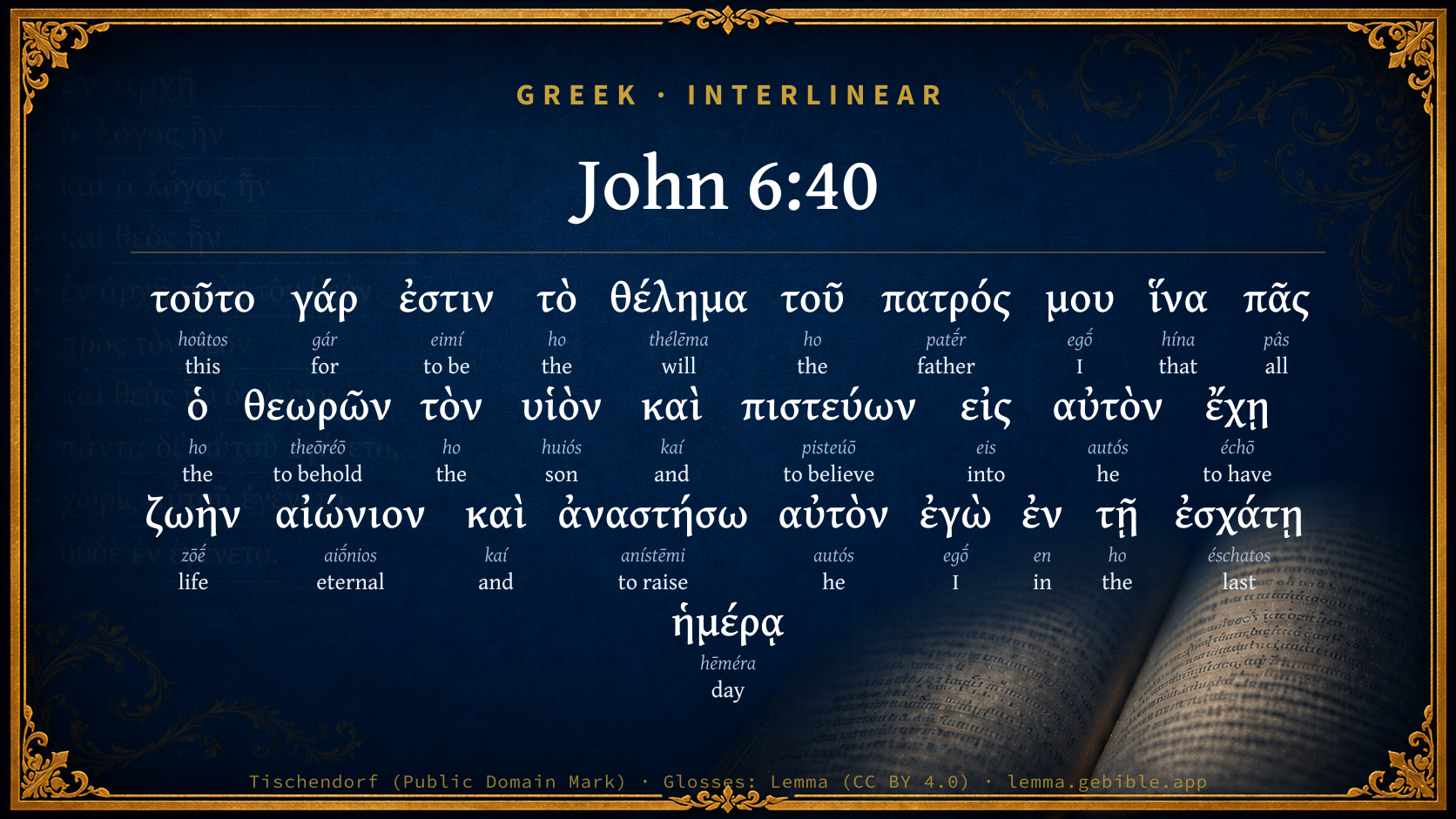
Download image
Cite this verse

John 6:40 (World English Bible). Public Domain. Lemma interlinear Bible study tool, https://lemma.gebible.app/v/john/6/40.

Show BibTeX & RIS
BibTeX
RIS
English Translation
This is the will of the one who sent me, that everyone who sees the Son, and believes in him, should have eternal life; and I will raise him up at the last day."
World English Bible · Public Domain
Download a study sheet

One document with this verse’s original text, its word-by-word gloss line, the meaning frame, cross-references with their text, attributed commentary, and full source and license credits — printable, and it pastes into notes with its structure intact.

This verse Autodidact and up

Study sheet (.html) Plain text (.txt)

A passage Seminary Student

Up to 50 verses in one chapter. A passage sheet keeps up to 6 commentary sources and 12 cross-references per verse, in the order this page ranks them, and says so on the sheet whenever that leaves anything out. Ask for a single verse and you get the Autodidact verse sheet above.

Everything on this page stays free to read, with no account — the sheet is a download of what is already on screen, not access to it.

Want to remove ads? Support Godless Engineer
Compare translations 3

The same verse in 3 English versions, stacked beneath the original-language interlinear above. Click any original word for its lexicon entry.

Each is an independent rendering of the whole verse — the interlinear is not word-aligned to these translations.

Highlighted words mark where these versions differ — a whole-verse word diff, not a word-by-word alignment.

  • World English Bible Public Domain
    This is the will of the one who sent me, that everyone who sees the Son, and believes in him, should have eternal life; and I will raise him up at the last day."
  • King James Version Public Domain
    And this is the will of him that sent me, that every one which seeth the Son, and believeth on him, may have everlasting life: and I will raise him up at the last day.
  • unfoldingWord Literal Text CC BY-SA 4.0
    For this is the will of my Father, that everyone seeing the Son and believing in him would have eternal life, and I will raise him up on the last day.”

unfoldingWord Literal Text — © unfoldingWord, licensed CC BY-SA 4.0. Word-aligned USFM3 via Door43 (git.door43.org/unfoldingWord/en_ult).

Versions to compare (up to 4)

3 of 4 selected

Show all 19 translations

Every available English version of this verse, each an independent rendering of the whole verse.

  • World English Bible Public Domain
    This is the will of the one who sent me, that everyone who sees the Son, and believes in him, should have eternal life; and I will raise him up at the last day."
  • Berean Standard Bible Public Domain
    For it is My Father’s will that everyone who looks to the Son and believes in Him shall have eternal life, and I will raise him up at the last day.”
  • Majority Standard Bible Public Domain
    And it is the will of Him who sent Me that everyone who looks to the Son and believes in Him shall have eternal life, and I will raise him up at the last day.”
  • King James Version Public Domain
    And this is the will of him that sent me, that every one which seeth the Son, and believeth on him, may have everlasting life: and I will raise him up at the last day.
  • American Standard Version (1901) Public Domain
    For this is the will of my Father, that every one that beholdeth the Son, and believeth on him, should have eternal life; and I will raise him up at the last day.
  • Revised Version (1885) Public Domain
    For this is the will of my Father, that every one that beholdeth the Son, and believeth on him, should have eternal life; and I will raise him up at the last day.
  • Geneva Bible (1599) Public Domain
    And this is the will of him that sent mee, that euery man which seeth the Sonne, and beleeueth in him, should haue euerlasting life: and I will raise him vp at the last day.
  • Douay-Rheims (1899) Public Domain
    And this is the will of my Father that sent me: that every one who seeth the Son, and believeth in him, may have life everlasting, and I will raise him up in the last day.
  • Young's Literal Translation Public Domain
    and this is the will of Him who sent me, that every one who is beholding the Son, and is believing in him, may have life age-during, and I will raise him up in the last day.'
  • Literal Standard Version CC BY-SA 4.0
    and this is the will of Him who sent Me, that everyone who is beholding the Son, and is believing in Him, may have continuous life, and I will raise him up in the last day.”
  • Unlocked Literal Bible CC BY-SA 4.0
    For this is the will of my Father, that everyone who sees the Son and believes in him would have eternal life and I will raise him up on the last day.”
  • unfoldingWord Literal Text CC BY-SA 4.0
    For this is the will of my Father, that everyone seeing the Son and believing in him would have eternal life, and I will raise him up on the last day.”
  • Darby Bible Public Domain
    For this is the will of my Father, that every one who sees the Son, and believes on him, should have life eternal; and I will raise him up at the last day.
  • World Messianic Bible Public Domain
    This is the will of the one who sent me, that everyone who sees the Son and believes in him should have eternal life; and I will raise him up at the last day.”
  • Webster's Bible Public Domain
    And this is the will of him that sent me, that every one who seeth the Son, and believeth on him, may have everlasting life: and I will raise him up at the last day.
  • Free Bible Version CC BY-SA 4.0
    What my Father wants is for everyone who sees the Son and trusts in him to have eternal life, and for me to raise them up at the last day.”
  • Bible in Basic English Public Domain
    This, I say, is my Father's pleasure, that everyone who sees the Son and has faith in him may have eternal life: and I will take him up on the last day.
  • Text-Critical English NT CC BY 4.0
    And this is the will of him who sent me, that anyone who looks to the Son and believes in him should have eternal life, and I will raise him up on the last day.”
  • Tyndale New Testament (1534) Public Domain
    And this is the wyll of him that sent me: that every man which seith the sonne and beleveth on him have everlastinge lyfe. And I will rayse him vp at the last daye.

Literal Standard Version (2020), Covenant Press — licensed CC BY-SA 4.0. Text via the HelloAO Bible API (eBible.org). Unlocked Literal Bible (unfoldingWord) — licensed CC BY-SA 4.0. Text via the HelloAO Bible API (eBible.org). unfoldingWord Literal Text — © unfoldingWord, licensed CC BY-SA 4.0. Word-aligned USFM3 via Door43 (git.door43.org/unfoldingWord/en_ult). Free Bible Version, Dr. Jonathan Gallagher — licensed CC BY-SA 4.0. Text via the HelloAO Bible API (eBible.org).

Word by word

More ways to search: Search by grammar → Find every occurrence → Compare this word →

Practice this passage: Drill this verse → Learn its vocabulary →

ἐσχάτῃ
éschatos
G2078
“last”
Adjective, Dative, Singular, Feminine, Superlative
Part of Speech
Adjective
Case
Dative
Number
Singular
Gender
Feminine
Degree
Superlative
Full Thayer's Definition

Origin: a superlative probably from G2192 (in the sense of contiguity)

TDNT: 13:37,3

1. extreme a. last in time or in place b. last in a series of places c. last in a temporal succession 2. the last a. last, referring to time b. of space, the uttermost part, the end, of the earth c. of rank, grade of worth, last i.e. lowest
  1. τοῦτο hoûtos G3778 “this” Demonstrative pronoun, Nominative, Singular, Neuter
  2. γάρ gár G1063 “for” Conjunction
  3. ἐστιν eimí G1510 “to be” Verb, Present, Active, Indicative, 3rd person, Singular
  4. τὸ ho G3588 “the” Article, Nominative, Singular, Neuter
  5. θέλημα thélēma G2307 “will” Noun, Nominative, Singular, Neuter
  6. τοῦ ho G3588 “the” Article, Genitive, Singular, Masculine
  7. πατρός patḗr G3962 “father” Noun, Genitive, Singular, Masculine
  8. μου egṓ G1473 “I” Personal pronoun, 1st person, Genitive, Singular
  9. ἵνα hína G2443 “that” Conjunction
  10. πᾶς pâs G3956 “all” Adjective, Nominative, Singular, Masculine
  11. ὁ ho G3588 “the” Article, Nominative, Singular, Masculine
  12. θεωρῶν theōréō G2334 “to behold” Verb, Present, Active, Participle, Nominative, Singular, Masculine
  13. τὸν ho G3588 “the” Article, Accusative, Singular, Masculine
  14. υἱὸν huiós G5207 “son” Noun, Accusative, Singular, Masculine
  15. καὶ kaí G2532 “and” Conjunction
  16. πιστεύων pisteúō G4100 “to believe” Verb, Present, Active, Participle, Nominative, Singular, Masculine
  17. εἰς eis G1519 “into” Preposition
  18. αὐτὸν autós G846 “he” Personal pronoun, Accusative, Singular, Masculine
  19. ἔχῃ échō G2192 “to have” Verb, Present, Active, Subjunctive, 3rd person, Singular
  20. ζωὴν zōḗ G2222 “life” Noun, Accusative, Singular, Feminine
  21. αἰώνιον aiṓnios G166 “eternal” Adjective, Accusative, Singular, Feminine
  22. καὶ kaí G2532 “and” Conjunction
  23. ἀναστήσω anístēmi G450 “to raise” Verb, Future, Active, Indicative, 1st person, Singular
  24. αὐτὸν autós G846 “he” Personal pronoun, Accusative, Singular, Masculine
  25. ἐγὼ egṓ G1473 “I” Personal pronoun, 1st person, Nominative, Singular
  26. ἐν en G1722 “in” Preposition
  27. τῇ ho G3588 “the” Article, Dative, Singular, Feminine
  28. ἡμέρᾳ hēméra G2250 “day” Noun, Dative, Singular, Feminine

About this verse

These counts appear in no published source. They are computed here, from the morphology-tagged text and Lemma’s own curated glosses. What Lemma adds →

29
words
22
distinct lemmas
Gospels
section

Shared distinctive vocabulary

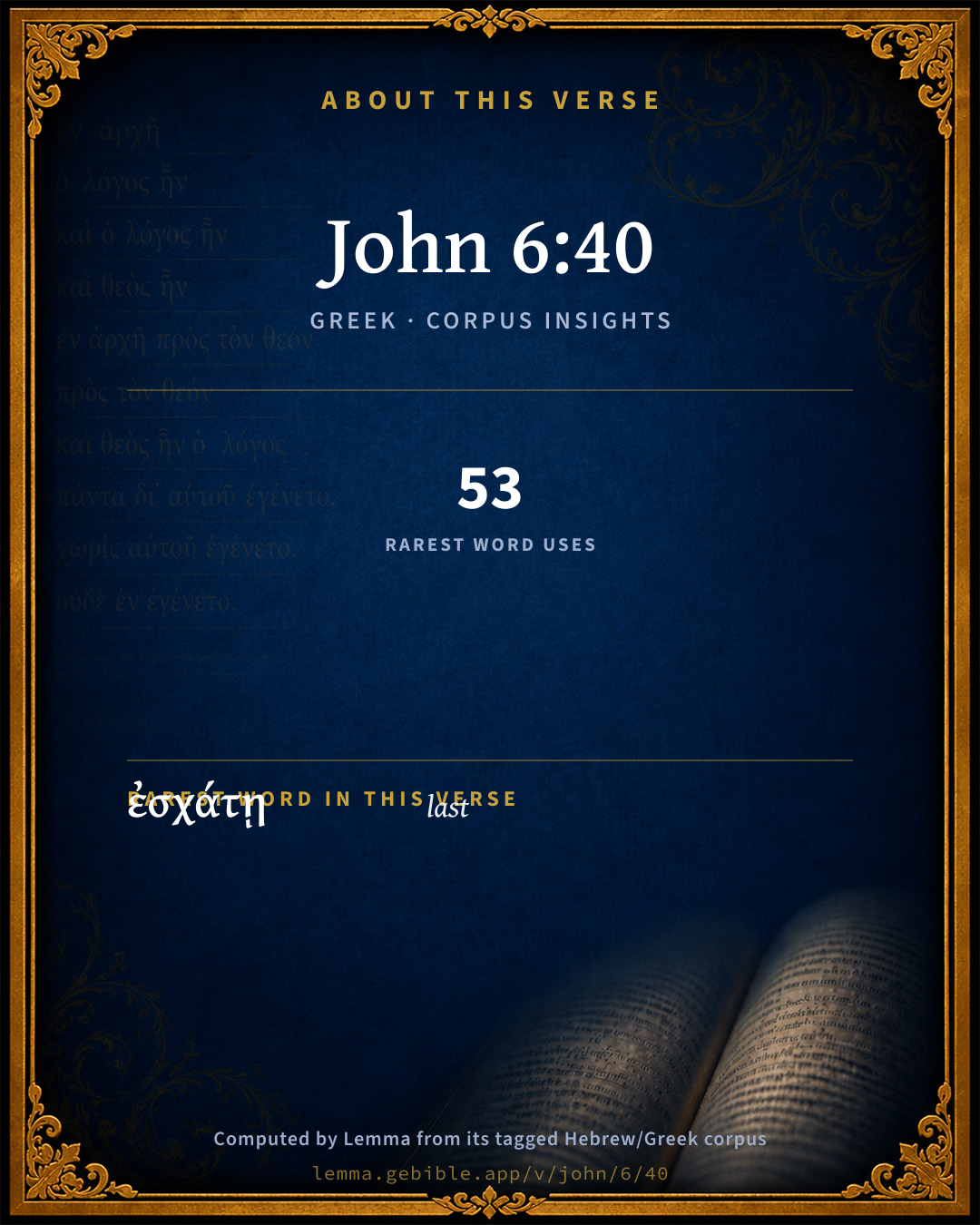
ἐσχάτῃ last G2078 occurs in 48 verses of the Greek New Testament. Also found in:
Repetition

Words recur within this verse:

Cross-references

31

Topical passages linked to John 6:40 in the Treasury of Scripture Knowledge — connected by theme and wording, ordered by reader-vote popularity; previews shown in the World English Bible.

  • John 5:24 "Most assuredly I tell you, he who hears my word, and believes him who sent me, has eternal life, and doesn't come into judgment, but has passed out of death into life.
  • Romans 6:23 For the wages of sin is death, but the free gift of God is eternal life in Christ Jesus our Lord.
  • John 6:54 He who eats my flesh and drinks my blood has eternal life, and I will raise him up at the last day.
  • John 11:25 Jesus said to her, "I am the resurrection and the life. He who believes in me, though he die, yet will he live.
  • John 3:15–18 that whoever believes in him should not perish, but have eternal life.
  • John 4:14 but whoever drinks of the water that I will give him will never thirst again; but the water that I will give him will become in him a well of water springing up to eternal life."
  • Luke 2:30 For my eyes have seen your salvation,
  • John 1:14 The Word became flesh, and lived among us. We saw his glory, such glory as of the one and only Son of the Father, full of grace and truth.
  • John 3:36 One who believes in the Son has eternal life, but one who disobeys the Son won't see life, but the wrath of God remains on him."
  • John 6:27 Don't work for the food which perishes, but for the food which remains to eternal life, which the Son of Man will give to you. For God the Father has sealed him."
  • John 12:45 He who sees me sees him who sent me.
  • John 14:19 Yet a little while, and the world will see me no more; but you will see me. Because I live, you will live also.
  • 1 John 1:1–3 That which was from the beginning, that which we have heard, that which we have seen with our eyes, that which we saw, and our hands touched, concerning the Word of life
  • 1 John 2:25 This is the promise which he promised us, the eternal life.
  • Isaiah 45:21–22 Declare you, and bring [it] forth; yes, let them take counsel together: who has shown this from ancient time? who has declared it of old? Haven't I, Yahweh? and there is no God else besides me, a just God and a Savior; there is no one besides me.
  • Isaiah 52:10 Yahweh has made bare his holy arm in the eyes of all the nations; and all the ends of the earth have seen the salvation of our God.
  • John 10:28 I give eternal life to them. They will never perish, and no one will snatch them out of my hand.
  • 1 John 5:11–13 The testimony is this, that God gave to us eternal life, and this life is in his Son.
  • John 17:2 even as you gave him authority over all flesh, he will give eternal life to all whom you have given him.
  • Isaiah 53:2 For he grew up before him as a tender plant, and as a root out of a dry ground: he has no form nor comeliness; and when we see him, there is no beauty that we should desire him.
  • Mark 16:16 He who believes and is baptized will be saved; but he who disbelieves will be condemned.
  • John 8:56 Your father Abraham rejoiced to see my day. He saw it, and was glad."
  • John 12:50 I know that his commandment is eternal life. The things therefore which I speak, even as the Father has said to me, so I speak."
  • Romans 5:21 that as sin reigned in death, even so might grace reign through righteousness to eternal life through Jesus Christ our Lord.
  • 2 Corinthians 4:6 seeing it is God who said, "Light will shine out of darkness," who has shone in our hearts, to give the light of the knowledge of the glory of God in the face of Jesus Christ.
  • Hebrews 11:1 Now faith is assurance of things hoped for, proof of things not seen.
  • 1 Peter 1:8 whom not having known you love; in whom, though now you don't see him, yet believing, you rejoice greatly with joy unspeakable and full of glory--
  • Jude 1:21 Keep yourselves in the love of God, looking for the mercy of our Lord Jesus Christ to eternal life.
  • John 6:35–37 Jesus said to them, "I am the bread of life. He who comes to me will not be hungry, and he who believes in me will never be thirsty.
  • John 14:17 the Spirit of truth, whom the world can't receive; for it doesn't see him, neither knows him. You know him, for he lives with you, and will be in you.
  • Hebrews 11:27 By faith, he left Egypt, not fearing the wrath of the king; for he endured, as seeing him who is invisible.

Cross-references courtesy of OpenBible.info (CC BY 4.0).

Where the printed editions differ

1 variant

Places in this verse where the major printed Greek editions disagree on the wording in a way that affects the translation — a comparison of editions, not a manuscript-by-manuscript collation. The editions are the modern critical texts (Nestlé-Aland 28/27, SBL, Westcott-Hort, Tregelles, Tyndale House) and the traditional texts behind the KJV (the Textus Receptus and the Byzantine/Majority text). It is not a claim about which reading is original.

  1. Different wording
    πατρός

    “Father”

    In NA28NA27TynSBLWHTreg Not in TRByz

    πέμψαντός (pempsantos) 'having sent' occurs in traditional manuscripts (TR+Byz) instead of πατρός (patros) 'Father' in older manuscripts (NA28+NA27+Tyn+SBL+WH+Treg)

Textual data: Translators Amalgamated Greek New Testament (STEPBible TAGNT) · CC BY 4.0.

Commentary

Notes on John 6:40 from classic Christian and Jewish commentators (each source and its license shown beneath its notes). The classic Christian expositions comment on the surrounding passage and are grouped to its opening verse, so a note may address several verses; the Jewish commentaries on the Tanakh (Rashi and others) are per-verse, so they appear only where the commentator wrote on this verse.

Lemma curates 59 commentaries, every one of them public domain or Creative Commons licensed, each selected and text-cleaned for this edition rather than reprinted as found. About our sources →

The Cambridge Bible for Schools and Colleges

gen. ed. J. J. S. Perowne

40. And this is the will of him that sent me] The true reading is; For this is the will of My Father. The opening words of Joh_6:39-40, being very similar, have become confused in inferior MSS. The best MSS. have ‘Father’ in this verse, where ‘the Son’ is mentioned, not in Joh_6:39, where He is not. Moreover this verse is explanatory of Joh_6:40, and opens with ‘for;’ it shews who are meant by ‘all which He hath given me,’ viz. every one that contemplateth the Son and believeth on Him. ‘Seeth’ is not strong enough for the Greek word here used: the Jews had seen Jesus; they had not contemplated Him so as to believe. ‘Contemplate’ is frequent in S. John and the Acts, elsewhere not. Comp. Joh_12:45, Joh_14:19, Joh_16:10; Joh_16:16; Joh_16:19. ‘That’ again = in order that.

I will raise him up] The Greek construction is ambiguous; possibly ‘raise’ depends upon ‘that’ as in Joh_6:39 : and that I should raise him up. ‘I’ is here very emphatic; ‘by My power as Messiah.’

The Cambridge Bible for Schools and Colleges (gen. ed. J. J. S. Perowne; Cambridge University Press, 1878–1918) — public domain. Text from a community e-Sword module.

Bengel's Gnomon

Johann Albrecht Bengel

Joh 6:40. Τοῦτο γάρ—Πατρός, for this—of the Father) See notes on Joh 6:37; Joh 6:39.—ὁ θεωρῶν καὶ πιστεύων, who seeth and believeth) The Jews were then seeing, but not believing, Joh 6:36, “Ye also have seen Me, and believe not.” Those who beheld Christ had a great opportunity for believing; and those of them who believed had a pre-eminent degree of blessedness. Mat 13:16, “Blessed are your eyes, for they see.”—ζωὴν αἰώνιον, everlasting life) even before the last day, of which the mention here follows immediately subsequent: as also at Joh 6:54, “hath eternal life; and I will raise him up at the last day.” Human reason transposes the order of these two.—ἀναστήσω, I will raise up again) The Future, as at Joh 6:44, and ch. Joh 15:8, “bear much fruit: so shall ye be My disciples.”—ἐγώ, I) This pronoun, which was not employed at Joh 6:39, is now employed: there the preceding verb is also in the first person [that of all—I should lose nothing]; but here, in the third person [that every one which—believeth—may have everlasting life], as Joh 6:44; Joh 6:54.

Bengel's Gnomon of the New Testament — English translation (T&T Clark, Edinburgh, 1860) — public domain. Text from a community e-Sword module.

Meyer's Critical & Exegetical Commentary

Heinrich August Wilhelm Meyer

Joh_6:40. Explanation, and consequently an assigning of the reason for the statement of Gods will, Joh_6:39; the words τοῦτο, etc., being an impressive anaphora, and τοῦ πατρός μου being spoken instead of τοῦ πέμψ. με, because at the close Jesus means to describe Himself, with still more specific definiteness, as the Son.

ὁ θεωρ. τὸν υἱὸν κ. πιστ. εἰς αὐτ.] characterizes those meant by the ὃ δέδωκέ μοι. There is implied in θεωρ. the attenta contemplatio (τοῖς ὀφθαλμοῖς τῆς ψυχῆς, Euthymius Zigabenus), the result of which is faith. Observe the carefully chosen word (Tittmann, Synon. p. 121; Grotius, in loc.). The Jews have seen Him, and have not believed, Joh_6:36. One must contemplate Him, and believe.

ἔχῃ and ἀναστήσω are both dependent upon ἵνα. There is nothing decisive against the rendering of καὶ ἀναστ. independently (Vulgate, Luther, Luthardt, Hengstenberg), but the analogy of Joh_6:39 does not favour it. Observe the change of tenses. The believer is said to have eternal Messianic life already in its development in time (see on Joh_3:15), but its perfect completion[234] at the last day by means of the resurrection; therefore ἈΝΑΣΤΉΣΩ after the ἔχειν of the ΖΩῊ ΑἸΏΝ.

ἘΓΏ] from the consciousness of Messianic power. Comp. Joh_6:44; Joh_6:54.

[234] Nothing is further from John than the Gnostic opinion, 2Ti_2:18, upon which, according to Baur, he is said very closely to border.

Meyer — Critical and Exegetical Commentary on the New Testament — English translation by Peter Christie, edited by Frederick Crombie (T&T Clark, 1880) — public domain. Text from a community e-Sword module.

Expositor's Greek Testament

ed. W. Robertson Nicoll

Joh 6:40 . In Joh 6:40 Jesus describes the recipients of salvation from the human side, πᾶς ὁ θεωρῶν τὸν υἱὸν καὶ πιστεύων εἰς αὐτόν , the latter, “believing,” being necessary, as already shown, to complete the former. The neuter πᾶν necessarily gives place to the masculine. καὶ ἀναστήσω αὐτὸν ἐγὼ τῇ ἐσχάτῃ ἡμέρᾳ . This promise recurs like a refrain, Joh 6:39-40 ; Joh 6:44 ; Joh 6:54 ; each time the ἐγώ is expressed and emphatic, “I, this same person who here stands before you, I and no other”. Christ gives His hearers the assurance that in this respect He is superior to Moses, that the life He gives is not confined to this present time. In itself it is a stupendous declaration.

The Expositor's Greek Testament, edited by W. Robertson Nicoll (1897–1910) — public domain. Text from a community e-Sword module.

Cambridge Greek Testament for Schools and Colleges

40. γάρ for δέ. πατρός μου for πέμψαντός με (from Joh 6:39) with אBCDLTU against A.

40. τοῦτο γὰρ … πατρός μου. This is the true reading; but the opening words of Joh 6:39-40, being very similar, have become confused in inferior MSS. The best have πατρός in Joh 6:40, where the Son is mentioned, not in Joh 6:39, where He is not. Moreover Joh 6:40 is explanatory of Joh 6:39, and opens with γάρ; it shews who are meant by πᾶν ὃ δέδ. μοι, viz. every one that contemplateth the Son and believeth on Him. Not ὁρῶν but θεωρῶν: the Jews had seen Jesus; they had not contemplated Him so as to believe. Θεωρεῖν is frequent in S. John and the Acts, elsewhere not; Joh 7:3, Joh 12:45, Joh 14:19, Joh 16:10; Joh 16:16; Joh 16:19, Joh 17:24, Joh 20:6; Joh 20:12; Joh 20:14.

ἀναστήσω. Here, still more easily than in Joh 6:39, ἀναστήσω may be future. Ἐγὼ is very emphatic; ‘by My power as Messiah.’

Some think that a break in the discourse must be made here; Joh 6:25-40 being spoken on the shore of the lake, Joh 6:41-58 in the synagogue at Capernaum to a somewhat different audience.

Cambridge Greek Testament for Schools and Colleges (Cambridge University Press, 1896; 21 vols, various authors incl. Carr, Maclear, Plummer, Farrar, Lumby, Moule, M. R. James, Simcox) — public domain. Text from a community e-Sword module.

Godet's Commentaries

Frédéric Louis Godet

Ver. 40. “For this is the will of my Father, that whosoever beholds the Son and believes on him has eternal life, and I will raise him up at the last day.”

This verse reproduces, either by confirming it (for, according to the Alexandrian authorities and the ancient versions), or by completing it (now, according to the Byzantine authorities), the thought of Joh 6:39. The principal difference is that in Joh 6:40 Jesus sets forth by the side of the gift which the Father makes in the person of the Son, the subjective act of the man who beholds and believes. In this expression is the decisive point. The two present participles, θεωρῶν καὶ πιστεύων, who beholds and believes, indicate the rapid succession of the two acts: “He who gives himself up to the contemplation and in whom it is immediately changed into faith.” This is the intentional antithesis of Joh 6:36 : “You have seen me, and you do not believe.”

The commission which the Father has given to Jesus is not to save all men indiscriminately. His work is to offer Himself to the sight of all, and, where the sight becomes contemplation and contemplation becomes faith, there to save. The Alexandrian reading: of my Father, is more in harmony with the term Son. On the other hand, the received reading:of him that sent me, accords better with the words: he that beholds : “He has sent me that I might offer myself for contemplation:” The term θεωρεῖν, to behold, indicates a more reflective act than the simple ὁρᾶν, to see, of Joh 6:36. He only beholds who has been sufficiently struck by the mere sight to pause before the object with emotion. Jesus substitutes here the masculine πᾶς for the neuter πᾶν (Joh 6:39), of which He had made use, because faith is an individual act. The history of Jesus’ ministry in the Synoptics is the commentary on this verse. Is it not by this sign, faith, that He recognizes those whom He can receive and save?

Luk 5:20 : “Seeing their faith, he said, Man, thy sins are forgiven thee.” He does not Himself know either the individuals or the number of persons of whom the whole gift (τὸ πᾶν) which the Father bestows upon Him will be composed; God, in sending Him, has given to Him only this watchword: Whosoever believeth. The two ἀναστήσω, in Joh 6:39-40, may be made subjunctive aorists depending on ἵνα : “and that I may raise it up.” It is certainly so, in my view, with that of Joh 6:39; but perhaps we must detach that of Joh 6:40 from the preceding and see in it a future indicative. “And this done, I charge myself with raising him at the last day, without any possibility that anything should be able to prevent the accomplishment of this last work.” The pronoun με, me, especially placed as it is, seems to me to be better explained in this way.

In the presence of Jewish unbelief, Jesus has strengthened Himself anew by the assurance of the success of His work. He has explained the severity of His conduct towards the Jews: God has said: “He who sees and believes; and as for them, they have seen and have not believed.” There was here a serious charge against his hearers. Far from accepting it, they endeavor to throw it back upon Him.

Frédéric Louis Godet — Commentaries on Luke, John, Romans, and 1 Corinthians — English translation (T&T Clark, Edinburgh, 1870s–1890s) — public domain. Text from a community e-Sword module.

Geneva Bible (1599)

Geneva Bible translators

Seeing and believing are joined together: for there is another kind of seeing, which is general, which the devils have, for they see: but here he speaketh of that kind of seeing, which is proper to the elect.

Geneva Bible (1599) marginal notes — public domain. Text via Bolls.life.

Jamieson, Fausset & Brown

Robert Jamieson, A. R. Fausset & David Brown

And this--in the second place.

is the will of Him that sent Me, that every one which seeth the Son and believeth on Him--seeing the Son believeth on Him.

may have everlasting life, and I will raise him up at the last day--This is the human side of the same thing as in the foregoing verse, and answering to "Him that cometh unto Me I will in no wise cast out"; that is, I have it expressly in charge that everyone that so "beholdeth" (so vieweth) the Son as to believe on Him shall have everlasting life; and, that none of Him be lost, "I will raise him up at the last day." (See on Joh 6:54).

Jamieson, Fausset & Brown — Commentary Critical and Explanatory on the Whole Bible (1871) — public domain (CC PDM 1.0). Text via the HelloAO Bible API.

Adam Clarke's Commentary

Verse 40. This is the will of him that sent me] Lest they should take a wrong meaning out of his words, as many have done since, he tells them that, far from any person being excluded from his mercy, it was the will of God that every one who saw him might believe and be saved. The power, without which they could not believe, he freely gave them; but the use of that power was their own. God gives the grace of repentance and faith to every man; but he neither repents nor believes for any man. Each must repent for his own sins, and believe in the Lord Jesus, through the grace given, or perish.

Adam Clarke's Commentary on the Bible (1810–1826) — public domain. Text from a community e-Sword/MySword module.

John Calvin's Commentaries

40. And this is the will of him who sent me. He had said that the Father had committed to him the protection of our salvation; and now he likewise describes the manner in which it is accomplished. The way to obtain salvation, therefore, is to obey the Gospel of Christ. This point he had, indeed, glanced at a little before but now he expresses more fully what he had spoken somewhat obscurely. And if it is the will of God that those whom he has elected shall be saved, and if in this manner he ratifies and executes his eternal decree, whoever he be that is not satisfied with Christ, but indulges in curious inquiries about eternal predestination, such a person, as far as lies in his power, desires to be saved contrary to the purpose of God. The election of God is in itself hidden and secret; the Lord manifests it by calling, that is, when he bestows on us this blessing of calling us

They are madmen, therefore, who seek their own salvation or that of others in the whirlpool of predestination, not keeping the way of salvation which is exhibited to them. Nay more, by this foolish speculation, they endeavor to overturn the force and effect of predestination; for if God has elected us to this end, that we may believe, take away faith, and election will be imperfect. But we have no right to break through the order and succession of the beginning and the end, since God, by his purpose, hath decreed and determined that it shall proceed unbroken. Besides, as the election of God, by an indissoluble bond, draws his calling along with it, so when God has effectually called us to faith in Christ, let this have as much weight with us as if he had engraven his seal to ratify his decree concerning our salvation. For the testimony of the Holy Spirit is nothing else than the sealing of our adoption, (Romans 8:15.) To every man, therefore, his faith is a sufficient attestation of the eternal predestination of God, so that it would be a shocking sacrilege to carry the inquiry farther; for that man offers an aggravated insult to the Holy Spirit, who refuses to assent to his simple testimony.

Whosoever seeth the Son, and believeth in him. He uses the words, see and believe, in contrast with what he had formerly said; for he had reproached the Jews with not believing, even though they saw, (verse 36.) But now, speaking of the sons of God, with the feeling which they have of the power of God in Christ, he joins the obedience of faith. Moreover, these words show that faith proceeds from the knowledge of Christ; not that it desires anything beyond the simple word of God, but because, if we trust in Christ, we must perceive what he is, and what he brings to us.

John Calvin's Commentaries (1540-1563) — public domain. Text from the Calvin Translation Society English edition (1840s-50s) via the Christian Classics Ethereal Library (ccel.org). Calvin's coverage is partial (roughly two-thirds of the Bible); uncommented books and verses are honest gaps, never fabricated. The 19th-century editor's footnotes and remarks are omitted so the notes are faithfully Calvin's own voice.

Ellicott's Commentary for English Readers

(40) And this is the will of him that sent me.—Read, For this is the will of My Father. (See Joh_6:39.) The common text has inserted the opening words of these verses. There can be no doubt that the change indicated gives the original reading, and it will be seen that the relation of “Father” and “Son” is thus preserved.

Every one which seeth the Son.—We pass here to the individuals who compose the great mass of humanity. It is the divine will that no one should be excluded, but that he may have eternal life (comp. Joh_3:15; Joh_5:24): this is the Father’s gift in the person of the Son. The exercise of the mental power to see Him, the reception of Him and trust upon Him: this is man’s acceptance of God’s gift. The word rendered “seeth” means to look upon, to contemplate, and is the first step towards a true faith.

The analogy of the previous verse makes it probable that we should render the last clause of this verse, and that I should raise him up at the last day. The difference of tenses is important. The believer has now the principle of eternal life, but this is to be his in its fulness when he shall be raised up at the last day. This thought of the final victory is the joyous refrain of these verses (Joh_6:39-40; Joh_6:44; Joh_6:54). The spirit brought into communion with the original source of life becomes life in itself. This life is greater than death, and cannot be holden by it (comp. Joh_6:53).

A Bible Commentary for English Readers, edited by Charles John Ellicott (1878–1897) — public domain. Text from a community e-Sword module.

John Gill's Exposition

The Jews then murmured at him,.... When they found that he spoke of himself as the true bread, the bread of God, and bread of life, and as descending from heaven: and which was to be fed upon in a spiritual manner by faith, which they were ignorant of, and had no desire unto: and thus being disappointed of the delicious corporeal food they expected, they grew uneasy, and displeased,

because he said I am the bread which came down from heaven; for though, as yet, he had not said this in so many words, and in this direct form, as afterwards, in Joh 6:51; yet he had said what amounted to it, and which might be easily gathered from Joh 6:35 The Vulgate Latin reads, "I am the living bread"; and the Persic version, "I am the bread of life". And this last renders the first clause "mocked at him".

John Gill's Exposition of the Whole Bible (1746–1763) — public domain (CC PDM 1.0). Text via the HelloAO Bible API.

Trapp's Complete Commentary

John Trapp

40 And this is the will of him that sent me, that every one which seeth the Son, and believeth on him, may have everlasting life: and I will raise him up at the last day.

Ver. 40. Which seeth the Son and believeth] This these Jews did not, Joh 6:36. Some slight knowledge of Christ they had; but it amounted not to a saving faith. {See Trapp on "Joh 6:36"} Meteors hang awhile in the air, but are not of strength enough to ascend to the upper region hence they soon vanish.

And I will raise him up] This is four different times repeated, that we may rest secure of it, and be comforted. Fiducia Christianorum resurrectio mortuorum, the faith of the Christians is by the ressurection of the dead, saith Tertullian.

John Trapp, A Commentary or Exposition upon All the Books of the Old and New Testament (1647–1656) — public domain. Text from a community e-Sword module.

Albert Barnes' Notes on the Bible

Every one which seeth the Son, and believeth on him - It was not sufficient to see him and hear him, but it was necessary, also, to believe on him. Many of the Jews had seen him, but few believed on him. Jesus had said in the previous verse that all that the Father had given him should be saved. But he never left a doctrine so that men must misunderstand it. Lest it should be supposed that if a man was given to him this was all that was needful, and lest anyone should say, “If I am to be saved I shall be, and my efforts will be useless,” he states here that it is necessary that a man should believe on him. This would be the evidence that he was given to God, and this would be evidence conclusive that he would be saved. If this explanation of the Saviour had always been attended to, the doctrine of election would not have been abused as it has been. Sinners would not sit down in unconcern, saying that if they are given to Christ all will be well. They would have arisen like the prodigal, and would have gone to God; and, having believed on the Saviour, they would then have had evidence that they were given to him - the evidence resulting from an humble, penitent, believing heart - and then they might rejoice in the assurance that Jesus would lose none that were given to him, but would raise it up at the last day. All the doctrines of Jesus, as he preached them, are safe, and pure, and consistent; as men preach them, they are, unhappily, often inconsistent and open to objection, and are either fitted to produce despair on the one hand, or presumptuous self-confidence on the ether. Jesus teaches men to strive to enter heaven, as if they could do the work themselves; and yet to depend on the help of God, and give the glory to him, as if he had done it all.

Albert Barnes' Notes on the Bible (1834–1885) — public domain. Text from a community e-Sword/MySword module.

Matthew Poole's English Annotations

Our Lord having asserted the will of God, as to the final issue and happiness of believers, goes on to assert the means by which, in this life using, they must obtain this life: those are, seeing the Son, and believing in him; seeing him, not with the eyes of their bodies, or seeing his miraculous operations, both which these Capernaites did, and yet did not believe, (as he told them, Joh 6:36), but a seeing them with the eye of their minds, discerning him as the Messiah, and Saviour of the world; so seeing him, as to believe on him. As to these, he confirmeth it again to be the will of his Father, that they should live eternally, and that they should be raised again at the last day; and that by him, whom God had enabled to be the Judge both of the quick and the dead, Act 10:42, which agreeth with what he had before said, Joh 5:28.

Matthew Poole's English Annotations on the Holy Bible (1683–1685) — public domain. Text from a community e-Sword/MySword module.

Whedon's Commentary on the Bible

Daniel D. Whedon

40. Believeth on him—So long as he performs the condition, so long is he heir of the salvation. When he ceases to be a believer he loses all claim to the divine promise, and all interest in eternal life. That he has once believed no longer secures him heaven, any more than the fact that he has once disbelieved secures eternal death.

Daniel D. Whedon (gen. ed.), Commentary on the Old and New Testaments (1874–1909) — public domain. Text from a community e-Sword module.

The Pulpit Commentary

Forthis is the will of my Father (or, of him that sent me), that every one (pav , instead of the pan of vers. 37, 39), treated separately and individually, who beholdeth i.e. steadily and continuously contemplatesthe Son (here he identifies himself with the revelation of the sonship in his own Person) and believeth on himi.e. entrusts himself in a full moral surrender to the Son (the eiv auton must be here especially noticed) as thus revealedshould have eternal life. This is the sublime law of Divine arrangement, and the fullest expression of the will of the Father. (comp. 1Jn_5:12, "He that hath the Son hath life; and he that hath not the Son of God hath not life Behold and trust." These are the conditions. The steady gaze, the full perception of the Divine Son-ship that is adequately expressed in the Son of man, issues by a Divine arrangement in life eternal. The blessedness of the life of faith, its elevation above the conditions of corruption and decay, are not all which he promises, for he added, And (perhaps the ina is carried on to the anasthsw , and so the word is in subj. aor. rather than fut. indic., and, if so, the sentence may express the fact), that I should raise him (not "it;" cf. ver. 39) at the last day.

It is not improbable, as we have seen, that our Lord uttered these verses (37-40) to the innermost circle of his followers. The first discourse closes with ver. 36. The disciples looked with eager and inquisitive glances at each other and at their Lord, and received these teachings of the Lord concerning the relation he was sustaining to the Father, and the claim he made to be the Almoner of the mercy and minister of the judgment of him that sent him. This great utterance corresponds with the celebrated synoptic recital. (Mat_11:26, Mat_11:27)

The Pulpit Commentary (1880–1919), ed. H.D.M. Spence-Jones & Joseph S. Exell — public domain. Text from a community e-Sword module.

John Wesley's Explanatory Notes

Here is the sum of the three foregoing verses. This is the will of him that sent me - This is the whole of what I have said: this is the eternal, unchangeable will of God. Everyone who truly believeth, shall have everlasting life. Everyone that seeth and believeth - The Jews saw, and yet believed not. And I will raise him up - As this is the will of him that sent me, I will perform it effectually.

John Wesley, Explanatory Notes Upon the Whole Bible (1754–1765) — public domain. Text via the GEBible commentary corpus.

International Critical Commentary

40. AΓΔ have τοῦ πέμψαντός με (from v. 39) for τοῦ πατρός μου, which is read by אBCDLTNWΘ. There is, again, as in vv. 39, 54, a variant for ἐν τῇ ἐσχ. ἡμ., ἐν being om. by BCTΓΔΘW, although found in אADLN.

τοῦτο γάρ κτλ., “This, too, is my Father’s will”: v. 40 amplifies and repeats with emphasis what has been already said in v. 39. The rec. has τοῦτο δέ.

For “my Father,” cf. v. 32, and see on 2:16.

πᾶς ὁ θεωρῶν τὸν υἱόν, “who beholdeth the Son,” sc. not with the bodily eyes, but with the eye of faith perceives Him for what He is. Cf. 12:45 ὁ θεωρῶν ἐμὲ θεωρεῖ τὸν πέμψαντά με. See on 2:23 for Jn.’s use of θεωρῶ, and on 3:17 for ὁ υἱός used absolutely. It is the Father’s will that “he who beholdeth the Son and believeth on Him should have eternal life”; cf. 3:15, 36 and the notes thereon. This ζωὴ αἰώνιος

begins in the present world, but its possession continues after death.

ἀναστήσω αὐτὸν ἐγώ κτλ., “I, even I (ἐγώ is emphatic) will raise Him up at the Last Day.” This is repeated in another form at v. 54. Cf. Introd., p. clxvii.

The Second Part of the Discourse (Vv. 41-51a)

International Critical Commentary — older volumes (1896–1929), various authors — public domain. Text from a community e-Sword module.

Vincent's Word Studies in the New Testament

Marvin R. Vincent

And this [δε] . The best texts read gar, for. There is a logical connection between the last sentence and the following. The Father 's will in preserving and raising up that which he has given to the Son, includes in its fulfillment the believing contemplation of the Son and its issue in eternal life.

Of Him that sent me. The best texts substitute patrov, you, of my Father.

Seeth [θεωρων] . The word is designedly used. The saving vision of Christ is not here seeing, but earnest contemplation. Rev., beholdeth. See on 1 18. Compare ye have seen me, and believe not (ver. 36).

Marvin R. Vincent, Word Studies in the New Testament (1887–1900) — public domain. Text from a community e-Sword/MySword module.

Lesson kit

Teaching starters — assembled from the data on this page, not authored interpretation. Every prompt links to the verse data it draws on. Edit before teaching.

John, in the Gospels, opens this verse with 29 words (22 distinct Greek lemmas). Its most distinctive word is éschatos (“last”). A historical commentator’s framing appears above. Read the whole chapter for the surrounding context.

Discussion questions

  1. The word éschatos carries the sense “last.” How does it shape the verse?
  2. How does Matthew 5:26, which shares the word «last», read alongside this verse?
  3. What does the repetition of “the” (5× in this one verse) do in this verse?
  4. The translations on this page render this verse differently — a whole-verse word diff, not a word-by-word alignment. What might account for the different wordings?
  5. Compare how The Cambridge Bible for Schools and Colleges and Bengel's Gnomon read this verse. Where do they agree or differ?

Things to notice

Reading settings

Reading text

Shown beneath each verse's original-language words.

Old Testament
Old Testament edition

Read the OT as the Masoretic Hebrew (MT) or the Greek Septuagint (LXX).

English shown for the Greek Septuagint (in the Hebrew ↔ Greek comparison).

Comparing translations? Open the Compare panel on any verse page to stack up to four side by side.