
Matthew 4:21

Greek (Tischendorf 8th ed.) Matthew 4:21 appears in the Greek New Testament. The text above is from the Tischendorf 8th edition. Each word links to its Strong’s number and a concise gloss. Click any word for its full Thayer’s Greek Lexicon entry.

Download image
Cite this verse

Matthew 4:21 (World English Bible). Public Domain. Lemma interlinear Bible study tool, https://lemma.gebible.app/v/matthew/4/21.

Show BibTeX & RIS
BibTeX
RIS
English Translation
Going on from there, he saw two other brothers, James the son of Zebedee, and John his brother, in the boat with Zebedee their father, mending their nets. He called them.
World English Bible · Public Domain
Highlights
  • 6 first appearances in the Greek New Testament
Full analysis ↓
Download a study sheet

One document with this verse’s original text, its word-by-word gloss line, the meaning frame, cross-references with their text, attributed commentary, and full source and license credits — printable, and it pastes into notes with its structure intact.

This verse Autodidact and up

Study sheet (.html) Plain text (.txt)

A passage Seminary Student

Up to 50 verses in one chapter. A passage sheet keeps up to 6 commentary sources and 12 cross-references per verse, in the order this page ranks them, and says so on the sheet whenever that leaves anything out. Ask for a single verse and you get the Autodidact verse sheet above.

Everything on this page stays free to read, with no account — the sheet is a download of what is already on screen, not access to it.

Want to remove ads? Support Godless Engineer
Compare translations 3

The same verse in 3 English versions, stacked beneath the original-language interlinear above. Click any original word for its lexicon entry.

Each is an independent rendering of the whole verse — the interlinear is not word-aligned to these translations.

Highlighted words mark where these versions differ — a whole-verse word diff, not a word-by-word alignment.

  • World English Bible Public Domain
    Going on from there, he saw two other brothers, James the son of Zebedee, and John his brother, in the boat with Zebedee their father, mending their nets. He called them.
  • King James Version Public Domain
    And going on from thence, he saw other two brethren, James the son of Zebedee, and John his brother, in a ship with Zebedee their father, mending their nets; and he called them.
  • unfoldingWord Literal Text CC BY-SA 4.0
    And having gone on from there, he saw two other brothers, James the of Zebedee, and John his brother in the boat with Zebedee their father mending their nets, and he called them,

unfoldingWord Literal Text — © unfoldingWord, licensed CC BY-SA 4.0. Word-aligned USFM3 via Door43 (git.door43.org/unfoldingWord/en_ult).

Versions to compare (up to 4)

3 of 4 selected

Show all 19 translations

Every available English version of this verse, each an independent rendering of the whole verse.

  • World English Bible Public Domain
    Going on from there, he saw two other brothers, James the son of Zebedee, and John his brother, in the boat with Zebedee their father, mending their nets. He called them.
  • Berean Standard Bible Public Domain
    Going on from there, He saw two other brothers, James son of Zebedee and his brother John. They were in a boat with their father Zebedee, mending their nets. Jesus called them,
  • Majority Standard Bible Public Domain
    Going on from there, He saw two other brothers, James son of Zebedee and his brother John. They were in a boat with their father Zebedee, mending their nets. Jesus called them,
  • King James Version Public Domain
    And going on from thence, he saw other two brethren, James the son of Zebedee, and John his brother, in a ship with Zebedee their father, mending their nets; and he called them.
  • American Standard Version (1901) Public Domain
    And going on from thence he saw two other brethren, James the `son' of Zebedee, and John his brother, in the boat with Zebedee their father, mending their nets; and he called them.
  • Revised Version (1885) Public Domain
    And going on from thence he saw other two brethren, James the son of Zebedee, and John his brother, in the boat with Zebedee their father, mending their nets; and he called them.
  • Geneva Bible (1599) Public Domain
    And when he was gone forth from thence, he saw other two brethren, Iames the sonne of Zebedeus, and Iohn his brother in a ship with Zebedeus their father, mending their nets, and he called them.
  • Douay-Rheims (1899) Public Domain
    And going on from thence, he saw other two brethren, James the son of Zebedee, and John his brother, in a ship with Zebedee their father, mending their nets: and he called them.
  • Young's Literal Translation Public Domain
    And having advanced thence, he saw other two brothers, James of Zebedee, and John his brother, in the boat with Zebedee their father, refitting their nets, and he called them,
  • Literal Standard Version CC BY-SA 4.0
    And having advanced from there, He saw two other brothers, James of Zebedee, and his brother John, in the boat with their father Zebedee, refitting their nets, and He called them,
  • Unlocked Literal Bible CC BY-SA 4.0
    As Jesus was going on from there he saw two other brothers, James son of Zebedee, and John his brother. They were in the boat with Zebedee their father mending their nets. He called them,
  • unfoldingWord Literal Text CC BY-SA 4.0
    And having gone on from there, he saw two other brothers, James the of Zebedee, and John his brother in the boat with Zebedee their father mending their nets, and he called them,
  • Darby Bible Public Domain
    And going on thence he saw other two brothers, James the [son] of Zebedee and John his brother, in the ship with Zebedee their father, mending their trawl-nets, and he called them;
  • World Messianic Bible Public Domain
    Going on from there, he saw two other brothers, Jacob the son of Zebedee, and Yochanan his brother, in the boat with Zebedee their father, mending their nets. He called them.
  • Webster's Bible Public Domain
    And going on from thence, he saw other two brethren, James the son of Zebedee, and John his brother, in a boat with Zebedee their father, mending their nets: and he called them.
  • Free Bible Version CC BY-SA 4.0
    Continuing on he saw two other brothers, James and John. They were in a boat with their father Zebedee, mending their nets. He called them to follow him.
  • Bible in Basic English Public Domain
    And going on from there he saw two other brothers, James, the son of Zebedee, and John, his brother, in the boat with their father, stitching up their nets; and he said, Come.
  • Text-Critical English NT CC BY 4.0
    Going on from there, he saw two other brothers, James the son of Zebedee and John his brother, in the boat with their father Zebedee, mending their nets, and he called them.
  • Tyndale New Testament (1534) Public Domain
    And he went forthe from thence and sawe other twoo brethren Iames the sonne of zebede and Ihon his brother in the shippe with zebede their father mendynge their nettes and called them.

Literal Standard Version (2020), Covenant Press — licensed CC BY-SA 4.0. Text via the HelloAO Bible API (eBible.org). Unlocked Literal Bible (unfoldingWord) — licensed CC BY-SA 4.0. Text via the HelloAO Bible API (eBible.org). unfoldingWord Literal Text — © unfoldingWord, licensed CC BY-SA 4.0. Word-aligned USFM3 via Door43 (git.door43.org/unfoldingWord/en_ult). Free Bible Version, Dr. Jonathan Gallagher — licensed CC BY-SA 4.0. Text via the HelloAO Bible API (eBible.org).

Word by word

More ways to search: Search by grammar → Find every occurrence → Compare this word →

Practice this passage: Drill this verse → Learn its vocabulary →

προβὰς
probaínō
G4260
“to go forward”
Verb, Aorist, Active, Participle, Nominative, Singular, Masculine
Part of Speech
Verb
Tense
Aorist
Voice
Active
Mood
Participle
Case
Nominative
Number
Singular
Gender
Masculine
Full Thayer's Definition

Origin: from G4253 and the base of G939

TDNT: None

1. to go forwards, go on
  1. Καὶ kaí G2532 “and” Conjunction
  2. ἐκεῖθεν ekeîthen G1564 “thence” Adverb
  3. εἶδεν horáō G3708 “to see” Verb, Aorist, Active, Indicative, 3rd person, Singular
  4. ἄλλους állos G243 “another” Adjective, Accusative, Plural, Masculine
  5. δύο dýo G1417 “two” Adjective, Numeral (indeclinable)
  6. ἀδελφούς adelphós G80 “brother” Noun, Accusative, Plural, Masculine
  7. Ἰάκωβον Iákōbos G2385 “James” Noun, Accusative, Singular, Masculine
  8. τὸν ho G3588 “the” Article, Accusative, Singular, Masculine
  9. τοῦ ho G3588 “the” Article, Genitive, Singular, Masculine
  10. Ζεβεδαίου Zebedaîos G2199 “Zebedee” Noun, Genitive, Singular, Masculine
  11. καὶ kaí G2532 “and” Conjunction
  12. Ἰωάννην Iōánnēs G2491 “John” Noun, Accusative, Singular, Masculine
  13. τὸν ho G3588 “the” Article, Accusative, Singular, Masculine
  14. ἀδελφὸν adelphós G80 “brother” Noun, Accusative, Singular, Masculine
  15. αὐτοῦ autós G846 “he” Personal pronoun, Genitive, Singular, Masculine
  16. ἐν en G1722 “in” Preposition
  17. τῷ ho G3588 “the” Article, Dative, Singular, Neuter
  18. πλοίῳ ploîon G4143 “ship” Noun, Dative, Singular, Neuter
  19. μετὰ metá G3326 “with” Preposition
  20. Ζεβεδαίου Zebedaîos G2199 “Zebedee” Noun, Genitive, Singular, Masculine
  21. τοῦ ho G3588 “the” Article, Genitive, Singular, Masculine
  22. πατρὸς patḗr G3962 “father” Noun, Genitive, Singular, Masculine
  23. αὐτῶν autós G846 “he” Personal pronoun, Genitive, Plural, Masculine
  24. καταρτίζοντας katartízō G2675 “to complete” Verb, Present, Active, Participle, Accusative, Plural, Masculine
  25. τὰ ho G3588 “the” Article, Accusative, Plural, Neuter
  26. δίκτυα díktyon G1350 “net” Noun, Accusative, Plural, Neuter
  27. αὐτῶν autós G846 “he” Personal pronoun, Genitive, Plural, Masculine
  28. καὶ kaí G2532 “and” Conjunction
  29. ἐκάλεσεν kaléō G2564 “to call” Verb, Aorist, Active, Indicative, 3rd person, Singular
  30. αὐτούς autós G846 “he” Personal pronoun, Accusative, Plural, Masculine

About this verse

These counts appear in no published source. They are computed here, from the morphology-tagged text and Lemma’s own curated glosses. What Lemma adds →

31
words
19
distinct lemmas
Gospels
section

Notable vocabulary

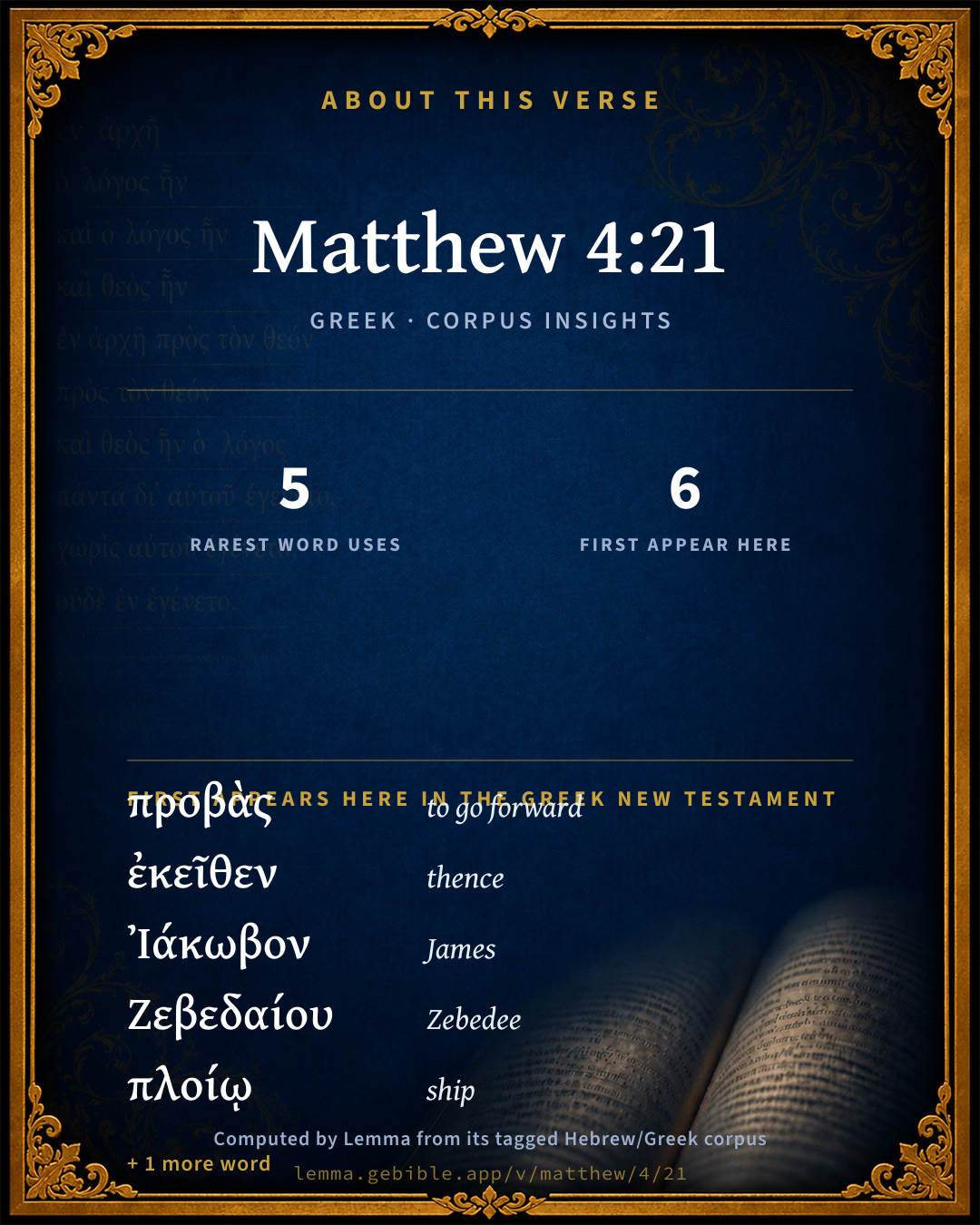
The rarest word here is προβὰς to go forward G4260 — appearing just 5 times in the whole Greek New Testament.

First appearance in Scripture

These words make their first canonical appearance in the Greek New Testament here:

  • προβὰς to go forward G4260
  • ἐκεῖθεν thence G1564
  • Ἰάκωβον James G2385
  • Ζεβεδαίου Zebedee G2199
  • πλοίῳ ship G4143
  • καταρτίζοντας to complete G2675

Shared distinctive vocabulary

προβὰς to go forward G4260 occurs in 5 verses of the Greek New Testament. Also found in:
Repetition

Words recur within this verse:

  • ἀδελφούς brother G80 ×2
  • Ζεβεδαίου Zebedee G2199 ×2
  • τὸν the G3588 ×6
  • αὐτοῦ he G846 ×4
  • Καὶ and G2532 ×3

Cross-references

10

Topical passages linked to Matthew 4:21 in the Treasury of Scripture Knowledge — connected by theme and wording, ordered by reader-vote popularity; previews shown in the World English Bible.

  • Matthew 10:2 Now the names of the twelve apostles are these. The first, Simon, who is called Peter; Andrew, his brother; James the son of Zebedee; John, his brother;
  • Mark 1:19–20 Going on a little further from there, he saw James the son of Zebedee, and John, his brother, who were also in the boat mending the nets.
  • Mark 3:17 James the son of Zebedee; John, the brother of James, and he surnamed them Boanerges, which means, Sons of Thunder;
  • Luke 5:10–11 and so also were James and John, sons of Zebedee, who were partners with Simon. Jesus said to Simon, "Don't be afraid. From now on you will be catching people alive."
  • John 21:2 Simon Peter, Thomas called Didymus, Nathanael of Cana in Galilee, and the sons of Zebedee, and two others of his disciples were together.
  • Acts 12:2 He killed James, the brother of John, with the sword.
  • Matthew 17:1 After six days, Jesus took with him Peter, James, and John his brother, and brought them up into a high mountain by themselves.
  • Matthew 20:20–21 Then the mother of the sons of Zebedee came to him with her sons, kneeling and asking a certain thing of him.
  • Matthew 26:37 He took with him Peter and the two sons of Zebedee, and began to be sorrowful and severely troubled.
  • Mark 5:37 He allowed no one to follow him, except Peter, James, and John the brother of James.

Cross-references courtesy of OpenBible.info (CC BY 4.0).

Commentary

Notes on Matthew 4:21 from classic Christian and Jewish commentators (each source and its license shown beneath its notes). The classic Christian expositions comment on the surrounding passage and are grouped to its opening verse, so a note may address several verses; the Jewish commentaries on the Tanakh (Rashi and others) are per-verse, so they appear only where the commentator wrote on this verse.

Lemma curates 59 commentaries, every one of them public domain or Creative Commons licensed, each selected and text-cleaned for this edition rather than reprinted as found. About our sources →

The Biblical Illustrator

Joseph S. Exell

Mat_4:21

He called them.

Jesus calls all to follow Him

When engaged in their ordinary occupations. By His Word-Providence-Spirit.

I. The call.

1. Who calls? Jesus, the Saviour. His right to do so. His love in doing it.

2. The action. A call. Does not compel.

3. The purpose. To bring from toil to rest, from danger to safety, from nature to grace.

II. The obedience. Immediate-no delay. Thorough. They left, renounced, gave up, not to return: forsook, parted with possessions, relations. The reason was to follow Him-imitate, save. Through humility to glory. What remarkable faith! What ready obedience! (J. R. Taft, M. A.)

The character of St. James.

I. His thoroughness.

II. His readiness.

III. His devotedness. (Preb. Griffith, M. A.)

Forsaking all and following.

I. Consider the demand made upon the men called.

1. It involved the sacrifice of

(1) Domestic ties;

(2) Property;

(3) Their means of livelihood.

2. It secured

(1) Ridicule;

(2) Persecution;

(3) St. Andrews cross. Such was the prospect.

II. Contemplate their obedience manifested.

1. It was thorough.

(1) They forsook all;

(2) They followed Him-everywhere.

2. It was constant.

III. Now, as regards yourselves.

1. You have been called to follow Christ-

(1) In your baptism;

(2) Preaching;

(3) Warnings of Providence.

2. You are called to-Renounce evil ways.

3. You are called as they were, to endure loss, pain, death. Test your proceedings:-Sunday-how do you keep it? church-do you value its services? Holy Communion, etc. (G. Venables.)

The Biblical Illustrator, edited by Joseph S. Exell (c. 1880s–1900s) — public domain. Text from a community e-Sword module.

Joseph Benson's Commentary

Mat 4:21-22. Going on from thence — Mark says, A little further thence, He saw two other brethren, James the son of Zebedee, and John his brother — The reader will observe, there was another James, the son of Alpheus, or Cleophas, commonly called James the Less. In a ship, with Zebedee their father — By the sea-side, mending their nets — Which had been broken by the vast draught of fishes they had taken just before. And he called them — Not with his voice only, but by his Spirit affecting and drawing their hearts, so that they immediately left their ship and their father, and indeed their earthly all, and followed him.

Joseph Benson's Commentary on the Old and New Testaments (1811–1818) — public domain. Text from a community e-Sword module.

Bengel's Gnomon

Johann Albrecht Bengel

Mat 4:21. Μετὰ Ζεβεδαίου, with Zebedee) They were therefore youths; their father Zebedee being still in his prime, and both their parents alive. John lived seventy years longer. James was the first of the apostles who died; John survived him a long time.[160]—καταρτίζοντας, adjusting for work) This word is said of a vessel or tool, which is either prepared for work or repaired after work. The first meaning is more suitable to this passage. The sons of Zebedee, as well as those of Jonas, on more than one occasion, abandoned the work in which they were respectively engaged with the greatest promptitude and obedience.

[160] These two are more frequently joined together in the New Testament than Peter and Andrew.—B. G. V.

Bengel's Gnomon of the New Testament — English translation (T&T Clark, Edinburgh, 1860) — public domain. Text from a community e-Sword module.

Expositor's Greek Testament

ed. W. Robertson Nicoll

Mat 4:21 . ἄλλους δύο , another pair of brothers, James and John, sons of Zebedee, the four together an important instalment of the twelve. The first pair were casting their nets, the second were mending them, ( καταρτίζοντες ), with their father.

The Expositor's Greek Testament, edited by W. Robertson Nicoll (1897–1910) — public domain. Text from a community e-Sword module.

Jamieson, Fausset & Brown

Robert Jamieson, A. R. Fausset & David Brown

And going on from thence, he saw other two brethren, James the son of Zebedee, and John his brother, in a ship--rather, "in the ship," their fishing boat.

with Zebedee their father, mending their nets: and he called them.

Jamieson, Fausset & Brown — Commentary Critical and Explanatory on the Whole Bible (1871) — public domain (CC PDM 1.0). Text via the HelloAO Bible API.

Ellicott's Commentary for English Readers

(21) Mending their nets.—On the assumption that the facts in St. Luke preceded what we read here, the “mending” might seem the natural consequence of the “breaking” there described, and be noted as an undesigned coincidence. It must be remembered, however, (1) that the “mending” as well as “washing” flowed naturally even on a night of unsuccessful fishing, and (2) that the Greek of St. Luke does not say that the nets actually broke, but that they were on the point of breaking, and were beginning to do so.

A Bible Commentary for English Readers, edited by Charles John Ellicott (1878–1897) — public domain. Text from a community e-Sword module.

John Gill's Exposition

And there followed him great multitudes of people,.... Some on one account, and some on another; some out of good will, others out of ill will; some for the healing of their bodies, others for the good of their souls; some to see his miracles, others to hear his doctrine; and what with one and another, the concourse of people that followed him was greater than that which followed John. The Greek word for "multitude" is adopted into the Talmudic language, and is often used by the doctors; who have a tradition to this purpose, that , "there is no multitude less than sixty myriads" (o); but we are not to imagine, that when here, and elsewhere, a multitude is said to follow, or attend on Christ, that he had such a number of people after him as this; only that the number was very large. The places from whence they came are particularly mentioned, as "from Galilee"; where he had called his disciples, had been preaching the Gospel, and healing all manner of diseases; and therefore it is not to be wondered at that he should have a large number of followers from hence. This country was divided into (p) three parts:

"There was upper Galilee, and nether Galilee, and the valley from Capharhananiah and upwards: all that part which did not bring forth sycamine trees was upper Galilee, and from Capharhananiah downwards: all that part which did bring forth sycamine trees was nether Galilee; and the coast of Tiberias was the valley.''

Frequent mention is made in the Talmudic (q) writings of upper Galilee, as distinct from the other.

And from Decapolis; a tract of land so called, from the "ten cities" that were in it; and which, according to Pliny (r) were these following; Damascus, Opoton, Philadelphia, Raphana, Scythopolis, Gadara, Hippondion, Pella, Galasa, and Canatha; see Mar 5:20 "And from Jerusalem"; the metropolis of the whole land; for his fame had reached that great city, and there were some there, curious and desirous to see him, and hear him; though he was got into those distant and obscure parts.

And from Judea; from the other parts of it:

and from beyond Jordan; which was a distinct country of itself, known by the name of Peraea; so called, perhaps, from the word here translated, "from beyond". It is to be observed, that here are three countries distinctly mentioned, Galilee, Judea, and "beyond Jordan"; which was the division of the land of Israel; of these three lands the Talmudists often speak.

"It is a tradition of the Rabbins (s), that in three countries they intercalate the year; Judea, and beyond Jordan, and Galilee.''

Again (t),

"There are three lands, that are obliged to the removing of fruits; Judea, and beyond Jordan, and Galilee.''

Once more (u),

"There are three countries for celebration of marriages, Judea, and "beyond Jordan", and Galilee.''

The account which (w) Maimonides gives of these three countries is this;

"The land of Judea, all of it, the mountain, the plain, and the valley, are one country beyond Jordan, all of it, the plain of Lydda, and the mountain of the plain of Lydda, and from Betheron to the sea, are one country: Galilee, all of it, the upper and nether, and the coast of Tiberias, are one country.''

The country beyond Jordan was not so much esteemed as what was properly the land of Canaan, or Israel; for the Jews (x) say,

"the land of Israel is holier than all lands; because they bring out of it the sheaf, the first fruits, and the showbread, which they do not bring from other lands: the land of Canaan is holier than beyond Jordan; the land of Canaan is fit to be the habitation of the Shekinah; beyond Jordan is not.''

This, they say (y), was not the land flowing with milk and honey.

(o) T. Bab. Beracot, fol. 58. 1. (p) Misn, Sheviith. c. 9. sect. 2. (q) T. Bab. Bava Kama, fol. 80. 1. Cetubot, fol. 67. 2. & Succa, fol. 27. 2. & 28. 1. Zohar in Gen. fol. 129. 3. (r) Nat. Hist. l. 5. c. 18. (s) T. Bab. Sanhedrim, fol. 11. 2. (t) Misn. Sheviith. c. 9. sect. 2. (u) Misn. Cetubot, c. 13. sect. 10. (w) Hilch. Shemittah, c. 7. sect. 9. (x) Bemidbar Rabba, sect. 7. fol. 188. 3. Maimon. Beth Habechira, c. 7. sect. 12. (y) Misn. Biccurim, c. 1. sect. 10.

Next: Matthew Chapter 5

John Gill's Exposition of the Whole Bible (1746–1763) — public domain (CC PDM 1.0). Text via the HelloAO Bible API.

Trapp's Complete Commentary

John Trapp

21 And going on from thence, he saw other two brethren, James the son of Zebedee, and John his brother, in a ship with Zebedee their father, mending their nets; and he called them.

Ver. 21. He saw other two brethren, James, &c.] Three pair of brethren, at least, our Saviour called to the apostleship; to show what brotherly love should be found among ministers, what agreement in judgment and affection. There the Lord commands the blessing, and life for evermore, Psa 133:3. As where envying and strife is, there is confusion, and every evil work, Jas 3:16. Hence the devil laboureth (all he can) to set ministers at variance, and to sow dissension among them (as between Paul and Barnabas), that the work may be hindered. Divide et impera, make division, and so get dominion, was a maxim of Machiavel, which he learnt of the devil. What woeful tragedies hath he raised of late between the Lutherans and Zuinglians! What comedies have the Papists composed out of the Church’s tragedies! To foster the faction, they joined themselves to the Lutherans in that sacramentary quarrel. They commended them, made much of them, and almost pardoned them all that loss they had sustained by them. ( Eos excusabant, in pretio habebant, ac tantum non ignoscebant iis. Scultet.) This, that holy man of God, Oecolampadius, bitterly bewaileth in a letter to the Lutherans of Suevia. The error, saith he, may be pardoned through faith in Christ, but the discord we cannot expiate with the dearest and warmest blood in our hearts. ( Error condonari potest, modo fides adsit in Christum; discordiam, neque si sanguinem fundamus, expiabimus.) They, on the other side (in their syngram or answer), handled that most innocent man so coarsely, ut non obiurgatione, sed execratione dignum sit, saith Zuinglius, that they deserved not to be confuted, but to be abhorred by all men. This was as good sport to the Papists as the jars between Abraham and Lot were to the Amorites. But that one consideration (that we are brethren) should conjure down all disagreements (as between them) and make us unite against a common adversary. The Low Countrymen, suspecting the English (A.D. 1587), stamped money with two earthen pots swimming in the sea (according to the old fable), and wittily inscribed, Si collidimur, frangimur, If we clash we are broken. The Thracians, had they been all of one mind, had been invincible, saith Herodotus. And Cornelius Tacitus (who had been here in Brittany with his father-in-law Agricola) reporteth of our forefathers that they fell into the hands of the Romans by nothing so much as by their dissensions among themselves. Rarus duabus tribusve civitatibus conventus. Ita dum singuli pugnant, universi vincuntur. (Tacitus.) Pliny telleth of the stone Thyrraeus, that, though never so large, while it is whole, it floateth upon the waters; but being broken, it sinketh. And who hath not read of Silurus’s bundle of arrows? To break unity is to cut asunder the very veins and sinews of the mystical body of Christ, as the apostle intimateth, 1Co 1:10; (κατηρτισμενοι), to hinder all true growth in godliness, Eph 4:16, and inward comfort, Php 2:1, to drive away God, who appeared not to Abraham till the difference was made up, Gen 13:14, &c., and to outdo ourselves ( Praesente Loto, et vigente contentione, Deus non apparuit. Par. in loc.): as the dragon sucketh out the blood of the elephant, and the weight of the falling elephant oppresseth the dragon, and so both perish together. (Plin. lib. 8, c. 12.) To prevent all which, and to compose all quarrels in this Egypt of the world, let it be remembered, as Moses told the two striving Israelites, that we are brethren. And oh how good and how pleasant it is for brethren (in the ministry especially) to dwell together in unity, Psa 133:1.

John Trapp, A Commentary or Exposition upon All the Books of the Old and New Testament (1647–1656) — public domain. Text from a community e-Sword module.

Albert Barnes' Notes on the Bible

And going on from thence - From the place where he had found Peter and Andrew, Mat 4:18.

Saw two other brothers - They were men engaged in the same employment, as it is probable that there were many such in the neighborhood of the lake.

In a ship - A small vessel. In fact, it was little more, probably, than a sail-boat.

Mending their nets - A very common employment when they were not actually engaged in fishing.

Albert Barnes' Notes on the Bible (1834–1885) — public domain. Text from a community e-Sword/MySword module.

Haydock's Catholic Bible Commentary

It was objected by the ancient enemies of Christianity, Porphyrius, Julian the apostate, and others, that Christ chose for his apostles simple and ignorant men, easy to be imposed upon, and not such as would have been on their guard against deception; thus converting that into an argument against the doctrine of Jesus Christ, which of all other circumstances most solidly and forcibly establishes its divinity and authority. (Salmeron. trac. 25.) --- If Christ had persuaded the ignorant apostles only, there might be some room for such an argument. But if these 12 ignorant men triumphed over the learning, the eloquence, the sophisms of the philosophers themselves, over the strong arm of power in the hands of tyrants, and finally over the devils and passions of men, which were the last to give up the combat against a doctrine that established itself on their ruin, then we may conclude, with St. Paul, that it was wisdom in God to choose the weak things of this world to confound the strong --- the foolish and the things that are not, to confound those which are. (Haydock)

George Leo Haydock (1774–1849), Haydock's Catholic Family Bible and Commentary, 1859 edition — public domain. Excludes Psalms (Douay-Rheims chapter numbering differs from Protestant) and Deuterocanonical books (Catholic canon only).

Matthew Poole's English Annotations

There was another James, Mat 10:3, the son of Alpheus, called James the less, brother of Joses and Salome, Mar 15:40. This was

James the son of Zebedee, and John, who is thought to be the evangelist. Christ calleth them, not with his voice only, but by his Spirit, affecting their hearts, so as they immediately left their ship and their father. Elsewhere the disciples say, Master, we have left all and followed thee; probably their employment with their ship was their all. They left their father also, but it was upon Christ’s call, in which case it is every man’s duty,

and followed him, to learn of him before they went out to preach him, and to be witnesses of his miracles, &c.

Matthew Poole's English Annotations on the Holy Bible (1683–1685) — public domain. Text from a community e-Sword/MySword module.

The Pulpit Commentary

Other two brethren (cf. ver. 18, note); in Matthew only. James the son of Zebedee. Why is the father of Peter and Andrew never mentioned, save incidentally, and by our Lord? (Mat_16:17 Joh_1:42 Joh_21:15-17) Probably Zebedee and his wife Salome became, unlike Peter"s parents, well-known believers. It may be that Peter was the eldest of the Twelve, and that his father was already dead or, though perhaps believing on Jesus, was too old to take any special part in the work. Luke (Luk_5:10) adds, "Who were partners with Simon an item of information perhaps obtained from the same source as his first and second chapters. In a ship; in the boot (Revised Version), and so always in the Gospels. The word (ploion) may be used of any sized vessel, (equivalent to "large ship" in Ac 27) but here, as managed by so few men, it is equivalent to "boat." Other words translated "boat" in the New Testament are ploiarion , "little boat" (Mark once, John four times), and skafh , "small ship"s boat". (Act_27:16, Act_27:30, Act_27:32) Josephus says ("Bell. Jud:," 2:21:8) that when he gathered all the boats on the lake to attack Tiberius, there were "not more than four sailors in each;" by which he probably means, not the number of men wherewith he was able to equip them, but the number he found already managing them. With Zebedee their father. In Matthew only. Mending their nets. The first pair of brothers were in the excitement of catching; the second had perhaps caught, and were mending their nets with a view to a fresh attempt; in neither case was there a moment"s delay. And he called them. This time his words are not given.

The Pulpit Commentary (1880–1919), ed. H.D.M. Spence-Jones & Joseph S. Exell — public domain. Text from a community e-Sword module.

Scofield Reference Notes

C. I. Scofield

James

Two persons are called by this name in the N.T.

(1) James the son of Zebedee, an apostle Mat 10:2 and the brother of the apostle John, apart from whom he is never mentioned, and with whom, together with Peter, he was admitted to the especial intimacy of our Lord.; Mat 17:1; Mar 5:37; Mar 9:2; Mar 14:33 He was martyred by Herod. Act 12:2

(2) A son of Alphaeus (or Cleopas) and Mary the sister of Mary the mother of Jesus. (See Scofield "Mat 1:16") and brother of Joses. Mar 15:40. He was, therefore, a cousin of the Lord Jesus. He is called James "the less" Mar 15:40 lit. little, i.e. of shorter stature than James the son of Zebedee). He was an apostle. Mat 10:3 It has been conjectured that "Lebbaeus, whose surname was Thaddaeus" Mat 10:3 was identical with the Juda of Luk 6:16 who is there called "of i.e. ’son’ or ’brother’ as is has been variously translated] James." A Juda is mentioned with a James and Joses and Simon in Mar 6:3 as "brother" of our Lord (See Scofield "Mat 13:55, marg.). Mat 13:55. The Gospels mention no other James who could be called the brother of the Lord Jesus, but James the less was certainly the son of Alphaeus and Mary the sister of our Lord’s mother. The conclusion seems, therefore most probable that; Mat 10:3; Mat 13:55; Mar 3:18; Mar 6:3; Luk 6:15; Act 1:13; Act 12:17; Mar 15:13; Gal 1:19; Gal 2:9; Gal 2:12; Jas 1:1 refer to James the less, son of Alphaeus and Mary, and cousin, or, according to Jewish usage, "brother" of the Lord Jesus. He was the author of the Epistle of James.

The Scofield Reference Bible (1917 edition), notes by C. I. Scofield — public domain. Text from a community e-Sword module.

Kretzmann's Popular Commentary

Paul E. Kretzmann

Others joined them on the same day:

v. 21. And going on from thence, He saw two other brethren, James, the son of Zebedee, and John, his brother, in a ship with Zebedee, their father, mending their nets; and He called them.

v. 22. And they immediately left the ship and their father, and followed Him.

This occurred in the same neighborhood as the event just recorded and in immediate conjunction with it, Luk 5:10. John had probably been among those that followed Jesus at the Jordan, Joh 1:35-40, and had, in the meantime, also told his older brother James of his wonderful experience. Therefore, although they were busily engaged with the routine of their calling, and although the call of Jesus implied the severing of family ties, there was just as little hesitation on their part. The honor of serving their Lord, even in poverty and humility, outweighs any and all temporal considerations.

Paul E. Kretzmann, Popular Commentary of the Bible (1921–1924) — public domain. Text from a community e-Sword module.

The People's New Testament

B. W. Johnson

21. Saw other two brethren. James and John, the sons of Zebedee. They were fishermen also, are supposed to have been cousins of Jesus, probably were already disciples (John 1:29–42), but were now called to preparation for their great work. In a ship. A small fishing vessel. The Revision says, “boat,” which gives the idea.

B. W. Johnson's The People's New Testament with Notes (1889–1891) — public domain. Electronic text from the Christian Classics Ethereal Library (CCEL) ThML edition.

unfoldingWord translationNotes

Door43 World Missions Community

Connecting Statement:

Jesus calls more men to be his disciples.

He called them

"Jesus called John and James." This phrase also means that Jesus invited them to follow him, live with him, and become his disciples.

they immediately left

"at that moment they left"

left the boat ... and followed him

It should be clear that this is a life change. These men are no longer going to be fishermen and are leaving the family business to follow Jesus for the rest of their lives.

translationWords

Jesus

James (son of Zebedee)

John (the apostle)

Zebedee

call

unfoldingWord translationNotes — © Distant Shores Media and the Door43 World Missions Community, licensed CC BY-SA 4.0. Source: git.door43.org/Door43/en_tn.

International Critical Commentary

21. And going forward thence, He saw two other brethren, James the son of Zebedee, and John his brother, in the boat with Zebedee their father, mending their nets. And He called them.] Mk. has: “And going forward a little, He saw James the son of Zebedee, and John his brother, these also in the boat mending the nets.” Mt. inserts ἐκεῖθεν, which occurs 12 times in this Gospel, 5 in Mk., 3 in Lk., 2 in Jn. He inserts also ἄλλους δύο ἀδελφούς, as in v. 18, and omits Mk.’s Semitic καὶ αὐτούς. He adds “with Zebedee their father” by anticipation from the next verse of Mk., and “their” after “nets.”

(M)

International Critical Commentary — older volumes (1896–1929), various authors — public domain. Text from a community e-Sword module.

Vincent's Word Studies in the New Testament

Marvin R. Vincent

Mending [καταρτιζοντας] . Not necessarily repairing; the word means to adjust, to "put to rights." It may mean here preparing the nets for the next fishing.

Marvin R. Vincent, Word Studies in the New Testament (1887–1900) — public domain. Text from a community e-Sword/MySword module.

Lesson kit

Teaching starters — assembled from the data on this page, not authored interpretation. Every prompt links to the verse data it draws on. Edit before teaching.

Matthew, in the Gospels, opens this verse with 31 words (19 distinct Greek lemmas). Its most distinctive word is probaínō (“to go forward”). A historical commentator’s framing appears above. Read the whole chapter for the surrounding context.

Discussion questions

  1. The word probaínō carries the sense “to go forward.” How does it shape the verse?
  2. 6 words make their first appearance in Scripture here. What does this debut establish?
  3. How does Mark 1:19, which shares the word «to go forward», read alongside this verse?
  4. What does the repetition of “brother” (2× in this one verse) do in this verse?
  5. The translations on this page render this verse differently — a whole-verse word diff, not a word-by-word alignment. What might account for the different wordings?
  6. Compare how The Biblical Illustrator and Joseph Benson's Commentary read this verse. Where do they agree or differ?

Things to notice

  • 6 words make their first canonical appearance in Scripture here.
  • These translations choose different wording for 10 words in this verse.
  • “brother” occurs 2× in this single verse.
  • 19 distinct Greek lemmas span 31 words in this verse.

Reading settings

Reading text

Shown beneath each verse's original-language words.

Old Testament
Old Testament edition

Read the OT as the Masoretic Hebrew (MT) or the Greek Septuagint (LXX).

English shown for the Greek Septuagint (in the Hebrew ↔ Greek comparison).

Comparing translations? Open the Compare panel on any verse page to stack up to four side by side.