
Matthew 18:19

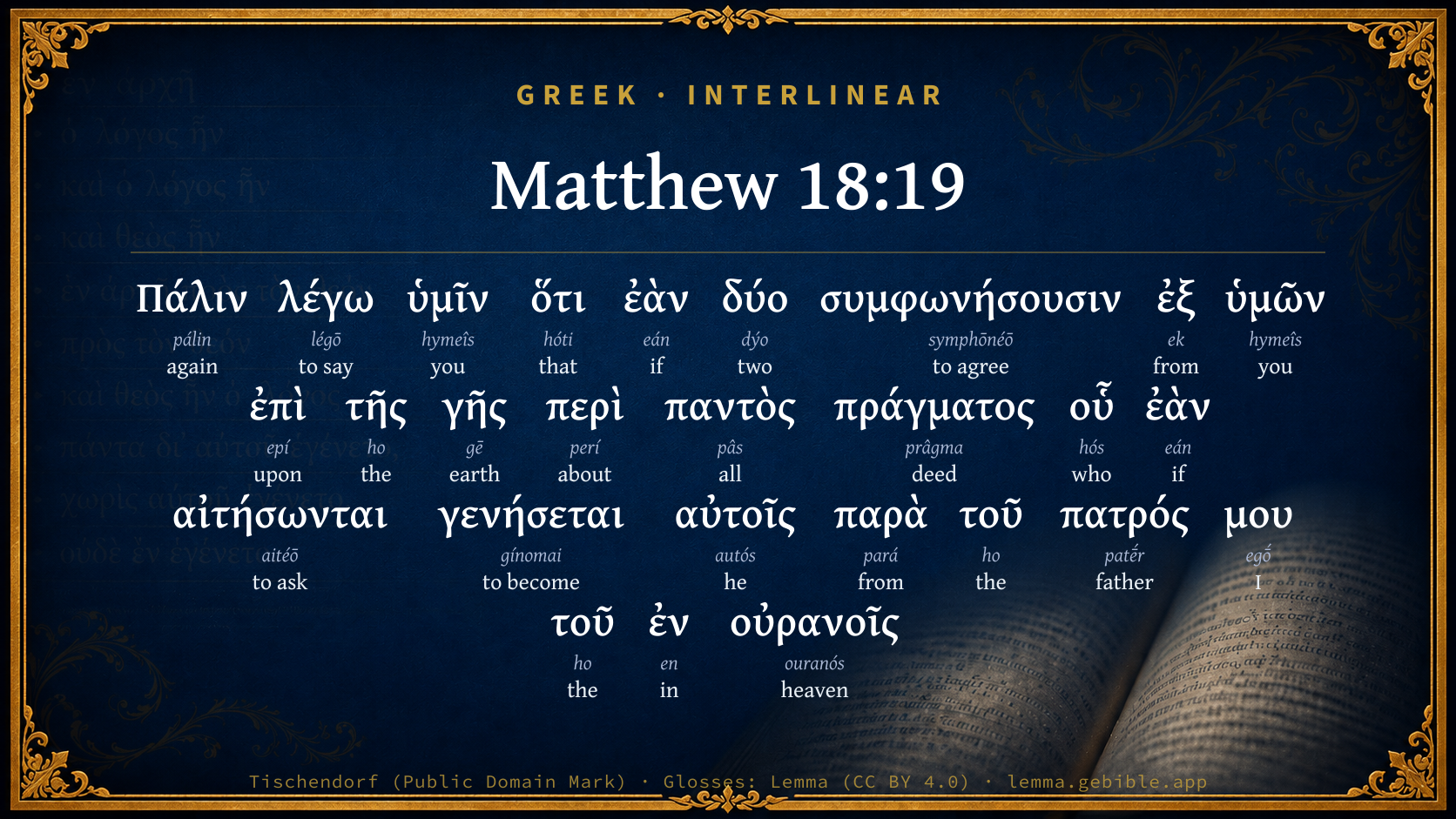
Greek (Tischendorf 8th ed.) Matthew 18:19 appears in the Greek New Testament. The text above is from the Tischendorf 8th edition. Each word links to its Strong’s number and a concise gloss. Click any word for its full Thayer’s Greek Lexicon entry.
Download image
Cite this verse

Matthew 18:19 (World English Bible). Public Domain. Lemma interlinear Bible study tool, https://lemma.gebible.app/v/matthew/18/19.

Show BibTeX & RIS
BibTeX
RIS
English Translation
Again, assuredly I tell you, that if two of you will agree on earth concerning anything that they will ask, it will be done for them by my Father who is in heaven.
World English Bible · Public Domain
Highlights
  • 2 first appearances in the Greek New Testament
Full analysis ↓
Download a study sheet

One document with this verse’s original text, its word-by-word gloss line, the meaning frame, cross-references with their text, attributed commentary, and full source and license credits — printable, and it pastes into notes with its structure intact.

This verse Autodidact and up

Study sheet (.html) Plain text (.txt)

A passage Seminary Student

Up to 50 verses in one chapter. A passage sheet keeps up to 6 commentary sources and 12 cross-references per verse, in the order this page ranks them, and says so on the sheet whenever that leaves anything out. Ask for a single verse and you get the Autodidact verse sheet above.

Everything on this page stays free to read, with no account — the sheet is a download of what is already on screen, not access to it.

Want to remove ads? Support Godless Engineer
Compare translations 3

The same verse in 3 English versions, stacked beneath the original-language interlinear above. Click any original word for its lexicon entry.

Each is an independent rendering of the whole verse — the interlinear is not word-aligned to these translations.

Highlighted words mark where these versions differ — a whole-verse word diff, not a word-by-word alignment.

  • World English Bible Public Domain
    Again, assuredly I tell you, that if two of you will agree on earth concerning anything that they will ask, it will be done for them by my Father who is in heaven.
  • King James Version Public Domain
    Again I say unto you, That if two of you shall agree on earth as touching any thing that they shall ask, it shall be done for them of my Father which is in heaven.
  • unfoldingWord Literal Text CC BY-SA 4.0
    Again, truly I say to you that if two of you agree together on the earth about any matter, whatever they might ask, it will be done for them by my Father in the heavens.

unfoldingWord Literal Text — © unfoldingWord, licensed CC BY-SA 4.0. Word-aligned USFM3 via Door43 (git.door43.org/unfoldingWord/en_ult).

Versions to compare (up to 4)

3 of 4 selected

Show all 19 translations

Every available English version of this verse, each an independent rendering of the whole verse.

  • World English Bible Public Domain
    Again, assuredly I tell you, that if two of you will agree on earth concerning anything that they will ask, it will be done for them by my Father who is in heaven.
  • Berean Standard Bible Public Domain
    Again, I tell you truly that if two of you on the earth agree about anything you ask for, it will be done for you by My Father in heaven.
  • Majority Standard Bible Public Domain
    Again, I tell you truly that if two of you on the earth agree about anything you ask for, it will be done for you by My Father in heaven.
  • King James Version Public Domain
    Again I say unto you, That if two of you shall agree on earth as touching any thing that they shall ask, it shall be done for them of my Father which is in heaven.
  • American Standard Version (1901) Public Domain
    Again I say unto you, that if two of you shall agree on earth as touching anything that they shall ask, it shall be done for them of my Father who is in heaven.
  • Revised Version (1885) Public Domain
    Again I say unto you, that if two of you shall agree on earth as touching anything that they shall ask, it shall be done for them of my Father which is in heaven.
  • Geneva Bible (1599) Public Domain
    Againe, verely I say vnto you, that if two of you shall agree in earth vpon any thing, whatsoeuer they shall desire, it shall be giuen them of my Father which is in heauen.
  • Douay-Rheims (1899) Public Domain
    Again I say to you, that if two of you shall consent upon earth, concerning any thing whatsoever they shall ask, it shall be done to them by my Father who is in heaven.
  • Young's Literal Translation Public Domain
    `Again, I say to you, that, if two of you may agree on the earth concerning anything, whatever they may ask -- it shall be done to them from my Father who is in the heavens,
  • Literal Standard Version CC BY-SA 4.0
    Again, I say to you that if two of you may agree on the earth concerning anything, whatever they may ask—it will be done to them from My Father who is in the heavens,
  • Unlocked Literal Bible CC BY-SA 4.0
    Again I say to you, if two of you agree on earth about anything they ask, it will be done for them by my Father who is in heaven.
  • unfoldingWord Literal Text CC BY-SA 4.0
    Again, truly I say to you that if two of you agree together on the earth about any matter, whatever they might ask, it will be done for them by my Father in the heavens.
  • Darby Bible Public Domain
    Again I say to you, that if two of you shall agree on the earth concerning any matter, whatsoever it may be that they shall ask, it shall come to them from my Father who is in [the] heavens.
  • World Messianic Bible Public Domain
    Again, assuredly I tell you, that if two of you will agree on earth concerning anything that they will ask, it will be done for them by my Father who is in heaven.
  • Webster's Bible Public Domain
    Again I say to you, That if two of you shall agree on earth, concerning any thing that they shall ask, it shall be done for them by my Father who is in heaven.
  • Free Bible Version CC BY-SA 4.0
    I also tell you that if two of you agree here on earth about something you're praying for, then my heavenly Father will do it for you.
  • Bible in Basic English Public Domain
    Again, I say to you, that if two of you are in agreement on earth about anything for which they will make a request, it will be done for them by my Father in heaven.
  • Text-Critical English NT CC BY 4.0
    Again, truly I say to you, if two of you agree on earth about anything you ask, it will be done for you by my Father in heaven.
  • Tyndale New Testament (1534) Public Domain
    Agayn I say vnto you that yf two of you shall agre in erth apon eny maner thynge what soever they shall desyre: it shalbe geven them of my father which is in heven.

Literal Standard Version (2020), Covenant Press — licensed CC BY-SA 4.0. Text via the HelloAO Bible API (eBible.org). Unlocked Literal Bible (unfoldingWord) — licensed CC BY-SA 4.0. Text via the HelloAO Bible API (eBible.org). unfoldingWord Literal Text — © unfoldingWord, licensed CC BY-SA 4.0. Word-aligned USFM3 via Door43 (git.door43.org/unfoldingWord/en_ult). Free Bible Version, Dr. Jonathan Gallagher — licensed CC BY-SA 4.0. Text via the HelloAO Bible API (eBible.org).

Word by word

More ways to search: Search by grammar → Find every occurrence → Compare this word →

Practice this passage: Drill this verse → Learn its vocabulary →

συμφωνήσουσιν
symphōnéō
G4856
“to agree”
Verb, Future, Active, Indicative, 3rd person, Plural
Part of Speech
Verb
Tense
Future
Voice
Active
Mood
Indicative
Person
3rd person
Number
Plural
Full Thayer's Definition

Origin: from G4859

TDNT: 14:04,1

1. to agree together 2. to agree with one in making a bargain, to make an agreement, to bargain
  1. Πάλιν pálin G3825 “again” Adverb
  2. λέγω légō G3004 “to say” Verb, Present, Active, Indicative, 1st person, Singular
  3. ὑμῖν hymeîs G5210 “you” Personal pronoun, 2nd person, Dative, Plural
  4. ὅτι hóti G3754 “that” Conjunction
  5. ἐὰν eán G1437 “if” Conditional
  6. δύο dýo G1417 “two” Adjective, Numeral (indeclinable)
  7. ἐξ ek G1537 “from” Preposition
  8. ὑμῶν hymeîs G5210 “you” Personal pronoun, 2nd person, Genitive, Plural
  9. ἐπὶ epí G1909 “upon” Preposition
  10. τῆς ho G3588 “the” Article, Genitive, Singular, Feminine
  11. γῆς gē G1093 “earth” Noun, Genitive, Singular, Feminine
  12. περὶ perí G4012 “about” Preposition
  13. παντὸς pâs G3956 “all” Adjective, Genitive, Singular, Neuter
  14. πράγματος prâgma G4229 “deed” Noun, Genitive, Singular, Neuter
  15. οὗ hós G3739 “who” Relative pronoun, Genitive, Singular, Neuter
  16. ἐὰν eán G1437 “if” Conditional
  17. αἰτήσωνται aitéō G154 “to ask” Verb, Aorist, Middle, Subjunctive, 3rd person, Plural
  18. γενήσεται gínomai G1096 “to become” Verb, Future, Middle deponent, Indicative, 3rd person, Singular
  19. αὐτοῖς autós G846 “he” Personal pronoun, Dative, Plural, Masculine
  20. παρὰ pará G3844 “from” Preposition
  21. τοῦ ho G3588 “the” Article, Genitive, Singular, Masculine
  22. πατρός patḗr G3962 “father” Noun, Genitive, Singular, Masculine
  23. μου egṓ G1473 “I” Personal pronoun, 1st person, Genitive, Singular
  24. τοῦ ho G3588 “the” Article, Genitive, Singular, Masculine
  25. ἐν en G1722 “in” Preposition
  26. οὐρανοῖς ouranós G3772 “heaven” Noun, Dative, Plural, Masculine

About this verse

These counts appear in no published source. They are computed here, from the morphology-tagged text and Lemma’s own curated glosses. What Lemma adds →

27
words
23
distinct lemmas
Gospels
section

Notable vocabulary

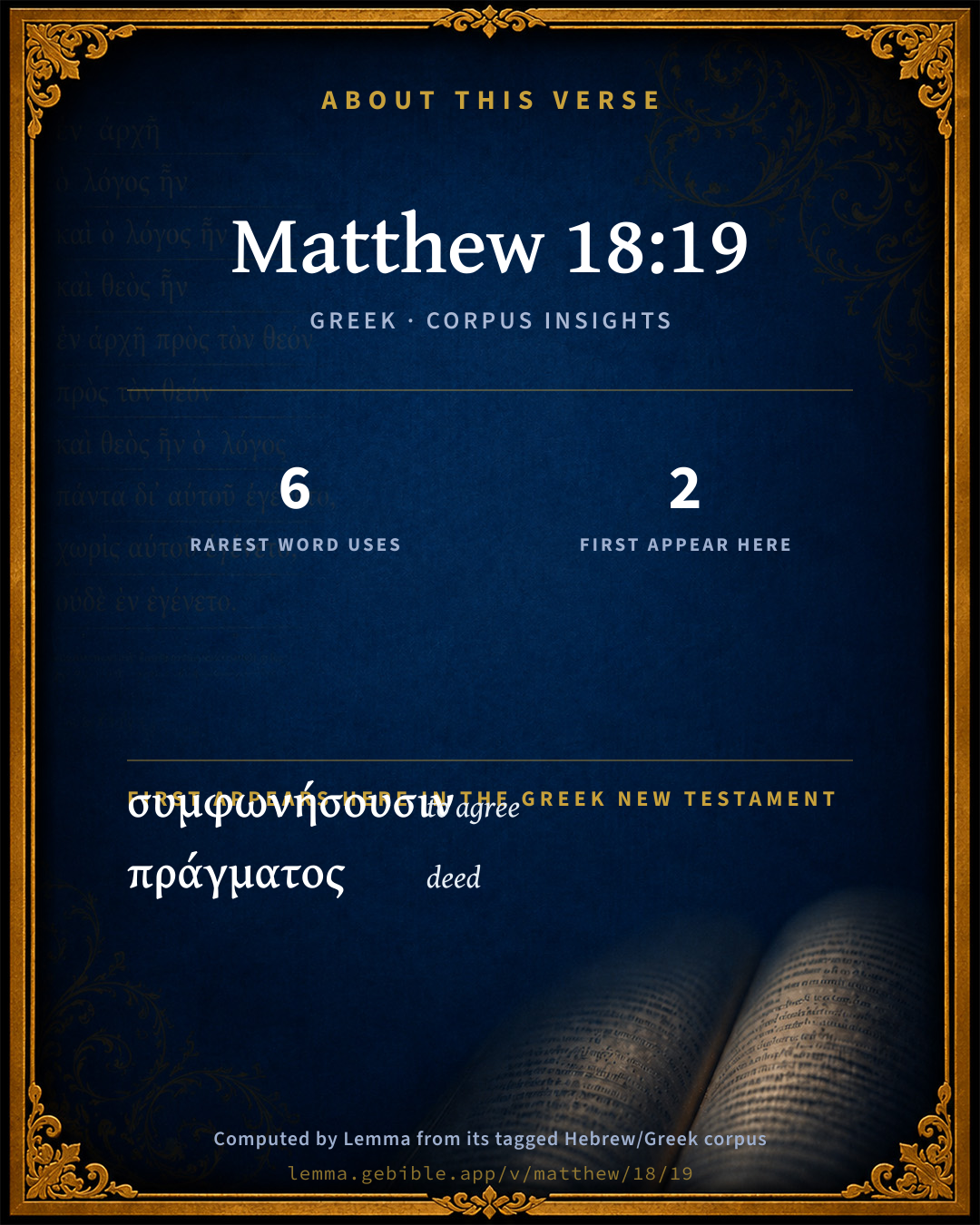
The rarest word here is συμφωνήσουσιν to agree G4856 — appearing just 6 times in the whole Greek New Testament.

First appearance in Scripture

These words make their first canonical appearance in the Greek New Testament here:

  • συμφωνήσουσιν to agree G4856
  • πράγματος deed G4229

Shared distinctive vocabulary

συμφωνήσουσιν to agree G4856 occurs in 6 verses of the Greek New Testament. Also found in:
Repetition

Words recur within this verse:

Cross-references

19

Topical passages linked to Matthew 18:19 in the Treasury of Scripture Knowledge — connected by theme and wording, ordered by reader-vote popularity; previews shown in the World English Bible.

  • Matthew 7:7 "Ask, and it will be given you. Seek, and you will find. Knock, and it will be opened for you.
  • 1 John 5:14–16 This is the boldness which we have toward him, that, if we ask anything according to his will, he listens to us.
  • Mark 11:24 Therefore I tell you, all things whatever you pray and ask for, believe that you receive them, and you shall have them.
  • John 14:13–14 Whatever you will ask in my name, that will I do, that the Father may be glorified in the Son.
  • John 16:23 "In that day you will ask me no questions. Most assuredly I tell you, whatever you may ask of the Father in my name, he will give it to you.
  • Philippians 1:19 For I know that this will turn out to my salvation, through your supplication and the supply of the Spirit of Jesus Christ,
  • James 5:14–16 Is any among you sick? Let him call for the elders of the assembly, and let them pray over him, anointing him with oil in the name of the Lord,
  • Matthew 21:22 All things, whatever you ask in prayer, believing, you will receive."
  • John 15:7 If you remain in me, and my words remain in you, you will ask whatever you desire, and it will be done for you.
  • 1 John 3:22 and whatever we ask, we receive from him, because we keep his commandments and do the things that are pleasing in his sight.
  • John 15:16 You didn't choose me, but I chose you, and appointed you, that you should go and bear fruit, and that your fruit should remain; that whatever you will ask of the Father in my name, he may give it to you.
  • Acts 12:5 Peter therefore was kept in the prison, but constant prayer was made by the assembly to God for him.
  • Acts 4:24–31 When they heard it, they lifted up their voice to God with one accord, and said, "O Lord, you are God, who made the heaven, the earth, the sea, and all that is in them;
  • Ephesians 6:18–20 with all prayer and requests, praying at all times in the Spirit, and being watchful to this end in all perseverance and requests for all the saints:
  • Acts 1:14 All these with one accord continued steadfastly in prayer and supplication, along with the women, and Mary the mother of Jesus, and with his brothers.
  • Acts 2:1–2 Now when the day of Pentecost had come, they were all with one accord in one place.
  • Acts 6:4 But we will continue steadfastly in prayer and in the ministry of the word."
  • Matthew 5:24 leave your gift there before the altar, and go your way. First be reconciled to your brother, and then come and offer your gift.
  • Revelation 11:4–6 These are the two olive trees and the two lampstands, standing before the Lord of the earth.

Cross-references courtesy of OpenBible.info (CC BY 4.0).

Where the printed editions differ

1 variant

Places in this verse where the major printed Greek editions disagree on the wording in a way that affects the translation — a comparison of editions, not a manuscript-by-manuscript collation. The editions are the modern critical texts (Nestlé-Aland 28/27, SBL, Westcott-Hort, Tregelles, Tyndale House) and the traditional texts behind the KJV (the Textus Receptus and the Byzantine/Majority text). It is not a claim about which reading is original.

  1. Extra text
    ἀμὴν

    “Amen”

    In NA28NA27TynSBLWHTregByz Not in TR

    ἀμὴν (amēn) 'Amen' is only in older manuscripts (NA28+NA27+Tyn+SBL+WH+Treg+Byz)

Textual data: Translators Amalgamated Greek New Testament (STEPBible TAGNT) · CC BY 4.0.

Commentary

Notes on Matthew 18:19 from classic Christian and Jewish commentators (each source and its license shown beneath its notes). The classic Christian expositions comment on the surrounding passage and are grouped to its opening verse, so a note may address several verses; the Jewish commentaries on the Tanakh (Rashi and others) are per-verse, so they appear only where the commentator wrote on this verse.

Lemma curates 59 commentaries, every one of them public domain or Creative Commons licensed, each selected and text-cleaned for this edition rather than reprinted as found. About our sources →

The Biblical Illustrator

Joseph S. Exell

Mat_18:19-20

For when two or three are gathered together in My name.

The presence of Christ in the sanctuary

I. What is implied in this promise or the divine presence. God comes not here as to a court of assize, but to a Bethesda, to dispense mercy.

II. The conditions under which the promise will be fulfilled.

1. TO meet in the Saviours name is to seek its exaltation.

2. His name must be pleaded as the ground of approach to God.

3. The sole authority of Christ must be recognized if we would meet in His name.

III. The Jewish church as well as the Christian had Gods gracious presence.

1. The incarnation was substituted for the Shekinah-a symbol.

2. The bodily exercises, carnal ordinances are at an end in the Christian worship.

3. We have the indwelling of the Holy Ghost.

4. Let us expect the Divine blessing.

5. If the presence of God be promised, how is it that professors are content with an occasional visit to the sanctuary? (J. S. Pearsall.)

The presence of Christ in the meetings of His people

I. Thy promise.

1. There is a sense in which it is true that Jesus is present with all men at all times.

2. But in the text He meant something different from that to which we have referred. Jacob at Bethel.

3. It implies a readiness on the part of Christ to do for His people what they ask.

4. It implies a gift of those graces which are fitted to sweeten the spiritual intercourse of the soul with Himself, and to enrich it with those Divine ornaments which shall best display the lustre of His own glory.

II. That in order to realize the riches of the promise the disciples must be gathered together. Also to meet in the name of Christ. Acknowledge on our part all fulness and power in Christ. (W. Willson.)

I. When the people of God meet together for religious worship it should be in the name of Christ.

1. With His authority.

2. Agreeably to His directions.

3. That our expectations of success are founded on the influence which may connect itself with His name.

II. When Christians are thus gathered together they may expect their masters presence.

1. A large number not necessary.

2. A particular class not necessary.

3. A particular place not necessary. Christ once present.

III. The redeemer has important ends to accomplish in connection with the vouchsafement of his presence when his disciples are assembled. (T. Bradshaw.)

Christs presence consecrating His Church

I. The speaker.

1. The beaming of His essential glory.

2. How our Lord claims to Himself omnipresence.

3. That our Lord here claims to Himself self-existence, independent existence.

4. Our Lord does not contemplate His own existence as a contingency.

II. The acknowledged relation in which Christ stands to his church.

1. Our Lord declares His headship.

2. The declaration which He here makes of His mind towards the Church

(1) condescension;

(2) faithfulness.

III. The view here given by Christ himself of the church.

1. The amount, two or three. The Church small in the world.

2. The unobstrusibe, humble character of the Church.

3. The special bond of the Church.

IV. The gracious promise which christ here makes to the church as thus exercised. (J. Macdonald, M. A.)

United prayer

I. United prayer is to those who exercise it a means of grace.

1. In recognizing this, you will get a clue to the advantages to be derived from united prayer as an agency for personal and relative spiritual advancement.

2. United prayer strongly tends to draw out the souls of those engaged therein in sympathy and care, and love for one another, and for Christians generally.

II. Untied prayer is an instrument of service for Christ. Some phases of service to which Christians are called. The cultivation of personal spiritual life. The development and maintenance of the true nature, status, and influence of the Church of Christ. Effort to save souls.

III. How shall we, as Christians, avail ourselves to this means of grace and instrument of service for Christ? Exercise united prayer for the outpouring of Gods Holy spirit upon the Church, etc. For the conversion of men, women, and children. For the agencies employed, that they may accomplish the devout ends they have in view. (John, Thomas.)

I. The religion of jesus christ is social. Two or three. Man is a social being. The gospel raises men to considerations of the highest nature, and to a uniting order of things. The servants of God have similarity of views; a common ground of dependence, a common relation to Christ; the same object of endeavour; oneness as to cause and interest, look for the same blessed end. We are not surprised that they meet together.

II. Wherever they meet Christ is in the midst of them.

1. It is His word, grace, and spirit that forms the Church.

2. It is the love of Christ that prompts and influences them.

3. This subject constitutes a criterion of discipleship.

4. It may serve to encourage us when few in number.

5. It animates our thought in view of the eternal world. In heaven there will be a great gathering. (J. Rift.)

An august visitor

I. The place. Where, etc. A meeting place is intended; simple; it may be lonely.

II. The presence. A spiritual presence. The world sees Him not. Time was when He granted sensible tokens of His presence to man; burning bush, Jacob; Christ incarnate; now the Comforter is come.

III. The purpose. He is in the midst for

(1) inspection, His eyes are as a flame of fire;

(2) for protection;

(3)direction;

(4) probation. He is in the midst to try with means and mercies-

(5) salvation. (J. Basley.)

Jesus present in worship

More than the numbers stated here have thus met. Christ is here. If we had met this evening to discuss questions concerning geography, we should probably have felt ourselves honoured with the presence of such a man as Sir Roderick Murchison or Dr. Livingstone. Had the discussion related to history, to antiquity, to chemistry, with what elatedness and bated breath should we have listened to that prince of historians, the late Lord Macaulay, to the world-renowned Layard, and to the wonder-working Faraday. Had this been a congress of nations-a meeting of crowned heads-planning the course of politics, disposing of the destinies of nations, and marking the limits of empires, how important should we have deemed the occasion! Notable visitors from other climes, men of mark and might from other lands, would have attracted our observation-have riveted our attention; our interest would have risen with the occasion. But we meet with other ends in view. We come together about our souls affairs; our present peace, and our everlasting salvation, are the matters which concern us. Compared with these other things are temporary and trivial. (J. Basley.)

Jesus present in a simple sanctuary

Where two or three are gathered together. There is evidently a meeting-place intended. Proud mortals love display. When Henry of England and his neighbour monarch of France met with friendly greetings, it was amid the most gorgeous glitter on the Field of Cloth of Gold. Christ makes no demand for parade or ostentatious display. It forms no condition in the terms upon which He will visit us. We have not a tesselated pavement; we can worship God without it. We have no encaustic tiles: Christ does not want them. (J. Basley.)

Jesus present to inspect

He is Light. He is the Searcher of hearts, the great Revealer. He visits thus all His Churches. He knows them all-their constitution, their practice, their state. He visits them as the florist visits his garden, to watch the progress of choice plants and flowers. He visits them as the shepherd does his flock, to inspect the condition of his sheep. He visits them as the officer does his soldiers, to see if they are at their post, if their discipline is as it should he, and their arms in good condition. What a sight for Christ do some churches professedly Christian present! How must His holiness loathe the worldliness, selfishness, pride, and the many foul abominations that are covered with a Christian name! Christ is here for inspection. No member, no character, no practice, no thought, word, wish, or feeling, escapes the notice of His eye. Christian professor! Christ sees thee. Thou art fully and thoroughly known to Him. (J. Basley.)

Four present, but only one visible

When it was decided to close the prayer-meeting m a certain village, a good woman declared that she would be there if no one else was. She was true to her word, and when the next morning some one said to her rather jestingly, Did you have a prayer-meeting last night? All! that we did, she replied. How many were present? … Four, she said. Why, said he, I heard that you were there all alone. No, she said; I was the only one visible but the Father was there, and the Son was there, and the Holy Spirit was there, and we were all agreed in prayer. Before long there was a revival prayer-meeting and a prospering church. (J. Basley.)

In My name

I. The place which the name of Jesus occupies in christianity. The subject of knowledge. The object of faith and love. Doctrines, duties, precepts permeated with His name. Does not imply nominality, as the name of a book; but He is the substance of the thing. He is the life of Christianity.

II. On what ground does the name of jesus occupy this place in Christianity.

1. The Fathers appointment.

2. On His own authority as Messiah.

3. His Divine nature.

4. His perfect manhood.

5. His mediatorship.

Jesus

1. The central force of Christianity.

2. The radiating glory of Christianity.

3. The attractive power of Christianity.

4. The ultimate victory of Christianity.

5. Who then will be ashamed of the name of Jesus? (J. Bate.)

Public worship acceptable to God

No doubt the prayers which the faithful put up to heaven from under their private roofs were very acceptable unto Him. But if a saints single voice in prayer be so sweet to Gods ear, much more the church choir. His saints prayers in consort together. A father is glad to see any one of his children, and makes him welcome when he visits him, but much more when they come together; the greatest feast is when they all meet at his house. The public praises of the Church are the emblem of heaven itself, where all the angels and saints make but one consort. There is a wonderful prevalency in the joint prayers of His people. When Peter was in prison, the Church meets and prays him out of his enemies hands. A prince will grant a petition subscribed by the hands of a whole city, which may be he would not at the request of a private subject, and yet love him well, too. There is an especial promise to public prayer Where two or three, etc. (Gurnall)

The Biblical Illustrator, edited by Joseph S. Exell (c. 1880s–1900s) — public domain. Text from a community e-Sword module.

Godbey's Commentary on the New Testament

William B. Godbey

EFFICIENCY OF PRAYER

Mat 18:19-20. “Again I say unto you, If two of you shall agree on earth concerning anything which you may ask, it shall be done unto you by My Father who is in the heavens. For where two or three are assembled in My name, there I am in the midst of them.” This is really a wonderful promise to the saints of all ages, assuring us of His personal presence in an assembly of two or three, and positive answer to prayer in case of unity on the part of those two or three. This promise guarantees the miraculous availability of the social prayer league in every home. Christians are not aware of the paradoxical availability of family prayer, actually securing the presence of Jesus in the home, the little prayer-meeting, and the Sabbath gatherings. You see here the necessity of union in order to availability. Though the number may be small, only amounting to two or three, if they are really united, they have the promise.

When a circuit-rider, thirty years ago, I went to an old church out in the country to begin a protracted meeting, when the snow was knee-deep, and all the waters frozen into ice. I met but four people, though it was Sunday. We availed ourselves of this promise. Within forty-eight hours, the house ran over, the altar was piled with seekers, and such a revival as the people had not seen in a generation swept down from heaven, ninety souls being gloriously converted and added to the Church within two weeks. If two or three will meet and unite at a Throne of Grace, it is their glorious privilege to be master of the situation. I never found a place in my life where I could not have a glorious revival. When in the pastorate, I made it a rule to have a big revival in every community in my territorial bailiwick. In countless instances I have gone to a place where I had not a solitary member; prevailed on two or three, or perhaps a half dozen, to unite with me in prayer, having no congregation to begin with. We never staid long on our knees, gripping the mercy seat in an inflexible prayer-league, till the people came trooping and booming from all directions, crowding us out of all room, and apparently under conviction from the moment of their arrival, and ready to crowd the altar and seek salvation. What was the solution? We had actually prayed them under conviction before we ever saw them.

This is the Lord’s infallible receipt for a revival. Will you take it? You need not send off after a big preacher, who may come, and he may not. Get two or three to help you, and send for Jesus. He is sure to come. When He comes, the people will come too. And they will come crying, and they will go away shouting.

William B. Godbey, Commentary on the New Testament (1896–1900) — public domain. Text from a community e-Sword module.

Tyndale Open Study Notes

Tyndale Open Resources

18:19 anything you ask: In the context of church discipline (18:15-17), this suggests that discipline must be done in prayer.

Tyndale Open Study Notes — © Tyndale Open Resources, licensed CC BY-SA 4.0. Text via the HelloAO Bible API.

Bengel's Gnomon

Johann Albrecht Bengel

Mat 18:19. Πάλιν, again) The same thing is repeated in somewhat different language. The particle πάλιν is used epitatically,[834] as in ch. Mat 19:24, and Gal 5:3. In this place, our Lord speaks of His disciples as acting together; in Mat 18:18, in their individual. capacity. Cf. ch. Mat 16:19.—δύο, two) sc. two, if not more, contrasted with all; cf. Mat 18:18: two, e.g. husband and wife. Great is the virtue of united faith. That which may hinder the prayers of one man, from his own weakness, is made up by the fellowship (societas) of even one brother.—ἐπὶ τῆς γῆς—ἐν οὐρανοῖς, on earth—in heaven) The same antithesis occurs in Mat 18:18.—αἰτήσωνται shall ask) sc. with regard to binding or loosing.

[834] See explanation of technical terms in Appendix, on the figure Epitasis.—(I. B.)

Bengel's Gnomon of the New Testament — English translation (T&T Clark, Edinburgh, 1860) — public domain. Text from a community e-Sword module.

Expositor's Greek Testament

ed. W. Robertson Nicoll

Mat 18:19-20 . Promise of the power and presence of God to encourage concord .

Mat 18:19 . πάλιν ἀμὴν : a second amen , introducing a new thought of parallel importance to the former, in Mat 18:18 . ἐὰν δύο : two; not the measure of Christ’s expectation of agreement among His disciples, but of the moral power that lies in the sincere consent of even two minds. It outweighs the nominal agreement of thousands who have no real bond of union. συμφωνήσωσιν : agree, about what? not necessarily only the matters referred to in previous context, but anything concerning the Kingdom of God. περὶ παντὸς πράγματος : concerning every or any matter, offences committed by brethren included of course. γενήσεται : it shall be; what absolute confidence in the laws of the moral world! παρὰ τ . π . μ .: from my Father. The Father-God of Jesus is here defined as a lover of peace and fraternal concord. In this verse we have a case of attraction, of the main subject into the conditional clause. Resolved, the sentence would run: πᾶν πρᾶγμα , ὃ ἐὰν αἰτήσωσιν , ἐὰν συμφωνήσουσιν περὶ αὐτοῦ , γενήσεται αὐτοῖς .

The Expositor's Greek Testament, edited by W. Robertson Nicoll (1897–1910) — public domain. Text from a community e-Sword module.

Geneva Bible (1599)

Geneva Bible translators

This word is translated from the body to the mind, for it belongeth properly to song.

Geneva Bible (1599) marginal notes — public domain. Text via Bolls.life.

Jamieson, Fausset & Brown

Robert Jamieson, A. R. Fausset & David Brown

Again I say unto you, That if two of you shall agree on earth as touching anything that they shall ask, it shall be done for them of my Father which is in heaven.

Jamieson, Fausset & Brown — Commentary Critical and Explanatory on the Whole Bible (1871) — public domain (CC PDM 1.0). Text via the HelloAO Bible API.

Adam Clarke's Commentary

Verse 19. Again I say unto you] The word αμην, verily, is added here, in ninety-eight MSS., (many of which are of the greatest antiquity and importance,) seven editions, all the Arabic, the Slavonic, and several of the Itala. The taking in or leaving out such a word may appear to some a matter of indifference; but, as I am fully convinced Jesus Christ never spoke a useless or a needless word, my maxim is, to omit not one syllable that I am convinced (from such authority as the above) he has ever used, and to take in nothing that he did not speak. It makes the passage much more emphatic - Again, VERILY I say unto you,

If two of you shall agree] συμφωνηστωσιν, symphonize, or harmonize. It is a metaphor taken from a number of musical instruments set to the same key, and playing the same tune: here, it means a perfect agreement of the hearts, desires, wishes, and voices, of two or more persons praying to God. It also intimates that as a number of musical instruments, skilfully played, in a good concert, are pleasing to the ears of men, so a number of persons united together in warm, earnest, cordial prayer, is highly pleasing in the sight and ears of the Lord. Now this conjoint prayer refers, in all probability, to the binding and loosing in the preceding verse; and thus we see what power faithful prayer has with God!

It shall be done for them] What an encouragement to pray! even to two, if there be no more disposed to join in this heavenly work.

Adam Clarke's Commentary on the Bible (1810–1826) — public domain. Text from a community e-Sword/MySword module.

Ellicott's Commentary for English Readers

(19) Shall agree on earth.—The promise, as before, is dependent on implied conditions. Those who pray must be gathered together in the name of Christ (Mat_18:20), i.e., as trusting to His intercession, asking a prayer which is not the utterance of the natural but the spiritual man, asking it in entire submission to the will of their Father in heaven. In the absence of those conditions, as in the prayer of the sons of Zebedee, asking they knew not what (Mat_20:20), that which they desired might be withheld from them, or granted in quite another manner than that on which they had set their hearts.

A Bible Commentary for English Readers, edited by Charles John Ellicott (1878–1897) — public domain. Text from a community e-Sword module.

The Cambridge Bible for Schools and Colleges

gen. ed. J. J. S. Perowne

19. The slight digression is continued. Christ thinks of His Church. Not only shall your decisions be ratified, but your requests shall be granted, provided ye agree.

The Cambridge Bible for Schools and Colleges (gen. ed. J. J. S. Perowne; Cambridge University Press, 1878–1918) — public domain. Text from a community e-Sword module.

John Gill's Exposition

Jesus saith unto him, I say not unto thee,.... Which is as if he had said, observe what I am about to say, I do not agree to what thou sayest to fix the number, "until seven times only", but

until seventy times seven; a certain number for an uncertain, see Gen 4:24. Christ's meaning is, that a man should be all the days, and every day of his life, forgiving those that sin against him, as often as they repent and acknowledge their fault; and that no time is to be set for the exercise of the grace of forgiveness; but as often as there are objects and occasions, though ever so many and frequent, it should be used; and which he illustrates by the following parable.

John Gill's Exposition of the Whole Bible (1746–1763) — public domain (CC PDM 1.0). Text via the HelloAO Bible API.

Trapp's Complete Commentary

John Trapp

19 Again I say unto you, That if two of you shall agree on earth as touching any thing that they shall ask, it shall be done for them of my Father which is in heaven.

Ver. 19. If two of you shall agree] How much more then a whole church full of you! Great is the power of joint prayer, Act 12:12; Dan 2:18. Those in the Revelation whose prayers went up as a pillar of incense, and came before the Lord as the sound of many waters; the thundering legion, the Christians in Tertullian’s time, that came, an army of them, not more to beseech than to besiege God by their prayers. This made Henry III, King of France, forbid the Protestant householders in his dominions to pray with their families. And a great queen said, that she feared more the prayers of John Knox and his complices than an army of 30,000 men. The house shook where the disciples were praying, Act 4:31. The devil was forced to throw in the obligation to Luther and some others that were praying for a young man that had yielded himself body and soul to the devil for money, and had written the bond with his own blood. The Popish soldiers that went against the Angrognians in France, said that the ministers of that town with their prayers conjured and bewitched them, that they could not fight. While Moses, Aaron, and Hur lift up their hands and minds together in the mount, Joshua beats Amalek in the valley. He prevailed precando, more than he did proeliando. Now for the fruit of prayer, said those brave spirits at Edgehill battle, where there was never less seen of man and more of God, as the noble general thankfully acknowledged.

John Trapp, A Commentary or Exposition upon All the Books of the Old and New Testament (1647–1656) — public domain. Text from a community e-Sword module.

Albert Barnes' Notes on the Bible

Again I say unto you, That if two of you ... - This is connected with the previous verses. The connection is this: The obstinate man is to be excluded from the church, Mat 18:17. The care of the church - the power of admitting or excluding members - of organizing and establishing it - is committed to you, the apostles, Mat 18:18. Yet there is not need of the whole to give validity to the transaction. When two of you agree, or have the same mind, feelings, and opinion, about the arrangement of affairs in the church, or about things desired for its welfare, and shall ask of God, it shall be done for them. See Act 1:14-26; 15:1-29. The promise here has respect to the apostles in organizing the church. It cannot with any propriety be applied to the ordinary prayers of believers. Other promises are made to them, and it is true that the prayer of faith will be answered, but that is not the truth taught here.

Albert Barnes' Notes on the Bible (1834–1885) — public domain. Text from a community e-Sword/MySword module.

Haydock's Catholic Bible Commentary

That if two of you. From these words, we learn how superior is public to private prayer. The efficacy of the former is attributed to the presence of Christ in those assemblies. The Father, for his Son’s sake, will grant petitions thus offered. (Jansenius) --- The fervour of one will supply for the weakness and distractions of the other.

George Leo Haydock (1774–1849), Haydock's Catholic Family Bible and Commentary, 1859 edition — public domain. Excludes Psalms (Douay-Rheims chapter numbering differs from Protestant) and Deuterocanonical books (Catholic canon only).

Matthew Poole's English Annotations

Most interpreters agree there is a connection betwixt these verses and those immediately preceding, as if it were a further confirmation of what God had said concerning his binding and loosing in heaven whatsoever they should bind or loose on earth; and say, the asking mentioned in this verse supposes that no church will adventure upon so grave an act as excommunication, without asking his direction or counsel; nor undertake such a thing as absolution, without the like serious asking of God pardon for the repenting sinner. Now, saith he, let the church be never so small that so joins in prayers on this occasion, what they ask of God shall be done. Whether it hath any such reference or no, or be an independent promise of Christ’s presence with his church, I shall not determine. Those who think this text hath such a particular reference, yet do also grant it a more general promise of Christ’s presence with his people. Whenever they are met by his authority, or upon his account or command, whether it be for counsel, or judgment, or prayer, or the celebration of any sacred institution of his, he is in the midst of them, to protect and favour them: what they ask

shall be done for them; that is, provided the thing asked be good, Mat 7:11, and for a right end, Jam 4:3, and in a right manner, Luk 18:1; Jam 1:5-7. Christ in this text establisheth the duty of prayer in communion with others. He doth not only require of his people secret prayer, Mat 6:6, but also praying in company with others; the gathering together of his people for prayer, whether in private families or more public congregations.

Matthew Poole's English Annotations on the Holy Bible (1683–1685) — public domain. Text from a community e-Sword/MySword module.

Whedon's Commentary on the Bible

Daniel D. Whedon

19. If two — Let it be remembered that our Lord is still stating the blessed results of preserving the true childlike place of his little ones, as depicted in the previous discourse. He has just told them how God will ratify their collective proceedings, in accordance with Christ’s laws as a Church. He now proceeds to the them that it requires not the assembly of a whole Church to obtain the gifts of God. The smallest number shall suffice to obtain the fulfillment of prayer. As touching anything — That is, as touching anything which could be obtained even by the largest number.

The fewness of the numbers shall be no bar to the answer of their prayers.

It shall be done for them — That is, it shall be done for them in accordance with the usual laws of God’s kingdom of grace and nature. If the prayer be of that faith which God’s laws of prayer require; if the faith be such as God’s Spirit hath empowered, and be by us co-operatively exercised. It is the purpose of the present verse not to state under what conditions prayer shall be heard, or how extensive the range of fulfilled prayer; but to encourage even the smallest number who shall gather together for prayer, that their fewness is no bar to the proper answer from God.

Daniel D. Whedon (gen. ed.), Commentary on the Old and New Testaments (1874–1909) — public domain. Text from a community e-Sword module.

The Pulpit Commentary

Again I say unto you. The following paragraph has been thought by many to be addressed especially to the apostles in confirmation of the powers conferred on them above; but from ver. 20 we should judge the promise to be general. Herein is set forth the privilege of united prayer. God confirms the sentence of his authorized ambassadors; he gives special heed to the joint intercessions of all Christians. Two of you. Two of my followers, even the smallest number that could form an association. Shall agree (sumfwnhswsin). Be in complete accord, like the notes of a perfect strain of music. Here one man"s infirmity is upheld by another"s strength; one man"s short-sightedness compensated by another"s wider view; this man"s little faith overpowered by that man"s firm confidence. Anything. Of course, this is to be understood with some restriction. The thing asked must be reasonable, good in itself, expedient for the petitioner; the prayer must be earnest, faithful, persevering. If such conditions are satisfied, the desire will be granted in some form, though, perhaps, not in the way or at the time expected. Thus the Lord sanctions guilds or bodies of Christians united together to offer up supplications for special objects or with some definite intention in which all ere agreed.

Vers. 19, 20. The power of united prayer.

The point of this verse is in the idea of the association of two people in prayer. Elsewhere we often read of the value of prayer in general. Here a special efficacy is ascribed to the united prayer of two Christian people. Let us consider the meaning of this. Why is Christ most present to help in united prayer?

I IT IS UNSELFISH. Two people might be plotting together for some mutual advantage of a low order. But we cannot conceive of their having a prayer meeting about it. Many of our personal prayers are shamefully selfish. They do not seek that God"s will may be done; they simply demand a concession to our own will. The same fatal evil may be found in a united prayer, but it is less likely there.

II IT IS BROTHERLY. We must be on friendly, even on brotherly terms before we can really pray together. The union of two alone in prayer implies very deep mutual confidence. They must agree together. The reason why earth is so cut off from heaven is that earth is too often a scene of discord. When there is agreement on earth, earth is more like heaven, and the wish expressed on earth may be granted in heaven.

III IT IS DELIBERATE. The conference and agreement of the two imply a careful consideration of the subject of the prayer. Many prayers are too hasty and inconsiderate to deserve any attention. But the grave conference in prayer here described by our Lord would give the weight of deliberation to the petition. Probably it would be less foolish than many private prayers.

IV IT HONORS THE IDEA OF THE CHURCH. Christ encouraged secret prayer in private devotion. (Mat_6:6) This should be a daily practice. But there are reasons when more is required, viz. in general public worship and in prayer for special objects. Now, while Christ deals with individual souls in the first instance, he is also interested in social religion. He did not found an order of hermits, he founded a Church. He is present in his Church in a peculiar way. This is the real secret of the answer to united prayer. It is difficult to break through the reserve which too often keeps us back from the prayer which our Lord here encourages. But it is our duty to do so.

V IT SHOWS THE POWER OF THE PEW. We are not heard for our much speaking, our many words; neither are we heard on account of our numerical strength. In listening to prayer God does not count heads; he weighs hearts. One Elijah stands for more in prayer than a cathedral full of listless worshippers. The ideal Church is not the large Church, but the Christ-like Church. Religious statistics encourage a most unspiritual way of valuing Christian work and estimating Church progress. The Church of but two members cannot be a weak Church, if those two members are united in prayer. Further, it is to be noted that the value of a prayer meeting cannot be measured by the numbers that attend it. A small meeting may be a very real one, and if it is truly united it must have power with God. It is foolish, therefore, to despair of such a meeting because it is sparsely attended. The prayer meeting of but two is here commended by Christ. If it be a meeting at all, though reduced to the numerical minimum, it may issue in incalculable results. W.F.A.

Power gained by agreement in prayer.

This verse is part of a digression from our Lord"s point. Perhaps it is suggested by the disunion occasioned by the disputing of the disciples, and our Lord takes the opportunity of pressing the importance and value of preserving mutual agreement. The disunited feeling spoils everything in Christian life; it spoils even prayer. Harmony, unity, mutual trustfulness, make up the atmosphere in which everything Christian can thrive. Our Lord. makes prayer a representative of every phase of Christian life and relation. This text is, with ver. 20, a very familiar promise, often used in acts of public prayer, but almost always misquoted. (It is remarkable how many scriptural texts have non-scriptural ideas attached to them, through misquotation.) It is always right, and always best, to take God"s Word as it precisely is. Ver. 19 appears to be an unconditional promise, but it is not. What we ask shall be done for us, but only if two of you, my disciples, join to ask; and only if you two are really agreed in the matter about which you ask. It will at once be seen that, simple as these conditions sound, they really are searching conditions, and were especially searching to those disputatious disciples.

I THE AGREEMENT OF CHRISTIAN DISCIPLES. This suggests what is the primary foundation principle of Christ"s Church. We know what it has developed to; it is well to see what it has sprung from. it is the voluntary union, for worship, fellowship, and prayer, of two or three. They must be disciples; they must meet together; then we may apply the term "Church" to them. They must agree on some special points of interest, if they allow large liberty of opinion in other matters. The real uniting bond must be their common love to Christ, and purpose to secure the honour of his Name. And the Divine seal set upon their fellowship will be the spiritual presence of Jesus, and all that for them, and by means of them, which his spiritual presence involves.

II THE PRAYER POWER WHICH COMES OUT OF SUCH AGREEMENTS. It is a meeting of necessary conditions. It is a persuasion with God. Such agreement differs from personal prayer in two things:

1. It represents interest in others.

2. It indicates thoughtful consideration. Many a private prayer cannot be answered because it is only the utterance of a passing impulse, and had better not be answered. What we consult; over becomes intelligent. Well-considered prayer cannot fail to gain the Divine regard. R.T.

The Pulpit Commentary (1880–1919), ed. H.D.M. Spence-Jones & Joseph S. Exell — public domain. Text from a community e-Sword module.

Burkitt's Expository Notes on the New Testament

William Burkitt

Here we have a gracious promise made by Christ of his presence with all his members in general, and with is ministers in special; whenever they meet together in his name, that is by his authority, in obedience to his command, and with an eye to his glory. Whenever they celebrate any sacred institution of his, or execute any church-censures, he will be in the midst of them, to quicken their prayers, to guide their councils, to ratify their sentence, to accept their endeavours.

Learn, 1. That Christ will be graciously present with and amongst his people, whenever they assemble and meet together in his name, be it ever so small a number.

2. That Christ will, in a special manner, be present with the guides and officers of his church, to direct their censures, and to confirm the sentence passed in his name, and pronounced by his authority upon obstinate offenders.

William Burkitt's Expository Notes on the New Testament (1700–1703) — public domain. Text from a community e-Sword module.

The People's New Testament

B. W. Johnson

19, 20. If two of you shall agree. Two shall constitute a Christian fellowship. The united prayers of this fellowship for any legitimate object shall be heard. The assurance of this is found in the fact that Christ will be present wherever two or three are gathered in his name. Their united prayers will ascend, made mighty by the intercession of the Son of God. By his presence it becomes his prayer. In my name. As followers of Christ.

B. W. Johnson's The People's New Testament with Notes (1889–1891) — public domain. Electronic text from the Christian Classics Ethereal Library (CCEL) ThML edition.

Cambridge Greek Testament for Schools and Colleges

19. συμφωνήσουσιν has far higher authority than συμφωνήσωσιν, a grammatical correction.

19. The slight digression is continued. Christ thinks of His Church. Not only shall your decisions be ratified, but your requests shall be granted, provided ye agree.

ἐὰν συμφωνήσουσιν. For this construction see Winer, p. 369. The close relation between the future indicative and the subjunctive moods easily accounts for the usage; in many passages the readings vary between the subjunctive and the future indicative; in Act 8:31, ἐὰν μή τις ὁδηγήσει is read by Tischendorf and Tregelles. It is more startling to find ἐὰν οἴδαμεν, 1Jn 5:15. ὅταν ἐθεώρουν, Mar 3:11. ὅταν ἤνοιξεν, Rev 8:1. See also the quotation from the Scholiast, Mat 18:5, where ὅταν is followed by indicative.

Cambridge Greek Testament for Schools and Colleges (Cambridge University Press, 1896; 21 vols, various authors incl. Carr, Maclear, Plummer, Farrar, Lumby, Moule, M. R. James, Simcox) — public domain. Text from a community e-Sword module.

Alford’s Greek Testament

Henry Alford

19. παντὸς πρ.] ‘every thing:’—but the construction is an instance of attraction: πᾶν πρᾶγμα, the subject of the sentence, is thrown into government after the verb: the plain construction would be ὅτι πᾶν πρ., ἐὰν δύο ὑμ. συμφ. ἐπὶ τ. γ. περὶ αὐτοῦ, οὗ ἐὰν αἰτήσωνται, γενήσεται κ.τ.λ.: so that παντὸς πρ. amounts in English to any thing. This refers to that entire accordance of hearty faith, which could hardly have place except also in accordance with the divine will.

It was apparently misunderstood by the Apostles James and John;—see St. Mark’s account, ch. 10:35, in which they nearly repeat these words. Notice again the ἀμὴν λέγω ὑμῖν: see on ch. 16 ult.

Henry Alford, The Greek Testament (1849–1861) — public domain. Text from a community e-Sword module.

International Critical Commentary

19. Again I say to you, That if two of you agree upon earth concerning anything which they shall ask, it shall be done for them from My Father who is in the heavens.] This gives the reason for the assurance made in v. 18. The decisions of the community will be final, because God will hear the petitions of even two Christians who agree together. But the verse cannot be in an original connection. In v. 18 the agreement presupposed is agreement in coming to decisions upon questions which concern the Church’s welfare. V. 19 is clearly an encouragement to prayer on the ground that the agreement of the smallest number in their petitions will insure an answer. The “on earth” and “in heaven” in both verses suggested the insertion of 19 here. Cf. note on v. 7.

(L)

International Critical Commentary — older volumes (1896–1929), various authors — public domain. Text from a community e-Sword module.

Vincent's Word Studies in the New Testament

Marvin R. Vincent

Shall agree [συμφωνησουσιν] . From sun, together, and fwnh, sound or voice. Transcribed in our word symphony. It has so far lost its distinctive character as a concord of voices as to be used for agreement in the deeper and more inward sense.

Concerning anything that they shall ask [περι παντος πραγματος ου εαν αιτηςωνται] . The literal rendering is, if any thing, stronger : Everything, whatever it be, for which they may have asked. Wyc., Shall consent of everything whatever they shall ask. Tynd., Shall agree in any manner thing whatsoever they shall desire. The word pragma, thing, is used like the Latin res; a matter, affair, business, with the meaning at bottom of something to be done, since it is cognate to the verb prassw, to do. Shall be done, however, is genhsetai, it shall come to pass.

Marvin R. Vincent, Word Studies in the New Testament (1887–1900) — public domain. Text from a community e-Sword/MySword module.

Lesson kit

Teaching starters — assembled from the data on this page, not authored interpretation. Every prompt links to the verse data it draws on. Edit before teaching.

Matthew, in the Gospels, opens this verse with 27 words (23 distinct Greek lemmas). Its most distinctive word is symphōnéō (“to agree”). A historical commentator’s framing appears above. Read the whole chapter for the surrounding context.

Discussion questions

  1. What does “to agree” (symphōnéō) contribute to the verse as a whole?
  2. 2 words make their first appearance in Scripture here. What does this debut establish?
  3. How does Matthew 20:2, which shares the word «to agree», read alongside this verse?
  4. What does the repetition of “the” (3× in this one verse) do in this verse?
  5. The translations on this page render this verse differently — a whole-verse word diff, not a word-by-word alignment. What might account for the different wordings?
  6. Compare how The Biblical Illustrator and Godbey's Commentary on the New Testament read this verse. Where do they agree or differ?

Things to notice

  • 2 words make their first canonical appearance in Scripture here.
  • These translations choose different wording for 20 words in this verse.
  • “the” occurs 3× in this single verse.
  • 23 distinct Greek lemmas span 27 words in this verse.

Reading settings

Reading text

Shown beneath each verse's original-language words.

Old Testament
Old Testament edition

Read the OT as the Masoretic Hebrew (MT) or the Greek Septuagint (LXX).

English shown for the Greek Septuagint (in the Hebrew ↔ Greek comparison).

Comparing translations? Open the Compare panel on any verse page to stack up to four side by side.