
Luke 2:48

Greek (Tischendorf 8th ed.) Luke 2:48 appears in the Greek New Testament. The text above is from the Tischendorf 8th edition. Each word links to its Strong’s number and a concise gloss. Click any word for its full Thayer’s Greek Lexicon entry.
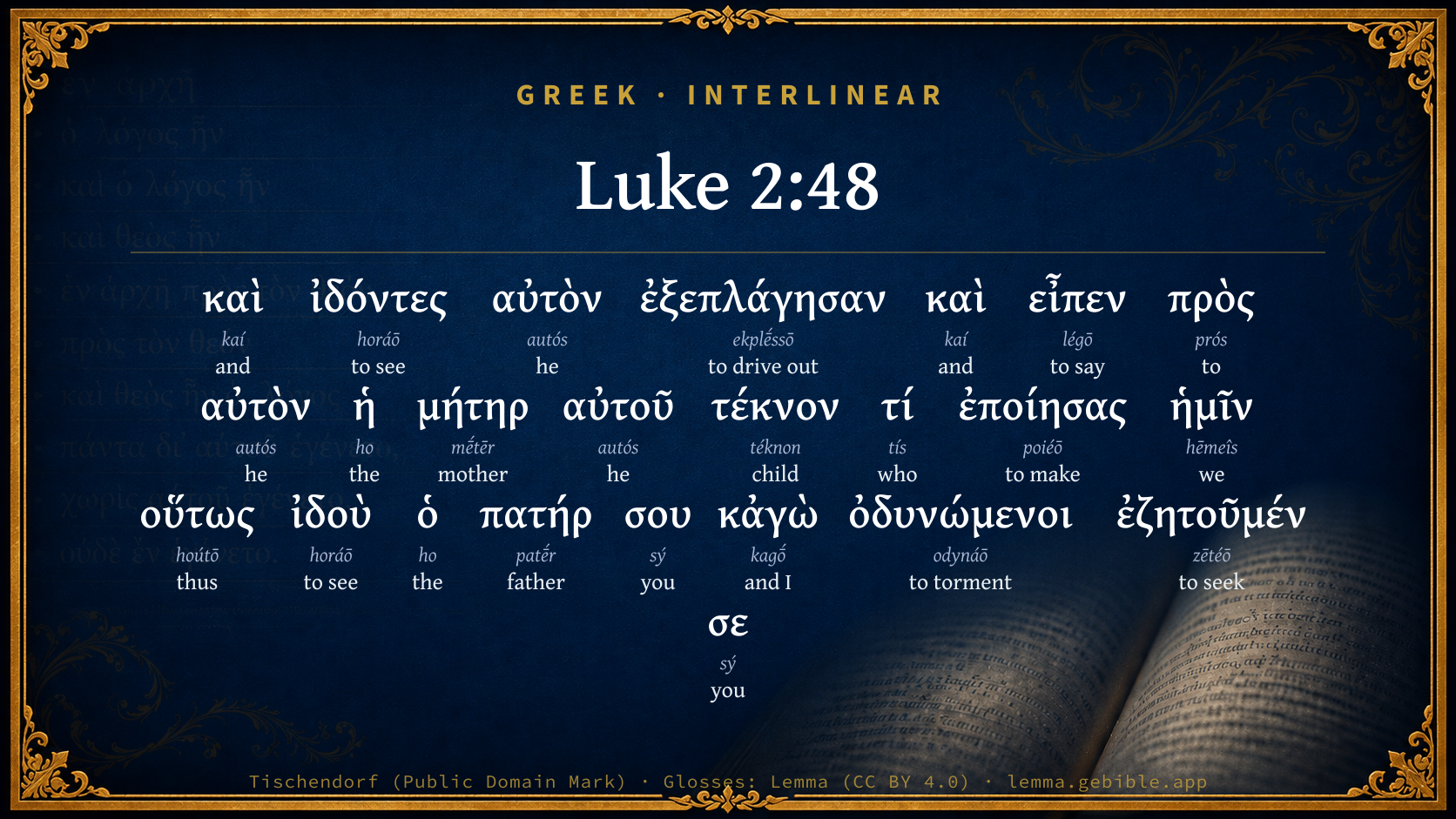
Download image
Cite this verse

Luke 2:48 (World English Bible). Public Domain. Lemma interlinear Bible study tool, https://lemma.gebible.app/v/luke/2/48.

Show BibTeX & RIS
BibTeX
RIS
English Translation
When they saw him, they were astonished, and his mother said to him, "Son, why have you treated us this way? Behold, your father and I were anxiously looking for you."
World English Bible · Public Domain
Highlights
  • 1 first appearance in the Greek New Testament
Full analysis ↓
Download a study sheet

One document with this verse’s original text, its word-by-word gloss line, the meaning frame, cross-references with their text, attributed commentary, and full source and license credits — printable, and it pastes into notes with its structure intact.

This verse Autodidact and up

Study sheet (.html) Plain text (.txt)

A passage Seminary Student

Up to 50 verses in one chapter. A passage sheet keeps up to 6 commentary sources and 12 cross-references per verse, in the order this page ranks them, and says so on the sheet whenever that leaves anything out. Ask for a single verse and you get the Autodidact verse sheet above.

Everything on this page stays free to read, with no account — the sheet is a download of what is already on screen, not access to it.

Want to remove ads? Support Godless Engineer
Compare translations 3

The same verse in 3 English versions, stacked beneath the original-language interlinear above. Click any original word for its lexicon entry.

Each is an independent rendering of the whole verse — the interlinear is not word-aligned to these translations.

Highlighted words mark where these versions differ — a whole-verse word diff, not a word-by-word alignment.

  • World English Bible Public Domain
    When they saw him, they were astonished, and his mother said to him, "Son, why have you treated us this way? Behold, your father and I were anxiously looking for you."
  • King James Version Public Domain
    And when they saw him, they were amazed: and his mother said unto him, Son, why hast thou thus dealt with us? behold, thy father and I have sought thee sorrowing.
  • unfoldingWord Literal Text CC BY-SA 4.0
    And having seen him, they were astonished, and his mother said to him, “Child, why have you treated us thus? Behold, your father and I have been tormented searching for you.”

unfoldingWord Literal Text — © unfoldingWord, licensed CC BY-SA 4.0. Word-aligned USFM3 via Door43 (git.door43.org/unfoldingWord/en_ult).

Versions to compare (up to 4)

3 of 4 selected

Show all 19 translations

Every available English version of this verse, each an independent rendering of the whole verse.

  • World English Bible Public Domain
    When they saw him, they were astonished, and his mother said to him, "Son, why have you treated us this way? Behold, your father and I were anxiously looking for you."
  • Berean Standard Bible Public Domain
    When His parents saw Him, they were astonished. “Child, why have You done this to us?” His mother asked. “Your father and I have been anxiously searching for You.”
  • Majority Standard Bible Public Domain
    When His parents saw Him, they were astonished. “Child, why have You done this to us?” His mother asked. “Your father and I have been anxiously searching for You.”
  • King James Version Public Domain
    And when they saw him, they were amazed: and his mother said unto him, Son, why hast thou thus dealt with us? behold, thy father and I have sought thee sorrowing.
  • American Standard Version (1901) Public Domain
    And when they saw him, they were astonished; and his mother said unto him, Son, why hast thou thus dealt with us? behold, thy father and I sought thee sorrowing.
  • Revised Version (1885) Public Domain
    And when they saw him, they were astonished: and his mother said unto him, Son, why hast thou thus dealt with us? behold, thy father and I sought thee sorrowing.
  • Geneva Bible (1599) Public Domain
    So when they sawe him, they were amased, and his mother said vnto him, Sonne, why hast thou thus dealt with vs? beholde, thy father and I haue sought thee with very heauie hearts.
  • Douay-Rheims (1899) Public Domain
    And seeing him, they wondered. And his mother said to him: Son, why hast thou done so to us? behold thy father and I have sought thee sorrowing.
  • Young's Literal Translation Public Domain
    And, having seen him, they were amazed, and his mother said unto him, `Child, why didst thou thus to us? lo, thy father and I, sorrowing, were seeking thee.'
  • Literal Standard Version CC BY-SA 4.0
    And having seen Him, they were amazed, and His mother said to Him, “Child, why did You do this to us? Behold, Your father and I, sorrowing, were seeking You.”
  • Unlocked Literal Bible CC BY-SA 4.0
    When they saw him, they were astonished. His mother said to him, “Son, why have you treated us this way? Listen, your father and I have been anxiously searching for you.”
  • unfoldingWord Literal Text CC BY-SA 4.0
    And having seen him, they were astonished, and his mother said to him, “Child, why have you treated us thus? Behold, your father and I have been tormented searching for you.”
  • Darby Bible Public Domain
    And when they saw him they were amazed: and his mother said to him, Child, why hast thou dealt thus with us? behold, thy father and I have sought thee distressed.
  • World Messianic Bible Public Domain
    When they saw him, they were astonished; and his mother said to him, “Son, why have you treated us this way? Behold, your father and I were anxiously looking for you.”
  • Webster's Bible Public Domain
    And when they saw him, they were amazed: and his mother said to him, Son, why hast thou thus dealt with us? behold, thy father and I have sought thee sorrowing.
  • Free Bible Version CC BY-SA 4.0
    His parents were totally confused when they saw what he was doing. His mother asked him, “Son, why have you treated us like this? Your father and I—we've been worried sick! We've been looking everywhere for you!”
  • Bible in Basic English Public Domain
    And when they saw him they were surprised, and his mother said to him, Son, why have you done this to us? see, your father and I have been looking for you with sorrow.
  • Text-Critical English NT CC BY 4.0
    When his parents saw him, they were astonished. His mother said to him, “Child, why have yoʋ treated us like this? Behold, yoʋr father and I have been looking for yoʋ in great distress.”
  • Tyndale New Testament (1534) Public Domain
    And when they sawe him they were astonyed. And his mother sayde vnto him: sonne why hast thou thus dealte with vs? Beholde thy father and I have sought the sorowenge.

Literal Standard Version (2020), Covenant Press — licensed CC BY-SA 4.0. Text via the HelloAO Bible API (eBible.org). Unlocked Literal Bible (unfoldingWord) — licensed CC BY-SA 4.0. Text via the HelloAO Bible API (eBible.org). unfoldingWord Literal Text — © unfoldingWord, licensed CC BY-SA 4.0. Word-aligned USFM3 via Door43 (git.door43.org/unfoldingWord/en_ult). Free Bible Version, Dr. Jonathan Gallagher — licensed CC BY-SA 4.0. Text via the HelloAO Bible API (eBible.org).

Word by word

More ways to search: Search by grammar → Find every occurrence → Compare this word →

Practice this passage: Drill this verse → Learn its vocabulary →

ὀδυνώμενοι
odynáō
G3600
“to torment”
Verb, Present, Passive, Participle, Nominative, Plural, Masculine
Part of Speech
Verb
Tense
Present
Voice
Passive
Mood
Participle
Case
Nominative
Number
Plural
Gender
Masculine
Full Thayer's Definition

Origin: from G3601

TDNT: 5:115,*

1. to cause intense pain 2. to be in anguish, be tormented 3. to torment or distress one's self
  1. καὶ kaí G2532 “and” Conjunction
  2. ἰδόντες horáō G3708 “to see” Verb, Aorist, Active, Participle, Nominative, Plural, Masculine
  3. αὐτὸν autós G846 “he” Personal pronoun, Accusative, Singular, Masculine
  4. ἐξεπλάγησαν ekplḗssō G1605 “to drive out” Verb, Aorist, Passive, Indicative, 3rd person, Plural
  5. καὶ kaí G2532 “and” Conjunction
  6. εἶπεν légō G3004 “to say” Verb, Aorist, Active, Indicative, 3rd person, Singular
  7. πρὸς prós G4314 “to” Preposition
  8. αὐτὸν autós G846 “he” Personal pronoun, Accusative, Singular, Masculine
  9. ἡ ho G3588 “the” Article, Nominative, Singular, Feminine
  10. μήτηρ mḗtēr G3384 “mother” Noun, Nominative, Singular, Feminine
  11. αὐτοῦ autós G846 “he” Personal pronoun, Genitive, Singular, Masculine
  12. τέκνον téknon G5043 “child” Noun, Vocative, Singular, Neuter
  13. τί tís G5101 “who” Interrogative pronoun, Accusative, Singular, Neuter
  14. ἐποίησας poiéō G4160 “to make” Verb, Aorist, Active, Indicative, 2nd person, Singular
  15. ἡμῖν hēmeîs G2249 “we” Personal pronoun, 1st person, Dative, Plural
  16. οὕτως hoútō G3779 “thus” Adverb
  17. ἰδοὺ horáō G3708 “to see” Verb, Aorist, Middle, Imperative, 2nd person, Singular
  18. ὁ ho G3588 “the” Article, Nominative, Singular, Masculine
  19. πατήρ patḗr G3962 “father” Noun, Nominative, Singular, Masculine
  20. σου sý G4771 “you” Personal pronoun, 2nd person, Genitive, Singular
  21. κἀγὼ kagṓ G2504 “and I” Personal pronoun, 1st person, Nominative, Singular, Aramaic form
  22. ἐζητοῦμέν zētéō G2212 “to seek” Verb, Imperfect, Active, Indicative, 1st person, Plural
  23. σε sý G4771 “you” Personal pronoun, 2nd person, Accusative, Singular

About this verse

These counts appear in no published source. They are computed here, from the morphology-tagged text and Lemma’s own curated glosses. What Lemma adds →

24
words
18
distinct lemmas
Gospels
section

Notable vocabulary

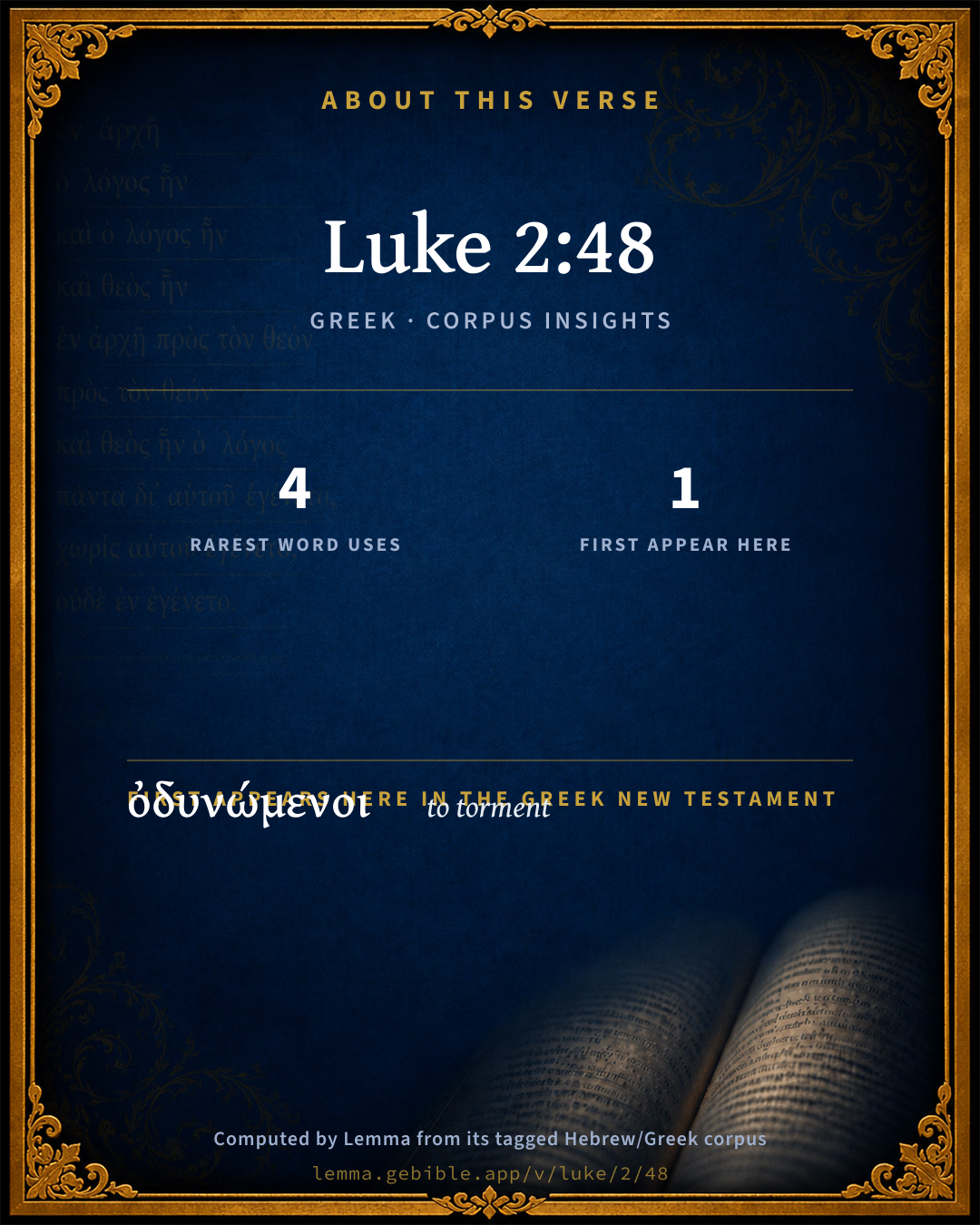
The rarest word here is ὀδυνώμενοι to torment G3600 — appearing just 4 times in the whole Greek New Testament.

First appearance in Scripture

This word makes its first canonical appearance in the Greek New Testament here:

  • ὀδυνώμενοι to torment G3600

Shared distinctive vocabulary

ὀδυνώμενοι to torment G3600 occurs in 4 verses of the Greek New Testament. Also found in:
Repetition

Words recur within this verse:

  • ἰδόντες to see G3708 ×2
  • αὐτὸν he G846 ×3
  • καὶ and G2532 ×2
  • ἡ the G3588 ×2
  • σου you G4771 ×2

Cross-references

4

Topical passages linked to Luke 2:48 in the Treasury of Scripture Knowledge — connected by theme and wording, ordered by reader-vote popularity; previews shown in the World English Bible.

  • Matthew 12:46 While he was yet speaking to the multitudes, behold, his mother and his brothers stood outside, seeking to speak to him.
  • Luke 2:49 He said to them, "Why were you looking for me? Didn't you know that I must be in my Father's house?"
  • Luke 3:23 Jesus himself, when he began to teach, was about thirty years old, being the son (as was supposed) of Joseph, the son of Heli,
  • Luke 4:22 All testified about him, and wondered at the gracious words which proceeded out of his mouth, and they said, "Isn't this Joseph's son?"

Cross-references courtesy of OpenBible.info (CC BY 4.0).

Commentary

Notes on Luke 2:48 from classic Christian and Jewish commentators (each source and its license shown beneath its notes). The classic Christian expositions comment on the surrounding passage and are grouped to its opening verse, so a note may address several verses; the Jewish commentaries on the Tanakh (Rashi and others) are per-verse, so they appear only where the commentator wrote on this verse.

Lemma curates 59 commentaries, every one of them public domain or Creative Commons licensed, each selected and text-cleaned for this edition rather than reprinted as found. About our sources →

The Biblical Illustrator

Joseph S. Exell

Luk_2:48

Son, why hast Thou thus dealt with us?

--

Perplexity in presence of mystery

This question of the mother of Jesus reveals an experience of the human heart which is very common, which is most common in the best hearts and those who feel their responsibility the most. The Virgin Mary is the perpetual type of people who, entrusted with any great and sacred interest, identify their own lives with that interest and care for it conscientiously; but who, by and by, when the interest begins to manifest its own vitality, and to shape its own methods, are filled with perplexity. They cannot keep the causes for which they labour under their own care. As His mother asked of Jesus, so they are always asking of the objects for which they live, Why hast thou thus dealt with us? Such people are people who have realized responsibility more than they have realized God. Just as Mary felt at the moment when she asked this question, that Jesus was her Son more than that He was Gods Son, so there is a constant tendency among the most earnest and conscientious people to feel that the causes for which they live and work are their causes more than that they are Gods causes, and so to experience something which is almost like jealousy when they see those causes pass beyond their power and fulfil themselves in larger ways than theirs. For such people, often the most devoted and faithful souls among us, there must be some help and light in this story of Jesus and His mother. (Phillips Brooks, D. D.)

A parents wonder

The first and simplest case of this experience is that which comes nearest to the circumstances of our story. It comes in every childhood. It comes whenever a boy grows up to the time at which he passes beyond the merely parental government which belonged to his earliest years. It comes with all assertion of individual character and purpose in a boys life. A boy has had his career all identified with his home where he was cradled. What he was and did he was and did as a member of that household. But by and by there comes some sudden outbreak of a personal energy. He shows some disposition, and attempts some task, distinctively his own. It is a puzzling moment Mike for the child and the parent. The child is perplexed with pleasure, which is almost pain, to find himself for the first time doing an act which is genuinely his own. The parent is filled with a pain which yet has pride and pleasure in it, to see his boy doing something original, something which he never bade him do, something which perhaps he could not do himself. The real understanding of that moment, both to child and parent, depends on one thing--upon whether they can see in it the larger truth that this child is not merely the son of his father, but is also the son of God. If they both understand that, then the child, as he undertakes his personal life, passes not into a looser, but into a stronger, responsibility. And the parent is satisfied to see his first authority over his son grow less, because he cannot be jealous of God. It is a noble progress and expansion of life when the first independent venture of a young man on a career of his own, is not the wilful claim of the prodigal, Give me the portion of goods that falleth to me, but the reverent appeal of Jesus, Wist ye not theft I must be about My Fathers business? (Phillips Brooks, D. D.)

Divine as well as human education

Who is there of us that is not aware that his soul has had two educations? Sometimes the two have been in opposition; sometimes they have overlapped; sometimes they have wholly coincided; but always the two have been two. Our own government of ourselves is most evident, is the one which we are most aware of, so that sometimes for a few moments we forget that there is any other; but very soon our plans for ourselves are so turned and altered and hindered that we cannot ignore the other greater, deeper force. We meant to do that, and look! we have been led on to this. We meant to be this, and lo! we are that. We never meant to believe this, and lo! we hold it with all our hearts. What does it mean? It is the everlasting discovery, the discovery which each thoughtful man makes for himself with almost as much surprise as if no other man had ever made it for himself before, that this soul, for which he is responsible, is not his soul only, but it is Gods soul too. The rex-e-lation which came of old to the Virgin Mother about her Child--not your Child only, but Gods Child, too; yours, genuinely, really yours, but, behind yours and over yours, Gods. That is the great revelation about life. When it comes, everything about ones self-culture is altered. Every anticipation and thought of living changes its colour. It comes sometimes early and sometimes late in life. Sometimes it is the flush and glow which fills childhood with dewy hope and beauty. Sometimes it is the peace which gathers about old age and makes it happy. When ever it comes it makes life new. See what the changes are which it must bring. First, it makes anything like a bewildering surprise impossible. When I have once taken it into my account that God has His plans for my souls culture, that these plans of His outgo and supersede any plans for it which I can make, then any new turn that comes is explicable to me, and, though I may not have anticipated it all, I am not overwhelmed, nor disturbed, nor dismayed by it. I find a new conviction growing in my soul, another view of life, another kind of faith. It is not what I had intended. I had determined that as long as I lived I would believe something very different from this which I now feel rising and taking possession of me. It seems at first as if my soul had been disloyal to me, and had turned its back faithlessly upon my teaching. I appeal to it, and say, Soul, why hast thou thus dealt with me? And it answers back to me, Wist ye not that I must be about my Fathers business? Did you not know that I was Gods soul as well as your soul? This is something which He has taught me. Then again, the true man will have one great purpose in living, and only one. He will try to come to harmony with God, to perfect understanding of what God wants and is trying to do. Let me not be trying to make one thing out of this soul of mine while He is trying to make entirely another! As Mary went back with her Son, realizing, out of His own mouth, that He was not only her Son, but Gods; as she settled down with Him to their Nazareth life again, must not one single strong question have been upon her heart, What does God want this Son of His to be? O let me find that out, that I may work with Him. And as you go into the house where you are to train your soul, realizing, through some revelation that has come to it, that it is Gods soul as well as yours, one strong and single question must be pressing on you too--What does God want this soul of mine to be? O, let me find that out, that I may work with Him. And how can you find that out? Only by finding Him out. Only by understanding what He is, can you understand what He wants you to do. And understanding comes by love. And love to God comes by faith in Jesus Christ. (Phillips Brooks, D. D. )

Christs strange dealings with His people

The words may usefully remind us that the dealings of the Lord Jesus with those who sincerely love and serve Him are often very strange. Not only does He try them by ordinary troubles, such as loss of health and loss of friends, but sometimes He takes away from them all spiritual comfort, and leaves their souls dark and disconsolate. Once they had joy and peace in believing, but they have it no longer now. Perhaps it is that they have grown lukewarm and self-sufficient, and He withdraws Himself from them for a time, to make them seek Him with greater earnestness. Where this is the case, people must go on seeking till they find. The dryness and hardness of our minds in prayer may be a sore distress to us, but we must not give over praying: we must be content to seek Him sorrowing. Where we cannot pray as we would, we must pray as we can. We must not faint, but determine to make ourselves heard at heavens gate. And then it shall be but a little, and we shall find Him whom our soul loveth. And when we have found Him, we must be careful to hold Him, and not let Him go. One who knows the Saviours love, and lives in habits of holy intercourse with Him, must, as it were, keep His eye upon Him constantly by Christian watchfulness and an effort to realize His presence everywhere. Let such an one lose Him by wilful disobedience, or careless self-indulgence, or by relaxing in prayer and in the effort to believe, and there will be nothing but sorrowing till He is found again. Most merciful is it of God, when we are living without Christ, to hedge up our way with thorns, to make conscience uneasy, worldly pleasures unsatisfactory, and even religious exercises disappointing and irksome. Anything is wholesome, however bitter, which drives us to His side, and keeps us there. (Dean Goulburn.)

The manliness of Christ

There is something at first sight wilful indeed, possibly courageous, but not manly, in a boy of twelve staying behind his parents in a strange city without their knowledge or consent; something thoughtless, almost ungracious, in the words of reply to Marys question. The clue to this apparent divergence from the perfect manly life is given with rare insight and beauty in Mr. Holman Hunts great picture--at any rate, the face and attitude of the boy there seemed for the first time to make clear to me the meaning of the recorded incident, and to cast a flood of light upon those eighteen years of preparation which yet remained before He should be ready for His great work. The first sight of Jerusalem and of the Temple has stirred new and strange thoughts within Him. The replies of the doctors to His eager questionings have lighted up the consciousness which must have been dimly working in Him already, that He was not altogether like those around Him-the children with whom He used to play, the parents at whose knees He had been brought up. To the young spirit before whose inward eye such a vision is opening all human ties would sink back, and be for the moment forgotten; and, when recalled suddenly by the words of His mother, the half-conscious dreamy answer, How is it that ye sought Me? &c., loses all its apparent wilfulness and abruptness. And so, full of this new question and great wonder, He went home to the village in Galilee with His parents, and was subject unto them; and the curtain falls for us on His boyhood and youth and early manhood. But, as nothing but what is most important and necessary for understanding all of His life which we need for our own growth into His likeness is told us in these simple narratives, it would seem that this vivid light is thrown on that first visit to Jerusalem because it was the crisis in our Lords earthly life which bears most directly on His work for our race. If so, we must, I think, allow that the question, once fairly presented to the boys mind, would never again leave it. Day by day it would come back with increasing insistency, gathering power and weight. (Thomas Hughes.)

The Mother and Son

There has descended into Marys humble home a treasure too great for heaven itself to contain. What wonder if she fails to understand the value of this Divine Son; if she wholly mistakes the meaning of His absence? What wonder if she applies to His case the common-place rebuke, Thy father and I have sought Thee sorrowing? Nay, but we may be told it was inexcusable in one who remembered the marvels of His birth, and all that then occurred, to chide Him for resorting to the Temple, and to be astonished that He sat with doctors and heard and questioned them. Twelve years of meek obedience in common household tasks and duties had passed since His birth. Miracles, which are meant to witness to doctrines, were not, we may be sure, performed to startle the carpenters humble family, and she had forgotten in some measure the significant tokens of the past, and the dutiful boy was to her the future carpenter, the support of her age, the inmate of her home, or of some frugal home like hers, to the end, and the air of authority sat easy upon her, for her right had not been disputed. But other rights asserted themselves now. The light within Him breaks forth now from behind the Tell of flesh. How is it that ye sought Me? Wist ye not, &c. Other claims and ties supersede, or soon shall do so, the calm family life. He shall dwell with that Father who, in His baptism, His transfiguration, His death, will attest that this One is the Son of God. He shall seek for brethren and for children in all whom the ties of a common faith in His Father unite to Him. His work shall not be with the axe and hammer in Josephs workshop, but it shall lie in turning souls from darkness to light, from death to life, from the power of Satan unto God. What wonder if the mother after the flesh cannot at once train her ear to the full compass of this new revelation. She will acquiesce, but not till she has painfully learned the plan of God in the life of battle with all forms of evil, which He shall lead, in the face of Satan and his host, where she is not; where she shall be met, if she venture into its sphere, by words of strangeness, Woman, what have I to do with thee? (Joh_2:4). Some have entertained angels unawares; but the King whom angels serve is a sojourner under her roof; she has to unlearn the speech of a mother, and learn that of a worshipper of the adorable Son of God and her Redeemer. She must cease to command and to admonish, and kneel with the rest of us before the Cross that was raised for all our guilty race alike. (Archbishop Thomson.)

Sorrow for grieving a mother

When Garibaldi saw any one looking at his mothers picture the tears started into his eyes. He felt remorse at having, by his adventurous life, been a source to her of cruel anxiety. He believed in the power of her prayers to preserve him from the effects of his own temerity, and on the field of battle, or in the storm at sea, he never lost courage, because he thought he saw her kneeling before God and imploring for him the Divine protection.

A mothers solicitude

The parents of Robert Moffat were both pious, and his mothers heart was set upon his knowing from a child the Holy Scriptures. When about to leave Inverkeithing, in Fifeshire, where he was in service in the Earl of Morays gardens, for a situation in Cheshire, she earnestly besought him to promise, before going, that he would read the Bible every day, morning and evening. Sensible of his own weakness, and of, perhaps, his boyish disinclination, he parried the question. But at the last moment she pressed his hand. Robert, she said, imploringly, you will promise me to read the Bible, more particularly the New Testament, and most especially the Gospels--those are the words of Christ Himself; and then you cannot possibly go astray. There was no refusing then; it was the melting hour. Yes, mother, he answered, I make you the promise. He knew, as he remarked in relating the circumstances, that the promise, once made, must be kept. And oh, he added, I am happy that I did make it! (Hand and Heart.)

The Biblical Illustrator, edited by Joseph S. Exell (c. 1880s–1900s) — public domain. Text from a community e-Sword module.

Joseph Benson's Commentary

Luk 2:48-50. And when they saw him they were amazed — The clause, thus rendered, signifies, that Joseph and Mary were amazed when they saw him, but it may be translated, They who saw him were amazed, namely, not his parents only, or chiefly, but others. In this sense Dr. Campbell understands it, as suiting better the scope of the passage. “His parents,” says he, “may be said to have had reason of surprise, or even amazement, when they discovered that he was not in their company; but surely, to them at least, there was nothing peculiarly surprising in finding that he was not amusing himself with boys, but was in the temple, among the doctors, discoursing on the most important subjects. I may say justly, that to them who knew whence he was, there was less ground of amazement at the wisdom and understanding displayed in his answers than to any other human being. Again: it appears to be the intention of the evangelist, in this passage, to impress us with a sense of the extraordinary attainments of our Lord in wisdom and knowledge, even in childhood, from the effect which the discovery of them produced on others. All in the temple, who, though they did not see him, were within hearing, and could judge from what they heard, were astonished at the propriety, the penetration, and the energy they discovered in every thing he said; but those whose eye-sight convinced them of his tender age were confounded, as persons who were witnesses of something preternatural.” His mother said, Son, why hast thou thus dealt with us — Why hast thou put us into such fear for thy safety? Why hast thou given us such occasion for anxiety and distress? Thy father and I have sought thee sorrowing — Being not only troubled that we lost thee, but vexed at ourselves for not taking more care of thee. The word οδυνωμενοι, here rendered sorrowing, is expressive of the most racking anguish, and is often applied to the distress and pains of a woman in travail; it has therefore been rendered, with great concern — with inexpressible anxiety and distress. And he said, How is it that ye sought me? He does not blame them for losing, but for thinking it needful to seek him; and intimates that he could not be lost nor found anywhere but doing the will of a higher Parent. Wist ye not that I must be about my Father’s business — His words imply, that they had no reason to be angry with him for leaving them without their knowledge, nor even to be grieved on that account, since they might have understood by his miraculous conception, and the revelations which accompanied it, that he was not to continue always with them, but was to employ himself in the business of Him who really was his father. The original expression here used, εν τοις του πατρος μου δει ειναι με, is ambiguous, and is translated by Dr. Waterland and many other learned men, following the Syriac version, Knew ye not that I must be in my Father’s house; a translation which the words will very well bear; and, so understood, the reply of Christ will signify, that though they thought him lost, yet he was at home; he was in his Father’s house, Joh 2:16; and that, in staying behind at Jerusalem, he had not left his true Father. “It is to be remembered,” says Dr. Doddridge, “that this is the first visit Christ had ever made to the temple since he was a child in arms; and it is no wonder, therefore, that the delight he found there inclined him to prolong it.” How happy those children who, like the holy Jesus, love the house and ordinances of God, and thirst for the instructions of his good word! They understood not the saying — Christ having expressed himself in a somewhat concise and ambiguous manner, his parents did not fully comprehend his meaning; either because they now doubted his being the Messiah, or because they had few just conceptions of the end for which the Messiah was to come into the world. It is observable that Joseph is not mentioned after this time, whence it is probable he did not live long after.

Joseph Benson's Commentary on the Old and New Testaments (1811–1818) — public domain. Text from a community e-Sword module.

Bengel's Gnomon

Johann Albrecht Bengel

Luk 2:48. Πρὸς αὐτὸν, to Him) This expression, inasmuch as it is in the beginning of the clause, is emphatic. To Him she ought not to have spoken so.—ἡ μήτηρ, His mother) Joseph did not speak: the tie which bound the mother to Him was stronger.—εἶπε, said) publicly before all.—τί) What? not Why? What hast thou done for us[32] by this way of acting [His conduct]?—ὀδυνώμενοι, sorrowing) No doubt the heart of Mary turned over and revolved many things in thought during these three days. Comp. Luk 2:35.

[32] “Quid nobis confecisti?” implying that He had effected nothing by the delay, but the giving of trouble to His parents.—ED.

Bengel's Gnomon of the New Testament — English translation (T&T Clark, Edinburgh, 1860) — public domain. Text from a community e-Sword module.

Expositor's Greek Testament

ed. W. Robertson Nicoll

Luk 2:48 . ἰδόντες refers to the parents. This astonishment points to some contrast between a previous quiet, reserved manner of Jesus and His present bearing; sudden flashing out of the inner life. ἡ μήτηρ : the mother spoke, naturally; a woman , and the mother’s heart more keenly touched. This apart from the peculiar relation referred to in Bengel’s major erat necessitudo matris .

The Expositor's Greek Testament, edited by W. Robertson Nicoll (1897–1910) — public domain. Text from a community e-Sword module.

Geneva Bible (1599)

Geneva Bible translators

All duties which we owe to men as they were not to be neglected, so are they according to our vocation, not to be preferred before the glory of God.

Geneva Bible (1599) marginal notes — public domain. Text via Bolls.life.

Adam Clarke's Commentary

Verse 48. Why hast thou thus dealt with us?] It certainly was not his fault, but theirs. Men are very apt to lay on others the blame of their own misconduct.

Adam Clarke's Commentary on the Bible (1810–1826) — public domain. Text from a community e-Sword/MySword module.

Ellicott's Commentary for English Readers

(48)Behold, thy father and I have sought.—The latter clause expresses a continuous act, We were seeking thee; and our Lord uses the same tense in His answer.

A Bible Commentary for English Readers, edited by Charles John Ellicott (1878–1897) — public domain. Text from a community e-Sword module.

The Cambridge Bible for Schools and Colleges

gen. ed. J. J. S. Perowne

48. they were amazed] The “people of the land,” such as were the simple peasants of Galilee, held their great teachers in the deepest awe, and hitherto the silent, sweet, obedient childhood of Jesus had not prepared them for such a scene.

Son, why hast thou thus dealt with us?] Rather, My child, why didst thou treat us thus?

have sought thee sorrowing] Rather, were searching for thee with aching hearts.

The Cambridge Bible for Schools and Colleges (gen. ed. J. J. S. Perowne; Cambridge University Press, 1878–1918) — public domain. Text from a community e-Sword module.

John Gill's Exposition

And he said unto them, how is it that ye sought me?.... That is, with so much uneasiness and distress of mind, not trusting in the power and providence of God, to take care of him; and in other places, besides the temple, where they had been inquiring for him:

wist ye not that I must be about my Father's business? or "in my Father's house", as the Syriac and Persic versions render it; where, as soon as you missed me, you might, at once, have concluded I was, and not have put yourselves to so much trouble and pains in seeking for me. Christ seems to tax them with ignorance, or, at least, forgetfulness of his having a Father in heaven, whose business he came to do on earth; and which they should have thought in their own minds he was now about, and so have made themselves easy. The business that Christ came about was to preach the Gospel, and which he afterwards performed with great clearness and fulness, with much power, majesty, and authority, with great constancy and diligence, with much concern for the souls of men, arid with great awfulness; and in which he took great delight, though he went through many dangers and risks of life; as also to work miracles in proof of his deity and Messiahship, and for the good of the bodies of men, and in which he was very assiduous, going about every where doing good this way: but the main, and principal part of his business was, to work out salvation for his people, by fulfilling the law, making reconciliation and atonement for their sins, and obtaining eternal redemption: this was a business which neither angels nor men could do; was very toilsome and laborious, and yet he delighted in it; nor did he desist from it until it was accomplished: and this is called his Father's business, because he contrived and assigned it to him; he called him to it, and sent him to perform; he enjoined it to him as man and mediator, and the glory of his perfections was concerned in it, and secured by it: and it was a business that Christ must be about, be concerned in, and perform, because he engaged to do it from all eternity; and because it was the will of his Father, which must be done, and was necessary in order to show himself dutiful and obedient; and because it was foretold in prophecy again and again and promised that it should be done; and because it could not be done by another. Now our Lord's conversing with the doctors, and which was a branch of his prophetic office, and was, no doubt, with a view to the good of the souls of men, and nothing less than miraculous, was a show, a prelude of, and a sort of an entrance upon the business he came about.

John Gill's Exposition of the Whole Bible (1746–1763) — public domain (CC PDM 1.0). Text via the HelloAO Bible API.

Trapp's Complete Commentary

John Trapp

48 And when they saw him, they were amazed: and his mother said unto him, Son, why hast thou thus dealt with us? behold, thy father and I have sought thee sorrowing.

Ver. 48. Have sought thee sorrowing] Animo tristissimo, et afflictissimo. God often cures a lethargy of security, by a fever of perplexity.

John Trapp, A Commentary or Exposition upon All the Books of the Old and New Testament (1647–1656) — public domain. Text from a community e-Sword module.

Albert Barnes' Notes on the Bible

Why hast thou thus dealt with us? - Why hast thou given us all this trouble and anxiety, in going so far and returning with so much solicitude?

Thy father - Joseph was not the “real” father of Jesus, but he was “legally” so; and as the secret of his birth was not commonly known, he was called his father. Mary, in accordance with that usage, also called him so.

Sorrowing - Anxious, lest in the multitude he might not be found, or lest some accident might have happened to him.

Albert Barnes' Notes on the Bible (1834–1885) — public domain. Text from a community e-Sword/MySword module.

Matthew Poole's English Annotations

Though something must be allowed to a woman’s passions and a mother’s indulgence, yet one would think that, especially considering where they found him, and what doing, she should not have spoken thus unto him, had she had a clear and distinct knowledge of his Divine nature, in union with her flesh: she speaks to him with the authority of a mother,

Why hast thou thus dealt with us?

Matthew Poole's English Annotations on the Holy Bible (1683–1685) — public domain. Text from a community e-Sword/MySword module.

The Pulpit Commentary

Son, why hast thou thus dealt with us? behold, thy father and I have sought thee sorrowing. Mary"s words have in them something of reproach. Joseph, it is noticeable, stands evidently apart; but the mother, strangely as it would seem at first, associates him in "thy father and I have sought thee sorrowing." Had she, then, forgotten the past? Who but Mary could have repeated this sacred memory of her mistake, and of the Boy"s far-reaching answer? What forger could have imagined such a verse?

The Pulpit Commentary (1880–1919), ed. H.D.M. Spence-Jones & Joseph S. Exell — public domain. Text from a community e-Sword module.

Burkitt's Expository Notes on the New Testament

William Burkitt

Without doubt it was impossible to express the sorrow of the Holy Virgin’s soul, when all the search of three days could bring them no tidings of their holy child. How did she blame her eyes for once looking off this object of her love, and spend both days and nights in a passionate bemoaning of her loss!

O blessed Saviour, who can miss thee, and not mourn for thee! Never any soul conceived thee by faith, but was apprehensive of thy worth, and sensible of thy want: what comforts are we capable of, while we want thee? And what relish can we taste in an earthly delight without thee?

William Burkitt's Expository Notes on the New Testament (1700–1703) — public domain. Text from a community e-Sword module.

unfoldingWord translationNotes

Door43 World Missions Community

When they saw him

"When Mary and Joseph found Jesus"

why have you treated us this way?

This was an indirect rebuke because he had not gone with them on the way back home. This caused them to worry about him. AT: "you should not have done this to us!" (See: Rhetorical Question)

Listen

This word is often used to show the beginning of a new or important event. It also can be used to show where the action begins. If your language has a phrase that is used in this way, consider whether it would be natural to use it here.

Why were you searching for me?

Jesus uses two questions to mildly rebuke his parents, and to begin to tell them that he had a purpose from his heavenly Father that they did not understand. AT: "You did not need to be concerned about me" (See: Rhetorical Question)

Did you not know ... business?

Jesus uses this second question to try to say that his parents should have known about the purpose for which his Father sent him. AT: "You should have known ... business" (See: Rhetorical Question)

about my Father's business

Possible meanings are 1) Jesus meant these words literally, to indicate that he was doing the work that his Father had given him, or 2) these words are an idiom that indicate where Jesus was, "in my Father's house." Since the next verse says that his parents did not understand what he was telling them, it would be best not to explain it more.

my Father's business

At age 12, Jesus, the Son of God, understood that God was his real Father (not Joseph, Mary's husband). (See: Translating Son and Father)

translationWords

amazed

God the Father

word

unfoldingWord translationNotes — © Distant Shores Media and the Door43 World Missions Community, licensed CC BY-SA 4.0. Source: git.door43.org/Door43/en_tn.

Cambridge Greek Testament for Schools and Colleges

48. ἐξεπλάγησαν. The “people of the land,” such as were the simple peasants of Galilee, held their great teachers in the deepest awe, and hitherto the silent, sweet, obedient childhood of Jesus had not prepared them for such a scene.

τέκνον, τί ἐποίησας ἡμῖν οὕτως; ‘My child, why didst thou treat us thus?’

ὀδυνώμενοι ἐζητοῦμέν σε, ‘were searching for thee with aching hearts.’

Cambridge Greek Testament for Schools and Colleges (Cambridge University Press, 1896; 21 vols, various authors incl. Carr, Maclear, Plummer, Farrar, Lumby, Moule, M. R. James, Simcox) — public domain. Text from a community e-Sword module.

Alford’s Greek Testament

Henry Alford

48-50.] The salient point of this narrative appears to lie in ὁ πατήρ σου contrasted with τοῦ πατρός μου. This was the first time that those wonderful words of self-consciousness had been heard from the holy Child—when He began to be “a son of the law,” He first calls Him His Father, Who gave Him the work to do on earth, of perfectly keeping that Law.

Every word of these verses is of the first importance to modern combatants for sound doctrine. Let the adversaries answer us,—why should his mother here have spoken and not Joseph, unless there were some more than usual reason for her being put forward rather than his reputed father? Again, let the mythical school of Strauss give us a reason, why an incident altogether (in their view) so derogatory to the character of the subject of it, should have been inserted, if the myths arose out of an exaggerated estimate of the dignity of that character?

ὁ πατ. σου] Then up to this time Joseph had been so called by the holy Child Himself: but from this time, never. Such words are not chance; had Mary said ἡμεῖς, the strong contrast with what follows could not have been brought out.

τί ὅτι ἐζ.;] τί, ὅτι … what (reason) is there, that …: see reff.

This is no reproachful question. It is asked in all the simplicity and boldness of holy childhood … ‘did ye not know?’ … it appeared as if that conviction, the expression of which now first breaks forth from Him, must have been a matter known to them before.

δεῖ] This is that δεῖ so often used by our Lord of His appointed and undertaken course. Analogous to this first utterance of His conviction, is the dawn, amongst ourselves, of the principle of duty in the youthful and well-trained spirit about this same age,—this ‘earing time’ of human progress: see below on ver. 52.

ἐν τοῖς τοῦ π.] Primarily, in the house of my Father (so in Sir. 42:10, ἐν τοῖς πατρικοῖς αὐτῆς: Theocr. ii. 76, τὰ Λύκωνος: Demosth. p. 1071, τὰ τοῦ ἀποθανόντος: see Lobeck on Phryn. p. 100); but we must not exclude the wider sense, which embraces all places and employments of my Father’s (cf. ἐν τούτοις ἴσθι, 1Ti 4:15). The best rendering would perhaps be,—among my Father’s matters. The employment in which he was found, learning the word of God, would naturally be one of these.

αὐτ. οὐ συν.] Both Joseph and His mother knew in some sense, Who He was: but were not prepared to hear so direct an appeal to God as His Father: understood not the deeper sense of these wonderful words. Still (ver. 51) they appear to have awakened in the mind of His mother a remembrance of κληθήσεται υἱὸς θεοῦ, ch. 1:35. And probably, as Stier remarks (1:5), the unfolding of His childhood had been so gradual and natural, that even they had not been forcibly reminded by any strong individual notes, of that which He was, and which now shewed itself.

It is a remarkable instance of the blindness of the rationalistic Commentators to the richness and depth of Scripture narrative, that Meyer holds this οὐ συνῆκαν to be altogether inconceivable as coming after the angelic announcement to Mary. Can he suppose that she συνῆκεν that announcement itself? De Wette has given the right interpretation, fie verftanden nicht den tiefern Sinn, and refers to chap. 18:34: so also Olsh., Ebrard.

Henry Alford, The Greek Testament (1849–1861) — public domain. Text from a community e-Sword module.

International Critical Commentary

48. ἰδόντες. Return to the original subject, οἱ γονεῖς.—ἐξελάγησαν. Another strong expression: 9:43; Act 8:12. They were astonished at finding Him there, and thus occupied, apparently without thought of them.

ἡ μήτηρ αὐτοῦ. It was most natural that she should be the first to speak. Her reproachful question perhaps contains in it a vein of self-reproach. She and Joseph had appeared to be negligent.

ζητοῦμεν. “Are seeking”: the pain of the anxiety has not yet quite ceased. For καὶ ἐγώ see on 16:9.

א B read ζητοῦμεν, which WH. adopt. Almost all other editors follow almost all other authorities in reading ἐζητοῦμεν.

ὀδυνώμενοι. “In great anguish” of mind, as in Act 20:38 and Zec 12:10; of body and mind, 16:24, 25; comp. Rom 9:2; 1Ti 6:10. The ῥομφαία (ver. 35) has already begun its work. Anguish cannot be reasonable. But they might have been sure that the Child who was to be the Messiah could not be lost. This agrees with ver. 50.

International Critical Commentary — older volumes (1896–1929), various authors — public domain. Text from a community e-Sword module.

Vincent's Word Studies in the New Testament

Marvin R. Vincent

They were amazed [εξεπλαγησαν] . A very strong word; the verb meaning, literally, to strike out or drive away from; and so to drive out of one's senses. Hence in the general sense of great amazement. Amaze is to throw into a maze or labyrinth; and so is closely akin to the Greek word here, and is a faithful rendering.

Son [τεκνον] . Lit., child. See on Mt 1:1.

Thy father. "Up to this time Joseph had been so called by the holy child himself; but from this time never" (Alford).

Have sought [εζητουμεν] . Imperfect tense : were seeking; Mary is going over in mind the process of the search.

Marvin R. Vincent, Word Studies in the New Testament (1887–1900) — public domain. Text from a community e-Sword/MySword module.

Lesson kit

Teaching starters — assembled from the data on this page, not authored interpretation. Every prompt links to the verse data it draws on. Edit before teaching.

Luke, in the Gospels, opens this verse with 24 words (18 distinct Greek lemmas). Its most distinctive word is odynáō (“to torment”). A historical commentator’s framing appears above. Read the whole chapter for the surrounding context.

Discussion questions

  1. The word odynáō carries the sense “to torment.” How does it shape the verse?
  2. This is the first place “to torment” appears in Scripture (first appears here). What does its debut here establish?
  3. How does Luke 16:24, which shares the word «to torment», read alongside this verse?
  4. What does the repetition of “to see” (2× in this one verse) do in this verse?
  5. These translations render this verse differently. What is at stake in choosing one wording over another?
  6. Compare how The Biblical Illustrator and Joseph Benson's Commentary read this verse. Where do they agree or differ?

Things to notice

  • 1 word makes its first canonical appearance in Scripture here.
  • These translations choose different wording for 20 words in this verse.
  • “to see” occurs 2× in this single verse.
  • 18 distinct Greek lemmas span 24 words in this verse.

Reading settings

Reading text

Shown beneath each verse's original-language words.

Old Testament
Old Testament edition

Read the OT as the Masoretic Hebrew (MT) or the Greek Septuagint (LXX).

English shown for the Greek Septuagint (in the Hebrew ↔ Greek comparison).

Comparing translations? Open the Compare panel on any verse page to stack up to four side by side.