
John 6:44

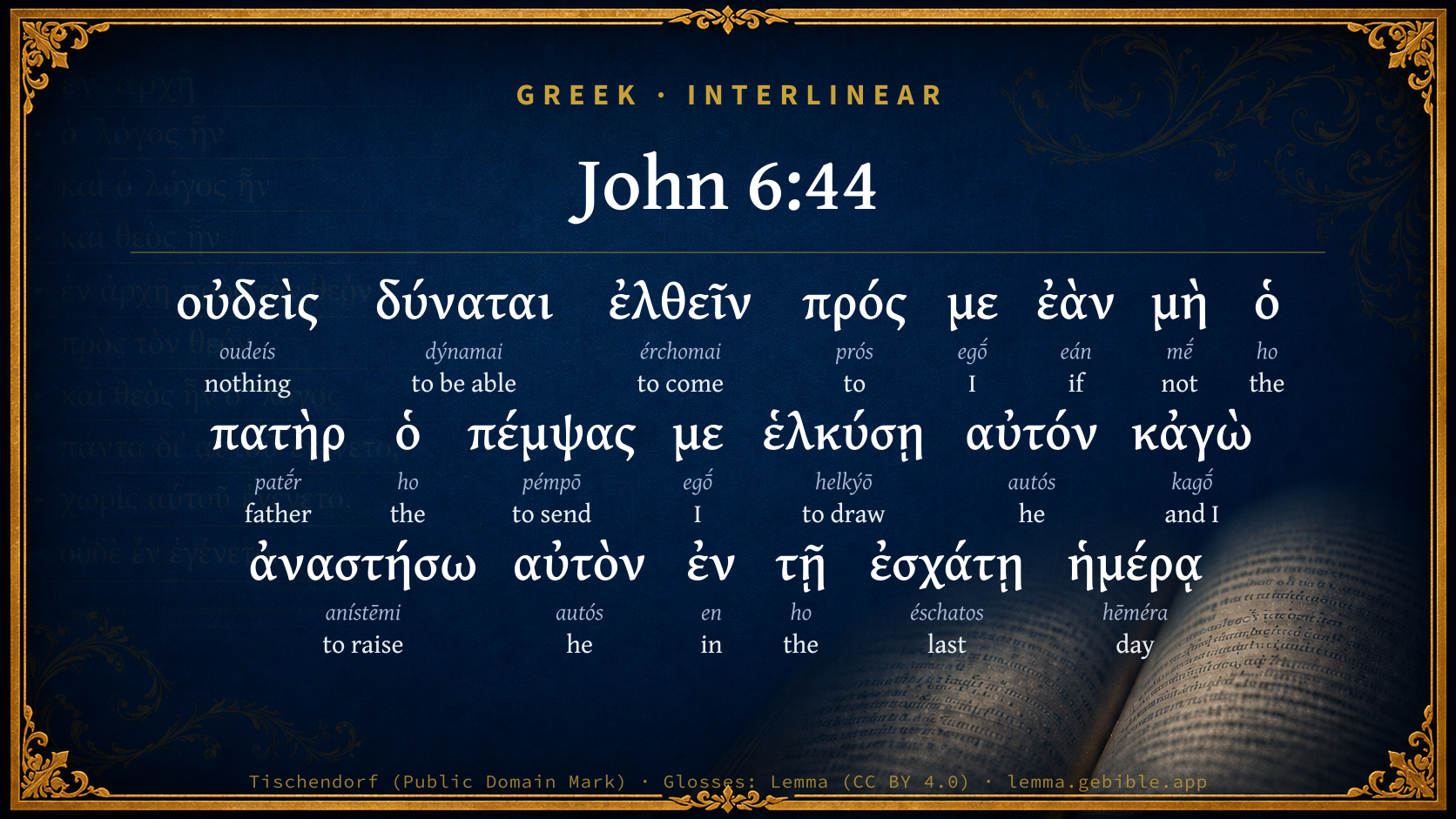
Greek (Tischendorf 8th ed.) John 6:44 appears in the Greek New Testament. The text above is from the Tischendorf 8th edition. Each word links to its Strong’s number and a concise gloss. Click any word for its full Thayer’s Greek Lexicon entry.
Download image
Cite this verse

John 6:44 (World English Bible). Public Domain. Lemma interlinear Bible study tool, https://lemma.gebible.app/v/john/6/44.

Show BibTeX & RIS
BibTeX
RIS
English Translation
No one can come to me unless the Father who sent me draws him, and I will raise him up in the last day.
World English Bible · Public Domain
Highlights
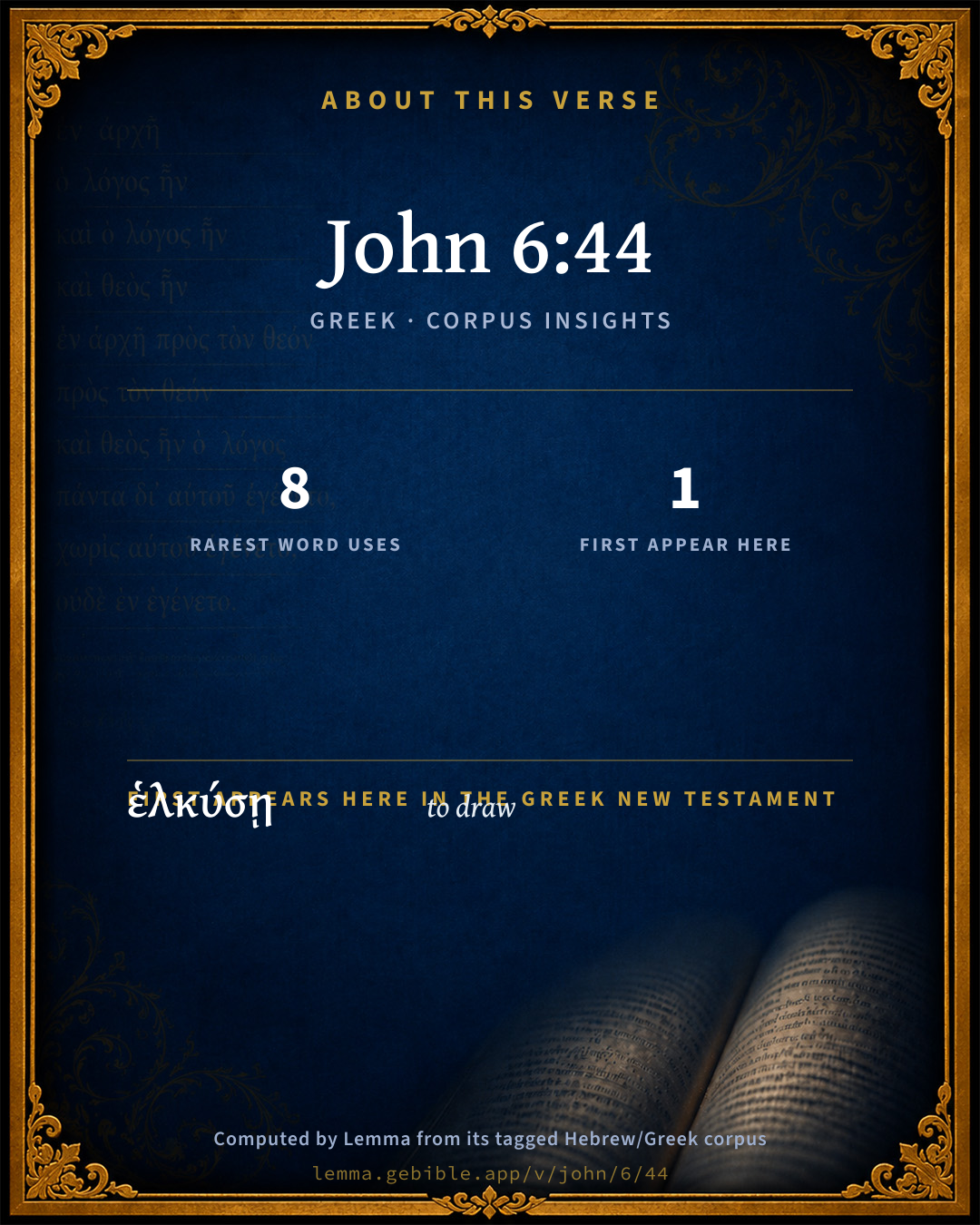
  • 1 first appearance in the Greek New Testament
Full analysis ↓
Download a study sheet

One document with this verse’s original text, its word-by-word gloss line, the meaning frame, cross-references with their text, attributed commentary, and full source and license credits — printable, and it pastes into notes with its structure intact.

This verse Autodidact and up

Study sheet (.html) Plain text (.txt)

A passage Seminary Student

Up to 50 verses in one chapter. A passage sheet keeps up to 6 commentary sources and 12 cross-references per verse, in the order this page ranks them, and says so on the sheet whenever that leaves anything out. Ask for a single verse and you get the Autodidact verse sheet above.

Everything on this page stays free to read, with no account — the sheet is a download of what is already on screen, not access to it.

Want to remove ads? Support Godless Engineer
Compare translations 3

The same verse in 3 English versions, stacked beneath the original-language interlinear above. Click any original word for its lexicon entry.

Each is an independent rendering of the whole verse — the interlinear is not word-aligned to these translations.

Highlighted words mark where these versions differ — a whole-verse word diff, not a word-by-word alignment.

  • World English Bible Public Domain
    No one can come to me unless the Father who sent me draws him, and I will raise him up in the last day.
  • King James Version Public Domain
    No man can come to me, except the Father which hath sent me draw him: and I will raise him up at the last day.
  • unfoldingWord Literal Text CC BY-SA 4.0
    No one is able to come to me unless the Father having sent me would draw him, and I will raise him up on the last day.

unfoldingWord Literal Text — © unfoldingWord, licensed CC BY-SA 4.0. Word-aligned USFM3 via Door43 (git.door43.org/unfoldingWord/en_ult).

Versions to compare (up to 4)

3 of 4 selected

Show all 19 translations

Every available English version of this verse, each an independent rendering of the whole verse.

  • World English Bible Public Domain
    No one can come to me unless the Father who sent me draws him, and I will raise him up in the last day.
  • Berean Standard Bible Public Domain
    “No one can come to Me unless the Father who sent Me draws him, and I will raise him up at the last day.
  • Majority Standard Bible Public Domain
    “No one can come to Me unless the Father who sent Me draws him, and I will raise him up at the last day.
  • King James Version Public Domain
    No man can come to me, except the Father which hath sent me draw him: and I will raise him up at the last day.
  • American Standard Version (1901) Public Domain
    No man can come to me, except the Father that sent me draw him: and I will raise him up in the last day.
  • Revised Version (1885) Public Domain
    No man can come to me, except the Father which sent me draw him: and I will raise him up in the last day.
  • Geneva Bible (1599) Public Domain
    No man can come to mee, except the Father, which hath sent mee, drawe him: and I will raise him vp at the last day.
  • Douay-Rheims (1899) Public Domain
    No man can come to me, except the Father, who hath sent me, draw him; and I will raise him up in the last day.
  • Young's Literal Translation Public Domain
    no one is able to come unto me, if the Father who sent me may not draw him, and I will raise him up in the last day;
  • Literal Standard Version CC BY-SA 4.0
    no one is able to come to Me if the Father who sent Me may not draw him, and I will raise him up in the last day;
  • Unlocked Literal Bible CC BY-SA 4.0
    No one can come to me unless the Father who sent me draws him, and I will raise him up on the last day.
  • unfoldingWord Literal Text CC BY-SA 4.0
    No one is able to come to me unless the Father having sent me would draw him, and I will raise him up on the last day.
  • Darby Bible Public Domain
    No one can come to me except the Father who has sent me draw him, and I will raise him up in the last day.
  • World Messianic Bible Public Domain
    No one can come to me unless the Father who sent me draws him; and I will raise him up in the last day.
  • Webster's Bible Public Domain
    No man can come to me, except the Father who hath sent me draw him: and I will raise him up at the last day.
  • Free Bible Version CC BY-SA 4.0
    “No one can come to me unless the Father who sent me attracts them, and I will raise them up at the last day.
  • Bible in Basic English Public Domain
    No man is able to come to me if the Father who sent me does not give him the desire to come: and I will take him up from the dead on the last day.
  • Text-Critical English NT CC BY 4.0
    No one can come to me unless the Father who sent me draws him, and I will raise him up on the last day.
  • Tyndale New Testament (1534) Public Domain
    No man can come to me except the father which hath sent me, drawe him. And I will rayse him vp at the last daye.

Literal Standard Version (2020), Covenant Press — licensed CC BY-SA 4.0. Text via the HelloAO Bible API (eBible.org). Unlocked Literal Bible (unfoldingWord) — licensed CC BY-SA 4.0. Text via the HelloAO Bible API (eBible.org). unfoldingWord Literal Text — © unfoldingWord, licensed CC BY-SA 4.0. Word-aligned USFM3 via Door43 (git.door43.org/unfoldingWord/en_ult). Free Bible Version, Dr. Jonathan Gallagher — licensed CC BY-SA 4.0. Text via the HelloAO Bible API (eBible.org).

Word by word

More ways to search: Search by grammar → Find every occurrence → Compare this word →

Practice this passage: Drill this verse → Learn its vocabulary →

ἑλκύσῃ
helkýō
G1670
“to draw”
Verb, Aorist, Active, Subjunctive, 3rd person, Singular
Part of Speech
Verb
Tense
Aorist
Voice
Active
Mood
Subjunctive
Person
3rd person
Number
Singular
Full Thayer's Definition

Origin: probably akin to G138

TDNT: 10:23,2

1. to draw, drag off 2. metaph., to draw by inward power, lead, impel
  1. οὐδεὶς oudeís G3762 “nothing” Adjective, Nominative, Singular, Masculine, Negative
  2. δύναται dýnamai G1410 “to be able” Verb, Present, Middle or Passive deponent, Indicative, 3rd person, Singular
  3. ἐλθεῖν érchomai G2064 “to come” Verb, Aorist, Active, Infinitive
  4. πρός prós G4314 “to” Preposition
  5. με egṓ G1473 “I” Personal pronoun, 1st person, Accusative, Singular
  6. ἐὰν eán G1437 “if” Conditional
  7. μὴ mḗ G3361 “not” Particle, Negative
  8. ὁ ho G3588 “the” Article, Nominative, Singular, Masculine
  9. πατὴρ patḗr G3962 “father” Noun, Nominative, Singular, Masculine
  10. ὁ ho G3588 “the” Article, Nominative, Singular, Masculine
  11. πέμψας pémpō G3992 “to send” Verb, Aorist, Active, Participle, Nominative, Singular, Masculine
  12. με egṓ G1473 “I” Personal pronoun, 1st person, Accusative, Singular
  13. αὐτόν autós G846 “he” Personal pronoun, Accusative, Singular, Masculine
  14. κἀγὼ kagṓ G2504 “and I” Personal pronoun, 1st person, Nominative, Singular, Aramaic form
  15. ἀναστήσω anístēmi G450 “to raise” Verb, Future, Active, Indicative, 1st person, Singular
  16. αὐτὸν autós G846 “he” Personal pronoun, Accusative, Singular, Masculine
  17. ἐν en G1722 “in” Preposition
  18. τῇ ho G3588 “the” Article, Dative, Singular, Feminine
  19. ἐσχάτῃ éschatos G2078 “last” Adjective, Dative, Singular, Feminine, Superlative
  20. ἡμέρᾳ hēméra G2250 “day” Noun, Dative, Singular, Feminine

About this verse

These counts appear in no published source. They are computed here, from the morphology-tagged text and Lemma’s own curated glosses. What Lemma adds →

21
words
17
distinct lemmas
Gospels
section

Notable vocabulary

The rarest word here is ἑλκύσῃ to draw G1670 — appearing just 8 times in the whole Greek New Testament.

First appearance in Scripture

This word makes its first canonical appearance in the Greek New Testament here:

  • ἑλκύσῃ to draw G1670

Shared distinctive vocabulary

ἑλκύσῃ to draw G1670 occurs in 8 verses of the Greek New Testament. Also found in:
Repetition

Words recur within this verse:

Cross-references

19

Topical passages linked to John 6:44 in the Treasury of Scripture Knowledge — connected by theme and wording, ordered by reader-vote popularity; previews shown in the World English Bible.

  • John 6:65 He said, "For this cause have I said to you that no one can come to me, unless it is given to him by my Father."
  • Matthew 11:25–27 At that time, Jesus answered, "I thank you, Father, Lord of heaven and earth, that you hid these things from the wise and understanding, and revealed them to infants.
  • John 6:39–40 This is the will of my Father who sent me, that of all he has given to me I should lose nothing, but should raise him up at the last day.
  • Ephesians 2:4–10 But God, being rich in mercy, for his great love with which he loved us,
  • Matthew 16:17 Jesus answered him, "Blessed are you, Simon Bar Jonah, for flesh and blood has not revealed this to you, but my Father who is in heaven.
  • John 12:32 And I, if I am lifted up from the earth, will draw all people to myself."
  • John 6:45 It is written in the prophets, 'They will all be taught by God.' Therefore everyone who hears from the Father, and has learned, comes to me.
  • Titus 3:3–5 For we were also once foolish, disobedient, deceived, serving various lusts and pleasures, living in malice and envy, hateful, and hating one another.
  • Jeremiah 31:3 Yahweh appeared of old to me, [saying], Yes, I have loved you with an everlasting love: therefore with loving kindness have I drawn you.
  • Hosea 11:4 I drew them with cords of a man, with ties of love; And I was to them like those who lift up the yoke on their necks; And I bent down to him and I fed him.
  • John 5:44 How can you believe, who receive glory from one another, and you don't seek the glory that comes from the only God?
  • John 3:3–7 Jesus answered him, "Most assuredly, I tell you, unless one is born anew, he can't see the Kingdom of God."
  • Colossians 2:12 having been buried with him in baptism, in which you were also raised with him through faith in the working of God, who raised him from the dead.
  • John 12:37–40 But though he had done so many signs before them, yet they didn't believe in him,
  • Romans 8:7–8 because the mind of the flesh is hostile towards God; for it is not subject to God's law, neither indeed can it be.
  • Philippians 1:29 Because it has been granted to you on behalf of Christ, not only to believe in him, but also to suffer on his behalf,
  • Song of Solomon 1:4 Take me away with you. Let us hurry. The king has brought me into his chambers. Friends We will be glad and rejoice in you. We will praise your love more than wine! Beloved They are right to love you.
  • Isaiah 44:18–20 They don't know, neither do they consider: for he has shut their eyes, that they can't see; and their hearts, that they can't understand.
  • John 8:43 Why don't you understand my speech? Because you can't hear my word.

Cross-references courtesy of OpenBible.info (CC BY 4.0).

Commentary

Notes on John 6:44 from classic Christian and Jewish commentators (each source and its license shown beneath its notes). The classic Christian expositions comment on the surrounding passage and are grouped to its opening verse, so a note may address several verses; the Jewish commentaries on the Tanakh (Rashi and others) are per-verse, so they appear only where the commentator wrote on this verse.

Lemma curates 59 commentaries, every one of them public domain or Creative Commons licensed, each selected and text-cleaned for this edition rather than reprinted as found. About our sources →

Bengel's Gnomon

Johann Albrecht Bengel

Joh 6:44. Οὐδείς, no man) Jesus is wont, before that He removes error out of minds, to convict the perverse disposition itself of those who so err. This is His aim, Joh 6:44-46: and at the same time, after having passed without notice that which was unseasonable in the interruption on the part of the Jews, and having stilled their murmuring Joh 6:43, He in continuation discusses those very truths, which He spake at Joh 6:40. Nor, however, does He omit to confirm His descent from heaven: He only does not reply to the question, How?—οὐδεὶς δύναται, no man can) The Jews were relying on their own powers: this Jesus refutes, and teaches them of the need of observing the drawing of the Father.—ἐλθεῖν πρός με, come to Me) To come to Christ, is, by faith to attain to and recognise His heavenly mission, and to commit one’s self to Him.—ἐὰν μή, unless [except]) He therefore doeth aright who cometh to Me, saith Jesus: for by the very fact of coming, He is following the drawing of the Father.—ἑλκύσῃ, shall have drawn) The Father hath sent the Son to us; and draws us to the Son, by the power of His love making us hear and see. See following ver., “Every man that hath heard and learned of the Father, cometh unto Me;” and 65, “No man can come unto Me, except it were given him of My Father.” [It is one and the same thing, the expression which is used, to give us to the Son, or to give to us (grace) that we may come to the Son, Joh 6:39, “All which He hath given Me.”—V. g.] An instance of such a drawing is given in the case of Peter, Joh 6:68, “Lord, to whom shall we go? Thou hast the words of eternal life:” in the case of Paul, Gal 1:15, “It pleased God, who separated me from my mother’s womb, and called me by His grace.” The same word occurs in the Septuag., Son 1:4, εἵλκυσάν σε, [Engl. Vers.] “Draw me, we will run after Thee;” Jer 31:3, “I have loved thee with an everlasting love, therefore with loving-kindness have I drawn thee” [in Septuag. ch. 38:3, εἵλκυσά σε εἰς οἰκτείρημα].

Bengel's Gnomon of the New Testament — English translation (T&T Clark, Edinburgh, 1860) — public domain. Text from a community e-Sword module.

Vincent's Word Studies in the New Testament

Marvin R. Vincent

Draw [ελκυση] . Two words for drawing are found in the New Testament, surw and eJlkuw. The distinction is not habitually observed, and the meanings often overlap. Surw is originally to drag or trail along, as a garment or torn slippers. Both words are used of haling to justice. (See Act 8:3; Act 17:6; Act 16:19.) In Act 14:19, su. rw, of dragging Paul 's senseless body out of the city at Lystra. In Joh 21:6, 8, 11, both words of drawing the net. In Joh 18:10, eJlkuw, of drawing Peter's sword. One distinction, however, is observed : surw is never used of Christ 's attraction of men. See Joh 6:44; Joh 12:32. Elkuw occurs only once outside of John's writings (Act 16:19). Luther says on this passage : "The drawing is not like that of the executioner, who draws the thief up the ladder to the gallows; but it is a gracious allurement, such as that of the man whom everybody loves, and to whom everybody willingly goes."

Marvin R. Vincent, Word Studies in the New Testament (1887–1900) — public domain. Text from a community e-Sword/MySword module.

Jamieson, Fausset & Brown

Robert Jamieson, A. R. Fausset & David Brown

can come to me--in the sense of Joh 6:35.

except the Father which hath sent me--that is, the Father as the Sender of Me and to carry out the design of My mission.

draw him--by an internal and efficacious operation; though by all the means of rational conviction, and in a way altogether consonant to their moral nature (Sol 1:4; Jer 31:3; Hos 11:3-4).

raise him up, &c.--(See on Joh 6:54).

Jamieson, Fausset & Brown — Commentary Critical and Explanatory on the Whole Bible (1871) — public domain (CC PDM 1.0). Text via the HelloAO Bible API.

Adam Clarke's Commentary

Verse 44. Except the Father - draw him] But how is a man drawn? St. Augustin answers from the poet, Trahit sua quemque voluptas; a man is attracted by that which he delights in. Show green herbage to a sheep, he is drawn by it: show nuts to a child, and he is drawn by them. They run wherever the person runs who shows these things: they run after him, but they are not forced to follow; they run, through the desire they feel to get the things they delight in. So God draws man: he shows him his wants - he shows the Saviour whom he has provided for him: the man feels himself a lost sinner; and, through the desire which he finds to escape hell, and get to heaven, he comes unto Christ, that he may be justified by his blood. Unless God thus draw, no man will ever come to Christ; because none could, without this drawing, ever feel the need of a Saviour. See August. Tract. 26, in Joan. and Calmet.

Drawing, or alluring, not dragging is here to be understood. "He," say the rabbins, "who desires to cleave to the holy and blessed God, God lays hold of him, and will not cast him off." Synops. Sohar. p. 87. The best Greek writers use the verb in the same sense of alluring, inciting, &c.

Adam Clarke's Commentary on the Bible (1810–1826) — public domain. Text from a community e-Sword/MySword module.

John Calvin's Commentaries

44. No man can come to me, unless the Father, who hath sent me, draw him. He does not merely accuse them of wickedness, but likewise reminds them, that it is a peculiar gift of God to embrace the doctrine which is exhibited by him; which he does, that their unbelief may not disturb weak minds. For many are so foolish that, in the things of God, they depend on the opinions of men; in consequence of which, they entertain suspicions about the Gospel, as soon as they see that it is not received by the world. Unbelievers, on the other hand, flattering themselves in their obstinacy, have the hardihood to condemn the Gospel because it does not please them. On the contrary, therefore, Christ declares that the doctrine of the Gospel, though it is preached to all without exception, cannot be embraced by all, but that a new understanding and a new perception are requisite; and, therefore, that faith does not depend on the will of men, but that it is God who gives it.

Unless the Father draw him. To come to Christ being here used metaphorically for believing, the Evangelist, in order to carry out the metaphor in the apposite clause, says that those persons are drawn whose understandings God enlightens, and whose hearts he bends and forms to the obedience of Christ. The statement amounts to this, that we ought not to wonder if many refuse to embrace the Gospel; because no man will ever of himself be able to come to Christ, but God must first approach him by his Spirit; and hence it follows that all are not drawn, but that God bestows this grace on those whom he has elected. True, indeed, as to the kind of drawing, it is not violent, so as to compel men by external force; but still it is a powerful impulse of the Holy Spirit, which makes men willing who formerly were unwilling and reluctant. It is a false and profane assertion, therefore, that none are drawn but those who are willing to be drawn, as if man made himself obedient to God by his own efforts; for the willingness with which men follow God is what they already have from himself, who has formed their hearts to obey him.

John Calvin's Commentaries (1540-1563) — public domain. Text from the Calvin Translation Society English edition (1840s-50s) via the Christian Classics Ethereal Library (ccel.org). Calvin's coverage is partial (roughly two-thirds of the Bible); uncommented books and verses are honest gaps, never fabricated. The 19th-century editor's footnotes and remarks are omitted so the notes are faithfully Calvin's own voice.

Ellicott's Commentary for English Readers

(44) No man can come to me.—The subject is still the mystery of the varying effects of His revelation on the minds of men. These depend upon their present mental state, which is itself the result of acceptance of, or rejection of, divine influence. The Father which sent Him had, by law, and prophets, and worship, been preparing them. The history of each individual life had been a succession, in every conscious hour, of influences for good or for evil. The mind stood between these, and willed for one or other. He who day by day, with all his light and strength, however little that all might have been, had sought the pure, and true, and good—had sought really to know God—was drawn of God, and he only it was who could now come to Him whom God sent. Others were drawn of evil, because they had submitted themselves to its power. They had chosen darkness, and could not now see the light; they had bound themselves in the silken cords of sin, which had hardened into fetters of iron; they had lost themselves in the labyrinths of what they thought wisdom, and did not recognise the true and living way which was opened for them.

The word “draw” need not perplex us; and all the theories opposed to the width of divine love and influence, and to the freedom of human will and action, which have been built upon it, are at once seen to be without support, when we remember that the only other passage in the New Testament where it occurs in a moral sense is in the declaration: “And I, if I be lifted up from the earth, will draw all men unto Me” (Joh_12:32).

A Bible Commentary for English Readers, edited by Charles John Ellicott (1878–1897) — public domain. Text from a community e-Sword module.

The Cambridge Bible for Schools and Colleges

gen. ed. J. J. S. Perowne

44. draw him] It is the same word as is used Joh_12:32; ‘will draw all men unto Me.’ The word does not necessarily imply force, still less irresistible force, but merely attraction of some kind, some inducement to come. Comp. ‘with loving-kindness have I drawn thee’ (Jer_31:3), and Virgil’s trahit sua quemque voluptas.

The Cambridge Bible for Schools and Colleges (gen. ed. J. J. S. Perowne; Cambridge University Press, 1878–1918) — public domain. Text from a community e-Sword module.

John Gill's Exposition

It is written in the prophets,.... In the book of the prophets, as the Ethiopic version renders it: the Jews divided the books of the Old Testament into three parts, the Law, the Prophets, and the Hagiographa; now in that division which was called the Prophets, are the following words: or in one of the prophets, namely, in Isa 54:13; so the Syriac version reads, "in the prophet"; though some think reference is had to more prophets, and more passages than one, as besides the above mentioned, Jer 31:34 Mic 4:2;

and they shall be all taught of God; by his Spirit to know themselves, and Jesus Christ; that is, all that are ordained to eternal life; all that are given to Christ, and are chosen in him; all the children of Zion, and who are the children of God; these are all, sooner or later, in a special manner, taught of God: and which does not intend mere external instructions, and objective teachings by the ministry of the word, for many are so taught, who never come to Christ; but special teachings, such as are attended with the energy of divine grace, and the power of the Spirit of God, who guides into all truth, savingly and spiritually: for this is to be understood of their being taught in the Gospel of Christ, and not in the law, as the Targum paraphrases it,

"all thy children shall learn in the law of the Lord.''

And that this prophecy refers to Gospel times, is clear from the citation and application of the first verse of it, to the church in the times of the apostles, Gal 4:27. The Jews themselves acknowledge the prophecy belongs to the times of the Messiah, to which they expressly apply (u) the words in Isa 54:5, "thy Maker is thy husband", &c. And one of their modern commentators allows (w), that this very passage, "all thy children shall be taught of God", refers, "to the time to come"; that is, to the times of the Messiah: in this citation, those words, "thy children", are left out, to show that the words are not to be restrained to the people of the Jews, as they might seem by that clause, and to whom the Jews would limit them: for so they say (x),

"they are truly taught of God from whom prophecy comes, which does not to all the world, but to Israel only, of whom it is written, "and all thy children are taught of God".''

But our Lord, by these words, instructs us, and would have us observe, that all that the Father hath given him, whether Jews or Gentiles, of whom he had been speaking in the preceding verses, should be taught of God; and so taught, as to be drawn and brought to him, and believe in him, and have everlasting life: wherefore he infers from hence, that every man, whether a Jew or a Gentile, that is taught of God, will come to him in a spiritual way, and trust in him for eternal life and happiness, as follows:

every man therefore that hath heard, and hath learned of the Father, cometh unto me; everyone that has heard the voice of the Father's love, grace, and mercy in the Gospel, and has learned of him the way of peace, life, and salvation by Christ, under the influence of his grace, comes unto Christ; being encouraged by the declarations and promises of grace he has heard and learned, and ventures his soul on Christ, and commits it to him; trusting and relying on his person, blood, righteousness, and sacrifice, for justification, pardon, atonement, acceptance with God, and eternal life.

(u) Shemot Rabba, sect. 15. fol. 102. 4. (w) Kimichi in loc. (x) Zohar in Exod. fol. 70. 1.

John Gill's Exposition of the Whole Bible (1746–1763) — public domain (CC PDM 1.0). Text via the HelloAO Bible API.

Trapp's Complete Commentary

John Trapp

44 No man can come to me, except the Father which hath sent me draw him: and I will raise him up at the last day.

Ver. 44. No man can come to me, except, &c.] Down then goes the Dagon of free will, with all that vitreum acumen glass point of all the patrons thereof; whether Pagans or Papagans, Pelagians or Semi-pelagians. Let them say never so much Ignavis opus est auxilio divino; Quod vivimus Deorum munus est; quod bene sancteque vivimus, nostrum. Lazy work is with the help of God; we live because the service is of the gods; we live because it is well consecrated of us. (Sen.) A wiser than the wisest of them tells us here another tale; and elsewhere, Joh 15:5; "Without me ye can do nothing." Where Austin observes that our Saviour saith not perficere, to finish, but facere; to do; nor doth he say, Without me ye can do no hard thing, but nothing. And the same church father notes that sub laudibus naturae latent inimiei gratiae. The friends of free will are enemies to free grace.

God the Father draw him] By a merciful violence, ex nolentibus volentes facit. {See Trapp on "Son 1:4"} The Father draweth, and the man cometh; that notes the efficacy of grace, and this the sweetness of grace. Grace works strongly, and therefore God is said to draw; and it works sweetly too, and therefore man is said to come.

John Trapp, A Commentary or Exposition upon All the Books of the Old and New Testament (1647–1656) — public domain. Text from a community e-Sword module.

Albert Barnes' Notes on the Bible

No man can come to me - This was spoken by Jesus to reprove their complaints - “Murmur not among yourselves.” They objected to his doctrine, or complained against it, because he claimed to be greater than Moses, and because they supposed him to be a mere man, and that what he said was impossible. Jesus does not deny that these things appeared difficult, and hence he said that if any man believed, it was proof that God had inclined him. It was not to be expected that of themselves they would embrace the doctrine. If any man believed, it would be because he had been influenced by God. When we inquire what the reasons were why they did not believe, they appear to have been:

1. Their improper regard for Moses, as if no one could be superior to him.

2. Their unwillingness to believe that Jesus, whom they knew to be the reputed son of a carpenter, should be superior to Moses.

3. The difficulty was explained by Jesus Joh 5:40 as consisting in the opposition of their will; and Joh 5:44 when he said that their love of honor prevented their believing on him. The difficulty in the case was not, therefore, a want of natural faculties, or of power to do their duty, but erroneous opinions, pride, obstinacy, self-conceit, and a deep-felt contempt for Jesus. The word cannot is often used to denote a strong and violent opposition of the will. Thus we say a man is so great a liar that he cannot speak the truth, or he is so profane that he cannot but swear. We mean by it that he is so wicked that while he has that disposition the other effects will follow, but we do not mean to say that he could not break off from the habit. Thus it is said Gen 37:4 of the brethren of Joseph that they hated him, and could not speak peaceably to him. Thus Mat 12:34, “How can ye, being evil, speak good things?” See Luk 14:33; 1Sa 16:2.

Come to me - The same as believe on me.

Draw him - This word is used here, evidently, to denote such an influence from God as to secure the result, or as to incline the mind to believe; yet the manner in which this is done is not determined by the use of the word. It is used in the New Testament six times. Once it is applied to a compulsory drawing of Paul and Silas to the market-place, Act 16:19. Twice it is used to denote the drawing of a net, Joh 21:6, Joh 21:11. Once to the drawing of a sword Joh 18:10; and once in a sense similar to its use here Joh 12:32; “And I, if I be lifted up from the earth, will draw all men unto me.” What is its meaning here must be determined by the facts about the sinner’s conversion. See the notes at Joh 6:40. In the conversion of the sinner God enlightens the mind Joh 6:45, he inclines the will Psa 110:3, and he influences the soul by motives, by just views of his law, by his love, his commands, and his threatenings; by a desire of happiness, and a consciousness of danger; by the Holy Spirit applying truth to the mind, and urging him to yield himself to the Saviour. So that, while God inclines him, and will have all the glory, man yields without compulsion; the obstacles are removed, and he becomes a willing servant of God.

Albert Barnes' Notes on the Bible (1834–1885) — public domain. Text from a community e-Sword/MySword module.

Haydock's Catholic Bible Commentary

Draw him. Not by compulsion, nor by laying the free-will under any necessity, but by the strong and sweet motions of his heavenly grace. (Challoner) --- We are drawn to the Father by some secret pleasure, delight, or love, which brings us to the Father. "Believe and you come to the Father," says St. Augustine, "Love, and you are drawn. The Jews could not believe, because they would not." God, by his power, could have overcome their hardness of heart; but he was not bound to do it; neither had they any right to expect this favour, after the many miracles which they had seen. (Calmet)

George Leo Haydock (1774–1849), Haydock's Catholic Family Bible and Commentary, 1859 edition — public domain. Excludes Psalms (Douay-Rheims chapter numbering differs from Protestant) and Deuterocanonical books (Catholic canon only).

Matthew Poole's English Annotations

That by drawing here is not to be understood any coaction, or force upon the will, is a thing on all hands out of question; but whether by it be only to be understood a rational drawing by arguments, (used in the ministry of the gospel), or a further powerful influence upon the soul, inclining it to be willing and obedient, that is the question. The patrons of a power in man’s will to do what is spiritually good and necessary in order to eternal life and salvation, understand it of the former only (of which the compelling, mentioned Luk 14:23, is to be understood, for the ministers of the gospel have no other power to compel); but in regard the drawing here mentioned is the act not of the servants, but of the Master; not of the ministers, but of the Father; it is more reasonably concluded that it here signifies a Divine power put forth upon the soul of man, by which it is made obedient to the heavenly call, and willing to close with the offer of Christ in the gospel; for though no such thing can necessarily be concluded from the word draw, yet it is easily concluded from the nature of the motion, in coming to Christ, which is the soul’s motion to a sublime, spiritual object, to which no soul hath any power of itself; such is the darkness of the human mind, the obstinacy of the will, the depravation of the affections, unless it be illuminated and drawn by the Spirit of God. No soul is able of itself to discern spiritual things, so as to see that goodness and excellency that is in them, much less to move towards the participation of them.

Matthew Poole's English Annotations on the Holy Bible (1683–1685) — public domain. Text from a community e-Sword/MySword module.

Whedon's Commentary on the Bible

Daniel D. Whedon

44. No man can come to me—Men are by nature so depraved and lost that they have no power to attain salvation, but for a gracious ability bestowed. (Joh_1:4-5.) That ability consists in a great degree of those special drawings purchased for them by the atonement.

Except the Father… draw him—That is, attract him; shed drawing influences upon him, and inwardly empower him to a full obedience; but not obliging or securing that obedience. Nor will that drawing avail unless the man freely use his natural and grace-given power to obey.

Daniel D. Whedon (gen. ed.), Commentary on the Old and New Testaments (1874–1909) — public domain. Text from a community e-Sword module.

John Wesley's Explanatory Notes

Christ having checked their murmuring, continues what he was saying, ver. 40. No man comes to me, unless my Father draw him - No man can believe in Christ, unless God give him power: he draws us first, by good desires. Not by compulsion, not by laying the will under any necessity; but by the strong and sweet, yet still resistible, motions of his heavenly grace.

John Wesley, Explanatory Notes Upon the Whole Bible (1754–1765) — public domain. Text via the GEBible commentary corpus.

Burkitt's Expository Notes on the New Testament

William Burkitt

In which words we have something necessarily implied, and something positively expressed. The misery of man in his natural and unsanctified state is here implied; he is far distant from Christ, and unable of himself to come unto him. By nature we are strangers, yea, enemies, unto God; enemies to the holiness of his nature, and to the righteousness of his laws; and as the state of unregeneracy is a state of enmity, so consequently must it be a state of impotency; Without me, therefore says Christ, ye can do nothing, that is, without interest in me, and influences of grace derived from me. Joh 15:5

Again, the truth we have expressed are these:

1. That all those who come unto Christ are drawn unto him.

2. That the drawing of sinful souls unto Jesus Christ is the special and peculiar work of God. This drawing is a powerful act, but not a compulsory act; God doth not draw any against their wills to Christ, but he inclines the wills of sinners to come unto him. He draws by effectual persuasion, and not by violent compulsion.

3. That all those who are drawn to Christ here, shall be raised up gloriously by him hereafter: I will raise him up at the last day. Such as are brought to Christ by the Father, Christ shall never abandon them, till he has raised them up at the last day, and presented them blameless and complete before his Father; where they shall ever be with the Lord.

William Burkitt's Expository Notes on the New Testament (1700–1703) — public domain. Text from a community e-Sword module.

The People's New Testament

B. W. Johnson

44. No man can come to me, except the Father … draw him. Their obstinacy and unbelief (verses 41, 42) called out this. Two things are needful to come to Christ, the human will to come and the divine drawing (see John 5:40; Matt. 23:37; Rev. 22:17). God “draws” by the gospel. “It is the power of God unto salvation” (Rom. 1:16). If our will consents, so that we yield to the drawing, we will come to Christ.

B. W. Johnson's The People's New Testament with Notes (1889–1891) — public domain. Electronic text from the Christian Classics Ethereal Library (CCEL) ThML edition.

Cambridge Greek Testament for Schools and Colleges

44. οὐδεὶς δύναται. It is a moral impossibility: comp. Joh 3:3; Joh 3:5, Joh 5:44, Joh 8:43, Joh 12:39, Joh 14:17, Joh 15:4-5. The οὐδείς corresponds to the πᾶν in Joh 6:37, as ἑλκύσῃ to δίδωσιν: all that are given shall reach Christ; none but those who are drawn are able to come to Him. The aor. ἐλθεῖν expresses the result, rather than the process, as in τὸν ἐρχόμενον (Joh 6:37), and ἔρχεται (Joh 6:45).

ἑλκύσῃ. Comp. Joh 12:32, πάντας ἑλκύσω πρὸς ἐμαυτόν. Unlike σύρειν, ‘to drag’ (Act 8:3; Act 14:19; Act 17:6), ἑλκύειν does not necessarily imply force, but mere attraction of some kind, some inducement to come. Comp. Jer 31:3, ‘with lovingkindness have I drawn thee’ (εἵλκυσά σε), and Virgil’s trahit sua quemque voluptas. Ἑλκίσῃ expresses the internal process, δίδωσιν (Joh 6:37) the result.

κἀγώ. The Father begins the work of salvation, the Son completes it. The Father draws and gives; the Son receives, preserves, and raises up to eternal life.

Cambridge Greek Testament for Schools and Colleges (Cambridge University Press, 1896; 21 vols, various authors incl. Carr, Maclear, Plummer, Farrar, Lumby, Moule, M. R. James, Simcox) — public domain. Text from a community e-Sword module.

Alford’s Greek Testament

Henry Alford

44.] The connexion seems to be this: They were not to murmur among themselves because He had said this; for the right understanding of what He had said is only to be gained by being taught of God, by being drawn by the Father, who alone can give the desire to come to Christ, and bring a man to Him. That this ‘drawing is not irresistible grace, is confessed even by Augustine himself, in his Tractatus on this passage. “Si trahitur, ait aliquis, invitus venit. Si invitus venit, nec credit: si non credit, nec venit. Non enim ad Christum ambulando currimus, sed credendo; nec motu corporis sed voluntate cordis accedimus, … Noli te cogitare invitum trahi; trahitur animus et amore.” And just before; “Intrare quisquam ecclesiam potest nolens, accedere ad altare potest nolens, accipere sacramentum potest nolens:—credere non potest, nisi volens.” He quotes, “trahit sua quemque voluptas” (Virg. Ecl. ii. 65), to shew that the drawing is that of delight and choice, not of obligation and necessity. Calvin (?), Beza, and Lampe understand irresistible grace to be here meant: “Falsum est et profanum, non nisi volentes trahi” (Calv., Lücke, ii. 144 note). The Greek expositors, Cyril, Chrysostom, Euthymius, Theophylact, take the view which I have adopted above. Chrysostom says, ὃ καὶ αὐτὸ οὐ τὸ ἐφʼ ἡμῖν ἀναίρει, ἀλλὰ μᾶλλον ἐμφαίνει ἡμᾶς βοηθείας δεομένους. See Article X. of the Church of England, in fine.

This drawing towards Christ may be exemplified in the legal dispensation, which was to the Jews a παιδαγωγία εἰς χριστόν. It now is being exerted on all the world,—in accordance with the Lord’s prophecy ch. 12:32 (see note there), and His command Mat 28:19, Mat 28:20,—by Christian preaching and missions; but, after all, the individual will must be turned to Christ by the Father, Whose covenanted promise is, that He will so turn it in answer to prayer. “Nondum traheris? ora ut traharis” (Augustine, ut supra).

The same solemn and joyous refrain, as Meyer well calls it, follows, as in vv. 39, 40.

Henry Alford, The Greek Testament (1849–1861) — public domain. Text from a community e-Sword module.

International Critical Commentary

44. οὐδεὶς δύναται ἐλθεῖν πρός με ἐὰν μὴ ὁ πατὴρ … ἑλκύσῃ αὐτόν. This is repeated v. 65 οὐδεὶς δύναται ἐλθεῖν πρός με ἐὰν μὴ ᾖ δεδομένον αὐτῷ ἐκ τοῦ πατρός. Here is a fundamental doctrine of the Fourth Gospel, viz. that the approach of the soul to God or Christ is not initiated by the man himself, but by a movement of Divine grace. We have had it adumbrated at 4:23, where it is said that the Universal Father seeks His genuine worshippers (see note in loc.); and the hard saying of 12:39 (where see note) that the Jews could not believe, because Isaiah’s words about the blinding of their eyes by God must have fulfilment, is an explicit statement of the darker side of the doctrine of predestination. (See Introd., p. clii f.). Here is the counterpart of v. 37, “All (πᾶν) that the Father gives me shall come to me”; in v. 44 we have “no one (οὐδείς) can come except the Father draw him” (cf. 3:27).

We might have expected that here Jesus would have been represented as saying “My Father” (see on 2:16), for the question at issue is that of His uniquely Divine origin; but in Jn. we find ὁ πατήρ more frequently than ὁ πατήρ μου on the lips of Jesus. (See on 3:17 for the similar ὁ υἱός, used absolutely.)

ὁ πατὴρ ὁ πέμψας με. See also on 3:17 for the conception of the Son as “sent” by the Father.

ἑλκύσῃ αὐτόν. ἑλκύειν is used in the LXX of Jer 31:3 of the Divine attraction: “With lovingkindness have I drawn thee.” It is used of the attractive power of Christ Crucified in Joh 12:32, occurring elsewhere in the N.T. only at Joh 18:10 (of drawing a sword), Joh 21:6, Joh 21:11 (of dragging a net ashore), and Act 16:19 (of dragging Paul and Silas to the magistrates). It seems generally to connote a certain resistance on the part of that which is “dragged” or “drawn,” and this may be involved in its use in the present verse (but cf. Son 1:4).

κἀγὼ ἀναστήσω αὐτὸν ἐν τῇ ἐσχάτῃ ἡμέρᾳ. This is the consummation of that spiritual progress which begins by a certain Divine constraint. See on v. 39 for this great assurance, four times repeated in this passage.

International Critical Commentary — older volumes (1896–1929), various authors — public domain. Text from a community e-Sword module.

Lesson kit

Teaching starters — assembled from the data on this page, not authored interpretation. Every prompt links to the verse data it draws on. Edit before teaching.

John, in the Gospels, opens this verse with 21 words (17 distinct Greek lemmas). Its most distinctive word is helkýō (“to draw”). A historical commentator’s framing appears above. Read the whole chapter for the surrounding context.

Discussion questions

  1. What does “to draw” (helkýō) contribute to the verse as a whole?
  2. This is the first place “to draw” appears in Scripture (first appears here). What does its debut here establish?
  3. How does John 12:32, which shares the word «to draw», read alongside this verse?
  4. What does the repetition of “the” (3× in this one verse) do in this verse?
  5. The translations on this page render this verse differently — a whole-verse word diff, not a word-by-word alignment. What might account for the different wordings?
  6. Compare how Bengel's Gnomon and Vincent's Word Studies in the New Testament read this verse. Where do they agree or differ?

Things to notice

  • 1 word makes its first canonical appearance in Scripture here.
  • These translations choose different wording for 12 words in this verse.
  • “the” occurs 3× in this single verse.
  • 17 distinct Greek lemmas span 21 words in this verse.

Reading settings

Reading text

Shown beneath each verse's original-language words.

Old Testament
Old Testament edition

Read the OT as the Masoretic Hebrew (MT) or the Greek Septuagint (LXX).

English shown for the Greek Septuagint (in the Hebrew ↔ Greek comparison).

Comparing translations? Open the Compare panel on any verse page to stack up to four side by side.