
Matthew 5:16

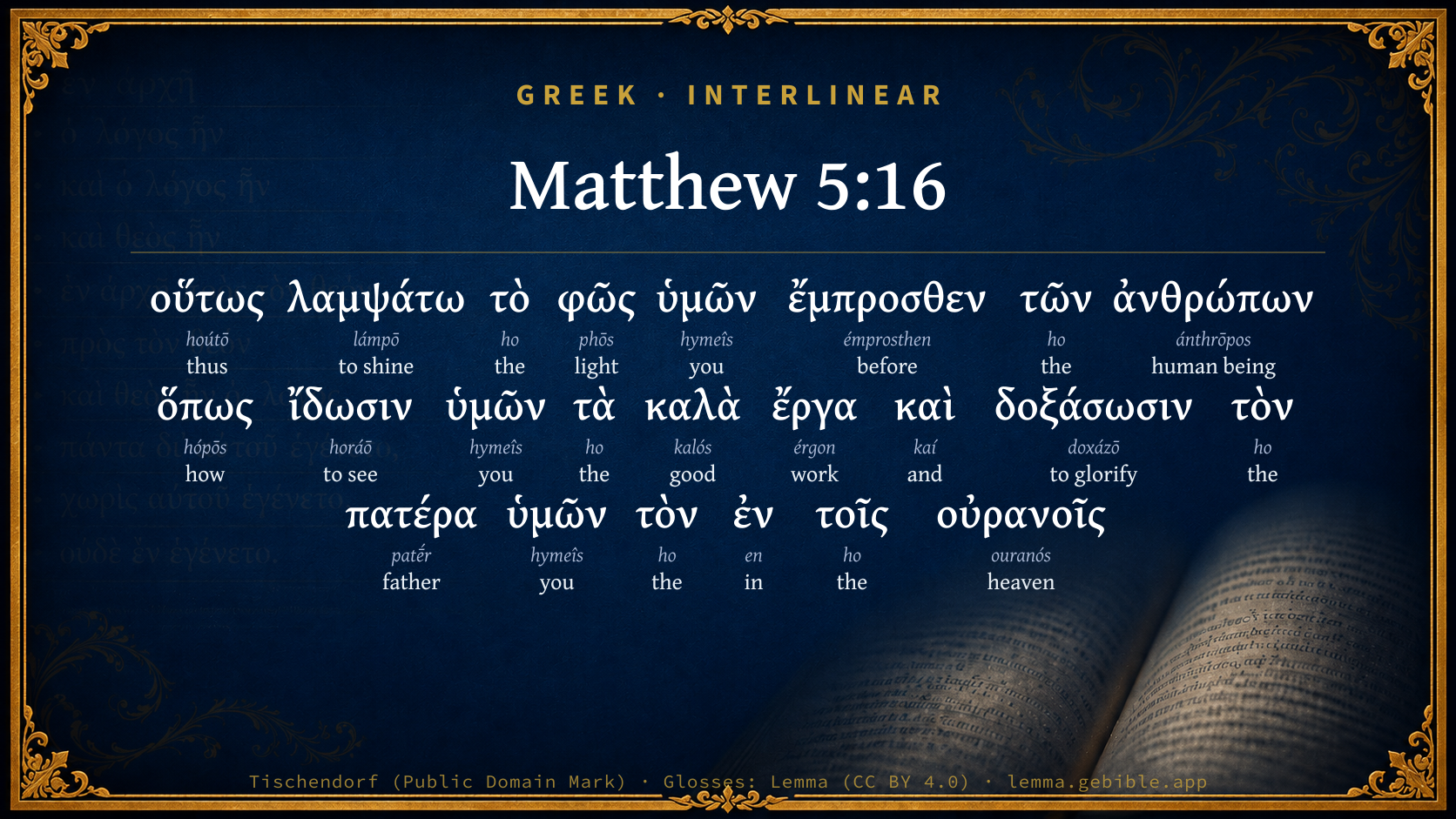
Greek (Tischendorf 8th ed.) Matthew 5:16 appears in the Greek New Testament. The text above is from the Tischendorf 8th edition. Each word links to its Strong’s number and a concise gloss. Click any word for its full Thayer’s Greek Lexicon entry.
Download image
Cite this verse

Matthew 5:16 (World English Bible). Public Domain. Lemma interlinear Bible study tool, https://lemma.gebible.app/v/matthew/5/16.

Show BibTeX & RIS
BibTeX
RIS
English Translation
Even so, let your light shine before men; that they may see your good works, and glorify your Father who is in heaven.
World English Bible · Public Domain
Highlights
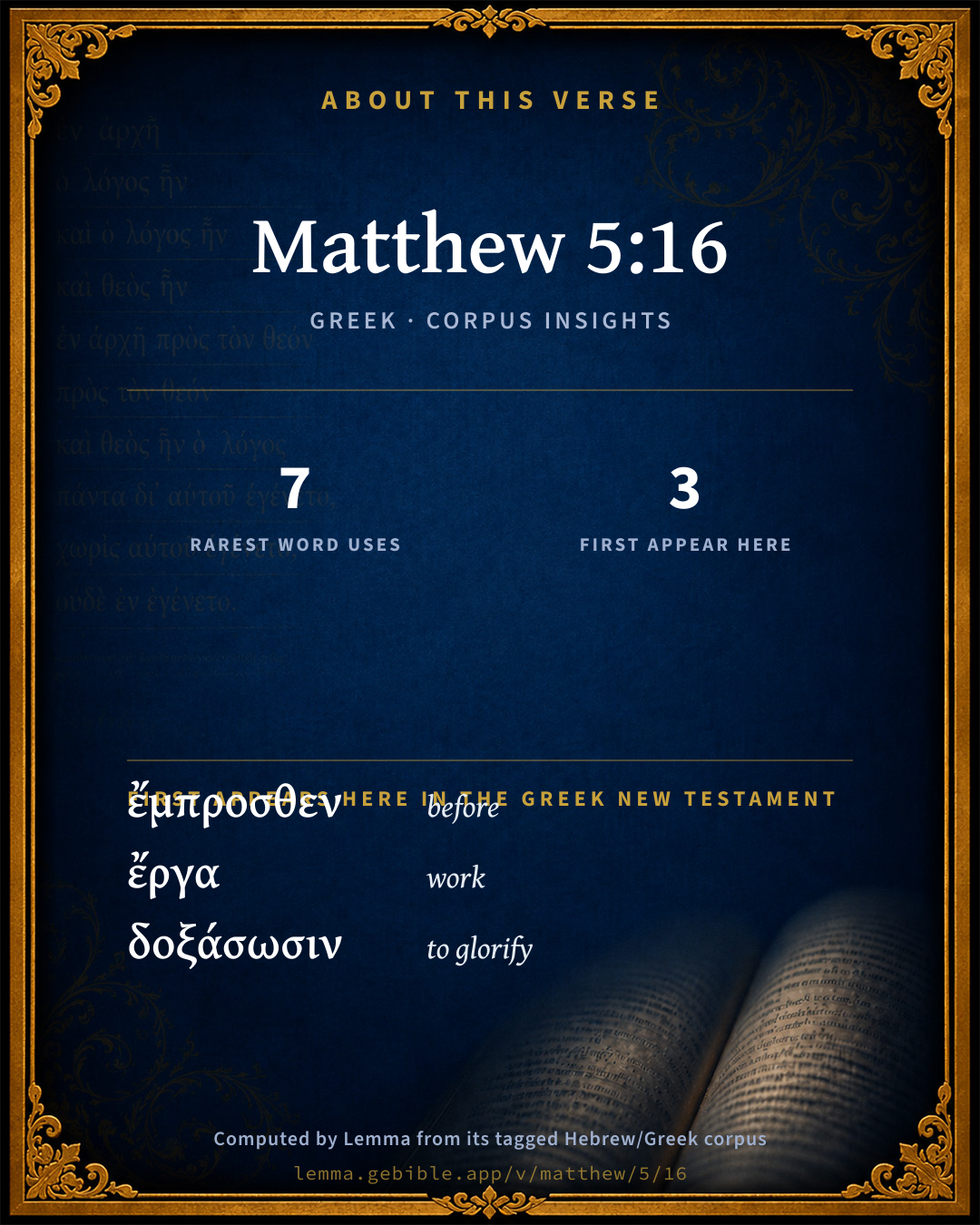
  • 3 first appearances in the Greek New Testament
Full analysis ↓
Download a study sheet

One document with this verse’s original text, its word-by-word gloss line, the meaning frame, cross-references with their text, attributed commentary, and full source and license credits — printable, and it pastes into notes with its structure intact.

This verse Autodidact and up

Study sheet (.html) Plain text (.txt)

A passage Seminary Student

Up to 50 verses in one chapter. A passage sheet keeps up to 6 commentary sources and 12 cross-references per verse, in the order this page ranks them, and says so on the sheet whenever that leaves anything out. Ask for a single verse and you get the Autodidact verse sheet above.

Everything on this page stays free to read, with no account — the sheet is a download of what is already on screen, not access to it.

Want to remove ads? Support Godless Engineer
Compare translations 3

The same verse in 3 English versions, stacked beneath the original-language interlinear above. Click any original word for its lexicon entry.

Each is an independent rendering of the whole verse — the interlinear is not word-aligned to these translations.

Highlighted words mark where these versions differ — a whole-verse word diff, not a word-by-word alignment.

  • World English Bible Public Domain
    Even so, let your light shine before men; that they may see your good works, and glorify your Father who is in heaven.
  • King James Version Public Domain
    Let your light so shine before men, that they may see your good works, and glorify your Father which is in heaven.
  • unfoldingWord Literal Text CC BY-SA 4.0
    Let your light shine before men in such a way so that they might see your good deeds and might glorify your Father in the heavens.

unfoldingWord Literal Text — © unfoldingWord, licensed CC BY-SA 4.0. Word-aligned USFM3 via Door43 (git.door43.org/unfoldingWord/en_ult).

Versions to compare (up to 4)

3 of 4 selected

Show all 19 translations

Every available English version of this verse, each an independent rendering of the whole verse.

  • World English Bible Public Domain
    Even so, let your light shine before men; that they may see your good works, and glorify your Father who is in heaven.
  • Berean Standard Bible Public Domain
    In the same way, let your light shine before men, that they may see your good deeds and glorify your Father in heaven.
  • Majority Standard Bible Public Domain
    In the same way, let your light shine before men, that they may see your good deeds and glorify your Father in heaven.
  • King James Version Public Domain
    Let your light so shine before men, that they may see your good works, and glorify your Father which is in heaven.
  • American Standard Version (1901) Public Domain
    Even so let your light shine before men; that they may see your good works, and glorify your Father who is in heaven.
  • Revised Version (1885) Public Domain
    Even so let your light shine before men, that they may see your good works, and glorify your Father which is in heaven.
  • Geneva Bible (1599) Public Domain
    Let your light so shine before men, that they may see your good workes, and glorifie your Father which is in heauen.
  • Douay-Rheims (1899) Public Domain
    So let your light shine before men, that they may see your good works, and glorify your Father who is in heaven.
  • Young's Literal Translation Public Domain
    so let your light shine before men, that they may see your good works, and may glorify your Father who `is' in the heavens.
  • Literal Standard Version CC BY-SA 4.0
    so let your light shine before men, that they may see your good works, and may glorify your Father who [is] in the heavens.
  • Unlocked Literal Bible CC BY-SA 4.0
    Let your light shine before people in such a way that they see your good deeds and praise your Father who is in heaven.
  • unfoldingWord Literal Text CC BY-SA 4.0
    Let your light shine before men in such a way so that they might see your good deeds and might glorify your Father in the heavens.
  • Darby Bible Public Domain
    Let your light thus shine before men, so that they may see your upright works, and glorify your Father who is in the heavens.
  • World Messianic Bible Public Domain
    Even so, let your light shine before men, that they may see your good works and glorify your Father who is in heaven.
  • Webster's Bible Public Domain
    Let your light so shine before men, that they may see your good works, and glorify your Father who is in heaven.
  • Free Bible Version CC BY-SA 4.0
    In the same way you should let your light shine before everyone so they can see the good things you do and praise your heavenly Father.
  • Bible in Basic English Public Domain
    Even so let your light be shining before men, so that they may see your good works and give glory to your Father in heaven.
  • Text-Critical English NT CC BY 4.0
    Let your light shine before others in such a way that they may see your good works and glorify your Father in heaven.
  • Tyndale New Testament (1534) Public Domain
    Let youre light so shyne before men that they maye se youre good workes and glorify youre father which is in heven.

Literal Standard Version (2020), Covenant Press — licensed CC BY-SA 4.0. Text via the HelloAO Bible API (eBible.org). Unlocked Literal Bible (unfoldingWord) — licensed CC BY-SA 4.0. Text via the HelloAO Bible API (eBible.org). unfoldingWord Literal Text — © unfoldingWord, licensed CC BY-SA 4.0. Word-aligned USFM3 via Door43 (git.door43.org/unfoldingWord/en_ult). Free Bible Version, Dr. Jonathan Gallagher — licensed CC BY-SA 4.0. Text via the HelloAO Bible API (eBible.org).

Word by word

More ways to search: Search by grammar → Find every occurrence → Compare this word →

Practice this passage: Drill this verse → Learn its vocabulary →

λαμψάτω
lámpō
G2989
“to shine”
Verb, Aorist, Active, Imperative, 3rd person, Singular
Part of Speech
Verb
Tense
Aorist
Voice
Active
Mood
Imperative
Person
3rd person
Number
Singular
Full Thayer's Definition

Origin: a primary verb

TDNT: 04:16,5

1. to shine
  1. οὕτως hoútō G3779 “thus” Adverb
  2. τὸ ho G3588 “the” Article, Nominative, Singular, Neuter
  3. φῶς phōs G5457 “light” Noun, Nominative, Singular, Neuter
  4. ὑμῶν hymeîs G5210 “you” Personal pronoun, 2nd person, Genitive, Plural
  5. ἔμπροσθεν émprosthen G1715 “before” Preposition
  6. τῶν ho G3588 “the” Article, Genitive, Plural, Masculine
  7. ἀνθρώπων ánthrōpos G444 “human being” Noun, Genitive, Plural, Masculine
  8. ὅπως hópōs G3704 “how” Adverb
  9. ἴδωσιν horáō G3708 “to see” Verb, Aorist, Active, Subjunctive, 3rd person, Plural
  10. ὑμῶν hymeîs G5210 “you” Personal pronoun, 2nd person, Genitive, Plural
  11. τὰ ho G3588 “the” Article, Accusative, Plural, Neuter
  12. καλὰ kalós G2570 “good” Adjective, Accusative, Plural, Neuter
  13. ἔργα érgon G2041 “work” Noun, Accusative, Plural, Neuter
  14. καὶ kaí G2532 “and” Conjunction
  15. δοξάσωσιν doxázō G1392 “to glorify” Verb, Aorist, Active, Subjunctive, 3rd person, Plural
  16. τὸν ho G3588 “the” Article, Accusative, Singular, Masculine
  17. πατέρα patḗr G3962 “father” Noun, Accusative, Singular, Masculine
  18. ὑμῶν hymeîs G5210 “you” Personal pronoun, 2nd person, Genitive, Plural
  19. τὸν ho G3588 “the” Article, Accusative, Singular, Masculine
  20. ἐν en G1722 “in” Preposition
  21. τοῖς ho G3588 “the” Article, Dative, Plural, Masculine
  22. οὐρανοῖς ouranós G3772 “heaven” Noun, Dative, Plural, Masculine

About this verse

These counts appear in no published source. They are computed here, from the morphology-tagged text and Lemma’s own curated glosses. What Lemma adds →

23
words
16
distinct lemmas
Gospels
section

Notable vocabulary

The rarest word here is λαμψάτω to shine G2989 — appearing just 7 times in the whole Greek New Testament.

First appearance in Scripture

These words make their first canonical appearance in the Greek New Testament here:

  • ἔμπροσθεν before G1715
  • ἔργα work G2041
  • δοξάσωσιν to glorify G1392

Shared distinctive vocabulary

λαμψάτω to shine G2989 occurs in 6 verses of the Greek New Testament. Also found in:
Repetition

Words recur within this verse:

Cross-references

41

Topical passages linked to Matthew 5:16 in the Treasury of Scripture Knowledge — connected by theme and wording, ordered by reader-vote popularity; previews shown in the World English Bible.

  • 1 Peter 2:12 having good behavior among the nations, so in that which they speak against you as evil-doers, they may by your good works, which they see, glorify God in the day of visitation.
  • Titus 2:7 in all things showing yourself an example of good works; in your teaching showing integrity, seriousness, incorruptibility,
  • John 15:8 "In this is my Father glorified, that you bear much fruit; and so you will be my disciples.
  • 1 John 1:5–7 This is the message which we have heard from him and announce to you, that God is light, and in him is no darkness at all.
  • Philippians 2:15–16 that you may become blameless and harmless, children of God without blemish in the midst of a crooked and perverse generation, among whom you are seen as lights in the world,
  • Ephesians 5:8 For you were once darkness, but are now light in the Lord. Walk as children of light,
  • Isaiah 60:1–3 Arise, shine; for your light is come, and the glory of Yahweh is risen on you.
  • 1 Peter 3:16 having a good conscience; that, while you are spoken against as evildoers, they may be disappointed who curse your good manner of life in Christ.
  • 1 Peter 4:14 If you are insulted for the name of Christ, blessed are you; because the Spirit of glory and of God rests on you. On their part he is blasphemed, but on your part he is glorified.
  • Isaiah 58:8 Then shall your light break forth as the morning, and your healing shall spring forth speedily; and your righteousness shall go before you; the glory of Yahweh shall by your rearward.
  • 1 Peter 2:9 But you are a chosen race, a royal priesthood, a holy nation, a people for God's own possession, that you may show forth the excellencies of him who called you out of darkness into his marvelous light:
  • Titus 3:14 Let our people also learn to maintain good works for necessary uses, that they may not be unfruitful.
  • 2 Corinthians 9:13 seeing that through the proof given by this service, they glorify God for the obedience of your confession to the Gospel of Christ, and for the liberality of your contribution to them and to all;
  • Hebrews 10:24 Let us consider how to provoke one another to love and good works,
  • Ephesians 2:10 For we are his workmanship, created in Christ Jesus for good works, which God prepared before that we would walk in them.
  • Proverbs 4:18 But the path of the righteous is like the dawning light, That shines more and more until the perfect day.
  • Romans 13:11–14 Do this, knowing the time, that it is already time for you to awaken out of sleep, for salvation is now nearer to us than when we first believed.
  • 2 Thessalonians 1:10–12 when he comes to be glorified in his saints, and to be admired among all those who have believed (because our testimony to you was believed) in that day.
  • 1 Timothy 6:18 that they do good, that they be rich in good works, that they be ready to distribute, willing to communicate;
  • 1 Peter 4:11 If any man speaks, let it be as it were oracles of God. If any man serves, let it be as of the strength which God supplies, that in all things God may be glorified through Jesus Christ, to whom belong the glory and the dominion forever and ever. Amen.
  • 1 Thessalonians 2:12 to the end that you should walk worthily of God, who calls you into his own Kingdom and glory.
  • 1 Thessalonians 5:6–8 so then let's not sleep, as the rest do, but let's watch and be sober.
  • 1 Timothy 5:25 In the same way also there are good works that are obvious, and those that are otherwise can't be hidden.
  • 1 Peter 3:1 In like manner, wives, be in subjection to your own husbands; so that, even if any don't obey the Word, they may be won by the behavior of their wives without a word;
  • Titus 2:14 who gave himself for us, that he might redeem us from all iniquity, and purify for himself a people for his own possession, zealous for good works.
  • Acts 9:36 Now there was at Joppa a certain disciple named Tabitha, which when translated, means Dorcas. This woman was full of good works and acts of mercy which she did.
  • Matthew 5:45 that you may be children of your Father who is in heaven. For he makes his sun to rise on the evil and the good, and sends rain on the just and the unjust.
  • Titus 3:7–8 that, being justified by his grace, we might be made heirs according to the hope of eternal life.
  • Isaiah 61:3 to appoint to those who mourn in Zion, to give to them a garland for ashes, the oil of joy for mourning, the garment of praise for the spirit of heaviness; that they may be called trees of righteousness, the planting of Yahweh, that he may be glorified.
  • Matthew 6:1–5 "Be careful that you don't do your charitable giving before men, to be seen by them, or else you have no reward from your Father who is in heaven.
  • Luke 11:2 He said to them, "When you pray, say, 'Our Father in heaven, May your name be kept holy. May your Kingdom come. May your will be done on Earth, as it is in heaven.
  • 1 Timothy 2:10 but (which becomes women professing godliness) with good works.
  • Galatians 1:24 And they glorified God in me.
  • 1 Timothy 5:10 being approved by good works, if she has brought up children, if she has been hospitable to strangers, if she has washed the saints' feet, if she has relieved the afflicted, and if she has diligently followed every good work.
  • Titus 3:4 But when the kindness of God our Savior and his love toward mankind appeared,
  • Matthew 23:5 But all their works they do to be seen by men. They make their phylacteries broad, enlarge the fringes of their garments,
  • 1 Corinthians 14:25 And thus the secrets of his heart are revealed. So he will fall down on his face and worship God, declaring that God is among you indeed.
  • Matthew 9:8 But when the multitudes saw it, they marveled and glorified God, who had given such authority to men.
  • Matthew 6:9 Pray like this: 'Our Father in heaven, may your name be kept holy.
  • Matthew 6:16 "Moreover when you fast, don't be like the hypocrites, with sad faces. For they disfigure their faces, that they may be seen by men to be fasting. Most assuredly I tell you, they have received their reward.
  • Matthew 23:9 Call no man on the earth your father, for one is your Father, he who is in heaven.

Cross-references courtesy of OpenBible.info (CC BY 4.0).

Commentary

Notes on Matthew 5:16 from classic Christian and Jewish commentators (each source and its license shown beneath its notes). The classic Christian expositions comment on the surrounding passage and are grouped to its opening verse, so a note may address several verses; the Jewish commentaries on the Tanakh (Rashi and others) are per-verse, so they appear only where the commentator wrote on this verse.

Lemma curates 59 commentaries, every one of them public domain or Creative Commons licensed, each selected and text-cleaned for this edition rather than reprinted as found. About our sources →

Joseph Benson's Commentary

Mat 5:16. Let your light — The light of that doctrine which you receive from me, and the light of your holy conversation, so shine before men — Be so evident and apparent unto men, that they may see your good works, and glorify, &c. — That is, that seeing your good works they may both praise God for sending such a religion into the world, and also, embracing your faith, may imitate your holy example, or may be moved to love and serve God as you do, and thereby to glorify him. Here then our Lord tells us, in plain words, what he intended by the comparison before mentioned.

Joseph Benson's Commentary on the Old and New Testaments (1811–1818) — public domain. Text from a community e-Sword module.

Tyndale Open Study Notes

Tyndale Open Resources

5:16 praise your heavenly Father: Religious hypocrites seek praise for themselves; Jesus’ disciples should seek praise for God (see 1 Pet 2:12).

Tyndale Open Study Notes — © Tyndale Open Resources, licensed CC BY-SA 4.0. Text via the HelloAO Bible API.

Bengel's Gnomon

Johann Albrecht Bengel

Mat 5:16. Ἔμπροσθεν τῶν ἀνθρώπων, before men) sc. all men.—ὅπως, in order that) The force of this particle does not so much refer to the verb ἴδωσιν (they may see) as to δοξάσωσι (may glorify).—ὑμῶν—ἔργα, your works) Your works, not yourselves. The light, not the candle.[181]—τὸν Πατέρα ὑμῶν, your Father) Who has begotten you like unto Himself. In the whole of this address, the Son shows God to us as our Father, and that more richly than all the prophets of old.

[181] So there follows [That men may See] Your Father; not yourselves: comp. ch. Mat 6:2.—Vers. Germ.

Bengel's Gnomon of the New Testament — English translation (T&T Clark, Edinburgh, 1860) — public domain. Text from a community e-Sword module.

Meyer's Critical & Exegetical Commentary

Heinrich August Wilhelm Meyer

Mat_5:16. Οὕτω] like a burning lamp upon its stand.

τὸ φῶς ὑμῶν] the light, of which you are the trusted possessors. This shines before men, if the disciples come forward publicly in their office with fidelity and courage, do not draw back, but spread abroad the gospel boldly and freely.

ὅτως ἴδωσιν ὑμῶν, κ.τ.λ.] that they may see the excellent works done by you. These are not their virtues in general, but, in accordance with the whole context from Mat_5:11, their ministry as faithful to its obligations, their specific works as disciples, which, however, are also of a moral nature.

καὶ δοξάσωσι, κ.τ.λ.] that He has made you fit (2Co_3:5) to perform such works, they must recognise Him as their author; comp. Mat_9:8; 1Pe_2:12. The opposite, Rom_2:24.

τ. πατ. ὑμῶν τ. ἐν τοῖς οὐρ.] see on Mat_6:9. This designation of God, which Christ gives forth from the fundamental standpoint of His gospel, already presupposes instructions previously given to the disciples upon the point. Observe, moreover, that here it is not ὑμῶν which, as formerly, has the emphasis.

Meyer — Critical and Exegetical Commentary on the New Testament — English translation by Peter Christie, edited by Frederick Crombie (T&T Clark, 1880) — public domain. Text from a community e-Sword module.

Expositor's Greek Testament

ed. W. Robertson Nicoll

Mat 5:16 . οὕτω . Do ye as they do in cottage life: apply the parable. λαμψάτω , let your light shine. Don’t use means to prevent it, turning the rare exception of household practice into the rule, so extinguishing your light, or at least rendering it useless. Cowards can always find plausible excuses for the policy of obscuration reasons of prudence and wisdom: gradual accustoming of men to new ideas; deference to the prejudices of good men; avoidance of rupture by premature outspokenness; but generally the true reason is fear of unpleasant consequences to oneself. Their conduct Jesus represents as disloyalty to God ὅπως , etc. The shining of light from the good works of disciples glorifies God the Father in heaven. The hiding of the light means withholding glory. The temptation arises from the fact a stern law of the moral world it is that just when most glory is likely to accrue to God, least glory comes to the light-bearer; not glory but dishonour and evil treatment his share. Many are ready enough to let their light shine when honour comes to themselves. But their “light” is not true heaven-kindled light; their works are not καλὰ , noble, heroic, but πονηρὰ (Mat 7:17 ), ignoble, worthless, at best of the conventional type in fashion among religious people, and wrought often in a spirit of vanity and ostentation. This is theatrical goodness, which is emphatically not what Jesus wanted. Euthy. Zig. says: οὐ κελεύει θεατρίζειν τὴν ἀρετὴν .

Note that here, for the first time in the Gospel, Christ’s distinctive name for God, “Father,” occurs. It comes in as a thing of course. Does it presuppose previous instruction? (So Meyer.) One might have expected so important a topic as the nature and name of God to have formed the subject of a distinct lesson. But Christ’s method of teaching was not scholastic or formal. He defined terms by discriminating use ; Father, e.g. , as a name for God, by using it as a motive to noble conduct. The motive suggested throws light on the name. God, we learn, as Father delights in noble conduct; as human fathers find joy in sons who acquit themselves bravely. Jesus may have given formal instruction on the point, but not necessarily. This first use of the title is very significant. It is full , solemn, impressive: your Father, He who is in the heavens; so again in Mat 5:45 . It is suggestive of reasons for faithfulness, reasons of love and reverence. It hints at a reflected glory, the reward of heroism. The noble works which glorify the Father reveal the workers to be sons. The double-sided doctrine of this logion of Jesus is that the divine is revealed by the heroic in human conduct, and that the moral hero is the true son of God. Jesus Himself is the highest illustration of the twofold truth.

The Expositor's Greek Testament, edited by W. Robertson Nicoll (1897–1910) — public domain. Text from a community e-Sword module.

Jamieson, Fausset & Brown

Robert Jamieson, A. R. Fausset & David Brown

Let your light so shine before men, that they may see your good works, and glorify your Father which is in heaven--As nobody lights a lamp only to cover it up, but places it so conspicuously as to give light to all who need light, so Christians, being the light of the world, instead of hiding their light, are so to hold it forth before men that they may see what a life the disciples of Christ lead, and seeing this, may glorify their Father for so redeeming, transforming, and ennobling earth's sinful children, and opening to themselves the way to like redemption and transformation.

Jamieson, Fausset & Brown — Commentary Critical and Explanatory on the Whole Bible (1871) — public domain (CC PDM 1.0). Text via the HelloAO Bible API.

Adam Clarke's Commentary

Verse 16. Let your light so shine] Or more literally, Thus let your light shine, ουτω λαμψατω το φως. As the sun is lighted up in the firmament of heaven to diffuse its light and heat freely to every inhabitant of the earth; and as the lamp is not set under the bushel, but placed upon the lamp-stand that it may give light to all in the house; THUS let every follower of Christ, and especially every preacher of the Gospel, diffuse the light of heavenly knowledge, and the warmth of Divine love through the whole circle of their acquaintance.

That they may see your good works] It is not sufficient to have light - we must walk in the light, and by the light. Our whole conduct should be a perpetual comment on the doctrine we have received, and a constant exemplification of its power and truth.

And glorify your Father] The following curious saying is found in Bammidbar Rabba, s. 15. "The Israelites said to the holy blessed God, Thou commandest us to light lamps to thee; and yet thou art the, Light of the world, and with thee the light dwelleth. The holy blessed God answered, I do not command this because I need light; but that you may reflect light upon me, as I have illuminated you: - that the people may say, Behold, how the Israelites illustrate him, who illuminates them in the sight of the whole earth." See more in Schoettgen. Real Christians are the children of God - they are partakers of his holy and happy nature: they should ever be concerned for their Father's honour, and endeavour so to recommend him, and his salvation, that others may be prevailed on to come to the light, and walk in it. Then God is said to be glorified, when the glorious power of his grace is manifested in the salvation of men.

Adam Clarke's Commentary on the Bible (1810–1826) — public domain. Text from a community e-Sword/MySword module.

Ellicott's Commentary for English Readers

(16) Let your light so shine.—The English form of the sentence is somewhat misleading, or at least ambiguous. It is not simply, Let your light so shine that men may glorify; but, “Thus, like the lamp on its stand, let your light shine. . . .” The motive to publicity is, however, the direct opposite of the temper which led the Pharisee to his ostentatious prayers and almsgiving; not “to be seen of men,” and win their praise, but to win men, through our use of the light which we know to be not our own, to glorify the Giver of the light. We have at least a partial fulfilment of the command in the impression made on the heathen world by the new life of the Church when they confessed, in spite of all prejudices, “See how these Christians love one another.”

Your Father which is in heaven.—The name was in common use among devout Jews, but its first occurrence in our Lord’s teaching deserves to be noted. The thought of God as a Father was that which was to inspire men not only when engaged in prayer (Mat_6:9), but in the activity of obedience. (See Note on Mat_6:9.)

A Bible Commentary for English Readers, edited by Charles John Ellicott (1878–1897) — public domain. Text from a community e-Sword module.

The Cambridge Bible for Schools and Colleges

gen. ed. J. J. S. Perowne

16. Let your light so shine …] The word translated “shine” is rendered “giveth light” in the preceding verse. It would be better to use the same English word in both cases. So = “in like manner.” That is final, not consecutive = ‘in order that.’

The Cambridge Bible for Schools and Colleges (gen. ed. J. J. S. Perowne; Cambridge University Press, 1878–1918) — public domain. Text from a community e-Sword module.

John Gill's Exposition

Let your light so shine before men,.... Here Christ applies the foregoing simile to his disciples, and more fully opens the meaning and design of it. His sense is this; that the light of the Gospel, which he had communicated to them, the spiritual knowledge of the mysteries of grace, which he had favoured them with, were to be openly declared, and made manifest before men. Light was not given merely for their own private use, but for the public good of mankind; and therefore, as they were placed as lights in the world, they were to hold forth, in the most open and conspicuous manner, the word of light and life:

that they may see your good works: meaning their zeal and fervency; their plainness and openness; their sincerity, faithfulness, and integrity; their courage and intrepidity; their diligence, industry, and indefatigableness in preaching the Gospel; their strict regard to truth, the honour of Christ, and the good of souls; as also their very great care and concern to recommend the doctrines of grace, by their example in their lives and conversations:

and glorify your Father which is in heaven; that is, that when the ministration of the Gospel has been blessed, for the illumination of the minds of men, to a thorough conviction of their state; and for their regeneration, conversion, sanctification, and comfort; they may give praise to God, and bless his name for qualifying and sending such Gospel ministers to show unto them the way of salvation; and that the word has been made useful to them for communicating spiritual light, life, joy, and comfort, , "Our and your Father which is in heaven", is a name, appellation, or periphrasis of God, frequently used by Jewish writers (s); and is often expressed by Christ in these his sermons on the mount.

(s) Vid. Misn. Sota, c. 9. sect. 15. & Yoma, c. 8. sect. 9.

John Gill's Exposition of the Whole Bible (1746–1763) — public domain (CC PDM 1.0). Text via the HelloAO Bible API.

Trapp's Complete Commentary

John Trapp

16 Let your light so shine before men, that they may see your good works, and glorify your Father which is in heaven.

Ver. 16. Let your light so shine before men] We use to hang the picture of a dear friend in a conspicuous place, that it may appear we rejoice in it, as an ornament to us: so should we the image of Christ, and his graces. And as pearls, though formed and found in the water, are like the heavens in clearness, so should all, but especially ministers: their faces should shine, as Moses when he came from the mount; their feet should be beautiful, Rom 10:15; their mouths (as heaven in the Revelation) should never open, but some great matter should follow; their lives should be, as one speaketh of Joseph’s life, coelum quoddam lucidissimis virtulum stellis exornatum, a very heaven sparkling with variety of virtues, as with so many bright stars. (Bucholcer.) The high priest of the law came forth to the people in habit more like a god than a man. Os humerosque Deo similis. (Virgil.) And Alexander the Great took him for no less, but fell at his feet, meeting him upon his way to Jerusalem. There are those who hold, that by his linen he was taught purity; by his shash, discretion; by his embroidered coat, heavenly conversation; by his golden bells, sound doctrine; by his ponmgranates, fruitfulness in good works; by his shoulder pieces, patience in bearing other men’s infirmities; by his breastplate, continual care of the Church; by his mitre, a right intention; and by the golden plate upon it, a bold and wise profession of "Holiness to the Lord." The apostle also is exact in forming a minister of the gospel, 1Ti 3:2-4: for he must be, 1. "Blameless" (αντπιληπτος), such as against whom no just exception can be laid. 2. "Vigilant" (νηφαλεος), pale and wan again with watching and working. 3. "Sober" (σωφρων), or temperate, one that can contain his passions, master his own heart, and keep a mean. 4. "Modest" (κοσμιος), neat and comely in his bodily attire, neither curious nor careless thereof, but venerable in all his behaviour; and one that keepeth a fit decorum in all things. 5. "Hospitable" (φιλοξενος), and harbourous. Quicquid habent Clerici, pauperum est, saith Jerome. 6. "Able and apt to teach" (διδακτικος), as Bishop Ridley, Dr Taylor, and Mr Bradford, who preached every Sunday and holiday ordinarily; and as Chrysostom, Origen, and some others, who preached every day in the week. 7. "Not given to wine" (παροινος), no ale stake, as those drunken priests, the two sons of Aaron, who died by the fire of God, for coming before him with strange fire, Lev 10:2-20. "No striker" (πληκτης), neither with hand nor tongue, to the just grief or disgrace of any. 9. "Not greedy of filthy lucre" (αισχροκερδης), so as to get gain by evil arts; but honest, plain dealing; and (as it follows in the text) pae tient, or equanimous, easily parting with his right for peace’ sake (επιεικης, Arist. Ethic. 5. 10), and ever preferring equity before extremity of law. 10. "Not a brawler" (αμαχος), or connnon barrator, a wrangler, as Ishmael. 11. "Not covetous," not doting on his wealth, or trusting to his wedge. Not without money, but without the love of money. The apostle here distinguisheth, "greedy of filthy lucre" (αφιλαργυρος), which is in getting, from covetousness, which consists in pinching and saving. 12. "One that ruleth well in his own house," &c. For the children’s faults reflect upon the parents, and the servant’s sin is the master’s shame. Besides, every man is that in religion that he is relatively; and so much true goodness he hath as he showeth at home. 13. "Not a novice" (νεοφυτος), a young scholar, rude and ungrounded; or a tender young plant in Christianity, as the word signifieth, that may be bent any way, but a well grown oak, stable and steady. 14. Lastly, "he must have a good report of them which are without;" which he cannot but have, if qualified as above said, 1Ti 3:7. The same God which did at first put an awe of man in the fiercest creatures, hath stamped in the cruelest hearts an awful respect to his faithful ministers: so as even they that hate them cannot choose but honour them, as Saul did Samuel, Darius Daniel, Nebuchadnezzar the three worthies. Natural conscience cannot but stoop and do homage to God’s image fairly stamped upon the natures and works of his people. So that when men see in such that which is above the ordinary strain and their own expectation, their hearts ache within them many times; and they stand much amazed at the height of their spirits and the majesty that shines in their faces. Either they are convinced, as Nebuchadnezzar, Darius, and Diocletian, who laid down the empire out of a deep discontent and despair of ever conquering the constancy of Christians by any bloody persecution; or, which is better, they are converted, and seeing such good works, they glorify God our heavenly Father, as Justin Martyr, who confesseth of himself, that by beholding the Christians’ piety in life and patience in death (ορων δε αφοβους προς θανατον), he gathered their doctrine to be the truth, and glorified God in the day of his visitation. For there is no Christian, saith Athenagoras in his Apology to the Heathens, that is not good, unless he be a hypocrite, and a pretender only to religion. (ουδεις χριστιανος πονηρος, ει μη υποκρινηται τον λογον.) Vere magnus est Deus Christianorum, said one Calocerius, a heathen, beholding the sufferings of the primitive martyrs. And it is reported of one Cecilia, a virgin, that by her constance and exhortations before and at her martyrdom, four hundred were converted Chrysostom calls good works unanswerable syllogisms, invincible demonstrations to confute and convert pagans. Julian the Apostate could not but confess, Quod Christiana religio propter Christianorum erga omnes beneficentiam propagata est: Christian religion spread by the holiness of those who professed it. Bede mentioneth one Alban, who receiving a poor persecuted Christian into his house, and seeing his holy and devout carriage, was so much affected therewith, as that he became an earnest professor of the faith, and in the end a glorious martyr for the faith.

John Trapp, A Commentary or Exposition upon All the Books of the Old and New Testament (1647–1656) — public domain. Text from a community e-Sword module.

Albert Barnes' Notes on the Bible

Let your light so shine ... - Let your holy life, your pure conversation, and your faithful instructions, be everywhere seen and known. Always, in all societies, in all business, at home and abroad, in prosperity and adversity, let it be seen that you are real Christians.

That they may see your good works - The proper motive to influence us is not simply that we may be seen (compare Mat 6:1), but it should be that our heavenly Father may be glorified. The Pharisees acted to be seen of men, true Christians act to glorify God, and care little what people may think of them, except as by their conduct others may he brought to honor God, yet they should so live that people may see from their conduct what is the proper nature of their religion.

Glorify your Father - Praise, or honor God, or be led to worship him. Seeing in your lives the excellency of religion, and the power and purity of the gospel, they may be won to be Christians also, and give praise and glory to God for his mercy to a lost world.

We learn here:

1.That religion, if it exists, cannot be concealed.

2.That where it is not manifest in the life, it does not exist.

3.That “professors” of religion, who live like other people, give evidence that they have never been truly converted.

4.That to attempt to conceal or hide our Christian knowledge or experience is to betray our trust, injure the cause of piety, and to render our lives useless. And,

5.That good actions will be seen, and will lead people to honor God. If we have no other way of doing good - if we are poor, and unlearned, and unknown yet we may do good by our lives. No sincere and humble Christian lives in vain. The feeblest light at midnight is of use.

“How far the little candle throws his beams!

So shines a good deed in a naughty world!”

Albert Barnes' Notes on the Bible (1834–1885) — public domain. Text from a community e-Sword/MySword module.

Matthew Poole's English Annotations

Our Saviour now plainly tells us what he intended by the comparisons before mentioned. Let the light of that doctrine which you receive from me, and the light of your holy conversation, (the latter by the following words seemeth to be here principally intended),

so shine before men, be so evident and apparent unto men,

that they may see your good works; all sorts of good works, whatsoever I have commanded or shall command you; and as I command you, and in obedience to such commands, otherwise they are no good works;

and glorify your Father which is in heaven. You are not in your good actions to aim at yourselves, to be seen of men, as Mat 6:1, nor merely at doing good to others; good works are to be maintained for necessary uses, Tit 3:14, but having a primary, and principal respect to the glorifying of your Father; for, Joh 15:8, Herein is my Father glorified, if ye bear much fruit: not that we can add any thing to God’s essential glory, but we may predicate and manifest his glory; which how we can do by good works, if they proceed from mere power and liberty of our own wills, not from his special efficacious grace, is hard to understand. Our Father is said to be in heaven, because, though his essential presence filleth all places, yet he is pleased there, more than any where, to manifest his glory and majesty.

Matthew Poole's English Annotations on the Holy Bible (1683–1685) — public domain. Text from a community e-Sword/MySword module.

Whedon's Commentary on the Bible

Daniel D. Whedon

16. Let your light shine — While you indulge no ostentation to win applause for yourself, it is your duty so to manifest the clearness of your good works as that men may honour the Gospel. And glorify your Father — Do nothing to glorify yourself, but everything to get glory to God by honouring the Gospel. The illumination of the candle is not for itself, but for the master whose house it illumines.

Men should not wish their donations to a Church or to a charity to be published, for the reputation of it, but in order that the Gospel should have the credit of it, and that others may be influenced to like liberality by the example.

Daniel D. Whedon (gen. ed.), Commentary on the Old and New Testaments (1874–1909) — public domain. Text from a community e-Sword module.

The Pulpit Commentary

Matthew only. Let your light so shine; even so let your light shine (Revised Version); outwv lamqa fwv umwn . The Revised Version (cf. Rheims) does away with the misinterpretation suggested by the Authorized Version, "so that," for outwv refers solely to the method of shining spoken of in ver. 15, "like a burning lamp upon its stand" (Meyer). Our Lord has here no thought of effort in shining, such as may improve the brightness of the light given, or of illuminating others, but of not concealing what light the disciples have. (For a similar outwv , cf. 1Co_9:24) Yet remember, "A lamp for one is a lamp for a hundred" (Talm. Bab., "Sabb.," 122 a) and "Adam was the lamp of the world" (Talm. Jeremiah, "Sabb.," 2:4 a play on Pro_20:27) Your light. Either genitive of apposition, the light which you are (Achelis), of. ver. 14; or genitive of possession, the light of which you are the trusted possessors (Meyer, Weiss). The latter is preferable, as the disciples have, in ver. 15, been compared to the lamp, i.e. the light-bearer. Before men (emprosyen twn anyrwpwn ). More than enwpion , "in presence of," for the position of the lamp "in front of" the people is what our Lord is here emphasizing. (cf. Joh_12:37) That they may see your good works (umwn ta kala erga). Your. Three times in this verse. Our Lord lays stress on personal possession of light, personal action, personal relationship and origin. Good works; i.e. of your lives generally (Weiss-Meyer), not ministerially (Mever). Noble works, works which by their generous and attractive character win the natural admiration of men". (Bishop Westcott, Heb_10:24) And glorify. This is actually done in Mat_9:8 Mat_15:31. St. Peter"s language (1Pe_2:12) is probably due to a reminiscence of our Lord"s words. Your Father which is in heaven. The Fatherhood of God is here predicated in a special sense of the disciples, in the same way as the Fatherhood of God is, in the Old Testament, always connected with his covenant relation to his people as a nation. (cf. Isa_63:16 Isa_64:8 Jer_3:4 Deu_32:6) Our Lord here is not thinking of the original relation of God to being and especially to humanity, in virtue of man"s creation in the Divine image (o pathr), but of the relation into which the disciples have entered through the revelation of God in Christ; cf. further Bishop Westcott, on Joh_4:21 (Add. Note) and on 1Jn_1:2 (Add. Note); also Weiss, "Life," 2:348. The phrase, which occurs here for the first time in St. Matthew (but cf. ver. 9, note), henceforth occurs frequently, becoming of great importance for this Gospel. (cf. vers. 45, 48 Mat_6:1, Mat_6:9, etc.)

The Pulpit Commentary (1880–1919), ed. H.D.M. Spence-Jones & Joseph S. Exell — public domain. Text from a community e-Sword module.

John Wesley's Explanatory Notes

That they may see - and glorify - That is, that seeing your good works, they may be moved to love and serve God likewise.

John Wesley, Explanatory Notes Upon the Whole Bible (1754–1765) — public domain. Text via the GEBible commentary corpus.

Kretzmann's Popular Commentary

Paul E. Kretzmann

Jesus Himself applies the parable:

v. 16. Let your light so shine before men that they may see your good works, and glorify your Father which is in heaven.

The policy of obscuration, of hiding beliefs and convictions, is often urged by lukewarm Christians, so-called "reasons of prudence and wisdom: gradual accustoming of men to new ideas; deference to the prejudices of good men; avoidance of rupture by premature outspokenness; but generally the true reason is fear of unpleasant consequences to oneself. " To think and act thus is deliberate disloyalty to Christ. Your light, given to you from above, not to be used according to expediency, but to shine; your light, not you, the object being not to make your person prominent, but your Christianity. The Christians, individually and collectively, should perform this task as their steady work. For the light which shall be thrown out from them in every direction, before all men, consists in their good works, the fruits of their regeneration, the proof of their being illuminated by Jesus. These should be seen by the people for a definite reason. All men that come in contact with their works shall be forced to draw conclusions as to the power that inspires them. And so the glory, the honor will be placed where it properly and exclusively belongs, will be given to the Father in heaven. This fact renders the admonition urgent by giving to it its real basis. Faith is the lamp; love is the light; the good works are the illumination. As little as the lamp can pride itself upon its light, so little can the Christians glory in their good works; all glory must be God’s.

Paul E. Kretzmann, Popular Commentary of the Bible (1921–1924) — public domain. Text from a community e-Sword module.

The People's New Testament

B. W. Johnson

16. Even so, let your light shine. Like the city set on a hill, or the lighted lamp on a stand. We are told, 1. To let our light shine. 2. Before men. 3. By good works. 4. That they may glorify the Father in heaven. Christ is the Light; we will shine reflected light if we walk in his light. If we give forth light it will honor God.

B. W. Johnson's The People's New Testament with Notes (1889–1891) — public domain. Electronic text from the Christian Classics Ethereal Library (CCEL) ThML edition.

Alford’s Greek Testament

Henry Alford

16. οὕτως] i.e. like a candle on a candlestick—like a city on a hill; not οὕτως, ὅπως, ‘so … that,’ as our English version seems rather to imply. By rendering οὕτως in like manner, the ambiguity will be avoided. See ref., and note there. The sense of this verse is as if it were ὅπως, ἰδόντες ὑμῶν τ. κ. ἔργ. δοξάσωσιν τ. π. ὑ … the latter verb, and not the former, carrying the purpose of the action. Thus the praise and glory of a well-lighted and brilliant feast would be given, not to the lights, but to the master of the house; and of a stately city on a hill, not to the buildings, but to those who built them. The whole of this division of our Lord’s sermon is addressed to all His followers, not exclusively to the ministers of his word. All servants of Christ are the salt of the earth, the light of the world (Php 2:15). And all that is here said applies to us all. But à fortiori does it apply, in its highest sense, to those who are, among Christians, selected to teach and be examples; who are as it were the towers and pinnacles of the city, not only not hid, but seen far and wide above the rest.

Henry Alford, The Greek Testament (1849–1861) — public domain. Text from a community e-Sword module.

International Critical Commentary

(L) 16. So let your light shine before men, that they may see your good works, and glorify your Father who is in the heavens.]

λυχνία] a word of the later Greek writers for the Attic λυχνίον. It is used in the LXX., Joseph., Luc., Philo, Galen, but was an old vernacular word. Cf. Kennedy, Sources, 40.

16. τὸν πατέρα ὑμῶν τὸν ἐν τοῖς οὐρανοῖς] The phrase is characteristic of Mt. See Introduction, p. lvi. It occurs besides only in Mar 11:25, cf. Luk 11:13. As early as the books of Wisdom and Ecclesiasticus we find Israelites addressing God as “Father”; cf. Wis 2:16, 14:3, Ecclus 23:1. 4 “O Lord, Father and Master of my life”; and the idea of God as Father of the nation had been familiar from very primitive times. For examples from the later literature, cf. To 13:4 “our Father,” Jub 1:24 “their Father,” 3 Mac 5:7 “their merciful God and Father.” The term “Father in heaven” is not infrequent in the Rabbinical literature; cf. Mechilta (Ugol.) 397: “my Father who is in heaven”; 331: “their Father who is in heaven”; Siphri (Ugol.) 871: “his Father who is in heaven”; Aboth 5:22 “Jehuda ben Tema said, Be … strong as a lion to do the will of thy Father who is in heaven”; Sotah, ix. 15 (49b): “Upon whom shall we lean? Upon our Father who is in heaven”; Rosh ha-Shana, iii. 8 (29a): “As often as the Israelites directed their heart towards their Father who is in heaven they were strong”; Shabbath 116a, Joma, viii. 9 (85b), Pesikta (Wünsche), pp. 228, 238; Vayyikra R. (Wünsche), p. 222; Siphri (Ugol.) 593. These examples carry us back to the beginning of the second cent. a.d., for the speaker in the last case is Simeon ben Jochai, who lived c. 130 a.d.1 Cf. Bacher, Ag. d. Tann. ii. 70 ff. For the phrase in Jewish literature, see Dalm. Words, pp. 184 ff. Bousset, Rel. Jud. p. 357, sees in the phrase a possible influence of Christianity upon Judaism; cf. Bischoff, Jesu und die Rabbinen, p. 74. But it is not improbable that the phrase was already current in Palestine at the time of Christ.

International Critical Commentary — older volumes (1896–1929), various authors — public domain. Text from a community e-Sword module.

Vincent's Word Studies in the New Testament

Marvin R. Vincent

So shine [ουτως] . Often misconceived, as if the meaning were "Let your light shine in such a way that men may see," etc. Standing at the beginning of the sentence, it points back to the illustration just used. "So," even as that lamp just mentioned, let your light shine. Wycliffe has apparently caught this correct sense : So shine your light before men.

Marvin R. Vincent, Word Studies in the New Testament (1887–1900) — public domain. Text from a community e-Sword/MySword module.

Lesson kit

Teaching starters — assembled from the data on this page, not authored interpretation. Every prompt links to the verse data it draws on. Edit before teaching.

Matthew, in the Gospels, opens this verse with 23 words (16 distinct Greek lemmas). Its most distinctive word is lámpō (“to shine”). A historical commentator’s framing appears above. Read the whole chapter for the surrounding context.

Discussion questions

  1. What does “to shine” (lámpō) contribute to the verse as a whole?
  2. 3 words here appear for the first time in Scripture. What is being introduced at this debut?
  3. Matthew 5:15 shares the word «to shine» with this verse. How do the two illuminate each other?
  4. “the” occurs 6× in this one verse. What is the effect of the repetition?
  5. The translations on this page render this verse differently — a whole-verse word diff, not a word-by-word alignment. What might account for the different wordings?
  6. Reading how Joseph Benson's Commentary and Tyndale Open Study Notes read this verse, where do the two commentators agree and where do they part?

Things to notice

  • 3 words make their first canonical appearance in Scripture here.
  • These translations choose different wording for 11 words in this verse.
  • “the” occurs 6× in this single verse.
  • 16 distinct Greek lemmas span 23 words in this verse.

Reading settings

Reading text

Shown beneath each verse's original-language words.

Old Testament
Old Testament edition

Read the OT as the Masoretic Hebrew (MT) or the Greek Septuagint (LXX).

English shown for the Greek Septuagint (in the Hebrew ↔ Greek comparison).

Comparing translations? Open the Compare panel on any verse page to stack up to four side by side.