John 8:41

Greek (Tischendorf 8th ed.) John 8:41 appears in the Greek New Testament. The text above is from the Tischendorf 8th edition. Each word links to its Strong’s number and a concise gloss. Click any word for its full Thayer’s Greek Lexicon entry.
Download image
Cite this verse

John 8:41 (World English Bible). Public Domain. Lemma interlinear Bible study tool, https://lemma.gebible.app/v/john/8/41.

Show BibTeX & RIS
BibTeX
RIS
English Translation
You do the works of your father." They said to him, "We were not born of sexual immorality. We have one Father, God."
World English Bible · Public Domain
Download a study sheet

One document with this verse’s original text, its word-by-word gloss line, the meaning frame, cross-references with their text, attributed commentary, and full source and license credits — printable, and it pastes into notes with its structure intact.

This verse Autodidact and up

Study sheet (.html) Plain text (.txt)

A passage Seminary Student

Up to 50 verses in one chapter. A passage sheet keeps up to 6 commentary sources and 12 cross-references per verse, in the order this page ranks them, and says so on the sheet whenever that leaves anything out. Ask for a single verse and you get the Autodidact verse sheet above.

Everything on this page stays free to read, with no account — the sheet is a download of what is already on screen, not access to it.

Want to remove ads? Support Godless Engineer
Compare translations 3

The same verse in 3 English versions, stacked beneath the original-language interlinear above. Click any original word for its lexicon entry.

Each is an independent rendering of the whole verse — the interlinear is not word-aligned to these translations.

Highlighted words mark where these versions differ — a whole-verse word diff, not a word-by-word alignment.

  • World English Bible Public Domain
    You do the works of your father." They said to him, "We were not born of sexual immorality. We have one Father, God."
  • King James Version Public Domain
    Ye do the deeds of your father. Then said they to him, We be not born of fornication; we have one Father, even God.
  • unfoldingWord Literal Text CC BY-SA 4.0
    You do the works of your father.” Then they said to him, “We have not been born from sexual immorality; we have one Father: God.”

unfoldingWord Literal Text — © unfoldingWord, licensed CC BY-SA 4.0. Word-aligned USFM3 via Door43 (git.door43.org/unfoldingWord/en_ult).

Versions to compare (up to 4)

3 of 4 selected

Show all 19 translations

Every available English version of this verse, each an independent rendering of the whole verse.

  • World English Bible Public Domain
    You do the works of your father." They said to him, "We were not born of sexual immorality. We have one Father, God."
  • Berean Standard Bible Public Domain
    You are doing the works of your father.” “We are not illegitimate children,” they declared. “Our only Father is God Himself.”
  • Majority Standard Bible Public Domain
    You are doing the works of your father.” “We are not illegitimate children,” they declared. “Our only Father is God Himself.”
  • King James Version Public Domain
    Ye do the deeds of your father. Then said they to him, We be not born of fornication; we have one Father, even God.
  • American Standard Version (1901) Public Domain
    Ye do the works of your father. They said unto him, We were not born of fornication; we have one Father, `even' God.
  • Revised Version (1885) Public Domain
    Ye do the works of your father. They said unto him, We were not born of fornication; we have one Father, even God.
  • Geneva Bible (1599) Public Domain
    Ye do the workes of your father. Then said they to him, We are not borne of fornication: we haue one Father, which is God.
  • Douay-Rheims (1899) Public Domain
    You do the works of your father. They said therefore to him: We are not born of fornication: we have one Father, even God.
  • Young's Literal Translation Public Domain
    ye do the works of your father.' They said, therefore, to him, `We of whoredom have not been born; one Father we have -- God;'
  • Literal Standard Version CC BY-SA 4.0
    you do the works of your father.” They said, therefore, to Him, “We have not been born of whoredom; we have one Father—God”;
  • Unlocked Literal Bible CC BY-SA 4.0
    You do the works of your father.” They said to him, “We were not born in sexual immorality; we have one Father: God.”
  • unfoldingWord Literal Text CC BY-SA 4.0
    You do the works of your father.” Then they said to him, “We have not been born from sexual immorality; we have one Father: God.”
  • Darby Bible Public Domain
    Ye do the works of your father. They said [therefore] to him, We are not born of fornication; we have one father, God.
  • World Messianic Bible Public Domain
    You do the works of your father.” They said to him, “We were not born of sexual immorality. We have one Father, God.”
  • Webster's Bible Public Domain
    Ye do the deeds of your father. Then said they to him, We are not born of fornication; we have one Father, even God.
  • Free Bible Version CC BY-SA 4.0
    You're doing what your father does.” “Well we are not illegitimate,” they responded. “God alone is our father!”
  • Bible in Basic English Public Domain
    You are doing the works of your father. They said to him, We are true sons of Abraham; we have one Father, who is God.
  • Text-Critical English NT CC BY 4.0
    You are doing the works of your father.” They said to him, “We were not born of fornication. We have one Father—God.”
  • Tyndale New Testament (1534) Public Domain
    Iesus sayde vnto them: yf God were youre father then wolde ye love me. For I proceaded forthe and come from God. Nether came I of my selfe but he sent me.

Literal Standard Version (2020), Covenant Press — licensed CC BY-SA 4.0. Text via the HelloAO Bible API (eBible.org). Unlocked Literal Bible (unfoldingWord) — licensed CC BY-SA 4.0. Text via the HelloAO Bible API (eBible.org). unfoldingWord Literal Text — © unfoldingWord, licensed CC BY-SA 4.0. Word-aligned USFM3 via Door43 (git.door43.org/unfoldingWord/en_ult). Free Bible Version, Dr. Jonathan Gallagher — licensed CC BY-SA 4.0. Text via the HelloAO Bible API (eBible.org).

Word by word

More ways to search: Search by grammar → Find every occurrence → Compare this word →

Practice this passage: Drill this verse → Learn its vocabulary →

πορνείας
porneía
G4202
“sexual immorality”
Noun, Genitive, Singular, Feminine
Part of Speech
Noun
Case
Genitive
Number
Singular
Gender
Feminine
Full Thayer's Definition

Origin: from G4203

TDNT: 15:39,9

1. illicit sexual intercourse a. adultery, fornication, homosexuality, lesbianism, intercourse with animals etc. b. sexual intercourse with close relatives; Lev. 18 c. sexual intercourse with a divorced man or woman; Mk. 10:11 , 2. metaph. the worship of idols a. of the defilement of idolatry, as incurred by eating the sacrifices offered to idols
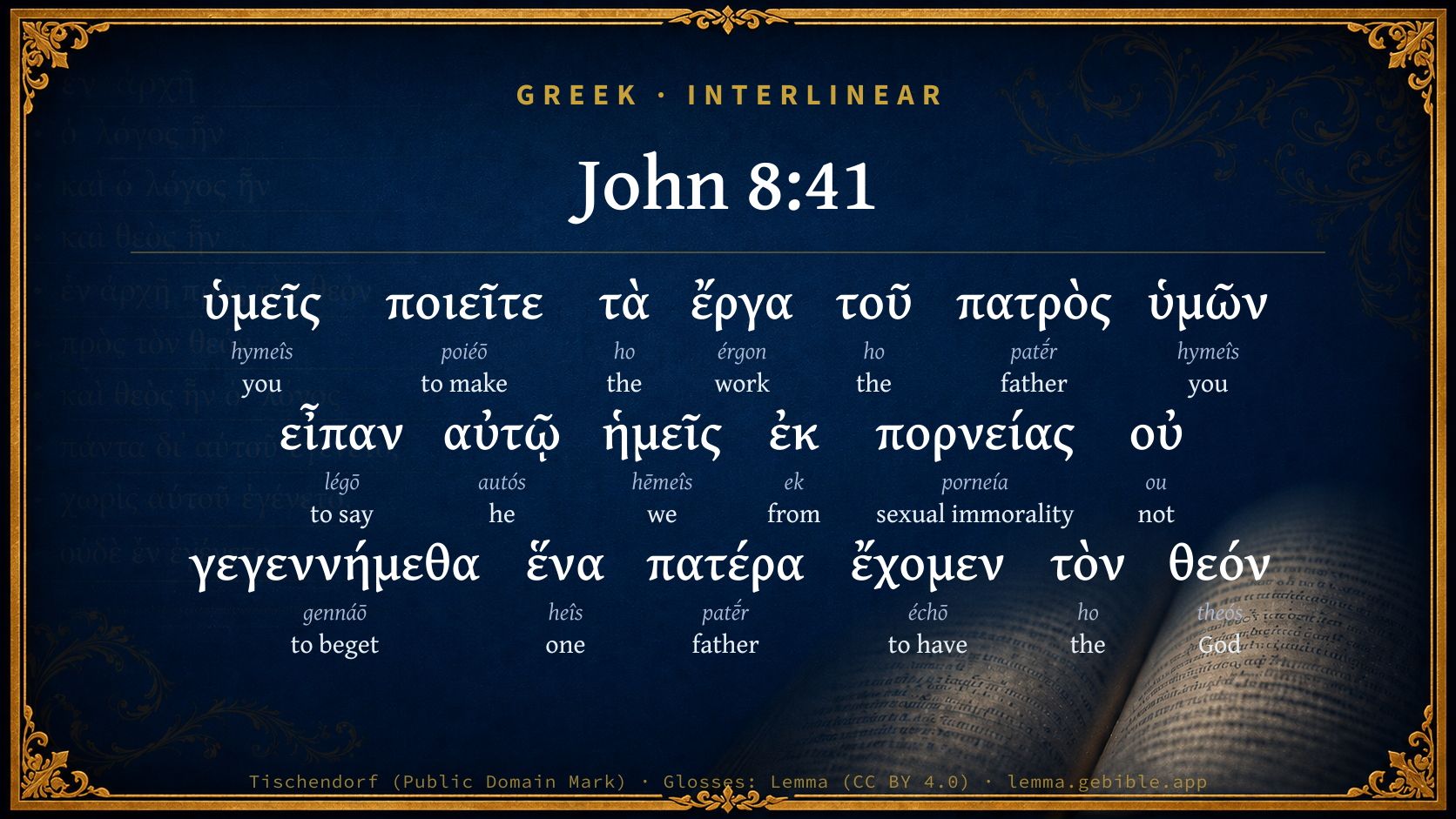
  1. ὑμεῖς hymeîs G5210 “you” Personal pronoun, 2nd person, Nominative, Plural
  2. ποιεῖτε poiéō G4160 “to make” Verb, Present, Active, Indicative, 2nd person, Plural
  3. τὰ ho G3588 “the” Article, Accusative, Plural, Neuter
  4. ἔργα érgon G2041 “work” Noun, Accusative, Plural, Neuter
  5. τοῦ ho G3588 “the” Article, Genitive, Singular, Masculine
  6. πατρὸς patḗr G3962 “father” Noun, Genitive, Singular, Masculine
  7. ὑμῶν hymeîs G5210 “you” Personal pronoun, 2nd person, Genitive, Plural
  8. εἶπαν légō G3004 “to say” Verb, Aorist, Active, Indicative, 3rd person, Plural
  9. αὐτῷ autós G846 “he” Personal pronoun, Dative, Singular, Masculine
  10. ἡμεῖς hēmeîs G2249 “we” Personal pronoun, 1st person, Nominative, Plural
  11. ἐκ ek G1537 “from” Preposition
  12. οὐ ou G3756 “not” Particle, Negative
  13. γεγεννήμεθα gennáō G1080 “to beget” Verb, Perfect, Passive, Indicative, 1st person, Plural
  14. ἕνα heîs G1520 “one” Adjective, Accusative, Singular, Masculine
  15. πατέρα patḗr G3962 “father” Noun, Accusative, Singular, Masculine
  16. ἔχομεν échō G2192 “to have” Verb, Present, Active, Indicative, 1st person, Plural
  17. τὸν ho G3588 “the” Article, Accusative, Singular, Masculine
  18. θεόν theós G2316 “God” Noun, Accusative, Singular, Masculine

About this verse

These counts appear in no published source. They are computed here, from the morphology-tagged text and Lemma’s own curated glosses. What Lemma adds →

19
words
15
distinct lemmas
Gospels
section

Notable vocabulary

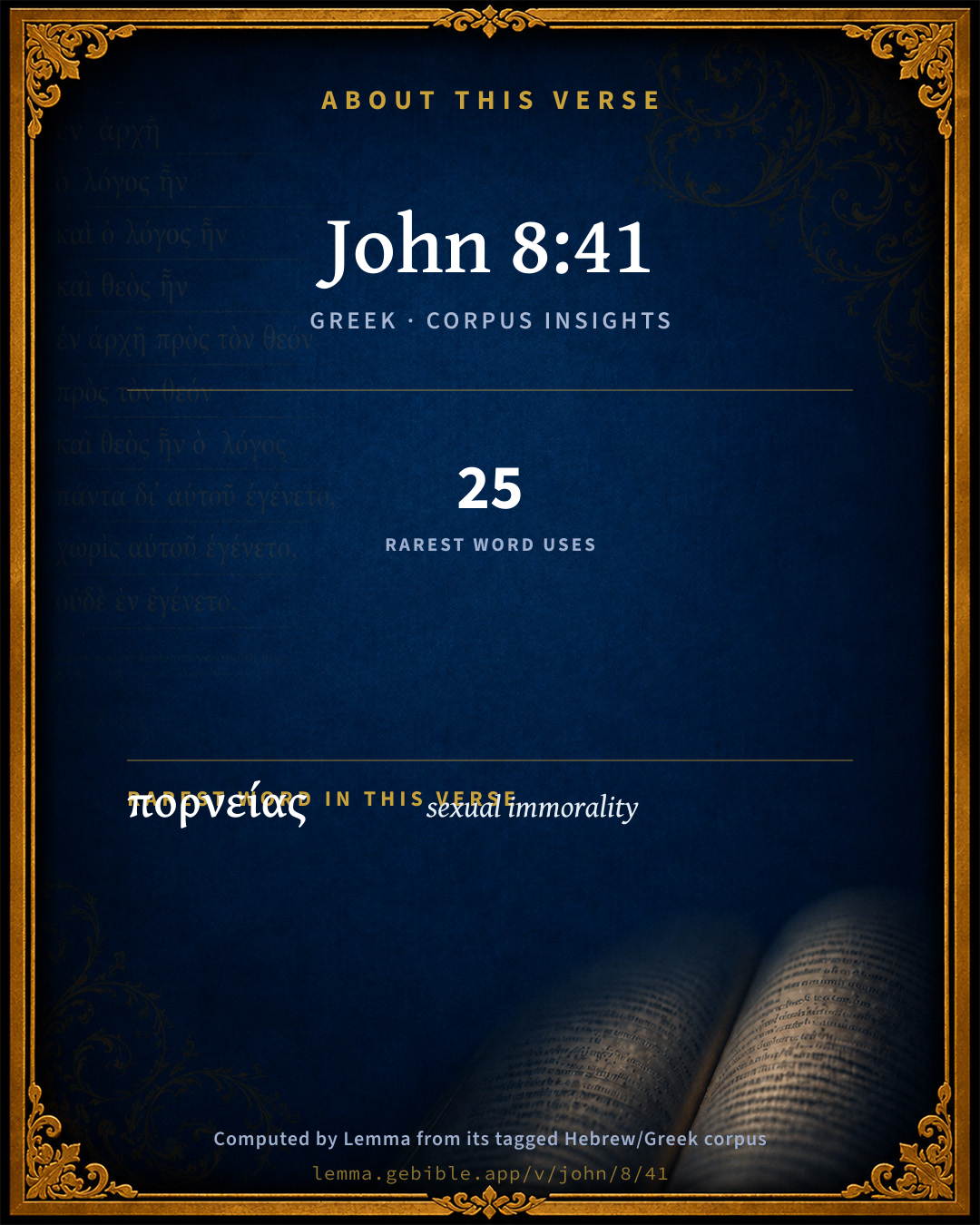
The rarest word here is πορνείας sexual immorality G4202 — appearing just 25 times in the whole Greek New Testament.

Shared distinctive vocabulary

πορνείας sexual immorality G4202 occurs in 24 verses of the Greek New Testament. Also found in:

Repetition

Words recur within this verse:

  • πατρὸς father G3962 ×2
  • τὰ the G3588 ×3
  • ὑμεῖς you G5210 ×2

Cross-references

16

Topical passages linked to John 8:41 in the Treasury of Scripture Knowledge — connected by theme and wording, ordered by reader-vote popularity; previews shown in the World English Bible.

  • Isaiah 64:8 But now, Yahweh, you are our Father; we are the clay, and you our potter; and we all are the work of your hand.
  • Isaiah 63:16 For you are our Father, though Abraham doesn't know us, and Israel does not acknowledge us: you, Yahweh, are our Father; our Redeemer from everlasting is your name.
  • John 8:38 I say the things which I have seen with my Father; and you also do the things which you have seen with your father."
  • John 8:44 You are of your Father, the devil, and you want to do the desires of your father. He was a murderer from the beginning, and doesn't stand in the truth, because there is no truth in him. When he speaks a lie, he speaks on his own; for he is a liar, and the father of it.
  • Malachi 2:11 Judah has dealt treacherously, and an abomination is committed in Israel and in Jerusalem; for Judah has profaned the holiness of Yahweh which he loves, and has married the daughter of a foreign god.
  • Exodus 4:22 You shall tell Pharaoh, 'Thus says Yahweh, Israel is my son, my firstborn,
  • Deuteronomy 14:1 You are the children of Yahweh your God: you shall not cut yourselves, nor make any baldness between your eyes for the dead.
  • Deuteronomy 32:6 Do you thus requite Yahweh, Foolish people and unwise? Isn't he your father who has bought you? He has made you, and established you.
  • Isaiah 57:3–7 But draw near here, you sons of the sorceress, the seed of the adulterer and the prostitute.
  • Jeremiah 3:19 But I said, How I will put you among the children, and give you a pleasant land, a goodly heritage of the hosts of the nations! and I said, You shall call me My Father, and shall not turn away from following me.
  • Jeremiah 31:20 Is Ephraim my dear son? is he a darling child? for as often as I speak against him, I do earnestly remember him still: therefore my heart yearns for him; I will surely have mercy on him, says Yahweh.
  • Malachi 1:6 "A son honors his father, and a servant his master. If I am a father, then where is my honor? And if I am a master, where is the respect due me? Says Yahweh of Hosts to you, priests, who despise my name. You say, 'How have we despised your name?'
  • Ezekiel 16:20–21 Moreover you have taken your sons and your daughters, whom you have borne to me, and these have you sacrificed to them to be devoured. Were your prostitution a small matter,
  • Ezekiel 23:45–47 Righteous men, they shall judge them with the judgment of adulteresses, and with the judgment of women who shed blood; because they are adulteresses, and blood is in their hands.
  • Hosea 1:2 When Yahweh spoke at the first by Hosea, Yahweh said to Hosea, "Go, take for yourself a wife of prostitution and children of unfaithfulness; for the land commits great adultery against from Yahweh."
  • Hosea 2:2–5 Contend with your mother! Contend, for she is not my wife, Neither am I her husband; And let her put away her prostitution from her face, And her adulteries from between her breasts;

Cross-references courtesy of OpenBible.info (CC BY 4.0).

Commentary

Notes on John 8:41 from classic Christian and Jewish commentators (each source and its license shown beneath its notes). The classic Christian expositions comment on the surrounding passage and are grouped to its opening verse, so a note may address several verses; the Jewish commentaries on the Tanakh (Rashi and others) are per-verse, so they appear only where the commentator wrote on this verse.

Lemma curates 59 commentaries, every one of them public domain or Creative Commons licensed, each selected and text-cleaned for this edition rather than reprinted as found. About our sources →

Joseph Benson's Commentary

Joh 8:41-43. Ye do the deeds of your father — By your deeds ye show whose children ye are. They said, We be not born of fornication — We are not bastard Jews, a mixed, spurious blood, descended from Gentile idolaters or apostate Israelites; nor are we ourselves worshippers of idols: but have one Father, even God — Whose true children we are, by virtue of our descent from his people, and our profession of his religion. It seems that they perceived, at length, that Jesus spake not so much of natural as of spiritual lineage; and that they alluded to the marriage-covenant, which, in Scripture, is said to have subsisted between God and the Jewish nation, and by which their obligation to reverence, love, and obey him, was represented as fidelity to their heavenly husband, and their violation of that obligation, as spiritual whoredom. Jesus said, If God were your Father — And you were his genuine children, as you profess to be; you would love me — And therefore would be far from forming designs to take away my life; for I proceeded forth and came from God — Greek, εξηλθον και ηκω, I proceeded, namely, originally, and do come from God, and appear among you as his messenger. Neither came I of myself — As the false prophets did, who had neither their mission nor message from God; but he sent me — As is evident from the many proofs of my mission, which I am daily giving you. Observe, reader, all that really have God for their Father, have a true love to the Lord Jesus, an esteem for his person, a grateful sense of his love, a sincere regard for his cause and interest, a complacency in the salvation effected by him, and in the method and terms of it, and a care to keep his commandments, which is the surest evidence of our love to him. We are here in a state of probation: and God is trying, so to speak, how we will conduct ourselves toward him; and we shall be treated accordingly in a state of retribution. God has taken various methods to prove mankind, and this was one: he sent his Son into the world with sufficient proofs both of his Sonship and mission, concluding that all, who called him Father, would kiss his Son, and bid him welcome, who was firstborn among many brethren. By this our adoption will be proved or disproved, namely, by our loving, or not loving Christ. Why do ye not understand my speech — What is the reason that you do not comprehend the true meaning of the things which I have spoken to you? Even because — Or, interrogatively, Is it not because ye cannot hear my word — Cannot give obedience thereto, it being contrary to your lusts? Not being desirous to do my will, you cannot understand my doctrine, chap. Joh 7:17. Or, as Dr. Campbell renders the clause, Ye cannot bear my doctrine. For, “the verb, ακουειν, denotes frequently in Scripture, and even in profane authors, not barely to hear, but to hear patiently; consequently, not to hear, often means not to bear. The English verb, to hear, has also sometimes the same meaning.”

Joseph Benson's Commentary on the Old and New Testaments (1811–1818) — public domain. Text from a community e-Sword module.

Whedon's Commentary on the Bible

Daniel D. Whedon

Children, not of God, but of Satan, Joh_8:41-47.

41. Born of fornication—True, legitimate sons of Abraham, we have our Divine Father, God alone. The one paternity insures the other paternity. And, corporeally, Jesus would admit both. Spiritually, he denies both. For as being murderers in intent, they are no children of Abraham, 40; nor of God, 42; but of the murderer Satan, 44.

Daniel D. Whedon (gen. ed.), Commentary on the Old and New Testaments (1874–1909) — public domain. Text from a community e-Sword module.

Tyndale Open Study Notes

Tyndale Open Resources

8:41 your real father: Jesus knew who controlled them. • We aren’t illegitimate children! This was both a defense and an attack. In Greek, the pronoun we is emphatic: “We [in contrast to you] are not illegitimate,” implying that Jesus was illegitimate (see Matt 1:18-25).

Tyndale Open Study Notes — © Tyndale Open Resources, licensed CC BY-SA 4.0. Text via the HelloAO Bible API.

Bengel's Gnomon

Johann Albrecht Bengel

Joh 8:41. Τοῦ πατρὸς ὑμῶν, of your father) His name is not yet expressed: but presently after, when the Jews presume to call God their father, he is expressly called the Devil: see foll. verses.—ἐκ πορνειας, from fornication) A new paroxysm of Jewish unreasonableness [unseasonable clamour]. They stoutly insist, that they are not illegitimate.

Bengel's Gnomon of the New Testament — English translation (T&T Clark, Edinburgh, 1860) — public domain. Text from a community e-Sword module.

Meyer's Critical & Exegetical Commentary

Heinrich August Wilhelm Meyer

Joh_8:41. You do what your father is in the habit of doing,result of Joh_8:39-40, though still without specifying who this father is. Paulatim procedit castigatio (Grotius).

As the Jews are not to look upon Abraham as their father, they imagine that some other human father must be meant. In this case, however, they would be bastards, born of fornication (the fornication of Sarah with another man); and they would have two fathers, an actual one (from whom they descend ἐκ πορνείας) and a putative one (Abraham). But inasmuch as their descent is not an adulterous one,[25] and notwithstanding that Abraham is not to be regarded as their father, there remains in opposition to the assertion of Jesus, so they think, only God as the one Father; to Him, therefore, they assign this position: We be not born of fornication, as thou seemest to assume, in that thou refusest to allow that Abraham is our father; one father only (not two, as is the case with such as are born of adultery) have we, and that God, if our descent from Abraham is not to be taken into consideration. For God was not merely the creator (Mal_2:10) and theocratic Father of the people (Isa_63:16; Isa_64:8); but His Fatherhood was further and specially grounded in the power of His promise made at the conception of Isaac (Rom_4:19; Gal_4:23). The supposition that they implicitly drew a contrast between themselves and Ishmael (Euth. Zigabenus, who thinks that there is an allusion to the birth of Jesus, Ruperti, Wetstein, Tittmann) is erroneous, inasmuch as Ishmael was not born ἐκ πορνείας. We must reject also the common explanation of the passage as a denial of the charge of idolatry (Hos_1:2; Hos_2:4; Eze_20:30; Isa_57:3); our filial relationship to God has not been polluted by idolatry (De Wette; comp. Grotius, Lampe, Kuinoel, Lücke, Tholuck, Lange, Hengstenberg, Baeumlein, and several others). It is quite opposed to the context, however, for the starting-point is not the idea of a superhuman Father, nor are the Jews reproached at all with idolatry; but the charge is brought against them, that Abraham is not their father; hence also the supposition of an antithesis to a combined Jewish and heathen descent (Theodore of Mopsuestia, Theophylact, Godet), such as was the case with the Samaritans (Paulus), is inadmissible. Ewald also takes the same simple and correct view;[26] comp. Erasmus, Paraphr. Bengel, however, aptly characterizes the entire objection raised by the Jews as a novus importunitatis Judaicae paroxysmus.

ἡμεῖς] spoken with the emphasis of pride.

[25] Ἐκ πορνείας implies one mother, but several fathers. Who is the one mother, follows from the denial of the paternity of Abraham, consequently Sarah, the ancestress of the theocratic people. Hence the inadmissibility of Luthardts explanation based on the idea, Israel is Jehovahs spouse; according to which the thought of the Jews would have been: they were not sprung from a marriage covenant of Israel with another, so that Jehovah would thus be merely nominally their father, in reality, however, another; and they would thus have several fathers. Moreover, a marriage covenant between Israel and another would be a contradiction, this other must needs also be conceived as a true God, consequently as a strange God, a notion which Luthardt justly rejects. It is surprising how B. Crusius could adduce Deu_23:2 for the purpose of representing the Jews as affirming their theocratic equality of birth.

[26] Although characterized by Ebrard as absurd. He regards ἐκ πορνείας οὐ γεγ. as merely a caricatured form of the accusation that they are not Abrahams children, and in this way, of course, gets rid of the need of explaining the words. He then takes ἕνα πατέρα ἔχομεν in the sense of we and thou have one common Father, which is incompatible with the word ἡμεῖς, which also belongs to ἔχομεν, and is, besides, altogether opposed to the context; for the entire dialogue is constituted by the antithesis of we and thou, I and ye. Ebrards view is an unfortunate evasion of a desperate kind.

Meyer — Critical and Exegetical Commentary on the New Testament — English translation by Peter Christie, edited by Frederick Crombie (T&T Clark, 1880) — public domain. Text from a community e-Sword module.

Expositor's Greek Testament

ed. W. Robertson Nicoll

Joh 8:41 . ὑμεῖς … ὑμῶν . You do not the works of Abraham: you do the works of your father. And yet (Joh 8:37 ) He had acknowledged them to be the children of Abraham. The only possible conclusion was that besides Abraham some other father had been concerned in producing them. This idea they repudiate with indignation: Ἡμεῖς … Θεόν . “We were not born of fornication: we have one father, God”; not “Abraham,” as might have been expected, but “God”: i.e. , they claim to be the children of the promise, within the Theocracy, children of God’s house (Joh 8:35 ).

The Expositor's Greek Testament, edited by W. Robertson Nicoll (1897–1910) — public domain. Text from a community e-Sword module.

Jamieson, Fausset & Brown

Robert Jamieson, A. R. Fausset & David Brown

We be not born of fornication . . . we have one Father, God--meaning, as is generally allowed, that they were not an illegitimate race in point of religion, pretending only to be God's people, but were descended from His own chosen Abraham.

Jamieson, Fausset & Brown — Commentary Critical and Explanatory on the Whole Bible (1871) — public domain (CC PDM 1.0). Text via the HelloAO Bible API.

Adam Clarke's Commentary

Verse 41. Ye do the deeds of your father.] You have certainly another father than Abraham-one who has instilled his own malignant nature into you; and, as ye seek to murder me for telling you the truth, ye must be the offspring of him who was a murderer from the beginning, and stood not in the truth, Joh 8:44.

We be not born of fornication] We are not a mixed, spurious breed-our tribes and families have been kept distinct-we are descended from Abraham by his legal wife Sarah; and we are no idolaters.

We have one Father, even God.] In the spiritual sense of father and son, we are not a spurious, that is, an idolatrous race; because we acknowledge none as our spiritual father, and worship none as such, but the true God. See Bishop Pearce.

Adam Clarke's Commentary on the Bible (1810–1826) — public domain. Text from a community e-Sword/MySword module.

John Calvin's Commentaries

41. We were not born of fornication. They claim no more for themselves than they did formerly, for it was the same thing with them to be Abraham’s children and to be God’s children. But they erred grievously in this respect, that they imagined that God was bound to the whole seed of Abraham. For they reason thus: “God adopted for himself the family of Abraham; therefore, since we are Abraham’s descendants, we must be the children of God.” We now see how they thought that they had holiness from the womb, because they were sprung from a holy root. In short, they maintain that they are the family of God, because they are descended from the holy fathers. In like manner, the Papists in the present day are exceedingly vain of an uninterrupted succession from the fathers. By sorceries of this description Satan deceives them, so that they separate God from his word, the Church from faith, and the kingdom of heaven from the Spirit.

Let us know, therefore, that they who have corrupted the seed of life are at the farthest remove from being the children of God, though, according to the flesh, they are not bastards, but pretend a right to the plausible title of the Church. For let them go about the bush as much as they please, still they will never avoid the discovery that the only ground of their arrogant boasting is, “We have succeeded the holy fathers; therefore, we are the Church.” And if the reply of Christ was sufficient for confuting the Jews, it is not less sufficient now for reproving the Papists. Never indeed will hypocrites cease to employ the name of God falsely, with most wicked effrontery; but those false grounds of boasting, on which they plume themselves, will never cease to appear ridiculous in the eyes of all who shall abide by the decision of Christ.

John Calvin's Commentaries (1540-1563) — public domain. Text from the Calvin Translation Society English edition (1840s-50s) via the Christian Classics Ethereal Library (ccel.org). Calvin's coverage is partial (roughly two-thirds of the Bible); uncommented books and verses are honest gaps, never fabricated. The 19th-century editor's footnotes and remarks are omitted so the notes are faithfully Calvin's own voice.

Ellicott's Commentary for English Readers

(41) Ye do the deeds of your father.—It is better to read works rather than “deeds,” as in Joh_8:39. They did not the works of Abraham. They did the works of that father, who is now more clearly pointed out, but still not named. Before, when he was referred to (Joh_8:38), they could answer that Abraham was their father; but their works prove that they are not the true children of Abraham (Joh_8:39-40). They see that a spiritual father is intended, and they will claim God as their Father.

We be not born of fornication.—The meaning of this is to be found in the fact that the word became in the Old Testament prophets a frequent symbol for idolatry. Comp. Isa_1:21; Jer_2:20; Jer_3:8-9; Ezekiel 16; Hos_1:2 (especially), 4:12, and 5:7.) They, as distinguished from the nations among whom they dwelt, had maintained a pure monotheism, and had never been idolaters, or children born of spiritual fornication.

We have one Father, even God.—“We” is strongly emphatic, expressing their pride in the theocracy, and their spiritual superiority to other nations. There may be in this pride also a touch of the scorn with which they asked “Will He go unto the dispersion of the Gentiles?” (Joh_7:35), or with which they call Him a Samaritan, as they do in this very discussion (Joh_8:48). “Howbeit every nation made gods of their own, and put them in the high places which the Samaritans had made, every nation in their cities wherein they dwelt.” This is the historian’s account of the spiritual paternity of the Samaritans, and these Jews may well have felt their superiority in contrast with their neighbours. (See the whole passage in 2Ki_17:26-41, especially Joh_8:30-31.)

A Bible Commentary for English Readers, edited by Charles John Ellicott (1878–1897) — public domain. Text from a community e-Sword module.

The Cambridge Bible for Schools and Colleges

gen. ed. J. J. S. Perowne

41. Ye do the deeds of your father] Better, Ye are doing the works of your father. The word here rendered ‘deeds’ is the same as that rendered ‘works’ in Joh_8:39. ‘Ye’ is emphatic, in contrast to Abraham. This shews them plainly that spiritual parentage is what He means. In Joh_8:39 they still cling to Abraham, although He has evidently assigned them some other father. Here they drop literal parentage and adopt His figurative language. ‘You are speaking of spiritual parentage. Well, our spiritual Father is God.’

We be not born of fornication] The meaning of this is very much disputed. The following are the chief explanations: (1) Thou hast denied that we are the children of Abraham, then we must be the children of some one sinning with Sarah: which is false.’ But this would be adultery, not fornication. (2) ‘We are the children of Sarah, not of Hagar.’ But this was lawful concubinage, not fornication. (3) ‘We are not a mongrel race, like the Samaritans; we are pure Jews.’ This is far-fetched, and does not suit the context. (4) ‘We were not born of fornication, as Thou art.’ But His miraculous birth was not yet commonly known, and this foul Jewish lie, perpetuated from the second century onwards (Origen, c. Celsum i. xxxii.), was not yet in existence. (5) ‘We were not born of spiritual fornication; our sonship has not been polluted with idolatry. If thou art speaking of spiritual parentage, ‘we have one Father, even God.’ This last seems the best. Idolatry is so constantly spoken of as whoredom and fornication throughout the whole of the O.T., that in a discussion about spiritual fatherhood this image would be perfectly natural in the mouth of a Jew. Exo_34:15-16; Lev_17:7; Jdg_2:17; 2Ki_9:22; Psa_73:27; Isa_1:21; Jer_3:1; Jer_3:9; Eze_16:15; &c. &c. See esp. Hos_2:4. There is a proud emphasis on ‘we;’—‘we are not idolaters, like Thy friends the Gentiles’ (comp. Joh_7:35).

we have one Father] Or, one Father we have, with emphasis on the ‘one,’ in contrast to the many gods of the heathen.

The Cambridge Bible for Schools and Colleges (gen. ed. J. J. S. Perowne; Cambridge University Press, 1878–1918) — public domain. Text from a community e-Sword module.

John Gill's Exposition

Ye are of your father the devil,.... Not of his substance, but by imitation and example; and as being under his authority and influence, his instructions and directions, and ready to follow after him, and obey his commands; the word "your" is rightly supplied, and is in some copies:

and the lusts of your father ye will do; the Syriac and Persic versions read in the singular number, "the lust", or "desire of your father"; by which may be particularly meant, his eager desire after the death of Christ, which he showed at different times; he instigated Herod to seek to destroy his life in his infancy, and when he was just entering on his public ministry, he tempted him to destroy himself; and often stirred up the Scribes and Pharisees, to stone him or kill him, some other way; and at last put it into the heart of one of his disciples, Judas Iscariot, to betray him: this looks as if though the devil had a notion of the salvation of men by Christ, yet that he thought, as some erroneous men have also done, that it was only by his doctrine and example, and therefore he was in haste to get him out of the world, that he might not be useful, or any more so that way; and not by the shedding of his blood, the sacrifice of himself, or by his sufferings and death, in the room of sinners; or otherwise it is scarcely credible, that he would have sought his death so earnestly: now this selfsame lust and insatiable desire after the death of Christ prevailed in the Jews; and they were resolute and bent upon fulfilling it at any rate, nor could anything divert them from it; this is the thing Christ is speaking of in the context, and is what fully proved the devil to be their father, and them to be his children:

he was a murderer from the beginning; he was not only spoken of from the beginning, as he that should bruise the Messiah's heel, or should compass his death, but he was actually a murderer of Adam and Eve, and of all their posterity, by tempting them to sin, which brought death and ruin upon them; and who quickly after that instigated Cain to slay his brother; and has had, more or less, a concern in all murders committed since; and has been in all ages, and still is, a murderer of the souls of men; and therefore is rightly called Abaddon, and Apollyon, which signify the destroyer: the phrase, "from the beginning", does not intend the beginning of his own creation; for he was created a holy creature, was in the truth, though he abode not in it; and was in an happy state, though he lost it: nor strictly the beginning of time, or of the creation of the world, which were some days at least before the fall of man, when the devil commenced a murderer; but it being very near it, therefore this phrase is made use of: the Syriac version renders it, "from Bereshith", which is the first word in the Hebrew Bible, and is frequently used by the Jewish Rabbins for the six days of the creation; and if Adam fell, as some think, the same day he was created, it might be properly said that the devil was a murderer from thence. Philo (p) speaks of Eve's serpent, as , "a murderer of man"; applying to this purpose the text before referred to, Gen 3:15;

and abode not in the truth; neither in the integrity, innocence, and holiness, in which he was created; nor in veracity, or as a creature of veracity, but spake lies, and formed one, by which he deceived Eve, saying, "ye shall not surely die", Gen 3:4, when God had said they should, Gen 2:17; nor in the truth of the Gospel, which was at least in part made known unto him; particularly that the Son of God should become man, and in that nature be the head of angels and men: this he and his associates, in the pride of their hearts, not bearing that the human nature should be exalted above that of theirs, left their first estate, broke off their allegiance to God, and turned rebels against him:

because there is no truth in him; not that this is a reason why he continued not in the truth, for there was originally truth in him; though he abode not in it; but a reason, showing there was none in him now, since he was fallen from it, and abode not in it; there is no truth in him, that is natural and genuine, and essential to him; and if at any time he speaks it, it is not from his heart, but because he is forced to it, or has an evil design in it:

when he speaketh a lie, he speaketh of his own; that is genuine and natural, of his own devising, willing, and approving:

for he is a liar, and the father of it; he was a liar, as early as he was a murderer, or rather earlier; it was with a lie he deceived, and so murdered our first parents, and he has continued so ever since; he was the first author of a lie; the first lie that ever was told, was told by him; he was the first inventor of one; he was the first of that trade; in this sense the word "father" is used, Gen 4:20; so the serpent is by the Cabalistic Jews (q) called, the lip of lie, or the lying lip.

(p) De Agricultura, p. 203. (q) Lex. Cabalist. p. 724.

John Gill's Exposition of the Whole Bible (1746–1763) — public domain (CC PDM 1.0). Text via the HelloAO Bible API.

Trapp's Complete Commentary

John Trapp

41 Ye do the deeds of your father. Then said they to him, We be not born of fornication; we have one Father, even God.

Ver. 41. We have one Father, even God] Yet God is not in their heads, Psa 10:4, nor heart, Psa 14:1, nor words, Psa 12:4, nor ways, Tit 1:16. In such a posture of distance, nay, defiance, stand wicked men. And yet none so forward to call God Father, Jer 3:4-5.

John Trapp, A Commentary or Exposition upon All the Books of the Old and New Testament (1647–1656) — public domain. Text from a community e-Sword module.

Albert Barnes' Notes on the Bible

The deeds of your father - See Joh 8:38. Jesus repeats the charge, and yet repeats it as if unwilling to name Satan as their father. He chose that they should infer whom he meant, rather than bring a charge so direct and repelling. When the Saviour delivered an awful or an offensive truth, he always approached the mind so that the truth might make the deepest impression.

We be not born of fornication - The people still professed not to understand him; and since Jesus had denied that they were the children of Abraham, they affected to suppose that he meant they were a mixed, spurious race; that they had no right to the covenant privileges of the Jews; that they were not worshippers of the true God. Hence, they said, We are not thus descended. We have the evidence of our genealogy. We are worshippers of the true God, descended from those who acknowledged him, and we acknowledge no other God and Father than him. To be children of fornication is an expression denoting in the Scriptures idolatry, or the worship of other gods than the true God, Isa 1:21; Isa 57:3; Heb 1:2; Heb 2:4. This they denied. They affirmed that they acknowledged no God for their Father but the true God.

Albert Barnes' Notes on the Bible (1834–1885) — public domain. Text from a community e-Sword/MySword module.

Haydock's Catholic Bible Commentary

We are not born of fornication; we have one Father, God. These Jews perceived that Christ had hinted that they were not the true and faithful sons of Abraham; and therefore they replied in this manner. But Christ answered, if God was your Father, if you were his dutiful children, you would also believe in me, and love me; for I have proceeded from him, and am come from him, his true Son: and not sent into the world by him. But you cannot hear my word, because you will not, by your own wilful obstinate blindness. (Witham)

George Leo Haydock (1774–1849), Haydock's Catholic Family Bible and Commentary, 1859 edition — public domain. Excludes Psalms (Douay-Rheims chapter numbering differs from Protestant) and Deuterocanonical books (Catholic canon only).

Matthew Poole's English Annotations

Ye do the deeds of your father; you imitate him who is indeed your father; by whom our Saviour (as we shall hear more afterwards) meaneth the devil. This they fume at, and tell him they were not

born of fornication, which is, in our English dialect, as much as, We are no bastards; but it hath another sense in this place, as appeareth by the next words.

We have one Father, even God; that is, we own and worship one God, who is our Father; which makes very good interpreters think, that their meaning in those words, We are not born of fornication, is, We are no idolaters; idolatry in holy writ being very ordinarily compared to whoredom and fornication.

Matthew Poole's English Annotations on the Holy Bible (1683–1685) — public domain. Text from a community e-Sword/MySword module.

The Pulpit Commentary

Instead of doing the works of Abraham, you are doing the works of your father. That is, you have a father with whom you are, nevertheless, in living, ethical relation. If you persist in boasting of your father, who is neither "the Father" nor Abraham, I must soon tell you who that father is. Loud interruption followed. Abrupt and startling was the retort: We are were not born of fornication; we have one Father, God. Many expositors think that these Jews began to babble against the possibility of their being bastard children of Sarah, or to protest that they were not Ishmaelites or any collateral branch of the seed of Abraham, like the Idumaeans or the sons of Keturah. This is far away from the context, and unworthy of the controversy. The idea is sufficiently explained by the second clause. The covenant relation between Jehovah and Israel is so constantly referred to in the Old Testament (Hos_1:2 Hos_2:4 Jer_2:20) under the image of marriage and the unfaithfulness of particular generations to Jehovah; and their false worship and idolatry are so often regarded as "fornication" and "adultery" from God, the Husband of the dedicated spouse, so that nothing is more probable, when Jesus charged them with doing the works of their father, that they should have exclaimed, "Surely we have no idolatrous sympathies. None but Jehovah is our God. Thou must not charge us with any compromise with the accursed thing." The wild rage which the Jews had shown to Pilate in the matter of the shields, their abhorrence of the defilement of idols in the matter of food, their avoidance even of the supreme court of Roman justice under fear of idolatrous contamination, explain the outflash of this indignant rejoinder. This view is, in the main, advocated by De Wette, Lampe, Lucke, Lange, and Hengstenberg; but opposed by Meyer, Westcott: "We do not owe our position to idolatrous desertion of Jehovah. We are the offspring of the union of God with his chosen people. Our spiritual descent is as pure as our historical descent." Godet modifies it: "We have no idolatrous blood in our veins; we are Hebrews of the Hebrews." They claim to be the children of God, as well as children of Abraham. (Deu_32:6 Isa_63:16 Mal_2:10)

Vers. 41-47. True spiritual paternity.

Notice

I THEIR MISTAKEN SPIRITUAL PATERNITY. "We have one Father, even God." This in a sense is true.

(1) God was their Father as creatures;

(2) he was their Father as a nation;

(3) he was their Father still in his yearning love to save and pity them. But it is substantially hollow and false, as proved by their conduct towards Christ.

1. They failed to recognize his connection with God.

(1) He was the Son of God. "I came forth out of God." He was, in fact, God"s Son, as evidenced by his person and miracles.

(2) He was come on a Divine mission. Come to them, and come on a mission of love and salvation.

(3) He was divinely sent. "Neither came I of myself, but he sent me he whom you call your Father.

2. They failed to understand his message. Although

(1) he spoke with Divine authority;

(2) with Divine simplicity;

(3) with Divine importunity and tenderness, so that he could naturally ask the pretended children of God, "Why do ye not understand my speech?

3. They failed to believe him and his message. Although:

(1) His character was perfect. "Which of you," etc.?

(2) His message was truthful. He could challenge them with regard to the truthfulness of his message, as well as the perfection of his character, and both deserved and demanded attention and faith.

(3) Yet they disbelieved and rejected him for the very reason which should induce them to believe and accept him. "Because I tell you the truth, ye," etc.

4. These sad failures flatly contradict their pretended relationship to God. (Vers. 42-47)

II THEIR TRUE SPIRITUAL PATERNITY. "Ye are of your father," etc. Look at the picture of the father and the children and their likeness.

1. Look at his murderous propensities.

(1) The devil is a murderer. The murderer of human bodies and souls; the destroyer of human happiness and the Divine image in man. The Jewish nation bore this character. From time to time they manifested murderous propensities; they became the murderers of the Messiah, the Son of God and the Lord of glory.

(2) The devil was a murderer from the beginning. Not the beginning of all things, nor even the very beginning of his own existence, but the beginning of the human race. His fall preceded that of man, and perhaps the existence of man; but no sooner had he perceived Adam, young, innocent, and loyal in his happy paradise, than the lust of murder was excited in his breast, and he fixed upon man as his victim, and effected his foul purpose in the spiritual murder of our first parents. This was the character of the Jews from the beginning, and the character of these very persons since the beginning of Christ"s earthly existence. No sooner had the second Adam appeared on the scene than they sought by every means to kill him.

(3) The devil is a most selfish and wilful murderer. This was the case with regard to our first parents. There was no provocation, no gain beyond the gratification of his own selfishness and malice. This was the case with these Jews in the murder of their Messiah; they could find no reason for it but in their own dark and selfish hatred.

2. Look at his lying propensities.

(1) The devil is a liar. He is opposed to truth, to all truth, especially to the great system of truth brought to light by Christ. Thus his falsehood serves well his murderous opposition to the redeeming truth of the gospel. In this the heads of the Jewish nation resembled him; they murderously opposed Jesus, and he came to help murder; they bore false witness against him.

(2) The devil became a liar by falling from the truth He was in the truth once and the truth in him, but abode not in it long enough to be morally safe. He fell wilfully, of his own accord. He is a backslider, and, having fallen from truth, he had no place to fall but into the whirlpool of falsehood, with all its concomitant vices. How like their spiritual father were the Jewish nation! They were born into great religious privileges, they had eminent spiritual fathers, brought up under the watchful care and in the tender lap of a kind Providence, nursed on the breast of Divine and precious promises, and familiarized with the idea of a coming Messiah, their Divine Deliverer; but they abode not in the truth, but wilfully fell into falsehood. It seems as if only the children of special light alone are capable of becoming the veritable children of the prince of darkness.

(3) The devil as a liar is most complete. "There is no truth in him." He is completely lost to true, and truth to him; there is not a vestige of it in his nature. It is so completely gone, that eternal hatred of it now sits on its old throne, and the very thought of it is repugnant and unbearable. In this how like their father these children were! Jesus appealed to every sentiment of virtue and affection in their breast, but in vain. He exhibited in his life and character all that is attractive in human nature, and all that is mighty and benevolent in the Divine; but all this not only did not excite their admiration and gratitude, but excited their most deadly hatred, which proves the sad hollowness and falsity of their character. There was no truth in them.

(4) The devil as a liar is terribly original. "When he speaketh a lie, he speaketh of his own," etc. It is net a passing impulse, the result of temptation, but the natural outflow, and a part and parcel of his nature. Here the problem of the existence of evil is somewhat solved; we have found its father, its original propagator. His children partake of his spiritual nature, otherwise they would not be his children. The days of repentance, struggle, resistance, and prayer are past; these are days of spiritual generation, and in this case the result is a progeny of the devil. These Jews were more than under his influence; they were his progeny. Terribly original, self-responsible, voluntary, independent and complacent in their sin, they spoke of their own; their falsehoods were their own, and their murderous act was especially their own, the outflow of their evil nature. "Let his blood be upon us," etc. The father of murder has not finished with any one till that one carries on business on his own footing, manufactures his own goods and disposes of them at his own risk, and does all this naturally. Then his paternity is complete, the relationship real, and his possession safe. This is the lowest point of moral deterioration reached in this world.

LESSONS.

1. Man in this world is capable of the highest and the lowest spiritual affinities. He may partake of the Divine or a devilish nature, may become the child of God or the child of the devil. Truly we are fearfully and wonderfully made.

2. Man in this world is capable of the most serious self-deception with regard to his spiritual paternity. These Jews thought that they were the children of God, while they were really the children of the devil. Such a self-deception is very characteristic of him, whose chief delight is to lie and deceive, and is perhaps the climax of his evil genius with regard to men. He cares but little about the name, only let him have the game. Of all self-deceptions this is the most miserable and disappointing!

3. No one can claim God as his Father who despises and rejects his Son. Our conduct towards him and his gospel decides our spiritual fatherhood at once.

4. To Christ our spiritual paternity is quite evident, which he will reveal sooner or later. And in the light of his revelation this is not difficult for each to know for himself.

5. Nothing can explain the conduct of some men towards Christ and his gospel but a true statement of their spiritual paternity. Let this be known, and the sequel is plain.

6. Even the children of the devil condemn him, for they do not like to own him as their father. State the fact, they are insulted. The alliance must be unholy and unnatural. Many of them claim God as their Father the compliment of vice to virtue. A compulsory admission and a full realization of this relationship will be painful in the extreme.

7. Let his children remember that they are such by their own choice. For spiritual generation, for good or evil, is by and through the will. It is not fate, but deliberate and voluntary selection. "His lusts it is your will to do." All are either the children of God or of the devil by their own choice. Hence the importance of a wise choice. B.T.

The Pulpit Commentary (1880–1919), ed. H.D.M. Spence-Jones & Joseph S. Exell — public domain. Text from a community e-Sword module.

John Wesley's Explanatory Notes

Ye do the deeds of your father - He is not named yet. But when they presumed to call God their Father, then he is expressly called the devil, ver. 44.

John Wesley, Explanatory Notes Upon the Whole Bible (1754–1765) — public domain. Text via the GEBible commentary corpus.

Burkitt's Expository Notes on the New Testament

William Burkitt

In the former verses the Jews made their boast that they were the children of Abraham: in these that they are the children of God. We have one Father, even God. This our Saviour disproves, telling them, that if God were their Father, they would love him, as proceeding from him by eternal generation; and in his office employed by him as Mediator. Also, if God were their father, they would understand him speaking from God; whereas now they were so transported with malice, that they could not endure his doctrine with patience, though it came from God. All which were undeniable proofs, that they were not the children of God.

Hence learn, That none can justly pretend any interest in God as his children, but they that love Christ, as being the express image of his Father’s person, and do hear and receive his doctrine, as coming from God: this the Jews did not do; therefore, says Christ, they are not the children of God.

Observe farther, Having told them whose children they are not, our Saviour tells them plainly whose children they were, Ye are of your Father, the devil. This appears by their being actuated by him, by their resembling and imitating of him; their inclinations, dispositions, and actions, being all to fullfil the lusts of the devil. Now, as his servants we are, whom we obey; so his children we are, whom we resemble.

Learn hence, That men’s sinful practices will prove them to be Satan’s children, let their profession be what it will; if in the temper of their minds, and in the actions of their lives, there by a conformity to Satan’s disposition, and a ready compliance with his temptations, they are certainly his children, what pretensions soever they make of being the children of God. None could pretend higher to the relation of God’s children than the Jews did: yet, says Christ, Ye are the children of the devil, for his works ye do.

Note hence, That the devil hath the relation of a father to all wicked men: and this fatherhood doth not proceed from the act of the father, but of the children; for the devil doth not make wicked men his children by begetting them: but they make the devil their father, by imitating of him.

William Burkitt's Expository Notes on the New Testament (1700–1703) — public domain. Text from a community e-Sword module.

The People's New Testament

B. W. Johnson

41. Ye do the deeds of your father. Satan.

B. W. Johnson's The People's New Testament with Notes (1889–1891) — public domain. Electronic text from the Christian Classics Ethereal Library (CCEL) ThML edition.

Cambridge Greek Testament for Schools and Colleges

41. οὐκ ἐγεννήθημεν (BD1) for οὐ γεγεννήμεθα (CD2).

41. ὑμεῖς π. τ. ἐρ. Ye are doing the works of your father: ὑμεῖς in emphatic contrast to Ἀβραάμ. This shews them that He means spiritual not literal descent; so they accept His figurative language, but indignantly deny any evil parentage. ‘Thou art speaking of spiritual parentage. Well, our spiritual Father is God.’

ἡμεῖς ἐκ πορνείας. The meaning of this is very much disputed. The following are the chief explanations: (1) Thou hast denied that we are the children of Abraham, then we must be the children of some one sinning with Sarah: which is false.’ But this would be adultery, not fornication. (2) ‘We are the children of Sarah, not of Hagar.’ But this was lawful concubinage, not fornication. (3) ‘We are not a mongrel race, like the Samaritans; we are pure Jews.’ This is farfetched, and does not suit the context. (4) ‘We were not born of fornication, as Thou art.’ But His miraculous birth was not yet commonly known, and this foul Jewish lie, perpetuated from the second century onwards (Origen, c. Celsum I. xxxii.), was not yet in existence. (5) ‘We were not born of spiritual fornication; our son-ship has not been polluted with idolatry. If thou art speaking of spiritual parentage, we have one Father, even God.’ This last seems the best. Idolatry is so constantly spoken of as whoredom and fornication throughout the whole of the O. T., that in a discussion about spiritual fatherhood this image would be perfectly natural in the mouth of a Jew. Exo 34:15-16; Lev 17:7; Jdg 2:17; 2Ki 9:22; Psa 73:27; Isa 1:21; Jer 3:1; Jer 3:9; Jer 3:20; Eze 16:15; &c. &c. See esp. Hos 2:4. There is a proud emphasis on ‘we;’—‘we are not idolaters, like Thy friends the Gentiles’ (comp. Joh 7:35). Ἕνα also is emphatic: One Father we have, in contrast to the many gods of the heathen and of the first Samaritans (2Ki 17:33): comp. Joh 8:48.

Cambridge Greek Testament for Schools and Colleges (Cambridge University Press, 1896; 21 vols, various authors incl. Carr, Maclear, Plummer, Farrar, Lumby, Moule, M. R. James, Simcox) — public domain. Text from a community e-Sword module.

Alford’s Greek Testament

Henry Alford

41.] ποιεῖτε—not imperative, which destroys the sense.

ἐκ πορν.] Stier remarks, that they now let fall Abraham as their father, being convicted of unlikeness to him. They see that a spiritual paternity must be meant, and accordingly refer to God as their Father. This consideration will rule the sense of ἐκ πορν., which must therefore be spiritual also. And spiritually the τέκνα πορνείας, ref. Hosea, are idolaters. πολύθεος ὁ ἐκ πόρνης, τυφλώττων περὶ τὸν ἀληθῆ πατέρα, καὶ διὰ τοῦτο πολλοὺς ἀνθʼ ἑνὸς γονεῖς αἰνιττόμενος. Philo de Migr. Abr. 13, vol. i. p. 447. Ishmael cannot well be alluded to; for they would not call the relation between Abraham and Hagar one of πορνεία. Still less can Origen’s interpretation be adopted, ἔλεγον Ἡμεῖς μᾶλλον ἕνα πατέρα ἔχομεν τὸν θεόν, ἤπερ σύ, ὁ φάσκων μὲν ἐκ παρθένου γεγεννῆσθαι, ἐκ πορνείας δὲ γεγεννημένος, καὶ διὰ τὸ αὐχεῖν τὸ ἐκ παρθένου γεγεννῆσθαι λέγων ἕνα πατέρα ἔχειν μόνον, τὸν θεόν (tom. 20:14, p. 327),—for our Lord never proclaimed this of Himself. There may possibly be a reference to the Samaritans (ver. 48), who completely answered in the spiritual sense to the children of fornication: see Deu 31:16: Isa 1:21: Eze 16:15 ff.; 20:30 .

Henry Alford, The Greek Testament (1849–1861) — public domain. Text from a community e-Sword module.

International Critical Commentary

41. Paulatim procedit castigatio is the comment of Grotius on the severe denunciation which follows.

ὑμεῖς ποιεῖτε τὰ ἔργα τοῦ πατρὸς ὑμῶν. “You,” with emphasis, “do the works of your father,” sc. the devil, although that is not yet said explicitly.

The Jews still misapprehend what is meant. They say, first, that if it is being suggested that they are not the legitimate descendants of Abraham and Sarah, it is not true; and secondly, that if it is spiritual and not physical descent that is in question, then their Father is God. The sentence is very much compressed.

ἡμεῖς ἐκ πορνείας οὐκ ἐγεννήθημεν (so BD*; οὐ γεγεννήμεθα is the rec. reading with אcCD2NWΓΔΘ). It has been held by some expositors, both ancient and modern, that the Jewish disputants mean to affirm by these words the legitimacy of the spiritual relation of Israel to Yahweh. See on 1:12 for the conception of Israel as Yahweh’s wife, and Israelites as His children, in contradistinction to the heathen or Samaritans. Idolatry was fornication, and those who went after other gods were τέκνα πορνείας (Hos 2:4). This is a possible interpretation of ἐκ πορνείας οὐκ ἐγεννήθημεν, and accords well with what follows; but it is simpler to take the words literally and to regard them as a reaffirmation of σπέρμα Ἀβραάμ ἐσμεν … ὁ πατὴρ ἡμῶν Ἀβραάμ ἐστιν (vv. 33, 39), “we were not begotten of fornication” (see on 1:13).

ἕνα πατέρα ἔχομεν τὸν θεόν. As for spiritual parentage, it was a fundamental and often expressed principle of the Israelites that Yahweh was their Father; cf. Exo 4:22, Deu 32:6, Isa 63:16, Isa 64:8. This is a wholly different figure from that of Israel as Yahweh’s wife, and it is difficult to believe that there is a sudden transition from the one figure to the other, as we must suppose if ἡμεῖς ἐκ πορνείας οὐκ ἐγεννήθημεν is to be interpreted of spiritual fornication, i.e. idolatry.

The sentence “We have one Father, even God,” is, then, not to be taken in strict connexion with what immediately precedes. It is a new plea, put forward for the Jewish disputants, who are beginning to understand that Jesus has been speaking of spiritual, not natural, parentage.

International Critical Commentary — older volumes (1896–1929), various authors — public domain. Text from a community e-Sword module.

Vincent's Word Studies in the New Testament

Marvin R. Vincent

Ye do. Or, are doing.

Fornication [πορνειας] . From pernhmi, to sell.

Marvin R. Vincent, Word Studies in the New Testament (1887–1900) — public domain. Text from a community e-Sword/MySword module.

Godet's Commentaries

Frédéric Louis Godet

Vv. 41b-43. “They said therefore to him: We are not children born in fornication; we have only one father, God. 42. Jesus said unto them, If God were your Father, you would love me; for I came forth and am come from God; for neither am I come of myself, but he sent me. 43. Why do you not recognize my speech? Because you cannot understand my word.” The Jews now accept the moral sense in which Jesus takes the notion of sonship and use it in their own behalf: “Let us not speak any more of Abraham, if thou wilt have it so; whatever it may be, in the spiritual domain, of which it seems that thou art thinking, it is God alone who is our Father. And we have been able to receive in His house only good examples and good principles.” We, ἡμεῖς, at the beginning of the clause; persons such as we are! From the time of the return from the captivity (comp. the books of Nehemiah and Malachi), the union with a Gentile woman was regarded as impure, and the child born of such a marriage as illegitimate, as belonging through one of its parents to the family of Satan, the God of the heathen. It is probably in this sense that the Jews say: “We have only one Father, God.” They were born in the most normal theocratic conditions; they have not a drop of idolatrous blood in their veins; they are Hebrews, born of Hebrews (Php 3:5). Thus, even when rising with Jesus to the moral point of view, they cannot rid themselves altogether of their idea of physical sonship. Meyer, Ewald and Weiss think that they mean that their common mother, Sarah, was not a woman guilty of adultery. But how could a supposition like this come to their thought! Lucke and de Wette suppose rather that they assert the fact that their worship is free from any idolatrous element. But the question here is of origin, not of worship. It would be possible, according to the sense which we have given, that they were alluding to the Samaritans born of a mingling of Jewish and heathen populations.

But Jesus does not hesitate to deprive them even of this higher prerogative, which they think they can ascribe to themselves with so much of assurance. And He does this by the same method which He has just employed, in Joh 8:40, to deny their patriarchal filiation: He lays down a moral fact against which their claim is shattered. By virtue of His origin, of which He is distinctly conscious (Joh 8:14), Jesus knows that His appearing carries with it a divine seal. Every true child of God will be disposed to love Him. Their ill-will towards Him is, consequently, enough to annihilate their claim to the title of children of God. The true translation of the words: ἐκ τοῦ θεοῦ ἐξῆλθον καὶ ἥκω, is: “It is from God that I came forth and am here,” (ἥκω, present formed from a perfect). Jesus presents Himself to the world with the consciousness that nothing in Him weakens the impression which the heavenly abode that He has just left must make upon accessible souls. ᾿Εξῆλθον, I came forth, refers to the divine fact of the incarnation; ἥκω, I am here, to the divine character of His appearing. And along with His origin and His presence, there is also His mission which He has from God: “For neither am I come of myself.”

This second point is fitted to confirm the impression produced by the first ones. He does not accomplish here below a work of His own choice; He continues in the service of that work which God gives to Him at each moment (for...neither). If they loved God, they would without difficulty recognize this character of His coming, His person and His work.

Frédéric Louis Godet — Commentaries on Luke, John, Romans, and 1 Corinthians — English translation (T&T Clark, Edinburgh, 1870s–1890s) — public domain. Text from a community e-Sword module.

Lesson kit

Teaching starters — assembled from the data on this page, not authored interpretation. Every prompt links to the verse data it draws on. Edit before teaching.

John, in the Gospels, opens this verse with 19 words (15 distinct Greek lemmas). Its most distinctive word is porneía (“sexual immorality”). A historical commentator’s framing appears above. Read the whole chapter for the surrounding context.

Discussion questions

  1. The word porneía carries the sense “sexual immorality.” How does it shape the verse?
  2. Matthew 5:32 shares the word «sexual immorality» with this verse. How do the two illuminate each other?
  3. “father” occurs 2× in this one verse. What is the effect of the repetition?
  4. These translations render this verse differently; the difference is in the English rendering, not the original. What questions does that raise?
  5. Reading how Joseph Benson's Commentary and Whedon's Commentary on the Bible read this verse, where do the two commentators agree and where do they part?

Things to notice

  • These translations choose different wording for 8 words in this verse.
  • “father” occurs 2× in this single verse.
  • 15 distinct Greek lemmas span 19 words in this verse.

Reading settings

Reading text

Shown beneath each verse's original-language words.

Old Testament
Old Testament edition

Read the OT as the Masoretic Hebrew (MT) or the Greek Septuagint (LXX).

English shown for the Greek Septuagint (in the Hebrew ↔ Greek comparison).

Comparing translations? Open the Compare panel on any verse page to stack up to four side by side.