
Luke 22:29

Greek (Tischendorf 8th ed.) Luke 22:29 appears in the Greek New Testament. The text above is from the Tischendorf 8th edition. Each word links to its Strong’s number and a concise gloss. Click any word for its full Thayer’s Greek Lexicon entry.
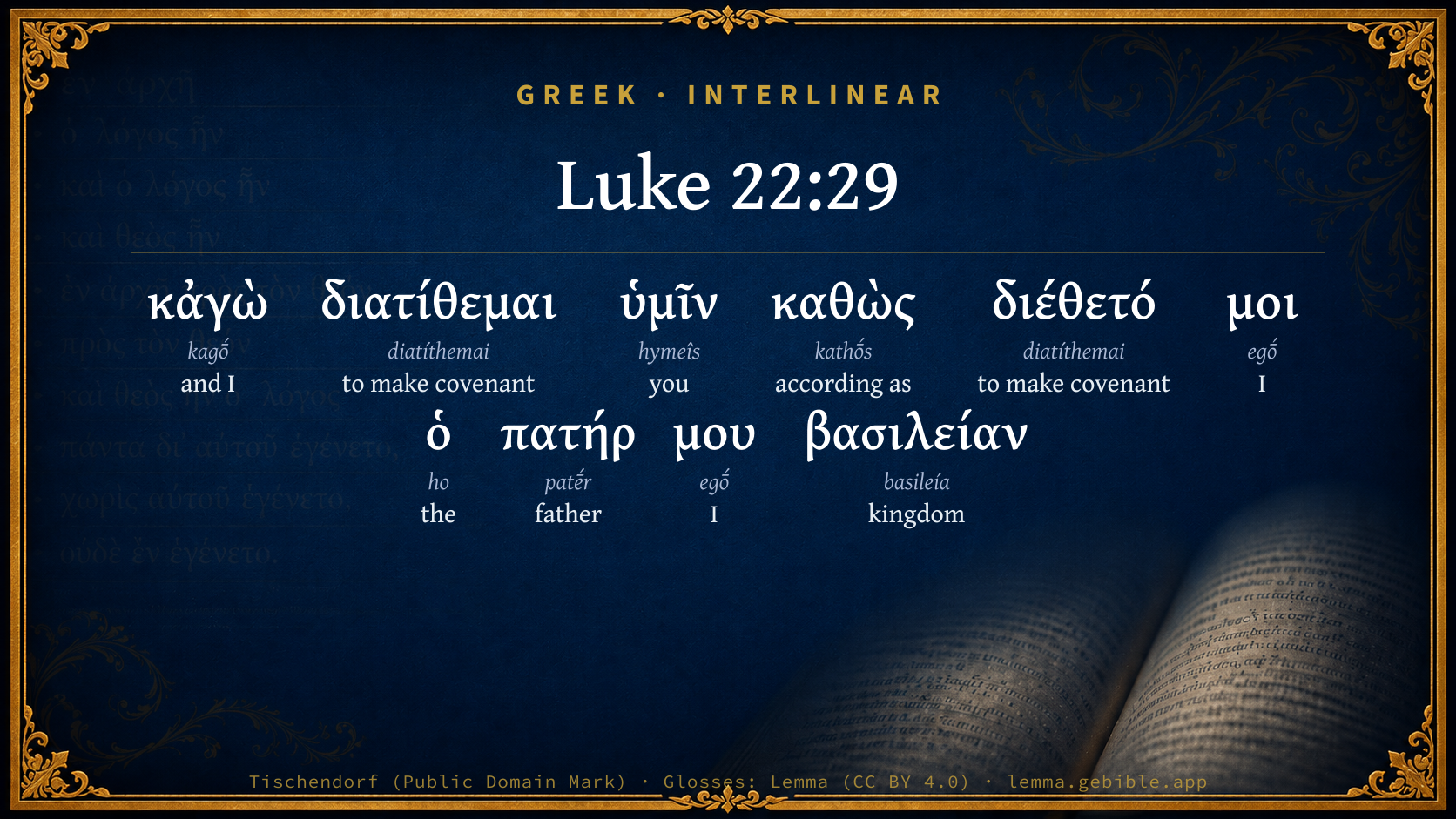
Download image
Cite this verse

Luke 22:29 (World English Bible). Public Domain. Lemma interlinear Bible study tool, https://lemma.gebible.app/v/luke/22/29.

Show BibTeX & RIS
BibTeX
RIS
English Translation
I confer on you a kingdom, even as my Father conferred on me,
World English Bible · Public Domain
Highlights
  • 1 first appearance in the Greek New Testament
Full analysis ↓
Download a study sheet

One document with this verse’s original text, its word-by-word gloss line, the meaning frame, cross-references with their text, attributed commentary, and full source and license credits — printable, and it pastes into notes with its structure intact.

This verse Autodidact and up

Study sheet (.html) Plain text (.txt)

A passage Seminary Student

Up to 50 verses in one chapter. A passage sheet keeps up to 6 commentary sources and 12 cross-references per verse, in the order this page ranks them, and says so on the sheet whenever that leaves anything out. Ask for a single verse and you get the Autodidact verse sheet above.

Everything on this page stays free to read, with no account — the sheet is a download of what is already on screen, not access to it.

Want to remove ads? Support Godless Engineer
Compare translations 3

The same verse in 3 English versions, stacked beneath the original-language interlinear above. Click any original word for its lexicon entry.

Each is an independent rendering of the whole verse — the interlinear is not word-aligned to these translations.

Highlighted words mark where these versions differ — a whole-verse word diff, not a word-by-word alignment.

  • World English Bible Public Domain
    I confer on you a kingdom, even as my Father conferred on me,
  • King James Version Public Domain
    And I appoint unto you a kingdom, as my Father hath appointed unto me;
  • unfoldingWord Literal Text CC BY-SA 4.0
    And I grant to you, just as my Father has granted to me, a kingdom,

unfoldingWord Literal Text — © unfoldingWord, licensed CC BY-SA 4.0. Word-aligned USFM3 via Door43 (git.door43.org/unfoldingWord/en_ult).

Versions to compare (up to 4)

3 of 4 selected

Show all 19 translations

Every available English version of this verse, each an independent rendering of the whole verse.

  • World English Bible Public Domain
    I confer on you a kingdom, even as my Father conferred on me,
  • Berean Standard Bible Public Domain
    And I bestow on you a kingdom, just as My Father has bestowed one on Me,
  • Majority Standard Bible Public Domain
    And I bestow on you a kingdom, just as My Father has bestowed one on Me,
  • King James Version Public Domain
    And I appoint unto you a kingdom, as my Father hath appointed unto me;
  • American Standard Version (1901) Public Domain
    and I appoint unto you a kingdom, even as my Father appointed unto me,
  • Revised Version (1885) Public Domain
    and I appoint unto you a kingdom, even as my Father appointed unto me,
  • Geneva Bible (1599) Public Domain
    Therefore I appoint vnto you a kingdome, as my Father hath appointed vnto me,
  • Douay-Rheims (1899) Public Domain
    And I dispose to you, as my Father hath disposed to me, a kingdom;
  • Young's Literal Translation Public Domain
    and I appoint to you, as my Father did appoint to me, a kingdom,
  • Literal Standard Version CC BY-SA 4.0
    and I appoint to you a kingdom, as My Father appointed to Me,
  • Unlocked Literal Bible CC BY-SA 4.0
    I give to you a kingdom, even as my Father has given a kingdom to me,
  • unfoldingWord Literal Text CC BY-SA 4.0
    And I grant to you, just as my Father has granted to me, a kingdom,
  • Darby Bible Public Domain
    And *I* appoint unto you, as my Father has appointed unto me, a kingdom,
  • World Messianic Bible Public Domain
    I confer on you a kingdom, even as my Father conferred on me,
  • Webster's Bible Public Domain
    And I appoint to you a kingdom, as my Father hath appointed to me;
  • Free Bible Version CC BY-SA 4.0
    And I grant to you authority to rule, just as my Father granted it to me,
  • Bible in Basic English Public Domain
    And I will give you a kingdom as my Father has given one to me,
  • Text-Critical English NT CC BY 4.0
    And I bestow on you a kingdom, just as my Father bestowed one on me,
  • Tyndale New Testament (1534) Public Domain
    And I apoynt vnto you a kyngdome as my father hath appoynted to me:

Literal Standard Version (2020), Covenant Press — licensed CC BY-SA 4.0. Text via the HelloAO Bible API (eBible.org). Unlocked Literal Bible (unfoldingWord) — licensed CC BY-SA 4.0. Text via the HelloAO Bible API (eBible.org). unfoldingWord Literal Text — © unfoldingWord, licensed CC BY-SA 4.0. Word-aligned USFM3 via Door43 (git.door43.org/unfoldingWord/en_ult). Free Bible Version, Dr. Jonathan Gallagher — licensed CC BY-SA 4.0. Text via the HelloAO Bible API (eBible.org).

Word by word

More ways to search: Search by grammar → Find every occurrence → Compare this word →

Practice this passage: Drill this verse → Learn its vocabulary →

διατίθεμαι
diatíthemai
G1303
“to make covenant”
Verb, Present, Middle, Indicative, 1st person, Singular
Part of Speech
Verb
Tense
Present
Voice
Middle
Mood
Indicative
Person
1st person
Number
Singular
Full Thayer's Definition

Origin: middle voice from G1223 and G5087

TDNT: 03:44,2

1. to arrange, dispose of, one's own affairs a. of something that belongs to one b. to dispose of by will, make a testament 2. to make a covenant, enter into a covenant, with one
  1. κἀγὼ kagṓ G2504 “and I” Personal pronoun, 1st person, Nominative, Singular, Aramaic form
  2. ὑμῖν hymeîs G5210 “you” Personal pronoun, 2nd person, Dative, Plural
  3. καθὼς kathṓs G2531 “according as” Adverb
  4. διέθετό diatíthemai G1303 “to make covenant” Verb, Aorist, Middle, Indicative, 3rd person, Singular
  5. μοι egṓ G1473 “I” Personal pronoun, 1st person, Dative, Singular
  6. ὁ ho G3588 “the” Article, Nominative, Singular, Masculine
  7. πατήρ patḗr G3962 “father” Noun, Nominative, Singular, Masculine
  8. μου egṓ G1473 “I” Personal pronoun, 1st person, Genitive, Singular
  9. βασιλείαν basileía G932 “kingdom” Noun, Accusative, Singular, Feminine

About this verse

These counts appear in no published source. They are computed here, from the morphology-tagged text and Lemma’s own curated glosses. What Lemma adds →

10
words
8
distinct lemmas
Gospels
section

Notable vocabulary

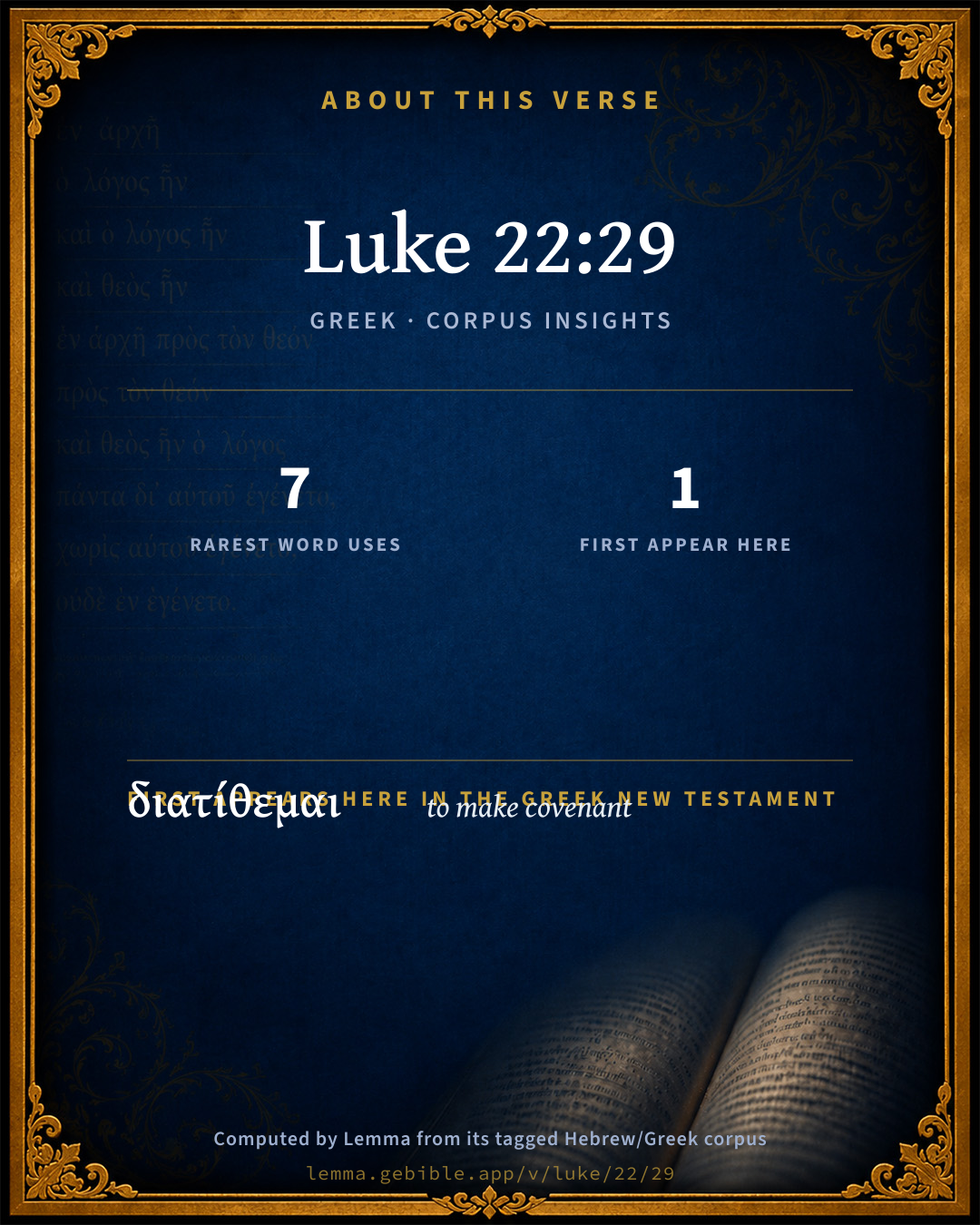
The rarest word here is διατίθεμαι to make covenant G1303 — appearing just 7 times in the whole Greek New Testament.

First appearance in Scripture

This word makes its first canonical appearance in the Greek New Testament here:

  • διατίθεμαι to make covenant G1303

Shared distinctive vocabulary

διατίθεμαι to make covenant G1303 occurs in 6 verses of the Greek New Testament. Also found in:
Repetition

Words recur within this verse:

  • διατίθεμαι to make covenant G1303 ×2
  • μοι I G1473 ×2

Cross-references

11

Topical passages linked to Luke 22:29 in the Treasury of Scripture Knowledge — connected by theme and wording, ordered by reader-vote popularity; previews shown in the World English Bible.

  • Matthew 25:34 Then the King will tell those on his right hand, 'Come, blessed of my Father, inherit the Kingdom prepared for you from the foundation of the world;
  • 2 Timothy 2:12 If we endure, We will also reign with him. If we deny him, He also will deny us.
  • James 2:5 Listen, my beloved brothers. Didn't God choose those who are poor in this world to be rich in faith, and heirs of the Kingdom which he promised to those who love him?
  • Matthew 24:47 Most assuredly I tell you that he will set him over all that he has.
  • Matthew 28:18 Jesus came to them and spoke to them, saying, "All authority has been given to me in heaven and on earth.
  • Luke 12:32 Don't be afraid, little flock, for it is your Father's good pleasure to give you the Kingdom.
  • Luke 19:17 "He said to him, 'Well done, you good servant! Because you were found faithful with very little, you shall have authority over ten cities.'
  • 1 Corinthians 9:25 Every man who strives in the games exercises self-control in all things. Now they do it to receive a corruptible crown, but we an incorruptible.
  • 1 Peter 5:4 When the chief Shepherd is revealed, you will receive the crown of glory that doesn't fade away.
  • 2 Corinthians 1:7 Our hope for you is steadfast, knowing that, since you are partakers of the sufferings, so also are you of the comfort.
  • Revelation 21:14 The wall of the city had twelve foundations, and on them twelve names of the twelve Apostles of the Lamb.

Cross-references courtesy of OpenBible.info (CC BY 4.0).

Commentary

Notes on Luke 22:29 from classic Christian and Jewish commentators (each source and its license shown beneath its notes). The classic Christian expositions comment on the surrounding passage and are grouped to its opening verse, so a note may address several verses; the Jewish commentaries on the Tanakh (Rashi and others) are per-verse, so they appear only where the commentator wrote on this verse.

Lemma curates 59 commentaries, every one of them public domain or Creative Commons licensed, each selected and text-cleaned for this edition rather than reprinted as found. About our sources →

Tyndale Open Study Notes

Tyndale Open Resources

22:29-30 I now grant you the right to eat and drink at my table: See “The Messianic Banquet” Theme Note.

Tyndale Open Study Notes — © Tyndale Open Resources, licensed CC BY-SA 4.0. Text via the HelloAO Bible API.

Bengel's Gnomon

Johann Albrecht Bengel

Luk 22:29. Καγὼ) and in turn [in return for your fidelity] I. The sense is: I also will warrant that you shall be unhurt amidst your dangerous temptations (comp. Rev 3:10, “Because thou hast kept the word of my patience, I also will keep thee from the hour of temptation, which shall come upon all the world, to try them,” etc.), even until ye enter into the kingdom. But this is expressed in an abbreviated form of phraseology; for the entrance into the kingdom takes for granted preservation amidst temptations. [Comp. Joh 6:39, “This is the Father’s will—that of all which He hath given Me I should lose nothing.”]—διατίθεμαι) now, by these very words. The promise is put before the warning. See Luk 22:31. Flacius and Beza translate the word, ‘paciscor,’ I covenant to give. E. Schmidius, “testamento dispono,” I assign by will. A word appropriate to one dying. Heb 9:15-16 [He is the mediator of the New Testament, that by means of death for, etc.—they that are called might receive the promise of eternal inheritance. For where a testament is, there must also of necessity be the death of the testator”]. [However the word presently after must be taken in a wider sense when it is applied to the Father (διέθετό μοι ὁ πατήρ).—V. g.]—μοι, unto me) inasmuch as I have continued stedfast.[235]—βασιλείαν, a kingdom) In a kingdom there is wont to be a princely and splendid style of living and diet, as also royal power and the exercise of it. Both are promised in the following verse. [Then indeed the question, who is to be accounted the greater, will have easily passed away from the memory of all. He who duly considers these so great blessings which are promised will find no difficulty in making the world a secondary consideration in his aims.—V. g.]

[235] I have persevered; referring to the disciples having perseveringly continued, διαμεμενηκότες, Luk 22:28.—E. and T.

Bengel's Gnomon of the New Testament — English translation (T&T Clark, Edinburgh, 1860) — public domain. Text from a community e-Sword module.

Expositor's Greek Testament

ed. W. Robertson Nicoll

Luk 22:29 . διατίθεμαι ( διατίθημι , middle only in N.T.), “appoint,” make a disposition of. The corresponding noun is διαθήκη . In Heb 9:17 we find ὁ διαθέμενος , a testator, and the verb may be used here in the sense of bequeathing, though that sense is inapplicable to God’s gift of a kingdom to Jesus referred to in next clause.

The Expositor's Greek Testament, edited by W. Robertson Nicoll (1897–1910) — public domain. Text from a community e-Sword module.

Jamieson, Fausset & Brown

Robert Jamieson, A. R. Fausset & David Brown

I appoint, &c.--Who is this that dispenses kingdoms, nay, the Kingdom of kingdoms, within an hour or two of His apprehension, and less than a day of His shameful death? These sublime contrasts, however, perpetually meet and entrance us in this matchless history.

Jamieson, Fausset & Brown — Commentary Critical and Explanatory on the Whole Bible (1871) — public domain (CC PDM 1.0). Text via the HelloAO Bible API.

Adam Clarke's Commentary

Verse 29. I appoint unto you a kingdom, as my Father hath appointed unto me] The Codex Alexandrinus, with some other MSS., the later Syriac, and Origen, read in the first clause, διαθηκην, a covenant. I appoint unto you a COVENANT, as my Father hath appointed unto me a kingdom: - Ye shall be ministers of the new covenant, as I am king in that spiritual kingdom to which it relates. This is a curious reading: but our Lord is probably to be understood as promising that they should get a kingdom - a state of blessedness, as he should get it - they must go through much tribulation in order to enter into the kingdom of God. So the Son of man suffered that he might enter into his glory: for the joy that was set before him, he endured the cross, and despised the shame, and is set down on the right hand of God.

Adam Clarke's Commentary on the Bible (1810–1826) — public domain. Text from a community e-Sword/MySword module.

Ellicott's Commentary for English Readers

(29) And I appoint unto you a kingdom.—As being the verb from which is formed the noun for “covenant,” or “testament,” the Greek for “appoint,” has a force which we lose in the English. This was part of the New Covenant with them. They were to be sharers in His glory, as they had been in His afflictions. The latter clause, “as the Father hath appointed unto Me,” conveys the thought that His throne also was bestowed on the fulfilment of like conditions. The “sufferings” came first, and then the glory (1Pe_1:11). He was to endure the cross before He entered into joy (Heb_12:2). The Name that is above every name was the crowning reward of obedient humility (Php_2:8-9).

A Bible Commentary for English Readers, edited by Charles John Ellicott (1878–1897) — public domain. Text from a community e-Sword module.

The Cambridge Bible for Schools and Colleges

gen. ed. J. J. S. Perowne

29. I appoint unto you a kingdom] See Luk_12:32. “If we suffer we shall also reign with Him,” 2Ti_2:12. Diatithemai is ‘I appoint by way of bequest,’ Psa_81:4 (LXX.).

The Cambridge Bible for Schools and Colleges (gen. ed. J. J. S. Perowne; Cambridge University Press, 1878–1918) — public domain. Text from a community e-Sword module.

John Gill's Exposition

That ye may eat, and drink, at my table, in my kingdom,.... In the Gospel dispensation, or Gospel church state, in which Christ has a table, called the table of the Lord, Co1 10:21 which is the Lord's supper, and is a table well furnished with the best of provisions, his flesh and blood, of which believers may eat and drink with a hearty welcome; Christ himself being present to sup with them: and in his personal reign on earth, where will be the marriage supper of the Lamb, to which all the saints will be called; and will sit down with Abraham, Isaac, and Jacob, and be regaled with joys and pleasures not to be expressed: and in the ultimate glory, when the Lamb shall feed them, and shall lead them to fountains of water; and they shall never hunger nor thirst more, but shall have fulness of joy, and be satiated with pleasures that will never fade nor end:

and sit on thrones; expressive of the great honour and dignity they were raised to, both in this, and the other world, from a low and mean estate, being before as beggars on the dunghill, now among princes, and on thrones, even on the same throne with Christ; see Sa1 2:8

judging the twelve tribes of Israel; doctrinally and ministerially; accusing the Jews, and arraigning them for the crucifixion of Christ; passing sentence upon them, and condemning them, and declaring that they should be damned for their disbelief and rejection of him; See Gill on Mat 19:28.

John Gill's Exposition of the Whole Bible (1746–1763) — public domain (CC PDM 1.0). Text via the HelloAO Bible API.

Trapp's Complete Commentary

John Trapp

29 And I appoint unto you a kingdom, as my Father hath appointed unto me;

Ver. 29. And I appoint] Gr. διατιθεμαι, I bequeath as by my last will and testament. See Heb 9:17.

John Trapp, A Commentary or Exposition upon All the Books of the Old and New Testament (1647–1656) — public domain. Text from a community e-Sword module.

Albert Barnes' Notes on the Bible

And I appoint unto you a kingdom - He assures them here that they should “have” a kingdom - their expectations would be realized. They had continued with him; they had seen how “he” had lived, and to what trials he had been subjected; they had all along expected a kingdom, and he assures them that they should not be disappointed.

As my Father ... - They had seen how God had appointed a kingdom to “him.” It was not with pomp, and splendor, and external glory, but it was in poverty, want, persecution, and trial. So would “he” appoint to them a kingdom. They should “surely” possess it; but it would be not with external splendor, but by poverty and toil. The original word “appoint” has the force of a “covenant” or compact, and means that it should be “surely” or certainly done, or that he pledged himself to do it. All Christians must enter into the kingdom of heaven after the manner of their Lord - through much tribulation; but, though it must be, as it was with him, by many tears and sorrows, yet they shall surely reach the place of their rest and the reward of heaven, for it is secured to them by the covenant pledge and faithfulness of their Lord and King.

Albert Barnes' Notes on the Bible (1834–1885) — public domain. Text from a community e-Sword/MySword module.

Haydock's Catholic Bible Commentary

And I assign to you, as my Father hath assigned to me, a kingdom; i.e. as my heavenly Father decreed to exalt me, even as man, and with my human nature, above all creatures; so will I also make you, according to you different merits, partakers of my glory. (Witham)

George Leo Haydock (1774–1849), Haydock's Catholic Family Bible and Commentary, 1859 edition — public domain. Excludes Psalms (Douay-Rheims chapter numbering differs from Protestant) and Deuterocanonical books (Catholic canon only).

Whedon's Commentary on the Bible

Daniel D. Whedon

29. I appoint—Literally, I bequeath, as if an inheritance after his death.

A kingdom—A realm more powerful than any political kingdom; a royalty more dignified than any civil throne. This is the kingdom of the true Church, being a humble share in the mediatorial kingdom of Christ himself.

Daniel D. Whedon (gen. ed.), Commentary on the Old and New Testaments (1874–1909) — public domain. Text from a community e-Sword module.

The Pulpit Commentary

And I appoint unto you a kingdom, as my Father hath appointed unto me. This promise refers to earth and this life. They and their successors in his Church would bear sway over men"s hearts, His kingdom would be administered by them. With strangely literal accuracy has this promise been fulfilled. From the hour when the despised Master, already doomed to a shameful death, uttered this seemingly improbable prediction, his kingdom over men"s hearts has been extending. Then at most the kingdom numbered a few hundreds; nine it can only be reckoned by millions. For centuries the story of the civilized world has been the story of this kingdom.

The Pulpit Commentary (1880–1919), ed. H.D.M. Spence-Jones & Joseph S. Exell — public domain. Text from a community e-Sword module.

John Wesley's Explanatory Notes

And I - Will preserve you in all your temptations, till ye enter into the kingdom of glory: appoint to you - By these very words. Not a primacy to one, but a kingdom to every one: on the same terms: as my Father hath appointed to me - Who have fought and conquered.

John Wesley, Explanatory Notes Upon the Whole Bible (1754–1765) — public domain. Text via the GEBible commentary corpus.

MacLaren's Expositions of Holy Scripture

Alexander MacLaren

Luke

PARTING PROMISES AND WARNINGS

Luk 22:24 - Luk 22:37.

It was blameworthy, but only too natural, that, while Christ’s heart was full of His approaching sufferings, the Apostles should be squabbling about their respective dignity. They thought that the half-understood predictions pointed to a brief struggle immediately preceding the establishment of the kingdom, and they wished to have their rank settled in advance. Possibly, too, they had been disputing as to whose office was the menial task of presenting the basin for foot-washing. So little did the first partakers of the Lord’s Supper ‘discern the Lord’s body,’ and so little did His most loving friends share His sorrows.

I. Our Lord was not so absorbed in His anticipations of the near Cross as to be unobservant of the wrangling among the Apostles.

Even then His heart was enough at leisure from itself to observe, to pity, and to help. So He at once turns to deal with the false ideas of greatness betrayed by the dispute. The world’s notion is that the true use and exercise of superiority is to lord it over others. Tyrants are flattered by the title of benefactor, which they do not deserve, but the giving of which shows that, even in the world, some trace of the true conception lingers. It was sadly true, at that time, that power was used for selfish ends, and generally meant oppression. One Egyptian king, who bore the title Benefactor, was popularly known as Malefactor, and many another old-world monarch deserved a like name.

Jesus lays down the law for His followers as being the exact opposite of the world’s notion. Dignity and pre-eminence carry obligations to serve. In His kingdom power is to be used to help others, not to glorify oneself. In other sayings of Christ’s, service is declared to be the way to become great in the kingdom, but here the matter is taken up at another point, and greatness, already attained on whatever grounds, is commanded to be turned to its proper use. The way to become great is to become small, and to serve. The right use of greatness is to become a servant. That has become a familiar commonplace now, but its recognition as the law for civic and other dignity is all but entirely owing to Christianity. What conception of such a use of power has the Sultan of Turkey, or the petty tyrants of heathen lands? The worst of European rulers have to make pretence to be guided by this law; and even the Pope calls himself ‘the servant of servants.’

It is a commonplace, but like many another axiom, universal acceptance and almost as universal neglect are its fate. Ingrained selfishness fights against it. Men admire it as a beautiful saying, and how many of us take it as our life’s guide? We condemn the rulers of old who wrung wealth out of their people and neglected every duty; but what of our own use of the fraction of power we possess, or our own demeanour to our inferiors in world or church? Have all the occupants of royal thrones or presidential chairs, all peers, members of Parliament, senators, and congressmen, used their position for the public weal? Do we regard ours as a trust to be administered for others? Do we feel the weight of our crown, or are we taken up with its jewels, and proud of ourselves for it? Christ’s pathetic words, giving Himself as the example of greatness that serves, are best understood as referring to His wonderful act of washing the disciples’ feet. Luke does not record it, and probably did not know it, but how the words are lighted up if we bring them into connection with it!

II. Verses 28 to 30 naturally flow from the preceding.

They lift a corner of the veil, and show the rewards, when the heavenly form of the kingdom has come, of the right use of eminence in its earthly form. How pathetic a glimpse into Christ’s heart is given in that warm utterance of gratitude for the imperfect companionship of the Twelve! It reveals His loneliness, His yearning for a loving hand to grasp, His continual conflict with temptations to choose an easier way than that of the Cross. He has known all the pain of being alone, and feeling in vain for a sympathetic heart to lean on. He has had to resist temptation, not only in the desert at the beginning, or in Gethsemane at the end, but throughout His life. He treasures in His heart, and richly repays, even a little love dashed with much selfishness, and faithfulness broken by desertion. We do not often speak of the tempted Christ, or of the lonely Christ, or of the grateful Christ, but in these great words we see Him as being all these.

The rewards promised point onwards to the perfecting of the kingdom in the future life. We notice the profound thought that the kingdom which His servants are to inherit is conferred on them, ‘as My Father hath appointed unto Me,’-that is, that it is a kingdom won by suffering and service, and wielded by gentleness and for others. ‘If we suffer, we shall also reign with Him.’ The characteristics of the future royalty of Christ’s servants are given in highly figurative language. A state of which we have no experience can only be revealed under forms drawn from experience; but these are only far-off approximations, and cannot be pressed.

The sacred Last Supper suggested one metaphor. It was the last on earth, but its sanctity would be renewed in heaven, and sadness and separation and the following grief would not mar the perfect, perpetual, joyful feast. What dim visions of rule and delegated authority may lie in the other promise of judging the twelve tribes of Israel, we must wait till we go to that world to understand. But this is clear, that continuing with Jesus here leads to everlasting companionship hereafter, in which all desires shall be satisfied, and we shall share in His authority and be representatives of His glory.

III. But Jesus abruptly recalls Himself and the Twelve from these remoter prospects of bliss to the nearer future of trial and separation.

The solemn warning to Peter follows with startling suddenness. Why should they be fighting about precedence when they were on the verge of the sorest trial of their constancy? And as for Peter, who had, no doubt, not been the least loud-voiced in the strife, he needed most of all to be sobered. Our narrow limits forbid our doing even partial justice to the scene with him; but we note the significant use of the old name ‘Simon,’ reminding the Apostle of his human weakness, and its repetition, giving emphasis to the address.

We note, too, the partial withdrawal of the veil which hides the spirit world from us, in the distinct declaration of the agency of a personal tempter, whose power is limited, though his malice is boundless, and who had to obtain God’s permission ere he could tempt. His sieve is made to let the wheat through, and to retain the chaff. It will be hard to empty this saying of its force. Christ taught the existence and operation of Satan; but He taught, too, that He Himself was Satan’s victorious antagonist and our prevailing intercessor. He is so still. He does not seek to avert conflict from us, but prays that our faith fail not, and Himself, too, fulfils the prayer by strengthening us.

Faith, then, conquers, and withstands Satan’s sifting. If it holds out, we shall not fall, though all the winds howl round us. We are not passive between the two antagonists, but have to take our share in the struggle. Partial failures may be followed by recovery, and even tend to increase our power to strengthen other tempted ones, by the experience gained of our own weakness, which deepens humility and forbearance with others’ faults, and by the experience of Christ’s strength, which makes us able to direct them to the source of all safety.

Peter’s passionate avowal of readiness to bear anything, if only he was with Christ, is the genuine utterance of a warm impulsive heart, which took too little heed of Christ’s solemn warning, and fancied that the tide of present feeling would always run as strong as now. Emotion fluctuates. Steadfast devotion is chary of mortgaging the future by promises. He who knows himself is slow to say, ‘I will,’ for he knows that ‘Oh that I may!’ is fitter for his weakness. Very likely, if Peter had been offered fetters or the scaffold then and there, he would have accepted them bravely; but it was a different thing in the raw, cold morning, after an agitating night, and the Master away at the far end of the great hall. A flippant maid’s tongue was enough to finish him then.

It is sometimes easier to bear a great load for Christ than a small one. Some of us could be martyrs at the stake more easily than confessors among sneering neighbours. Jesus had spared the Apostle in the former warning of his fall, but He spoke plainly at last, since the former had been ineffectual; and He addressed him by his new name of Peter, as if to heighten the sin of denial by recalling the privileges bestowed.

IV. The last part of the passage deals with the new conditions consequent on Christ’s departure.

The Twelve had been exempt from the care of providing for themselves while He was with them, but now they are to be launched into the world alone, like fledglings from the nest. Not that His presence is not with them or with us, but that His absence throws the task of providing for wants and guarding against dangers on themselves, as had not been the case during the blessed years of companionship. Hence the injunctions in verse 36 lay down the permanent law for the Church, while verse 37 assigns as its reason the speedy fulfilment of the prophecies of Messiah’s sufferings.

Substantially the meaning of the whole is: ‘I am on the point of leaving you, and, when I am gone, you must use common-sense means for provision and protection. I provided for you while I was here, without your co-operation. Remember how I did so, and trust Me to provide in future, through your co-operation.’

The life of faith does not exclude ordinary prudence and the use of appropriate means. It is more in accord with Christ’s mind to have a purse to keep money in, and a wallet for food-stores, than to go out, as some good people do, saying, ‘The Lord will provide.’ Yes, He will; but it will be by blessing your common-sense and effort. As to the difficulty felt in the injunction to buy a sword, our Lord would be contradicting His whole teaching if He was here commanding the use of arms for the defence of His servants or the promotion of His kingdom. That He did not mean literal swords is plain from His answer to the Apostles, who produced the formidable armament of two.

‘It is enough.’ A couple are plenty to fight the Roman Empire with. Yes, two too many, as was soon seen. The expression is plainly an intensely energetic metaphor, taking line with purse and scrip. The plain meaning of the whole is that we are called on to provide necessary means of provision and defence, which He will bless. The only sword permitted to His followers is the sword of the Spirit.

Alexander MacLaren, Expositions of Holy Scripture (1904–1910) — public domain. Text from a community e-Sword module.

Cambridge Greek Testament for Schools and Colleges

29. διατίθεμαι ὑμῖν … βασιλείαν. I ordain for you (dispono) a kingdom; not ‘I bequeath.’ See Luk 12:32; 2Ti 2:12. διατίθεμαι is ‘I appoint by way of bequest,’ Psa 81:4 (LXX[381]).

[381] LXX. Septuagint.

Cambridge Greek Testament for Schools and Colleges (Cambridge University Press, 1896; 21 vols, various authors incl. Carr, Maclear, Plummer, Farrar, Lumby, Moule, M. R. James, Simcox) — public domain. Text from a community e-Sword module.

Vincent's Word Studies in the New Testament

Marvin R. Vincent

I appoint [διατιθεμαι] . Implying allotment : assigning in the course of distribution [δια] . Wyc., dispose. Luke is especially fond of compounds with dia.

Marvin R. Vincent, Word Studies in the New Testament (1887–1900) — public domain. Text from a community e-Sword/MySword module.

Lesson kit

Teaching starters — assembled from the data on this page, not authored interpretation. Every prompt links to the verse data it draws on. Edit before teaching.

Luke, in the Gospels, opens this verse with 10 words (8 distinct Greek lemmas). Its most distinctive word is diatíthemai (“to make covenant”). A historical commentator’s framing appears above. Read the whole chapter for the surrounding context.

Discussion questions

  1. What does “to make covenant” (diatíthemai) contribute to the verse as a whole?
  2. The word “to make covenant” first appears here in Scripture. What is being introduced at this debut?
  3. Acts 3:25 shares the word «to make covenant» with this verse. How do the two illuminate each other?
  4. “to make covenant” occurs 2× in this one verse. What is the effect of the repetition?
  5. These translations render this verse differently; the difference is in the English rendering, not the original. What questions does that raise?
  6. Reading how Tyndale Open Study Notes and Bengel's Gnomon read this verse, where do the two commentators agree and where do they part?

Things to notice

  • 1 word makes its first canonical appearance in Scripture here.
  • These translations choose different wording for 9 words in this verse.
  • “to make covenant” occurs 2× in this single verse.
  • 8 distinct Greek lemmas span 10 words in this verse.

Reading settings

Reading text

Shown beneath each verse's original-language words.

Old Testament
Old Testament edition

Read the OT as the Masoretic Hebrew (MT) or the Greek Septuagint (LXX).

English shown for the Greek Septuagint (in the Hebrew ↔ Greek comparison).

Comparing translations? Open the Compare panel on any verse page to stack up to four side by side.