Matthew 10:29

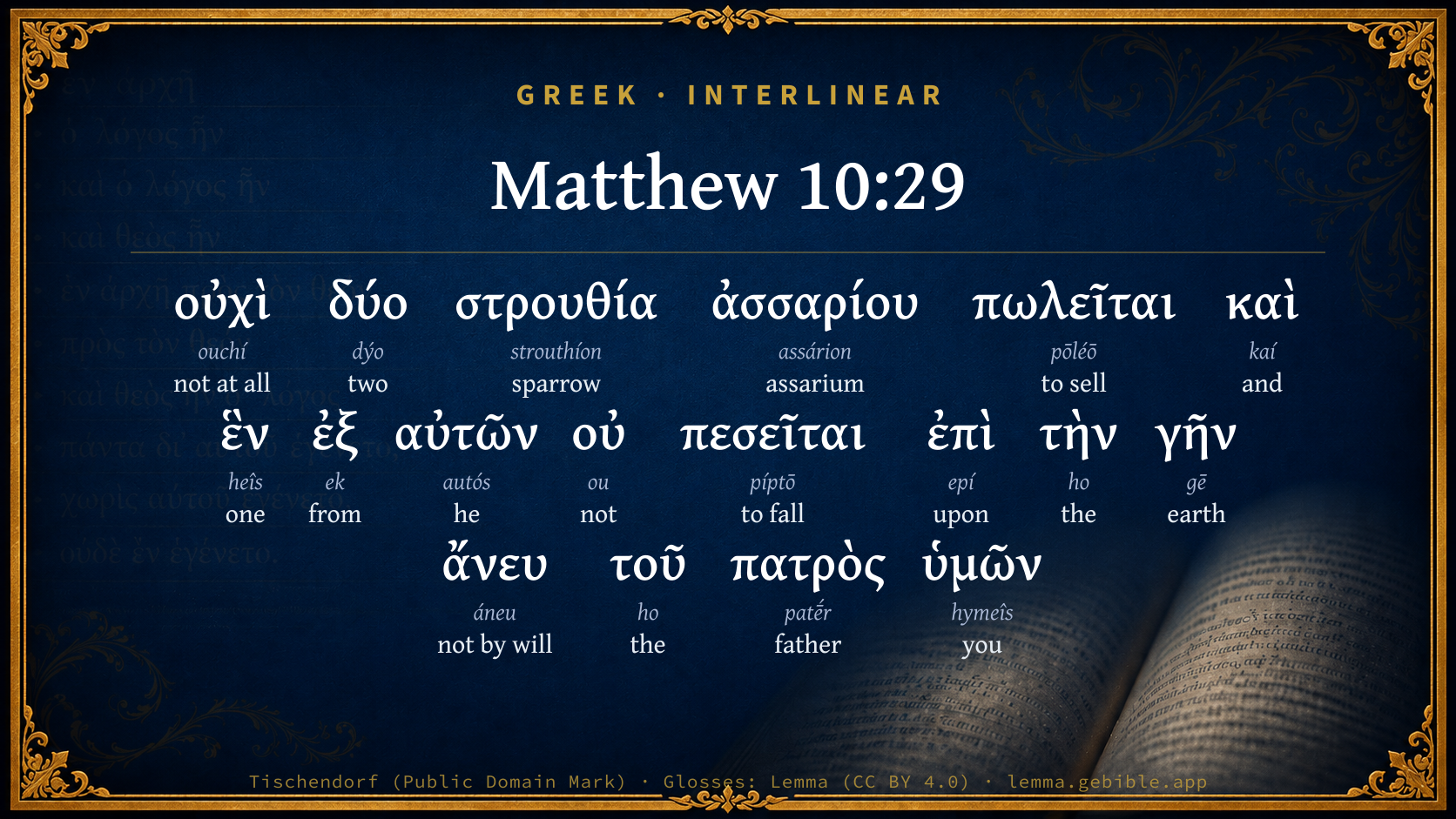
Greek (Tischendorf 8th ed.) Matthew 10:29 appears in the Greek New Testament. The text above is from the Tischendorf 8th edition. Each word links to its Strong’s number and a concise gloss. Click any word for its full Thayer’s Greek Lexicon entry.
Download image
Cite this verse

Matthew 10:29 (World English Bible). Public Domain. Lemma interlinear Bible study tool, https://lemma.gebible.app/v/matthew/10/29.

Show BibTeX & RIS
BibTeX
RIS
English Translation
"Aren't two sparrows sold for an assarion? Not one of them falls on the ground apart from your Father's will,
World English Bible · Public Domain
Highlights
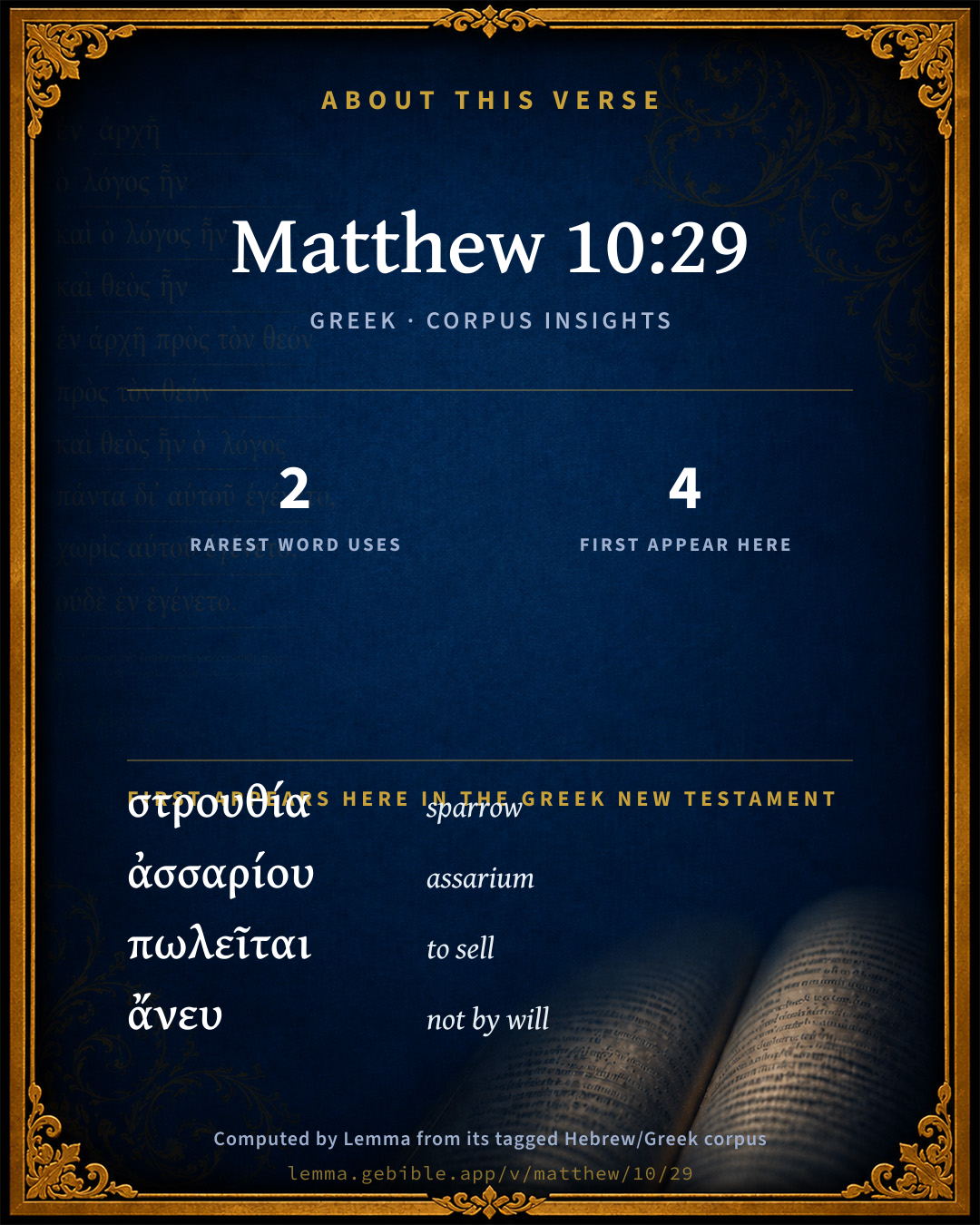
  • 4 first appearances in the Greek New Testament
Full analysis ↓
Download a study sheet

One document with this verse’s original text, its word-by-word gloss line, the meaning frame, cross-references with their text, attributed commentary, and full source and license credits — printable, and it pastes into notes with its structure intact.

This verse Autodidact and up

Study sheet (.html) Plain text (.txt)

A passage Seminary Student

Up to 50 verses in one chapter. A passage sheet keeps up to 6 commentary sources and 12 cross-references per verse, in the order this page ranks them, and says so on the sheet whenever that leaves anything out. Ask for a single verse and you get the Autodidact verse sheet above.

Everything on this page stays free to read, with no account — the sheet is a download of what is already on screen, not access to it.

Want to remove ads? Support Godless Engineer
Compare translations 3

The same verse in 3 English versions, stacked beneath the original-language interlinear above. Click any original word for its lexicon entry.

Each is an independent rendering of the whole verse — the interlinear is not word-aligned to these translations.

Highlighted words mark where these versions differ — a whole-verse word diff, not a word-by-word alignment.

  • World English Bible Public Domain
    "Aren't two sparrows sold for an assarion? Not one of them falls on the ground apart from your Father's will,
  • King James Version Public Domain
    Are not two sparrows sold for a farthing? and one of them shall not fall on the ground without your Father.
  • unfoldingWord Literal Text CC BY-SA 4.0
    Are not two sparrows sold for an assarion? And yet not one of them will fall to the ground apart from your Father.

unfoldingWord Literal Text — © unfoldingWord, licensed CC BY-SA 4.0. Word-aligned USFM3 via Door43 (git.door43.org/unfoldingWord/en_ult).

Versions to compare (up to 4)

3 of 4 selected

Show all 19 translations

Every available English version of this verse, each an independent rendering of the whole verse.

  • World English Bible Public Domain
    "Aren't two sparrows sold for an assarion? Not one of them falls on the ground apart from your Father's will,
  • Berean Standard Bible Public Domain
    Are not two sparrows sold for a penny? Yet not one of them will fall to the ground apart from the will of your Father.
  • Majority Standard Bible Public Domain
    Are not two sparrows sold for a penny? Yet not one of them will fall to the ground apart from the will of your Father.
  • King James Version Public Domain
    Are not two sparrows sold for a farthing? and one of them shall not fall on the ground without your Father.
  • American Standard Version (1901) Public Domain
    Are not two sparrows sold for a penny? and not one of them shall fall on the ground without your Father:
  • Revised Version (1885) Public Domain
    Are not two sparrows sold for a farthing? and not one of them shall fall on the ground without your Father:
  • Geneva Bible (1599) Public Domain
    Are not two sparrowes sold for a farthing, and one of them shall not fal on the ground without your Father?
  • Douay-Rheims (1899) Public Domain
    Are not two sparrows sold for a farthing? and not one of them shall fall on the ground without your Father.
  • Young's Literal Translation Public Domain
    `Are not two sparrows sold for an assar? and one of them shall not fall on the ground without your Father;
  • Literal Standard Version CC BY-SA 4.0
    Are not two sparrows sold for an assarion? And one of them will not fall on the ground without your Father;
  • Unlocked Literal Bible CC BY-SA 4.0
    Are not two sparrows sold for a small coin? Yet not one of them falls to the ground without your Father's knowledge.
  • unfoldingWord Literal Text CC BY-SA 4.0
    Are not two sparrows sold for an assarion? And yet not one of them will fall to the ground apart from your Father.
  • Darby Bible Public Domain
    Are not two sparrows sold for a farthing? and one of them shall not fall to the ground without your Father;
  • World Messianic Bible Public Domain
    “Aren’t two sparrows sold for an assarion coin? Not one of them falls to the ground apart from your Father’s will.
  • Webster's Bible Public Domain
    Are not two sparrows sold for a farthing? and not one of them shall fall on the ground without your Father.
  • Free Bible Version CC BY-SA 4.0
    Aren't two sparrows sold for just one penny? But not a single one of them falls to the ground without your Father knowing about it.
  • Bible in Basic English Public Domain
    Are not sparrows two a farthing? and not one of them comes to an end without your Father:
  • Text-Critical English NT CC BY 4.0
    Are not two sparrows sold for a penny? Yet not one of them will fall to the ground without your Father's consent.
  • Tyndale New Testament (1534) Public Domain
    Are not two sparowes solde for a farthinge? And none of them dothe lyght on the grounde with out youre father.

Literal Standard Version (2020), Covenant Press — licensed CC BY-SA 4.0. Text via the HelloAO Bible API (eBible.org). Unlocked Literal Bible (unfoldingWord) — licensed CC BY-SA 4.0. Text via the HelloAO Bible API (eBible.org). unfoldingWord Literal Text — © unfoldingWord, licensed CC BY-SA 4.0. Word-aligned USFM3 via Door43 (git.door43.org/unfoldingWord/en_ult). Free Bible Version, Dr. Jonathan Gallagher — licensed CC BY-SA 4.0. Text via the HelloAO Bible API (eBible.org).

Word by word

More ways to search: Search by grammar → Find every occurrence → Compare this word →

Practice this passage: Drill this verse → Learn its vocabulary →

ἀσσαρίου
assárion
G787
“assarium”
Noun, Genitive, Singular, Neuter
Part of Speech
Noun
Case
Genitive
Number
Singular
Gender
Neuter
Full Thayer's Definition

Origin: of Latin origin

TDNT: None

1. an assarium or assarius, the name of a coin equal to the tenth part of a drachma
  1. οὐχὶ ouchí G3780 “not at all” Particle, Interrogative
  2. δύο dýo G1417 “two” Adjective, Numeral (indeclinable)
  3. στρουθία strouthíon G4765 “sparrow” Noun, Nominative, Plural, Neuter
  4. πωλεῖται pōléō G4453 “to sell” Verb, Present, Passive, Indicative, 3rd person, Singular
  5. καὶ kaí G2532 “and” Conjunction
  6. ἓν heîs G1520 “one” Adjective, Nominative, Singular, Neuter
  7. ἐξ ek G1537 “from” Preposition
  8. αὐτῶν autós G846 “he” Personal pronoun, Genitive, Plural, Neuter
  9. οὐ ou G3756 “not” Particle, Negative
  10. πεσεῖται píptō G4098 “to fall” Verb, Future, Middle deponent, Indicative, 3rd person, Singular
  11. ἐπὶ epí G1909 “upon” Preposition
  12. τὴν ho G3588 “the” Article, Accusative, Singular, Feminine
  13. γῆν gē G1093 “earth” Noun, Accusative, Singular, Feminine
  14. ἄνευ áneu G427 “not by will” Preposition
  15. τοῦ ho G3588 “the” Article, Genitive, Singular, Masculine
  16. πατρὸς patḗr G3962 “father” Noun, Genitive, Singular, Masculine
  17. ὑμῶν hymeîs G5210 “you” Personal pronoun, 2nd person, Genitive, Plural

About this verse

These counts appear in no published source. They are computed here, from the morphology-tagged text and Lemma’s own curated glosses. What Lemma adds →

18
words
17
distinct lemmas
Gospels
section

Notable vocabulary

The rarest word here is ἀσσαρίου assarium G787 — appearing just 2 times in the whole Greek New Testament.

First appearance in Scripture

These words make their first canonical appearance in the Greek New Testament here:

  • στρουθία sparrow G4765
  • ἀσσαρίου assarium G787
  • πωλεῖται to sell G4453
  • ἄνευ not by will G427

Shared distinctive vocabulary

ἀσσαρίου assarium G787 occurs in 2 verses of the Greek New Testament. Also found in:

Repetition

A word recurs within this verse:

Cross-references

2

Topical passages linked to Matthew 10:29 in the Treasury of Scripture Knowledge — connected by theme and wording, ordered by reader-vote popularity; previews shown in the World English Bible.

  • Luke 12:6–7 "Aren't five sparrows sold for two assaria coins? Not one of them is forgotten by God.
  • Psalms 104:27–30 These all wait for you, That you may give them their food in due season.

Cross-references courtesy of OpenBible.info (CC BY 4.0).

Commentary

Notes on Matthew 10:29 from classic Christian and Jewish commentators (each source and its license shown beneath its notes). The classic Christian expositions comment on the surrounding passage and are grouped to its opening verse, so a note may address several verses; the Jewish commentaries on the Tanakh (Rashi and others) are per-verse, so they appear only where the commentator wrote on this verse.

Lemma curates 59 commentaries, every one of them public domain or Creative Commons licensed, each selected and text-cleaned for this edition rather than reprinted as found. About our sources →

The Biblical Illustrator

Joseph S. Exell

Mat_10:29

And one of them shall not fall to the ground.

I. The doctrine of providence. It is involved in difficulties. The text justifies the assertion that it is comprehensive and even universal, especially engaged on behalf of man, more particularly directed to the safety, prosperity, and increase of the Church. The special providence of God extends to every individual among His people.

II. The subject is capable of very extensive and important application. Recognize the hand of God in all the events of life. No such thing as chance. Submit to God amid all trials. For comfort and confidence. Let it guide your practice. A powerful argument to recommend religion to the choice of all men. (D. Katterns.)

A particular providence

I. To illustrate and confirm the doctrine which these words exhibit that there is a particular providence. The Bible reveals this doctrine-His kingdom ruleth over all.

1. The providence of God extends to a meaner order of things-to raiment, birds, lilies; thus it is concerned with events great and small.

2. The providence of God is more extensive and minute than the care of any one part of the creation over another. The most tender mother never counted the hairs of her child, but Gods providence extends to this.

3. The notion which the Scriptures give us of God. He is said to be Governor, but how can He be unless He attend to all the concerns of those over whom He rules. Where is His wisdom if events take place to meet which He is not provided; or His power, if circumstances transpire over which He has no control.

4. If we reject providence, one great part of Scripture must be resigned, that which we call prophecy.

II. To point out the purposes of utility-experimental and practical-to which this doctrine is to be applied.

1. It is calculated to cheer the ministers of Christ under the various difficulties to their success to which they are exposed.

2. It is calculated to console the true Church of God in all parts of the earth.

3. It may serve to sustain the heart of every individual disciple of Christ.

4. It tends to calm the mind while watching the various dispensations of Providence as it respects nations or individuals. (J. Clayton.)

Particular providence of God

In viewing the attributes of God and His relations to us, there are two questions to be considered.

1. Has God the gracious will, the benevolent inclination, to observe and direct the works of creation? and has He sufficient power to discern all His creatures, and to regulate everything respecting them according to His will?

2. What is thus taught us from the consideration of God is confirmed by an attention to our feelings; a persuasion of the superintending providence of God is incorporated with our very nature.

3. An attention to the history of the world shows us that the providence of God is universal. God has used the smallest things to produce the greatest consequences.

4. In the holy volume(1Sa_2:6; 1Ch_29:11-12; Job_5:9; Psa_75:6-7).

(1) It is of unspeakable importance to keep the remembrance of Gods providence fresh upon the mind; the forgetfulness of it is often mentioned in Scripture as an occasion of sin.

(2) This subject excites deep melancholy when we reflect how many oppose the providence of God, and sin against it.

(3) This subject is full of consolation to the pious. (H. Kollock, D. D.)

Sparrows turned preachers

I. Though common in human eyes, God cares for me, chirps the sparrow; then, man, fear not.

II. Though ignorant, God cares for me, chirps the sparrow; then, man, fear not. III. Though feeble and mortal, God cares for me, chirps the sparrow; then, man, fear not. (G. T. Coster.)

Sale of sparrows

At the present day the markets of Jerusalem and Jaffa are attended by many fowlers, who offer for sale long strings of little birds of various species, chiefly sparrows, wagtails, and larks. These are also frequently sold, ready plucked, trussed in rows of about a dozen on slender wooden skewers. (H. B. Tristram, LL. D.)

A minute providence not unworthy of the Divine Majesty

The continued and universal exercise of wisdom and goodness cannot be inconsistent with majesty. The sun, the brightest natural emblem of its Creator, loses none of its excellence, because it not only enlightens powerful emperors, but also permits insects to sport in its beams. (H. Kollock, D. D.)

Special providence in peril

When George Washington had been graciously preserved amidst the terrible carnage which attended Braddocks defeat, he was not ashamed to leave on record this evidence of his faith:-By the all-powerful dispensations of Providence I have been protected beyond all human probability or expectation; for I had four bullets through my coat, and two horses shot under me, yet escaped unhurt, although death was leveling my companions on every side of me. His friend, Dr. James Craik, who was with him in the battle, was often afterward heard to say:-I expected every moment to see him fall. Nothing but the superintending care of Providence could have saved him from the fate of all around him. Let unbelievers in the special providence of God listen also to the language of the matter-of-fact Dr. Franklin, whom no one will suspect of giving the least countenance to vain theories and old wives fables. The Convention was in session at Philadelphia to frame our Federal Constitution. Weeks and weeks had passed, but strife and confusion so far prevailed that no perceptible good was done. A proposition was then made for daily prayers, and Franklin rose in his place and said: In the beginning of the contest with Britain, when we were sensible of danger, we had daily prayers in this room for the Divine protection. Our prayers were heard and graciously answered. All of us who were engaged in the struggle must have observed frequent instances of a superintending Providence in our favour. To that kind Providence we owe this happy opportunity of consulting in peace on the means of establishing our future national felicity. And have we forgotten this powerful friend? or do we no longer need His assistance? I have lived a long time, and the longer I live, the more convincing proof I see of this truth, that God governs in the affairs of men. (J. Norton.)

Gods care removes our fear

I remember once entering a room where a little blind girl sat on her fathers knee, with one of his arms clasping her. Without saying a word, or making a sign, I stepped quietly up, unclasped his arm, and lifted the child away. As I took her out of the room, her father said, Louie, are you not afraid? You dont know who has you. She answered at once, No, I dont know who has me, and Im not afraid, for I know that you know. (J. Culross, D. D.)

Said Martin Luther, as his eye caught sight of a little bird among the leaves of a tree, one evening, This little fellow has chosen his shelter for the night, and is quietly rocking himself to sleep, without a care for tomorrows lodgings, calmly holding by his little twig, and leaving God to think for him.

Small value of sparrows

The value of a sparrow is just about as little as anything that could come under appraisement. Two of them are sold for a farthing (less than a penny of our money). Two for a farthing, says one evangelist; five for two farthings, says another. A charming discrepancy, says some one-and, indeed, when we think of it, the discrepancy takes us into the very market-place, and we see the humble trading going on. How much? … Two for a farthing; but if you take two farthings worth, you shall have one thrown into the bargain; you shall have five. (A. Raleigh, D. D.)

The Biblical Illustrator, edited by Joseph S. Exell (c. 1880s–1900s) — public domain. Text from a community e-Sword module.

Joseph Benson's Commentary

Mat 10:29-31. Are not two sparrows sold for a farthing — As if he had said, The particular providence of God is another reason for your not fearing man. For this extends to the very smallest things, even to sparrows and the hairs of your heads, which are all numbered. In other words, the meanest of God’s creatures are under the protection of his providence, insomuch that nothing befalls them without its direction; and therefore your enemies cannot touch even your bodies without your heavenly Father’s permission. A most consolatory doctrine this, indeed, and a strong reason why we should exercise a continual dependance on God, and in all circumstances and situations cast our care on him who thus careth for us. Fear ye not therefore — Lest ye should be overlooked or neglected, ye, my rational and immortal creatures, especially ye my children, adopted and regenerated, and above all, ye ministers of my word, honoured with so important an employment as that of preaching my gospel: ye are of more value than many sparrows — Yea, than the whole species of them: and therefore you may assure yourselves that providence will watch over you.

Joseph Benson's Commentary on the Old and New Testaments (1811–1818) — public domain. Text from a community e-Sword module.

Tyndale Open Study Notes

Tyndale Open Resources

10:29-31 Because God cares about every sparrow, and because Jesus’ disciples are much more valuable, certainly the disciples need not fear—God will providentially care for them.

Tyndale Open Study Notes — © Tyndale Open Resources, licensed CC BY-SA 4.0. Text via the HelloAO Bible API.

Bengel's Gnomon

Johann Albrecht Bengel

Mat 10:29. Δύο στρουθία ἀσσαρίου, two sparrows for a farthing)[494] In Luk 12:6, we read, five sparrows for two farthings. A reason why men are not to be feared.—ἕν, one) sc. one in preference to another.[495]—Οὐ ΠΕΣΕῖΤΑΙ, shall not fall) To fall on the ground is to die. The use of the future tense implies a condition: if it falls, it does not fall without your Father’s permission.—ἄνευ τοῦ θελήματος τοῦ Πατρὸς ὑμῶν, without the will of your Father) This is the reading of Irenæu[496], Tertullian, Novatian, Cypria[497], Hilary, Augustine, Cassiodorius; also of the Italic, Coptic, Arabic, Gothic, and Persic versions. It is therefore an ancient reading, and one too widely received to be accounted for on the hypothesis of its being a paraphrase, especially since the sense would be complete without the contested words ΤΟῦ ΘΕΛΉΜΑΤΟς” (the will of), as the LXX. in Isa 36:10[498] write ἌΝΕΥ ΚΥΡΊΟΥ, without the Lord, and the Hebrews say, מבלעדי שמיא, without heaven. The later Greeks omitted these words, τοῦ θελήματος, from the recurrence of the article τοῦ. The numbered hairs of the faithful, mentioned in the parallel passage of Luk 12:7, correspond to this “will.”[499]—ὑμῶν, your) not their Father.

[494] The ἀσσάριον, called λεπτὸν in Mar 12:42, and rendered mite in that place and elsewhere by the E. V., was about 31/336 of a farthing.—(I. B)

[495] Bengel means, that this is a proof of God’s individual providence even in matters relating to the brute creation.—(I. B.)

[496] renæus (of Lyons, in Gaul: born about 130 A.D., and died about the end of the second century). The Editio Renati Massueti, Parisinæ, a. 1710.

[497] yprian (in the beginning and middle of the third century: a Latin father). Ed. Steph. Baluzii, Paris. 1726.

[498] In the Hebrew also, “without Jehovah.”—(I. B.)

[499] BD Orig. (omitting ὑμῶν) Vulg. and Rec. Text, have ἄνευ τοῦ πατρὸς ὑμῶν. But sine voluntate” is added by abc Hil. 657, 831 Iren. Cypr. 82, 121 (omitting ‘vestri’ before ‘patris’).—ED.

Bengel's Gnomon of the New Testament — English translation (T&T Clark, Edinburgh, 1860) — public domain. Text from a community e-Sword module.

Expositor's Greek Testament

ed. W. Robertson Nicoll

Mat 10:29 στρουθία , im. for στρουθός , small birds in general, sparrows in particular. ἀσσαρίου , a brass coin, Latin as , 1/10 of a δραχμή = about 3/4d. The smallness of the price makes it probable that sparrows are meant (Fritzsche). We are apt to wonder that sparrows had a price at all. ἓν … οὐ looks like a. Hebraism, but found also in Greek writers, “cannot be called either a Graecism or a Hebraism; in every case the writer aims at greater emphasis than would be conveyed by οὐδείς , which properly means the same thing, but had become weakened by usage” (Winer, § 26). ἐπὶ τὴν γῆν . Chrys. paraphrases: εἰς παγίδα (Hom. 34), whence Bengel conjectured that the primitive reading was not γῆν but πάγην , the first syllable of a little used word falling out. But Wetstein and Fritzsche have pointed out that ἐπὶ does not suit that reading. The idea is that not a single sparrow dies from any cause on wing or perch, and falls dead to the earth ἄνευ τ . πατρὸς ὑ . Origen ( c. Celsum , i. 9) remarks: “nothing useful among men comes into existence without God” ( ἀθεεί ). Christ expresses a more absolute faith in Providence: “the meanest creature passes not out of existence unobserved of your Father”.

The Expositor's Greek Testament, edited by W. Robertson Nicoll (1897–1910) — public domain. Text from a community e-Sword module.

Geneva Bible (1599)

Geneva Bible translators

The fourth part of an ounce.

Geneva Bible (1599) marginal notes — public domain. Text via Bolls.life.

Jamieson, Fausset & Brown

Robert Jamieson, A. R. Fausset & David Brown

Are not two sparrows sold for a farthing?--In Luke (Luk 12:6) it is "five sparrows for two farthings"; so that, if the purchaser took two farthings' worth, he got one in addition--of such small value were they.

and one of them shall not fall on the ground--exhausted or killed

without your Father--"Not one of them is forgotten before God," as it is in Luke (Luk 12:6).

Jamieson, Fausset & Brown — Commentary Critical and Explanatory on the Whole Bible (1871) — public domain (CC PDM 1.0). Text via the HelloAO Bible API.

Adam Clarke's Commentary

Verse 29. Are not two sparrows sold for a farthing?] ασσαριου. A Roman AS was one-tenth of a DENARIUS, which was about sevenpence-halfpenny, and one-tenth of sevenpence-halfpenny makes just three farthings.

The word ασσαριον, which we translate farthing, is found among the rabbins in the word עיסר aisar, which, according to Maimonides, is equal to four grains of silver, but is used among them to express a thing of the lowest, or almost no value. Our Lord seems to have borrowed the expression, One of them shall not fall on the ground, c., from his own countrymen. In Bereshith Rabba, sec. 79, fol. 77, it is said: In the time in which the Jews were compelled to apostatize, Rab. Simeon, Ben. Jochai, and Eliezer his son hid themselves in a cave, and lived upon dry husks. After thirteen years they came out and, sitting at the mouth of the cave, they observed a fowler stretching his nets to catch birds; and as often as the Bath Kol said דימוס dimos, escape! the bird escaped; but when it said ספקולא spicula, a dart, the bird was taken. Then the rabbin said, Even a bird is not taken without Heaven, i.e. without the will of God, how much less the life of man! The doctrine intended to be inculcated is this: The providence of God extends to the minutest things; every thing is continually under the government and care of God, and nothing occurs without his will or permission; if then he regards sparrows, how much more man, and how much more still the soul that trusts in him!

Fall on the ground] Instead of επι την γην, Origen, Clement, Chrysostom, Juvencus, and six MSS. of Mathai, read εις την παγιδα into a snare. Bengel conjectures that it might have been written at first, επι την παγην; that the first syllable πα being lost out of the word, γην, the earth, instead of παγην, snare, became the common reading.

Without your Father.] Without the will of your Father: της βουλης, the will or counsel, is added here by Origen, Coptic, all the Arabic, latter Persic, Gothic, all the Itala except two; Tert., Iren., Cypr., Novatian, and other Latin fathers. If the evidence be considered as insufficient to entitle it to admission into the text, let it stand there as a supplementary italic word, necessary to make the meaning of the place evident.

All things are ordered by the counsel of God. This is a great consolation to those who are tried and afflicted. The belief of an all-wise, all-directing Providence, is a powerful support under the most grievous accidents of life. Nothing escapes his merciful regards, not even the smallest things of which he may be said to be only the creator and preserver; how much less those of whom he is the Father, Saviour, and endless felicity! See Clarke on Lu 12:7.

Adam Clarke's Commentary on the Bible (1810–1826) — public domain. Text from a community e-Sword/MySword module.

Ellicott's Commentary for English Readers

(29) Are not two sparrows sold for a farthing?—The coin mentioned here is not the same as the “farthing” of Mar_12:42. The word there is kodrantçs, the quadrans, or fourth part, of the Roman as; here it is assarion, the diminutive of the as, and equal to the tenth part of the denarius. The fact that the denarius was the average day’s wages of a soldier or a labourer, gives a fair approximation to its value. The homeliness of the illustration was adapted to the past experience of the apostles. It appears in a yet more homely form, in the “five sparrows sold for two farthings” of Luk_12:6, the cheapness that thus tempted the purchaser witnessing to the small account men took of the birds so bargained for.

Without your Father.—The primary thought is obviously that the providence of God extends to the very meanest of His creatures. The thoughts with which we in these later days are more familiar may lead us to think of that Providence as more commonly working under the form of fixed and general laws; but, however this may be, the truth remains unaltered, for law itself is but the expression of the will of God, and faith may accept the law as working out a divine purpose of good for the universe and for every free agent who consciously accepts it.

A Bible Commentary for English Readers, edited by Charles John Ellicott (1878–1897) — public domain. Text from a community e-Sword module.

The Cambridge Bible for Schools and Colleges

gen. ed. J. J. S. Perowne

29. one of them shall not fall on the ground without your Father] Two deductions may be drawn—(1) That human life is more precious in God’s sight than the life of the lower animals (Mat_10:31); (2) That kindness to animals is part of God’s law.

The word translated sparrow means any kind of small bird.

The Cambridge Bible for Schools and Colleges (gen. ed. J. J. S. Perowne; Cambridge University Press, 1878–1918) — public domain. Text from a community e-Sword module.

John Gill's Exposition

But the very hairs of your head are all numbered. A proverbial expression, showing the perfect knowledge God has, and the exquisite care he takes, in providence, of all his creatures, particularly men, and especially his dear children and faithful ministers; as not a sparrow, so not a single hair of a man's head falls to the ground without the knowledge, and will of God: a way of speaking sometimes used to signify, that not the least hurt or damage should befall a person; see Sa1 14:45 and the phraseology of the text was in use, and very well known by the Jews; for so they represent God speaking (i);

"do not I number all the hairs of every creature?''

As our Lord applies this particularly to his disciples, his sense is, that they had no reason to be afraid of men, or fear anything that should befall them, for their bearing a faithful testimony to him; for, their valuable lives were under the special and peculiar care of divine providence; not only the days, months, and years of their lives were with God, and put down in his book of purposes and decrees, which could neither be shortened nor lengthened; and not only the more principal, and even all the members of their bodies were written in his book of providence, and a singular care taken of them; but even their very excrescences, the more minute parts, and which were of no great account with them, the "hairs" of their head", even "all" of them, were not only known, but numbered", taken account of; yea, the thing was done already, it was not to be done; a very strong way of setting forth the doctrine of divine providence: a doctrine which the Jews were not unacquainted with, who say (k);

"that the events of man, and accidents which come upon him, , "are all by", or "in the hands of God";''

and (l) that

"nothing is by chance, but all things are "with design";''

or, as they elsewhere say (m),

"a man does not hurt his finger below, but they proclaim concerning it above;''

that is, as the gloss explains it, , "it is decreed" concerning it: which comes very near to the phrase here used.

(i) Pesikta, fol. 18. 4. apud Drusium in loc. (k) Piske Tosaphot ad Cetubot, art. 119. (l) Kimchi in Ps. civ. 4. (m) T. Bab. Cholin, fol. 7. 2.

John Gill's Exposition of the Whole Bible (1746–1763) — public domain (CC PDM 1.0). Text via the HelloAO Bible API.

Trapp's Complete Commentary

John Trapp

29 Are not two sparrows sold for a farthing? and one of them shall not fall on the ground without your Father.

Ver. 29. Are not two sparrows, {a} &c.] Birds flying seem to be at liberty, yet are guided by an overruling hand: they fly freely, yet fall by Divine dispose, and not as the fowler will. But we are better than many sparrows. God’s providence is punctual and particular, extending even to the least and lightest circumstances of all our occurrences; whatever Jerome thought to the contrary, and Pliny with his Irridendum vero curare agere rerum humanarum illud quicquid est summum: It is a ridiculous thing, saith he, to imagine that God takes care of our particular affairs. How much better St Augustine, Deus sic curat universes quasi singulos, sic singulos quasi solos. God’s providence extends to every particular, both person and occurrence.

{a} στρουθια, Magna est emphasis diminutivi. The greatnes is noted in the small matters.

John Trapp, A Commentary or Exposition upon All the Books of the Old and New Testament (1647–1656) — public domain. Text from a community e-Sword module.

Albert Barnes' Notes on the Bible

Are not two sparrows ... - He encourages them not to fear by two striking considerations: first, that God takes care of sparrows, the smallest and least valuable of birds; and, secondly, by the fact that God numbers even the hairs of the head. The argument is, that if He takes care of birds of the least value, if He regards so small a thing as the hair of the head, and numbers it, He will certainly protect and provide for you. You need not, therefore, fear what man can do to you.

Sparrows - The sparrows are well-known birds in Syria. They are small; they are found in great numbers; they are tame, intrusive, and nestle everywhere. “They are extremely pertinacious in asserting their right of possession, and have not the least reverence for any place or thing. David alludes to these characteristics of the sparrow in Psa 84:1-12, when he complains that they had appropriated even the altars of God for their nests. Concerning himself, he says, I watch, and am as a sparrow upon the housetop, Psa 102:7. When one of them has lost its mate - a matter of everyday occurrence - he will sit on the housetop alone, and lament by the hour his sad bereavement. These birds are snared and caught in great numbers, but, as they are small, and not much relished for food, five sparrows may still be sold for two farthings; and when we see their countless numbers, and the eagerness with which they are destroyed as a worthless nuisance, we can better appreciate the assurance that our heavenly Father, who takes care of them, so that not one can fall to the ground without his notice, will surely take care of us, who are of more value than many sparrows.” - “The Land and the Book” (Thomson), vol. i. pp. 52, 53.

Farthing - See the notes at Mat 5:26.

Without your Father - That is, God, your Father, guides and directs its fall. It falls only with His permission, and where He chooses.

Mat 10:30

The very hairs of your head are all numbered - That is, each one has exercised the care and attention of God.

He has fixed the number; and, though of small importance, yet he does not think it beneath him to determine how few or how many they shall be. He will therefore take care of you.

Albert Barnes' Notes on the Bible (1834–1885) — public domain. Text from a community e-Sword/MySword module.

Haydock's Catholic Bible Commentary

Are not two sparrows? The sense is, sparrows are of very small value, and yet divine Providence defends and feeds them; how much more, therefore, will not God take care of you, who so far excel them? No one, therefore, will be able to rob you of life without God’s permission. (Menochius)

George Leo Haydock (1774–1849), Haydock's Catholic Family Bible and Commentary, 1859 edition — public domain. Excludes Psalms (Douay-Rheims chapter numbering differs from Protestant) and Deuterocanonical books (Catholic canon only).

Matthew Poole's English Annotations

Besides, consider, there is a God that governs the world, and by his providence influences and watcheth over the most minute and invaluable beings in it, and preserveth and upholdeth them; it extendeth to the very hairs of your head, and to a sparrow (two of which are sold ordinarily for an assarion, the tenth part of a Roman penny): these little birds fall not when they are shot, without the notice of him who is your heavenly Father, and he will much more regard even your bodies, for you are of more value than many sparrows. Our Lord here,

1. Asserts the providence of God to extend to the most minute things, not to be restrained to things in heaven, or some greater and more noble creatures.

2. He teacheth his disciples to take courage from the consideration of it, as being assured that their greatest enemies should not be able to steal or wrest them out of God’s hands. But if they should die in their testimony, it should be by God’s ordering.

Matthew Poole's English Annotations on the Holy Bible (1683–1685) — public domain. Text from a community e-Sword/MySword module.

Whedon's Commentary on the Bible

Daniel D. Whedon

29. Are not — Our Lord now farther states an additional reason for the feeling of safety in suffering in his behalf. They are under an infallible divine protection. Two sparrows — The sparrow is the very emblem of a being of little consequence. A farthing — Equal to about half a cent of our money. Fall on the ground — That is, perish or expire. Without your Father — Not their Father, but your Father. They are his creatures, you are his children. They are but animated forms, you are undying souls. They are naturally perishable, you are immortal. They are taken care of not so much for themselves as for you.

Daniel D. Whedon (gen. ed.), Commentary on the Old and New Testaments (1874–1909) — public domain. Text from a community e-Sword module.

The Pulpit Commentary

Are not two sparrows sold for a farthing? The form of the saying in Luk_12:6 is practically equivalent ("Are not five sparrows sold for two farthings?"); for sparrows are so common and cheap that if a man buys two farthings" worth he gets one thrown in. "At the present day the markets of Jerusalem and Jaffa are attended by many "f owlets," who offer for sale long strings of little birds of various species, chiefly sparrows, wagtails, and larks. These are also frequently sold ready plucked, trussed in rows of about a dozen on slender wooden skewers, and are cooked and eaten like kabobs" (Tristram, in Smith"s "Dict. of Bible," 3:1366, where is added an into-resting account of the various methods of catching them). A farthing (assariou). This might either be one of the coins of the Herods (ver. 9, note), or, as it seems, a second brass" Antiochene as (cf. Madden, "Coins of the Jews," p. 301, etc.). And one of them shall not fall and not one of them shall fall (Revised Version, more idiomatically)on the ground. Dead. In the parallel passage in Luke, more generally, "Not one of them is forgotten in the sight of God," even in life. Origen and Chrysostom read, "fall into the snare". (cf. Amo_3:5) Without (aneu). Cwriv would deny merely physical connexion, (cf. Joh_15:5) and the sentence would then imply that God causes their death; aneu is only negative, and the sentence implies that their death is not outside of his knowledge and care. In Amo_3:5 the thought is that for every event there is a cause; here that every event is taken notice of by God. Sennacherib"s boast (Isa_36:10) contained a truth other than he intended. Your Father. For this and nothing less is God"s relation to you. There is a Talmudic tale told in various forms, of which the earliest seems to be that R. Simon ben Jochai, after hiding thirteen years in a cave, saw from the entrance of it a fowler snaring birds, but that these could not be taken if the Divine voice (Bath Qol) said, "Released" (dimus," dimissus). "A bird," said the rabbi, "perishes not without God, much less a man," and he returned to the city (Talm. Jeremiah, "Shebiith," 9:1).

The Lord of the sparrows.

The connection of this illustration should be noticed. Our Lord bids the first missionaries stand even on the house-tops, and freely speak out his message; but he, in effect, adds, "In doing this you will meet with dangers not a few. You will meet with enemies, some of whom will not stop short if only their power will reach so far of bloody issues. But fear not. You are watched and protected at every step, and come life, come death, you are safe." Van Lennep tells us that the edge of the house-top is the favourite station for the sparrows. "There they sit, or hop about and chirp, sharpen their little bills, or carry on their little quarrels; and when the coast is clear in the yard below, down they fly in a body to pick up any crumbs or scraps of food they may chance to find." Sparrows are sold at the smallest price fetched by any game. It was also the smallest living creature offered in sacrifice under the Mosaic dispensation. It was the gift for the poor leper.

I GOD"S TENDER MERCY IS OVER ALL HIS WORKS. "His way is to look at the lowliest creatures and things as carefully, as paternally, as to the noblest and highest. To him there is nothing great, nothing little. He has a record of all the birds that fly. Sparrows on the earth are as numerous as stars in heaven, "and not one of them is forgotten before God." They build their nests in his sight; they hatch their young, and send forth their families every year; and God knows each one whither it flies and where it rests; and not one of them falleth to the ground by shot of fowler, or spring of cat, or cold of winter, nay, one of them shall not hop down on the ground (so some understand the meaning of the term) without your Father" (Dr. A. Raleigh).

II GOD"S TENDER MERCY IS OVER ALL HIS CHILDREN. It is an argument from the less to the greater which is suggested. We see it and feel its force at once when we apply the argument in our common home relations. If the house-mother tends so carefully the canary bird in the cage, how much more will she tend carefully and lovingly the child in the cradle! If we are of more value than many sparrows, we may have the fullest confidence that God"s dealings with us fit to our value. R.T.

The Pulpit Commentary (1880–1919), ed. H.D.M. Spence-Jones & Joseph S. Exell — public domain. Text from a community e-Sword module.

John Wesley's Explanatory Notes

The particular providence of God is another reason for your not fearing man. For this extends to the very smallest things. And if he has such care over the most inconsiderable creatures, how much more will he take care of you, (provided you confess him before men, before powerful enemies of the truth, ) and that not only in this life, but in the other also?

John Wesley, Explanatory Notes Upon the Whole Bible (1754–1765) — public domain. Text via the GEBible commentary corpus.

Burkitt's Expository Notes on the New Testament

William Burkitt

Observe here, 1. The doctrine which our Saviour preaches to his disciples: and that is the doctrine of divine providence; which concerns itself for the meanest creatures: even the birds of the air, and the hairs of our head, do fall within the compass of God’s protecting care.

2. Here is the use which our Saviour makes of this doctrine; namely, to fortify the spirits of his disciples against all distrustful fears and distraction cares.

Learn, That the condsideration of the divine care and gracious providence of God over us and ours, ought to antidote our spirits against all distrustful fears whatsoever. If a hair from the head falls not to the ground without a providence much less shall the head itself; it the very excretions of the body, (such are the hairs,) be taken care of by God, surely the more noble parts of the body, and especially the noblest part of ourselves, our souls, shall fall under his particular regard.

William Burkitt's Expository Notes on the New Testament (1700–1703) — public domain. Text from a community e-Sword module.

The People's New Testament

B. W. Johnson

29. Two sparrows. Among the smallest and least valuable birds, yet under the Divine care. So cheap as to be offered in pairs for an insignificant coin, but God notes the fall of one.

B. W. Johnson's The People's New Testament with Notes (1889–1891) — public domain. Electronic text from the Christian Classics Ethereal Library (CCEL) ThML edition.

Cambridge Greek Testament for Schools and Colleges

29. στρουθία, translated ‘sparrows’ (A.V.) means any kind of small bird.

καὶ ἓν ἐξ αὐτῶν κ.τ.λ. Two deductions may be drawn—(1) That human life is more precious in God’s sight than the life of the lower animals (Mat 10:31); (2) That kindness to animals is part of God’s law.

Cambridge Greek Testament for Schools and Colleges (Cambridge University Press, 1896; 21 vols, various authors incl. Carr, Maclear, Plummer, Farrar, Lumby, Moule, M. R. James, Simcox) — public domain. Text from a community e-Sword module.

Alford’s Greek Testament

Henry Alford

29. στρουθία] any small birds.

ἀσσαρίου] This word, derived from ‘as,’ was used in Greek and Hebrew (אִיסָר) to signify the meanest, most insignificant amount: see Buxtorf, Lex. Chald. sub voce.

καί, and yet: see examples in Hartung, Partikellehre, i. 147. 6.

πεσ. ἐπὶ τ. γ.] which birds do when struck violently, or when frozen, wet, or starved = die, ἓν ἐξ αὐτῶν οὐκ ἔστιν ἐπιλελησμένον ἐνώπιον τοῦ θεοῦ, Luk 12:6.

Henry Alford, The Greek Testament (1849–1861) — public domain. Text from a community e-Sword module.

International Critical Commentary

(L) 29. Are not two sparrows sold for a farthing ? and not one of them falls to the ground without your Father.] Lk. has: “Are not five sparrows sold for two farthings? and not one of them is forgotten before God.”

ἀσσάριον] The Latin as, known to the Talmudic writers as אסד. It was equivalent to 1/16th of a denarius, i.e. to something less than a halfpenny. Cf. Pesikta des Rab. Kahana, 10 (Wünsche), p. 113: “If the bird is not captured without the will of heaven, how much less we!”

International Critical Commentary — older volumes (1896–1929), various authors — public domain. Text from a community e-Sword module.

Vincent's Word Studies in the New Testament

Marvin R. Vincent

Sparrows [στρουθια] . The word is a diminutive, little sparrows, and carries with it a touch of tenderness. At the present day, in the markets of Jerusalem and Jaffa, long strings of little birds, sparrows and larks, are offered for sale, trussed on long wooden skewers. Edersheim things that Jesus may have had reference to the two sparrows which, according to the Rabbins, were used in the ceremonial of purification from leprosy (Lev 14:49 - 54).

Shall not fall. A Rabbinic legend relates how a certain Rabbi had been for thirteen years hiding from his persecutors in a cave, where he was miraculously fed; when he observed that when the bird - catcher laid his snare, the bird escaped or was caught, according as a voice from heaven proclaimed "Mercy" or "Destruction." Arguing that if even a sparrow cannot be caught without heaven 's bidding, how much more safe was the life of a son of man, he came forth.

Marvin R. Vincent, Word Studies in the New Testament (1887–1900) — public domain. Text from a community e-Sword/MySword module.

Lesson kit

Teaching starters — assembled from the data on this page, not authored interpretation. Every prompt links to the verse data it draws on. Edit before teaching.

Matthew, in the Gospels, opens this verse with 18 words (17 distinct Greek lemmas). Its most distinctive word is assárion (“assarium”). A historical commentator’s framing appears above. Read the whole chapter for the surrounding context.

Discussion questions

  1. The word assárion carries the sense “assarium.” How does it shape the verse?
  2. 4 words here appear for the first time in Scripture. What is being introduced at this debut?
  3. Luke 12:6 shares the word «assarium» with this verse. How do the two illuminate each other?
  4. “the” occurs 2× in this one verse. What is the effect of the repetition?
  5. These translations render this verse differently. What is at stake in choosing one wording over another?
  6. Reading how The Biblical Illustrator and Joseph Benson's Commentary read this verse, where do the two commentators agree and where do they part?

Things to notice

  • 4 words make their first canonical appearance in Scripture here.
  • These translations choose different wording for 11 words in this verse.
  • “the” occurs 2× in this single verse.
  • 17 distinct Greek lemmas span 18 words in this verse.

Reading settings

Reading text

Shown beneath each verse's original-language words.

Old Testament
Old Testament edition

Read the OT as the Masoretic Hebrew (MT) or the Greek Septuagint (LXX).

English shown for the Greek Septuagint (in the Hebrew ↔ Greek comparison).

Comparing translations? Open the Compare panel on any verse page to stack up to four side by side.