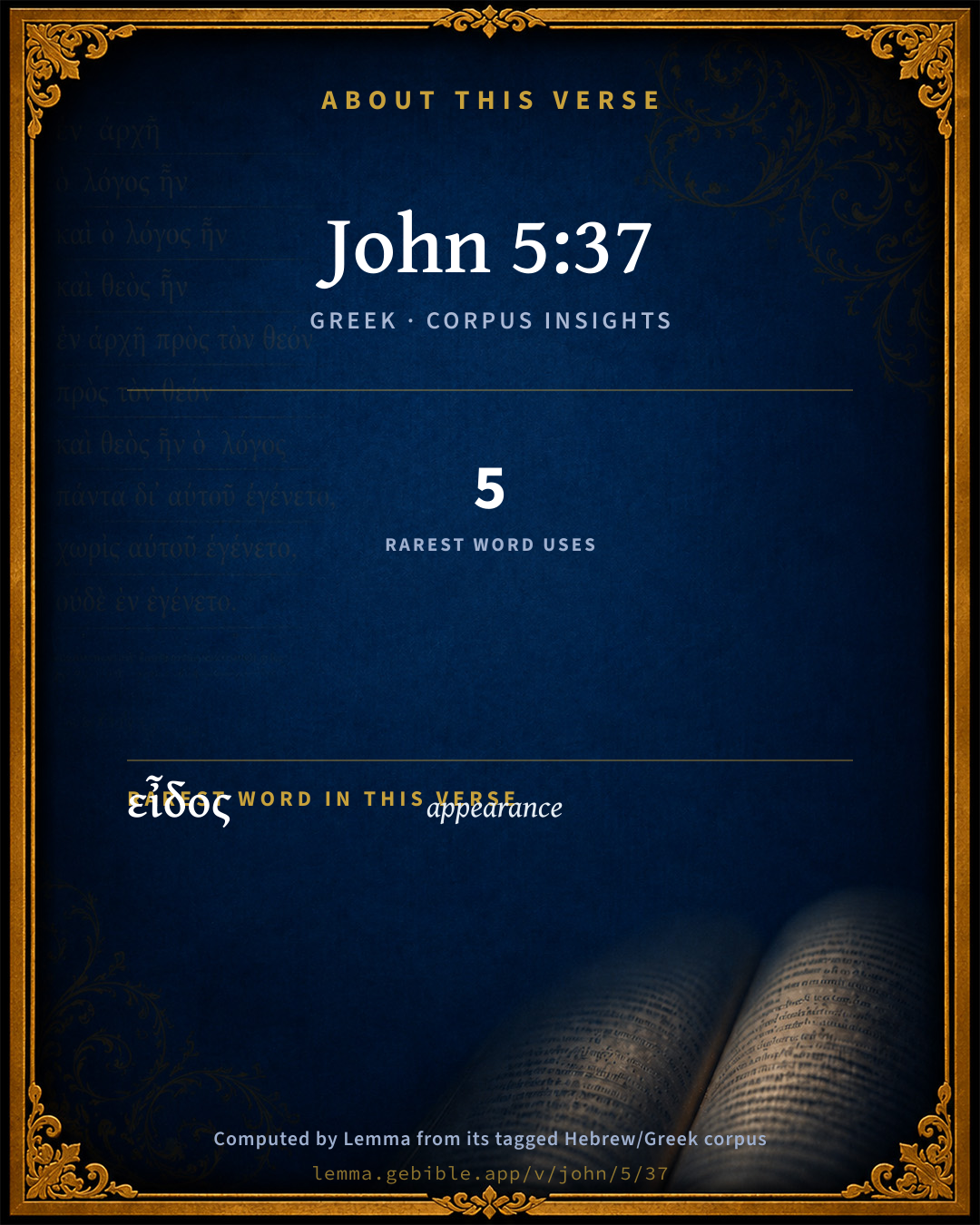
John 5:37

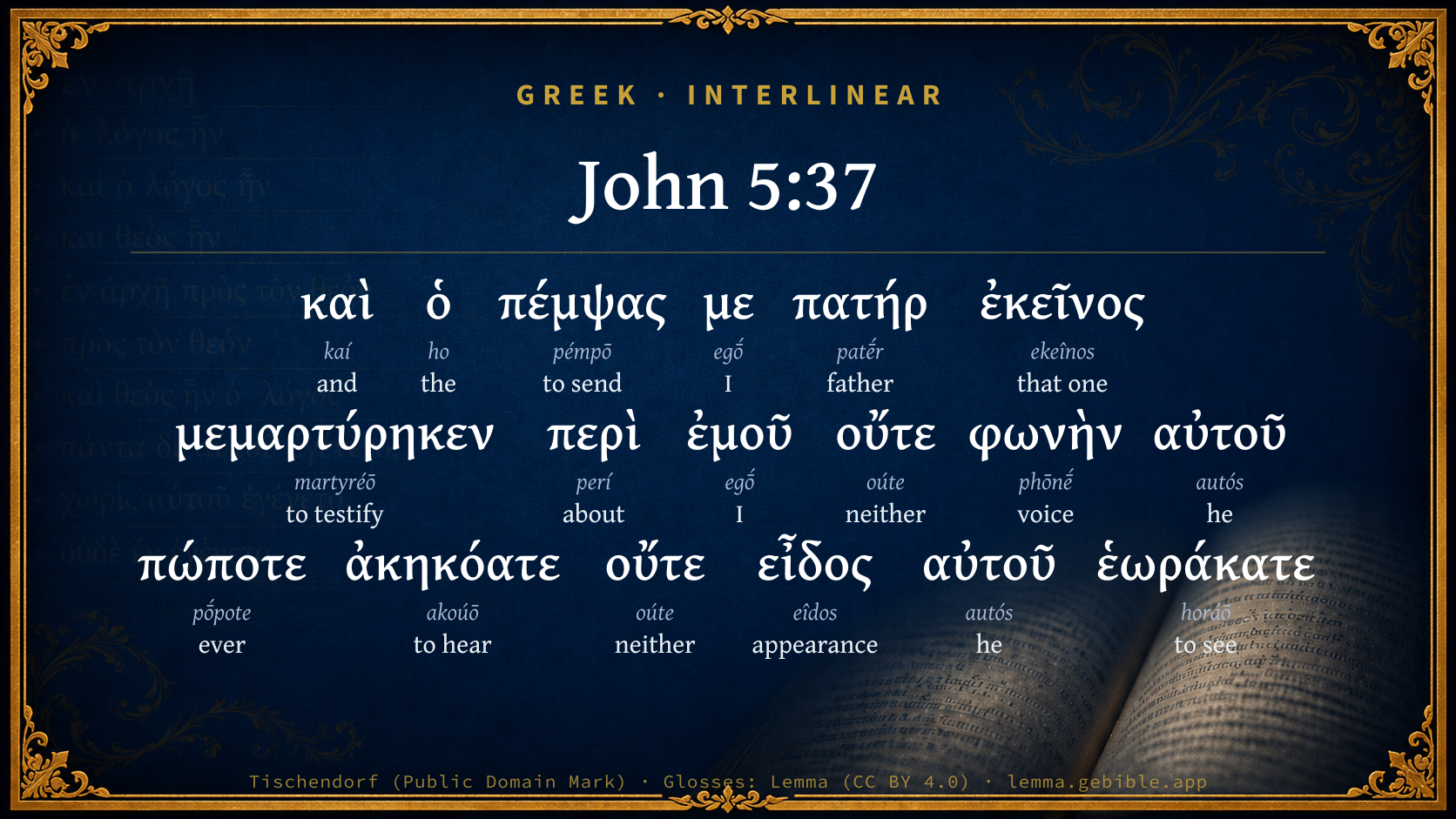
Greek (Tischendorf 8th ed.) John 5:37 appears in the Greek New Testament. The text above is from the Tischendorf 8th edition. Each word links to its Strong’s number and a concise gloss. Click any word for its full Thayer’s Greek Lexicon entry.
Download image
Cite this verse

John 5:37 (World English Bible). Public Domain. Lemma interlinear Bible study tool, https://lemma.gebible.app/v/john/5/37.

Show BibTeX & RIS
BibTeX
RIS
English Translation
The Father himself, who sent me, has testified about me. You have neither heard his voice at any time, nor seen his form.
World English Bible · Public Domain
Download a study sheet

One document with this verse’s original text, its word-by-word gloss line, the meaning frame, cross-references with their text, attributed commentary, and full source and license credits — printable, and it pastes into notes with its structure intact.

This verse Autodidact and up

Study sheet (.html) Plain text (.txt)

A passage Seminary Student

Up to 50 verses in one chapter. A passage sheet keeps up to 6 commentary sources and 12 cross-references per verse, in the order this page ranks them, and says so on the sheet whenever that leaves anything out. Ask for a single verse and you get the Autodidact verse sheet above.

Everything on this page stays free to read, with no account — the sheet is a download of what is already on screen, not access to it.

Want to remove ads? Support Godless Engineer
Compare translations 3

The same verse in 3 English versions, stacked beneath the original-language interlinear above. Click any original word for its lexicon entry.

Each is an independent rendering of the whole verse — the interlinear is not word-aligned to these translations.

Highlighted words mark where these versions differ — a whole-verse word diff, not a word-by-word alignment.

  • World English Bible Public Domain
    The Father himself, who sent me, has testified about me. You have neither heard his voice at any time, nor seen his form.
  • King James Version Public Domain
    And the Father himself, which hath sent me, hath borne witness of me. Ye have neither heard his voice at any time, nor seen his shape.
  • unfoldingWord Literal Text CC BY-SA 4.0
    And the Father having sent me has himself testified about me. You have neither heard his voice nor have seen his form at any time.

unfoldingWord Literal Text — © unfoldingWord, licensed CC BY-SA 4.0. Word-aligned USFM3 via Door43 (git.door43.org/unfoldingWord/en_ult).

Versions to compare (up to 4)

3 of 4 selected

Show all 19 translations

Every available English version of this verse, each an independent rendering of the whole verse.

  • World English Bible Public Domain
    The Father himself, who sent me, has testified about me. You have neither heard his voice at any time, nor seen his form.
  • Berean Standard Bible Public Domain
    And the Father who sent Me has Himself testified about Me. You have never heard His voice nor seen His form,
  • Majority Standard Bible Public Domain
    And the Father who sent Me has Himself testified about Me. You have never heard His voice nor seen His form,
  • King James Version Public Domain
    And the Father himself, which hath sent me, hath borne witness of me. Ye have neither heard his voice at any time, nor seen his shape.
  • American Standard Version (1901) Public Domain
    And the Father that sent me, he hath borne witness of me. Ye have neither heard his voice at any time, nor seen his form.
  • Revised Version (1885) Public Domain
    And the Father which sent me, he hath borne witness of me. Ye have neither heard his voice at any time, nor seen his form.
  • Geneva Bible (1599) Public Domain
    And the Father himselfe, which hath sent me, beareth witnesse of me. Ye haue not heard his voyce at any time, neither haue ye seene his shape.
  • Douay-Rheims (1899) Public Domain
    And the Father himself who hath sent me, hath given testimony of me: neither have you heard his voice at any time, nor seen his shape.
  • Young's Literal Translation Public Domain
    `And the Father who sent me Himself hath testified concerning me; ye have neither heard His voice at any time, nor His appearance have ye seen;
  • Literal Standard Version CC BY-SA 4.0
    And the Father who sent Me has testified Himself concerning Me; you have neither heard His voice at any time, nor have you seen His appearance;
  • Unlocked Literal Bible CC BY-SA 4.0
    The Father who sent me has himself testified about me. You have neither heard his voice nor seen his form at any time.
  • unfoldingWord Literal Text CC BY-SA 4.0
    And the Father having sent me has himself testified about me. You have neither heard his voice nor have seen his form at any time.
  • Darby Bible Public Domain
    And the Father who has sent me himself has borne witness concerning me. Ye have neither heard his voice at any time, nor have seen his shape,
  • World Messianic Bible Public Domain
    The Father himself, who sent me, has testified about me. You have neither heard his voice at any time, nor seen his form.
  • Webster's Bible Public Domain
    And the Father himself who hath sent me, hath borne testimony concerning me. Ye have neither heard his voice at any time, nor seen his shape.
  • Free Bible Version CC BY-SA 4.0
    and this is the proof that the Father sent me. The Father who sent me, he himself speaks on my behalf. You've never heard his voice, and you've never seen what he looks like,
  • Bible in Basic English Public Domain
    And the Father himself who sent me has given witness about me. Not one of you has ever given ear to his voice; his form you have not seen.
  • Text-Critical English NT CC BY 4.0
    And the Father who sent me has himself testified about me. You have neither heard his voice at any time nor seen his form.
  • Tyndale New Testament (1534) Public Domain
    And the father him silfe which hath sent me beareth witnes of me. Ye have not hearde his voyce at eny tyme nor ye have sene his shape:

Literal Standard Version (2020), Covenant Press — licensed CC BY-SA 4.0. Text via the HelloAO Bible API (eBible.org). Unlocked Literal Bible (unfoldingWord) — licensed CC BY-SA 4.0. Text via the HelloAO Bible API (eBible.org). unfoldingWord Literal Text — © unfoldingWord, licensed CC BY-SA 4.0. Word-aligned USFM3 via Door43 (git.door43.org/unfoldingWord/en_ult). Free Bible Version, Dr. Jonathan Gallagher — licensed CC BY-SA 4.0. Text via the HelloAO Bible API (eBible.org).

Word by word

More ways to search: Search by grammar → Find every occurrence → Compare this word →

Practice this passage: Drill this verse → Learn its vocabulary →

εἶδος
eîdos
G1491
“appearance”
Noun, Accusative, Singular, Neuter
Part of Speech
Noun
Case
Accusative
Number
Singular
Gender
Neuter
Full Thayer's Definition

Origin: from G1492

TDNT: 08:13,2

1. the external or outward appearance, form figure, shape 2. form, kind
  1. καὶ kaí G2532 “and” Conjunction
  2. ὁ ho G3588 “the” Article, Nominative, Singular, Masculine
  3. πέμψας pémpō G3992 “to send” Verb, Aorist, Active, Participle, Nominative, Singular, Masculine
  4. με egṓ G1473 “I” Personal pronoun, 1st person, Accusative, Singular
  5. πατήρ patḗr G3962 “father” Noun, Nominative, Singular, Masculine
  6. ἐκεῖνος ekeînos G1565 “that one” Demonstrative pronoun, Nominative, Singular, Masculine
  7. μεμαρτύρηκεν martyréō G3140 “to testify” Verb, Perfect, Active, Indicative, 3rd person, Singular
  8. περὶ perí G4012 “about” Preposition
  9. ἐμοῦ egṓ G1473 “I” Personal pronoun, 1st person, Genitive, Singular
  10. οὔτε oúte G3777 “neither” Conjunction, Negative
  11. φωνὴν phōnḗ G5456 “voice” Noun, Accusative, Singular, Feminine
  12. αὐτοῦ autós G846 “he” Personal pronoun, Genitive, Singular, Masculine
  13. πώποτε pṓpote G4455 “ever” Adverb
  14. ἀκηκόατε akoúō G191 “to hear” Verb, Perfect, Active, Indicative, 2nd person, Plural, Attic form
  15. οὔτε oúte G3777 “neither” Conjunction, Negative
  16. αὐτοῦ autós G846 “he” Personal pronoun, Genitive, Singular, Masculine
  17. ἑωράκατε horáō G3708 “to see” Verb, Perfect, Active, Indicative, 2nd person, Plural, Attic form

About this verse

These counts appear in no published source. They are computed here, from the morphology-tagged text and Lemma’s own curated glosses. What Lemma adds →

18
words
15
distinct lemmas
Gospels
section

Notable vocabulary

The rarest word here is εἶδος appearance G1491 — appearing just 5 times in the whole Greek New Testament.

Shared distinctive vocabulary

εἶδος appearance G1491 occurs in 5 verses of the Greek New Testament. Also found in:

Repetition

Words recur within this verse:

  • οὔτε neither G3777 ×2
  • με I G1473 ×2
  • αὐτοῦ he G846 ×2

Cross-references

14

Topical passages linked to John 5:37 in the Treasury of Scripture Knowledge — connected by theme and wording, ordered by reader-vote popularity; previews shown in the World English Bible.

  • John 8:18 I am one who testifies about myself, and the Father who sent me testifies about me."
  • Matthew 3:17 Behold, a voice out of the heavens said, "This is my beloved Son, with whom I am well pleased."
  • John 1:18 No one has seen God at any time. The one and only Son, who is in the bosom of the Father, he has declared him.
  • 1 Timothy 1:17 Now to the King eternal, immortal, invisible, to God who alone is wise, be honor and glory forever and ever. Amen.
  • 1 Timothy 6:16 who alone has immortality, dwelling in unapproachable light; whom no man has seen, nor can see: to whom be honor and eternal power. Amen.
  • 1 John 4:12 No one has seen God at any time. If we love one another, God remains in us, and his love has been perfected in us.
  • 1 John 4:20 If a man says, "I love God," and hates his brother, he is a liar; for he who doesn't love his brother whom he has seen, how can he love God whom he has not seen?
  • Exodus 20:19 They said to Moses, "Speak with us yourself, and we will listen; but don't let God speak with us, lest we die."
  • Deuteronomy 4:12 Yahweh spoke to you out of the midst of the fire: you heard the voice of words, but you saw no form; only [you heard] a voice.
  • Matthew 17:5 While he was still speaking, behold, a bright cloud overshadowed them. Behold, a voice came out of the cloud, saying, "This is my beloved Son, in whom I am well pleased. Listen to him."
  • John 6:27 Don't work for the food which perishes, but for the food which remains to eternal life, which the Son of Man will give to you. For God the Father has sealed him."
  • John 14:9 Jesus said to him, "Have I been with you such a long time, and do you not know me, Philip? He who has seen me has seen the Father. How do you say, 'Show us the Father?'
  • 1 John 1:1–2 That which was from the beginning, that which we have heard, that which we have seen with our eyes, that which we saw, and our hands touched, concerning the Word of life
  • John 15:24 If I hadn't done among them the works which no one else did, they wouldn't have had sin. But now have they seen and also hated both me and my Father.

Cross-references courtesy of OpenBible.info (CC BY 4.0).

Commentary

Notes on John 5:37 from classic Christian and Jewish commentators (each source and its license shown beneath its notes). The classic Christian expositions comment on the surrounding passage and are grouped to its opening verse, so a note may address several verses; the Jewish commentaries on the Tanakh (Rashi and others) are per-verse, so they appear only where the commentator wrote on this verse.

Lemma curates 59 commentaries, every one of them public domain or Creative Commons licensed, each selected and text-cleaned for this edition rather than reprinted as found. About our sources →

The Cambridge Bible for Schools and Colleges

gen. ed. J. J. S. Perowne

37–40. The connexion of thought in the next few verses is very difficult to catch, and cannot be affirmed with certainty. This is often the case in S. John’s writings. A number of simple sentences follow one another with an even flow; but it is by no means easy to see how each leads on to the next. Here there is a transition from the indirect testimony to the Messiahship of Jesus given by the works which He is commissioned to do (Joh_5:36), to the direct testimony to the same given by the words of Scripture (Joh_5:37-40). The Jews were rejecting both.

which hath sent me, hath borne witness] There is a difference of tense in the Greek which should be retained: the Father which sent Me (once for all at the Incarnation) He hath borne witness (for a long time past, and is still doing so) of Me.

Ye have neither, &c.] These words are a reproach; therefore there can be no allusion (as suggested in the margin) to the Baptism or the Transfiguration. The Transfiguration had not yet taken place, and very few if any of Christ’s hearers could have heard the voice from heaven at the Baptism. Moreover, if that particular utterance were meant, ‘voice’ in the Greek would have had the article. Nor can there be any reference to the theophanies, or symbolical visions of God, in O.T. It could be no matter of reproach to these Jews that they had never beheld a theophany. A paraphrase will shew the meaning; ‘neither with the ear of the heart have ye ever heard Him, nor with the eye of the heart have ye ever seen Him, in the revelation of Himself given in the Scriptures; and so ye have not the testimony of His word present as an abiding power within you.’ There should be no full stop at ‘shape,’ only a comma or semi-colon. Had they studied Scripture rightly they would have had a less narrow view of the Sabbath (Joh_5:16), and would have recognised the Messiah.

The Cambridge Bible for Schools and Colleges (gen. ed. J. J. S. Perowne; Cambridge University Press, 1878–1918) — public domain. Text from a community e-Sword module.

Bengel's Gnomon

Johann Albrecht Bengel

Joh 5:37. Αὐτός) Himself [independently of, and, in weight of testimony] beyond the works.—μεμαρτύρηκε, hath borne witness) Past time. That testimony is recorded ch. Joh 1:32-33, “Upon whom thou shalt see the Spirit descending and remaining on Him, the same is He,” etc.—οὔτε, neither) In the beginning of verses 36 and 37 is described [the Father’s] testimony concerning Jesus Christ: at the close of 37 and in 38 is described the unbelief of the Jews.—εἶδος αὐτοῦ, His appearance) This corresponds with the first chapter of Ezekiel, where there is described at large “the appearance of the likeness of the glory of God” [Joh 5:28], seen by Ezekiel, who presently after also heard the voice of God. And that whole chapter was the Haphtara [portion, or lesson of the Prophets, appointed for the day] of the feast mentioned in the first verse. [They had not seen or heard Him at any time, as the prophets (for instance Eze 1:28), much less as the Christ had. Comp. Joh 1:17, “Grace and truth came by Jesus Christ;” Joh 6:46, “Not that any man hath seen the Father, save He which is of God, He hath seen the Father.”—Not. Crit. and V. g.]

Bengel's Gnomon of the New Testament — English translation (T&T Clark, Edinburgh, 1860) — public domain. Text from a community e-Sword module.

Meyer's Critical & Exegetical Commentary

Heinrich August Wilhelm Meyer

Joh_5:37. From the works which testified that He was the Sent of God, He now passes to the witness of the Sender Himself; therefore from the indirect divine testimony, presented in the works, to the direct testimony in the Scriptures. And the Father Himself, who hath sent me, hath borne witness of me. The subject, which is placed at the beginning of the sentence, the independence (immediateness) expressed by αὐτός, together with the Perfect μεμαρτ., unite to prove that there is no longer any reference here to the previous testimony, that of the works, by which God had borne testimony (against Augustine, Grotius, Maldonatus, Olshausen, Baur, and most others). Quite arbitrary, and in opposition to the account of the baptism given by John, is the view which others take, that the divine witness given in the voice at the baptism, Mat_3:17 (but see rather Joh_1:33), is here meant (Chrysostom, Rupertius, Jansen, Bengel, Lampe, Paulus, Godet). While Ewald (Johann. Schr. I. 216) includes together both the baptism and the works, Hengstenberg adds to these two the witness of Scripture likewise; others, again, the immediate divine witness in the believers heart, by means of which the indirect testimony of the works is first apprehended (De Wette, B. Crusius, Tholuck), the drawing of the Father, Joh_6:14, comp. Joh_6:45, Joh_8:47. But there is not the slightest indication in the text that an outward, perceptible, concrete, and objective witness is meant; nay more, in the face of the following connection (φωνήν … εἶδος). The only true interpretation in harmony with the context is that which takes it to mean the witness which God Himself has given in His word, in the Scriptures of the O. T. (Cyril, Nonnus, Theophylact, Euthymius Zigabenus, Beda, Calvin, Kuinoel, Lücke, Lange, Maier, Luthardt). In the O. T. prophecies, God Himself has lifted up His voice and revealed His form.

οὔτε φωνήν, κ.τ.λ.] Reproach of want of susceptibility for this testimony, all the more emphatic through the absence of any antithetic particle. Neither a voice of His have ye ever heard, nor a form of His have ye ever seen. With respect to what God had spoken in the O. T. as a testimony to Christ (μεμαρτύρ. περὶ ἐμοῦ), or as to the manner in which, with a like purpose, He had therein given His self-manifestation to the spiritual contemplation (He had made known his δόξα; comp. μορφὴ θεοῦ, Php_2:6),to the one ye were spiritually deaf, to the other ye were spiritually blind. As the first cannot, conformably with the context, be taken to mean the revealing voice of God within, vouchsafed to the prophets (De Wette), so neither can the second refer merely to the Theophanies (in particular, to the appearances of the Angel of the Lord, Hengstenberg) and prophetic visions,[221] but to the entire self-revelation of God in the O. T. generally, by virtue of which He lets Himself be seen by him who has eyes to see;a general and broad interpretation, which corresponds with the general nature of the expression, and with its logical relation to μεμαρτ. π. ἐμοῦ. The Jews could not have heard the voice at the baptism, nor could they have seen the form of God as the Logos had seen it, Joh_1:18, Joh_3:13; and for this reason neither the one meaning nor the other can be found in the words (Ewald). Every interpretation, moreover, is incorrect which finds in them anything but a reproach, because Jesus speaks in the second person, and continues to do so in Joh_5:38, where the tone of censure is still obvious. We must therefore reject the explanation of B. Crusius: never hitherto has this immediate revelation of God taken place; and that of Tholuck: ye have not received a more direct revelation than did Moses and his cotemporaries (Num_12:8; Deu_4:15; Deu_5:24), but ye have not received within you the witness of the revelation in the word,an artificial connecting of Joh_5:37 with Joh_5:38, which the words forbid. Paulus and Kuinoel (comp. Euthymius Zigabenus) likewise erroneously say that Jesus here concedes, in some degree, to the Jews what they had themselves wished to urge in objection, viz. that they had heard no divine voice, etc. Comp. Ebrard (in Olshausen), who imports the idea of irony into the passage.

[221] Jesus could not reproach His opponents with not having received prophetic revelations, such as Theophanies and Visions, for these were marks of distinction bestowed only on individuals. This also against Weiss, Lehrbegr. pp. 104, 105.

Meyer — Critical and Exegetical Commentary on the New Testament — English translation by Peter Christie, edited by Frederick Crombie (T&T Clark, 1880) — public domain. Text from a community e-Sword module.

Expositor's Greek Testament

ed. W. Robertson Nicoll

Joh 5:37 . But over and above the evidence of the works καὶ ὁ πέμψας με πατήρ , αὐτὸς μεμαρτύρηκε , “And the Father who sent me has Himself also testified”. Where and how this testimony of the Father’s separate from the works has been given, is explained, Joh 5:38 ; Joh 5:40 But, first, Jesus states how it has no been given: οὔτε φωνὴν αὐτοῦ … ἑωράκατε . It is not by coming into your midst in a visible form and speaking as I speak that the Father has testified. “His voice you have never heard: His form you have never seen.” It is not by sensible sights and sounds the Father has given His testimony. [This interpretation is however ignored by most: by Meyer, who thinks the reference is to their insensibility to the revelation of God in Scripture; by Westcott, who says “the Jews by their disbelief of Christ failed to hear and see Him”; by Godet, who finds “a declaration of man’s natural impotence to rise to the immediate and personal knowledge of God”. Reference to the baptism is put out of the question by πώποτε . The reference to the two chief forms of prophetic revelation (Weiss) is too remote.]

The Expositor's Greek Testament, edited by W. Robertson Nicoll (1897–1910) — public domain. Text from a community e-Sword module.

Godet's Commentaries

Frédéric Louis Godet

Ver. 37. “And the Father who sent me, himself hath borne witness of me. Ye have neither heard his voice at any time, nor seen his form.”

It is clear, whatever Olshausen, Baur and others may say, that Jesus here speaks of anew testimony of the Father: otherwise, why should He substitute for the present beareth witness (Joh 5:36), which applies to the miracles which Jesus at present performs, the perfect hath borne witness, which can only denote a testimony given and completed.—The pronoun αὐτός, Himself, emphasized as it is, strongly sets forth the personalcharacter of this new testimony: God has spoken Himself. This is the reason why the reading αὐτός seems to me preferable to the ἐκεῖνος, he, of the Alexandrian authorities. What is this personal testimony? De Wette andTholuck, understand by it the inner voice by which God testifies in the heart of man in favor of the Gospel, “the drawing of the Father to the Son.” But it is impossible from this point of view to explain the perfect hath borne witness, and very difficult to account for the following expressions, His voice, His form, which so evidently refer to a personal manifestation. Chrysostom, Grotius, Bengel (I myself, in the former editions), refer this expression to the testimony of God at the baptism of Jesus, which very well answers to this condition.

But objection is rightly made because of the οὐ...πώποτε, never, in the following words: and it would be to return to the testimony of John the Baptist, which Jesus had set aside, since the voice of God had not been heard except by the forerunner and everything rested, therefore, upon his testimony. We must, accordingly, take our position rather with the explanation of Cyril, Calvin, Lucke, Meyer, Luthardt, Weiss, Keil, who refer Joh 5:37 to the testimony of God in the Old Testament, the book in which He manifests Himself and Himself speaks. Joh 5:38-39 confirm this view. But how, from this point of view, can we explain the following clause? A reproach has been found here (Meyer, Luthardt, Keil); “You are miserably deaf and blind, that is, incapable of apprehending this testimony; you have never inwardly received the divine word.” This sense suits the context. But the expression: “You have not seen his face” would be a strange one to designate moral insensibility to the Holy Scriptures. Others see rather in these words a concession made to the hearers: for example, Tholuck: “You have, no doubt, neither heard...nor seen..., for that is impossible; it is not this with which I reproach you (Joh 5:37); but you should at least have received the testimony which God gives in the Scriptures” (Joh 5:38).

If this were the thought, however, an adversative particle could not be wanting at the beginning of Joh 5:38. But the expression: and you have not in you, on the contrary, continues the movement of the preceding clause. The expressions to hear the voice, see the form of God, denote an immediate personal knowledge of God (Joh 1:18). Jesus uses the former in Joh 6:46, to characterize the knowledge of God which He has Himself, in contrast with all purely human knowledge: “Not that any one hath seen the Father, save He that is of the Father; he hath seen the Father.” This declaration ought to serve as a standard for the explanation of the one before us. We shall say with Weiss:There is not here either a reproach or a concession; it is the simple authentication of a fact, namely, the natural powerlessness of man to rise to the intuitive knowledge of God. The thought of Jesus is, therefore: “This personal testimony of God (Joh 5:37 a) has not reached you, first because no divine revelation or appearance has been personally given to you, as to the prophets and men of God in the Old Testament (Joh 5:37 b); and then because the word to which those men of God consigned their immediate communications with God, has not become living and abiding in you (Joh 5:38).” Consequently the personal testimony of God, that which Jesus here means, does not exist for them. God has never spoken to them directly, and the only book, in which they could have heard His testimony, has remained for them, through their own fault, a closed book. We can well understand why in Joh 5:37 Jesus employs the term φωνή, the personal voice, the symbol of immediate revelation, while in Joh 5:38 He makes use of the word λόγος, word, the term in use to denote the revelation handed down to the people. The direct connection of Joh 5:37 with Joh 5:38 by καί, and, presents no more difficulty from this point of view.

Frédéric Louis Godet — Commentaries on Luke, John, Romans, and 1 Corinthians — English translation (T&T Clark, Edinburgh, 1870s–1890s) — public domain. Text from a community e-Sword module.

Jamieson, Fausset & Brown

Robert Jamieson, A. R. Fausset & David Brown

the Father himself . . . hath borne witness of me--not referring, probably, to the voice of His baptism, but (as seems from what follows) to the testimony of the Old Testament Scripture [CALVIN, LUCKE, MEYER, LUTHARDT, &c.].

neither heard his voice, &c.--never recognized Him in this character. The words are "designedly mysterious, like many others which our Lord uttered" [STIER].

Jamieson, Fausset & Brown — Commentary Critical and Explanatory on the Whole Bible (1871) — public domain (CC PDM 1.0). Text via the HelloAO Bible API.

Adam Clarke's Commentary

Verse 37. The Father himself - hath borne witness] That is, by his prophets.

Ye have neither heard his voice] I make these words, with Bp. Pearce, a parenthesis: the sense is-"Not that my Father ever appeared visibly or spake audibly to any of you; but he did it by the mouths of his prophets." Lately, however, he had added to their testimony his own voice from heaven, on the day of Christ's baptism. See Mt 3:17.

Adam Clarke's Commentary on the Bible (1810–1826) — public domain. Text from a community e-Sword/MySword module.

John Calvin's Commentaries

37. And the Father who hath sent me. To limit this statement, as some have done, to the voice which was heard at his baptism, (Matthew 3:17,) is a mistake; for he says in the past tense, that the Father (μεμαρτύρηκε) testified, in order to show that he did not come forward as an unknown person, because the Father had long ago distinguished him by such peculiar marks that, bringing them along with him, he might be recognized. I explain, therefore, that God testified concerning his Son, whenever in past times he held out to the ancient people the hope of salvation, or promised that the kingdom of Israel would be fully restored. In this manner the Jews must have formed an idea of Christ from the Prophets, before he was manifested in the flesh. When having him before their eyes, they despise and therefore reject him, they show plainly that they have no relish for the Law, with which Christ also reproaches them; and yet they boasted of their knowledge of the Law, as if they had been brought up in the bosom of God.

You have never heard his voice. After having complained that they do not receive him, Christ breaks out in still more severe language against their blindness. When he says that they had never heard the voice of God, or seen his shape, these are metaphorical expressions, by which he intends to state generally that they are utterly estranged from the knowledge of God. For as men are made known by the countenance and speech, so God utters his voice to us by the voice of the Prophets, and, in the sacraments, takes, as it were, a visible form, from which he may be known by us according to our feeble capacity. But he who does not recognize God in his lively image, plainly shows by this very fact that he worships no Deity but what he has himself contrived. For this reason Paul says, that the Jews had a vail placed before their eyes, that they might not perceive the glory of God in the face of Christ, (2 Corinthians 3:14.)

John Calvin's Commentaries (1540-1563) — public domain. Text from the Calvin Translation Society English edition (1840s-50s) via the Christian Classics Ethereal Library (ccel.org). Calvin's coverage is partial (roughly two-thirds of the Bible); uncommented books and verses are honest gaps, never fabricated. The 19th-century editor's footnotes and remarks are omitted so the notes are faithfully Calvin's own voice.

Ellicott's Commentary for English Readers

(37) Hath borne witness of me.—The marginal reference interprets this testimony of the Father by the voices from heaven spoken at the Baptism and on the Mount of Transfiguration Both are indeed illustrations, and are naturally suggested by the imagery of voice and shape in the latter half of the verse; but one was at this moment in the future, and the other was a definite event which would have required a more definite reference. The Greek, indeed, distinguishes between the Incarnation at a definite point in time and the witness which was continued—And the Father Himself which sent Me (not “hath sent Me”) hath borne witness of Me.

“His voice” and “His shape” are both general, and the “at any time” extends over the whole duration of previous revelation. Literally the clause is, Voice of Him ye have not at any time heard, nor shape of Him have ye seen. The reference to the revelation of the Old Testament Scriptures is, moreover, demanded by the immediate context, while the voice at the Baptism and the Transfiguration are not only absent from the present circle of thoughts, but also from St. John’s Gospel. Jesus is answering a charge of breaking God’s law, and of making Himself equal with God because he has claimed God’s fatherhood in word for Himself, and has manifested it in life-power for man. That charge was but an example of their unreceptive spirit. Through the whole history of the nation. He had been revealing Himself to them. Through the chief knowledge-giving senses, eye and ear, they should have learnt in that past history to see God in the act of mercy, to hear Him in the word of love. They jealous for God’s honour! Ah! it was then as it had been ever. Voice of God they could not hear. Vision of God they could not see.

A Bible Commentary for English Readers, edited by Charles John Ellicott (1878–1897) — public domain. Text from a community e-Sword module.

John Gill's Exposition

And the Father himself, which hath sent me,.... Not only the works he gave him to do, and which he did, but he himself in person:

hath borne witness of me; not only in the writings of Moses, and the prophecies of the Old Testament, but by an audible articulate voice from heaven, at the time of Christ's baptism, Mat 3:17; which was a full testimony of the sonship of Christ, and of the Father's well pleasure in him; and which was repeated at his transfiguration on the mount, Mat 17:5; and the sonship of Christ is the grand thing which the three that bear record in heaven, the Father, the Word, and the Holy Ghost, testify of, Jo1 5:7;

ye have neither heard his voice at any time, nor seen his shape; for the voices that were heard, and the forms that were seen under the Old Testament dispensation, from the first of this kind in Eden's garden, to the incarnation of Christ, which are ascribed to God, or to a divine person, were either by the ministry of angels, or they were voices uttered by the Son of God, or forms assumed by him, who often appeared in an human form, as a prelude of his incarnation; so that it was unusual, and wonderful, and remarkable, that the Father should bear a testimony to the sonship of Christ by a voice from heaven; and which therefore ought to be attended to, and received as a sufficient and valid testimony.

John Gill's Exposition of the Whole Bible (1746–1763) — public domain (CC PDM 1.0). Text via the HelloAO Bible API.

Trapp's Complete Commentary

John Trapp

37 And the Father himself, which hath sent me, hath borne witness of me. Ye have neither heard his voice at any time, nor seen his shape.

Ver. 37. Hath borne witness of me] By the voice from heaven, and the descending of the Holy Ghost in the shape of a dove, Mat 3:16; yet ye have neither heard his voice, nor seen his shape. Who so blind as he that will not see? Isa 42:19.

John Trapp, A Commentary or Exposition upon All the Books of the Old and New Testament (1647–1656) — public domain. Text from a community e-Sword module.

Albert Barnes' Notes on the Bible

The Father himself ...hath borne witness of me - This God had done,

By the miracles which Jesus had performed, and of which he was conversing. At the baptism of Jesus, where he said, “This is my beloved Son,” Mat 3:17. In the prophecies of the Old Testament. It is not easy to say here to which of these he refers. Perhaps he has reference to all.

Ye have neither heard his voice - This difficult passage has been interpreted in various ways. The main design of it seems to be clear - to reprove the Jews for not believing the evidence that he was the Messiah. In doing this he says that they were indisposed to listen to the testimony of God. He affirmed that God had given sufficient evidence of his divine mission, but they had disregarded it. The first thing that he notices is that they had not heard his voice. The word “hear,” in this place, is to be understood in the sense of “obey” or listen to. See the notes at Joh 5:25. The voice of God means his commands or his declarations, however made; and the Saviour said that it had been the “characteristic” of the Jews that they had not listened to the voice or command of God. As this had been their general characteristic, it was not wonderful that they disregarded now his testimony in regard to the Messiah. The voice of God had been literally heard on the mount. See Deu 4:12; “Ye heard the voice of the words.”

At any time - This has been the uniform characteristic of the nation that they have disregarded and perverted the testimony of God, and it was as true of that generation as of their fathers.

Nor seen his shape - No man hath seen God at any time, Joh 1:18. But the word “shape,” here, does not mean “God himself.” It refers to the visible “manifestation” of himself; to the “appearance” which he assumed. It is applied in the Septuagint to his manifesting himself to Moses, Num 12:8; “With him will I speak mouth to mouth, ‘even apparently;’” in Greek, “in a form” or “shape” the word used here. It is applied to the visible symbol of God that appeared in the cloud and that rested on the tabernacle, Num 9:15-16. It is the same word that is applied to the Holy Spirit appearing in bodily shape like a dove, Luk 3:22. Jesus does not here deny that God had “appeared” in this manner, but he says they had not seen - that is, had not “paid attention to,” or “regarded,” the appearance of God. He had manifested himself, but they disregarded it, and, in particular, they had disregarded his manifestations in attestation of the Messiah. As the word “hear” means to obey, to listen to, so the word “see” means “to pay attention to, to regard” 2Jo 1:8; 1Jo 3:6, and thus throws light on Joh 14:9; “He that hath seen me hath seen the Father.” “I am a ‘manifestation’ of God - God appearing in human flesh, as he appeared formerly in the symbol of the cloud; and he that ‘regards me,’ or attends to me, regards the Father.”

Albert Barnes' Notes on the Bible (1834–1885) — public domain. Text from a community e-Sword/MySword module.

Matthew Poole's English Annotations

Hath borne witness of me; not only in my baptism, and at my transfiguration by an audible voice from heaven, but by the voice of his prophets, by whom he spoke to your fathers.

Ye have neither heard his voice at any time, nor seen his shape; you have no knowledge of him, nor any acquaintance with him. It is expounded, Joh 5:38, Ye have not his word abiding in you: for though indeed God appeared to the Jews in no shape or similitude; yet they (that is, their forefathers) had heard his voice, Deu 4:12, speaking out of the midst of the fire, Joh 5:33. God, being an incorporeal Being, hath no such organs of speech as we have, by which we declare our minds unto others; but God had formed an audible voice, by which he revealed his will unto the Jews; so as it could only be said of the Jews of that generation and their forefathers, from the time of giving the law, that they had not heard his voice; for, Exo 20:19, they then desired that Moses might speak to them, and that God would speak no more immediately. Accordingly, he did by the prophets speak to them; but they would not believe them, no, not when he spake to them by his Son, who knew his will, Heb 1:1,3.

Matthew Poole's English Annotations on the Holy Bible (1683–1685) — public domain. Text from a community e-Sword/MySword module.

Whedon's Commentary on the Bible

Daniel D. Whedon

37. Father himself… borne witness—By giving him a miraculous incarnation, rendering him a living miracle; by an audible voice at his baptism; by dwelling in him with all the Godhead bodily, and speaking to the world through him; and by accompanying him with signs and wonders.

Nor seen his shape—His shape you have not seen; you have only seen the effects of his divine power attached to my person, and in testimony to my divinity.

Daniel D. Whedon (gen. ed.), Commentary on the Old and New Testaments (1874–1909) — public domain. Text from a community e-Sword module.

The Pulpit Commentary

Vers. 37, 38. The witness of the Father further elucidated. (See ver. 32)

And the Father (himself), who sent me. (he) hath borne witness concerning me. If the "himself" be the genuine reading (and it is defended by Godet, M"Clellan, and Meyer), there would seem to be a special or direct and additional form of the Father"s testimony. And several ancient and modern critics (Chrysostom, Bengel, Paulus, Godet) have seen in it a reference to the special "voice and shape" which were heard and teen by John and Jesus at the baptism, when heaven was opened, when a voice from heaven proclaimed him to be the well beloved and only begotten Son of God, and when the Spirit of God descended as a dove and abode upon him. This testimony was only given to the world through the consciousness and word of John, who, after receiving it, bore record that this was the Son of God. Meyer and many others, rather following the suggestion of De Wette that the inward drawing of the Father to the Son was that to which the Lord referred, would thus complete the testimony of the "works." This testimony, then, which is cited against the challenge, "Thou bearest witness concerning thyself," would be a purely subjective one. Westcott thinks it refers to the whole of the Old Testament ministry and prophetic and typical anticipation of the Christ, culminating in John the Baptist. This particular series of testimonies is referred to in vers. 39 and 47, etc. Moulton, who rejects the auto sees no new, no direct, testimony in addition to that of the works, but the assertion that they are the voice of the Father in a sense the very form of the Father, for the conviction of those who might if they would come to him. If the autov must be retained, I think that we must suppose our Lord referring to the whole of those objective manifestations of the Father"s will and mind concerning Christ which were outside of his own act or work; and all that shining through his face, that whispering through his word of what was the eternal Father"s face and voice, and plainly distinguished from the work of the Son; e.g. the angels" song, the miraculous providence which protected his childhood, the opening of heaven at his baptism, the Divinity which attended him and which made his ministry so strange and strong an influence. Nor could he who had the whole of his life before him fail to be conscious of further testimonies from heaven and from Providence which, though unrecorded, would continue to set their seal upon his character and work. We must never forget that our Lord himself was a revelation of the Son. But the revelation of the Son in his erga was accompanied throughout with another manifestation that of the Father. The glory of the Lord shone round about him. Nevertheless, a difficulty is conceded as arising out of the unsusceptibility and limited opportunities of his hearers. Never have ye heard a voice of him, or seen a form of him. These voices and these sounds need opened ears and unsealed eyes. You (says Christ) have not heard that which you might have heard. You have not seen that which you might have seen. On a subsequent occasion he said to one of his disciples, "Have I been so long time with you, and yet hast thou not known me, Philip? He that hath seen me hath seen the Father. How sayest thou, then, Show us the Father?" So that there was, indeed, the condition of adequate revelation of the Father provided for the disciples in the life of Christ, in the ministry of the Son of the Father. Moreover, it far exceeded the vision of God which was granted to patriarchs and prophets under the Old Testament dispensation. Doubtless the voice of Jehovah had been heard, (Exo_20:19 Deu_4:12) the face of Jehovah had been. (Gen_32:30 Exo_24:10 Num_12:8 Deu_5:4, Deu_5:24) Isaiah saw the glory of the Angel of the Lord, (6; cf. Joh_12:41) and Ezekiel likewise by the river of Chebar. (Eze_3:23) Nevertheless, the evangelist, on the credit of the great utterance before us, has laid down, as the very climax of the prologue, "No man hath seen God at any time (pwpote); the only begotten Son, who is in the bosom of the Father, he hath declared him." This language of the prologue shows that the true revelation of the Father"s heart was not even granted to the noblest of the seers and patriarchs. Such manifestations as the visions of the Old Testament saints were not the veritable voice or form of the Father. Should mankind ever obtain vision or audition of the Father, it must be through the presence among them of him who had been forever in the bosom of the Father. Though these captious critics were in a position to have received this revelation of the Highest, they had not done so. Ye hare neither heard a voice of him, nor seen a form of him. You might have seen and heard and handled if you had chosen, but You will not come to me, you will not believe me, you will not yield to my claims as One sent to you from the Father!"

The Pulpit Commentary (1880–1919), ed. H.D.M. Spence-Jones & Joseph S. Exell — public domain. Text from a community e-Sword module.

John Wesley's Explanatory Notes

He hath testified of me - Namely at my baptism. I speak not of my supposed father Joseph. Ye are utter strangers to him of whom I speak.

John Wesley, Explanatory Notes Upon the Whole Bible (1754–1765) — public domain. Text via the GEBible commentary corpus.

Scofield Reference Notes

C. I. Scofield

seen Cf.

(See Scofield "Joh 1:18").

The Scofield Reference Bible (1917 edition), notes by C. I. Scofield — public domain. Text from a community e-Sword module.

Burkitt's Expository Notes on the New Testament

William Burkitt

Here our blessed Saviour produces again the testimony of his Father, that he was the true and promised Messias: this was given him both at his baptism and his transfiguration: when God the Father owned Christ to be his Son, by an audible voice from heaven, saying, This is my beloved Son in whom I am well pleased. Which testimony the Jews ought the more to have regarded, because though their forefathers had heard the voice of God at certain times, Exo 20:1; Deu 4:1 yet they in their times had never heard his voice.

Learn hence, That the Father’s immediate testimony of Christ from heaven, is greater than all the testimonies given to him here on earth; greater than John’s, greater than his miracles. The presence of the glorious Trinity, when that testimony was given, Matthew 3 ult. made that witness most awful and solemn.

William Burkitt's Expository Notes on the New Testament (1700–1703) — public domain. Text from a community e-Sword module.

Cambridge Greek Testament for Schools and Colleges

37–40. The connexion of thought in the next few verses is very difficult to catch, and cannot be affirmed with certainty. This is often the case in S. John’s writings. A number of simple sentences follow one another with an even flow; but it is by no means easy to see how each leads on to the next. Here there is a transition from the indirect testimony to the Messiahship of Jesus given by the works which He is commissioned to do (Joh 5:36) to the direct testimony to the same given by the words of Scripture (37–40). The Jews were rejecting both.

37. ἐκεῖνος (אBL) for αὐτός, which was first inserted along with ἐκεῖνος (D), and then drove it out (A).

37. ὁ πέμψας. See on Joh 1:33: ἐκεῖνος, see on Joh 1:18, Joh 3:32. Note the change from aorist to perfect; The Father which sent Me (once for all at the Incarnation) He hath borne witness (for a long time past, and is still doing so) of Me. For the conjunctions see Winer, p. 613.

οὔτε φωνὴν κ.τ.λ. These words are a reproach; therefore there can be no allusion (as suggested in the margin) to the Baptism or the Transfiguration. The Transfiguration had not yet taken place, and very few if any of Christ’s hearers could have heard the voice from heaven at the Baptism. Moreover, if that particular utterance were meant, φωνήν would have had the article. Nor can there be any reference to the theophanies, or symbolical visions of God, in O.T. It could be no matter of reproach to these Jews that they had never beheld a theophany. A paraphrase will shew the meaning; ‘neither with the ear of the heart have ye ever heard Him, nor with the eye of the heart have ye ever seen Him, in the revelation of Himself given in the Scriptures; and so ye have not the testimony of His word present as an abiding power within you.’ There should be no full stop at ‘shape,’ only a comma or semi-colon. Had they studied Scripture rightly they would have had a less narrow view of the Sabbath (Joh 5:16), and would have recognised the Messiah.

Cambridge Greek Testament for Schools and Colleges (Cambridge University Press, 1896; 21 vols, various authors incl. Carr, Maclear, Plummer, Farrar, Lumby, Moule, M. R. James, Simcox) — public domain. Text from a community e-Sword module.

Alford’s Greek Testament

Henry Alford

37-39.] The connexion of these verses has been much disputed. I believe it will be found to be this: ‘The works of which I have spoken, are only indirect testimonies; the Father Himself, who sent Me, has given direct testimony concerning Me. Now that testimony cannot be derived by you, nor any man, by direct communication with Him; for ye have never heard His voice nor seen His shape. (Or perhaps have not heard His voice, as your fathers did from Sinai,—nor seen His visional appearance, as the Prophets did.) Nor (ver. 38), in your case, has it been given by that inward witness (ch. 3:33: 1Jn 4:13, 1Jn 4:14) which those have (and had in a measure, even before the gift of the Spirit—see inter al., Psa 51:11) in whom His word abides; for ye have not His word abiding in you, not believing on Him whom He hath sent. Yet (ver. 39) there is a form of this direct testimony of the Father, accessible even to you;—‘search the Scriptures,’ &c. Chrysostom, Euthymius, Lampe, Bengel, &c., understand φωνή to refer to the voice at our Lord’s baptism: but, as Lücke observes, πώποτε forbids this. I may also add that the perfect, ἀκηκόατε, excludes it. Had reference been to a distinct event, it must have been ἠκούσατε,—and (Lücke) τὴν φωνήν.

Observe that the testimony in the Scriptures is not the only, nor the chief one, intended in ver. 37, but (as De Wette well maintains) the direct testimony in the heart of the believer;—which, as the Jews have not, they are directed to another form of the Father’s testimony, that in the Scriptures.

ἐραυνᾶτε, either indicative (Cyril, Erasm., Beza, Lampe, Bengel, Kuinoel, Lücke, Tholuck, Olshausen, De Wette), ‘Ye search the Scriptures, for ye believe ye have &c., and they are they that testify of Me, and (yet, ver. 40) ye will not come to Me that ye may have life:’ or imperative (Chrys., Theophyl., Euthym., August., Luther, Calvin, ., Paulus, Stier), in which case generally a period has been placed after ἐμοῦ, and a fresh sentence begins at καὶ οὐ θέλ.

I believe the imperative sense only will be found to cohere with the previous verses:—see above, where I have given the context. And no other sense will suit the word ἐραυνᾶτε, which cannot be used, as in the indicative it would be, with blame attached to it,—‘ye make nice and frivolous search into the letter of Scripture;’ but, as ἐξερευν. in ref. Ps., implies a thorough search (see also 1Pe 1:11) into the contents and spirit of Scripture. Besides, the emphatic position of ἐραυνᾶτε before τὰς γραφάς, while it does not absolutely necessitate the imper. sense, makes it much more probable than the indic., which would be conveyed by τὰς γρ. ἐραυνᾶτε. Luthardt (ii. 21) remarks, that the almost unanimous verdict of the Greek Fathers (Cyril however is a remarkable exception) for the imper. decides him in its favour.

ὅτι ὑμ. δοκ.] Ye (emphatic) imagine that in them (emphatic) ye have eternal life (Schöttgen quotes testimonies from the Rabbis: “Qui acquirit sibi verba legis, is acquirit sibi vitam æternam, &c.”);—but they, like all other secondary ordinances, have a spiritual end in view, and that end is to testify, from first to last (it is their office, ἐκεῖναί εἰσιν αἱ μαρτυροῦσαι) of Me.

Henry Alford, The Greek Testament (1849–1861) — public domain. Text from a community e-Sword module.

International Critical Commentary

37. ὁ πέμψας με πατήρ. We cannot distinguish between πέμπω here and ἀποστέλλω in the preceding verse; see on 3:17.

The rec. αὐτός has the support of ANΓΔΘ, but ἐκεῖνος of אBLW must be preferred; see on 1:8 for ἐκεῖνος in Jn.

μεμαρτύρηκεν περὶ ἐμοῦ. Cf. 8:18; and see v. 32. We have already had the indirect witness of the Father to the Son, through the ἔργα which the Son did (v. 36), but the Father’s witness is also direct, and this is indicated, although the argument is abbreviated to the point of obscurity, in vv. 37, 38. The reasoning is as follows:

“The Father, who sent me, has borne witness of me. True, He is not a visible witness: you cannot see God’s form or hear His voice with the outward ear. But to those who accept Jesus, the message from God that He is His Son abides continually in the believer’s heart. The consciousness of a Divine revelation is the Father’s own witness, although invisible to the world.”

The key to vv. 37, 38, is found in 1Jn 5:9, 1Jn 5:10 αὕτη ἐστὶν ἡ μαρτυρία τοῦ θεοῦ, ὅτι μεμαρτύρηκεν περὶ τοῦ υἱοῦ αὐτοῦ. ὁ πιστεύων εἰς τὸν υἱὸν τοῦ θεοῦ ἔχει τὴν μαρτυρίαν ἐν ἑαυτῷ. The believer has an internal witness, which is in reality the witness of God. We are not to think of voices from heaven or visible epiphanies as indicated by the μαρτυρία of the Father; such are recorded by the Synoptists at the Baptism and the Transfiguration (cf. also Joh 12:28). It is the confident assurance of the believer which is here in question.

οὔτε φωνὴν αὐτοῦ πώποτε ἀκηκόατε, “you have never heard His voice,” much less heard it with intelligence. See on 3:8 for ἀκούειν with the acc. in Jn., who uses this constr. as equivalent to a mere perception by hearing, without definite appreciation of what is said. What is stated is that the Jews could not have heard the voice of God with the outward ear.

For πώποτε, and its use in the N.T., see on 1:18.

οὔτε εἶδος αὐτοῦ ἑωράκατε, “nor have you seen His form.” So 1:18 θεον οὐδεὶς ἑώρακεν πώποτε, and 1Jn 4:12; cf. 6:46. This was admitted by Jew and Greek alike. Peniel, the place of Jacob’s wrestling, is called indeed in the LXX εἶδος θεοῦ (Gen 32:30), the reason given being ἴδον γὰρ θεὸν πρόσωπον πρὸς πρόσωπον. But no Jew regarded that as an ordinary experience, or one that he might expect to be repeated in his own case. Man cannot see with bodily eyes the εἶδος of God; and so God cannot appear as a witness to give legal evidence.

From οὔτε φωνήν to ἑωράκατε is a kind of parenthesis, interpolated to avoid misunderstanding. Then follows the description of the true μαρτυρία of the Father.

International Critical Commentary — older volumes (1896–1929), various authors — public domain. Text from a community e-Sword module.

Vincent's Word Studies in the New Testament

Marvin R. Vincent

Himself [αυτος] . The best texts substitute ejkeinov, he; reading, "the Father which sent me, He hath born witness." So Rev.

Voice - shape. Not referring to the descent of the dove and the voice from heaven at Jesus ' baptism, but generally and figuratively to God 's witness in the Old Testament Scriptures. This is in harmony with the succeeding reference to the word.

Marvin R. Vincent, Word Studies in the New Testament (1887–1900) — public domain. Text from a community e-Sword/MySword module.

Lesson kit

Teaching starters — assembled from the data on this page, not authored interpretation. Every prompt links to the verse data it draws on. Edit before teaching.

John, in the Gospels, opens this verse with 18 words (15 distinct Greek lemmas). Its most distinctive word is eîdos (“appearance”). A historical commentator’s framing appears above. Read the whole chapter for the surrounding context.

Discussion questions

  1. The word eîdos carries the sense “appearance.” How does it shape the verse?
  2. Luke 3:22 shares the word «appearance» with this verse. How do the two illuminate each other?
  3. “neither” occurs 2× in this one verse. What is the effect of the repetition?
  4. The translations on this page render this verse differently — a whole-verse word diff, not a word-by-word alignment. What might account for the different wordings?
  5. Reading how The Cambridge Bible for Schools and Colleges and Bengel's Gnomon read this verse, where do the two commentators agree and where do they part?

Things to notice

Reading settings

Reading text

Shown beneath each verse's original-language words.

Old Testament
Old Testament edition

Read the OT as the Masoretic Hebrew (MT) or the Greek Septuagint (LXX).

English shown for the Greek Septuagint (in the Hebrew ↔ Greek comparison).

Comparing translations? Open the Compare panel on any verse page to stack up to four side by side.