Mark 7:11

Greek (Tischendorf 8th ed.) Mark 7:11 appears in the Greek New Testament. The text above is from the Tischendorf 8th edition. Each word links to its Strong’s number and a concise gloss. Click any word for its full Thayer’s Greek Lexicon entry.
Download image
Cite this verse

Mark 7:11 (World English Bible). Public Domain. Lemma interlinear Bible study tool, https://lemma.gebible.app/v/mark/7/11.

Show BibTeX & RIS
BibTeX
RIS
English Translation
But you say, 'If a man tells his father or his mother, "Whatever profit you might have received from me is Corban, that is to say, given to God;"'
World English Bible · Public Domain
Download a study sheet

One document with this verse’s original text, its word-by-word gloss line, the meaning frame, cross-references with their text, attributed commentary, and full source and license credits — printable, and it pastes into notes with its structure intact.

This verse Autodidact and up

Study sheet (.html) Plain text (.txt)

A passage Seminary Student

Up to 50 verses in one chapter. A passage sheet keeps up to 6 commentary sources and 12 cross-references per verse, in the order this page ranks them, and says so on the sheet whenever that leaves anything out. Ask for a single verse and you get the Autodidact verse sheet above.

Everything on this page stays free to read, with no account — the sheet is a download of what is already on screen, not access to it.

Want to remove ads? Support Godless Engineer
Compare translations 3

The same verse in 3 English versions, stacked beneath the original-language interlinear above. Click any original word for its lexicon entry.

Each is an independent rendering of the whole verse — the interlinear is not word-aligned to these translations.

Highlighted words mark where these versions differ — a whole-verse word diff, not a word-by-word alignment.

  • World English Bible Public Domain
    But you say, 'If a man tells his father or his mother, "Whatever profit you might have received from me is Corban, that is to say, given to God;"'
  • King James Version Public Domain
    But ye say, If a man shall say to his father or mother, It is Corban, that is to say, a gift, by whatsoever thou mightest be profited by me; he shall be free.
  • unfoldingWord Literal Text CC BY-SA 4.0
    But you say, ‘If a man says to his father or his mother, “Whatever you might have benefited from me Corban”’ (that is, a gift),

unfoldingWord Literal Text — © unfoldingWord, licensed CC BY-SA 4.0. Word-aligned USFM3 via Door43 (git.door43.org/unfoldingWord/en_ult).

Versions to compare (up to 4)

3 of 4 selected

Show all 19 translations

Every available English version of this verse, each an independent rendering of the whole verse.

  • World English Bible Public Domain
    But you say, 'If a man tells his father or his mother, "Whatever profit you might have received from me is Corban, that is to say, given to God;"'
  • Berean Standard Bible Public Domain
    But you say that if a man says to his father or mother, ‘Whatever you would have received from me is Corban’ (that is, a gift devoted to God),
  • Majority Standard Bible Public Domain
    But you say that if a man says to his father or mother, ‘Whatever you would have received from me is Corban’ (that is, a gift devoted to God),
  • King James Version Public Domain
    But ye say, If a man shall say to his father or mother, It is Corban, that is to say, a gift, by whatsoever thou mightest be profited by me; he shall be free.
  • American Standard Version (1901) Public Domain
    but ye say, If a man shall say to his father or his mother, That wherewith thou mightest have been profited by me is Corban, that is to say, Given `to God';
  • Revised Version (1885) Public Domain
    but ye say, If a man shall say to his father or his mother, That wherewith thou mightest have been profited by me is Corban, that is to say, Given to God;
  • Geneva Bible (1599) Public Domain
    But yee say, If a man say to father or mother, Corban, that is, By the gift that is offered by mee, thou mayest haue profite, hee shall be free.
  • Douay-Rheims (1899) Public Domain
    But you say: If a man shall say to his father or mother, Corban, (which is a gift,) whatsoever is from me, shall profit thee.
  • Young's Literal Translation Public Domain
    and ye say, If a man may say to father or to mother, Korban (that is, a gift), `is' whatever thou mayest be profited out of mine,
  • Literal Standard Version CC BY-SA 4.0
    and you say, If a man may say to father or to mother, Korban (that is, a gift), [is] whatever you may be profited out of mine,
  • Unlocked Literal Bible CC BY-SA 4.0
    But you say, 'If a man says to his father or mother, “Whatever help you would have received from me is Corban”' (that is to say, 'Given to God'),
  • unfoldingWord Literal Text CC BY-SA 4.0
    But you say, ‘If a man says to his father or his mother, “Whatever you might have benefited from me Corban”’ (that is, a gift),
  • Darby Bible Public Domain
    But *ye* say, If a man say to his father or his mother, [It is] corban (that is, gift), whatsoever thou mightest have profit from me by...
  • World Messianic Bible Public Domain
    But you say, ‘If a man tells his father or his mother, “Whatever profit you might have received from me is Corban,”’” that is to say, given to God,
  • Webster's Bible Public Domain
    But ye say, If a man shall say to his father or mother, It is Corban, that is to say, a gift, by whatever thou mightest be profited by me; he shall be free.
  • Free Bible Version CC BY-SA 4.0
    But you say that if someone tells their father or mother, ‘Anything you might have received from me is now Corban,’ (that means dedicated to God),
  • Bible in Basic English Public Domain
    But you say, If a man says to his father or his mother, That by which you might have had profit from me is Corban, that is to say, Given to God,
  • Text-Critical English NT CC BY 4.0
    But you teach that it is acceptable for a man to say to his father or mother, ‘Whatever benefit yoʋ might have received from me is Corban’ ” (that is, a gift devoted to God).
  • Tyndale New Testament (1534) Public Domain
    But ye saye: a man shall saye to father or mother Corban: which is: that thou desyrest of me to helpe the with is geven God.

Literal Standard Version (2020), Covenant Press — licensed CC BY-SA 4.0. Text via the HelloAO Bible API (eBible.org). Unlocked Literal Bible (unfoldingWord) — licensed CC BY-SA 4.0. Text via the HelloAO Bible API (eBible.org). unfoldingWord Literal Text — © unfoldingWord, licensed CC BY-SA 4.0. Word-aligned USFM3 via Door43 (git.door43.org/unfoldingWord/en_ult). Free Bible Version, Dr. Jonathan Gallagher — licensed CC BY-SA 4.0. Text via the HelloAO Bible API (eBible.org).

Word by word

More ways to search: Search by grammar → Find every occurrence → Compare this word →

Practice this passage: Drill this verse → Learn its vocabulary →

κορβᾶν
korbân
G2878
“gift offering”
Hebrew transliteration
Part of Speech
Hebrew transliteration
Full Thayer's Definition

Origin: of hebrew and Aramaic origin respectively G7133

TDNT: 17:20,5

1. a gift offered (or to be offered) to God 2. the sacred treasury
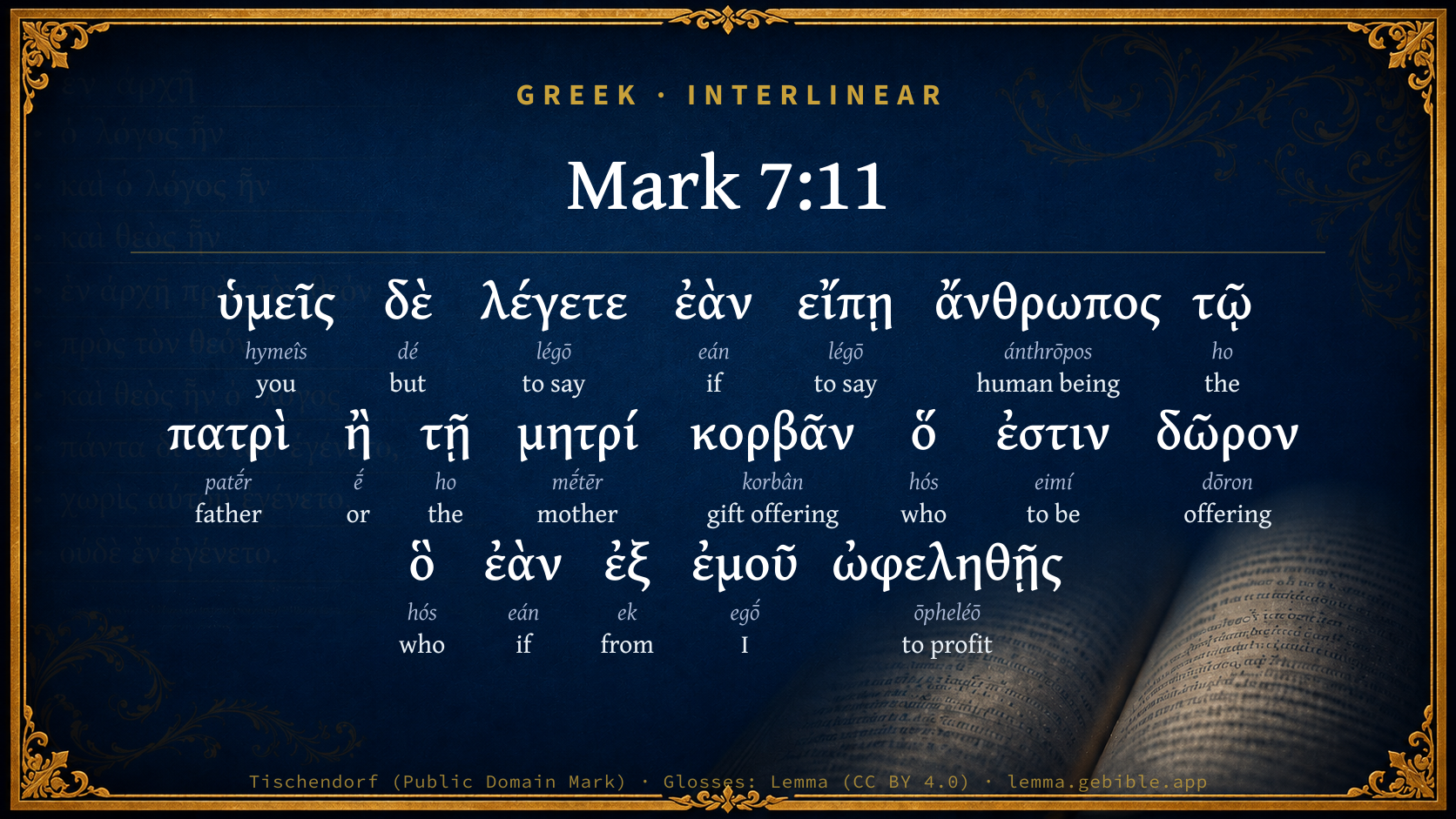
  1. ὑμεῖς hymeîs G5210 “you” Personal pronoun, 2nd person, Nominative, Plural
  2. δὲ dé G1161 “but” Conjunction
  3. λέγετε légō G3004 “to say” Verb, Present, Active, Indicative, 2nd person, Plural
  4. ἐὰν eán G1437 “if” Conditional
  5. εἴπῃ légō G3004 “to say” Verb, Aorist, Active, Subjunctive, 3rd person, Singular
  6. ἄνθρωπος ánthrōpos G444 “human being” Noun, Nominative, Singular, Masculine
  7. τῷ ho G3588 “the” Article, Dative, Singular, Masculine
  8. πατρὶ patḗr G3962 “father” Noun, Dative, Singular, Masculine
  9. ἢ ḗ G2228 “or” Particle
  10. τῇ ho G3588 “the” Article, Dative, Singular, Feminine
  11. μητρί mḗtēr G3384 “mother” Noun, Dative, Singular, Feminine
  12. ὅ hós G3739 “who” Relative pronoun, Nominative, Singular, Neuter
  13. ἐστιν eimí G1510 “to be” Verb, Present, Active, Indicative, 3rd person, Singular
  14. δῶρον dōron G1435 “offering” Noun, Nominative, Singular, Neuter
  15. ὃ hós G3739 “who” Relative pronoun, Accusative, Singular, Neuter
  16. ἐὰν eán G1437 “if” Conditional
  17. ἐξ ek G1537 “from” Preposition
  18. ἐμοῦ egṓ G1473 “I” Personal pronoun, 1st person, Genitive, Singular
  19. ὠφεληθῇς ōpheléō G5623 “to profit” Verb, Aorist, Passive, Subjunctive, 2nd person, Singular

About this verse

These counts appear in no published source. They are computed here, from the morphology-tagged text and Lemma’s own curated glosses. What Lemma adds →

20
words
16
distinct lemmas
Gospels
section

Notable vocabulary

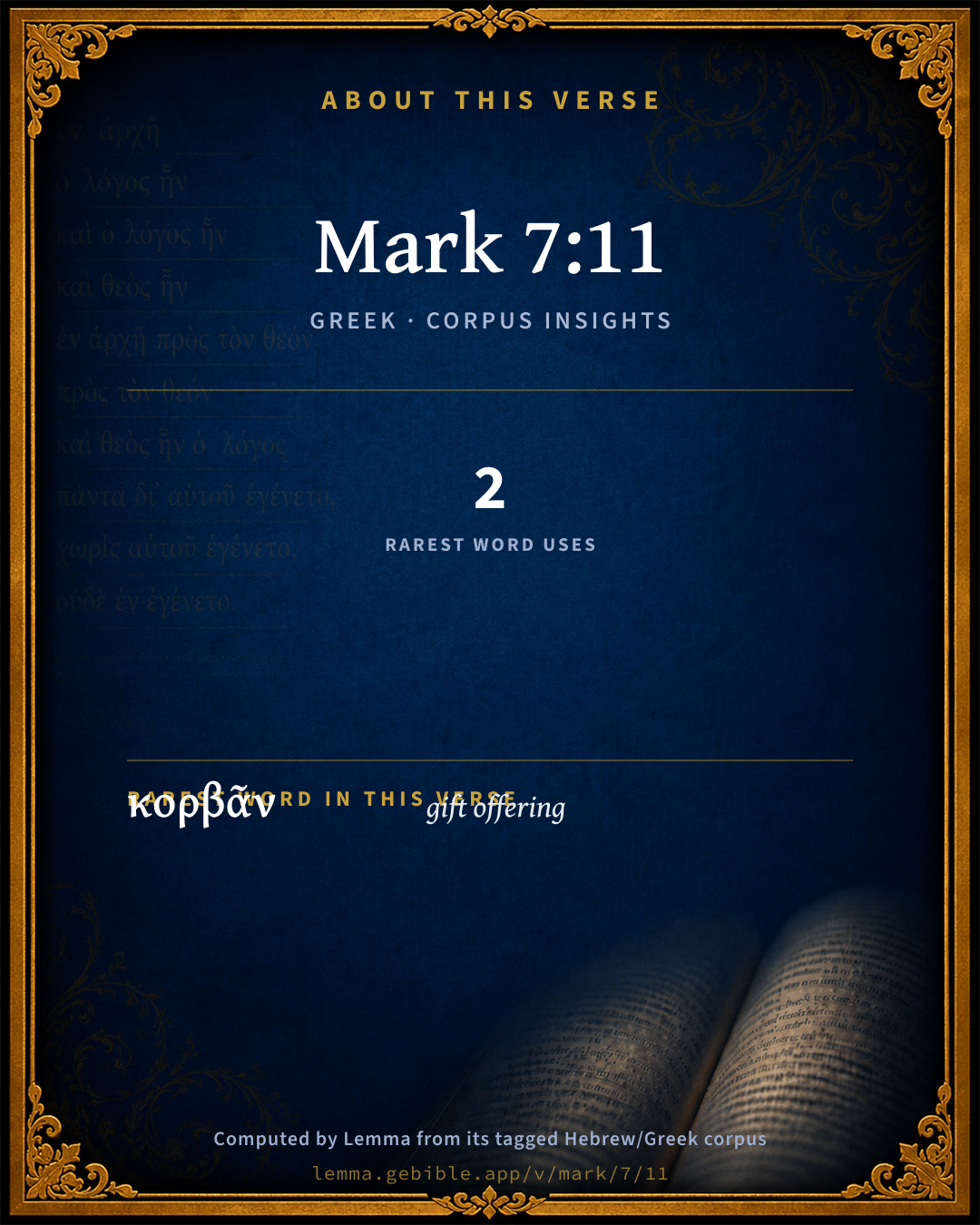
The rarest word here is κορβᾶν gift offering G2878 — appearing just 2 times in the whole Greek New Testament.

Shared distinctive vocabulary

κορβᾶν gift offering G2878 occurs in 2 verses of the Greek New Testament. Also found in:

Repetition

Words recur within this verse:

Cross-references

3

Topical passages linked to Mark 7:11 in the Treasury of Scripture Knowledge — connected by theme and wording, ordered by reader-vote popularity; previews shown in the World English Bible.

  • Matthew 23:18 'Whoever swears by the altar, it is nothing; but whoever swears by the gift that is on it, he is obligated.'
  • 1 Timothy 5:4–8 But if any widow has children or grandchildren, let them learn first to show piety towards their own family, and to repay their parents, for this is acceptable in the sight of God.
  • Matthew 15:5 But you say, 'Whoever may tell his father or his mother, "Whatever help you might otherwise have gotten from me is a gift devoted to God,"

Cross-references courtesy of OpenBible.info (CC BY 4.0).

Commentary

Notes on Mark 7:11 from classic Christian and Jewish commentators (each source and its license shown beneath its notes). The classic Christian expositions comment on the surrounding passage and are grouped to its opening verse, so a note may address several verses; the Jewish commentaries on the Tanakh (Rashi and others) are per-verse, so they appear only where the commentator wrote on this verse.

Lemma curates 59 commentaries, every one of them public domain or Creative Commons licensed, each selected and text-cleaned for this edition rather than reprinted as found. About our sources →

Tyndale Open Study Notes

Tyndale Open Resources

7:11-12 But you say: The contrast with God’s law is emphatic—their tradition repudiated God’s command for people to honor their parents by providing for their needs. • ‘For I have vowed to give to God what I would have given to you’: The tradition said that people could sidestep their obligation to support their parents by dedicating some of their resources to God, thus disregarding and dishonoring their needy parents.

Tyndale Open Study Notes — © Tyndale Open Resources, licensed CC BY-SA 4.0. Text via the HelloAO Bible API.

Expositor's Greek Testament

ed. W. Robertson Nicoll

Mar 7:11 . Κορβᾶν : Mk. gives first the Hebrew word, then its Greek equivalent.

The Expositor's Greek Testament, edited by W. Robertson Nicoll (1897–1910) — public domain. Text from a community e-Sword module.

Ellicott's Commentary for English Readers

(11) It is Corban.—The Hebrew word is peculiar to St. Mark. It occurs frequently in Leviticus and Numbers (e.g., Lev_2:1; Lev_2:5; Num_7:3; Num_7:5), and is translated generally by “offering,” sometimes by “oblation” (Lev_2:13; Lev_3:1), but elsewhere in the Old Testament it only appears in Eze_20:28; Eze_40:43. It had come to be applied specifically (as in the Greek of Mat_27:6; Jos. Wars, ii. 9, § 4) to the sacred treasure of the Temple.

He shall be free.—The words, as the italics show, have nothing corresponding to them in the Greek, nor are they needed, if only, with some MSS., we strike out the conjunction “and” from the next verse. So the sentence runs, “If a man shall say . . . ye suffer him no more . . .”

A Bible Commentary for English Readers, edited by Charles John Ellicott (1878–1897) — public domain. Text from a community e-Sword module.

The Cambridge Bible for Schools and Colleges

gen. ed. J. J. S. Perowne

11. If a man shall say] Literally it runs, If a man shall say to his father or his mother, That, from which thou mightest have been benefited by me, is Corban, that is to say, a gift, or offering consecrated to God, he shall be free, and ye suffer him no longer to do aught for his father or his mother. A person had merely to pronounce the word Corban over any possession or property, and it was irrevocably dedicated to the Temple. Our Lord is quoting a regular formula, which often occurs in the Talmudic tracts Nedarim and Nazir. Others would give to the words an imperative force, Be it Corban from which thou mightest have been benefited by me, i. e. “If I give thee anything or do anything for thee, may it be as though I gave thee that which is devoted to God, and may I be accounted perjured and sacrilegious.” This view certainly gives greater force to the charge made by our Lord, that the command “Whoso curseth father or mother, let him die the death” was nullified by the tradition.

The Cambridge Bible for Schools and Colleges (gen. ed. J. J. S. Perowne; Cambridge University Press, 1878–1918) — public domain. Text from a community e-Sword module.

John Gill's Exposition

But ye say,.... Your elders, doctors, and wise men, in opposition to God and Moses:

if a man shall say to his father or his mother, it is Corban, that is to say, a gift; in the same manner is this word interpreted by Josephus, who speaking of some that call themselves Corban unto God, says (u) in the Greek tongue, , "this signifies a gift": now, according to the traditions of the elders, whoever made use of that word to his father or his mother, signifying thereby, that what they might have expected relief from at his hands, he had devoted it; or it was as if it was devoted to sacred uses; adding,

by whatsoever thou mightest be profited by me, he shall be free; and not under any obligation to regard and relieve his parents, let their case and circumstances be what they would. This is the form of a vow, which a man having made on purpose, to free himself from the charge of the maintenance of his parents, when reduced, repeats unto them; or which he makes upon their application to him: various forms of this kind of vows, are produced in the note see Gill on Mat 15:5, which see: this was not the form of an oath, or swearing by Corban, or the sacred treasury in the temple, mentioned in Mat 27:6, of which I do not remember any instance; nor was it a dedication of his substance to holy and religious uses; to the service of God and the temple; but it was a vow he made, that what he had, should be as Corban, as a gift devoted to sacred uses: that as that could not be appropriated to any other use, so his substance, after such a vow, could not be applied to the relief of his parents; though he was not obliged by it to give it for the use of the temple, but might keep it himself, or bestow it upon others. L. Capellus has wrote a very learned dissertation upon this vow, at the end of his Spicilegium on the New Testament; very and our learned countryman, Dr. Pocock, has said many excellent things upon it, in his miscellaneous notes on his Porta Mosis; both which ought to be read and consulted, by those who have learning and leisure.

(u) Autiqu. Jud. l. 4. c. 4. sect. 4.

John Gill's Exposition of the Whole Bible (1746–1763) — public domain (CC PDM 1.0). Text via the HelloAO Bible API.

Trapp's Complete Commentary

John Trapp

11 But ye say, If a man shall say to his father or mother, It is Corban, that is to say, a gift, by whatsoever thou mightest be profited by me; he shall be free.

Ver. 11. It is Corban] i.e. Consecrated, and cast into the treasury; therefore look for no duty from me. This is the Jews’ solemn oath, in this case.

John Trapp, A Commentary or Exposition upon All the Books of the Old and New Testament (1647–1656) — public domain. Text from a community e-Sword module.

The Pulpit Commentary

Vers. 11-13. But ye say, If a man shall say to his father or his mother, That wherewith thou mightest have been profited by me is Corban, that is to say, Given to God these words, "that is to say, Given to God," are St. Mark"s explanation of "corban" ye no longer suffer him to do aught for his father or his mother; making void the word of God by your tradition, which ye have delivered. Now, this the scribes and Pharisees did for their own covetous ends. For most of them were priests, who received offerings made to God as his ministers, and then converted them to their own uses. In this they greatly erred; because the obligation of piety by which children are bound to support their parents when they need it, is a part of the law of nature, to which every vow, every oblation, ought to yield. Thus, if any one had devoted his goods to God, and his father or his mother became needy, those goods ought to be given to his parents and not to the temple. The word "corban" is a Hebrew word, meaning "that which is brought near," "a gift or offering to God." Hence, figuratively, the place where these offerings were deposited was called the "corbanas," or, "sacred treasury. (see Mat_27:6, korbanan) Hence to say of anything, "It is Corban," was to say that it had a prior and more sacred destination. And when it was something that a parent might need, to say, "It is Corban," i.e. it is already appropriated to another purpose, was simply to refuse his request and to deny him assistance, and so to break one of the first of the Divine commandments. Thus the son, by crying "Corban" to his needy parents, shut their mouths, by opposing to them a scruple of conscience, and suggesting to them a superstitious fear. It was as much as to say, "That which you ask of me is a sacred thing which I have devoted to God. Beware, therefore, lest you, by asking this of me, commit sacrilege by converting it to your own uses." Thus the parents would be silenced and alarmed, choosing rather to perish of hunger than to rob God. To such extremities did these covetous scribes and Pharisees drive their victims, compelling a son to abstain from any kind offices for his father or his mother. St. Ambrose says, "God does not seek a gift wrung out of the necessities of parents." Making void (akurountev); literally, depriving it of its authority , annulling. In Gal_3:17 the same word is rendered "disannul." By your traditions; the traditions, that is, by which they taught children to say "Corban" to their parents. Observe the words, "your tradition" (th pardosei umwn ); your tradition, as opposed to those Divine traditions which God has sanctified, and his Church has handed down from the beginning. And many such like things ye do. This is added by St. Mark to fill up the outline, and to show that this was only a sample of the many ways in which the commandment of God was twisted, distorted, and annulled by these rabbinical traditions.

The Pulpit Commentary (1880–1919), ed. H.D.M. Spence-Jones & Joseph S. Exell — public domain. Text from a community e-Sword module.

Scofield Reference Notes

C. I. Scofield

a gift

Or, I have dedicated to God that which would relieve your need; Mar 7:12.

No longer do you permit him to use it for his father or mother. Cf. Mat 15:5; Mat 15:6

The Scofield Reference Bible (1917 edition), notes by C. I. Scofield — public domain. Text from a community e-Sword module.

unfoldingWord translationNotes

Door43 World Missions Community

General Information:

In verses 11 and 12, Jesus shows how the Pharisees teach people that they do not have to obey God's commandment to honor their parents.

General Information:

In verse 11 Jesus tells what the Pharisees allow people to say about their possessions, and in verse 12 he tells how that shows the Pharisees' attitude toward people helping their parents. This information can be reordered to first tell about the Pharisees' attitude toward people helping their parents and then tell how that attitude is shown in what the Pharisees allow people to say about their possessions. (See: Verse Bridges)

Whatever help you would have received from me is Corban

The tradition of the scribes said that once money or other things were promised to the temple, they could not be used for any other purpose.

is Corban

"Corban" here is a Hebrew word that refers to things that people promise to give to God. Translators normally transliterate it using the target language alphabet. Some translators translate its meaning, and then leave out Mark's explanation of the meaning that follows. AT: "is a gift to God" or "belongs to God" (See: Copy or Borrow Words)

Given to God

This phrase explains the meaning of the Hebrew word "Corban." It can be stated in active form. Mark explained the meaning so that his non-Jewish readers could understand what Jesus said. AT: "I have given it to God" (See: Active or Passive)

then you no longer permit him to do anything for his father or his mother

By doing this, the Pharisees are allowing people not to provide for their parents, if they promise to give to God what they would have given to them. (See: Assumed Knowledge and Implicit Information)

void

canceled or done away with

many similar things you do

"you are doing may other things similar to this"

translationWords

God

command

tradition

unfoldingWord translationNotes — © Distant Shores Media and the Door43 World Missions Community, licensed CC BY-SA 4.0. Source: git.door43.org/Door43/en_tn.

Cambridge Greek Testament for Schools and Colleges

11. ὑμεῖς δὲ λέγετε. “But ye say.” As in Mar 7:2-5 and Mar 4:26; Mar 4:31, we have a confused constr. Mk forgets that he began with ὑμεῖς δὲ λέγετε and leaves the ἐὰν εἴπῃ sentence unfinished. Omit λέγετε and the constr. will stand; with λέγετε Mar 7:12 should run οὐκέτι οὐδὲν ποιήσει. Cf. Mar 3:22.

Κορβᾶν, ὅ ἐστιν Δῶρον. As in Mar 5:41, Mar 7:34, Mar 14:36, we have Aramaic with a translation. Κορβάν is not found in LXX., but Josephus (Ant. IV. iv. 4) gives it with this translation. It means a dedicated or vowed gift, a gift not to be revoked by the giver (Ibid. c. Apion. i. 22). The Scribes taught that a vow, however unrighteous, mast stand. Even if the man who made it desired to remedy the wrong, and even if the wrong was to his own parents, he could not be allowed to remedy it. Such ruling cuts right across the Fifth Commandment. See Wright, Synopsis, p. 69; Driver on Deu 23:24. The sentence means, “Whatsoever support thou mightest have from me is Korban, irrevocably given elsewhere.” Luther, putting a comma after me in Vulg.—Corban quodcunque ex me, tibi profuerit—took it to mean, “If I dedicate it, it is far more valuable to thee.”

Cambridge Greek Testament for Schools and Colleges (Cambridge University Press, 1896; 21 vols, various authors incl. Carr, Maclear, Plummer, Farrar, Lumby, Moule, M. R. James, Simcox) — public domain. Text from a community e-Sword module.

Alford’s Greek Testament

Henry Alford

11.] κορβᾶν ═ קָרְבָּן, an offering without a sacrifice. οἱ κορβᾶν αὐτοὺς ὀνομάσαντες τῷ θεῷ,—δῶρον δὲ τοῦτο σημαίνει κατὰ Ἑλλήνων γλῶτταν—Jos. Antt. iv. 4. 4.

Henry Alford, The Greek Testament (1849–1861) — public domain. Text from a community e-Sword module.

International Critical Commentary

11. With the omission of καὶ, and, at the beginning of v. 12, the two verses belong together, and read, But you say, “If a man say to his father or his mother, ‘Anything in which you may be profited by me is Corban (that is, an offering),’ ” you no longer permit him to do anything for his father or his mother.2

Omit καὶ, and, at beginning of v. 12, Tisch. Treg. WH. RV. א BD Δ 1, 13, 28, 69, 102, 346, mss. Lat. Vet. Memph.

κορβᾶν is the Hebrew word for an offering. It is the predicate, having the antecedent of the relative for its subj. The meaning is, that a man had only to pronounce this word over anything, setting it aside to a Divine use, in order to escape the obligation of giving it for the relief or comfort of his parents. Even when said in good faith, this contravenes the Divine Law, since the duty to the parent takes precedence of the obligation to make offerings. The choice in such cases is not between God and man, but between two ways of serving God, the one formal and the other real. Offerings belong to the formal side of worship, whereas God is really served and worshipped in our human duties and affections. But it was not necessary that the banning should be carried out on its positive side. The word having once been uttered, the man was freed from the human obligation, but needed not to make the offering. Nay, he was positively forbidden to use the article any longer for the human purpose with reference to which the Korban had been uttered. The regulation was not invented for this purpose, but was intended to emphasize the sacredness of a thing once set apart, even by a thoughtless word, to Divine uses. But it failed, as the uninspired mind generally does, to define Divine uses, and left out what was of real importance, while emphasizing and retaining the unimportant.

Omit αὐτοῦ after πατρὶ, Tisch. Treg. WH. א BDL Δ 28, 69, 240, 244, 245, 346, mss. Lat. Vet. Omit αὐτοῦ after μητρὶ א BDL 1, 13, 28, 56, 69, 240, 244, 346, Latt.

International Critical Commentary — older volumes (1896–1929), various authors — public domain. Text from a community e-Sword module.

Vincent's Word Studies in the New Testament

Marvin R. Vincent

Corban. Mark only gives the original word, and then translates. See on Mt 14:5.

Marvin R. Vincent, Word Studies in the New Testament (1887–1900) — public domain. Text from a community e-Sword/MySword module.

Lesson kit

Teaching starters — assembled from the data on this page, not authored interpretation. Every prompt links to the verse data it draws on. Edit before teaching.

Mark, in the Gospels, opens this verse with 20 words (16 distinct Greek lemmas). Its most distinctive word is korbân (“gift offering”). A historical commentator’s framing appears above. Read the whole chapter for the surrounding context.

Discussion questions

  1. The word korbân carries the sense “gift offering.” How does it shape the verse?
  2. Matthew 27:6 shares the word «gift offering» with this verse. How do the two illuminate each other?
  3. “to say” occurs 2× in this one verse. What is the effect of the repetition?
  4. These translations render this verse differently; the difference is in the English rendering, not the original. What questions does that raise?
  5. Reading how Tyndale Open Study Notes and Expositor's Greek Testament read this verse, where do the two commentators agree and where do they part?

Things to notice

Reading settings

Reading text

Shown beneath each verse's original-language words.

Old Testament
Old Testament edition

Read the OT as the Masoretic Hebrew (MT) or the Greek Septuagint (LXX).

English shown for the Greek Septuagint (in the Hebrew ↔ Greek comparison).

Comparing translations? Open the Compare panel on any verse page to stack up to four side by side.