John 10:37

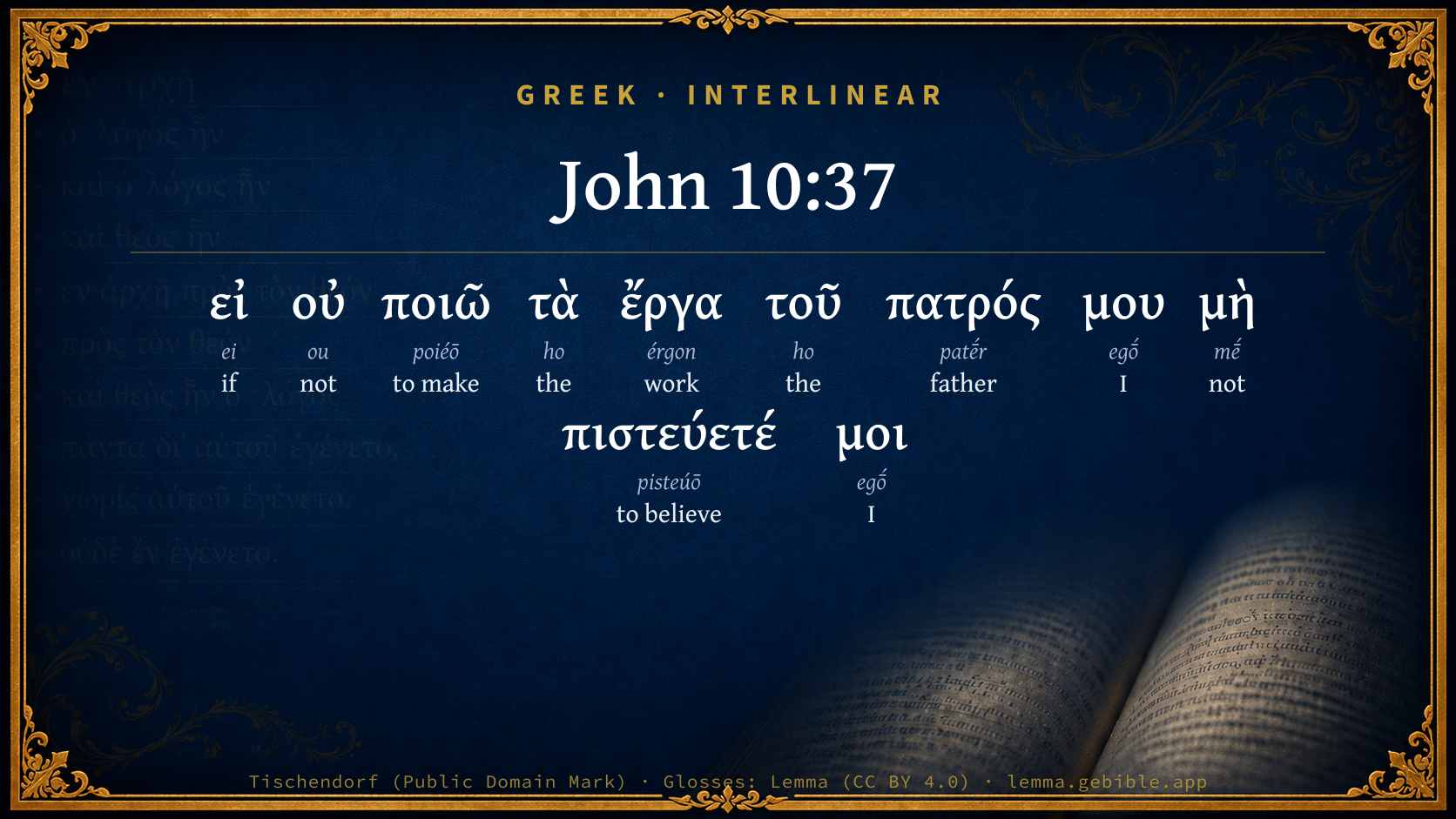
Greek (Tischendorf 8th ed.) John 10:37 appears in the Greek New Testament. The text above is from the Tischendorf 8th edition. Each word links to its Strong’s number and a concise gloss. Click any word for its full Thayer’s Greek Lexicon entry.
Download image
Cite this verse

John 10:37 (World English Bible). Public Domain. Lemma interlinear Bible study tool, https://lemma.gebible.app/v/john/10/37.

Show BibTeX & RIS
BibTeX
RIS
English Translation
If I don't do the works of my Father, don't believe me.
World English Bible · Public Domain
Download a study sheet

One document with this verse’s original text, its word-by-word gloss line, the meaning frame, cross-references with their text, attributed commentary, and full source and license credits — printable, and it pastes into notes with its structure intact.

This verse Autodidact and up

Study sheet (.html) Plain text (.txt)

A passage Seminary Student

Up to 50 verses in one chapter. A passage sheet keeps up to 6 commentary sources and 12 cross-references per verse, in the order this page ranks them, and says so on the sheet whenever that leaves anything out. Ask for a single verse and you get the Autodidact verse sheet above.

Everything on this page stays free to read, with no account — the sheet is a download of what is already on screen, not access to it.

Want to remove ads? Support Godless Engineer
Compare translations 3

The same verse in 3 English versions, stacked beneath the original-language interlinear above. Click any original word for its lexicon entry.

Each is an independent rendering of the whole verse — the interlinear is not word-aligned to these translations.

Highlighted words mark where these versions differ — a whole-verse word diff, not a word-by-word alignment.

  • World English Bible Public Domain
    If I don't do the works of my Father, don't believe me.
  • King James Version Public Domain
    If I do not the works of my Father, believe me not.
  • unfoldingWord Literal Text CC BY-SA 4.0
    If I am not doing the works of my Father, do not believe me.

unfoldingWord Literal Text — © unfoldingWord, licensed CC BY-SA 4.0. Word-aligned USFM3 via Door43 (git.door43.org/unfoldingWord/en_ult).

Versions to compare (up to 4)

3 of 4 selected

Show all 19 translations

Every available English version of this verse, each an independent rendering of the whole verse.

  • World English Bible Public Domain
    If I don't do the works of my Father, don't believe me.
  • Berean Standard Bible Public Domain
    If I am not doing the works of My Father, then do not believe Me.
  • Majority Standard Bible Public Domain
    If I am not doing the works of My Father, then do not believe Me.
  • King James Version Public Domain
    If I do not the works of my Father, believe me not.
  • American Standard Version (1901) Public Domain
    If I do not the works of my Father, believe me not.
  • Revised Version (1885) Public Domain
    If I do not the works of my Father, believe me not.
  • Geneva Bible (1599) Public Domain
    If I doe not the workes of my Father, beleeue me not.
  • Douay-Rheims (1899) Public Domain
    If I do not the works of my Father, believe me not.
  • Young's Literal Translation Public Domain
    if I do not the works of my Father, do not believe me;
  • Literal Standard Version CC BY-SA 4.0
    If I do not do the works of My Father, do not believe Me;
  • Unlocked Literal Bible CC BY-SA 4.0
    If I am not doing the works of my Father, do not believe me.
  • unfoldingWord Literal Text CC BY-SA 4.0
    If I am not doing the works of my Father, do not believe me.
  • Darby Bible Public Domain
    If I do not the works of my Father, believe me not;
  • World Messianic Bible Public Domain
    If I don’t do the works of my Father, don’t believe me.
  • Webster's Bible Public Domain
    If I do not the works of my Father, believe me not.
  • Free Bible Version CC BY-SA 4.0
    If I'm not doing what my Father does, then don't believe me.
  • Bible in Basic English Public Domain
    If I am not doing the works of my Father, do not have belief in me;
  • Text-Critical English NT CC BY 4.0
    If I do not do the works of my Father, do not believe me.
  • Tyndale New Testament (1534) Public Domain
    If I do not the workes of my father beleve me not.

Literal Standard Version (2020), Covenant Press — licensed CC BY-SA 4.0. Text via the HelloAO Bible API (eBible.org). Unlocked Literal Bible (unfoldingWord) — licensed CC BY-SA 4.0. Text via the HelloAO Bible API (eBible.org). unfoldingWord Literal Text — © unfoldingWord, licensed CC BY-SA 4.0. Word-aligned USFM3 via Door43 (git.door43.org/unfoldingWord/en_ult). Free Bible Version, Dr. Jonathan Gallagher — licensed CC BY-SA 4.0. Text via the HelloAO Bible API (eBible.org).

Word by word

More ways to search: Search by grammar → Find every occurrence → Compare this word →

Practice this passage: Drill this verse → Learn its vocabulary →

About this verse

These counts appear in no published source. They are computed here, from the morphology-tagged text and Lemma’s own curated glosses. What Lemma adds →

11
words
9
distinct lemmas
Gospels
section

Repetition

Words recur within this verse:

Cross-references

7

Topical passages linked to John 10:37 in the Treasury of Scripture Knowledge — connected by theme and wording, ordered by reader-vote popularity; previews shown in the World English Bible.

  • John 15:24 If I hadn't done among them the works which no one else did, they wouldn't have had sin. But now have they seen and also hated both me and my Father.
  • John 10:25 Jesus answered them, "I told you, and you don't believe. The works that I do in my Father's name, these testify about me.
  • Matthew 11:20–24 Then he began to denounce the cities in which most of his mighty works had been done, because they didn't repent.
  • John 5:31 "If I testify about myself, my witness is not valid.
  • John 10:32 Jesus answered them, "I have shown you many good works from my Father. For which of those works do you stone me?"
  • John 12:37–40 But though he had done so many signs before them, yet they didn't believe in him,
  • John 14:10 Don't you believe that I am in the Father, and the Father in me? The words that I tell you, I speak not from myself; but the Father who lives in me does his works.

Cross-references courtesy of OpenBible.info (CC BY 4.0).

Commentary

Notes on John 10:37 from classic Christian and Jewish commentators (each source and its license shown beneath its notes). The classic Christian expositions comment on the surrounding passage and are grouped to its opening verse, so a note may address several verses; the Jewish commentaries on the Tanakh (Rashi and others) are per-verse, so they appear only where the commentator wrote on this verse.

Lemma curates 59 commentaries, every one of them public domain or Creative Commons licensed, each selected and text-cleaned for this edition rather than reprinted as found. About our sources →

Joseph Benson's Commentary

Joh 10:37-39. If I do not the works of my Father, &c. — When I claim the character of the Son of God, I do not expect to be credited merely on my own affirmation: if I do not such glorious works as could not be performed by any but a divine agent, believe me not: but if I do — If it be apparent that I do such works, though you believe not me, and are regardless of my own testimony in the case, yet, at least, believe the works; and let their evidence remove the prejudices you have entertained; that ye may know, &c., that the Father is in me, and I in him — Namely, by such a union as abundantly justifies the expression which seems to give you such peculiar offence. In other words, Though ye do not believe what I say concerning my personal dignity, on my own authority, you ought to believe it on account of my miracles, which are plainly of such a kind, that it is impossible for any deceiver to perform them; they are the works of God himself, and therefore you ought to consider them as such. Therefore they sought again to take him — For this defence was so far from pacifying them, that they were rather the more enraged at him through it. But he escaped out of their hand — Withdrew himself, as he had done before, in an extraordinary manner. See Joh 8:59; Luk 4:30.

Joseph Benson's Commentary on the Old and New Testaments (1811–1818) — public domain. Text from a community e-Sword module.

Bengel's Gnomon

Johann Albrecht Bengel

Joh 10:37. Τὰ ἔργα τοῦ Πατρός μου, the works of My Father) Those very works of a divine nature, which My Father doeth, ch. Joh 14:10-11, “The words that I speak unto you, I speak not of Myself; but the Father, that dwelleth in Me, He doeth the works. Believe Me that I am in the Father, and the Father in Me; or else believe Me for the very works’ sake.” His words are characterized by the accompanying works.

Bengel's Gnomon of the New Testament — English translation (T&T Clark, Edinburgh, 1860) — public domain. Text from a community e-Sword module.

Meyer's Critical & Exegetical Commentary

Heinrich August Wilhelm Meyer

Joh_10:37-39. Your unbelief, which lies at the foundation of the judgment ὅτι βλασφημεῖς, would then be justifiable, if I were not, etc. In the other case, however, you ought to believe, if not me, at all events my works, in order that you, etc.

εἰ οὐ ποιῶ] if I leave them undone. Comp. Buttm. Neut. Gr. p. 297 [E. T. p. 346]; Baeumlein, Partik. p. 278.

τὰ ἔργα τοῦ πατρ. μ.] which my Father works; compare on Joh_9:3, Joh_14:10, also Joh_10:23.

μὴ πιστ. μοι] not merely permissive, but an actual command, as in the case of the following πιστεύετε (see the critical note). The alternative is decided: they ought not to believe Him, if, etc.

ἐμοί] My person in and by itself, apart from the actual testimony borne to it by the ἔργα.

To believe the works, is to hold for true the testimony which is contained in them (Joh_5:36). The object of faith is that which Jesus declares concerning Himself, and what, in agreement therewith (comp. Joh_14:11), the works prove concerning Him. According to the reading ἵνα γνῶτε κ. γινώσκητε (see the critical note), which Hengstenberg, notwithstanding, rejects as giving an unbearable meaning, Jesus describes this as the end to be attained by His prescription: in order that ye may attain to knowledge, and may (permanently) know, etc.drawing a distinction between the act and the state of knowledge. Compare ἐπιμεληθῆναι καὶ ἐπιμελεῖσθαι, Plat. Legg. viii. p. 849 B.

ὅτι ʼν ἐμοὶ ὁ πατ. κἀγὼ ἐν αὐτῷ] This now is the unity which He meant in Joh_10:30; not essential unity (old orthodox explanation of the περιχώρησις essentialis patris in filio et filii in patre, see Calovius), although it is metaphysically the fundamental condition, but dynamic unity: the Father lives and moves in Christ, who is His active organ, and again Christ is in the Father, so far as Christ in God is the power which determines the execution of the divine ἔργον. The thought that Christ has in God the ground of His existence and working (De Wette), lies far remote from the words κἀγὼ ἐν αὐτῷ, because the relation of the clauses of the proposition must be equal. But this relation is nothing else than that of inner, active, reciprocal fellowship. In accordance therewith, the Father is in the Son, as in the executor of His work, as the Son is also in the Father, because Christ is the regulative and determining agens et movens of the work of redemption in the Father. Comp. the many Pauline passages which represent all the divine redemptive activity as taking place in Christ; e.g. Rom_8:39; Eph_1:3 ff.

Joh_10:39. οὖν] In consequence of this defence, which averted the threatened tumultuous stoning, for which the Jews had begun to prepare themselves. The supposition that πιάσαι denotes laying hold of with a view to carrying out the stoning, is opposed by the πάλιν, which refers back to Joh_7:30; Joh_7:32; Joh_7:44 (against Calvin, Luthardt, Hengstenberg).

καὶ ἐξῆλθεν, etc.] And yet they were unable to carry their plan into execution; He escaped out of their hands, which are conceived as already stretched out after Him. How this deliverance was effected must be left undetermined. (Kuinoel: by the arrival of His adherents; Hengstenberg: by the indecision of His enemies); of any miraculous element (e.g. becoming invisible) in His escape, although assumed by many early commentators, and even yet by B. Crusius and Luthardt, John gives no hint. Comp. on Joh_8:59. Euth. Zigabenus: ἀναχωρεῖ διὰ τὸν θυμὸν τῶν φθονερῶν, ἐνδιδοὺς αὐτῷ λωφῆσαι καὶ λῆξαι τῇ ἀπουσίᾳ αὐτοῦ.

Meyer — Critical and Exegetical Commentary on the New Testament — English translation by Peter Christie, edited by Frederick Crombie (T&T Clark, 1880) — public domain. Text from a community e-Sword module.

Expositor's Greek Testament

ed. W. Robertson Nicoll

Joh 10:37-38 . εἰ οὐ ποιῶ … πιστεύσατε . “If I do not the works of my Father, do not believe me: but if I do them, even though you do not believe me, believe the works.” That is, if you do not credit my statements, accept the testimony of the deeds I do. And this, not to give me the glory but “that ye may know and believe [ cf. Joh 6:69 ] that the Father is in me, and I in the Father” [for αὐτῷ read τῷ πατρί ].

The Expositor's Greek Testament, edited by W. Robertson Nicoll (1897–1910) — public domain. Text from a community e-Sword module.

Jamieson, Fausset & Brown

Robert Jamieson, A. R. Fausset & David Brown

though ye believe not me, believe the works--There was in Christ's words, independently of any miracles, a self-evidencing truth, majesty and grace, which those who had any spiritual susceptibility were unable to resist (Joh 7:46; Joh 8:30). But, for those who wanted this, "the works" were a mighty help. When these failed, the case was desperate indeed.

that ye may know and believe that the Father is in me, and I in him--thus reiterating His claim to essential oneness with the Father, which He had only seemed to soften down, that He might calm their rage and get their ear again for a moment.

Jamieson, Fausset & Brown — Commentary Critical and Explanatory on the Whole Bible (1871) — public domain (CC PDM 1.0). Text via the HelloAO Bible API.

Adam Clarke's Commentary

Verse 37. If I do not the works, &c.] I desire you to believe only on the evidence of my works: if I do not do such works as God only can perform, then believe me not.

Adam Clarke's Commentary on the Bible (1810–1826) — public domain. Text from a community e-Sword/MySword module.

John Calvin's Commentaries

37. If I do not the works Lest the Jews might reply that it was in vain for him to boast of sanctification, and of all that depended on it, he again draws their attention to his miracles, in which there was a sufficiently evident proof of his Divinity. This is in the shape of a concession, as if he had said, “I do not wish you to be bound to give me credit on any other condition than that you see the fact plainly before your eyes. You may safely reject me, if God has not openly given testimony to me.”

The works of my Father. He gives them this name, because those works were truly Divine, and because so great power shone in them, that they could not be ascribed to a man.

John Calvin's Commentaries (1540-1563) — public domain. Text from the Calvin Translation Society English edition (1840s-50s) via the Christian Classics Ethereal Library (ccel.org). Calvin's coverage is partial (roughly two-thirds of the Bible); uncommented books and verses are honest gaps, never fabricated. The 19th-century editor's footnotes and remarks are omitted so the notes are faithfully Calvin's own voice.

Ellicott's Commentary for English Readers

(37) If I do not the works of my Father.—He has met the charge of blasphemy on technical grounds. In this and the following verse He advances from that defence to the ultimate test. Whether He is a blasphemer or not depends upon whether He represents God or not, and to prove this He appeals again to the works. Are they or are they not the works of the Father? (Joh_10:32; comp. Joh_5:17; Joh_5:36; Joh_9:3; Joh_14:10.)

A Bible Commentary for English Readers, edited by Charles John Ellicott (1878–1897) — public domain. Text from a community e-Sword module.

The Cambridge Bible for Schools and Colleges

gen. ed. J. J. S. Perowne

37. believe me not] A literal command. If His works are not those which His Father works, they ought not (not merely have no need) to believe what He says. Comp. Joh_5:24; Joh_5:46; Joh_6:30; Joh_8:31; Joh_8:45. His works are His Father’s (Joh_9:3, Joh_14:10).

37, 38. Having met their technical charge in a technical manner He now proceeds to justify the assertion of His unity with the Father by an appeal to His works.

The Cambridge Bible for Schools and Colleges (gen. ed. J. J. S. Perowne; Cambridge University Press, 1878–1918) — public domain. Text from a community e-Sword module.

John Gill's Exposition

But if I do,.... Works, which none but God can do:

though ye believe not me; what Christ said in his doctrine and ministry, though they paid no regard to that, and did not receive his testimony, on the credit of him the testifier, as they ought to have done:

believe the works; not only that they are true and real, and not imaginary and delusory; but for the sake of them believe the above assertion, that Christ is the Son of God, he and his Father being one; or take such notice of these works and miracles, consider the nature, evidence, and importance of them, and the divine power that attends them,

that ye may know and believe, that the Father is in me, and I in him; or "in the Father", as one of Beza's exemplars; the Vulgate Latin, Persic, and Ethiopic versions read, or "in my Father", as read the Syriac and Arabic versions; that they are one in nature, distinct in person, equal in power, and have a mutual inhabitation and communion in the divine essence; all which is manifest, by doing the same works, and which are out of the reach and power of any mere creature.

John Gill's Exposition of the Whole Bible (1746–1763) — public domain (CC PDM 1.0). Text via the HelloAO Bible API.

Trapp's Complete Commentary

John Trapp

37 If I do not the works of my Father, believe me not.

Ver. 37. If I do not the works of my Father, believe me not] Thus said Christ, but so saith not Christ’s vicar, as the pope will needlessly be called, His placita pleasing must be obeyed, not examined; and though by his evil example he draw thousands to hell, none must mute, or say so much as, What doest thou?

John Trapp, A Commentary or Exposition upon All the Books of the Old and New Testament (1647–1656) — public domain. Text from a community e-Sword module.

Matthew Poole's English Annotations

Our Saviour doth often appeal to his works to testify concerning his Divine mission and power; these works he here calleth the

works of his Father; by which he doth not only mean works that are pleasing and acceptable to God, as acts of obedience to the will of God performed by men may be called, and are, Joh 6:28,29; nor (as I conceive) only those works which he did by commission and authority from his Father, which, Joh 17:4, he calleth the work which his Father had given him to do; but those works which none but God could do; such were the multiplication of the loaves, Joh 6:1-14, the curing of him who was born blind, Joh 9:1-41, &c. If (saith our Saviour) I do not do those works which no mere man ever did, give me no credit; but if I do those works which can be done by no human art or power, you have reason to believe me.

Matthew Poole's English Annotations on the Holy Bible (1683–1685) — public domain. Text from a community e-Sword/MySword module.

Whedon's Commentary on the Bible

Daniel D. Whedon

37. Works of my Father—Here is proof of higher claim to divinity than human magistrates can show. Works of omnipotence show a profounder identification with the Omnipotent than any human office can arrogate.

Daniel D. Whedon (gen. ed.), Commentary on the Old and New Testaments (1874–1909) — public domain. Text from a community e-Sword module.

The Pulpit Commentary

"I and the Father are one," and "I am the Son of God." These two mighty utterances are equivalent to the following: "I do the works of my Father." My works are his works, his works are mine. "My Father worketh hitherto, and I work." The recognition of the Divine is a sign of the regenerated mind, and a test of fitness for a place in Christ"s flock (cf. "I know my sheep, and my sheep know me"). The Jews had not recognized the true reciprocal relation between the Father and Son. He had come out from God, and been sent from the Father to produce this impression, to make known the Father by his Sonship; and he had taken steps to convince even unbelieving men of the identity of his nature and Spirit with that of the Father. He is content to rest his claims upon their belief, on the character of his works. He is content to leave the question as to whether he be a blasphemer or one with the Father, a sinner of sinners or Son of God, on the evidence of his works on the God-like, Father-like character of his entire ministry (cf. ver. 32; Joh_5:17, Joh_5:36; Joh_9:3). If I do not the works of my Father, believe me not. "If the evidence be insufficient, I acquit you of blame in not taking me at my word. My own words and Person and life might be enough for you; but if my works are not in perfect harmony with the best you know of the Father, believe me not." Christ"s appeal to the reason of his hearers, to the sufficiency of the evidence he had given, would justify unbelief in case of a proved failure.

The Pulpit Commentary (1880–1919), ed. H.D.M. Spence-Jones & Joseph S. Exell — public domain. Text from a community e-Sword module.

Burkitt's Expository Notes on the New Testament

William Burkitt

Here we have a second argument, by which our Saviour proves, that it was no blasphemy to call himself God; but that he was God in very deed; namely, an argument taken from his works: If I do not the works of my Father, believe me not; and the argument runs thus; If (says Christ) I do those miraculous works, which no power less than a divine power can effect, then you ought by these works to be led to believe and acknowledge, that I am truly and really God: but the works which I do are the effect and product of an omnipotent power, therefore you ought to believe, that I am one in essence with the Father, there being a mutual in-existence of one person in the other, so that he Father is in me, and I in him; and thus I and the Father are one.

Learn hence, That Christ never required of his disciples and followers an implicit faith, or a blind obedience; but as he submitted his doctrine to the trial of reason, so he submitted his miracles to the examination and judgment of sense: therefore he says, If I do not the works of my Father, that is, divine works, believe me not to be a divine person.

William Burkitt's Expository Notes on the New Testament (1700–1703) — public domain. Text from a community e-Sword module.

unfoldingWord translationNotes

Door43 World Missions Community

Connecting Statement:

Jesus finishes responding to the Jews.

Father

This is an important title for God. (See: Translating Son and Father)

believe me

Here the word "believe" means to accept or trust what Jesus said is true.

believe in the works

Here "believe in" is to acknowledge that the works Jesus does are from the Father.

the Father is in me and that I am in the Father

These are idioms that express the close personal relationship between God and Jesus. AT: "My Father and I are completely joined together as one" (See: Idiom)

went away out of their hand

The word "hand" is a metonym that represents the custody or possession of the Jewish leaders. AT: "got away from them again" (See: Metonymy)

translationWords

works

God the Father

believe

know

understand

seize

hand

unfoldingWord translationNotes — © Distant Shores Media and the Door43 World Missions Community, licensed CC BY-SA 4.0. Source: git.door43.org/Door43/en_tn.

Cambridge Greek Testament for Schools and Colleges

37, 38. Having met their technical charge in a technical manner He now justifies the assertion of His unity with the Father by an appeal to His works. Deum non vides, tamen Deum agnoscis ex operibus ejus (Cicero).

37. εἰ οὐ ποιῶ. Not εἰ μή, because the negative belongs to ποιῶ, not to the sentence; if I omit to do: Joh 3:12, Joh 5:47; Rev 20:15. Comp. Soph. Ajax, 1131. Winer, pp. 599, 600.

μὴ πιστ. μοι. A literal command: if His works are not those which His Father works, they ought not (not merely have no need) even to believe what He says (see on Joh 6:30), much less believe on Him (see on Joh 1:12). Comp. Joh 5:24; Joh 5:46, Joh 8:31; Joh 8:45, Joh 14:11. His works are His Father’s (Joh 9:3, Joh 14:10).

Cambridge Greek Testament for Schools and Colleges (Cambridge University Press, 1896; 21 vols, various authors incl. Carr, Maclear, Plummer, Farrar, Lumby, Moule, M. R. James, Simcox) — public domain. Text from a community e-Sword module.

International Critical Commentary

37. εἰ οὐ ποιῶ τὰ ἔργα τοῦ πατρός μου, μὴ πιστεύετέ μοι. He returns to the argument which He has put forward all through. They had seen His works of healing; He had declared consistently that they were really the ἔργα of God Himself, whose Ambassador He was (v. 25); if they did not recognise these as works of God and accept their witness. He did not expect them to believe His words (μὴ πιστεύετέ μοι: for πιστεύειν followed by a dative, see on 8:31). Cf. 5:36.

International Critical Commentary — older volumes (1896–1929), various authors — public domain. Text from a community e-Sword module.

Vincent's Word Studies in the New Testament

Marvin R. Vincent

Believe me [πιστευετε μοι] . Notice believe, with the simple dative; believe me, not on me. It is a question of faith in His testimony, not in His person. See on 1 12.

Marvin R. Vincent, Word Studies in the New Testament (1887–1900) — public domain. Text from a community e-Sword/MySword module.

Godet's Commentaries

Frédéric Louis Godet

Vv. 37-38. “If I do not the works of my Father, believe me not; 38 but if I do them, though you believe not me, believe my works, to the end that you may know and may understand that my Father is in me and I am in him.”

There is much of gentleness in the manner in which Jesus here expresses Himself and reasons. He appeals with calmness from passion to sound reason. He consents that they should not believe on the ground of the word, although the testimony of a being like Himself ought to carry its proof in itself. But to His testimony there are unitedthe works which the Father has accomplished through Him. If they have not ears, they have eyes; and what they do not infer from His words, they should, at least, infer from such works. The words: “If you do not believe me,” mean: “If you do not accord belief to my personal affirmations.” The reading of some Alexandrian authorities: ἵνα γνῶτε καὶ γινώσκητε, seems to me the best one: “To the end that you may learn to know (γνῶτε) and at last may understand (γινώσκητε).” These two terms taken together express the long and painful labor of that discovery which might have resulted from the first glance: “Come and see” (Joh 1:47). The apparently pleonastic sense of this reading not having been understood by the copyists, they gave to the text the more common form which we find in the received reading: to the end that you may understand and believe. The words: the Father in me, and I in the Father, which indicate the contents of this obtained knowledge, recall the declaration of Joh 10:30 (we are one), but it does not follow from this, that, as Weiss will have it, it exhausts the sense of that declaration. It must not be forgotten that Joh 10:30; Joh 10:36 are the immediate expression of the contents of the consciousness of Jesus Himself, while Joh 10:38 formulates these contents only in the measure in which they can and should become the object of the moral apperception of believers. By beholding with the eye of faith, they will discover more and more clearly two things: the full communication which God makes of His riches to this human being, His organ on the earth (the Father in me); and the complete self- divesting by which Jesus, renouncing His own life, draws everything solely from the fullness of the Father and His gifts (I in him). This is the form in which faith can apprehend here below the unity of the Father and the Son. This relation is the manifestation of their essential unity, which Jesus had affirmed as the contents of His own consciousness.

Frédéric Louis Godet — Commentaries on Luke, John, Romans, and 1 Corinthians — English translation (T&T Clark, Edinburgh, 1870s–1890s) — public domain. Text from a community e-Sword module.

Lesson kit

Teaching starters — assembled from the data on this page, not authored interpretation. Every prompt links to the verse data it draws on. Edit before teaching.

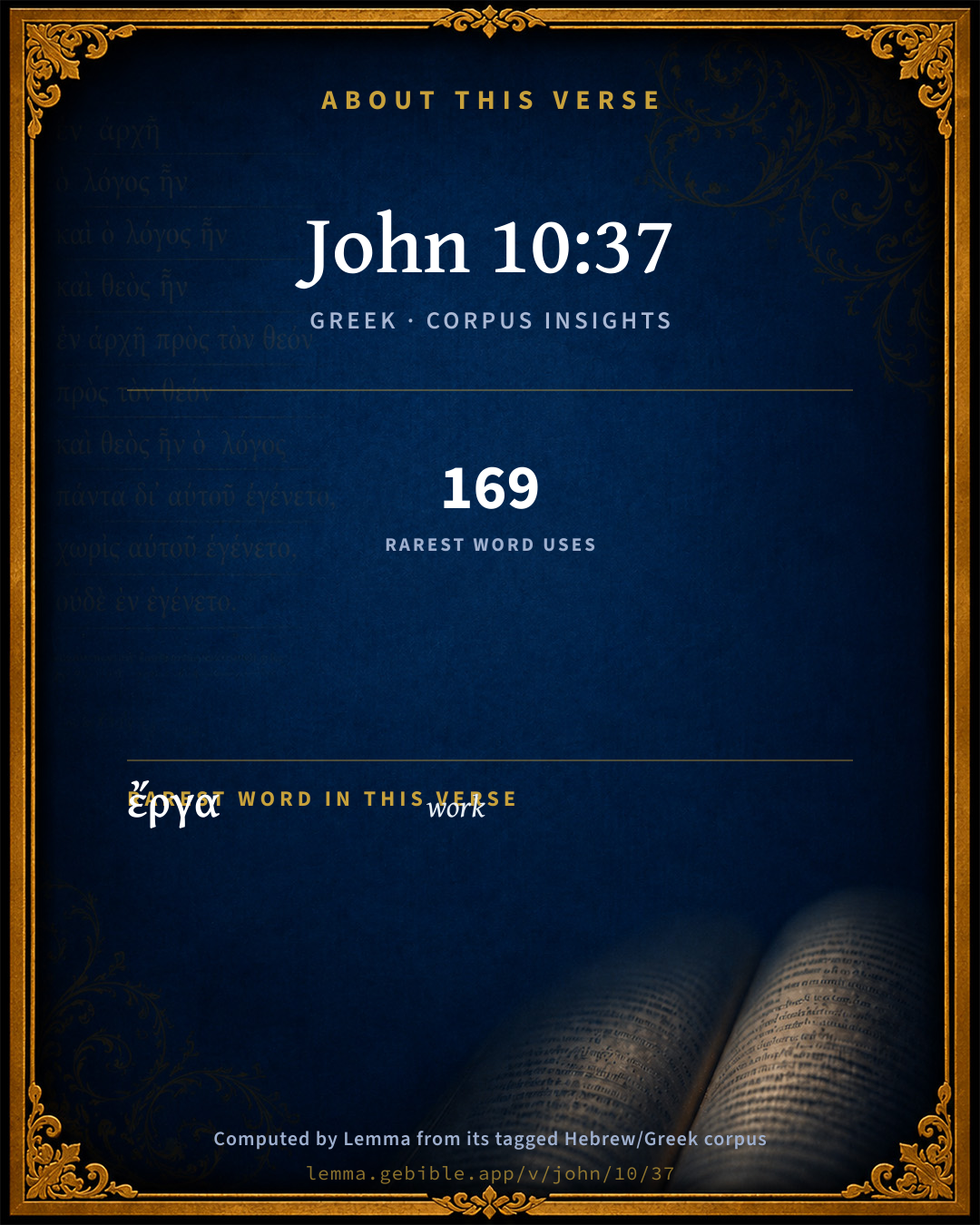
John, in the Gospels, opens this verse with 11 words (9 distinct Greek lemmas). Its most distinctive word is érgon (“work”). A historical commentator’s framing appears above. Read the whole chapter for the surrounding context.

Discussion questions

  1. The word érgon carries the sense “work.” How does it shape the verse?
  2. John 15:24 shares this passage’s theme. How do the two illuminate each other?
  3. “the” occurs 2× in this one verse. What is the effect of the repetition?
  4. The translations on this page render this verse differently — a whole-verse word diff, not a word-by-word alignment. What might account for the different wordings?
  5. Reading how Joseph Benson's Commentary and Bengel's Gnomon read this verse, where do the two commentators agree and where do they part?

Things to notice

  • These translations choose different wording for 3 words in this verse.
  • “the” occurs 2× in this single verse.
  • 9 distinct Greek lemmas span 11 words in this verse.

Reading settings

Reading text

Shown beneath each verse's original-language words.

Old Testament
Old Testament edition

Read the OT as the Masoretic Hebrew (MT) or the Greek Septuagint (LXX).

English shown for the Greek Septuagint (in the Hebrew ↔ Greek comparison).

Comparing translations? Open the Compare panel on any verse page to stack up to four side by side.