
Luke 10:21

Greek (Tischendorf 8th ed.) Luke 10:21 appears in the Greek New Testament. The text above is from the Tischendorf 8th edition. Each word links to its Strong’s number and a concise gloss. Click any word for its full Thayer’s Greek Lexicon entry.
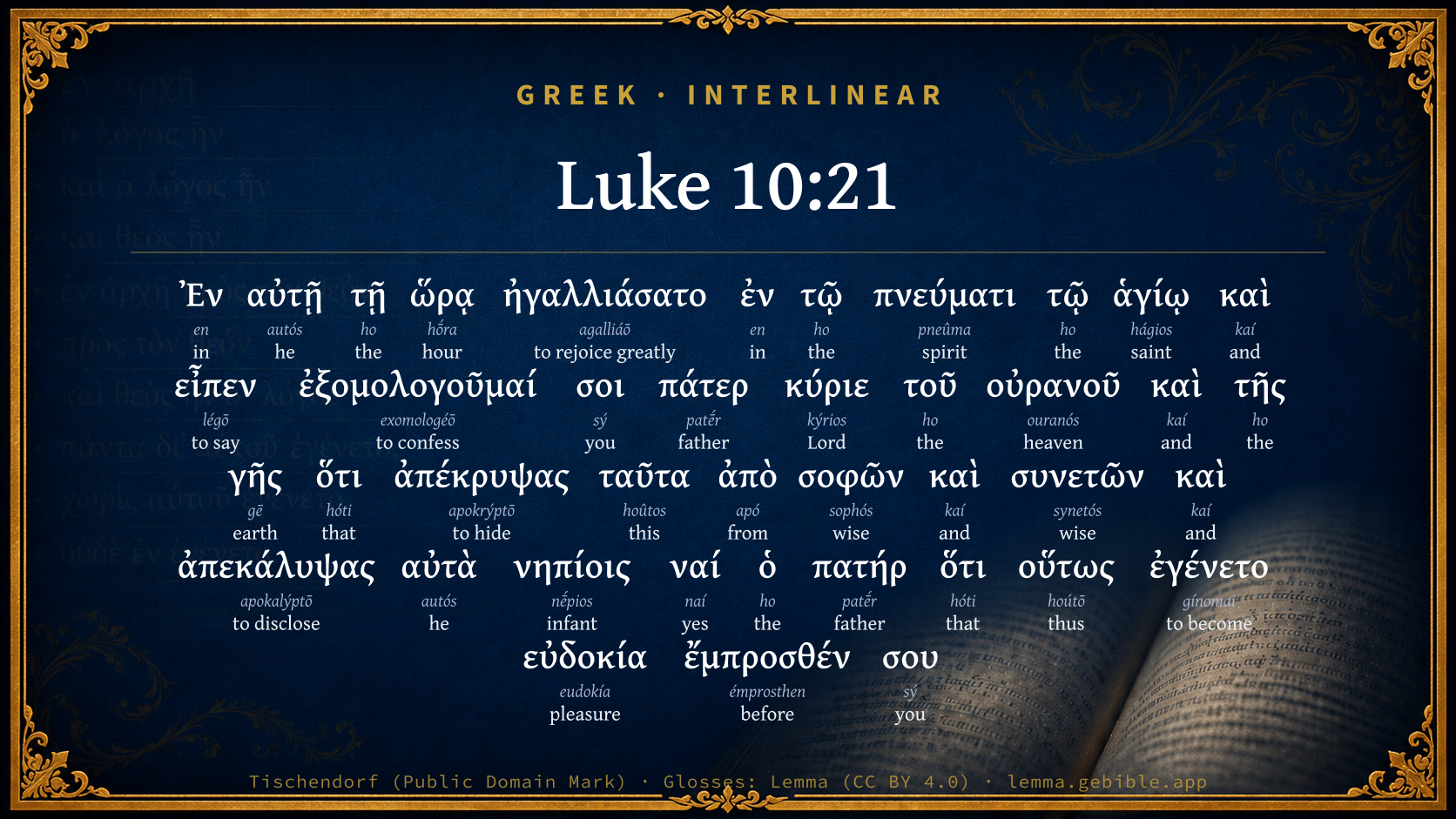
Download image
Cite this verse

Luke 10:21 (World English Bible). Public Domain. Lemma interlinear Bible study tool, https://lemma.gebible.app/v/luke/10/21.

Show BibTeX & RIS
BibTeX
RIS
English Translation
In that same hour Jesus rejoiced in the Holy Spirit, and said, "I thank you, O Father, Lord of heaven and earth, that you have hidden these things from the wise and understanding, and revealed them to little children. Yes, Father, for so it was well-pleasing in your sight."
World English Bible · Public Domain
Highlights
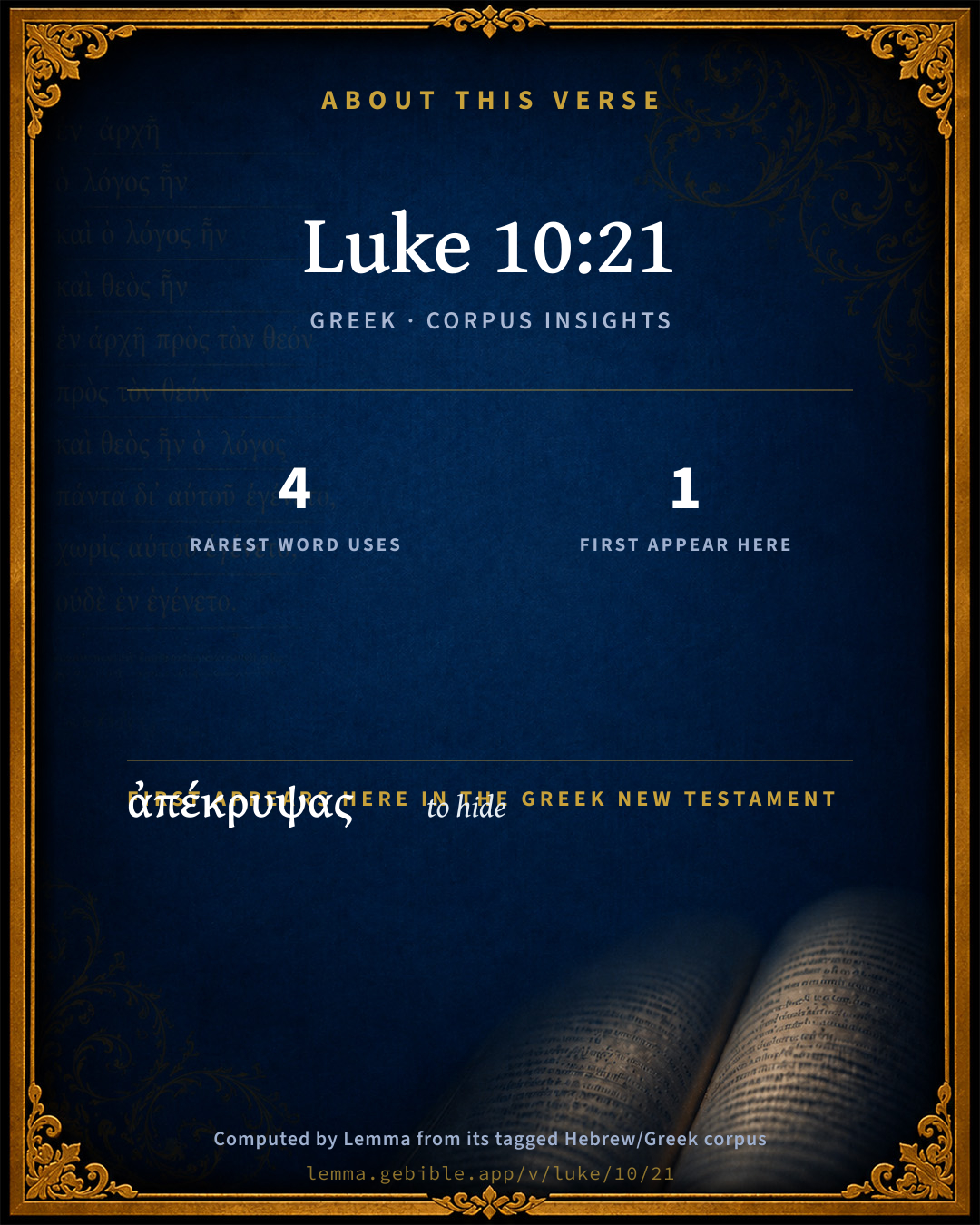
  • 1 first appearance in the Greek New Testament
Full analysis ↓
Download a study sheet

One document with this verse’s original text, its word-by-word gloss line, the meaning frame, cross-references with their text, attributed commentary, and full source and license credits — printable, and it pastes into notes with its structure intact.

This verse Autodidact and up

Study sheet (.html) Plain text (.txt)

A passage Seminary Student

Up to 50 verses in one chapter. A passage sheet keeps up to 6 commentary sources and 12 cross-references per verse, in the order this page ranks them, and says so on the sheet whenever that leaves anything out. Ask for a single verse and you get the Autodidact verse sheet above.

Everything on this page stays free to read, with no account — the sheet is a download of what is already on screen, not access to it.

Want to remove ads? Support Godless Engineer
Compare translations 3

The same verse in 3 English versions, stacked beneath the original-language interlinear above. Click any original word for its lexicon entry.

Each is an independent rendering of the whole verse — the interlinear is not word-aligned to these translations.

Highlighted words mark where these versions differ — a whole-verse word diff, not a word-by-word alignment.

  • World English Bible Public Domain
    In that same hour Jesus rejoiced in the Holy Spirit, and said, "I thank you, O Father, Lord of heaven and earth, that you have hidden these things from the wise and understanding, and revealed them to little children. Yes, Father, for so it was well-pleasing in your sight."
  • King James Version Public Domain
    In that hour Jesus rejoiced in spirit, and said, I thank thee, O Father, Lord of heaven and earth, that thou hast hid these things from the wise and prudent, and hast revealed them unto babes: even so, Father; for so it seemed good in thy sight.
  • unfoldingWord Literal Text CC BY-SA 4.0
    At that hour he rejoiced greatly in the Holy Spirit, and said, “I praise you, Father, Lord of heaven and earth, because you concealed these things from the wise and intelligent and revealed them to little children. Yes, Father, for thus it was well-pleasing before you.

unfoldingWord Literal Text — © unfoldingWord, licensed CC BY-SA 4.0. Word-aligned USFM3 via Door43 (git.door43.org/unfoldingWord/en_ult).

Versions to compare (up to 4)

3 of 4 selected

Show all 19 translations

Every available English version of this verse, each an independent rendering of the whole verse.

  • World English Bible Public Domain
    In that same hour Jesus rejoiced in the Holy Spirit, and said, "I thank you, O Father, Lord of heaven and earth, that you have hidden these things from the wise and understanding, and revealed them to little children. Yes, Father, for so it was well-pleasing in your sight."
  • Berean Standard Bible Public Domain
    At that time Jesus rejoiced in the Holy Spirit and declared, “I praise You, Father, Lord of heaven and earth, because You have hidden these things from the wise and learned, and revealed them to little children. Yes, Father, for this was well-pleasing in Your sight.
  • Majority Standard Bible Public Domain
    At that time Jesus rejoiced in the Spirit and declared, “I praise You, Father, Lord of heaven and earth, because You have hidden these things from the wise and learned, and revealed them to little children. Yes, Father, for this was well-pleasing in Your sight.”
  • King James Version Public Domain
    In that hour Jesus rejoiced in spirit, and said, I thank thee, O Father, Lord of heaven and earth, that thou hast hid these things from the wise and prudent, and hast revealed them unto babes: even so, Father; for so it seemed good in thy sight.
  • American Standard Version (1901) Public Domain
    In that same hour he rejoiced in the Holy Spirit, and said, I thank thee, O Father, Lord of heaven and earth, that thou didst hide these things from the wise and understanding, and didst reveal them unto babes: yea, Father; for so it was well-pleasing in thy sight.
  • Revised Version (1885) Public Domain
    In that same hour he rejoiced in the Holy Spirit, and said, I thank thee, O Father, Lord of heaven and earth, that thou didst hide these things from the wise and understanding, and didst reveal them unto babes: yea, Father; for so it was well-pleasing in thy sight.
  • Geneva Bible (1599) Public Domain
    That same houre reioyced Iesus in the spirit, and said, I confesse vnto thee, Father, Lord of heauen and earth, that thou hast hid these things from the wise and vnderstanding, and hast reueiled them to babes: euen so, Father, because it so pleased thee.
  • Douay-Rheims (1899) Public Domain
    In that same hour, he rejoiced in the Holy Ghost, and said: I confess to thee, O Father, Lord of heaven and earth, because thou hast hidden these things from the wise and prudent, and hast revealed them to little ones. Yea, Father, for so it hath seemed good in thy sight.
  • Young's Literal Translation Public Domain
    In that hour was Jesus glad in the Spirit, and said, `I do confess to thee, Father, Lord of the heaven and of the earth, that Thou didst hide these things from wise men and understanding, and didst reveal them to babes; yes, Father, because so it became good pleasure before Thee.
  • Literal Standard Version CC BY-SA 4.0
    In that hour Jesus was glad in the Spirit and said, “I confess to You, Father, Lord of Heaven and of earth, that You hid these things from wise men and understanding, and revealed them to babies; yes, Father, because so it became good pleasure before You.
  • Unlocked Literal Bible CC BY-SA 4.0
    At that same time he rejoiced greatly in the Holy Spirit, and said, “I praise you, Father, Lord of heaven and earth, because you concealed these things from the wise and understanding, and revealed them to those who are untaught, like little children. Yes, Father, for so it was well pleasing in your sight.”
  • unfoldingWord Literal Text CC BY-SA 4.0
    At that hour he rejoiced greatly in the Holy Spirit, and said, “I praise you, Father, Lord of heaven and earth, because you concealed these things from the wise and intelligent and revealed them to little children. Yes, Father, for thus it was well-pleasing before you.
  • Darby Bible Public Domain
    In the same hour Jesus rejoiced in spirit and said, I praise thee, Father, Lord of the heaven and of the earth, that thou hast hid these things from wise and prudent, and hast revealed them to babes: yea, Father, for thus has it been well-pleasing in thy sight.
  • World Messianic Bible Public Domain
    In that same hour, Yeshua rejoiced in the Holy Spirit, and said, “I thank you, O Father, Lord of heaven and earth, that you have hidden these things from the wise and understanding, and revealed them to little children. Yes, Father, for so it was well-pleasing in your sight.”
  • Webster's Bible Public Domain
    In that hour Jesus rejoiced in spirit, and said, I thank thee, O Father, Lord of heaven and earth, that thou hast hid these things from the wise and prudent, and hast revealed them to babes: even so, Father; for so it seemed good in thy sight.
  • Free Bible Version CC BY-SA 4.0
    At that moment Jesus was filled with the joy of the Holy Spirit, and said, “I thank you Father, Lord of heaven and earth, for you hid these things from the wise and clever people and revealed them to children! Yes, Father, you were pleased to do it in this way.
  • Bible in Basic English Public Domain
    In that same hour he was full of joy in the Holy Spirit and said, I give praise to you, O Father, Lord of heaven and earth, because you have kept these things secret from the wise and the men of learning, and have made them clear to little children: for so, O Father, it was pleasing in your eyes.
  • Text-Critical English NT CC BY 4.0
    At that same hour Jesus rejoiced in the Spirit and said, “I praise yoʋ, Father, Lord of heaven and earth, because yoʋ have hidden these things from the wise and intelligent, and revealed them to infants. Yes, Father, for so it was well-pleasing in yoʋr sight.”
  • Tyndale New Testament (1534) Public Domain
    That same tyme reioysed Iesus in the sprete and sayde: I confesse vnto the father Lorde of heaven and erth that thou hast hyd these thynges from the wyse and prudent and hast opened them to the babes. Even so father for soo pleased it the.

Literal Standard Version (2020), Covenant Press — licensed CC BY-SA 4.0. Text via the HelloAO Bible API (eBible.org). Unlocked Literal Bible (unfoldingWord) — licensed CC BY-SA 4.0. Text via the HelloAO Bible API (eBible.org). unfoldingWord Literal Text — © unfoldingWord, licensed CC BY-SA 4.0. Word-aligned USFM3 via Door43 (git.door43.org/unfoldingWord/en_ult). Free Bible Version, Dr. Jonathan Gallagher — licensed CC BY-SA 4.0. Text via the HelloAO Bible API (eBible.org).

Word by word

More ways to search: Search by grammar → Find every occurrence → Compare this word →

Practice this passage: Drill this verse → Learn its vocabulary →

ἀπέκρυψας
apokrýptō
G613
“to hide”
Verb, Aorist, Active, Indicative, 2nd person, Singular
Part of Speech
Verb
Tense
Aorist
Voice
Active
Mood
Indicative
Person
2nd person
Number
Singular
Full Thayer's Definition

Origin: from G575 and G2928

TDNT: 18:57,5

1. to hide 2. concealing, keeping secret
  1. Ἐν en G1722 “in” Preposition
  2. αὐτῇ autós G846 “he” Personal pronoun, Dative, Singular, Feminine
  3. τῇ ho G3588 “the” Article, Dative, Singular, Feminine
  4. ὥρᾳ hṓra G5610 “hour” Noun, Dative, Singular, Feminine
  5. ἠγαλλιάσατο agalliáō G21 “to rejoice greatly” Verb, Aorist, Middle deponent, Indicative, 3rd person, Singular
  6. ἐν en G1722 “in” Preposition
  7. τῷ ho G3588 “the” Article, Dative, Singular, Neuter
  8. πνεύματι pneûma G4151 “spirit” Noun, Dative, Singular, Neuter
  9. τῷ ho G3588 “the” Article, Dative, Singular, Neuter
  10. ἁγίῳ hágios G40 “saint” Adjective, Dative, Singular, Neuter
  11. καὶ kaí G2532 “and” Conjunction
  12. εἶπεν légō G3004 “to say” Verb, Aorist, Active, Indicative, 3rd person, Singular
  13. ἐξομολογοῦμαί exomologéō G1843 “to confess” Verb, Present, Middle, Indicative, 1st person, Singular
  14. σοι sý G4771 “you” Personal pronoun, 2nd person, Dative, Singular
  15. πάτερ patḗr G3962 “father” Noun, Vocative, Singular, Masculine
  16. κύριε kýrios G2962 “Lord” Noun, Vocative, Singular, Masculine
  17. τοῦ ho G3588 “the” Article, Genitive, Singular, Masculine
  18. οὐρανοῦ ouranós G3772 “heaven” Noun, Genitive, Singular, Masculine
  19. καὶ kaí G2532 “and” Conjunction
  20. τῆς ho G3588 “the” Article, Genitive, Singular, Feminine
  21. γῆς gē G1093 “earth” Noun, Genitive, Singular, Feminine
  22. ὅτι hóti G3754 “that” Conjunction
  23. ταῦτα hoûtos G3778 “this” Demonstrative pronoun, Accusative, Plural, Neuter
  24. ἀπὸ apó G575 “from” Preposition
  25. σοφῶν sophós G4680 “wise” Adjective, Genitive, Plural, Masculine
  26. καὶ kaí G2532 “and” Conjunction
  27. συνετῶν synetós G4908 “wise” Adjective, Genitive, Plural, Masculine
  28. καὶ kaí G2532 “and” Conjunction
  29. ἀπεκάλυψας apokalýptō G601 “to disclose” Verb, Aorist, Active, Indicative, 2nd person, Singular
  30. αὐτὰ autós G846 “he” Personal pronoun, Accusative, Plural, Neuter
  31. νηπίοις nḗpios G3516 “infant” Adjective, Dative, Plural, Masculine
  32. ναί naí G3483 “yes” Particle
  33. ὁ ho G3588 “the” Article, Nominative, Singular, Masculine
  34. πατήρ patḗr G3962 “father” Noun, Nominative, Singular, Masculine
  35. ὅτι hóti G3754 “that” Conjunction
  36. οὕτως hoútō G3779 “thus” Adverb
  37. ἐγένετο gínomai G1096 “to become” Verb, Aorist, Middle deponent, Indicative, 3rd person, Singular
  38. εὐδοκία eudokía G2107 “pleasure” Noun, Nominative, Singular, Feminine
  39. ἔμπροσθέν émprosthen G1715 “before” Preposition
  40. σου sý G4771 “you” Personal pronoun, 2nd person, Genitive, Singular

About this verse

These counts appear in no published source. They are computed here, from the morphology-tagged text and Lemma’s own curated glosses. What Lemma adds →

41
words
28
distinct lemmas
Gospels
section

Notable vocabulary

The rarest word here is ἀπέκρυψας to hide G613 — appearing just 4 times in the whole Greek New Testament.

First appearance in Scripture

This word makes its first canonical appearance in the Greek New Testament here:

  • ἀπέκρυψας to hide G613

Shared distinctive vocabulary

ἀπέκρυψας to hide G613 occurs in 4 verses of the Greek New Testament. Also found in:
Repetition

Words recur within this verse:

Cross-references

28

Topical passages linked to Luke 10:21 in the Treasury of Scripture Knowledge — connected by theme and wording, ordered by reader-vote popularity; previews shown in the World English Bible.

  • 2 Corinthians 4:3 Even if our Gospel is veiled, it is veiled in those who perish;
  • Matthew 11:25–27 At that time, Jesus answered, "I thank you, Father, Lord of heaven and earth, that you hid these things from the wise and understanding, and revealed them to infants.
  • Matthew 13:11–16 He answered them, "To you it is given to know the mysteries of the Kingdom of Heaven, but it is not given to them.
  • 1 Corinthians 2:6–8 We speak wisdom, however, among those who are full grown; yet a wisdom not of this world, nor of the rulers of this world, who are coming to nothing.
  • 1 Peter 2:1–2 Putting away therefore all wickedness, all deceit, hypocrisies, envies, and all evil speaking,
  • Ephesians 1:5 having predestined us for adoption as children through Jesus Christ to himself, according to the good pleasure of his desire,
  • Job 5:12–14 He frustrates the devices of the crafty, So that their hands can't perform their enterprise.
  • Psalms 8:2 From the lips of babes and infants you have established strength, Because of your adversaries, that you might silence the enemy and the avenger.
  • Matthew 16:17 Jesus answered him, "Blessed are you, Simon Bar Jonah, for flesh and blood has not revealed this to you, but my Father who is in heaven.
  • Matthew 21:16 and said to him, "Do you hear what these are saying?" Jesus said to them, "Yes. Did you never read, 'Out of the mouth of babes and nursing babies you have perfected praise?'"
  • Mark 10:15 Most assuredly I tell you, whoever will not receive the Kingdom of God like a little child, he will in no way enter into it."
  • 1 Corinthians 1:9–29 God is faithful, through whom you were called into the fellowship of his Son, Jesus Christ, our Lord.
  • Ephesians 1:11 in whom also we were assigned an inheritance, having been foreordained according to the purpose of him who works all things after the counsel of his will;
  • Colossians 2:2–3 that their hearts may be comforted, they being knit together in love, and gaining all riches of the full assurance of understanding, that they may know the mystery of God, both of the Father and of Christ,
  • Isaiah 53:11 He shall see of the travail of his soul, [and] shall be satisfied: by the knowledge of himself shall my righteous servant justify many; and he shall bear their iniquities.
  • Isaiah 66:1 Thus says Yahweh, heaven is my throne, and the earth is my footstool: what manner of house will you build to me? and what place shall be my rest?
  • Luke 15:5 When he has found it, he carries it on his shoulders, rejoicing.
  • Luke 15:9 When she has found it, she calls together her friends and neighbors, saying, 'Rejoice with me, for I have found the drachma which I had lost.'
  • 1 Corinthians 3:18–20 Let no one deceive himself. If anyone thinks that he is wise among you in this world, let him become a fool, that he may become wise.
  • Psalms 24:1 The earth is Yahweh's, with its fullness; The world, and those who dwell therein.
  • Psalms 25:14 The friendship of Yahweh is with those who fear him. He will show them his covenant.
  • Isaiah 29:14 therefore, behold, I will proceed to do a marvelous work among this people, even a marvelous work and a wonder; and the wisdom of their wise men shall perish, and the understanding of their prudent men shall be hid.
  • Isaiah 29:18–19 In that day shall the deaf hear the words of the book, and the eyes of the blind shall see out of obscurity and out of darkness.
  • Isaiah 35:8 A highway shall be there, and a way, and it shall be called The way of holiness. The unclean shall not pass over it, but is shall be for for him who walks in the Way. Wicked fools will not go there.
  • Isaiah 62:5 For as a young man marries a virgin, so shall your sons marry you; and as the bridegroom rejoices over the bride, so shall your God rejoice over you.
  • Zephaniah 3:17 Yahweh, your God, is in the midst of you, a mighty one who will save. He will rejoice over you with joy. He will rest in his love. He will rejoice over you with singing.
  • John 11:41 So they took away the stone from the place where the dead man was lying. Jesus lifted up his eyes, and said, "Father, I thank you that you listened to me.
  • John 17:24–26 Father, I desire that they also whom you have given me be with me where I am, that they may see my glory, which you have given me, for you loved me before the foundation of the world.

Cross-references courtesy of OpenBible.info (CC BY 4.0).

Where the printed editions differ

1 variant

Places in this verse where the major printed Greek editions disagree on the wording in a way that affects the translation — a comparison of editions, not a manuscript-by-manuscript collation. The editions are the modern critical texts (Nestlé-Aland 28/27, SBL, Westcott-Hort, Tregelles, Tyndale House) and the traditional texts behind the KJV (the Textus Receptus and the Byzantine/Majority text). It is not a claim about which reading is original.

  1. Different wording
    ἁγίῳ

    “Holy”

    In NA28NA27TynSBLWHTreg Not in TRByz

    Ἰησοῦς (Iēsous) 'Jesus' occurs in traditional manuscripts (TR+Byz) instead of ἁγίῳ (hagiō) 'Holy' in older manuscripts (NA28+NA27+Tyn+SBL+WH+Treg)

Textual data: Translators Amalgamated Greek New Testament (STEPBible TAGNT) · CC BY 4.0.

Commentary

Notes on Luke 10:21 from classic Christian and Jewish commentators (each source and its license shown beneath its notes). The classic Christian expositions comment on the surrounding passage and are grouped to its opening verse, so a note may address several verses; the Jewish commentaries on the Tanakh (Rashi and others) are per-verse, so they appear only where the commentator wrote on this verse.

Lemma curates 59 commentaries, every one of them public domain or Creative Commons licensed, each selected and text-cleaned for this edition rather than reprinted as found. About our sources →

The Biblical Illustrator

Joseph S. Exell

Luk_10:21-22

Jesus rejoiced in Spirit

Christ glorifies His Father and magnifies Himself

Learn hence--

1.

That till God reveals Himself, His nature and will, no man can know either what He is, or what He requires--Thou hast revealed.

2. That the wise and knowing men in the world have in all ages despised the mysteries of the gospel, and have therefore been judicially blinded by God--Thou hast hid these things from the wise and prudent. When men shut their eyes against the clearest light, and say they will not see, God closes their eyes and says they shall not see.

3. That the most ignorant, if humble, and desirous of spiritual illumination, are in the readiest disposition to embrace the gospel revelation--Thou hast revealed them unto babes.

4. That this is not more pleasing to Christ than it is the pleasure of His Father--Even so, Father, for so it seemed good in Thy sight.

Observe--Our Saviour magnifies Himself:

1. His authority and commission--All things are delivered unto Me; that is, all power is committed unto Me, as Mediator, from God the Father.

2. His office to reveal His Fathers will to a lost world--No man knoweth the Father but the Son, or the Son but the Father; that is, no man knoweth their essence and nature, their will and pleasure, their counsel and consent, their mutual compact and agreement betwixt themselves, for saving a lost world, but only themselves, and those to whom they have revealed it. Learn thence, That all saving knowledge of God is in, by, and through Christ; He, as the Great Prophet of His Church, reveals unto us the mind and will of God for our salvation. (W. Burkitt.)

Lessons

1. Let me ask you if you resemble Christ in rejoicing at the success of true religion? He greatly rejoiced in spirit, and gave thanks to His Father, that Satan was dethroned, and that, though some were obstinate, others were blessed with a saving discovery of Divine things.

2. Beware of being proud of your own wisdom and prudence, and cherish the humility and teachableness of babes.

3. We should learn, from the twenty-second verse, never to separate the truths of what is called natural religion from the gospel. The idea that there is, or can be, any true and acceptable religion whatever, apart from the revelation of Christ, is here shown to be quite preposterous. The true Witness declares that no man can know the Father except he to whom He shall reveal Him.

4. Let us be thankful for the precious religious privileges which we enjoy, and careful to improve them. Blessed are the eyes which see the things that ye see.

5. Lastly: Are we blessed, because our eyes see, and our ears hear these things?--then, Christian benevolence should lead us to feel for those who enjoy no such privileges, and to do everything we can to extend them to the utmost corners of the earth. (James Foote, M. A.)

The Saviours joy

The sublimity of this joy we feel the more, when we compare with it that of the seventy. They rejoice in the great things, He in the good brought to pass; they have their joy directed to the outer, Jesus His to the moral world; they rejoice alone in the present, Jesus also in the past and the future; they are disposed to self-praise, Jesus to thankful adoration. (Van Oosterzee.)

Christs joy

1. An example of the joy which the Lord sometimes experienced upon earth.

2. An image of the joy which He now experiences in heaven.

3. A presage of the blessedness which He shall hereafter taste when the kingdom of God shall be fully perfected. (Van Oosterzee.)

The joy of Jesus

It is remarkable that this is the only instance on record in the Gospels in which our Lord is said to have rejoiced. Yet I do not think it would be fair to infer from the fact of a solitary mention of His rejoicing that He did not rejoice at other times; on the contrary, our Lord must, despite His sorrow, have possessed a peaceful, happy spirit. He was infinitely benevolent, and went about doing good; and benevolence always finds a quiet delight in blessing others. Moreover, our Lord was so pure that He had a well of joy within which could not fail Him. Besides, Christ Jesus was a man of faith; faiths highest exposition and example. He it was, who for the joy that was set before Him endured the cross, despising the shame. His faith must, therefore, have anticipated the reward of His passion, and have brought the joy thereof home to Him even while He sorrowed here. It is clear that joy was not a distinguishing feature in our Lords life, so as to strike the beholder. Peace may have sat serenely on His brow, but nothing of the exuberant spirits which are seen in some men, for His countenance was marred with lines of care and grief. The words here used are very emphatic. He rejoiced. The Greek word is much stronger than the English rendering; it signifies to leap for joy. It is the word of the blessed Virgins song, My spirit hath rejoiced in God my Saviour. Strong emotions of delight were visible upon our Lords face, and were expressed by the tones of His voice as well as by His words. It is clear that He was greatly glad. The text also says, He rejoiced in spirit: that is, deep down in the very centre of His nature, in that largest and moat capacious part of His human being, the Redeemer rejoiced.

I. Our Lords joy was JOY IS THE FATHERS REVELATION OF THE GOSPEL.

1. I call your attention to the fact that He ascribed all that was done to the Father, and joyed that the Father was working with Him.

2. The Saviours joy was that through the Fathers grace men were being enlightened.

3. Further, our Saviours joy lay very much in this, that this revelation to men was being made through such humble instruments.

4. And yet, further, His great joy was that the converts were of such a character as they were.

5. Our Lords joy sprang from one other source, namely, His view of the manner in which God was pleased to save His people. It was by revealing these things to them. There is, then, to every man who is saved a revelation, not of anything over and above what is given us in the Word of God; but of that same truth to Himself personally and with power. In the word is the light; but what is needed is that each mans eye should be opened by the finger of God to see it.

II. OUR LORDS MODE OF EXPRESSIVE HIS JOY.

1. His joy finds tongue in thanksgiving.

2. He found expression for His joy in declaring the Fathers sovereignty.

3. He delighted in the special act of sovereignty which was before Him, that the Lord had hid these things from the wise and prudent, and had revealed them unto babes. His voice, as it were, went with the Fathers voice; He agreed with the Fathers choice, He rejoiced in it, He triumphed in it.

III. Thirdly, and briefly, I want you to see OUR LORDS EXPLANATION OF THE FATHERS ACT.

1. The Father had been pleased to hide these things from the wise and prudent and to reveal them unto babes, and Jesus Christ is perfectly satisfied with that order of things, quite content with the kind of converts He has and the kind of preachers that God has given Him. The Lord Jesus does not need prestige.

2. See how the Lord explains it yet further, by showing that human wisdom cannot find out God. Next, learn that the sovereignty of God is always exercised in such a way that the pure in heart may always rejoice in it. God never did a sovereign act yet that the loving Christ Himself could not rejoice in. The ultimate honour of the gospel is secured unto God alone, let that be our last lesson. (C. H. Spurgeon.)

Revealed them unto babes.

Why God reveals to babes

The babe is the representative of the receptive spirit. Its characteristic is trust, openness to impression, and freedom from prejudice. The disciples were babes who lay open to the Divine message, and did not interpose theories and traditions. They were poor and knew it, and were willing to become rich. To them God revealed. But the revealing to a certain disposition is of necessity the hiding from its opposite.

I. TO REVEAL TO BABES HARMONIZES WITH GODS CHARACTER AS A FATHER AND ILLUSTRATES IT. Babe is the counterpart to Father--wise and understanding has no such relation. The wise and understanding might have a special relation to an almighty Taskmaster, an infinite Schoolmaster and Prizegiver; but certainly not to an infinite Father. A fathers heart is not attracted to the brilliance or power in his family, but to the want. The gospel is salvation by the free gift of God. Any true conception of the evil of sin, and its effects on the soul, renders other ideas of salvation incredible. We call God Father, and ask His forgiveness. Salvation by grace is bound up with the Divine arrangement, which reveals to babes. The distinction of the babe is just here--he is adapted to salvation by grace.

II. IT GLORIFIES GOD AS LORD OF HEAVEN AND EARTH TO REVEAL TO BABES. That God is Lord of heaven and earth makes His lowliness not less, but more needful and credible. The more you extend the empire of God, the more necessary it is for the heart to feel that God is lowly, and to have abundant proof of it. The higher and mightier you conceive God to be, the less it will appear credible to you that He should show preference to force of any kind.

III. BY REVEALING TO BABES THE FATHER AND LORD OF HEAVEN AND EARTH MANIFESTS THE SUPREMACY OF THE MORAL ELEMENT. What a calamity it would have been if the highest blessing had been in any way specially associated with intellectual qualities. This would have been to confirm and glorify the false estimate already so prevalent and so disastrous. But when God passes by the soaring imagination, the lofty intellect, the keen understanding, and puts His main blessing into the lowly heart and open spirit, when He comes down to the very lowest form of the moral and spiritual, the mere sense of want, the mere hunger for better things, and gives infinite eternal wealth to that--what a rebuke He conveys to pride of intellect; what honour He confers upon plain heart and conscience. Now is the false judgment of the world reversed. Now substance is put in place of show. Now spirit is exalted over form. Now right is put on the royal seat.

IV. IT GLORIFIES GOD AS FATHER AND LORD OF HEAVEN AND EARTH TO REVEAL TO BABES; FOR IT SHOWS HIS DESIRE TO REVEAL AS MUCH AS POSSIBLE, AND TO AS MANY AS POSSIBLE. Had God then revealed to the wise and understanding, He would have hidden from the world as a whole. By revealing to babes He gives hope to universal humanity. The babe slumbers in every soul however artificial or proud, and may be wakened up by some simple touch of pathos, or glimpse of memory, as well as by disaster. God who reveals to babes shows that it is man himself that He wants, not mans accomplishments, not mans energies, and distinctions and elevations, but man.

V. THE APPOINTMENT OF A PERSONAL SAVIOUR GLORIFIES GOD AS FATHER AND LORD OF HEAVEN AND EARTH, AND IS PECULIARLY ADAPTED TO BABES. Jesus is the typical original Babe, the perfect, infinite example of the receptive spirit; therefore He reveals the Father, and is the refuge of men and the rest for the weary. On account of the very vastness of the lordship of heaven and earth a person is needed to bring God near, to show that it is a lordship, and not a mere system; and that there is a heart at the centre. The gospel is salvation by a person. Trust in Christ saves us. This suits the babes, and, therefore, at bottom, all men. (J. Leckie, D. D.)

The child-heart

I. THE INTELLECTUAL CONTRAST. The world, Christ would tell us, is divisible into the simple and the wise. Our Lord rejoices that the larger section is not excluded from participation in the things of the kingdom of God; that men do not need worldly wisdom and the prudence of experience in order to knowing the truths of salvation. No exclusive sentence is written over the portals of Christianity. It is adjusted to the lowest and meanest capacity. Christs mission was to all humanity, and He rejoiced in that fact.

II. THE MORAL CONTRAST. He wishes to tell us what is essential--that it is only to the child-heart that revelation will be made. We know the contrast between the childheart and a heart sophisticated by life. Worldly and hardened hearts cannot receive the revelation of the things of heaven.

1. It is even so in regard to the world of beauty around us. We fill our hearts with cares, and immerse ourselves in business, so that we cannot see the beauty of a landscape which entrances the child-heart.

2. It is true also of noble actions or ideas: only the care-free childheart feels their beauty and sublimity.

3. When a great evil is to be dealt with, we notice how slowly the consciences of worldly-wise, practical men rise to a great public duty, and how swiftly the child-heart perceives the line between right and wrong.

III. THE PRACTICAL RESULT. Christ rejoices that none are excluded from His kingdom. But no gigantic effort of intellect will enable us to climb over the battlements of heaven. Wisdom is nearer to us when we stoop. (Bishop Boyd Carpenter)

Revelation to the lowly

I. THE FACT.

1. A childlike mind is required in those who would receive Christ and His kingdom.

2. The first disciples were children and men of childlike mind.

3. In the present day, the gospel is for the childlike.

II. THE SECRET.

1. The nature of the truth revealed requires a childlike mind for the reception of it.

(1) Its novelty. It is not contrary to true reason; but it is aside from and different from the old results of human reason.

(2) Its unwordliness. The eyes that are wearied with poring over earthly lore are often too worn to bear the light of heavenly truth. This requires a healthy, fresh vision.

(3) Its lowliness. A gospel for the simple is not necessarily a simple gospel.

2. The method of the revelation requires a childlike mind for the reception of it. It is not given by logical demonstration, but through act and life. We must see it with the souls eyes. For the clearness of this spiritual vision we need

(1) simplicity and self-forgetfulness,

(2) trustfulness,

(3) purity--childrens graces.

III. THE THANKSGIVING. Why?

1. It is according to Gods will.

2. It redounds to the glory of God.

(1) As an evidence that the revelation comes from heaven and is not got by mans wisdom. It is not stolen Promethean fire.

(2) As a proof of the power of God. He can teach highest truth to lowliest scholars.

(3) As a sign of the goodness and condescension of God.

3. It proves the breadth of revelation.

4. It brings to us the best discipline in revelation. (W. F. Adeney, M. A.)

The kingdom of God, now as ever, hidden from the wise and prudent, and revealed unto babes

1. This is not different:

(1) In the days of the Saviour;

(2) In later ages;

(3) In our time.

2. This cannot be different.

(1) Objective cause in the nature of the gospel.

(2) Subjective cause in the human heart.

(3) Supernatural cause in the counselor God.

3. This may not be different; for, even in this way--

(1) The divinity of the gospel is confirmed;

(2) The requirements of the gospel are satisfied;

(3) The trial of the gospel is assured. (Van Oosterzee.)

Divine truths hidden and revealed

Whilst Jesus deemed it needful to warn His disciples against self-exaltation because of what they had been the means of doing, He Himself found in the successes which had accompanied their labours a ground for grateful rejoicing. In these successes He saw the firstfruits of a rich and glorious harvest; and He broke out into the exclamation--I thank Thee, O Father! &c. By the expression, these things, our Saviour meant the great Divine truths which He had come into the world expressly to reveal, which He had commissioned these seventy disciples to announce in the towns they visited, and for the rejection of which He had a little while before upbraided the cities of Galilee. With respect to these Divine truths, Christ here makes a two-fold statement.

I. HE SPEAKS OF THEM AS HAVING BEEN HIDDEN FROM SOME.

1. Divine truths were not hidden from these people through any want of outward revelation.

2. Nor through any lack of intellectual ability to understand them. They were the wise and prudent.

3. Nor through any influence exerted by God for the purpose. Thou hast hid, &c., must be interpreted in the broad light of our Saviours teaching as a whole.

4. In what sense, then, are we to understand that Divine truths were hidden from these people? To answer this question we must first answer another, namely, Who were the wise and prudent from whom these truths were concealed?

(1) They were not really the wise and prudent.

(2) They supposed themselves to be so, and gloried in the supposition. There is in such a case an element of retribution of which we must not lose sight. The retribution consists in this--that these people, having wilfully shut their minds against the revelations of Gods truth, are left by God to the consequences of their self-inflicted blindness.

II. HE SPEAKS OF THEM AS HAVING BEEN REVEALED TO OTHERS. The word babes is clearly intended to be antithetic to the words wise and prudent. As by the wise and prudent, the Saviour meant those who were proud, ostentatious, self-sufficient, thinking of themselves more highly than they ought to think, and looking down on others with a cold indifference or a supercilious contempt; so by babes He meant those who were humble, teachable, self-distrustful, feeling themselves to be destitute of all real good, and being willing to receive help and blessing from whatever quarter or in whatsoever way it might come. To such as these Divine truths were revealed, and only to such.

1. It was not because they had been favoured with a greater amount of light respecting these truths.

2. It was not because they had been supplied with better means of preparation for the reception of these truths.

3. It was not because they had been made the exclusive objects of a selecting love.

4. It was because they were in a fit and proper mood for the reception of spiritual truths. With respect to this revelation of Divine truths to the humble we have to notice two things, each of which suggests a practical lesson well worth learning:

(1) It was a source of grateful joy to the Saviours heart.

(2) It had His cordial and unqualified acquiescence. In conclusion, let us remember that if we would be as babes to whom Divine truths are revealed, we must not only bow before God in self-abasement and contrition, but we must look for the revelation of those truths through Jesus Christ. This point comes out in Luk_10:22, All things are delivered, etc. (B. Wilkinson, F. G. S.)

The simplicity of mystery

In that hour Jesus rejoiced in Spirit. How few such occasions occurred in His life! What hour was it? When He saw, humanly speaking, a glimpse of Gods method of unfolding His governmental purposes, and His beneficent plans and designs. I thank Thee that Thou hast hid these things from the wise and prudent, from intellectual giants, from merely clever people, from so-called genius, and sagacity and intellectual power. Who is greatest in the kingdom of heaven? Jesus did not summon the proudest king, or the mightiest thinker, but He set a child in the midst of them, and said, The child is always the greatest. So you will find it all throughout life, that when you have been most happy, when you have been most childlike, you have seen things most clearly; not when you have put on the cap of your genius, and have taken the sceptre of your power, and robed yourself in the official dignity of a passing moment or a transient situation; but when you have stripped yourself of your own greatness, and have sat down, and said, Lord, teach me. Religion, as propounded to us by Jesus Christ, is not a riddle to be solved by the intellectually great. It is a revelation to the heart; it is a word spoken to sin; it is a gospel breathed upon sorrow; it is a word of liberty delivered to those that are bound; a subtle sympathy--something not to be named in high-sounding phrases, or to be wrought out in pomp of words. If you have been in the habit of going to church for the purpose of settling some critical argument, for the purpose of hearing the minister through the medium of your scholastic accumulations and of your native power of intellect, I do not wonder you are numbered with the lean kine who, having devoured much, are none the better for their gluttony; but if you go hungering and thirsting after righteousness, if you have left your big self outside, and have come in, just enough of you to breathe and confess sin, just enough to be a mere spot on the floor of the sanctuary--a mere cripple, with only breath enough to say, God be merciful to me a sinner, you were never disappointed. If in hymn, or psalm, or high anthem, or exposition, or reading of the Word Divine, you have received satisfaction, great answers, infinite gospels, you have secretly blessed God for His revelations. The disciples were compared to babes, and the babes received the great revelation. It will be found that simplicity itself is the chief mystery of God. Some things are so simple that we wont believe them. I know sceptical minds who, if they were asking me which is the way to the Thames, and I were to say This, would doubt the answer because of its brevity and simplicity. If I could have conveyed the indication of the route by a roundabout process, they might, perhaps, have been led to believe that I meant what I said, though they did not know what I meant. Do not look so far from home for your blessings; do not make mysteries where God intends you to find simplicity. (J. Parker, D. D.)

The babe-spirit

Observe, I am speaking about the beginning, in developing this doctrine of the babe-spirit, and not about the end. And even at the end thou shalt find out the great mystery of the unity between the man and the child that He, the child Jesus, and the man Christ Jesus are one and the same. The greater his modesty; the more wonderful his power and influence, the greater his readiness to consider, and oblige, and do good. From the greatest expect the best; from the master more than from the servant; from the disciple rudeness and rejection, from the Master, Forbid them not, let them come. (J. Parker, D. D.)

God revealed unto babes

That the sage should miss what the infant can see seems at first but little possible, and still less a subject for thankfulness. It would appear to discourage the highest attributes of our nature, to throw contempt on the patience of thought, and cruelly to visit the prayer for light with the deeper darkness. Can it be that the more pains we take to know, the less will the truth be found; that the rich and practised mind is at a disadvantage compared with the inexperienced and empty? And if so, why exult in the frustration of the noblest of human aims, and the confiscation of the prize to those who have no aim at all? Tertullian dwells with a savage satisfaction on the supposed exclusion from the kingdom of God of whatever we hold fair and great in the old heathen world, and richest for the adornment of all time; and exults in peopling it with hordes of triumphant barbarians like himself. Is this the spirit of Christs thanksgiving? Are we required, out of sympathy with it, to believe Socrates an outcast and clap our hands as he vanishes from hope? to stifle our reverence for AEschylus and Plato, for the Scipios and Antonines--and declare Gods preference for mendicant monks and illiterate missionaries? Must we condemn as secular and carnal our own natural admiration for the gifts of wisdom--the disciplined powers, the large and supple thought, the accurate expression, of a wellcultured nature--and force ourselves into harmony of taste with the raw religion of unmellowed sectaries, their loud voice, their rude speech, their narrow zeal, their tumultuous aspirations? Far from it. It is not intellect from which God hides Himself, but selfishness and pride; which may belong alike to taught and untaught, and darken the soul of sophist or of clown. There is light both in the base and in the wise: but in the former it is wholly spontaneous; in the latter it is chiefly derivative. In its infancy the soul simply apprehends what is given it to perceive, lies confidingly in the bosom of nature, and lets the morning beams come into the full and wondering eyes. It is the loss of the habit of natural trust, the tendency to anxious quest of something distant instead of pure repose on what is here, that according to Christs prayer, hides God from the wise and prudent. And, conversely, it is the surrender to spontaneous light and love, the simple passing out upon it into life, without doubt of its guidance or scrutiny of its claims, that reveals Him unto babes. How profoundly true this is--that in Divine things the little child may know what the great philosopher may miss--will appear if you only think what God is, and whether He is likely to be discovered on any explorers track or by any artifice of calculation. Two things science enables us to do, from which all its triumphs spring. It shows us how to put the parts and products of nature into true classes; and it qualifies us to foresee phenomena else unsuspected. But God is neither a being to be classified, nor a phenomenon to be foreseen, (Dr. Martineau.)

It is the great marvel of the Christian character

that the completest self-sacrifice gives the completest self-possession; that only the captive soul, which has flung her rights away, has all her powers free; and that simply to serve under the instant orders of the living God, is the highest qualification for command. This is the meaning of that great saying of Cromwells: One never mounts so high as when one knows not whither one is going: a saying which the wise and prudent scorned as a confession of blindness, but which reveals to simpler minds the deepest truth. (Dr. Martineau.)

Two types of human greatness are there

The Pagan and the Christian--the moral and the religious--the secular and the Divine. The former has its root and essence in trying hard; the latter, in trusting gently: the one depends on voluntary energy; the other on relinquishment of personal will to cast every burden upon God. (Dr. Martineau.)

To commune with God

There is need of no subtle thought, no foreign tongue, no newest philosophy: the pure in heart shall see Him; and Fox and Bunyan can more truly make Him known, than Masters of Sentences and Angelic Doctors. (Dr. Martineau.)

Learning the alphabet of religion

A man came to his pastor one night to learn the way of salvation. He was a very learned man, but he said: I know nothing of Divine truth. I come to you to learn--as a child. I come to learn the very alphabet of religion. His pastor replied: My friend, when you return home, open your Bible and read prayerfully the third chapter of John. Think of it. Study it. That will be A. Then turn to Isaiah, fifty-fifth chapter. Study it. Believe it. That is B. A B, ab, almost Abba Father. (Handbook to Scripture Doctrines.)

Humility of Pascal

The curate who attended Pascal on his dying bed, struck with the triumph of religion over the pride of an intellect which continued to burn after it had ceased to blaze, would frequently exclaim, He is an infant--humble and submissive as an infant! (Life of Pascal.)

The receptive spirit

The Rev. John Foster, whose sceptical tendencies were the source of much distress of mind, was finally led to say: I have felt the necessity of dismissing subtle speculations, and of yielding a humble, cordial assent to mysterious truth, just as and because the Scriptures declare it, without asking How can these things be? The gospel is to me a matter of urgent necessity. I come to Jesus because I need pardon.

The Son will reveal Him

Deity revealed

I. THE MYSTERY OF DEITY IN SELF-EXISTENCE. He is an unknown God where there is no supernatural revelation of Him. Reason is baffled, because it is under the fall. Eternal self-existence. How wonderful! It exceeds all power of calculation.

II. THE INCARNATE SON OF GOD REVEALING. NOW mark, I beseech you, that all this glory of the Father, made to shine in the face of Jesus Christ, is unknown to the sinner as long as he is blinded.

III. THE SALVATION SECURED THEREBY. Contrived and bestowed by God the Father. Carried out by God the Son. It is, therefore, infallible, and it secures the glory of Jehovah. (J. Irons.)

The power bestowed on Christ by the Father

1. Unlimited.

2. Legitimate.

3. Beneficent.

4. Ever-enduring. (Van Oosterzee.)

The unique relation between the Son and the Father

1. How far it is the object of our faith.

2. How far it can be the object of our knowledge. (Van Oosterzee.)

The relation between Father and Son

1. The highest mystery.

2. A revealed mystery.

3. Even after the revelation yet continually a partially concealed mystery. (Van Oosterzee.)

Christ the Revealer of God

Christ, as you see here, speaks of Himself. What does He say of Himself?

1. Does He not claim to be Divinely constituted as a Revealer of God? All things are delivered to Me of My Father.

2. Our Lord speaks here also of the glorious mystery of His own person and character. No man, nor angel, nor archangel, nor any intelligence in this or in the heavenly world, knoweth who the Son is but the Father. It takes an Infinite Being to comprehend an Infinite Being.

3. Christ alone knows God in perfection--No man knoweth who the Father is but the Son. What an awful sense of loneliness--a loneliness which is unutterable--would be involved in our idea of God, unless we had some light given to us by Jesus Christ, concerning His relation to the Father.

4. Jesus Christ is and can alone be the Revealer of God to us--And he to whom the Son will reveal Him.

(1) He can be known to whom the Son will reveal Him.

(2) The way to the knowledge of God is by meekness, humility, submission, trustfulness, love. (W. Dorling.)

The Biblical Illustrator, edited by Joseph S. Exell (c. 1880s–1900s) — public domain. Text from a community e-Sword module.

Joseph Benson's Commentary

Luk 10:21-24. In that hour Jesus rejoiced — On this occasion Jesus, meditating on the unspeakable wisdom and goodness of the divine dispensations to mankind, felt extraordinary emotions of joy. And said, I thank thee, O Father, Lord of heaven and earth — In both of which thy kingdom stands, and that of Satan is to be destroyed; that thou hast hid these things from the wise and prudent — Hast suffered them to be hid from those that are wise and prudent in their own eyes, or who really are so with respect to the things of this world; and hast revealed them unto babes — To persons illiterate, and of comparatively weak understanding, but are wise as to the things of God. He rejoiced not in the state of ignorance and darkness, in which the wise and prudent were left, as a punishment of their self-confidence and pride, and in their consequent destruction, but in the display of the riches of God’s grace to others, in such a manner as reserves to him the entire glory of our salvation, and hides pride from man. All things are delivered to me of my Father — He repeats the declaration of his own extensive authority, which he had testified before. See notes on Mat 11:25-27. And no man knoweth who the Son is — Essentially one with the Father; but the Father — Who sent him, and who only knows his dignity and the mystery of his person. And who the Father is — How great, how wise, how good; but the Son — His essential wisdom and word. And he to whom the Son will reveal him — In pursuance of one very important design of his coming, which was to declare the Father, and communicate the saving knowledge of him to all truly willing and desirous to receive it. And he turned to his disciples, and said privately, &c. — It appears, that when the seventy disciples returned, Jesus was surrounded with a great multitude of people; therefore after he had spoken publicly as above related, to the seventy, he turned himself to all his disciples, and uttered what follows privately, so as not to be heard by the people in general. Blessed are the eyes which see the things which ye see, &c. — The happiness here praised was enjoyed by the seventy, as well as by the twelve, and consequently it was as fit that they should be made sensible of its greatness, as that the twelve should understand it. Besides, this declaration, as well as what was spoken more publicly, was designed to moderate the joy which the seventy had conceived, on finding the devils subject to them. The subjection of the devils to their command was not so great a happiness as their being allowed to hear Christ’s sermons, and to see his miracles. These things show, that what our Lord said privately to his disciples, was said to the seventy as well as to the twelve.

Joseph Benson's Commentary on the Old and New Testaments (1811–1818) — public domain. Text from a community e-Sword module.

Tyndale Open Study Notes

Tyndale Open Resources

10:21 hiding these things: God uses simple things that a child can understand to shame those who think themselves wise but are foolish in God’s eyes (see Isa 29:14; 1 Cor 1:18-31).

Tyndale Open Study Notes — © Tyndale Open Resources, licensed CC BY-SA 4.0. Text via the HelloAO Bible API.

Bengel's Gnomon

Johann Albrecht Bengel

Luk 10:21. Ἠγαλλιάσατο, exulted) The crowning point of the fruits of Christ’s office was reached at that time. He Himself rejoiced in the joy of His disciples described in Luk 10:20, But rejoice, etc.—Κύριε τοῦ οὐρανοῦ καὶ τῆς γῆς, Lord of heaven and earth) Satan is cast out from heaven and earth: the kingdom of God stands in heaven and on earth.—[νηπίοις, babes) Such were the Seventy, and those who had received their testimony.—V. g.]

Bengel's Gnomon of the New Testament — English translation (T&T Clark, Edinburgh, 1860) — public domain. Text from a community e-Sword module.

Meyer's Critical & Exegetical Commentary

Heinrich August Wilhelm Meyer

Luk_10:21-22. See on Mat_11:25-27.[134] Luke places this thanksgiving prayer in immediate chronological connection (in the same hour) with the return of the Seventy. Theophylact says: ὥσπερ πατὴρ ἀγαθὸς παῖδας ἰδὼν κατορθώσαντάς τι, οὕτω καὶ ὁ σωτὴρ ἀγάλλεται, ὅτι τοιούτων ἀγαθῶν ἠξιώθησαν οἱ ἀπόστολοι. Still this chronological position is hardly the historical one. See on Matth.

Τῷ ΠΝΕΎΜΑΤΙ] not the Holy Spirit (see the critical remarks). Comp. Luk_1:47. It is His own πνεῦμα ἁγιωσύνης, Rom_1:4. The opposite of this, ἨΓΑΛΛ. Τ. ΠΝ., occurs in Joh_11:33.

ΤΑῦΤΑ] finds in Luke its reference in ὍΤΙ ΤᾺ ὈΝΌΜΑΤΑ ὙΜῶΝ Κ.Τ.Λ., Luk_10:20, and is hence to be understood[135] of the knowledge of the life eternal in the kingdom of Messiah (comp. Luk_8:10 : γνῶναι τὰ μυστήρια τῆς βασιλείας).

Luk_10:22. καὶ στραφεὶς κ.τ.λ.] (see the critical remarks). From the prayer to God He turns in the following words to the disciples (the Seventy and the Twelve).

πρὸς τοὺς μαθ.] belongs to στραφείς. Comp. Luk_7:44, Luk_14:25. As to the idea of the πάντα μοι παρεδ., which is not, as with Baur, Schenkel, and others, to be referred merely to the spiritual and moral region, see on Mat_28:18.

γινώσκει] That the Marcionite reading ἔγνω is the original one, and not a gnostic alteration, is rendered probable by the very ancient date at which it is found (Justin, the Clementines, the Marcosites). Comp. on Mat_11:27. The gnostic interpretation of ἔγνω, which is contested by the Clementines (Luk_18:13 f.), very easily brought about the change into the present tense. See (after Baur, Hilgenfeld, Semisch, Köstlin, Volkmar) Zeller, Apostelg. p. 13f.

τίς] in respect of His nature, counsel, will, thought, etc. In what way, however, τίς ἐστιν ὁ πατήρ is said to be gnostic rather than biblical (Köstlin, p. 161) it is not easy to see. The Father who has sent the Son has His perfect revelation for the first time in Him. Comp. Joh_14:9.

ᾧ ἐὰν βούλ.] Comp. concerning the Spirit, 1Co_12:11. This will of the Son, however, in virtue of His essential and moral unity with the Father, is no other than the Fathers will, which the Son has to fulfil. Comp. Gess, Pers. Chr. p. 18 f. Observe, again, that the negation, which is not to be relatively explained away, οὐδεὶς … εἰ μή, establishes a relation of a unique kind, namely, that of the metaphysical fellowship.

[134] Keim, Geschichtl. Christus, p. 51, sees here the climax reached of the consciousness of the divine Sonship, and that hence there now appears, instead of the your Father, as hitherto, the designation my Father. But on the one hand your Father is still said at the same time and later (Luk_12:30; Luk_12:32; Mat_10:20; Mat_18:14; Mat_23:9), and on the other Jesus, not to mention Luk_2:49, says my Father even as early as in the Sermon on the Mount (Mat_7:21). Baur, indeed (Neutest. Theol. p. 86), knows no other way of getting rid of the offence which this expression of Mat_7:21 gives him than by attributing the words to a later period of the ministry of Jesus. It is easy in this way to set aside what will not fit into our notions.

[135] Not, of the power over the demons, as Wittichen, d. Idee Gottes als des Vaters, 1865, p. 30, wishes to hare it. To that also belongs πάντα, ver. 22.

Meyer — Critical and Exegetical Commentary on the New Testament — English translation by Peter Christie, edited by Frederick Crombie (T&T Clark, 1880) — public domain. Text from a community e-Sword module.

Expositor's Greek Testament

ed. W. Robertson Nicoll

Luk 10:21-24 . The exultation of Jesus (Mat 11:25-27 ). The setting in Mt. gives to this great devotional utterance of Jesus a tone of resignation in connection with the apparent failure of His ministry. Here, connected with the fall of Satan, it has a tone of triumph ( ἠγαλλιάσατο ). ἐν τῷ πνεύματι τῷ ἁγίῳ : it was an inspired utterance, “a kind of glossolaly,” J. Weiss (Meyer).

Luk 10:21 is almost verbatim , as in Mat 11:25 , only that Lk. has ἀπέκρυψας for Mt.’s ἔκρυψας .

The Expositor's Greek Testament, edited by W. Robertson Nicoll (1897–1910) — public domain. Text from a community e-Sword module.

Geneva Bible (1599)

Geneva Bible translators

Then he turned to his disciples, and said, Is read in some copies.

Of this world.

The Church is contemptible, if we behold the outward face of it, but the wisdom of God is not so marvelous, in any thing, as in it.

Geneva Bible (1599) marginal notes — public domain. Text via Bolls.life.

Jamieson, Fausset & Brown

Robert Jamieson, A. R. Fausset & David Brown

Jesus . . . said, &c.--The very same sublime words were uttered by our Lord on a former similar occasion (see on Mat 11:25-27); but (1) There we are merely told that He "answered and said" thus; here, He "rejoiced in spirit and said," &c. (2) There it was merely "at that time" (or season) that He spoke thus, meaning with a general reference to the rejection of His gospel by the self-sufficient; here, "In that hour Jesus said," with express reference probably to the humble class from which He had to draw the Seventy, and the similar class that had chiefly welcomed their message. "Rejoice" is too weak a word. It is "exulted in spirit"--evidently giving visible expression to His unusual emotions; while, at the same time, the words "in spirit" are meant to convey to the reader the depth of them. This is one of those rare cases in which the veil is lifted from off the Redeemer's inner man, that, angel-like, we may "look into it" for a moment (Pe1 1:12). Let us gaze on it with reverential wonder, and as we perceive what it was that produced that mysterious ecstasy, we shall find rising in our hearts a still rapture--"Oh, the depths!"

Jamieson, Fausset & Brown — Commentary Critical and Explanatory on the Whole Bible (1871) — public domain (CC PDM 1.0). Text via the HelloAO Bible API.

Adam Clarke's Commentary

Verse 21. Rejoiced in spirit] Was truly and heartily joyous: felt an inward triumph. But τῳ πνευματι, τῳ ἁγιῳ, the HOLY Spirit, is the reading here of BCDKL, six others; the three Syriac, later Persic, Coptic, AEthiopic, Armenian, Vulgate, all the Itala except one, and Augustin and Bede. These might be considered sufficient authority to admit the word into the text.

I thank thee] Bishop PEARCE justly observes, the thanks are meant to be given to God for revealing them to babes, not for hiding them from the others. See Clarke on Mt 11:25.

Thou hast hid] That is, thou hast not revealed them to the scribes and Pharisees, who idolized their own wisdom; but thou hast revealed them to the simple and humble of heart.

Adam Clarke's Commentary on the Bible (1810–1826) — public domain. Text from a community e-Sword/MySword module.

Ellicott's Commentary for English Readers

(21, 22) in that hour Jesus rejoiced in spirit.—The words that follow are found also in Mat_11:25-27 (see Notes on those verses), but the opening clause that introduces them is peculiar to St. Luke, and is noticeable as the one instance where the word “rejoiced,” which appears in the Magnificat (Luk_1:47), is used of our Lord’s human feeling of exultation. It indicates what one may call the enthusiasm of spiritual joy more than any other synonym, and conveys the impression that the disciples must have noticed something exceptional in their Lord’s look and manner. The verbal agreement with St. Matthew indicates that both the Evangelists must have drawn from a common source, documentary or oral.

A Bible Commentary for English Readers, edited by Charles John Ellicott (1878–1897) — public domain. Text from a community e-Sword module.

The Cambridge Bible for Schools and Colleges

gen. ed. J. J. S. Perowne

21. rejoiced] Rather, exulted, a much stronger word, and most valuable as recording one element — the element of exultant joy—in the life of our Lord, on which the Evangelists so rarely touch as to have originated the legend, preserved in the spurious letter of P. Lentulus to the Senate, that He wept often, but that no one had ever seen Him smile.

I thank thee, O Father] Literally, “I make grateful acknowledgment to Thee .”

from the wise and prudent...unto babes] Here we have the contrast between the ‘wisdom of the world,’ which is ‘foolishness with God,’ and the ‘foolishness of the world,’ which is ‘wisdom with God,’ on which St Paul also was fond of dwelling, 1Co_1:21; 1Co_1:26; 2Co_4:3-4; Rom_1:22. For similar passages in the Gospels see Mat_16:17; Mat_18:3-4.

unto babes] i.e. to all who have “the young lamb’s heart amid the full- grown flocks”—to all innocent childlike souls, such as are often those of the truly wise. Genius itself has been defined as “the heart of childhood taken up and matured into the power of manhood.”

The Cambridge Bible for Schools and Colleges (gen. ed. J. J. S. Perowne; Cambridge University Press, 1878–1918) — public domain. Text from a community e-Sword module.

John Gill's Exposition

In that hour Jesus rejoiced in Spirit,.... In his human soul: his heart was filled with joy, not so much at the success of the seventy disciples, and the subjection of the devils to them, as in the view he had of the spread of the Gospel, and of the revelation and application of the truths of it to multitudes of mean and despicable persons, while it was rejected by the wise and learned; and particularly at the sovereign and distinguishing grace of God towards the elect, whose names are written in heaven; upon the mention of which his soul was so affected, that he broke out in, an exulting strain, into thanksgivings to God, in the following manner,

and said, I thank thee, O Father,.... In three ancient copies of Beza's, and in the Vulgate Latin, Syriac, and Ethiopic versions it is read, "in the Holy Spirit"; and the Persic version reads, "he spake, or confabulated with the Holy Spirit": but the former reading and sense are best. See Gill on Mat 11:25, Mat 11:26

John Gill's Exposition of the Whole Bible (1746–1763) — public domain (CC PDM 1.0). Text via the HelloAO Bible API.

Trapp's Complete Commentary

John Trapp

21 In that hour Jesus rejoiced in spirit, and said, I thank thee, O Father, Lord of heaven and earth, that thou hast hid these things from the wise and prudent, and hast revealed them unto babes: even so, Father; for so it seemed good in thy sight.

Ver. 21. I thank thee, O Father, &c.] With this prayer the Anabaptists of Germany usually began their sermons, thinking thereby to excuse their lack of learning. (Scultet. Annal.) And then protested that they would deliver nothing but what was revealed to them from above.

John Trapp, A Commentary or Exposition upon All the Books of the Old and New Testament (1647–1656) — public domain. Text from a community e-Sword module.

Albert Barnes' Notes on the Bible

See the notes at Mat 11:25-27.

Albert Barnes' Notes on the Bible (1834–1885) — public domain. Text from a community e-Sword/MySword module.

Haydock's Catholic Bible Commentary

He rejoiced in the Holy Ghost. In almost all Greek copies, we read in spirit, without holy. And it is expounded of Christ’s own spirit. (Witham) --- I give thanks, &c. In this verse we see plainly refuted the heretical Marcion, and his follower Manicheus, who asserted that God was not the creator of the earth, or of any thing existing on the earth. St. Epiphanius says, that in a gospel written by Marcion, the words Father and earth were entirely omitted. Who does not here deplore the blindness of heretics, who, in order to spread their errors, do not hesitate thus to corrupt the original Scripture received by the whole Christian world!!! (Denis the Carthusian)

George Leo Haydock (1774–1849), Haydock's Catholic Family Bible and Commentary, 1859 edition — public domain. Excludes Psalms (Douay-Rheims chapter numbering differs from Protestant) and Deuterocanonical books (Catholic canon only).

Matthew Poole's English Annotations

See Poole on "Mat 11:25", and following verses to, Mat 11:27, where we met with these words of our Saviour.

Matthew Poole's English Annotations on the Holy Bible (1683–1685) — public domain. Text from a community e-Sword/MySword module.

Whedon's Commentary on the Bible

Daniel D. Whedon

21. In that hour—At the season of that transaction.

Father, Lord of heaven and earth—For it was from God the Father Almighty, as above stated, that the omens of triumph were given, both to the Seventy and to the human spirit of the blessed Jesus.

Rejoiced in spirit—Rather triumphed or exulted in spirit. The revelations of the hour gave to him his joy and triumph, as well as to the Seventy theirs.

From the wise and prudent— From not only the statesman, the general, and the prince, but from the rabbi, the priest, and the pontiff; from Herod, Caiaphas, and Gamaliel. Jesus was soon to encounter these wise and prudent at the Feast of Tabernacles.

These two verses, 21, 22, show that Jesus, in illustrating his mystical unity with the Father, rose into precisely the style of his discourses as reported in the Gospel of John.

Daniel D. Whedon (gen. ed.), Commentary on the Old and New Testaments (1874–1909) — public domain. Text from a community e-Sword module.

The Pulpit Commentary

In that hour Jesus rejoiced in spirit. More than "rejoiced;" the Greek word rather signifies "exulted." Very rarely in the holy story of the life of lives is a hint given us of any gleam of gladness or of joy irradiating the spirit of the Man of sorrows. The exultation of the Blessed here was based upon his conviction that this first success of his own was but the commencement of a long and weary, but yet, in the end, of a triumphant campaign against the spirits of sin and evil. What these, in their mortal weakness by the aid of their poor imperfect faith in his Name, had been able to accomplish, was an earnest, a pledge, of the mighty work which his followers would, in the power of the same Name, be enabled to effect in the coming ages. In that solemn hour did Messiah see, in the far future, of "the travail of his soul," and was satisfied. The absence of all sign of joy in the life of our Lord is well brought out in that touching legend which we find in the spurious letter of P. Lentulus to the senate, that he wept often, but that no one had ever seen him smile. That thou hast hid these things from the wise and prudent, and hast revealed them unto babes. Looking upon his servants after their return from their successful mission, a group made up certainly for the most part of poor untutored men fishers, artisans, and the like, children of the people, without rank or position Jesus thanks the Father that, in the persons of the men chosen to be the instruments of his work, he has looked away from all the ordinary machinery of human influence. As he gazes upon the band of successful missionaries, Jesus thanks the Father that henceforth his servants, if they would be successful, must owe the powers which gave them success entirely to his training, and not to the world"s. Even so, Father; for so it seemed good in thy sight. This is "the only record, outside St. John"s Gospel, of a prayer like that which we find in Joh 17. For the most part, we may believe, those prayers were offered apart, on the lonely hillside, in the darkness of night; or, it may be, the disciples shrank in their reverence, or perhaps in the consciousness of their want of capacity, from attempting to record what was so unspeakably sacred. But it is noteworthy that in this exceptional instance we find, both in the prayer and the teaching that follows it in St. Matthew and St. Luke, turns of thought and phrase almost absolutely identical with what is most characteristic of St. John. It is as though this isolated fragment of a higher teaching had been preserved by them as a witness that there was a region upon which they scarcely dared to enter, but into which men were to be led afterwards by the beloved disciple, to whom the Spirit gave power to recall what had been above the reach of the other reporters of his Master"s teaching" (Dean Plumptre).

The gladness of gratitude, etc.

Our thought is directed to

I THE GLADNESS OF GRATITUDE. "Jesus rejoiced in spirit, and said, I thank thee, O Father." Joy and thankfulness are here united, as indeed they are everywhere. It is gratitude that holds the key to happiness of heart and life. Who are the miserable? Not the poor; they are often the most contented. Not the afflicted; they are often very cheerful under great privation. Not the lonely; they are found happy in their solitude, conversing with the departed great or communing with the Highest. It is the ungrateful who are the unhappy; it is they who take every kindness shown them by their fellow-men in a spirit of surliness, as if they deserved more than they have received; it is they who accept innumerable mercies and the "unspeakable Gift" at the hand of God without response, unmindful of the one, unappreciative of and ungrateful for the other. Who are the happy? Not the rich because they are rich; not the strong because they are strong; not those who have many friends because they have them. These may be burdened, wearied, wretched, and their life be darkly shadowed. It is the grateful who are the happy souls; it is they who receive with appreciation and thankfulness whatever man may give them, whether of love, of confidence, of sympathy, of practical help; it is they who have a deep sense of the kindness of the heavenly Father, and of the grace of the Lord Jesus Christ. The heart that is full of gratitude is the heart that is full of joy; and such joy is both pure and lasting.

II THE HERITAGE OF THE HUMBLE-HEARTED. "Thou hast hid these things from the wise,... and revealed them unto babes.

1. In our Lord"s time the scribes and lawyers "rejected the counsel of God;" they refused the wisdom of the Wisest; and the supercilious Sadducees stood aloof from the kingdom of Divine truth, from the kingdom of God. The "wise and prudent" were too haughty of heart to part with their beloved prejudices and to welcome the new truth which the great Teacher brought them. But the "common people heard him gladly;" all "the people" were "very attentive to hear him." The fishermen of Galilee left their nets and their ships to follow him.

2. In the time of the apostles the same results were found. (see 1Co_1:26-28)

3. In our own time we find that they who have gathered together a little human learning are apt to think that they are competent to solve, unaided, all the great problems of their being and their destiny, and they close the gates of their mind against the great verities of the Christian faith. But they who know how little they have grasped of all that is to be acquired, and who stand as "babes," as very little children, before the Divine Father, are ready to welcome to their souls all that he is ready to reveal to them, and theirs is the blessed heritage of spiritual truth, of heavenly wisdom, of eternal life.

III THE REFUGE OF THE PERPLEXED. "Even so, Father; for so it seemed good in thy sight." We have our perplexities now, and they, may weigh upon our spirit with crushing power. We cannot understand God"s doings or his inaction in the wide human world, or in the Church of Christ, or in the more limited sphere where our own interests and efforts lie. The more we think the more we are assured that we are baffled and beaten. The various solutions proposed do not reach the heart of the difficulty. What, then, can we do? Just retreat to that safe refuge the strong, immovable assurance that all things are in the hands, and are subject to the guidance, of a holy, wise, loving Father. C.

The Pulpit Commentary (1880–1919), ed. H.D.M. Spence-Jones & Joseph S. Exell — public domain. Text from a community e-Sword module.

John Wesley's Explanatory Notes

Lord of heaven and earth - In both of which thy kingdom stands, and that of Satan is destroyed. That thou hast hid these things - He rejoiced not in the destruction of the wise and prudent, but in the display of the riches of God's grace to others, in such a manner as reserves to Him the entire glory of our salvation, and hides pride from man. Matt. xi, 25.

John Wesley, Explanatory Notes Upon the Whole Bible (1754–1765) — public domain. Text via the GEBible commentary corpus.

Kretzmann's Popular Commentary

Paul E. Kretzmann

The exultation of Jesus:

v. 21. In that hour Jesus rejoiced in spirit and said, I thank Thee, O Father, Lord of heaven and earth, that Thou hast hid these things from the wise and prudent, and hast revealed them unto babes. Even so, Father; for so it seemed good in Thy sight.

v. 22. All things are delivered to Me of My rather; and no man knoweth who the Son is but the Father; and who the Father is but the Son, and he to whom the Son will reveal Him.

There is a note of triumph in these words of Jesus, that the salvation of men is going on in spite of all efforts of the enemy to frustrate it. He exulted in the Holy Spirit, the Spirit in Him uttered an inspired saying. He gives the fullness of praise to the Father, the almighty Lord of heaven and earth. The final purpose of the entire work of redemption was to redound to the glory of God, according to whose counsel it was carried out. To those that are wise and prudent in their own conceit, that hope to find the way to a heaven of their own imagination by works of their own imagination and by wisdom of their own, to these the way of salvation is hidden, 1Co 1:18-25. But to the unlearned, to those that are willing to take all reason captive under the obedience of Christ and, as new-born babes, desire the sincere milk of the Word, to these God revels in the wonders of His Word and works. That has been God’s good pleasure, and for that we owe Him everlasting thankfulness.

Paul E. Kretzmann, Popular Commentary of the Bible (1921–1924) — public domain. Text from a community e-Sword module.

Burkitt's Expository Notes on the New Testament

William Burkitt

Here we find our Saviour glorifying his Father, and magnifying himself.

1. He glorifies his Father for the wise and free dispensation of his gospel grace to the meanest and most ignorant persons, while the great and learned men of the world undervalued and despises it: I thank thee, Father, that thou hast revealed these things to babes.

Learn hence,

1. That until God reveals himself, his nature and will, no man can know either what he is, or what he requires: Thou hast revealed.

2. That the wise and knowing men in the world have in all ages despised the mysteries of the gospel, and having therefore been judicially blinded by God: Thou hast hid these things from the wise and prudent.

3. That the most ignorant, if humble, and desirous of spiritual illumination, are in the readiest disposition to receive and embrace the gospel revelation: Thou hast revealed them unto babes.

4. That this is not more pleasing to Christ than it is the pleasure of his Father: Even so, Father, for so it seemed good in thy sight.

Observe, 2. Our Saviour magnifies himself.

1. His authority and commission: All things are delivered unto me; that is, all power is committed to me as mediator from God the Father.

2. His office to reveal his Father’s will to a lost world: No man knoweth the father, but the Son, or the Son but the Father; that is, no man knows their essence and nature, their will and pleasure, their counsel and consent, their mutual compact and agreement between themselves, for saving a lost world, but only themselves, and those to whom they have revealed it.

Learn thence, that all saving knowledge of God is in, by, and through Christ; he, as the great prophet of his chruch, reveals unto us the mind and will of God for our salvation: None knoweth but he to whom the Son revealeth.

William Burkitt's Expository Notes on the New Testament (1700–1703) — public domain. Text from a community e-Sword module.

The People's New Testament

B. W. Johnson

21, 22. I thank thee, Father. See Matt. 11:25–27, for notes. The same language is probably uttered here a second time.

B. W. Johnson's The People's New Testament with Notes (1889–1891) — public domain. Electronic text from the Christian Classics Ethereal Library (CCEL) ThML edition.

unfoldingWord translationNotes

Door43 World Missions Community

Father

This is an important title for God. (See: Translating Son and Father)

Lord of heaven and earth

"heaven" and "earth" represent everything that exists. AT: "Master over everyone and everything in heaven and earth" (See: Merism)

these things

This refers to Jesus' previous teaching about the authority of the disciples. It may be best to simply say "these things" and let the reader determine the meaning.

the wise and understanding

The words "wise" and "understanding" are nominal adjectives that refer to people with these qualities. Because God had concealed truth from them, these people were not actually wise and understanding, even though they thought they were. AT: "from people who think they are wise and have understanding" (See: Irony and Nominal Adjectives)

those who are untaught, like little children

This refers to those who may not have much education but who are willing to accept Jesus' teachings in the same way that little children willingly listen to those they trust. AT: "people who may have little education, but who listen to God as little children do" (See: Ellipsis and Simile)

for so it was well pleasing in your sight

"for it pleased you to do this"

translationWords

Holy Spirit

praise

God the Father

lord

heaven

earth

wise

understand

reveal

unfoldingWord translationNotes — © Distant Shores Media and the Door43 World Missions Community, licensed CC BY-SA 4.0. Source: git.door43.org/Door43/en_tn.

Cambridge Greek Testament for Schools and Colleges

21. ἠγαλλιάσατο. ‘Exulted,’ a much stronger word than the ‘rejoiced’ of the A.V[224]; and most valuable as recording one element—the element of exultant joy—in the life of our Lord, on which the Evangelists touch so rarely as to have originated the legend, preserved in the spurious letter of P. Lentulus to the Senate, that He wept often, but that no one had ever seen Him smile. The word ἐνεβριμήσατο τῷ πνεύματι (Joh 11:33) expresses the opposite extreme of emotion.

[224] A.V. Authorised Version.

ἐξομολογοῦμαί σοι πάτερ. Literally, “I make grateful acknowledgment to Thee.” For the verb see Rom 14:11. It has this sense often in the LXX[225] It also means ‘to confess,’ Mat 3:6, &c.

[225] LXX. Septuagint.

ἀπὸ σοφῶν καὶ συνετῶν … νηπίοις. Here we have the contrast between the ‘wisdom of the world,’ which is ‘foolishness with God,’ and the ‘foolishness of the world,’ which is ‘wisdom with God,’ on which St Paul also was fond of dwelling, 1Co 1:21; 1Co 1:26; 2Co 4:3-4; Rom 1:22. For similar passages in the Gospels see Mat 16:17; Mat 18:3-4.

νηπίοις, i.e. to all who have “the young lamb’s heart amid the full-grown flocks”—to all innocent childlike souls, such as are often those of the truly wise. Genius itself has been defined as “the heart of childhood taken up and matured into the power of manhood.” God, says Gess, met the pride of intellect by blindness, and rewarded truth-loving simplicity by revelation.

ναὶ ὁ πατήρ. The nom. is here used in a vocative sense, as in Luk 8:54, ἡ παῖς ἔγειρε; Mat 27:29, χαῖρε ὁ βασιλεὺς τῶν Ἰουδαίων. This is especially the case with the imperative, as in Luk 12:32, μὴ φοβοῦ τὸ μικρὸν ποίμνιον. The meaning is not however exactly the same as in the πάτερ at the beginning of the verse, but ‘Thou who art my Father.’

εὐδοκία ἔμπροσθέν σου. A Hebraism. Exo 28:38.

Cambridge Greek Testament for Schools and Colleges (Cambridge University Press, 1896; 21 vols, various authors incl. Carr, Maclear, Plummer, Farrar, Lumby, Moule, M. R. James, Simcox) — public domain. Text from a community e-Sword module.

Alford’s Greek Testament

Henry Alford

21.] The words τῷ ἁγίῳ cannot well be excluded from the text; the expression as thus standing, forms an ἅπαξ λεγ., but is agreeable to the analogy of Scripture: cf. Rom 1:4: Heb 9:14: 1Pe 3:18: see also Rom 14:17: 1Th 1:6. The ascription of praise, and the verses following, are here in the very closest connexion, and it is perfectly unimaginable that they should have been inserted in this place arbitrarily. The same has been said of their occurrence in Mat 11:25; and, from no love of harmonizing or escaping difficulties, but from a deep feeling of the inner spirit of both discourses, I am convinced that our Lord did utter, on the two separate occasions, these weighty words; and I find in them a most instructive instance of the way in which such central sayings were repeated by Him. It was not a rejoicing before (in Matt.), but a confession: compare the whole discourse and notes.

That the introductory words ἐν αὐτῇ τ. ὥρᾳ, = ἐν ἐκ. τῷ καιρῷ, may have been introduced from one passage into the other, and perhaps by some one who imagined them the same, I would willingly grant, if needful; not that, in the presence of such truths, such a trifle is worth mention, but that the shallow school of modern critics do mention, and rest upon such. On vv. 21, 22, see notes on Mat 11:25-27, observing here the gradual narrowing of the circle to which our Lord addresses himself, ver. 22, στραφ. πρ. τ. μ.,—then ver. 23 the same, with κατʼ ἰδίαν added.

Henry Alford, The Greek Testament (1849–1861) — public domain. Text from a community e-Sword module.

International Critical Commentary

21-24. The Exultation of Jesus over the Divine Preference shown to the Disciples. Mat 11:25-27. Nowhere else is anything of the kind recorded of Christ. Mt. connects it with the Woes on the three cities, and connects these with the message from the Baptist.

21. Ἐν αὐτῇ τῇ ὥρᾳ “In that very hour” (see small print on ver. 7), making the connexion with the return of the Seventy close and express. Both this and αὐτῇ τῇ ὥρᾳ (without ἐν) are peculiar to Lk. (7:21?, 12:12, 20:19: and 2:38; Act 14:18, Act 22:13). In the parallel passage we have ἐν ἐκείνῳ τῷ καιρωε͂ͅ (Mat 11:25).

ἠγαλλιάσατο τῷ πνεύματι τῷ ἁγίῳ . “Exulted in the Holy Spirit,” i.e. this holy joy is a Divine inspiration. The fact is analogous to His being “led by the Spirit in the wilderness” (4:1). Nowhere else is anything of the kind recorded of Christ. The verb is a strong one: Comp. 1:47; Act 2:26, Act 2:16:34; 2Sa 1:20; 1Ch 16:31; Hab 3:18; Isa 12:6, 25:9; Psalms passim. Mt. has merely ἀποκριθείς.

The strangeness of the expression “exulted in the Holy Spirit” has led to the omission of τῷ ἁγίῳ in A Syr-Sin. and some inferior authorities. There is no parallel in Scripture. Rom 1:4; Heb 9:14; 1Pe 3:18, are not analogous.

Ἐξομολογοῦμαί σοι, πάτερ κύριε τοῦ οὐρανοῦ καὶ τῆς γῆς . “I acknowledge openly to Thine honour, I give Thee praise”; Gen 29:35; Psa 30:4, 106:47, 122:4; Rom 14:11, Rom 15:9: Clem. Rom 61:3. Satan is cast down from heaven, and vanquished on earth. God is Father and Lord of both; Father in respect of the love, and Lord in respect of the power, which this fact exhibits. For other public recognitions of God as His Father comp. Mat 15:13, Mat 15:18:35; Joh 5:17, Joh 5:11:41, Joh 5:12:27; Luk 23:34, Luk 23:46. The genitives belong to κύριε only, not to πάτερ: comp. Clem Hom xvii. 5.

ἀπέκρυψας ταῦτα ἀπὸ σοφῶν καὶ συνετῶν, κ.τ.λ. The ταῦτα refers to the facts about the Kingdom made known by the Seventy. In sound as in sense there is a contrast between ἀπέκρυψας and ἀπεκάλυψας. The aristocracy of intellect, who prided themselves upon their superiority, are here the lowest of all. The statement is general, but has special reference to the scribes and Pharisees, who both in their own and in popular estimation were the wise and enlightened (Joh 7:49, Joh 9:40). The νήπιοι are the unlearned, and therefore free from the prejudices of those who had been trained in the Rabbinical schools. It is very arbitrary to confine the thanksgiving to ἀπεκάλυψας: it belongs to ἀπέκρυψας also. That God has proved His independence of human intellect is a matter for thankfulness. Intellectual gifts, so far from being necessary, are often a hindrance. S. Paul is fond of pointing out this law of the “Lord of heaven and earth”: Rom 1:22; 1Co 1:19-31, 2Co 4:3, 2Co 4:4. Note the omission of the article before σοφῶν, συνετῶν, and νηπίοις. To be σοφός and συνετός is not fatal: such are not ipso facto excluded, although they often exclude themselves. Nor are the νήπιοι ipso facto accepted.

In Clem Hom viii. 6 the passage is quoted thus: ἐξομολογοῦμαἰ σοι, πάτερ τοῦ οὐρανοῦ καὶ τῆς γῆς, ὅτι ἀπέκρυψας ταῦτα ἀπὸ σοφῶν καὶ πρεσβυτέρων, καὶ ἀπεκάλυψας αὐτὰ νηπίοις θηλάζουσιν; and again, 18:15: ὅτι ἅτερ ἧν κρυπτὰ σοφοῖς, ἀπεκάλυψας αὐτὰ νηπίοις θηλάζουσιν. The latter form avoids the difficulty about thanking God for hiding the wise. In application the νήπιοι are made to be the Gentiles. The Marcosians had the future,—ἐξομολογήσομαι (Iren. i. 20, 3).

The word νήπιος (νη, ἔπος) represents the Latin infans. Lat. Vet. and Vulg. have parvulis here and Mat 11:25 ; but infantium, Mat 21:16. It is opposed to ἀνήρ, 1Co 13:11; Eph 4:14; and to τέλειος, Heb 5:13.

ναί. This resumes the expression of thanks; and hence the second ὅτι, like the first, depends upon ἐξομολογοῦμαί σοι: “I thank Thee that thus it was well-pleasing.” Comp. Php 4:3; Phm 1:20; Rev 16:7; Rev 22:20.

ὁ πατήρ. The nom. with the art. often takes the place of the voc. in N.T., and generally without any difference in meaning. This is specially the case with imperatives (8:54, 12:32; Mat 27:29?; Mar 5:41, Mar 5:9:25; Col 3:18; Eph 6:1, etc.), and may often be due to Hebrew influence (2Ki 9:31; Jer 47:6). Here there is perhaps a slight difference between πάτερ and ὁ πατήρ, the latter meaning, “Thou who art the Father of all.” The use of ὁ πατήρ for πάτερ may be due to liturgical influence. Comp. Mar 14:36; Rom 8:15; and see Lft. on Gal 4:6 and Col 3:18; also Win. xxix. 2, p. 227; Simcox, Lang. of N.T. p. 76.

εὐδοκία ἐγένετο ἔμπροσθέν σου . A Hebraism, with εὐδοκία first for emphasis. See on 2:14.

International Critical Commentary — older volumes (1896–1929), various authors — public domain. Text from a community e-Sword module.

Vincent's Word Studies in the New Testament

Marvin R. Vincent

The best texts omit Jesus.

Rejoiced. See on 1Pe 1:6.

In spirit. The best texts add tw aJgiw, the holy, and render in the Holy Spirit.

I thank. See on Mt 11:25. From this point to ver. 25, compare Mt 11:25 - 27, and Mt 13:16, 17.

Prudent. See on Mt 11:25.

Marvin R. Vincent, Word Studies in the New Testament (1887–1900) — public domain. Text from a community e-Sword/MySword module.

Godet's Commentaries

Frédéric Louis Godet

Vers. 21-24. The Joy of Jesus.

We reach a point in the life of the Saviour, the exceptional character of which is expressly indicated by the first words of the narrative, in that same hour. Jesus has traced to their goal the lines of which His disciples discern as yet only the beginning. He has seen in spirit the work of Satan destroyed, the structure of the kingdom of God raised on the earth. But by what hands? By the hands of those ignorant fishermen, those simple rustics whom the powerful and learned of Jerusalem call accursed rabble (Joh 7:49), “the vermin of the earth” (a rabbinical expression). Perhaps Jesus had often meditated on the problem: How shall a work be able to succeed which does not obtain the assistance of any of the men of knowledge and authority in Israel? The success of the mission of the seventy has just brought Him the answer of God: it is by the meanest instruments that He is to accomplish the greatest of His works. In this arrangement, so contrary to human anticipations, Jesus recognises and adores with an overflowing heart the wisdom of His Father.

Vers. 21, 22. In that same hour Jesus rejoiced in spirit, and said, I praise Thee, O Father, Lord of heaven and earth, that Thou hast hid these things from the wise and prudent, and hast revealed them unto babes: even so, Father; for so it seemed good in Thy sight. 22 All things are delivered to me of my Father: and no one knoweth who the Son is, but the Father; and who the Father is, but the Son, and he to whom the Son will reveal Him.” The πνεῦμα, the spirit, which is here spoken of, is undoubtedly that of Jesus Himself, as an element of His human Person (1Th 5:23; Heb 4:12; Rom 1:9). The spirit, in this sense, is in man the boundless capacity of receiving the communications of the Divine Spirit, and consequently the seat of all those emotions which have God and the things of God for their object (see on Luk 1:47). We think it necessary to read τῷ πνεύματι as dat. instr., and that the addition of τῳ ἁγίῳ (the holy) and of the prep. ἐν in some MSS. arises from the false application of this expression to the Spirit of God. ᾿Αγαλλιᾶσθαι, to exult, denotes an inner transport, which takes place in the same deep regions of the soul of Jesus as the opposite emotion expressed by the ἐμβριμᾶσθαι, to groan (Joh 11:33). This powerful influence of external events on the inner being of Jesus proves how thoroughly in earnest the Gospels take His humanity. ᾿Εξομολογεῖσθαι, strictly, to declare, confess, corresponds in the LXX. to הודה, to praise. Here it expresses a joyful and confident acquiescence in the ways of God.

The words Father and Lord indicate, the former the special love of which Jesus feels Himself to be the object in the dispensation which He celebrates, the latter the glorious sovereignty in virtue of which God dispenses with all human conditions of success, and looks for it only from His own power. The close of this verse has been explained in this way: “that whilst Thou hast hid..., Thou hast revealed...” The giving of thanks would thus be limited to the second fact. Comp. a similar form, Isa 1:2, Rom 6:17. But we doubt that this is to impair the depth of our Lord’s thought. Did not God, in the way in which He was guiding the work of Jesus (in Israel), wish quite as positively the exclusion of the wise as the co-operation of the ignorant? The motive for this divine method is apparent from 1Co 1:23-31, in particular from Luk 10:29; Luk 10:31: “that no flesh should glory;” and, “that he that glorieth, let him glory in the Lord.” By this rejection the great are humbled, and see that they are not needed for God’s work. On the other hand, the mean cannot boast of their co-operation, since it is evident that they have derived nothing from themselves. We may compare the saying of Jesus regarding the old and the new bottles (Luk 10:37-38). The wise were not to mingle the alloy of their own science with the divine wisdom of the gospel. Jesus required instruments prepared exclusively in His own school, and having no other wisdom than that which He had communicated to them from His Father (Joh 17:8). When He took a learned man for an apostle, He required, before employing him, to break him, as it were, by the experience of his folly. Jesus, in that hour of holy joy, takes account more definitely of the excellence of this divine procedure; and it is while contemplating its first effects that His heart exults and adores. “L’événement capital de l’histoire du monde,” carried out by people who had scarcely a standing in the human race! Comp. Joh 9:39.

The ναί, “yea, Father,” reasserts strongly the acquiescence of Jesus in this paradoxical course. Instead of the nom. ὁ πατήρ, Father, it might be thought that He would have used the voc. πάτερ, O Father! as at the beginning of the verse. But the address does not need to be repeated. The nom. has another meaning: “It is as a Father that Thou art acting in thus directing my work.”

The ὅτι, for that or because, which follows, is usually referred to an idea which is understood: “yea, it is so, because...” But this ellipsis would be tame. It would be better in that case to supply the notion of a prayer: “Yea, let it be and remain so, since...!” But is it not more simple to take ὅτι as depending on ἐξομολογοῦμαι: “yea, assuredly, and in spite of all, I praise Thee, because that...” The phrase εὐδοκία ἔμπρ. σου is a Hebraism (צוֹן לְרָ... נייַהָוה׃ לִפְ,ֵ Exo 28:38).

Gess thus sums up the thought of this verse: “To pride of knowledge, blindness is the answer; to that simplicity of heart which wishes truth, revelation.”

Frédéric Louis Godet — Commentaries on Luke, John, Romans, and 1 Corinthians — English translation (T&T Clark, Edinburgh, 1870s–1890s) — public domain. Text from a community e-Sword module.

Lesson kit

Teaching starters — assembled from the data on this page, not authored interpretation. Every prompt links to the verse data it draws on. Edit before teaching.

Luke, in the Gospels, opens this verse with 41 words (28 distinct Greek lemmas). Its most distinctive word is apokrýptō (“to hide”). A historical commentator’s framing appears above. Read the whole chapter for the surrounding context.

Discussion questions

  1. How does “to hide” (apokrýptō) shape what this verse is saying?
  2. This is the first place “to hide” appears in Scripture (first appears here). What does its debut here establish?
  3. How does 1 Corinthians 2:7, which shares the word «to hide», read alongside this verse?
  4. What does the repetition of “father” (2× in this one verse) do in this verse?
  5. These translations render this verse differently. What is at stake in choosing one wording over another?
  6. Compare how The Biblical Illustrator and Joseph Benson's Commentary read this verse. Where do they agree or differ?

Things to notice

  • 1 word makes its first canonical appearance in Scripture here.
  • These translations choose different wording for 27 words in this verse.
  • “father” occurs 2× in this single verse.
  • 28 distinct Greek lemmas span 41 words in this verse.

Reading settings

Reading text

Shown beneath each verse's original-language words.

Old Testament
Old Testament edition

Read the OT as the Masoretic Hebrew (MT) or the Greek Septuagint (LXX).

English shown for the Greek Septuagint (in the Hebrew ↔ Greek comparison).

Comparing translations? Open the Compare panel on any verse page to stack up to four side by side.