Mark 13:12

Greek (Tischendorf 8th ed.) Mark 13:12 appears in the Greek New Testament. The text above is from the Tischendorf 8th edition. Each word links to its Strong’s number and a concise gloss. Click any word for its full Thayer’s Greek Lexicon entry.
Download image
Cite this verse

Mark 13:12 (World English Bible). Public Domain. Lemma interlinear Bible study tool, https://lemma.gebible.app/v/mark/13/12.

Show BibTeX & RIS
BibTeX
RIS
English Translation
"Brother will deliver up brother to death, and the father his child. Children will rise up against parents, and cause them to be put to death.
World English Bible · Public Domain
Download a study sheet

One document with this verse’s original text, its word-by-word gloss line, the meaning frame, cross-references with their text, attributed commentary, and full source and license credits — printable, and it pastes into notes with its structure intact.

This verse Autodidact and up

Study sheet (.html) Plain text (.txt)

A passage Seminary Student

Up to 50 verses in one chapter. A passage sheet keeps up to 6 commentary sources and 12 cross-references per verse, in the order this page ranks them, and says so on the sheet whenever that leaves anything out. Ask for a single verse and you get the Autodidact verse sheet above.

Everything on this page stays free to read, with no account — the sheet is a download of what is already on screen, not access to it.

Want to remove ads? Support Godless Engineer
Compare translations 3

The same verse in 3 English versions, stacked beneath the original-language interlinear above. Click any original word for its lexicon entry.

Each is an independent rendering of the whole verse — the interlinear is not word-aligned to these translations.

Highlighted words mark where these versions differ — a whole-verse word diff, not a word-by-word alignment.

  • World English Bible Public Domain
    "Brother will deliver up brother to death, and the father his child. Children will rise up against parents, and cause them to be put to death.
  • King James Version Public Domain
    Now the brother shall betray the brother to death, and the father the son; and children shall rise up against their parents, and shall cause them to be put to death.
  • unfoldingWord Literal Text CC BY-SA 4.0
    And brother will hand over brother to death, and a father, his child, and children will rise up against parents and put them to death.

unfoldingWord Literal Text — © unfoldingWord, licensed CC BY-SA 4.0. Word-aligned USFM3 via Door43 (git.door43.org/unfoldingWord/en_ult).

Versions to compare (up to 4)

3 of 4 selected

Show all 19 translations

Every available English version of this verse, each an independent rendering of the whole verse.

  • World English Bible Public Domain
    "Brother will deliver up brother to death, and the father his child. Children will rise up against parents, and cause them to be put to death.
  • Berean Standard Bible Public Domain
    Brother will betray brother to death, and a father his child. Children will rise against their parents and have them put to death.
  • Majority Standard Bible Public Domain
    Brother will betray brother to death, and a father his child. Children will rise against their parents and have them put to death.
  • King James Version Public Domain
    Now the brother shall betray the brother to death, and the father the son; and children shall rise up against their parents, and shall cause them to be put to death.
  • American Standard Version (1901) Public Domain
    And brother shall deliver up brother to death, and the father his child; and children shall rise up against parents, and cause them to be put to death.
  • Revised Version (1885) Public Domain
    And brother shall deliver up brother to death, and the father his child; and children shall rise up against parents, and cause them to be put to death.
  • Geneva Bible (1599) Public Domain
    Yea, and the brother shall deliuer the brother to death, and the father the sonne, and the children shall rise against their parents, and shall cause them to die.
  • Douay-Rheims (1899) Public Domain
    And the brother shall betray his brother unto death, and the father his son; and children shall rise up against the parents, and shall work their death.
  • Young's Literal Translation Public Domain
    `And brother shall deliver up brother to death, and father child, and children shall rise up against parents, and shall put them to death,
  • Literal Standard Version CC BY-SA 4.0
    And brother will deliver up brother to death, and father child, and children will rise up against parents, and will put them to death,
  • Unlocked Literal Bible CC BY-SA 4.0
    Brother will deliver up brother to death, and a father his child. Children will rise up against their parents and cause them to be put to death.
  • unfoldingWord Literal Text CC BY-SA 4.0
    And brother will hand over brother to death, and a father, his child, and children will rise up against parents and put them to death.
  • Darby Bible Public Domain
    But brother shall deliver up brother to death, and father child; and children shall rise up against parents, and cause them to be put to death.
  • World Messianic Bible Public Domain
    “Brother will deliver up brother to death, and the father his child. Children will rise up against parents and cause them to be put to death.
  • Webster's Bible Public Domain
    Now the brother will betray the brother to death, and the father the son: and children will rise up against their parents, and will cause them to be put to death.
  • Free Bible Version CC BY-SA 4.0
    Brother will betray brother to death, and a father will betray his child. Children will turn against their parents and have them condemned to death.
  • Bible in Basic English Public Domain
    And brother will give up brother to death, and the father his child; and children will go against their fathers and mothers, and put them to death.
  • Text-Critical English NT CC BY 4.0
    Brother will deliver up brother to death, and a father his child, and children will rise up against their parents and have them put to death.
  • Tyndale New Testament (1534) Public Domain
    Ye and the brother shall delyvre the brother to deeth and the father the sonne and the chyldre shall ryse agaynste their fathers and mothers and shall put them to deeth.

Literal Standard Version (2020), Covenant Press — licensed CC BY-SA 4.0. Text via the HelloAO Bible API (eBible.org). Unlocked Literal Bible (unfoldingWord) — licensed CC BY-SA 4.0. Text via the HelloAO Bible API (eBible.org). unfoldingWord Literal Text — © unfoldingWord, licensed CC BY-SA 4.0. Word-aligned USFM3 via Door43 (git.door43.org/unfoldingWord/en_ult). Free Bible Version, Dr. Jonathan Gallagher — licensed CC BY-SA 4.0. Text via the HelloAO Bible API (eBible.org).

Word by word

More ways to search: Search by grammar → Find every occurrence → Compare this word →

Practice this passage: Drill this verse → Learn its vocabulary →

ἐπαναστήσονται
epanístamai
G1881
“to raise up against”
Verb, Future, Middle deponent, Indicative, 3rd person, Plural
Part of Speech
Verb
Tense
Future
Voice
Middle deponent
Mood
Indicative
Person
3rd person
Number
Plural
Full Thayer's Definition

Origin: middle voice from G1909 and G450

TDNT: None

1. to cause to rise up against, to raise up against
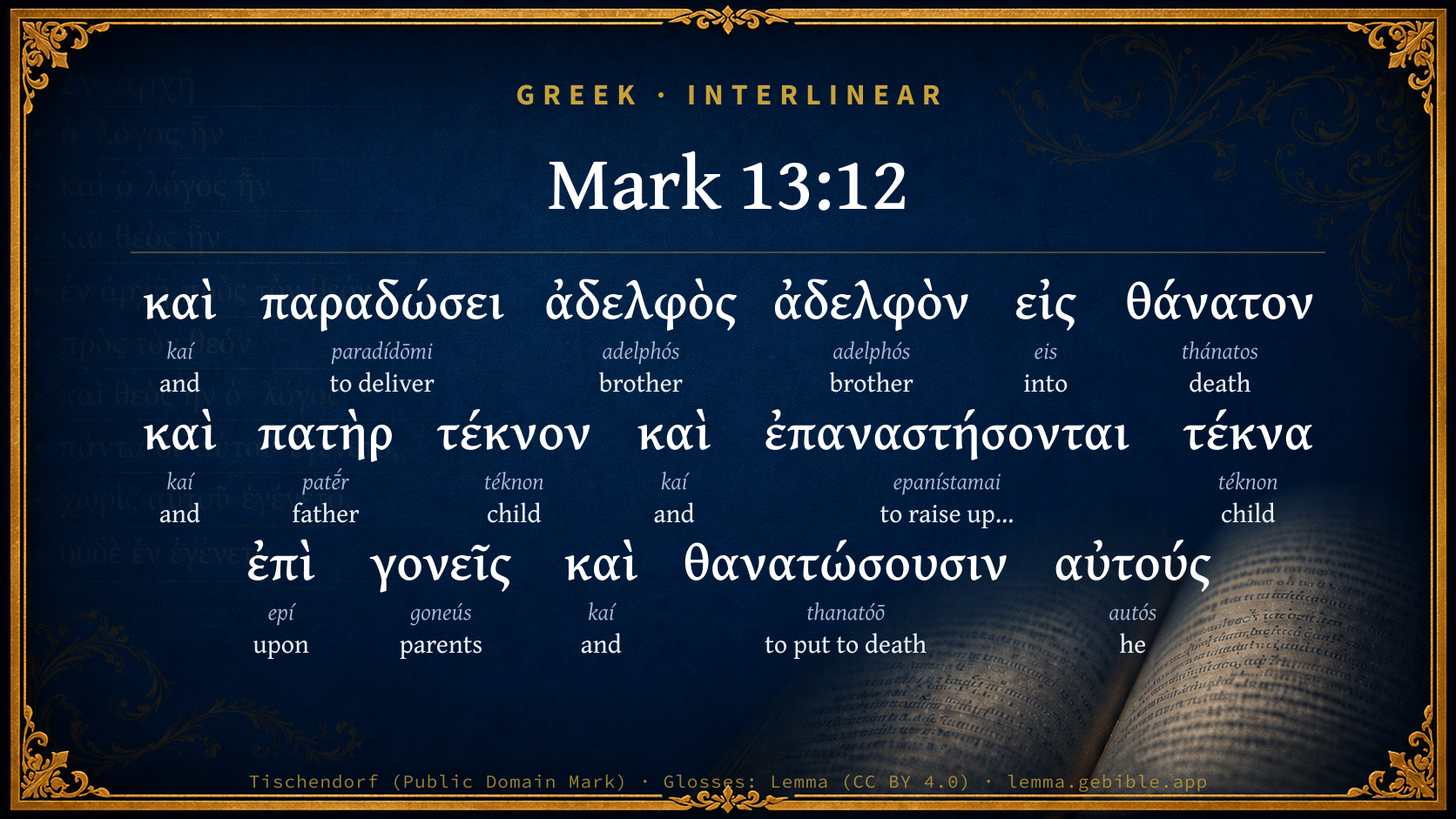
  1. καὶ kaí G2532 “and” Conjunction
  2. παραδώσει paradídōmi G3860 “to deliver” Verb, Future, Active, Indicative, 3rd person, Singular
  3. ἀδελφὸς adelphós G80 “brother” Noun, Nominative, Singular, Masculine
  4. ἀδελφὸν adelphós G80 “brother” Noun, Accusative, Singular, Masculine
  5. εἰς eis G1519 “into” Preposition
  6. θάνατον thánatos G2288 “death” Noun, Accusative, Singular, Masculine
  7. καὶ kaí G2532 “and” Conjunction
  8. πατὴρ patḗr G3962 “father” Noun, Nominative, Singular, Masculine
  9. τέκνον téknon G5043 “child” Noun, Accusative, Singular, Neuter
  10. καὶ kaí G2532 “and” Conjunction
  11. τέκνα téknon G5043 “child” Noun, Nominative, Plural, Neuter
  12. ἐπὶ epí G1909 “upon” Preposition
  13. γονεῖς goneús G1118 “parents” Noun, Accusative, Plural, Masculine
  14. καὶ kaí G2532 “and” Conjunction
  15. θανατώσουσιν thanatóō G2289 “to put to death” Verb, Future, Active, Indicative, 3rd person, Plural
  16. αὐτούς autós G846 “he” Personal pronoun, Accusative, Plural, Masculine

About this verse

These counts appear in no published source. They are computed here, from the morphology-tagged text and Lemma’s own curated glosses. What Lemma adds →

17
words
12
distinct lemmas
Gospels
section

Notable vocabulary

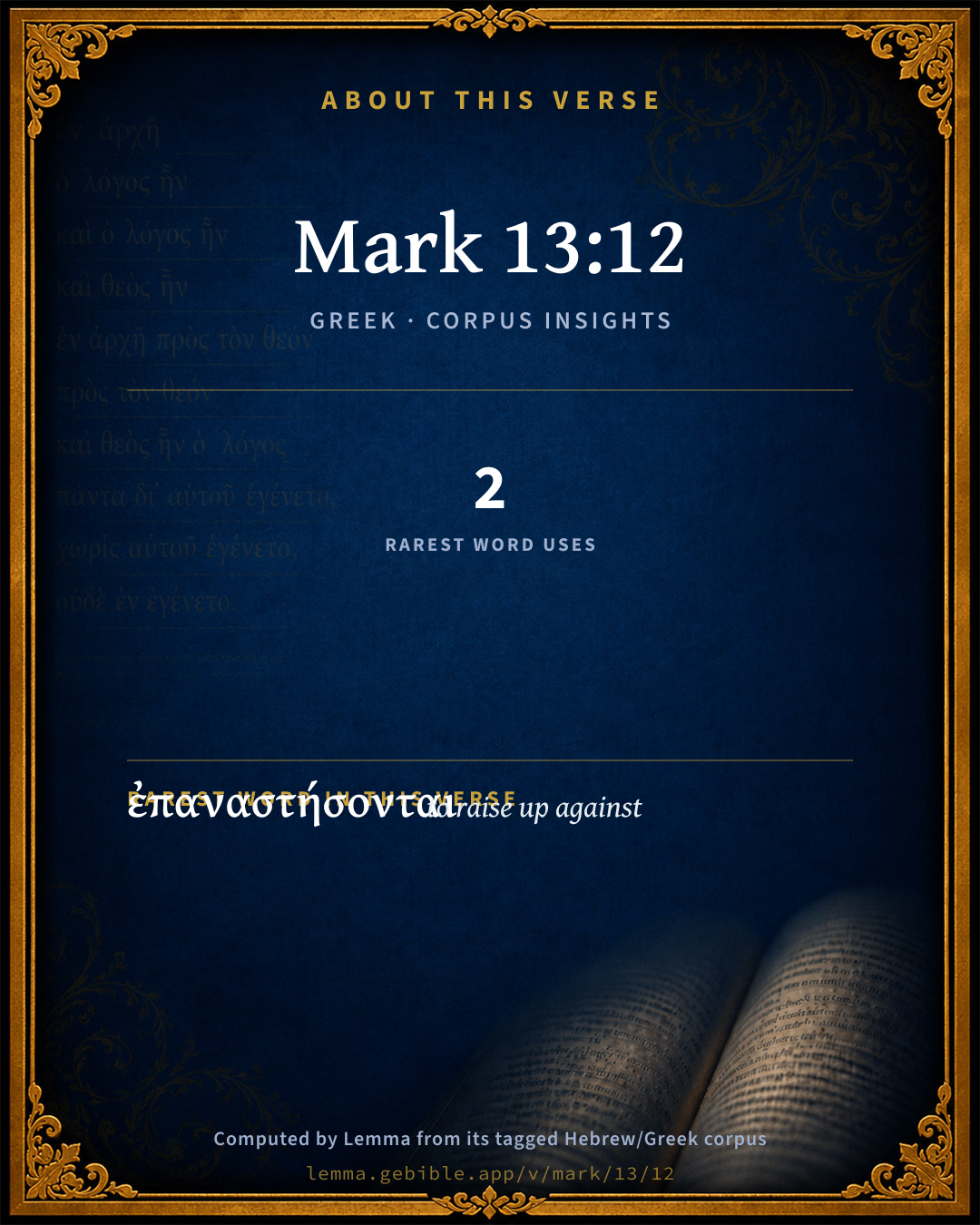
The rarest word here is ἐπαναστήσονται to raise up against G1881 — appearing just 2 times in the whole Greek New Testament.

Shared distinctive vocabulary

ἐπαναστήσονται to raise up against G1881 occurs in 2 verses of the Greek New Testament. Also found in:

Repetition

Words recur within this verse:

  • ἀδελφὸς brother G80 ×2
  • τέκνον child G5043 ×2
  • καὶ and G2532 ×4

Cross-references

6

Topical passages linked to Mark 13:12 in the Treasury of Scripture Knowledge — connected by theme and wording, ordered by reader-vote popularity; previews shown in the World English Bible.

  • Matthew 10:21 "Brother will deliver up brother to death, and the father his child. Children will rise up against parents, and cause them to be put to death.
  • Luke 12:52–53 For from now on, there will be five in one house divided, three against two, and two against three.
  • Ezekiel 38:21 I will call for a sword against him to all my mountains, says the Lord Yahweh: every man's sword shall be against his brother.
  • Micah 7:4–6 The best of them is like a brier. The most upright is worse than a thorn hedge. The day of your watchmen, Even your visitation, has come; Now is the time of their confusion.
  • Matthew 24:10 Then many will stumble, and will deliver up one another, and will hate one another.
  • Luke 21:16 You will be handed over even by parents, brothers, relatives, and friends. Some of you they will cause to be put to death.

Cross-references courtesy of OpenBible.info (CC BY 4.0).

Commentary

Notes on Mark 13:12 from classic Christian and Jewish commentators (each source and its license shown beneath its notes). The classic Christian expositions comment on the surrounding passage and are grouped to its opening verse, so a note may address several verses; the Jewish commentaries on the Tanakh (Rashi and others) are per-verse, so they appear only where the commentator wrote on this verse.

Lemma curates 59 commentaries, every one of them public domain or Creative Commons licensed, each selected and text-cleaned for this edition rather than reprinted as found. About our sources →

The Biblical Illustrator

Joseph S. Exell

Mar_13:12

Now the brother shall betray the brother to death.

Christianity causing division

As Christianity gives birth to and cherishes the most perfect love, so it calls forth the most bitter hatred. It calls forth a love which is above nature, because it makes men love their enemies. Contrariwise it calls forth a hatred which is unnatural, for it made, and yet makes, men hate and betray, and, if they can, destroy their own flesh and blood. Thus we read that the Emperor Domitian, in his hatred of the Christian name, slew Flavius Clemens and his niece, or near relation Flavia Domitilla; the Emperor Maximin martyred Artemis, his own sister; and Diocletian slew his own wife, and other relatives. St. Barbara also was killed by her own father; and if we had a full martyrology of obscure Christians, we should find multitudes of others similarly betrayed by their own flesh and blood. We are told by Indian missionaries, that as soon as converts are baptized, they become objects of hatred to their nearest relatives; even their wives often desert them. Now, if this be so in a country where Christianity is the religion of the rulers, what would it be if heathenism were unchecked in its power of persecution? (M. F. Sadler, M. A.)

The Biblical Illustrator, edited by Joseph S. Exell (c. 1880s–1900s) — public domain. Text from a community e-Sword module.

Joseph Benson's Commentary

Mar 13:12-13. The brother shall betray the brother to death — The unbelieving Jews and heathen shall discover, betray, and deliver to be imprisoned, tortured, and put to death, their believing relatives, even their brethren, fathers, or children. With respect to the Jews in particular, their known zeal and cruelty render it abundantly credible that, in the persecution of the Christians, the bigots to the law of Moses, overlooking the ties of nature, would be instrumental in putting their own relations to death, who followed the standard of Christ. And ye shall be hated of all men for my name’s sake — That the disciples of Christ were hated of all men in the first ages of Christianity, is well known. Their opposition to idolatry was the cause of the ill-will which the heathen bore toward them; their preaching that the law of Moses was abrogated, enraged the Jews: and in this temper both Jews and heathen continued during the first three centuries, till Constantine, declaring himself a Christian, put an end to the cruelties that had been so long exercised upon the disciples of Christ. “That not only the apostles,” says Dr. Doddridge, “but all the primitive Christians, were in general more hated and persecuted than any other religious sect of men, is most notorious to all who are at all acquainted with ecclesiastical history: a fact which might seem unaccountable, when we consider how inoffensive and benevolent their temper and conduct was, and how friendly an aspect their tenets had on the security of any government under which they lived. The true reason of this opposition was, that while the different pagan religions, like the confederated demons honoured by them, sociably agreed with each other, the gospel taught Christians, not only, like Jews, to bear their testimony to the falsehood of them all; but also with the most fervent zeal to urge the renunciation of them, as a point of absolute necessity, requiring all men, on the most tremendous penalties, to believe on Christ, and in all things to submit themselves to his authority: a demand which bore so hard, especially on the pride and licentiousness of their princes, and the secular interests of their priests, that it is no wonder they raised so violent a storm against it; which, considering the character and prejudices of the populace, it must be very easy to do.” But he that shall endure unto the end, the same shall be saved — He who is neither made to apostatize by the persecutions I have described, nor led astray by the seduction of unbelieving Jews or false Christians, shall escape out of the destruction that is about to fall on this land; and, persevering in faith and piety to the end of his life, shall be saved eternally.

Joseph Benson's Commentary on the Old and New Testaments (1811–1818) — public domain. Text from a community e-Sword module.

Tyndale Open Study Notes

Tyndale Open Resources

13:12-13 There would be no single group, not even their own families, to whom persecuted Christians could automatically flee or turn for help (see Matt 10:35-36; Luke 12:53). They would be universally hated because of their allegiance to Jesus (because you are my followers). Those who remain faithful to death (to the end) will be saved from eternal punishment (see also Mark 8:35; Rev 2:7, 10, 17, 26-28; 3:5, 12, 21).

Tyndale Open Study Notes — © Tyndale Open Resources, licensed CC BY-SA 4.0. Text via the HelloAO Bible API.

Ellicott's Commentary for English Readers

(12) Now the brother.—Literally, and the brother.

A Bible Commentary for English Readers, edited by Charles John Ellicott (1878–1897) — public domain. Text from a community e-Sword module.

John Gill's Exposition

And ye shall be hated of all men,.... Not only of your friends and relations of your countrymen the Jews; but of all men, the generality of men, in, all nations of the world, wherever they came:

for my name's sake; for the sake of Christ and his Gospel, they professed and preached:

but he that shall endure; reproaches, afflictions, and persecutions, patiently; or persevere in the faith of Christ, in the profession of his name, and in preaching his Gospel:

to the end; of such troubles, and of life:

the same shall be saved; if not with a temporal, yet with an everlasting salvation; See Gill on Mat 10:22, Mat 24:13.

John Gill's Exposition of the Whole Bible (1746–1763) — public domain (CC PDM 1.0). Text via the HelloAO Bible API.

Trapp's Complete Commentary

John Trapp

12 Now the brother shall betray the brother to death, and the father the son; and children shall rise up against their parents, and shall cause them to be put to death.

Ver. 12. See Mat 10:21.

John Trapp, A Commentary or Exposition upon All the Books of the Old and New Testament (1647–1656) — public domain. Text from a community e-Sword module.

Albert Barnes' Notes on the Bible

The brother shall betray ... - The brother shall give up in a treacherous manner his brother to be put to death, on account of his attachment to Jesus. Through fear, or from the hope of reward and from the hatred of the gospel, he will overcome all the natural ties of brotherhood. and give up his own kindred to be burnt or crucified. Perhaps nothing could more clearly show the dreadful evil of those times, as well as the natural opposition of the heart to the religion of Christ.

Albert Barnes' Notes on the Bible (1834–1885) — public domain. Text from a community e-Sword/MySword module.

Matthew Poole's English Annotations

This is but an amplification of the fifth sign, given us Mar 13:9, viz. a furious persecution, eminently made good in the Jewish persecution before the destruction of Jerusalem; in the pagan persecution, for three hundred years after Christ; and in the popish persecutions at this day.

See Poole on "Mat 24:9-10".

Matthew Poole's English Annotations on the Holy Bible (1683–1685) — public domain. Text from a community e-Sword/MySword module.

The Pulpit Commentary

Our Lord further warns his disciples that they would have to suffer persecution even from their own relations, their brethren, and their fathers, who, forgetful of natural affection, would persecute the faithful even unto death. It is related of Woodman, a martyr in Sussex, in Queen Mary"s time, that he was betrayed and taken by his father and his brother, and that he comforted himself with the thought that this very text of Scripture was verified in him. Bede says that our Lord predicted these evils, in order that his disciples, by a knowledge of them beforehand, might be the better able to bear them when they came.

The Pulpit Commentary (1880–1919), ed. H.D.M. Spence-Jones & Joseph S. Exell — public domain. Text from a community e-Sword module.

Kretzmann's Popular Commentary

Paul E. Kretzmann

Dissension within families:

v. 12. Now the brother shall betray the brother to death and the father the son; and children shall rise up against their parents, and shall cause them to be put to death.

v. 13. And ye shall be hated of all men for My name’s sake. But he that shall endure unto the end, the same shall be saved.

There is no hatred so unrelenting and implacable as that caused by enmity against Christ. It destroys the firmest friendships, it severs the ties of the closest blood-relationship. Brothers, fathers, children will not only stand by unmoved and see their nearest of kin suffer for the sake of their religious, Christian conviction, but they will become inhuman enough to cause these sufferings, to deliver them into the hands of the authorities and cause them to be put to death. History has scores of examples, from the time of the apostles down through the time of the Inquisition, to the present day. It is an ineradicable characteristic of the world and its children that they hate the truth of the Gospel, even at such times when they speak of toleration and of the value of the Christian spirit for the community. But mark two factors that make such persecutions not only endurable, but under circumstances welcome: They come upon the believers for the sake of the Lord’s name, and it is an honor to suffer for Him, on His account; they have a glorious promise: He that endures, patiently suffers, to the end, the same shall be saved. A reward of mercy will come upon him from the boundless treasure of his Lord, salvation will be given him with endless rejoicing in heaven.

Paul E. Kretzmann, Popular Commentary of the Bible (1921–1924) — public domain. Text from a community e-Sword module.

Cambridge Greek Testament for Schools and Colleges

12. καὶ παραδώσει ([2926][2927][2928][2929][2930]) rather than παρ. δέ ([2931][2932][2933][2934][2935][2936]).

[2926] Codex Sinaiticus. 4th cent. Discovered by Tischendorf in 1859 at the Monastery of St Katharine on Mount Sinai. Now at St Petersburg. The whole Gospel, ending at Mar 16:8. Photographic facsimile, 1911.

[2927] Codex Vaticanus. 4th cent., but perhaps a little later than א. In the Vatican Library almost since its foundation by Pope Nicolas V., and one of its greatest treasures. The whole Gospel, ending at Mar 16:8. Photographic facsimile, 1889.

[2928] Codex Bezae. 6th cent. Has a Latin translation (d) side by side with the Greek text, and the two do not quite always agree. Presented by Beza to the University Library of Cambridge in 1581. Remarkable for its frequent divergences from other texts. Contains Mark, except Mar 16:15-20, which has been added by a later hand. Photographic facsimile, 1899.

[2929] Codex Regius. 8th cent. An important witness. At Paris. Contains Mar 1:1 to Mar 10:15; Mar 10:30 to Mar 15:1; Mar 15:20 to Mar 16:20, but the shorter ending is inserted between Mar 16:8 and Mar 16:9, showing that the scribe preferred it to the longer one.

[2930] Codex Athous Laurae. 8th cent. Like N and Σ, it is written in silver letters on purple vellum. Contains Mar 9:5 to Mar 16:20, and, as in L, the shorter ending is inserted between Mar 16:8 and Mar 16:9. As in Δ, the text of Mark is specially good.

[2931] Codex Alexandrinus. 5th cent. Brought by Cyril Lucar, Patriarch of Constantinople, from Alexandria, and afterwards presented by him to King Charles I. in 1628. In the British Museum. The whole Gospel. Photographic facsimile, 1879.

[2932] Codex Bezae. 6th cent. Has a Latin translation (d) side by side with the Greek text, and the two do not quite always agree. Presented by Beza to the University Library of Cambridge in 1581. Remarkable for its frequent divergences from other texts. Contains Mark, except Mar 16:15-20, which has been added by a later hand. Photographic facsimile, 1899.

[2933] Codex Monacensis. 10th cent. Contains Mar 6:47 to Mar 16:20. Many verses in 14, 15, 16 are defective.

[2934] Codex Oxoniensis. 9th cent. Contains Mark, except Mar 3:35 to Mar 6:20.

[2935] Codex Sangallensis. 9th or 10th cent. Contains the Gospels nearly complete, with an interlinear Latin translation. The text of Mark is specially good, agreeing often with CL. At St Gall.

[2936] Codex Petropolitanus. 9th cent. Gospels almost complete. Mar 16:18-20 is in a later hand.

12. παραδώσει ἀδελφός. In Mar 13:9, παραδώσουσιν is impersonal. Here we are told who they are that will do this thing—“they of a man’s own household” (Mat 10:36); nec ullus est inter eos fidus affectus, quorum diversa fides est (Bede). This deadly division in families is predicted Mic 7:1-6; cf. Eze 22:7; Eze 38:21. It was regarded as a special feature in the Woes of the Messiah; 2Es 6:24; 2Es 13:30-32. Cf. Enoch c. 1; “Brothers will fall in death one with another, until it streams with their blood like a river.”

ἐπαναστήσονται. The verb implies rebellion against authority (Jdg 9:18; 2Sa 22:40; etc.). Note the plur. verbs, marking the numerous separate instances of such conduct.

θανατώσουσιν. All three have this verb, which in class. Grk is used of executions. In Enoch c. 2 it is the fathers who put the sons to death.

Cambridge Greek Testament for Schools and Colleges (Cambridge University Press, 1896; 21 vols, various authors incl. Carr, Maclear, Plummer, Farrar, Lumby, Moule, M. R. James, Simcox) — public domain. Text from a community e-Sword module.

Alford’s Greek Testament

Henry Alford

12.] = καὶ ἀλλήλους παραδώσουσιν καὶ μισήσουσιν ἀλλήλους Matt.

Henry Alford, The Greek Testament (1849–1861) — public domain. Text from a community e-Sword module.

International Critical Commentary

12. καὶ παραδώσει ἀδελφὸς ἀδελφὸν εἰς θάνατον—And brother will deliver up brother to death.

καὶ παραδώσει, instead of παραδώσει δὲ, א BDL mss. Lat. Vet. Egyptt.

They will be subject not only to governmental opposition, but to private persecution, and this will extend even to members of their own families, so bitter will be the hostility awakened against them.

International Critical Commentary — older volumes (1896–1929), various authors — public domain. Text from a community e-Sword module.

Lesson kit

Teaching starters — assembled from the data on this page, not authored interpretation. Every prompt links to the verse data it draws on. Edit before teaching.

Mark, in the Gospels, opens this verse with 17 words (12 distinct Greek lemmas). Its most distinctive word is epanístamai (“to raise up against”). A historical commentator’s framing appears above. Read the whole chapter for the surrounding context.

Discussion questions

  1. What does “to raise up against” (epanístamai) contribute to the verse as a whole?
  2. Matthew 10:21 shares the word «to raise up against» with this verse. How do the two illuminate each other?
  3. “brother” occurs 2× in this one verse. What is the effect of the repetition?
  4. These translations render this verse differently. What is at stake in choosing one wording over another?
  5. Reading how The Biblical Illustrator and Joseph Benson's Commentary read this verse, where do the two commentators agree and where do they part?

Things to notice

Reading settings

Reading text

Shown beneath each verse's original-language words.

Old Testament
Old Testament edition

Read the OT as the Masoretic Hebrew (MT) or the Greek Septuagint (LXX).

English shown for the Greek Septuagint (in the Hebrew ↔ Greek comparison).

Comparing translations? Open the Compare panel on any verse page to stack up to four side by side.