John 12:28

Greek (Tischendorf 8th ed.) John 12:28 appears in the Greek New Testament. The text above is from the Tischendorf 8th edition. Each word links to its Strong’s number and a concise gloss. Click any word for its full Thayer’s Greek Lexicon entry.
Download image
Cite this verse

John 12:28 (World English Bible). Public Domain. Lemma interlinear Bible study tool, https://lemma.gebible.app/v/john/12/28.

Show BibTeX & RIS
BibTeX
RIS
English Translation
Father, glorify your name!" Then there came a voice out of the sky, saying, "I have both glorified it, and will glorify it again."
World English Bible · Public Domain
Download a study sheet

One document with this verse’s original text, its word-by-word gloss line, the meaning frame, cross-references with their text, attributed commentary, and full source and license credits — printable, and it pastes into notes with its structure intact.

This verse Autodidact and up

Study sheet (.html) Plain text (.txt)

A passage Seminary Student

Up to 50 verses in one chapter. A passage sheet keeps up to 6 commentary sources and 12 cross-references per verse, in the order this page ranks them, and says so on the sheet whenever that leaves anything out. Ask for a single verse and you get the Autodidact verse sheet above.

Everything on this page stays free to read, with no account — the sheet is a download of what is already on screen, not access to it.

Want to remove ads? Support Godless Engineer
Compare translations 3

The same verse in 3 English versions, stacked beneath the original-language interlinear above. Click any original word for its lexicon entry.

Each is an independent rendering of the whole verse — the interlinear is not word-aligned to these translations.

Highlighted words mark where these versions differ — a whole-verse word diff, not a word-by-word alignment.

  • World English Bible Public Domain
    Father, glorify your name!" Then there came a voice out of the sky, saying, "I have both glorified it, and will glorify it again."
  • King James Version Public Domain
    Father, glorify thy name. Then came there a voice from heaven, saying, I have both glorified it, and will glorify it again.
  • unfoldingWord Literal Text CC BY-SA 4.0
    Father, glorify your name.” Then a voice came from heaven, “I have both glorified, and I will glorify again.”

unfoldingWord Literal Text — © unfoldingWord, licensed CC BY-SA 4.0. Word-aligned USFM3 via Door43 (git.door43.org/unfoldingWord/en_ult).

Versions to compare (up to 4)

3 of 4 selected

Show all 19 translations

Every available English version of this verse, each an independent rendering of the whole verse.

  • World English Bible Public Domain
    Father, glorify your name!" Then there came a voice out of the sky, saying, "I have both glorified it, and will glorify it again."
  • Berean Standard Bible Public Domain
    Father, glorify Your name!” Then a voice came from heaven: “I have glorified it, and I will glorify it again.”
  • Majority Standard Bible Public Domain
    Father, glorify Your name!” Then a voice came from heaven: “I have glorified it, and I will glorify it again.”
  • King James Version Public Domain
    Father, glorify thy name. Then came there a voice from heaven, saying, I have both glorified it, and will glorify it again.
  • American Standard Version (1901) Public Domain
    Father, glorify thy name. There came therefore a voice out of heaven, `saying', I have both glorified it, and will glorify it again.
  • Revised Version (1885) Public Domain
    Father, glorify thy name. There came therefore a voice out of heaven, saying, I have both glorified it, and will glorify it again.
  • Geneva Bible (1599) Public Domain
    Father, glorifie thy Name. Then came there a voyce from heauen, saying, I haue both glorified it, and will glorifie it againe.
  • Douay-Rheims (1899) Public Domain
    Father, glorify thy name. A voice therefore came from heaven: I have both glorified it, and will glorify it again.
  • Young's Literal Translation Public Domain
    Father, glorify Thy name.' There came, therefore, a voice out of the heaven, `I both glorified, and again I will glorify `it';'
  • Literal Standard Version CC BY-SA 4.0
    Father, glorify Your Name.” Therefore there came a voice out of Heaven, “I both glorified, and again I will glorify [it]”;
  • Unlocked Literal Bible CC BY-SA 4.0
    Father, glorify your name.” Then a voice came from heaven and said, “I have glorified it and I will glorify it again.”
  • unfoldingWord Literal Text CC BY-SA 4.0
    Father, glorify your name.” Then a voice came from heaven, “I have both glorified, and I will glorify again.”
  • Darby Bible Public Domain
    Father, glorify thy name. There came therefore a voice out of heaven, I both have glorified and will glorify [it] again.
  • World Messianic Bible Public Domain
    Father, glorify your name!” Then a voice came out of the sky, saying, “I have both glorified it and will glorify it again.”
  • Webster's Bible Public Domain
    Father, glorify thy name. Then came there a voice from heaven, saying, I have both glorified it, and will glorify it again.
  • Free Bible Version CC BY-SA 4.0
    Father, show the glory of your character.” A voice came from heaven, saying, “I have shown its glory, and I will show it again.”
  • Bible in Basic English Public Domain
    Father, give glory to your name. Then there came a voice out of heaven, saying, I have given it glory, and I will give it glory again.
  • Text-Critical English NT CC BY 4.0
    Father, glorify yoʋr name.” Then a voice came from heaven: “I have glorified it, and will glorify it again.”
  • Tyndale New Testament (1534) Public Domain
    Father glorify thy name. Then came ther a voyce from heaven: I have glorified it and will glorify it agayne.

Literal Standard Version (2020), Covenant Press — licensed CC BY-SA 4.0. Text via the HelloAO Bible API (eBible.org). Unlocked Literal Bible (unfoldingWord) — licensed CC BY-SA 4.0. Text via the HelloAO Bible API (eBible.org). unfoldingWord Literal Text — © unfoldingWord, licensed CC BY-SA 4.0. Word-aligned USFM3 via Door43 (git.door43.org/unfoldingWord/en_ult). Free Bible Version, Dr. Jonathan Gallagher — licensed CC BY-SA 4.0. Text via the HelloAO Bible API (eBible.org).

Word by word

More ways to search: Search by grammar → Find every occurrence → Compare this word →

Practice this passage: Drill this verse → Learn its vocabulary →

δόξασόν
doxázō
G1392
“to glorify”
Verb, Aorist, Active, Imperative, 2nd person, Singular
Part of Speech
Verb
Tense
Aorist
Voice
Active
Mood
Imperative
Person
2nd person
Number
Singular
Full Thayer's Definition

Origin: from G1391

TDNT: 06:13,2

1. to think, suppose, be of opinion 2. to praise, extol, magnify, celebrate 3. to honour, do honour to, hold in honour 4. to make glorious, adorn with lustre, clothe with splendour a. to impart glory to something, render it excellent b. to make renowned, render illustrious 1. to cause the dignity and worth of some person or thing to become manifest and acknowledged
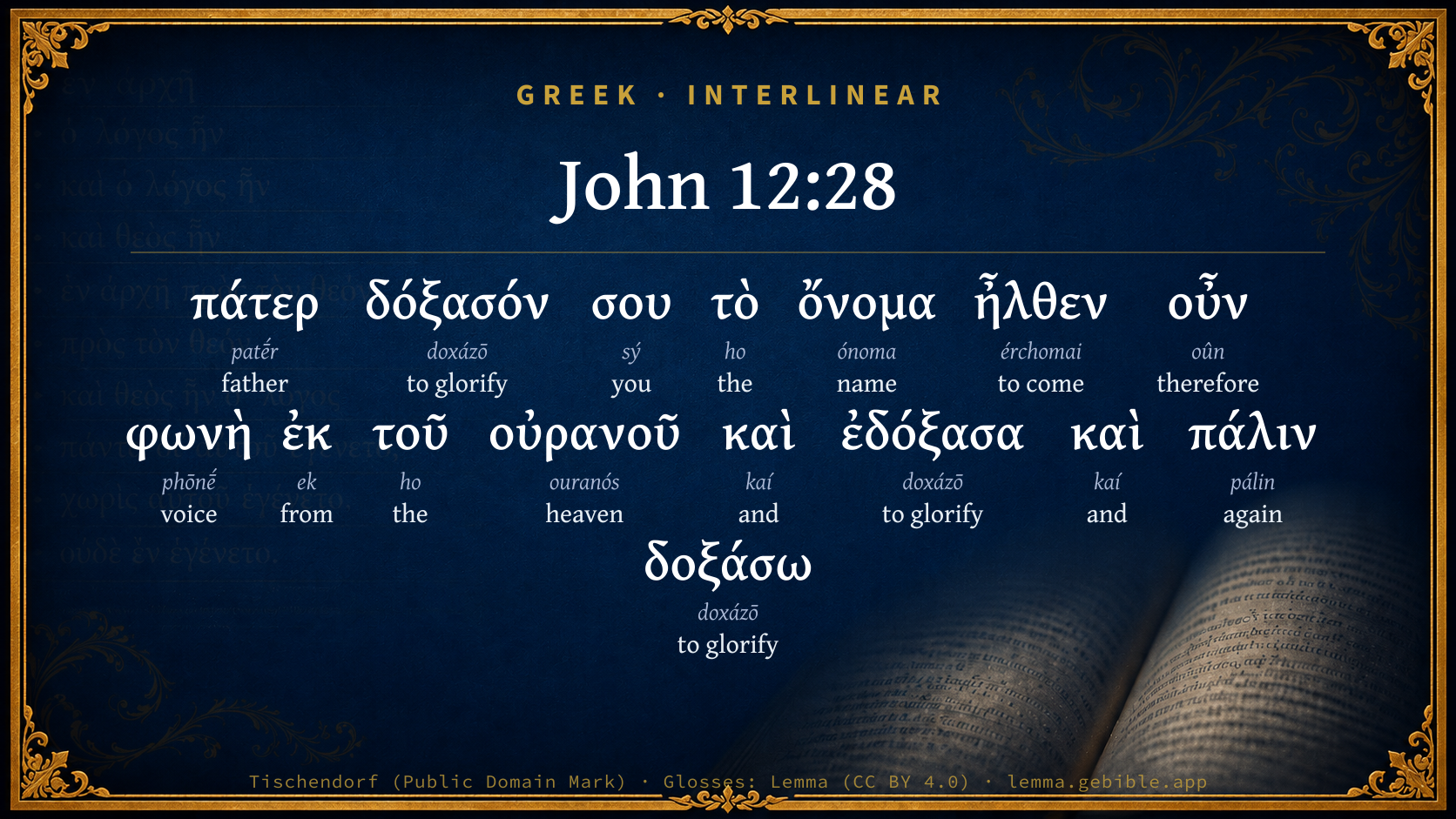
  1. πάτερ patḗr G3962 “father” Noun, Vocative, Singular, Masculine
  2. σου sý G4771 “you” Personal pronoun, 2nd person, Genitive, Singular
  3. τὸ ho G3588 “the” Article, Accusative, Singular, Neuter
  4. ὄνομα ónoma G3686 “name” Noun, Accusative, Singular, Neuter
  5. ἦλθεν érchomai G2064 “to come” Verb, Aorist, Active, Indicative, 3rd person, Singular
  6. οὖν oûn G3767 “therefore” Conjunction
  7. φωνὴ phōnḗ G5456 “voice” Noun, Nominative, Singular, Feminine
  8. ἐκ ek G1537 “from” Preposition
  9. τοῦ ho G3588 “the” Article, Genitive, Singular, Masculine
  10. οὐρανοῦ ouranós G3772 “heaven” Noun, Genitive, Singular, Masculine
  11. καὶ kaí G2532 “and” Conjunction
  12. ἐδόξασα doxázō G1392 “to glorify” Verb, Aorist, Active, Indicative, 1st person, Singular
  13. καὶ kaí G2532 “and” Conjunction
  14. πάλιν pálin G3825 “again” Adverb
  15. δοξάσω doxázō G1392 “to glorify” Verb, Future, Active, Indicative, 1st person, Singular

About this verse

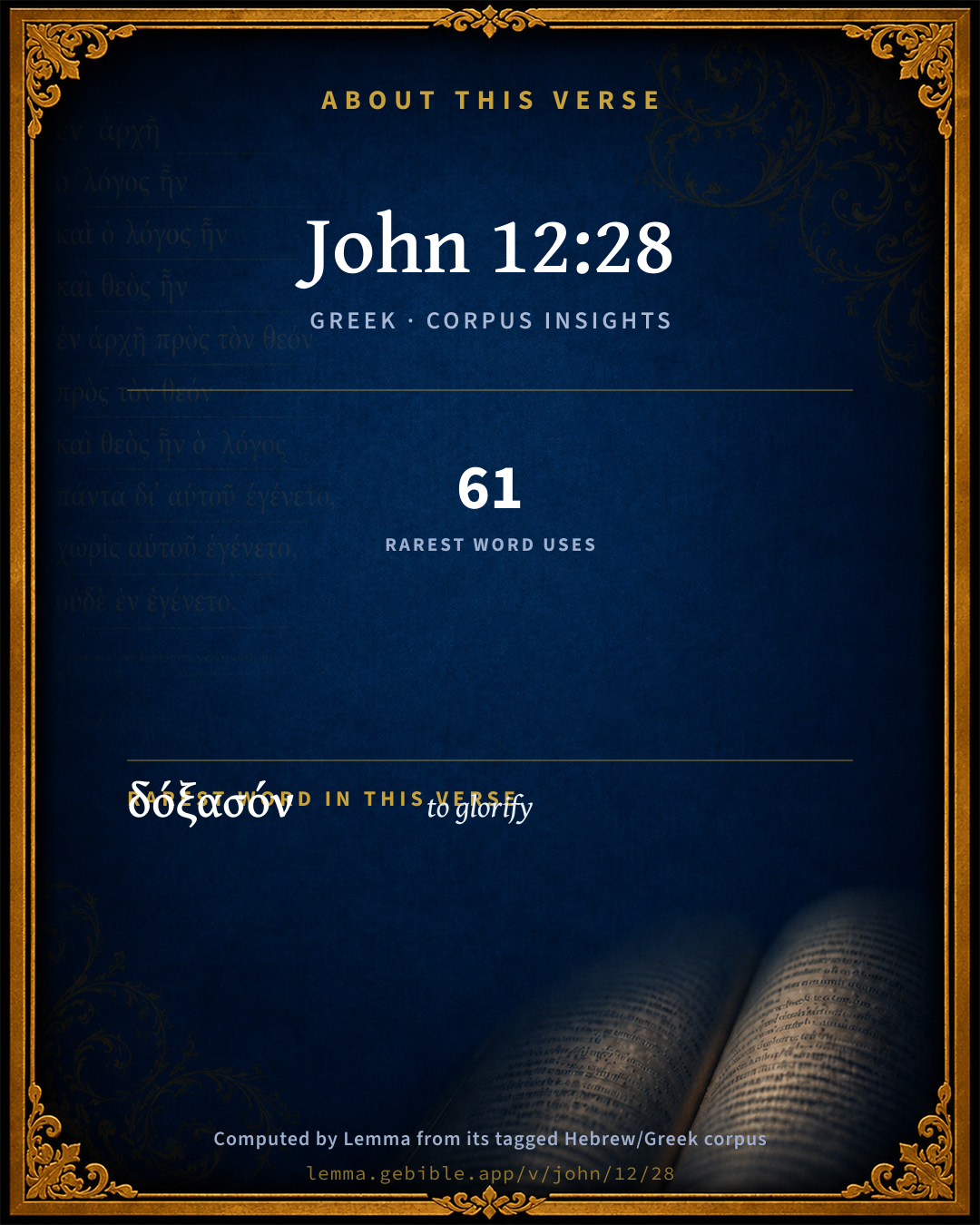
These counts appear in no published source. They are computed here, from the morphology-tagged text and Lemma’s own curated glosses. What Lemma adds →

16
words
12
distinct lemmas
Gospels
section

Repetition

Words recur within this verse:

  • δόξασόν to glorify G1392 ×3
  • τὸ the G3588 ×2
  • καὶ and G2532 ×2

Cross-references

20

Topical passages linked to John 12:28 in the Treasury of Scripture Knowledge — connected by theme and wording, ordered by reader-vote popularity; previews shown in the World English Bible.

  • John 13:31–32 When he had gone out, Jesus said, "Now the Son of Man has been glorified, and God has been glorified in him.
  • Matthew 26:42 Again, a second time he went away, and prayed, saying, "My Father, if this cup can't pass away from me unless I drink it, your desire be done."
  • John 11:40–44 Jesus said to her, "Didn't I tell you that if you believed, you would see God's glory?"
  • Revelation 5:9–14 They sang a new song, saying, "You are worthy to take the book, And to open its seals: For you were killed, And bought us for God with your blood, Out of every tribe, language, people, and nation,
  • Isaiah 49:3–7 and he said to me, You are my servant; Israel, in whom I will be glorified.
  • Matthew 3:17 Behold, a voice out of the heavens said, "This is my beloved Son, with whom I am well pleased."
  • Matthew 17:5 While he was still speaking, behold, a bright cloud overshadowed them. Behold, a voice came out of the cloud, saying, "This is my beloved Son, in whom I am well pleased. Listen to him."
  • Philippians 1:6–11 being confident of this very thing, that he who began a good work in you will complete it until the day of Jesus Christ.
  • Mark 1:11 A voice came out of the sky, "You are my beloved Son, in whom I am well pleased."
  • Mark 9:7 A cloud came, overshadowing them, and a voice came out of the cloud, "This is my beloved Son. Listen to him."
  • Mark 14:36 He said, "Abba, Father, all things are possible to you. Please remove this cup from me. However, not what I desire, but what you desire."
  • Luke 3:22 and the Holy Spirit descended in a bodily form as a dove on him; and a voice came out of the sky, saying "You are my beloved Son. In you I am well pleased."
  • Luke 9:35 A voice came out of the cloud, saying, "This is my beloved Son. Listen to him!"
  • John 9:3 Jesus answered, "Neither did this man sin, nor his parents; but, that the works of God might be revealed in him.
  • John 11:4 But when Jesus heard it, he said, "This sickness is not to death, but for the glory of God, that God's Son may be glorified by it."
  • John 18:11 Jesus therefore said to Peter, "Put the sword into its sheath. The cup which the Father has given me, shall I not surely drink it?"
  • Ephesians 2:7 that in the ages to come he might show the exceeding riches of his grace in kindness toward us in Christ Jesus;
  • Ephesians 3:10 to the intent that now through the assembly the manifold wisdom of God might be made known to the principalities and the powers in the heavenly places,
  • Ephesians 3:21 to him be the glory in the assembly and in Christ Jesus to all generations forever and ever. Amen.
  • 2 Peter 1:17 For he received from God the Father honor and glory, when the voice came to him from the Majestic Glory, "This is my beloved Son, in whom I am well pleased."

Cross-references courtesy of OpenBible.info (CC BY 4.0).

Commentary

Notes on John 12:28 from classic Christian and Jewish commentators (each source and its license shown beneath its notes). The classic Christian expositions comment on the surrounding passage and are grouped to its opening verse, so a note may address several verses; the Jewish commentaries on the Tanakh (Rashi and others) are per-verse, so they appear only where the commentator wrote on this verse.

Lemma curates 59 commentaries, every one of them public domain or Creative Commons licensed, each selected and text-cleaned for this edition rather than reprinted as found. About our sources →

The Biblical Illustrator

Joseph S. Exell

Joh_12:28-30

Father, glorify Thy name

The glorified name

1.

One important aspect of Christian life is the imitation of Christ. But this is not necessarily doing the same things that Christ did, but involves the discovery of the principles by which His life was ruled, and the imitation of ways of expressing character after we have gained Christs principles.

2. A mans ruling principle can best be discovered in his prayers, particularly in those which are forced on by sudden calamity or pressure. Then all the guards and formalities around a man are broken down, and the man reveals himself in his heart cry to God. The circumstances of the text present such an occasion, and that we may know what was our Lords ruling principle, let us study this revealing prayer.

I. THE PRAYER THAT EMBODIES THE PRINCIPLE OF THE NOBLE CHRISTLY LIFE. Observe

1. The apprehension of God that is in it. The character of our prayer depends on the name we are able to use for God. Our Lord could only employ the richest and dearest--Father. This apprehension includes some apprehension of the mystery of life and suffering, and a comforting recognition of the Divine purpose. His is a fatherhood of many sons whom He is training for glory.

2. The attitude of soul it indicates.

(1) Perfect trust in the goodness of all the Fathers arrangements and doings.

(2) Simple and unquestioning obedience.

(3) Intense love making complete self-sacrifice possible.

3. What is involved in the petition--living out to the end such a perfect sonship that men, throughout the ages, thinking of the life of Jesus, should fill the name of Father with highest, tenderest, and holiest meanings. To live for self is ignoble; to live for God in His character of Father, the noble life indeed.

II. THE DIVINE RESPONSE TO SUCH A PRAYER.

1. A side of tender comforting--I have glorified it; that has been the meaning of all your lifes toil and pain. This voice may be heard to cheer all true-hearted sons of God. Their life has not been lived in vain.

2. A sign of assurance for the future--I will, etc. Therefore our Lord may calmly go on to new scenes of toil and suffering. (R. Tuck, B. A.)

The glory of God interpreted in Christ

The true glory of God must be interpreted in Christ Jesus; and when you understand what it is that God makes to be His glory; when you understand that the glory of God is not self-laudation, nor enriching His own power, nor multiplying His own treasures, but that it is supremely to make others happy; when you understand that the glory of God means loving other people and not oneself, mercy and not selfishness, the distribution of His bounty and not the hoarding it up; when you understand that God sits with all the infinite stores of redemptive love only to shed them abroad upon men forever and forever, then you form a different conception of what it is for God to reign for His own glory. If love is His glory; if generosity is His glory; if giving is His glory; if thinking of the poor is His glory; if strengthening the weak is His glory; if standing as the defender of the wronged is His glory; if loving and watching over every being that He has created forever and forever is His glory, then, blessed be that teaching which represents that God does reign for His own glory. That is a glory which is worthy of the Divine regality. It will bring out blossoms of joy and gladness in heaven and on earth. (H. W. Beecher.)

The glory of God in Christ crucified

Here shine spotless justice, incomprehensible wisdom, and infinite love, all at once; none of them darkens or eclipses the other; every one of them gives a lustre to the rest; they mingle their beams, and shine with united, eternal, splendour. The just Judge, the merciful Father, the wise Governor--no other object gives such a display of all these perfections; yea, all the objects we know give not such a display as any one of them. Nowhere does justice appear so terribly awful, mercy so sweetly amiable, or wisdom so unfathomably profound. The glories that are found separately in the other works of God, are found united here. The joys of heaven glorify Gods goodness; the pains of hell glorify His justice; the cross of Christ glorifies both of them in a more remarkable way than heaven or hell glorifies any of them. The justice of God is more awfully displayed in the sufferings of Christ, as the substitute of sinners, than in the torments of devils; and His mercy is far more brightly manifested in these sufferings, than in the joys of angels. (J. McLaurin.)

The glory of God the object of grace

Whenever God has blessed the Church, He has secured Himself the glory of the blessing, though we have had the profit of it. Sometimes He has been pleased to redeem His people by might; but then He had so used the power that all the glory hath come to Him, and His head alone hath worn the crown. Did He smite Egypt, and lead forth His people with a strong hand and an outstretched arm? the glory was not to the rod of Moses, but to the Almighty power which made the rod so potent. Did He lead His people through the wilderness and defend them from their enemies? Still, did He, by teaching the people their dependence upon Him, preserve to Himself all the glory. So that not Moses or Aaron amongst the priests or prophets could share the honour with Him. And tell me, if ye will, of slaughtered Anak, and the destruction of the tribes of Canaan; tell me of Israels possessing the promised land; tell me of Philistines routed, and laid heaps on heaps; of Midianites made to fall on each other; tell me of kings and princes who fled apace and fell, until the ground was white, like the snow in Salmon. I will say of every one of these triumphs, Sing ye to the Lord, for He hath triumphed gloriously; and I will say at the end of every victory, Crown Him, crown Him, for He hath done it; and let His name be exalted and extolled, world without end. (C. H.Spurgeon.)

Human glory, what it comes to

A moment before he uttered his last sigh he called the herald who had carried his banner before him in all his battles, and commanded him to fasten to the top of a lance the shroud in which the dying prince was soon to be buried. Go, said he, carry the lance, unfurl this banner; and while you lift up this standard, proclaim, This, this is all that remains to Saladin the Great (the conqueror and the king of the empire) of all his glory. Christians, I perform today the office of this herald. I fasten to the staff of a spear sensual and intellectual pleasures, worldly riches, and human honours. All these I reduce to the piece of crape in which you will shortly be buried. This standard of death I lift up in your sight, and I cry, This, this is all that will remain to you of the possessions for which you exchanged your souls. (J. Saurin.)

Voices from the excellent glory

(Text and Mat_3:16-17; Mat_17:5)

I. THE THREE TESTIMONIES.

1. When the voices were heard

(1) In relation to Christs personal ministry.

(a) The first at the commencement of His public ministry.

(b) The second some little time after its central point.

(c) The last just before its close. How cheering at the beginning of a great enterprise to have Gods testimony that He has sent you; how encouraging when the labour is heavy and the spirit faint to receive another affirming word; but best of all to have it when we are about to depart.

(2) In relation to His life and enterprise.

(a) The first celestial witness was given after He had lived for thirty years in obscurity. It was meet when He first appeared that there should be some token that He was what He professed to be. It came also before the temptation, for which there could not be a better forearming. So with us: before temptation, spiritual sustenance.

(b) The second was when our Lord (according to Luke) was about to send out other seventy disciples. Before extending His agencies of mercy He received a token for good. When the Lord calls us to wider service; let us go up into the mountain to pray, and there too we may expect to enjoy the comforting and strengthening witness of the Spirit.

(c) The third came just before His sufferings and death. It was meet that the Sufferer who must tread the winepress alone should receive a word meeting the point about which His soul was most concerned, viz., Gods glory.

(3) In relation to His habits.

(a) The first came when He was in the attitude of obedience--fulfilling all righteousness. When you are in the path of filial obedience you may expect the Spirit to bear witness with yours that you are born of God.

(b) The second came when He was in devout retirement. He had gone up into the mountain alone, and when you are there you may expect to receive Divine testimonies.

(c) The third came when about Isis work, preaching in the Temple. If you are called to any form of service, under no pretext neglect it, or you may lose the inward witness.

2. To whom the attestations were given.

(1) To an increasing number of persons. The first to John alone; the second to five; the last to many. Gods testimony to Christ is an ever growing one.

(2) It was given in this wise.

(a) The first to the greatest of men, yet the voice revealed a greater than he.

(b) The second to the best of men, but the voice bear witness to a better.

(c) The third in the holiest place, and there it testified to a holier. Jesus is everywhere magnified beyond all others.

3. To what God bore testimony.

(1) The first was to Christs miraculous origin: This is My beloved Son.

(2) The second sealed His appointment as the Great Prophet--Hear Him.

(3) The third bore witness to the success of His work--I have glorified it, etc. Some have thought that the three voices attested our Lord in His threefold office.

(a) John came proclaiming the kingdom, and Jesus was in His baptism proclaimed the chief of the new kingdom.

(b) On the second occasion, Hear Him, ordained Him the Prophet of the people.

(c) In the third He was owned as Priest. Is this threefold witness received in your hearts the testimony of God, who cannot lie. Behold Christ well pleasing to the Father; let Him be well pleasing to you. Hear Him proclaimed as Gods beloved; let Him be the beloved of your hearts. Hear the testimony that He has glorified God, and remember that His further glorifying God depends in some measure on you.

4. How were these testimonies given?

(1) On the first occasion the heavens were opened and the Spirit descended. What if this proclaims to us that by His obedience our Lord procured the opening of heaven for us that our prayers might go up and our blessings come down!

(2) Heaven was not beheld as opened the second time--the overshadowing cloud represented the Mediatorship of Christ veiling the excessive brightness of the Godhead.

(3) In the third our mind rests neither upon the opening of heaven nor on the cloud, but on the voice. The opening of heaven and the interposition of a Mediator are but means to the great end of glorifying God. Let this one great object absorb all our souls.

5. What was it that was spoken?

(1) The first time the heavenly voice preached the gospel, This is My beloved Son, etc. The gospel is tidings concerning a blessed person, and His acceptableness as the chosen of God, and of the Divine pleasure with those who are in Him.

(2) The second time the voice uttered the great command, Hear Him. Salvation does not come by seeing, as Romanists have it. Faith cometh by hearing, and not the doctrines of men, even such as Moses and Elias, but Him.

(3) On the third occasion testimony was given to the gospels result. It is through the gospel that God is glorified.

II. INSTRUCTIVE CIRCUMSTANCES CONNECTED WITH THESE TESTIMONIES.

1. On each occasion Jesus was in prayer. Learn that if any would have God speak comfortably to him, he must speak to God in prayer.

2. Each time His sufferings were prominently before Him. John, at the waters of Jordan, said, Behold the Lamb, etc. On Tabor Moses and Elias spoke of His decease. In the Temple His soul was troubled at the prospect of His death. Learn, then, if you desire to see the glory of Christ, as attested of the Father, you must dwell much on His death.

3. Each time He was honouring the Father. In His baptism by obedience, on the mountain by devotion, in the Temple His very words were, Glorify Thy name. If you would see Gods glory and hear His voice you must honour Him. Conclusion: Receive these testimonies.

1. With assured conviction.

2. With profound reverence.

3. With unconditional obedience.

4. With joyful confidence. (C. H. Spurgeon.)

The best prayer ever offered

I. ITS OBJECT.

1. It is unselfish. Personal apprehension is swallowed up in the craving for Divine glory. Compare this with Mat_6:9. Prayer is often too selfish.

2. It seeks the revealing of Gods glory. God is changeless and cannot grow more glorious in Himself. But His name is glorified when the beauty of His character is revealed. The mountains are not changed when the mists lift; but they are glorified in being unveiled.

3. The particular form is the glory of the Fatherhood of God. His creative glory of wisdom and might had been revealed in nature; His regal glory of justice and government in providence; His highest glory of goodness awaited its full manifestation when His Fatherhood would be seen in personal self-sacrificing love to His children.

II. ITS MOTIVES.

1. The name of God as our Father deserves to be glorified.

2. Christ found His own greatest encouragement in the vision of the glory of God. So did Moses (Exo_33:18-19). We are most strengthened when we forget self in God.

3. Christs work is accomplished when the name of God as our Father is glorified. This name had been dishonoured till Christ raised it to honour among His disciples. The Christian is glorified only as he reflects the glory of God, and this can only be as God is first revealed to him (2Co_3:18).

III. ITS ANSWER.

1. Gods Fatherhood had been revealed

(1) In creation, providence, and Old Testament revelation, but dimly and partially.

(2) In the incarnation, life, character, words, and works of Christ, but still not perfectly.

2. It was destined to be revealed more fully.

(1) In the passion of Christ, by the love of God shown in sustaining His Son, by His holiness and goodness in the suffering Saviour, and by the great act of redemption then accomplished.

(2) In the resurrection, and the proof this gave of Gods redeeming goodness.

(3) In the fruits of the redemption seen in the history of the Church.

(4) Through the inspiration of the Holy Spirit in helping the Church to read aright the mystery of the Cross, which, after Pentecost, became the central theme of the Churchs praises. (W. F. Adeney, M. A.)

The changed prayer

A man once complained to his minister that he had prayed for a whole year that he might enjoy the comforts of religion, but found no answer to his prayers. The minister replied, Go home now, and pray, Father, glorify Thy name.

The truest and deepest view of life

I. A MAN TAKING THE TRUEST AND DEEPEST VIEW OF LIFE. A sentence is often a revelation. This is unique, suggestive. If we were to put our deepest desires into words would they be this? The worldly mans life is limited to the self sphere; the very point of this is that Christ had no self sphere. The former is the shallow, the latter the ennobling view. Observe our Lords

1. Cherished life thought. This inspiring thought for Christ and us starts the question, Will not a cherished sense of our independence do more for us than the sense of dependence, and so of responsibility? Let Christs life be the answer. The independent view--I am my own--may be fascinating; but it is untrue and deteriorating, and sooner or later is found to be such. What is the condition of the parasite when the tree on which it feeds is dead? or that of the ivy cut below and made independent of its secret rootings? What good is an independent vine branch?

2. Ruling life-force--obedience inspired by affection for His Father. Here we see how all the seeming hardness of dependence is lost in the atmosphere of love. The wife never finds it hard to obey when she loves.

Mere obedience is, for man, very hard; but obedience out of love is the highest joy; and this deep joy we find in Christ.

3. Prevailing life-attitude--the activity of submission; for true submission is not mere bearing, but bearing in doing. This is fully illustrated in the life of Christ.

II. GODS RESPONSE TO THE MAN WHO TAKES THIS VIEW OF LIFE.

1. That the deepest wish of His heart has been already realized and He may read His past in the light of it. All depends on the light in which we read our past. Read Christs in the light thrown by this response and see how it had been a glorifying of the Father-name of God in

(1) His own Sonship.

(2) His teachings about the Father.

(3) His brotherhood with men.

2. That the deepest wish of his heart shall yet be realized, and he may go calmly on into darkness with the assurance that even his Cross shall glorify the Father. Death shall do even more than life. The forsaking was a final triumph of obedience. The will of God was so beautiful that He could even suffer and die for it. Conclusion: We say, God is our Father. Do we say, Father, glorify Thy name. Is this our inspiring life secret? In life labour, relationships, sufferings, bereavements, death, do I honour myself or my Father? (R. Tuck, B. A.)

The people … said that it thundered.--The whole multitude heard a noise; but the meaning of the voice was only perceived by each in proportion to his spiritual intelligence. Thus the wild beast perceives only a sound in the human voice; the trained animal discovers a meaning, a command, e.g., which it immediately obeys; man alone discerns a thought. (F. Godet, D. D.)

The voice from heaven

I. THE VOICE.

1. Grossly misunderstood by the bystanders

(1) As a natural phenomenon, as thunder.

(2) As a supernatural utterance, the speech of an angel--a significant proof of mans incapacity to understand the words of God (1Co_2:14).

2. Lovingly by Jesus; as an old and familiar voice, the voice of His Father, which twice previously had addressed Him out of heaven. It needs a childs heart to recognize a fathers voice.

3. Rightly interpreted again by Jesus--perhaps also by John and his co-apostles--to whom it spoke in the language of

(1) Approbation, I have glorified it.

(2) Consolation, Will glorify it again.

II. THE PURPOSE OF THE VOICE.

1. Not for His sake; since He knew His Father always heard Him (chap. 11:42).

2. But for theirs--to assure them that He was the Fathers Son, the heaven-sent Messiah.

Learn

1. The superiority of faith to unbelief in the understanding of Divine revelations.

2. The condescension of Christ in considering mans weakness and infirmity. (T. Whitelaw, D. D.)

The Biblical Illustrator, edited by Joseph S. Exell (c. 1880s–1900s) — public domain. Text from a community e-Sword module.

Joseph Benson's Commentary

Joh 12:28-30. Father, glorify thy name — Whatever I suffer. For this may be considered as a further expression of his resignation, importing that he was willing to submit to whatever the Father should judge necessary for the manifestation of his perfections: as if he had said, Dispose of me and all my concerns in such a way as may most effectually promote thy glory. The answer, however, that was now given to this part of Christ’s prayer, rather suggests another meaning, namely, that he entreated God to demonstrate, perhaps by an immediate interposition, the truth of his mission, a full proof thereof being altogether necessary for vindicating the honour of God. Accordingly, the words were no sooner spoken, than a voice from heaven was heard, answering distinctly to this sense of them: saying, I have glorified it, and will glorify it again — I have glorified it by the miracles which thou hast already performed, and will continue to glorify it by other miracles yet to be performed. Accordingly, by the miraculous circumstances which accompanied our Lord’s crucifixion, but especially by his resurrection from the dead, by his ascension into heaven, and by the effusion of the Holy Ghost upon his apostles, the truth of Christ’s mission was demonstrated, and the glory of God greatly advanced. The people, therefore, that stood by, and heard it — That is, heard a sound, but not the distinct words; said it thundered — The voice being probably strong and loud as thunder, and evidently preternatural. Others said, An angel spake to him — By this it appears, that it was an articulate voice: none of them, however, took it for a human voice, it being entirely different from any thing they had ever heard. Jesus answered, This voice came not because of me — Nor did I pray for it on my own account; but for your sakes — Not to assure me of the love of my Father, but to confirm you in the belief of my mission, that you may not be offended at the treatment I shall meet with, or quit your hope in me on account of the sufferings which are coming upon me.

Joseph Benson's Commentary on the Old and New Testaments (1811–1818) — public domain. Text from a community e-Sword module.

Tyndale Open Study Notes

Tyndale Open Resources

12:28 a voice spoke from heaven: Cp. Matt 3:17; 17:5; Mark 1:11; 9:7; Luke 3:22; 9:35. • God had already brought glory to himself when Christ entered the world (John 1:14) and through Jesus’ work, which showed God’s power to the world. • I will do so again: The final display of glory would come at the cross (see 12:23; 17:1). In John, the cross is an event of glory as Christ was “lifted up” (12:32) and glorified there. Jesus was prepared for crucifixion like a king coming to his coronation; the cross was like a throne (see 19:19-22), and he was buried like royalty. Jesus’ time of glorification included the entire sequence from arrest through resurrection.

Tyndale Open Study Notes — © Tyndale Open Resources, licensed CC BY-SA 4.0. Text via the HelloAO Bible API.

Bengel's Gnomon

Johann Albrecht Bengel

Joh 12:28. Πάτερ, Father) This appellation, lovingly repeated, agrees with the change in the subject of address to Him.—δόξασον) glorify, at any cost whatever to Me. The Father presently after accepts this petition; δοξάσω, I will glorify it. Already the ταραχή, troubling, Joh 12:27, is past.—σοῦ τὸ ὄνομα) Thy name of Father, which is in Me, as being Thy only-begotten Son: Exo 23:21, “My name is in Him:” with which comp. Mat 3:17. [At His baptism] “This is My beloved Son, in whom I am well pleased,” Joh 17:5, [At the transfiguration, the same testimony of the Father]. Therefore the voice from heaven thrice proclaimed the Son of God.—καὶ ἐδόξασα, I both have glorified) My name. See ch. Joh 17:5.—πάλιν δοξάσω, I will again glorify it) See the same passage, ch. Joh 17:5; Joh 17:1. By the verb, I have glorified, the entrance of Christ upon that hour is accepted [as also His entrance into the world, His sojourn in it being simultaneously implied.—V. g.]; by the verb, I will glorify, there is promised the glorification of the Father’s name through the glorification of Christ owing to His passion [suffering]. To the twofold speech of Jesus the twofold reply of the Father corresponds.

Bengel's Gnomon of the New Testament — English translation (T&T Clark, Edinburgh, 1860) — public domain. Text from a community e-Sword module.

Expositor's Greek Testament

ed. W. Robertson Nicoll

Joh 12:28 . Therefore He prays: Πάτερ δόξασόν σου τὸ ὄνομα . “Father, glorify Thy name.” Complete that manifestation of Thy holiness and love which through me Thou art making; complete it even at the cost of my agony. Ἦλθεν οὖν φωνὴ … δοξάσω . “There came, therefore, a voice out of heaven: I have both glorified it and will again glorify it.” However Jesus might seem in the coming days to be tossed on the sea of human passions, the Father was steadily guiding all to the highest end. The assurance that His death would glorify God was, of course, that which nerved Jesus for its endurance. He was not throwing His life away.

The Expositor's Greek Testament, edited by W. Robertson Nicoll (1897–1910) — public domain. Text from a community e-Sword module.

Geneva Bible (1599)

Geneva Bible translators

So then the Father’s glory is Christ’s glory.

Geneva Bible (1599) marginal notes — public domain. Text via Bolls.life.

Jamieson, Fausset & Brown

Robert Jamieson, A. R. Fausset & David Brown

Father, glorify thy name--by a present testimony.

I have both glorified it--referring specially to the voice from heaven at His baptism, and again at His transfiguration.

and will glorify it again--that is, in the yet future scenes of His still deeper necessity; although this promise was a present and sublime testimony, which would irradiate the clouded spirit of the Son of man.

Jamieson, Fausset & Brown — Commentary Critical and Explanatory on the Whole Bible (1871) — public domain (CC PDM 1.0). Text via the HelloAO Bible API.

Adam Clarke's Commentary

Verse 28. Father, glorify thy name.] By the name of God is to be understood himself, in all his attributes: his wisdom, truth, mercy, justice, holiness, c., which were all more abundantly glorified by Christ's death and resurrection, (i.e. shown forth in their own excellence,) than they had ever been before. Christ teaches here a lesson of submission to the Divine will. Do with me what thou wilt, so that glory may redound to thy name. Some MSS. read, Father, glorify my name: others, glorify thy Son.

Then came there a voice from heaven, c.] The following is a literal translation of Calmet's note on this passage, which he has taken from Chrysostom, Theodoret, Theophylact, and others: "I have accomplished my eternal designs on thee. I have sent thee into the world to make an atonement for the sin of the world, and to satisfy my offended justice. I will finish my work. Thou shalt shed thy blood upon the cross. My glory is interested in the consummation of thy sacrifice. But, in procuring my own glory, I shall procure thine. Thy life and thy death glorify me: I have glorified thee by the miracles which have accompanied thy mission and I will continue to glorify thee at thy death, by unexampled prodigies, and thy resurrection shall be the completion of thy glory and of thy elevation."

Christ was glorified:

1st. By the prodigies which happened at his death.

2. In his resurrection.

3. In his ascension, and sitting at the right hand of God.

4. In the descent of the Holy Ghost on the apostles. and

5. In the astonishing success with which the Gospel was accompanied, and by which the kingdom of Christ has been established in the world. 2Co 2:14.

Adam Clarke's Commentary on the Bible (1810–1826) — public domain. Text from a community e-Sword/MySword module.

John Calvin's Commentaries

28. Father, glorify thy name. By these words he testifies, that he prefers the glory of the Father to all things else, and even neglects and disregards his own life. And the true regulation of all our desires is, to seek the glory of God in such a manner that all other things shall give way to it; for it ought to be reckoned by us an abundant recompense, leading us to endure patiently all that is vexatious or irksome.

I have both glorified it. It is as if he had said, I will finish what I have begun; for God never leaveth the work of his hands imperfect as it is said, Psalm 138:8. But as it is the purpose of God to prevent the offense of the cross, he not only promises that the death of Christ will be glorious, but also mentions with commendation the numerous ornaments with which he had already adorned it.

John Calvin's Commentaries (1540-1563) — public domain. Text from the Calvin Translation Society English edition (1840s-50s) via the Christian Classics Ethereal Library (ccel.org). Calvin's coverage is partial (roughly two-thirds of the Bible); uncommented books and verses are honest gaps, never fabricated. The 19th-century editor's footnotes and remarks are omitted so the notes are faithfully Calvin's own voice.

Ellicott's Commentary for English Readers

(28) Father, glorify thy name.—The pronoun “Thy” is emphatic. The Son’s will is one with that of the Father; the Son’s glory is in the glorifying the Father’s name. Comp. the opening clause of the Lord’s Prayer (Note on Mat_6:9 et seq.) and in this context Note on Joh_12:23.

Then came there a voice from heaven.—The words mean, not that a sound came from heaven, but that there was heard an articulate voice (comp. Note on Joh_3:8); and that St. John intended his readers to understand this cannot be questioned. He records here a fact parallel to those recorded by the other Evangelists at the Baptism (Mat_3:17; Mar_1:11; Luk_4:22), and at the Transfiguration (Mat_17:5; Mar_9:7; Luk_9:35), and parallel to that to which St. Luke and St. Paul have testified (Act_9:4; Act_22:9; Act_26:14).

I have both glorified it, and will glorify it again.—The words are without limit, extending to the whole past and to the whole future of God’s revelation of Himself to man. The only limit in the context is that this revelation is thought of as in the person of Christ. His words, His works. His life revealing the mercy and love and majesty of the Father, had to many hearts glorified the Father’s name. The wider future is at hand. The death and resurrection are to reveal God’s character, and therefore glorify the Father’s name to all the world. (Comp. Exo_33:18-19; Exo_34:5-7.)

A Bible Commentary for English Readers, edited by Charles John Ellicott (1878–1897) — public domain. Text from a community e-Sword module.

The Cambridge Bible for Schools and Colleges

gen. ed. J. J. S. Perowne

28. Then came there] Better, There came therefore, i.e. in answer to Christ’s prayer. There can be no doubt what S. John wishes us to understand;—that a voice was heard speaking articulate words, that some could distinguish the words, others could not, while some mistook the sounds for thunder. To make the thunder the reality, and the voice and the words mere imagination, is to substitute an arbitrary explanation for the Evangelist’s plain meaning. For similar voices comp. that heard by Elijah (1Ki_19:12-13); by Nebuchadnezzar (Dan_4:31); at Christ’s Baptism (Mar_1:11) and Transfiguration (Mar_9:7); and at S. Paul’s Conversion (Act_9:4; Act_9:7; Act_22:9), where it would seem that S. Paul alone could distinguish the words, while his companions merely heard a sound (see on Act_9:4). One of the conditions on which power to distinguish what is said depends is sympathy with the speaker.

have glorified it] in all God’s works from the Creation onwards, especially in the life of Christ.

will glorify it] in the death of Christ and its results.

The Cambridge Bible for Schools and Colleges (gen. ed. J. J. S. Perowne; Cambridge University Press, 1878–1918) — public domain. Text from a community e-Sword module.

John Gill's Exposition

The people therefore that stood by and heard it,.... Some more confusedly, who were farthest off; others more distinctly, who were nearer: the first of these,

said that it thundered; as it used to do when "Bath Kol" was heard, which, as the Jews say (a),

"is a voice that comes out of heaven proceeding from the midst of another voice,''

as thunder; wherefore some took this for thunder, and others for the voice of an angel out of the thunder:

others said, an angel spoke to him; these being nearer, perceived it was an articulate voice, which expressed certain distinct words, which they thought were delivered by an angel; for the Jews had a mighty notion of the discourse and conversation of angels with men, which their doctors pretended to understand; particularly R. Jochanan ben Zaccai, a Rabbi, who was living at this time, had learned their speech, and was well versed in it (b).

(a) Piske Tosephot in T. Bab. Sanhedrin, art. 30. (b) T. Bab. Succa, fol. 28. 1. & Bava Bathra, fol. 134. 1.

John Gill's Exposition of the Whole Bible (1746–1763) — public domain (CC PDM 1.0). Text via the HelloAO Bible API.

Trapp's Complete Commentary

John Trapp

28 Father, glorify thy name. Then came there a voice from heaven, saying, I have both glorified it, and will glorify it again.

Ver. 28. Then came there a voice from heaven] God sometimes gives a sensible answer to the prayers of his people, as they are praying, or immediately after, as Dan 9:21; Act 4:31. And Luther, praying for the good success of God’s cause in Germany, came leaping out of his study, with Vicimus, vicimus, we counquer, we conquer, in his mouth.

John Trapp, A Commentary or Exposition upon All the Books of the Old and New Testament (1647–1656) — public domain. Text from a community e-Sword module.

Albert Barnes' Notes on the Bible

Glorify thy name - The meaning of this expression in this connection is this: “I am willing to bear any trials; I will not shrink from any sufferings. Let thy name be honored. Let thy character, wisdom, goodness, and plans of mercy be manifested and promoted, whatever sufferings it may cost me.” Thus Jesus showed us that God’s glory is to be the great end of our conduct, and that we are to seek that, whatever sufferings it may cost us.

I have both glorified it - The word “it” is not here in the original, but it is not improperly supplied by the translators. There can be no doubt that when God says here that he had glorified his name, he refers to what had been done by Christ, and that this was to be understood as an attestation that he attended him and approved his work. See Joh 12:30. He had honored his name, or had glorified him, by the pure instructions which he had given to man through him; by the power displayed in his miracles; by proclaiming his mercy through him; by appointing him to be the Messiah, etc.

Will glorify it again - By the death, the resurrection, and ascension of his Son, and by extending the blessings of the gospel among all nations. It was thus that he sustained his Son in view of approaching trials; and we may learn:

1.That God will minister grace to us in the prospect of suffering.

2.That the fact that God will be honored by our afflictions should make us willing to hear them.

3.That whatever was done by Christ tended to honor the name of God. This was what he had in view. He lived and suffered, not for himself, but to glorify God in the salvation of men.

Albert Barnes' Notes on the Bible (1834–1885) — public domain. Text from a community e-Sword/MySword module.

Haydock's Catholic Bible Commentary

Father, glorify thy name, by my sufferings and death, as well as by many miracles that shall follow. A voice came from heaven, and so loud, that some there present compared it to thunder: and at the same time these words were heard: I have glorified it, thy name, and I will glorify it again, by a number of ensuing miracles at Christ’s death, at his resurrection and ascension, as well as by all those miracles, which the apostles and disciples wrought afterwards. (Witham)

George Leo Haydock (1774–1849), Haydock's Catholic Family Bible and Commentary, 1859 edition — public domain. Excludes Psalms (Douay-Rheims chapter numbering differs from Protestant) and Deuterocanonical books (Catholic canon only).

Matthew Poole's English Annotations

Father, glorify thy name; that is, make thy name glorious, make it to be known and famous over all the earth. A general petition, but such a one as all our particular requests must be reduced to, if they be according to the will of God. It is as much as, Father, do thine own will: for God is then glorified when his will is done. But it here signifies more: Not my will, but thy will be done. My flesh indeed saith save me from this hour; but, Father, do thy own will, let that be done concerning me which will most tend to make thy name renowned. Such a prayer never goes without an answer.

Then came there a voice from heaven, &c.; the Lord caused a voice as from heaven to be heard. I have glorified it; I have by thee caused my glory to be published and proclaimed in the world, by thy preaching, by thy miracles; and I will perfect that which I have begun, I will glorify it again; thou shalt further glorify me by thy death, by thy resurrection from the dead, by the preaching of the gospel, and carrying it to the ends of the earth.

Matthew Poole's English Annotations on the Holy Bible (1683–1685) — public domain. Text from a community e-Sword/MySword module.

Whedon's Commentary on the Bible

Daniel D. Whedon

28. Father, glorify thy name—His spirit now rises, in the greatness of its victory, into glorious sympathy with the Father, and the voice of the Father answers. The voice declares that as the Father has glorified him in the past, so will he glorify him in the future. Not only in the past eternity of the Son with the Father, and in his past life of human suffering, has there been a true glorification, but there shall be no cessation here on the brink of death. On the cross, through the valley of death, through the resurrection even, the shame shall be glory, and all shall redound to a glory eternal.

Daniel D. Whedon (gen. ed.), Commentary on the Old and New Testaments (1874–1909) — public domain. Text from a community e-Sword module.

The Pulpit Commentary

Vers. 28, 29. A heavy thunder-cloud seems to hang over him; for a moment a break in the darkness, a rift in the clouds, presents itself, and, though he might have prayed for legions of angels, he did not. The second Adam knows the issue of the tremendous trial, and, in full apprehension of the answer to his deepest prayer, he cries, Father, glorify thy Name. The "thy" is emphatic. A contrast is implied between the eternal glory and the glory of the Christ. "I am thine; thou art mine;" "Thy will be done;" "Not as I will, but as thou wilt;" "If this cup cannot pass away from me except I drink it, thy will be done;" "Not my will, but thine be done." I bare my breast for the blow; I yield my quch absolutely to thy control! God glorifies himself in many ways, and here we see the highest point to which the human can rise. Godet calls attention to the extraordinary mistake made by Colani, who founds a charge against the Gospel itself on the supposition that these solemn words were, "Father, glorify my Name." The synoptists tell us that at the baptism (Mat_3:17) and at the Transfiguration (Mat_17:5) a literal voice of words was heard from heaven conveying intelligible ideas to John the Baptist and subsequently to Peter, James, and John. And here the same John (son of Zebedee) records, not only that such a kind of voice was repeated on this occasion, but reports the very words themselves. There came therefore a voice out of heaven, saying, I have both glorified it, and will glorify it again. These words many of the crowd round about him, as well as Jesus himself, distinctly heard. The multitude that stood by said, It has thundered; hearing only a voice of thunder. It will not, however, on that account be fair to this evangelist to say (with Paulus, Lucke, and even Hengstenberg) that there was no objective audible voice which any ear beside that of Jesus could hear, and which none but the mind of Jesus could interpret. It is not sufficient to say "that the thunder and the voice were identical." Hengstenberg quotes numerous passages from the Old Testament where thunder was interpreted to mean the "voice of Jehovah", (1Sa_12:18 Ps 29 Job_37:4 Psa_18:13) but there are numerous passages both in the Old Testament and in the Gospels and Acts where an objective voice was heard. Such voice was at times accompanied by thunder, but not in the majority of cases. In the promises made in the garden of Eden, in the call of Moses and Samuel, and in the communion that passed between the Lord and Abraham, Moses, Joshua, Gideon, Samuel, Solomon, and Elijah, Jehovah spake in audible words without such auxiliary. When communications were made to Eli, to David, to Hezekiah, and others, they were given by the lips of prophetic men. When the Law was given to all the tribes of Israel, the thunder-trumpet was exceeding loud and long, and the people could not bear the awful experience, so that the Lord was pleased to speak to Moses only, and he was to communicate with the people. The case of Elijah is remarkable because the "still small voice" is distinguished from the thunder, etc., which had preceded it. Why should Hengstenberg have refrained from giving these Old Testament facts their proper weight? The rationalistic view would make the words spoken to have been the inference that either Jesus or John drew from a clap of thunder, and must conclude that the crowd, so far as the objective fact was concerned, were practically in the right. The narrative itself recounts a varied appreciation of a distinct and objective fact. Those who were not alive to any voice from heaven confounded it with thunder, lowered the Divine communication down to an ordinary natural fact. Others, i.e. "a few others," were much nearer to the reality when they said, An angel hath spoken to him (compare reference to the angelic aid that came to the Lord in Gethsemane). The voice of God"s plenipotentiary angel speaking in his Name, was recognized as a supernatural communication, though the meaning of it was not grasped (cf. the voice with which Jesus spoke to Paul on the way to Damascus). But we may reasonably suppose that these Greeks, that the disciples who surrounded Jesus, that the beloved John, found in the voice a direct answer to the previous sublime cry of the Lord. The prayer, "Father, glorify thy Name," received the answer, I have both glorified it, and will glorify it again; i.e. In thy work and life hitherto, as Prophet, Master, Example, as my beloved Son, my Name has already been glorified in thee, and now in thy approaching sacrificial agony in which thou wilt become perfect as a Priest-King, and the Author of eternal salvation, "I will glorify it again.

The Father glorifying his Name.

I THE DESIRE OF JESUS FOR HIS FATHER"S GLORY. Jesus did not seek that the eyes of men should be fixed in admiration on him. With powers such as never belonged to any other being of flesh and blood, he never used them for his own advancement among men. The pleasures of human ambition and human fame were far from his heart. No one truly glorifies Jesus unless he glorifies the Father of Jesus. Jesus was glad to find men drawn to him in ever-increasing numbers; he would be glad to find such as these Greeks who had just been inquiring for him; but all the time he felt how there was another Name and another power to which human attention needed to be increasingly directed. The name of Jesus had been already made glorious after a fashion; men had made it glorious. They talked about Jesus; no name would be better known through the land than his; but all the time Jesus felt that he was getting the fame which was only his in part. It was right and serviceable that men should talk of him; but that talk would only lead into delusion and disappointment unless they could talk of his Father also.

II THE EFFORTS OF JESUS TO GLORIFY HIS FATHER. HOW he kept the Name of his Father before his disciples! He talked of the Father as of One with whom he was in constant and most familiar connection. But men could not see the Father as they could see Jesus, and hence the Father-Name remained but a name. And thus we have this strange fact to notice, that whereas Jesus came to reveal the Father, he rather seemed at first to hide him. The fact was that Jesus hid the revelation of the Father for a while in himself, just as the revelation of the full-developed plant is hidden in the seed. Jesus had to speak of things which his audience understood not as yet; but those same things would by-and-by be unveiled, and not only unveiled, but the brightest light of heaven would be cast upon them.

III THE FATHER GLORIFYING HIS NAME. The hour was impending when Jesus would appear to the natural man utterly weak, shorn of his habitual strength and resources, just as Samson was when he lost his locks. Many a one would be puzzled to reconcile the Jesus, so mighty in doing wonderful works in Galilee, with the Jesus seemingly so helpless in the hands of his enemies at Jerusalem. But eclipse is not the same thing as destruction. Jesus went into obscurity for a little while that the glory of the Father might more distinctly appear. When Jesus breathed his last, the Father got the opportunity, to be fully used, of glorifying his Name. And then the Church entered fully upon its privilege, and was permitted to behold the Father glorifying himself in the Son, and the Son correspondently glorified in the Father. Y.

The Pulpit Commentary (1880–1919), ed. H.D.M. Spence-Jones & Joseph S. Exell — public domain. Text from a community e-Sword module.

John Wesley's Explanatory Notes

Father, glorify thy name - Whatever I suffer. Now the trouble was over. I have glorified it - By thy entrance into this hour. And I will glorify it - By thy passing through it.

John Wesley, Explanatory Notes Upon the Whole Bible (1754–1765) — public domain. Text via the GEBible commentary corpus.

The People's New Testament

B. W. Johnson

28. Then came a voice from heaven, saying, I have both glorified it. At Gethsemane the angel came to strengthen him; here the Father's voice speaks in approval. Three times the Father's voice was heard from the sky: first, when Christ was buried in Jordan, a type of his own burial; second, when Moses and Elijah talked with him on the holy mount about his death; third, when he had his struggle of soul in view of death portrayed here, and triumphed. Will glorify it again. God had glorified his name by the wonders wrought by Jesus; he would glorify it by his resurrection, his exaltation, the scenes of Pentecost, and the triumphs of the church.

B. W. Johnson's The People's New Testament with Notes (1889–1891) — public domain. Electronic text from the Christian Classics Ethereal Library (CCEL) ThML edition.

Cambridge Greek Testament for Schools and Colleges

28. ἦλθεν οὖν. There came therefore, i.e. in answer to Christ’s prayer. There can be no doubt what S. John wishes us to understand;—that a voice was heard speaking articulate words, that some could distinguish the words, others could not, while some mistook the sounds for thunder. To make the thunder the reality, and the voice and the words mere imagination, is to substitute an arbitrary explanation for the Evangelist’s plain meaning. For similar voices comp. that heard by Elijah (1Ki 19:12-13); by Nebuchadnezzar (Dan 4:31); at Christ’s Baptism (Mar 1:11) and Transfiguration (Mar 9:7); at S. Paul’s Conversion (Act 9:4; Act 9:7; Act 22:9), where it would seem that S. Paul alone could distinguish the words, while his companions merely heard a sound (see on Act 9:4); and the mixed φωναὶ καὶ βρονταί of the Apocalypse (Joh 4:5, Joh 8:5, Joh 16:18). One of the conditions on which power to distinguish what is said depends is sympathy with the speaker.

ἐδόξασα. In all God’s works from the Creation onwards, especially in the life of Christ; δοξάσω, in the death of Christ and its results.

Cambridge Greek Testament for Schools and Colleges (Cambridge University Press, 1896; 21 vols, various authors incl. Carr, Maclear, Plummer, Farrar, Lumby, Moule, M. R. James, Simcox) — public domain. Text from a community e-Sword module.

Alford’s Greek Testament

Henry Alford

28.] The glorifying the Name of the Father can only take place by the glorification of the Son; and this latter only by His death: so that this is the “ardor obedientiæ” triumphant.

φωνή] This ‘voice’ can no otherwise be understood, than as a plain articulate sound, miraculously spoken, heard by all, and variously interpreted. So all the ancients, and the best of the modern expositors, Meyer, Stier, Luthardt, &c. On the saying of the crowd (ver. 29) has been built the erroneous and unworthy notion, that it was only thunder, but understood by the Lord and the disciples to mean as here stated. The Jewish Bath Kol has no applicability here.

ἐδόξασα] In the manifestation hitherto made of the Son of God, imperfect as it was (see Mat 16:16, Mat 16:17); in all O.T. type and prophecy; in creation; and indeed ( in Joan. Tract. Lev_4) “antequam facerem mundum.”

πάλιν is here no mere repetition, but an intensification of the δοξάζειν, a yet once more [: and this time fully and finally].

Henry Alford, The Greek Testament (1849–1861) — public domain. Text from a community e-Sword module.

International Critical Commentary

28. πάτερ, δόξασόν σου τὸ ὄνομα, “Father (see on preceding verse), make Thy Name glorious,” sc. in the fulfilment of the mission of Redemption, which was the Passion of Christ. As “save me from this hour” is the prayer of the σάρξ, so this is the prayer of the πνεῦμα, willing to suffer all, if thereby the Name of God may be glorified. For “the Name” of God, as expressing His character revealed in and by the Son, see on 1:12, 5:43, 17:11. The “glory” of His Name is His glory as exhibited in the world (cf. Isa 63:14, Isa 66:5); and that the Father was “glorified” in the Death of Jesus is said again at 13:31, where see note.

In Psa 79:9 we have βοήθησον ἡμῖν, ὁ θεὸς ὁ σωτὴρ ἡμῶν, ἕνεκα τῆς δόξης τοῦ ὀνόματός σου, but the Psalmist`s prayer was that the people might be delivered, and that in this deliverance the glory of the Name might be exhibited. Here the prayer is not for deliverance; it is a prayer of submission to what was impending, because through the Passion God`s Name would be glorified. This is the most complete and perfect example of the prayer enjoined upon every disciple, ἀγιασθήτω τὸ ὄνομά σου (Mat 6:9). In the Lord`s Prayer this comes first, before any petition; it is the condition to be accepted before the petition “deliver us from evil” can be offered. But in the case of Jesus it involved the surrender of all thought of such deliverance. “Glorify Thy Name” carries with it the “Thy will be done” of resignation.

There is a variant reading (L 1, 13, 33), δόξασόν σου τὸν υἱόν, which may (as Abbott suggests, Diat. 2769) have arisen by the misreading of a scribe, τοονομα being written τουνομα, and then τουν at the end of a line being read as τουν, “the Son.” But it is more likely that δόξασόν σου τὸν υἱόν has been imported here from 17:1; and the fact that D adds ἐν τῇ δόξῃ ᾗ εἶχον παρὰ σοὶ πρὸ τοῦ τὸν κόσμον γένεσθαι from 17:5 makes this probable. In any case, “glorify Thy Son” has a wholly different meaning (see note on 17:1) from “glorify Thy Name,” which is undoubtedly the true reading in the present passage.

It must be observed that πάτερ, δόξασόν σου τὸ ὄνομα is not a prayer that God`s Name may be glorified by Jesus or by the world (for which idea, cf. Psa 86:12, Isa 42:10, Mal 1:11), but that God may Himself make it glorious. This is to be, indeed, through the voluntary Death of Jesus; but the ministry of Jesus is treated throughout the Gospel as fulfilled in the Name of the Father, His words and works being, as it were, words and works of the Father (see on 5:43, 10:25, 17:11).

ἦλθεν οὖν φωνὴ ἐκ τοῦ οὐρανοῦ, “there came then,” sc. in answer to the prayer, “a Voice from heaven.” This expression first appears Dan 4:31, where a voice from heaven warns Nebuchadnezzar. The phrase became common in later Judaism. In the O.T. there are many indications of the belief that God may speak to men with audible and articulate voice (e.g. 1Sa 3:4, 1Ki 19:13, Job 4:16). The Rabbis, however, hesitated to use so anthropomorphic a form of speech as “God said,” and they preferred to speak of a “voice from heaven.” For examples, see Enoch lxv. 4, Jubilees xvii. 15, 2, 2 Esd. 6:13. 17, and the first-century Apocalypse of Baruch xxii. 1, which has “The heavens were opened, and … a voice was heard from on high, and it said, Baruch, why art thou troubled?” Cf. also a remarkable parallel to the passage before us in Test. of XII. Patr. (Levi, 18:6): “The heavens shall be opened, and from the temple of glory shall come upon him sanctification, with the Father’s voice as from Abraham to Isaac, and the glory of the Most High shall be uttered over him.”

In Rabbinical literature the heavenly voice is often mentioned under the name of bath-qôl, בת קול, i.e. “the daughter of a voice.” The days of the prophets being over, the bath-qôl was regarded as the only medium of Divine revelation, and was generally counted as miraculous.1 Two points only can be noted here: (1) the revelations of the bath-qôl were often expressed in Scripture phrases,2 and (2) there are instances of the bath-qôl taking the form of an echo of words spoken on earth.3

In the N.T. voices from heaven are spoken of in Act 11:7, Rev 10:4, and besides in three passages of the Gospels, sc. the Synoptic narratives of the Baptism (Mar 1:11) and the Transfiguration (Mar 9:7) of Jesus, and the present verse. In both the Synoptic passages, sc. of the Baptism and Transfiguration, the bath-qôl or heavenly Voice speaks in almost the same words. It combines Psa 2:7 and Isa 42:1: “Thou art My Son … My chosen in whom My soul delighteth”; that is, it was expressed in Scripture phrases. Jn. does not tell of the Transfiguration, and he says nothing about the voice from heaven at the Baptism (cf. 1:32, 33). But he mentions here a bath-qôl of which, on the other hand, the Synoptists say nothing. Even if we are right in regarding vv. 28-30 as the Johannine version of the agonised prayer at Gethsemane, there is nothing in any of the Synoptic accounts of Gethsemane which corresponds with this comforting voice, although Lk. (22:43) tells of angelic ministration.

That is, according to the Gospel narratives, heavenly voices were heard by Jesus at three great moments of crisis and consecration in His ministry: after His Baptism, at His Transfiguration, and just before His Passion. In no case is it said that others understood or interpreted these “voices”; and if we put this into our modern ways of speech, we should say that their messages were subjective in the sense that they conveyed a meaning to none but Him to whom they were addressed, while objective in the sense that He was not deluded or deceived, for they were truly messages from God.

In v. 28 the Voice is an answer to the prayer δόξασον τὸ ὄνομα, and according to Jn. it said to Jesus καὶ ἐδόξασα καὶ πάλιν δοξάσω, i.e. “I did glorify My Name, and will glorify it again.” This is not a quotation from the O.T., as the bath-qôl often was, although there are O.T. passages verbally like it. The pregnant saying of 1Sa 2:30 τοὺς δοξάζοντάς με δοξάσω, and the promise of Divine deliverance in Psa 91:15, which ends ἐξελοῦμαι καὶ δοζάσω αὐτόν, both speak of God “glorifying” His pious servants; but the thought here is of God glorifying His own Name, which is quite different. The bath-qôl, if it may be so called, in this passage is of the nature of an echo, the word “glorify” in the prayer being twice repeated in answer. It is just possible, as Abbott suggests (Diat. 782 f.), that we should illustrate this by the one or two instances of an echoing bath-qôl that appear in the Talmud. But, whether this be so or not, it is plain that Jn. means us to understand that a sound was heard after Jesus had prayed, which conveyed an assurance to Him that His prayer was answered, while at the same time it impressed the bystanders with the sense that, at all events, something unusual was taking place.

ἐδόξασα, as, e.g., at the raising of Lazarus, where the spectators saw τὴν δόξαν τοῦ θεοῦ (11:40). All the ἔργα of Jesus during His earthly ministry were ad maiorem Dei gloriam.

πάλιν δοξάσω, sc. in the approaching Passion of Jesus, when ὁ θεὸς ἐδοξάσθη ἐν αὐτῷ (13:31). Nor need the promise πάλιν δοξάσω be thus restricted, for in every fresh triumph of the Christian spirit may be seen its fulfilment.

Aphrahat (Sel. Dem. xxi. 17) attributes the words “I have glorified and will glorify” to Jesus Himself—a curious slip of memory, unless it is a deliberate attempt to evade the difficulty of the passage.

International Critical Commentary — older volumes (1896–1929), various authors — public domain. Text from a community e-Sword module.

Vincent's Word Studies in the New Testament

Marvin R. Vincent

Glorify [δοξασον] . (Wyc., clarify, as the Vulgate clarifca.) Name. See on Matthew : 19.

Marvin R. Vincent, Word Studies in the New Testament (1887–1900) — public domain. Text from a community e-Sword/MySword module.

Godet's Commentaries

Frédéric Louis Godet

Vv. 28b, 29. “Whereupon there came a voice from heaven, I have both glorified it and I will glorify it again.29. The multitude therefore that stood by and heard it, said that it thundered; others said, An angel has spoken to him.”

Each time that the Son performs a great act of self-humiliation and personal consecration, the Father answers by a sensible manifestation of approval. What had happened at the baptism and the transfiguration is now renewed. At this hour which is the closing of Jesus’ ministry, and in which He devoted Himself to death, is the time—or never—for the Father publicly to set the seal of His satisfaction upon His person and His work.

Lucke, de Wette, Hengstenberg, Weiss, regard this voice from heaven as a simple thunder-clap. By reason of the coincidence of this external phenomenon with His prayer, Jesus, in their view, interpreted it freely in the sense indicated by the evangelist. Is not thunder often called in the Old Testament, the voice of the Lord? The Rabbis gave a name to these prophetic voices, these mysterious inspirations which a word accidentally heard calls up in the hearts of believers, namely, Bath-Kol (daughter of the voice). But the text does not favor this interpretation of the phenomenon here related. According to John, it is not a clap of thunder taken to be a voice from heaven; it is, on the contrary, a voice from heaven which a part of the multitude regard as a clap of thunder; comp. Meyer.

How could Jesus say: this voice (Joh 12:30)? How could this voice be translated by Him or by John into a definite expression in words? Whence would arise in these words the contrast between the past (I have glorified) and the future (I will glorify), a contrast which has no connection with anything in the prayer of Jesus? How, finally, could one part of the multitude itself discern in this sound an articulate language which they attribute to an angel? The text permits us to think only of a divine phenomenon. As to the Rabbinical superstition called Bath-Kol, it cannot be cited here, since one would infer from such signs only a human voice. The past I have glorified refers to the ministry of the Lord in Israel, which is close upon its end; the future I will glorify, to the approaching action of Jesus on the whole world, when from the midst of His glory He will enlighten the heathen. Between these two great works which the Father accomplishes through the Son, is placed precisely the hour of suffering and death which is the necessary transition from the one to the other. There is no ground therefore to draw back before this hour. It is, moreover, well surrounded. Before,—the name of God glorified in Israel; after,—the name of God glorified in the whole world. Here indeed is the most consoling response for the filial heart of Jesus (Joh 17:1-2; Joh 17:4-5). The two καί, and, and, bring out the close connection between the work done and the work to be done: “I who have accomplished the one, will also accomplish the other.”

The whole multitude hear a sound; but the meaning of the voice is perceived by each one only in proportion to his spiritual intelligence. Thus, in human speech the wild beast perceives only a sound, the trained animal discovers in it a meaning, a command, for example, which it immediately obeys; man only discerns in it a thought.῎Οχλος : the greater number; ἄλλοι : others in smaller numbers; comp. Act 9:7 with Act 22:9; Act 26:13-14, where an analogous phenomenon occurs at the time of the appearance of Jesus to Paul. In order to understand a vision, there must be an internal organ and this organ may be more or less favorably disposed. At Pentecost, where some see only the effects of drunkenness, others discern a revelation of the glorious things of God (Act 2:11-13). The perfectλελάληκεν, instead of the aorist, signifies that to their view Jesus is for the future a person in possession of this heavenly sign.

Frédéric Louis Godet — Commentaries on Luke, John, Romans, and 1 Corinthians — English translation (T&T Clark, Edinburgh, 1870s–1890s) — public domain. Text from a community e-Sword module.

Lesson kit

Teaching starters — assembled from the data on this page, not authored interpretation. Every prompt links to the verse data it draws on. Edit before teaching.

John, in the Gospels, opens this verse with 16 words (12 distinct Greek lemmas). Its most distinctive word is doxázō (“to glorify”). A historical commentator’s framing appears above. Read the whole chapter for the surrounding context.

Discussion questions

  1. How does “to glorify” (doxázō) shape what this verse is saying?
  2. John 13:31–32 shares this passage’s theme. How do the two illuminate each other?
  3. “to glorify” occurs 3× in this one verse. What is the effect of the repetition?
  4. These translations render this verse differently; the difference is in the English rendering, not the original. What questions does that raise?
  5. Reading how The Biblical Illustrator and Joseph Benson's Commentary read this verse, where do the two commentators agree and where do they part?

Things to notice

  • These translations choose different wording for 5 words in this verse.
  • “to glorify” occurs 3× in this single verse.
  • 12 distinct Greek lemmas span 16 words in this verse.

Reading settings

Reading text

Shown beneath each verse's original-language words.

Old Testament
Old Testament edition

Read the OT as the Masoretic Hebrew (MT) or the Greek Septuagint (LXX).

English shown for the Greek Septuagint (in the Hebrew ↔ Greek comparison).

Comparing translations? Open the Compare panel on any verse page to stack up to four side by side.