
Matthew 6:32

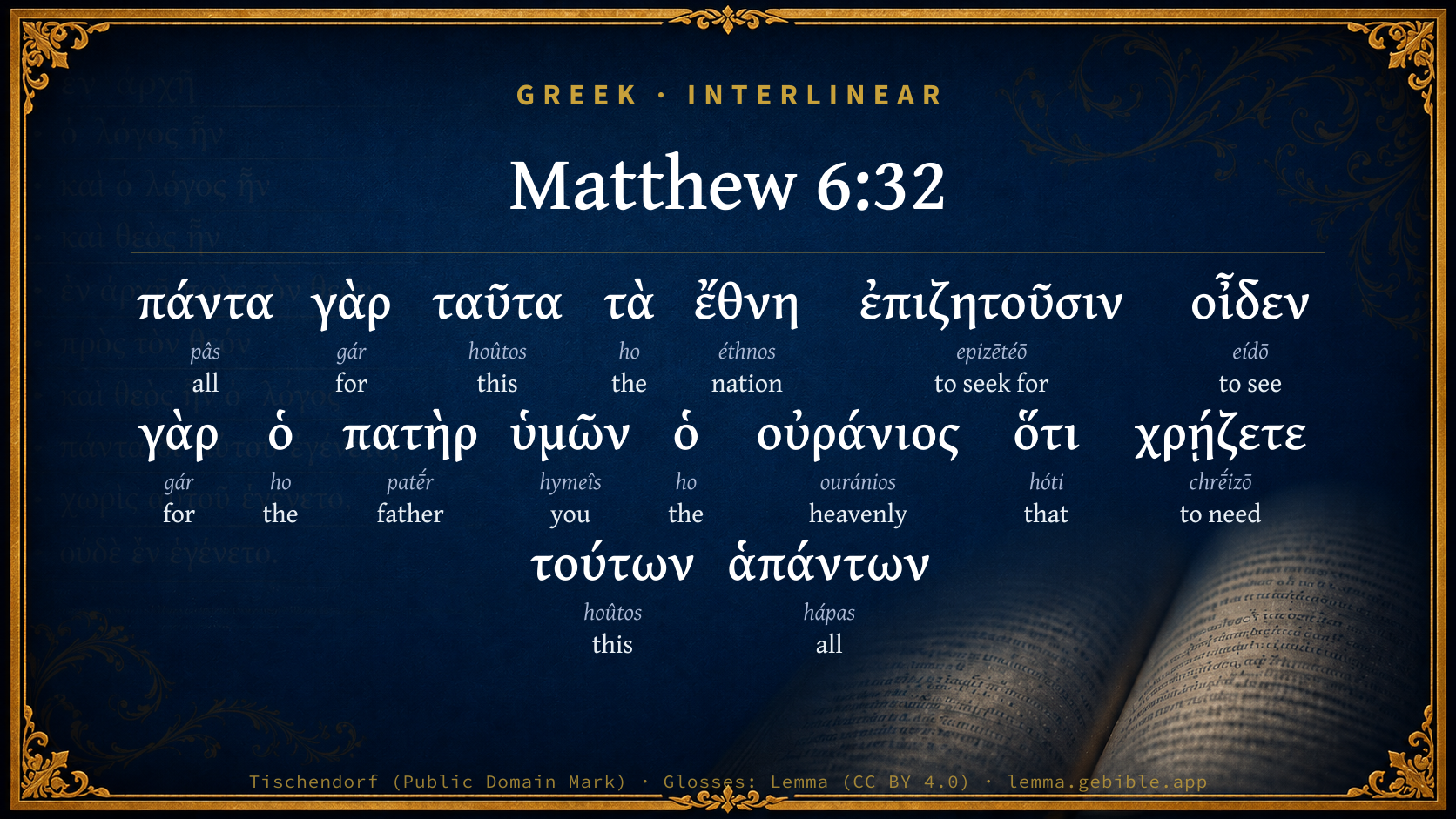
Greek (Tischendorf 8th ed.) Matthew 6:32 appears in the Greek New Testament. The text above is from the Tischendorf 8th edition. Each word links to its Strong’s number and a concise gloss. Click any word for its full Thayer’s Greek Lexicon entry.
Download image
Cite this verse

Matthew 6:32 (World English Bible). Public Domain. Lemma interlinear Bible study tool, https://lemma.gebible.app/v/matthew/6/32.

Show BibTeX & RIS
BibTeX
RIS
English Translation
For the Gentiles seek after all these things, for your heavenly Father knows that you need all these things.
World English Bible · Public Domain
Highlights
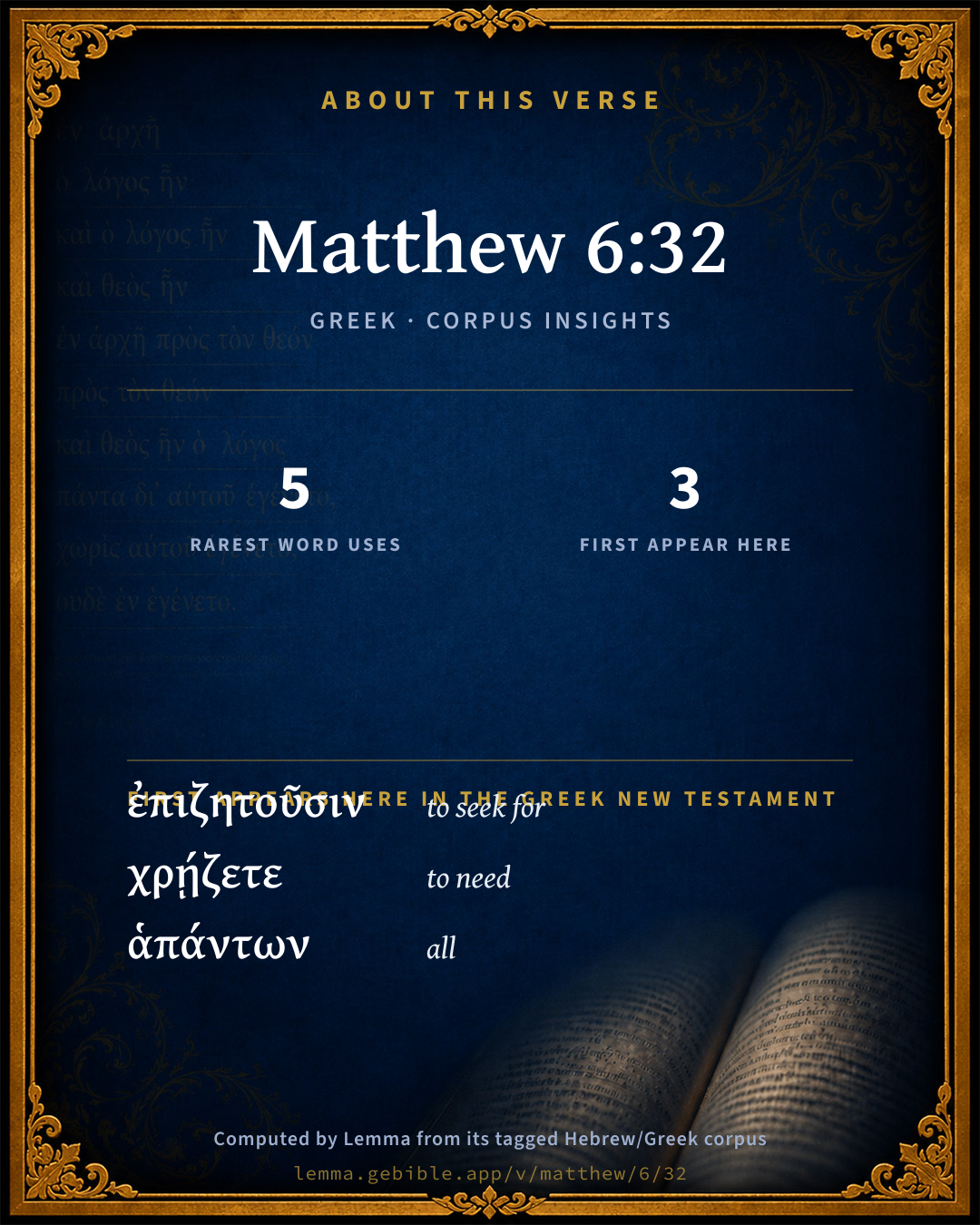
  • 3 first appearances in the Greek New Testament
Full analysis ↓
Download a study sheet

One document with this verse’s original text, its word-by-word gloss line, the meaning frame, cross-references with their text, attributed commentary, and full source and license credits — printable, and it pastes into notes with its structure intact.

This verse Autodidact and up

Study sheet (.html) Plain text (.txt)

A passage Seminary Student

Up to 50 verses in one chapter. A passage sheet keeps up to 6 commentary sources and 12 cross-references per verse, in the order this page ranks them, and says so on the sheet whenever that leaves anything out. Ask for a single verse and you get the Autodidact verse sheet above.

Everything on this page stays free to read, with no account — the sheet is a download of what is already on screen, not access to it.

Want to remove ads? Support Godless Engineer
Compare translations 3

The same verse in 3 English versions, stacked beneath the original-language interlinear above. Click any original word for its lexicon entry.

Each is an independent rendering of the whole verse — the interlinear is not word-aligned to these translations.

Highlighted words mark where these versions differ — a whole-verse word diff, not a word-by-word alignment.

  • World English Bible Public Domain
    For the Gentiles seek after all these things, for your heavenly Father knows that you need all these things.
  • King James Version Public Domain
    (For after all these things do the Gentiles seek:) for your heavenly Father knoweth that ye have need of all these things.
  • unfoldingWord Literal Text CC BY-SA 4.0
    For the Gentiles seek all these things; for your heavenly Father knows that you need all of these things.

unfoldingWord Literal Text — © unfoldingWord, licensed CC BY-SA 4.0. Word-aligned USFM3 via Door43 (git.door43.org/unfoldingWord/en_ult).

Versions to compare (up to 4)

3 of 4 selected

Show all 19 translations

Every available English version of this verse, each an independent rendering of the whole verse.

  • World English Bible Public Domain
    For the Gentiles seek after all these things, for your heavenly Father knows that you need all these things.
  • Berean Standard Bible Public Domain
    For the Gentiles strive after all these things, and your heavenly Father knows that you need them.
  • Majority Standard Bible Public Domain
    For the Gentiles strive after all these things, and your heavenly Father knows that you need them.
  • King James Version Public Domain
    (For after all these things do the Gentiles seek:) for your heavenly Father knoweth that ye have need of all these things.
  • American Standard Version (1901) Public Domain
    For after all these things do the Gentiles seek; for your heavenly Father knoweth that ye have need of all these things.
  • Revised Version (1885) Public Domain
    For after all these things do the Gentiles seek; for your heavenly Father knoweth that ye have need of all these things.
  • Geneva Bible (1599) Public Domain
    (For after all these things seeke the Gentiles) for your heauenly Father knoweth, that ye haue neede of all these things.
  • Douay-Rheims (1899) Public Domain
    For after all these things do the heathens seek. For your Father knoweth that you have need of all these things.
  • Young's Literal Translation Public Domain
    for all these do the nations seek for, for your heavenly Father doth know that ye have need of all these;
  • Literal Standard Version CC BY-SA 4.0
    For the nations seek for all these, for your heavenly Father knows that you have need of all these;
  • Unlocked Literal Bible CC BY-SA 4.0
    For the Gentiles search for these things, and your heavenly Father knows that you need them.
  • unfoldingWord Literal Text CC BY-SA 4.0
    For the Gentiles seek all these things; for your heavenly Father knows that you need all of these things.
  • Darby Bible Public Domain
    for all these things the nations seek after; for your heavenly Father knows that ye have need of all these things.
  • World Messianic Bible Public Domain
    For the Gentiles seek after all these things; for your heavenly Father knows that you need all these things.
  • Webster's Bible Public Domain
    (For after all these things do the Gentiles seek) for your heavenly Father knoweth that ye have need of all these things.
  • Free Bible Version CC BY-SA 4.0
    These are all the things that the heathen chase after, but your heavenly Father knows everything you need.
  • Bible in Basic English Public Domain
    Because the Gentiles go in search of all these things: for your Father in heaven has knowledge that you have need of all these things:
  • Text-Critical English NT CC BY 4.0
    For the Gentiles seek after all these things, and your heavenly Father knows that you need them all.
  • Tyndale New Testament (1534) Public Domain
    After all these thynges seke the getyls. For youre hevely father knoweth that ye have neade of all these thynges.

Literal Standard Version (2020), Covenant Press — licensed CC BY-SA 4.0. Text via the HelloAO Bible API (eBible.org). Unlocked Literal Bible (unfoldingWord) — licensed CC BY-SA 4.0. Text via the HelloAO Bible API (eBible.org). unfoldingWord Literal Text — © unfoldingWord, licensed CC BY-SA 4.0. Word-aligned USFM3 via Door43 (git.door43.org/unfoldingWord/en_ult). Free Bible Version, Dr. Jonathan Gallagher — licensed CC BY-SA 4.0. Text via the HelloAO Bible API (eBible.org).

Word by word

More ways to search: Search by grammar → Find every occurrence → Compare this word →

Practice this passage: Drill this verse → Learn its vocabulary →

χρῄζετε
chrḗizō
G5535
“to need”
Verb, Present, Active, Indicative, 2nd person, Plural
Part of Speech
Verb
Tense
Present
Voice
Active
Mood
Indicative
Person
2nd person
Number
Plural
Full Thayer's Definition

Origin: from G5532

TDNT: None

1. to have need of, to be in want of
  1. πάντα pâs G3956 “all” Adjective, Accusative, Plural, Neuter
  2. γὰρ gár G1063 “for” Conjunction
  3. ταῦτα hoûtos G3778 “this” Demonstrative pronoun, Accusative, Plural, Neuter
  4. τὰ ho G3588 “the” Article, Nominative, Plural, Neuter
  5. ἔθνη éthnos G1484 “nation” Noun, Nominative, Plural, Neuter
  6. ἐπιζητοῦσιν epizētéō G1934 “to seek for” Verb, Present, Active, Indicative, 3rd person, Plural
  7. οἶδεν eídō G1492 “to see” Verb, Perfect, Active, Indicative, 3rd person, Singular
  8. γὰρ gár G1063 “for” Conjunction
  9. ὁ ho G3588 “the” Article, Nominative, Singular, Masculine
  10. πατὴρ patḗr G3962 “father” Noun, Nominative, Singular, Masculine
  11. ὑμῶν hymeîs G5210 “you” Personal pronoun, 2nd person, Genitive, Plural
  12. ὁ ho G3588 “the” Article, Nominative, Singular, Masculine
  13. οὐράνιος ouránios G3770 “heavenly” Adjective, Nominative, Singular, Masculine
  14. ὅτι hóti G3754 “that” Conjunction
  15. τούτων hoûtos G3778 “this” Demonstrative pronoun, Genitive, Plural, Neuter
  16. ἁπάντων hápas G537 “all” Adjective, Genitive, Plural, Neuter

About this verse

These counts appear in no published source. They are computed here, from the morphology-tagged text and Lemma’s own curated glosses. What Lemma adds →

17
words
13
distinct lemmas
Gospels
section

Notable vocabulary

The rarest word here is χρῄζετε to need G5535 — appearing just 5 times in the whole Greek New Testament.

First appearance in Scripture

These words make their first canonical appearance in the Greek New Testament here:

  • ἐπιζητοῦσιν to seek for G1934
  • χρῄζετε to need G5535
  • ἁπάντων all G537

Shared distinctive vocabulary

χρῄζετε to need G5535 occurs in 5 verses of the Greek New Testament. Also found in:
Repetition

Words recur within this verse:

Cross-references

8

Topical passages linked to Matthew 6:32 in the Treasury of Scripture Knowledge — connected by theme and wording, ordered by reader-vote popularity; previews shown in the World English Bible.

  • Matthew 6:8 Therefore don't be like them, for your Father knows what things you need, before you ask him.
  • Luke 12:30 For the nations of the world seek after all of these things, but your Father knows that you need these things.
  • Ephesians 4:17 This I say therefore, and testify in the Lord, that you no longer walk as the rest of the Gentiles also walk, in the futility of their mind,
  • Luke 11:11–13 "Which of you fathers, if your son asks for bread, will give him a stone? Or if he asks for a fish, he won't give him a snake instead of a fish, will he?
  • Psalms 17:14 From men by your hand, Yahweh, From men of the world, whose portion is in this life. You fill the belly of your cherished ones. Your sons have plenty, And they store up wealth for their children.
  • Matthew 20:25–26 But Jesus summoned them, and said, "You know that the rulers of the Gentiles lord it over them, and their great ones exercise authority over them.
  • 1 Thessalonians 4:5 not in the passion of lust, even as the Gentiles who don't know God;
  • Psalms 103:13 Like a father has compassion on his children, So Yahweh has compassion on those who fear him.

Cross-references courtesy of OpenBible.info (CC BY 4.0).

Commentary

Notes on Matthew 6:32 from classic Christian and Jewish commentators (each source and its license shown beneath its notes). The classic Christian expositions comment on the surrounding passage and are grouped to its opening verse, so a note may address several verses; the Jewish commentaries on the Tanakh (Rashi and others) are per-verse, so they appear only where the commentator wrote on this verse.

Lemma curates 59 commentaries, every one of them public domain or Creative Commons licensed, each selected and text-cleaned for this edition rather than reprinted as found. About our sources →

The Biblical Illustrator

Joseph S. Exell

Mat_6:32

Your heavenly Father knoweth.

The antidote to anxiety

I. Reasons against anxiety.

1. Anxiety is a part of indecision of character and partakes of its harmfulness. No man can serve two masters.

2. An argument from the greater to the less; God takes care of fowls, He will of men.

3. The impossibilities in the case-Which of you, etc.

4. The analogies of nature-Consider the lilies, etc.

5. It puts the Christian to shame by showing that he is anxious like the heathen.

6. The character of God-Your heavenly Father, etc.

7. The folly of the thing.

II. The magnitude of the sin of anxiety.

1. It makes you unhappy, which is matter for blame rather than pity.

2. It is a positive wrong done to God; it distrusts him.

3. Do not speak of your anxieties as something for which you are to be commiserated.

4. Never place yourself willingly in a position of worldly anxiety; it is a great hindrance to spiritual life. (A. Vaughan, M. A.)

Gods individual care of His children

A father does not deal with all his children by one and the same universal rule, but with each child individually. For he is acquainted with their separate, especial wants; he knows them as no one else knows them. Therefore, not only have all their portions, but every one the portion he requires. The delicate one is the most shielded,-the timid one is the most encouraged,-the infirm one is the most helped,-the dull one is the most taught,-the tempted one is the most prayed for,-the returning one is the most rejoiced over. And it is the speciality and the appropriateness of the care which makes the great characteristics of paternal government. (A. Vaughan, M. A)

The Biblical Illustrator, edited by Joseph S. Exell (c. 1880s–1900s) — public domain. Text from a community e-Sword module.

Tyndale Open Study Notes

Tyndale Open Resources

6:32 unbelievers (literally Gentiles): Those who fail to know God and follow his will (see also 20:19). • your heavenly Father already knows: Prayer does not inform God about needs; it expresses trust in his provision.

Tyndale Open Study Notes — © Tyndale Open Resources, licensed CC BY-SA 4.0. Text via the HelloAO Bible API.

Bengel's Gnomon

Johann Albrecht Bengel

Mat 6:32. Πάντα γὰρ ταῦτα, κ.τ.λ., for all these things, etc.) and nothing else.—τὰ ἔθνη, the gentiles) the heathen nations. The faithful ought to be free from the cares, not only of the covetous among the heathen, but of all heathens; many, however, in the present day fall short of the heathen in this matter.[294]—ἐπιζητεῖ, seek after) as though a difficult matter. This word is followed by the simple verb ζητεῖτε, seek ye,—οἶδε γὰρ ὁ πατὴρ ὑμῶν ὁ οὐράνιος, for your Heavenly Father knoweth) An argument from the omniscience, the goodness, and the omnipotence of God.—ὑμῶν, your) sc. who is your Father in a pre-eminent degree in preference to the heathen.[295]

[294] In the original, “At multi hodie non eam, quam gentes, habent αὐτάρκειαν.” Bengel in Gnomon on ch. Mat 4:4 defines αὐτάρκεια as “Prœsens animi quies.” See p. 150 and f. n. 3.—(I. B.)

[295] In the original all this is expressed by two words, “præ ethnicis.”—(I. B.)

Bengel's Gnomon of the New Testament — English translation (T&T Clark, Edinburgh, 1860) — public domain. Text from a community e-Sword module.

Meyer's Critical & Exegetical Commentary

Heinrich August Wilhelm Meyer

Mat_6:32. The second γάρ does not append another reason co-ordinate with the first, but after the injunction contained in Mat_6:31 has been justified by the reference to the heathen (to whom they are not to compare themselves), this same injunction is provided with an explanation of an encouraging nature, so that the first γάρ is logical, the second explanatory, as frequently in classical writers (Kühner, ad Xen. Anab. v. 6. 6. Frotscher, ad Hieron. xi. 6). The referring of the second γάρ to something to be supplied after τὰ ἔθνη, such as who know nothing of God (Tholuck), is arbitrary.

οἶδε is emphatic; is certainly known to your Father, and so on.

ὅτι] that, not ὅ, τι (Paulus: that, which; Fritzsche: quatenus).

Meyer — Critical and Exegetical Commentary on the New Testament — English translation by Peter Christie, edited by Frederick Crombie (T&T Clark, 1880) — public domain. Text from a community e-Sword module.

Expositor's Greek Testament

ed. W. Robertson Nicoll

Mat 6:32 . τὰ ἔθνη , again a reference to heathen practice; in Mat 6:7 to their “battology” in prayer, here to the kind of blessings they eagerly ask ( ἐπιζητοῦσιν ); material only or chiefly; bread, raiment, wealth, etc. I never realised how true the statement of Jesus is till I read the Vedic Hymns , the prayer book and song book of the Indian Aryans. With the exception of a few hymns to Varuna , in which sin is confessed and pardon begged, most hymns, especially those to Indra , contain prayers only for material goods: cows, horses, green pastures, good harvests.

To wifeless men thou givest wives,

And joyful mak’st their joyless lives;

Thou givest sons, courageous, strong,

To guard their aged sires from wrong,

Lands, jewels, horses, herds of kine,

All kinds of wealth are gifts of thine

Thy friend is never slain; his might

Is never worsted in the fight.

Dr. Muir, Sanskrit Texts , vol. v., p. 137.

οἶδεν γὰρ ὁ πατὴρ ὑ .: Disciples must rise above the pagan level, especially as they worship not Indra , but a Father in heaven , believed in even by the Indian Aryans, in a rude way, under the name of Dyaus-Pitar, Heaven-Father. γὰρ explains the difference between pagans and disciples. The disciple has a Father who knows, and never forgets, His children’s needs, and who is so regarded by all who truly believe in Him. Such faith kills care. But such faith is possible only to those who comply with the following injunction.

Mat 6:33 . ζητεῖτε πρῶτον . There is considerable variation in the text of this counsel. Perhaps the nearest to the original is the reading of [44] , which omits τοῦ θεοῦ with [45] , and inverts the order of βασ . and δικαι . Seek ye His (the Father’s) righteousness and kingdom, though it may be against this that in Luke (Luk 12:31 ) the kingdom only is mentioned, πρῶτον also being omitted: Seek ye His kingdom. This may have been the original form of the logion , all beyond being interpretation, true though unnecessary. Seeking the kingdom means seeking righteousness as the summum bonum , and the πρῶτον is implied in such a quest. Some (Meyer, Sevin, Achelis) think there is no second, not even a subordinate seeking after earthly goods, all that to be left in God’s hands, our sole concern the kingdom. That is indeed the ideal heroic attitude. Yet practically it comes to be a question of first and second, supreme and subordinate, and if the kingdom be indeed first it will keep all else in its proper place. The πρῶτον , like the prayer against temptation, indicates consideration for weakness in the sincere. προστεθήσεται , shall be added , implying that the main object of quest will certainly be secured.

[44] Codex Vaticanus (sæc. iv.), published in photographic facsimile in 1889 under the care of the Abbate Cozza-Luzi.

[45] Codex Sinaiticus (sæc. iv.), now at St. Petersburg, published in facsimile type by its discoverer, Tischendorf, in 1862.

The Expositor's Greek Testament, edited by W. Robertson Nicoll (1897–1910) — public domain. Text from a community e-Sword module.

Jamieson, Fausset & Brown

Robert Jamieson, A. R. Fausset & David Brown

(For after all these things do the Gentiles seek)--rather, "pursue." Knowing nothing definitely beyond the present life to kindle their aspirations and engage their supreme attention, the heathen naturally pursue present objects as their chief, their only good. To what an elevation above these does Jesus here lift His disciples!

for your heavenly Father knoweth that ye have need of all these things--How precious this word! Food and raiment are pronounced needful to God's children; and He who could say, "No man knoweth the Father but the Son, and he to whomsoever the Son will reveal Him" (Mat 11:27), says with an authority which none but Himself could claim, "Your heavenly Father knoweth that ye have need of all these things." Will not that suffice you, O ye needy ones of the household of faith?

Jamieson, Fausset & Brown — Commentary Critical and Explanatory on the Whole Bible (1871) — public domain (CC PDM 1.0). Text via the HelloAO Bible API.

Adam Clarke's Commentary

Verse 32. For after all these things do the Gentiles seek] The fifth reason against solicitude about the future is-that to concern ourselves about these wants with anxiety, as if there was no such thing as a providence in the world; with great affection towards earthly enjoyments, as if we expected no other; and without praying to God or consulting his will, as if we could do any thing without him: this is to imitate the worst kind of heathens, who live without hope, and without God in the world.

Seek] επιζητει from επι, intensive, and ζητεω, I seek, to seek intensely, earnestly, again and again: the true characteristic of the worldly man; his soul is never satisfied-give! give! is the ceaseless language of his earth-born heart.

Your heavenly Father knoweth, c.] The sixth reason against this anxiety about the future is-because God, our heavenly Father, is infinite in wisdom, and knows all our wants. It is the property of a wise and tender father to provide necessaries, and not superfluities, for his children. Not to expect the former is an offence to his goodness to expect the latter is injurious to his wisdom.

Adam Clarke's Commentary on the Bible (1810–1826) — public domain. Text from a community e-Sword/MySword module.

Ellicott's Commentary for English Readers

(32) After all these things do the Gentiles seek.—The tone is one of pity rather than of censure, though it appeals, not without a touch of gentle rebuke (as before in Mat_6:5) to the national pride of Israelites: “You look down upon the heathen nations, and think of yourselves as God’s people, yet in what do you excel them, if you seek only what they are seeking?”

For your heavenly Father knoweth . . .—The bearing of this teaching on the meaning of the “daily bread” of the Lord’s Prayer has already been noticed (comp. Note on Mat_6:11). The outer life of man, and its accidents, may well be left to the wisdom of the All-knowing. It lies below the region of true prayer, or occupies an altogether subordinate place within it.

A Bible Commentary for English Readers, edited by Charles John Ellicott (1878–1897) — public domain. Text from a community e-Sword module.

The Cambridge Bible for Schools and Colleges

gen. ed. J. J. S. Perowne

32. the Gentiles seek] Seek with eagerness. A compound verb. The simple verb is used below in the next verse. For the aims of the heathen world read Juvenal Sat. x., or Johnson’s imitation of it “The Vanity of Human Wishes.”

The Cambridge Bible for Schools and Colleges (gen. ed. J. J. S. Perowne; Cambridge University Press, 1878–1918) — public domain. Text from a community e-Sword module.

John Gill's Exposition

But seek first the kingdom of God,.... Meaning either the Gospel, and the ministration of it; in which sense this phrase is often used, see Mat 21:43 and which is diligently to be sought after, and into; to be constantly attended on, and to be preferred to our necessary food, to raiment, or riches, or any enjoyment of life: or else the kingdom of glory, which is prepared by God, and is his gift; for which he makes his people meet here, and will introduce them into it hereafter.

And his righteousness; the righteousness of God, which is revealed in the Gospel, and is what gives a right and title to the kingdom of heaven. This is not the righteousness of man, but of God; and is no other than the righteousness of Christ; so called, because he is God who has wrought it; it is what God approves of, accepts, and imputes, and which only can justify in his sight, and give an abundant entrance into his kingdom and glory. Heaven is to be sought for in the first place, as the perfection of the saints' happiness; and Christ's righteousness is to be sought for, and laid hold on by faith, as the way and means of enjoying that happiness; without which, there will be no entering into the kingdom of heaven.

And all these things shall be added unto you: of the free bounty, goodness, and liberality of God, without your thought and care, and much less merit; even "all these things", meat, drink, clothing, or whatsoever worldly sustenance else is necessary for you: which are not parts of the happiness of saints, only appendages thereunto; which they have over and above what they are, or should be chiefly seeking after. The Hebrews (r) say,

"that no good sign will be shown to Israel, until they return and "seek" three things: "afterwards the children of Israel shall return and seek the Lord"; , "this is the kingdom of heaven"; and "David their king", according to its literal sense; "and shall fear the Lord and his goodness"; this is the house of the sanctuary, as it is said, "this goodly mountain", and Lebanon.''

(r) Jarchi & Kimchi, in Hos. iii. 5.

John Gill's Exposition of the Whole Bible (1746–1763) — public domain (CC PDM 1.0). Text via the HelloAO Bible API.

Trapp's Complete Commentary

John Trapp

32 (For after all these things do the Gentiles seek:) for your heavenly Father knoweth that ye have need of all these things.

Ver. 32. For after all these things do the Gentiles seek] With whom if you should symbolize in sins, or not exceed in virtue, it were a shame to you. They studiously seek these things, they seek them with all their might; as being without God in the world, and therefore left by him to shift for themselves. {a} When we observe a young man toiling and moiling, running and riding, and not missing a market, &c., we easily guess and gather that he is fatherless and friendless, and hath none other to take care for him. Surely this immoderate care is better beseeming infidels that know not God, but rest wholly upon themselves and their own means, than Christians, who acknowledge God most wise and all-sufficient to be their loving father, {b} As we differ from heathens in profession, so we should in practice; and a gross business it is, that Jerusalem should justify Sodom, and it should be said unto her, "Neither hath Samaria committed half of thy sins, but thou hast multiplied thine abominations more than they," Eze 16:51. Such as have hope in this life only, what marvel if they labour their utmost to make their best of it? Now many of the poor pagans believed not the immortality of the soul, and those few of them that dreamed of another life beyond this, yet affirmed it very faintly, and scarcely believed themselves. Socrates, the wisest of heathens, spake thus to his friends at his death: "The time is now come that I must die, and you survive; but whether is the better of these two, the gods only know, and not any man living, that is my opinion." {c} "But we have not so learned Christ." Neither must we do as heathens and aliens from the commonwealth of Israel; since now in Christ Jesus, we who sometimes were far off are made nigh by his blood, and have an access through him by one Spirit to the Father, Eph 2:13; Eph 2:18.

For your heavenly Father knoweth that ye have need of all these things] Not with a bare barren notional knowledge, but with a fatherly tender care to provide for his own in all their necessities: which whoso doeth not, he judgeth him worse than an infidel. We need not be careful of our maintenance here in our minority and non-age, nor yet for our eternal inheritance when we come to full age. We are cared for in everything that we need, and that can be good for us. Oh happy we, did we but know our happiness! How might we live in a very heaven upon earth, could we but live by faith and walk before God with a perfect heart? He made himself known to be our gracious and provident Father before we were born. And did we but seriously consider who kept and fed us in our mother’s womb, Psa 22:9-10, when neither we could shift for ourselves nor our parents do aught for us, how he filled us two bottles with milk against we came into the light, bore us in his arms as a nursing father, Num 11:12, fed us, clothed us, kept us from fire and water, charged his angels with us, commanded all winds to blow good to us, Son 4:16, all creatures to serve us, Hos 2:21-23, and all occurrences to work together for our good, Rom 8:28, how could we but be confident? Why art thou so sad from day to day? and what is it thou ailest or needest? Art not thou the king’s son? said Jonadab to Amnon, 2Sa 13:4, -say I to every godly Christian. Profane Esau could go to his father for a child’s portion; so could the prodigal, because a child; and had it. Every child of God shall have a Benjamin’s portion here, and at length power over all nations, Rev 2:26, and possession of that "new heaven and new earth, wherein dwelleth righteousness," 2Pe 3:13. Either therefore disclaim God for your Father, or else rest confident of his fatherly provision.

" Certa mihi spes est quod vitam qui dedit, idem

Et velit, et possit suppeditare cibum."

God that giveth mouths will not fail to give meat also.

{a} επιζητει, Summo studio efflagitat.

{b} κερδαινοντες ου κοπιωμεν. Naz.

{c} Utrum autem sit menus Dii immortales sciunt: hominem quidem arbitror scire neminem. Plato and Cic.

John Trapp, A Commentary or Exposition upon All the Books of the Old and New Testament (1647–1656) — public domain. Text from a community e-Sword module.

Albert Barnes' Notes on the Bible

For after all these things do the Gentiles seek - That is, those destitute of the true doctrines of religion, and unacquainted with proper dependence on Divine Providence, make it their chief anxiety thus to seek food and clothing. But you, who have a knowledge of your Father in heaven; who know that He will provide for your needs, should not be anxious. Seek first His kingdom; seek first to be righteous, and to become interested in His favor, and all necessary things will be added to you. He has control over all things, and He can give you what you need. He will give you what he deems best for you.

Albert Barnes' Notes on the Bible (1834–1885) — public domain. Text from a community e-Sword/MySword module.

Haydock's Catholic Bible Commentary

It is not without reason that men are in such great fear and distress, when they are so blind as to imagine that their happiness in this life is ruled by fate. But such as know that they are entirely governed by the will of God, know also that a store is laid up for them in his hands. (St. John Chrysostom)

George Leo Haydock (1774–1849), Haydock's Catholic Family Bible and Commentary, 1859 edition — public domain. Excludes Psalms (Douay-Rheims chapter numbering differs from Protestant) and Deuterocanonical books (Catholic canon only).

Whedon's Commentary on the Bible

Daniel D. Whedon

32. After all these things — All worldly goods and earthly treasures, (18-21,) which are included under the dominion of the world-god, Mammon. And so, be not ye, therefore, like unto them. Their god is Mammon, yours is your heavenly Father. The Gentiles seek — Hence this whole third part of our Lord’s discourse is properly a rebuke of Gentilism, or godless Secularism, either as existing among the heathen, or infecting the Jews.

Daniel D. Whedon (gen. ed.), Commentary on the Old and New Testaments (1874–1909) — public domain. Text from a community e-Sword module.

The Pulpit Commentary

Parallel passage: Luk_12:30. Save in reading "but" instead of the second "for," Luke"s seems the more original. (For after all these things do the Gentiles seek; ) for your heavenly Father knoweth, etc. The Revised Version removes the marks of parenthesis. For...for; these are probably co-ordinate, and adduce two reasons for our not being for one moment anxious about earthly things:

(1) it is like the heathen; (cf. the thought of Mat_5:47)

(2) your Father knows your need of them. Heavenly. (Mat_5:16, note) Knoweth (ver. 8, note).

The Pulpit Commentary (1880–1919), ed. H.D.M. Spence-Jones & Joseph S. Exell — public domain. Text from a community e-Sword module.

The People's New Testament

B. W. Johnson

32. For after all these things do the Gentiles seek. This worldliness, anxiety, and distrust, might do in heathen, who have no knowledge of a heavenly Father, but you have a heavenly Father, and he knows that ye need all these things.

B. W. Johnson's The People's New Testament with Notes (1889–1891) — public domain. Electronic text from the Christian Classics Ethereal Library (CCEL) ThML edition.

unfoldingWord translationNotes

Door43 World Missions Community

For the Gentiles search for these things

"for the Gentiles are concerned about what they will eat, drink, and wear"

your heavenly Father knows that you need them

Jesus is implying that God will make sure their basic needs are met.

Father

This is an important title for God. (See: Translating Son and Father)

seek first his kingdom and his righteousness

Here "kingdom" refers to God's rule as king. AT: "concern yourselves with serving God, who is your king, and doing what is right" (See: Metonymy)

all these things will be given to you

This can be stated in active form. AT: "God will provide all these things for you" (See: Active or Passive)

Therefore

"Because of all this"

tomorrow will be anxious for itself

Jesus speaks of "tomorrow" as if it were a person who could worry. Jesus means that a person will have enough to worry about when the next day comes. (See: Personification)

translationWords

Gentile

heaven

God the Father

kingdom of God

righteous

evil

unfoldingWord translationNotes — © Distant Shores Media and the Door43 World Missions Community, licensed CC BY-SA 4.0. Source: git.door43.org/Door43/en_tn.

Cambridge Greek Testament for Schools and Colleges

32. ἐπιζητοῦσιν. Either (1) ‘seek with eagerness’; ἐπὶ having the force of ‘on,’ ‘further,’ so earnestly. See Vaughan on Rom 11:7. Or (2) ‘make special objects of pursuit,’ from the sense of direction or aim in ἐπί. Cp. ἐπικωμωδεῖν, ‘to select for caricature.’ Riddell, Plato, Apol. Socr. 31 D. With the general thought of the passage cp. Rom 14:17, οὐ γάρ ἐστιν ἡ βασιλεία τοῦ Θεοῦ βρῶσις καὶ πόσις ἀλλὰ δικαιοσύνη καὶ εἰρήνη καὶ χαρὰ ἐν πνεύματι ἁγίῳ.

Cambridge Greek Testament for Schools and Colleges (Cambridge University Press, 1896; 21 vols, various authors incl. Carr, Maclear, Plummer, Farrar, Lumby, Moule, M. R. James, Simcox) — public domain. Text from a community e-Sword module.

Alford’s Greek Testament

Henry Alford

32. οἶδεν γάρ] This 2nd γάρ brings in an additional reason: see Xen. Symp. iv. 55.

Henry Alford, The Greek Testament (1849–1861) — public domain. Text from a community e-Sword module.

International Critical Commentary

32. For all these things the Gentiles seek after. For your heavenly Father knoweth that you need all these things.] Lk. has: “For all these things the Gentiles of the world seek after. But your Father knoweth that ye need these things.”

(L)

International Critical Commentary — older volumes (1896–1929), various authors — public domain. Text from a community e-Sword module.

Lesson kit

Teaching starters — assembled from the data on this page, not authored interpretation. Every prompt links to the verse data it draws on. Edit before teaching.

Matthew, in the Gospels, opens this verse with 17 words (13 distinct Greek lemmas). Its most distinctive word is chrḗizō (“to need”). A historical commentator’s framing appears above. Read the whole chapter for the surrounding context.

Discussion questions

  1. The word chrḗizō carries the sense “to need.” How does it shape the verse?
  2. 3 words make their first appearance in Scripture here. What does this debut establish?
  3. How does Luke 11:8, which shares the word «to need», read alongside this verse?
  4. What does the repetition of “the” (3× in this one verse) do in this verse?
  5. The translations on this page render this verse differently — a whole-verse word diff, not a word-by-word alignment. What might account for the different wordings?
  6. Compare how The Biblical Illustrator and Tyndale Open Study Notes read this verse. Where do they agree or differ?

Things to notice

  • 3 words make their first canonical appearance in Scripture here.
  • These translations choose different wording for 6 words in this verse.
  • “the” occurs 3× in this single verse.
  • 13 distinct Greek lemmas span 17 words in this verse.

Reading settings

Reading text

Shown beneath each verse's original-language words.

Old Testament
Old Testament edition

Read the OT as the Masoretic Hebrew (MT) or the Greek Septuagint (LXX).

English shown for the Greek Septuagint (in the Hebrew ↔ Greek comparison).

Comparing translations? Open the Compare panel on any verse page to stack up to four side by side.