
John 6:42

Greek (Tischendorf 8th ed.) John 6:42 appears in the Greek New Testament. The text above is from the Tischendorf 8th edition. Each word links to its Strong’s number and a concise gloss. Click any word for its full Thayer’s Greek Lexicon entry.
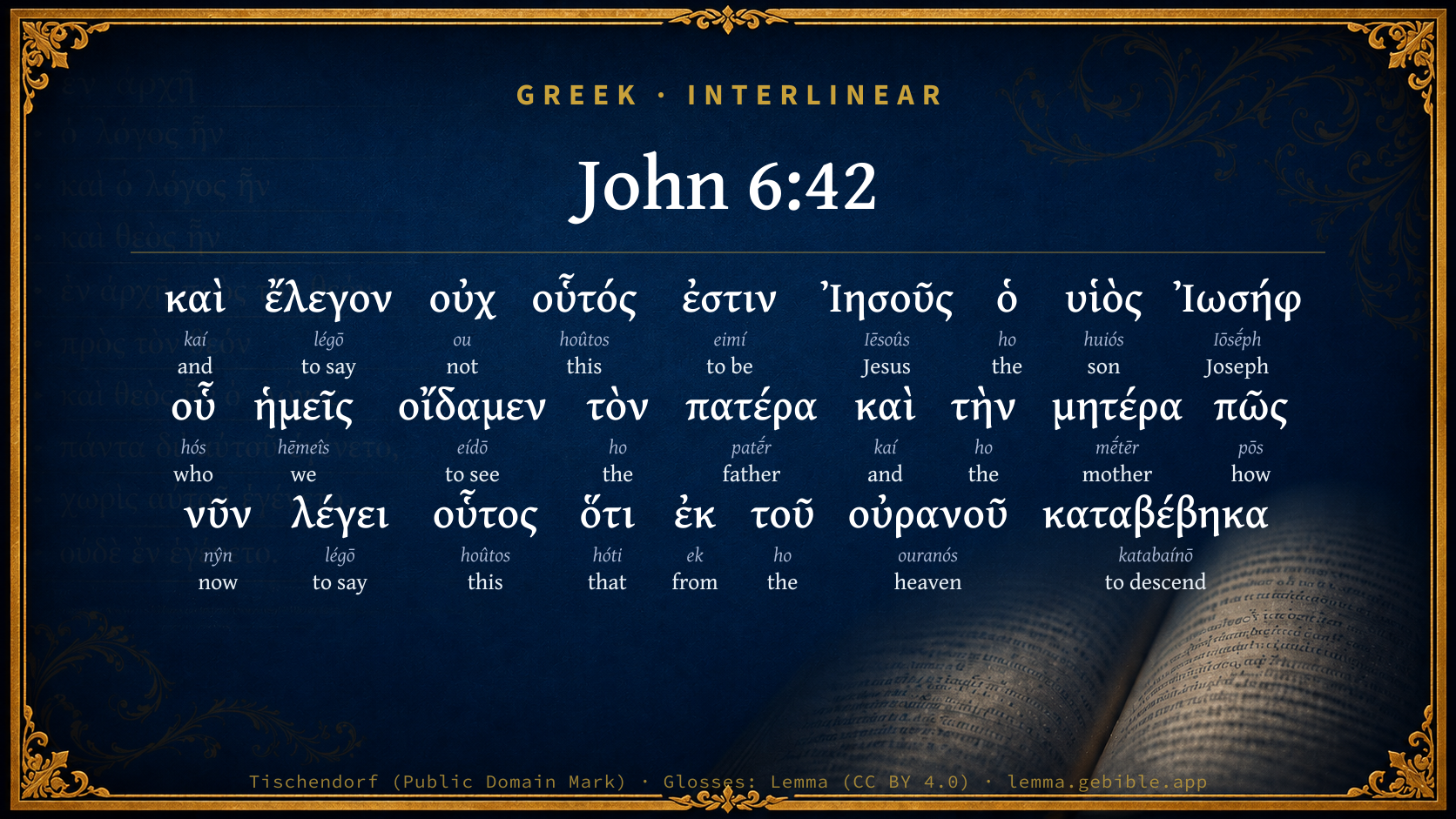
Download image
Cite this verse

John 6:42 (World English Bible). Public Domain. Lemma interlinear Bible study tool, https://lemma.gebible.app/v/john/6/42.

Show BibTeX & RIS
BibTeX
RIS
English Translation
They said, "Isn't this Jesus, the son of Joseph, whose father and mother we know? How then does he say, 'I have come down out of heaven?'"
World English Bible · Public Domain
Download a study sheet

One document with this verse’s original text, its word-by-word gloss line, the meaning frame, cross-references with their text, attributed commentary, and full source and license credits — printable, and it pastes into notes with its structure intact.

This verse Autodidact and up

Study sheet (.html) Plain text (.txt)

A passage Seminary Student

Up to 50 verses in one chapter. A passage sheet keeps up to 6 commentary sources and 12 cross-references per verse, in the order this page ranks them, and says so on the sheet whenever that leaves anything out. Ask for a single verse and you get the Autodidact verse sheet above.

Everything on this page stays free to read, with no account — the sheet is a download of what is already on screen, not access to it.

Want to remove ads? Support Godless Engineer
Compare translations 3

The same verse in 3 English versions, stacked beneath the original-language interlinear above. Click any original word for its lexicon entry.

Each is an independent rendering of the whole verse — the interlinear is not word-aligned to these translations.

Highlighted words mark where these versions differ — a whole-verse word diff, not a word-by-word alignment.

  • World English Bible Public Domain
    They said, "Isn't this Jesus, the son of Joseph, whose father and mother we know? How then does he say, 'I have come down out of heaven?'"
  • King James Version Public Domain
    And they said, Is not this Jesus, the son of Joseph, whose father and mother we know? how is it then that he saith, I came down from heaven?
  • unfoldingWord Literal Text CC BY-SA 4.0
    And they said, “Is not this Jesus, the son of Joseph, whose father and mother we know? How then does he now say, ‘I have come down from heaven’?”

unfoldingWord Literal Text — © unfoldingWord, licensed CC BY-SA 4.0. Word-aligned USFM3 via Door43 (git.door43.org/unfoldingWord/en_ult).

Versions to compare (up to 4)

3 of 4 selected

Show all 19 translations

Every available English version of this verse, each an independent rendering of the whole verse.

  • World English Bible Public Domain
    They said, "Isn't this Jesus, the son of Joseph, whose father and mother we know? How then does he say, 'I have come down out of heaven?'"
  • Berean Standard Bible Public Domain
    They were asking, “Is this not Jesus, the son of Joseph, whose father and mother we know? How then can He say, ‘I have come down from heaven?’”
  • Majority Standard Bible Public Domain
    They were asking, “Is this not Jesus, the son of Joseph, whose father and mother we know? How then can He say, ‘I have come down from heaven’?”
  • King James Version Public Domain
    And they said, Is not this Jesus, the son of Joseph, whose father and mother we know? how is it then that he saith, I came down from heaven?
  • American Standard Version (1901) Public Domain
    And they said, Is not this Jesus, the son of Joseph, whose father and mother we know? how doth he now say, I am come down out of heaven?
  • Revised Version (1885) Public Domain
    And they said, Is not this Jesus, the son of Joseph, whose father and mother we know? how doth he now say, I am come down out of heaven?
  • Geneva Bible (1599) Public Domain
    And they said, Is not this Iesus that sonne of Ioseph, whose father and mother wee knowe? howe then sayth he, I came downe from heauen?
  • Douay-Rheims (1899) Public Domain
    And they said: Is not this Jesus, the son of Joseph, whose father and mother we know How then saith he, I came down from heaven
  • Young's Literal Translation Public Domain
    and they said, `Is not this Jesus, the son of Joseph, whose father and mother we have known? how then saith this one -- Out of the heaven I have come down?'
  • Literal Standard Version CC BY-SA 4.0
    and they said, “Is this not Jesus, the Son of Joseph, whose father and mother we have known? How then does this One say, I have come down out of Heaven?”
  • Unlocked Literal Bible CC BY-SA 4.0
    They said, “Is not this Jesus son of Joseph, whose father and mother we know? How then does he now say, 'I have come down from heaven'?”
  • unfoldingWord Literal Text CC BY-SA 4.0
    And they said, “Is not this Jesus, the son of Joseph, whose father and mother we know? How then does he now say, ‘I have come down from heaven’?”
  • Darby Bible Public Domain
    And they said, Is not this Jesus the son of Joseph, whose father and mother we have known? how then does *he* say, I am come down out of heaven?
  • World Messianic Bible Public Domain
    They said, “Isn’t this Yeshua, the son of Joseph, whose father and mother we know? How then does he say, ‘I have come down out of heaven’?”
  • Webster's Bible Public Domain
    And they said, Is not this Jesus the son of Joseph, whose father and mother we know? how is it then that he saith, I came down from heaven?
  • Free Bible Version CC BY-SA 4.0
    They said, “Isn't this Jesus, the son of Joseph? We know his father and his mother. So how can he now tell us, ‘I came down from heaven’?”
  • Bible in Basic English Public Domain
    And they said, Is not this Jesus, the son of Joseph, whose father and mother we have seen? How is it then that he now says, I have come down from heaven?
  • Text-Critical English NT CC BY 4.0
    They said, “Is this not Jesus, the son of Joseph, whose father and mother we know? How then can he say, ‘I have come down from heaven’?”
  • Tyndale New Testament (1534) Public Domain
    And they sayde: Is not this Iesus the sonne of Ioseph whose father and mother we knowe? How ys that then that he sayeth I came doune from heaven?

Literal Standard Version (2020), Covenant Press — licensed CC BY-SA 4.0. Text via the HelloAO Bible API (eBible.org). Unlocked Literal Bible (unfoldingWord) — licensed CC BY-SA 4.0. Text via the HelloAO Bible API (eBible.org). unfoldingWord Literal Text — © unfoldingWord, licensed CC BY-SA 4.0. Word-aligned USFM3 via Door43 (git.door43.org/unfoldingWord/en_ult). Free Bible Version, Dr. Jonathan Gallagher — licensed CC BY-SA 4.0. Text via the HelloAO Bible API (eBible.org).

Word by word

More ways to search: Search by grammar → Find every occurrence → Compare this word →

Practice this passage: Drill this verse → Learn its vocabulary →

Ἰωσήφ
Iōsḗph
G2501
“Joseph”
Noun, Proper, indeclinable
Part of Speech
Noun · Proper, indeclinable
Full Thayer's Definition

Origin: of hebrew origin H3130

TDNT: None

Joseph = "let him add" 1. the patriarch, the eleventh son of Jacob 2. the son of Jonan or Jonam, one of the ancestors of Christ, Lk 3:30 3. the son of Judah [or Judas; better Joda] another ancestor of Jesus, Lk 3:26 4. the son of Mattathias, another ancestor of Christ, Lk 3:24 , 25 5. the husband of Mary, the mother of Jesus 6. a half-brother of Jesus Mat. 13:55 7. Joseph of Arimathaea, a member of the Sanhedrin, who favoured Jesus. Mt. 27:57 , 59 ; Mk 15:43 , 8. Joseph surnamed Barnabas Acts 4:36 9. Joseph call Barsabas and surnamed Justus, Acts 1:23
  1. καὶ kaí G2532 “and” Conjunction
  2. ἔλεγον légō G3004 “to say” Verb, Imperfect, Active, Indicative, 3rd person, Plural
  3. οὐχ ou G3756 “not” Particle, Negative
  4. οὗτός hoûtos G3778 “this” Demonstrative pronoun, Nominative, Singular, Masculine
  5. ἐστιν eimí G1510 “to be” Verb, Present, Active, Indicative, 3rd person, Singular
  6. Ἰησοῦς Iēsoûs G2424 “Jesus” Noun, Nominative, Singular, Masculine
  7. ὁ ho G3588 “the” Article, Nominative, Singular, Masculine
  8. υἱὸς huiós G5207 “son” Noun, Nominative, Singular, Masculine
  9. οὗ hós G3739 “who” Relative pronoun, Genitive, Singular, Masculine
  10. ἡμεῖς hēmeîs G2249 “we” Personal pronoun, 1st person, Nominative, Plural
  11. οἴδαμεν eídō G1492 “to see” Verb, Perfect, Active, Indicative, 1st person, Plural
  12. τὸν ho G3588 “the” Article, Accusative, Singular, Masculine
  13. πατέρα patḗr G3962 “father” Noun, Accusative, Singular, Masculine
  14. καὶ kaí G2532 “and” Conjunction
  15. τὴν ho G3588 “the” Article, Accusative, Singular, Feminine
  16. μητέρα mḗtēr G3384 “mother” Noun, Accusative, Singular, Feminine
  17. πῶς pōs G4459 “how” Adverb, Interrogative
  18. νῦν nŷn G3568 “now” Adverb
  19. λέγει légō G3004 “to say” Verb, Present, Active, Indicative, 3rd person, Singular
  20. οὗτος hoûtos G3778 “this” Demonstrative pronoun, Nominative, Singular, Masculine
  21. ὅτι hóti G3754 “that” Conjunction
  22. ἐκ ek G1537 “from” Preposition
  23. τοῦ ho G3588 “the” Article, Genitive, Singular, Masculine
  24. οὐρανοῦ ouranós G3772 “heaven” Noun, Genitive, Singular, Masculine
  25. καταβέβηκα katabaínō G2597 “to descend” Verb, Perfect, Active, Indicative, 1st person, Singular

About this verse

These counts appear in no published source. They are computed here, from the morphology-tagged text and Lemma’s own curated glosses. What Lemma adds →

26
words
20
distinct lemmas
Gospels
section

Shared distinctive vocabulary

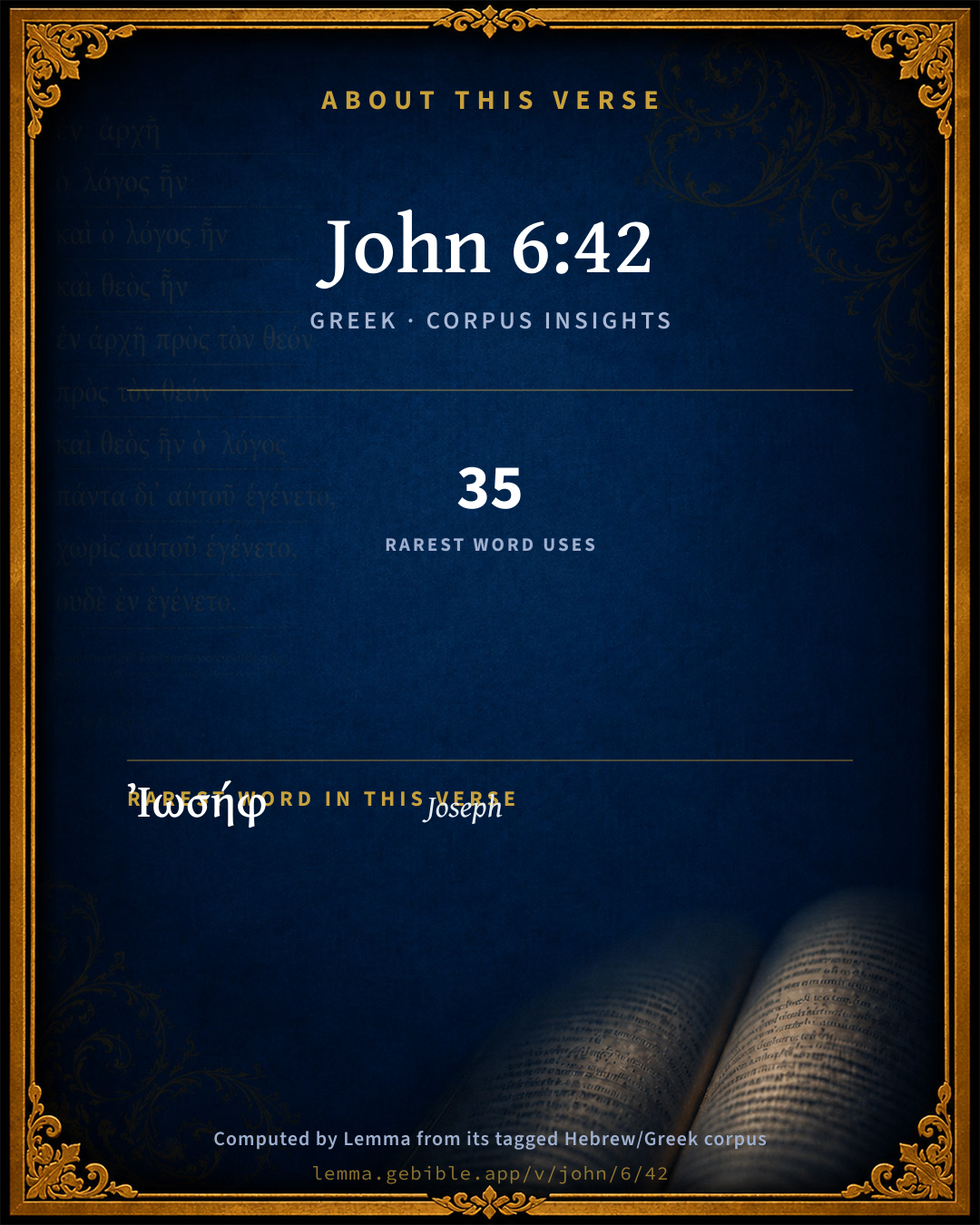
Ἰωσήφ Joseph G2501 occurs in 35 verses of the Greek New Testament. Also found in:
Repetition

Words recur within this verse:

Cross-references

10

Topical passages linked to John 6:42 in the Treasury of Scripture Knowledge — connected by theme and wording, ordered by reader-vote popularity; previews shown in the World English Bible.

  • Luke 4:22 All testified about him, and wondered at the gracious words which proceeded out of his mouth, and they said, "Isn't this Joseph's son?"
  • Matthew 13:55–56 Isn't this the carpenter's son? Isn't his mother called Mary, and his brothers, James, Joses, Simon, and Judas?
  • Mark 6:3 Isn't this the carpenter, the son of Mary, and brother of James, Joses, Judas, and Simon? Aren't his sisters here with us?" They were offended at him.
  • John 7:27–28 However we know where this man comes from, but when the Christ comes, no one will know where he comes from."
  • 1 Corinthians 15:47 The first man is of the earth, made of dust. The second man is the Lord from heaven.
  • John 6:38 For I have come down from heaven, not to do my own will, but the will of him who sent me.
  • John 6:62 Then what if you would see the Son of Man ascending to where he was before?
  • Romans 1:3–4 concerning his Son, who was born of the seed of David according to the flesh,
  • Galatians 4:4 But when the fullness of the time came, God sent out his Son, born to a woman, born under the law,
  • Romans 9:5 of whom are the fathers, and from whom is Christ as concerning the flesh, who is over all, God, blessed forever. Amen.

Cross-references courtesy of OpenBible.info (CC BY 4.0).

Where the printed editions differ

1 variant

Places in this verse where the major printed Greek editions disagree on the wording in a way that affects the translation — a comparison of editions, not a manuscript-by-manuscript collation. The editions are the modern critical texts (Nestlé-Aland 28/27, SBL, Westcott-Hort, Tregelles, Tyndale House) and the traditional texts behind the KJV (the Textus Receptus and the Byzantine/Majority text). It is not a claim about which reading is original.

  1. Different wording
    νῦν

    “then”

    In NA28NA27TynSBLWHTreg Not in TRByz

    οὖν (oun) 'therefore' occurs in traditional manuscripts (TR+Byz) instead of νῦν (nun) 'then' in older manuscripts (NA28+NA27+Tyn+SBL+WH+Treg)

Textual data: Translators Amalgamated Greek New Testament (STEPBible TAGNT) · CC BY 4.0.

Commentary

Notes on John 6:42 from classic Christian and Jewish commentators (each source and its license shown beneath its notes). The classic Christian expositions comment on the surrounding passage and are grouped to its opening verse, so a note may address several verses; the Jewish commentaries on the Tanakh (Rashi and others) are per-verse, so they appear only where the commentator wrote on this verse.

Lemma curates 59 commentaries, every one of them public domain or Creative Commons licensed, each selected and text-cleaned for this edition rather than reprinted as found. About our sources →

Bengel's Gnomon

Johann Albrecht Bengel

Joh 6:42. Οἴδαμεν) we are personally acquainted with [novimus], or rather, we know about [scimus]. Joseph was dead; but the remembrance of him remained.—πῶς, how) So Joh 6:52, “How can this man give us His flesh to eat?”—οὖν, then) On this very account they ought to have thought, that there was in Jesus something higher [than what outwardly appeared].

Bengel's Gnomon of the New Testament — English translation (T&T Clark, Edinburgh, 1860) — public domain. Text from a community e-Sword module.

Ellicott's Commentary for English Readers

(42) Is not this Jesus?—Here is something definite. He has spoken of being the Bread of Life, and of the Bread from Heaven. Putting together Joh_6:33; Joh_6:35; Joh_6:38, they in effect quote His words. But His natural descent and birth was in its outer facts well known, though all its mysteries were still stored in the mother’s heart, and waiting for the human life’s completion before they should be revealed. “Jesus Bar-Joseph” would be the name by which He was commonly called; Joseph and Mary had been known, probably, to many in the crowd; attention had now for more than a year been fixed on Him; and the genealogies would have been searched and local inquiries made. All these indications point to an ordinary life in a Galilean village. It is human, and therefore they think it cannot be divine. They can conceive a coming in the clouds of heaven: that would be a miracle and tell of God; but the birth of a child is no miracle! the existence of life itself—and such an existence, and such a life—is no sign! All this they cannot read. “How does He then say, I am come down from heaven?” (Comp. Joh_6:38 and Note on Joh_7:27.)

A Bible Commentary for English Readers, edited by Charles John Ellicott (1878–1897) — public domain. Text from a community e-Sword module.

The Cambridge Bible for Schools and Colleges

gen. ed. J. J. S. Perowne

42. Is not this] Or, Is not this fellow; the expression is contemptuous.

whose father and mother we know] ‘We know all about His parentage; there is nothing supernatural or mysterious about His origin.’ Nothing can be inferred from this as to Joseph’s being alive at this time: the probability is that he was not, as he nowhere appears in the Gospel narrative; but this cannot be proved.

how is it then, &c.] Better, How doth He now say, I am come down.

The Cambridge Bible for Schools and Colleges (gen. ed. J. J. S. Perowne; Cambridge University Press, 1878–1918) — public domain. Text from a community e-Sword module.

John Gill's Exposition

Jesus therefore answered and said unto them,.... Either overhearing what they said, or knowing, as God, their secret murmurs, and private cavils among themselves, thus addressed them,

murmur not among yourselves: meaning neither about his descent from heaven, nor about coming to him, and believing in him; for it follows,

John Gill's Exposition of the Whole Bible (1746–1763) — public domain (CC PDM 1.0). Text via the HelloAO Bible API.

Trapp's Complete Commentary

John Trapp

42 And they said, Is not this Jesus, the son of Joseph, whose father and mother we know? how is it then that he saith, I came down from heaven?

Ver. 42. The son of Joseph] Who was Christi pater putativus, politicus, secudum dici, non secundum esse.

How is it then] Wretched men dare reprehend what they do not comprehend.

John Trapp, A Commentary or Exposition upon All the Books of the Old and New Testament (1647–1656) — public domain. Text from a community e-Sword module.

Matthew Poole's English Annotations

For Capernaum, where our Saviour now was, was not far from Nazareth, where he had been educated, and lived near thirty years with Joseph his reputed father. Understanding therefore nothing of our Saviour’s miraculous conception by the overshadowing of the Holy Ghost in the womb of the virgin, they were much offended at his discourse of his coming down from heaven.

Matthew Poole's English Annotations on the Holy Bible (1683–1685) — public domain. Text from a community e-Sword/MySword module.

Whedon's Commentary on the Bible

Daniel D. Whedon

42. Whose father and mother we know—These Jews therefore were familiar with Nazareth. Their terms are not now, as before, Rabbi and Lord. They have discarded from their memory the miraculous feeding, and so, doubtless, they carefully forget the Davidic descent of his parents, and all reference to his miraculous birth. They scout the idea of his having come down from heaven.

Daniel D. Whedon (gen. ed.), Commentary on the Old and New Testaments (1874–1909) — public domain. Text from a community e-Sword module.

The Pulpit Commentary

They were saying (elegon) the one to the other, murmuring in critical and angry mood, and not necessarily in his hearing; for he did not reply to their express assertion, and proceeded rather to enlarge and reiterate the great theme which he had already deduced in the hearing of his disciples. Weiss (vol. 3:6) thinks that John has here introduced an amplification which belongs to a totally different connection. Is not this Jesus, the Son of Joseph . (cf. Joh_1:46 Luk_4:22) We cannot argue from this passage whether Joseph was living still or had died. The murmuring is explicable on either hypothesis. The traditionary impression is that "Joseph" had fallen asleep. Either hypothesis is compatible with the languagewhose father and mother we know? They may have merely meant "whose reputed parentage is well understood," without implying that either one or other no longer lived. The fact of his parentage was admitted. This is an apparent point blank contradiction to the descent of his humanity from heaven. The supposition of the truth of the immaculate and supernatural birth of Jesus is perfectly compatible with the ignorance of the "Jews" about it. This deep mystery of love could not be made matter of public discourse, nor do our narratives suggest that the fact itself was promulgated until after the Resurrection. Whatever was apprehended by the sacred society of the hill country of Judaea, or laid up in the breasts of Joseph and Mary and of the few who pondered these strange things in their holy circle at Nazareth, we know not. The synoptic narratives, though they assert the mystery, do not give the smallest indication that it was ever referred to. or made an article of faith, by Jesus himself The difficulty that besets this passage is rather the silence of John, both here and elsewhere, concerning the manner of the Lord"s birth. He, who knew the mother of Jesus, and must have been acquainted with the language of Matthew and Luke, says nothing in vindication of the words of the Lord. Here was an opportunity for putting the "Jews" in the wrong, by endorsing the synoptic account which he did not embrace. We have already seen (cf. notes, Joh_1:14 Joh_3:1-6) that the underlying presupposition of the miraculous birth is the best explanation of his own words. Still his silence is remarkable. It is best accounted for by the fact that he was evermore looking to the moral, spiritual significance of all the miracles he records, as well as of those to which he vaguely refers. He is content with the words of Jesus. They are the surest explanation of the synoptic narrative. The Jews, on the basis of their general knowledge, are struck with consternation. How (now) therefore doth he say, I have come down out of heaven? This was not an irrational nor a malignant criticism. This question must have been asked by those who heard for the first time the stupendous claim. It would not seem that these interrogations were put in the heating of our Lord. His "answer" goes back to the "question" as it shaped itself in the hearts of the disciples, and involves some of the deepest truths which he had previously communicated to Nicodemus. He demands and must have a new humanity, a regenerated audience, subjects for his kingdom who are born anew or from above. He who came down from heaven insists that his true disciples must become what he is heaven born, must have a life out of heaven. They must be "of God," they must "hear" and "learn of the Father," must be drawn by Divine hands, if they would or should come to him. No lip-homage, no fickle desire for the Messianic kingdom, would satisfy him.

The Father draws the soul to Christ.

We have to acknowledge a debt of gratitude to God, first for giving and sending his Son to be our Saviour, and then for guiding us unto his Son, in order that in fellowship with him we may experience the blessings of salvation. For in these two ways does the Father furnish us with a complete display of his love; in these two ways does he completely secure our highest good.

I THE DRAWING OF THE SOUL BY THE FATHER.

1. The soul needs to be divinely drawn. And this because:

(1) By reason of sin it is estranged from God, is far from God, is even at enmity with God.

(2) There are other attractions, very powerful, and such as men are wont to yield to, which draw man"s nature in an opposite direction. "The world, the flesh, and the devil" have great power; and in the case of very many exert that power efficaciously to keep the soul from God, and even to increase the distance by which it is so separated.

2. The instrumentalities, or spiritual forces, by which the Father draws human souls to Christ.

(1) The presentation of truth adapted to man"s intelligence. The next verse brings this agency before us in explicit statement: "They shall be all taught of God.

(2) The utterance of moral authority addressing the conscience. Passion and interest may draw men from Christ; duty, with a mighty imperative, bids them approach their Lord and Saviour.

(3) Love appeals to the heart of man with mystic power. "The moon may draw the sea; The cloud may stoop from heaven, and take the shape, With fold to fold, of mountain or of cape.

The attraction of Christ"s character and life, of his gracious language, and above all of his sacrifice upon the cross, is the mightiest moral force the world has ever felt. "I," said he, "if I am lifted up, will draw all men unto myself." Thus in many ways, adapted by his own wisdom to the nature and circumstances of men, is the Father drawing men unto Christ.

3. The manner in which the Father draws the soul unto himself.

(1) This attraction is not of a physical, mechanical, forcible kind. Such compulsion would be out of all character, would not harmonize with man"s moral freedom. And, indeed, it would not be the drawing of the soul.

(2) It is a moral, spiritual attraction, in accordance with the nature both of him who draws and of those who are drawn. The Holy Spirit of God is the power to whom we owe the action of those moral constraints which are the chief and most beneficent factors in the moral life of mankind.

(3) Mighty though this drawing be, it is for the most part gentle and gradual. Its influence is not always at once apparent; it becomes manifest with the growth of experience and the lapse of time. It is continuous, lasting in the case of many from childhood to old age.

(4) The power and efficacy of this agency is not to be disputed. The Father calls, and the child answers. The magnetism is exercised, and the soul flies to the attracting power. The light shines, and the eye turns towards the welcome ray.

II THE COMING OF THE SOUL TO CHRIST.

1. There is an indispensable condition without which no soul can come to Christ. Christ must first come to the soul. The gospel must be preached, and must be received, for it is the Divine call, which alone can authorize the approach of sinful man to the Holy One and Just.

2. The soul"s method in coming. It is easy enough to understand how when Jesus was on earth men came to him; they came actually, bodily, locally. Yet the principle of approach is ever the same; for our Lord said indifferently," Come unto me," and Believe on me." The coming of the bodily form was useless apart from spiritual approach, sympathy, and trust. As it is the soul which the Father draws, so it is the soul which, being drawn, finds itself near the Saviour and in fellowship with him.

3. The soul"s purpose in coming. It is impelled by conscious need of the Redeemer, as the Prophet, the Priest, the King, divinely appointed. It hopes to find in him that fall satisfaction which, sought elsewhere, is sought in vain.

4. The soul"s experience in coming.

(1) There is welcome and acceptance; for he who comes is never, in any wise, cast out.

(2) There is a perfect response to the desire and need. The hungry is fed, the thirsty finds the water of life, the weary meets with rest, and the man who longs to serve has revealed to him the law and rule of consecration.

(3) There is the eternal abiding; for the soul that comes to Jesus neither leaves him, nor is left by him.

5. The soul"s obligation in coming.

(1) Gratefully to acknowledge the infinite mercy by which this attractive influence has been exercised, and to which the fellowship with Christ is due.

(2) Diligently to act as the Father"s agent in bringing other souls to Jesus. We can trace the Divine power in the human agency which was employed to lead us to the Saviour. The same God can still use the same means to the same result. T.

The Pulpit Commentary (1880–1919), ed. H.D.M. Spence-Jones & Joseph S. Exell — public domain. Text from a community e-Sword module.

Cambridge Greek Testament for Schools and Colleges

42. οὗτος. Contemptuous; this fellow. ‘We know all about His parentage; there is nothing supernatural about His origin.’ Nothing can be inferred from this as to Joseph’s being still alive (see on Joh 2:1). Ἡμεῖς is emphatic; ‘we know it for ourselves.’ This is in favour of the speakers being of Galilee rather than from Jerusalem.

Cambridge Greek Testament for Schools and Colleges (Cambridge University Press, 1896; 21 vols, various authors incl. Carr, Maclear, Plummer, Farrar, Lumby, Moule, M. R. James, Simcox) — public domain. Text from a community e-Sword module.

Alford’s Greek Testament

Henry Alford

42.] They rightly supposed that this καταβῆναι ἐκ τοῦ οὐρανοῦ must imply some method of coming into the world diverse from ordinary generation. Meyer gathers from the οἴδαμεν, that our Lord’s reputed father was then still alive. But surely the verb will bear the sense of knowing as matter of fact who they were, and need not be confined to personal knowledge.

Henry Alford, The Greek Testament (1849–1861) — public domain. Text from a community e-Sword module.

International Critical Commentary

42. καὶ ἔλεγον κτλ., “And they were saying, Is not this person (οὗτος, perhaps with a slight suggestion of disparagement, as at v. 52, 7:15) Jesus, the son of Joseph, whose father and mother we know?” It is plain (see on v. 41) that Jn. conceives of the speakers as natives of Galilee, and acquainted with the household at Nazareth. The Synoptists (Mar 6:3, Mat 13:55, Luk 4:22) mention a similar criticism (the words in Lk. are οὐχὶ υἱός ἐστιν Ἰωσὴφ οὗτος; ) as having been passed on Jesus in the synagogue at Nazareth at an earlier point in His ministry. The criticism was probably made more than once, and it is natural in the context where Jn. places it. But it is possible that he has taken the episode out of its historical setting; as in 4:44 (where see note) he has introduced the proverb about a prophet being without honour in his own country, which the Synoptists place in sequence to the criticism, “Is not this the son of Mary? Is not this the son of Joseph?”

As at 1:45 (where see note), Jn. does not stay to comment on the mistake which is involved in the question, “Is not this Joseph’s son?” It is unnecessary for him to explain to Christian readers that this was not so. There is nothing in the form of the question to suggest that Joseph was alive, and the probability is that he had died before the public ministry of Jesus began (see on 2:1).

πῶς νῦν λέγει κτλ. For νῦν, the rec. text (with אADLΓΔN) has οὖν, but νῦν is read by BCTWΘ, and has a special force, “How does he say now that, etc.,” sc. to us who have known him from a child. οὗτος is inserted again after λέγει by אAΓΔ, but is redundant. ὅτι, recitantis, the words following being a citation.

ἐκ τοῦ οὐρανοῦ καταβέβηκα, the order of the words being changed, ἐκ τοῦ οὐρανοῦ being placed first for emphasis. This was the incredible thing, that it was from heaven He claimed to have come down.

International Critical Commentary — older volumes (1896–1929), various authors — public domain. Text from a community e-Sword module.

Vincent's Word Studies in the New Testament

Marvin R. Vincent

We know. Not implying necessarily that Joseph was still alive, but merely the fact that Joseph was recognized as the father of Jesus.

Marvin R. Vincent, Word Studies in the New Testament (1887–1900) — public domain. Text from a community e-Sword/MySword module.

Lesson kit

Teaching starters — assembled from the data on this page, not authored interpretation. Every prompt links to the verse data it draws on. Edit before teaching.

John, in the Gospels, opens this verse with 26 words (20 distinct Greek lemmas). Its most distinctive word is Iōsḗph (“Joseph”). A historical commentator’s framing appears above. Read the whole chapter for the surrounding context.

Discussion questions

  1. How does “Joseph” (Iōsḗph) shape what this verse is saying?
  2. How does Matthew 1:16, which shares the word «Joseph», read alongside this verse?
  3. What does the repetition of “to say” (2× in this one verse) do in this verse?
  4. The translations on this page render this verse differently — a whole-verse word diff, not a word-by-word alignment. What might account for the different wordings?
  5. Compare how Bengel's Gnomon and Ellicott's Commentary for English Readers read this verse. Where do they agree or differ?

Things to notice

  • These translations choose different wording for 8 words in this verse.
  • “to say” occurs 2× in this single verse.
  • 20 distinct Greek lemmas span 26 words in this verse.

Reading settings

Reading text

Shown beneath each verse's original-language words.

Old Testament
Old Testament edition

Read the OT as the Masoretic Hebrew (MT) or the Greek Septuagint (LXX).

English shown for the Greek Septuagint (in the Hebrew ↔ Greek comparison).

Comparing translations? Open the Compare panel on any verse page to stack up to four side by side.