
Matthew 6:14

Greek (Tischendorf 8th ed.) Matthew 6:14 appears in the Greek New Testament. The text above is from the Tischendorf 8th edition. Each word links to its Strong’s number and a concise gloss. Click any word for its full Thayer’s Greek Lexicon entry.
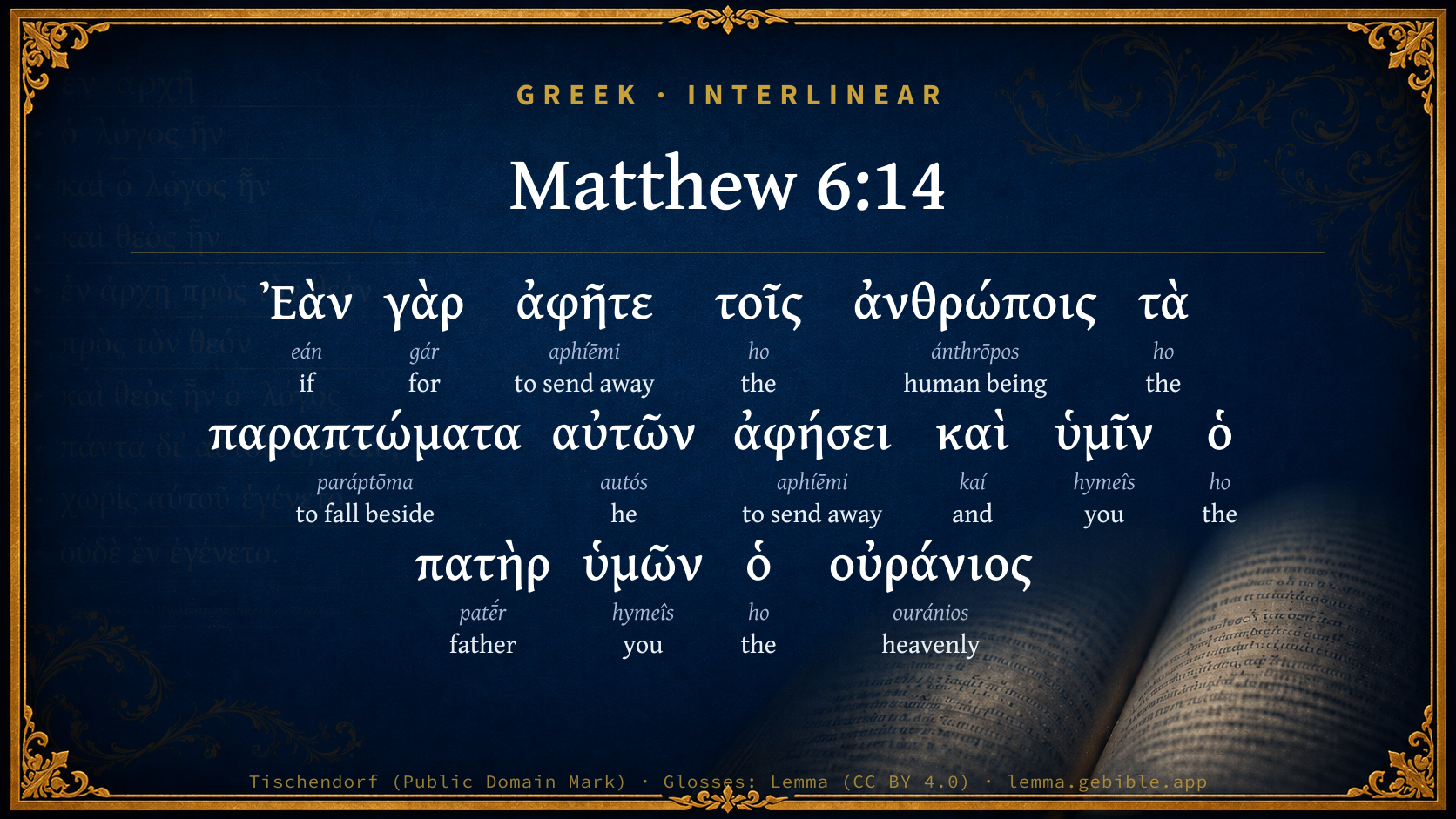
Download image
Cite this verse

Matthew 6:14 (World English Bible). Public Domain. Lemma interlinear Bible study tool, https://lemma.gebible.app/v/matthew/6/14.

Show BibTeX & RIS
BibTeX
RIS
English Translation
"For if you forgive men their trespasses, your heavenly Father will also forgive you.
World English Bible · Public Domain
Highlights
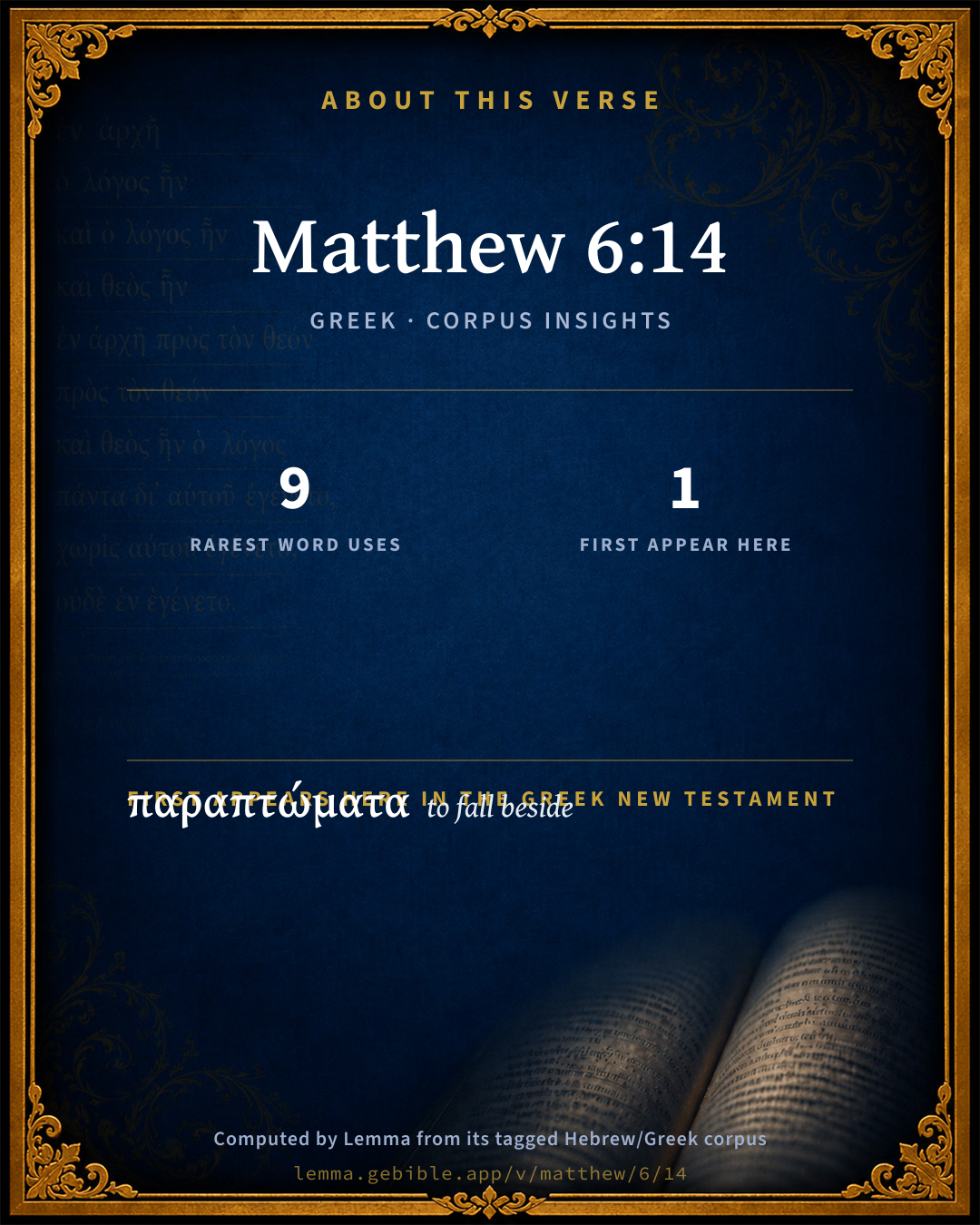
  • 1 first appearance in the Greek New Testament
Full analysis ↓
Download a study sheet

One document with this verse’s original text, its word-by-word gloss line, the meaning frame, cross-references with their text, attributed commentary, and full source and license credits — printable, and it pastes into notes with its structure intact.

This verse Autodidact and up

Study sheet (.html) Plain text (.txt)

A passage Seminary Student

Up to 50 verses in one chapter. A passage sheet keeps up to 6 commentary sources and 12 cross-references per verse, in the order this page ranks them, and says so on the sheet whenever that leaves anything out. Ask for a single verse and you get the Autodidact verse sheet above.

Everything on this page stays free to read, with no account — the sheet is a download of what is already on screen, not access to it.

Want to remove ads? Support Godless Engineer
Compare translations 3

The same verse in 3 English versions, stacked beneath the original-language interlinear above. Click any original word for its lexicon entry.

Each is an independent rendering of the whole verse — the interlinear is not word-aligned to these translations.

Highlighted words mark where these versions differ — a whole-verse word diff, not a word-by-word alignment.

  • World English Bible Public Domain
    "For if you forgive men their trespasses, your heavenly Father will also forgive you.
  • King James Version Public Domain
    For if ye forgive men their trespasses, your heavenly Father will also forgive you:
  • unfoldingWord Literal Text CC BY-SA 4.0
    For if you forgive men their trespasses, your heavenly Father will also forgive you.

unfoldingWord Literal Text — © unfoldingWord, licensed CC BY-SA 4.0. Word-aligned USFM3 via Door43 (git.door43.org/unfoldingWord/en_ult).

Versions to compare (up to 4)

3 of 4 selected

Show all 19 translations

Every available English version of this verse, each an independent rendering of the whole verse.

  • World English Bible Public Domain
    "For if you forgive men their trespasses, your heavenly Father will also forgive you.
  • Berean Standard Bible Public Domain
    For if you forgive men their trespasses, your heavenly Father will also forgive you.
  • Majority Standard Bible Public Domain
    For if you forgive men their trespasses, your heavenly Father will also forgive you.
  • King James Version Public Domain
    For if ye forgive men their trespasses, your heavenly Father will also forgive you:
  • American Standard Version (1901) Public Domain
    For if ye forgive men their trespasses, your heavenly Father will also forgive you.
  • Revised Version (1885) Public Domain
    For if ye forgive men their trespasses, your heavenly Father will also forgive you.
  • Geneva Bible (1599) Public Domain
    For if ye doe forgiue men their trespasses, your heauenly Father will also forgiue you.
  • Douay-Rheims (1899) Public Domain
    For if you will forgive men their offences, your heavenly Father will forgive you also your offences.
  • Young's Literal Translation Public Domain
    `For, if ye may forgive men their trespasses He also will forgive you -- your Father who `is' in the heavens;
  • Literal Standard Version CC BY-SA 4.0
    For if you may forgive men their trespasses He also will forgive you—your Father who [is] in the heavens;
  • Unlocked Literal Bible CC BY-SA 4.0
    For if you forgive people their trespasses, your heavenly Father will also forgive you.
  • unfoldingWord Literal Text CC BY-SA 4.0
    For if you forgive men their trespasses, your heavenly Father will also forgive you.
  • Darby Bible Public Domain
    For if ye forgive men their offences, your heavenly Father also will forgive you [yours],
  • World Messianic Bible Public Domain
    “For if you forgive men their trespasses, your heavenly Father will also forgive you.
  • Webster's Bible Public Domain
    For, if ye forgive men their trespasses, your heavenly Father will also forgive you:
  • Free Bible Version CC BY-SA 4.0
    For if you forgive those who sin against you, your heavenly Father will also forgive you.
  • Bible in Basic English Public Domain
    For if you let men have forgiveness for their sins, you will have forgiveness from your Father in heaven.
  • Text-Critical English NT CC BY 4.0
    For if you forgive others their trespasses, your heavenly Father will also forgive you.
  • Tyndale New Testament (1534) Public Domain
    For and yf ye shall forgeve other men their treaspases youre hevenly father shall also forgeve you.

Literal Standard Version (2020), Covenant Press — licensed CC BY-SA 4.0. Text via the HelloAO Bible API (eBible.org). Unlocked Literal Bible (unfoldingWord) — licensed CC BY-SA 4.0. Text via the HelloAO Bible API (eBible.org). unfoldingWord Literal Text — © unfoldingWord, licensed CC BY-SA 4.0. Word-aligned USFM3 via Door43 (git.door43.org/unfoldingWord/en_ult). Free Bible Version, Dr. Jonathan Gallagher — licensed CC BY-SA 4.0. Text via the HelloAO Bible API (eBible.org).

Word by word

More ways to search: Search by grammar → Find every occurrence → Compare this word →

Practice this passage: Drill this verse → Learn its vocabulary →

οὐράνιος
ouránios
G3770
“heavenly”
Adjective, Nominative, Singular, Masculine
Part of Speech
Adjective
Case
Nominative
Number
Singular
Gender
Masculine
Full Thayer's Definition

Origin: from G3772

TDNT: 13:56,7

1. heavenly a. dwelling in heaven b. coming from heaven
  1. Ἐὰν eán G1437 “if” Conditional
  2. γὰρ gár G1063 “for” Conjunction
  3. ἀφῆτε aphíēmi G863 “to send away” Verb, Aorist, Active, Subjunctive, 2nd person, Plural
  4. τοῖς ho G3588 “the” Article, Dative, Plural, Masculine
  5. ἀνθρώποις ánthrōpos G444 “human being” Noun, Dative, Plural, Masculine
  6. τὰ ho G3588 “the” Article, Accusative, Plural, Neuter
  7. παραπτώματα paráptōma G3900 “to fall beside” Noun, Accusative, Plural, Neuter
  8. αὐτῶν autós G846 “he” Personal pronoun, Genitive, Plural, Masculine
  9. ἀφήσει aphíēmi G863 “to send away” Verb, Future, Active, Indicative, 3rd person, Singular
  10. καὶ kaí G2532 “and” Conjunction
  11. ὑμῖν hymeîs G5210 “you” Personal pronoun, 2nd person, Dative, Plural
  12. ὁ ho G3588 “the” Article, Nominative, Singular, Masculine
  13. πατὴρ patḗr G3962 “father” Noun, Nominative, Singular, Masculine
  14. ὑμῶν hymeîs G5210 “you” Personal pronoun, 2nd person, Genitive, Plural
  15. ὁ ho G3588 “the” Article, Nominative, Singular, Masculine

About this verse

These counts appear in no published source. They are computed here, from the morphology-tagged text and Lemma’s own curated glosses. What Lemma adds →

16
words
11
distinct lemmas
Gospels
section

Notable vocabulary

The rarest word here is οὐράνιος heavenly G3770 — appearing just 9 times in the whole Greek New Testament.

First appearance in Scripture

This word makes its first canonical appearance in the Greek New Testament here:

  • παραπτώματα to fall beside G3900

Shared distinctive vocabulary

οὐράνιος heavenly G3770 occurs in 9 verses of the Greek New Testament. Also found in:
Repetition

Words recur within this verse:

  • ἀφῆτε to send away G863 ×2
  • τοῖς the G3588 ×4
  • ὑμῖν you G5210 ×2

Cross-references

9

Topical passages linked to Matthew 6:14 in the Treasury of Scripture Knowledge — connected by theme and wording, ordered by reader-vote popularity; previews shown in the World English Bible.

  • Ephesians 4:32 And be kind to one another, tenderhearted, forgiving each other, just as God also in Christ forgave you.
  • Mark 11:25 Whenever you stand praying, forgive, if you have anything against anyone; so that your Father, who is in heaven, may also forgive you your transgressions.
  • Colossians 3:13 bearing with one another, and forgiving each other, if any man has a complaint against any; even as Christ forgave you, so you also do.
  • Matthew 7:2 For with whatever judgment you judge, you will be judged; and with whatever measure you measure, it will be measured to you.
  • James 2:13 For judgment is without mercy to him who has shown no mercy. Mercy triumphs over judgment.
  • Matthew 18:21–35 Then Peter came and said to him, "Lord, how often shall my brother sin against me, and I forgive him? Until seven times?"
  • Matthew 6:12 Forgive us our debts, as we also forgive our debtors.
  • Proverbs 21:13 Whoever stops his ears at the cry of the poor, He will also cry out, but shall not be heard.
  • 1 John 3:10 In this the children of God are revealed, and the children of the devil. Whoever doesn't do righteousness is not of God, neither is he who doesn't love his brother.

Cross-references courtesy of OpenBible.info (CC BY 4.0).

Commentary

Notes on Matthew 6:14 from classic Christian and Jewish commentators (each source and its license shown beneath its notes). The classic Christian expositions comment on the surrounding passage and are grouped to its opening verse, so a note may address several verses; the Jewish commentaries on the Tanakh (Rashi and others) are per-verse, so they appear only where the commentator wrote on this verse.

Lemma curates 59 commentaries, every one of them public domain or Creative Commons licensed, each selected and text-cleaned for this edition rather than reprinted as found. About our sources →

The Biblical Illustrator

Joseph S. Exell

Mat_6:14

If ye forgive men.

Mutual forgiveness

I. All mankind as transgressors are deeply indebted to Gods law.

II. That if ever man be saved it must be by an act of pure mercy.

III. That the Scriptural character of the Almighty encourages us to confide in him for forgiveness.

1. Because the love of God has laid such a foundation for its exercise.

2. It is seen in the earnestness of His invitations.

3. In the promises of His word.

4. In the persons whom He has saved;

(1) their number;

(2) their character.

IV. That however free the mercy of God is to man, A merciful disposition towards our fellow-creatures is necessary to its enjoyment.

1. It cannot, according to the general tenour of Scripture, condemn self-defence by lawful means.

2. There is a connection between forgiving and being forgiven.

3. Reason establishes this connection. (J. E. Good.)

Those who do not forgive others should never sin themselves

The Rev. J. Wesley, in the course of his voyage to America, hearing an unusual noise in the cabin of General Oglethorpe, the Governor of Georgia, with whom he sailed, stepped in to inquire the cause of it. The General addressed him: Mr. Wesley, you must excuse me; I have met with a provocation too great for man to bear. You know, the only wine I drink is Cyprus wine; I therefore provided myself with several dozens of it, and this villain, Grimaldi (his foreign valet, who was present, and almost dead with fear) has drunk up the whole of it: but I will be revenged on him. I have ordered him to be tied hand and foot, and be carried to the man-of-war which sails with us. The rascal should have taken care how he used me so, for I never forgive. Then I hope, sir, said Wesley, looking calmly at him, you never sin. The General was quite confounded at the reproof; and putting his hand into his pocket, took out a bunch of keys, which he threw at Grimaldi. There, villain, said he, take my keys and behave better for the future.

The Biblical Illustrator, edited by Joseph S. Exell (c. 1880s–1900s) — public domain. Text from a community e-Sword module.

Joseph Benson's Commentary

Mat 6:14. If ye forgive men their trespasses, your heavenly Father will also forgive you — We are not to infer from this, that the forgiving of injuries alone will entitle us to pardon. Surely not. Repentance toward God, and fruits worthy of repentance, as also faith in our Lord Jesus Christ, working by love, overcoming the world, and purifying the heart, are absolutely necessary, as is frequently stated elsewhere in the discourses of our Lord, and in the writings of the apostles and evangelists.

Joseph Benson's Commentary on the Old and New Testaments (1811–1818) — public domain. Text from a community e-Sword module.

Bengel's Gnomon

Johann Albrecht Bengel

Mat 6:14. Γὰρ, for) referring to the twelfth verse. See of how much account it is to forgive our neighbour. Of the seven petitions, one alone, the fifth, has a certain condition or restriction, as we also; the reason of this is, therefore, added in the present verse.

Bengel's Gnomon of the New Testament — English translation (T&T Clark, Edinburgh, 1860) — public domain. Text from a community e-Sword module.

Meyer's Critical & Exegetical Commentary

Heinrich August Wilhelm Meyer

Mat_6:14 f. Γάρ] points back to Mat_6:12, the subject of which is now further discussed.

ἀφήσει] like the preceding ἀφῆτε, placed first to render it emphatic. For the thought, the fundamental basis of which was stated in Mat_6:14 ff., comp. Sir_28:2 ff.

Meyer — Critical and Exegetical Commentary on the New Testament — English translation by Peter Christie, edited by Frederick Crombie (T&T Clark, 1880) — public domain. Text from a community e-Sword module.

Geneva Bible (1599)

Geneva Bible translators

They that forgive wrongs, to them sins are forgiven, but revenge is prepared for them that revenge.

Geneva Bible (1599) marginal notes — public domain. Text via Bolls.life.

Jamieson, Fausset & Brown

Robert Jamieson, A. R. Fausset & David Brown

For if ye forgive men, &c.--See on Mat 6:12.

Jamieson, Fausset & Brown — Commentary Critical and Explanatory on the Whole Bible (1871) — public domain (CC PDM 1.0). Text via the HelloAO Bible API.

Adam Clarke's Commentary

Verse 14. If ye forgive men] He who shows mercy to men receives mercy from God. For a king to forgive his subjects a hundred millions of treasons against his person and authority, on this one condition, that they wilt henceforth live peaceably with him and with each other, is what we shall never see; and yet this is but the shadow of that which Christ promises on his Father's part to all true penitents. A man can have little regard for his salvation, who refuses to have it on such advantageous terms. See Quesnel.

Adam Clarke's Commentary on the Bible (1810–1826) — public domain. Text from a community e-Sword/MySword module.

Ellicott's Commentary for English Readers

(14, 15) The condition implied in the Prayer itself is more distinctly asserted. It is, as we have seen, not an arbitrary condition, but the result of the eternal laws of the divine order. Repentance is the condition of being forgiven, and the temper that does not forgive is ipso facto incompatible with the temper of the penitent. As if for greater emphasis, the truth is presented in both its positive and negative aspects.

A Bible Commentary for English Readers, edited by Charles John Ellicott (1878–1897) — public domain. Text from a community e-Sword module.

John Gill's Exposition

For if ye forgive men their trespasses,.... Christ here refers to the petition in Mat 6:12 which is enforced with this reason and argument, "as", or "for", so Luk 11:4 "we forgive our debtors"; which he repeats and explains: and the reason why he singles out this particularly is, because he knew the Jews were a people very subject to revenge; and were very hardly brought to forgive any injuries done them: wherefore Christ presses it upon them closely to "forgive men their trespasses"; all sorts of injuries done them, or offences given them, whether by word or deed; and that fully, freely, from the heart; forgetting, as well as forgiving; not upbraiding them with former offences; and even without asking pardon, and though there might be no appearance of repentance. Now to this he encourages by saying,

your heavenly Father will also forgive you; will hear your prayers, and manifest his forgiving love to you: not that the forgiveness of others is the procuring cause of forgiveness with God, which is the blood of Christ; or of the manifestation and application of it, that is, the advocacy of Christ; nor the moving cause of it, that is, the free grace of God: but this enters into the character, and is descriptive of the persons, to whom God is pleased to make a comfortable discovery, and give a delightful sense of his pardoning grace; such persons, so disposed and assisted by his grace, may expect it of him.

John Gill's Exposition of the Whole Bible (1746–1763) — public domain (CC PDM 1.0). Text via the HelloAO Bible API.

Trapp's Complete Commentary

John Trapp

14 For if ye forgive men their trespasses, your heavenly Father will also forgive you:

Ver. 14. For if ye forgive men their trespasses] Our Saviour resumeth, and inculcateth the fifth petition with a repetition; because upon charity (which is chiefly seen in giving and forgiving) hangeth, after a sort, the restful success of all our suits, 2Ti 2:8. Malice is a leaven that swells the heart and sours the sacrifice, 1Co 5:7-8. Out with it, therefore, that we may keep the feast or holy day (εορταζωμεν); that we may (as we ought to do) keep a constant jubilee, nexus solvendo, et noxus remittendo. This flesh and blood will not easily yield to. But we are not debtors to the flesh, Rom 8:12; we owe it nothing, but the blue eye that St Paul gave it, 1Co 9:27, υπωπαιζω. When Peter heard that he might not recompense to any evil for evil, but most studiously seek his conversion and salvation, "Lord," saith he, "how often shall my brother sin against me, and I forgive him? till seven times?" this he thought a mighty deal, a very high pitch of perfection. Our Saviour tells him, till seventy times seven times, that is, infinitely, and without stint: yet he alludes to Peter’s seven, and, as it were, derides it, and his rashness in setting bounds to this duty and prescribing how often to him that was the wisdom of the Father.

This happens when my brother returneth and saith, It repents me. But what if he does not?

In forgiving an offender, say divines, there are three things: 1. The letting fall all wrath and desire of revenge. 2. A solemn profession of forgiveness. 3. Re-acceptance into former familiarity. The first must be done however. For the second, if he say, I repent, I must say, I remit, Luk 18:22. To the third a man is bound till satisfaction be given.

Your heavenly Father will also forgive you] Yet is not our forgiving men the cause of his forgiving us, but a necessary antecedent. The cause is only the free mercy of God in Christ. He puts away our iniquities for his own sake, Isa 43:25. Nevertheless, forasmuch as he hath made us this promise here, our forgiving others (saith learned Beza) seemeth to have the nature of an intervenient cause, a cause, sine qua non, of his forgiving us. (Annot. in Luk 11:4)

John Trapp, A Commentary or Exposition upon All the Books of the Old and New Testament (1647–1656) — public domain. Text from a community e-Sword module.

Albert Barnes' Notes on the Bible

For if ye forgive men their trespasses - If ye forgive others when they offend or injure you.

Your heavenly Father will also forgive you - This is constantly required in the Bible. See the notes at Mat 6:12. Our Saviour says we should forgive even if the offence be committed seventy times seven times, Mat 18:22. By this is meant, that when a man asks forgiveness, we are cordially and forever to pardon the offence; we are to declare our willingness to forgive him. If he does not ask forgiveness, yet we are still to treat him kindly; not to harbor malice, not to speak ill of him, to be ready to do him good, and be always prepared to declare him forgiven when he asks it, and if we are not ready and willing to forgive him; we are assured that God will not forgive us.

Albert Barnes' Notes on the Bible (1834–1885) — public domain. Text from a community e-Sword/MySword module.

Haydock's Catholic Bible Commentary

Here he again recommendeth the forgiving of others, as the means of obtaining forgiveness. (Haydock)

George Leo Haydock (1774–1849), Haydock's Catholic Family Bible and Commentary, 1859 edition — public domain. Excludes Psalms (Douay-Rheims chapter numbering differs from Protestant) and Deuterocanonical books (Catholic canon only).

Matthew Poole's English Annotations

Not that our mere forgiving our brethren the injuries done unto us is all that God requireth of us in order to the forgiveness we expect from him, the contrary is plain from several other texts, Joh 3:18,36; Ac 2:38; 16:31 &c.; but that without this forgiveness of our brethren, God will not forgive us, Mat 18:35. It is one piece of that obedience which we owe to God, and also of our gratitude, without the performance of which it is vain for us to hope for forgiveness from God.

Matthew Poole's English Annotations on the Holy Bible (1683–1685) — public domain. Text from a community e-Sword/MySword module.

The Pulpit Commentary

Vers. 14, 15. For if ye forgive men their trespasses, etc. Matthew only. To insert the reason for having said, in the Lord"s Prayer, "as we forgive our debtors," emphasizes the necessity of such forgiveness. (cf. also Mat_18:21, sqq.; Mar_11:25; Ecc 28:2-4) Trespasses; paraptwmata , not ofeilhmata (ver. 12). Our Lord uses a word which would forbid any limitation to pecuniary matters. Their trespasses. Omitted by Tischendorf, and bracketed by Westcott and Hort (cf. their "Introd.," p. 176). The omission more sharply contrasts "men" and "your Father."

The Pulpit Commentary (1880–1919), ed. H.D.M. Spence-Jones & Joseph S. Exell — public domain. Text from a community e-Sword module.

John Wesley's Explanatory Notes

Mark xi, 25.

John Wesley, Explanatory Notes Upon the Whole Bible (1754–1765) — public domain. Text via the GEBible commentary corpus.

Kretzmann's Popular Commentary

Paul E. Kretzmann

A necessary warning:

v. 14. For if ye forgive men their trespasses, your heavenly Father will also forgive you.

v. 15. But if ye forgive not men their trespasses, neither will your Father forgive your trespasses.

The hearing of our prayer, the granting of the benefits asked for, hinges upon our being in the right relation toward God, which is brought about by the assurance and the certainty of the forgiveness of sins. And this, in turn, depends upon the manner in which we show proofs of the right condition of our hearts toward the neighbor. Our sins toward God were called debts, and these are piled up with horrible swiftness. Our neighbor’s sins toward us are described as mere stumblings or faults in performing his duty. To be vindictive under such circumstances is folly in itself, and argues that the mercy of God is not appreciated. If we really desire the forgiveness of God, we must first show that we realize our own sinfulness and its damnableness by forgiving our neighbor his faults.

Paul E. Kretzmann, Popular Commentary of the Bible (1921–1924) — public domain. Text from a community e-Sword module.

Burkitt's Expository Notes on the New Testament

William Burkitt

There being no duty to which our corrupt natures are more backward than this of forgiving injuries, our Saviour repeats that duty over and over, and frequently inculcates it in the holy Gospels; assuring us, that forgiving others is the indispensable condition upon which we are to expect forgiveness from God.

Learn thence, That every time we go to God in prayer, and beg forgiveness of him, as we forgive others; if we do not forgive them heartily and sincerely, fully and freely, readily and willingly, we fly in the face of God, and our prayers are a sort of imprecations against ourselves.

Note farther, That although God promises us forgiveness if we forgive others; yet it is with this limitation, of no other condition of salvation be wanting, for this virtue alone cannot obtain favour with God, unless other duties are performed.

William Burkitt's Expository Notes on the New Testament (1700–1703) — public domain. Text from a community e-Sword module.

The People's New Testament

B. W. Johnson

14, 15. For if ye forgive men … your heavenly Father will forgive you. Our Lord makes it a condition of our obtaining forgiveness, that we shall have a merciful, forgiving spirit.

B. W. Johnson's The People's New Testament with Notes (1889–1891) — public domain. Electronic text from the Christian Classics Ethereal Library (CCEL) ThML edition.

unfoldingWord translationNotes

Door43 World Missions Community

General Information:

All instances of "you" and "your" are plural. However, Jesus is telling them what will happen to them as individuals if each person does not forgive others. (See: Forms of You)

their trespasses ... your trespasses

The abstract noun "trespasses" can be translated as a verb. AT: "when they trespass against you ... when you trespass against God" or "when they do things that harm you ... when you do things that make your Father angry" (See: Abstract Nouns)

Father

This is an important title for God. (See: Translating Son and Father)

translationWords

forgive

God the Father

unfoldingWord translationNotes — © Distant Shores Media and the Door43 World Missions Community, licensed CC BY-SA 4.0. Source: git.door43.org/Door43/en_tn.

Cambridge Greek Testament for Schools and Colleges

14. παραπτώματα. Another conception of sin, either (1) a false step, a blunder, or (2) a fall beside the way (cp. παραπεσόντες, Heb 6:6), so a transgression. In ὀφειλήματα sin is viewed in its aspect toward another, in παραπτώματα in its relation to the offender himself, παράπτωμα is later and rarer than παράπτωσις. Polybius uses the word with the same meaning as in the text; in Diod. Sic. it means ‘a defeat.’ For the force of παρὰ cp. παρακόπτειν and παράσημος of coins struck on the side instead of in the centre.

Cambridge Greek Testament for Schools and Colleges (Cambridge University Press, 1896; 21 vols, various authors incl. Carr, Maclear, Plummer, Farrar, Lumby, Moule, M. R. James, Simcox) — public domain. Text from a community e-Sword module.

International Critical Commentary

14. For if ye forgive men their trespasses, your heavenly Father will also forgive you.]

Similar words occur in Mar 11:25 “And when ye stand praying, forgive, if ye have anything against any one: that your Father who is in heaven may forgive you your trespasses.” Mt. has omitted them in the parallel to that passage, if indeed they stood in his copy of Mk. He inserts them here with the next verse from the Logia; cf. also 18:35.

(L)

International Critical Commentary — older volumes (1896–1929), various authors — public domain. Text from a community e-Sword module.

Vincent's Word Studies in the New Testament

Marvin R. Vincent

Trespasses [παραπτωματα] . The Lord here uses another word for sins, and still another [αμαρτιας] appears in Luke's version of the prayer, though he also says, "every one that is indebted to us." There is no difficulty in supposing that Christ, contemplating sins in general, should represent them by different terms expressive of different aspects of wrong - doing (see on Mt 1:21). This word is derived from parapiptw, to fall or thrown one's self beside. Thus it has a sense somewhat akin to aJmartia, of going beside a mark, missing. In classical Greek the verb is often used of intentional falling, as of throwing one's self upon an enemy; and this is the prevailing sense in biblical Greek, indicating reckless and wilful sin (see 1Ch 5:25; 1Ch 10:13; 2Ch 26:18; 2Ch 29:6, 19; Eze 14:13; Eze 28:26). It does not, therefore, imply palliation or excuse. It is a conscious violation of right, involving guilt, and occurs therefore, in connection with the mention of forgiveness (Rom 4:25; Rom 5:16; Col 2:13; Eph 2:1, 5). Unlike parabasiv (transgression), which contemplates merely the objective violation of law, it carries the thought of sin as affecting the sinner, and hence is found associated with expressions which indicate the consequences and the remedy of sin (Rom 4:25; Rom 5:15, 17; Eph 2:1).

Marvin R. Vincent, Word Studies in the New Testament (1887–1900) — public domain. Text from a community e-Sword/MySword module.

Lesson kit

Teaching starters — assembled from the data on this page, not authored interpretation. Every prompt links to the verse data it draws on. Edit before teaching.

Matthew, in the Gospels, opens this verse with 16 words (11 distinct Greek lemmas). Its most distinctive word is ouránios (“heavenly”). A historical commentator’s framing appears above. Read the whole chapter for the surrounding context.

Discussion questions

  1. What does “heavenly” (ouránios) contribute to the verse as a whole?
  2. This is the first place “to fall beside” appears in Scripture (first appears here). What does its debut here establish?
  3. How does Matthew 5:48, which shares the word «heavenly», read alongside this verse?
  4. What does the repetition of “to send away” (2× in this one verse) do in this verse?
  5. Compare how The Biblical Illustrator and Joseph Benson's Commentary read this verse. Where do they agree or differ?

Things to notice

  • 1 word makes its first canonical appearance in Scripture here.
  • “to send away” occurs 2× in this single verse.
  • 11 distinct Greek lemmas span 16 words in this verse.

Reading settings

Reading text

Shown beneath each verse's original-language words.

Old Testament
Old Testament edition

Read the OT as the Masoretic Hebrew (MT) or the Greek Septuagint (LXX).

English shown for the Greek Septuagint (in the Hebrew ↔ Greek comparison).

Comparing translations? Open the Compare panel on any verse page to stack up to four side by side.