
Luke 1:59

Greek (Tischendorf 8th ed.) Luke 1:59 appears in the Greek New Testament. The text above is from the Tischendorf 8th edition. Each word links to its Strong’s number and a concise gloss. Click any word for its full Thayer’s Greek Lexicon entry.
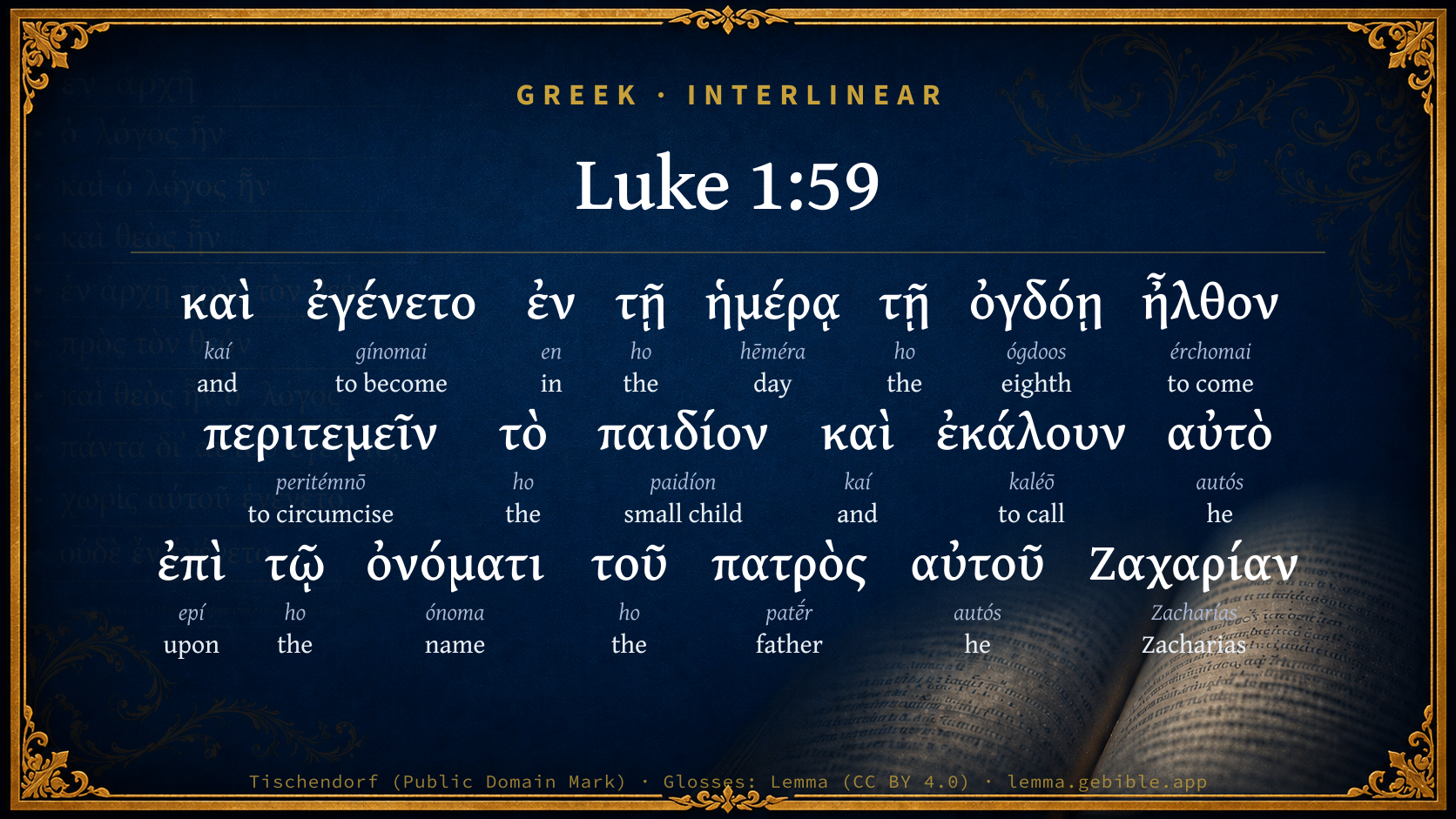
Download image
Cite this verse

Luke 1:59 (World English Bible). Public Domain. Lemma interlinear Bible study tool, https://lemma.gebible.app/v/luke/1/59.

Show BibTeX & RIS
BibTeX
RIS
English Translation
It happened on the eighth day, that they came to circumcise the child; and they would have called him Zacharias, after the name of the father.
World English Bible · Public Domain
Highlights
  • 2 first appearances in the Greek New Testament
Full analysis ↓
Download a study sheet

One document with this verse’s original text, its word-by-word gloss line, the meaning frame, cross-references with their text, attributed commentary, and full source and license credits — printable, and it pastes into notes with its structure intact.

This verse Autodidact and up

Study sheet (.html) Plain text (.txt)

A passage Seminary Student

Up to 50 verses in one chapter. A passage sheet keeps up to 6 commentary sources and 12 cross-references per verse, in the order this page ranks them, and says so on the sheet whenever that leaves anything out. Ask for a single verse and you get the Autodidact verse sheet above.

Everything on this page stays free to read, with no account — the sheet is a download of what is already on screen, not access to it.

Want to remove ads? Support Godless Engineer
Compare translations 3

The same verse in 3 English versions, stacked beneath the original-language interlinear above. Click any original word for its lexicon entry.

Each is an independent rendering of the whole verse — the interlinear is not word-aligned to these translations.

Highlighted words mark where these versions differ — a whole-verse word diff, not a word-by-word alignment.

  • World English Bible Public Domain
    It happened on the eighth day, that they came to circumcise the child; and they would have called him Zacharias, after the name of the father.
  • King James Version Public Domain
    And it came to pass, that on the eighth day they came to circumcise the child; and they called him Zacharias, after the name of his father.
  • unfoldingWord Literal Text CC BY-SA 4.0
    And it happened that, on the eighth day, they came to circumcise the child, and they were going to call after the name of his father, Zechariah.

unfoldingWord Literal Text — © unfoldingWord, licensed CC BY-SA 4.0. Word-aligned USFM3 via Door43 (git.door43.org/unfoldingWord/en_ult).

Versions to compare (up to 4)

3 of 4 selected

Show all 19 translations

Every available English version of this verse, each an independent rendering of the whole verse.

  • World English Bible Public Domain
    It happened on the eighth day, that they came to circumcise the child; and they would have called him Zacharias, after the name of the father.
  • Berean Standard Bible Public Domain
    On the eighth day, when they came to circumcise the child, they were going to name him after his father Zechariah.
  • Majority Standard Bible Public Domain
    On the eighth day, when they came to circumcise the child, they were going to name him after his father Zechariah.
  • King James Version Public Domain
    And it came to pass, that on the eighth day they came to circumcise the child; and they called him Zacharias, after the name of his father.
  • American Standard Version (1901) Public Domain
    And it came to pass on the eighth day, that they came to circumcise the child; and they would have called him Zacharias, after the name of the father.
  • Revised Version (1885) Public Domain
    And it came to pass on the eighth day, that they came to circumcise the child; and they would have called him Zacharias, after the name of his father.
  • Geneva Bible (1599) Public Domain
    And it was so that on the eight day they came to circumcise the babe, and called him Zacharias after the name of his father.
  • Douay-Rheims (1899) Public Domain
    And it came to pass, that on the eighth day they came to circumcise the child, and they called him by his father's name Zachary.
  • Young's Literal Translation Public Domain
    And it came to pass, on the eighth day, they came to circumcise the child, and they were calling him by the name of his father, Zacharias,
  • Literal Standard Version CC BY-SA 4.0
    And it came to pass, on the eighth day, they came to circumcise the child, and they were calling him by the name of his father, Zacharias,
  • Unlocked Literal Bible CC BY-SA 4.0
    Now it happened on the eighth day that they came to circumcise the child. They would have called him “Zechariah,” after the name of his father.
  • unfoldingWord Literal Text CC BY-SA 4.0
    And it happened that, on the eighth day, they came to circumcise the child, and they were going to call after the name of his father, Zechariah.
  • Darby Bible Public Domain
    And it came to pass on the eighth day they came to circumcise the child, and they called it after the name of his father, Zacharias.
  • World Messianic Bible Public Domain
    On the eighth day, they came to circumcise the child; and they would have called him Zechariah, after the name of his father.
  • Webster's Bible Public Domain
    And it came to pass, that on the eighth day they came to circumcise the child; and they called him Zacharias, after the name of his father.
  • Free Bible Version CC BY-SA 4.0
    Eight days later they came to circumcise the boy. They planned to call him Zechariah after his father.
  • Bible in Basic English Public Domain
    And on the eighth day they came to see to the circumcision of the child, and they would have given him the name of Zacharias, his father's name;
  • Text-Critical English NT CC BY 4.0
    On the eighth day they came to circumcise the child, and they were going to name him Zechariah, after his father.
  • Tyndale New Testament (1534) Public Domain
    And it fortuned the eyght daye: they cam to circumcise the chylde: and called his name zacharias after the name of his father.

Literal Standard Version (2020), Covenant Press — licensed CC BY-SA 4.0. Text via the HelloAO Bible API (eBible.org). Unlocked Literal Bible (unfoldingWord) — licensed CC BY-SA 4.0. Text via the HelloAO Bible API (eBible.org). unfoldingWord Literal Text — © unfoldingWord, licensed CC BY-SA 4.0. Word-aligned USFM3 via Door43 (git.door43.org/unfoldingWord/en_ult). Free Bible Version, Dr. Jonathan Gallagher — licensed CC BY-SA 4.0. Text via the HelloAO Bible API (eBible.org).

Word by word

More ways to search: Search by grammar → Find every occurrence → Compare this word →

Practice this passage: Drill this verse → Learn its vocabulary →

ὀγδόῃ
ógdoos
G3590
“eighth”
Adjective, Dative, Singular, Feminine
Part of Speech
Adjective
Case
Dative
Number
Singular
Gender
Feminine
Full Thayer's Definition

Origin: from G3638

TDNT: None

1. the eighth
  1. καὶ kaí G2532 “and” Conjunction
  2. ἐγένετο gínomai G1096 “to become” Verb, Aorist, Middle deponent, Indicative, 3rd person, Singular
  3. ἐν en G1722 “in” Preposition
  4. τῇ ho G3588 “the” Article, Dative, Singular, Feminine
  5. ἡμέρᾳ hēméra G2250 “day” Noun, Dative, Singular, Feminine
  6. τῇ ho G3588 “the” Article, Dative, Singular, Feminine
  7. ἦλθον érchomai G2064 “to come” Verb, Aorist, Active, Indicative, 3rd person, Plural
  8. περιτεμεῖν peritémnō G4059 “to circumcise” Verb, Aorist, Active, Infinitive
  9. τὸ ho G3588 “the” Article, Accusative, Singular, Neuter
  10. παιδίον paidíon G3813 “small child” Noun, Accusative, Singular, Neuter
  11. καὶ kaí G2532 “and” Conjunction
  12. ἐκάλουν kaléō G2564 “to call” Verb, Imperfect, Active, Indicative, 3rd person, Plural
  13. αὐτὸ autós G846 “he” Personal pronoun, Accusative, Singular, Neuter
  14. ἐπὶ epí G1909 “upon” Preposition
  15. τῷ ho G3588 “the” Article, Dative, Singular, Neuter
  16. ὀνόματι ónoma G3686 “name” Noun, Dative, Singular, Neuter
  17. τοῦ ho G3588 “the” Article, Genitive, Singular, Masculine
  18. πατρὸς patḗr G3962 “father” Noun, Genitive, Singular, Masculine
  19. αὐτοῦ autós G846 “he” Personal pronoun, Genitive, Singular, Masculine
  20. Ζαχαρίαν Zacharías G2197 “Zacharias” Noun, Accusative, Singular, Masculine

About this verse

These counts appear in no published source. They are computed here, from the morphology-tagged text and Lemma’s own curated glosses. What Lemma adds →

21
words
15
distinct lemmas
Gospels
section

Notable vocabulary

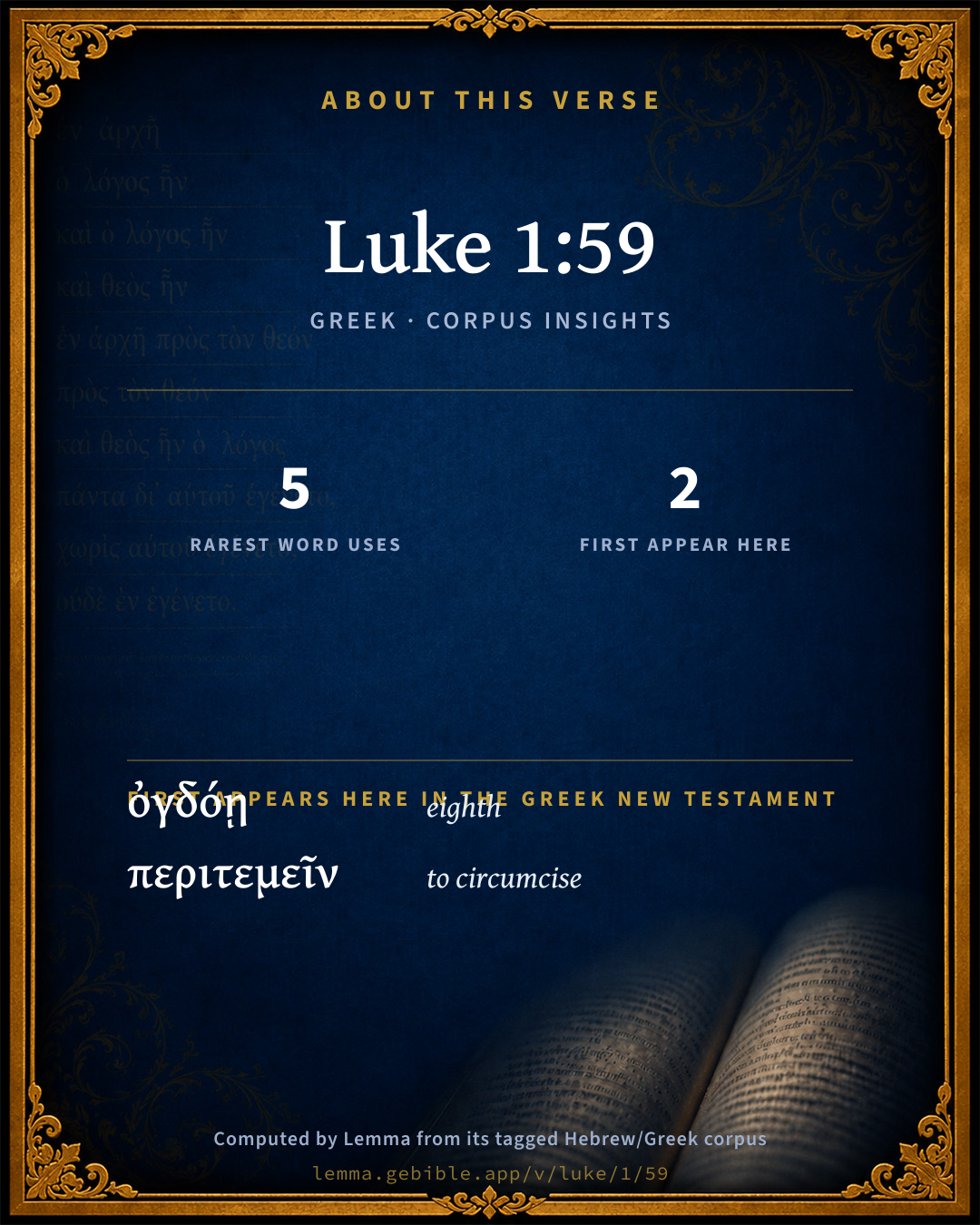
The rarest word here is ὀγδόῃ eighth G3590 — appearing just 5 times in the whole Greek New Testament.

First appearance in Scripture

These words make their first canonical appearance in the Greek New Testament here:

  • ὀγδόῃ eighth G3590
  • περιτεμεῖν to circumcise G4059

Shared distinctive vocabulary

ὀγδόῃ eighth G3590 occurs in 5 verses of the Greek New Testament. Also found in:
Repetition

Words recur within this verse:

Cross-references

6

Topical passages linked to Luke 1:59 in the Treasury of Scripture Knowledge — connected by theme and wording, ordered by reader-vote popularity; previews shown in the World English Bible.

  • Genesis 17:12 He who is eight days old will be circumcised among you, every male throughout your generations, he who is born in the house, or bought with money of any foreigner who is not of your seed.
  • Leviticus 12:3 In the eighth day the flesh of his foreskin shall be circumcised.
  • Luke 2:21 When eight days were fulfilled for the circumcision of the child, his name was called Jesus, which was given by the angel before he was conceived in the womb.
  • Philippians 3:5 circumcised the eighth day, of the stock of Israel, of the tribe of Benjamin, a Hebrew of Hebrews; concerning the law, a Pharisee;
  • Genesis 21:3–4 Abraham called his son who was born to him, whom Sarah bare to him, Isaac.
  • Acts 7:8 He gave him the covenant of circumcision. So Abraham became the father of Isaac, and circumcised him the eighth day. Isaac became the father of Jacob, and Jacob became the father of the twelve patriarchs.

Cross-references courtesy of OpenBible.info (CC BY 4.0).

Commentary

Notes on Luke 1:59 from classic Christian and Jewish commentators (each source and its license shown beneath its notes). The classic Christian expositions comment on the surrounding passage and are grouped to its opening verse, so a note may address several verses; the Jewish commentaries on the Tanakh (Rashi and others) are per-verse, so they appear only where the commentator wrote on this verse.

Lemma curates 59 commentaries, every one of them public domain or Creative Commons licensed, each selected and text-cleaned for this edition rather than reprinted as found. About our sources →

Tyndale Open Study Notes

Tyndale Open Resources

1:59 God commanded every Israelite male to be circumcised when eight days old (Gen 17:9-14; Lev 12:3). Circumcision signified the child’s incorporation into the covenant community of Israel. • They wanted to name him Zechariah: It was common to name a child after a relative. The family and friends were surprised because John was not the name of any of his relatives.

Tyndale Open Study Notes — © Tyndale Open Resources, licensed CC BY-SA 4.0. Text via the HelloAO Bible API.

Bengel's Gnomon

Johann Albrecht Bengel

Luk 1:59. Ἐπὶ τῷ ὀνόματι τοῦ πατρὸς αὐτοῦ, after the name of his father) This was not the custom among the Jews: but in this case an extraordinary cause moved the members of the family, inasmuch as John was to sustain the whole posterity of [was the sole representative to posterity of] Zacharias.

Bengel's Gnomon of the New Testament — English translation (T&T Clark, Edinburgh, 1860) — public domain. Text from a community e-Sword module.

Meyer's Critical & Exegetical Commentary

Heinrich August Wilhelm Meyer

Luk_1:59 f. With the circumcision was associated the giving of the name, Gen_21:3. See Ewald, Alterth. p. 110. Among the Greeks and Romans it took place on the dies lustricus. See Dougtaeus, Anal. II. p. 44 f.; Hermann, Privatalterth. § 32. 17.

ἦλθον] The subject is evident of itself, namely, the persons pertaining to the circumcision: amici ad eam rem vocati, Grotius. Any Israelite might be the circumciser (in case of necessity even a woman, Exo_4:25). See Lund, Heiligth., ed. Wolf, p. 949; Keil, Archäol. I. p. 307 f.

ἐκάλουν] They actually uttered this name (this took place immediately after the circumcision was performed; see Lund, l.c., Buxtorf, Synagog. 4): but the mother (for the father was still dumb) took exception to it, Luk_1:60. Vere enim incipit actus, sed ob impedimenta caret eventu, Schaefer, ad Phoen. 81; Buttmann, neut. Gr. p. 178 [E. T. 205].

The naming of the child after the father (Tob_1:9; Joseph. Antt. xiv. 1. 3) or after a relative (Luk_1:61; Lightfoot, p. 726) was very common, as it was also among the Greeks (Hermann, l.c. 18). On ἐπί, comp. Neh_7:63; Plut. Demetr. 2. The idea is: in reference to.

οὐχί, ἀλλὰ κληθ. Ἰωάνν.] The usual supposition (Paulus, Kuinoel, Ebrard, Bleek, following Calvin and others), that Zacharias after his return from the temple made known to Elizabeth by writing the words of the angel, Luk_1:13, is the more arbitrary, the less it is in keeping with the miraculous impress of the whole history. Theophylact is right in saying: ἡ δὲ Ἐλισάβετ ὡς προφῆτις ἐλάλησε περὶ τοῦ ὀνόματος; and Euthymius Zigabenus: ἐκ πνεύματος ἁγίου καὶ αὐτὴ τὸ ὄνομα τοῦ παιδὸς μεμάθηκε (comp. Origen and Ambrose), and this, indeed, at the moment of that ἐκάλουν, Luk_1:59, else it would not be easy to perceive why she should not at the very beginning have carried out the giving of the divinely-appointed name.

Meyer — Critical and Exegetical Commentary on the New Testament — English translation by Peter Christie, edited by Frederick Crombie (T&T Clark, 1880) — public domain. Text from a community e-Sword module.

Expositor's Greek Testament

ed. W. Robertson Nicoll

Luk 1:59 . ἦλθον , on the eighth, the legal day, they came , to circumcise the child; i.e. , those who were concerned in the function the person who performed the operation, and the relatives of the family. ἐκάλουν may be the imperfect of repeated action = they took for granted by repeated expressions that the name was to be Zechariah, or the conative imperfect indicating a wish which was frustrated.

The Expositor's Greek Testament, edited by W. Robertson Nicoll (1897–1910) — public domain. Text from a community e-Sword module.

Godet's Commentaries

Frédéric Louis Godet

2. Circumcision of John: Luk 1:59-66. As an Israelitish child by its birth became a member of the human family, so by circumcision, on the corresponding day of the following week, he was incorporated into the covenant (Genesis 17); and it was the custom on this occasion to give him his name. The subject of ἦλθον, came, is that of the preceding verse. It has been maintained that the text suggests something miraculous in the agreement of Elizabeth and Zacharias; as if, during the nine months which had just passed away, the father had not made to the mother a hundred times over the communication which he presently makes to all present (Luk 1:63)! How many times already, especially during Mary’s stay in their house, must the names of John and Jesus have been mentioned!

It has been inferred from the words, they made signs to him (Luk 1:62), that Zacharias became deaf as well as dumb. But the case of Zacharias cannot be assimilated to that of deaf mutes from their birth, in whom dumbness ordinarily results from deafness. The whole scene, on the contrary, implies that Zacharias had heard everything. The use of the language of signs proceeds simply from this, that we instinctively adopt this means of communication towards those who can speak in no other way:

Ver. 63. The word λέγων added to ἔγραψεν is a Hebraism ( וַיִּכְתֹּבלֵאמֹר, 2Ki 10:6), the meaning of which is, “deciding the question.”

The expression, his name is, points to a higher authority which has so determined it; and it is this circumstance, rather than the agreement between the father and mother—a fact so easily explained—which astonishes the persons present. Every one recalls on this occasion the strange events which had preceded the birth of the child.

Ver. 64. Zacharias, thus obedient, recovers his speech, of which his want of faith had deprived him. The verb ἀνεῴχθη, was opened, does not agree with the second subject, the tongue, for which the verb was loosed, taken from the preceding verb, must be supplied.

In the words, he spake and praised God, naturally it is on the word spake that the emphasis rests, in opposition to his previous dumbness. The last words are only an appendix, serving to introduce the song which follows. We must therefore refrain from translating, with Ostervald, “He spake by praising God.”

Ver. 65. At the sight of this miracle, surprise changes into fear. And this impression spreads abroad, with the report of these facts, throughout all the country. That is more especially the sense of the reading of א, which, however, from a critical point of view, it is impossible to adopt.

Ver. 66. They not merely told, they laid to heart; these were the first emotions of the Messianic era.

The Alex. reading, καὶ γάρ, for also the hand of the Lord was with him, although adopted by Tischendorf, appears to us untenable. Whether, in fact, this for be put in the mouth of the narrator, or be assigned to the persons who ask the preceding question, in either case these words, the hand of the Lord was with him, must refer to all the circumstances which have just been narrated, while, according to the natural sense of the imperfect ἦν, was, they apply to the entire childhood of John the Baptist. This for has been wrongly added, with a view of making this reflection the motive of the preceding question. The T. R. is supported by not only the majority of the Mjj., but more especially by the agreement of the Alexandrinus and of the Peschito, which is always a criterion worthy of attention.

The development of this child was effected with the marked concurrence of divine power. The hand, here as usually, is the emblem of force.

These last words form the first of those resting-points which we shall often meet with in the course of our Gospel, and which occur in the book of the Acts. It is a picture, drawn with a single stroke of the pen, of the entire childhood of John the Baptist. Comp. Luk 1:80, which describes, by a corresponding formula, his youth.

Frédéric Louis Godet — Commentaries on Luke, John, Romans, and 1 Corinthians — English translation (T&T Clark, Edinburgh, 1870s–1890s) — public domain. Text from a community e-Sword module.

Jamieson, Fausset & Brown

Robert Jamieson, A. R. Fausset & David Brown

BIRTH AND CIRCUMCISION OF JOHN--SONG OF ZACHARIAS AND PROGRESS OF THE CHILD. (Luke 1:57-80)

eighth day--The law (Gen 17:12) was observed, even though the eighth day after birth should be a sabbath (Joh 7:23; and see Phi 3:5).

called him--literally, "were calling"--that is, (as we should say) "were for calling." The naming of children at baptism has its origin in the Jewish custom at circumcision (Gen 21:3-4); and the names of Abram and Sarai were changed at its first performance (Gen 17:5, Gen 17:15).

Jamieson, Fausset & Brown — Commentary Critical and Explanatory on the Whole Bible (1871) — public domain (CC PDM 1.0). Text via the HelloAO Bible API.

Adam Clarke's Commentary

Verse 59. On the eighth day they came to circumcise] See an account of this institution in Clarke's notes on Ge 17:10-14. Had circumcision been essential to an infant's salvation, God would not have ordered it to be delayed to the eighth day, because, in all countries, multitudes die before they arrive at that age. Baptism, which is generally allowed to have been substituted for circumcision, is no more necessary to the salvation of an infant than circumcision was. Both are signs of the covenant - circumcision, of the putting away the impurity of the flesh; and baptism, of the washing of regeneration, and renewing of the Holy Ghost, producing the answer of a good conscience towards God. Confer 1Pe 3:21, with Tit 3:5. This should never be neglected: it is a sign and token of the spiritual grace.

They called him Zacharias] Among the Jews, the child was named when it was circumcised, and ordinarily the name of the father was given to the first-born son.

Adam Clarke's Commentary on the Bible (1810–1826) — public domain. Text from a community e-Sword/MySword module.

Ellicott's Commentary for English Readers

(59) They came to circumcise the child.—The day of circumcision, as the admission of the child into God’s covenant with his people, was, like the day of the baptism of infants among Christians, one on which relatives were invited to be present as witnesses, and was commonly followed by a feast. It was also, as baptism has come to be, the time on which the child received the name which was to bear its witness of the prayers of his parents for him, and of his personal relation to the God of his fathers.

They called him . . .—The Greek tense is strictly imperfect—they were calling him. The choice of the name commonly rested with the father, but the kinsfolk seem to have assumed that, in the dumbness of the father, the duty devolved on them, and they, according to a custom not uncommon, showed their respect for the father by choosing his name.

A Bible Commentary for English Readers, edited by Charles John Ellicott (1878–1897) — public domain. Text from a community e-Sword module.

The Cambridge Bible for Schools and Colleges

gen. ed. J. J. S. Perowne

59. on the eighth day] According to the ordinance of Gen_17:12; Lev_12:3;—Php_3:5. The name was then given, because at the institution of circumcision the names of Abram and Sarai had been changed, Gen_17:15. The rite was invested with extreme solemnity, and in later times a chair was always put for the prophet Elijah.

they called] Rather, they wished to call. Literally, ‘they were calling,’ but the imperfect by an idiomatic use often expresses an unfulfilled attempt. So in Mat_3:14, ‘he tried to prevent Him’ (diekôluen).

The Cambridge Bible for Schools and Colleges (gen. ed. J. J. S. Perowne; Cambridge University Press, 1878–1918) — public domain. Text from a community e-Sword module.

John Gill's Exposition

And it came to pass that on the eighth day,.... The precise time fixed in the normal restitution of the ordinance of circumcision, Gen 17:12 though this was not always attended to, but circumcision was sometimes deferred to another time; yet keeping the exact time was judged most commendable and praiseworthy; see Gill on Phi 3:5.

they came to circumcise the child; that is, the neighbours and cousins of Elisabeth, who were at the time of her delivery; eight days after they came again to be at the circumcision of the child: who was the operator is not known; nor was there any particular person appointed for this service; but any one might do it, whether ecclesiastic or laic, men or women, father or mother, or any other friend; for the rule is (n),

"all are fit to circumcise; even an uncircumcised person, and a woman, and a minor, may circumcise in a place where there is no man; but a Gentile may not circumcise at all.

The circumcision of John seems to be performed in Zacharias's house, and by one of those that came; for Zacharias, being dumb, could not say the blessing which the circumciser was obliged to say: nor indeed could he say that, which, as the father of the child, belonged to him; concerning which, take the following account (o):

"the circumciser blesses before he circumcises, "saying", blessed is he that hath sanctified us by his precepts, and hath commanded us concerning circumcision: if he circumcises the son of his friend, or if he circumcises his own son, he blesses him with "this blessing"; and hath commanded us to circumcise a son: and the father of the son blesses with another blessing; blessed art thou, O Lord our God, the King of the world, who hath sanctified us by his precepts, and hath commanded us to enter him into the covenant of Abraham our father.----If his father is not there, they do not say this other blessing.----And if there are any standing there, they say, as he hath brought him into the covenant, so bring him to the law, and to matrimony, and to good works; and after that the father of the child, or the circumciser, or one of those that stand by, bless, "saying", blessed art thou, O Lord our God, the King of the world, who sanctified the beloved (Isaac) from the womb, &c.

How many of Elisabeth's neighbours and relations were present at this ceremony, is not related; but the Jews require ten persons as witnesses of it; for they say (p), that "testimonies worthy of belief, in Israel, are ten, the witnesses of the covenant of circumcision are ten, the witnesses of a dead person ten, &c.

and at this time also it was usual to give the child a name, which was not by divine appointment, but was a custom that prevailed among them; which took its rise from Abraham, having his name changed at the time when circumcision was enjoined him, Gen 17:5 and from the naming and circumcision of Isaac, mentioned together, .

and they called him Zacharias, after the name of his father: as the neighbours of Naomi gave a name to the son of Boaz and Ruth, calling him Obed, Rut 4:17. This they took upon them to do, because that Zacharias was deaf and dumb; but why they should call him by his name, cannot well be accounted for, it not being usual to call the father, and the son, by the same name; unless they were desirous of continuing the same name in the family, which had been famous in Israel for a prophet, and a priest: to call children by Gentile names was not lawful. In the Targum on Amo 6:1 it is said,

"woe to them that name their children after the names of the Gentiles.

(n) Maimon. Hilch. Milah, c. 2. sect. 1, (o) Ib. c. 3. sect. 1, 2, 3. (p) Pirke Eliezer, c. 19.

John Gill's Exposition of the Whole Bible (1746–1763) — public domain (CC PDM 1.0). Text via the HelloAO Bible API.

Trapp's Complete Commentary

John Trapp

59 And it came to pass, that on the eighth day they came to circumcise the child; and they called him Zacharias, after the name of his father.

Ver. 59. To circumcise the child] Infants are no innocents, they are conceived in sin, and the first sheet or blanket wherewith they are covered is woven of sin, shame, blood, and filth, Eze 16:4; Eze 16:6. They were circumcised, to signify that we had better be flayed, and have our skin quite stript off, than to have it as a skin bottle hanging in the smoke of filthy desires, and blown full of unclean motions with the breath of Satan.

John Trapp, A Commentary or Exposition upon All the Books of the Old and New Testament (1647–1656) — public domain. Text from a community e-Sword module.

Albert Barnes' Notes on the Bible

On the eighth day - This was the day on which it was required to circumcise children, Gen 21:4.

And they called him Zacharias - The name of the child was commonly given at the time of the circumcision, Gen 21:3-4. The name “commonly” given to the eldest son was that of the father.

Albert Barnes' Notes on the Bible (1834–1885) — public domain. Text from a community e-Sword/MySword module.

Matthew Poole's English Annotations

The law for circumcision, Gen 17:12; Lev 12:3, was strictly for it to be performed the eighth day. We find nothing commanded in Scripture, either as to the person who was to perform the office of the circumciser, or as to the place. God met Moses in the inn, and sought to kill him, because he had not circumcised his child, and Zipporah his wife did it, Exo 4:24,25. It is said they afterwards did it in the synagogues, but there is no Divine law in the case. That the name was given to the child upon its circumcision appeareth not from Scripture. It is said, Gen 21:3, that Abraham called his son Isaac, and then, Luk 1:4, he circumcised his son Isaac being eight days old. We read of no name given by Zipporah to her child when she circumcised him. But the name was at circumcision declared. It is most certain that John was circumcised in his father’s house, for we find his mother was present, who at that time was not in a condition to stir abroad. They called his name

Zacharias, whence we may observe the ancient usage of giving to children the names of their fathers and kindred. This in all probability is the reason of so many odd and unjustifiable names given to persons, such as are names of heathenish gods and goddesses, not fit to be named amongst Christians, &c. We derive from pagans, and though some heathens changed their names when they turned Christians, yet many (probably) did not, and by a long traduction (the names of parents being given to children) the names of pagan idols, such as Fortune, Diana, and the like, are by a most sordid practice made the names of Christians, a thing which certainly ought to be reformed, for it is a doing honour to those idols, if the giving a person’s name to a child be (as we ordinarily account it) an honour done to the person whose name is so given. The Jews from their beginning seem to have had a religion as to this, giving names to their children either significative of God’s mercy to them, or their children, or their own duty to God; and the names of the parents, or some of the kindred, were in honour to them given to their children; therefore when Elisabeth (who knew the counsel of God as to this child, either by some writing from Zacharias, or some revelation to herself) heard them call him Zacharias, and contradicted them in this thing, and named him John, they object that none of her kindred was called by that name.

Matthew Poole's English Annotations on the Holy Bible (1683–1685) — public domain. Text from a community e-Sword/MySword module.

Whedon's Commentary on the Bible

Daniel D. Whedon

59. They came—To the house probably of Zacharias. For no particular place was prescribed, and no particular person as performer of the rite.

To circumcise the child—Circumcision was given by God to Abraham as the sign of the covenant between God and the circumcised. Perhaps it was, as in the case of sacrifices, merely the renewal of an ancient rite, for we find that not only the Jews and other Abrahamic tribes practised the rite, but the Ethiopians, Abyssinians, Egyptians, and others. Under the Mosaic law, infant circumcision was the rite of induction into the kingdom of God. It was the condition to be performed before the adult person could partake of the paschal feast. Exo_12:43-48. This was enjoined with great solemnity. So under the Christian dispensation except a man be externally born of water he cannot see the external kingdom of God. Joh_3:3. That is, as circumcision once, so baptism now is the admission rite of the Church of God. From this it would follow that no one who is not qualified—if an adult, by justifying faith, if an infant, by the unconditional power of the atonement—to enter the kingdom of God, is qualified for baptism. And as circumcision was required previous to the paschal feast, so baptism should be performed previous to the partaking of the communion.

They called him—The name was generally given to the child by the Jews at circumcision. Like baptism, circumcision was the sacred recognition of the personality of the individual; and the persons solemnly present are proper witnesses to identify him in case of future dispute. So in our old English, to baptize is to christen, that is, both to Christianize and to name him; giving him his Christian or christen name.

Daniel D. Whedon (gen. ed.), Commentary on the Old and New Testaments (1874–1909) — public domain. Text from a community e-Sword module.

The Pulpit Commentary

On the eighth day they came to circumcise the child. This was always, among the Hebrew people, a solemn day of rejoicing; it resembled in some particulars our baptismal gatherings. Relatives were invited to be present, as witnesses that the child had been formally incorporated into the covenant. It was, too, the time when the name which the newly born was to bear through life was given him.

Vers. 59-80. The name-giving, and what followed it.

There is a quiet, gentle beauty in the picture of the home life given in verse 58. The touches of nature in it make us feel our kinship with all the ages. We are told of the flood of congratulations and kind messages which surges towards the happy mother; how the cousins of the priestly families in and around Hebron, and the neighbors scattered over that part of northern Judea, hastened to express their gladness to Zacharias and Elisabeth. The birth of a son of the old age is the talk of the whole countryside. Our attention is more particularly drawn to the ceremonial connected with the circumcision. Observe

I THE IMPORTANCE ATTACHED TO THE NAME IN THE BIBLE. Both in his word to Zacharias and his annunciation to the Virgin the angel is explicit as to the name. So, backwards in all the Hebrew records, the name is regarded as full of significancee.g. Cain, Abel, Seth, Noah. Changes in character and destiny are marked by changes of namee.g. Abram changed into Abraham; Jacob into Israel; Oshea into Jehoshua; Saul into Paul. The force of the names given to individuals should always be noticede.g. Isaac, Ishmael, Jehoshaphat. It is a sign of the deep religious feeling of the Hebrew nation that, in the name, there is so often a part of the ever-adorable name of Gode.g. Elijah, Elisha, Jehoshua. The name is the witness for personal responsibility and personal immortality, a reminder that each of us stands fully out, and alone, before God; that he deals with us separately. Moreover, as the Roman no less than the Hebrew understood, there is a capacity of acting on the imagination and, through the imagination, on the will, in the name. Note, with regard to the name, an interesting conjunction between Christian and Jewish habits. It was the Jewish custom to declare the name on the day of circumcision; it is a Christian custom to declare the name on the day of baptism. As the Hebrew word was the covenant name that by which the child was to be recognized and individualized in midst of the covenant people so, theoretically, the name which the parent bestows (not the surname) is that by which the child is individualized in the blood-bought Church of Christ.

II THE DEPARTURE FROM "USE AND WONT" AT THE CIRCUMCISION OF ZACHARIAS"S BABE. A practice which had its root in a healthy instinct had come to be an accepted institution the naming of the child after one of" the kindred." What should be the name of the babe? Surely that of the honored father. "Not so," interposes the mother, who had been instructed by her husband, now dumb and deaf; "he shall be called John." "John? No relative is called by this name! What shall the father decide?" Then, to the amazement of all, the writing on the slate, "His name is John." It was the angel name; it was the Divine name. Note: God the Father in heaven has his special name-giving. (see Rev_2:17) Blessed oh, how blessed! to have this name the name written in the Lamb"s book of life, in which there is recorded "all that goes on in the depths of the heart between the inmost self and God"!

III HOW THE PRIEST BECOMES THE PROPHET. The word is no sooner written than the mouth which for months had been closed is opened, and the long pent-up tides of feeling burst forth. When God brings back the soul"s captivity, the soul"s lost capacities are found. The tongue is loosed which unbelief always ties tongue and ear as well. "Mine ears hast thou opened; then said I, Lo, I come;" "When I speak with thee, I will open thy mouth;" "We believe, and therefore speak." It is a song of exalted praise, in some of its features resembling Mary"s, which flows from the opened lips. See how, towards the end, borne along by the ever-rising inspirations of the Spirit, the song swells into a grand missionary hymn. The Dayspring from on high, that shall visit Israel, will pour a light into the darkness that enwraps the earth, giving light to all that sit in it and in the shadow of death, and guiding their feet into the way of peace. Thus the father prophesied that the child should go before the face of the Lord.

IV WHAT IS SAID AS TO THE CHILD WHOSE BIRTH AND MISSION HAVE BEEN THUS CELEBRATED. Is not the question discussed in the hill-country (verse 66) one suggested by a birth, by looking at the tiny infant? How wonderful a birth is! What shall be the manner, type of mind, life-story, of the child? A being begun! A journey on and on for ever; but whither? O child! "God fill thee with his heavenly light To steer thy Christian course aright; Make thee a tree of blessed root, That ever bends with heavenly fruit.

"The child grew, and waxed strong in spirit." Blessed growth! High-spirited in the better sense of the word the human guided by the Divine! The home far from the world, in the breezy uplands, where he could meditate in the Law of the Lord day and night, and realize the preparation for the work of the prophet of the Highest! Here we leave him for a little. For another Child has been born he who is called "Wonderful, Counselor."

The Pulpit Commentary (1880–1919), ed. H.D.M. Spence-Jones & Joseph S. Exell — public domain. Text from a community e-Sword module.

Burkitt's Expository Notes on the New Testament

William Burkitt

Observe here, 1. The circumcision of the child at eight days old, according to the commandment, Gen 17:12.

Where note, first, the act, circumcising.

Secondly, the time, at eight days old.

God commanded every male child to be circumcised; because the males by the foreskin, propagate sin, and convey original impurity.

By this ordinance, God gave his people to understand the exceeding filthiness of sin, and that man brings something into the world with him, which ought presently to be cut off.

Note also, the time of circumcising the child, at eight days old; not before, lest the child should be too weak to bear the pain; and it must not be deferred longer, lest God interpret the delay to be a contempt of the ordinance.

Hence by the way we may learn, that God did not tie salvation to the outward sacrament; for if the child had perished that died uncircumcised, it had been a hard thing to defer circumcision eight hours. ’Tis not the want, but the contempt and neglect, of the sacrament that damns. "It came to pass on the eighth day they came to circumcise the child." We find in scripture, the ordinance appointed, and the time limited, but neither the persons nor the place declared: Moses’s wife "circumcised the child, and that in an inn," Exo 4:25.

A duty is sometimes positively enjoined in the scriptures, when the circumstances belonging to the duty are undetermined. Thus the sacrament of the Lord’s supper is appointed by Christ; but the time, the place, the gesture, are not positively commanded, but to be prudentially determined.

Observe, 2. The name is given, or at least declared, at the time of the child’s circumcising, and that by his parents; "His mother said, he shall be called John."

But how did his mother know that, when her husband was dumb?

Ans. ’Tis likely her husband Zachary had, by a writing, informed his wife concerning the whole vision, and what name was imposed upon him by the angel; therefore she says, "He shall be called John," and Zachary ratifies it, " His name is John." The nomination was originally from the angel, the imposition of the name is now at circumcision from the parents.

Observe, 3. How ancient a custom it has been to give names to children, according to the names of their fathers or kindred: "There is none of thy kindred of this name," say they: the Jews made it a part of religion, to give suitable names to their children, and significant names.

Accordingly they either gave them names to put them in remembrance of God’s mercy to them, or of their duty to him. Thus Zachary signifies the remembrance of God; which name points at God’s mercy in remembering him, and his duty in remembering God.

Well then, it is usual and useful for parents to give significant names to their children: then let the children have an holy ambition to make good the signification of their names. Thus John signifies the grace of God; but how will that gracious name be raised up in judgment against that child that is graceless!

Observe, 4. How Zacharias’s speech is immediately restored to him upon the naming of his child. The angel, Luk 1:20, told him, "he should be dumb till the things he had told him should be performed;" and now that they were performed, his tongue is loosed, and he praised God in a most thankful manner.

Observe, 5. The effect which all this had upon the neighbourhood; "Fear came upon all them that dwelt round about them;" that is, an awful and religious fear of God, occasioned by these miraculous operations; and they laid up these sayings in their hearts; that is, considered of them,. and pondered upon them. It argues a very vain spirit and temper of mind, when we pass over the observation of God’s wonderful acts with a slight regard. The true reason why we do so little admire the wonderful works of God, is, because we consider so little of them.

Observe, 6. The special favour vouchsafed by God to this child John: "The hand of the Lord was with him;" that is, God was in a special manner present with him, to direct and assist him, to protect and prosper him. The hand of God, in scripture, signifies the help of God, the strength and assistance of God. The hand of man is a weak and impotent hand, a short and ineffectual hand: but the hand of God is a strong hand, an almighty hand, able to assist and help, able to protect and preserve: "The hand of the Lord was with him;" that is, the heart of God and the help of God, the love and favour of God to support him, the power and providence of God to protect and preserve him. Lord, let our hearts be with thee, and then thy heart and thy helping hand will be with us.

William Burkitt's Expository Notes on the New Testament (1700–1703) — public domain. Text from a community e-Sword module.

The People's New Testament

B. W. Johnson

59. On the eighth day. On the eighth day male Jewish children were circumcised and named (Gen. 17:12). The kinsmen present called the child after his father's name, a common Jewish custom, but Elisabeth protested that his name should be John, that given by the angel. The matter was referred to the father.

B. W. Johnson's The People's New Testament with Notes (1889–1891) — public domain. Electronic text from the Christian Classics Ethereal Library (CCEL) ThML edition.

unfoldingWord translationNotes

Door43 World Missions Community

Now it happened

This phrase is used here to mark a break in the main story line. Here Luke starts to tell a new part of the story. (See: Introduction of a New Event)

on the eighth day

Here "eighth day" refers to the time after the birth of the baby, counted from the first day, which was the day he was born. AT: "on the eighth day of the baby's life" (See: Ordinal Numbers)

they came to circumcise the child

This was often a ceremony where one person circumcised the baby and friends were there to celebrate with the family. AT: "they came for the baby's circumcision ceremony" (See: Assumed Knowledge and Implicit Information)

They would have called him

"They were going to name him" or "They wanted to give him the name"

after the name of his father

"his father's name"

by this name

"by that name" or "by the same name"

translationWords

circumcise

Zechariah (NT)

John (the Baptist)

unfoldingWord translationNotes — © Distant Shores Media and the Door43 World Missions Community, licensed CC BY-SA 4.0. Source: git.door43.org/Door43/en_tn.

Cambridge Greek Testament for Schools and Colleges

59. τῇ ἡμέρα τῇ ὀγδόῃ. According to the ordinance of Gen 17:12; Lev 12:3;—Php 3:5. The name was then given, because at the institution of circumcision the names of Abram and Sarai had been changed, Gen 17:15. The rite was invested with extreme solemnity, and in later times a chair was always put for the prophet Elijah.

ἐκάλουν. ‘they wished to call.’ Literally, ‘they were calling,’ but the imperfect, by an idiomatic use, often expresses an unfulfilled attempt. So in Mat 3:14, ‘he tried to prevent Him’ (διεκώλυεν). Comp. Thuc. IV. 28, ἐξανεχώρει τὰ εἰρημένα, ‘he tried to back out of his assertions.’ See Brief Greek Syntax, § 136. Winer, p. 336 (comp. Act 7:26, συνήλλασσεν αὐτούς, ‘he tried to reconcile them’). This is the very meaning of imperfectum, “in eo quod quis voluit facere, nec tamen perfecit.” “Vere incipit actus sed ob impedimenta caret eventu.” Schäfer on Eur. Phoen. 79.

Cambridge Greek Testament for Schools and Colleges (Cambridge University Press, 1896; 21 vols, various authors incl. Carr, Maclear, Plummer, Farrar, Lumby, Moule, M. R. James, Simcox) — public domain. Text from a community e-Sword module.

Alford’s Greek Testament

Henry Alford

59.] ἐκάλουν—they were calling—wished to call: see Mat 3:14 for this use of the imperfect. The names of children were given at circumcision, because, at the institution of that rite, the names of Abram and Sarai were changed to Abraham and Sarah,—Gen 17:5, Gen 17:15.

Henry Alford, The Greek Testament (1849–1861) — public domain. Text from a community e-Sword module.

International Critical Commentary

59. ἦλθαν περιτεμεῖν τὸ παιδίον. The nom. must be understood from the context, amici ad eam rem advocati, viz. some of those mentioned ver. 58. Circumcision might be performed anywhere and by any Jew, even by a woman (Exo 4:25).

On the mixture of first and second aorist in such forms as ἦλθαν, ἔπεσα, εἴδαμεν, ἀνεῖλαν, etc., see Win. xiii. 1. a, p. 86;. WH. 2. App. p. 164; and comp. ver. 61, 2:16, 8, 5:7, 26, 6:17, 7:24, 11:2, 52, 22:52; Act 2:23, Act 12:7, Act 16:37, Act 22:7, etc.

ἐκάλουν αὐτὸ ἐπὶ τῷ ὀνόματι τοῦ πατρὸς αὐτοῦ . Not merely “they wished to call,” but “they began to call, were calling”; comp. 5:6; Act 7:26; Mat 3:14. The custom of combining the naming with circumcision perhaps arose from Abram being changed to Abraham when circumcision was instituted. Naming after the father was common among the Jews (Jos. Vita, I; Ant. xiv. I, 3). For the ἐπί comp. ἐκλήθη ἐπʼ ὀνόματι αὐτῶν (Neh 7:63).

International Critical Commentary — older volumes (1896–1929), various authors — public domain. Text from a community e-Sword module.

Vincent's Word Studies in the New Testament

Marvin R. Vincent

They called [εκαλουν] . The imperfect ense signifies, as Rev., they would have called : they were about to call : or, as Bishop Lightfoot has happily suggested, they were for calling.

Marvin R. Vincent, Word Studies in the New Testament (1887–1900) — public domain. Text from a community e-Sword/MySword module.

Lesson kit

Teaching starters — assembled from the data on this page, not authored interpretation. Every prompt links to the verse data it draws on. Edit before teaching.

Luke, in the Gospels, opens this verse with 21 words (15 distinct Greek lemmas). Its most distinctive word is ógdoos (“eighth”). A historical commentator’s framing appears above. Read the whole chapter for the surrounding context.

Discussion questions

  1. The word ógdoos carries the sense “eighth.” How does it shape the verse?
  2. 2 words here appear for the first time in Scripture. What is being introduced at this debut?
  3. Acts 7:8 shares the word «eighth» with this verse. How do the two illuminate each other?
  4. “the” occurs 5× in this one verse. What is the effect of the repetition?
  5. These translations render this verse differently. What is at stake in choosing one wording over another?
  6. Reading how Tyndale Open Study Notes and Bengel's Gnomon read this verse, where do the two commentators agree and where do they part?

Things to notice

  • 2 words make their first canonical appearance in Scripture here.
  • These translations choose different wording for 10 words in this verse.
  • “the” occurs 5× in this single verse.
  • 15 distinct Greek lemmas span 21 words in this verse.

Reading settings

Reading text

Shown beneath each verse's original-language words.

Old Testament
Old Testament edition

Read the OT as the Masoretic Hebrew (MT) or the Greek Septuagint (LXX).

English shown for the Greek Septuagint (in the Hebrew ↔ Greek comparison).

Comparing translations? Open the Compare panel on any verse page to stack up to four side by side.