
Luke 15:18

Greek (Tischendorf 8th ed.) Luke 15:18 appears in the Greek New Testament. The text above is from the Tischendorf 8th edition. Each word links to its Strong’s number and a concise gloss. Click any word for its full Thayer’s Greek Lexicon entry.
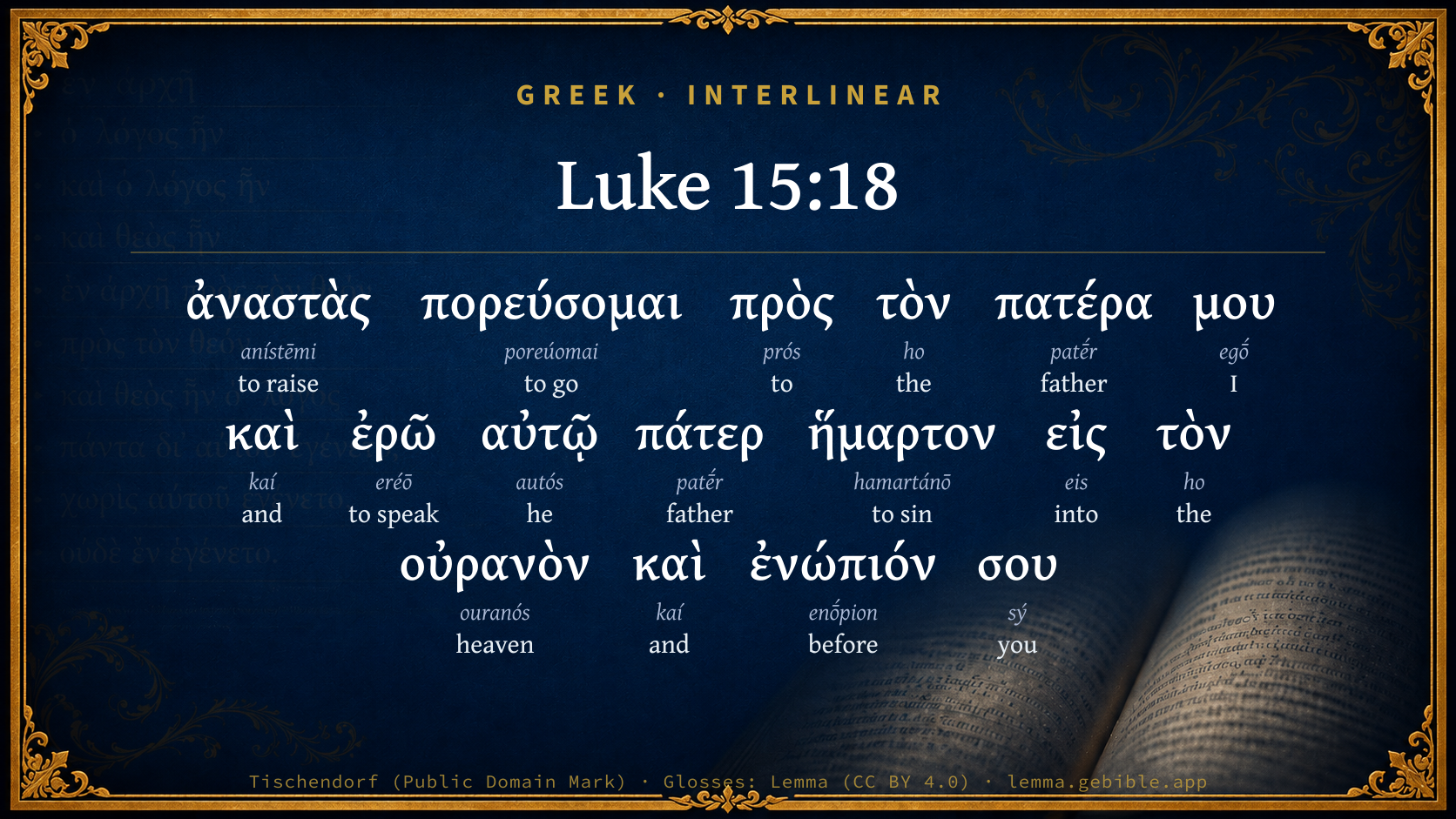
Download image
Cite this verse

Luke 15:18 (World English Bible). Public Domain. Lemma interlinear Bible study tool, https://lemma.gebible.app/v/luke/15/18.

Show BibTeX & RIS
BibTeX
RIS
English Translation
I will get up and go to my father, and will tell him, "Father, I have sinned against heaven, and in your sight.
World English Bible · Public Domain
Download a study sheet

One document with this verse’s original text, its word-by-word gloss line, the meaning frame, cross-references with their text, attributed commentary, and full source and license credits — printable, and it pastes into notes with its structure intact.

This verse Autodidact and up

Study sheet (.html) Plain text (.txt)

A passage Seminary Student

Up to 50 verses in one chapter. A passage sheet keeps up to 6 commentary sources and 12 cross-references per verse, in the order this page ranks them, and says so on the sheet whenever that leaves anything out. Ask for a single verse and you get the Autodidact verse sheet above.

Everything on this page stays free to read, with no account — the sheet is a download of what is already on screen, not access to it.

Want to remove ads? Support Godless Engineer
Compare translations 3

The same verse in 3 English versions, stacked beneath the original-language interlinear above. Click any original word for its lexicon entry.

Each is an independent rendering of the whole verse — the interlinear is not word-aligned to these translations.

Highlighted words mark where these versions differ — a whole-verse word diff, not a word-by-word alignment.

  • World English Bible Public Domain
    I will get up and go to my father, and will tell him, "Father, I have sinned against heaven, and in your sight.
  • King James Version Public Domain
    I will arise and go to my father, and will say unto him, Father, I have sinned against heaven, and before thee,
  • unfoldingWord Literal Text CC BY-SA 4.0
    I will get up go to my father, and I will say to him, “Father, I have sinned against heaven and before you.

unfoldingWord Literal Text — © unfoldingWord, licensed CC BY-SA 4.0. Word-aligned USFM3 via Door43 (git.door43.org/unfoldingWord/en_ult).

Versions to compare (up to 4)

3 of 4 selected

Show all 19 translations

Every available English version of this verse, each an independent rendering of the whole verse.

  • World English Bible Public Domain
    I will get up and go to my father, and will tell him, "Father, I have sinned against heaven, and in your sight.
  • Berean Standard Bible Public Domain
    I will get up and go back to my father and say to him, “Father, I have sinned against heaven and against you.
  • Majority Standard Bible Public Domain
    I will get up and go back to my father and say to him, “Father, I have sinned against heaven and against you.
  • King James Version Public Domain
    I will arise and go to my father, and will say unto him, Father, I have sinned against heaven, and before thee,
  • American Standard Version (1901) Public Domain
    I will arise and go to my father, and will say unto him, Father, I have sinned against heaven, and in thy sight:
  • Revised Version (1885) Public Domain
    I will arise and go to my father, and will say unto him, Father, I have sinned against heaven, and in thy sight:
  • Geneva Bible (1599) Public Domain
    I wil rise and goe to my father, and say vnto him, Father, I haue sinned against heaue, and before thee,
  • Douay-Rheims (1899) Public Domain
    I will arise, and will go to my father, and say to him: Father, I have sinned against heaven, and before thee:
  • Young's Literal Translation Public Domain
    having risen, I will go on unto my father, and will say to him, Father, I did sin -- to the heaven, and before thee,
  • Literal Standard Version CC BY-SA 4.0
    Having risen, I will go on to my father, and will say to him, Father, I sinned—to Heaven, and before you,
  • Unlocked Literal Bible CC BY-SA 4.0
    I will leave here and go to my father, and will say to him, “Father, I have sinned against heaven and against you.
  • unfoldingWord Literal Text CC BY-SA 4.0
    I will get up go to my father, and I will say to him, “Father, I have sinned against heaven and before you.
  • Darby Bible Public Domain
    I will rise up and go to my father, and I will say to him, Father, I have sinned against heaven and before thee;
  • World Messianic Bible Public Domain
    I will get up and go to my father, and will tell him, “Father, I have sinned against heaven and in your sight.
  • Webster's Bible Public Domain
    I will arise and go to my father, and will say to him, Father, I have sinned against heaven, and before thee,
  • Free Bible Version CC BY-SA 4.0
    I'm going home to my father! I'll tell him: Father, I've sinned against heaven and against you.
  • Bible in Basic English Public Domain
    I will get up and go to my father, and will say to him, Father, I have done wrong, against heaven and in your eyes:
  • Text-Critical English NT CC BY 4.0
    I will arise, go to my father, and say to him, “Father, I have sinned against heaven and before yoʋ.
  • Tyndale New Testament (1534) Public Domain
    I will aryse and goo to my father and will saye vnto him: father I have synned agaynst heven and before the

Literal Standard Version (2020), Covenant Press — licensed CC BY-SA 4.0. Text via the HelloAO Bible API (eBible.org). Unlocked Literal Bible (unfoldingWord) — licensed CC BY-SA 4.0. Text via the HelloAO Bible API (eBible.org). unfoldingWord Literal Text — © unfoldingWord, licensed CC BY-SA 4.0. Word-aligned USFM3 via Door43 (git.door43.org/unfoldingWord/en_ult). Free Bible Version, Dr. Jonathan Gallagher — licensed CC BY-SA 4.0. Text via the HelloAO Bible API (eBible.org).

Word by word

More ways to search: Search by grammar → Find every occurrence → Compare this word →

Practice this passage: Drill this verse → Learn its vocabulary →

ἥμαρτον
hamartánō
G264
“to sin”
Verb, Aorist, Active, Indicative, 1st person, Singular
Part of Speech
Verb
Tense
Aorist
Voice
Active
Mood
Indicative
Person
1st person
Number
Singular
Full Thayer's Definition

Origin: perhaps from G1 (as a negative particle) and the base of G3313

TDNT: 05:27,4

1. to be without a share in 2. to miss the mark 3. to err, be mistaken 4. to miss or wander from the path of uprightness and honour, to do or go wrong 5. to wander from the law of God, violate God's law, sin
  1. ἀναστὰς anístēmi G450 “to raise” Verb, Aorist, Active, Participle, Nominative, Singular, Masculine
  2. πορεύσομαι poreúomai G4198 “to go” Verb, Future, Middle deponent, Indicative, 1st person, Singular
  3. πρὸς prós G4314 “to” Preposition
  4. τὸν ho G3588 “the” Article, Accusative, Singular, Masculine
  5. πατέρα patḗr G3962 “father” Noun, Accusative, Singular, Masculine
  6. μου egṓ G1473 “I” Personal pronoun, 1st person, Genitive, Singular
  7. καὶ kaí G2532 “and” Conjunction
  8. ἐρῶ eréō G2046 “to speak” Verb, Future, Active, Indicative, 1st person, Singular
  9. αὐτῷ autós G846 “he” Personal pronoun, Dative, Singular, Masculine
  10. πάτερ patḗr G3962 “father” Noun, Vocative, Singular, Masculine
  11. εἰς eis G1519 “into” Preposition
  12. τὸν ho G3588 “the” Article, Accusative, Singular, Masculine
  13. οὐρανὸν ouranós G3772 “heaven” Noun, Accusative, Singular, Masculine
  14. καὶ kaí G2532 “and” Conjunction
  15. ἐνώπιόν enṓpion G1799 “before” Adverb
  16. σου sý G4771 “you” Personal pronoun, 2nd person, Genitive, Singular

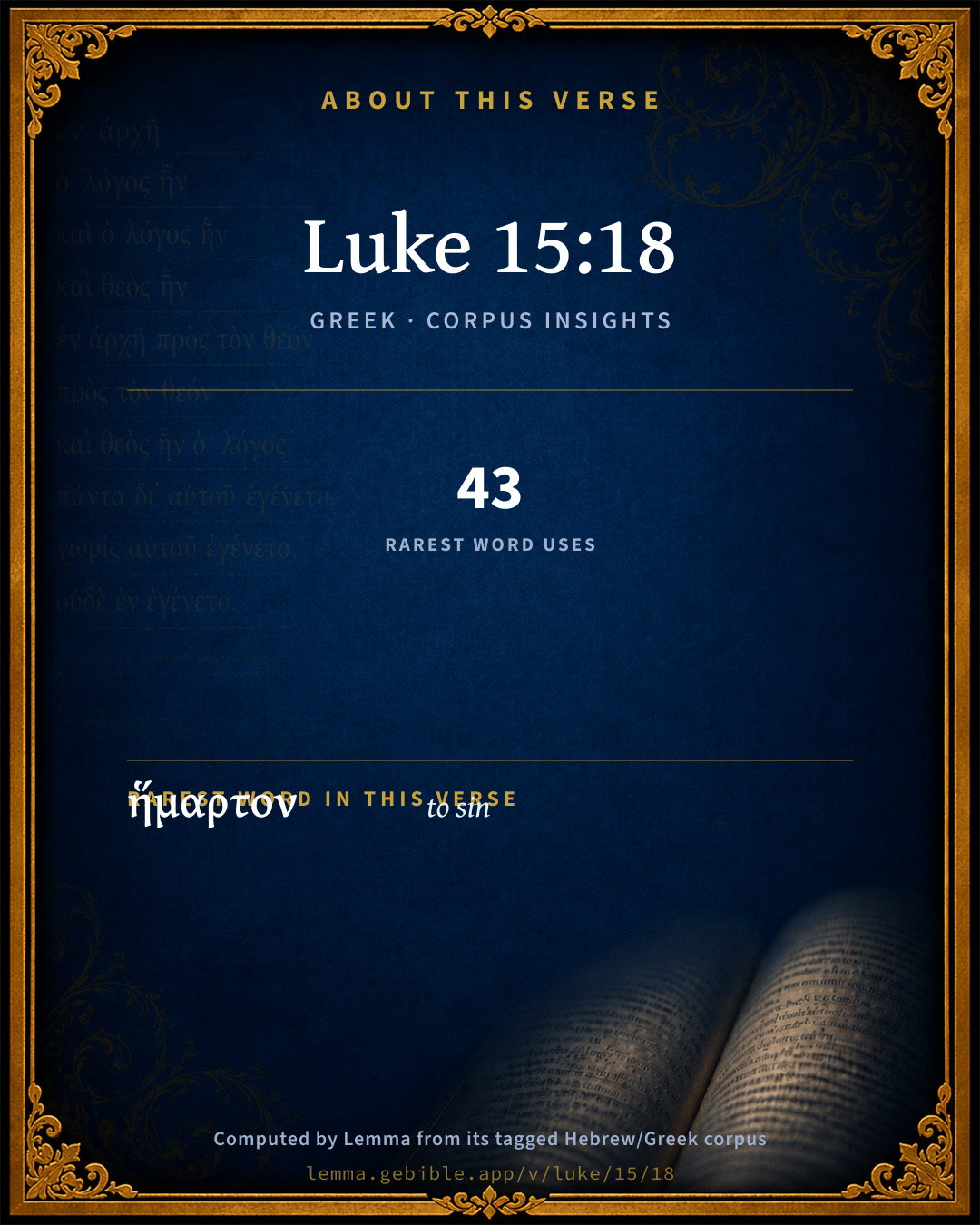
About this verse

These counts appear in no published source. They are computed here, from the morphology-tagged text and Lemma’s own curated glosses. What Lemma adds →

17
words
14
distinct lemmas
Gospels
section

Shared distinctive vocabulary

ἥμαρτον to sin G264 occurs in 37 verses of the Greek New Testament. Also found in:
Repetition

Words recur within this verse:

  • πατέρα father G3962 ×2
  • τὸν the G3588 ×2
  • καὶ and G2532 ×2

Cross-references

34

Topical passages linked to Luke 15:18 in the Treasury of Scripture Knowledge — connected by theme and wording, ordered by reader-vote popularity; previews shown in the World English Bible.

  • Lamentations 3:40 Let us search and try our ways, and turn again to Yahweh.
  • 1 John 1:8–10 If we say that we have no sin, we deceive ourselves, and the truth is not in us.
  • Luke 15:21 The son said to him, 'Father, I have sinned against heaven, and in your sight. I am no longer worthy to be called your son.'
  • Psalms 51:3–5 For I know my transgressions. My sin is constantly before me.
  • Jeremiah 50:4–5 In those days, and in that time, says Yahweh, the children of Israel shall come, they and the children of Judah together; they shall go on their way weeping, and shall seek Yahweh their God.
  • Luke 18:13 But the tax collector, standing far away, wouldn't even lift up his eyes to heaven, but beat his breast, saying, 'God, be merciful to me, a sinner!'
  • Matthew 6:14 "For if you forgive men their trespasses, your heavenly Father will also forgive you.
  • Psalms 32:3–5 When I kept silence, my bones wasted away through my groaning all day long.
  • Hosea 2:6–7 Therefore, behold, I will hedge up your way with thorns, And I will build a wall against her, That she can't find her way.
  • Psalms 25:11 For your name's sake, Yahweh, Pardon my iniquity, for it is great.
  • Jeremiah 3:19 But I said, How I will put you among the children, and give you a pleasant land, a goodly heritage of the hosts of the nations! and I said, You shall call me My Father, and shall not turn away from following me.
  • 2 Chronicles 33:12–13 When he was in distress, he begged Yahweh his God, and humbled himself greatly before the God of his fathers.
  • 2 Chronicles 33:19 His prayer also, and how [God] was entreated of him, and all his sin and his trespass, and the places in which he built high places, and set up the Asherim and the engraved images, before he humbled himself: behold, they are written in the history of Hozai.
  • Job 33:27–28 He sings before men, and says, 'I have sinned, and perverted that which was right, And it didn't profit me.
  • Proverbs 23:13 Don't withhold correction from a child. If you punish him with the rod, he will not die.
  • Isaiah 63:16 For you are our Father, though Abraham doesn't know us, and Israel does not acknowledge us: you, Yahweh, are our Father; our Redeemer from everlasting is your name.
  • Jeremiah 31:20 Is Ephraim my dear son? is he a darling child? for as often as I speak against him, I do earnestly remember him still: therefore my heart yearns for him; I will surely have mercy on him, says Yahweh.
  • Matthew 3:6 They were baptized by him in the Jordan, confessing their sins.
  • Matthew 6:9 Pray like this: 'Our Father in heaven, may your name be kept holy.
  • Leviticus 26:40–41 "'If they confess their iniquity, and the iniquity of their fathers, in their trespass which they trespassed against me, and also that, because they walked contrary to me,
  • 1 Kings 8:47–48 yet if they shall repent themselves in the land where they are carried captive, and turn again, and make supplication to you in the land of those who carried them captive, saying, We have sinned, and have done perversely, we have dealt wickedly;
  • 1 Kings 20:30–31 But the rest fled to Aphek, into the city; and the wall fell on twenty-seven thousand men who were left. Ben Hadad fled, and came into the city, into an inner chamber.
  • 2 Kings 7:3–4 Now there were four leprous men at the entrance of the gate: and they said one to another, Why sit we here until we die?
  • Job 36:8–10 If they are bound in fetters, And are taken in the cords of afflictions,
  • Psalms 116:3–7 The cords of death surrounded me, The pains of Sheol got a hold of me. I found trouble and sorrow.
  • Jeremiah 31:6–9 For there shall be a day, that the watchmen on the hills of Ephraim shall cry, Arise you, and let us go up to Zion to Yahweh our God.
  • Hosea 14:1–3 Israel, return to Yahweh your God; For you have fallen because of your sin.
  • Jonah 3:9 Who knows whether God will not turn and repent, and turn away from his fierce anger, so that we might not perish?"
  • Matthew 7:11 If you then, being evil, know how to give good gifts to your children, how much more will your Father who is in heaven give good things to those who ask him!
  • Lamentations 3:18–22 I said, My strength is perished, and my expectation from Yahweh.
  • Lamentations 3:29 Let him put his mouth in the dust, if so be there may be hope.
  • Daniel 4:26 Whereas they commanded to leave the stump of the roots of the tree; your kingdom shall be sure to you, after that you shall have known that the heavens do rule.
  • Jonah 2:4 I said, 'I have been banished from your sight; Yet I will look again toward your holy temple.'
  • Luke 11:2 He said to them, "When you pray, say, 'Our Father in heaven, May your name be kept holy. May your Kingdom come. May your will be done on Earth, as it is in heaven.

Cross-references courtesy of OpenBible.info (CC BY 4.0).

Commentary

Notes on Luke 15:18 from classic Christian and Jewish commentators (each source and its license shown beneath its notes). The classic Christian expositions comment on the surrounding passage and are grouped to its opening verse, so a note may address several verses; the Jewish commentaries on the Tanakh (Rashi and others) are per-verse, so they appear only where the commentator wrote on this verse.

Lemma curates 59 commentaries, every one of them public domain or Creative Commons licensed, each selected and text-cleaned for this edition rather than reprinted as found. About our sources →

Bengel's Gnomon

Johann Albrecht Bengel

Luk 15:18. Ἀναστὰς, having arisen) The first steps of repentance are herein accurately indicated.—Πάτερ, Father) The name, Father, remains the same [His willingness to receive us in that character, as our Father, remains], even though the sons he degenerate.—εἰς τὸν οὐρανὸν, against heaven) Comp. Luk 15:7 [which implies that the inhabitants of heaven have a concern in the sinner’s recovery, and therefore also in the fall of the sinner, who accordingly in part sins against them].

Bengel's Gnomon of the New Testament — English translation (T&T Clark, Edinburgh, 1860) — public domain. Text from a community e-Sword module.

Meyer's Critical & Exegetical Commentary

Heinrich August Wilhelm Meyer

Luk_15:18-19. With this coming to himself and longing is associated the corresponding determination, namely, to turn back to God, to confess to Him his guilt and unworthiness, and to petition for grace. In this petition, however, the humility which belongs to the consciousness of guilt sets aside the thought of complete restoration.

εἰς τὸν οὐρανόν] against heaven. Comp. Mat_18:15; Mat_18:21, and elsewhere; εἰς τὸ θεῖον, Plat. Phaedr. p. 243 C. Heaven does not denote God, but is, as the abode of the Godhead and of the pure spirits, personified, so that this holy heavenly world appears as injured and offended by sin.

ἐνώπιον σοῦ] comp. 1Sa_7:6; 1Sa_10:1; Psa_51:4; Tob_3:3; Jdt_5:17; Susann. 23. The meaning is: I have so sinned that I have transgressed before Thee, i.e. in relation to Thee. The moral relation of the deed to the offended subject is thus rendered palpable, as though this subject had suffered in respect of the deed; the moral reference is set forth as visible. Grotius, moreover, well says: Non in aetatem, non in malos consultatores culpam rejicit, sed nudam parat sine excusatione confessionem.

Luk_15:19. οὐκέτι] not: not yet (Paulus), but: no longer.

ποίησόν με κ.τ.λ.] i.e. place me in the position of being as one of thy day-labourers. Comp. Gen_48:20; Isa_41:15. Without ὡς the petition would aim at the result of making him a day-labourer; with ὡς its purport is: although he is a son, yet to place him no otherwise than if he were one of the day-labourers.

Meyer — Critical and Exegetical Commentary on the New Testament — English translation by Peter Christie, edited by Frederick Crombie (T&T Clark, 1880) — public domain. Text from a community e-Sword module.

Expositor's Greek Testament

ed. W. Robertson Nicoll

Luk 15:18 . ἀναστὰς : a bright hope gives energy to the starving man; home! Said, done, but the motive is not high. It is simply the last resource of a desperate man. He will go home and confess his fault, and so, he hopes, get at least a hireling’s fare. Well to be brought out of that land, under home influences, by any motive. It is in the right direction. Yet though bread is as yet the supreme consideration, foretokens of true ethical repentance appear in the premeditated speech: Πάτερ : some sense of the claims that long-disused word implies ἥμαρτον , I erred; perception that the whole past has been a mistake and folly εἰς τὸν οὐρανὸν , against heaven, God ἐνώπιόν σου , in thy sight, in thy judgment (Hahn) he knows quite well what his father must think of his conduct; what a fool he must think him (Psa 73:22 ) οὐκέτι εἰμὶ , etc. (Luk 15:19 ), fully conscious that he has forfeited all filial claims. The omission of καὶ suits the emotional mood.

The Expositor's Greek Testament, edited by W. Robertson Nicoll (1897–1910) — public domain. Text from a community e-Sword module.

Geneva Bible (1599)

Geneva Bible translators

Against God, because he is said to dwell in heaven.

Geneva Bible (1599) marginal notes — public domain. Text via Bolls.life.

Jamieson, Fausset & Brown

Robert Jamieson, A. R. Fausset & David Brown

I will arise and go to my FATHER--The change has come at last, and what a change!--couched in terms of such exquisite simplicity and power as if expressly framed for all heart-broken penitents.

Father, &c.--Mark the term. Though "no more worthy to be called his son," the prodigal sinner is taught to claim the defiled, but still existing relationship, asking not to be made a servant, but remaining a son to be made "as a servant," willing to take the lowest place and do the meanest work. Ah! and is it come to this? Once it was, "Any place rather than home." Now, "Oh, that home! Could I but dare to hope that the door of it would not be closed against me, how gladly would I take any place and do any worK, happy only to be there at all." Well, that is conversion--nothing absolutely new, yet all new; old familiar things seen in a new light and for the first time as realities of overwhelming magnitude and power. How this is brought about the parable says not. (We have that abundantly elsewhere, Phi 2:13, &c.). Its one object is to paint the welcome home of the greatest sinners, when (no matter for the present how) they "arise and go to their Father."

Jamieson, Fausset & Brown — Commentary Critical and Explanatory on the Whole Bible (1871) — public domain (CC PDM 1.0). Text via the HelloAO Bible API.

Adam Clarke's Commentary

Verse 18. Against heaven] εις τον ουρανον; that is, against God. The Jews often make use of this periphrasis in order to avoid mentioning the name of God, which they have ever treated with the utmost reverence. But some contend that it should be translated, even unto heaven; a Hebraism for, I have sinned exceedingly-beyond all description.

Adam Clarke's Commentary on the Bible (1810–1826) — public domain. Text from a community e-Sword/MySword module.

Ellicott's Commentary for English Readers

(18) I will arise and go to my father.—This, then, was the firstfruits of repentance. He remembers that he has a father, and trusts in that father’s love; but he dares not claim the old position which he had so recklessly cast away. He is content to be as one of the “hired servants.” Spiritually, the first impulse of the contrite heart is to take the lowest place, to wish for the drudgery of daily duties, or even menial service, if only it may be near its Father in heaven, and by slow degrees regain His favour and earn the wages of His praise.

I have sinned . . .—More strictly, I sinned, as going back in thought to the first act of sin as virtually including all that grew out of it.

A Bible Commentary for English Readers, edited by Charles John Ellicott (1878–1897) — public domain. Text from a community e-Sword module.

The Cambridge Bible for Schools and Colleges

gen. ed. J. J. S. Perowne

18. I will arise and go to my father] The youth in the parable had loved his father, and would not doubt about his father’s love; and in the region which the parable shadows forth, the mercy of God to the returning penitent has always been abundantly promised. Is. 4:7; Jer_3:12; Hos_14:1-2, &c.; and throughout the whole New Testament.

Father, I have sinned] “Repentance is the younger brother of innocence itself.” Fuller, Holy War.

The Cambridge Bible for Schools and Colleges (gen. ed. J. J. S. Perowne; Cambridge University Press, 1878–1918) — public domain. Text from a community e-Sword module.

John Gill's Exposition

I will arise,.... This is the resolution which at last, through divine grace, he came into: he determines to quit the country, and his companions; he had left his harlots, and his old course of living before, but was in the same country still; for this a man may do, and yet remain unregenerate: but he is now for leaving the country itself, and his new acquaintance; he is now determined to drop his legal preacher, to be gone out of his fields, and from under his ministry, and to leave his swine and husks;

and go to my father: not to his old companions in debauchery and sin; nor to his elder brother, the Pharisees; he had made trial of both these to his cost already; nor to his father's servants, but to his father himself; to which he was moved and encouraged, from his being ready to perish, from the fulness of bread in his father's house and from the relation he stood in to him; notwithstanding, all that had passed, he was his father, and a kind and merciful one: this shows, that he knew him as his father, having now the Spirit of adoption sent down into him; and the way unto him, which lies through Christ the mediator:

and will say unto him, father; or, "my father", as the Syriac and Persic versions read:

I have sinned against heaven; by preferring earthly things to heavenly ones; and have sinned openly in the face of the heavens, who were witnesses against him; and against God, who dwells in heaven. It was usual with the Jews to call God, "heaven"; See Gill on Mat 21:25. They have this very phrase;

"there is a man, (say (b) they), who sins against earth, and he does not , "sin against heaven"; against heaven, and he does not sin against earth: but he that speaks with an ill tongue sins against heaven and earth, as it is said, Psa 73:9 "they set their mouth against the heavens and their tongue walketh through the earth."''

And so the sense is, that he had sinned against God himself, and not merely against men, and human laws. All sin is a transgression of the law of God; and the thought of sin being committed against a God of infinite holiness, justice, goodness, grace, and mercy, is cutting to a sensible sinner: and this being the case, this man determined to go to God his Father, and him only, for the pardon of his sin, against whom it was committed. It is added,

and before thee; for he was now convinced of his omniscience. Sin may be committed against a man, and not before him, or he not know it; but whatever is committed against God, is before him, it is in his sight, he knows it: he is God omniscient, though sinners take no notice of this perfection of his, but go on in sin, as if it was not seen, known, and observed by God. But when God works powerfully and effectually upon the heart of a sinner, he convinces him of his omniscience, as this man was convinced: hence he determined to go to God, and acknowledge his sin before him; and that it was committed before him, and was in his sight; and that he could not be justified in his sight by any righteousness of his own; and therefore humbly desires pardon at his hands. This man's sense of sin and sorrow for it, and confession of it, appear very right and genuine, which he determined to express; they appear to be the convictions of the Spirit of God: it was not a sense of sin, and sorrow for it, as done before men, but God; and the concern was not so much for the mischief that comes by sin, as for the evil that was in it; and this did not drive him to despair, as in the cases of Cain and Judas, but brought him home to his father; and his confession appears to be hearty, sincere, and without excuse.

(b) Midrash Kohclet, in c. 9. 12. fol. 79. 4.

John Gill's Exposition of the Whole Bible (1746–1763) — public domain (CC PDM 1.0). Text via the HelloAO Bible API.

Trapp's Complete Commentary

John Trapp

18 I will arise and go to my father, and will say unto him, Father, I have sinned against heaven, and before thee,

Ver. 18. Against heaven and before thee] That is, I have not only thee, but the whole heaven for a swift witness against me of mine offences and outbursts. "The heaven doth declare mine iniquity, and the earth riseth up against me," Job 20:27.

John Trapp, A Commentary or Exposition upon All the Books of the Old and New Testament (1647–1656) — public domain. Text from a community e-Sword module.

Albert Barnes' Notes on the Bible

I will arise - This is a common expression among the Hebrews to denote “entering on a piece of business.” It does not imply that he was “sitting,” but that he meant immediately to return. This should be the feeling of every sinner who is conscious of his guilt and danger.

To My father - To his father, although he had offended him, and treated him unkindly, and had provoked him, and dishonored him by his course of conduct. So the sinner. He has nowhere else to go but to “God.” He has offended him, but he may trust in his kindness. If “God” does not save him he cannot be saved. There is no other being that has an arm strong enough to deliver from sin; and though it is painful for a man to go to one whom he has offended - though he cannot go but with shame and confusion of face - yet, unless the sinner is willing to go to “God” and confess his faults, he can never be saved.

I have sinned - I have been wicked, dissipated, ungrateful, and rebellious.

Against heaven - The word “heaven” here, as it is often elsewhere, is put for God. I have sinned against “God.” See Mat 21:25. It is also to be observed that one evidence of the genuineness of repentance is the feeling that our sins have been committed chiefly against “God.” Commonly we think most of our offences as committed against “man;” but when the sinner sees the true character of his sins, he sees that they have been aimed chiefly against “God,” and that the sins against “man” are of little consequence compared with those against God. So David, even after committing the crimes of adultery and murder after having inflicted the deepest injury on “man” - yet felt that the sin as committed against “God” shut every other consideration out of view: “Against thee, thee only, have I sinned,” etc., Psa 2:4.

Before thee - This means the same as “against” thee. The offences had been committed mainly against God, but they were to be regarded, also, as sins against his “father,” in wasting property which he had given him, in neglecting his counsels, and in plunging himself into ruin. He felt that he had “disgraced” such a father. A sinner will be sensible of his sins against his relatives and friends as well as against God. A true penitent will be as ready to “acknowledge” his offences against his fellow-men as those against his Maker.

Albert Barnes' Notes on the Bible (1834–1885) — public domain. Text from a community e-Sword/MySword module.

Haydock's Catholic Bible Commentary

How merciful is the Almighty, who, though so much offended, still does not disdain the name of father. --- I have sinned. These are the first words of a sinner’s confession to the author of nature. God knows all things; still does he expect to hear the voice of your confession. It is in vain to think of concealing your sins from the eyes of him whom nothing can escape; and there can be no danger of acknowledging to him what his infinite knowledge has already embraced. Confess then that Christ may intercede for you, the Church pray for you, the people pour forth their tears for you. Fear not that you cannot obtain pardon, for pardon is promised to you; grace, and a reconciliation with a most tender parent, are held out to you. (St. Ambrose) --- Before thee, &c. By this does our Redeemer shew, that the Almighty is here to be understood by the name of father: for the all-seeing eye of God only beholds all things, from whom even the secret machinations of the heart cannot be concealed. (St. John Chrysostom in St. Thomas Aquinas)

George Leo Haydock (1774–1849), Haydock's Catholic Family Bible and Commentary, 1859 edition — public domain. Excludes Psalms (Douay-Rheims chapter numbering differs from Protestant) and Deuterocanonical books (Catholic canon only).

Matthew Poole's English Annotations

The way of a sinner’s returning to God must be by arising, going to the Father, confessing his sins with the aggravations of them, disclaiming any goodness, any righteousness in himself, humbling himself to God’s footstool.

I will arise (saith the prodigal) and go to my father, and will say unto him, Father, I have sinned against heaven, and before thee, and am no more worthy to be called thy son: make me as one of thy hired servants. And he arose, and came to his father. He arose from the sleep and bed of sin, and came unto his father. We are not here told by whose strength, or in whose assistance, he arose and came. We must remember that our Saviour is here representing a spiritual notion by an ordinary human action; now men have an innate power to natural motions, though not to spiritual actions. We are elsewhere told, that no man cometh to the Father, but by Christ, nor doth any man come unto the Son, but he whom the Father draweth. Every one as he is taught of the Father cometh unto the Son. And again, that though we be saved by faith, yet it is not of ourselves, it is the gift of God; and, it is given to us in the behalf of Christ to believe, Phi 1:29. These are but several expressions signifying, by the tender affections and gracious reception of earthly parents of a returning prodigal son, the exceeding readiness of our heavenly Father to receive penitent sinners; he is so far from discouraging great sinners from taking up thoughts of returning unto him, that he cherisheth the embryos of such resolutions: I said, (saith the psalmist), I will confess my transgressions unto the Lord; and thou forgavest the iniquity of my sin, Psa 32:5. God seeth the first good motions and stirrings of our hearts towards him, and he needs must do so, for he stirreth them up in us; there is no sacred fire upon our altar, but first cometh down from heaven. While yet the soul is far off from believing, and closing with Christ actually, and hath but some thoughts of that tendency, God looks upon it, encourages it, meeteth it as it were half way; and indeed if he did not, our goodness would be but like a morning dew, which would quickly pass away; our first inclinations would perish like an untimely birth, before it hath seen the light.

Matthew Poole's English Annotations on the Holy Bible (1683–1685) — public domain. Text from a community e-Sword/MySword module.

Whedon's Commentary on the Bible

Daniel D. Whedon

18. I have sinned—Very different from his bold address, (Luk_15:12,) Give me the portion. Confession is good for the soul.

Against heaven—Against the divine authority of God as Creator, and against the law of right and nature.

And before thee—It was from the former, heaven, that the famine came upon the land. It was from the latter, thee, that the son wandered, and to whom he was now returning, 19. As one of thy hired servants—This son embodies in himself all classes of wanderers and aliens from God, both Jew and Gentile. As Jew he has a natural born sonship. But as Gentile, though he has also a natural born sonship in the back ground, he now takes position as an alien. And then when the father forthwith restores him to sonship, he who is in symbol even the alien, becomes a true son in the Gospel acceptance.

No more worthy to be called thy son—He says truth. He has forfeited his birthright.

If a man by free voluntary sin lose the grace to which he is born, and which meets him from the atonement at the threshold of life, being symbolized in his circumcision or baptism, he is only a son as all others are sons, and must return to God as a returned alien. It is the mercy of God which restores his sonship.

Daniel D. Whedon (gen. ed.), Commentary on the Old and New Testaments (1874–1909) — public domain. Text from a community e-Sword module.

The Pulpit Commentary

Vers. 18, 19. I will arise and go to my father... make me as one of thy hired servants. The repentance of the prodigal was real. It was no mere sentimental regret, no momentary flash of sorrow for a bad past. There was before him a long and weary journey to be undertaken, and he brought up in luxury had to face it without means. There was the shame of confession before dependents and relatives and friends, and, as the crown of all, there was the position of a servant to be filled in the home where once he had been a son, for that was all he hoped to gain even from his father"s pitying love.

The Pulpit Commentary (1880–1919), ed. H.D.M. Spence-Jones & Joseph S. Exell — public domain. Text from a community e-Sword module.

John Wesley's Explanatory Notes

I will arise and go to my father - How accurately are the first steps of true repentance here pointed out! Against Heaven - Against God.

John Wesley, Explanatory Notes Upon the Whole Bible (1754–1765) — public domain. Text via the GEBible commentary corpus.

Scofield Reference Notes

C. I. Scofield

sinned

Sin. (See Scofield "Rom 3:23").

The Scofield Reference Bible (1917 edition), notes by C. I. Scofield — public domain. Text from a community e-Sword module.

Cambridge Greek Testament for Schools and Colleges

18. ἀναστὰς πορεύσομαι πρὸς τὸν πατέρα μου. The ἀναστὰς is pictorial, comp. Act 5:17; Mar 1:35, &c. The youth in the parable had loved his father, and would not doubt about His father’s love; and in the region which the parable shadows forth, the mercy of God to the returning penitent has always been abundantly promised. Isa 55:7; Jer 3:12; Hos 14:1-2, &c.; and throughout the whole New Testament.

πάτερ, ἥμαρτον. “Repentance is the younger brother of innocence itself.” Fuller, Holy War.

Cambridge Greek Testament for Schools and Colleges (Cambridge University Press, 1896; 21 vols, various authors incl. Carr, Maclear, Plummer, Farrar, Lumby, Moule, M. R. James, Simcox) — public domain. Text from a community e-Sword module.

Alford’s Greek Testament

Henry Alford

18. ἀναστάς] See ver. 24, νεκρὸς ἦν καὶ ἀνέζησεν [it was truly a resurrection from the dead]. This resolution is a further step than his last reflection. In it he no where gives up his sonship: this, and the πάτερ, lie at the root of his penitence:—it is the thought of having sinned against (in the parable itself, Heaven and) Thee, which works now in him. And accordingly he does not resolve to ask to be made ἕνα τῶν μισθ. but ὡς ἕνα τ. μ.:—still a son, but as an hireling. “And what is it that gives the sinner now a sure ground of confidence, that returning to God he shall not be repelled, nor cast out? The adoption of sonship which he received in Christ Jesus at his baptism, and his faith that the gifts and calling of God are without repentance or recall.” Trench, Par. in loc.

Henry Alford, The Greek Testament (1849–1861) — public domain. Text from a community e-Sword module.

International Critical Commentary

18. ἀναστὰς πορεύσομαι. Not mere Oriental fulness of description (1:39; Act 10:20, Act 22:10). The ἀναστάς expresses his rousing himself from his lethargy and despair (Act 5:17, Act 5:9:6, Act 5:18).

εἰς τὸν οὐρανόν. “Against heaven.” This is not a rare use of εἰς: comp. 17:4; Mat 18:21; 1Co 6:18, 1Co 8:12. It is common in LXX and is found also in class. Grk. Comp. Pharaoh’s confession, Ἡμάρτηκα ἐναντίον Κυρίου τοῦ Θεοῦ ὑμῶν καὶ εἰς ὑμᾶς (Exo 10:16); also Plat. Rep. iv. 396 A; Phædr. 242 C; Hdt. i. 138, 2; Soph. O. C. 968. Filial misconduct is a sin utterly displeasing to God. But the εἰς does not mean “crying to heaven for punishment,” himmelschreiend, which is otherwise expressed (Gen 4:10, Gen 18:21). For ἁμαρτάνω ἐνώπιόν τινος comp. 1Sa 7:6, 20:1; Tobit 3:3; Judith 5:17; Sus. 23. The sin is regarded as something to be judged by the person who regards it.

κληθῆναι υἱός σου. By the father himself. What other people may call him is not in question.

International Critical Commentary — older volumes (1896–1929), various authors — public domain. Text from a community e-Sword module.

Lesson kit

Teaching starters — assembled from the data on this page, not authored interpretation. Every prompt links to the verse data it draws on. Edit before teaching.

Luke, in the Gospels, opens this verse with 17 words (14 distinct Greek lemmas). Its most distinctive word is hamartánō (“to sin”). A historical commentator’s framing appears above. Read the whole chapter for the surrounding context.

Discussion questions

  1. How does “to sin” (hamartánō) shape what this verse is saying?
  2. Matthew 18:15 shares the word «to sin» with this verse. How do the two illuminate each other?
  3. “father” occurs 2× in this one verse. What is the effect of the repetition?
  4. These translations render this verse differently; the difference is in the English rendering, not the original. What questions does that raise?
  5. Reading how Bengel's Gnomon and Meyer's Critical & Exegetical Commentary read this verse, where do the two commentators agree and where do they part?

Things to notice

  • These translations choose different wording for 8 words in this verse.
  • “father” occurs 2× in this single verse.
  • 14 distinct Greek lemmas span 17 words in this verse.

Reading settings

Reading text

Shown beneath each verse's original-language words.

Old Testament
Old Testament edition

Read the OT as the Masoretic Hebrew (MT) or the Greek Septuagint (LXX).

English shown for the Greek Septuagint (in the Hebrew ↔ Greek comparison).

Comparing translations? Open the Compare panel on any verse page to stack up to four side by side.