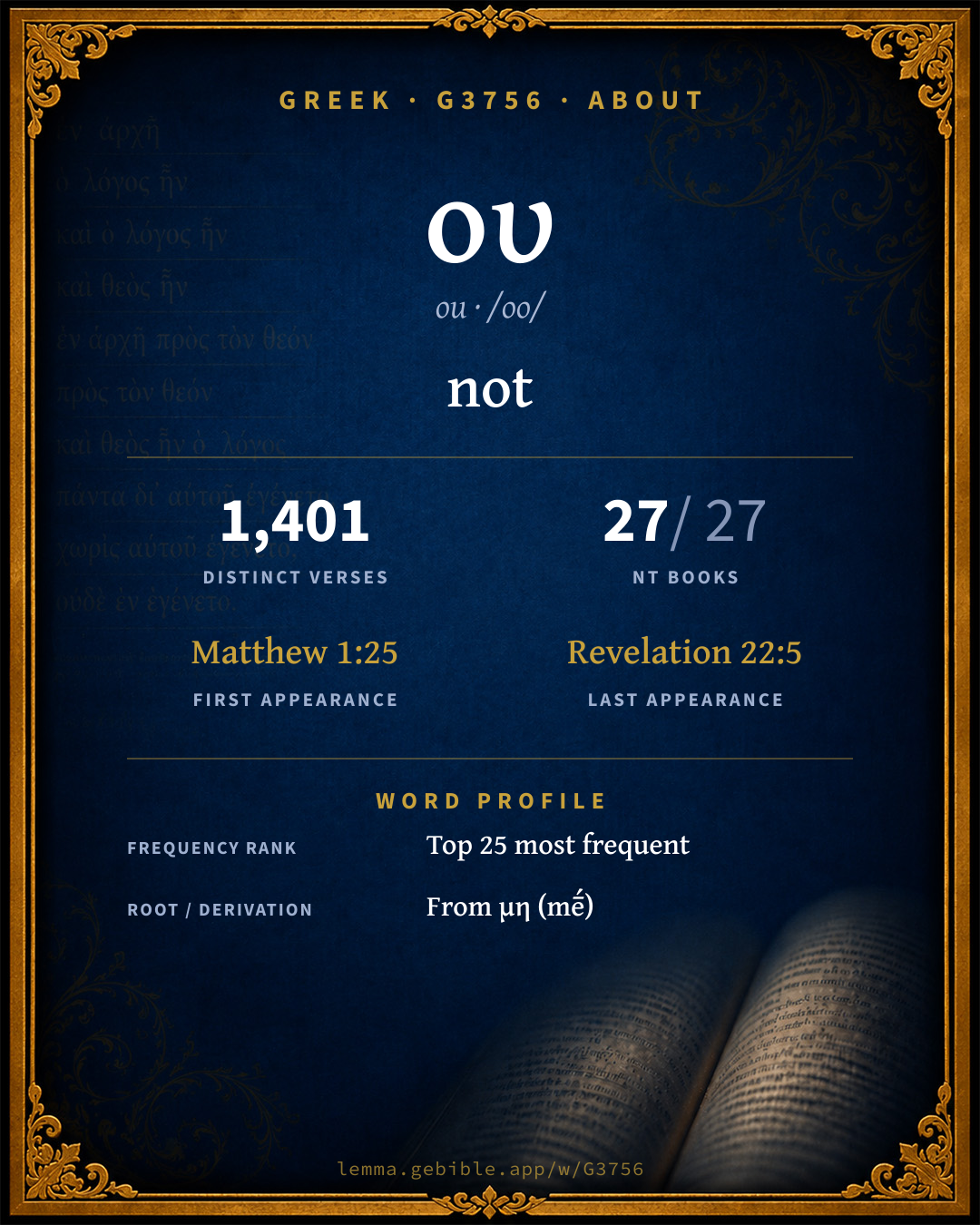
οὐ
not
Full lexicon entry — Thayer's Greek Lexicon
From Thayer's Greek Lexicon
Where this word appears
Grammar key — what these labels mean
Part of speech
- Particle
- A short, often untranslatable function word adding nuance or connection.
Degree
- Negative
- Marks a negative form.
Page 1 of 8 — showing verses 1–200 of 1,401 distinct verses where G3756 appears, across 27 books. Click any verse to open its interlinear word-by-word view. Verse text shown in the World English Bible for context — . Each verse’s Greek form is shown with its reference; the English is not keyword-highlighted, since the data carries no word-level English alignment. Use “Compare translations” on any verse to read it across multiple English versions. This concordance covers the Greek New Testament; Septuagint (Greek Old Testament) occurrences of this word are not indexed here.
Matthew 174 verses
- Matthew 1:25 οὐκ ptcl neg and didn't know her sexually until she had brought forth her firstborn son. He named him Jesus.
- Matthew 2:18 οὐκ οὐκ ptcl neg ptcl neg "A voice was heard in Ramah, Lamentation, weeping and great mourning, Rachel weeping for her children; She wouldn't be comforted, Because they are no more."
- Matthew 3:11 οὐκ ptcl neg I indeed baptize you in water for repentance, but he who comes after me is mightier than I, whose shoes I am not worthy to carry. He will baptize you in the Holy Spirit.
- Matthew 4:4 οὐκ ptcl neg But he answered, "It is written, 'Man shall not live by bread alone, but by every word that proceeds out of the mouth of God.'"
- Matthew 4:7 οὐκ ptcl neg Jesus said to him, "Again, it is written, 'You shall not test the Lord, your God.'"
- Matthew 5:14 οὐ ptcl neg You are the light of the world. A city located on a hill can't be hidden.
- Matthew 5:17 οὐκ ptcl neg "Don't think that I came to destroy the law or the prophets. I didn't come to destroy, but to fulfill.
- Matthew 5:18 οὐ ptcl neg For most assuredly, I tell you, until heaven and earth pass away, not even one smallest letter or one tiny pen stroke shall in any way pass away from the law, until all things are accomplished.
- Matthew 5:20 οὐ ptcl neg For I tell you that unless your righteousness exceeds that of the scribes and Pharisees, there is no way you will enter into the Kingdom of Heaven.
- Matthew 5:21 οὐ ptcl neg "You have heard that it was said to the ancient ones, 'You shall not murder;' and 'Whoever shall murder shall be in danger of the judgment.'
- Matthew 5:26 οὐ ptcl neg Most assuredly I tell you, you shall by no means get out of there, until you have paid the last penny.
- Matthew 5:27 οὐ ptcl neg "You have heard that it was said, 'You shall not commit adultery;'
- Matthew 5:33 οὐκ ptcl neg "Again you have heard that it was said to them of old time, 'You shall not make false vows, but shall perform to the Lord your vows,'
- Matthew 5:36 οὐ ptcl neg Neither shall you swear by your head, for you can't make one hair white or black.
- Matthew 5:37 οὒ οὔ ptcl neg ptcl neg But let your 'Yes' be 'Yes' and your 'No' be 'no.' Whatever is more than these is of the evil one.
- Matthew 6:1 οὐκ ptcl neg "Be careful that you don't do your charitable giving before men, to be seen by them, or else you have no reward from your Father who is in heaven.
- Matthew 6:5 οὐκ ptcl neg "When you pray, you shall not be as the hypocrites, for they love to stand and pray in the synagogues and in the corners of the streets, that they may be seen by men. Most assuredly, I tell you, they have received their reward.
- Matthew 6:20 οὐ ptcl neg but lay up for yourselves treasures in heaven, where neither moth nor rust consume, and where thieves don't break through and steal;
- Matthew 6:24 οὐ ptcl neg "No one can serve two masters, for either he will hate the one and love the other; or else he will be devoted to one and despise the other. You can't serve both God and Mammon.
- Matthew 6:26 οὐ οὐχ ptcl neg ptcl neg See the birds of the sky, that they don't sow, neither do they reap, nor gather into barns. Your heavenly Father feeds them. Aren't you of much more value than they?
- Matthew 6:28 οὐ ptcl neg Why are you anxious about clothing? Consider the lilies of the field, how they grow. They don't toil, neither do they spin,
- Matthew 6:30 οὐ ptcl neg But if God so clothes the grass of the field, which today exists, and tomorrow is thrown into the oven, won't he much more clothe you, you of little faith?
- Matthew 7:3 οὐ ptcl neg Why do you see the speck that is in your brother's eye, but don't consider the beam that is in your own eye?
- Matthew 7:18 οὐ ptcl neg A good tree can't produce evil fruit, neither can a corrupt tree produce good fruit.
- Matthew 7:21 Οὐ ptcl neg Not everyone who says to me, 'Lord, Lord,' will enter into the Kingdom of Heaven; but he who does the will of my Father who is in heaven.
- Matthew 7:22 οὐ ptcl neg Many will tell me in that day, 'Lord, Lord, didn't we prophesy in your name, in your name cast out demons, and in your name do many mighty works?'
- Matthew 7:25 οὐκ ptcl neg The rain came down, the floods came, and the winds blew, and beat on that house; and it didn't fall, for it was founded on the rock.
- Matthew 7:29 οὐχ ptcl neg for he taught them with authority, and not like the scribes.
- Matthew 8:8 οὐκ ptcl neg The centurion answered, "Lord, I'm not worthy for you to come under my roof. Just say the word, and my servant will be healed.
- Matthew 8:20 οὐκ ptcl neg Jesus said to him, "The foxes have holes, and the birds of the sky have nests, but the Son of Man has nowhere to lay his head."
- Matthew 9:12 οὐ ptcl neg When Jesus heard it, he said to them, "Those who are healthy have no need for a physician, but those who are sick do.
- Matthew 9:13 οὐ οὐ ptcl neg ptcl neg But you go and learn what this means: 'I desire mercy, and not sacrifice,' for I came not to call the righteous, but sinners to repentance."
- Matthew 9:14 οὐ ptcl neg Then John's disciples came to him, saying, "Why do we and the Pharisees fast often, but your disciples don't fast?"
- Matthew 9:24 οὐ ptcl neg he said to them, "Make room, because the girl isn't dead, but sleeping." They were ridiculing him.
- Matthew 10:20 οὐ ptcl neg For it is not you who speak, but the Spirit of your Father who speaks in you.
- Matthew 10:23 οὐ ptcl neg But when they persecute you in this city, flee into the next, for most assuredly I tell you, you will not have gone through the cities of Israel, until the Son of Man has come.
- Matthew 10:24 Οὐκ ptcl neg "A disciple is not above his teacher, nor a servant above his lord.
- Matthew 10:26 οὐκ οὐ ptcl neg ptcl neg Therefore don't be afraid of them, for there is nothing covered that will not be revealed; and hidden that will not be known.
- Matthew 10:29 οὐ ptcl neg "Aren't two sparrows sold for an assarion? Not one of them falls on the ground apart from your Father's will,
- Matthew 10:34 οὐκ ptcl neg "Don't think that I came to send peace on the earth. I didn't come to send peace, but a sword.
- Matthew 10:37 οὐκ οὐκ ptcl neg ptcl neg He who loves father or mother more than me is not worthy of me; and he who loves son or daughter more than me isn't worthy of me.
- Matthew 10:38 οὐ οὐκ ptcl neg ptcl neg He who doesn't take his cross and follow after me, isn't worthy of me.
- Matthew 10:42 οὐ ptcl neg Whoever gives one of these little ones just a cup of cold water to drink in the name of a disciple, most assuredly I tell you he will in no way lose his reward."
- Matthew 11:11 οὐκ ptcl neg Most assuredly I tell you, among those who are born of women there has not arisen anyone greater than John the Baptizer; yet he who is least in the Kingdom of Heaven is greater than he.
- Matthew 11:17 οὐκ οὐκ ptcl neg ptcl neg and say, 'We played the flute for you, and you didn't dance. We mourned for you, and you didn't lament.'
- Matthew 11:20 οὐ ptcl neg Then he began to denounce the cities in which most of his mighty works had been done, because they didn't repent.
- Matthew 12:2 οὐκ ptcl neg But the Pharisees, when they saw it, said to him, "Behold, your disciples do what is not lawful to do on the Sabbath."
- Matthew 12:3 οὐκ ptcl neg But he said to them, "Haven't you read what David did, when he was hungry, and those who were with him;
- Matthew 12:4 οὐκ ptcl neg how he entered into the house of God, and ate the show bread, which was not lawful for him to eat, neither for those who were with him, but only for the priests?
- Matthew 12:5 οὐκ ptcl neg Or have you not read in the law, that on the Sabbath day, the priests in the temple profane the Sabbath, and are guiltless?
- Matthew 12:7 οὐ οὐκ ptcl neg ptcl neg But if you had known what this means, 'I desire mercy, and not sacrifice,' you would not have condemned the guiltless.
- Matthew 12:19 οὐκ ptcl neg He will not strive, nor shout; Neither will anyone hear his voice in the streets.
- Matthew 12:20 οὐ οὐ ptcl neg ptcl neg He won't break a bruised reed. He won't quench a smoking flax, Until he leads justice to victory.
- Matthew 12:24 οὐκ ptcl neg But when the Pharisees heard it, they said, "This man does not cast out demons, except by Beelzebul, the prince of the demons."
- Matthew 12:25 οὐ ptcl neg Knowing their thoughts, Jesus said to them, "Every kingdom divided against itself is brought to desolation, and every city or house divided against itself will not stand.
- Matthew 12:31 οὐκ ptcl neg Therefore I tell you, every sin and blasphemy will be forgiven men, but the blasphemy against the Spirit will not be forgiven men.
- Matthew 12:32 οὐκ ptcl neg Whoever speaks a word against the Son of Man, it will be forgiven him; but whoever speaks against the Holy Spirit, it will not be forgiven him, neither in this age, nor in that which is to come.
- Matthew 12:39 οὐ ptcl neg But he answered them, "An evil and adulterous generation seeks after a sign, but no sign will be given it but the sign of Jonah the prophet.
- Matthew 12:43 οὐχ ptcl neg But the unclean spirit, when he is gone out of the man, passes through waterless places, seeking rest, and doesn't find it.
- Matthew 13:5 οὐκ ptcl neg Others fell on rocky ground, where they didn't have much soil, and immediately they sprang up, because they had no depth of earth.
- Matthew 13:11 οὐ ptcl neg He answered them, "To you it is given to know the mysteries of the Kingdom of Heaven, but it is not given to them.
- Matthew 13:12 οὐκ ptcl neg For whoever has, to him will be given, and he will have abundance, but whoever doesn't have, from him will be taken away even that which he has.
- Matthew 13:13 οὐ οὐκ ptcl neg ptcl neg Therefore I speak to them in parables, because seeing they don't see, and hearing, they don't hear, neither do they understand.
- Matthew 13:14 οὐ οὐ ptcl neg ptcl neg In them the prophecy of Isaiah is fulfilled, which says, 'By hearing you will hear, And will in no way understand; Seeing you will see, And will in no way perceive:
- Matthew 13:17 οὐκ οὐκ ptcl neg ptcl neg For most assuredly I tell you that many prophets and righteous men desired to see the things which you see, and didn't see them; and to hear the things which you hear, and didn't hear them.
- Matthew 13:21 οὐκ ptcl neg yet he has no root in himself, but endures for a while. When oppression or persecution arises because of the word, immediately he stumbles.
- Matthew 13:29 οὔ ptcl neg "But he said, 'No, lest perhaps while you gather up the darnel, you root up the wheat with them.
- Matthew 13:55 οὐχ οὐχ ptcl neg ptcl neg Isn't this the carpenter's son? Isn't his mother called Mary, and his brothers, James, Joses, Simon, and Judas?
- Matthew 13:57 οὐκ ptcl neg They were offended by him. But Jesus said to them, "A prophet is not without honor, except in his own country, and in his own house."
- Matthew 13:58 οὐκ ptcl neg He didn't do many mighty works there because of their unbelief.
- Matthew 14:4 οὐκ ptcl neg For John said to him, "It is not lawful for you to have her."
- Matthew 14:16 οὐ ptcl neg But Jesus said to them, "They don't need to go away. You give them something to eat."
- Matthew 14:17 οὐκ ptcl neg They told him, "We only have here five loaves and two fish."
- Matthew 15:2 οὐ ptcl neg "Why do your disciples disobey the tradition of the elders? For they don't wash their hands when they eat bread."
- Matthew 15:5 οὐ ptcl neg But you say, 'Whoever may tell his father or his mother, "Whatever help you might otherwise have gotten from me is a gift devoted to God,"
- Matthew 15:11 οὐ ptcl neg That which enters into the mouth doesn't defile the man; but that which proceeds out of the mouth, this defiles the man."
- Matthew 15:13 οὐκ ptcl neg But he answered, "Every plant which my heavenly Father didn't plant will be uprooted.
- Matthew 15:17 οὐ ptcl neg Don't you understand that whatever goes into the mouth passes into the belly, and then out of the body?
- Matthew 15:20 οὐ ptcl neg These are the things which defile the man; but to eat with unwashed hands doesn't defile the man."
- Matthew 15:23 οὐκ ptcl neg But he answered her not a word. His disciples came and begged him, saying, "Send her away; for she cries after us."
- Matthew 15:24 οὐκ ptcl neg But he answered, "I wasn't sent to anyone but the lost sheep of the house of Israel."
- Matthew 15:26 οὐκ ptcl neg But he answered, "It is not appropriate to take the children's bread and throw it to the dogs."
- Matthew 15:32 οὐκ οὐ ptcl neg ptcl neg Jesus summoned his disciples and said, "I have compassion on the multitude, because they continue with me now three days and have nothing to eat. I don't want to send them away fasting, or they might faint on the way."
- Matthew 16:3 οὐ ptcl neg In the morning, 'It will be foul weather today, for the sky is red and threatening.' Hypocrites! You know how to discern the appearance of the sky, but you can't discern the signs of the times!
- Matthew 16:4 οὐ ptcl neg An evil and adulterous generation seeks after a sign, and there will be no sign given to it, except the sign of the prophet Jonah." He left them, and departed.
- Matthew 16:7 οὐκ ptcl neg They reasoned among themselves, saying, "We brought no bread."
- Matthew 16:8 οὐκ ptcl neg Jesus, perceiving it, said, "Why do you reason among yourselves, you of little faith, 'because you have brought no bread?'
- Matthew 16:11 οὐ οὐ ptcl neg ptcl neg How is it that you don't perceive that I didn't speak to you concerning bread? But beware of the yeast of the Pharisees and Sadducees."
- Matthew 16:12 οὐκ ptcl neg Then they understood that he didn't tell them to beware of the yeast of bread, but of the teaching of the Pharisees and Sadducees.
- Matthew 16:17 οὐκ ptcl neg Jesus answered him, "Blessed are you, Simon Bar Jonah, for flesh and blood has not revealed this to you, but my Father who is in heaven.
- Matthew 16:18 οὐ ptcl neg I also tell you that you are Peter, and on this rock I will build my assembly, and the gates of Hades will not prevail against it.
- Matthew 16:22 οὐ ptcl neg Peter took him aside, and began to rebuke him, saying, "Far be it from you, Lord! This will never be done to you."
- Matthew 16:23 οὐ ptcl neg But he turned, and said to Peter, "Get behind me, Satan! You are a stumbling-block to me, for you are not setting your mind on the things of God, but on the things of men."
- Matthew 16:28 οὐ ptcl neg Most assuredly I tell you, there are some standing here who will in no way taste of death, until they see the Son of Man coming in his Kingdom."
- Matthew 17:12 οὐκ ptcl neg but I tell you that Elijah has come already, and they didn't recognize him, but did to him whatever they wanted to. Even so the Son of Man will also suffer by them."
- Matthew 17:16 οὐκ ptcl neg So I brought him to your disciples, and they could not cure him."
- Matthew 17:19 οὐκ ptcl neg Then the disciples came to Jesus privately, and said, "Why weren't we able to cast it out?"
- Matthew 17:24 οὐ ptcl neg When they had come to Capernaum, those who collected the didrachma coins came to Peter, and said, "Doesn't your teacher pay the didrachma?"
- Matthew 18:3 οὐ ptcl neg and said, "Most assuredly I tell you, unless you turn, and become as little children, you will in no way enter into the Kingdom of Heaven.
- Matthew 18:14 οὐκ ptcl neg Even so it is not the will of your Father who is in heaven that one of these little ones should perish.
- Matthew 18:22 οὐ ptcl neg Jesus said to him, "I don't tell you until seven times, but, until seventy times seven.
- Matthew 18:30 οὐκ ptcl neg He would not, but went and cast him into prison, until he should pay back that which was due.
- Matthew 18:33 οὐκ ptcl neg Shouldn't you also have had mercy on your fellow servant, even as I had mercy on you?'
- Matthew 19:4 οὐκ ptcl neg He answered, "Haven't you read that he who made them from the beginning made them male and female,
- Matthew 19:8 οὐ ptcl neg He said to them, "Moses, because of the hardness of your hearts, allowed you to divorce your wives, but from the beginning it has not been so.
- Matthew 19:10 οὐ ptcl neg His disciples said to him, "If this is the case of the man with his wife, it is not expedient to marry."
- Matthew 19:11 οὐ ptcl neg But he said to them, "Not all men can receive this saying, but those to whom it is given.
- Matthew 19:18 οὐ οὐ οὐ οὐ ptcl neg ptcl neg ptcl neg ptcl neg He said to him, "Which ones?" Jesus said, "'You shall not murder.' 'You shall not commit adultery.' 'You shall not steal.' 'You shall not offer false testimony.'
- Matthew 20:13 οὐκ ptcl neg "But he answered one of them, 'Friend, I am doing you no wrong. Didn't you agree with me for a denarius?
- Matthew 20:15 οὐκ ptcl neg Isn't it lawful for me to do what I want to with what I own? Or is your eye evil, because I am good?'
- Matthew 20:22 οὐκ ptcl neg But Jesus answered, "You don't know what you are asking. Are you able to drink the cup that I am about to drink, and be baptized with the baptism that I am baptized with?" They said to him, "We are able."
- Matthew 20:23 οὐκ ptcl neg He said to them, "You will indeed drink my cup, and be baptized with the baptism that I am baptized with, but to sit on my right hand and on my left hand is not mine to give; but it is for whom it has been prepared by my Father."
- Matthew 20:26 οὐχ ptcl neg It shall not be so among you, but whoever desires to become great among you shall be your servant.
- Matthew 20:28 οὐκ ptcl neg even as the Son of Man came not to be served, but to serve, and to give his life as a ransom for many."
- Matthew 21:19 οὐ ptcl neg Seeing a fig tree by the road, he came to it, and found nothing on it but leaves. He said to it, "Let there be no fruit from you forever!" Immediately the fig tree withered away.
- Matthew 21:21 οὐ ptcl neg Jesus answered them, "Most assuredly I tell you, if you have faith, and don't doubt, you will not only do what is done to the fig tree, but even if you told this mountain, 'Be taken up and cast into the sea,' it would be done.
- Matthew 21:26 οὐκ ptcl neg But if we say, 'From men,' we fear the multitude, for all hold John as a prophet."
- Matthew 21:27 οὐκ ptcl neg They answered Jesus, and said, "We don't know." He also said to them, "Neither will I tell you by what authority I do these things.
- Matthew 21:29 οὐ ptcl neg He answered, 'I will not,' but afterward he changed his mind, and went.
- Matthew 21:30 οὐκ ptcl neg He came to the second, and said the same thing. He answered, 'I go, sir,' but he didn't go.
- Matthew 21:32 οὐκ οὐ ptcl neg ptcl neg For John came to you in the way of righteousness, and you didn't believe him, but the tax collectors and the prostitutes believed him. When you saw it, you didn't even repent afterward, that you might believe him.
- Matthew 22:3 οὐκ ptcl neg and sent out his servants to call those who were invited to the marriage feast, but they would not come.
- Matthew 22:8 οὐκ ptcl neg "Then he said to his servants, 'The wedding is ready, but those who were invited weren't worthy.
- Matthew 22:11 οὐκ ptcl neg But when the king came in to see the guests, he saw there a man who didn't have on wedding clothing,
- Matthew 22:16 οὐ οὐ ptcl neg ptcl neg They sent their disciples to him, along with the Herodians, saying, "Teacher, we know that you are honest, and teach the way of God in truth, no matter who you teach, for you aren't partial to anyone.
- Matthew 22:17 οὔ ptcl neg Tell us therefore, what do you think? Is it lawful to pay taxes to Caesar, or not?"
- Matthew 22:31 οὐκ ptcl neg But concerning the resurrection of the dead, haven't you read that which was spoken to you by God, saying,
- Matthew 22:32 οὐκ ptcl neg 'I am the God of Abraham, and the God of Isaac, and the God of Jacob?' God is not the God of the dead, but of the living."
- Matthew 23:3 οὐ ptcl neg All things therefore whatever they tell you to observe, observe and do, but don't do their works; for they say, and don't do.
- Matthew 23:4 οὐ ptcl neg For they bind heavy burdens that are grievous to be borne, and lay them on men's shoulders; but they themselves will not lift a finger to help them.
- Matthew 23:13 οὐκ ptcl neg "Woe to you, scribes and Pharisees, hypocrites! For you devour widows' houses, and as a pretense you make long prayers. Therefore you will receive greater condemnation.
- Matthew 23:30 οὐκ ptcl neg and say, 'If we had lived in the days of our fathers, we wouldn't have been partakers with them in the blood of the prophets.'
- Matthew 23:37 οὐκ ptcl neg "Jerusalem, Jerusalem, who kills the prophets, and stones those who are sent to her! How often would I have gathered your children together, even as a hen gathers her chickens under her wings, and you would not!
- Matthew 23:39 οὐ ptcl neg For I tell you, you will not see me from now on, until you say, 'Blessed is he who comes in the name of the Lord!'"
- Matthew 24:2 οὐ οὐ οὐ ptcl neg ptcl neg ptcl neg But he answered them, "Don't you see all of these things? Most assuredly I tell you, there will not be left here one stone on another, that will not be thrown down."
- Matthew 24:21 οὐκ οὐ ptcl neg ptcl neg for then there will be great oppression, such as has not been from the beginning of the world until now, no, nor ever will be.
- Matthew 24:22 οὐκ ptcl neg Unless those days had been shortened, no flesh would have been saved. But for the sake of the chosen ones, those days will be shortened.
- Matthew 24:29 οὐ ptcl neg But immediately after the oppression of those days, the sun will be darkened, the moon will not give its light, the stars will fall from the sky, and the powers of the heavens will be shaken;
- Matthew 24:34 οὐ ptcl neg Most assuredly I tell you, this generation will not pass away, until all these things are accomplished.
- Matthew 24:35 οὐ ptcl neg Heaven and earth will pass away, but my words will not pass away.
- Matthew 24:39 οὐκ ptcl neg and they didn't know until the flood came, and took them all away, so will be the coming of the Son of Man.
- Matthew 24:42 οὐκ ptcl neg Watch therefore, for you don't know in what hour your Lord comes.
- Matthew 24:43 οὐκ ptcl neg But know this, that if the master of the house had known in what watch of the night the thief was coming, he would have watched, and would not have allowed his house to be broken into.
- Matthew 24:44 οὐ ptcl neg Therefore also be ready, for in an hour that you don't expect, the Son of Man will come.
- Matthew 24:50 οὐ οὐ ptcl neg ptcl neg the lord of that servant will come in a day when he doesn't expect it, and in an hour when he doesn't know it,
- Matthew 25:3 οὐκ ptcl neg Those who were foolish, when they took their lamps, took no oil with them,
- Matthew 25:9 οὐκ ptcl neg But the wise answered, saying, 'What if there isn't enough for us and you? You go rather to those who sell, and buy for yourselves.'
- Matthew 25:12 οὐκ ptcl neg But he answered, 'Most assuredly I tell you, I don't know you.'
- Matthew 25:13 οὐκ ptcl neg Watch therefore, for you don't know the day nor the hour in which the Son of Man is coming.
- Matthew 25:24 οὐκ οὐ ptcl neg ptcl neg "He also who had received the one talent came and said, 'Lord, I knew you that you are a hard man, reaping where you did not sow, and gathering where you did not scatter.
- Matthew 25:26 οὐκ οὐ ptcl neg ptcl neg "But his lord answered him, 'You wicked and slothful servant. You knew that I reap where I didn't sow, and gather where I didn't scatter.
- Matthew 25:42 οὐκ οὐκ ptcl neg ptcl neg for I was hungry, and you didn't give me food to eat; I was thirsty, and you gave me no drink;
- Matthew 25:43 οὐ οὐ οὐκ ptcl neg ptcl neg ptcl neg I was a stranger, and you didn't take me in; naked, and you didn't clothe me; sick, and in prison, and you didn't visit me.'
- Matthew 25:44 οὐ ptcl neg "Then they will also answer, saying, 'Lord, when did we see you hungry, or thirsty, or a stranger, or naked, or sick, or in prison, and didn't help you?'
- Matthew 25:45 οὐκ ptcl neg "Then he will answer them, saying, 'Most assuredly I tell you, inasmuch as you didn't do it to one of the least of these, you didn't do it to me.'
- Matthew 26:11 οὐ ptcl neg For you always have the poor with you; but you don't always have me.
- Matthew 26:24 οὐκ ptcl neg The Son of Man goes, even as it is written of him, but woe to that man through whom the Son of Man is betrayed! It would be better for that man if he had not been born."
- Matthew 26:29 οὐ ptcl neg But I tell you that I will not drink of this fruit of the vine from now on, until that day when I drink it anew with you in my Father's Kingdom."
- Matthew 26:35 οὐ ptcl neg Peter said to him, "Even if I must die with you, I will not deny you." All of the disciples also said likewise.
- Matthew 26:39 οὐχ ptcl neg He went forward a little, fell on his face, and prayed, saying, "My Father, if it is possible, let this cup pass away from me; nevertheless, not what I desire, but what you desire."
- Matthew 26:40 οὐκ ptcl neg He came to the disciples, and found them sleeping, and said to Peter, "What, couldn't you watch with me for one hour?
- Matthew 26:42 οὐ ptcl neg Again, a second time he went away, and prayed, saying, "My Father, if this cup can't pass away from me unless I drink it, your desire be done."
- Matthew 26:53 οὐ ptcl neg Or do you think that I couldn't ask my Father, and he would even now send me more than twelve legions of angels?
- Matthew 26:55 οὐκ ptcl neg In that hour Jesus said to the multitudes, "Have you come out as against a robber with swords and clubs to seize me? I sat daily in the temple teaching, and you didn't arrest me.
- Matthew 26:60 οὐχ ptcl neg and they found none. Even though many false witnesses came forward, they found none. But at last two false witnesses came forward,
- Matthew 26:70 οὐκ ptcl neg But he denied it before them all, saying, "I don't know what you are talking about."
- Matthew 26:72 οὐκ ptcl neg Again he denied it with an oath, "I don't know the man."
- Matthew 26:74 οὐκ ptcl neg Then he began to curse and to swear, "I don't know the man!" Immediately the rooster crowed.
- Matthew 27:6 οὐκ ptcl neg The chief priests took the pieces of silver, and said, "It's not lawful to put them into the treasury, since it is the price of blood."
- Matthew 27:13 οὐκ ptcl neg Then Pilate said to him, "Don't you hear how many things they testify against you?"
- Matthew 27:14 οὐκ ptcl neg He gave him no answer, not even one word, so that the governor marveled greatly.
- Matthew 27:34 οὐκ ptcl neg They gave him sour wine to drink mixed with gall. When he had tasted it, he would not drink.
- Matthew 27:42 οὐ ptcl neg "He saved others, but he can't save himself. If he is the King of Israel, let him come down from the cross now, and we will believe in him.
- Matthew 28:6 οὐκ ptcl neg He is not here, for he has risen, just like he said. Come, see the place where the Lord was lying.
Mark 109 verses
- Mark 1:7 οὐκ ptcl neg He preached, saying, "After me comes he who is mightier than I, the thong of whose sandals I am not worthy to stoop down and loosen.
- Mark 1:22 οὐχ ptcl neg They were astonished at his teaching, for he taught them as having authority, and not as the scribes.
- Mark 1:34 οὐκ ptcl neg He healed many who were sick with various diseases, and cast out many demons. He didn't allow the demons to speak, because they knew him.
- Mark 2:17 οὐ οὐκ ptcl neg ptcl neg When Jesus heard it, he said to them, "Those who are healthy have no need for a physician, but those who are sick. I came not to call the righteous, but sinners to repentance."
- Mark 2:18 οὐ ptcl neg John's disciples and the Pharisees were fasting, and they came and asked him, "Why do John's disciples and the disciples of the Pharisees fast, but your disciples don't fast?"
- Mark 2:19 οὐ ptcl neg Jesus said to them, "Can the groomsmen fast while the bridegroom is with them? As long as they have the bridegroom with them, they can't fast.
- Mark 2:24 οὐκ ptcl neg The Pharisees said to him, "Behold, why do they do that which is not lawful on the Sabbath day?"
- Mark 2:26 οὐκ ptcl neg How he entered into the house of God when Abiathar was high priest, and ate the show bread, which it is not lawful to eat except for the priests, and gave also to those who were with him?"
- Mark 2:27 οὐχ ptcl neg He said to them, "The Sabbath was made for man, not man for the Sabbath.
- Mark 3:24 οὐ ptcl neg If a kingdom is divided against itself, that kingdom cannot stand.
- Mark 3:25 οὐ ptcl neg If a house is divided against itself, that house cannot stand.
- Mark 3:26 οὐ ptcl neg If Satan has risen up against himself, and is divided, he can't stand, but has an end.
- Mark 3:27 οὐ ptcl neg But no one can enter into the house of the strong man to plunder, unless he first binds the strong man; and then he will plunder his house.
- Mark 3:29 οὐκ ptcl neg but whoever may blaspheme against the Holy Spirit never has forgiveness, but is guilty of an eternal sin"
- Mark 4:5 οὐκ ptcl neg Others fell on the rocky ground, where it had little soil, and immediately it sprang up, because it had no depth of soil.
- Mark 4:7 οὐκ ptcl neg Others fell among the thorns, and the thorns grew up, and choked it, and it yielded no fruit.
- Mark 4:13 οὐκ ptcl neg He said to them, "Don't you understand this parable? How will you understand all of the parables?
- Mark 4:17 οὐκ ptcl neg They have no root in themselves, but are short-lived. When oppression or persecution arises because of the word, immediately they stumble.
- Mark 4:21 οὐχ ptcl neg He said to them, "Is the lamp brought to be put under a basket or under a bed? Isn't it put on a lampstand?
- Mark 4:22 οὐ ptcl neg For there is nothing hidden, except that it should be made known; neither was anything made secret, but that it should come to light.
- Mark 4:25 οὐκ ptcl neg For whoever has, to him will more be given, and he who doesn't have, from him will be taken away even that which he has."
- Mark 4:27 οὐκ ptcl neg and should sleep and rise night and day, and the seed should spring up and grow, he doesn't know how.
- Mark 4:34 οὐκ ptcl neg Without a parable he didn't speak to them; but privately to his own disciples he explained all things.
- Mark 4:38 οὐ ptcl neg He himself was in the stern, asleep on the cushion, and they woke him up, and told him, "Teacher, don't you care that we are dying?"
- Mark 4:40 οὐκ ptcl neg He said to them, "Why are you so afraid? How is it that you have no faith?"
- Mark 5:19 οὐκ ptcl neg He didn't allow him, but said to him, "Go to your house, to your friends, and tell them what great things the Lord has done for you, and how he had mercy on you."
About this entry
At a glance — auto-summarized from this page’s data, not written by a person. Every figure links to its source below. This summary describes the numbers; it doesn’t interpret them.
“not” is the headline sense of the Greek word ου (ou). First canonically at Matthew 1:25, it enters the text early. It appears 1,401 verses across 27 books of the Greek New Testament, among its most common vocabulary. Related forms include μη, μηδαμως and μηδε. The sections below give every sense, occurrence, and version rendering.
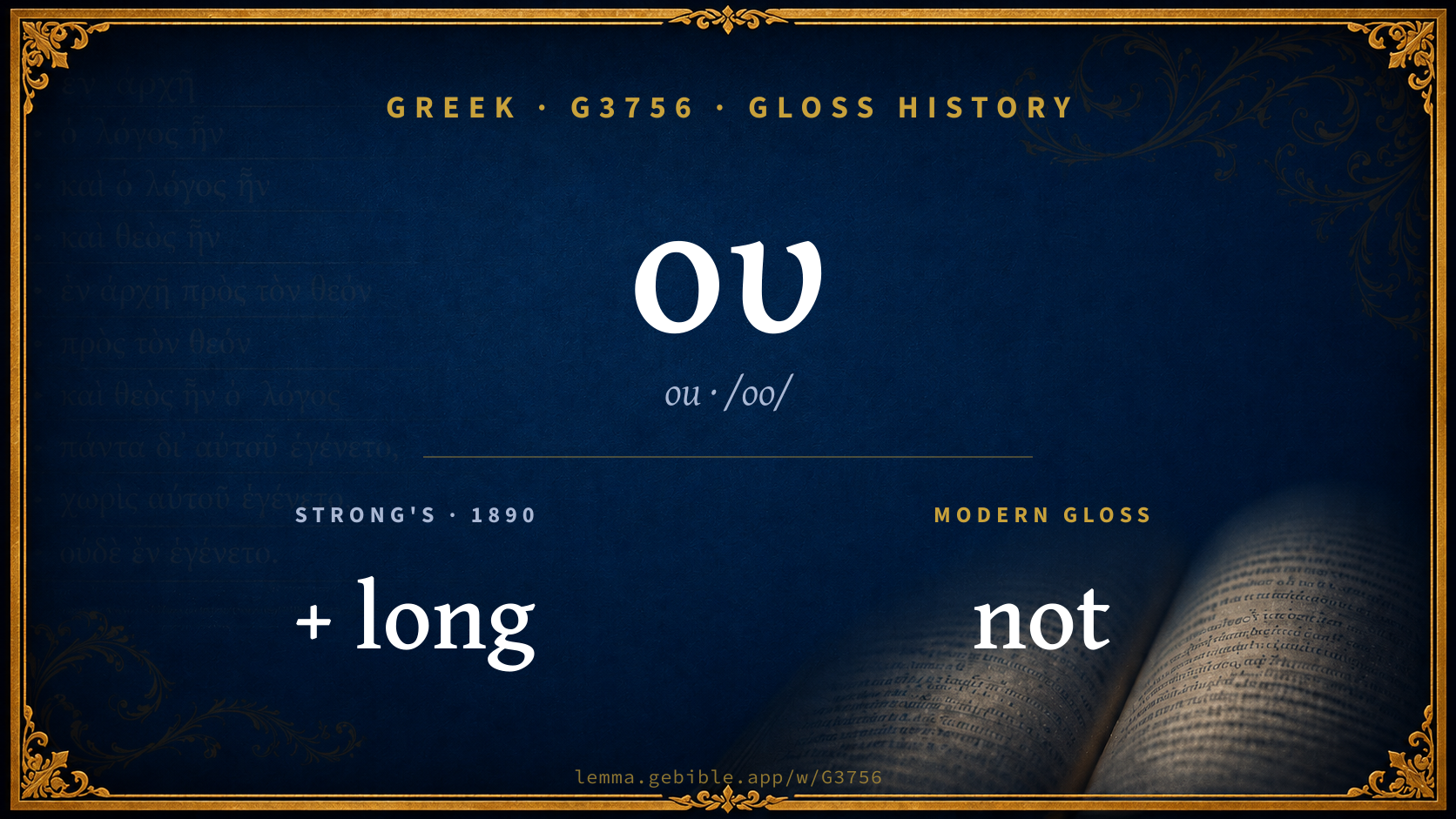
Gloss history
Strong's 1890 vs modern scholarship
About this word
Strong's G3756 catalogs a Greek word from the Greek New Testament.
These counts are not copied from any lexicon or concordance. They are computed here, from the morphology-tagged Greek New Testament. What Lemma adds →
- 1,401
- distinct verses
- The word appears in 1,401 distinct verses.
- 27 / 27
- NT books
- The word appears in 27 of 27 New Testament books.
- #11
- by frequency
- Top 25 most frequent Greek words (rank 11 of 5,347 Greek words by occurrence).
View all 1,401 occurrences in the concordance →
By section of the New Testament
By traditional corpus
Conventional, traditional groupings — biblical authorship is debated, so this is a traditional corpus grouping, not an authorship claim. Some books belong to more than one corpus (Luke is in both the Gospels and the Lukan corpus, and so on), so these shares overlap and need not total 100%. Each figure is a share of the word’s 1,401 distinct verses.
- Gospels 686 verses · 49%
- Pauline corpus 404 verses · 29%
- Johannine 348 verses · 25%
- Lukan (Luke–Acts) 256 verses · 18%
- General (Catholic) Epistles 92 verses · 7%
- Hebrews 62 verses · 4%
- Revelation 54 verses · 4%
How translations render this word
Counts come from each version’s own published word-to-Strong’s tagging or interlinear alignment — an approximate guide to how each version renders this word, not a word-level alignment the data otherwise carries. Because each total is that version’s own tagged count, the per-version totals vary from one another and need not match the appearance or distinct-verse counts above. These counts may also differ from a printed concordance because Lemma counts each distinctly tagged rendering and does not collapse phrase taggings into a single head-word total. This is a fixed set of word-tagged versions (KJV, ASV, BSB, ULT) and does not change with the reading translation you choose elsewhere. Each version’s license is shown beside its name below (and on Sources).
- King James Version: Not 1,159×, No 138×, Cannot 27×
- American Standard Version: Not 1,108×, No 165×, Is not 19×
- Berean Standard Bible: Not 365×, No 123×, Does not 26×
- unfoldingWord Literal Text: Not 1,367×, No 92×, Certainly not 89×
King James Version Public Domain
Renders G3756 across 1,506 tagged occurrences — most commonly:
Plus other, less common renderings. Plus 47 renderings that appear only once — usually multi-word phrases or single function words the recovered tagging swept in, not distinct renderings. Not rendered by a distinct English word in 31 further occurrences.
American Standard Version Public Domain
Renders G3756 across 1,534 tagged occurrences — most commonly:
Plus other, less common renderings. Plus 89 renderings that appear only once — usually multi-word phrases or single function words the recovered tagging swept in, not distinct renderings. Not rendered by a distinct English word in 1 further occurrence.
Berean Standard Bible Public Domain
Renders G3756 across 705 tagged occurrences — most commonly:
Plus other, less common renderings. Plus 46 renderings that appear only once — usually multi-word phrases or single function words the recovered tagging swept in, not distinct renderings. Not rendered by a distinct English word in 128 further occurrences.
unfoldingWord Literal Text CC BY-SA 4.0
Renders G3756 across 1,635 tagged occurrences — most commonly:
Plus other, less common renderings. Plus 21 renderings that appear only once — usually multi-word phrases or single function words the recovered tagging swept in, not distinct renderings.
Senses in Thayer's
The 1 sense Thayer's distinguishes for this word, in lexicon order (not ranked by frequency or importance). The full entry — with sub-senses — is in the Lexicon Entry tab.
- no, not; in direct questions expecting an affirmative answer
Word origin
Derived from μη (mḗ) (G3361) — not.
Also οὐκ ouk ook used before a vowel and οὐχ ouch ookh before an aspirate. A primary word; the absolutely negative (compare G3361 ) adverb; no or not : - + long nay neither never no (X man) none [can-] not + nothing + special un ([-worthy]) when + without + yet but. See also G3364 G3372 .
— Strong’s Exhaustive Concordance (1890), public domain.
Forms in the corpus
The 8 distinct written forms G3756 takes in the Greek New Testament, most frequent first — each parse links to that case’s occurrences in the concordance.
| Form | Parsing | Example | Uses |
|---|---|---|---|
| οὐκ ouk | Particle, Negative | Matthew 1:25 | 828 |
| οὐ ou | Particle, Negative | Matthew 5:14 | 660 |
| οὐχ ouch | Particle, Negative | Matthew 6:26 | 104 |
| οὔ oú | Particle, Negative | Matthew 5:37 | 14 |
| Οὐ Ou | Particle, Negative | Matthew 7:21 | 11 |
| Οὐκ Ouk | Particle, Negative | Matthew 10:24 | 4 |
| οὒ où | Particle, Negative | Matthew 5:37 | 3 |
| Οὐχ Ouch | Particle, Negative | Romans 9:6 | 2 |
Same root — word family
Other Thayer's entries built from the same root as G3756, grouped by Strong’s listed origin. These share a root / origin per the lexicon — not necessarily a shared meaning. Each links to that word’s own entry.
Derives from
Shares the same root
- μηδαμως mēdamōs G3365 by no means
- μηδε mēdé G3366 and not
- μηδεις mēdeís G3367 no one
- μηκετι mēkéti G3371 no longer
- μη ουκ mḕ ouk G3378 not ever
- μηποτε mḗpote G3379 lest
- μηπω mḗpō G3380 not yet
- μηπως mḗpōs G3381 lest
- μητε mḗte G3383 nor
- μητι mḗti G3385 whether
- μητις mḗtis G3387 let no one
Derived from this word
- μη mḗ G3361 not
- ου μη ou mḗ G3364 by no means
- ουδε oudé G3761 neither
- ουκετι oukéti G3765 no longer
- ουκουν oukoûn G3766 not therefore
- ουπω oúpō G3768 not yet
- ουτε oúte G3777 neither
- ουχι ouchí G3780 not at all
Compare all same-root words → Showing 4 of 20 — not the complete family. They share a root, not necessarily a meaning.
Septuagint usage
The same Greek word ου appears 5,233 times in the Greek Old Testament (Septuagint), across 4,158 verses in 38 books.
- 5,233
- LXX occurrences
- Tagged occurrences of this Greek word in the Septuagint.
- 4,158
- verses
- Distinct Septuagint verses containing this word.
- 38 / 39
- OT books
- The word appears in 38 of the 39 Old Testament books.
Sample Septuagint occurrences
- Genesis 2:5 οὐ
- Exodus 1:8 οὐ
- Leviticus 1:17 οὐ
- Numbers 1:47 οὐ
- Deuteronomy 1:9 οὐ
- Joshua 1:5 οὐ
- Judges 1:18 οὐ
- Ruth 2:7 οὐ
- 1 Samuel 1:2 οὐ
- 2 Samuel 1:10 οὐ
- 1 Kings 1:1 οὐ
- 2 Kings 1:4 οὐ
Septuagint occurrences (same lexeme)
Every verse where the same Strong’s number (G3756) appears in the Greek Septuagint — showing the first 50 of 4,158. Verse text shown in the World English Bible for context; the Greek form is the matched word — the English is not keyword-highlighted.
- Genesis 2:5 οὐ No plant of the field was yet in the earth, and no herb of the field had yet sprung up; for Yahweh God had not caused it to rain on the earth. There was not a man to till the ground,
- Genesis 2:17 οὐ but of the tree of the knowledge of good and evil, you shall not eat of it: for in the day that you eat of it you will surely die."
- Genesis 2:18 οὐ Yahweh God said, "It is not good that the man should be alone; I will make him a helper suitable for him."
- Genesis 2:20 οὐ The man gave names to all cattle, and to the birds of the sky, and to every animal of the field; but for man there was not found a helper suitable for him.
- Genesis 2:25 οὐ They were both naked, the man and his wife, and were not ashamed.
- Genesis 3:1 οὐ Now the serpent was more subtle than any animal of the field which Yahweh God had made. He said to the woman, "Yes, has God said, 'You shall not eat of any tree of the garden?'"
- Genesis 3:3 οὐ but of the fruit of the tree which is in the midst of the garden, God has said, 'You shall not eat of it, neither shall you touch it, lest you die.'"
- Genesis 3:4 οὐ The serpent said to the woman, "You won't surely die,
- Genesis 4:5 οὐ but he didn't respect Cain and his offering. Cain was very angry, and the expression on his face fell.
- Genesis 4:7 οὐ If you do well, will it not be lifted up? If you don't do well, sin crouches at the door. Its desire is for you, but you are to rule over it."
- Genesis 4:9 οὐ Yahweh said to Cain, "Where is Abel, your brother?" He said, "I don't know. Am I my brother's keeper?"
- Genesis 4:12 οὐ From now on, when you till the ground, it won't yield its strength to you. You shall be a fugitive and a wanderer in the earth."
- Genesis 4:15 οὐ Yahweh said to him, "Therefore whoever slays Cain, vengeance will be taken on him sevenfold." Yahweh appointed a sign for Cain, lest any finding him should strike him.
- Genesis 5:24 οὐ Enoch walked with God, and he was not, for God took him.
- Genesis 6:3 οὐ Yahweh said, "My Spirit will not strive with man forever, because he also is flesh; yet will his days be one hundred twenty years."
- Genesis 8:7 οὐ and he sent forth a raven. It went back and forth, until the waters were dried up from off the earth.
- Genesis 8:9 οὐ but the dove found no place to rest her foot, and she returned to him into the ark; for the waters were on the surface of the whole earth. He put forth his hand, and took her, and brought her to him into the ark.
- Genesis 8:12 οὐ He stayed yet another seven days, and sent forth the dove; and she didn't return to him any more.
- Genesis 8:21 οὐ Yahweh smelled the sweet savor. Yahweh said in his heart, "I will not again curse the ground any more for man's sake, because the imagination of man's heart is evil from his youth; neither will I ever again strike everything living, as I have done.
- Genesis 8:22 οὐ While the earth remains, seed time and harvest, and cold and heat, and summer and winter, and day and night shall not cease."
- Genesis 9:4 οὐ But flesh with the life of it, the blood of it, you shall not eat.
- Genesis 9:11 οὐ I will establish my covenant with you; neither will all flesh be cut off any more by the waters of the flood; neither will there any more be a flood to destroy the earth."
- Genesis 9:15 οὐ and I will remember my covenant, which is between me and you and every living creature of all flesh, and the waters will no more become a flood to destroy all flesh.
- Genesis 9:23 οὐ Shem and Japheth took a garment, and laid it on both their shoulders, went in backwards, and covered the nakedness of their father. Their faces were backwards, and they didn't see their father's nakedness.
- Genesis 11:6 οὐ Yahweh said, "Behold, they are one people, and they have all one language; and this is what they begin to do. Now nothing will be withheld from them, which they intend to do.
- Genesis 11:30 οὐ Sarai was barren. She had no child.
- Genesis 12:18 οὐ Pharaoh called Abram, and said, "What is this that you have done to me? Why didn't you tell me that she was your wife?
- Genesis 13:6 οὐ The land was not able to bear them, that they might live together: for their substance was great, so that they could not live together.
- Genesis 13:9 οὐ Isn't the whole land before you? Please separate yourself from me. If you go to the left hand, then I will go to the right. Or if you go to the right hand, then I will go to the left."
- Genesis 15:3 οὐ Abram said, "Behold, to me you have given no seed: and, behold, one born in my house is my heir."
- Genesis 15:4 οὐ Behold, the word of Yahweh came to him, saying, "This man will not be your heir, but he who will come forth out of your own body will be your heir."
- Genesis 15:10 οὐ He took him all these, and divided them in the middle, and laid each half opposite the other; but he didn't divide the birds.
- Genesis 15:13 οὐ He said to Abram, "Know for sure that your seed will live as foreigners in a land that is not theirs, and will serve them. They will afflict them four hundred years.
- Genesis 16:1 οὐ Now Sarai, Abram's wife, bore him no children. She had a handmaid, an Egyptian, whose name was Hagar.
- Genesis 16:10 οὐ The angel of Yahweh said to her, "I will greatly multiply your seed, that they will not be numbered for multitude."
- Genesis 17:5 οὐ Neither will your name any more be called Abram, but your name will be Abraham; for the father of a multitude of nations have I made you.
- Genesis 17:12 οὐ He who is eight days old will be circumcised among you, every male throughout your generations, he who is born in the house, or bought with money of any foreigner who is not of your seed.
- Genesis 17:14 οὐ The uncircumcised male who is not circumcised in the flesh of his foreskin, that soul shall be cut off from his people. He has broken my covenant."
- Genesis 17:15 οὐ God said to Abraham, "As for Sarai your wife, you shall not call her name Sarai, but her name will be Sarah.
- Genesis 18:15 οὐ Then Sarah denied, saying, "I didn't laugh," for she was afraid." He said, "No, but you did laugh."
- Genesis 18:24 οὐ What if there are fifty righteous within the city? Will you consume and not spare the place for the fifty righteous who are therein?
- Genesis 18:25 οὐ Be it far from you to do things like that, to kill the righteous with the wicked, that so the righteous should be as the wicked. May that be far from you. Shouldn't the Judge of all the earth do right?"
- Genesis 18:28 οὐ What if there will lack five of the fifty righteous? Will you destroy all the city for lack of five?" He said, "I will not destroy it, if I find forty-five there."
- Genesis 18:29 οὐ He spoke to him yet again, and said, "What if there are forty found there?" He said, "I will not do it for the forty's sake."
- Genesis 18:30 οὐ He said, "Oh don't let the Lord be angry, and I will speak. What if there are thirty found there?" He said, "I will not do it, if I find thirty there."
- Genesis 18:31 οὐ He said, "See now, I have taken it on myself to speak to the Lord. What if there are twenty found there?" He said, "I will not destroy it for the twenty's sake."
- Genesis 18:32 οὐ He said, "Oh don't let the Lord be angry, and I will speak yet but this once. What if ten are found there?" He said, "I will not destroy it for the ten's sake."
- Genesis 19:2 οὐ and he said, "See now, my lords, please turn aside into your servant's house, stay all night, wash your feet, and you will rise up early, and go on your way." They said, "No, but we will stay in the street all night."
- Genesis 19:8 οὐ See now, I have two virgin daughters. Please let me bring them out to you, and do you to them as is good in your eyes. Only don't do anything to these men, because they have come under the shadow of my roof."
- Genesis 19:19 οὐ See now, your servant has found favor in your sight, and you have magnified your loving kindness, which you have shown to me in saving my life. I can't escape to the mountain, lest evil overtake me, and I die.
These are occurrences of the same Greek lexeme (G3756) in the Septuagint — not a translation of any one Hebrew word. The store carries no word-level Hebrew↔Greek alignment, so no Hebrew original is asserted here. Counts come from the recovered LXX Strong's tagging — high-frequency vocabulary is well covered, while rare or late forms may be untagged — so they reflect tagged occurrences and may slightly undercount.