
Matthew 19:4

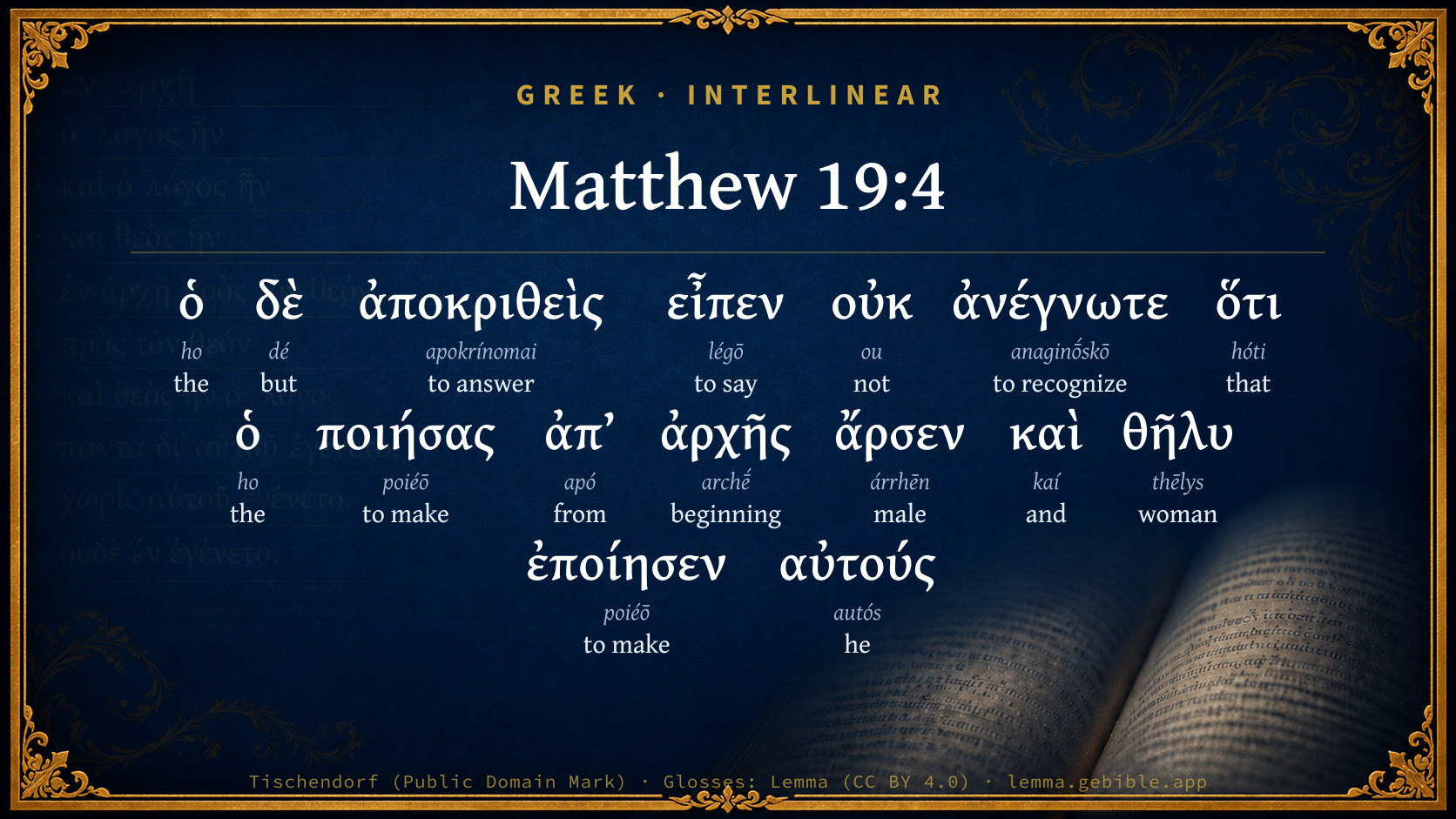
Greek (Tischendorf 8th ed.) Matthew 19:4 appears in the Greek New Testament. The text above is from the Tischendorf 8th edition. Each word links to its Strong’s number and a concise gloss. Click any word for its full Thayer’s Greek Lexicon entry.
Download image
Cite this verse

Matthew 19:4 (World English Bible). Public Domain. Lemma interlinear Bible study tool, https://lemma.gebible.app/v/matthew/19/4.

Show BibTeX & RIS
BibTeX
RIS
English Translation
He answered, "Haven't you read that he who made them from the beginning made them male and female,
World English Bible · Public Domain
Highlights
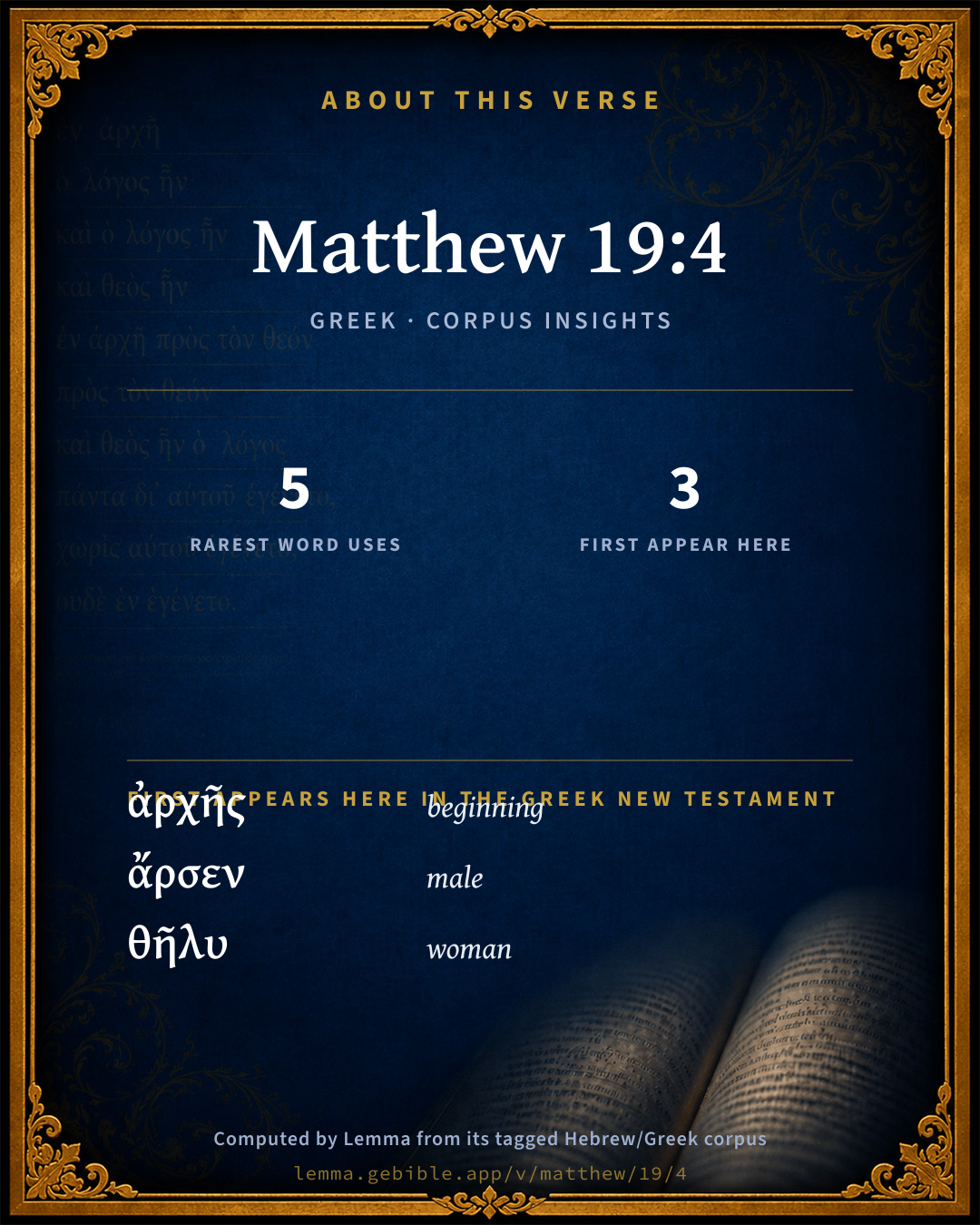
  • 3 first appearances in the Greek New Testament
Full analysis ↓
Download a study sheet

One document with this verse’s original text, its word-by-word gloss line, the meaning frame, cross-references with their text, attributed commentary, and full source and license credits — printable, and it pastes into notes with its structure intact.

This verse Autodidact and up

Study sheet (.html) Plain text (.txt)

A passage Seminary Student

Up to 50 verses in one chapter. A passage sheet keeps up to 6 commentary sources and 12 cross-references per verse, in the order this page ranks them, and says so on the sheet whenever that leaves anything out. Ask for a single verse and you get the Autodidact verse sheet above.

Everything on this page stays free to read, with no account — the sheet is a download of what is already on screen, not access to it.

Want to remove ads? Support Godless Engineer
Compare translations 3

The same verse in 3 English versions, stacked beneath the original-language interlinear above. Click any original word for its lexicon entry.

Each is an independent rendering of the whole verse — the interlinear is not word-aligned to these translations.

Highlighted words mark where these versions differ — a whole-verse word diff, not a word-by-word alignment.

  • World English Bible Public Domain
    He answered, "Haven't you read that he who made them from the beginning made them male and female,
  • King James Version Public Domain
    And he answered and said unto them, Have ye not read, that he which made them at the beginning made them male and female,
  • unfoldingWord Literal Text CC BY-SA 4.0
    But he, answering, said, “Have you not read that the one having made from the beginning ‘made them male and female,’

unfoldingWord Literal Text — © unfoldingWord, licensed CC BY-SA 4.0. Word-aligned USFM3 via Door43 (git.door43.org/unfoldingWord/en_ult).

Versions to compare (up to 4)

3 of 4 selected

Show all 19 translations

Every available English version of this verse, each an independent rendering of the whole verse.

  • World English Bible Public Domain
    He answered, "Haven't you read that he who made them from the beginning made them male and female,
  • Berean Standard Bible Public Domain
    Jesus answered, “Have you not read that from the beginning the Creator ‘made them male and female,’
  • Majority Standard Bible Public Domain
    Jesus answered, “Have you not read that from the beginning the Creator ‘made them male and female,’
  • King James Version Public Domain
    And he answered and said unto them, Have ye not read, that he which made them at the beginning made them male and female,
  • American Standard Version (1901) Public Domain
    And he answered and said, Have ye not read, that he who made `them' from the beginning made them male and female,
  • Revised Version (1885) Public Domain
    And he answered and said, Have ye not read, that he which made them from the beginning made them male and female,
  • Geneva Bible (1599) Public Domain
    And he answered and sayd vnto them, Haue ye not read, that hee which made them at the beginning, made them male and female,
  • Douay-Rheims (1899) Public Domain
    Who answering, said to them: Have ye not read, that he who made man from the beginning, Made them male and female And he said:
  • Young's Literal Translation Public Domain
    And he answering said to them, `Did ye not read, that He who made `them', from the beginning a male and a female made them,
  • Literal Standard Version CC BY-SA 4.0
    And He answering said to them, “Did you not read that He who made [them] from the beginning, made them a male and a female,
  • Unlocked Literal Bible CC BY-SA 4.0
    Jesus answered and said, “Have you not read that he who made them from the beginning made them male and female?
  • unfoldingWord Literal Text CC BY-SA 4.0
    But he, answering, said, “Have you not read that the one having made from the beginning ‘made them male and female,’
  • Darby Bible Public Domain
    But he answering said [to them], Have ye not read that he who made [them], from the beginning made them male and female,
  • World Messianic Bible Public Domain
    He answered, “Haven’t you read that he who made them from the beginning made them male and female,
  • Webster's Bible Public Domain
    And he answered and said to them, Have ye not read, that he who made them, at the beginning made them male and female,
  • Free Bible Version CC BY-SA 4.0
    Jesus replied, “Haven't you read that God who created people in the beginning made them male and female?
  • Bible in Basic English Public Domain
    And he said in answer, Have you not seen in the Writings, that he who made them at the first made them male and female, and said,
  • Text-Critical English NT CC BY 4.0
    He answered them, “Have you not read that he who made them from the beginning ‘made them male and female,’
  • Tyndale New Testament (1534) Public Domain
    He answered and sayd vnto them: Have ye not redde how that he which made man at the beginninge made them man and woman

Literal Standard Version (2020), Covenant Press — licensed CC BY-SA 4.0. Text via the HelloAO Bible API (eBible.org). Unlocked Literal Bible (unfoldingWord) — licensed CC BY-SA 4.0. Text via the HelloAO Bible API (eBible.org). unfoldingWord Literal Text — © unfoldingWord, licensed CC BY-SA 4.0. Word-aligned USFM3 via Door43 (git.door43.org/unfoldingWord/en_ult). Free Bible Version, Dr. Jonathan Gallagher — licensed CC BY-SA 4.0. Text via the HelloAO Bible API (eBible.org).

Word by word

More ways to search: Search by grammar → Find every occurrence → Compare this word →

Practice this passage: Drill this verse → Learn its vocabulary →

θῆλυ
thēlys
G2338
“woman”
Adjective, Accusative, Singular, Neuter
Part of Speech
Adjective
Case
Accusative
Number
Singular
Gender
Neuter
Full Thayer's Definition

Origin: from the same as G2337

TDNT: None

1. of the female sex 2. a woman, a female
  1. ὁ ho G3588 “the” Article, Nominative, Singular, Masculine
  2. δὲ dé G1161 “but” Conjunction
  3. ἀποκριθεὶς apokrínomai G611 “to answer” Verb, Aorist, Passive deponent, Participle, Nominative, Singular, Masculine
  4. εἶπεν légō G3004 “to say” Verb, Aorist, Active, Indicative, 3rd person, Singular
  5. οὐκ ou G3756 “not” Particle, Negative
  6. ἀνέγνωτε anaginṓskō G314 “to recognize” Verb, Aorist, Active, Indicative, 2nd person, Plural
  7. ὅτι hóti G3754 “that” Conjunction
  8. ὁ ho G3588 “the” Article, Nominative, Singular, Masculine
  9. ποιήσας poiéō G4160 “to make” Verb, Aorist, Active, Participle, Nominative, Singular, Masculine
  10. ἀπ’ apó G575 “from” Preposition
  11. ἀρχῆς archḗ G746 “beginning” Noun, Genitive, Singular, Feminine
  12. ἄρσεν árrhēn G730 “male” Adjective, Accusative, Singular, Neuter
  13. καὶ kaí G2532 “and” Conjunction
  14. ἐποίησεν poiéō G4160 “to make” Verb, Aorist, Active, Indicative, 3rd person, Singular
  15. αὐτούς autós G846 “he” Personal pronoun, Accusative, Plural, Masculine

About this verse

These counts appear in no published source. They are computed here, from the morphology-tagged text and Lemma’s own curated glosses. What Lemma adds →

16
words
14
distinct lemmas
Gospels
section

Notable vocabulary

The rarest word here is θῆλυ woman G2338 — appearing just 5 times in the whole Greek New Testament.

First appearance in Scripture

These words make their first canonical appearance in the Greek New Testament here:

  • ἀρχῆς beginning G746
  • ἄρσεν male G730
  • θῆλυ woman G2338

Shared distinctive vocabulary

θῆλυ woman G2338 occurs in 5 verses of the Greek New Testament. Also found in:
Repetition

Words recur within this verse:

  • ποιήσας to make G4160 ×2
  • ὁ the G3588 ×2

Cross-references

13

Topical passages linked to Matthew 19:4 in the Treasury of Scripture Knowledge — connected by theme and wording, ordered by reader-vote popularity; previews shown in the World English Bible.

  • Genesis 2:23 The man said, "This is now bone of my bones, and flesh of my flesh. She will be called Woman, because she was taken out of Man."
  • Genesis 1:27 God created man in his own image. In God's image he created him; male and female he created them.
  • Genesis 5:2 He created them male and female, and blessed them, and called their name Adam, in the day when they were created.
  • Luke 10:26 He said to him, "What is written in the law? How do you read it?"
  • Malachi 2:15 Did he not make one, although he had the residue of the Spirit? Why one? He sought a godly seed. Therefore take heed to your spirit, and let none deal treacherously against the wife of his youth.
  • Genesis 2:18 Yahweh God said, "It is not good that the man should be alone; I will make him a helper suitable for him."
  • Matthew 22:31 But concerning the resurrection of the dead, haven't you read that which was spoken to you by God, saying,
  • Matthew 21:42 Jesus said to them, "Did you never read in the Scriptures, 'The stone which the builders rejected, The same was made the head of the corner. This was from the Lord. It is marvelous in our eyes?'
  • Mark 12:10 Haven't you even read this Scripture: 'The stone which the builders rejected, The same was made the head of the corner.
  • Mark 12:26 But about the dead, that they are raised; haven't you read in the book of Moses, about the Bush, how God spoke to him, saying, 'I am the God of Abraham, the God of Isaac, and the God of Jacob?'
  • Matthew 12:3 But he said to them, "Haven't you read what David did, when he was hungry, and those who were with him;
  • Luke 6:3 Jesus, answering them, said, "Haven't you read what David did when he was hungry, he, and those who were with him;
  • Mark 2:25 He said to them, "Did you never read what David did, when he had need, and was hungry--he, and they who were with him?

Cross-references courtesy of OpenBible.info (CC BY 4.0).

Where the printed editions differ

1 variant

Places in this verse where the major printed Greek editions disagree on the wording in a way that affects the translation — a comparison of editions, not a manuscript-by-manuscript collation. The editions are the modern critical texts (Nestlé-Aland 28/27, SBL, Westcott-Hort, Tregelles, Tyndale House) and the traditional texts behind the KJV (the Textus Receptus and the Byzantine/Majority text). It is not a claim about which reading is original.

  1. Different wording
    κτίσας

    “created”

    In NA28NA27TynSBLWHTreg Not in TRByz

    ποιήσας (poiēsas) 'made' occurs in traditional manuscripts (TR+Byz) instead of κτίσας (ktisas) 'created' in older manuscripts (NA28+NA27+Tyn+SBL+WH+Treg)

Textual data: Translators Amalgamated Greek New Testament (STEPBible TAGNT) · CC BY 4.0.

Commentary

Notes on Matthew 19:4 from classic Christian and Jewish commentators (each source and its license shown beneath its notes). The classic Christian expositions comment on the surrounding passage and are grouped to its opening verse, so a note may address several verses; the Jewish commentaries on the Tanakh (Rashi and others) are per-verse, so they appear only where the commentator wrote on this verse.

Lemma curates 59 commentaries, every one of them public domain or Creative Commons licensed, each selected and text-cleaned for this edition rather than reprinted as found. About our sources →

Joseph Benson's Commentary

Mat 19:4-6. He answered, Have ye not read, &c. — It is thought by some that the chief design of the Pharisees in putting the fore-mentioned question to our Lord, was to make him contradict Moses. If so, they were much disappointed, for, instead of contradicting him, he confutes them by the very words of Moses. He who made them at the beginning — When the human race began to exist; made them male and female — Greek, αρσεν και θηλυ, which Dr. Campbell renders, a male and a female. He finds fault with our version as inaccurate and irrelative to our Lord’s argument, and thinks our translators “could not have rendered the clause differently if the original expression had been αρρενας και θηλειας εποιεσεν αυτους. Yet it is manifest, that the sense would have been different. All that this declaration would have implied is, that when God created mankind, he made people of both sexes. But what argument could have been drawn from this principle, to show that the tie of marriage was indissoluble? Or how could the conclusion annexed have been supported? For this cause shall a man leave father and mother. Besides, it was surely unnecessary to recur to the history of the creation to convince those Pharisees of what all the world knew, that the human race was composed of men and women, and consequently of two sexes. The weight of the argument, therefore,” he says, “must lie in this circumstance, that God created at first no more than a single pair, one of each sex, whom he united in the bond of marriage, and, in so doing, exhibited a standard of that union to all generations. The very words, and these two, show that it is implied in the historian’s declaration, that they were two, one male and one female, and no more. But this is by no means implied in the common version. It lets us know, indeed, that they were two sexes, but gives us no hint that these were but two persons.” And said — By the mouth of Adam, who uttered these words, For this cause — On account of his engaging in the married state; shall a man leave father and mother — When those dear relations of parental and filial tenderness shall take place, and shall cleave to his wife — With an affection more strong and steady than he feels even for those from whom, under God, he has derived his being: and they twain shall be one flesh — That is, “shall constitute only one person, in respect of the unity of their inclinations and interests, and of the mutual power which they have over each other’s bodies, 1Co 6:16; 1Co 7:4; and as long as they continue faithful to this law, they must remain undivided till death separates them.” Wherefore they are no more twain, but one flesh —

“From the original institution of marriage, therefore, in paradise, and from the great law thereof, declared by God himself on that occasion, it evidently appears that it is the strongest and tenderest of all friendships, a friendship supported by the divine sanction and approbation, a friendship therefore which ought to be indissoluble till death.” What therefore God hath joined together, let no man put asunder — By unreasonable divorces. Husbands and wives, being joined together by the ordinance of God, must not be put asunder by any ordinance of man: but the bond of marriage must be esteemed sacred, and incapable of being dissolved by any thing which does not make them cease to be one flesh, by making that of the one common to some third person, that is, by one of the parties committing adultery: for as, by forming at first only one man and one woman, God condemned polygamy, so, by making them one flesh, he condemned divorce.

Joseph Benson's Commentary on the Old and New Testaments (1811–1818) — public domain. Text from a community e-Sword module.

Tyndale Open Study Notes

Tyndale Open Resources

19:4-5 The Pharisees were not considering all of God’s word. The Creator had made marriage as a permanent union (see Gen 2:18-25; see also 1 Cor 7:10-16).

Tyndale Open Study Notes — © Tyndale Open Resources, licensed CC BY-SA 4.0. Text via the HelloAO Bible API.

Bengel's Gnomon

Johann Albrecht Bengel

Mat 19:4. Ὁ ποιήσας, He who made) sc. them; with this construction, He who made them in the beginning, made them male and female. ὁ ποιήσας, ἐποίησεν (He who made, made), is a striking example of Ploce.[855]—ἀπʼ ἀρχῆς, at the beginning) In every discussion or interpretation recourse should be had to the origin of a Divine institution; see Mat 19:8 and Act 15:7.

[855] See Explanation of Technical Terms in Appendix.—(I. B.)

Bengel's Gnomon of the New Testament — English translation (T&T Clark, Edinburgh, 1860) — public domain. Text from a community e-Sword module.

Meyer's Critical & Exegetical Commentary

Heinrich August Wilhelm Meyer

Mat_19:4. Αὐτούς] δηλαδὴ τοὺς ἀνθρώπους· τουτὶ μὲν οὖν τὸ ῥητὸν ἐν τῇ βίβλῳ τῆς γενέσεως (Matthew 1:27) γέγραπται, Euthymius Zigabenus. The following αὐτούς should be understood after ὁ ποιήσας, as the object of the succeeding verb has often to be supplied after the participle (Krügers note on Xen. Anab. i. 8. 11). For ποιεῖν, to create, comp. Plat. Tim. p. 76 C; Hesiod, Theog. 110, 127 (γένος ἀνθρώπων).

ἀπʼ ἀρχῆς] does not belong to ὁ ποιήσας (as usually explained), in which case it would be superfluous, but to what follows (Fritzsche, Bleek), where great stress is laid on the expression, since the very beginning (Mat_19:8).

ἄρσεν κ. θῆλυ] as male and female, as a pair consisting of one of each sex.

ἐποίησεν] after ὁ ποίησας the same verb. See Kühner, ad Xen. Mem. iv. 2. 21, and Gramm. II. 2, p. 656.

Meyer — Critical and Exegetical Commentary on the New Testament — English translation by Peter Christie, edited by Frederick Crombie (T&T Clark, 1880) — public domain. Text from a community e-Sword module.

Expositor's Greek Testament

ed. W. Robertson Nicoll

Mat 19:4 . οὐκ ἀνέγνωτε : the words quoted are to be found in Gen 1:27 ; Gen 2:24 . ὁ κτίσας : the participle with article used substantively = the Creator. ἀπʼ ἀρχῆς goes along with what follows, Christ’s purpose being to emphasise the primitive state of things. From the beginning God made man, male and female; suited to each other, needing each other. ἄρσεν καὶ θῆλυ : “one male and one female, so that the one should have the one; for if He had wished that the male should dismiss one and marry another He would have made more females at the first,” Euthy.

The Expositor's Greek Testament, edited by W. Robertson Nicoll (1897–1910) — public domain. Text from a community e-Sword module.

Jamieson, Fausset & Brown

Robert Jamieson, A. R. Fausset & David Brown

And he answered and said unto them, Have ye not read, that he which made them at the beginning made them male and female--or better, perhaps, "He that made them made them from the beginning a male and a female."

Jamieson, Fausset & Brown — Commentary Critical and Explanatory on the Whole Bible (1871) — public domain (CC PDM 1.0). Text via the HelloAO Bible API.

Adam Clarke's Commentary

Verse 4. He which made them at the beginning] When Adam and Eve were the first of human kind.

Made them male and female] Merely through the design of matrimonial union, that the earth might be thus peopled. To answer a case of conscience, a man should act as Christ does here; pay no regard to that which the corruption of manners has introduced into Divine ordinances, but go back to the original will, purpose, and institution of God. Christ will never accommodate his morality to the times, nor to the inclinations of men. What was done at the beginning is what God judged most worthy of his glory, most profitable for man, and most suitable to nature.

Adam Clarke's Commentary on the Bible (1810–1826) — public domain. Text from a community e-Sword/MySword module.

Ellicott's Commentary for English Readers

(4) Have ye not read . . .?—The answer to the question is found not in the words of a code of laws, but in the original facts of creation. That represented the idea of man and woman as created for a permanent relationship to each other, not as left to unite and separate as appetite or caprice might prompt.

A Bible Commentary for English Readers, edited by Charles John Ellicott (1878–1897) — public domain. Text from a community e-Sword module.

The Cambridge Bible for Schools and Colleges

gen. ed. J. J. S. Perowne

4. at the beginning] An appeal from the law of Moses to a higher and absolute law, which has outlived the law of Moses.

The Cambridge Bible for Schools and Colleges (gen. ed. J. J. S. Perowne; Cambridge University Press, 1878–1918) — public domain. Text from a community e-Sword module.

John Gill's Exposition

And he answered and said unto them,.... Not by replying directly to the question, but by referring them to the original creation of man, and to the first institution of marriage, previous to the law of Moses;

have ye not read, that he which made them at the beginning, made them male and female? This may be read in Gen 1:27 and from thence this sense of things collected; that God, who in the beginning of time, or of the creation, as Mark expresses it, made all things, the heavens, and the earth, and all that is therein, and particularly "man", as the Vulgate Latin, and Munster's Hebrew Gospel supply it here, made the first parents of mankind, male and female; not male and females, but one male, and one female; first, one male, and then, of him one female, who, upon her creation, was brought and married to him; so that in this original constitution, no provision was made for divorce, or polygamy. Adam could not marry more wives than one, nor could he put away Eve for every cause, and marry another: now either the Pharisees had read this account, or they had not; if they had not, they were guilty of great negligence and sloth; if they had, they either understood it or not; if they did not understand it, it was greatly to their reproach, who pretended to great knowledge of the Scriptures, and to be able to explain them to others; and if they did understand it, there was no need for this question, which therefore must be put with an evil design.

John Gill's Exposition of the Whole Bible (1746–1763) — public domain (CC PDM 1.0). Text via the HelloAO Bible API.

Trapp's Complete Commentary

John Trapp

4 And he answered and said unto them, Have ye not read, that he which made them at the beginning made them male and female,

Ver. 4. And he answered and said unto them] Our Saviour would not divide the inheritance, when required to it, Luk 12:13, but he would decide controversies touching divorces; for in marriage matters many cases of conscience fall out fit to be determined by the minister, whose lips should both preserve and present knowledge to the people, whose house for this cause should be always open, as the Aediles’ house in Rome was to all comers.

John Trapp, A Commentary or Exposition upon All the Books of the Old and New Testament (1647–1656) — public domain. Text from a community e-Sword module.

Albert Barnes' Notes on the Bible

And he answered and said ... - Instead of referring to the opinions of either party, Jesus called their attention to the original design of marriage, to the authority of Moses an authority acknowledged by them both.

Have ye not read? - Gen 1:27; Gen 2:21-22. “And said, For this cause,” etc., Gen 2:24. That is, God, at the beginning, made but one man and one woman: their posterity should learn that the original intention of marriage was that a man should have but one wife.

Shall leave his father and mother - This means, shall bind himself more strongly to his wife than he was to his father or mother. The marriage connection is the most tender and endearing of all human relations more tender than even that bond which unites us to a parent.

And shall cleave unto his wife - The word “cleave” denotes a union of the firmest kind. It is in the original taken from gluing, and means so firmly to adhere together that nothing can separate them.

They twain shall be one flesh - That is, they two, or they that were two, shall be united as one - one in law, in feeling, in interest, in affection. They shall no longer have separate interests, but shall act in all things as if they were one - animated by one soul and one wish. The argument of Jesus here is, that since they are so intimately united as to be one, and since in the beginning God made but one woman for one man, it follows that they cannot be separated but by the authority of God. Man may not put away his wife for every cause. What God has joined together man may not put asunder. In this decision he really decided in favor of one of the parties; and it shows that when it was proper, Jesus answered questions without regard to consequences, from whatever cause they might have been proposed, and however much difficulty it might involve him in. Our Lord, in this, also showed consummate wisdom. He answered the question, not from Hillel or Shammai, their teachers, but from Moses, and thus defeated their malice.

Albert Barnes' Notes on the Bible (1834–1885) — public domain. Text from a community e-Sword/MySword module.

Haydock's Catholic Bible Commentary

In the beginning. It is remarked by St. Jerome, St. John Chrysostom, and Theophylactus, that the Almighty does not say of any of the animals which he created, as he does of man and woman, that he joined one male to one female; from which it appears, according to the reasoning of St. Augustine, that monogamy, as well as the indissolubility of marriage, was instituted from the beginning by the Almighty. (Tirinus)

George Leo Haydock (1774–1849), Haydock's Catholic Family Bible and Commentary, 1859 edition — public domain. Excludes Psalms (Douay-Rheims chapter numbering differs from Protestant) and Deuterocanonical books (Catholic canon only).

Matthew Poole's English Annotations

Mark, Mar 10:2-9, giveth us the same history of this discourse, differing a little in the order of the words, but nothing as to the substance of his discourse. Our Saviour answereth neither Yea nor Nay to their discourse, but gives them a fair occasion to answer themselves, and tacitly charges them with ignorance and corruption of the law of God. He refers them to the first institution of marriage, and for that to the book of Genesis, Gen 1:27; 2:24. It is as much as if our Lord had said, You own the book of Genesis, as well as the book of Deuteronomy. In the book of Genesis you read the first institution of marriage: it was instituted by God himself; he made male and female, Gen 1:27; he made the law of marriage, Gen 2:24, that a man (should) leave his father and mother, and cleave unto his wife, and they (should) be one flesh; from whence he concludes that the man and wife are one flesh in God’s account. From hence he leaves them to conclude, whether it was probable that Moses, whom they so reverenced, and who was so faithful in the house of God as a servant, would license them to put asunder whom God had put together; or whether they had not put an interpretation upon the law of Moses which it could not bear in consistency with the law of God. For the sense of those words, Gen 1:27; 2:24, see the notes on those places. See Poole on "Gen 1:27". See Poole on "Gen 2:24".

Matthew Poole's English Annotations on the Holy Bible (1683–1685) — public domain. Text from a community e-Sword/MySword module.

Whedon's Commentary on the Bible

Daniel D. Whedon

4. He answered — Our Lord’s answer really coincides with neither party. Schammai is indeed in the right in maintaining the stricter view of marriage obligation. His views are founded in absolute right. But then he is wrong in maintaining that the letter of the Mosaic law does maintain the highest strictness of the divine right on this subject. From the hardness of their hearts Moses did permit to the Jews, though not enjoin, a practice which was not absolutely right. A truly pure man could not avail himself of the permission. Have ye not read — Our Lord here quotes the book of Genesis as a divine authority. We thus prove the Old Testament by the New. If Christ was the Son of God, Moses was the servant of God. If Christ’s words had a divine authority, then Moses was also inspired. Made them male and female — He made the race male and female, with the divine intention that marriage should exist. And by still maintaining the race as divided into two sexes, he shows that marriage is a permanent and natural institution. And as he made one for one, and no more, so the marriage of a single man with a single woman is a law of the race. And since, by some mysterious law, the two sexes are perpetually preserved in an approximate equality in point of number, it is plain that the permanent marriage of one man with one woman is the permanent and universal law of nature. Polygamy, as well as capricious divorce, is a violation of natural law.

Daniel D. Whedon (gen. ed.), Commentary on the Old and New Testaments (1874–1909) — public domain. Text from a community e-Sword module.

The Pulpit Commentary

He answered and said. Our Lord does not directly reply in the negative, but refers to the original institution of marriage. All his auditors agreed in holding the legality of divorce, though they differed in their estimation of the causes that warranted separation. It was quite a new idea to find the propriety of divorce questioned, and to have their captious question met by an appeal to Scripture which they could not gainsay, and an enunciation of a high ideal of matrimony which their glosses and laxity had miserably perverted or obscured. He which made them. Manuscripts vary between o poihsav and o ktisav . The latter is approved by Westcott and Hort. It is best translated, the Creator. The Vulgate gives, qui fecit hominem. At the beginning (ap archv). These words should be joined to the following verb made (epoihsen), and not with the preceding participle, as it is intended to show the primordial design in the creation of man and woman. God made the first members of the human family a male and a female, not a male and females. The lower animals were created separately, male and female; "mankind was created in one person in Adam, and when there was found no help meet for Adam, no companion in body, soul, or spirit, fit for him, then God, instead of creating a wholly new thing, made Eve out of Adam" (Sadler). Two individuals of opposite sexes were thus formed for each other; one was the complement of the other, and the union was perfect and lasted, as long as life. There was in this original institution no room for polygamy, no room for divorce. It was a concrete example of the way in which God unites man and wife.

The Pulpit Commentary (1880–1919), ed. H.D.M. Spence-Jones & Joseph S. Exell — public domain. Text from a community e-Sword module.

John Wesley's Explanatory Notes

He said, Have ye not read - So instead of contradicting him, our Lord confutes them by the very words of Moses. He who made them, made them male and female from the beginning - At least from the beginning of the Mosaic creation. And where do we read of any other? Does it not follow, that God's making Eve was part of his original design, and not a consequence of Adam's beginning to fall? By making them one man and one woman, he condemned polygamy: by making them one flesh, he condemned divorce.

John Wesley, Explanatory Notes Upon the Whole Bible (1754–1765) — public domain. Text via the GEBible commentary corpus.

Scofield Reference Notes

C. I. Scofield

Have ye not read

See, Gen 1:27; Gen 2:23; Gen 2:24. The passage is significant as Jesus’ confirmation of the Genesis narrative of creation.

The Scofield Reference Bible (1917 edition), notes by C. I. Scofield — public domain. Text from a community e-Sword module.

Kretzmann's Popular Commentary

Paul E. Kretzmann

The answer of Jesus:

v. 4. And He answered and said unto them, Have ye not read that He which made them at the beginning made them male and female,

v. 5. and said, For this cause shall a man leave father and mother, and shall cleave to his wife; and they twain shall be one flesh?

v. 6. Wherefore they are no more twain, but one flesh. What, therefore, God hath joined together, let not man put asunder.

The Pharisees, as usual, find the tables turned upon them. Christ is too firmly grounded in the truth of the Old Testament. They had been so sure that there was no way out of the dilemma, that Christ’s answer, either way, would be sure to give offense. He appeals, with fine irony, to the knowledge of the books of Moses which they ought to have. He that made at the beginning, the Creator, at the time when Adam and Eve were the only representatives of the human race, made them two sexes, male and female. Their being brought together by God constituted the type of marriage in its fullest meaning, as an indissoluble union. At that time God Himself said, speaking through the mouth of Adam, Gen 2:24; See 1:27, that for this reason, because marriage was so instituted and so intended by God, a man would sever the ties which formerly held him to his mother and father, in his relation of son in the family, and would be joined in union with his wife. The two that were formerly separate and distinct would, by following the instinct of sex, controlled by the ordinance of God, become united in the most intimate, in the strongest relation, that of physical, fleshly unity. Where marriage has been entered into in this manner, in obedience to God’s natural and written laws, where there is unity of the two natures, of soul properly as well as body, of sympathy, interest, and purpose, there they can no more, nevermore, be two distinct, but they are and will remain, in the sight of God, one flesh. God has joined them together, yoked them together, as oxen before the plow, but not with a heavy, burdensome yoke, but with that of mutual affection, which will cause them cheerfully to share the inevitable difficulties of their joint estate, the man as shouldering the heaviest burdens, the wife as his faithful helpmate. Man shall not separate, is His plain statement, neither the persons that have thus been joined, thinking it a light matter to break the hallowed ties, nor any other person in the world, relatives, friends, the government. There is before God, strictly speaking, no such thing as granting a divorce. The Church or the government can merely state the fact, established by competent witnesses, that a marriage has been deliberately disrupted by one or both of the contracting parties, either by adultery or by malicious desertion; it cannot grant permission to break the marriage tie. Note: What the Lord here says represents the original, the primitive state of things with reference to marriage. He has never changed His ordinance. Only two persons, one man and one woman, shall be joined in holy wedlock; for if He had wished that the male dismiss one woman and marry another. He would have made more females at the beginning. Marriage is the natural, the logical relation for people to enter into at the proper time. The first two individuals of the male and female sex were not merely a man and a woman, but male and female, in the sense of being destined and intended exclusively for each other. Even now, in the normal human being, the presence of the sex instinct is the creation of God; for the two sexes are not created arbitrarily, or independently of, but for each other, suitable and adapted for each other, and should fulfill their destiny in accordance with God’s ordinance, in holy wedlock, the indissoluble union. "As though He would say: Thou, man, shalt not permit thyself to be separated from thy wife, for He that created the man brought thee to the woman; and He that made thee woman gave thee to the man as helpmate, and wants no divorce. Since this is so that what God has joined together no man shall part asunder, that He brings man and wife together, that He makes thee to be a man and thee to be a woman, and by His order man and woman become one body: therefore no man shall break this ordinance of God, whether his name be Moses or anything else; but here it says; Hast thou taken me, then thou must be separated from me only by death. If you are angry with each other and disagree, then be reconciled again, as also St. Paul commands, but divorce shall not be among you."

Paul E. Kretzmann, Popular Commentary of the Bible (1921–1924) — public domain. Text from a community e-Sword module.

Burkitt's Expository Notes on the New Testament

William Burkitt

Observe here, Christ gives no direct answer to the Pharisees insnaring question, but refers them to the first institution of marriage, when God made them one, to the intent that matrimonial love might be both incommunicable and indissoluble.

Whence learn, 1. The sacred institution of marriage: it is an ordinace of God’s own appointment, as the ground and foundation of all sacred and civil society. What God has joined together.

Learn, 2. The antiquity of this institution, it was from the beginning: He which made them at the beginning, made them male and female. Marriage is almost as old as the world, as old a nature; there was no sooner one person, but God divided him into two; and no sooner were there two, but he united them into one.

Learn hence, 3. The intimacy and nearness of this endeared and endearing relation: the conjugal knot is tied so close, that the bonds of matrimonial love are stronger than those of nature: stricter is the tie betwixt husband and wife, than betwixt parent and children, according to God’s own institution. For this cause shall a man leave father and mother, and cleave to his wife.

William Burkitt's Expository Notes on the New Testament (1700–1703) — public domain. Text from a community e-Sword module.

The People's New Testament

B. W. Johnson

4, 5. Made them male and female. In the creation, God made man male and female and united the two by an indissoluble bond in the marriage of one man to one woman.

For this cause. The bond of husband and wife is stronger than that between children and parents. Be one flesh. Two lives joined into one.

B. W. Johnson's The People's New Testament with Notes (1889–1891) — public domain. Electronic text from the Christian Classics Ethereal Library (CCEL) ThML edition.

Cambridge Greek Testament for Schools and Colleges

4. ἀπʼ ἀρχῆς. An appeal from the law of Moses to a higher and absolute law, which has outlived the law of Moses.

Cambridge Greek Testament for Schools and Colleges (Cambridge University Press, 1896; 21 vols, various authors incl. Carr, Maclear, Plummer, Farrar, Lumby, Moule, M. R. James, Simcox) — public domain. Text from a community e-Sword module.

Alford’s Greek Testament

Henry Alford

4-6.] On these verses we may remark (1) that our Lord refers to the Mosaic account of the Creation as the historical fact of the first creation of man; and grounds his argument on the literal expressions of that narrative. (2) That He cites both from the first and second chapters of Genesis, and in immediate connexion; thus shewing them to be consecutive parts of a continuous narrative, which, from their different diction, and apparent repetition, they have sometimes been supposed not to be. (3) That He quotes as spoken by the Creator the words in Gen 2:24, which were actually said by Adam; they must therefore be understood as said in prophecy, divino afflatu, which indeed the terms made use of in them would require, since the relations alluded to by those terms did not yet exist. Augustin. de Nupt. ii. 4 (12), vol. x. pt. i., ‘Deus utique per hominem dixit quod homo prophetande prædixit.’ (4) That the force of the argument consists in the previous unity of male and female, not indeed organically, but by implication, in Adam. Thus it is said in Gen 1:27, not ἄνδρα καὶ γυναῖκα ἐποίησεν αὐτούς, but ἄρσεν καὶ θῆλυ ἐπ. αὐ. He made them (man, as a race) male (not, a male) and female: but then the male and female were implicitly shut up in one; and therefore after the creation of woman from man, when one man and one woman were united in marriage they should be one flesh, ἕνεκεν τούτου, because woman was taken out of man. The answer then is, that abstractedly, from the nature of marriage, it is indissoluble.

The words οἱ δύο are in the LXX and the Samaritan Pentateuch, but not in the Hebrew.

Henry Alford, The Greek Testament (1849–1861) — public domain. Text from a community e-Sword module.

International Critical Commentary

(M) 4. And He answered and said, Have ye not read, that the Creator from the beginning made them male and female?] Mk. has: “But from the beginning of the creation male and female He made them.” ὁ κτίσας ἀπʼ ἀρχῆς is an adaptation to suit the altered order of Mk.’s ἀπʼ ἀρχῆς κτίσεως, for which cf. Pesikta R. K. 21 (Wünsche, p. 205): מתחלת ברייתו של עולם.2 ἄρσεν καὶ θῆλυ ἐποίησεν αὐτούς is a quotation from the LXX. of Gen 1:27, Gen 5:2.

4. ὁ κτίσας] So B 1 22 33 124. κτίσας is probably a reminiscence of Mar 10:6, and is probably genuine.—ὁ ποιήσας] of א C D Z al S1 S2 latt., though strongly attested, is probably an assimilation to the following ἐποίησεν, and to the LXX. of Gen 1:27. S1 S2 have: “Have ye not read that He that made the male from the beginning, the female also made?” This is not the original text (Merx), but a clumsy translation which necessitates the omission of αὐτούς at the end of the clause.—ἄρσεν καὶ θῆλυ έποίησεν αὐτούς] is taken by the editor from Mk. If he had wished to suggest the complete equality of the sexes by omitting αὐτούς, he would also have changed the order of the words to make this clear. καὶ εἷπεν is added by Mt. to separate the two quotations. It is omitted by S1, but after the change of Mk.’s κτίσεως into ὀ κτίσας it suitably introduces the following quotation as a direct command of the Creator expressed in the words of Scripture. S1 ff omit ἐξ ἀρχῆς.

International Critical Commentary — older volumes (1896–1929), various authors — public domain. Text from a community e-Sword module.

Lesson kit

Teaching starters — assembled from the data on this page, not authored interpretation. Every prompt links to the verse data it draws on. Edit before teaching.

Matthew, in the Gospels, opens this verse with 16 words (14 distinct Greek lemmas). Its most distinctive word is thēlys (“woman”). A historical commentator’s framing appears above. Read the whole chapter for the surrounding context.

Discussion questions

  1. What does “woman” (thēlys) contribute to the verse as a whole?
  2. 3 words here appear for the first time in Scripture. What is being introduced at this debut?
  3. Mark 10:6 shares the word «woman» with this verse. How do the two illuminate each other?
  4. “to make” occurs 2× in this one verse. What is the effect of the repetition?
  5. These translations render this verse differently. What is at stake in choosing one wording over another?
  6. Reading how Joseph Benson's Commentary and Tyndale Open Study Notes read this verse, where do the two commentators agree and where do they part?

Things to notice

  • 3 words make their first canonical appearance in Scripture here.
  • These translations choose different wording for 10 words in this verse.
  • “to make” occurs 2× in this single verse.
  • 14 distinct Greek lemmas span 16 words in this verse.

Reading settings

Reading text

Shown beneath each verse's original-language words.

Old Testament
Old Testament edition

Read the OT as the Masoretic Hebrew (MT) or the Greek Septuagint (LXX).

English shown for the Greek Septuagint (in the Hebrew ↔ Greek comparison).

Comparing translations? Open the Compare panel on any verse page to stack up to four side by side.