
Matthew 15:17

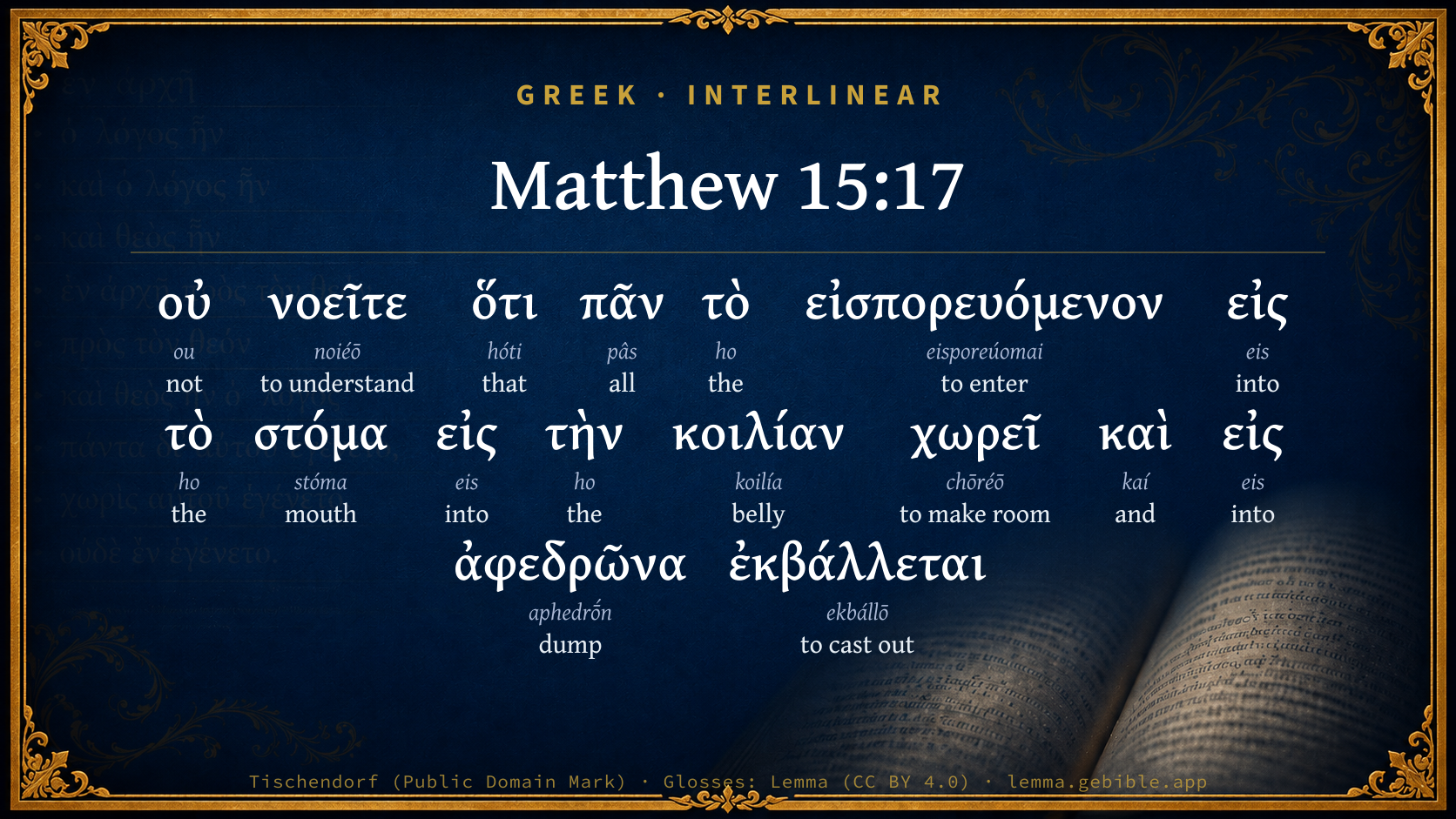
Greek (Tischendorf 8th ed.) Matthew 15:17 appears in the Greek New Testament. The text above is from the Tischendorf 8th edition. Each word links to its Strong’s number and a concise gloss. Click any word for its full Thayer’s Greek Lexicon entry.
Download image
Cite this verse

Matthew 15:17 (World English Bible). Public Domain. Lemma interlinear Bible study tool, https://lemma.gebible.app/v/matthew/15/17.

Show BibTeX & RIS
BibTeX
RIS
English Translation
Don't you understand that whatever goes into the mouth passes into the belly, and then out of the body?
World English Bible · Public Domain
Highlights
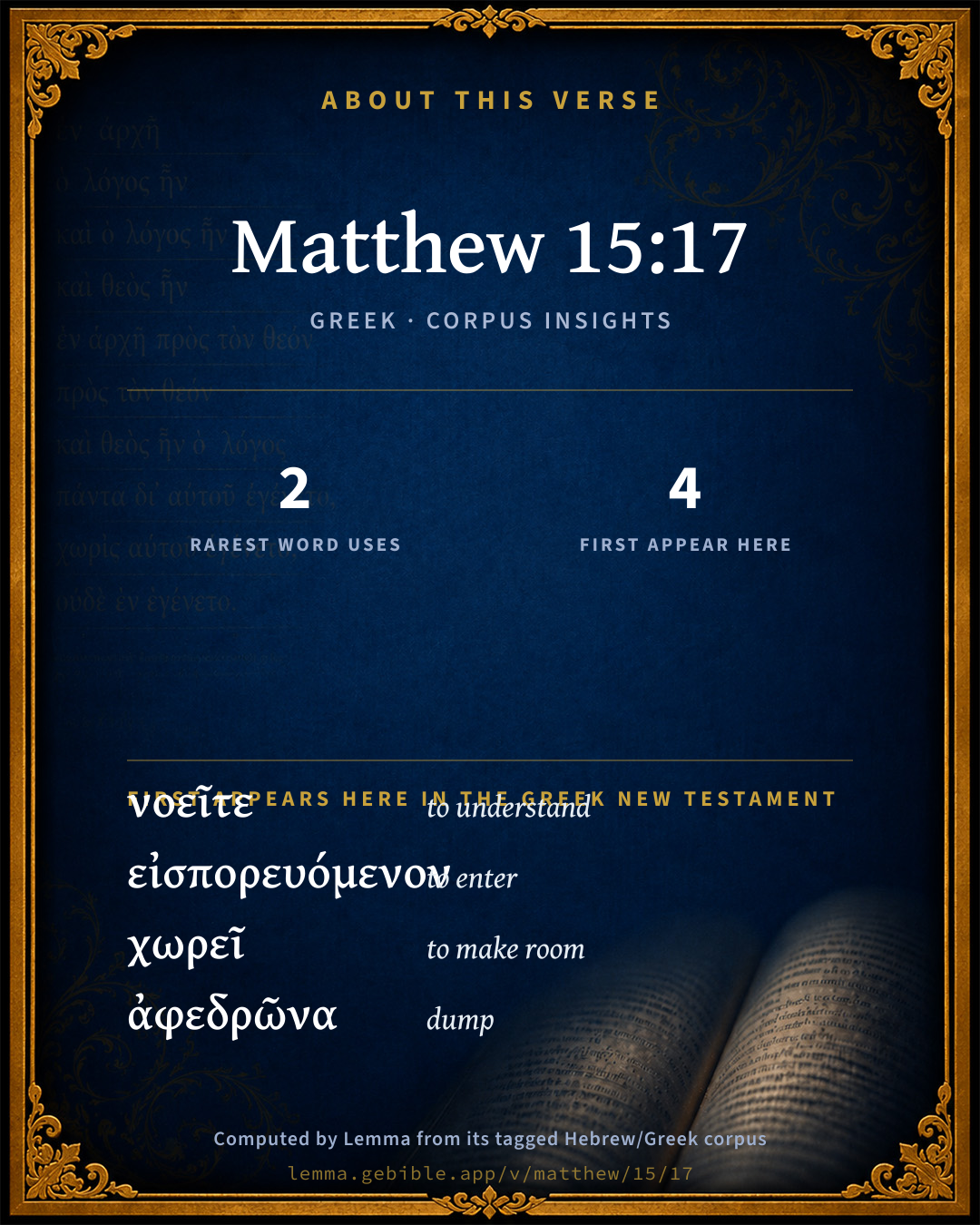
  • 4 first appearances in the Greek New Testament
Full analysis ↓
Download a study sheet

One document with this verse’s original text, its word-by-word gloss line, the meaning frame, cross-references with their text, attributed commentary, and full source and license credits — printable, and it pastes into notes with its structure intact.

This verse Autodidact and up

Study sheet (.html) Plain text (.txt)

A passage Seminary Student

Up to 50 verses in one chapter. A passage sheet keeps up to 6 commentary sources and 12 cross-references per verse, in the order this page ranks them, and says so on the sheet whenever that leaves anything out. Ask for a single verse and you get the Autodidact verse sheet above.

Everything on this page stays free to read, with no account — the sheet is a download of what is already on screen, not access to it.

Want to remove ads? Support Godless Engineer
Compare translations 3

The same verse in 3 English versions, stacked beneath the original-language interlinear above. Click any original word for its lexicon entry.

Each is an independent rendering of the whole verse — the interlinear is not word-aligned to these translations.

Highlighted words mark where these versions differ — a whole-verse word diff, not a word-by-word alignment.

  • World English Bible Public Domain
    Don't you understand that whatever goes into the mouth passes into the belly, and then out of the body?
  • King James Version Public Domain
    Do not ye yet understand, that whatsoever entereth in at the mouth goeth into the belly, and is cast out into the draught?
  • unfoldingWord Literal Text CC BY-SA 4.0
    Do you not yet understand that everything that enters into the mouth passes into the stomach and is passed out into the latrine?

unfoldingWord Literal Text — © unfoldingWord, licensed CC BY-SA 4.0. Word-aligned USFM3 via Door43 (git.door43.org/unfoldingWord/en_ult).

Versions to compare (up to 4)

3 of 4 selected

Show all 19 translations

Every available English version of this verse, each an independent rendering of the whole verse.

  • World English Bible Public Domain
    Don't you understand that whatever goes into the mouth passes into the belly, and then out of the body?
  • Berean Standard Bible Public Domain
    “Do you not yet realize that whatever enters the mouth goes into the stomach and then is eliminated?
  • Majority Standard Bible Public Domain
    “Do you not yet realize that whatever enters the mouth goes into the stomach and then is eliminated?
  • King James Version Public Domain
    Do not ye yet understand, that whatsoever entereth in at the mouth goeth into the belly, and is cast out into the draught?
  • American Standard Version (1901) Public Domain
    Perceive ye not, that whatsoever goeth into the mouth passeth into the belly, and is cast out into the draught?
  • Revised Version (1885) Public Domain
    Perceive ye not, that whatsoever goeth into the mouth passeth into the belly, and is cast out into the draught?
  • Geneva Bible (1599) Public Domain
    Perceiue ye not yet, that whatsoeuer entreth into the mouth, goeth into the bellie, and is cast out into the draught?
  • Douay-Rheims (1899) Public Domain
    Do you not understand, that whatsoever entereth into the mouth, goeth into the belly, and is cast out into the privy?
  • Young's Literal Translation Public Domain
    do ye not understand that all that is going into the mouth doth pass into the belly, and into the drain is cast forth?
  • Literal Standard Version CC BY-SA 4.0
    Do you not understand that all that is going into the mouth passes into the belly, and is cast forth into the drain?
  • Unlocked Literal Bible CC BY-SA 4.0
    Do you not see that whatever goes into the mouth passes into the stomach and is then passed out into the latrine?
  • unfoldingWord Literal Text CC BY-SA 4.0
    Do you not yet understand that everything that enters into the mouth passes into the stomach and is passed out into the latrine?
  • Darby Bible Public Domain
    Do ye not yet apprehend, that everything that enters into the mouth finds its way into the belly, and is cast forth into the draught?
  • World Messianic Bible Public Domain
    Don’t you understand that whatever goes into the mouth passes into the belly and then out of the body?
  • Webster's Bible Public Domain
    Do ye not yet understand, that whatever entereth in at the mouth goeth into the belly, and is cast out into the draught?
  • Free Bible Version CC BY-SA 4.0
    “Don't you see that whatever goes in through the mouth then passes through the stomach, and then leaves the body as waste?
  • Bible in Basic English Public Domain
    Do you not see that whatever goes into the mouth goes on into the stomach, and is sent out as waste?
  • Text-Critical English NT CC BY 4.0
    Do you not yet understand that everything that goes into the mouth passes into the stomach and is expelled into the latrine?
  • Tyndale New Testament (1534) Public Domain
    perceave ye not that what soever goeth in at the mouth descendeth doune in to the bely and is cast out into the draught?

Literal Standard Version (2020), Covenant Press — licensed CC BY-SA 4.0. Text via the HelloAO Bible API (eBible.org). Unlocked Literal Bible (unfoldingWord) — licensed CC BY-SA 4.0. Text via the HelloAO Bible API (eBible.org). unfoldingWord Literal Text — © unfoldingWord, licensed CC BY-SA 4.0. Word-aligned USFM3 via Door43 (git.door43.org/unfoldingWord/en_ult). Free Bible Version, Dr. Jonathan Gallagher — licensed CC BY-SA 4.0. Text via the HelloAO Bible API (eBible.org).

Word by word

More ways to search: Search by grammar → Find every occurrence → Compare this word →

Practice this passage: Drill this verse → Learn its vocabulary →

ἀφεδρῶνα
aphedrṓn
G856
“dump”
Noun, Accusative, Singular, Masculine
Part of Speech
Noun
Case
Accusative
Number
Singular
Gender
Masculine
Full Thayer's Definition

Origin: from a compound of G575 and the base of G1476

TDNT: None

1. a place where the human waste discharges are dumped a. a privy, sink, toilet
  1. οὐ ou G3756 “not” Particle, Negative
  2. νοεῖτε noiéō G3539 “to understand” Verb, Present, Active, Indicative, 2nd person, Plural
  3. ὅτι hóti G3754 “that” Conjunction
  4. πᾶν pâs G3956 “all” Adjective, Nominative, Singular, Neuter
  5. τὸ ho G3588 “the” Article, Nominative, Singular, Neuter
  6. εἰσπορευόμενον eisporeúomai G1531 “to enter” Verb, Present, Middle or Passive deponent, Participle, Nominative, Singular, Neuter
  7. εἰς eis G1519 “into” Preposition
  8. τὸ ho G3588 “the” Article, Accusative, Singular, Neuter
  9. στόμα stóma G4750 “mouth” Noun, Accusative, Singular, Neuter
  10. εἰς eis G1519 “into” Preposition
  11. τὴν ho G3588 “the” Article, Accusative, Singular, Feminine
  12. κοιλίαν koilía G2836 “belly” Noun, Accusative, Singular, Feminine
  13. χωρεῖ chōréō G5562 “to make room” Verb, Present, Active, Indicative, 3rd person, Singular
  14. καὶ kaí G2532 “and” Conjunction
  15. εἰς eis G1519 “into” Preposition
  16. ἐκβάλλεται ekbállō G1544 “to cast out” Verb, Present, Passive, Indicative, 3rd person, Singular

About this verse

These counts appear in no published source. They are computed here, from the morphology-tagged text and Lemma’s own curated glosses. What Lemma adds →

17
words
13
distinct lemmas
Gospels
section

Notable vocabulary

The rarest word here is ἀφεδρῶνα dump G856 — appearing just 2 times in the whole Greek New Testament.

First appearance in Scripture

These words make their first canonical appearance in the Greek New Testament here:

  • νοεῖτε to understand G3539
  • εἰσπορευόμενον to enter G1531
  • χωρεῖ to make room G5562
  • ἀφεδρῶνα dump G856

Shared distinctive vocabulary

ἀφεδρῶνα dump G856 occurs in 2 verses of the Greek New Testament. Also found in:
Repetition

Words recur within this verse:

Cross-references

6

Topical passages linked to Matthew 15:17 in the Treasury of Scripture Knowledge — connected by theme and wording, ordered by reader-vote popularity; previews shown in the World English Bible.

  • Luke 6:45 The good man out of the good treasure of his heart brings out that which is good, and the evil man out of the evil treasure of his heart brings out that which is evil, for out of the abundance of the heart, his mouth speaks.
  • 1 Corinthians 6:13 "Foods for the belly, and the belly for foods," but God will bring to nothing both it and them. But the body is not for sexual immorality, but for the Lord; and the Lord for the body.
  • Matthew 7:19–20 Every tree that doesn't grow good fruit is cut down, and thrown into the fire.
  • 2 Kings 10:27 They broke down the pillar of Baal, and broke down the house of Baal, and made it a latrine, to this day.
  • Colossians 2:21–22 "Don't handle, nor taste, nor touch"
  • James 3:6 And the tongue is a fire. The world of iniquity among our members is the tongue, which defiles the whole body, and sets on fire the course of nature, and is set on fire by Gehenna.

Cross-references courtesy of OpenBible.info (CC BY 4.0).

Where the printed editions differ

1 variant

Places in this verse where the major printed Greek editions disagree on the wording in a way that affects the translation — a comparison of editions, not a manuscript-by-manuscript collation. The editions are the modern critical texts (Nestlé-Aland 28/27, SBL, Westcott-Hort, Tregelles, Tyndale House) and the traditional texts behind the KJV (the Textus Receptus and the Byzantine/Majority text). It is not a claim about which reading is original.

  1. Different wording
    οὐ

    “Surely”

    In NA28NA27TynSBLWHTreg Not in TRByz

    Οὔπω (Oupō) 'Not yet' occurs in traditional manuscripts (TR+Byz) instead of οὐ (ou) 'Surely' in older manuscripts (NA28+NA27+Tyn+SBL+WH+Treg)

Textual data: Translators Amalgamated Greek New Testament (STEPBible TAGNT) · CC BY 4.0.

Commentary

Notes on Matthew 15:17 from classic Christian and Jewish commentators (each source and its license shown beneath its notes). The classic Christian expositions comment on the surrounding passage and are grouped to its opening verse, so a note may address several verses; the Jewish commentaries on the Tanakh (Rashi and others) are per-verse, so they appear only where the commentator wrote on this verse.

Lemma curates 59 commentaries, every one of them public domain or Creative Commons licensed, each selected and text-cleaned for this edition rather than reprinted as found. About our sources →

The Biblical Illustrator

Joseph S. Exell

Mat_15:17-20

For out of the heart proceed evil thoughts.

Our evil thoughts

I. When may your thoughts be counted voluntary, and we be truly and justly answerable for then?

1. When evil thoughts are plainly occasioned by anything that was voluntary in us, then they are to be accounted voluntary and sinful.

2. When evil thoughts proceed from gross, supine negligence and carelessness, then we are accountable for them; when we keep no guard at all over our minds and fancies, but give them free liberty wildly to rove and ramble.

3. Though evil thoughts may be involuntary at the first starting of them, being occasioned by what we could not avoid hearing and seeing, or coming upon us unawares, or proceeding from the temper and habit of our bodies, or the accidental impulses and motions of the animal spirits in our brains, which are the most immediate instruments the soul uses in her operations; though thus the first rise of evil thoughts may be involuntary., yet if we with pleasure entertain and cherish them, if our fancies are tickled by them, if they are delightful and grateful to us, this implies the consent of our wills. They then become greatly sinful to us.

II. The nature and kinds of evil thoughts.

(a) Especially dwell on the representing and acting over sins in our minds and thoughts; when we erect a stage in our fancies, and on it with strange complacence, imagine those satisfactions and filthinesses which we have not opportunity to bring into outward act.

1. Consider these lewd imaginations as to the present time. There is no sin or wickedness so vile and heinous but a man may become truly guilty of it in the sight of God only by imagining it done in his mind, and taking pleasure in such a thought.

2. As to what is past, there is reciting and repeating over those sins in our thoughts and fancies, which we had long before committed, and, perhaps, as to the external acts, quite forsaken.

3. With respect to the time to come, the speculative wickedness of mens fancies and imaginations shows itself in the wild and extravagant suppositions they make to themselves, feigning themselves to be what they would fain be, and then imagining in their minds what in such circumstances they would do.

(b) Dwell on unworthy, atheistical, profane, desperate thoughts of (led Almighty.

(c) Thinkings that become evil because of the seasons of them.

(d) Envious, malicious, fretting thoughts.

(e) Troublesome, anxious thoughts of future events.

(f) Haughty, proud, admiring thoughts of ourselves.

III. Practical rules for the right government of our thoughts.

1. If they proceed from the hearts, then we must look after them.

2. Consider what care and art wicked men use to prevent good thoughts, and let us use the same diligence and endeavours to hinder evil and wicked thoughts and motions.

3. Avoid idleness.

4. Live under the due awe of Gods continual presence with us.

5. Serious devotion, especially humble and hearty prayer to God Almighty. (B. Calamy.)

Evil thoughts.

I. Define the classes of thought which may be regarded as evil.

1. Vain thoughts. These are not of a directly noxious quality; yet, light, empty, trifling, and insignificant, they form a most fearful waste of the noble faculty of thought.

2. Thoughts of a directly irreligious tendency. Impious and unworthy conceptions of God, sceptical thoughts in relation to various parts of revealed religion nourished as a subterfuge for sin, rebellious thoughts formed in the hardness of our hearts against the allotments of His providence, etc.

3. Intensely selfish and worldly thoughts.

4. Thoughts of deliberate wickedness.

II. Indicate the sinfulness of evil thoughts.

1. They have the stamp of guilt affixed to them by the Divine law.

2. They lead to the expressions of evil actions.

3. They defraud us of the supreme end of thought.

III. Enforce the necessity of resistance of evil, thoughts. How necessary such resistance when we consider the advantages accruing, e.g., the influence-

1. Upon our personal character.

2. Upon society.

3. Upon a review of life in leaving it and during eternity. (James Foster, B. A.)

The heart a den of evil

I. The humiliating truth which the saviour here sets forth,

II. The truths which are connected with this humbling fact.

1. We are driven to believe in the doctrine of the fall.

2. It shows the need of a new nature.

3. Admire the grace of God.

4. This doctrine illustrates the doctrine of the atonement. (C. H. Spugeon.)

Sin deeply seated

He plainly tells us that the part of human nature which yields such poisonous fruit is not a bough which may be sawn off, a limb which may be cut away, but the very core and substance of the man-his heart. He in effect tells us that lust doth not come out of the eye merely, but from the inmost nature of a depraved being. Murder comes not in the first place from the hasty hand, but from a wild ungovernable heart. (C. H. Spurgeon.)

Sin natural

You never need educate any man into sin. As soon as ever the young crocodile has left its shell it begins to act just like its parent, and to bite at the stick which broke the shell. The serpent is scarcely born before it rears itself and begins to hiss. The young tiger may be nurtured in your parlour, but it will develop ere long the same thirst for blood as if it were in the forest. So is it with man; he sins as naturally as the young lion seeks for blood, or the young serpent stores up venom. (C. H. Spurgeon.)

Sin inward

If you can drive a man from outward vice, how far have you improved him if he lives in inward sin? You have benefited him as far as the sight of man is concerned, but not before God. There was a man killed on Holborn Hill this week, and I have heard that there was little or no external appearance of injury upon his body. He had been crushed between an omnibus and a cart, and all the wounds were internal, but he died just as surely as if he had been beaten black and blue, or cut into a thousand gashes. So a man may die of internal sin; it does not appear outwardly for certain reasons, but he will die of it just the same if it be within. Many a man has died from internal bleeding, and yet there has been no wound whatever to be seen by the eye. You, my dear hearer, may go to hell as well dressed in the garnishings of morality as in the rags of immorality. (C. H. Spurgeon.)

The heart the home of sin

The Saviour does not stop to prove that these things come out of the heart. He asserts it, and asserts it because it is self-evident. When you see a thing coming forth, you are clear it was there first. Last summa.: I noticed hornets continually flying from a number of decayed logs in my garden. I saw them constantly flying in and out, and I did not think myself at all unreasonable in concluding that there was a hornets nest there; and so, if we see the hornets of sin flying out of a man, we suppose at once there is sin within him. (C. H. Spurgeon.)

The heart needs the remedy

Some malady which you do not understand troubles and alarms you. The physician is called. Thinking that the illness proceeds from a certain inflammatory process on a portion of your skin, you anxiously direct his attention to the spot. Silently, but sympathizingly, he looks at the place where you have bidden him look, and because you have bidden him look there, but soon he turns away. He is busy with an instrument on another part of your body. He presses his trumpet tube gently to your breast, and listens for the pulsations which faintly but distinctly pass through. He looks and listens there, and saddens as he looks. You again direct his attention to the cutaneous eruption which annoys you. He sighs and sits silent. When you reiterate your request that something should be done for the external eruption, he gently shakes his head, and answers not a word. From this silence you would learn the truth at last, you would not miss its meaning long. (W. Arnot.)

The heart the root of actual evil

Original sin is the womb of all actual sin. Every sinful act in us derives its descent from this. This is the spawn; actual transgressions are the offspring. This is actual sin in the egg, more than the cockatrices. Hatched by Satan, it yields a fearful brood, whose name is legion, whose end is destruction, whose grave is hell. In Eden there was a tree of life, so will there be in the Eden above-a tree whose leaves are for the healing of the nations. But since man was thrust out of Paradise, a tree of death, a root of bitterness, has grown in every soul, bearing all manner of cursed fruits; and every leaf, every bud, tends to destroy life and ruin man. Its grapes are gall, its clusters are bitter, its wine is the poison of asps. Ransack the records of human crime, dig up from the grave of forgetfulness every atrocity, however unprecedented, however abominable, it lay in germ in the ordinary corruption of human nature. Ten thousand trees spread their arms over the earth in giant magnitude, yet all spring from the one same root. (R. B. Nichol.)

Inward derangement the cause of outward wickedness

The heart is the seat and source of every great wickedness. No wonder that the wickedness of man is great. If the pendulum and weights and machinery of a clock are all deranged, it is quite clear that the hands will not point with correctness to the hours. If the fountain is corrupt and impure, the streams must inevitably be so. (J. Cumming, D. D.)

Inward sin

If a man covets, he steals. If a man has murderous hate, he murders. If a man broods dishonest thoughts, he is a -knave. If a man harbours sharp and bitter jealousies, envies, hatreds, though he never express them by his tongue, or shape them by his hand, they are there. There are many goodseeming men, who, if all their days thoughts and feelings were to be suddenly developed into acts visible to the eye, would run from themselves, as men in earthquakes run from the fiery gapings of the ground, and sulphurous cracks that open the way to the uncooled centre of perdition. (H. W. Beecher.)

The heart-mill

Anselm says, Our heart is like a mill, ever grinding, which a certain lord gave in charge to his servant, enjoining that he should only grind in it his masters grain, whether wheat, barley, or oats, and telling him that he must subsist on the produce. But that servant has an enemy, who is always playing tricks on the mill. If, any moment, he finds it unwatched, he throws in gravel to keep the stones from acting, or pitch to clog them, or dirt and chaff to mix with the meal. If the servant is careful in tending his mill, there flows forth a beautiful flour, which is at once a service to his master, and a subsistence to himself; but if he plays truant, and allows his enemy to tamper with his machinery, the bad outcome tells the tale; his lord is angry; and he himself is starved. This mill, ever grinding, is the heart; thoughts are the grain; the devil is the watchful enemy: he throws in bad thoughts, which can only be prevented by watchfulness and prayer.

The Biblical Illustrator, edited by Joseph S. Exell (c. 1880s–1900s) — public domain. Text from a community e-Sword module.

Bengel's Gnomon

Johann Albrecht Bengel

Mat 15:17. Οὔπω, not yet) Although you have been instructed in Mat 15:11, and elsewhere, in the whole system of divine morality, from which you might have inferred this matter also.—νοεῖτε) perceive.—εἰς, into) Into is repeated thrice without any mention of the heart, which is the true seat of real purity or impurity.

Bengel's Gnomon of the New Testament — English translation (T&T Clark, Edinburgh, 1860) — public domain. Text from a community e-Sword module.

Meyer's Critical & Exegetical Commentary

Heinrich August Wilhelm Meyer

Mat_15:17 ff. Οὔπω νοεῖτε, κ.τ.λ.] Do you not yet understand that, and so on, notwithstanding all that I have already done to develope your minds?

Food and drink are simply things that pass into the stomach to be digested there, and have nothing in common with mans spiritual nature, with his reason, his will, and his affections and desires (καρδία, the centre of the whole inner life, see note on Mat_22:37). Notice the contrast between εἰς τὴν κοιλίαν (abdominal cavity, see note on Joh_7:38) and ἐκ τῆς καρδίας.

Mat_15:19. Proof of what is said in Mat_15:18 : for the heart is the place where immoral thoughts, murders, adulteries, and so on, therefore where inward and outward sins, are first conceived, and from which they pass into actual transgressions. Accordingly, it is that which comes out of the heart, and expresses itself by means of the mouth (Mat_15:18), which defiles the man as a moral being. The opposite case, in which the heart sends forth what is good, presupposes conversion.

The plurals denote different instances of murder, adultery, and so on (Kühner, II. 1, p. 15 f.; Maetzner, ad Lycurg. p. 144 f.), and render the language more forcible (Bremi, ad Aeschin. p. 326).

βλασφημ.] i.e. against ones neighbour, on account of the connection with ψευδομ. Comp. note on Eph_4:31.

Meyer — Critical and Exegetical Commentary on the New Testament — English translation by Peter Christie, edited by Frederick Crombie (T&T Clark, 1880) — public domain. Text from a community e-Sword module.

Expositor's Greek Testament

ed. W. Robertson Nicoll

Mat 15:17 . ἀφεδρῶνα : here only, probably a Macedonian word = privy ; a vulgar word and a vulgar subject which Jesus would gladly have avoided, but He forces Himself to speak of it for the sake of His disciples. The idea is: from food no moral defilement comes to the soul; such defilement as there is, purely physical, passing through the bowels into the place of discharge. Doubtless Jesus said this, otherwise no one would have put it into His mouth. Were the Twelve any the wiser? Probably the very rudeness of the speech led them to think.

The Expositor's Greek Testament, edited by W. Robertson Nicoll (1897–1910) — public domain. Text from a community e-Sword module.

Jamieson, Fausset & Brown

Robert Jamieson, A. R. Fausset & David Brown

Do not ye yet understand that whatsoever entereth in at the mouth, &c.--Familiar though these sayings have now become, what freedom from bondage to outward things do they proclaim, on the one hand; and on the other, how searching is the truth which they express--that nothing which enters from without can really defile us; and that only the evil that is in the heart, that is allowed to stir there, to rise up in thought and affection, and to flow forth in voluntary action, really defiles a man!

Jamieson, Fausset & Brown — Commentary Critical and Explanatory on the Whole Bible (1871) — public domain (CC PDM 1.0). Text via the HelloAO Bible API.

Adam Clarke's Commentary

Verse 17. Cast out into the draught] εις αφεδωνα, [Anglo-Saxon]. And beeth into the forthgoing a sent - what is not fit for nourishment is evacuated; is thrown into the sink. This I believe to be the meaning of this difficult and variously translated word, αφεδρων. Diodati translates it properly, nella latrina, into the privy. And the Persian translator has given a good paraphrase, and appears to have collected the general meaning [Persian] her teche der dehen ander ayeed, az nusheeb beeroon rood, we ber zemeen aftad: "Whatsoever enters into the mouth goes downward, and falls upon the ground." Michaelis, and his annotator, Dr. Marsh, have been much perplexed with this perplexing passage. See Michaelis's Introduction, vol. i. note 35. p. 458.

Adam Clarke's Commentary on the Bible (1810–1826) — public domain. Text from a community e-Sword/MySword module.

Ellicott's Commentary for English Readers

(17) Is cast out into the draught.—The word is used in its old English meaning, as equivalent to drain, sewer, cesspool (see 2Ki_10:27). St. Mark (Mar_7:19) adds the somewhat perplexing words, “purging all meats,” on which see Note on that verse. The principle implied is that a process purely physical from first to last cannot in itself bring any moral defilement. It was possible, of course, that the appetites connected with that process might bring the taint of moral evil; but then these appetites were there before the food, and they took their place among the things that came “out of the heart,” and not into it.

A Bible Commentary for English Readers, edited by Charles John Ellicott (1878–1897) — public domain. Text from a community e-Sword module.

John Gill's Exposition

Do not ye understand,.... You must understand, you cannot be so ignorant,

that whatsoever entereth in at the mouth, goeth into the belly, and is cast out into the draught? that is, that whatsoever food a man takes in at his mouth, he swallows down, and it is received into his stomach; which, having performed its office, the grosser parts go down into the belly, and passing through the bowels, are evacuated into the vault, or privy, "purging all meats", as Mark says; for that only receives the filth and excrementitious matter; so that what is left in the body is pure, wholesome, and nourishing: nor can any part of what goes into a man defile him, because it only enters into the body, and passes through it; and, as Mark says, "entereth not into the heart", which is the seat of moral impurity; so that no moral pollution can be contracted by eating any sort of food, even though it should not be clean itself, nor be eaten with clean hands.

John Gill's Exposition of the Whole Bible (1746–1763) — public domain (CC PDM 1.0). Text via the HelloAO Bible API.

Trapp's Complete Commentary

John Trapp

17 Do not ye yet understand, that whatsoever entereth in at the mouth goeth into the belly, and is cast out into the draught?

Ver. 17. Whatsoever entereth in at the mouth] In nature, Animantis cuiusque vita est fuga. Life, were it not for the repair by daily nourishment, would be soon extinguished, Hence it is called, "The life of our hand," because maintained by the labour of our hands, Isa 5:7; Isa 5:10. But that which our Saviour here driveth at is, to set forth the ridiculous madness of the Pharisees, while they placed a kind of holiness in those things that were evacuated and thrown into the draught. And do not Papists the very same? Qui gustavit ovum trahitur in carcerem, cogiturque de haeresi causam dicere, saith Erasmus. To eat flesh, or but an egg, in Lent, is punished with death. Whereas in the year of Christ 330, Spiridion, a godly bishop in Cyprus, having not what else ready to set before a guest that came to him in Lent, set him a piece of pork to feed on. And when the stranger made scruple of eating flesh in Lent, saying, I am a Christian, and may not do it: Nay, therefore thou mayest do it, said he, because "to the pure all things are pure," and the kingdom of God consists not in meats and drinks, &c., Rom 14:20.

John Trapp, A Commentary or Exposition upon All the Books of the Old and New Testament (1647–1656) — public domain. Text from a community e-Sword module.

Matthew Poole's English Annotations

Mark hath this, with very small difference in words, Mar 7:18-23; only he specifies some more sins than Matthew enumerates. The sum of what our Saviour saith is this: That all sin proceedeth from lust, some desires in the heart of man after things forbidden in the law of God. All the ticklings of our hearts with such thoughts, all the willings and desires of such things, though they never issue in overt acts, yet defile and pollute a man; and from these inward motions of the heart proceed those overt acts (mentioned by Matthew or Mark) of murders, adulteries, fornications, thefts, false witness, blasphemies, deceit, lasciviousness, an evil eye, pride, foolishness: now these things, take them in their nest, which is the heart, they defile and pollute that; take them in their passage through our lips into the world, they pollute that; take them in their overt act, they pollute the man. But to eat with unwashen hands, a thing no where forbidden by God, only by the Pharisees, who had no such authority given them from God to command any such things, this doth not pollute a man. It is possible that men may sin in not obeying the commandments of men, but it must be then in things in which God hath authorized them to command, and to determine our practice in, for the pollution lies in a disobedience to the commandment of God, not of men.

Matthew Poole's English Annotations on the Holy Bible (1683–1685) — public domain. Text from a community e-Sword/MySword module.

Whedon's Commentary on the Bible

Daniel D. Whedon

17. Entereth in… mouth… draught — The food passes the stomach and goes to the draught or privy without touching the soul to defile it.

Daniel D. Whedon (gen. ed.), Commentary on the Old and New Testaments (1874–1909) — public domain. Text from a community e-Sword module.

The Pulpit Commentary

Whatsoever entereth in at the mouth, etc. Food taken into the mouth goes into the stomach, is assimilated into the bodily system, and its refuse passes away to the draught (afedrwna), the necessary house. It has nothing to do with the heart or the moral being; it affects only the material organization, and has no connection with the spiritual. Christ does not concern himself with questions, which modern philosophers would attempt to solve, concerning the mutual influence of soul and body, the animal and spiritual nature; he puts forth an argument which every one could receive, plain even to those "without understanding." This is the elucidation of the first part of ver. 11. The further explanation follows in vers. 18, 19.

The Pulpit Commentary (1880–1919), ed. H.D.M. Spence-Jones & Joseph S. Exell — public domain. Text from a community e-Sword module.

John Wesley's Explanatory Notes

Are ye also yet without understanding - How fair and candid are the sacred historians? Never concealing or excusing their own blemishes.

John Wesley, Explanatory Notes Upon the Whole Bible (1754–1765) — public domain. Text via the GEBible commentary corpus.

Alford’s Greek Testament

Henry Alford

17.] στόματι, διʼ οὗ γίνεται θνητῶν μέν, ὡς ἔφη Πλάτων, εἴσοδος, ἔξοδος δὲ ἀφθάρτων.

ἐπεισέρχεται μὲν γὰρ αὐτῷ σιτία καὶ ποτά, φθαρτοῦ σώματος φθαρταὶ τροφαί. λόγοι δὲ ἐξίασιν, ἀθανάτου ψυχῆς ἀθάνατοι νόμοι, διʼ ὧν ὁ λογικὸς βίος κυβερνᾶται. Philo de Opif. Mundi, 40, vol. i. p. 29.

Henry Alford, The Greek Testament (1849–1861) — public domain. Text from a community e-Sword module.

International Critical Commentary

17. Do you not understand that everything that goeth into the mouth passeth into the belly, and is cast out into the closet.] Mk. has: “Do you not understand that everything that goeth into the man from outside cannot defile him, because it goeth not into the heart, but into the belly, and goeth forth into the closet, cleansing all meats.” The editor omits the last clause in Mk., which is difficult to construe, and of doubtful meaning.—ἀφεδρών] is a rare word of doubtful meaning. It is generally understood as equivalent to ἀπόπατος. But Wellhausen argues that it means the “intestine,” on the ground that this suits the context in Mk. “The intestine (not the closet) cleanses meats by separating from them the unwholesome elements.” But Mt., who substitutes ἐκβάλλεται for ἐκπορεύεται and omits καθαρίζων πάντα τὰ βρώματα, probably understood the word to mean “closet.”

(M)

International Critical Commentary — older volumes (1896–1929), various authors — public domain. Text from a community e-Sword module.

Lesson kit

Teaching starters — assembled from the data on this page, not authored interpretation. Every prompt links to the verse data it draws on. Edit before teaching.

Matthew, in the Gospels, opens this verse with 17 words (13 distinct Greek lemmas). Its most distinctive word is aphedrṓn (“dump”). A historical commentator’s framing appears above. Read the whole chapter for the surrounding context.

Discussion questions

  1. How does “dump” (aphedrṓn) shape what this verse is saying?
  2. 4 words here appear for the first time in Scripture. What is being introduced at this debut?
  3. Mark 7:19 shares the word «dump» with this verse. How do the two illuminate each other?
  4. “into” occurs 3× in this one verse. What is the effect of the repetition?
  5. The translations on this page render this verse differently — a whole-verse word diff, not a word-by-word alignment. What might account for the different wordings?
  6. Reading how The Biblical Illustrator and Bengel's Gnomon read this verse, where do the two commentators agree and where do they part?

Things to notice

  • 4 words make their first canonical appearance in Scripture here.
  • These translations choose different wording for 18 words in this verse.
  • “into” occurs 3× in this single verse.
  • 13 distinct Greek lemmas span 17 words in this verse.

Reading settings

Reading text

Shown beneath each verse's original-language words.

Old Testament
Old Testament edition

Read the OT as the Masoretic Hebrew (MT) or the Greek Septuagint (LXX).

English shown for the Greek Septuagint (in the Hebrew ↔ Greek comparison).

Comparing translations? Open the Compare panel on any verse page to stack up to four side by side.