
Matthew 12:5

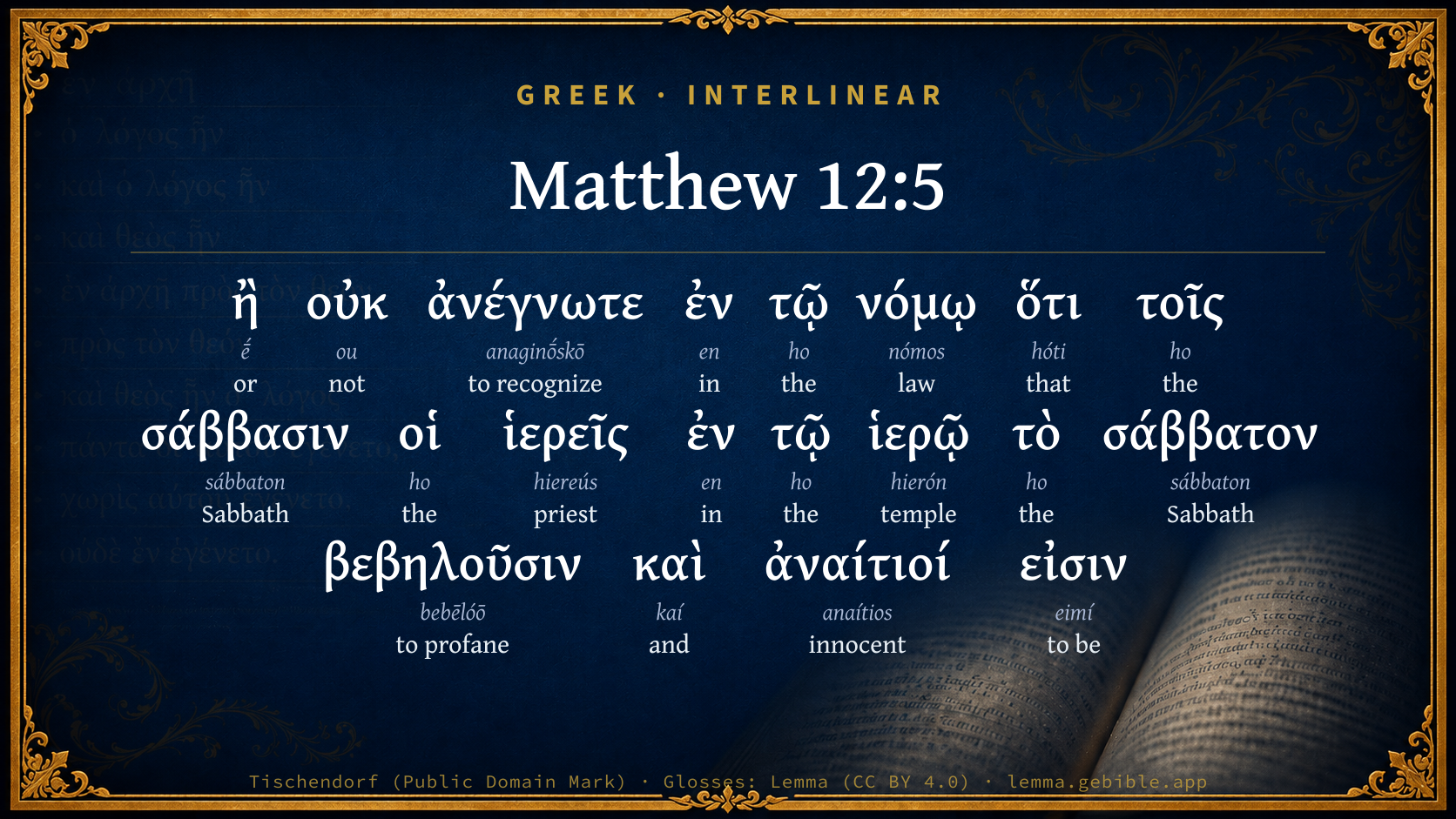
Greek (Tischendorf 8th ed.) Matthew 12:5 appears in the Greek New Testament. The text above is from the Tischendorf 8th edition. Each word links to its Strong’s number and a concise gloss. Click any word for its full Thayer’s Greek Lexicon entry.
Download image
Cite this verse

Matthew 12:5 (World English Bible). Public Domain. Lemma interlinear Bible study tool, https://lemma.gebible.app/v/matthew/12/5.

Show BibTeX & RIS
BibTeX
RIS
English Translation
Or have you not read in the law, that on the Sabbath day, the priests in the temple profane the Sabbath, and are guiltless?
World English Bible · Public Domain
Highlights
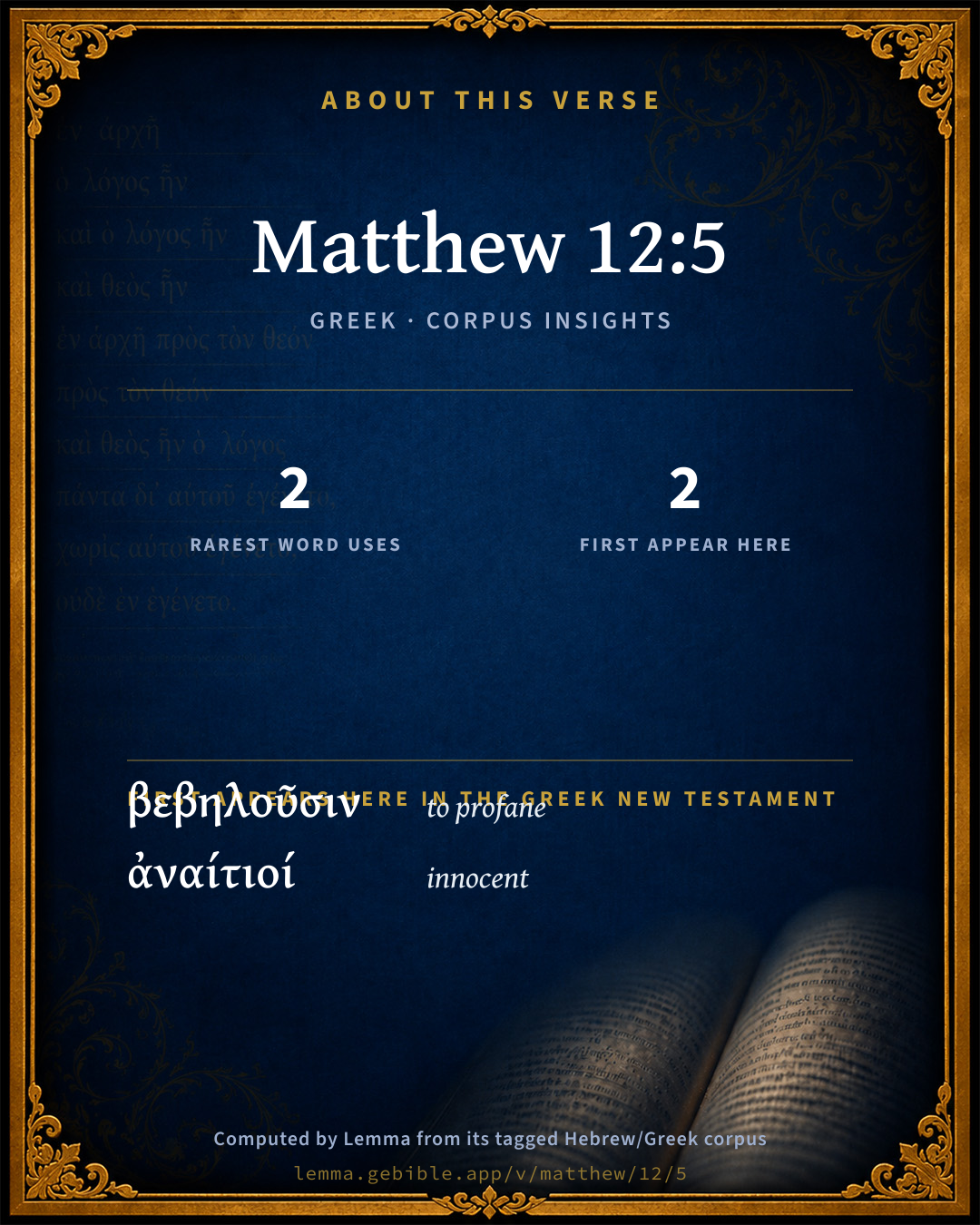
  • 2 first appearances in the Greek New Testament
Full analysis ↓
Download a study sheet

One document with this verse’s original text, its word-by-word gloss line, the meaning frame, cross-references with their text, attributed commentary, and full source and license credits — printable, and it pastes into notes with its structure intact.

This verse Autodidact and up

Study sheet (.html) Plain text (.txt)

A passage Seminary Student

Up to 50 verses in one chapter. A passage sheet keeps up to 6 commentary sources and 12 cross-references per verse, in the order this page ranks them, and says so on the sheet whenever that leaves anything out. Ask for a single verse and you get the Autodidact verse sheet above.

Everything on this page stays free to read, with no account — the sheet is a download of what is already on screen, not access to it.

Want to remove ads? Support Godless Engineer
Compare translations 3

The same verse in 3 English versions, stacked beneath the original-language interlinear above. Click any original word for its lexicon entry.

Each is an independent rendering of the whole verse — the interlinear is not word-aligned to these translations.

Highlighted words mark where these versions differ — a whole-verse word diff, not a word-by-word alignment.

  • World English Bible Public Domain
    Or have you not read in the law, that on the Sabbath day, the priests in the temple profane the Sabbath, and are guiltless?
  • King James Version Public Domain
    Or have ye not read in the law, how that on the sabbath days the priests in the temple profane the sabbath, and are blameless?
  • unfoldingWord Literal Text CC BY-SA 4.0
    Or have you not read in the law that on the Sabbaths the priests in the temple profane the Sabbath, but are innocent?

unfoldingWord Literal Text — © unfoldingWord, licensed CC BY-SA 4.0. Word-aligned USFM3 via Door43 (git.door43.org/unfoldingWord/en_ult).

Versions to compare (up to 4)

3 of 4 selected

Show all 19 translations

Every available English version of this verse, each an independent rendering of the whole verse.

  • World English Bible Public Domain
    Or have you not read in the law, that on the Sabbath day, the priests in the temple profane the Sabbath, and are guiltless?
  • Berean Standard Bible Public Domain
    Or haven’t you read in the Law that on the Sabbath the priests in the temple break the Sabbath and yet are innocent?
  • Majority Standard Bible Public Domain
    Or haven’t you read in the Law that on the Sabbath the priests in the temple break the Sabbath and yet are innocent?
  • King James Version Public Domain
    Or have ye not read in the law, how that on the sabbath days the priests in the temple profane the sabbath, and are blameless?
  • American Standard Version (1901) Public Domain
    Or have ye not read in the law, that on the sabbath day the priests in the temple profane the sabbath, and are guiltless?
  • Revised Version (1885) Public Domain
    Or have ye not read in the law, how that on the sabbath day the priests in the temple profane the sabbath, and are guiltless?
  • Geneva Bible (1599) Public Domain
    Or haue ye not read in the Lawe, how that on the Sabbath dayes the Priestes in the Temple breake the Sabbath, and are blameles?
  • Douay-Rheims (1899) Public Domain
    Or have ye not read in the law, that on the sabbath days the priests in the temple break the sabbath, and are without blame?
  • Young's Literal Translation Public Domain
    `Or did ye not read in the Law, that on the sabbaths the priests in the temple do profane the sabbath, and are blameless?
  • Literal Standard Version CC BY-SA 4.0
    Or did you not read in the Law that on the Sabbaths the priests in the temple profane the Sabbath and are blameless?
  • Unlocked Literal Bible CC BY-SA 4.0
    Have you not read in the law that on the Sabbath the priests in the temple profane the Sabbath but are guiltless?
  • unfoldingWord Literal Text CC BY-SA 4.0
    Or have you not read in the law that on the Sabbaths the priests in the temple profane the Sabbath, but are innocent?
  • Darby Bible Public Domain
    Or have ye not read in the law that on the sabbaths the priests in the temple profane the sabbath, and are blameless?
  • World Messianic Bible Public Domain
    Or have you not read in the law that on the Sabbath day the priests in the temple profane the Sabbath and are guiltless?
  • Webster's Bible Public Domain
    Or have ye not read in the law, that on the sabbath the priests in the temple profane the sabbath, and are blameless?
  • Free Bible Version CC BY-SA 4.0
    Haven't you read in the law that on the Sabbath day the priests in the Temple break the Sabbath but are not considered guilty?
  • Bible in Basic English Public Domain
    Or is it not said in the law, how the Sabbath is broken by the priests in the Temple and they do no wrong?
  • Text-Critical English NT CC BY 4.0
    Or have you not read in the law that on the Sabbath the priests in the temple profane the Sabbath and yet are guiltless?
  • Tyndale New Testament (1534) Public Domain
    Or have ye not reed in the lawe how that the prestes in the temple breake the saboth daye and yet are blamlesse?

Literal Standard Version (2020), Covenant Press — licensed CC BY-SA 4.0. Text via the HelloAO Bible API (eBible.org). Unlocked Literal Bible (unfoldingWord) — licensed CC BY-SA 4.0. Text via the HelloAO Bible API (eBible.org). unfoldingWord Literal Text — © unfoldingWord, licensed CC BY-SA 4.0. Word-aligned USFM3 via Door43 (git.door43.org/unfoldingWord/en_ult). Free Bible Version, Dr. Jonathan Gallagher — licensed CC BY-SA 4.0. Text via the HelloAO Bible API (eBible.org).

Word by word

More ways to search: Search by grammar → Find every occurrence → Compare this word →

Practice this passage: Drill this verse → Learn its vocabulary →

βεβηλοῦσιν
bebēlóō
G953
“to profane”
Verb, Present, Active, Indicative, 3rd person, Plural
Part of Speech
Verb
Tense
Present
Voice
Active
Mood
Indicative
Person
3rd person
Number
Plural
Full Thayer's Definition

Origin: from G952

TDNT: 11:05,1

1. to profane, desecrate
  1. ἢ ḗ G2228 “or” Particle
  2. οὐκ ou G3756 “not” Particle, Negative
  3. ἀνέγνωτε anaginṓskō G314 “to recognize” Verb, Aorist, Active, Indicative, 2nd person, Plural
  4. ἐν en G1722 “in” Preposition
  5. τῷ ho G3588 “the” Article, Dative, Singular, Masculine
  6. νόμῳ nómos G3551 “law” Noun, Dative, Singular, Masculine
  7. ὅτι hóti G3754 “that” Conjunction
  8. τοῖς ho G3588 “the” Article, Dative, Plural, Neuter
  9. σάββασιν sábbaton G4521 “Sabbath” Noun, Dative, Plural, Neuter
  10. οἱ ho G3588 “the” Article, Nominative, Plural, Masculine
  11. ἱερεῖς hiereús G2409 “priest” Noun, Nominative, Plural, Masculine
  12. ἐν en G1722 “in” Preposition
  13. τῷ ho G3588 “the” Article, Dative, Singular, Neuter
  14. ἱερῷ hierón G2411 “temple” Noun, Dative, Singular, Neuter
  15. τὸ ho G3588 “the” Article, Accusative, Singular, Neuter
  16. σάββατον sábbaton G4521 “Sabbath” Noun, Accusative, Singular, Neuter
  17. καὶ kaí G2532 “and” Conjunction
  18. ἀναίτιοί anaítios G338 “innocent” Adjective, Nominative, Plural, Masculine
  19. εἰσιν eimí G1510 “to be” Verb, Present, Active, Indicative, 3rd person, Plural

About this verse

These counts appear in no published source. They are computed here, from the morphology-tagged text and Lemma’s own curated glosses. What Lemma adds →

20
words
14
distinct lemmas
Gospels
section

Notable vocabulary

The rarest word here is βεβηλοῦσιν to profane G953 — appearing just 2 times in the whole Greek New Testament.

First appearance in Scripture

These words make their first canonical appearance in the Greek New Testament here:

  • βεβηλοῦσιν to profane G953
  • ἀναίτιοί innocent G338

Shared distinctive vocabulary

βεβηλοῦσιν to profane G953 occurs in 2 verses of the Greek New Testament. Also found in:
Repetition

Words recur within this verse:

  • σάββασιν Sabbath G4521 ×2
  • τῷ the G3588 ×5
  • ἐν in G1722 ×2

Cross-references

2

Topical passages linked to Matthew 12:5 in the Treasury of Scripture Knowledge — connected by theme and wording, ordered by reader-vote popularity; previews shown in the World English Bible.

  • Numbers 28:9–10 On the Sabbath day two he-lambs a year old without blemish, and two tenth parts [of an ephah] of fine flour for a meal-offering, mixed with oil, and the drink-offering of it:
  • John 7:22–23 Moses has given you circumcision (not that it is of Moses, but of the fathers), and on the Sabbath you circumcise a boy.

Cross-references courtesy of OpenBible.info (CC BY 4.0).

Commentary

Notes on Matthew 12:5 from classic Christian and Jewish commentators (each source and its license shown beneath its notes). The classic Christian expositions comment on the surrounding passage and are grouped to its opening verse, so a note may address several verses; the Jewish commentaries on the Tanakh (Rashi and others) are per-verse, so they appear only where the commentator wrote on this verse.

Lemma curates 59 commentaries, every one of them public domain or Creative Commons licensed, each selected and text-cleaned for this edition rather than reprinted as found. About our sources →

Joseph Benson's Commentary

Mat 12:5-6. Have ye not read in the law, &c. — He does not mean that the words following were to be found in the law, but only that they might read in the law, how the priests were obliged, on the sabbath days, to perform such servile work in the temple as, considered separately from the end of it, would have been a profanation of the sabbath, but really was not so, because it was necessary to the public worship of God, on account of which the sabbath was instituted. If it be asked what servile work the priests performed on the sabbath, the answer is obvious. On that day, as well as on other days, they made up the fires, killed, flayed, and dressed the sacrifices, and performed other pieces of manual labour necessary to the religious service which God had established among them. Nay, besides the continual burnt offering, the priests were obliged, on the sabbaths, to sacrifice two lambs extraordinary, by which their servile work was that day double of what it was on the other days of the week. See Num 28:9. But in this place is one greater than the temple — As if he had said, “If you reply that the priests were not culpable in those actions, because they were undertaken for the temple service, I acknowledge it; but at the same time I must observe, that if the temple, with its service, is of such importance as to merit a particular dispensation from the law of the sabbath, I and my disciples, whose business of promoting the salvation of men is a matter of more importance, may, on that account, with more reason take the same liberty in a case of the like necessity. According to this interpretation, the reading μειζον, a greater work, instead of μειζων, a greater person, which is authorized by many manuscripts, will have a peculiar elegance. Then the sense will be, ‘There is here a much more noble work carrying on than the temple service.’” — Macknight.

Joseph Benson's Commentary on the Old and New Testaments (1811–1818) — public domain. Text from a community e-Sword module.

Tyndale Open Study Notes

Tyndale Open Resources

12:5-6 Priests worked on the Sabbath (Lev 24:8-9; Num 28:9-10), and this was not offensive to Pharisees. If the priests’ work for the Temple on the Sabbath is allowed, then certainly Jesus can do the same because he is greater than the Temple (see Matt 4:23; 9:35; 11:2-6, 20-30).

Tyndale Open Study Notes — © Tyndale Open Resources, licensed CC BY-SA 4.0. Text via the HelloAO Bible API.

Bengel's Gnomon

Johann Albrecht Bengel

Mat 12:5. Ἢ, or? Lat. an?)—ἐν τῷ νόμῳ,[551] in the Law) He proceeds step by step to a more stringent argument, from the example of the Prince, which the priest had approved, to the Law itself; from the prophets, even the earlier, parts of whom were read, to the Law, all of which was read; and from the sacred food to the sacred day, concerning which the dispute arose.—οἱ ἱερεῖς, the priests) who ought especially to maintain the law, yet in this matter are especially excepted. Thus also, the priests of Christ are less bound to the Sabbath than the remaining multitude.—ἐν τῷ ἱερῷ, in the temple) Whilst they are employed in sacred rites.—βεβηλοῦσι, profane) (verb); the adjective βέβηλον, profane, is opposed to ἅγιον, sacred, nor does it always imply impurity or guilt.—See Lev 10:10, and 1Sa 21:4.

[551] At that very time of year Leviticus was being read on the Sabbaths, the book in which there occur so many precepts as to sacrifices, which were required to be performed even on the Sabbath.—V. g.

Bengel's Gnomon of the New Testament — English translation (T&T Clark, Edinburgh, 1860) — public domain. Text from a community e-Sword module.

Meyer's Critical & Exegetical Commentary

Heinrich August Wilhelm Meyer

Mat_12:5. Ἀνέγνωτε] Num_28:9.

βεβηλοῦσι] that is, if one were consistently to judge according to your precepts, which forbid every sort of work on the Sabbath as being a desecration of that day. For βεβηλ., profanant, comp. Act_24:6, and see Schleusner, Thes. I. p. 558.

Meyer — Critical and Exegetical Commentary on the New Testament — English translation by Peter Christie, edited by Frederick Crombie (T&T Clark, 1880) — public domain. Text from a community e-Sword module.

Expositor's Greek Testament

ed. W. Robertson Nicoll

Mat 12:5 . his reference to the priests naturally leads on to the second instance taken from their systematic breach of the technical Sabbath law in the discharge of sacerdotal duty. ἢ οὐκ ἀνέγνωτε , have ye not read? not of course the statement following, but directions on which such a construction could be put, as in Num 28:9 , concerning the burnt offering of two lambs. They had read often enough, but had not understood. As Euthy. Zig. remarks, Jesus reproaches them for their vain labour, as not understanding what they read ( μὴ ἐπιγινώσκουσιν ἃ ἀναγινώσκουσι ). βεβηλοῦσι , profane, on the Pharisaic view of the Sabbath law, as an absolute prohibition of work. Perhaps the Pharisees themselves used this word as a technical term, applicable even to permissible Sabbath labour. So Schanz after Schöttgen.

The Expositor's Greek Testament, edited by W. Robertson Nicoll (1897–1910) — public domain. Text from a community e-Sword module.

Geneva Bible (1599)

Geneva Bible translators

When the Priests do God’s service upon the Sabbath day, yet they break not the Law: much less doth the Lord of the Sabbath break the Sabbath.

Geneva Bible (1599) marginal notes — public domain. Text via Bolls.life.

Jamieson, Fausset & Brown

Robert Jamieson, A. R. Fausset & David Brown

Or have ye not read in the law, how that on the sabbath days the priests in the temple profane the sabbath--by doing "servile work."

and are blameless?--The double offerings required on the sabbath day (Num 28:9) could not be presented, and the new-baked showbread (Lev 24:5; Ch1 9:32) could not be prepared and presented every sabbath morning, without a good deal of servile work on the part of the priests; not to speak of circumcision, which, when the child's eighth day happened to fall on a sabbath, had to be performed by the priests on that day. (See on Joh 7:22-23).

Jamieson, Fausset & Brown — Commentary Critical and Explanatory on the Whole Bible (1871) — public domain (CC PDM 1.0). Text via the HelloAO Bible API.

Adam Clarke's Commentary

Verse 5. The priests - profane the Sabbath] Profane, i.e. put it to what might be called a common use, by slaying and offering up sacrifices, and by doing the services of the temple, as on common days, Ex 29:38; Nu 28:9.

Adam Clarke's Commentary on the Bible (1810–1826) — public domain. Text from a community e-Sword/MySword module.

Ellicott's Commentary for English Readers

(5) The priests in the temple profane the sabbath.—The work of the priests, as described, e.g., in Num_28:9, viz., slaying victims, placing the shewbread, involved an amount of labour which, in work of any other kind, would have broken the Sabbath rest; yet no one blamed the priests, for they were serving in the Temple of Jehovah.

A Bible Commentary for English Readers, edited by Charles John Ellicott (1878–1897) — public domain. Text from a community e-Sword module.

The Cambridge Bible for Schools and Colleges

gen. ed. J. J. S. Perowne

5. the priests in the temple profane the sabbath] by labour in removing the shewbread, preparing fire for the sacrifice, and performing the whole temple service. “Not merely does the sacred history relate exceptional instances of necessity, but the Law itself ordains labour on the Sabbath as a duty” (Stier).

The Cambridge Bible for Schools and Colleges (gen. ed. J. J. S. Perowne; Cambridge University Press, 1878–1918) — public domain. Text from a community e-Sword module.

John Gill's Exposition

Or have ye not read in the law,.... Num 28:9 by which law the priests were obliged, every sabbath day, to offer up two lambs for a burnt offering; to which were annexed many servile works, as killing the sacrifice, flaying it, cutting it in pieces, and laying it on the altar, cutting of wood, and putting that in order, and kindling the fire: from all which, it might be observed,

how that on the sabbath days, the priests in the temple profane the sabbath, and are blameless. There were many things, which, according to the Jewish canons, the priests might do on the sabbath day; particularly they might slay the sacrifice: it was a rule with them, , "that slaying drives away the sabbath" (u). They might also knead, make, and bake the showbread on the sabbath day: their general rule was, as R. Akiba says, that what was possible to be done on the evening of the sabbath, did not drive away the sabbath; but what was not possible to be done on the sabbath eve, did drive away the sabbath (w): so they might kill the passover, sprinkle its blood, wipe its inwards, and burn the fat on the sabbath day (x), with many other things. What exculpated these men was, that what they did was done in the temple, and for the service of it, upon which an emphasis is put; and agrees with their canons, which say, that there is no prohibition in the sanctuary; , "that which is forbidden to be done on the sabbath, is lawful to be done in the sanctuary" (y): and whereas, it might be objected to the disciples of Christ, that they were not priests; and what they did was not in the temple, but in the fields; to this it is replied, in the following words:

(u) T. Bab. Menachot, fol. 72. 2. (w) Misn. Menachot, c. 11. sect. 3. (x) Misn. Pesachim, c. 6. sect. 1. Maimon. Pesach. c. 1. sect. 18. (y) lb. sect. 16. & Hilchot Sabbat, c. 21. sect. 27.

John Gill's Exposition of the Whole Bible (1746–1763) — public domain (CC PDM 1.0). Text via the HelloAO Bible API.

Trapp's Complete Commentary

John Trapp

5 Or have ye not read in the law, how that on the sabbath days the priests in the temple profane the sabbath, and are blameless?

Ver. 5. Profane the Sabbath] As ye count profaning of it: or they profane it by divine dispensation, while they do servile works in slaying sacrifices, and other things tending to the service of God, such as is now the ringing of the sermon bell among us, as among the Protestants in France the letting off of a harquebus {a} or pistol, whereby they congregate.

{a} The early type of portable gun, varying in size from a small cannon to a musket, which on account of its weight was, when used in the field, supported upon a tripod, trestle, or other ‘carriage’, and afterwards upon a forked ‘rest’. The name in German and Flemish meant literally ‘hook-gun’, from the hook cast along with the piece, by which it was fastened to the ‘carriage’; but the name became generic for portable fire-arms generally in the 16th century, so that the type with the hook was subsequently distinguished as arquebuse à croc. ŒD

John Trapp, A Commentary or Exposition upon All the Books of the Old and New Testament (1647–1656) — public domain. Text from a community e-Sword module.

Haydock's Catholic Bible Commentary

Break the sabbath; i.e. they do that, which if the divine worship did not require, would not be allowed on the sabbath, as the work they do, of its own nature, is servile.

George Leo Haydock (1774–1849), Haydock's Catholic Family Bible and Commentary, 1859 edition — public domain. Excludes Psalms (Douay-Rheims chapter numbering differs from Protestant) and Deuterocanonical books (Catholic canon only).

Matthew Poole's English Annotations

Neither Mark nor Luke have this argument of our Saviour’s. The meaning is, all acts of servile labour are not unlawful on the sabbath day. The priests, according to the law, Num 28:9, offer sacrifices, and do many other acts, such as circumcising, and many other things, which in your sense would be a profanation of the sabbath; yet you do not blame them, neither are they to he blamed, because God permitted and directed them.

If any say, "But how doth this agree to what our Saviour is speaking to?"

Answer: The disciples of Christ were employed with and by him in going about and preaching the gospel, and what they now did was but in order to fit them for his work, when they had not had such leisure as others beforehand to provide: and this establisheth a second rule, That works of piety, and tending to fit us for acts of piety, that cannot conveniently be done before, are lawful on the sabbath day.

Matthew Poole's English Annotations on the Holy Bible (1683–1685) — public domain. Text from a community e-Sword/MySword module.

Whedon's Commentary on the Bible

Daniel D. Whedon

5. The priests in the temple profane the sabbath — They perform what, on the reasoning of the Pharisees, would be profanation. The priests on that day killed, flayed, and dressed and burned the sacrifice, and baked the showbread. So that the law of itself made provision for its own profanation, as the Jews of the Saviour’s time construed law.

It appears from the passage in 1 Samuel xxi, that it was fresh bread which David ate. But by the law (Lev_24:8) the fresh bread was set on the table on the Sabbath. Hence, Alford infers that our Lord might have drawn a double argument from David’s case in regard to the Sabbath.

There is something striking in the remark that Jesus, who was king and priest of the new dispensation, draws his justifying example from a king and the priests of the old dispensation.

Daniel D. Whedon (gen. ed.), Commentary on the Old and New Testaments (1874–1909) — public domain. Text from a community e-Sword module.

The Pulpit Commentary

Matthew only. Or. A second example, if the first does not convince you. Have ye not read in the Law. Beyond which there is no appeal. Jewish authors often appeal to Scripture in the order of Hagiographs, Prophets, and, last of all, Law. He here refers to Lev_24:8, (cf. also 1Ch_9:32) but Bengel"s suggestive remark that Leviticus was read in the services at that very time of year is vitiated by the double uncertainty, first, what time of year it really was; and secondly, what is the antiquity of the present custom of reading the whole Law every year (cf. Dr. Lumby on Acts 13., "Add. Note"). According to the express orders of the Law, the priests put in fresh shewbread on the sabbath day. How that on the sabbath days the priests in the temple. The word of wider import is used (ieron , not skhnh), because the Law still holds good. Profane the sabbath. If their work is regarded in itself, as the action of my disciples is now regarded. And are blameless? (guiltless, Revised Version, as also the Authorized Version in ver. 7); i.e. in the eyes of the Law. This you will all grant (cf. Schurer, II 2:103). Lightfoot"s ("Her. Hebr.") attractive quotation from Maimonides in "Pesachim," 1. (i.e. "Hilkoth Korban Pesach," "There is no sabbatism at all in the temple," appears to rest on a misunderstanding.

The Pulpit Commentary (1880–1919), ed. H.D.M. Spence-Jones & Joseph S. Exell — public domain. Text from a community e-Sword module.

John Wesley's Explanatory Notes

The priests in the temple profane the Sabbath - That is, do their ordinary work on this, as on a common day, cleansing all things, and preparing the sacrifices. A greater than the temple - If therefore the Sabbath must give way to the temple, much more must it give way to me.

John Wesley, Explanatory Notes Upon the Whole Bible (1754–1765) — public domain. Text via the GEBible commentary corpus.

The People's New Testament

B. W. Johnson

5. The priests … profane the sabbath. The Sabbath was the busiest day of the week for the priests in the temple service. In this they rightly broke the ordinary Sabbath law, because the temple service set aside the law. Compare John 7:22, 23.

B. W. Johnson's The People's New Testament with Notes (1889–1891) — public domain. Electronic text from the Christian Classics Ethereal Library (CCEL) ThML edition.

unfoldingWord translationNotes

Door43 World Missions Community

Connecting Statement:

Jesus continues to respond to the Pharisees.

Have you not read in the law that ... but are guiltless?

Jesus uses a question to respond to the criticism of the Pharisees. Jesus is challenging them to think about the meaning of what they have read in the scriptures. AT: "Surely you have read in the law of Moses that ... but are guiltless." or "You should know that the law teaches that ... but are guiltless." (See: Rhetorical Question)

profane the Sabbath

"do on the Sabbath what they would do on any other day"

are guiltless

"God will not punish them" or "God does not consider them guilty"

I say to you

This adds emphasis to what Jesus says next.

one greater than the temple

"someone who is more important than the temple." Jesus was referring to himself as the one greater. (See: First, Second, or Third Person)

translationWords

law

Sabbath

temple

profane

unfoldingWord translationNotes — © Distant Shores Media and the Door43 World Missions Community, licensed CC BY-SA 4.0. Source: git.door43.org/Door43/en_tn.

Cambridge Greek Testament for Schools and Colleges

5. ἀνέγνωτε. For the aor. see ch. Mat 5:21 and Mat 11:27.

βεβηλοῦσιν. By labour in removing the shewbread, preparing fire for the sacrifice, and performing the whole temple service. ‘Not merely does the sacred history relate exceptional instances of necessity, but the Law itself ordains labour on the Sabbath as a duty’ (Stier).

βεβηλοῦσιν. The verb is late. βέβηλος (βάω, βαίνω, βηλός, ‘a threshold’) lit. = ‘allowable for all to tread,’ so common, profane.

Cambridge Greek Testament for Schools and Colleges (Cambridge University Press, 1896; 21 vols, various authors incl. Carr, Maclear, Plummer, Farrar, Lumby, Moule, M. R. James, Simcox) — public domain. Text from a community e-Sword module.

Alford’s Greek Testament

Henry Alford

5.] The priests were ordered to offer double offerings on the Sabbath (Num 28:9, Num 28:10), and to place fresh (hot, and therefore baked that day) shewbread. In performing these commands they must commit many of what the Pharisees would call profanations of the Sabbath. So that, as Stier (2:4), not only does the sacred history furnish examples of exception to the law of the Sabbath from necessity, but the Law itself ordains work to be done on the Sabbath as a duty.

Henry Alford, The Greek Testament (1849–1861) — public domain. Text from a community e-Sword module.

International Critical Commentary

(L) 5. The second point in Christ’s answer in Mk. is the statement that “the Sabbath was made for man, not man for the Sabbath,” with the inference that “the Son of Man is lord of the Sabbath.” It is clear that this last statement in the form given by Mk. does not very well suit the context. It is the disciples who were blamed, not Christ Himself. Very possibly ὁ υἱὸς τοῦ ἀνθρώπου is a mistranslation for “man.” This would give the required justification of the disciples. The Sabbath was made to subserve man’s need, therefore man is lord of the Sabbath, and may use it as need requires, working upon it if necessary. But Mk.’s καὶ ἔλεγεν αὐτοῖς may be a hint that he has added here words spoken on the occasion of some other Sabbath dispute, when Christ Himself was attacked, and the ὁ υἱὸς τοῦ ἀνθρώπου would be in place. Mt. omits the words καὶ ἔλεγεν—διὰ τὸ σάββατον, and substitutes a second appeal to the Old Testament. Just as it furnished a precedent for the breaking of religious regulations in case of necessity, so it also sanctioned the overruling of general laws (in this case the prohibition of work on the Sabbath) in particular cases. The editor then adds an appeal to the general tenor of the Old Testament witness, as illustrated in Hos 6:6, and ends with Mar 2:28. The argument in these verses is not easy to follow. The action of the disciples is in no sense parallel to that of the priests in the temple; nor could the fact that the priests obeyed the injunctions of the law, by working on the Sabbath, justify the disciples for disobeying the scribal expositions of the law which prohibited work on the Sabbath. The appeal to Hos 6:6 is more suitable in such a context as 9:13, where the editor has again inserted it, than it is here.

It seems probable, therefore, that the editor here, as elsewhere, adds to a particular incident sayings spoken on other similar occasions. He is also, probably, influenced here by the difficulty of the present text of Mk vv. 27-28. “The Sabbath was made for man—so that the son of Man is Lord of the Sabbath,” seems to have no bearing upon the disciples and their plucking the ears of corn. If ὁ υἱὸς τοῦ ἀνθρώπου is a mistranslation for “man,” the saying becomes pertinent, “Man is lord of the Sabbath.” That justifies the action of the disciples. But “the Son of Man is Lord of the Sabbath” seems to be no true inference from the preceding clause, nor to have any bearing upon the action complained of. The editor, therefore, omits “the Sabbath was made for man, not man for the Sabbath,” and, losing sight of the incident of the disciples and the ears, adds a saying in which Christ on some other occasion justified His own action in working on the Sabbath. The priests in the temple work on the Sabbath. That is to say, the sanctity of the temple overrides Sabbath regulations. But the Messiah is greater than the temple. Much more, therefore, can He dispense Sabbath rules. For the Son of Man ( = the Messiah) is, in virtue of His personality, Lord of the Sabbath.

(L) 5. Or did you not read in the law, that on the Sabbath the priests in the temple profane the Sabbath, and are without guilt?]ἐν τῷ νόμῳ] Cf. Num 28:9, Num 28:10.—βεβηλοῦσιν] i.e. by performing the actions necessary to the offering of the sacrifices.

International Critical Commentary — older volumes (1896–1929), various authors — public domain. Text from a community e-Sword module.

Lesson kit

Teaching starters — assembled from the data on this page, not authored interpretation. Every prompt links to the verse data it draws on. Edit before teaching.

Matthew, in the Gospels, opens this verse with 20 words (14 distinct Greek lemmas). Its most distinctive word is bebēlóō (“to profane”). A historical commentator’s framing appears above. Read the whole chapter for the surrounding context.

Discussion questions

  1. The word bebēlóō carries the sense “to profane.” How does it shape the verse?
  2. 2 words here appear for the first time in Scripture. What is being introduced at this debut?
  3. Acts 24:6 shares the word «to profane» with this verse. How do the two illuminate each other?
  4. “Sabbath” occurs 2× in this one verse. What is the effect of the repetition?
  5. These translations render this verse differently. What is at stake in choosing one wording over another?
  6. Reading how Joseph Benson's Commentary and Tyndale Open Study Notes read this verse, where do the two commentators agree and where do they part?

Things to notice

  • 2 words make their first canonical appearance in Scripture here.
  • These translations choose different wording for 8 words in this verse.
  • “Sabbath” occurs 2× in this single verse.
  • 14 distinct Greek lemmas span 20 words in this verse.

Reading settings

Reading text

Shown beneath each verse's original-language words.

Old Testament
Old Testament edition

Read the OT as the Masoretic Hebrew (MT) or the Greek Septuagint (LXX).

English shown for the Greek Septuagint (in the Hebrew ↔ Greek comparison).

Comparing translations? Open the Compare panel on any verse page to stack up to four side by side.