
Matthew 25:26

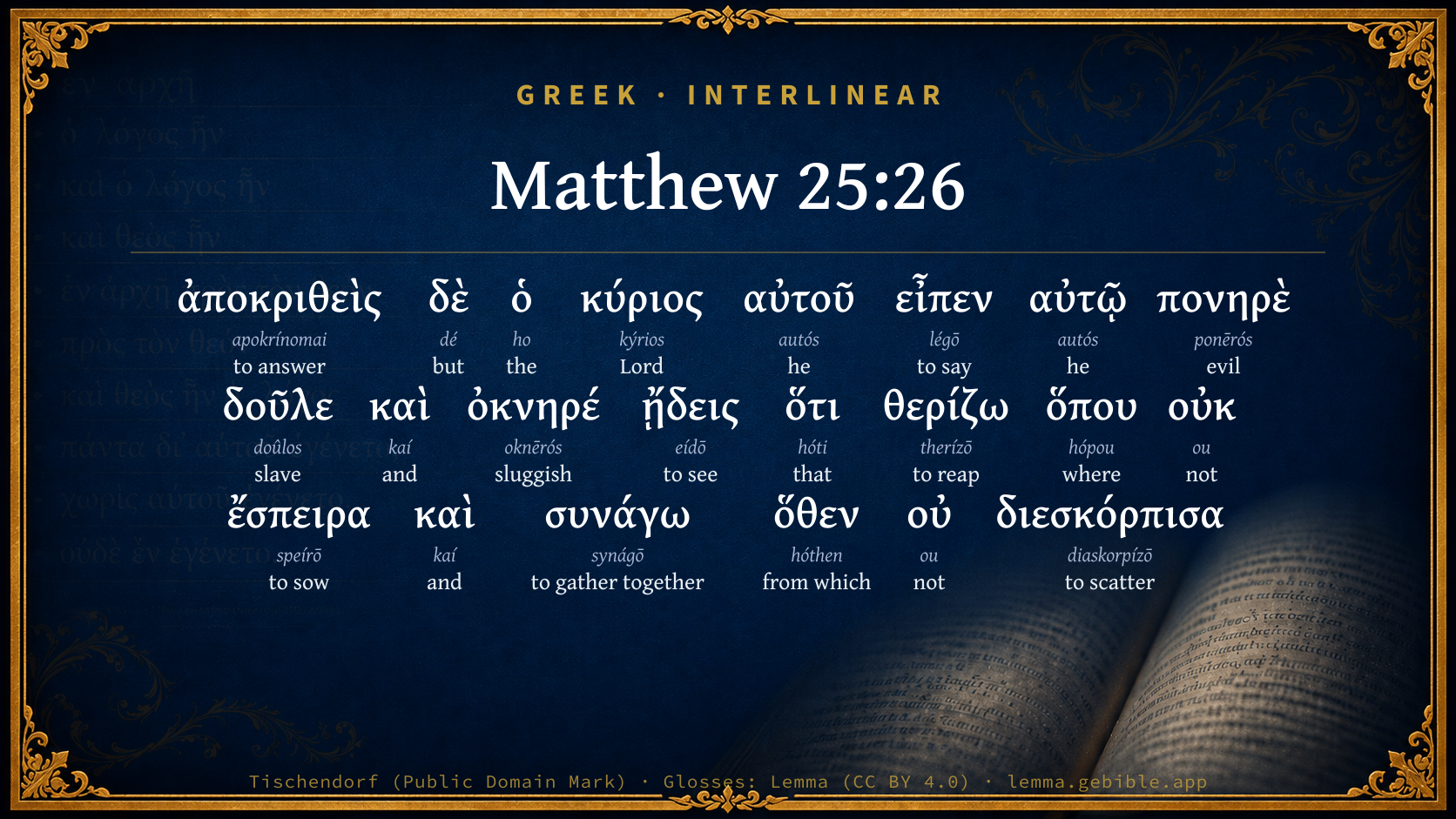
Greek (Tischendorf 8th ed.) Matthew 25:26 appears in the Greek New Testament. The text above is from the Tischendorf 8th edition. Each word links to its Strong’s number and a concise gloss. Click any word for its full Thayer’s Greek Lexicon entry.
Download image
Cite this verse

Matthew 25:26 (World English Bible). Public Domain. Lemma interlinear Bible study tool, https://lemma.gebible.app/v/matthew/25/26.

Show BibTeX & RIS
BibTeX
RIS
English Translation
"But his lord answered him, 'You wicked and slothful servant. You knew that I reap where I didn't sow, and gather where I didn't scatter.
World English Bible · Public Domain
Highlights
  • 1 first appearance in the Greek New Testament
Full analysis ↓
Download a study sheet

One document with this verse’s original text, its word-by-word gloss line, the meaning frame, cross-references with their text, attributed commentary, and full source and license credits — printable, and it pastes into notes with its structure intact.

This verse Autodidact and up

Study sheet (.html) Plain text (.txt)

A passage Seminary Student

Up to 50 verses in one chapter. A passage sheet keeps up to 6 commentary sources and 12 cross-references per verse, in the order this page ranks them, and says so on the sheet whenever that leaves anything out. Ask for a single verse and you get the Autodidact verse sheet above.

Everything on this page stays free to read, with no account — the sheet is a download of what is already on screen, not access to it.

Want to remove ads? Support Godless Engineer
Compare translations 3

The same verse in 3 English versions, stacked beneath the original-language interlinear above. Click any original word for its lexicon entry.

Each is an independent rendering of the whole verse — the interlinear is not word-aligned to these translations.

Highlighted words mark where these versions differ — a whole-verse word diff, not a word-by-word alignment.

  • World English Bible Public Domain
    "But his lord answered him, 'You wicked and slothful servant. You knew that I reap where I didn't sow, and gather where I didn't scatter.
  • King James Version Public Domain
    His lord answered and said unto him, Thou wicked and slothful servant, thou knewest that I reap where I sowed not, and gather where I have not strawed:
  • unfoldingWord Literal Text CC BY-SA 4.0
    But answering, his master said to him, ‘Wicked and lazy slave! Did you know that I reap where I did not sow and gather where I did not scatter?

unfoldingWord Literal Text — © unfoldingWord, licensed CC BY-SA 4.0. Word-aligned USFM3 via Door43 (git.door43.org/unfoldingWord/en_ult).

Versions to compare (up to 4)

3 of 4 selected

Show all 19 translations

Every available English version of this verse, each an independent rendering of the whole verse.

  • World English Bible Public Domain
    "But his lord answered him, 'You wicked and slothful servant. You knew that I reap where I didn't sow, and gather where I didn't scatter.
  • Berean Standard Bible Public Domain
    ‘You wicked, lazy servant!’ replied his master. ‘You knew that I reap where I have not sown and gather where I have not scattered seed.
  • Majority Standard Bible Public Domain
    ‘You wicked, lazy servant!’ replied his master. ‘You knew that I reap where I have not sown and gather where I have not scattered seed.
  • King James Version Public Domain
    His lord answered and said unto him, Thou wicked and slothful servant, thou knewest that I reap where I sowed not, and gather where I have not strawed:
  • American Standard Version (1901) Public Domain
    But his lord answered and said unto him, Thou wicked and slothful servant, thou knewest that I reap where I sowed not, and gather where I did not scatter;
  • Revised Version (1885) Public Domain
    But his lord answered and said unto him, Thou wicked and slothful servant, thou knewest that I reap where I sowed not, and gather where I did not scatter;
  • Geneva Bible (1599) Public Domain
    And his master answered, and said vnto him, Thou euill seruant, and slouthfull, thou knewest that I reape where I sowed not, and gather where I strawed not.
  • Douay-Rheims (1899) Public Domain
    And his lord answering, said to him: Wicked and slothful servant, thou knewest that I reap where I sow not, and gather where I have not strewed:
  • Young's Literal Translation Public Domain
    `And his lord answering said to him, Evil servant, and slothful, thou hadst known that I reap where I did not sow, and I gather whence I did not scatter!
  • Literal Standard Version CC BY-SA 4.0
    And his lord answering said to him, Evil servant, and slothful, you had known that I reap where I did not sow, and I gather from where I did not scatter!
  • Unlocked Literal Bible CC BY-SA 4.0
    But his master answered and said to him, 'You wicked and lazy servant, you knew that I reap where I have not sowed and harvest where I have not scattered.
  • unfoldingWord Literal Text CC BY-SA 4.0
    But answering, his master said to him, ‘Wicked and lazy slave! Did you know that I reap where I did not sow and gather where I did not scatter?
  • Darby Bible Public Domain
    And his lord answering said to him, Wicked and slothful bondman, thou knewest that I reap where I had not sowed, and gather from where I had not scattered;
  • World Messianic Bible Public Domain
    “But his lord answered him, ‘You wicked and slothful servant. You knew that I reap where I didn’t sow, and gather where I didn’t scatter.
  • Webster's Bible Public Domain
    His lord answered and said to him, Thou wicked and slothful servant, thou knewest that I reap where I have not sown, and gather where I have not strewed:
  • Free Bible Version CC BY-SA 4.0
    But his master answered him, ‘You wicked and lazy servant! If you think I reap where I don't sow, and harvest crops I didn't plant,
  • Bible in Basic English Public Domain
    But his lord in answer said to him, You are a bad and unready servant; if you had knowledge that I get in grain where I did not put seed, and make profits for which I have done no work,
  • Text-Critical English NT CC BY 4.0
    But his master answered him, ‘Yoʋ evil and lazy servant! Yoʋ knew, did yoʋ, that I reap where I have not sown and gather where I have scattered no seed?
  • Tyndale New Testament (1534) Public Domain
    His master answered and sayde vnto him: thou evyll servaut and slewthfull thou knewest that I repe where I sowed not and gaddre where I strawed not:

Literal Standard Version (2020), Covenant Press — licensed CC BY-SA 4.0. Text via the HelloAO Bible API (eBible.org). Unlocked Literal Bible (unfoldingWord) — licensed CC BY-SA 4.0. Text via the HelloAO Bible API (eBible.org). unfoldingWord Literal Text — © unfoldingWord, licensed CC BY-SA 4.0. Word-aligned USFM3 via Door43 (git.door43.org/unfoldingWord/en_ult). Free Bible Version, Dr. Jonathan Gallagher — licensed CC BY-SA 4.0. Text via the HelloAO Bible API (eBible.org).

Word by word

More ways to search: Search by grammar → Find every occurrence → Compare this word →

Practice this passage: Drill this verse → Learn its vocabulary →

ὀκνηρέ
oknērós
G3636
“sluggish”
Adjective, Vocative, Singular, Masculine
Part of Speech
Adjective
Case
Vocative
Number
Singular
Gender
Masculine
Full Thayer's Definition

Origin: from G3635

TDNT: 07:46,7

1. sluggish, slothful, backward
  1. ἀποκριθεὶς apokrínomai G611 “to answer” Verb, Aorist, Passive deponent, Participle, Nominative, Singular, Masculine
  2. δὲ dé G1161 “but” Conjunction
  3. ὁ ho G3588 “the” Article, Nominative, Singular, Masculine
  4. κύριος kýrios G2962 “Lord” Noun, Nominative, Singular, Masculine
  5. αὐτοῦ autós G846 “he” Personal pronoun, Genitive, Singular, Masculine
  6. εἶπεν légō G3004 “to say” Verb, Aorist, Active, Indicative, 3rd person, Singular
  7. αὐτῷ autós G846 “he” Personal pronoun, Dative, Singular, Masculine
  8. πονηρὲ ponērós G4190 “evil” Adjective, Vocative, Singular, Masculine
  9. δοῦλε doûlos G1401 “slave” Noun, Vocative, Singular, Masculine
  10. καὶ kaí G2532 “and” Conjunction
  11. ᾔδεις eídō G1492 “to see” Verb, Pluperfect, Active, Indicative, 2nd person, Singular
  12. ὅτι hóti G3754 “that” Conjunction
  13. θερίζω therízō G2325 “to reap” Verb, Present, Active, Indicative, 1st person, Singular
  14. ὅπου hópou G3699 “where” Adverb
  15. οὐκ ou G3756 “not” Particle, Negative
  16. ἔσπειρα speírō G4687 “to sow” Verb, Aorist, Active, Indicative, 1st person, Singular
  17. καὶ kaí G2532 “and” Conjunction
  18. συνάγω synágō G4863 “to gather together” Verb, Present, Active, Indicative, 1st person, Singular
  19. ὅθεν hóthen G3606 “from which” Adverb
  20. οὐ ou G3756 “not” Particle, Negative
  21. διεσκόρπισα diaskorpízō G1287 “to scatter” Verb, Aorist, Active, Indicative, 1st person, Singular

About this verse

These counts appear in no published source. They are computed here, from the morphology-tagged text and Lemma’s own curated glosses. What Lemma adds →

22
words
19
distinct lemmas
Gospels
section

Notable vocabulary

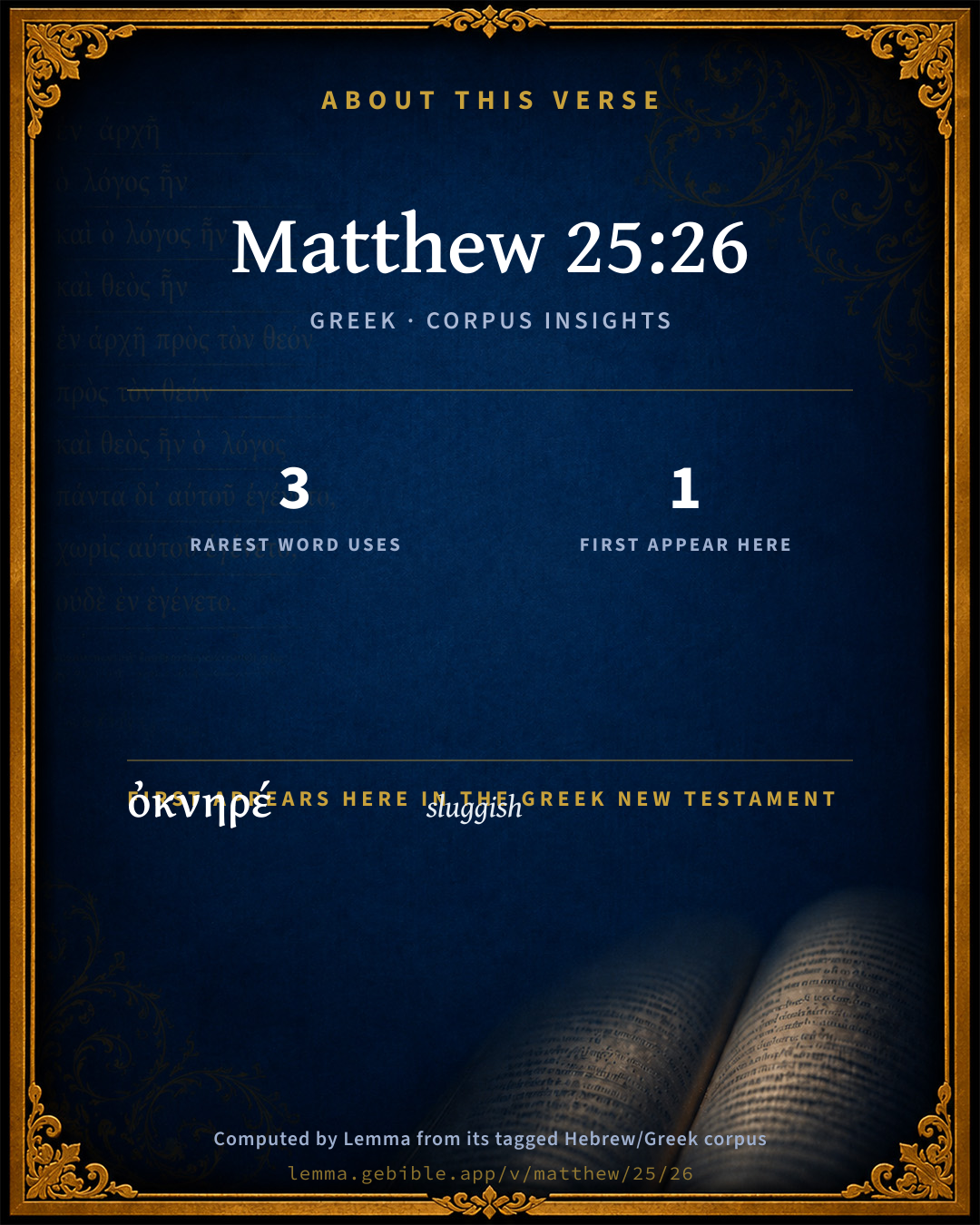
The rarest word here is ὀκνηρέ sluggish G3636 — appearing just 3 times in the whole Greek New Testament.

First appearance in Scripture

This word makes its first canonical appearance in the Greek New Testament here:

  • ὀκνηρέ sluggish G3636

Shared distinctive vocabulary

ὀκνηρέ sluggish G3636 occurs in 3 verses of the Greek New Testament. Also found in:
Repetition

Words recur within this verse:

  • αὐτοῦ he G846 ×2
  • καὶ and G2532 ×2
  • οὐκ not G3756 ×2

Cross-references

2

Topical passages linked to Matthew 25:26 in the Treasury of Scripture Knowledge — connected by theme and wording, ordered by reader-vote popularity; previews shown in the World English Bible.

  • Matthew 18:32 Then his lord called him in, and said to him, 'You wicked servant! I forgave you all that debt, because you begged me.
  • Job 15:5–6 For your iniquity teaches your mouth, And you choose the language of the crafty.

Cross-references courtesy of OpenBible.info (CC BY 4.0).

Commentary

Notes on Matthew 25:26 from classic Christian and Jewish commentators (each source and its license shown beneath its notes). The classic Christian expositions comment on the surrounding passage and are grouped to its opening verse, so a note may address several verses; the Jewish commentaries on the Tanakh (Rashi and others) are per-verse, so they appear only where the commentator wrote on this verse.

Lemma curates 59 commentaries, every one of them public domain or Creative Commons licensed, each selected and text-cleaned for this edition rather than reprinted as found. About our sources →

Joseph Benson's Commentary

Mat 25:26-27. Thou wicked and slothful servant — Wicked, because slothful. Observe well, reader, slothful servants are wicked servants, and will be reckoned with as such by their Master: for he that is slothful in his work, and neglects to do the good that God has commanded, is brother to him that is a great waster, by doing the evil that God has for bidden, Pro 18:9. He that is careless in God’s work, is near akin to him that is busy in the devil’s work: Satis est mali nihil fecisse boni. It is evil enough to have done no good. Omissions of duty are commissions of sin, and must come into judgment as such. Slothfulness makes way for wickedness, and when the house is empty, the unclean spirit takes possession of it. Thou knewest — I reap where I sowed not? — That I require impossibilities! This is not an allowing, but a strong denial of the charge. Thou oughtest therefore, &c. — On that very account, on thy own supposition, to have improved my talent, as far as was possible. To have put my money to the exchangers, &c. He mentions this instance of good management, because it was the lowest that could be, and was attended with the least trouble; to intimate that, though the servant had not pursued that particular sort of trade in which he ought to have employed the talent, yet if he had been at any pains at all to improve it, though it had been little, his lord would have accepted it. And then I should have received mine own with usury — Συν τοκω, with interest, or produce. “Anciently, the import of the word usury was no other than profit, whether great or small, allowed to the lender for the use of borrowed money. As this practice often gave rise to great extortion, the very name at length became odious. When Christian commonwealths judged it necessary to regulate this matter by law, they gave to such profit as does not exceed the legal, the softer name of interest; since which time, usury has come to signify solely extravagant profit disallowed by law; and which, therefore, it is criminal in the borrower to give, and in the lender to take. As it is not this kind of profit that is here meant, the word usury is now become improper.” — Campbell. Observe, reader, though the parable represents but one in three unfaithful; yet, in a history that answers the parable, we find the disproportion quite the other way; when ten lepers were cleansed, nine of the ten hid the talent, and only one returned to give thanks, Luk 17:18-19. The unfaithful servant was he that had only one talent, but doubtless there are many that have five talents, and bury them all; great abilities, great advantages, and yet do no good with them: but Christ would intimate to us, 1st, that if he that had but one talent was reckoned with thus for burying that one, much more will they be accounted offenders that have more, that have many, and bury them. If he that was but of small capacity was cast into outer darkness, because he did not improve what he had as he might have done, shall those be spared that trample under foot the greatest advantages? 2d, That often those who have least to do for God, do least of what they have to do. 3d, That the hard thoughts which sinners have of God will be so far from justifying their slothfulness, that they will rather aggravate and add to their guilt; so that in the day of final accounts, they will be left quite without excuse; all frivolous pleas will be overruled, and every mouth will be stopped.

Joseph Benson's Commentary on the Old and New Testaments (1811–1818) — public domain. Text from a community e-Sword module.

Meyer's Critical & Exegetical Commentary

Heinrich August Wilhelm Meyer

Mat_25:26 f. The master chastises the worthless and indolent (Rom_12:11) servant with his own weapons.

ᾔδεις, κ.τ.λ.] question of astonishment, which is more spirited and more in keeping with the surprising nature of the excuse than to understand the words in a conceding sense (Kuinoel, de Wette), or as an independent hypothesis (Bernhardy, p. 385), in which case the οὖν of the apodosis would be deprived of its force (see Hartung, Partikell. II. p. 22 f.; Klotz, ad Devar. p. 718 f.).

βαλεῖν … τοῖς τραπεζ.] flinging down upon the table of the money-changers, represents the indifference of the proceeding.

ἐγώ] is emphatic as related to the preceding ἴδε, ἔχεις τὸ σόν, Mat_25:25. To it likewise corresponds τὸ ἐμόν, to which, however, σὺν τόκῳ is now added for sake of emphasis.

Meyer — Critical and Exegetical Commentary on the New Testament — English translation by Peter Christie, edited by Frederick Crombie (T&T Clark, 1880) — public domain. Text from a community e-Sword module.

Expositor's Greek Testament

ed. W. Robertson Nicoll

Mat 25:26 πονηρὲ ( vide on Mat 6:23 ), wicked” is too general a meaning: mean-spirited or grudging would suit the connection better. πονηρὸς is the fitting reply to σκληρὸς , and the opposite of ἀγαθὸς . You call me hard, I call you a churl: with no heart for your work, unlike your fellow-servant who put his whole heart into his work. ὀκνηρέ , slothful; a poor creature altogether: suspicious, timid, heartless, spiritless, idle. ᾔδεις , etc.: a question, neither making an admission nor expressing surprise or anger, but leading up to a charge of inconsistency = If that was your idea of me, why then, etc.

The Expositor's Greek Testament, edited by W. Robertson Nicoll (1897–1910) — public domain. Text from a community e-Sword module.

Ellicott's Commentary for English Readers

(26) Thou wicked and slothful servant.—The words of the master pierce below the false excuse, and reveal the faults which had eaten like a canker into the man’s heart and soul.

A Bible Commentary for English Readers, edited by Charles John Ellicott (1878–1897) — public domain. Text from a community e-Sword module.

John Gill's Exposition

His Lord answered and said unto him,.... Resenting, as he well might, not only his indolence and sloth, his neglect of his duty, and his worldly disposition, but the abusive character he had given of him, in order to cover his own wickedness:

thou wicked and slothful servant; a very just character of him: he was a "wicked" servant; all men in a state of nature are wicked; they lie in wickedness, and are under the power of the wicked one; and there are many wicked men among professors of religion, and many wicked ministers, who, though not openly profane, yet either trusting to their works, or doing the work of the Lord deceitfully, or wholly neglecting it, justly merit this character. This man's wickedness lay in his slothfulness, in not doing the good he might, and had gifts and abilities for; and in entertaining wrong thoughts of, and in bringing false charges against his Lord: and he might be truly said to be "slothful"; since he took no pains to improve in spiritual knowledge; and instead of digging for that, as for silver and hid treasure, dug in the earth, and hid his talent there: he neglected the gift that was in him; did not stir it up, or study to show himself a workman that needeth not to be ashamed; did not give himself up to reading, meditation, and prayer; but trusted to, and depended on what other men had done; stole away his neighbour's words, reaped that for which he had not laboured, and entered into the labours of others; and being afraid of difficulties, indulged himself in ease and pleasure, served his own belly, and not the Lord Jesus; he gratified his worldly lusts, and had no regard to his master's interest,

Thou knowest that I reap where I sowed not, and gather where I have not strawed: not granting that he was such an one, and that his servant knew him to be such, and had given a true character of him; but supposing he was such a person he had wickedly represented him to be; he turns the argument upon him, that therefore he must needs know, that he expected to have had his money improved, and to have received it with an increase; and that upon such a consideration he ought to have been the more diligent and industrious, in using and improving his talent, and not to have indulged sloth, and idleness; and thus he convicts, judges, and condemns him, as a wicked, slothful servant, by his own words.

John Gill's Exposition of the Whole Bible (1746–1763) — public domain (CC PDM 1.0). Text via the HelloAO Bible API.

Trapp's Complete Commentary

John Trapp

26 His lord answered and said unto him, Thou wicked and slothful servant, thou knewest that I reap where I sowed not, and gather where I have not strawed:

Ver. 26. Thou wicked and slothful servant] God puts no difference between Nequaquam et nequam, an idle and an evil servant. Had idleness been a calling, this servant had been both a good husband and a good fellow too. But what saith the heathen? Nec illi falsi sunt, qui diversissimas res expectant, ignaviae voluptatem, et praemia virtutis. (Sallust. in Jug.)

John Trapp, A Commentary or Exposition upon All the Books of the Old and New Testament (1647–1656) — public domain. Text from a community e-Sword module.

Albert Barnes' Notes on the Bible

Slothful - Indolent, lazy, who had done nothing. God will judge people not merely for doing wrong, but for not “doing” right. See Mat 25:45. That servant was “wicked,” because he had such an opinion of his master; he had shown that he was slothful by not making good use of the talent, Mat 25:27.

Thou knewest ... - This should be understood, and might have been translated, as a question. If you knew that I was Such a man you ought to have acted accordingly, so as to have escaped punishment. Didst thou know that I reap, etc.? Then thou shouldst have given my money to the exchangers, etc. This is not intended to “admit” that he was such a man, but to convict the slothful servant of guilt and folly in not having been prepared to meet him.

Albert Barnes' Notes on the Bible (1834–1885) — public domain. Text from a community e-Sword/MySword module.

Haydock's Catholic Bible Commentary

Thou evil and slothful servant, for thus calumniating thy master; if I wish to reap where I have not sown, how ought you to fear my just indignation, if were I have sown I find nothing by your neglect to reap. Thus our Lord retorts the accusation upon the servant, as in Luke xix. 22. Out of thy own mouth I judge thee, thou wicked servant.

George Leo Haydock (1774–1849), Haydock's Catholic Family Bible and Commentary, 1859 edition — public domain. Excludes Psalms (Douay-Rheims chapter numbering differs from Protestant) and Deuterocanonical books (Catholic canon only).

Whedon's Commentary on the Bible

Daniel D. Whedon

26. Wicked and slothful servant — The precise opposite of good and faithful. Wicked in self-exculpation, by calumniating his Lord. Slothful in neglecting his talent. Thou knewest — The master echoes the culprit, in order to condemn him on his own grounds. It is best understood as an interrogation: “You knew I was a hard man, did you?”

Daniel D. Whedon (gen. ed.), Commentary on the Old and New Testaments (1874–1909) — public domain. Text from a community e-Sword module.

The Pulpit Commentary

Thou wicked and slothful servant. In marked contrast with the commendation, "good and faithful," its vers, 21, 23. He was "wicked," in that he calumniated his master, who really seems to have been ready to acknowledge the least service done to him, and never looked for results beyond a man"s ability and opportunities; and he was "slothful," in that he made no effort to improve the one talent entrusted to him. Thou knewest (hdeiv), etc. Out of his own mouth he judges him. (Luk_19:22) He repeats the slave"s words, in which he expressed his notion of his lord"s character and practice, and deduces therefrom the inconsistency of his action, without deigning to defend himself from the calumny, except, perhaps, by the use of hdeiv , which gives a hypothetical notion to the assumed knowledge. "You knew, you say." Some editors place a mark of interrogation at the end of the clause, which seems unnecessary.

The Pulpit Commentary (1880–1919), ed. H.D.M. Spence-Jones & Joseph S. Exell — public domain. Text from a community e-Sword module.

John Wesley's Explanatory Notes

Thou knewest - That I require impossibilities! This is not an allowing, but a strong denial of the charge.

John Wesley, Explanatory Notes Upon the Whole Bible (1754–1765) — public domain. Text via the GEBible commentary corpus.

MacLaren's Expositions of Holy Scripture

Alexander MacLaren

Matthew

TRADERS FOR THE MASTER

Mat 25:14 - Mat 25:30.

The parable of the Ten Virgins said nothing about their working whilst they waited. This one sets forth that side of the duties of the servants in their master’s absence, and so completes the former. It is clearly in its true historical connection here, and is closely knit to both the preceding and following context. It is a strange instance of superficial reading that it should ever have been supposed to be but another version of Luke’s parable of the pounds. The very resemblances of the two are meant to give force to their differences, which are fundamental. They are the converse of each other. That of the pounds teaches that men who have the same gifts intrusted to them may make a widely different use of these, and will be rewarded differently, in strictly graduated proportion to their unlike diligence. The lesson of the parable before us, on the other hand, is that men with dissimilar gifts may employ them with equal diligence; and that, if they do, their reward shall be the same, however great the endowments of one, and slender those of another. A reader who has missed that distinction must be very shortsighted, or sworn to make out a case against the Gospels.

I. We may consider the lent capital and the business done with it.

Masters nowadays do not give servants their money to trade with, when they leave home; but the incident is true to the old-world relations of master and slave. Our Lord’s consciousness of His near departure, which throbs in all this context, comes out emphatically here. He is preparing His disciples for the time when they will have to work without Him, like the managers of some branch house of business whose principal has gone abroad. What are the ‘talents’ with which He will start them on their own account? We have taken the word into common language, however little we remember the teaching of the parable as to the hand that gives ‘men of talent’ their endowments. But the natural powers usually called by the name are not what Christ means here, though the principles of the parable may be extended to include them. For these powers are the ‘ability’ according to which the talents are given. But the talents themselves are the spiritual knowledge and endowments which are properly the gifts of the ascended Lord to His Church. Two important lessons as to these are conveyed. First, that they are distributed in varying measure, and that not arbitrarily, by the mere will of the giver, but according to his discernment of what each servant can profitably administer. The ‘ability’ which settles their amount is not more closely defined. It may include natural faculty, for Christ’s gifts usually follow the line of that; and the larger the nature, the more of Him it can contain. But it also includes spiritual receptiveness and faithfulness, which increase the absorbing power. The capacity to receive will also be the capacity to administer, and it will be fully filled.

The second lesson taught is that spiritual gifts are given for trading with. In other words, they are here considered not so much as blessings to the possessor as his stock-in-trade, which he can employ for the Master’s enrichment. We are all tempted to think of them mostly as given us for our own blessing and joy; and the reminder is never unseasonable that a Christian receives nothing for himself alone. God hath shined into our hearts, that we may give to others the light of the knowledge which has flashed glad day into our darkness. The Master intrusts us with a portion of His wealth, not for expending on ourselves, but for trading with.

A third principle here is that the right use of His gifts increases them in our hands. ‘Money makes money.’ The five talents grow to ten, the two to four. The surest way to increase our possession of Christ’s grace is to try to impart it. There is no better way of strengthening our own faith than to seek to make others share in it. Christian convictions, spoken, are confirmed, but muffled in silence are weakened. ‘There is that scattereth and yet increaseth.’ Seed heaped and locked up in a granary breeds weevils and moths; flung broadcast over the furrows, it multiplies into seed that can be sown again, and bread that feeds the sower. So we have in this part of the parable almost the complete summary of the principles on which, the purposes for which, and the results to faithful use with which, Christ gives His gifts.

The conduct of the slenderly endowed servant who hides his talent will be considered farther on.

II. We note the faithful servants’ balance-sheet and reward.

Our Lord again sounds the note of delay-’After a long time’-an indefinite phrase which we know carries centuries in its folds, how many more we know not nor are intended to know. The two faithful servants present their balance-sheet in identical words, and receive the same commendation and reward. Their speech is in sharp contrast with the idle one’s excuse, inasmuch as it puts a glad acknowledgment of the lord’s giving in the forefront, as if to teach that the thankful recognition of his liberality underlies all joyful and successful service, and deepens while it makes glad the sense of responsibility. The cords of love are silken; and he who begins with setting before himself the largeness of Christ’s gifts to him, will not fail in using these so as to increase them. In the light of that day, the servant sees more clearly than when he was at work the results of his work. We do not know what the year’s profits have been till stock-taking and balancing-time comes. Here we often say, ‘I have laboured in vain.’ There we shall say, ‘I have gained five talents.’

The verbatim repetition of the same words to both servants teaches the great lesson of this parable as contrasted with that of the pounds, that where there has been the same faithful work, with different amounts of capital, there will be the same reward. Our Master does not care about quantity, but about quality and motive. The slave with a few shillings, enough to stock meagrely a little stall, may show as much business capacity, diligence, and fidelity, as if he had millions to work with. Christ rewards not actions, but the graces which are made visible in actions; and these can be as well seen in the tiniest as in the largest deeds. The light that streams through a pin-prick is the same that pours through the widest window. The crystals of a salt present the same facets, flashing back the sun at the same angles, whether they be large or microscopically small. Therefore the judgment of Christ, which is simply the utterance of fact, takes no heed of the extent but only of the kind of service, and puts on the same level of recompense all who, with however widely varying powers, were one in spirit, in diligence, and devotion. The eulogium on the servants is not ‘successful’ or ‘brilliant,’ but ‘faithful,’ and both alike get it.

The words of the lord fall into three parts. First comes his generous and hearty praise,-the brief and emphatic monosyllable ‘Well,’ and the characterisation of the servants as ‘good and faithful.’ Praise from Christ’s lips is praise indeed; and here He pours it out in no grudging or scanty measure, but with warmth and evident delight. His heart glows with pleasure, and His commendation is musical with the utterance of His own joy in His servants. He ‘rejoices over them with singing’; and more gladly than a fond mother speaks honeyed words of approval to her darling, of whose goodness she is proud, does He praise these two. When we are tempted to disparage our slender powers as compared with those of His more conspicuous servants, and to suppose that all which we do is nought, let us think of this merciful and loving estimate of our poor service. For such words from such lips, life itself were wisely flung away; but such words from such lips will be spoken in recognition of many a piece of service less high and heroic than a martyr’s. ‘Good and faithful’ refers not to the more general notion of goodness, but to the special excellence of a servant, and the latter word seems to define the former. Fidelity is the grace which He praises,-manifested in the recognition that the capital was a loan, given to be traded with for Him, and to be brought back increased to Him. He is faithful who ever keeps in view, and acts on, the conditions on which, and the purposes for which, he has received his spiritual wealth; and ‘he who is faithful in that which is least, is faithful also in much.’

The second part of the lord’s words is the appointment to higher office, as the reward of faithfulness. Here on earth, the tools come, in the long run, to the hands that can use them, and the best reward of faithfulness in a narrower sphere is to be lifted to a wider. Promotion means more to do; and if the world were rightly organised, the road to advancement would be diligence; and the higher a man climbed, the wider would be the horizon of his labour. It is so in Christ’s kingdom, and should be so in His visible Church. It will be so in heaven. Clearly this saying implies the active theory of the future life, and the continuance in some ministry of love, unknown to us, of the energies which were trained in the small transactions of earth. ‘If five talents are “a few things,” how great the “many things” will be!’ In the parable of the pounds, the servant is made a ruler; here being ‘set over’ seems rather still to point to the place of a steward or servant. The sphere is enlarged, but the office is unaltered. The manager who conducted a small trade rightly will be advanced to the superintendence of a larger business.

‘We doubt not that for one so true

There must be other, nobler work to do,’

and that in that work the same law will continue to operate, and faithfulness be crowned with ever-growing capacities and tasks through a dateless eternity.

The last words of the lord pass beyond our poor attempts at commenting. No eye can look undazzled at the sun. When Christ was near the Cross, He left His disciples a strange bequest at such a moment,-His joy; and that is their brightest portion here, even though it be shaded with many sorrows. The enthroned Christ welcomes all who have known ‘the fellowship of His sufferings’ into the fulness of His heavenly joy, unshaded, unbroken, unspeakable; and they pass into it as into an encompassing atmosphere, or some broad land of peace and abundance. Sympathy with His purposes leads to such oneness with Him that His joy is ours, both in its occasions and in its rapture. ‘Thou makest them drink of the river of Thy pleasures,’ and the lord and the servant drink from the same cup.

III. The excuse and punishment of the indolent servant.

His excuse is his reason. He did think hardly of his lord, and, even though he had His gift in his hand to confute him, he slandered Him in his heart as harsh and exacting. To many men the requirements of religion are more prominent than its gifts, and God is thought of as demanding rather than as ‘the giving God.’ Such thoughts paralyse action. Fear is barren, love is fruitful. Nothing grows on the mountain of curses, which frowns black over against the sunny slopes of the mountain of blessing with its blushing grapes. The indolence was illogical, for, if the master was such as was thought, the more reason for diligence; but fear is a bad reasoner, and the absurd gap between the premises and the conclusion is matched by one of the very same width in every life that thinks of God as rigidly requiring obedience, which, therefore, it does not give! Still another error is in the indolent servant’s words. He flings down the hoarded talent with ‘Lo, thou hast thine own.’ He was mistaken. Talents hid are not, when dug up, as heavy as they were when buried. This gold does rust, and a life not devoted to God is never carried back to Him unspoiled.

The lord’s answer again falls into three parts, corresponding to that to the faithful servants. First comes the stern characterisation of the man. As with the others’ goodness, his badness is defined by the second epithet. It is slothfulness. Is that all? Yes; it does not need active opposition to pull down destruction on one’s head. Simple indolence is enough, the negative sin of not doing or being what we ought. Ungirt loins, unlit lamps, unused talents, sink a man like lead. Doing nothing is enough for ruin.

The remarkable answer to the servant’s charge seems to teach us that timid souls, conscious of slender endowments, and pressed by the heavy sense of responsibility, and shrinking from Christian enterprises, for fear of incurring heavier condemnation, may yet find means of using their little capital. The bankers, who invest the collective contributions of small capitalists to advantage, may, or may not, be intended to be translated into the Church; but, at any rate, the principle of united service is here recommended to those who feel too weak for independent action. Slim houses in a row hold each other up; and, if we cannot strike out a path for ourselves, let us seek strength and safety in numbers.

The fate of the indolent servant has a double horror. It is loss and suffering. The talent is taken from the slack hands and coward heart that would not use it, and given to the man who had shown he could and would. Gifts unemployed for Christ are stripped off a soul yonder. How much will go from many a richly endowed spirit, which here flashed with unconsecrated genius and force! We do not need to wait for eternity to see that true possession, which is use, increases powers, and that disuse, which is equivalent to not possessing, robs of them. The blacksmith’s arm, the scout’s eye, the craftsman’s delicate finger, the student’s intellect, the sensualist’s passions, all illustrate the law on its one side; and the dying out of faculties and tastes, and even of intuitions and conscience, by reason of simple disuse, are melancholy instances of it on the other. But the solemn words of this condemnation seem to point to a far more awful energy in its working in the future, when everything that has not been consecrated by employment for Jesus shall be taken away, and the soul, stripped of its garb, shall ‘be found naked.’ How far that process of divesting may affect faculties, without touching the life, who can tell? Enough to see with awe that a spirit may be cut, as it were, to the quick, and still exist.

But loss is not all the indolent servant’s doom. Once more, like the slow toll of a funeral bell, we hear the dread sentence of ejection to the ‘mirk midnight’ without, where are tears undried and passion unavailing. There is something very awful in the monotonous repetition of that sentence so often in these last discourses of Christ’s. The most loving lips that ever spoke, in love, shaped this form of words, so heart-touching in its wailing, but decisive, proclamation of blackness, homelessness, and sorrow, and cannot but toll them over and over again into our ears, in sad knowledge of our forgetfulness and unbelief,-if perchance we may listen and be warned, and, having heard the sound thereof, may never know the reality of that death in life which is the sure end of the indolent who were blind to His gifts, and therefore would not listen to His requirements.

Alexander MacLaren, Expositions of Holy Scripture (1904–1910) — public domain. Text from a community e-Sword module.

The People's New Testament

B. W. Johnson

26. Thou wicked and slothful servant. The wickedness of the servant is demonstrated, not only his unfaithfulness, but by his false and slanderous excuses.

B. W. Johnson's The People's New Testament with Notes (1889–1891) — public domain. Electronic text from the Christian Classics Ethereal Library (CCEL) ThML edition.

unfoldingWord translationNotes

Door43 World Missions Community

Connecting Statement:

Jesus continues telling a parable about the servants and the talents. (See: Parables)

You wicked and lazy servant, you knew

"You are a wicked servant who does not want to work. You knew"

I reap where I have not sowed and harvest where I have not scattered

The words "reap where I have not sowed" and "harvest where I have not scattered" mean the same thing. They refer to a farmer who gathers crops that people who work for him have planted. See how you translated this in Matthew 25:24, where the servant uses these words to accuse the farmer. The readers should understand that the farmer is acknowledging that he does indeed gather what others have planted but is saying that he is right to do so. (See: Parallelism and Metaphor)

received back my own

The understood information can be stated clearly. AT: "received back my own money" (See: Ellipsis)

interest

payment from the banker for the temporary use of the master's money

translationWords

lord

evil

servant

unfoldingWord translationNotes — © Distant Shores Media and the Door43 World Missions Community, licensed CC BY-SA 4.0. Source: git.door43.org/Door43/en_tn.

Cambridge Greek Testament for Schools and Colleges

26. ᾔδεις ὅτι … διεσκόρπισα; ‘Thou knewest that I was,’ &c.? It is an interrogation ex concesso. The Lord does not admit the truth of this description, but judges the slave from his own standpoint. Even a low conception of the divine nature brings some responsibility, and has some promise of reward. This view brings this picture into agreement with the other descriptions of the last judgment.

Cambridge Greek Testament for Schools and Colleges (Cambridge University Press, 1896; 21 vols, various authors incl. Carr, Maclear, Plummer, Farrar, Lumby, Moule, M. R. James, Simcox) — public domain. Text from a community e-Sword module.

International Critical Commentary

26. And his master answered and said to him, Evil and slothful servant, thou knewest that I reap where I sowed not, and gather whence I did not scatter:]

(L)

International Critical Commentary — older volumes (1896–1929), various authors — public domain. Text from a community e-Sword module.

Vincent's Word Studies in the New Testament

Marvin R. Vincent

Slothful. With no more trouble than he expended in digging, he might have gone to the exchangers. The verse should be read interrogatively, Didst thou indeed know this of me? Thou shouldst then have acted with the promptness and care which one observes in dealing with a hard master. To omit the interrogation is to make the Lord admit that he was a hard master.

Marvin R. Vincent, Word Studies in the New Testament (1887–1900) — public domain. Text from a community e-Sword/MySword module.

Lesson kit

Teaching starters — assembled from the data on this page, not authored interpretation. Every prompt links to the verse data it draws on. Edit before teaching.

Matthew, in the Gospels, opens this verse with 22 words (19 distinct Greek lemmas). Its most distinctive word is oknērós (“sluggish”). A historical commentator’s framing appears above. Read the whole chapter for the surrounding context.

Discussion questions

  1. What does “sluggish” (oknērós) contribute to the verse as a whole?
  2. This is the first place “sluggish” appears in Scripture (first appears here). What does its debut here establish?
  3. How does Romans 12:11, which shares the word «sluggish», read alongside this verse?
  4. What does the repetition of “he” (2× in this one verse) do in this verse?
  5. These translations render this verse differently; the difference is in the English rendering, not the original. What questions does that raise?
  6. Compare how Joseph Benson's Commentary and Meyer's Critical & Exegetical Commentary read this verse. Where do they agree or differ?

Things to notice

  • 1 word makes its first canonical appearance in Scripture here.
  • These translations choose different wording for 20 words in this verse.
  • “he” occurs 2× in this single verse.
  • 19 distinct Greek lemmas span 22 words in this verse.

Reading settings

Reading text

Shown beneath each verse's original-language words.

Old Testament
Old Testament edition

Read the OT as the Masoretic Hebrew (MT) or the Greek Septuagint (LXX).

English shown for the Greek Septuagint (in the Hebrew ↔ Greek comparison).

Comparing translations? Open the Compare panel on any verse page to stack up to four side by side.