

Matthew 21:19
Greek (Tischendorf 8th ed.) Matthew 21:19 appears in the Greek New Testament. The text above is from the Tischendorf 8th edition. Each word links to its Strong’s number and a concise gloss. Click any word for its full Thayer’s Greek Lexicon entry.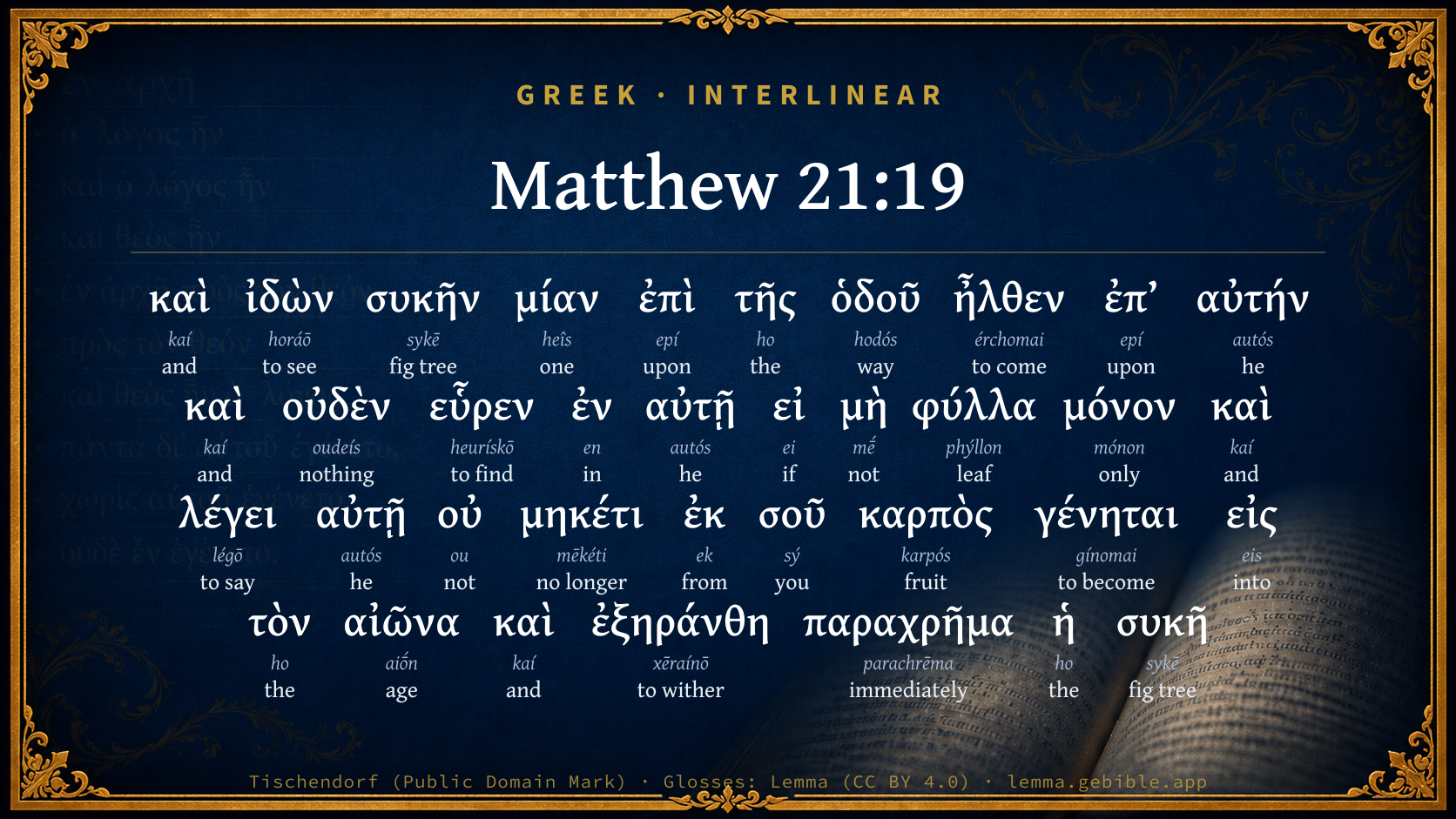
Seeing a fig tree by the road, he came to it, and found nothing on it but leaves. He said to it, "Let there be no fruit from you forever!" Immediately the fig tree withered away.
Download a study sheet
One document with this verse’s original text, its word-by-word gloss line, the meaning frame, cross-references with their text, attributed commentary, and full source and license credits — printable, and it pastes into notes with its structure intact.
This verse Autodidact and up
A passage Seminary Student
Up to 50 verses in one chapter. A passage sheet keeps up to 6 commentary sources and 12 cross-references per verse, in the order this page ranks them, and says so on the sheet whenever that leaves anything out. Ask for a single verse and you get the Autodidact verse sheet above.
Everything on this page stays free to read, with no account — the sheet is a download of what is already on screen, not access to it.
Compare translations 3
The same verse in 3 English versions, stacked beneath the original-language interlinear above. Click any original word for its lexicon entry.
Each is an independent rendering of the whole verse — the interlinear is not word-aligned to these translations.
Highlighted words mark where these versions differ — a whole-verse word diff, not a word-by-word alignment.
-
World English Bible Public Domain
Seeing a fig tree by the road, he came to it, and found nothing on it but leaves. He said to it, "Let there be no fruit from you forever!" Immediately the fig tree withered away.
-
King James Version Public Domain
And when he saw a fig tree in the way, he came to it, and found nothing thereon, but leaves only, and said unto it, Let no fruit grow on thee henceforward for ever. And presently the fig tree withered away.
-
unfoldingWord Literal Text CC BY-SA 4.0
And having seen one fig tree along the road, he went to it and found nothing on it except leaves only. And he says to it, “May there no longer be fruit from you to eternity,” and immediately the fig tree withered.
unfoldingWord Literal Text — © unfoldingWord, licensed CC BY-SA 4.0. Word-aligned USFM3 via Door43 (git.door43.org/unfoldingWord/en_ult).
Show all 19 translations
Every available English version of this verse, each an independent rendering of the whole verse.
-
World English Bible Public Domain
Seeing a fig tree by the road, he came to it, and found nothing on it but leaves. He said to it, "Let there be no fruit from you forever!" Immediately the fig tree withered away.
-
Berean Standard Bible Public Domain
Seeing a fig tree by the road, He went up to it but found nothing on it except leaves. “May you never bear fruit again!” He said. And immediately the tree withered.
-
Majority Standard Bible Public Domain
Seeing a fig tree by the road, He went up to it but found nothing on it except leaves. “May you never bear fruit again!” He said. And immediately the tree withered.
-
King James Version Public Domain
And when he saw a fig tree in the way, he came to it, and found nothing thereon, but leaves only, and said unto it, Let no fruit grow on thee henceforward for ever. And presently the fig tree withered away.
-
American Standard Version (1901) Public Domain
And seeing a fig tree by the way side, he came to it, and found nothing thereon, but leaves only; and he saith unto it, Let there be no fruit from thee henceforward for ever. And immediately the fig tree withered away.
-
Revised Version (1885) Public Domain
And seeing a fig tree by the way side, he came to it, and found nothing thereon, but leaves only; and he saith unto it, Let there be no fruit from thee henceforward for ever. And immediately the fig tree withered away.
-
Geneva Bible (1599) Public Domain
And seeing a figge tree in the way, he came to it, and found nothing thereon, but leaues onely, and said to it, Neuer fruite grow on thee henceforwards. And anon the figge tree withered.
-
Douay-Rheims (1899) Public Domain
And seeing a certain fig tree by the way side, he came to it, and found nothing on it but leaves only, and he saith to it: May no fruit grow on thee henceforward for ever. And immediately the fig tree withered away.
-
Young's Literal Translation Public Domain
and having seen a certain fig-tree on the way, he came to it, and found nothing in it except leaves only, and he saith to it, `No more from thee may fruit be -- to the age;' and forthwith the fig-tree withered.
-
Literal Standard Version CC BY-SA 4.0
and having seen a certain fig tree on the way, He came to it, and found nothing in it except leaves only, and He says to it, “No more fruit may be from you—throughout the age”; and instantly the fig tree withered.
-
Unlocked Literal Bible CC BY-SA 4.0
Seeing a fig tree along the roadside, he went to it and found nothing on it except leaves. He said to it, “May there be no fruit from you ever again,” and immediately the fig tree withered.
-
unfoldingWord Literal Text CC BY-SA 4.0
And having seen one fig tree along the road, he went to it and found nothing on it except leaves only. And he says to it, “May there no longer be fruit from you to eternity,” and immediately the fig tree withered.
-
Darby Bible Public Domain
And seeing one fig-tree in the way, he came to it and found on it nothing but leaves only. And he says to it, Let there be never more fruit of thee for ever. And the fig-tree was immediately dried up.
-
World Messianic Bible Public Domain
Seeing a fig tree by the road, he came to it and found nothing on it but leaves. He said to it, “Let there be no fruit from you forever!” Immediately the fig tree withered away.
-
Webster's Bible Public Domain
And when he saw a fig-tree in the way, he came to it, and found nothing on it, but leaves only, and said to it, Let no fruit grow on thee henceforth for ever. And immediately the fig-tree withered.
-
Free Bible Version CC BY-SA 4.0
He saw a fig tree at the side of the road, so he went over to it but didn't find any fruit, only leaves. He told the fig tree, “May you never ever produce fruit again!” Immediately the fig tree withered.
-
Bible in Basic English Public Domain
And seeing a fig-tree by the wayside, he came to it, and saw nothing on it but leaves only; and he said to it, Let there be no fruit from you from this time forward for ever. And straight away the fig-tree became dry and dead.
-
Text-Critical English NT CC BY 4.0
Seeing a lone fig tree by the road, he came to it and found nothing on it but leaves. Then he said to it, “May there never be any fruit from yoʋ again!” And at once the fig tree withered.
-
Tyndale New Testament (1534) Public Domain
and spyed a fygge tree in the waye and came to it and founde nothinge theron but leves only and sayd to it never frute growe on the hence forwardes. And anon the fygge tree wyddered awaye.
Literal Standard Version (2020), Covenant Press — licensed CC BY-SA 4.0. Text via the HelloAO Bible API (eBible.org). Unlocked Literal Bible (unfoldingWord) — licensed CC BY-SA 4.0. Text via the HelloAO Bible API (eBible.org). unfoldingWord Literal Text — © unfoldingWord, licensed CC BY-SA 4.0. Word-aligned USFM3 via Door43 (git.door43.org/unfoldingWord/en_ult). Free Bible Version, Dr. Jonathan Gallagher — licensed CC BY-SA 4.0. Text via the HelloAO Bible API (eBible.org).
Word by word
More ways to search: Search by grammar → Find every occurrence → Compare this word →
Practice this passage: Drill this verse → Learn its vocabulary →
- Appears 6× in the Greek New Testament
- First appears here
- Part of Speech
- Noun
- Case
- Accusative
- Number
- Plural
- Gender
- Neuter
Full Thayer's Definition
- καὶ kaí G2532 “and” Conjunction
- ἰδὼν horáō G3708 “to see” Verb, Aorist, Active, Participle, Nominative, Singular, Masculine
- συκῆν sykē G4808 “fig tree” Noun, Accusative, Singular, Feminine
- μίαν heîs G1520 “one” Adjective, Accusative, Singular, Feminine
- ἐπὶ epí G1909 “upon” Preposition
- τῆς ho G3588 “the” Article, Genitive, Singular, Feminine
- ὁδοῦ hodós G3598 “way” Noun, Genitive, Singular, Feminine
- ἦλθεν érchomai G2064 “to come” Verb, Aorist, Active, Indicative, 3rd person, Singular
- ἐπ’ epí G1909 “upon” Preposition
- αὐτήν autós G846 “he” Personal pronoun, Accusative, Singular, Feminine
- καὶ kaí G2532 “and” Conjunction
- οὐδὲν oudeís G3762 “nothing” Adjective, Accusative, Singular, Neuter, Negative
- εὗρεν heurískō G2147 “to find” Verb, Aorist, Active, Indicative, 3rd person, Singular
- ἐν en G1722 “in” Preposition
- αὐτῇ autós G846 “he” Personal pronoun, Dative, Singular, Feminine
- εἰ ei G1487 “if” Conditional
- μὴ mḗ G3361 “not” Particle, Negative
- φύλλα phýllon G5444 “leaf” Noun, Accusative, Plural, Neuter
- μόνον mónon G3440 “only” Adverb
- καὶ kaí G2532 “and” Conjunction
- λέγει légō G3004 “to say” Verb, Present, Active, Indicative, 3rd person, Singular
- αὐτῇ autós G846 “he” Personal pronoun, Dative, Singular, Feminine
- οὐ ou G3756 “not” Particle, Negative
- μηκέτι mēkéti G3371 “no longer” Adverb, Negative
- ἐκ ek G1537 “from” Preposition
- σοῦ sý G4771 “you” Personal pronoun, 2nd person, Genitive, Singular
- καρπὸς karpós G2590 “fruit” Noun, Nominative, Singular, Masculine
- γένηται gínomai G1096 “to become” Verb, Aorist, Middle deponent, Subjunctive, 3rd person, Singular
- εἰς eis G1519 “into” Preposition
- τὸν ho G3588 “the” Article, Accusative, Singular, Masculine
- αἰῶνα aiṓn G165 “age” Noun, Accusative, Singular, Masculine
- καὶ kaí G2532 “and” Conjunction
- ἐξηράνθη xēraínō G3583 “to wither” Verb, Aorist, Passive, Indicative, 3rd person, Singular
- παραχρῆμα parachrēma G3916 “immediately” Adverb
- ἡ ho G3588 “the” Article, Nominative, Singular, Feminine
- συκῆ sykē G4808 “fig tree” Noun, Nominative, Singular, Feminine
About this verse
These counts appear in no published source. They are computed here, from the morphology-tagged text and Lemma’s own curated glosses. What Lemma adds →
- 36
- words
- 27
- distinct lemmas
- Gospels
- section
Notable vocabulary
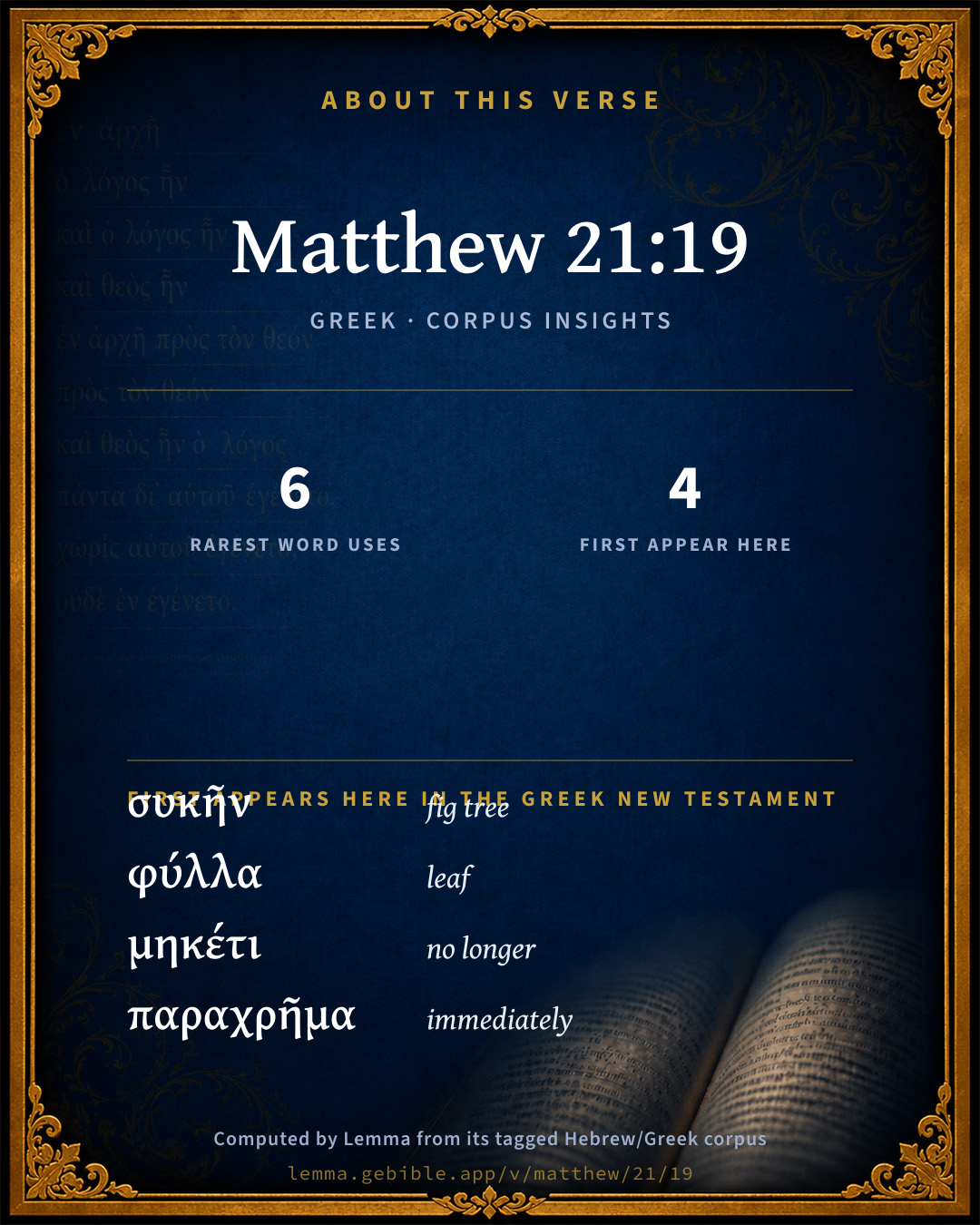
The rarest word here is φύλλα leaf G5444 — appearing just 6 times in the whole Greek New Testament.
First appearance in Scripture
These words make their first canonical appearance in the Greek New Testament here:
Shared distinctive vocabulary
φύλλα leaf G5444 occurs in 5 verses of the Greek New Testament. Also found in:
Cross-references
13Topical passages linked to Matthew 21:19 in the Treasury of Scripture Knowledge — connected by theme and wording, ordered by reader-vote popularity; previews shown in the World English Bible.
- Mark 11:14 Jesus told it, "May no one ever eat fruit from you again!" and his disciples heard it.
- John 15:6 If a man doesn't remain in me, he is thrown out as a branch, and is withered; and they gather them, throw them into the fire, and they are burned.
- Titus 1:16 They profess that they know God, but by their works they deny him, being abominable, disobedient, and unfit for any good work.
- Luke 3:9 Even now the axe also lies at the root of the trees. Every tree therefore that doesn't bring forth good fruit is cut down, and thrown into the fire."
- Luke 13:6–9 He spoke this parable. "A certain man had a fig tree planted in his vineyard, and he came seeking fruit on it, and found none.
- John 15:2 Every branch in me that doesn't bear fruit, he takes away. Every branch that bears fruit, he prunes, that it may bear more fruit.
- Isaiah 5:4–5 What could have been done more to my vineyard, that I have not done in it? Why, when I looked for it to yield grapes, did it yield wild grapes?
- 2 Timothy 3:5 holding a form of godliness, but having denied the power thereof. Turn away from these, also.
- Jude 1:12 These are hidden rocky reefs in your love feasts when they feast with you, shepherds who without fear feed themselves; clouds without water, carried along by winds; autumn leaves without fruit, twice dead, plucked up by the roots;
- Revelation 22:11 He who acts unjustly, let him act unjustly still. He who is filthy, let him be filthy still. He who is righteous, let him do righteousness still. He who is holy, let him be holy still."
- Hebrews 6:7–8 For the land which has drunk the rain that comes often on it, and brings forth a crop suitable for them for whose sake it is also tilled, receives blessing from God;
- Luke 19:42–44 saying, "If you, even you, had known today the things which belong to your peace! But now, they are hidden from your eyes.
- 2 Peter 2:20–22 For if, after they have escaped the defilement of the world through the knowledge of the Lord and Savior Jesus Christ, they are again entangled therein and overcome, the last state has become worse with them than the first.
Cross-references courtesy of OpenBible.info (CC BY 4.0).
Lesson kit
Teaching starters — assembled from the data on this page, not authored interpretation. Every prompt links to the verse data it draws on. Edit before teaching.
Matthew, in the Gospels, opens this verse with 36 words (27 distinct Greek lemmas). Its most distinctive word is phýllon (“leaf”). A historical commentator’s framing appears above. Read the whole chapter for the surrounding context.
Discussion questions
- What does “leaf” (phýllon) contribute to the verse as a whole?
- 4 words make their first appearance in Scripture here. What does this debut establish?
- How does Matthew 24:32, which shares the word «leaf», read alongside this verse?
- What does the repetition of “fig tree” (2× in this one verse) do in this verse?
- These translations render this verse differently; the difference is in the English rendering, not the original. What questions does that raise?
- Compare how Tyndale Open Study Notes and Bengel's Gnomon read this verse. Where do they agree or differ?
Things to notice
- 4 words make their first canonical appearance in Scripture here.
- These translations choose different wording for 29 words in this verse.
- “fig tree” occurs 2× in this single verse.
- 27 distinct Greek lemmas span 36 words in this verse.
Commentary
Notes on Matthew 21:19 from classic Christian and Jewish commentators (each source and its license shown beneath its notes). The classic Christian expositions comment on the surrounding passage and are grouped to its opening verse, so a note may address several verses; the Jewish commentaries on the Tanakh (Rashi and others) are per-verse, so they appear only where the commentator wrote on this verse.
Lemma curates 59 commentaries, every one of them public domain or Creative Commons licensed, each selected and text-cleaned for this edition rather than reprinted as found. About our sources →
Tyndale Open Study Notes
Tyndale Open Resources
Tyndale Open Study Notes — © Tyndale Open Resources, licensed CC BY-SA 4.0. Text via the HelloAO Bible API.
Bengel's Gnomon
Johann Albrecht Bengel
Bengel's Gnomon of the New Testament — English translation (T&T Clark, Edinburgh, 1860) — public domain. Text from a community e-Sword module.
Meyer's Critical & Exegetical Commentary
Heinrich August Wilhelm Meyer
Meyer — Critical and Exegetical Commentary on the New Testament — English translation by Peter Christie, edited by Frederick Crombie (T&T Clark, 1880) — public domain. Text from a community e-Sword module.
Expositor's Greek Testament
ed. W. Robertson Nicoll
The Expositor's Greek Testament, edited by W. Robertson Nicoll (1897–1910) — public domain. Text from a community e-Sword module.
Adam Clarke's Commentary
Adam Clarke's Commentary on the Bible (1810–1826) — public domain. Text from a community e-Sword/MySword module.
Ellicott's Commentary for English Readers
A Bible Commentary for English Readers, edited by Charles John Ellicott (1878–1897) — public domain. Text from a community e-Sword module.
John Gill's Exposition
John Gill's Exposition of the Whole Bible (1746–1763) — public domain (CC PDM 1.0). Text via the HelloAO Bible API.
Trapp's Complete Commentary
John Trapp
John Trapp, A Commentary or Exposition upon All the Books of the Old and New Testament (1647–1656) — public domain. Text from a community e-Sword module.
Whedon's Commentary on the Bible
Daniel D. Whedon
Daniel D. Whedon (gen. ed.), Commentary on the Old and New Testaments (1874–1909) — public domain. Text from a community e-Sword module.
The Pulpit Commentary
The Pulpit Commentary (1880–1919), ed. H.D.M. Spence-Jones & Joseph S. Exell — public domain. Text from a community e-Sword module.
Scofield Reference Notes
C. I. Scofield
The Scofield Reference Bible (1917 edition), notes by C. I. Scofield — public domain. Text from a community e-Sword module.
The People's New Testament
B. W. Johnson
B. W. Johnson's The People's New Testament with Notes (1889–1891) — public domain. Electronic text from the Christian Classics Ethereal Library (CCEL) ThML edition.
Cambridge Greek Testament for Schools and Colleges
Cambridge Greek Testament for Schools and Colleges (Cambridge University Press, 1896; 21 vols, various authors incl. Carr, Maclear, Plummer, Farrar, Lumby, Moule, M. R. James, Simcox) — public domain. Text from a community e-Sword module.
Alford’s Greek Testament
Henry Alford
Henry Alford, The Greek Testament (1849–1861) — public domain. Text from a community e-Sword module.
International Critical Commentary
International Critical Commentary — older volumes (1896–1929), various authors — public domain. Text from a community e-Sword module.
Vincent's Word Studies in the New Testament
Marvin R. Vincent
Marvin R. Vincent, Word Studies in the New Testament (1887–1900) — public domain. Text from a community e-Sword/MySword module.