Matthew 5:14

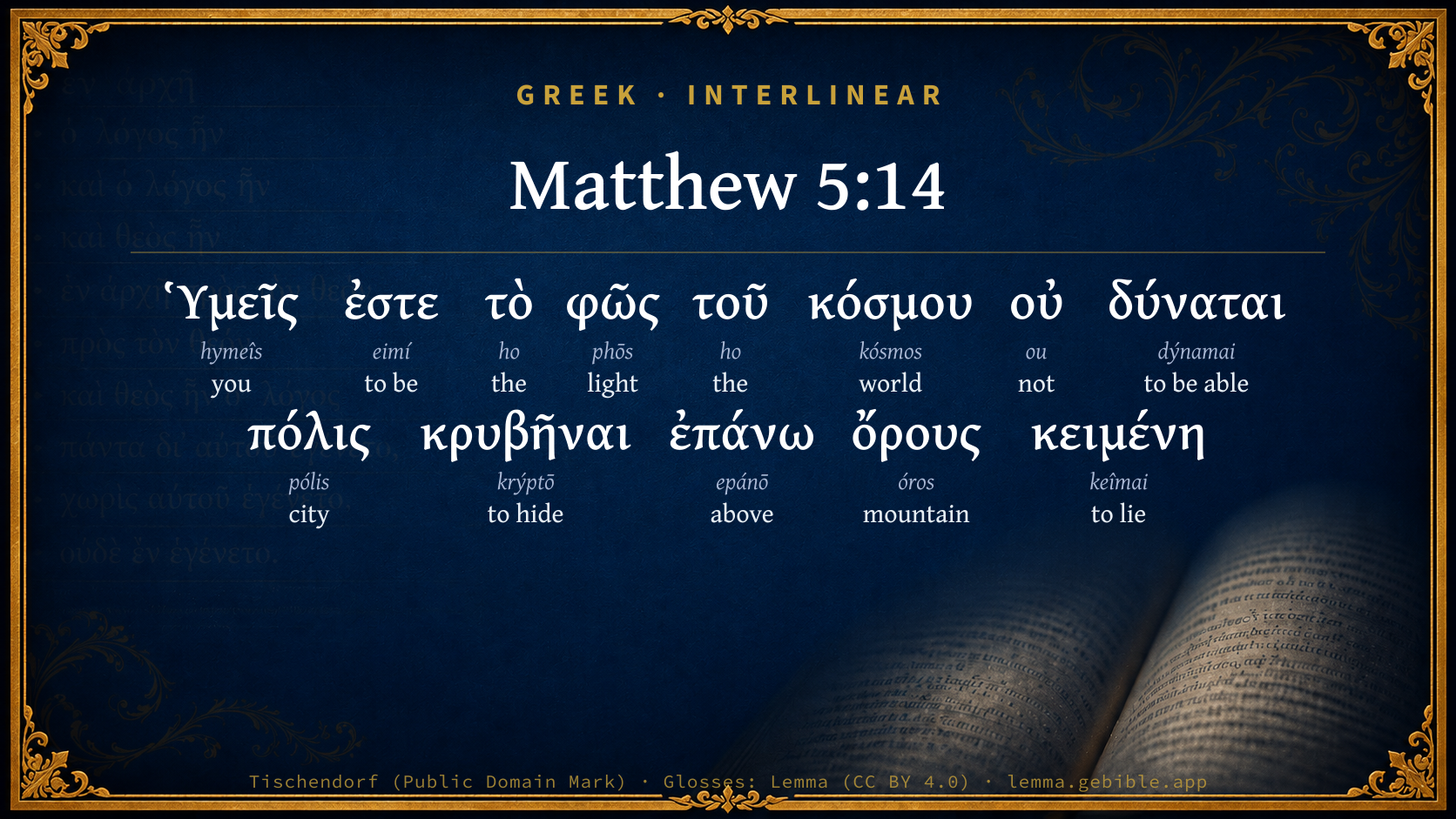
Greek (Tischendorf 8th ed.) Matthew 5:14 appears in the Greek New Testament. The text above is from the Tischendorf 8th edition. Each word links to its Strong’s number and a concise gloss. Click any word for its full Thayer’s Greek Lexicon entry.
Download image
Cite this verse

Matthew 5:14 (World English Bible). Public Domain. Lemma interlinear Bible study tool, https://lemma.gebible.app/v/matthew/5/14.

Show BibTeX & RIS
BibTeX
RIS
English Translation
You are the light of the world. A city located on a hill can't be hidden.
World English Bible · Public Domain
Highlights
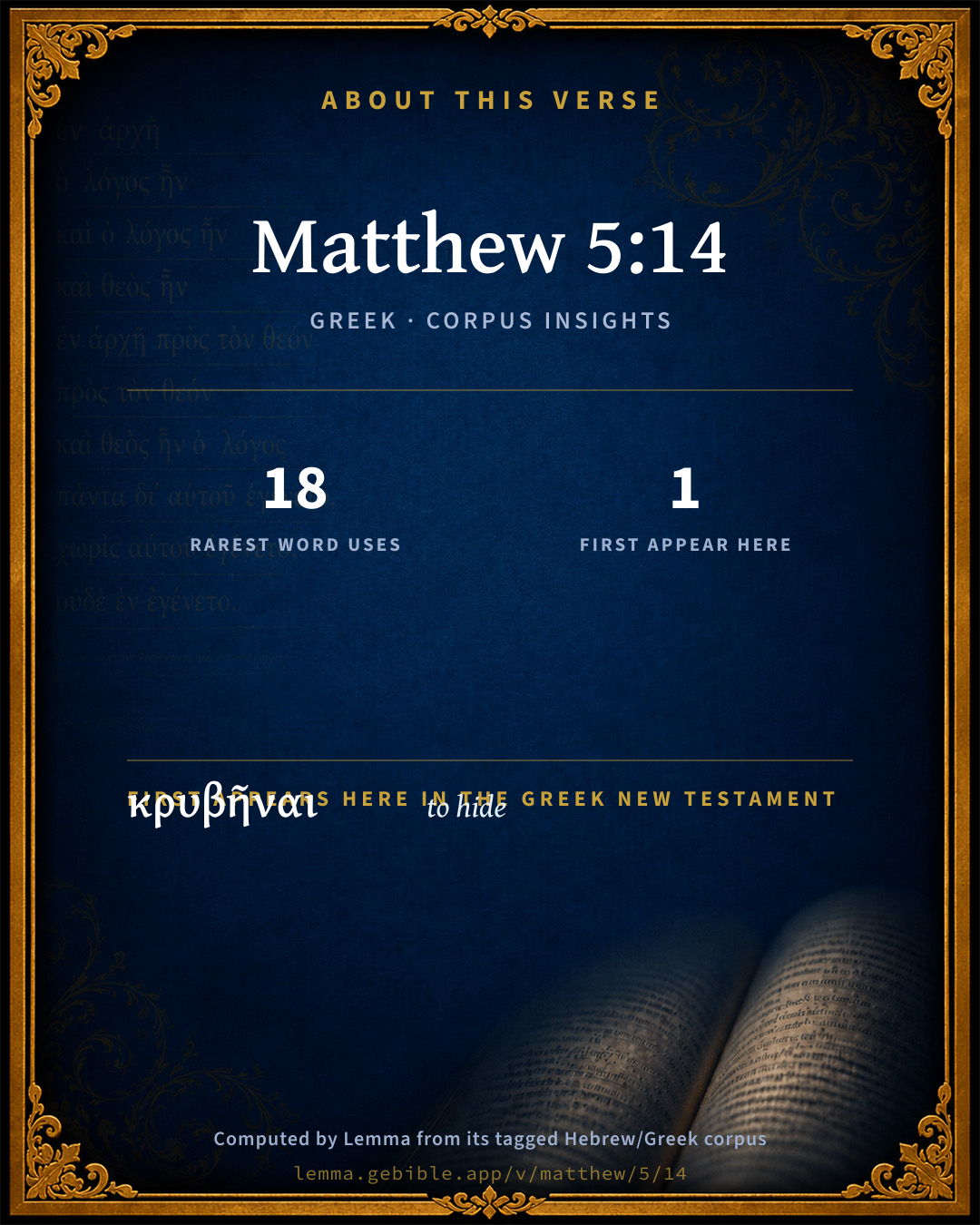
  • 1 first appearance in the Greek New Testament
Full analysis ↓
Download a study sheet

One document with this verse’s original text, its word-by-word gloss line, the meaning frame, cross-references with their text, attributed commentary, and full source and license credits — printable, and it pastes into notes with its structure intact.

This verse Autodidact and up

Study sheet (.html) Plain text (.txt)

A passage Seminary Student

Up to 50 verses in one chapter. A passage sheet keeps up to 6 commentary sources and 12 cross-references per verse, in the order this page ranks them, and says so on the sheet whenever that leaves anything out. Ask for a single verse and you get the Autodidact verse sheet above.

Everything on this page stays free to read, with no account — the sheet is a download of what is already on screen, not access to it.

Want to remove ads? Support Godless Engineer
Compare translations 3

The same verse in 3 English versions, stacked beneath the original-language interlinear above. Click any original word for its lexicon entry.

Each is an independent rendering of the whole verse — the interlinear is not word-aligned to these translations.

Highlighted words mark where these versions differ — a whole-verse word diff, not a word-by-word alignment.

  • World English Bible Public Domain
    You are the light of the world. A city located on a hill can't be hidden.
  • King James Version Public Domain
    Ye are the light of the world. A city that is set on an hill cannot be hid.
  • unfoldingWord Literal Text CC BY-SA 4.0
    You are the light of the world. A city being set on top of a mountain is not able to be hidden.

unfoldingWord Literal Text — © unfoldingWord, licensed CC BY-SA 4.0. Word-aligned USFM3 via Door43 (git.door43.org/unfoldingWord/en_ult).

Versions to compare (up to 4)

3 of 4 selected

Show all 19 translations

Every available English version of this verse, each an independent rendering of the whole verse.

  • World English Bible Public Domain
    You are the light of the world. A city located on a hill can't be hidden.
  • Berean Standard Bible Public Domain
    You are the light of the world. A city on a hill cannot be hidden.
  • Majority Standard Bible Public Domain
    You are the light of the world. A city on a hill cannot be hidden.
  • King James Version Public Domain
    Ye are the light of the world. A city that is set on an hill cannot be hid.
  • American Standard Version (1901) Public Domain
    Ye are the light of the world. A city set on a hill cannot be hid.
  • Revised Version (1885) Public Domain
    Ye are the light of the world. A city set on a hill cannot be hid.
  • Geneva Bible (1599) Public Domain
    Ye are the light of the world. A citie that is set on an hill, cannot be hid.
  • Douay-Rheims (1899) Public Domain
    You are the light of the world. A city seated on a mountain cannot be hid.
  • Young's Literal Translation Public Domain
    `Ye are the light of the world, a city set upon a mount is not able to be hid;
  • Literal Standard Version CC BY-SA 4.0
    You are the light of the world, a city set on a mountain is not able to be hid;
  • Unlocked Literal Bible CC BY-SA 4.0
    You are the light of the world. A city set on a hill cannot be hidden.
  • unfoldingWord Literal Text CC BY-SA 4.0
    You are the light of the world. A city being set on top of a mountain is not able to be hidden.
  • Darby Bible Public Domain
    *Ye* are the light of the world: a city situated on the top of a mountain cannot be hid.
  • World Messianic Bible Public Domain
    “You are the light of the world. A city located on a hill can’t be hidden.
  • Webster's Bible Public Domain
    Ye are the light of the world. A city that is set on a hill cannot be hid.
  • Free Bible Version CC BY-SA 4.0
    You are the light of the world. A city built on a hill can't be hidden.
  • Bible in Basic English Public Domain
    You are the light of the world. A town put on a hill may be seen by all.
  • Text-Critical English NT CC BY 4.0
    “You are the light of the world. A city set on a hill cannot be hidden,
  • Tyndale New Testament (1534) Public Domain
    ye are the light of the worlde. A cite that is set on an hill cannot be hid

Literal Standard Version (2020), Covenant Press — licensed CC BY-SA 4.0. Text via the HelloAO Bible API (eBible.org). Unlocked Literal Bible (unfoldingWord) — licensed CC BY-SA 4.0. Text via the HelloAO Bible API (eBible.org). unfoldingWord Literal Text — © unfoldingWord, licensed CC BY-SA 4.0. Word-aligned USFM3 via Door43 (git.door43.org/unfoldingWord/en_ult). Free Bible Version, Dr. Jonathan Gallagher — licensed CC BY-SA 4.0. Text via the HelloAO Bible API (eBible.org).

Word by word

More ways to search: Search by grammar → Find every occurrence → Compare this word →

Practice this passage: Drill this verse → Learn its vocabulary →

About this verse

These counts appear in no published source. They are computed here, from the morphology-tagged text and Lemma’s own curated glosses. What Lemma adds →

13
words
12
distinct lemmas
Gospels
section

Notable vocabulary

The rarest word here is ἐπάνω above G1883 — appearing just 18 times in the whole Greek New Testament.

First appearance in Scripture

This word makes its first canonical appearance in the Greek New Testament here:

  • κρυβῆναι to hide G2928

Shared distinctive vocabulary

ἐπάνω above G1883 occurs in 18 verses of the Greek New Testament. Also found in:

Repetition

A word recurs within this verse:

Cross-references

12

Topical passages linked to Matthew 5:14 in the Treasury of Scripture Knowledge — connected by theme and wording, ordered by reader-vote popularity; previews shown in the World English Bible.

  • Philippians 2:15 that you may become blameless and harmless, children of God without blemish in the midst of a crooked and perverse generation, among whom you are seen as lights in the world,
  • John 8:12 Again, therefore, Jesus spoke to them, saying, "I am the light of the world. He who follows me will not walk in the darkness, but will have the light of life."
  • Ephesians 5:8–14 For you were once darkness, but are now light in the Lord. Walk as children of light,
  • 1 Thessalonians 5:5 You are all children of light, and children of the day. We don't belong to the night, nor to darkness,
  • Proverbs 4:18 But the path of the righteous is like the dawning light, That shines more and more until the perfect day.
  • John 12:36 While you have the light, believe in the light, that you may become children of light." Jesus said these things, and he departed and hid himself from them.
  • Romans 2:19–20 and are confident that you yourself are a guide of the blind, a light to those who are in darkness,
  • 2 Corinthians 6:14 Don't be unequally yoked with unbelievers, for what fellowship have righteousness and iniquity? Or what communion has light with darkness?
  • John 5:35 He was the burning and shining lamp, and you were willing to rejoice for a while in his light.
  • Revelation 21:14–27 The wall of the city had twelve foundations, and on them twelve names of the twelve Apostles of the Lamb.
  • Revelation 1:20–2:1 the mystery of the seven stars which you saw in my right hand, and the seven golden lampstands. The seven stars are the angels of the seven assemblies. The seven lampstands are seven assemblies.
  • Genesis 11:4–8 They said, "Come, let's build us a city, and a tower, whose top reaches to the sky, and let's make us a name; lest we be scattered abroad on the surface of the whole earth."

Cross-references courtesy of OpenBible.info (CC BY 4.0).

Commentary

Notes on Matthew 5:14 from classic Christian and Jewish commentators (each source and its license shown beneath its notes). The classic Christian expositions comment on the surrounding passage and are grouped to its opening verse, so a note may address several verses; the Jewish commentaries on the Tanakh (Rashi and others) are per-verse, so they appear only where the commentator wrote on this verse.

Lemma curates 59 commentaries, every one of them public domain or Creative Commons licensed, each selected and text-cleaned for this edition rather than reprinted as found. About our sources →

The Biblical Illustrator

Joseph S. Exell

Mat_5:14

Ye are the light of the world.

Christians the light of the world

The Church can diffuse light.

1. By reflection.

2. By dispersing it. (L H. Evans, M. A.)

The Church of Christ the light of the world

I. These words as trey proclaim the redeemer.

1. These words proclaim the moral grandeur of His sentiments.

2. They show the Divine wisdom of His doctrine.

3. The prophetic grasp of His language.

II. These words as they specify the Christian.

1. Here is a distinction of persons-Ye.

2. A distinction of principle-light.

3. A distinction of efficacy-light of the world.

III. These words as they illustrate the world.

1. The world is dark in reference to God.

2. The world is dead, Christianity its salt. (R. Montgomery, M. A.)

Christians the light of the world

I. Vindicate the truth here asserted.

1. The world is dark.

2. A contrast to the gloom-of a principle, the antagonist of this moral darkness. Believers are the light of the world.

(1) As in their own souls they possess Christ.

(2) As in their life and labour they exhibit Christ.

II. Apply this truth to the case before us.

1. In the way of privilege.

2. In the way of duty and obligation. (F. Goode, M. A.)

I. Explain the symbol.

1. Light an emblem of purity.

2. Knowledge.

3. Action.

4. Unity.

5. Benevolence.

II. Enforce the doctrine.

1. The test of discipleship.

2. The criterion at the judgment. (W. W. Wythe.)

I. The worlds moral darkness implied. Jesus knew all the attainments of the earth, and He could appreciate their excellency and beauty too;… but nothing of all this could east light on the deepest problems that agitate the human heart-what must I do to be saved? Beneath the surface of all this beauty … we find lurking the most revolting immorality. It is the light of Christianity that solves the deepest questions and answers the most anxious inquiries of mankind. The object of light is to disclose what would be otherwise unseen. This light discloses God, the way to heaven, etc. This holy light possesses a peculiar character, which the light of mere science, literature, or secular knowledge has not and cannot have. And since its dawn, even those bright things that were proposed as substitutes for it, this light has seized and made handmaids to it. Science and religion need not be divided.

II. Christians are the bearers of this light into all the ends of the world. Kindled from the Sun, they are to go forth and cast their light upon the world. Our mission is to enlighten the sphere in which we are placed, etc. (Dr. J. Cussing.)

Keep the light bright or you will hear of it

I read somewhere of a traveller at Calais going one dark and stormy night to the lighthouse there. Whilst standing looking on, the keeper of the house boasted of its brilliancy and beauty, observing there were few such lights in the world beside. The traveller said, thoughtlessly it may be, What if one of these burners should go out to-night? … What! said the keeper, go out, sir? Oh, sir, said he, look at that dark and stormy sea. You cannot see them, but there are ships passing and repassing there to every point of the compass. Were the light to go out from my inattention, in six months news would arrive from every part of the coast, that such ships and crews were lost through my neglect! No, no! God forbid that such a thing should ever occur. I feel every night as I look at my burner as if all the eyes of all the sailors of the world were looking at my lights, and watching me! If such was his care of lights, the extinction of which could lead only to temporal catastrophes, oh I what should be ours!

I. The true disciples position and calling. His position is like that of a city set on a hill, eminently conspicuous; he cannot be hid, and he ought not to try to be hid. His calling is from the elevated position he occupies, to shed light upon the whole world.

II. The qualifications needed by Christs disciples for a right discharge of the duties of their position and calling (vers. 3-10):

III. The rewards of a right discharge of our duties as true disciples. The hatred of men, the esteem and love of men, the unspeakable blessedness of seeing others led by our influence to worship God (ver. 16; 1Th_2:19), the approval of God (ver. 9), everlasting blessedness (vers. 3, 8, 12; Rev_21:10). (The Preachers Monthly.)

These words are descriptive of:-

I. The genuine Christians character-light.

II. The Christians place and functions.

III. The Churchs responsibility. (James Stewart.)

Example is the source of the Christians most powerful influence on the world. In analyzing that power there are three or four elements.

I. It is the most successful method of illustrating truth and imparting instruction.

II. It is a demonstration of the practicability of religious life, as well as the truthfulness of Christianity, and the most successful method of removing objections to it.

III. It attracts attention.

IV. It is the most successful method of reproving wrong-doing.

V. It is also the most successful way of winning the esteem of the world. (Christian Age.)

Christian example a converting agency

When Lord Peterborough lodged for s, season with Fenelon, Archbishop of Cambray, he was so delighted with his piety and virtue, that he exclaimed at parting, If I stay here any longer, I shall become a Christian in spite of myself. (Anecdotes.)

Christian example an argument of weight

A young minister, when about to be ordained, stated that at one period of his life he was nearly an infidel. But, said he, there was one argument in favour of Christianity, which I could never refute-the consistent conduct of my own father. (Anecdotes.)

I. Christian professing. TO let our light shine is, undoubtedly, to make a Christian profession. This implies that the true light has been kindled in us. This Christian profession should be made in union with the Church of Christ.

II. Christian consistency. If the light which you let shine in your profession be the true light, there will be good works to be seen. The lowest requirement of Christian consistency is the absence of every evil work-the least immorality vitiates the entire profession. This Christian consistency requires nonconformity to the world, and the good works of an active Christian life.

III. Christian influence. This will be the result of Christian consistency. Our Heavenly Father shall be glorified by the influence for good we thus exert over the minds of those who see our good works. They will ascribe to God the power by which we have been made what we are. They will recognize the truth and Divinity of Christs religion, and many will be thus led to embrace it for themselves. How does the matter stand between our profession and our conduct? (W. S. Dewstoe.)

God glorified by our good works

I. Remove a difficulty which may have arises from an apparent inconsistency between our text and the words of our Lord in a subsequent part of His discourse. In the sixth chapter our Lord gives cautions against ostentation in religion. Take heed that ye do not your alms before men. It may appear from this that secrecy is necessary to prayer and almsgiving; but that it is not the lesson inculcated, is evident from the tenor of Scripture. Solomon prayed before an assembly. Daniel With regard to almsgiving, the Psalmist, speaks of it as properly exciting the esteem of men. He hath dispersed abroad, etc. The prohibition is of religious acts from a wrong motive, that they may be seen of men. The reproof of ostentation does not apply when the motive is already good. On the contrary, many advantages may arise to the cause of religion from the exhibition of piety. A Christian that hums with holy love to God cannot be-unnoticed.

II. How can men, the creatures, be said to glorify the creator? God is the eternal fountain of all honour and glory, therefore, strictly speaking, cannot be dishonoured; He cannot but be glorified, because to be Himself is to be-infinitely glorious. God is glorified by our repentance-faith-charity. (H. Hughes, M. A.)

Glorifying God

And yet He is pleased to say that our sins dishonour Him, and that our obedience glorifies Him. Just as the glorious orb of day, prying into the recesses of rocks and valleys, receives from the glassy lake and the limpid stream, and from every bright object, beautiful reflections of himself, though nothing could be seen at all without his own light; so God, contemplating the race of man, though he finds among us nothing but what He Himself enables us to exhibit, discovers in every heart that is faithful, in every heart that is pure, in every heart that is holy, merciful, and kind, beautiful representations of His own sublime perfections, and these He is pleased to call glorifications of Himself, though they are made so only by His own gracious acceptation. (H. Hughes, M. A.)

The light of Christian example

1. The first thing to be done with a lamp is to light it. God alone can light you; teachers may polish.

2. The next thing to do with a lamp is to set it where it may be seen and give light.

3. A lamp must be fed with oil, or it will not keep alight.

4. A lamp must be trimmed if it is to give a good light. (H. J. Wilmot Buxton.)

I. That religion, if it exists, cannot be concealed.

II. That where it is not manifest in the life, it does not exist.

III. That professors of religion, who live like other men, give evidence that they have not been renewed.

IV. That to attempt to conceal or hide our light is to betray our trust, and hinder the cause of piety, and render our lives useless.

V. That good actions will be seen, and will lead men to honour God. (Dr. A. Barnes.)

The Candle

I. Consider the lighting.

1. A Divine work.

2. A separating work.

3. A personal work to every man who is the subject of it.

4. A work which needs sustaining.

5. It consecrates a man entirely to the service of light.giving.

II. Consider the placing.

1. Negative.

2. Positive.

III. The shining. (C. H. Spurgeon.)

The Lamp and the Bushel

I. A word about the great conception of a Christian mans office which is set forth in this metaphor. Ye are the light of the world. Then our Lord goes on to explain what kind of a light it is to which He would compare His people-the light of a tamp kindled. Christian men individually, and the Christian Church as a whole, shine by derived light. Before the incarnation Christ was the light of men; also the historic Christ is the source of all revelation. Light signifies knowledge and moral purity.

II. The certainty that if we are light we shall shine. The nature and property of light is to radiate. All earnest Christian conviction will demand expression; and all deep experience of the purifying power of Christ upon character will show itself in conduct.

III. This obligation of giving light is still further enforced by the thought that that was Christs very purpose in all that he has done with us and for us. It is possible for good men to smother and shroud their light. We can bury the light of the Word under cowardly and indifferent silence.

IV. Let your light shine. Candles are not lit to be looked at, but that something else may be seen by them. Men may see God through our works. (A. Maclaren, D. D.)

If you are not warming the world, the world is chilling you

If you take a red-hot ball out of a furnace and lay it down upon a frosty moor, two processes will go on-the ball will lose its heat and the surrounding atmosphere will gain. There are two ways by which you equalize the temperature of a hotter and a colder body, the one is by the hot one getting cold, and the other is by the cold one getting hot. If you are not warming the world, the world is freezing you. Every man influences all about him, and receives influences from them, and if there be not more exports than imports, he is a poor creature at the mercy of circumstances. (A. Maclaren, D. D.)

No light apart from Christ

A sunbeam has no power to shine if it be severed from the sun than a man has to give light in this dark world if he be parted from Jesus Christ. Cut the current and the electric light dies, slacken the engine and the electric are becomes dim, quicken it and it burns bright. (A. Maclaren, D. D.)

The duty of letting our light shine before men

I. How shine. Because Christ has put light into His people, he does not intend it to be hid.

II. Why shine. Not to be seen of men. The Christian must show that he is earnest about religion. Habitual holiness is required. There must be a proper control of the temper. He must shine:-

1. As a member of society he must be blameless.

2. As a subject he must be orderly.

3. As a member of the Church of Christ he must show good will.

4. As a neighbour he must be accommodating.

5. As a father he will have proper regard for the spiritual good of his children.

6. As a son he will show the excellence of his principles.

7. As a master his Christian character must shine.

8. As a servant he will be obedient.

9. He must keep within the limits of his proper place. (E. Cooper.)

The importance of good example

Some suppose that they need not set a shining light, but keep from great irregularities.

1. The world, though corrupt, is very sensible of what Christian practice ought to be.

2. The withholding of a good example may be more fatal to religion than positive irregularities, because the turpitude of the latter destroys their power of seduction.

3. The scandal is, not to see religion opposed by unbelievers, but that Christians dare not maintain their religion with zeal and proclaim it as their greatest honour and glory.

4. It is not enough to be Christians only to ourselves, we must be so before God and men.

5. We are naturally inclined to imitation.

6. Not only the honour but the progress of religion depend upon your examples. The greatest praise we cam bestow upon a religion is to practise it. (S. Partridge, M. A.)

Christians the light

of the world:-

I. The positive injunction that Christians are to do all in their power to secure that their light shall shine as brightly as possible.

1. This is to be done by the position we take up.

2. By the character which we form.

3. By the exertions which we make for the conversion of our fellow men.

II. Look at the negative side of this injunction, which requires that we remove everything which tends to hide or obscure the light.

1. We should get rid of that undue reserve which keeps the real character from being as powerful an influence for good as otherwise it might be.

2. We should avoid all self-display. (W. M. Taylor.)

Christian Consistency

I. The primary and secondary purpose of the Christian life.

1. The glory of God.

2. The well-pleasing of men.

II. The means by which this witness-bearing may be the most effectually done.

1. Light is derived, and therefore humble.

2. Light is self-evident and consistent.

3. Then the light is a joyous and happy sort of thing. (W. M. Punshon.)

Christians the light of the world

I. Their character. All others are in darkness. Goshen only has light: Christians once dark; hut have received light.

1. The word light implies a saving knowledge of the truth.

2. Holiness of heart and life.

3. Happiness.

II. Their duty. Christians are made what they are to attract the world. Must use their blessings for the good of others, their knowledge, holiness, and happiness.

III. Their motive.

1. That they may see your good works, not yourselves, but your actions. Three things are necessary to render a work good.

(1) It must be done under the influence of faith in Christ.

(2) From love to God

(3) with a view to His glory.

2. That they may glorify your Father which is in heaven. (D. Rees.)

Spiritual modesty

What are the limits of lawful showing of our deeds, so that we may not break the law which bids us be secret?

1. The passage read to the end will remove the difficulty suggested. Take heed that ye do not your alms before men to be seen of them. Secrecy in good deeds is not absolute, but relative; not positive, and for its own sake, but in order to exhibit the vitiating effect of ostentation.

2. And so the text seems to offer the antidote to its own difficulty. And glorify your Father which is in Heaven. Your good works may be seen, and ought to be seen, but to Gods glory, and not your own. Not to let our works be seen when they ought to be seen would be to desert our Lord. This rule may serve for some external direction in this perplexed case. Let the separate deeds be hidden, according to the precept of the sixth chapter; let the general design of goodness be known, according to the text. But the principle guide in cases like these is not to be found so much in an external rule as in a spiritually enlightened discrimination, which feels instinctively when is the time for secrecy and when for publicity.

How dangerous to our Christian modesty everything must be which takes off from the delicacy of our natural modesty.

1. Do not fear that you incur any danger of ostentation in performing visibly such religious observances as your parents or teachers direct.

2. Be real, let all be really addressed to God.

3. Be consistent.

4. Be modest in other things. These rules will aid spiritual modesty. (G. Moberley, D. C. L.)

Lustrous Christians

1. Every man has a light peculiar to himself.

2. There is a right way of shedding light.

3. Men are to see the works, not the worker.

4. Men are affected by what they see. (W. W. Wythe.)

A good life the great means of glorifying God

I. The fact that there is a light possessed by Christians which peculiarly belongs to them. It is with borrowed rays that the Christian at any time illuminates others.

II. The duty of Christians to exhibit their light in a godly conversation. See your good works.

III. The end with a view to which the exhibition takes place. Glorify your Father which is in heaven. (W. Curling, M. A.)

The beauty of moral qualities

I. The moral qualities enjoined in Christianity are in the highest degree natural-not artificial or secondary. The human mind was constructed so that every faculty in its organization tends to produce good qualities. It is better adapted to good than bad. The bad is something interposed between the original creative design and the execution. Irreligion is artificial.

II. There is a moral constitution by reason of which Christian qualities seem admirable to men. The eye was not made any more for beauty in the outward world than a mans moral nature was made for beauty in the moral world. Men oppose light and yet light is pleasant to them.

III. It is upon this state of facts that Christ ordained that men should carry their moral faculties up to the highest degree of excellence.

IV. The success of the gospel was made to depend not on preaching, but upon living men.

V. The impressions which a Church makes on the moral consciousness of the community in which it byes is a fair test of its life and power. (H. W. Beecher.)

I. The holy and exemplary lives of Christians will naturally attract the eyes of unbelievers. By so doing will engage them in some serious reflections upon the Christian religion.

II. The holy and exemplary lives of Christians provoke men to a curious observation and examination of them, and also of the grounds and principles from which they proceed.

III. The holy and exemplary lives of Christians will be a sure means of recommending them to the favour and esteem, love and friendship, of unbelievers; and consequently a sure means of gaining opportunities of conversing familiarly with them, insinuating truth into them, and making them willing and easy to receive it.

IV. The holy and exemplary lives of Christians will so powerfully represent to unbelievers the reasonableness and excellency of the Christian religion, as well as the usefulness and advantage of it, towards the present and future happiness and well-being of mankind, that they will be led to examine into the grounds of it. Hence it appears that we ought frequently to contemplate the examples of good men, out of which there are so many and so great advantages to be drawn. We should learn in them to see our own faults, and to mend them. (Sir William Dawes, Bart. , D. D.)

Christian example leads to the discovery of Christian sympathy

When the English minstrel went to seek for his master of the Lion Heart, he played everywhere the monarchs favourite tune, and was at length rewarded by hearing its notes sent feebly back to him from the prison wherein Richard was confined. In like manner, if wherever you go you would sound out the music of your Christian experience, other hearts would respond to the melody, and your joy would be redoubled.

Christian example must be free from inconsistency

The visitor to a lighthouse is struck with the perfect cleanness of everything about the lantern or the lamps. The silver reflectors are burnished to the brightest purity, and every funnel and glass are absolutely without a spot. There must be nothing to mar the brilliancy of the light. So in us there should be nothing of evil to draw away mens eyes from the light and fix them upon our imperfections. That there is light in us at all makes it all the more important that we should keep ourselves pure. You may have a window all covered with dust, and spun over with the cobwebs of spiders, that have not been disturbed for years, and the passer-by, in the darkness, will take no note of its impurity. But so soon as you put a light behind it you thereby reveal its filthiness to every beholder. In the same way the evil deeds of open and avowed unbelievers are taken no notice of by the world, for there is no light behind them. But so soon as a man becomes connected with Christ and His Church, the light that is within him will be sure to make manifest his inconsistencies to all around.

God, not self, the end of Christian example

The purpose of letting our light shine is, that God, not ourselves, may be glorified. In looking at a painted window, we think more of the artist and his picture than of the light. And there are many who put such devices on the window, through which the light of their characters shines, that no beholder is ever moved to think of God. The best style in writing is that which gives the thought with such transparency that the reader sees nothing else; and that is the noblest Christian character which shows the most of Christ. When I was a lad, in my native town, I knew a painter there whose favourite works were all portraits of himself, taken in different costumes; and one of Englands most famous poets produced a series of writings, in which his moody, misanthropic self was ever the central figure. So there are Christians among us who, while letting their light shine, contrive to paint themselves upon the glass of the lamp in which it is enclosed. Their song, like that of the cuckoo, is a constant repetition of their own name, and the listener is wearied with its iteration. Let it not be so with us. Let Christ be all and in all. It was Michael Angelo who, according to the beautiful illustration of a Boston preacher, placed his candle so in his pasteboard cap that his own shadow might not fall upon his work. Let our song be like that of the skylark, as he rises with dewy breast from his lowly earth-couch, singing as he soars, until, unseen in the deep blue above, he rains a shower of melody on the listening earth. It matters not though we be unseen, if but the light be clear; for then we are fulfilling the command. (W. M. Taylor.)

Christ shines into the world through the lives of His people

Do you ever pause to think out how it is that our streets are nightly lighted up? By that discovery, to which we have been so long accustomed that we have ceased to reckon it wonderful. A great central storehouse of coal-gas is accumulated, and with that all the lamps are connected by a hidden system of pipes, so that each is supplied with the necessary quantity; and, as the result, we can thread our way through the intricate places of the city as easily, if not as safely, by night as by day. The city is lit by lamps, and yet it is the gas that lightens it. Both statements are true. The gas would be unavailable without the lamps; the lamps would be useless without the gas. Now, similarly, Christ is the hidden source and centre of the worlds enlightenment; but Christians, united to Him by the spiritual tubing of faith, draw off from Him that influence by which they are enabled, each in his own place and in his own measure, to dispel some portion of the darkness by which they are surrounded. (W. M. Taylor.)

Christians must be receptive of light

Our measure of light will depend greatly upon the clearness and sensibility of our spiritual perceptive and receptive capacities. All the glass in the optical instruments, whether they are intended for scientific purposes, or for ordinary use, should be free from dross. (S. Slocombe.)

Work entailed by Christ on His people

1. A reflector of spiritual light.

2. A reproducer of this light.

3. A prism, analyrically solving this moral light, and exhibiting its beauties of colour. (S. Slocombe.)

Christian example not transient

Be not a flashing meteor, exciting transitory curiosity with thy blaze of profession.

Men more ready to shine socially than morally

Persons who are not averse to make all the show they can in social life are wonderfully sensitive about any disclosure of spiritual conviction or feeling. (Dr. D. Fraser.)

Th,e light to reveal the work, not the worker

It is thus that his own sun works daily in the heavens: who dares look at the sun when he so shines as to fill the earth with all the beauty of summer? We turn our eyes up to him and he rebukes us with darts of fire; he says, Look down, not up: look at the works, not the worker. So we may feast our eyes upon a paradise of flowers, and get much of heaven out of it, but the moment we venture to say, Who did this-where is he? Show me the worker, the sun answers us with a rebuke of intolerable light. (Dr. Parker.)

Hidden light dies.

If he persists in this selfishness, his penalty is sure. The light that is in him will wax dim and incur great risk of going out, because it is shut up, and not set to burn on the lamp-stand,where the fresh air may reach and feed the flame. (D. Fraser, D. D.)

Wanted, much wanted, bright Christians!

The figure of the house-lamp suggests domestic Christianity; that of the conspicuous city the more public and collective duty of Christians. (D. Fraser, D. D.)

Shine by expressed conviction

I do say that if the fountain never rises into the sunlight above the dead level of the pool there can be very little pressure at the main; that if a man has not the longing to speak his religious convictions, these convictions must be feeble. (A. Maclaren, D. D.)

The purity of example the primary care of the Christian

The lighthouse-keeper takes no pains that the ships tossing away out at sea may behold the beam that shines from his lamp, but all that he does is to feed and tend it. That is all you and I have to do-tend the light, and do not like cowards cover it up. Modestly but yet bravely carry out your Christianity, and men will see it. Do not be as a dark lantern, burning with the shades down and illuminating nothing and nobody. (A. Maclaren, D. D.)

A good example a rebuke of evil

A good man or woman reveals the ugliness of evil by showing the beauty of holiness. (A. Maclaren, D. D.)

Missionaries the light of the world

Look at the primitive Schwartz, at the devoted Brainerd, at the zealous Corrie, and many others; Oh! how Godlike was their employ. These were burning and shining lights in the darkness; these displayed the glory of the Saviours love and power to save, in the very midst of Satans empire. (F. Goode, M. A.)

The Biblical Illustrator, edited by Joseph S. Exell (c. 1880s–1900s) — public domain. Text from a community e-Sword module.

Joseph Benson's Commentary

Mat 5:14-15. Ye are the light of the world — The effect of light being to make things manifest, Eph 5:13, and to direct us in the way in which we are to walk; the import of this metaphor is, that Christ had appointed his disciples in general, and his apostles and the other ministers of his gospel in particular, to enlighten and reform the world, immersed in ignorance, sin, and misery, by their doctrine and example; and so to direct their feet into the way leading to life and salvation. Christ, it must be observed, is in the highest sense the light of the world; the original light, the great light, who, like the sun, hath light in and from himself; but the ministers of his gospel are, in an inferior sense, lights of the world also, for the angels of the churches are said to be stars, Rev 1:20; and holy persons are children of the light, 1Th 5:5. A city that is set on a hill cannot be hid — As if he had said, If you do not hide this light from mankind, but cause it to shine forth in your doctrine and practice, it will be so clear and resplendent as not possibly to be hid, any more than a city set on a hill. The Church of Christ is often called the city of God, and it must be here observed, that his people are not here merely compared to a city, but to a city upon a hill; so that all our Saviour has in view in mentioning a city here, is the conspicuousness of one so built. It is as much as if our Saviour had said, You had need be wise and holy, for your conversation can no more be hid than a city that is built upon a hill, and is obvious to every eye. Neither do men light a candle — Or lamp rather, as λυχνον, signifies. Indeed, candles were not used at that time in Judea for lighting their houses; consequently, the word λυχνια, here and elsewhere in the New Testament, translated candlestick, means a lamp stand. The purport of this verse is, you, my apostles and disciples, ought to consider for what end I have communicated my light to you. It may be illustrated by that which men have in view when they light up a lamp in a room, which is, to give light to all those who are in it; for as they do not use to light it up that they may then hide it under a vessel, so I have not communicated my truth or my grace unto you merely for your own use, but for that of others. The word μοδιον, should be here rendered, not a bushel, but a corn-measure, for they had no such measure as a bushel. Indeed, the measure mentioned by the evangelist is so far from answering to our bushel, that it was as little as our peck. It is true, indeed, that as nothing here depends on the size of the measure, any measure of capacity might well enough suit the evangelist’s observation; yet a translator, as Dr. Campbell observes, ought not, even indirectly, to misrepresent the customs of the people he speaks of, or alludes to. Observe, reader, what our Lord says of John, He was a burning and shining light, is applicable both to every true minister of Christ, and to every true Christian: every such a one is not only a burning light, a person burning with love to God, and zeal for his glory, and love to mankind, and zeal for their salvation; but also a shining light, communicating his light to others, both by instruction and a holy conversation.

Joseph Benson's Commentary on the Old and New Testaments (1811–1818) — public domain. Text from a community e-Sword module.

Tyndale Open Study Notes

Tyndale Open Resources

5:14 light of the world . . . city on a hilltop: The attractive quality of the disciples’ lives will draw other people to live similarly and to glorify God (see Isa 2:2-5; 42:6; 49:6; 51:4; 56:6-8; 60:1-3; Phil 2:15).

Tyndale Open Study Notes — © Tyndale Open Resources, licensed CC BY-SA 4.0. Text via the HelloAO Bible API.

Bengel's Gnomon

Johann Albrecht Bengel

Mat 5:14. [180]Ὄρους, a mountain) Appositely, cf. ver 1. Concerning the thing itself, see Rev 21:10.

[180] By the words οὐ δύναται, it is implied that there is no need of a constrained feigning to be what we are not; so also, a light or lamp, provided it is not stifled, cannot but shine.—Vers. Germ.

Bengel's Gnomon of the New Testament — English translation (T&T Clark, Edinburgh, 1860) — public domain. Text from a community e-Sword module.

Meyer's Critical & Exegetical Commentary

Heinrich August Wilhelm Meyer

Mat_5:14. Τὸ φῶς τοῦ κόσμου] As the natural light illumines the world, which in itself is dark, so are ye intended to spiritually enlighten humanity. Christ is principaliter the Light (Joh_1:4; Joh_9:8; Joh_9:12, al.); the disciples mediate (Eph_3:9), as the mediators of His divine truth to men; and all Christians in general are, as those who are enlightened, also, on their part, bringers of light, and light in the Lord (Php_2:15; Eph_5:8).

οὐ δύναται πόλις, κ.τ.λ.] If you would desire timidly to withdraw into concealment (comp. Mat_5:11; Mat_5:13), then that would be conduct as opposed to the purpose for which you are destined as if a town set on a hill should wish to be concealed, or if one were to place (Mat_5:15) a light under a bushel.

No definite town is intended; Saphet has been conjectured; see, on the other hand, Robinson, Pal. III. p. 587. We are not to think of Jerusalem (whose destination the disciples are, in the opinion, of Weizsäcker, to realize, p. 336). It is just any city in general situated upon a hill.

Meyer — Critical and Exegetical Commentary on the New Testament — English translation by Peter Christie, edited by Frederick Crombie (T&T Clark, 1880) — public domain. Text from a community e-Sword module.

Expositor's Greek Testament

ed. W. Robertson Nicoll

Mat 5:14 . μωρανθῇ . The Vulgate renders the verb evanuerit . Better Beza and Erasmus, infatuatus fuerit . If the salt become insipid, so as to lack its proper preserving virtue can this happen? Weiss and others reply: It does not matter for the point of the comparison. Perhaps not, but it does matter for the felicity of the metaphor, which is much more strikingly apt if degeneracy can happen in the natural as well as in the spiritual sphere. Long ago Maundrell maintained that it could, and modern travellers confirm his statement. Furrer says: “As it was observed by Maundrell 200 years ago so it has often been observed in our time that salt loses somewhat of its sharpness in the storehouses of Syria and Palestine. Gathered in a state of impurity, it undergoes with other substances a chemical process, by which it becomes really another sort of stuff, while retaining its old appearance” ( Ztscht. für M. und R. , 1890). A similar statement is made by Thomson ( Land and Book , p. 381). There is no room for doubt as to whether the case supposed can happen in the spiritual sphere. The “salt of the earth” can become not only partially but wholly, hopelessly insipid, losing the qualities which constitute its conservative power as set forth in the Beatitudes and in other parts of Christ’s teaching ( e.g. , Mat 18 ). Erasmus gives a realistic description of the causes of degeneracy in these words: “Si vestri mores fuerint amore laudis, cupiditate pecuniarum, studio voluptatum, libidine vindicandi, metu infamiae damnorum aut mortis infatuati,” etc. (Paraph. in Evan. Matt.). ἐν τίνι ἁλις : not, with what shall the so necessary salting process be done? but, with what shall the insipid salt be salted? The meaning is that the lost property is irrecoverable. A stern statement, reminding us of Heb 6:6 , but true to the fact in the spiritual sphere. Nothing so hopeless as apostate discipleship with a bright past behind it to which it has become dead begun in the spirit, ending in the flesh. εἰς οὐδὲν , useless for salting, good for nothing else any more ( ἔτι ). εἰ μὴ βληθὲν , etc. This is a kind of humorous afterthought: except indeed, cast out as refuse, to be trodden under foot of man, i.e. , to make footpaths of. The reading βληθὲν is much to be preferred to βληθῆναι , as giving prominence to καταπατεῖσθαι as the main verb, pointing to a kind of use to which insipid salt can after all be put. But what a downcome: from being saviours of society to supplying materials for footpaths!

Mat 5:14 . τὸ φῶς τ . κ ., the light, the sun of the moral world conceived of as full of the darkness of ignorance and sin. The disciple function is now viewed as illuminating. And as under the figure of salt the danger warned against was that of becoming insipid, so here the danger to be avoided is that of obscuring the light. The light will shine, that is its nature, if pains be not taken to hide it. οὐ δύναται πόλις , etc. As a city situate on the top of a hill cannot be hid, neither can a light fail to be seen unless it be expressly prevented from shining. No pains need to be taken to secure that the light shall shine. For that it is enough to be a light. But Christ knew that there would be strong temptation for the men that had it in them to be lights to hide their light. It would draw the world’s attention to them, and so expose them to the ill will of such as hate the light. Therefore He goes on to caution disciples against the policy of obscuration.

The Expositor's Greek Testament, edited by W. Robertson Nicoll (1897–1910) — public domain. Text from a community e-Sword module.

Geneva Bible (1599)

Geneva Bible translators

You shine and give light, by being made partakers of the true light.

Geneva Bible (1599) marginal notes — public domain. Text via Bolls.life.

Jamieson, Fausset & Brown

Robert Jamieson, A. R. Fausset & David Brown

Ye are the light of the world--This being the distinctive title which our Lord appropriates to Himself (Joh 8:12; Joh 9:5; and see Joh 1:4, Joh 1:9; Joh 3:19; Joh 12:35-36) --a title expressly said to be unsuitable even to the highest of all the prophets (Joh 1:8) --it must be applied here by our Lord to His disciples only as they shine with His light upon the world, in virtue of His Spirit dwelling in them, and the same mind being in them which was also in Christ Jesus. Nor are Christians anywhere else so called. Nay, as if to avoid the august title which the Master has appropriated to Himself, Christians are said to "shine"--not as "lights," as our translators render it, but--"as luminaries in the world" (Phi 2:15); and the Baptist is said to have been "the burning and shining"--not "light," as in our translation, but "lamp" of his day (Joh 5:35). Let it be observed, too, that while the two figures of salt and sunlight both express the same function of Christians--their blessed influence on their fellow men--they each set this forth under a different aspect. Salt operates internally, in the mass with which it comes in contact; the sunlight operates externally, irradiating all that it reaches. Hence Christians are warily styled "the salt of the earth"--with reference to the masses of mankind with whom they are expected to mix; but "the light of the world"--with reference to the vast and variegated surface which feels its fructifying and gladdening radiance. The same distinction is observable in the second pair of those seven parables which our Lord spoke from the Galilean Lake--that of the "mustard seed," which grew to be a great overshadowing tree, answering to the sunlight which invests the world, and that of the "leaven," which a woman took and, like the salt, hid in three measures of meal, till the whole was leavened (Mat 13:31-33).

A city that is set on an hill cannot be hid--nor can it be supposed to have been so built except to be seen by many eyes.

Jamieson, Fausset & Brown — Commentary Critical and Explanatory on the Whole Bible (1871) — public domain (CC PDM 1.0). Text via the HelloAO Bible API.

Adam Clarke's Commentary

Verse 14. Ye are the light of the world] That is, the instruments which God chooses to make use of to illuminate the minds of men; as he uses the sun (to which probably he pointed) to enlighten the world. Light of the world, נר עולם ner olam, was a title applied to the most eminent rabbins. Christ transfers the title from these, and gives it to his own disciples, who, by the doctrines that he taught them, were to be the means of diffusing the light of life throughout the universe.

A city that is set on a hill] This place may receive light from the following passage in Maundrell's Travels. "A few points toward the north (of Tabor) appears that which they call the Mount of Beatitudes, a small rising, from which our blessed Saviour delivered his sermon in the fifth, sixth, and seventh chapters of Matthew. (See Clarke on Mt 5:5.) Not far from this little hill is the city Saphet, supposed to be the ancient Bethulia. It stands upon a very eminent and conspicuous mountain, and is SEEN FAR and NEAR. May we not suppose that Christ alludes to this city, in these words of his, A city set on a hill cannot be hid?" p. 115. Quesnell remarks here: "The Christian life is something very high and sublime, to which we cannot arrive without pains: while it withdraws us from the earth, and carries us nearer heaven, it places us in view, and as a mark, to the malice of carnal men."

Adam Clarke's Commentary on the Bible (1810–1826) — public domain. Text from a community e-Sword/MySword module.

Ellicott's Commentary for English Readers

(14) The light of the world.—In its highest or truest sense the word belongs to Christ, and to Him only (Joh_1:9; Joh_8:12). The comparison to the “candle” or “lamp” in Mat_5:15 shows, indeed, that even here the disciples are spoken of as shining in the world with a derived brightness flowing to them from the Fount of light.

A city that is set on an hill.—Assuming the Sermon on the Mount to have been preached from one of the hills of Galilee near the “horns of Hattin,” our Lord may have looked or pointed at Safed, 2,650 feet above the sea, commanding one of the grandest panoramic views in Palestine. It is now one of the four holy cities of the Jews, and probably existed as a fortress in our Lord’s time (Thomson’s The Land and the Book, p. 273). The imagery might, however, come from the prophetic visions of the Zion of the future, idealising the position of the actual Zion (Isa_2:2; Mic_4:1). No image could so vividly set forth the calling of the Church of Christ as a visible society. For good or for evil, it could not fail to be prominent in the world’s history, a city of refuge for the weary, or open to the attacks of the invader.

A Bible Commentary for English Readers, edited by Charles John Ellicott (1878–1897) — public domain. Text from a community e-Sword module.

The Cambridge Bible for Schools and Colleges

gen. ed. J. J. S. Perowne

14. the light of the world] See Joh_8:12, where Jesus says of Himself “I am the light of the world.” Cp. Php_2:15, “Ye shine as lights (rather ‘luminaries’) in the world.”

a city that is set on a hill …] Stanley remarks (S. and P. 337) that in Northern Palestine “the plain and mountain-sides are dotted with villages … situated for the most part (not like those of Judæa, on hilltops, or Samaria, in deep valleys, but) as in Philistia, on the slopes of the ranges which intersect or bound the plain.” The image in the text therefore recalls Judæa rather than Galilee, Bethlehem rather than Nazareth. Some however have conjectured that the lofty Safed was in sight, and was pointed to by our Lord. Land and Book, 273.

The Cambridge Bible for Schools and Colleges (gen. ed. J. J. S. Perowne; Cambridge University Press, 1878–1918) — public domain. Text from a community e-Sword module.

John Gill's Exposition

Ye are the light of the world,.... What the luminaries, the sun and moon, are in the heavens, with respect to corporal light, that the apostles were in the world with regard to spiritual light; carrying and spreading the light of the Gospel not only in Judea, but all over the world, which was in great darkness of ignorance and error; and through a divine blessing attending their ministry, many were turned from the darkness of Judaism and Gentilism, of sin and infidelity, to the marvellous light of divine grace. The Jews were wont to say, that of the Israelites in general, and particularly of their sanhedrim, and of their learned doctors, what Christ more truly applies here to his apostles; they observe (l), that

"on the fourth day it was said, "let there be light": which was done with respect to the Israelites, because they are they , "which give light to the world", as it is written, Dan 12:3'

And in another place (m), say they,

"how beautiful are the great ones of the congregation, and the wise men, who sit in the sanhedrim! for they are they , "that enlighten the world", the people of the house of Israel.''

So. R. Meir, R. Akiba his disciple, and R. Judah the prince, are each of them called (n) , "the light of the world"; as R. Jochanan ben Zaccai is by his disciples, , "the lamp of the world" (o): and it was usual for the head of a school, or of an university to be styled (p) , "the light of the world"; but this title much better agrees and suits with the persons Christ gives it to, who, no question, had a view to those exalted characters the Jews gave to their celebrated Rabbins. A city that

is set on an hill cannot be hid; alluding either to Nazareth, where he was educated, and had lately preached, which was built on an hill, from the brow of which the inhabitants sought to have cast him headlong, Luk 4:29 or to Capernaum, which, on account of its height, is said to be

exalted unto heaven, Mat 11:23 or to the city of Jerusalem, which was situated on a very considerable eminence. The land of Israel, the Jews say (q), was higher than all other lands; and the temple at Jerusalem was higher than any other part of the land of Israel. And as a city cannot be hid which is built on a high place, so neither could, nor ought the doctrines which the apostles were commissioned to preach, be hid, or concealed from men: they were not to shun to declare the whole counsel of God, nor study to avoid the reproaches and persecutions of men; for they were to be "made a spectacle"; to be set as in a public theatre, to be seen by "the world, angels, and men".

(l) Tzeror Hammor, fol. 1. 3. (m) Targum in Cant. iv. 1. (n) Juchasin, fol. 63. 2. (o) Abot R. Nathan, c. 25. fol. 6. 3. (p) Juchasin. fol. 121. 1. (q) T. Bab. Kiddushin, fol. 69. 1. Sanhedrim, fol. 87. 1. Zebachim, fol. 54. 2.

John Gill's Exposition of the Whole Bible (1746–1763) — public domain (CC PDM 1.0). Text via the HelloAO Bible API.

Trapp's Complete Commentary

John Trapp

14 Ye are the light of the world. A city that is set on an hill cannot be hid.

Ver. 14. Ye are the light of the world] And must therefore lead convincing lives, though ye incur never so much hatred of those Lucifugae, those Tenebriones of the world, that are ill afraid so much light should be diffused. But be ye blameless and harmless, the sons of God, without rebuke in the midst of a crooked and perverse nation (as the Baptist was), among whom ye shine as lights in the world; as those great lights (φωστηρις, luminaria, Php 2:15), the sun and moon (so the word signifieth), so that they that speak evil of you may be judged as absurd as those Atlantes that curse the rising sun because it scorcheth them. Be as the stars at least; which are said to affect these inferior bodies by their influences, motion, and light. (Pliny.) So good ministers (as fixed stars in the Church’s firmament) by the influence of their lips, feed; by the regular motion of their lives, confirm; and by the light of both, enlighten many. And with such orient stars this Church of ours, blessed be God, like a bright sky in a clear evening, sparkleth and is bespangled, though not in every part, yet in every zone and quarter of it.

A city that is set on a hill cannot be hid] As that city that is mounted on seven hills, Rev 17:9; ( Roma Radix Omnium Malorum), Rome the root of all evils and cannot be hid, but is apparently discerned and descried to be that great city Babylon: so Augustine and other writers call it: so Bellarmine and Ribera the Jesuit yield it. ( Roma; nec inficiantur Iesuitae, Rev 18:2) Joannes de Columna in his Mare Historiarum telleth us that Otho the emperor was once in a mind to make Rome the seat of his empire, as of old it had been. And having built a stately palace there, where formerly had stood the palace of Julian the Apostate (the Romans being much against it), he gave up the work. Theophanes, Zonaras, and Cedrenus report the like of Constans, nephew to Heraclitus, 340 years before Otho. Now that these and the like attempts took not effect, Genebrard saith it was a special providence of God, to the end that the kingdom of the Church foretold by Daniel might have Rome for its seat. If he had said, the kingdom of antichrist foretold by St Paul, and likewise by John the divine, he had divined aright. But to return from whence we are digressed:-a minister while he lived a private person, stood in the crowd, as it were: but no sooner entered into his office, than he is set up on the stage: all eyes are upon him, as they were upon Saul, who was higher by head and shoulders than the rest of the people. In him (as in a picture in a glass window) every little blemish will be soon seen: and, as in the celestial bodies, every small aberration will be quickly noted and noticed. Now therefore as the tree of life was sweet to the taste and fair to the eye; and as in Absalom there was no blemish from head to foot; so should it be with God’s ministers. Singular holiness is required of such; as those that quarter arms with the Lord Christ, whom they serve in the gospel. The priests of the law were to be neither deformed nor defective. And the ministers of the gospel (for the word priest is never used for such by the apostles, no, not by the most ancient Fathers, as Bellarmine himself confesseth) must be τυποι, stamps amd patterns to the believers in word and conversation; everything in them is eminent and exemplary. The world (though unjustly) looks for angelical perfection in them: and as the least deviation in a star is soon noted, so is it in such. Thrice happy he that (with Samuel, Daniel, Paul, and others) can be acquitted and approved by himself in private, in public by others, in both by God; that can by his spotless conversation slaughter envy, stop an open mouth, and draw testimony, if not from the mouths, yet from the consciences of the adversaries, of his integrity and uprightness. Mr Bradford the martyr was had in so great reverence and admiration with all good men, that a multitude, which never knew him but by fame, greatly lamented his death; yea, and a number also of Papists themselves wished heartily his life. (Acts and Mon.) And of Mr Bucer it is reported that he brought all men with such admiration of him, that neither his friends could sufficiently praise him, nor his enemies in any point find fault with his singular life and sincere doctrine. Bishop Hooper’s life was so good, that no kind of slander (although various went about to reprove it) could fasten any fault upon him. And the man’s life, saith Erasmus concerning Luther, whom he greatly loved not, is approved of all men; neither is this any small prejudice to his enemies, that they can tax him for nothing. Tantam esse morum integritatem, ut nec hostes reperiant quod calumnientur. (Erasmus.)

John Trapp, A Commentary or Exposition upon All the Books of the Old and New Testament (1647–1656) — public domain. Text from a community e-Sword module.

Albert Barnes' Notes on the Bible

The light of the world - The light of the world often denotes the sun, Joh 11:9. The sun renders objects visible, shows their form, their nature, their beauties, their deformities. The term light is often applied to religious teachers. See Mat 4:16; Luk 2:32; Joh 1:4; Joh 8:12; Isa 49:6. It is pre-eminently applied to Jesus in these places, because he is, in the moral world, what the sun is in the natural world. The apostles, Christian ministers, and all Christians, are lights of the world, because they, by their instructions and example, show what God requires, what is the condition of man, what is the way of duty, peace, and happiness the way that leads to heaven.

A city that is set on a hill ... - Many of the cities of Judea were placed on the summits or sides of mountains, and could be seen from afar. Perhaps Jesus pointed to such a city, and told his disciples that they were like it. Their actions could not be hid. The eyes of the world were upon them. They must be seen; and as this was the case, they ought to be holy, harmless, and undefiled.

Maundrell, Jowett, and others suppose that the Sermon on the Mount was delivered in the vicinity of the present city of Safed, or “the Horns of Huttin” (see the notes at Mat 5:1), and that this city may have been in his eye, and may have been directly referred to by the Saviour when he uttered this sentiment. It would give additional force and beauty to the passage to suppose that he pointed to the city. Of this Dr. Thomson (The Land and the Book, vol. i. pp. 420, 421) says, “The shape of the hill is a well-described oval, and the wall corresponds to it. The bottom of the outer ditch is now a very flourishing vineyard, and the entire circuit is not far from half a mile. The wall is mostly modern, but built on one more ancient, portions of which can be seen on the east side. The interior summit rises about a hundred feet higher than this wall, and was a separate castle, strongly defended. Here are beveled stones, as heavy, and as aged in appearance, as those of the most celebrated ruins in the country; and they prove that this has been a place of importance from a remote age. These ancient parts of the castle render it all but certain that there was then a city or citadel on this most conspicuous ‘hill’ top; and our Lord might well point to it to illustrate and confirm his precept. The present Hebrew name is Zephath, and may either refer to its elevation like a watchtower, or to the beauty and grandeur of the surrounding prospects. Certainly they are quite sufficient to suggest the name. There lies Gennesaret, like a mirror set in framework of dark mountains and many-faced hills. Beyond is the vast plateau of the Hauran, faintly shading with its rocky ranges the utmost horizon eastward. Thence the eye sweeps over Gilead and Bashan, Samaria and Carmel, the plains of Galilee, the coasts of Phoenicia, the hills of Naphtali, the long line of Lebanon, and the lofty head of Hermen - a vast panorama, embracing a thousand points of historic and sacred interest.”

Albert Barnes' Notes on the Bible (1834–1885) — public domain. Text from a community e-Sword/MySword module.

Matthew Poole's English Annotations

You that are to be my apostles are so eminently, but all you that are my disciples are so also. Christ is the Light of the world Joh 1:4,9; but though the sun be the light of the world, yet it doth not follow that the moon and the stars also are not so: he is the original Light, the great Light who hath light from and in himself. The ministers of the gospel are the lights of the world also; the angels of churches are stars, Rev 1:20, and holy persons are children of light, 1Th 5:5.

A city that is set on an hill cannot be hid. The church is often called the city of God. Christ compares his people here not to a city, but to a city upon a hill; so that all for which our Saviour mentions a city here, is the conspicuity of a city so built. It is as much as if our Saviour should have said, You had need be holy, for your conversation cannot be hid, any more than a city can that is built upon a hill, which is obvious to every eye. All men’s eyes will be upon you.

Matthew Poole's English Annotations on the Holy Bible (1683–1685) — public domain. Text from a community e-Sword/MySword module.

Whedon's Commentary on the Bible

Daniel D. Whedon

14. Ye — Apostles, and indeed all Christians — are the light of the world — For how dark the world would be without a Christ, a Gospel, a Holy Spirit, and a Church! Yet the Christian is not like the sun, self-luminous, but borrows his rays, like the moon, from a primal source. Or rather he is like the candle, mentioned below, deriving light, yet putting forth vigour to produce light. A city that is set on a hill cannot be hid — So the Church of God should be as a central and elevated city, visible to all the world. Some think the allusion is to the small city of Safed, which stood on a hill, so visible at the mount of Beatitudes that the Saviour might have pointed to it. The allusion may have been to Jerusalem, which stands upon heights, and is the emblem of the Church.

Of Safed Dr. Thomson (vol. i, p. 420) says: Maundrell, Jowett, and others, throw out the hint that this was the city set on a hill, which could not be hid; and if that greatest of sermons was preached on the horns of Huttin, or near them, as tradition affirms, and if any particular city was referred to, there would be plausibility enough in the suggestion. These ancient parts of the castle render it all but certain that there was then a city or citadel on this most conspicuous “hill” top, and our Lord might well point to it to illustrate and confirm his precept. The present Hebrew name is Zephath, and may either refer to its elevation like a watch-tower, or to the beauty and grandeur of the surrounding prospects. Certainly they are quite sufficient to suggest the name. There lies Gennesaret, like a mirror set in framework of dark mountains and many-faced hills. Beyond is the vast plateau of the Hauron, faintly shading with its rocky ranges the utmost horizon eastward. Thence the eye sweeps over Gilead and Bashan, Samaria and Carmel, the plains of Galilee, the coasts of Phoenicia, the hills of Naphtali, the long line of Lebanon, and the lofty head of Hermon, a vast panorama, embracing a thousand points of historic and sacred interest. Safed is truly a high tower, on which to set the watchmen of Zion. My aneroid makes it 2650 feet above the Mediterranean. Tabor looks low, and Huttin seems to be in a valley.

Daniel D. Whedon (gen. ed.), Commentary on the Old and New Testaments (1874–1909) — public domain. Text from a community e-Sword module.

The Pulpit Commentary

Matthew only. Ye are the light of the world. After speaking of the moral tone that the disciples were to give to the world, in contrast to sin in its corrupting power, Christ refers to them as enlightening, in contrast to sin as darkness and ignorance. Our Lord further naturally exchanges the term "the earth" (which from its strong materialism had suited the figure of the salt) for "the world a phrase which must, indeed, as regards the disciples, be limited to this earth, but as regards the light, need not be limited to less than the solar system. In other words, the simple reason why he exchanges "earth" for "world" is that they are respectively the best suited to the figure employed. Notice that Christ never applies the former figure, of salt, to himself; but the latter, of light, once or twice, especially Joh_8:12, where, since he is speaking of himself, and not of others, he adds the thought of life being connected with light, a city, etc.; literally, a city cannot be hid when set on a mountain. It seems at first slightly awkward to introduce the figure of a city between those of the sun and the lamp, both these having to do with light. The reason is that the city is not considered as such, but only as an object which can be teen, and which cannot (ou dunatai , emphatic) from its physical conditions avoid being seen. There is a true gradation in the thought of influence. The sun must be seen by all; the city, by the whole neighbourhood; the lamp, by the family. Our Lord comes from the general to the particular; from what is almost theory, at best a matter of hope and faith, to hard fact and practice. The influence you are to have if it is to be for the whole world, as indeed it is, must be felt in the neighbourhood in which you live, and a fortiori in the immediate circle of your own home. Conjectures have been made whether any one city can reasonably be mentioned as being in sight, and so having suggested this image to our Lord. If the exact spot where he was then sitting were itself certain, such conjectures might be worth considering. But, in fact, so many "cities" in Palestine were set on hills that the inquiry seems vain. Safed, some twelve miles north-west of Capernaum, the view from which extends to Tiberias (Neubaur, "Geogr.," p. 228), has been accepted by many, but evidence is lacking for it having been a city at that time. Tabor, at the south-west of the lake, has also been thought of, and at all events seems to have been then a fortified town. The view from it is even more extensive than from Safed (vide especially Socin"s Baedeker, p. 365).

The missionary power of Christ"s disciples.

"Ye are the light of the world. " Christ"s disciples are light-bearers rather than light. Christ is, properly speaking, the Light; and Christ"s disciples carry that light, in what they are, and what they do, and what they say.

I CHRIST THE LIGHT. It was a dark world indeed when the light rose and streamed forth from Bethlehem. (see Mat_4:16 Luk_2:32Jo Luk_1:4, 5 2Co_4:6)

1. Light reveals darkness. Illustrate effect of opening a window in a foul, dark dungeon. We use the expression, "I saw myself a sinner." The gospel light makes so impressive heathen darkness. Illustrate by heathen customs: Malagasy sprinkling the people; Chinese paper-money sent to the dead.

2. Light quickens any life there may be in the darkness. Illustrate by poem, "The ivy in a dungeon grew," etc. There are some germs of truth, even in dark heathen systems, and these the light of Christ is sure to quicken.

II THE WORLD THE SPHERE. A. whole world lies in the darkness. A whole world is grasped in the Divine love. But we still need to learn the lesson of the descending sheet that was taught to St. Peter. Notice how unlimited the sphere of the natural light is. It is impartial; it is universal. It visits poor and rich. It tints alike the flowers of the palace garden and of the garret window in the dingy city street. As day shines over city, village, plain, and hill, over land and over sea, so would Christ, the Day, shine over all the world, bringing life and hope and salvation everywhere.

III MEN THE LIGHT-BEARERS. Easterns did not use tables and chairs. They sat upon the floor; and therefore tall lamp-stands were required, in order that the light might be diffused over all the room. So God would have us be his atmosphere to carry his sunbeam; his candlestick, his lamp-stand, to lift up his light, so that all men might be brought unto him. There has been great difficulty in the way of securing the division of the electric light. But Christ, the Light, can be so divided that each of us can carry forth, and hold up, its full blaze. As lamp-stands, we can hold Christ the Light up, by

(1) Christly living;

(2) by loving commendations;

(3) by active efforts; and

(4) by the sympathy that strengthens all other light-bearers. R.T.

The Pulpit Commentary (1880–1919), ed. H.D.M. Spence-Jones & Joseph S. Exell — public domain. Text from a community e-Sword module.

John Wesley's Explanatory Notes

Ye are the light of the world - If ye are thus holy, you can no more be hid than the sun in the firmament: no more than a city on a mountain - Probably pointing to that on the brow of the opposite hill.

John Wesley, Explanatory Notes Upon the Whole Bible (1754–1765) — public domain. Text via the GEBible commentary corpus.

Scofield Reference Notes

C. I. Scofield

world

"kosmos" = "mankind." (See Scofield "Mat 4:8")

The Scofield Reference Bible (1917 edition), notes by C. I. Scofield — public domain. Text from a community e-Sword module.

Kretzmann's Popular Commentary

Paul E. Kretzmann

The same admonition under a different figure:

v. 14. Ye are the light of the world. A city that is set on a hill cannot be hid.

v. 15. Neither do men light a candle and put it under a bushel, but on a candlestick, and it giveth light unto all that are in the house.

Christ is, strictly speaking, the only true light of the world, Joh 8:12; Joh 9:5; Joh 12:35. But His disciples partake of His nature; they are a light in and through Him; they receive their illumination as well as their power to give light to others from Him, 1Th 5:5; Php 2:15; Eph 5:8. Their illumination, like His, is therefore not confined to their immediate neighborhood, but is supposed to extend to the ends of the world. So self-evident is this thought that Christ merely refers to a fact well known to His hearers. Many cities of the Holy Land, probably some of the smaller ones visible from the hill where they were assembled, were located on prominent elevations, and all Jews were familiar with Mount Zion. Cities thus situated could not be hid, they were the most conspicuous objects in the entire landscape. The Christians, by virtue of their discipleship, are like such a light, like such a city. Their very difference makes them marked people. That is as it should be, that agrees with the nature and with the object of their calling. To light a candle or a light, one of the small lamps used in Palestine, and then to place it under an overturned measure, a modius , an earthenware grain measure holding a little more than a peck, might be done occasionally for special reasons. But the purpose of such kindling was evidently another. The lamp should be placed on a stand, a small projecting stone in the wall in the cottages of the poor, or a lamp-stand in the form of a tripod, which could easily be moved about in the house. Then only can a lamp serve its purpose, namely, to illumine the house.

Paul E. Kretzmann, Popular Commentary of the Bible (1921–1924) — public domain. Text from a community e-Sword module.

Burkitt's Expository Notes on the New Testament

William Burkitt

Observe here, 1. Our Saviour’s doctrine.

2. The inference which he draws from it by way of application.

The doctrine delivered is this, That Christians in general and the ministers of the gospel in particular, are the light of the world.

But how? Not originally, but derivatively; not efficiently, but instrumentally, Christ himself is the light if the world by way of original, his ministers are lights by way of derivation, and participation from him.

Farther, Christ teaches them the end why he communicated light unto them, namely, to enlighten, direct, and quicken others: even as the sun in the firmament, and a candle in the house, diffuses and disperses its light to all that are within reach of it; so should all Christians, and particularly Christ’s ministers, by the light of life and doctrine, direct people in their way towards heaven.

Observe, 2. The inference which our Saviour draws from the foregoing doctrine, ye are the light of the world, therefore let your light shine before men.

Where, note 1. That our good works must shine, but not blaze; all vain glory and ostentation must be avoided in the good works we do.

2. Although we must abound in good works that men may see them, yet not to be seen of men.

3. That the glorifying of God, and doing good to mankind, must be the great end we propound in all the good works which we perform.

William Burkitt's Expository Notes on the New Testament (1700–1703) — public domain. Text from a community e-Sword module.

The People's New Testament

B. W. Johnson

14. Ye are the light of the world. The business of the church is not only to save, but to enlighten. Christ is light, and his disciples must be light. A city set on an hill. Anciently cities, for the sake of defense, were placed on hills. Such cities are seen from afar. So must the church give forth its light.

B. W. Johnson's The People's New Testament with Notes (1889–1891) — public domain. Electronic text from the Christian Classics Ethereal Library (CCEL) ThML edition.

Cambridge Greek Testament for Schools and Colleges

14. τὸ φῶς τοῦ κόσμου. See Joh 8:12, where Jesus says of Himself ἐγώ εἰμι τὸ φῶς τοῦ κόσμου. Cp. Php 2:15, φαίνεσθε ὡς φωστῆρες ἐν κόσμῳ.

τοῦ κόσμου, i.e. of the whole world, not of Israel only; or of the dark and evil world. κόσμος has an interesting history: (1) ‘order,’ ‘propriety’ (Homer); (2) ‘the divine order and arrangement of nature’ (Heracleitus and Anaxagoras); (3) ‘celestial order’ (Plato); (4) ‘order celestial and terrestrial’—the universe (Plato, see Bruder’s Concordance); (5) ‘the habitable world,’ ἡ πίστις ὑμῶν καταγγέλλεται ἐν ὅλῳ τῷ κόσμῳ, Rom 1:8; (6) the world around us, society; (7) especially ‘the evil world’, so frequently in John as μισεῖ ὑμᾶς ὁ κόσμος, Mat 15:19; (8) in modern Greek a ‘crowd,’ ‘rabble.’ κόσμος ἄπειρος ‘a countless multitude’ would have seemed to Heracleitus a contradiction in terms (Geldart, Mod. Greek, 94). In LXX. κόσμος is not used in this later sense of ‘the world,’ it there means ‘ornament’ or ‘order (host) of heaven’: καὶ συνετελέσθησαν καὶ πᾶς ὁ κόσμος αὐτῶν, Gen 2:1.

πόλις ἐπάνω ὄρους κειμένη. Stanley remarks (S. and P. 337) that in Northern Palestine ‘the plain and mountain-sides are dotted with villages … situated for the most part (not like those of Judæa, on hilltops, or Samaria, in deep valleys, but) as in Philistia, on the slopes of the ranges which intersect or bound the plain.’ The image in the text therefore recalls Judæa rather than Galilee, Bethlehem rather than Nazareth. Some however have conjectured that the lofty Safed was in sight, and was pointed to by our Lord. Land and Book, 273.

κρυβῆναι. This 2nd aor. form is late: in Soph. Aj. 1145, κρυφεὶς is now read for κρυβείς.

Cambridge Greek Testament for Schools and Colleges (Cambridge University Press, 1896; 21 vols, various authors incl. Carr, Maclear, Plummer, Farrar, Lumby, Moule, M. R. James, Simcox) — public domain. Text from a community e-Sword module.

Alford’s Greek Testament

Henry Alford

14. τὸ φῶς τοῦ κός.] And yet only in a lower and derivative sense; Christ Himself being τὸ φῶς τὸ ἀληθινόν, ὃ φωτίζει πάντα ἄνθρωπον, ἐρχόμενον εἰς τὸν κόσμον, Joh 1:9; τὸ φῶς τοῦ κόσμον, 8:12. His ministers are λύχνοι, Joh 5:35, and φωστῆρες, Php 2:15, receiving their light, and only burning for a time. ‘Johannes lumen illuminatum: Christus lumen illuminans.’ Aug. Serm. ccclxxx.7 (vol. v. pt. ii.). And here too, φῶς in this verse = λύχνος in ver. 15, where the comparison is resumed. So also Eph 5:8: ἦτε σκότος, νῦν δὲ φῶς ἐν κυρίῳ—light, as partaking of His Light: for πᾶν τὸ φανερούμενον (see note, ib. ver. 13) φῶς ἐστιν.

οὐ δύναται.…] Of course it is possible that our Lord may have had some town before Him thus situated, but not Bethulia, whose very existence is probably fabulous, being only mentioned in the apocryphal book of Judith. Recent travellers, as Drs. Stanley and Thomson (‘Sinai and Palestine,’ p. 429: ‘The Land and the Book,’ p. 273), have thought that, notwithstanding the fact shewn by Robinson, that the actual city of Safed was not in existence at this time, some ancient portion of it, at all events its fortress, which is ‘as aged in appearance as the most celebrated ruins in the country’ (Thomson), may have been before the eye of our Lord as He spoke. It is ‘placed high on a bold spur of the Galilæan Anti-Lebanon,’ and answers well to the description of a city ‘lying on the mountain top.’ ‘The only other in view would be the village and fortress of Tabor, distinctly visible from the mount of Beatitudes, though not from the hills on the lake side. Either or both of these would suggest the illustration, which would be more striking from the fact, that this situation of cities on the tops of the hills is as rare in Galilee, as it is common in Judæa.’ Stanley, ubi supra. But the Church of God, the city on a hill (Isa 2:2: Gal 4:26: see also Heb 12:22), in allusion to their present situation, on a mountain, is most probably the leading thought.

Henry Alford, The Greek Testament (1849–1861) — public domain. Text from a community e-Sword module.

International Critical Commentary

(EL) 14. Ye are the light of the world. A city set upon a hill cannot be hid.]

If salt designates the disciples as an element in the world, so light describes their attitude to it as one of aloofness and separation. But though separated from it they cannot but exercise an influence upon it, just as a city built on a hill is too conspicuous to remain unnoticed. For the light, cf. Test. Lev 14:3 “Ye are the lights of Israel”; 2 Es 12:42 “Thou only art left … as a lamp in a dark place”; Php 2:15. For κειμένη of a city, cf. 2 Mac 4:33. For the city, cf. Logia Jesu 7: πόλις ᾠκοδομηένη ἐπʼ ἄκρον ὄρους ὑψηλοῦ καὶ ἐστηριγμένη οὔτε πεσεῖν δύναται οὔτε κρυβῆναι. For the combination of “light” and “city,” cf. Cicero, Catilin. iv. 6: “Videor enim mihi hanc urbem videre, lucem orbis terrarum atque arcem omnium gentium.”

International Critical Commentary — older volumes (1896–1929), various authors — public domain. Text from a community e-Sword module.

Lesson kit

Teaching starters — assembled from the data on this page, not authored interpretation. Every prompt links to the verse data it draws on. Edit before teaching.

Matthew, in the Gospels, opens this verse with 13 words (12 distinct Greek lemmas). Its most distinctive word is epánō (“above”). A historical commentator’s framing appears above. Read the whole chapter for the surrounding context.

Discussion questions

  1. How does “above” (epánō) shape what this verse is saying?
  2. The word “to hide” first appears here in Scripture. What is being introduced at this debut?
  3. Matthew 2:9 shares the word «above» with this verse. How do the two illuminate each other?
  4. “the” occurs 2× in this one verse. What is the effect of the repetition?
  5. These translations render this verse differently. What is at stake in choosing one wording over another?
  6. Reading how The Biblical Illustrator and Joseph Benson's Commentary read this verse, where do the two commentators agree and where do they part?

Things to notice

  • 1 word makes its first canonical appearance in Scripture here.
  • These translations choose different wording for 12 words in this verse.
  • “the” occurs 2× in this single verse.
  • 12 distinct Greek lemmas span 13 words in this verse.

Reading settings

Reading text

Shown beneath each verse's original-language words.

Old Testament
Old Testament edition

Read the OT as the Masoretic Hebrew (MT) or the Greek Septuagint (LXX).

English shown for the Greek Septuagint (in the Hebrew ↔ Greek comparison).

Comparing translations? Open the Compare panel on any verse page to stack up to four side by side.