
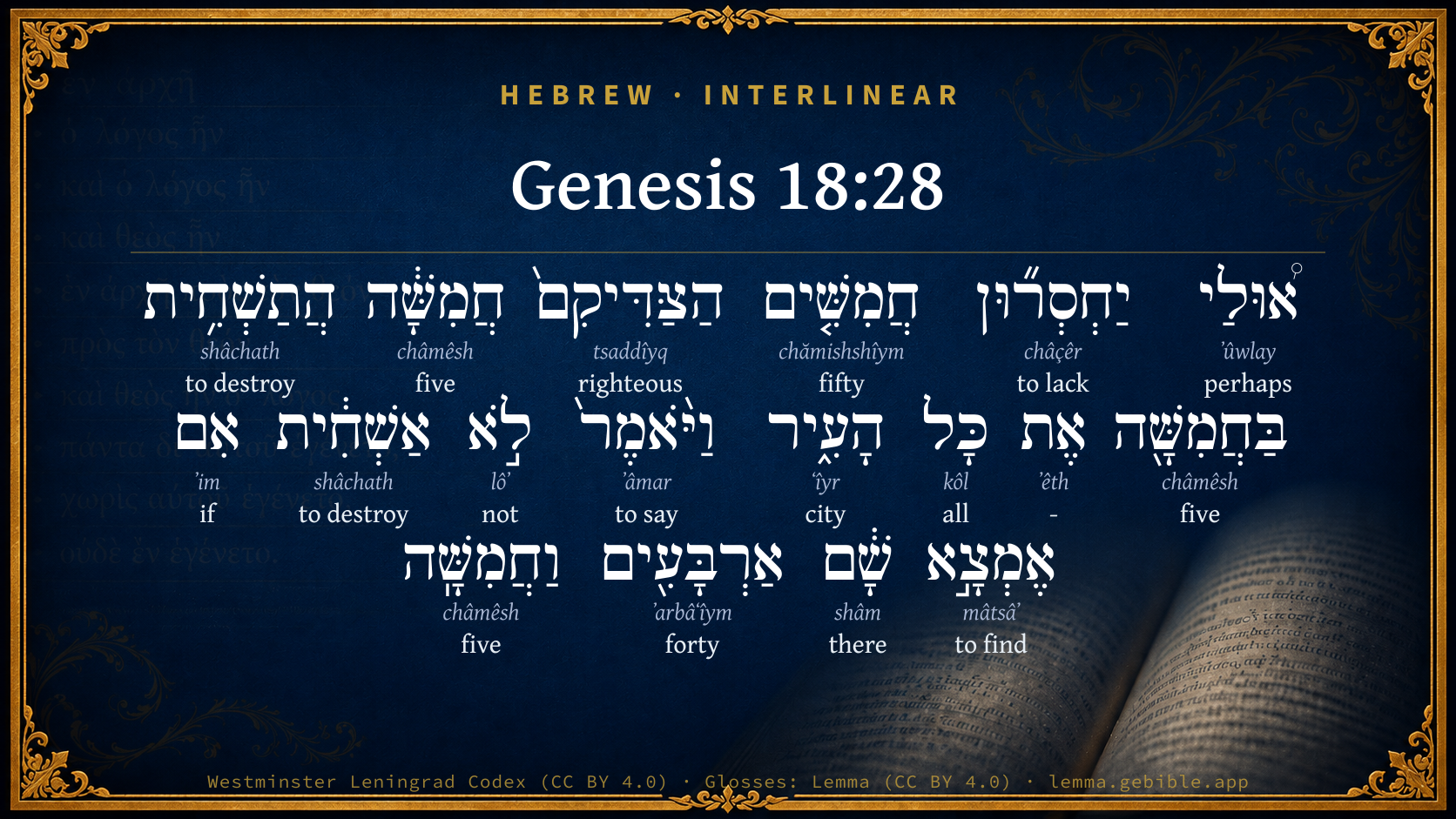
Genesis 18:28

Hebrew (Westminster Leningrad Codex) Genesis 18:28 appears in the Hebrew Old Testament. The text above is from the Westminster Leningrad Codex. Each word links to its Strong’s number, a concise gloss, and parsing drawn from the Open Scriptures Hebrew Bible morphology. Click any word for its full Brown-Driver-Briggs (BDB) entry.
Download image
Cite this verse

Genesis 18:28 (World English Bible). Public Domain. Lemma interlinear Bible study tool, https://lemma.gebible.app/v/genesis/18/28.

Show BibTeX & RIS
BibTeX
RIS
English Translation
What if there will lack five of the fifty righteous? Will you destroy all the city for lack of five?" He said, "I will not destroy it, if I find forty-five there."
World English Bible · Public Domain
Download a study sheet

One document with this verse’s original text, its word-by-word gloss line, the meaning frame, cross-references with their text, attributed commentary, and full source and license credits — printable, and it pastes into notes with its structure intact.

This verse Autodidact and up

Study sheet (.html) Plain text (.txt)

A passage Seminary Student

Up to 50 verses in one chapter. A passage sheet keeps up to 6 commentary sources and 12 cross-references per verse, in the order this page ranks them, and says so on the sheet whenever that leaves anything out. Ask for a single verse and you get the Autodidact verse sheet above.

Everything on this page stays free to read, with no account — the sheet is a download of what is already on screen, not access to it.

Want to remove ads? Support Godless Engineer
Compare translations 3

The same verse in 3 English versions, stacked beneath the original-language interlinear above. Click any original word for its lexicon entry.

Each is an independent rendering of the whole verse — the interlinear is not word-aligned to these translations.

Highlighted words mark where these versions differ — a whole-verse word diff, not a word-by-word alignment.

  • World English Bible Public Domain
    What if there will lack five of the fifty righteous? Will you destroy all the city for lack of five?" He said, "I will not destroy it, if I find forty-five there."
  • King James Version Public Domain
    Peradventure there shall lack five of the fifty righteous: wilt thou destroy all the city for lack of five? And he said, If I find there forty and five, I will not destroy it.
  • unfoldingWord Literal Text CC BY-SA 4.0
    Suppose the fifty righteous lack five? Will you destroy the whole city because of five?” And he said, “I will not destroy it if I find forty-five there.”

unfoldingWord Literal Text — © unfoldingWord, licensed CC BY-SA 4.0. Word-aligned USFM3 via Door43 (git.door43.org/unfoldingWord/en_ult).

Versions to compare (up to 4)

3 of 4 selected

Show all 18 translations

Every available English version of this verse, each an independent rendering of the whole verse.

  • World English Bible Public Domain
    What if there will lack five of the fifty righteous? Will you destroy all the city for lack of five?" He said, "I will not destroy it, if I find forty-five there."
  • Berean Standard Bible Public Domain
    suppose the fifty righteous ones lack five. Will You destroy the whole city for the lack of five?” He replied, “If I find forty-five there, I will not destroy it.”
  • Majority Standard Bible Public Domain
    suppose the fifty righteous ones lack five. Will You destroy the whole city for the lack of five?” He replied, “If I find forty-five there, I will not destroy it.”
  • King James Version Public Domain
    Peradventure there shall lack five of the fifty righteous: wilt thou destroy all the city for lack of five? And he said, If I find there forty and five, I will not destroy it.
  • American Standard Version (1901) Public Domain
    peradventure there shall lack five of the fifty righteous: wilt thou destroy all the city for lack of five? And he said, I will not destroy it, if I find there forty and five.
  • Revised Version (1885) Public Domain
    peradventure there shall lack five of the fifty righteous: wilt thou destroy all the city for lack of five? And he said, I will not destroy it, if I find there forty and five.
  • Geneva Bible (1599) Public Domain
    If there shall lacke fiue of fiftie righteous, wilt thou destroy all the citie for fiue? And he saide, If I finde there fiue and fourtie, I will not destroy it.
  • Douay-Rheims (1899) Public Domain
    And Abraham answered, and said: Seeing I have once begun, I will speak to my Lord, whereas I am dust and ashes.
  • Young's Literal Translation Public Domain
    peradventure there are lacking five of the fifty righteous -- dost Thou destroy for five the whole of the city?' and He saith, `I destroy `it' not, if I find there forty and five.'
  • Literal Standard Version CC BY-SA 4.0
    perhaps there are lacking five of the fifty righteous—do You destroy for five the whole of the city?” And He says, “I do not destroy [it], if I find there forty-five.”
  • Unlocked Literal Bible CC BY-SA 4.0
    What if there are five less than fifty righteous? Will you destroy the whole city for lack of five?” Then he said, “I will not destroy it, if I find there forty-five.”
  • unfoldingWord Literal Text CC BY-SA 4.0
    Suppose the fifty righteous lack five? Will you destroy the whole city because of five?” And he said, “I will not destroy it if I find forty-five there.”
  • Darby Bible Public Domain
    Perhaps there may want five of the fifty righteous: wilt thou destroy all the city on account of the five? And he said, If I shall find forty-five there, I will not destroy [it].
  • World Messianic Bible Public Domain
    What if there will lack five of the fifty righteous? Will you destroy all the city for lack of five?” He said, “I will not destroy it if I find forty-five there.”
  • Webster's Bible Public Domain
    Peradventure there will lack five of the fifty righteous: wilt thou destroy all the city for lack of five? And he said, If I find there forty and five, I will not destroy it.
  • Free Bible Version CC BY-SA 4.0
    “What if there are forty-five good people, just five less? Are you still going to wipe out the whole town just because there are five fewer people?” “I won't destroy it if I find forty-five,” the Lord replied.
  • Bible in Basic English Public Domain
    If by chance there are five less than fifty upright men, will you give up all the town to destruction because of these five? And he said, I will not give it to destruction if there are forty-five.
  • JPS Tanakh (1917) Public Domain
    Peradventure there shall lack five of the fifty righteous; wilt Thou destroy all the city for lack of five?' And He said: 'I will not destroy it, if I find there forty and five.'

Literal Standard Version (2020), Covenant Press — licensed CC BY-SA 4.0. Text via the HelloAO Bible API (eBible.org). Unlocked Literal Bible (unfoldingWord) — licensed CC BY-SA 4.0. Text via the HelloAO Bible API (eBible.org). unfoldingWord Literal Text — © unfoldingWord, licensed CC BY-SA 4.0. Word-aligned USFM3 via Door43 (git.door43.org/unfoldingWord/en_ult). Free Bible Version, Dr. Jonathan Gallagher — licensed CC BY-SA 4.0. Text via the HelloAO Bible API (eBible.org).

Word by word

More ways to search: Search by grammar → Find every occurrence → Compare this word →

Practice this passage: Drill this verse → Learn its vocabulary →

יַחְסְר֞וּן
châçêr
H2637
“to lack”
Verb, Qal, Imperfect, 3rd Person, Masculine, Plural + Suffix, n
Part of Speech
Verb
Stem
Qal
Form
Imperfect
Person
3rd Person
Gender
Masculine
Number
Plural
Full BDB Definition

Origin: a primitive root

TWOT: 705

to lack, be without, decrease, be lacking, have a need - (Qal) - to lack - to be lacking - to diminish, decrease - (Piel) to cause to lack - (Hiphil) to cause to be lacking
  1. א֠וּלַי ʼûwlay H194 “perhaps” Adverb
  2. חֲמִשִּׁ֤ים chămishshîym H2572 “fifty” Adjective, Cardinal number, Both, Plural, Absolute
  3. הַצַּדִּיקִם֙ tsaddîyq H6662 “the · righteous” Particle, Definite Article + Adjective, Adjective, Masculine, Plural, Absolute
  4. חֲמִשָּׁ֔ה châmêsh H2568 “five” Adjective, Cardinal number, Masculine, Singular, Absolute
  5. הֲתַשְׁחִ֥ית shâchath H7843 “to destroy” Particle, Interrogative + Verb, Hiphil, Imperfect, 2nd Person, Masculine, Singular
  6. בַּחֲמִשָּׁ֖ה châmêsh H2568 “in/at the · five” Preposition, Determined + Adjective, Cardinal number, Masculine, Singular, Absolute
  7. אֶת ʼêth H853 “-” Particle, Direct Object
  8. כָּל kôl H3605 “all of” Noun, Common, Masculine, Singular, Construct
  9. הָעִ֑יר ʻîyr H5892 “the · city” Particle, Definite Article + Noun, Common, Feminine, Singular, Absolute
  10. וַיֹּ֨אמֶר֙ ʼâmar H559 “and · to say” Conjunction + Verb, Qal, Sequential Imperfect, 3rd Person, Masculine, Singular
  11. לֹ֣א lôʼ H3808 “not” Particle, Negative
  12. אַשְׁחִ֔ית shâchath H7843 “to destroy” Verb, Hiphil, Imperfect, 1st Person, Common, Singular
  13. אִם ʼim H518 “if” Conjunction
  14. אֶמְצָ֣א mâtsâʼ H4672 “to find” Verb, Qal, Imperfect, 1st Person, Common, Singular
  15. שָׁ֔ם shâm H8033 “there” Adverb
  16. אַרְבָּעִ֖ים ʼarbâʻîym H705 “forty” Adjective, Cardinal number, Both, Plural, Absolute
  17. וַחֲמִשָּֽׁה châmêsh H2568 “and · five” Conjunction + Adjective, Cardinal number, Masculine, Singular, Absolute

About this verse

These counts appear in no published source. They are computed here, from the morphology-tagged text and Lemma’s own curated glosses. What Lemma adds →

18
words
15
distinct lemmas
Pentateuch
section

Notable vocabulary

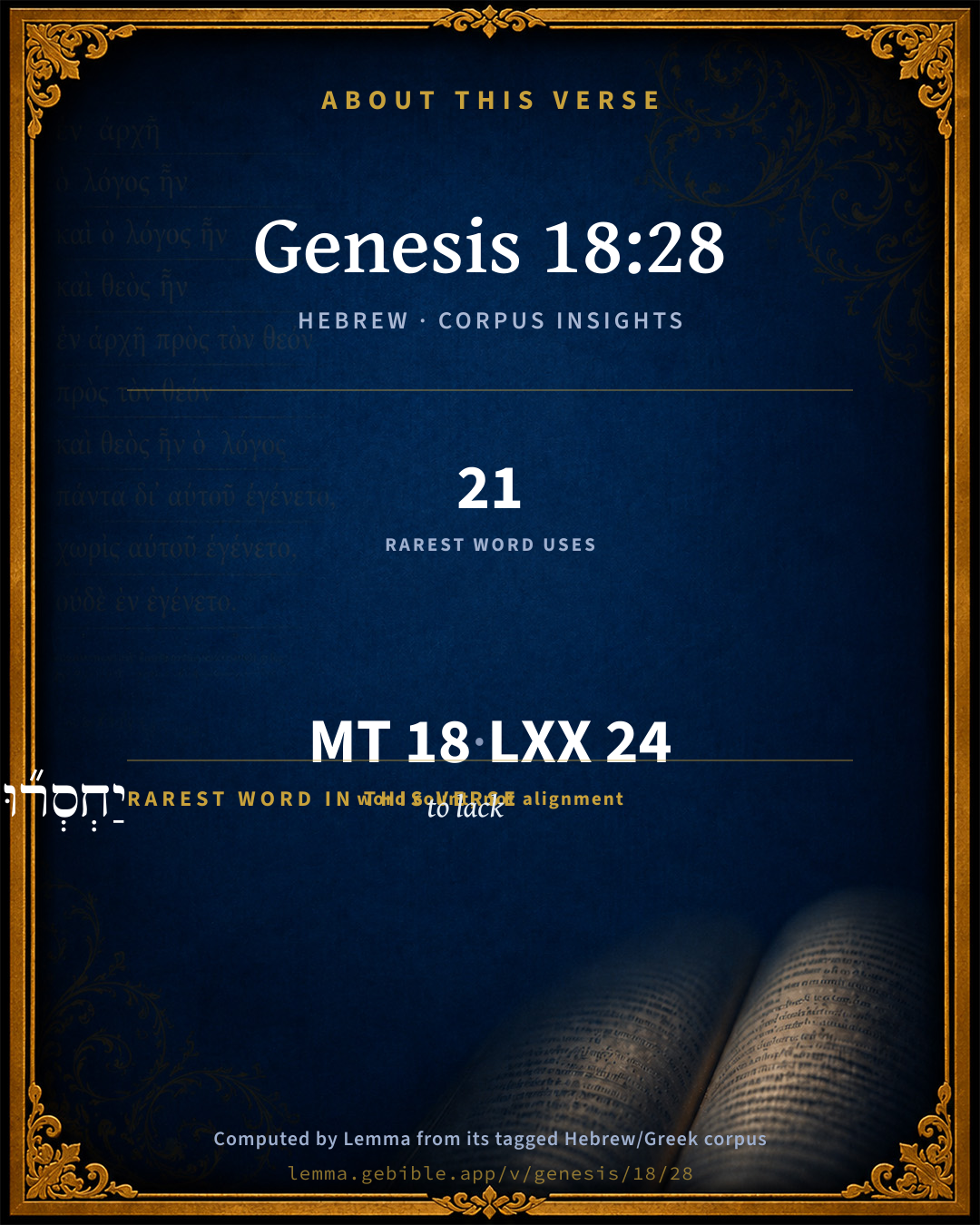
The rarest word here is יַחְסְר֞וּן to lack H2637 — appearing just 21 times in the whole Hebrew Bible.

Shared distinctive vocabulary

יַחְסְר֞וּן to lack H2637 occurs in 21 verses of the Hebrew Bible. Also found in:

Grammatical profile

  • 5 verbs
  • 2 nouns
  • 6 adjectives
  • 1 conjunction
  • 2 adverbs
  • 2 particles

Verb forms

  • יַחְסְר֞וּן Qal · Imperfect
  • הֲתַשְׁחִ֥ית Hiphil · Imperfect
  • וַיֹּ֨אמֶר֙ Qal · Sequential Imperfect
  • אַשְׁחִ֔ית Hiphil · Imperfect
  • אֶמְצָ֣א Qal · Imperfect

Repetition

Words recur within this verse — often emphatic in Hebrew:

  • חֲמִשָּׁ֔ה five H2568 ×3
  • הֲתַשְׁחִ֥ית to destroy H7843 ×2

Hebrew & Septuagint length

In English translation the verse runs 32 words from the Hebrew and 35 from the Septuagint (LXX English) — closely comparable.

A rough comparison of the two English renderings, which tokenize alike — not a word-level alignment.

Word counts can differ between the Hebrew and the Greek without any difference in meaning — e.g. the Hebrew direct-object marker אֵת has no separate Greek word, and Greek often adds the article ὁ.

In the original languages it is 18 Hebrew tokens and 24 Greek tokens — but the two are counted differently (Hebrew bundles its prefixes and suffixes into one token; the Greek is in lemma form), so that isn’t a like-for-like length.

Cross-references

5

Topical passages linked to Genesis 18:28 in the Treasury of Scripture Knowledge — connected by theme and wording, ordered by reader-vote popularity; previews shown in the World English Bible.

  • Genesis 18:26 Yahweh said, "If I find in Sodom fifty righteous within the city, then I will spare all the place for their sake."
  • Genesis 18:29 He spoke to him yet again, and said, "What if there are forty found there?" He said, "I will not do it for the forty's sake."
  • Numbers 14:17–19 Now please let the power of the Lord be great, according as you have spoken, saying,
  • 1 Kings 20:32–33 So they girded sackcloth on their loins, and [put] ropes on their heads, and came to the king of Israel, and said, Your servant Ben Hadad says, please let me live. He said, Is he yet alive? he is my brother.
  • Job 23:3–4 Oh that I knew where I might find him! That I might come even to his seat!

Cross-references courtesy of OpenBible.info (CC BY 4.0).

Hebrew and Greek witnesses Masoretic Hebrew ↔ Greek Septuagint

The same verse in the two great witnesses to the Old Testament, shown verse-for-verse.

These are two independent witnesses, not word-aligned to each other, and the Septuagint is shown in lemma (dictionary) form.

Hebrew Genesis 18:28 Masoretic · Westminster Leningrad Codex

א֠וּלַי יַחְסְר֞וּן חֲמִשִּׁ֤ים הַצַּדִּיקִם֙ חֲמִשָּׁ֔ה הֲתַשְׁחִ֥ית בַּחֲמִשָּׁ֖ה אֶת כָּל הָעִ֑יר וַיֹּ֨אמֶר֙ לֹ֣א אַשְׁחִ֔ית אִם אֶמְצָ֣א שָׁ֔ם אַרְבָּעִ֖ים וַחֲמִשָּֽׁה

What if there will lack five of the fifty righteous? Will you destroy all the city for lack of five?" He said, "I will not destroy it, if I find forty-five there."

World English Bible · Public Domain

Greek LXX Genesis 18:28 Septuagint · lemma form

ἐάν δέ ἐλαττονόω ὁ πεντήκοντα δίκαιος πέντε ἀποὀλλύω ἕνεκεν ὁ πέντε πᾶς ὁ πόλις καί εἶπον οὐ μή ἀποὀλλύω ἐάν εὑρίσκω ἐκεῖ τεσσαράκοντα πέντε

But if the fifty righteous should be diminished to forty-five, will you destroy the whole city because of the five lacking? And he said, I will not destroy it, if I should find there forty-five.

LXX2012 (modern English Septuagint) · Public Domain

Hebrew: Westminster Leningrad Codex (CC BY 4.0). Greek: Septuagint (public domain); English from LXX2012 (modern English Septuagint) (Public Domain). How the Septuagint differs from the Hebrew →

Targum (Aramaic paraphrase)

2

The Targum is the ancient Jewish Aramaic paraphrase of the Hebrew Scriptures — an interpretive translation, not the Hebrew text itself. Onkelos (literal) and Pseudo-Jonathan (expansive) render the Torah, and Jonathan the Prophets. Coverage is partial: where no permissively-licensed English translation exists for a verse, only the Aramaic is shown. This is verse-level text, not a word-by-word alignment to the Hebrew.

  1. Targum Onkelos Torah (Genesis–Deuteronomy)
    מָאִים יַחְסְרוּן חַמְשִׁין זַכָּאִין חַמְשָׁא הַתְחַבֵּל בְּחַמְשָׁא יָת כָּל קַרְתָּא וַאֲמַר לָא אֲחַבֵּל אִם אַשְׁכַּח תַּמָּן אַרְבְּעִין וְחַמְשָׁא

    (no public-domain English translation for this verse)

    Targum Onkelos — Aramaic: “Onkelos Genesis” (public domain); “Onkelos Exodus” (public domain); “Onkelos Leviticus” (public domain); “Onkelos Numbers” (public domain); “Onkelos Deuteronomy” (public domain). English: “Sefaria Community Translation” (CC0 1.0 (public-domain dedication)); “J.W. Etheridge. The Targums of Onkelos and Jonathan Ben Uzziel on the Pentateuch. London: Longmans, Green, 1862” (public domain). Text via Sefaria.

  2. Targum Pseudo-Jonathan Torah (Genesis–Deuteronomy)
    מָאִים חַסְרִין מִן חַמְשִׁין זַכָּאִין חַמְשָׁא הֲתַחֲבֵּל בְּגִין חַמְשָׁא דְחַסְרִין לְזוֹעֵר יַת כָּל קַרְתָּא וַאֲמַר לָא אֵיחַבֵּל אִין אַשְׁכַּח תַּמָן אַרְבְּעִין וְחַמְשָׁא

    Perhaps of the fifty innocent persons, five may be wanting. On account of the five who may be wanting to Zoar, wilt Thou destroy the whole city? And He said, I will not destroy it, if I find there forty and five.

    Targum Pseudo-Jonathan — Aramaic: “Targum Jonathan on Genesis” (public domain); “Targum Jonathan on Exodus” (public domain); “Targum Jonathan on Leviticus” (public domain); “Targum Jonathan on Numbers” (public domain); “Targum Jonathan on Deuteronomy” (public domain). English: “The Targum of Jonathan ben Uzziel, trans. J. W. Etheridge, London, 1862” (public domain). Text via Sefaria.

Commentary

Notes on Genesis 18:28 from classic Christian and Jewish commentators (each source and its license shown beneath its notes). The classic Christian expositions comment on the surrounding passage and are grouped to its opening verse, so a note may address several verses; the Jewish commentaries on the Tanakh (Rashi and others) are per-verse, so they appear only where the commentator wrote on this verse.

Lemma curates 59 commentaries, every one of them public domain or Creative Commons licensed, each selected and text-cleaned for this edition rather than reprinted as found. About our sources →

Trapp's Complete Commentary

John Trapp

Gen 18:28 Peradventure there shall lack five of the fifty righteous: wilt thou destroy all the city for [lack of] five? And he said, If I find there forty and five, I will not destroy [it].

Ver. 28. Peradventure, &c.] {See Trapp on "Gen 18:29"} {See Trapp on "Gen 18:30"}

John Trapp, A Commentary or Exposition upon All the Books of the Old and New Testament (1647–1656) — public domain. Text from a community e-Sword module.

John Gill's Exposition

Peradventure there should lack five of the fifty righteous,.... Or there should be but forty five; for Abraham perceived, by the Lord's answer, that there were not fifty righteous persons in the place:

wilt thou destroy all the city for lack of five? Abraham proceeds gradually in his requests, and does not ask too much at once, lest he should not succeed:

and he said, if l find there forty and five, I will not destroy it; that is, forty five righteous persons.

John Gill's Exposition of the Whole Bible (1746–1763) — public domain (CC PDM 1.0). Text via the HelloAO Bible API.

Matthew Poole's English Annotations

Lack of five, Heb. for five, or because of five, to wit, which are lacking or wanting. The same supplement we have also Psa 119:24; Lam 4:9.

Matthew Poole's English Annotations on the Holy Bible (1683–1685) — public domain. Text from a community e-Sword/MySword module.

Whedon's Commentary on the Bible

Daniel D. Whedon

28. There shall lack five — First he drops to forty-five; then to forty; then to thirty; then to twenty; and finally to ten. Conant observes on this whole passage that it has “no parallel, even in sacred history. With earnestness, but with unaffected humility, devout courtesy, and a reverent freedom, the patriarch presses his suit on behalf of the few righteous men in Sodom. On the other hand, Jehovah receives the intercession of his servant graciously, and admits the reasonableness of his plea by granting all that he desires. There is a beautiful aptness in the turn given to the first plea for a slight abatement of this number; ‘Wilt thou for five destroy the whole city?’ The whole passage is singularly felicitous and beautiful, in conception and expression.”

Daniel D. Whedon (gen. ed.), Commentary on the Old and New Testaments (1874–1909) — public domain. Text from a community e-Sword module.

The Pulpit Commentary

Peradventure there shall lack five of the fifty righteous: wilt thou destroy all the city for lack of five? Literally, on account of five, i.e. because they are wanting. A rare example of holy ingenuity in prayer. Abraham, instead of pleading for the city"s safety on account of forty-five, deprecates its destruction on account of five. And its said, If I find there forty and five, I will not destroy it.

The Pulpit Commentary (1880–1919), ed. H.D.M. Spence-Jones & Joseph S. Exell — public domain. Text from a community e-Sword module.

Rashi

Rabbi Shlomo Yitzchaki (Rashi)

התשחית בחמשה WILT THOU DESTROY ON ACCOUNT OF THE FIVE — Will there not still be nine for each city, and You, the All-Righteous One of the Universe, can be counted with them to make up the original number of ten! (Genesis Rabbah 49:9).

Rashi on the Tanakh — English translations: “The Judaica Press complete Tanach with Rashi, translated by A. J. Rosenberg” (CC BY 4.0); “Pentateuch with Rashi's commentary by M. Rosenbaum and A.M. Silbermann, 1929-1934” (public domain); “The Metsudah Tanach series, Lakewood, N.J” (CC BY 4.0); and “The Book of Joshua, Metsudah Publications, 1997” (CC BY 4.0). Text via Sefaria.

Ramban (Nachmanides)

Rabbi Moshe ben Nachman (Ramban / Nachmanides)

I WILL NOT DESTROY IT IF I FIND THERE. He assured him that He would not destroy it if that number of righteous men will be found there. And He did not tell him, “Know that there is not such a number there as you said,” since their trial had not been completed, just as He said, I will go down now, and see. Now Abraham did not know what would be done to them. Therefore, he rose early in the morning and looked towards Sodom, and upon seeing that they were destroyed, he knew that the required number of righteous men had not been there.

Ramban (Nachmanides) on the Tanakh — English translation: “Commentary on the Torah by Ramban (Nachmanides). Translated and annotated by Charles B. Chavel. New York, Shilo Pub. House, 1971-1976” (CC BY 4.0). Text via Sefaria.

Radak

Rabbi David Kimhi (Radak)

אולי יחסרון, if there are 5 righteous people missing from the 50 righteous people of whom I said that their presence should serve to save the city at this time, are You going to going to destroy the earth (surrounding these towns) and not forgive the place on account of the 45 righteous people that live there?”

Radak on the Tanakh — English translations: “Sefaria Community Translation” (CC0 1.0 (public-domain dedication)); “Eliyahu Munk, HaChut Hameshulash” (CC BY 4.0); “Rabbi Mike Feuer, Jerusalem Anthology” (CC BY 4.0); and “R. David Kimhi on the first book of Psalms, Translated by R.G. Finch, London, 1919” (public domain). Text via Sefaria.

Lesson kit

Teaching starters — assembled from the data on this page, not authored interpretation. Every prompt links to the verse data it draws on. Edit before teaching.

Genesis, in the Pentateuch, opens this verse with 18 words (15 distinct Hebrew lemmas). Its most distinctive word is châçêr (“to lack”). A historical commentator’s framing appears above. Read the whole chapter for the surrounding context.

Discussion questions

  1. How does “to lack” (châçêr) shape what this verse is saying?
  2. How does Genesis 8:3, which shares the word «to lack», read alongside this verse?
  3. What does the repetition of “five” (3× in this one verse) do in this verse?
  4. These translations render this verse differently; the difference is in the English rendering, not the original. What questions does that raise?
  5. «יַחְסְר֞וּן» is a Qal Imperfect verb. How does that grammatical form shape the action described?
  6. Compare how Trapp's Complete Commentary and John Gill's Exposition read this verse. Where do they agree or differ?

Things to notice

Reading settings

Reading text

Shown beneath each verse's original-language words.

Old Testament
Old Testament edition

Read the OT as the Masoretic Hebrew (MT) or the Greek Septuagint (LXX).

English shown for the Greek Septuagint (in the Hebrew ↔ Greek comparison).

Comparing translations? Open the Compare panel on any verse page to stack up to four side by side.