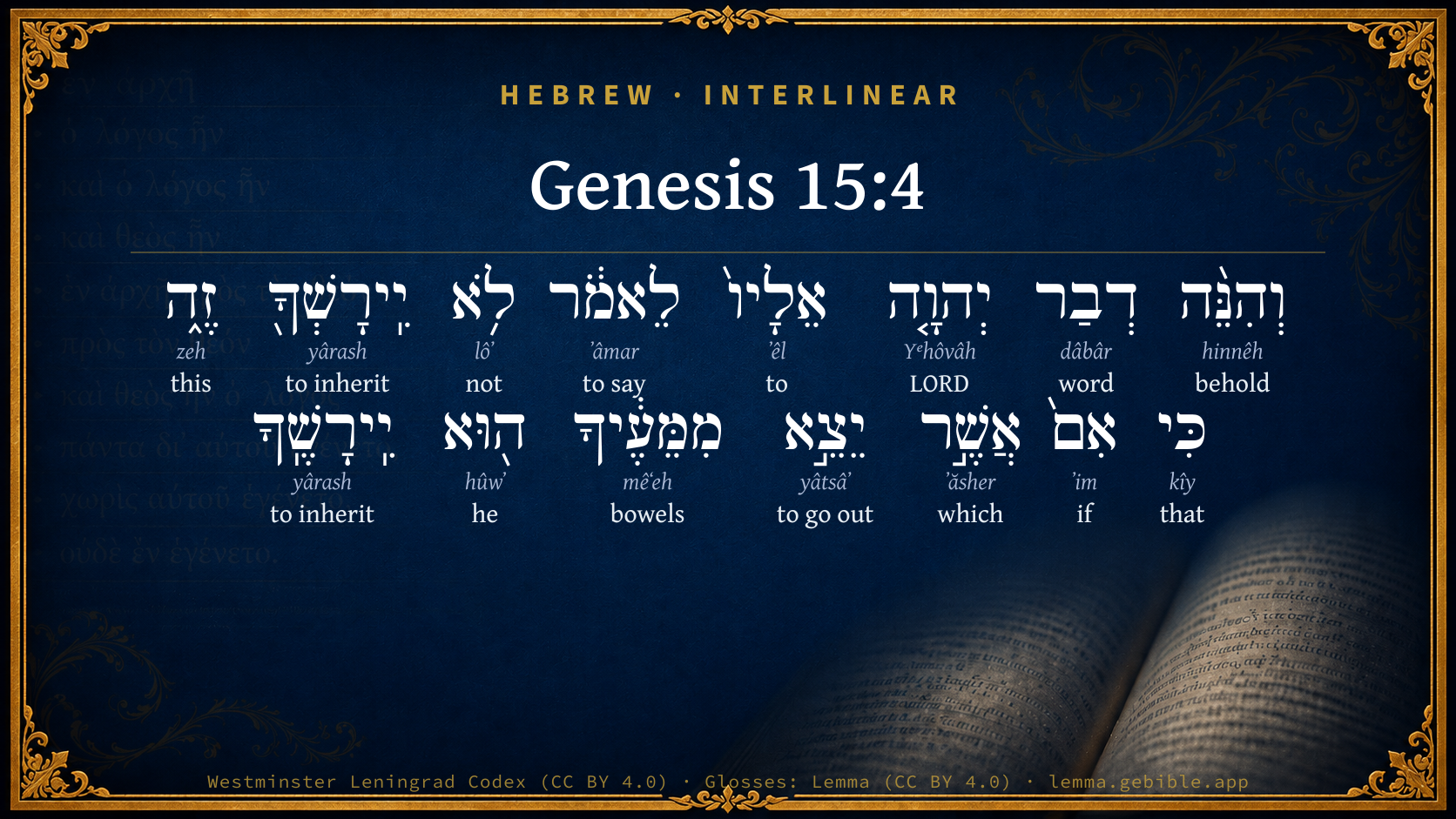
Genesis 15:4

Hebrew (Westminster Leningrad Codex) Genesis 15:4 appears in the Hebrew Old Testament. The text above is from the Westminster Leningrad Codex. Each word links to its Strong’s number, a concise gloss, and parsing drawn from the Open Scriptures Hebrew Bible morphology. Click any word for its full Brown-Driver-Briggs (BDB) entry.
Download image
Cite this verse

Genesis 15:4 (World English Bible). Public Domain. Lemma interlinear Bible study tool, https://lemma.gebible.app/v/genesis/15/4.

Show BibTeX & RIS
BibTeX
RIS
English Translation
Behold, the word of Yahweh came to him, saying, "This man will not be your heir, but he who will come forth out of your own body will be your heir."
World English Bible · Public Domain
Highlights
  • 1 first appearance in the Hebrew Bible
Full analysis ↓
Download a study sheet

One document with this verse’s original text, its word-by-word gloss line, the meaning frame, cross-references with their text, attributed commentary, and full source and license credits — printable, and it pastes into notes with its structure intact.

This verse Autodidact and up

Study sheet (.html) Plain text (.txt)

A passage Seminary Student

Up to 50 verses in one chapter. A passage sheet keeps up to 6 commentary sources and 12 cross-references per verse, in the order this page ranks them, and says so on the sheet whenever that leaves anything out. Ask for a single verse and you get the Autodidact verse sheet above.

Everything on this page stays free to read, with no account — the sheet is a download of what is already on screen, not access to it.

Want to remove ads? Support Godless Engineer
Compare translations 3

The same verse in 3 English versions, stacked beneath the original-language interlinear above. Click any original word for its lexicon entry.

Each is an independent rendering of the whole verse — the interlinear is not word-aligned to these translations.

Highlighted words mark where these versions differ — a whole-verse word diff, not a word-by-word alignment.

  • World English Bible Public Domain
    Behold, the word of Yahweh came to him, saying, "This man will not be your heir, but he who will come forth out of your own body will be your heir."
  • King James Version Public Domain
    And, behold, the word of the LORD came unto him, saying, This shall not be thine heir; but he that shall come forth out of thine own bowels shall be thine heir.
  • unfoldingWord Literal Text CC BY-SA 4.0
    Then behold, the word of Yahweh to him, saying, “That will not be your heir, but rather a son who comes from your bowels, he will be your heir.”

unfoldingWord Literal Text — © unfoldingWord, licensed CC BY-SA 4.0. Word-aligned USFM3 via Door43 (git.door43.org/unfoldingWord/en_ult).

Versions to compare (up to 4)

3 of 4 selected

Show all 18 translations

Every available English version of this verse, each an independent rendering of the whole verse.

  • World English Bible Public Domain
    Behold, the word of Yahweh came to him, saying, "This man will not be your heir, but he who will come forth out of your own body will be your heir."
  • Berean Standard Bible Public Domain
    Then the word of the LORD came to Abram, saying, “This one will not be your heir, but one who comes from your own body will be your heir.”
  • Majority Standard Bible Public Domain
    Then the word of the LORD came to Abram, saying, “This one will not be your heir, but one who comes from your own body will be your heir.”
  • King James Version Public Domain
    And, behold, the word of the LORD came unto him, saying, This shall not be thine heir; but he that shall come forth out of thine own bowels shall be thine heir.
  • American Standard Version (1901) Public Domain
    And, behold, the word of Jehovah came unto him, saying, This man shall not be thine heir; But he that shall come forth out of thine own bowels shall be thine heir.
  • Revised Version (1885) Public Domain
    And, behold, the word of the LORD came unto him, saying, This man shall not be thine heir; but he that shall come forth out of thine own bowels shall be thine heir.
  • Geneva Bible (1599) Public Domain
    Then beholde, the worde of the Lord came vnto him, saying, This man shall not be thine heire, but one that shall come out of thine owne bowels, he shalbe thine heire.
  • Douay-Rheims (1899) Public Domain
    And immediately the word of the Lord came to him, saying: He shall not be thy heir: but he that shall come out of thy bowels, him shalt thou have for thy heir.
  • Young's Literal Translation Public Domain
    And lo, the word of Jehovah `is' unto him, saying, `This `one' doth not heir thee; but he who cometh out from thy bowels, he doth heir thee;'
  • Literal Standard Version CC BY-SA 4.0
    And behold, the word of YHWH [is] to him, saying, “This [one] will not be your heir; but he who comes out from your bowels, he will be your heir”;
  • Unlocked Literal Bible CC BY-SA 4.0
    Then, behold, the word of Yahweh came to him, saying, “This man will not be your heir; but rather the one who will come from your own body will be your heir.”
  • unfoldingWord Literal Text CC BY-SA 4.0
    Then behold, the word of Yahweh to him, saying, “That will not be your heir, but rather a son who comes from your bowels, he will be your heir.”
  • Darby Bible Public Domain
    And behold, the word of Jehovah [came] to him, saying, This shall not be thine heir, but he that will come forth out of thy body shall be thine heir.
  • World Messianic Bible Public Domain
    Behold, the LORD’s word came to him, saying, “This man will not be your heir, but he who will come out of your own body will be your heir.”
  • Webster's Bible Public Domain
    And behold, the word of the LORD came to him, saying, This shall not be thy heir; but he that shall come forth out of thy own bowels shall be thy heir.
  • Free Bible Version CC BY-SA 4.0
    But then the Lord told him, “This man won't be your heir. Your heir will be your very own son.”
  • Bible in Basic English Public Domain
    Then said the Lord, This man will not get the heritage, but a son of your body will have your property after you.
  • JPS Tanakh (1917) Public Domain
    And, behold, the word of the LORD came unto him, saying: 'This man shall not be thine heir; but he that shall come forth out of thine own bowels shall be thine heir.'

Literal Standard Version (2020), Covenant Press — licensed CC BY-SA 4.0. Text via the HelloAO Bible API (eBible.org). Unlocked Literal Bible (unfoldingWord) — licensed CC BY-SA 4.0. Text via the HelloAO Bible API (eBible.org). unfoldingWord Literal Text — © unfoldingWord, licensed CC BY-SA 4.0. Word-aligned USFM3 via Door43 (git.door43.org/unfoldingWord/en_ult). Free Bible Version, Dr. Jonathan Gallagher — licensed CC BY-SA 4.0. Text via the HelloAO Bible API (eBible.org).

Word by word

More ways to search: Search by grammar → Find every occurrence → Compare this word →

Practice this passage: Drill this verse → Learn its vocabulary →

מִמֵּעֶ֔יךָ
mêʻeh
H4578
“from · bowels · your”
Preposition + Noun, Common, Masculine, Plural, Construct + Suffix, Personal, 2nd Person, Masculine, Singular
Part of Speech
Preposition + Noun
Type
Common
Gender
Masculine
Number
Plural
State
Construct
Full BDB Definition

Origin: from an unused root probably meaning to be soft

TWOT: 1227a

internal organs, inward parts, bowels, intestines, belly - inward parts - digestive organs - organs of procreation, womb - place of emotions or distress or love (figuratively) - external belly
  1. וְהִנֵּ֨ה hinnêh H2009 “and · behold” Conjunction + Particle, Demonstrative
  2. דְבַר dâbâr H1697 “word of” Noun, Common, Masculine, Singular, Construct
  3. יְהוָ֤ה Yᵉhôvâh H3068 “LORD” Noun, Proper
  4. אֵלָיו֙ ʼêl H413 “to · him” Preposition + Suffix, Personal, 3rd Person, Masculine, Singular
  5. לֵאמֹ֔ר ʼâmar H559 “to say” Preposition + Verb, Qal, Infinitive Construct
  6. לֹ֥א lôʼ H3808 “not” Particle, Negative
  7. יִֽירָשְׁךָ֖ yârash H3423 “to inherit · you” Verb, Qal, Imperfect, 3rd Person, Masculine, Singular + Suffix, Personal, 2nd Person, Masculine, Singular
  8. זֶ֑ה zeh H2088 “this” Pronoun, Demonstrative, Masculine, Singular
  9. כִּי kîy H3588 “that” Conjunction
  10. אִם֙ ʼim H518 “if” Conjunction
  11. אֲשֶׁ֣ר ʼăsher H834 “which” Particle, Relative
  12. יֵצֵ֣א yâtsâʼ H3318 “to go out” Verb, Qal, Imperfect, 3rd Person, Masculine, Singular
  13. ה֖וּא hûwʼ H1931 “he” Pronoun, Personal, 3rd Person, Masculine, Singular
  14. יִֽירָשֶֽׁךָ yârash H3423 “to inherit · you” Verb, Qal, Imperfect, 3rd Person, Masculine, Singular + Suffix, Personal, 2nd Person, Masculine, Singular

About this verse

These counts appear in no published source. They are computed here, from the morphology-tagged text and Lemma’s own curated glosses. What Lemma adds →

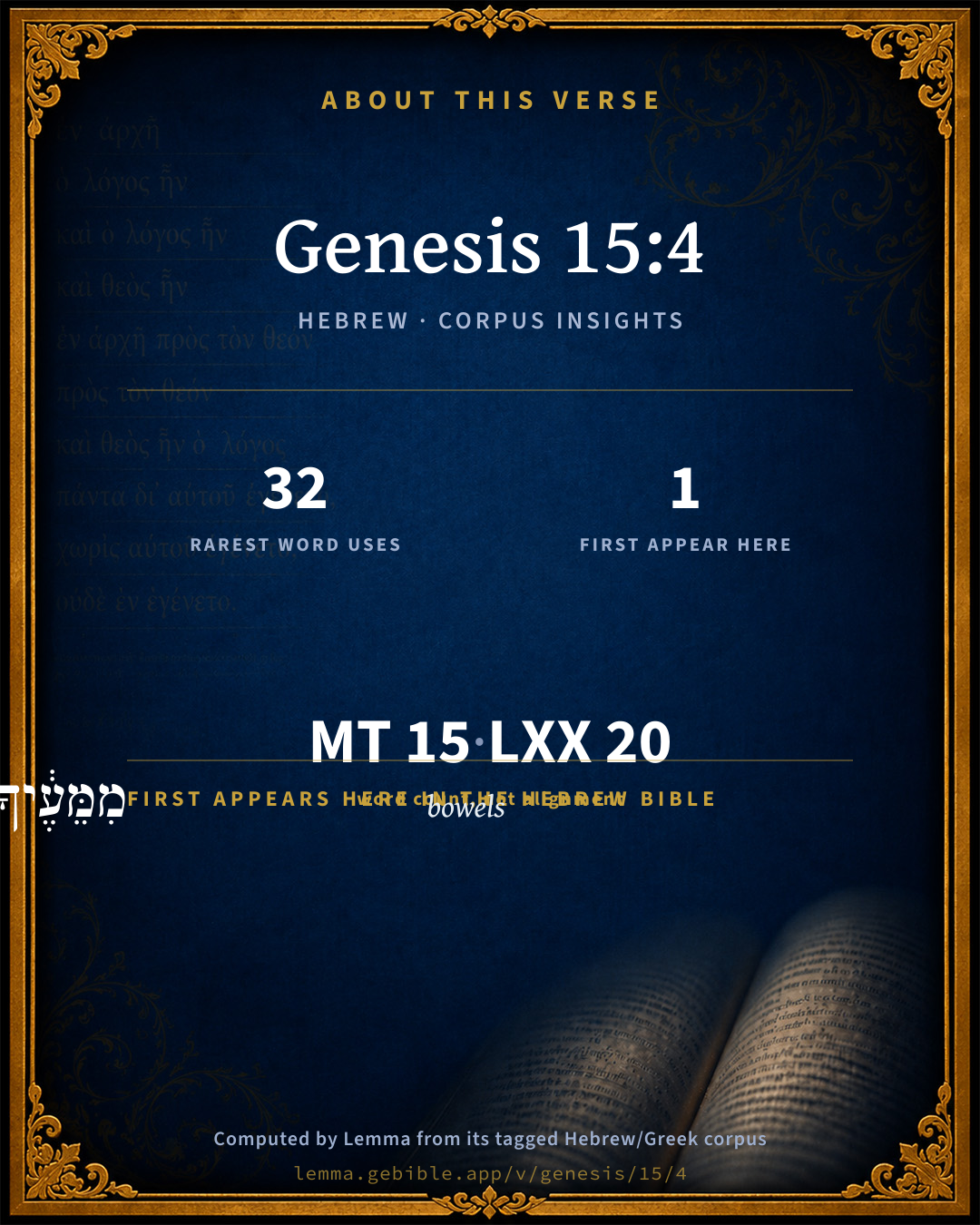
15
words
14
distinct lemmas
Pentateuch
section

First appearance in Scripture

This word makes its first canonical appearance in the Hebrew Bible here:

  • מִמֵּעֶ֔יךָ bowels H4578

Shared distinctive vocabulary

מִמֵּעֶ֔יךָ bowels H4578 occurs in 30 verses of the Hebrew Bible. Also found in:

Grammatical profile

  • 4 verbs
  • 3 nouns
  • 2 pronouns
  • 1 preposition
  • 2 conjunctions
  • 3 particles

Verb forms

  • לֵאמֹ֔ר Qal · Infinitive Construct
  • יִֽירָשְׁךָ֖ Qal · Imperfect
  • יֵצֵ֣א Qal · Imperfect
  • יִֽירָשֶֽׁךָ Qal · Imperfect

Repetition

A word recurs within this verse — often emphatic in Hebrew:

  • יִֽירָשְׁךָ֖ to inherit H3423 ×2

Hebrew & Septuagint length

In English translation the verse runs 31 words from the Hebrew and 30 from the Septuagint (LXX English) — closely comparable.

A rough comparison of the two English renderings, which tokenize alike — not a word-level alignment.

Word counts can differ between the Hebrew and the Greek without any difference in meaning — e.g. the Hebrew direct-object marker אֵת has no separate Greek word, and Greek often adds the article ὁ.

In the original languages it is 15 Hebrew tokens and 20 Greek tokens — but the two are counted differently (Hebrew bundles its prefixes and suffixes into one token; the Greek is in lemma form), so that isn’t a like-for-like length.

Cross-references

7

Topical passages linked to Genesis 15:4 in the Treasury of Scripture Knowledge — connected by theme and wording, ordered by reader-vote popularity; previews shown in the World English Bible.

  • Genesis 17:16 I will bless her, and moreover I will give you a son by her. Yes, I will bless her, and she will be a mother of nations. Kings of peoples will come from her."
  • 2 Samuel 7:12 When your days are fulfilled, and you shall sleep with your fathers, I will set up your seed after you, who shall proceed out of your bowels, and I will establish his kingdom.
  • Galatians 4:28 Now we, brothers, as Isaac was, are children of promise.
  • Genesis 21:12 God said to Abraham, "Don't let it be grievous in your sight because of the boy, and because of your handmaid. In all that Sarah says to you, listen to her voice. For from Isaac will your seed be called.
  • 2 Chronicles 32:21 Yahweh sent an angel, who cut off all the mighty men of valor, and the leaders and captains, in the camp of the king of Assyria. So he returned with shame of face to his own land. When he was come into the house of his god, those who came forth from his own bowels killed him there with the sword.
  • Philemon 1:12 I am sending him back. Therefore receive him, that is, my own heart,
  • 2 Samuel 16:11 David said to Abishai, and to all his servants, Behold, my son, who came forth from my bowels, seeks my life: how much more [may] this Benjamite now [do it]? let him alone, and let him curse; for Yahweh has invited him.

Cross-references courtesy of OpenBible.info (CC BY 4.0).

Hebrew and Greek witnesses Masoretic Hebrew ↔ Greek Septuagint

The same verse in the two great witnesses to the Old Testament, shown verse-for-verse.

These are two independent witnesses, not word-aligned to each other, and the Septuagint is shown in lemma (dictionary) form.

Hebrew Genesis 15:4 Masoretic · Westminster Leningrad Codex

וְהִנֵּ֨ה דְבַר יְהוָ֤ה אֵלָיו֙ לֵאמֹ֔ר לֹ֥א יִֽירָשְׁךָ֖ זֶ֑ה כִּי אִם֙ אֲשֶׁ֣ר יֵצֵ֣א מִמֵּעֶ֔יךָ ה֖וּא יִֽירָשֶֽׁךָ

Behold, the word of Yahweh came to him, saying, "This man will not be your heir, but he who will come forth out of your own body will be your heir."

World English Bible · Public Domain

Greek LXX Genesis 15:4 Septuagint · lemma form

καί εὐθύς φωνή κύριος γίγνομαι πρός αὐτός λέγω οὐ κληρονομέω σύ οὗτος ἀλλά ὅς ἐκἔρχομαι ἐκ σύ οὗτος κληρονομέω σύ

And immediately there was a voice of the Lord to him, saying, This shall not be your heir; but he that shall come out of you shall be your heir.

LXX2012 (modern English Septuagint) · Public Domain

Hebrew: Westminster Leningrad Codex (CC BY 4.0). Greek: Septuagint (public domain); English from LXX2012 (modern English Septuagint) (Public Domain). How the Septuagint differs from the Hebrew →

Targum (Aramaic paraphrase)

2

The Targum is the ancient Jewish Aramaic paraphrase of the Hebrew Scriptures — an interpretive translation, not the Hebrew text itself. Onkelos (literal) and Pseudo-Jonathan (expansive) render the Torah, and Jonathan the Prophets. Coverage is partial: where no permissively-licensed English translation exists for a verse, only the Aramaic is shown. This is verse-level text, not a word-by-word alignment to the Hebrew.

  1. Targum Onkelos Torah (Genesis–Deuteronomy)
    וְהָא פִּתְגָמָא דַיְיָ עִמֵהּ לְמֵימַר לָא יִרְתִינָךְ דֵין אֱלָהֵין בַּר דְתוֹלִיד הוּא יִרְתִינָךְ

    (no public-domain English translation for this verse)

    Targum Onkelos — Aramaic: “Onkelos Genesis” (public domain); “Onkelos Exodus” (public domain); “Onkelos Leviticus” (public domain); “Onkelos Numbers” (public domain); “Onkelos Deuteronomy” (public domain). English: “Sefaria Community Translation” (CC0 1.0 (public-domain dedication)); “J.W. Etheridge. The Targums of Onkelos and Jonathan Ben Uzziel on the Pentateuch. London: Longmans, Green, 1862” (public domain). Text via Sefaria.

  2. Targum Pseudo-Jonathan Torah (Genesis–Deuteronomy)
    וְהָא פִּתְגָמָא מִן קֳדָם יְיָ לֵיהּ לְמֵימַר לָא יַרְתִינָךְ דֵין אֱלָהֵין בַּר דְתוֹלִיד הוּא יַרְתִינָךְ

    And, behold, a word from before the Lord was to him, saying, He shall not be thine heir; but a son whom thou wilt beget shall be thy heir.

    Targum Pseudo-Jonathan — Aramaic: “Targum Jonathan on Genesis” (public domain); “Targum Jonathan on Exodus” (public domain); “Targum Jonathan on Leviticus” (public domain); “Targum Jonathan on Numbers” (public domain); “Targum Jonathan on Deuteronomy” (public domain). English: “The Targum of Jonathan ben Uzziel, trans. J. W. Etheridge, London, 1862” (public domain). Text via Sefaria.

Commentary

Notes on Genesis 15:4 from classic Christian and Jewish commentators (each source and its license shown beneath its notes). The classic Christian expositions comment on the surrounding passage and are grouped to its opening verse, so a note may address several verses; the Jewish commentaries on the Tanakh (Rashi and others) are per-verse, so they appear only where the commentator wrote on this verse.

Lemma curates 59 commentaries, every one of them public domain or Creative Commons licensed, each selected and text-cleaned for this edition rather than reprinted as found. About our sources →

Trapp's Complete Commentary

John Trapp

Gen 15:4 And, behold, the word of the LORD [came] unto him, saying, This shall not be thine heir; but he that shall come forth out of thine own bowels shall be thine heir.

Ver. 4. And, behold, the word of the Lord, &c.] Abram’s "Behold" of grief, is answered with God’s "Behold" of grace. The Greek rendereth it, "And straightway." God was straight at hand to help Abram’s infirmity, and to raise up his faith that began to flag and hang the wing, as the best faith will, if long put to it. Adeo nihil est in nobis magni, quod non queat minui .

John Trapp, A Commentary or Exposition upon All the Books of the Old and New Testament (1647–1656) — public domain. Text from a community e-Sword module.

Tyndale Open Study Notes

Tyndale Open Resources

15:4-6 God affirmed that the promise was for Abram’s own offspring and showed him the stars as a promise of the vast number of descendants that he would have (22:17; 26:4). Paul quotes this promise in Rom 4:18 to underscore the strength of Abram’s faith.

Tyndale Open Study Notes — © Tyndale Open Resources, licensed CC BY-SA 4.0. Text via the HelloAO Bible API.

Jamieson, Fausset & Brown

Robert Jamieson, A. R. Fausset & David Brown

This shall not be thine heir--To the first part of his address no reply was given; but having renewed it in a spirit of more becoming submission, "whereby shall I know that I shall inherit it" [Gen 15:8], he was delighted by a most explicit promise of Canaan, which was immediately confirmed by a remarkable ceremony.

Jamieson, Fausset & Brown — Commentary Critical and Explanatory on the Whole Bible (1871) — public domain (CC PDM 1.0). Text via the HelloAO Bible API.

John Calvin's Commentaries

4. This shall not be thine heir. We hence infer that God had approved the wish of Abram. Whence also follows the other point, that Abram had not been impelled by any carnal affection to offer up this prayer, but by a pious and holy desire of enjoying the benediction promised to him. For God not only promises him a seed, but a great people, who in number should equal the stars of heaven. They who expound the passage allegorically; implying that a heavenly seed was promised him which might be compared with the stars, may enjoy their own opinion: but we maintain what is more solid; namely, that the faith of Abram was increased by the sight of the stars. For the Lord, in order more deeply to affect his own people, and more efficaciously to penetrate their minds, after he here reached their ears by his word, also arrests their eyes by external symbols, that eyes and ears may consent together. Therefore the sight of the stars was not superfluous; but God intended to strike the mind of Abram with this thought, ‘He who by his word alone suddenly produced a host so numerous by which he might adorn the previously vast and desolate heaven; shall not He be able to replenish my desolate house with offspring?’ It is, however, not necessary to imagine a nocturnal vision, because the stars, which, during the day, escape our sight, would then appear; for since the whole was transacted in vision, Abram had a wonderful scene set before him, which would manifestly reveal hidden things to him. Therefore though he perhaps might not move a step, it was yet possible for him in vision to be led forth out of his tent. The question now occurs, concerning what seed the promise is to be understood. And it is certain that neither the posterity of Ishmael nor of Esau is to be taken into this account, because the legitimate seed is to be reckoned by the promise, which God determined should remain in Isaac and Jacob; yet the same doubt arises respecting the posterity of Jacob, because many who could trace their descent from him, according to the flesh, cut themselves off, as degenerate sons and aliens, from the faith of their fathers. I answer, that this term seed is, indiscriminately, extended to the whole people whole God has adopted to himself. But since many were alienated by their unbelief, we must come for information to Christ, who alone distinguishes true and genuine sons from such as are illegitimate. By pursuing this method, we find the posterity of Abram reduced to a small numbers that afterwards it may be the more increased. For in Christ the Gentiles also are gathered together, and are by faith ingrafted into the body of Abram, so as to have a place among his legitimate sons. Concerning which point more will be said in the seventeenth chapter Genesis 17:1

John Calvin's Commentaries (1540-1563) — public domain. Text from the Calvin Translation Society English edition (1840s-50s) via the Christian Classics Ethereal Library (ccel.org). Calvin's coverage is partial (roughly two-thirds of the Bible); uncommented books and verses are honest gaps, never fabricated. The 19th-century editor's footnotes and remarks are omitted so the notes are faithfully Calvin's own voice.

John Gill's Exposition

And behold, the word of the Lord came unto him,.... Either having disappeared, and then came a second time, or he again spoke unto him:

saying, this shall not be thine heir; this Eliezer, this servant of thine, as thou hast made him, or hast intended to make him, giving up all hopes of having issue by Sarai:

but he that shall come forth out of thine own bowels shall be thine heir; that is, one shall inherit all thou hast, that shall be begotten by thee; an own son of Abram's, and not a servant born in his house; one that should spring out of his own loins: the Vulgate Latin version renders it, "out of thy womb", that is, out of his wife's, which was his; the phrase designs a genuine and legitimate son of his, who would be legally his heir.

John Gill's Exposition of the Whole Bible (1746–1763) — public domain (CC PDM 1.0). Text via the HelloAO Bible API.

Matthew Poole's English Annotations

i.e. Out of thy own body: see Gen 35:11; 2Sa 7:12; 2Ch 6:9.

Matthew Poole's English Annotations on the Holy Bible (1683–1685) — public domain. Text from a community e-Sword/MySword module.

Whedon's Commentary on the Bible

Daniel D. Whedon

4. Behold — How vivid the revelation!

This shall not be thine heir — Such an express answer touching his heir was potent to quell all further doubt and fear.

Daniel D. Whedon (gen. ed.), Commentary on the Old and New Testaments (1874–1909) — public domain. Text from a community e-Sword module.

The Pulpit Commentary

And, behold, the word of the Lord came unto him, saying, This shall not be thine heir; but he that shall come forth out of thine own bowels shall be thine heir.

The Pulpit Commentary (1880–1919), ed. H.D.M. Spence-Jones & Joseph S. Exell — public domain. Text from a community e-Sword module.

unfoldingWord translationNotes

Door43 World Missions Community

Then, behold

The word "behold" emphasizes the fact that the word of Yahweh came to Abraham again.

the word of Yahweh came to him, saying, "This

The idiom "The word of Yahweh came to" is used to introduce a special message from God. See how you translated this idiom in Genesis 15:1. AT: "Yahweh gave him a message. He said, 'This" or "Yahweh spoke this message to him: 'This" (See: Idiom)

This man

This refers to Eliezer of Damascus.

the one who will come from your own body

"the one that you will father" or "your very own son." Abram's own son would become his heir.

number the stars

"count the stars"

So will your descendants be

Just as Abram would not be able to count all the stars, he would not be able to count all his descendants because there would be so many.

translationWords

word of God

heir

heaven

descend

unfoldingWord translationNotes — © Distant Shores Media and the Door43 World Missions Community, licensed CC BY-SA 4.0. Source: git.door43.org/Door43/en_tn.

Ramban (Nachmanides)

Rabbi Moshe ben Nachman (Ramban / Nachmanides)

AND, BEHOLD, THE WORD OF THE ETERNAL CAME UNTO HIM, SAYING: THIS MAN SHALL NOT BE THINE HEIR. Since Abraham had his son who would be his heir after his old age, the Eternal assured him only concerning the inheritance, i.e., that he should not worry, and his seed will inherit it.The meaning of the expression, And, behold, the word of the Eternal came unto him, is that while Abraham was still saying, And, lo, my household slave will be mine heir, the word of G-d suddenly came to him, saying This man shall not be thine heir.

Ramban (Nachmanides) on the Tanakh — English translation: “Commentary on the Torah by Ramban (Nachmanides). Translated and annotated by Charles B. Chavel. New York, Shilo Pub. House, 1971-1976” (CC BY 4.0). Text via Sefaria.

Radak

Rabbi David Kimhi (Radak)

'והנה דבר ה, now G’d’s word in response to his concern about who would inherit him, saying: לא יירשך זה, this loyal servant of yours will not inherit you, כי אם אשר יצא ממעיך, do not err in your understanding of the meaning of the words לך ולזרעך, “to you and to your descendants,” I only referred to your biological; offspring. The word מעיים refers to all the organs within the body, in this instance referring to the reproductive organ. The word is used in a similar sense in Isaiah 48,19 וצאצאי מעיך, “your offspring.”

Radak on the Tanakh — English translations: “Sefaria Community Translation” (CC0 1.0 (public-domain dedication)); “Eliyahu Munk, HaChut Hameshulash” (CC BY 4.0); “Rabbi Mike Feuer, Jerusalem Anthology” (CC BY 4.0); and “R. David Kimhi on the first book of Psalms, Translated by R.G. Finch, London, 1919” (public domain). Text via Sefaria.

Lesson kit

Teaching starters — assembled from the data on this page, not authored interpretation. Every prompt links to the verse data it draws on. Edit before teaching.

Genesis, in the Pentateuch, opens this verse with 15 words (14 distinct Hebrew lemmas). Its most distinctive word is mêʻeh (“bowels”). A historical commentator’s framing appears above. Read the whole chapter for the surrounding context.

Discussion questions

  1. The word mêʻeh carries the sense “bowels.” How does it shape the verse?
  2. The word “bowels” first appears here in Scripture. What is being introduced at this debut?
  3. Genesis 25:23 shares the word «bowels» with this verse. How do the two illuminate each other?
  4. “to inherit” occurs 2× in this one verse. What is the effect of the repetition?
  5. These translations render this verse differently. What is at stake in choosing one wording over another?
  6. The verb «לֵאמֹ֔ר» is Qal Infinitive Construct. How does its form color the action?
  7. Reading how Trapp's Complete Commentary and Tyndale Open Study Notes read this verse, where do the two commentators agree and where do they part?

Things to notice

Reading settings

Reading text

Shown beneath each verse's original-language words.

Old Testament
Old Testament edition

Read the OT as the Masoretic Hebrew (MT) or the Greek Septuagint (LXX).

English shown for the Greek Septuagint (in the Hebrew ↔ Greek comparison).

Comparing translations? Open the Compare panel on any verse page to stack up to four side by side.