
Matthew 13:14

Greek (Tischendorf 8th ed.) Matthew 13:14 appears in the Greek New Testament. The text above is from the Tischendorf 8th edition. Each word links to its Strong’s number and a concise gloss. Click any word for its full Thayer’s Greek Lexicon entry.
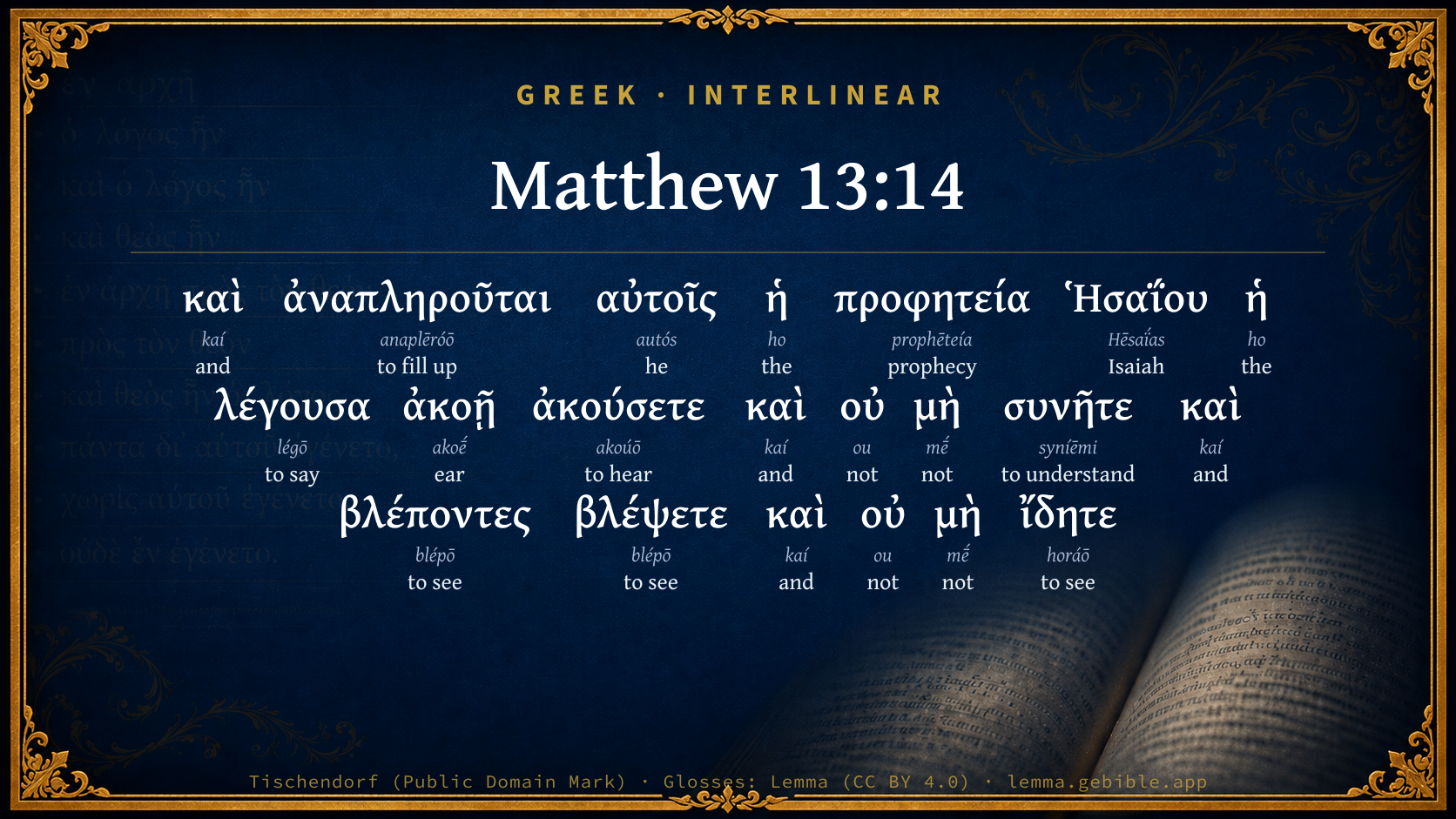
Download image
Cite this verse

Matthew 13:14 (World English Bible). Public Domain. Lemma interlinear Bible study tool, https://lemma.gebible.app/v/matthew/13/14.

Show BibTeX & RIS
BibTeX
RIS
English Translation
In them the prophecy of Isaiah is fulfilled, which says, 'By hearing you will hear, And will in no way understand; Seeing you will see, And will in no way perceive:
World English Bible · Public Domain
Highlights
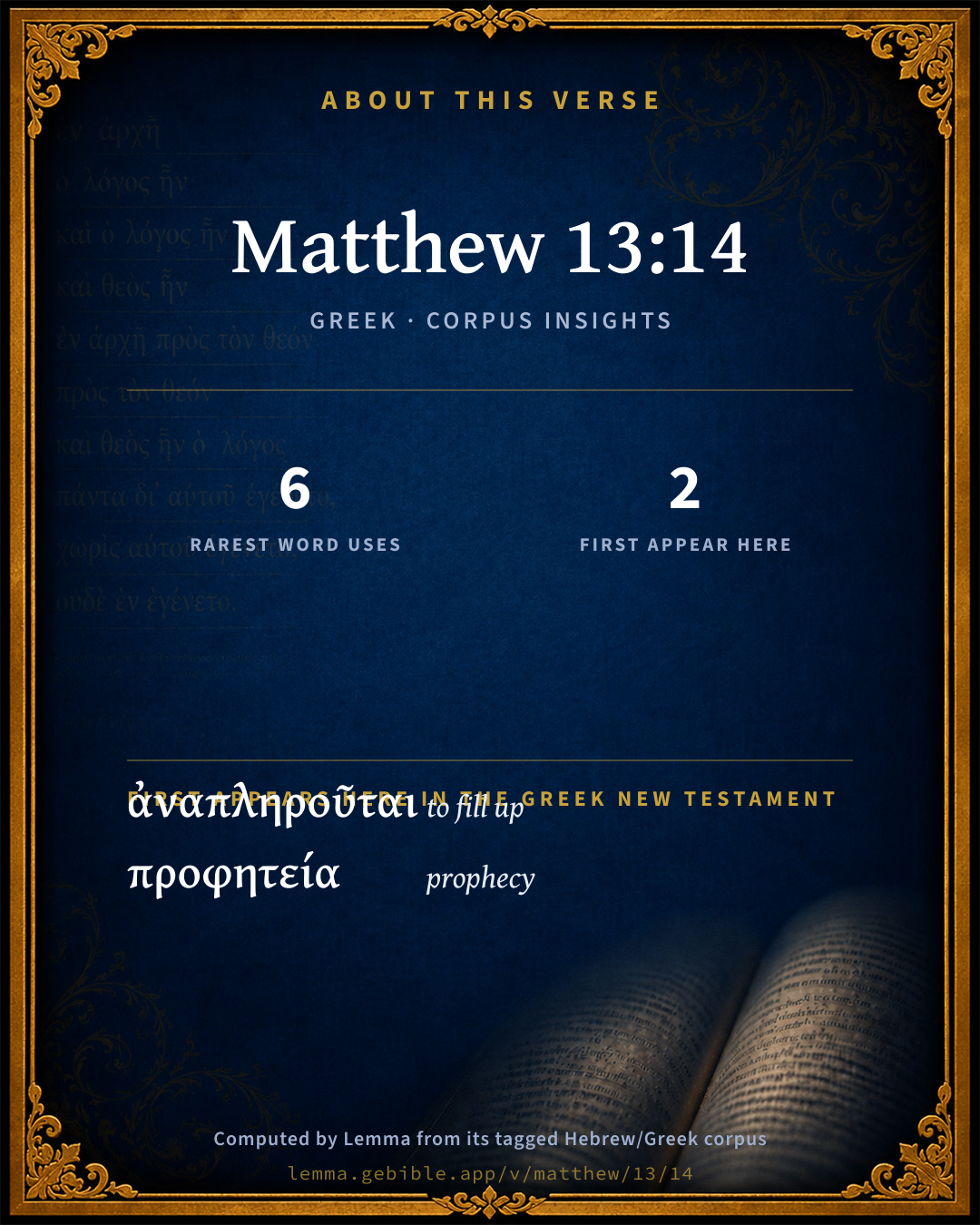
  • 2 first appearances in the Greek New Testament
Full analysis ↓
Download a study sheet

One document with this verse’s original text, its word-by-word gloss line, the meaning frame, cross-references with their text, attributed commentary, and full source and license credits — printable, and it pastes into notes with its structure intact.

This verse Autodidact and up

Study sheet (.html) Plain text (.txt)

A passage Seminary Student

Up to 50 verses in one chapter. A passage sheet keeps up to 6 commentary sources and 12 cross-references per verse, in the order this page ranks them, and says so on the sheet whenever that leaves anything out. Ask for a single verse and you get the Autodidact verse sheet above.

Everything on this page stays free to read, with no account — the sheet is a download of what is already on screen, not access to it.

Want to remove ads? Support Godless Engineer
Compare translations 3

The same verse in 3 English versions, stacked beneath the original-language interlinear above. Click any original word for its lexicon entry.

Each is an independent rendering of the whole verse — the interlinear is not word-aligned to these translations.

Highlighted words mark where these versions differ — a whole-verse word diff, not a word-by-word alignment.

  • World English Bible Public Domain
    In them the prophecy of Isaiah is fulfilled, which says, 'By hearing you will hear, And will in no way understand; Seeing you will see, And will in no way perceive:
  • King James Version Public Domain
    And in them is fulfilled the prophecy of Esaias, which saith, By hearing ye shall hear, and shall not understand; and seeing ye shall see, and shall not perceive:
  • unfoldingWord Literal Text CC BY-SA 4.0
    And in them the prophecy of Isaiah is being fulfilled, which says, ‘In hearing you will hear, but you will certainly not understand; and seeing, you will see, but you will certainly not perceive.

unfoldingWord Literal Text — © unfoldingWord, licensed CC BY-SA 4.0. Word-aligned USFM3 via Door43 (git.door43.org/unfoldingWord/en_ult).

Versions to compare (up to 4)

3 of 4 selected

Show all 19 translations

Every available English version of this verse, each an independent rendering of the whole verse.

  • World English Bible Public Domain
    In them the prophecy of Isaiah is fulfilled, which says, 'By hearing you will hear, And will in no way understand; Seeing you will see, And will in no way perceive:
  • Berean Standard Bible Public Domain
    In them the prophecy of Isaiah is fulfilled: ‘You will be ever hearing but never understanding; you will be ever seeing but never perceiving.
  • Majority Standard Bible Public Domain
    In them the prophecy of Isaiah is fulfilled: ‘You will be ever hearing but never understanding; you will be ever seeing but never perceiving.
  • King James Version Public Domain
    And in them is fulfilled the prophecy of Esaias, which saith, By hearing ye shall hear, and shall not understand; and seeing ye shall see, and shall not perceive:
  • American Standard Version (1901) Public Domain
    And unto them is fulfilled the prophecy of Isaiah, which saith, By hearing ye shall hear, and shall in no wise understand; And seeing ye shall see, and shall in no wise perceive:
  • Revised Version (1885) Public Domain
    And unto them is fulfilled the prophecy of Isaiah, which saith, By hearing ye shall hear, and shall in no wise understand; And seeing ye shall see, and shall in no wise perceive:
  • Geneva Bible (1599) Public Domain
    So in them is fulfilled the prophecie of Esaias, which prophecie saieth, By hearing, ye shall heare, and shall not vnderstand, and seeing, ye shall see, and shall not perceiue.
  • Douay-Rheims (1899) Public Domain
    And the prophecy of Isaias is fulfilled in them, who saith: By hearing you shall hear, and shall not understand: and seeing you shall see, and shall not perceive.
  • Young's Literal Translation Public Domain
    and fulfilled on them is the prophecy of Isaiah, that saith, With hearing ye shall hear, and ye shall not understand, and seeing ye shall see, and ye shall not perceive,
  • Literal Standard Version CC BY-SA 4.0
    and fulfilled on them is the prophecy of Isaiah that says, With hearing you will hear, and you will not understand, and seeing you will see, and you will not perceive,
  • Unlocked Literal Bible CC BY-SA 4.0
    To them the prophecy of Isaiah is fulfilled, that which says, 'While hearing you will hear, but you will in no way understand; while seeing you will see, but you will in no way perceive.
  • unfoldingWord Literal Text CC BY-SA 4.0
    And in them the prophecy of Isaiah is being fulfilled, which says, ‘In hearing you will hear, but you will certainly not understand; and seeing, you will see, but you will certainly not perceive.
  • Darby Bible Public Domain
    and in them is filled up the prophecy of Esaias, which says, Hearing ye shall hear and shall not understand, and beholding ye shall behold and not see;
  • World Messianic Bible Public Domain
    In them the prophecy of Isaiah is fulfilled, which says, ‘By hearing you will hear, and will in no way understand; Seeing you will see, and will in no way perceive;
  • Webster's Bible Public Domain
    And in them is fulfilled the prophecy of Isaiah, which saith, By hearing ye shall hear, and shall not understand; and seeing ye shall see, and shall not perceive:
  • Free Bible Version CC BY-SA 4.0
    The prophecy of Isaiah is fulfilled in them: ‘Even though you hear, you won't understand, and even though you see, you won't perceive.
  • Bible in Basic English Public Domain
    And for them the words of Isaiah have come true, Though you give ear, you will not get knowledge; and seeing, you will see, but the sense will not be clear to you:
  • Text-Critical English NT CC BY 4.0
    In them is fulfilled the prophecy of Isaiah, which says, ‘Yoʋ will hear but never understand, and you will see but never perceive.
  • Tyndale New Testament (1534) Public Domain
    And in them is fulfilled the Prophesie of Esayas which prophesie sayth: with the eares ye shall heare and shall not vnderstonde and with the eyes ye shall se and shall not perceave.

Literal Standard Version (2020), Covenant Press — licensed CC BY-SA 4.0. Text via the HelloAO Bible API (eBible.org). Unlocked Literal Bible (unfoldingWord) — licensed CC BY-SA 4.0. Text via the HelloAO Bible API (eBible.org). unfoldingWord Literal Text — © unfoldingWord, licensed CC BY-SA 4.0. Word-aligned USFM3 via Door43 (git.door43.org/unfoldingWord/en_ult). Free Bible Version, Dr. Jonathan Gallagher — licensed CC BY-SA 4.0. Text via the HelloAO Bible API (eBible.org).

Word by word

More ways to search: Search by grammar → Find every occurrence → Compare this word →

Practice this passage: Drill this verse → Learn its vocabulary →

ἀναπληροῦται
anaplēróō
G378
“to fill up”
Verb, Present, Passive, Indicative, 3rd person, Singular
Part of Speech
Verb
Tense
Present
Voice
Passive
Mood
Indicative
Person
3rd person
Number
Singular
Full Thayer's Definition

Origin: from G303 and G4137

TDNT: 11:05,9

1. to fill up, make full, e.g. a ditch 2. to supply
  1. καὶ kaí G2532 “and” Conjunction
  2. αὐτοῖς autós G846 “he” Personal pronoun, Dative, Plural, Masculine
  3. ἡ ho G3588 “the” Article, Nominative, Singular, Feminine
  4. προφητεία prophēteía G4394 “prophecy” Noun, Nominative, Singular, Feminine
  5. Ἡσαΐου Hēsaḯas G2268 “Isaiah” Noun, Genitive, Singular, Masculine
  6. ἡ ho G3588 “the” Article, Nominative, Singular, Feminine
  7. λέγουσα légō G3004 “to say” Verb, Present, Active, Participle, Nominative, Singular, Feminine
  8. ἀκοῇ akoḗ G189 “ear” Noun, Dative, Singular, Feminine
  9. ἀκούσετε akoúō G191 “to hear” Verb, Future, Active, Indicative, 2nd person, Plural
  10. καὶ kaí G2532 “and” Conjunction
  11. οὐ ou G3756 “not” Particle, Negative
  12. μὴ mḗ G3361 “not” Particle, Negative
  13. συνῆτε syníēmi G4920 “to understand” Verb, Aorist, Active, Subjunctive, 2nd person, Plural
  14. καὶ kaí G2532 “and” Conjunction
  15. βλέποντες blépō G991 “to see” Verb, Present, Active, Participle, Nominative, Plural, Masculine
  16. βλέψετε blépō G991 “to see” Verb, Future, Active, Indicative, 2nd person, Plural
  17. καὶ kaí G2532 “and” Conjunction
  18. οὐ ou G3756 “not” Particle, Negative
  19. μὴ mḗ G3361 “not” Particle, Negative
  20. ἴδητε horáō G3708 “to see” Verb, Aorist, Active, Subjunctive, 2nd person, Plural

About this verse

These counts appear in no published source. They are computed here, from the morphology-tagged text and Lemma’s own curated glosses. What Lemma adds →

21
words
14
distinct lemmas
Gospels
section

Notable vocabulary

The rarest word here is ἀναπληροῦται to fill up G378 — appearing just 6 times in the whole Greek New Testament.

First appearance in Scripture

These words make their first canonical appearance in the Greek New Testament here:

  • ἀναπληροῦται to fill up G378
  • προφητεία prophecy G4394

Shared distinctive vocabulary

ἀναπληροῦται to fill up G378 occurs in 6 verses of the Greek New Testament. Also found in:
Repetition

Words recur within this verse:

Cross-references

8

Topical passages linked to Matthew 13:14 in the Treasury of Scripture Knowledge — connected by theme and wording, ordered by reader-vote popularity; previews shown in the World English Bible.

  • Isaiah 6:9–10 He said, "Go, and tell this people, 'You hear indeed, But don't understand; And you see indeed, But don't perceive.'
  • Ezekiel 12:2 Son of man, you dwell in the midst of the rebellious house, who have eyes to see, and don't see, who have ears to hear, and don't hear; for they are a rebellious house.
  • 2 Corinthians 3:14 But their minds were hardened, for until this very day at the reading of the old covenant the same veil remains, because in Christ it passes away.
  • Luke 8:10 He said, "To you it is given to know the mysteries of the Kingdom of God, but to the rest in parables; that 'seeing they may not see, and hearing they may not understand.'
  • Acts 28:25–27 When they didn't agree among themselves, they departed after Paul had spoken one word, "The Holy Spirit spoke rightly through Isaiah, the prophet, to our fathers,
  • Mark 4:12 that 'seeing they may see, and not perceive; and hearing they may hear, and not understand; lest perhaps they should turn again, and their sins should be forgiven them.'"
  • John 12:39–40 For this cause they couldn't believe, for Isaiah said again,
  • Romans 11:8–10 According as it is written, "God gave them a spirit of stupor, eyes that they should not see, and ears that they should not hear, to this very day."

Cross-references courtesy of OpenBible.info (CC BY 4.0).

Commentary

Notes on Matthew 13:14 from classic Christian and Jewish commentators (each source and its license shown beneath its notes). The classic Christian expositions comment on the surrounding passage and are grouped to its opening verse, so a note may address several verses; the Jewish commentaries on the Tanakh (Rashi and others) are per-verse, so they appear only where the commentator wrote on this verse.

Lemma curates 59 commentaries, every one of them public domain or Creative Commons licensed, each selected and text-cleaned for this edition rather than reprinted as found. About our sources →

Tyndale Open Study Notes

Tyndale Open Resources

13:14-15 Like that of Isaiah, Jesus’ message has a dual effect: It judges people for unbelief and disobedience, and it creates a remnant of faithful ones who accomplish the Lord’s will (21:43).

Tyndale Open Study Notes — © Tyndale Open Resources, licensed CC BY-SA 4.0. Text via the HelloAO Bible API.

Bengel's Gnomon

Johann Albrecht Bengel

Mat 13:14. Καὶ, and) therefore.—ἀναπληροῦται, is now being refulfilled[606]) This word differs from the simple verb πληροῦται (is now being fulfilled), which is employed elsewhere in citing prophecies. The saying of Isaiah (Mat 6:9) was being fulfilled in his own days, and in the ages which followed, and also clearly and especially in the days of the Messiah.—ἀκοῇ, κ.τ.λ., by hearing, etc.) i.e. by however little you come short, yet you shall come short [of understanding what ye hear to the salvation of your souls].

[606] E. V. “is fulfilled.”—(I. B.)

“Is receiving its complete (full measure of) fulfilment.”—ED.

Bengel's Gnomon of the New Testament — English translation (T&T Clark, Edinburgh, 1860) — public domain. Text from a community e-Sword module.

Meyer's Critical & Exegetical Commentary

Heinrich August Wilhelm Meyer

Mat_13:14-15. Καί] still depending on ὅτι; but, in a manner suited to the simplicity of the language, and the conspicuous reference to the fulfilling of the prophecy, it begins a new sentence: andindeed so utterly incapable are they of comprehending the pure, literal statement of divine truthis being fulfilled with regard to them, and so on. ἀναπληρ., as being more forcible than the simple verb (comp. on Gal_6:2, and ἐκπληρ., Act_13:33), is expressly chosen (occurring nowhere else in Matthew, and, as referring to the predictions and such like, not found again in the whole New Testament), and for sake of emphasis placed at the beginning of the sentence; αὐτοῖς is the dative of reference: the fulfilment of the prophets words is realized in them.

The passage in question is Isa_6:9-10, as found in the LXX. Comp. on Joh_12:40; Act_28:25 ff.

ἐπαχύνθη] in a metaphorical sense, like pinguis. See Wetstein. The expression represents the indolent and inactive state into which the energies of the spiritual life have been allowed to sink.

βαρέως ἤκουσαν] they have become dull of hearing (βαρυήκοοι).

ἐκάμμυσαν] have they closed, Isa_6:10; Isa_29:10; Lam_3:44. The genuine Greek form is καταμύειν. See Lobeck, Phryn. p. 339 f.; Becker, Anecd. I. p. 103.

μήποτε] ne; they are not willing to be instructed by me, and morally healed. This shows that, in regard to the weakness of their capacity, it is their own will that is to blame.

By adopting the reading ἰάσομαι (see the critical remarks) we do not introduce the meaning, which is out of place in the present instance: and I will heal them (Fritzsche), but rather effect a change in the construction of μήποτε (Heindorf, ad Plat. Crat. p. 36; Hermann, ad Soph. El. 992; Winer, p. 468 [E. T. 630]), that is, in accordance with the sense (because expressing the result). Comp. note on Mar_14:2. Notice in ἰάσομαι the consciousness of being a personal revelation of God.

REMARK.

According to Matthew, then, the principle on which Jesus proceeds is this: He speaks to the multitude in parables, because this mode of instruction is suited to their intellectual poverty and obtuseness. Plain literal teaching would fail to attract them, and so lead to their conversion, which latter their very obtuseness stubbornly resists. But what is spoken in a parabolic form captivates and lays hold of the man of limited comprehension, so that it does not repel him from his instructor, but rather becomes in him, even though not yet apprehended in its abstract meaning, the starting-point of a further gradual development of fuller understanding and ultimate conversion. There is no reason why de Wette should be stumbled to find that the disciples themselves likewise failed to understand the parable, and were therefore on the same level as the multitudes; therefore, he argues, one is at a loss to see why Jesus did not favour the latter also with an explanation. But the difference between the two cases is, that the disciples, from having been already converted, and from their minds having been already stimulated and developed by intercourse with Jesus, were just in a position to understand the interpretation, which the people, on the other hand, were incapable of doing, so that it was necessary to present to them the mere illustration, the parable without the interpretation, in order to, first, interest and attract them. They had to be treated like children, for whose physical condition the only suitable food is milk, and not strong meat likewise, whereas the disciples had already shown themselves capable of receiving the strong meat as well. Consequently de Wette is wrong in conceiving of the matter differently from the representation of it given by the evangelists, and which is to this effect: that the object of Jesus in awakening a spirit of inquiry by means of the parables was, that those so awakened should come to Him to obtain instruction; that those who did so are to be regarded as the μαθηταί in the more comprehensive sense of the word; and that to them the explanation was given and the congratulation addressed; while, on the other hand, Jesus pities the unimpressionable multitude, and applies to them the words of Isa_6:9 f. (comp. already Münster). Lastly, Hilgenfeld professes to find in this passage indications of the view, censured by Strauss as melancholy, that the use of parables was not intended to aid weak powers of comprehension, but in the truly literal sense of the words to keep them slumbering. But as regards Matthew, above all, this is out of the question, seeing that in Mat_13:13 he has ὅτι, and not ἵνα. Comp. Keim also, II. p. 441. It is otherwise in Mar_4:12; Luk_8:10.

Meyer — Critical and Exegetical Commentary on the New Testament — English translation by Peter Christie, edited by Frederick Crombie (T&T Clark, 1880) — public domain. Text from a community e-Sword module.

Expositor's Greek Testament

ed. W. Robertson Nicoll

Mat 13:14-15 . he prophetic citation, given as such by Matthew only, may be due to him, though put into the mouth of Jesus. It is conceivable, however, that Jesus might use Isaiah’s words in Isaiah’s spirit, i.e. , ironically, expressing the bitter feeling of one conscious that his best efforts to teach his countrymen would often end in failure, and in his bitterness representing himself as sent to stop ears and blind eyes. Such utterances are not to be taken as deliberate dogmatic teaching. If, as some allege, the evangelists so took them, they failed to understand the mind of the Master. The quotation exactly follows the Sept [80] The verb καμμύω (Mat 13:15 , ἐκάμμυσαν ) is condemned by Phryn. as barbarous, the right word being καταμύειν .

[80] Septuagint.

The Expositor's Greek Testament, edited by W. Robertson Nicoll (1897–1910) — public domain. Text from a community e-Sword module.

Jamieson, Fausset & Brown

Robert Jamieson, A. R. Fausset & David Brown

And in them is fulfilled--rather, "is fulfilling," or "is receiving its fulfilment."

the prophecy of Esaias, which saith-- (Isa 6:9-10 --here quoted according to the Septuagint).

By hearing ye shall hear, and shall not understand, &c.--They were thus judicially sealed up under the darkness and obduracy which they deliberately preferred to the light and healing which Jesus brought nigh to them.

Jamieson, Fausset & Brown — Commentary Critical and Explanatory on the Whole Bible (1871) — public domain (CC PDM 1.0). Text via the HelloAO Bible API.

Adam Clarke's Commentary

Verse 14. In them is fulfilled] αναπληρουται, Is AGAIN fulfilled: this proper meaning of the Greek word has been generally overlooked. The evangelist means, that as these words were fulfilled in the Jews, in the time of the Prophet Isaiah, so they are now again fulfilled in these their posterity, who exactly copy their fathers example. These awful words may be again fulfilled in us, if we take not warning by the things which these disobedient people have suffered.

By hearing ye shall hear] Jesus Christ shall be sent to you, his miracles ye shall fully see, and his doctrines ye shall distinctly hear; but God will not force you to receive the salvation which is offered.

Adam Clarke's Commentary on the Bible (1810–1826) — public domain. Text from a community e-Sword/MySword module.

Ellicott's Commentary for English Readers

(14) In them is fulfilled.—The Greek verb expresses complete fulfilment, but the tense is that of a work still in progress. The prominence given to these words of Isaiah’s in the New Testament is very noticeable. Our Lord quotes them here, St. John in Joh_12:40. St. Paul cites them in Act_28:26. The quotation is from the LXX. version. It is as though the words which sounded at the very opening of Isaiah’s prophecy as the knell of the nation’s life, dwelt on the minds of the Master and His disciples, and prepared them for the seeming fruitlessness and hopelessness of their work.

A Bible Commentary for English Readers, edited by Charles John Ellicott (1878–1897) — public domain. Text from a community e-Sword module.

The Cambridge Bible for Schools and Colleges

gen. ed. J. J. S. Perowne

14. Isa_6:9-10. The words form part of the mission of Isaiah.

The Cambridge Bible for Schools and Colleges (gen. ed. J. J. S. Perowne; Cambridge University Press, 1878–1918) — public domain. Text from a community e-Sword module.

John Gill's Exposition

For this people's heart is waxed gross, Or fat, become stupid and sottish, and without understanding; and so incapable of taking in the true sense and meaning of what they saw with their eyes, and heard with their ears; for they had their outward senses of hearing and seeing, and yet their intellectual powers were stupefied.

And their ears are dull of hearing, and their eyes they have closed; which is expressive of the blindness and hardness, which were partly brought upon themselves by their own wilfulness and obstinacy, against such clear evidence as arose from the doctrine and miracles of Christ; and partly from the righteous judgment of God, giving them up, for their perverseness, to judicial blindness and obduracy; Joh 12:40 and are in the prophet ascribed to the ministry of the word; that being despised, was in righteous judgment, the savour of death unto death, unto them; and they under it, as clay, under the influence of the sun, grew harder and harder by it, stopping their ears, and shutting their eyes against it:

lest at any time they should see with their eyes, and hear with their ears, and should understand with their heart: which may be understood either of God's intention, and view, in giving them up to judicial blindness, and hardness of heart, under such miracles, and such a ministry, as a punishment for their wilful contempt of them; that so they might never have any true sight, hearing, and understanding of these things, and be turned from the evil of their ways, have repentance unto life, and remission of sins; which seems to be the sense of the other evangelists, Mar 4:12 or, as if these people purposely stupefied themselves, stopped their ears, and pulled away the shoulder, and wilfully shut their eyes; fearing they should receive some conviction, light, and knowledge,

and be converted by the power and grace of God:

and I should heal them; or, as in Mark, "and their sins should be forgiven them"; for healing of diseases, and forgiveness of sins, are, in Scripture language, one and the same thing; and this sense of the phrase here, is justified by the Chaldee paraphrase, which renders it, , "and they be forgiven", or "it be forgiven them", and by a Jewish commentator on the place; who interprets healing, of the healing of the soul, and adds , "and this is pardon" (m).

(m) R. David Kimchi in loc.

John Gill's Exposition of the Whole Bible (1746–1763) — public domain (CC PDM 1.0). Text via the HelloAO Bible API.

Trapp's Complete Commentary

John Trapp

14 And in them is fulfilled the prophecy of Esaias, which saith, By hearing ye shall hear, and shall not understand; and seeing ye shall see, and shall not perceive:

Ver. 14. In them is fulfilled] Ανατληρουται, is again fulfilled, q.d. It is even with these now, as it was with those then. The same fable is acted, the scene only changed. Men’s hearts are as hard as ever they were, the grace of the gospel hath not mended them a whit, nor ever will do, till God strike the stroke.

And shall not understand] Deus iis in lingua sua Barbarus, qui in Christo, suis Attiticus, their wit serves them not in spirituals.

Seeing, ye shall see, and not perceive] As Hagar saw not the fountain that was before her, till her eyes were opened. {a}

{a} ου μη, απαγορευτικως. Beza.

John Trapp, A Commentary or Exposition upon All the Books of the Old and New Testament (1647–1656) — public domain. Text from a community e-Sword module.

Matthew Poole's English Annotations

These words of the prophet are not less than five times found in the New Testament (besides by Matthew in these verses) applied to the Jews. They are taken out of Isaiah, Isa 6:9,10; And he said, Go and tell this people, Hear ye indeed, but understand not; and see ye indeed, but perceive not. Make the heart of this people fat, and make their ears heavy, and shut their eyes; lest they see with their eyes, and hear with their ears, and understand with their heart, and convert, and be healed. It is quoted Mar 4:12; Luk 8:10, where the sense of the words only is quoted more shortly; Joh 12:40; Act 28:26,27; Ro 9:8, more largely, yet with some more difference of phrase from that of the prophet. By all of them it appeareth, either that God spake those words to the prophet, as well with reference to those Jews that were to live in the time of Christ, as to those Jews who were living when Isaiah prophesied; or at least, that the words were as true of these Jews as they were of those, so the prophecy of Isaiah was fulfilled in them. But the words are so differently related, that the prophet, and St. John, Joh 12:39,40, seem to make God the cause of the fatness of this people’s hearts, the heaviness of their ears, and the blindness of their eyes: Therefore they could not believe, because that Esaias said again, He hath blinded their eyes, and hardened their heart; that they should not see with their eyes, nor understand with their heart, and be converted, and I should heal them. So also Paul speaketh, Rom 11:8, God hath given them the spirit of slumber, eyes that they should not see, and ears that they should not hear. Matthew saith,

This people’s heart is waxed gross. Matthew seemeth to speak of the more proximate cause; Isaiah, Luke, John, and Paul of the higher but remoter cause. Matthew, of their sinful act preceding; John, Luke, Paul, and Isaiah, of the judicial act of God, consequent to their sinful act. God first sent them Moses and the prophets, by whom they might have seen and known his will: they would not see, nor hear, nor understand, nor convert, nor be healed. God at last did leave them to the reprobacy of their own mind: he willed indeed the prophet to go and preach, But, saith he, this shall be all the fruit of thy ministry, it shall but make the heart of this people fat, and their ears heavy, they shall more and more shut their eyes: their time of conversion and healing is past; it is now too late, I will not convert, I will not heal them. Now (saith our Saviour) what was applicable to the Jews in the time of Isaiah, is in like manner applicable to you, and the prophet Isaiah did foretell what I should meet with. The generality of the people are a people that have so despised the grace of God, that their day of grace is over; God is resolved he will not convert nor heal them. They have had light, they have seen me and my works, they have heard my sermons and John Baptist’s; in seeing they would not see, in hearing they would not hear nor understand. So they are fallen under a judicial hardness and blindness. They shall not now have the light as they have had: my Spirit shall no longer strive with them; neither shall they have a heart to make a due use of the means they have. This is doubtless the meaning of these words. And so they give a just reason why he spake to them in parables. And thus undoubtedly God doth to this day; when a people have a long time sat under a good and profitable ministry, wherein their souls have been dealt with plainly and faithfully, and they remain still ignorant, debauched, and unbelieving, God in a righteous judgment gives them over to the blindness of mind and hardness of heart under the ministry, that though it continue never so good amongst them, yet they are not affected with the word, but sleep and harden under it. Sometimes he by his providence suffers such a minister to come amongst them as speaketh nothing but parables, things which they understand not; or smooth things, fit to smooth them up in their sinful courses, and harden them in their prejudices against Christ and holiness. A most tremendous judgment of God. When God, antecedently to this contempt, by his providence sends such a ministry as may declare his willingness they should be saved and come to the knowledge of his truth; and consequently to this contempt, and despising of his grace, so dealeth with them by his providence, either suffering their first seeming affections and edge to abate, (as the Jews are said for a while to have rejoiced in the light John brought), or suffering such a ministry to come amongst them, as one would think God sent lest men should convert and be healed. In the mean time Christ in this text excellently sets out God’s method in his dealing with souls:

1. He bringeth them to hear and see.

2. Then he makes them to understand and believe.

3. Then he converts them, renews and changes their hearts.

4. Then he healeth them, pardoneth their sins, and accepts their persons, not because they are converted, but at the same time when he works faith in them, and giveth them a heart to repent.

Matthew Poole's English Annotations on the Holy Bible (1683–1685) — public domain. Text from a community e-Sword/MySword module.

Whedon's Commentary on the Bible

Daniel D. Whedon

14. Esaias. (Isa_6:9-10.) Is fulfilled — It was a genetic description of character fulfilled equally truly by the Jew of the days of Isaiah, and the Jew of the days of Jesus. By the faculty of hearing ye shall hear the parable, but shall not understand its truth. Shall see the narrative of the parable, but shall not perceive its hidden doctrine.

Daniel D. Whedon (gen. ed.), Commentary on the Old and New Testaments (1874–1909) — public domain. Text from a community e-Sword module.

The Pulpit Commentary

And in them; and unto them (Revised Version); i.e. with reference to them. (cf. Jud_1:14) Is fulfilled. Completely. (anaplhroutai ; cf. 1Th_2:16) The present, because the process is still going on. The prophecy of Esaias, which saith. (Isa_6:9, Isa_6:10) Not quoted in this form in the parallel passages; for Mar_4:12 and Luk_8:10 are really nearer our ver. 13. The quotation is taken verbally from the LXX, and so in Act_28:26, Act_28:27. But Joh_12:40, on the contrary, is nearer the Hebrew. By hearing ye shall hear (akoh akousete). A too literal translation of the Greek attempt to reproduce the Hebrew idiom, which is rather "hear ye indeed" as a continued action (wm wm And shall not understand; (Mat_11:25, note) and seeing ye shall see, and shall not perceive. You may gaze at the object, but you shall not really see it. So with the bodily eye, an image may be formed in the retina, yet no impression conveyed to the brain.

The Pulpit Commentary (1880–1919), ed. H.D.M. Spence-Jones & Joseph S. Exell — public domain. Text from a community e-Sword module.

John Wesley's Explanatory Notes

Hearing ye will hear, but in nowise understand - That is, Ye will surely hear. All possible means will be given you: yet they will profit you nothing; because your heart is sensual, stupid, and insensible; your spiritual senses are shut up; yea, you have closed your eyes against the light; as being unwilling to understand the things of God, and afraid, not desirous that he should heal you. Isaiah vi, 9; John xii, 40; Acts xxviii, 26.

John Wesley, Explanatory Notes Upon the Whole Bible (1754–1765) — public domain. Text via the GEBible commentary corpus.

The People's New Testament

B. W. Johnson

14, 15, 16. The prophecy of Esaias. Isaiah 6:9, 10. Isaiah describes a spiritual state that existed in the time of Christ, and is often met still, when, on account of hardness of heart and love of the world, men cannot understand the gospel and be converted. It is caused by their own fault. If they would fall out with sin, and come to Christ with a broken and contrite spirit, they would be healed.

B. W. Johnson's The People's New Testament with Notes (1889–1891) — public domain. Electronic text from the Christian Classics Ethereal Library (CCEL) ThML edition.

Cambridge Greek Testament for Schools and Colleges

14. Isa 6:9-10. The words form part of the mission of Isaiah.

Cambridge Greek Testament for Schools and Colleges (Cambridge University Press, 1896; 21 vols, various authors incl. Carr, Maclear, Plummer, Farrar, Lumby, Moule, M. R. James, Simcox) — public domain. Text from a community e-Sword module.

International Critical Commentary

14, 15. Mt. here introduces the direct quotation, which is indirectly employed in Mar 5:12.

(E) And there is being fulfilled for them the prophecy of Isaiah, which says, With hearing ye shall hear, and shall not understand; and seeing ye shall see, and shall not perceive. For the heart of this people was made fat, and with their ears they heard heavily, and their eyes they smeared; lest they should see with their eyes, and hear with their ears, and understand with their heart, and should turn, and I should heal them.]

καὶ ἀναπληροῦται αὐτοῖς] We might expect the editor to use the formula ὅπως (ἵνα) πληρωθῇ τὸ ῥηθέν, on which see Introduction, p. lxi. But that formula seems to have been characteristic of a special group of quotations which the editor had before him in a Greek form. In this case he himself has recourse to the LXX., in order to quote a passage which has been suggested to him by Mar 4:12. He therefore uses an introductory phrase of his own, which was suggested, no doubt, by the πληρωθῇ of the recurring formula. The quotation which follows seems to be verbally identical with the LXX. of Isa 6:9-10, even to the unexpected fut. ind. ἰάσομαι of the last clause.

International Critical Commentary — older volumes (1896–1929), various authors — public domain. Text from a community e-Sword module.

Vincent's Word Studies in the New Testament

Marvin R. Vincent

Is fulfilled [αναπληρουται] . Rather of something in progress : is being fulfilled or in process of fulfilment.

Marvin R. Vincent, Word Studies in the New Testament (1887–1900) — public domain. Text from a community e-Sword/MySword module.

Lesson kit

Teaching starters — assembled from the data on this page, not authored interpretation. Every prompt links to the verse data it draws on. Edit before teaching.

Matthew, in the Gospels, opens this verse with 21 words (14 distinct Greek lemmas). Its most distinctive word is anaplēróō (“to fill up”). A historical commentator’s framing appears above. Read the whole chapter for the surrounding context.

Discussion questions

  1. What does “to fill up” (anaplēróō) contribute to the verse as a whole?
  2. 2 words make their first appearance in Scripture here. What does this debut establish?
  3. How does 1 Corinthians 14:16, which shares the word «to fill up», read alongside this verse?
  4. What does the repetition of “to see” (2× in this one verse) do in this verse?
  5. These translations render this verse differently. What is at stake in choosing one wording over another?
  6. Compare how Tyndale Open Study Notes and Bengel's Gnomon read this verse. Where do they agree or differ?

Things to notice

  • 2 words make their first canonical appearance in Scripture here.
  • These translations choose different wording for 9 words in this verse.
  • “to see” occurs 2× in this single verse.
  • 14 distinct Greek lemmas span 21 words in this verse.

Reading settings

Reading text

Shown beneath each verse's original-language words.

Old Testament
Old Testament edition

Read the OT as the Masoretic Hebrew (MT) or the Greek Septuagint (LXX).

English shown for the Greek Septuagint (in the Hebrew ↔ Greek comparison).

Comparing translations? Open the Compare panel on any verse page to stack up to four side by side.