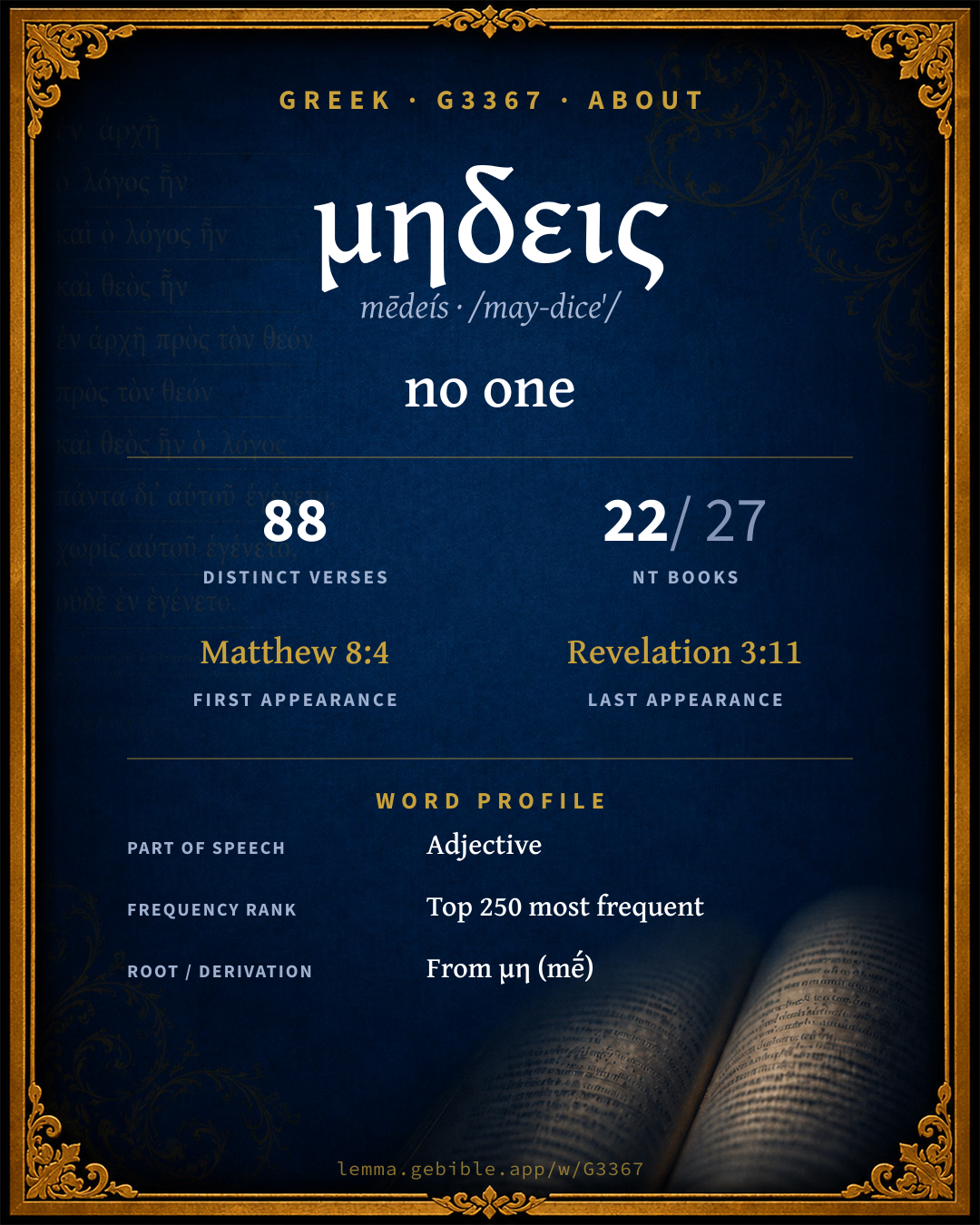
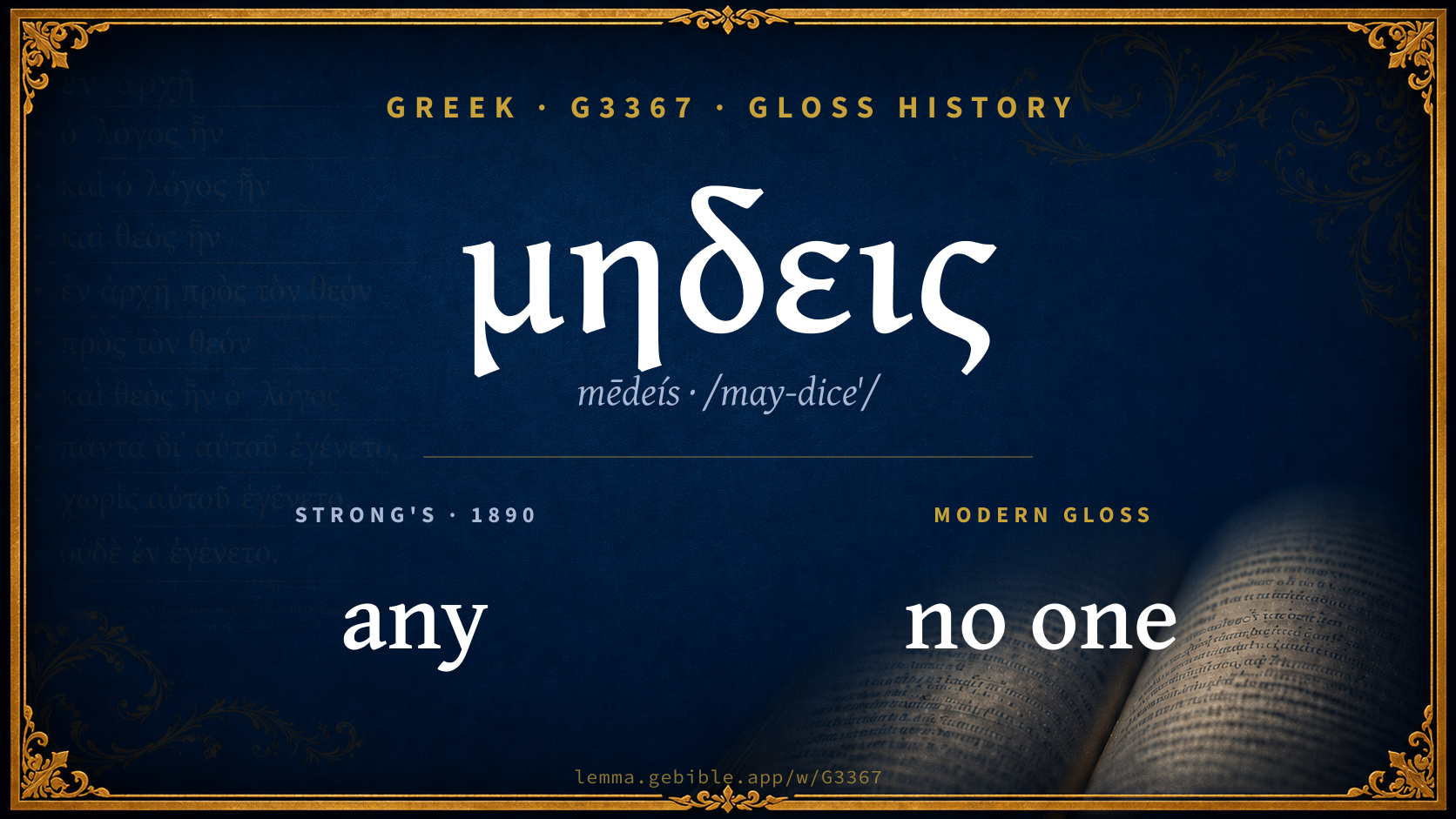
μηδεις
no one
Full lexicon entry — Thayer's Greek Lexicon
From Thayer's Greek Lexicon
Where this word appears
See every Accusative-case word in the Greek New Testament →
Grammar key — what these labels mean
Part of speech
- Adjective
- A word that describes or qualifies a noun.
Case
- Accusative
- The case of the direct object and of extent.
- Dative
- The case of the indirect object, means, or location — “to / for / with / in.”
- Nominative
- The case of the subject (and the predicate nominative).
- Genitive
- The case of source, possession, or “of” — answers “whose / from what.”
Gender
- Neuter
- Grammatically neuter.
- Masculine
- Grammatically masculine.
- Feminine
- Grammatically feminine.
Number
- Singular
- One.
Degree
- Negative
- Marks a negative form.
Grammatical forms
- Adjective, Accusative, Singular, Neuter, Negative 32 times (35%)
- Adjective, Dative, Singular, Masculine, Negative 16 times (17%)
- Adjective, Nominative, Singular, Masculine, Negative 15 times (16%)
- Adjective, Accusative, Singular, Masculine, Negative 11 times (12%)
- Adjective, Accusative, Singular, Feminine, Negative 7 times (8%)
- Adjective, Dative, Singular, Neuter, Negative 5 times (5%)
- Adjective, Genitive, Singular, Neuter, Negative 3 times (3%)
- Adjective, Nominative, Singular, Neuter, Negative 3 times (3%)
Parsed forms decoded from the imported morphology (Robinson–Tischendorf, public domain), counted across 92 parsed occurrences — not distinct verses.
Every verse where G3367 appears — 88 distinct verses across 22 books. Click any verse to open its interlinear word-by-word view. Verse text shown in the World English Bible for context — . Each verse’s Greek form is shown with its reference; the English is not keyword-highlighted, since the data carries no word-level English alignment. Use “Compare translations” on any verse to read it across multiple English versions. This concordance covers the Greek New Testament; Septuagint (Greek Old Testament) occurrences of this word are not indexed here.
Matthew 5 verses
- Matthew 8:4 μηδενὶ adj dat sg masc neg Jesus said to him, "See that you tell nobody, but go, show yourself to the priest, and offer the gift that Moses commanded, as a testimony to them."
- Matthew 9:30 μηδεὶς adj nom sg masc neg Their eyes were opened. Jesus strictly charged them, saying, "See that no one knows about this."
- Matthew 16:20 μηδενὶ adj dat sg masc neg Then he charged the disciples that they should tell no one that he is Jesus the Christ.
- Matthew 17:9 μηδενὶ adj dat sg masc neg As they were coming down from the mountain, Jesus commanded them, saying, "Don't tell anyone what you saw, until the Son of Man has risen from the dead."
- Matthew 27:19 μηδὲν adj nom sg neut neg While he was sitting on the judgment seat, his wife sent to him, saying, "Have nothing to do with that righteous man, for I have suffered many things this day in a dream because of him."
Mark 8 verses
- Mark 1:44 μηδενὶ μηδὲν adj dat sg masc neg adj acc sg neut neg and said to him, "See you say nothing to anybody, but go show yourself to the priest, and offer for your cleansing the things which Moses commanded, for a testimony to them."
- Mark 5:26 μηδὲν adj acc sg neut neg and had suffered many things by many physicians, and had spent all that she had, and was no better, but rather grew worse,
- Mark 5:43 μηδεὶς adj nom sg masc neg He strictly ordered them that no one should know this, and commanded that something should be given to her to eat.
- Mark 6:8 μηδὲν adj acc sg neut neg He charged them that they should take nothing for their journey, except a staff only: no bread, no wallet, no money in their purse,
- Mark 7:36 μηδενὶ adj dat sg masc neg He commanded them that they should tell no one, but the more he commanded them, so much the more widely they proclaimed it.
- Mark 8:30 μηδενὶ adj dat sg masc neg He charged them that they should tell no one about him.
- Mark 9:9 μηδενὶ adj dat sg masc neg As they were coming down from the mountain, he charged them that they should tell no one what things they had seen, until after the Son of Man had risen from the dead.
- Mark 11:14 μηδεὶς adj nom sg masc neg Jesus told it, "May no one ever eat fruit from you again!" and his disciples heard it.
Luke 9 verses
- Luke 3:13 μηδὲν adj acc sg neut neg He said to them, "Collect no more than that which is appointed to you."
- Luke 3:14 μηδένα μηδένα adj acc sg masc neg adj acc sg masc neg Soldiers also asked him, saying, "What about us? What must we do?" He said to them, "Extort from no one by violence, neither accuse anyone wrongfully. Be content with your wages."
- Luke 4:35 μηδὲν adj acc sg neut neg Jesus rebuked him, saying, "Be silent, and come out of him!" When the demon had thrown him down in their midst, he came out of him, having done him no harm.
- Luke 5:14 μηδενὶ adj dat sg masc neg He charged him to tell no one, "But go your way, and show yourself to the priest, and offer for your cleansing according to what Moses commanded, for a testimony to them."
- Luke 6:35 μηδένα adj acc sg masc neg But love your enemies, and do good, and lend, expecting nothing back; and your reward will be great, and you will be children of the Most High; for he is kind toward the unthankful and evil.
- Luke 8:56 μηδενὶ adj dat sg masc neg Her parents were amazed, but he charged them to tell no one what had been done.
- Luke 9:3 μηδὲν adj acc sg neut neg He said to them, "Take nothing for your journey--neither staffs, nor wallet, nor bread, nor money; neither have two coats apiece.
- Luke 9:21 μηδενὶ adj dat sg masc neg But he warned them, and commanded them to tell this to no one,
- Luke 10:4 μηδένα adj acc sg masc neg Carry no purse, nor wallet, nor sandals. Greet no one on the way.
John 1 verse
Acts 22 verses
- Acts 4:17 μηδενὶ adj dat sg masc neg But so that this spreads no further among the people, let's threaten them, that from now on they don't speak to anyone in this name."
- Acts 4:21 μηδὲν adj acc sg neut neg When they had further threatened them, they let them go, finding no way to punish them, because of the people; for everyone glorified God for that which was done.
- Acts 8:24 μηδὲν adj nom sg neut neg Simon answered, "Pray for me to the Lord, that none of the things which you have spoken happen to me."
- Acts 9:7 μηδένα adj acc sg masc neg The men who traveled with him stood speechless, hearing the sound, but seeing no one.
- Acts 10:20 μηδὲν adj acc sg neut neg But arise, get down, and go with them, doubting nothing; for I have sent them."
- Acts 10:28 μηδένα adj acc sg masc neg He said to them, "You yourselves know how it is an unlawful thing for a man who is a Jew to join himself or come to one of another nation, but God has shown me that I shouldn't call any man unholy or unclean.
- Acts 11:12 μηδὲν adj acc sg neut neg The Spirit told me to go with them, without discriminating. These six brothers also accompanied me, and we entered into the man's house.
- Acts 11:19 μηδενὶ adj dat sg masc neg They therefore who were scattered abroad by the oppression that arose about Stephen traveled as far as Phoenicia, Cyprus, and Antioch, speaking the word to no one except to Jews only.
- Acts 13:28 μηδεμίαν adj acc sg fem neg Though they found no cause for death, they still asked Pilate to have him killed.
- Acts 15:28 μηδὲν adj acc sg neut neg For it seemed good to the Holy Spirit, and to us, to lay no greater burden on you than these necessary things:
- Acts 16:28 μηδὲν adj acc sg neut neg But Paul cried with a loud voice, saying, "Don't harm yourself, for we are all here!"
- Acts 19:36 μηδὲν adj acc sg neut neg Seeing then that these things can't be denied, you ought to be quiet, and to do nothing rash.
- Acts 19:40 μηδενὸς adj gen sg neut neg For indeed we are in danger of being accused concerning this day's riot, there being no cause. Concerning it, we wouldn't be able to give an account of this commotion."
- Acts 23:14 μηδενὸς adj gen sg neut neg They came to the chief priests and the elders, and said, "We have bound ourselves under a great curse, to taste nothing until we have killed Paul.
- Acts 23:22 μηδενὶ adj dat sg masc neg So the commanding officer let the young man go, charging him, "Tell no one that you have revealed these things to me."
- Acts 23:29 μηδὲν adj acc sg neut neg I found him to be accused about questions of their law, but to have nothing laid to his charge worthy of death or of bonds.
- Acts 24:23 μηδένα adj acc sg masc neg He ordered the centurion that Paul should be kept in custody, and should have some privileges, and not to forbid any of his friends to serve him or to visit him.
- Acts 25:17 μηδεμίαν adj acc sg fem neg When therefore they had come together here, I didn't delay, but on the next day sat on the judgment seat, and commanded the man to be brought.
- Acts 25:25 μηδὲν adj acc sg neut neg But when I found that he had committed nothing worthy of death, and as he himself appealed to the emperor I determined to send him.
- Acts 27:33 μηθὲν adj acc sg neut neg While the day was coming on, Paul begged them all to take some food, saying, "This day is the fourteenth day that you wait and continue fasting, having taken nothing.
- Acts 28:6 μηδὲν adj acc sg neut neg But they expected that he would have swollen or fallen down dead suddenly, but when they watched for a long time and saw nothing bad happen to him, they changed their minds, and said that he was a god.
- Acts 28:18 μηδεμίαν adj acc sg fem neg who, when they had examined me, desired to set me free, because there was no cause of death in me.
Romans 2 verses
1 Corinthians 6 verses
- 1 Corinthians 1:7 μηδενὶ adj dat sg neut neg so that you come behind in no gift; waiting for the revelation of our Lord Jesus Christ;
- 1 Corinthians 3:18 Μηδεὶς adj nom sg masc neg Let no one deceive himself. If anyone thinks that he is wise among you in this world, let him become a fool, that he may become wise.
- 1 Corinthians 3:21 μηδεὶς adj nom sg masc neg Therefore let no one boast in men. For all things are yours,
- 1 Corinthians 10:24 μηδεὶς adj nom sg masc neg Let no one seek his own, but each one his neighbor's good.
- 1 Corinthians 10:25 μηδὲν adj acc sg neut neg Whatever is sold in the butcher shop, eat, asking no question for the sake of conscience,
- 1 Corinthians 10:27 μηδὲν adj acc sg neut neg But if one of those who don't believe invites you to a meal, and you are inclined to go, eat whatever is set before you, asking no questions for the sake of conscience.
2 Corinthians 5 verses
- 2 Corinthians 6:3 μηδεμίαν μηδενὶ adj acc sg fem neg adj dat sg neut neg We give no occasion of stumbling in anything, that our service may not be blamed,
- 2 Corinthians 6:10 μηδὲν adj acc sg neut neg as sorrowful, yet always rejoicing; as poor, yet making many rich; as having nothing, and yet possessing all things.
- 2 Corinthians 7:9 μηδενὶ adj dat sg neut neg I now rejoice, not that you were made sorry, but that you were made sorry to repentance. For you were made sorry in a godly way, that you might suffer loss by us in nothing.
- 2 Corinthians 11:5 μηδὲν adj acc sg neut neg For I reckon that I am not at all behind the very best apostles.
- 2 Corinthians 13:7 μηδέν adj acc sg neut neg Now I pray to God that you do no evil; not that we may appear approved, but that you may do that which is honorable, though we are as reprobate.
Galatians 2 verses
Ephesians 1 verse
Philippians 3 verses
- Philippians 1:28 μηδενὶ adj dat sg neut neg and in nothing frightened by the adversaries, which is for them a proof of destruction, but to you of salvation, and that from God.
- Philippians 2:3 μηδὲν adj acc sg neut neg doing nothing through rivalry or through conceit, but in humility, each counting others better than himself;
- Philippians 4:6 μηδὲν adj acc sg neut neg In nothing be anxious, but in everything, by prayer and petition with thanksgiving, let your requests be made known to God.
Colossians 2 verses
- Colossians 2:4 μηδεὶς adj nom sg masc neg Now this I say that no one may delude you with persuasiveness of speech.
- Colossians 2:18 μηδεὶς adj nom sg masc neg Let no one rob you of your prize by a voluntary humility and worshipping of the angels, dwelling in the things which he has not seen, vainly puffed up by his fleshly mind,
1 Thessalonians 2 verses
2 Thessalonians 2 verses
- 2 Thessalonians 2:3 μηδένα adj acc sg masc neg Let no one deceive you in any way. For it will not be, unless the departure comes first, and the man of sin is revealed, the son of destruction,
- 2 Thessalonians 3:11 μηδὲν adj acc sg neut neg For we hear of some who walk among you in rebellion, who don't work at all, but are busybodies.
1 Timothy 5 verses
- 1 Timothy 4:12 μηδείς adj nom sg masc neg Let no man despise your youth; but be an example to those who believe, in word, in your way of life, in love, in spirit, in faith, and in purity.
- 1 Timothy 5:14 μηδεμίαν adj acc sg fem neg I desire therefore that the younger widows marry, bear children, rule the household, and give no occasion to the adversary for reviling.
- 1 Timothy 5:21 μηδὲν adj acc sg neut neg I charge you in the sight of God, and Christ Jesus, and the chosen angels, that you observe these things without prejudice, doing nothing by partiality.
- 1 Timothy 5:22 μηδενὶ adj dat sg masc neg Lay hands hastily on no one, neither be a participant in other men's sins. Keep yourself pure.
- 1 Timothy 6:4 μηδὲν adj acc sg neut neg he is conceited, knowing nothing, but obsessed with arguments, disputes, and word battles, from which come envy, strife, reviling, evil suspicions,
Titus 4 verses
- Titus 2:8 μηδὲν adj acc sg neut neg and soundness of speech that can't be condemned; that he who opposes you may be ashamed, having no evil thing to say about us.
- Titus 2:15 μηδείς adj nom sg masc neg Say these things and exhort and reprove with all authority. Let no man despise you.
- Titus 3:2 μηδένα adj acc sg masc neg to speak evil of no one, not to be contentious, to be gentle, showing all humility toward all men.
- Titus 3:13 μηδὲν adj acc sg neut neg Send Zenas, the lawyer, and Apollos on their journey speedily, that nothing may be lacking for them.
Hebrews 1 verse
James 3 verses
- James 1:4 μηδενὶ adj dat sg neut neg Let endurance have its perfect work, that you may be perfect and complete, lacking in nothing.
- James 1:6 μηδὲν adj acc sg neut neg But let him ask in faith, without any doubting, for he who doubts is like a wave of the sea, driven by the wind and tossed.
- James 1:13 μηδεὶς adj nom sg masc neg Let no man say when he is tempted, "I am tempted by God," for God can't be tempted by evil, and he himself tempts no one.
1 Peter 1 verse
1 John 1 verse
3 John 1 verse
Revelation 2 verses
- Revelation 2:10 μηδὲν adj acc sg neut neg Don't be afraid of the things which you are about to suffer. Behold, the devil is about to throw some of you into prison, that you may be tested; and you will have oppression for ten days. Be faithful to death, and I will give you the crown of life.
- Revelation 3:11 μηδεὶς adj nom sg masc neg I am coming quickly! Hold firmly that which you have, so that no one takes your crown.
About this entry
At a glance — auto-summarized from this page’s data, not written by a person. Every figure links to its source below. This summary describes the numbers; it doesn’t interpret them.
“no one” is the headline sense of the Greek adjective μηδεις (mēdeís). Where the King James Version says “man,” newer translations reach for “one” (unfoldingWord Literal Text); the renderings breakdown has the detail. It appears 88 verses across 22 books of the Greek New Testament, among its moderately common vocabulary. More than a quarter of its appearances fall in Acts. First canonically at Matthew 8:4, it enters the text early. The sections below give every sense, occurrence, and version rendering.
Gloss history
Strong's 1890 vs modern scholarship
About this word
Strong's G3367 catalogs a Greek word from the Greek New Testament.
These counts are not copied from any lexicon or concordance. They are computed here, from the morphology-tagged Greek New Testament. What Lemma adds →
- 88
- distinct verses
- The word appears in 88 distinct verses.
- 22 / 27
- NT books
- The word appears in 22 of 27 New Testament books.
- #188
- by frequency
- Top 250 most frequent Greek words (rank 188 of 5,347 Greek words by occurrence).
View all 88 occurrences in the concordance →
By section of the New Testament
By traditional corpus
Conventional, traditional groupings — biblical authorship is debated, so this is a traditional corpus grouping, not an authorship claim. Some books belong to more than one corpus (Luke is in both the Gospels and the Lukan corpus, and so on), so these shares overlap and need not total 100%. Each figure is a share of the word’s 88 distinct verses.
- Pauline corpus 34 verses · 39%
- Lukan (Luke–Acts) 31 verses · 35%
- Gospels 23 verses · 26%
- General (Catholic) Epistles 6 verses · 7%
- Johannine 5 verses · 6%
- Revelation 2 verses · 2%
- Hebrews 1 verse · 1%
How translations render this word
Counts come from each version’s own published word-to-Strong’s tagging or interlinear alignment — an approximate guide to how each version renders this word, not a word-level alignment the data otherwise carries. Because each total is that version’s own tagged count, the per-version totals vary from one another and need not match the appearance or distinct-verse counts above. These counts may also differ from a printed concordance because Lemma counts each distinctly tagged rendering and does not collapse phrase taggings into a single head-word total. This is a fixed set of word-tagged versions (KJV, ASV, BSB, ULT) and does not change with the reading translation you choose elsewhere. Each version’s license is shown beside its name below (and on Sources).
- King James Version: Man 32×, Nothing 25×, No 15×
- American Standard Version: Man 26×, Nothing 23×, No 16×
- Berean Standard Bible: Nothing 14×, No 8×, One 8×
- unfoldingWord Literal Text: One 33×, Nothing 27×, No 9×
King James Version Public Domain
Renders G3367 across 91 tagged occurrences — most commonly:
Plus 8 renderings that appear only once — usually multi-word phrases or single function words the recovered tagging swept in, not distinct renderings. Not rendered by a distinct English word in 2 further occurrences.
American Standard Version Public Domain
Renders G3367 across 88 tagged occurrences — most commonly:
Plus 12 renderings that appear only once — usually multi-word phrases or single function words the recovered tagging swept in, not distinct renderings.
Berean Standard Bible Public Domain
Renders G3367 across 55 tagged occurrences — most commonly:
Plus 6 renderings that appear only once — usually multi-word phrases or single function words the recovered tagging swept in, not distinct renderings. Not rendered by a distinct English word in 32 further occurrences.
unfoldingWord Literal Text CC BY-SA 4.0
Renders G3367 across 92 tagged occurrences — most commonly:
Plus 3 renderings that appear only once — usually multi-word phrases or single function words the recovered tagging swept in, not distinct renderings.
Senses in Thayer's
The 1 sense Thayer's distinguishes for this word, in lexicon order (not ranked by frequency or importance). The full entry — with sub-senses — is in the Lexicon Entry tab.
- nobody, no one, nothing
Word origin
Derived from μη (mḗ) (G3361) — not.
Forms in the corpus
The 11 distinct written forms G3367 takes in the Greek New Testament, most frequent first — each parse links to that case’s occurrences in the concordance.
| Form | Parsing | Example | Uses |
|---|---|---|---|
| μηδὲν mēdèn | Adjective, Accusative, Singular, Neuter, Negative | Mark 1:44 | 33 |
| μηδενὶ mēdenì | Adjective, Dative, Singular, Masculine, Negative | Matthew 8:4 | 20 |
| μηδεὶς mēdeìs | Adjective, Nominative, Singular, Masculine, Negative | Matthew 9:30 | 12 |
| μηδένα mēdéna | Adjective, Accusative, Singular, Masculine, Negative | Luke 3:14 | 11 |
| μηδεμίαν mēdemían | Adjective, Accusative, Singular, Feminine, Negative | Acts 13:28 | 7 |
| μηδενὸς mēdenòs | Adjective, Genitive, Singular, Neuter, Negative | Acts 19:40 | 3 |
| μηδείς mēdeís | Adjective, Nominative, Singular, Masculine, Negative | 1 Timothy 4:12 | 2 |
| Μηδενὶ Mēdenì | Adjective, Dative, Singular, Masculine, Negative | Romans 13:8 | 1 |
| Μηδεὶς Mēdeìs | Adjective, Nominative, Singular, Masculine, Negative | 1 Corinthians 3:18 | 1 |
| μηδέν mēdén | Adjective, Accusative, Singular, Neuter, Negative | 2 Corinthians 13:7 | 1 |
| μηθὲν mēthèn | Adjective, Accusative, Singular, Neuter, Negative | Acts 27:33 | 1 |
Same root — word family
Other Thayer's entries built from the same root as G3367, grouped by Strong’s listed origin. These share a root / origin per the lexicon — not necessarily a shared meaning. Each links to that word’s own entry.
Derives from
Shares the same root
- μηδαμως mēdamōs G3365 by no means
- μηδε mēdé G3366 and not
- μηκετι mēkéti G3371 no longer
- μη ουκ mḕ ouk G3378 not ever
- μηποτε mḗpote G3379 lest
- μηπω mḗpō G3380 not yet
- μηπως mḗpōs G3381 lest
- μητε mḗte G3383 nor
- μητι mḗti G3385 whether
- μητις mḗtis G3387 let no one
- ου ou G3756 not
Compare all same-root words → Showing 4 of 13 — not the complete family. They share a root, not necessarily a meaning.
Septuagint usage
The same Greek word μηδεις appears 33 times in the Greek Old Testament (Septuagint), across 32 verses in 20 books.
- 33
- LXX occurrences
- Tagged occurrences of this Greek word in the Septuagint.
- 32
- verses
- Distinct Septuagint verses containing this word.
- 20 / 39
- OT books
- The word appears in 20 of the 39 Old Testament books.
Sample Septuagint occurrences
- Genesis 19:8 μηδείς
- Exodus 16:19 μηδείς
- Numbers 17:5 μηδείς
- Deuteronomy 28:55 μηδείς
- Joshua 6:10 μηδείς
- 1 Samuel 12:21 μηδείς
- 1 Kings 18:40 μηδείς
- 2 Kings 10:21 μηδείς
- Esther 4:1 μηδείς
- Job 12:6 μηδείς
- Psalms 55:8 μηδείς
- Proverbs 2:12 μηδείς
Septuagint occurrences (same lexeme)
Every verse where the same Strong’s number (G3367) appears in the Greek Septuagint. Verse text shown in the World English Bible for context; the Greek form is the matched word — the English is not keyword-highlighted.
- Genesis 19:8 μηδείς See now, I have two virgin daughters. Please let me bring them out to you, and do you to them as is good in your eyes. Only don't do anything to these men, because they have come under the shadow of my roof."
- Genesis 22:12 μηδείς He said, "Don't lay your hand on the boy, neither do anything to him. For now I know that you fear God, seeing you have not withheld your son, your only son, from me."
- Exodus 16:19 μηδείς Moses said to them, "Let no one leave of it until the morning."
- Exodus 16:29 μηδείς Behold, because Yahweh has given you the Sabbath, therefore he gives you on the sixth day the bread of two days. Everyone stay in his place. Let no one go out of his place on the seventh day."
- Exodus 22:9 μηδείς For every matter of trespass, whether it be for ox, for donkey, for sheep, for clothing, or for any kind of lost thing, about which one says, 'This is mine,' the cause of both parties shall come before God. He whom God condemns shall pay double to his neighbor.
- Exodus 34:3 μηδείς No one shall come up with you; neither let anyone be seen throughout all the mountain; neither let the flocks nor herds feed before that mountain."
- Numbers 17:5 μηδείς It shall happen, that the rod of the man whom I shall choose shall bud: and I will make to cease from me the murmurings of the children of Israel, which they murmur against you.
- Deuteronomy 28:55 μηδείς so that he will not give to any of them of the flesh of his children whom he shall eat, because he has nothing left him, in the siege and in the distress with which your enemy shall distress you in all your gates.
- Joshua 6:10 μηδείς Joshua commanded the people, saying, You shall not shout, nor let your voice be heard, neither shall any word proceed out of your mouth, until the day I bid you shout; then shall you shout.
- 1 Samuel 12:21 μηδείς and don't turn aside; for [then would you go] after vain things which can't profit nor deliver, for they are vain.
- 1 Samuel 21:3 μηδείς Now therefore what is under your hand? give me five loaves of bread in my hand, or whatever there is present.
- 1 Kings 18:40 μηδείς and Elijah said to them, Take the prophets of Baal; don't let one of them escape. They took them; and Elijah brought them down to the brook Kishon, and killed them there.
- 2 Kings 10:21 μηδείς Jehu sent through all Israel: and all the worshippers of Baal came, so that there was not a man left that didn't come. They came into the house of Baal; and the house of Baal was filled from one end to another.
- Esther 4:1 μηδείς Now when Mordecai knew all that was done, Mordecai tore his clothes, and put on sackcloth with ashes, and went out into the midst of the city, and cried with a loud and a bitter cry;
- Job 12:6 μηδείς The tents of robbers prosper, Those who provoke God are secure; Who carry their God in their hands.
- Psalms 55:8 μηδείς "I would hurry to a shelter from the stormy wind and tempest."
- Psalms 80:15 μηδείς The stock which your right hand planted, The branch that you made strong for yourself.
- Proverbs 2:12 μηδείς To deliver you from the way of evil, From the men who speak perverse things;
- Proverbs 5:17 μηδείς Let them be for yourself alone, Not for strangers with you.
- Proverbs 13:7 μηδείς There are some who pretend to be rich, yet have nothing. There are some who pretend to be poor, yet have great wealth.
- Proverbs 23:9 μηδείς Don't speak in the ears of a fool, For he will despise the wisdom of your words.
- Proverbs 24:22 μηδείς For their calamity will rise suddenly; The destruction from them both--who knows?
- Proverbs 28:1 μηδείς The wicked flee when no one pursues; But the righteous are as bold as a lion.
- Ecclesiastes 7:14 μηδείς In the day of prosperity be joyful, and in the day of adversity consider; yes, God has made the one side by side with the other, to the end that man should not find out anything after him.
- Isaiah 36:21 μηδείς But they held their peace, and answered him not a word; for the king's commandment was, saying, Don't answer him.
- Jeremiah 47:15 μηδείς
- Jeremiah 51:7 μηδείς Babylon has been a golden cup in Yahweh's hand, who made all the earth drunken: the nations have drunk of her wine; therefore the nations are mad.
- Daniel 2:35 μηδείς Then was the iron, the clay, the brass, the silver, and the gold, broken in pieces together, and became like the chaff of the summer threshing floors; and the wind carried them away, so that no place was found for them: and the stone that struck the image became a great mountain, and filled the whole earth.
- Hosea 4:4 μηδείς "Yet let no man bring a charge, neither let any man accuse; For your people are like those who bring charges against a priest.
- Jonah 3:7 μηδείς He made a proclamation and published through Nineveh by the decree of the king and his nobles, saying, "Let neither man nor animal, herd nor flock, taste anything; let them not feed, nor drink water;
- Micah 5:6 μηδείς They will rule the land of Assyria with the sword, And the land of Nimrod in its gates. He will deliver us from the Assyrian, When he invades our land, And when he marches within our border.
- Zephaniah 3:6 μηδείς I have cut off nations. Their battlements are desolate. I have made their streets waste, so that no one passes by. Their cities are destroyed, so that there is no man, so that there is no inhabitant.
These are occurrences of the same Greek lexeme (G3367) in the Septuagint — not a translation of any one Hebrew word. The store carries no word-level Hebrew↔Greek alignment, so no Hebrew original is asserted here. Counts come from the recovered LXX Strong's tagging — high-frequency vocabulary is well covered, while rare or late forms may be untagged — so they reflect tagged occurrences and may slightly undercount.