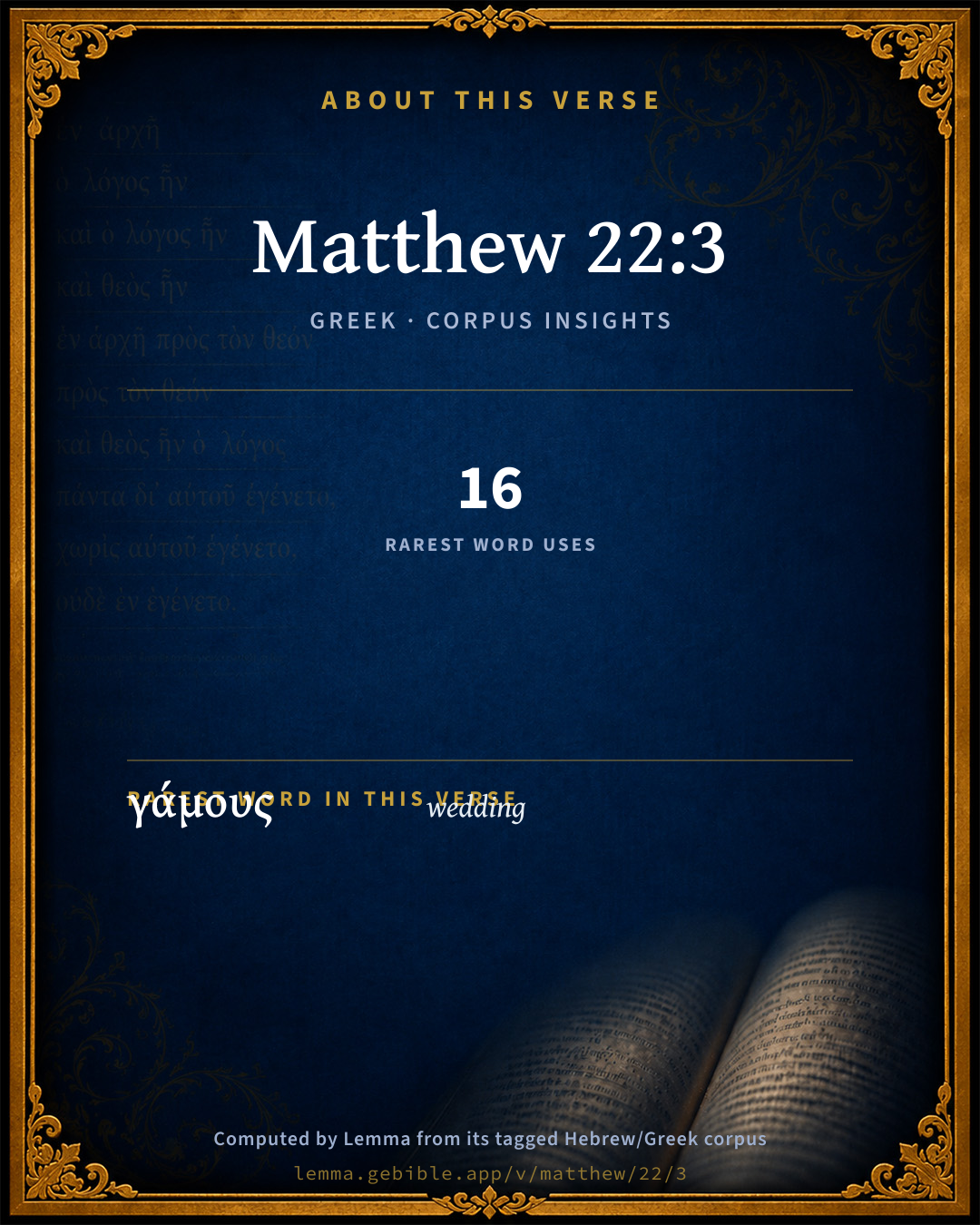
Matthew 22:3

Greek (Tischendorf 8th ed.) Matthew 22:3 appears in the Greek New Testament. The text above is from the Tischendorf 8th edition. Each word links to its Strong’s number and a concise gloss. Click any word for its full Thayer’s Greek Lexicon entry.
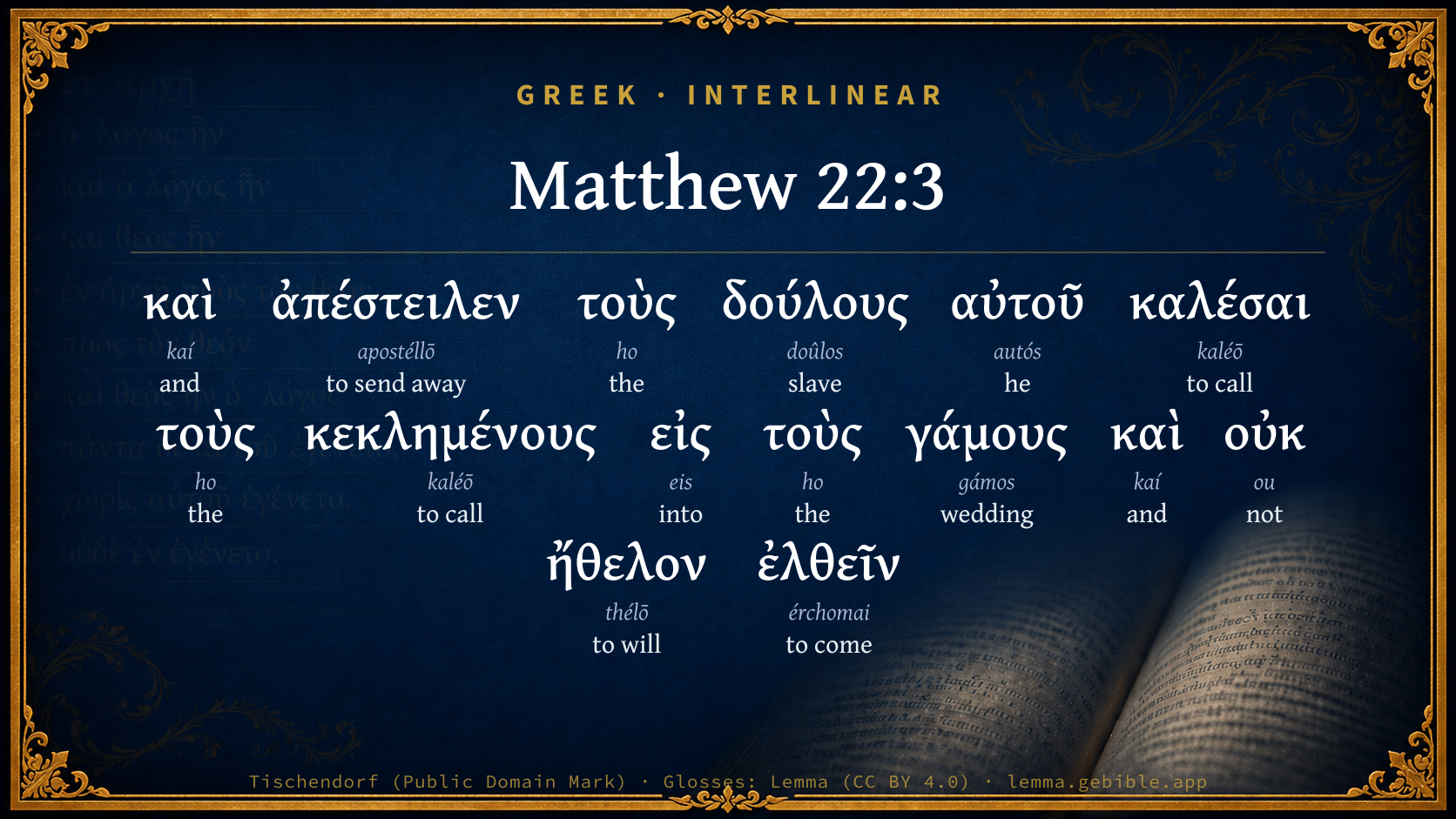
Download image
Cite this verse

Matthew 22:3 (World English Bible). Public Domain. Lemma interlinear Bible study tool, https://lemma.gebible.app/v/matthew/22/3.

Show BibTeX & RIS
BibTeX
RIS
English Translation
and sent out his servants to call those who were invited to the marriage feast, but they would not come.
World English Bible · Public Domain
Download a study sheet

One document with this verse’s original text, its word-by-word gloss line, the meaning frame, cross-references with their text, attributed commentary, and full source and license credits — printable, and it pastes into notes with its structure intact.

This verse Autodidact and up

Study sheet (.html) Plain text (.txt)

A passage Seminary Student

Up to 50 verses in one chapter. A passage sheet keeps up to 6 commentary sources and 12 cross-references per verse, in the order this page ranks them, and says so on the sheet whenever that leaves anything out. Ask for a single verse and you get the Autodidact verse sheet above.

Everything on this page stays free to read, with no account — the sheet is a download of what is already on screen, not access to it.

Want to remove ads? Support Godless Engineer
Compare translations 3

The same verse in 3 English versions, stacked beneath the original-language interlinear above. Click any original word for its lexicon entry.

Each is an independent rendering of the whole verse — the interlinear is not word-aligned to these translations.

Highlighted words mark where these versions differ — a whole-verse word diff, not a word-by-word alignment.

  • World English Bible Public Domain
    and sent out his servants to call those who were invited to the marriage feast, but they would not come.
  • King James Version Public Domain
    And sent forth his servants to call them that were bidden to the wedding: and they would not come.
  • unfoldingWord Literal Text CC BY-SA 4.0
    And he sent out his servants to call the ones having been invited to the wedding feast, and they were not willing to come.

unfoldingWord Literal Text — © unfoldingWord, licensed CC BY-SA 4.0. Word-aligned USFM3 via Door43 (git.door43.org/unfoldingWord/en_ult).

Versions to compare (up to 4)

3 of 4 selected

Show all 19 translations

Every available English version of this verse, each an independent rendering of the whole verse.

  • World English Bible Public Domain
    and sent out his servants to call those who were invited to the marriage feast, but they would not come.
  • Berean Standard Bible Public Domain
    He sent his servants to call those he had invited to the banquet, but they refused to come.
  • Majority Standard Bible Public Domain
    He sent his servants to call those he had invited to the banquet, but they refused to come.
  • King James Version Public Domain
    And sent forth his servants to call them that were bidden to the wedding: and they would not come.
  • American Standard Version (1901) Public Domain
    and sent forth his servants to call them that were bidden to the marriage feast: and they would not come.
  • Revised Version (1885) Public Domain
    and sent forth his servants to call them that were bidden to the marriage feast: and they would not come.
  • Geneva Bible (1599) Public Domain
    And sent foorth his seruants, to call them that were bidde to the wedding, but they woulde not come.
  • Douay-Rheims (1899) Public Domain
    And he sent his servants, to call them that were invited to the marriage; and they would not come.
  • Young's Literal Translation Public Domain
    and he sent forth his servants to call those having been called to the marriage-feasts, and they were not willing to come.
  • Literal Standard Version CC BY-SA 4.0
    and he sent forth his servants to call those having been called to the wedding feasts, and they were not willing to come.
  • Unlocked Literal Bible CC BY-SA 4.0
    He sent out his servants to call those who had been invited to come to the marriage feast, but they would not come.
  • unfoldingWord Literal Text CC BY-SA 4.0
    And he sent out his servants to call the ones having been invited to the wedding feast, and they were not willing to come.
  • Darby Bible Public Domain
    and sent his bondmen to call the persons invited to the wedding feast, and they would not come.
  • World Messianic Bible Public Domain
    and sent out his servants to call those who were invited to the wedding feast, but they would not come.
  • Webster's Bible Public Domain
    And sent his servants to call them that were invited to the wedding: and they would not come.
  • Free Bible Version CC BY-SA 4.0
    “He sent out his servants to everyone who was invited to the wedding to tell them to come, but they refused.
  • Bible in Basic English Public Domain
    And sent out his servants to get in the guests to the feast: and they would not come.
  • Text-Critical English NT CC BY 4.0
    He sent his servants to call those who had been invited to the wedding feast, but they would not come.
  • Tyndale New Testament (1534) Public Domain
    and sent forth his servantes to call them that were byd to the weddinge and they wolde not come.

Literal Standard Version (2020), Covenant Press — licensed CC BY-SA 4.0. Text via the HelloAO Bible API (eBible.org). Unlocked Literal Bible (unfoldingWord) — licensed CC BY-SA 4.0. Text via the HelloAO Bible API (eBible.org). unfoldingWord Literal Text — © unfoldingWord, licensed CC BY-SA 4.0. Word-aligned USFM3 via Door43 (git.door43.org/unfoldingWord/en_ult). Free Bible Version, Dr. Jonathan Gallagher — licensed CC BY-SA 4.0. Text via the HelloAO Bible API (eBible.org).

Word by word

More ways to search: Search by grammar → Find every occurrence → Compare this word →

Practice this passage: Drill this verse → Learn its vocabulary →

γάμους
gámos
G1062
“wedding”
Noun, Accusative, Plural, Masculine
Part of Speech
Noun
Case
Accusative
Number
Plural
Gender
Masculine
Full Thayer's Definition

Origin: of uncertain affinity

TDNT: 11:48,1

1. a wedding or marriage festival, a wedding banquet, a wedding feast 2. marriage, matrimony
  1. καὶ kaí G2532 “and” Conjunction
  2. ἀπέστειλεν apostéllō G649 “to send away” Verb, Aorist, Active, Indicative, 3rd person, Singular
  3. τοὺς ho G3588 “the” Article, Accusative, Plural, Masculine
  4. δούλους doûlos G1401 “slave” Noun, Accusative, Plural, Masculine
  5. αὐτοῦ autós G846 “he” Personal pronoun, Genitive, Singular, Masculine
  6. καλέσαι kaléō G2564 “to call” Verb, Aorist, Active, Infinitive
  7. τοὺς ho G3588 “the” Article, Accusative, Plural, Masculine
  8. κεκλημένους kaléō G2564 “to call” Verb, Perfect, Passive, Participle, Accusative, Plural, Masculine
  9. εἰς eis G1519 “into” Preposition
  10. τοὺς ho G3588 “the” Article, Accusative, Plural, Masculine
  11. καὶ kaí G2532 “and” Conjunction
  12. οὐκ ou G3756 “not” Particle, Negative
  13. ἤθελον thélō G2309 “to will” Verb, Imperfect, Active, Indicative, 3rd person, Plural
  14. ἐλθεῖν érchomai G2064 “to come” Verb, Aorist, Active, Infinitive

About this verse

These counts appear in no published source. They are computed here, from the morphology-tagged text and Lemma’s own curated glosses. What Lemma adds →

15
words
11
distinct lemmas
Gospels
section

Notable vocabulary

The rarest word here is γάμους wedding G1062 — appearing just 16 times in the whole Greek New Testament.

Shared distinctive vocabulary

γάμους wedding G1062 occurs in 16 verses of the Greek New Testament. Also found in:

Repetition

Words recur within this verse:

  • καλέσαι to call G2564 ×2
  • τοὺς the G3588 ×3
  • καὶ and G2532 ×2

Cross-references

28

Topical passages linked to Matthew 22:3 in the Treasury of Scripture Knowledge — connected by theme and wording, ordered by reader-vote popularity; previews shown in the World English Bible.

  • Revelation 22:17 The Spirit and the bride say, "Come!" He who hears, let him say, "Come!" He who is thirsty, let him come. He who desires, let him take the water of life freely.
  • Luke 14:15–17 When one of those who sat at the table with him heard these things, he said to him, "Blessed is he who will feast in the Kingdom of God!"
  • John 5:40 Yet you will not come to me, that you may have life.
  • Psalms 81:10–12 I am Yahweh, your God, Who brought you up out of the land of Egypt. Open your mouth wide, and I will fill it.
  • Hosea 11:7 My people are determined to turn from me. Though they call to the Most High, He certainly won't exalt them.
  • Matthew 3:2 "Repent, for the Kingdom of Heaven is at hand!"
  • Romans 10:21 But as to Israel he says, "All day long I stretched out my hands to a disobedient and contrary people."
  • 1 Samuel 9:13 as soon as you are come into the city, you shall immediately find him, before he goes up to the high place to eat; for the people will not eat until he come, because he does bless the sacrifice; [and] afterwards they eat who are invited. Now therefore get you up; for at this time you shall find him.
  • Psalms 68:11 The Lord announced the word. The ones who proclaim it are a great company.
  • Proverbs 1:24–32 Because I have called, and you have refused; I have stretched out my hand, and no one has paid attention;
  • Proverbs 9:1–3 Wisdom has built her house. She has carved out her seven pillars.
  • Isaiah 30:15 For thus said the Lord Yahweh, the Holy One of Israel, In returning and rest shall you be saved; in quietness and in confidence shall be your strength. You would not:
  • Isaiah 55:1–2 Ho, everyone who thirsts, come you to the waters, and he who has no money; come you, buy, and eat; yes, come, buy wine and milk without money and without price.
  • Jeremiah 6:16–17 Thus says Yahweh, Stand you in the ways and see, and ask for the old paths, where is the good way; and walk therein, and you shall find rest for your souls: but they said, We will not walk [therein].
  • Jeremiah 25:4 Yahweh has sent to you all his servants the prophets, rising up early and sending them, (but you have not listened, nor inclined your ear to hear),
  • Jeremiah 35:15 I have sent also to you all my servants the prophets, rising up early and sending them, saying, Return you now every man from his evil way, and amend your doings, and don't go after other gods to serve them, and you shall dwell in the land which I have given to you and to your fathers: but you have not inclined your ear, nor listened to me.
  • Hosea 11:2 They called to them, so they went from them. They sacrificed to the Baals, And burned incense to engraved images.
  • Zephaniah 1:7 Be silent at the presence of the Lord Yahweh, for the day of Yahweh is at hand. For Yahweh has prepared a sacrifice. He has consecrated his guests.
  • Matthew 10:6–7 Rather, go to the lost sheep of the house of Israel.
  • Matthew 23:37 "Jerusalem, Jerusalem, who kills the prophets, and stones those who are sent to her! How often would I have gathered your children together, even as a hen gathers her chickens under her wings, and you would not!
  • Mark 6:7–11 He called to himself the twelve, and began to send them out two by two; and he gave them authority over the unclean spirits.
  • Luke 9:1–6 He called the twelve together, and gave them power and authority over all demons, and to cure diseases.
  • Luke 13:34 "Jerusalem, Jerusalem, that kills the prophets, and stones those who are sent to her! How often I wanted to gather your children together, like a hen gathers her own brood under her wings, and you refused!
  • Luke 15:28 But he was angry, and would not go in. Therefore his father came out, and begged him.
  • Luke 19:27 But bring those enemies of mine who didn't want me to reign over them here, and kill them before me.'"
  • Acts 13:45 But when the Jews saw the multitudes, they were filled with jealousy, and contradicted the things which were spoken by Paul, and blasphemed.
  • Matthew 21:34 When the season for the fruit drew near, he sent his servants to the farmers, to receive his fruit.
  • Hebrews 12:25 See that you don't refuse him who speaks. For if they didn't escape when they refused him who warned on the Earth, how much more will we not escape who turn away from him who warns from heaven,

Cross-references courtesy of OpenBible.info (CC BY 4.0).

Commentary

Notes on Matthew 22:3 from classic Christian and Jewish commentators (each source and its license shown beneath its notes). The classic Christian expositions comment on the surrounding passage and are grouped to its opening verse, so a note may address several verses; the Jewish commentaries on the Tanakh (Rashi and others) are per-verse, so they appear only where the commentator wrote on this verse.

Lemma curates 59 commentaries, every one of them public domain or Creative Commons licensed, each selected and text-cleaned for this edition rather than reprinted as found. About our sources →

Tyndale Open Study Notes

Tyndale Open Resources

22:3-5 Those who were invited refers to the nation of Israel, who ignored God’s servants, the prophets (see study note on Matt 21:33-46).

Tyndale Open Study Notes — © Tyndale Open Resources, licensed CC BY-SA 4.0. Text via the HelloAO Bible API.

Bengel's Gnomon

Johann Albrecht Bengel

Mat 22:3. Καλέσαι τοὺς κεκλημένους, to call those that had been called) The first call was before the wedding; the second, on the day of its celebration.

Bengel's Gnomon of the New Testament — English translation (T&T Clark, Edinburgh, 1860) — public domain. Text from a community e-Sword module.

Expositor's Greek Testament

ed. W. Robertson Nicoll

Mat 22:3 . καλέσαι τοὺς κεκλημένους , to invite the already invited. This second invitation seems to accord with Eastern custom (Est 6:14 ). The first invitation was given to the people of Israel by the prophets in the Messianic pictures of a good time coming. This aspect of the prophetic ministry was welcomed. Israel never responded to the prophetic demand for righteousness , as shown in the parable of the vine-dressers, but they were pleased to hear of God’s gracious visitation in the latter days, to be invited to a feast in the indefinite future time. How they would act when the feast was due remained to be seen. τοὺς δούλους , the servants, are John the Baptist and Jesus Himself, whose joint message to their generation was: the Kingdom of Heaven is at hand, feast time at length arrived. οὐκ ἤθελον ἐλθεῖν . Israel in all her generations had been willing in a general way, quite intending to come; and the generation of John and Jesus were also willing in a general way, if it had only been the right son who was going to be married. How could they be expected to accept the obscure Nazarene for Bridegroom and Heir?

The Expositor's Greek Testament, edited by W. Robertson Nicoll (1897–1910) — public domain. Text from a community e-Sword module.

Jamieson, Fausset & Brown

Robert Jamieson, A. R. Fausset & David Brown

and sent forth his servants--representing all preachers of the Gospel.

to call them that were bidden--here meaning the Jews, who were "bidden," from the first choice of them onwards through every summons addressed to them by the prophets to hold themselves in readiness for the appearing of their King.

to the wedding--or the marriage festivities, when the preparations were all concluded.

and they would not come--as the issue of the whole ministry of the Baptist, our Lord Himself, and His apostles thereafter, too sadly showed.

Jamieson, Fausset & Brown — Commentary Critical and Explanatory on the Whole Bible (1871) — public domain (CC PDM 1.0). Text via the HelloAO Bible API.

Ellicott's Commentary for English Readers

(3) Sent forth his servants.—As in the parable of the Vineyard (Mat_21:33-46), the servants represent the aggregate work of the prophets up to the time of the Baptist. The refusal of guests invited to what seems to us so great an honour may seem, at first sight, so contrary to human nature as to be wanting in the element of dramatic probability. That refusal, however, would be natural enough, we must remember, in subjects who were in heart rebellious and disloyal; and it is precisely that character which the parable was intended to portray. The summons, it may be noted, came in the first instance to those who had long ago been “bidden” to the wedding. The proclamation of the kingdom was addressed to the Jews, who, as such, had all along been children of the kingdom.

A Bible Commentary for English Readers, edited by Charles John Ellicott (1878–1897) — public domain. Text from a community e-Sword module.

The Cambridge Bible for Schools and Colleges

gen. ed. J. J. S. Perowne

3. sent forth his servants] This was in accordance with Eastern custom. Cp. Est_5:8; Est_6:14.

servants] Or slaves. In Mat_22:13 a different Greek word is used for “servants.”

The Cambridge Bible for Schools and Colleges (gen. ed. J. J. S. Perowne; Cambridge University Press, 1878–1918) — public domain. Text from a community e-Sword module.

John Gill's Exposition

And sent forth his servants,.... The ministers of the Gospel, who are the servants of the most high God, of his choosing and ordaining, of his calling and sending, and of his qualifying and employing, and who voluntarily and cheerfully serve him; and may intend John the Baptist, and the twelve apostles of Christ, who were sent

to call them that were bidden to the wedding; "those that were called", as in Sa1 9:13 by whom are meant the Jews, who were the "bidden", or "called ones"; called of God, and therefore styled "Israel my called" Isa 48:12 and by the Targum interpreted "my bidden". They were called by the name of God, and called the people of God, and the children of God, and were the children of the kingdom; and were called to many valuable and external privileges; and had previous notice of the Gospel dispensation by the prophecies concerning Christ, and the blessings of his grace under the former dispensation; and by the ordinances and sacrifices of it, which in a very significant manner set him forth to that people; and now were called to embrace him, to receive his doctrines, and submit to his ordinances, by the ministry of John the Baptist, and the disciples of Christ. It seems, it was sometimes customary to give two invitations to a feast, or to send a second time to the persons bidden to the feast (i); to which the allusion is here;

and they would not come: which shows the insolence and ingratitude of men, their natural aversion to the Gospel, and the ordinances of it; the depravity of the will of man, with respect to things spiritual and evangelical; the insufficiency of outward means, to work with effect, upon the minds of men; and the necessity there is of efficacious and unfrustrable grace to bring men to believe in Christ, cordially to receive his truths, and be subject to his commands. There is a two fold call by the ministry the word; the one is internal, and that is, when the word comes not in word only, but in power; is the power of God unto salvation, and the savour of life unto life; for by the Gospel are the elect of God called to the obtaining of the glory of Christ; Th2 2:14. This call is of grace; it springs from the free grace and favour of God, and it is effected by the mighty power of his grace; and it is to special blessings of grace; it is a fruit of God's everlasting love, and an evidence of it; and is according to the eternal purpose of God, which is never frustrated: it is a call to the enjoyment of spiritual blessings, as peace, pardon, righteousness, and everlasting happiness; by it men are called to light and liberty, to the grace of Christ, and communion with him; to all the privileges of God's house here, and eternal glory hereafter; to which he that calls them, gives them a right and meetness, and infallibly brings them to it: and therefore it is styled an heavenly calling, and the high calling of God in Christ; for this call is ever effectual, and the ends of it are always answered; it is unchangeable, irreversible, and never repented of. But besides this, there is a bare external call to the sons of men, through the preaching of the word; which is not to make their peace with God, a thing impossible to be done by them, and which is contrary to the Gospel, and reflects dishonour on Christ, the peacemaker; nor to get an interest in him, which, wherever possessed, is given, and not gotten; nor to regenerate themselves; this is the work of the Spirit of God, and in which men are as passive, as the infant in its natural generation, conception, and birth; nor to the exercise of evangelical grace, as faith, love, &c. which are not in them, and no man can exercise that which he has not, nor should he be called to it; nor to any spiritual vital act, since men are dead in trespasses and sins, and cannot put forth any: but this call in the word, is to the natural duties of religion, as to hear, read, and pray; to attend on the word, to wait at Wisdom's gates, and watch at the posts of her door, and so lie in the way of being effectually called by the grace of God; but this call may be where election does not go before, and where sanctification does not follow, and where there may be no salvation, Mat 20:16 and is often slighted, neglected, and of no effect, which is the case here.

(i) via. Joseph. apud Grotium in loc.

John Gill's Exposition of the Whole Bible (1746–1763) — public domain (CC PDM 1.0). Text via the HelloAO Bible API.

Trapp's Complete Commentary

John Trapp

3 And sent forth his servants to call them that were bidden to the wedding: and they would not come.

Ver. 3. They would, not come] They proved recusants, and this rendered them unworthy of eternal life, Act 13:46. God’s ministers sent to call them, must turn them over to him, with a Non convertentur, uncovertable person, and let him deal with them.

John Trapp, A Commentary or Exposition upon All the Books of the Old and New Testament (1647–1656) — public domain. Text from a community e-Sword module.

Albert Barnes' Notes on the Bible

And sent forth his servants - These represent the messengers that God has sent to invite people to his kingdom.

To call them that were bidden - That is, to give notice to those who had before been invited that the feast was ready. It appears that there were two invitations - one considerably previous to the time of the feast, that they might have opportunity to prepare for it, and the other to give notice of the precise time when they were expected.

The wedding - The marriage-feast. The same word in the original as in Mat 22:2.

They would not come - They might have come if they had chosen, but they would not. So all the difficulty that sinners ever labour under in regard to salvation is in the will. It is a fixed determination not to come and be saved. See the notes at Joh 5:45.

Albert Barnes' Notes on the Bible (1834–1885) — public domain. Text from a community e-Sword/MySword module.

Haydock's Catholic Bible Commentary

His servants. John the Baptist and Christ himself, who took the form of a servant, to call such as had been formerly invited to the nuptials that were to be celebrated in his time. The Jews were invited by Moses and the prophets, and were instructed to believe that the Messias would celebrate the happy feast. On the predetermined day, they were again called by his servants, saying: Do penance; for the kingdom of heaven is at hand: come to the feast, i.e. become members of his Church, by believing in Christ. (Jansenius) --- In the same manner, St. John Chrysostom says that the Jews had been invited by the voice of the prophets, and afterwards by the Baptist, who declared to all, that Christ should increase, but that he himself should decrease. At length, they were invited by the Son in person, crying aloud to them: come to me all you that labour, and are heavily laden, and I will refresh you. (Matthew xi. 28.) And again: if any man thirst, let him come to me and drink. (St. John vii. 37.) --- and not by his words only, but by his actions also did he call them; and after his resurrection, by the ministry of Peter and the rest of the apostles (hom. lxx,) he informed the invited Jews that the banquet was ready; because the Christian religion being now established, the way to eternal happiness was laid open to mankind.

George Leo Haydock (1774–1849), Haydock's Catholic Family Bible and Commentary, 1859 edition — public domain. Excludes Psalms (Douay-Rheims chapter numbering differs from Protestant) and Deuterocanonical books (Catholic canon only).

Whedon's Commentary on the Bible

Daniel D. Whedon

3. Sent forth his servants — This verse describes the preaching of the Gospel before the death of Christ, namely, by the apostles and seventy.

Call them that were bidden — In Eastern countries a double call is given to guests at an entertainment: the first to allow them chance to prepare, and the second to inform them that the time has arrived, and all is ready. So these guests now to be called had all been bidden. The very plan of the Gospel bids every man to come; and then the ministry go forth to call those whom the Gospel has bidden.

Daniel D. Whedon (gen. ed.), Commentary on the Old and New Testaments (1874–1909) — public domain. Text from a community e-Sword module.

The Pulpit Commentary

Sent forth his servants. In the East, the original invitation to a solemn festivity is followed by reminders as the day approaches. (comp. Est_5:8 Est_6:14) The servants here are John the Baptist, the twelve apostles, the seventy, who first preached the gospel to the Jewish people. Them that were bidden. The Jews had already been invited to come in; to them already belonged "the adoption, and the glory, and the covenants... and the promises". (Rom_9:1) These early missionaries were sent to bring such things to their remembrance, and to bid them obey the call. They would not (ouk hyelon) come. Their reasons for refusal are not given here a fact which differentiates this parable from that of the great supper. A general disinclination or aversion is denoted; no actual outrage is perpetrated as yet, but the invited guests are ripening for this stage, in that they despise the King"s Son, and believe not in his Divine mission. This backwardness and obduracy recall Christ"s lamentation, "O Jerusalem, Jerusalem!". (Luk_13:34, Luk_13:35)

HOMILIES BY R. TUCK Ver. 3. Man"s ill-grounded wilfulness.

"And they would not come." There is nothing more to be said about it. They had no reasons. They offered no apologies, and no excuses. They were just wilful, stubborn, stupid; they had taken up with some unreasoning and unreasonable prejudice, and they "would not come." Dods points out that the "object of this parable is still the same (as of the previous parables), to set in a vivid light the guilt of the Jewish leaders in rejecting Christ, and the punishment which in consequence was to fall upon them." Our Lord had used a similar figure of a feast before, but then he represented those who declined the invitation as having more or less reasonable excuses. One was engaged over a farm, one over his oxen, and one over his marriage; and they were not disposed to put these aside in order to fulfil their engagements with their host. But here there are no excuses, only sheer wilfulness, which is ready to run even into rebellion and insult (see ver. 6).

I THE OPPOSITION OF THE MERELY WILFUL. Every parent knows the extreme difficulty of training a stubborn child. You cannot reason with him; you cannot persuade him. It does no good to chastise him. Many a parent is at his wits" end to know what to do with a wilful child. And what could any one hope to do with those stubborn Jerusalem officials, who had made up their minds that Jesus was an impostor, and so would heed no evidences, listen to no arguments, and yield to no persuasions? They too were invited to the gospel feast. They loudly professed their readiness to respond whenever God called. The call came; Christ brought it, and then up went their backs; "they would not come." If you trouble them with any importunity, they will turn dangerous, and insult the messengers; as these officials afterwards did Stephen, Peter, James, and Paul, All Christian workers understand the hopelessness of dealing with the stubborn and wilful. No force seems to reach them. Labour is in vain. Opposition may be overcome. Unintelligent wilfulness is hopeless.

II THE TREATMENT OF THE MERELY WILFUL. They have to be let alone, and left to suffer, and to learn by suffering. It is a hard school, and it must be a hard school, in which such persons have to learn. Our Lord even intimates that there must be a specially awakening severity of dealing with them, because that stubbornness is not mere natural disposition; it is a product of self-conceit, pride, and prejudice. It is sin, and must be punished. R.T.

The Pulpit Commentary (1880–1919), ed. H.D.M. Spence-Jones & Joseph S. Exell — public domain. Text from a community e-Sword module.

John Wesley's Explanatory Notes

Them that were invited - Namely, the Jews.

John Wesley, Explanatory Notes Upon the Whole Bible (1754–1765) — public domain. Text via the GEBible commentary corpus.

The People's New Testament

B. W. Johnson

3. Sent forth his servants to call them that were bidden to the wedding. It was the custom among the ancients for the guests to be twice invited; or rather first invited, that they might prepare themselves, and then summoned a short time before the banquet, that they might be there at the proper time. The first invitation to the Jews was given by the prophets, down to John the Baptist; the second afterwards by the apostles and other disciples in succession.

B. W. Johnson's The People's New Testament with Notes (1889–1891) — public domain. Electronic text from the Christian Classics Ethereal Library (CCEL) ThML edition.

Cambridge Greek Testament for Schools and Colleges

3. ἀπέστειλεν τοὺς δούλους. This was in accordance with Eastern custom. Cp. Est 5:8; Est 6:14.

οὐκ ἤθελον, ‘refused,’ the imperfect expresses the successive refusals: cp. singuli introducebantur, Livy X. 38.

Cambridge Greek Testament for Schools and Colleges (Cambridge University Press, 1896; 21 vols, various authors incl. Carr, Maclear, Plummer, Farrar, Lumby, Moule, M. R. James, Simcox) — public domain. Text from a community e-Sword module.

Alford’s Greek Testament

Henry Alford

3.] These δοῦλοι are not the Prophets, not the same as the servants in ch. 21:34, as generally interpreted:—the parable takes up its ground nearly from the conclusion of that former, and is altogether a New Testament parable. The office of these δοῦλοι (“κλήτορες, δειπνοκλήτορες, vocatores, invitatores,” Webst. and Wilk.) was καλέσαι τοὺς κεκλημένους, to summon those who had been invited, as was customary (see Est 5:8 and 6:14); these being the Jewish people, who had been before, by their prophets and covenant, invited. These first δοῦλοι are then the first messengers of the Gospel,—John the Baptist, the Twelve, and the Seventy,—who preached, saying ‘The Kingdom of heaven is at hand.’ And even our Lord Himself must in some sort be here included, inasmuch as He μορφὴν δοὺλου ἔλαβεν, and preached this same truth, with however the weighty addition of δεῦτε πρός με.

Henry Alford, The Greek Testament (1849–1861) — public domain. Text from a community e-Sword module.

International Critical Commentary

3. And sent his servants to call the invited (guests) to the marriage: and they were unwilling to come.]

(L)

International Critical Commentary — older volumes (1896–1929), various authors — public domain. Text from a community e-Sword module.

Vincent's Word Studies in the New Testament

Marvin R. Vincent

To call them that were bidden [καλεσαι τους κεκλημενους] . Perhaps an unconscious play on the words, lost in both A. V. and Rev., to call the called. This was according to the Oriental custom of sending a messenger, after the invitations have been issued, to notify the invited guests that the entertainment is prepared. Thus Esther invites Haman to a banquet on the morrow, and, at the actual time, the chamberlain comes to bring him to the feast (Est 5:8; Est 6:14).

Marvin R. Vincent, Word Studies in the New Testament (1887–1900) — public domain. Text from a community e-Sword/MySword module.

Lesson kit

Teaching starters — assembled from the data on this page, not authored interpretation. Every prompt links to the verse data it draws on. Edit before teaching.

Matthew, in the Gospels, opens this verse with 15 words (11 distinct Greek lemmas). Its most distinctive word is gámos (“wedding”). A historical commentator’s framing appears above. Read the whole chapter for the surrounding context.

Discussion questions

  1. How does “wedding” (gámos) shape what this verse is saying?
  2. How does Matthew 22:2, which shares the word «wedding», read alongside this verse?
  3. What does the repetition of “to call” (2× in this one verse) do in this verse?
  4. The translations on this page render this verse differently — a whole-verse word diff, not a word-by-word alignment. What might account for the different wordings?
  5. Compare how Tyndale Open Study Notes and Bengel's Gnomon read this verse. Where do they agree or differ?

Things to notice

Reading settings

Reading text

Shown beneath each verse's original-language words.

Old Testament
Old Testament edition

Read the OT as the Masoretic Hebrew (MT) or the Greek Septuagint (LXX).

English shown for the Greek Septuagint (in the Hebrew ↔ Greek comparison).

Comparing translations? Open the Compare panel on any verse page to stack up to four side by side.