
Matthew 7:3

Greek (Tischendorf 8th ed.) Matthew 7:3 appears in the Greek New Testament. The text above is from the Tischendorf 8th edition. Each word links to its Strong’s number and a concise gloss. Click any word for its full Thayer’s Greek Lexicon entry.
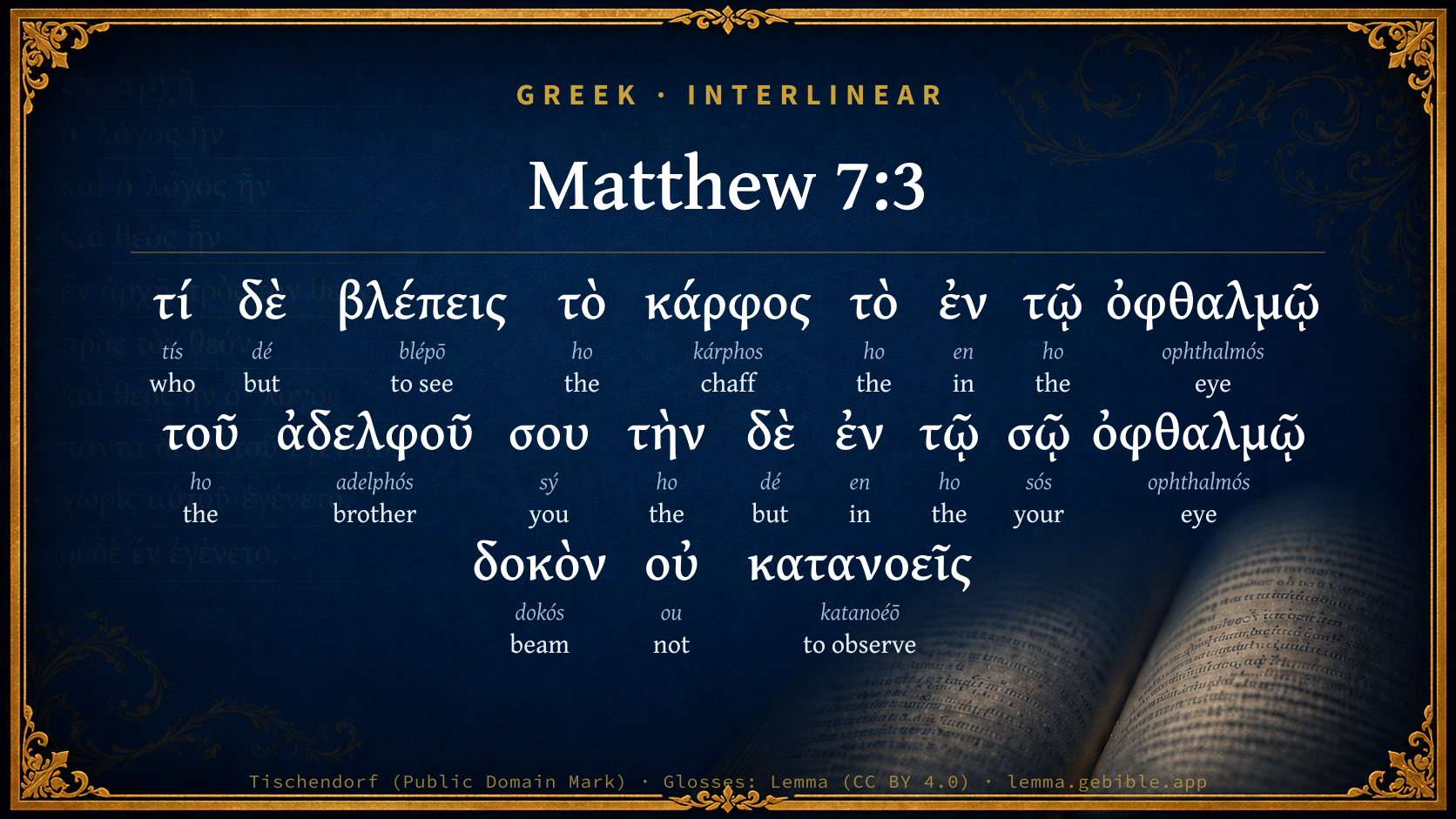
Download image
Cite this verse

Matthew 7:3 (World English Bible). Public Domain. Lemma interlinear Bible study tool, https://lemma.gebible.app/v/matthew/7/3.

Show BibTeX & RIS
BibTeX
RIS
English Translation
Why do you see the speck that is in your brother's eye, but don't consider the beam that is in your own eye?
World English Bible · Public Domain
Highlights
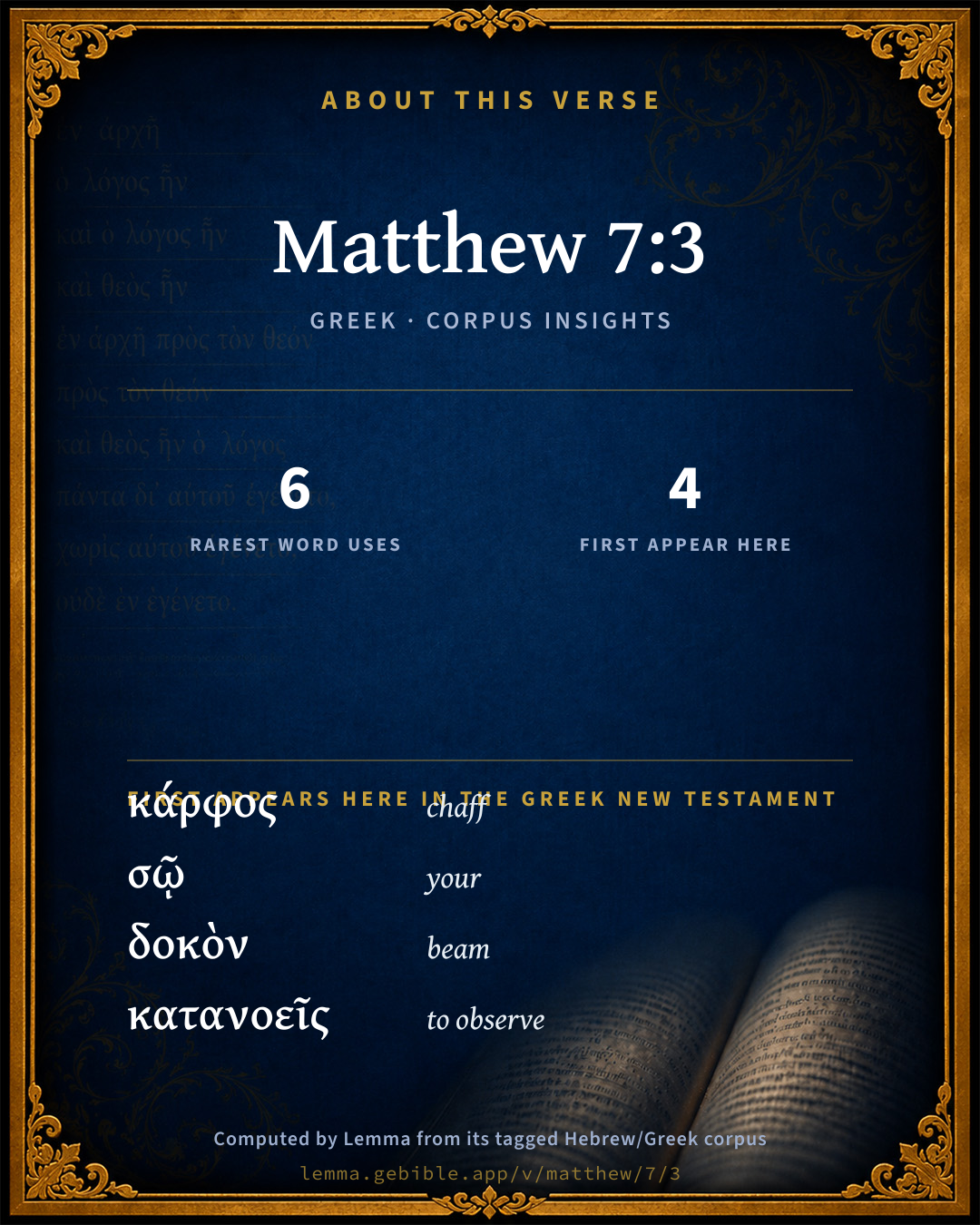
  • 4 first appearances in the Greek New Testament
Full analysis ↓
Download a study sheet

One document with this verse’s original text, its word-by-word gloss line, the meaning frame, cross-references with their text, attributed commentary, and full source and license credits — printable, and it pastes into notes with its structure intact.

This verse Autodidact and up

Study sheet (.html) Plain text (.txt)

A passage Seminary Student

Up to 50 verses in one chapter. A passage sheet keeps up to 6 commentary sources and 12 cross-references per verse, in the order this page ranks them, and says so on the sheet whenever that leaves anything out. Ask for a single verse and you get the Autodidact verse sheet above.

Everything on this page stays free to read, with no account — the sheet is a download of what is already on screen, not access to it.

Want to remove ads? Support Godless Engineer
Compare translations 3

The same verse in 3 English versions, stacked beneath the original-language interlinear above. Click any original word for its lexicon entry.

Each is an independent rendering of the whole verse — the interlinear is not word-aligned to these translations.

Highlighted words mark where these versions differ — a whole-verse word diff, not a word-by-word alignment.

  • World English Bible Public Domain
    Why do you see the speck that is in your brother's eye, but don't consider the beam that is in your own eye?
  • King James Version Public Domain
    And why beholdest thou the mote that is in thy brother's eye, but considerest not the beam that is in thine own eye?
  • unfoldingWord Literal Text CC BY-SA 4.0
    Now why do you look at the speck of wood that in the eye of your brother, but you do not notice the log in your eye?

unfoldingWord Literal Text — © unfoldingWord, licensed CC BY-SA 4.0. Word-aligned USFM3 via Door43 (git.door43.org/unfoldingWord/en_ult).

Versions to compare (up to 4)

3 of 4 selected

Show all 19 translations

Every available English version of this verse, each an independent rendering of the whole verse.

  • World English Bible Public Domain
    Why do you see the speck that is in your brother's eye, but don't consider the beam that is in your own eye?
  • Berean Standard Bible Public Domain
    Why do you look at the speck in your brother’s eye, but fail to notice the beam in your own eye?
  • Majority Standard Bible Public Domain
    Why do you look at the speck in your brother’s eye but fail to notice the beam in your own eye?
  • King James Version Public Domain
    And why beholdest thou the mote that is in thy brother's eye, but considerest not the beam that is in thine own eye?
  • American Standard Version (1901) Public Domain
    And why beholdest thou the mote that is in thy brother's eye, but considerest not the beam that is in thine own eye?
  • Revised Version (1885) Public Domain
    And why beholdest thou the mote that is in thy brother’s eye, but considerest not the beam that is in thine own eye?
  • Geneva Bible (1599) Public Domain
    And why seest thou the mote, that is in thy brothers eye, and perceiuest not the beame that is in thine owne eye?
  • Douay-Rheims (1899) Public Domain
    Any why seest thou the mote that is in thy brother's eye; and seest not the beam that is in thy own eye?
  • Young's Literal Translation Public Domain
    `And why dost thou behold the mote that `is' in thy brother's eye, and the beam that `is' in thine own eye dost not consider?
  • Literal Standard Version CC BY-SA 4.0
    And why do you behold the speck that [is] in your brother’s eye, and do not consider the beam that [is] in your own eye?
  • Unlocked Literal Bible CC BY-SA 4.0
    Why do you look at the tiny piece of straw that is in your brother's eye, but you do not notice the log that is in your own eye?
  • unfoldingWord Literal Text CC BY-SA 4.0
    Now why do you look at the speck of wood that in the eye of your brother, but you do not notice the log in your eye?
  • Darby Bible Public Domain
    But why lookest thou on the mote that is in the eye of thy brother, but observest not the beam that is in thine eye?
  • World Messianic Bible Public Domain
    Why do you see the speck that is in your brother’s eye, but don’t consider the beam that is in your own eye?
  • Webster's Bible Public Domain
    And why beholdest thou the mote that is in thy brother's eye, but considerest not the beam that is in thy own eye?
  • Free Bible Version CC BY-SA 4.0
    Why do you see the speck that's in your brother's eye? Don't you notice the plank that's in your own eye?
  • Bible in Basic English Public Domain
    And why do you take note of the grain of dust in your brother's eye, but take no note of the bit of wood which is in your eye?
  • Text-Critical English NT CC BY 4.0
    Why do yoʋ see the speck in yoʋr brother's eye, but do not consider the beam in yoʋr own eye?
  • Tyndale New Testament (1534) Public Domain
    Why seist thou a moote in thy brothers eye and perceavest not the beame that ys yn thyne awne eye.

Literal Standard Version (2020), Covenant Press — licensed CC BY-SA 4.0. Text via the HelloAO Bible API (eBible.org). Unlocked Literal Bible (unfoldingWord) — licensed CC BY-SA 4.0. Text via the HelloAO Bible API (eBible.org). unfoldingWord Literal Text — © unfoldingWord, licensed CC BY-SA 4.0. Word-aligned USFM3 via Door43 (git.door43.org/unfoldingWord/en_ult). Free Bible Version, Dr. Jonathan Gallagher — licensed CC BY-SA 4.0. Text via the HelloAO Bible API (eBible.org).

Word by word

More ways to search: Search by grammar → Find every occurrence → Compare this word →

Practice this passage: Drill this verse → Learn its vocabulary →

κάρφος
kárphos
G2595
“chaff”
Noun, Accusative, Singular, Neuter
Part of Speech
Noun
Case
Accusative
Number
Singular
Gender
Neuter
Full Thayer's Definition

Origin: from karpho (to wither)

TDNT: None

1. a dry stalk or twig, a straw 2. chaff
  1. τί tís G5101 “who” Interrogative pronoun, Accusative, Singular, Neuter
  2. δὲ dé G1161 “but” Conjunction
  3. βλέπεις blépō G991 “to see” Verb, Present, Active, Indicative, 2nd person, Singular
  4. τὸ ho G3588 “the” Article, Accusative, Singular, Neuter
  5. τὸ ho G3588 “the” Article, Accusative, Singular, Neuter
  6. ἐν en G1722 “in” Preposition
  7. τῷ ho G3588 “the” Article, Dative, Singular, Masculine
  8. ὀφθαλμῷ ophthalmós G3788 “eye” Noun, Dative, Singular, Masculine
  9. τοῦ ho G3588 “the” Article, Genitive, Singular, Masculine
  10. ἀδελφοῦ adelphós G80 “brother” Noun, Genitive, Singular, Masculine
  11. σου sý G4771 “you” Personal pronoun, 2nd person, Genitive, Singular
  12. τὴν ho G3588 “the” Article, Accusative, Singular, Feminine
  13. δὲ dé G1161 “but” Conjunction
  14. ἐν en G1722 “in” Preposition
  15. τῷ ho G3588 “the” Article, Dative, Singular, Masculine
  16. σῷ sós G4674 “your” Possessive pronoun, 2nd person, Dative, Singular, Masculine
  17. ὀφθαλμῷ ophthalmós G3788 “eye” Noun, Dative, Singular, Masculine
  18. δοκὸν dokós G1385 “beam” Noun, Accusative, Singular, Feminine
  19. οὐ ou G3756 “not” Particle, Negative
  20. κατανοεῖς katanoéō G2657 “to observe” Verb, Present, Active, Indicative, 2nd person, Singular

About this verse

These counts appear in no published source. They are computed here, from the morphology-tagged text and Lemma’s own curated glosses. What Lemma adds →

21
words
13
distinct lemmas
Gospels
section

Notable vocabulary

The rarest word here is κάρφος chaff G2595 — appearing just 6 times in the whole Greek New Testament.

First appearance in Scripture

These words make their first canonical appearance in the Greek New Testament here:

  • κάρφος chaff G2595
  • σῷ your G4674
  • δοκὸν beam G1385
  • κατανοεῖς to observe G2657

Shared distinctive vocabulary

κάρφος chaff G2595 occurs in 5 verses of the Greek New Testament. Also found in:
Repetition

Words recur within this verse:

Cross-references

7

Topical passages linked to Matthew 7:3 in the Treasury of Scripture Knowledge — connected by theme and wording, ordered by reader-vote popularity; previews shown in the World English Bible.

  • John 8:7–9 But when they continued asking him, he looked up and said to them, "He who is without sin among you, let him throw the first stone at her."
  • Galatians 6:1 Brothers, even if a man is caught in some fault, you who are spiritual must restore such a one in a spirit of gentleness; looking to yourself so that you also aren't tempted.
  • Luke 6:41–42 Why do you see the speck of chaff that is in your brother's eye, but don't consider the beam that is in your own eye?
  • 2 Samuel 12:5–6 David's anger was greatly kindled against the man, and he said to Nathan, "As Yahweh lives, the man who has done this is worthy to die!
  • Luke 18:11 The Pharisee stood and prayed to himself like this: 'God, I thank you, that I am not like the rest of men, extortioners, unrighteous, adulterers, or even like this tax collector.
  • Psalms 50:16–21 But to the wicked God says, "What right do you have to declare my statutes, That you have taken my covenant on your lips,
  • 2 Chronicles 28:9–10 But a prophet of Yahweh was there, whose name was Oded: and he went out to meet the host that came to Samaria, and said to them, Behold, because Yahweh, the God of your fathers, was angry with Judah, he has delivered them into your hand, and you have slain them in a rage which has reached up to heaven.

Cross-references courtesy of OpenBible.info (CC BY 4.0).

Commentary

Notes on Matthew 7:3 from classic Christian and Jewish commentators (each source and its license shown beneath its notes). The classic Christian expositions comment on the surrounding passage and are grouped to its opening verse, so a note may address several verses; the Jewish commentaries on the Tanakh (Rashi and others) are per-verse, so they appear only where the commentator wrote on this verse.

Lemma curates 59 commentaries, every one of them public domain or Creative Commons licensed, each selected and text-cleaned for this edition rather than reprinted as found. About our sources →

The Biblical Illustrator

Joseph S. Exell

Mat_7:3-5

The mote that is in thy brothers eye.

Three lessons stand out conspicuously in the text.

1. Close inspection of ourselves, lest any evil lurk there unobserved which we abhor in others; lest we be like the farmer whose field is overrun with weeds, who delights in pointing out the defective condition of a neighbours farm.

2. Avoidance of passing rash judgments on others.

3. Readiness to assist others in overcoming their faults. (Baring Gould, M. A.)

The beam and the mote

I. That sin may exist in man to an enormous extent, and yet he be unconscious of it-the beam. Several things tend to produce this unconsciousness.

1. Habit.

2. Association.

3. Satanic agency.

II. That however unconscious of our own sins, we may be alive to the sins of others.

1. Sin does not destroy the faculty for discerning moral distinctions.

2. The importance of Christians being circumspect in their conduct.

III. That self-improvement is a necessity qualification for the improvement of others. (Dr. David Thomas.)

Self-knowledge needful in a minister

At Wragby, in Yorkshire, in the vestry of the church is a very curious old painted window, representing in coloured glass the subject of my text; a man with a huge piece of wood before his eyes is trying diligently to extract a mere speck from the eye of another man. And this picture is most appropriately placed in the vestry, as it reminds the priest, whose ministry it is to declare to the people their faults and sins, that he should closely examine himself, lest, after he has preached to others, he himself should be a cast-away. (Baring Gould, M. A.)

Social intercourse should be free from scandal

I have got a piece of plate, probably two hundred years old, for the table at meal time. On the silver is embossed a representation of the mote and the beam; a man with a spiked log sticking into his eye is trying hard to pick a tiny grain out of the eye of another. Perhaps you may think it most inappropriate to have such a group and subject on a piece of plate before ones eyes commonly. But I do not think so. It is when families meet, or guests assemble round the board, that the characters of neighbours are most freely talked over. (Baring Gould, M. A.)

A knowledge of self gives skill in dealing with others

It is only when we have wrestled with and overcome our own besetting sins, that we have the insight and tact to direct others how to overcome theirs. Massillon, the great French preacher, was once asked where he obtained his profound knowledge of the world and of the human passions, and his skill in solving religious difficulties. From my own heart, he replied. In his endeavours after personal holiness he had met and vanquished, one by one, those bosom sins which trouble men. Their false excuses, their specious pretences, their conflicts with temptation, their weak submission to vices which they have vowed to forsake, their remorse, their fears-he knew them all from experience, and he described them as one who knew. Hence the convicting pungency of his preaching, by which the careless courtiers of Versailles were impressed, and to which Louis XIV. himself bore witness. At the close of a sermon the king said to him, I have heard several great orators, and been very much pleased with them; but every time I have heard you I have been very much displeased with myself. The ability to minister to others is acquired through faithful self-treatment.

Consistency required in the reprover

Before thou reprehend another, take heed that thou art not culpable in what thou goest about to reprehend. He that cleanses a blot with blurred fingers will make a greater blot. E yen the candle-snuffers of the sanctuary were of pure gold. (Quarles.)

Nowadays men take upon themselves to reprove others for committing such things as themselves do practise without amendment. Therefore these are like some tailors, who are busy in decking and tricking up others, but go both bare and beggarly themselves. (Henry Smith.)

If my carriage be unblamable, my counsel and reproof will be the more acceptable. Wholesome meat often is distasteful, coming out of nasty hands. A bad liver cannot be a good counsellor or bold reprover; such a man must speak softly for fear of awaking his own guilty conscience. If the bell be cracked, the sound must needs be jarring. (Swinnock.)

The vicious reproving vice, is the raven chiding blackness. (Eliza Cook.)

It is easier to judge others than to improve ourselves

Easy and ordinary is it for men to be others physicians, rather than their own. They can weed others gardens, whiles their own is overrun with nettles. But charity begins at home; and he that loves not his own soul, I will hardly trust him with mine. The usurer blames his sons pride, sees not his own extortion; and whiles the hypocrite is helping the dissolute out of the mire, he sticks in deeper himself. No marvel if, when we fix both our eyes on others wants, we lack a third to see our own. If two blind men rush one upon another in the way, either complains of others blindness, neither of his own. Thus, like mannerly guests, when a good morsel is carved us, we lay it liberally on anothers trencher, and fast ourselves. How much better were it for us to feed on our own portion! (Adams.)

The Biblical Illustrator, edited by Joseph S. Exell (c. 1880s–1900s) — public domain. Text from a community e-Sword module.

Joseph Benson's Commentary

Mat 7:3-5. And why beholdest thou the mote, &c. — In particular, why do you open your eyes to any fault of your brother, while you yourself are guilty of a much greater? — The word καρφος, here rendered mote, according to Hesychius, may signify a little splinter of wood. This, and the beam, its opposite, were proverbially used by the Jews to denote, the one, small infirmities, the other, gross, palpable faults. And how wilt thou say, &c. — With what face can you undertake to reprove others for smaller faults, while you are guilty of much greater yourself, and are neither sensible of them, nor have the integrity to amend them? Thou hypocrite, first cast out the beam, &c. — It is mere hypocrisy to pretend zeal for the amendment of others, while we have none for our own. Correct, therefore, the errors of thy judgment, and the enormities of thy life. And then — When that which obstructed thy sight is removed, thou shalt see clearly to cast out the mote out of thy brother’s eye — And mayest attempt it with more decency, and a greater probability of success. We may lay it down as a fixed and certain truth that the more we advance in genuine piety and virtue ourselves, we shall be the better able to form a correct judgment of the conduct of others, and the better qualified, both in point of skill and authority, to reprove and reform any thing that we may see amiss in their dispositions or behaviour. Our judgment of their character and actions will be the more charitable, and for that reason so much the more just: our rebukes will be the more mild, prudent, and winning; and our authority to press a reformation upon them so much the more weighty. “How happy would the world be, if all who teach the Christian religion would conscientiously observe the precept given them here by their Master.”

Joseph Benson's Commentary on the Old and New Testaments (1811–1818) — public domain. Text from a community e-Sword module.

Tyndale Open Study Notes

Tyndale Open Resources

7:3-5 Jesus exhorts his disciples to minister to others rather than condemning them. Reference to a speck (speck of dust, chip of wood) versus a log in the eye is hyperbolic imagery, intended to heighten the contrast (see 5:29; 23:23-24; cp. Mic 6:6-8).

Tyndale Open Study Notes — © Tyndale Open Resources, licensed CC BY-SA 4.0. Text via the HelloAO Bible API.

unfoldingWord translationNotes

Door43 World Missions Community

General Information:

Jesus is talking to a group of people about what they as individuals should or should not do. The instances of "you" and "your" are all singular, but in some languages they may need to be plural.

Why do you look ... brother's eye, but you do not notice the log that is in your own eye?

Jesus uses this question to rebuke the people for paying attention to other people's sins and ignoring their own. AT: "You look ... brother's eye, but you do not notice the log that is in your own eye." or "Do not look ... brother's eye and ignore the log that is in your own eye." (See: Rhetorical Question)

the tiny piece of straw that is in your brother's eye

This is a metaphor that refers to the less important faults of a fellow believer. (See: Metaphor)

tiny piece of straw

"speck" or "splinter" or "bit of dust." Use a word for the smallest thing that commonly falls into a person's eyes.

brother

All occurrences of "brother" in Mat 7:3-5 refer to a fellow believer, not to a literal brother or a neighbor.

the log that is in your own eye

This is a metaphor for a person's most important faults. A log could not literally go into a person's eye. Jesus is exaggerating to emphasize that a person should pay attention to his own more important faults before he deals with another person's less important faults. (See: Metaphor and Hyperbole and Generalization)

log

the largest part of a tree that someone has cut down

How can you say ... your own eye?

Jesus asks this question to challenge the people to pay attention to their own sins before they pay attention to another person's sins. AT: "You should not say ... your own eye." (See: Rhetorical Question)

translationWords

brother

hypocrite

unfoldingWord translationNotes — © Distant Shores Media and the Door43 World Missions Community, licensed CC BY-SA 4.0. Source: git.door43.org/Door43/en_tn.

Bengel's Gnomon

Johann Albrecht Bengel

Mat 7:3. Ἐν τῷ ὀφθαλμῷ, in the eye) In that part of the body which is the most noble, the most delicate, and the most conspicuous.—ἐν τῷ σῷ, in thine own) See Rom 2:21; Rom 2:23.

Bengel's Gnomon of the New Testament — English translation (T&T Clark, Edinburgh, 1860) — public domain. Text from a community e-Sword module.

Meyer's Critical & Exegetical Commentary

Heinrich August Wilhelm Meyer

Mat_7:3. Κάρφος, a minute fragment of twig, wood, or straw, which, in entering the eye (see Wetstein), becomes the figurative representation of a slight moral fault; δοκός, again, is the figure by which a heinous[425] fault is denoted. Comp. Lightfoot, p. 307; Buxtorf, Lex Talm. p. 2080. Tholuck prefers to find the point of comparison in the pain caused by the splinter or beam in the eye. This is inadmissible, for otherwise it could not be said, in reference to the beam in the eye, οὐ κατανοεῖς, i.e. thou perceivest not, art not aware. It is the magnitude of his own moral defects that the self-righteous man fails to discover. The brother, as in Mat_5:22. Notice, further, the arrangement of words so appropriate to the sense in the second clause.

[425] The view of Theophylact, Baumgarten-Crusius, and several others, that the beam in a mans own eye is calculated to make him conscious of his incapacity for recognising the faults of others, is foreign to the context. Luther correctly observes: That He may the more earnestly warn us, He takes a rough simile, and paints the thing before our eyes, pronouncing some such opinion as this,that every one who judges his neighbour has a huge beam in his eye, while he who is judged has only a tiny chip, (and) that he is ten times more deserving of judgment and condemnation for having condemned others.

Meyer — Critical and Exegetical Commentary on the New Testament — English translation by Peter Christie, edited by Frederick Crombie (T&T Clark, 1880) — public domain. Text from a community e-Sword module.

Expositor's Greek Testament

ed. W. Robertson Nicoll

Mat 7:3-5 . Proverb of the mote and beam . Also current among Jews and Arabs ( vide Tholuck). κάρφος , a minute dry particle of chaff, wood, etc. δοκός , a wooden beam ( let in , from δέχομαι ) or joist, a monstrous symbol of a great fault. A beam in the eye is a natural impossibility; cf. the camel and the needle eye. The Eastern imagination was prone to exaggeration. This is a case of tu quoque (Rom 2:2 ), or rather of “thou much more”. The faults may be of the same kind: κάρφος , a petty theft, δοκός , commercial dishonesty on a large scale “thou that judgest doest the same things” (Rom 2:2 ); or of a different sort: moral laxity in the publican, pride and inhumanity in the Pharisee who despised him (Luk 18:9-14 ). βλέπεις , οὐ κατανοεῖς : the contrast is not between seeing and failing to see, but between seeing and not choosing to see; ignoring, consciously overlooking. The censorious man is not necessarily ignorant of his own faults, but he does not let his mind rest on them. It is more pleasant to think of other people’s faults.

The Expositor's Greek Testament, edited by W. Robertson Nicoll (1897–1910) — public domain. Text from a community e-Sword module.

Jamieson, Fausset & Brown

Robert Jamieson, A. R. Fausset & David Brown

And why beholdest thou the mote--"splinter," here very well rendered "mote," denoting any small fault.

that is in thy brother's eye, but considerest not the beam that is in thine own eye?--denoting the much greater fault which we overlook in ourselves.

Jamieson, Fausset & Brown — Commentary Critical and Explanatory on the Whole Bible (1871) — public domain (CC PDM 1.0). Text via the HelloAO Bible API.

Adam Clarke's Commentary

Verse 3. And why beholdest thou the mote] Καρφος might be translated the splinter: for splinter bears some analogy to beam, but mote does not. I should prefer this word (which has been adopted by some learned men) on the authority of Hesychius, who is a host in such matters; Καρφος, κεραια ξυλου λεπτη, Karphos is a thin piece of wood, a splinter. It often happens that the faults which we consider as of the first enormity in others are, to our own iniquities, as a chip is, when compared to a large beam. On one side, self-love blinds us to ourselves; and, on the other, envy and malice give us piercing eyes in respect of others. When we shall have as much zeal to correct ourselves, as we have inclination to reprove and correct others, we shall know our own defects better than now we know those of our neighbour. There is a caution very similar to this of our Lord given by a heathen: -

Cum tua praevideas oculis mala lippus inunctis:

Cur in amicorum vitiis tam cernis acutum,

Quam aut aquila, aut serpens Epidaurius?

Hor. Sat. lib. 1. sat. 3. l. 25-27.

"When you can so readily overlook your own wickedness, why are you more clear-sighted than the eagle or serpent of Epidaurus, in spying out the failings of your friends?"

But the saying was very common among the Jews, as may be seen in Lightfoot.

Adam Clarke's Commentary on the Bible (1810–1826) — public domain. Text from a community e-Sword/MySword module.

Ellicott's Commentary for English Readers

(3) Why beholdest thou the mote . . .?—The Greek noun so translated means a “stalk” or “twig” rather than one of the fine particles of dust floating in the sun to which we attach the word “mote.” The illustration seems to have been a familiar one among the Jews, and a proverb all but verbally identical is found as a saying of Rabbi Tarphon. Like illustrations have been found in the proverbs and satires of every country, all teaching that men are keen-sighted as to the faults of others, blind as to their own. The Gracchi complain of sedition, and Clodius accuses others of adultery. We all need the wish—

“Oh, wad some Power the giftie gie us,

To see oursels as others see us!”

But considerest.—There is the same contrast as between “seeing” and “considering” in Mat_6:26; Mat_6:28. Our own faults require the careful scrutiny which we never give them: the faults of others we should be content to glance at.

A Bible Commentary for English Readers, edited by Charles John Ellicott (1878–1897) — public domain. Text from a community e-Sword module.

The Cambridge Bible for Schools and Colleges

gen. ed. J. J. S. Perowne

3. the mote] The English word is either connected with mite (the coin) from a Latin root (minutum), or mite (the insect) from an Anglo-Saxon root meaning “to cut,” “sever,” or from one meaning “to eat.” The Greek word = a “dry particle” of dust, wool, &c.

beholdest … considerest] It is the contrast between judging from the outside, and examination of the heart. The Greek verbs in this, and the Greek prepositions in the following verses, convey this contrast.

The Cambridge Bible for Schools and Colleges (gen. ed. J. J. S. Perowne; Cambridge University Press, 1878–1918) — public domain. Text from a community e-Sword module.

John Gill's Exposition

And why beholdest thou the mote that is in thy brother's eye?.... By "mote" is meant, any little bit of straw, or small splinter of wood, that flies into the eye, and does it damage, hinders its sight, and gives it pain; and designs little sins, comparatively speaking, such as youthful follies, human frailties, and infirmities, inadvertencies and imprudencies; which may be said to be light faults, in comparison of others: and though not to be vindicated, nor continued in, yet not to be severely looked upon and chastised. To scrutinize diligently into, aggravate, dwell upon, and sharply reprove the lighter faults of others, is a conduct, which is here inveighed against, and condemned by Christ; and more especially, when it may be said with the greatest truth and justice to such,

but considerest not the beam that is in thine own eye: by the "beam" is meant, greater sins, grosser abominations, and such as were more peculiar to the Pharisees; as pride, arrogance, a vain opinion of themselves, confidence in their own righteousness, hypocrisy, covetousness, and iniquity; things they did not advert to in themselves, when they loudly exclaimed against lesser evils in others. Such men must be of all persons inexcusable, who condemn that in others, which either they themselves do, or what is abundantly worse.

John Gill's Exposition of the Whole Bible (1746–1763) — public domain (CC PDM 1.0). Text via the HelloAO Bible API.

Trapp's Complete Commentary

John Trapp

3 And why beholdest thou the mote that is in thy brother’s eye, but considerest not the beam that is in thine own eye?

Ver. 3. And why beholdest thou] Here is the true method of preaching, by doctrine and use, explication and application. Ministers must (as our Saviour in his text) bring hammers with their nails, Jer 23:29, and drive them into the very head, yea, goad men to the quick, Ecc 12:11; that the people’s hearts may either break, as theirs, Act 2:37, or burst, as theirs, Act 7:54. A general doctrine, not applied, is as a sword without an edge, not in itself, but to us, through our singular fencelessness: or, as a whole loaf set before children, that will do them no good; the bellows will be burnt in the fire, but the dross remains still. A garment fitted for all bodies is fit for no body; and that which is spoken to all, is taken as spoken to none.

The mote that is in thy brother’s eye] The mote or straw: the word "beam" seems rather to have reference to a straw than to a mote: {a} and this is an evil disease that I have seen under the sun, that men (and those of the better sort sometimes) bear nothing, talk of nothing, so willingly, as they do of other men’s faults; Psa 50:20; "thou sittest and speakest against thy brother," &c. {b} There is no discourse that men will sit so long at and be so taken with as this. "The words of the talebearer are as flatteries, and they go down to the bowels of the belly," Pro 18:8. Many are never well, longer than they are holding their fingers in other men’s sores, amplifying and aggravating their faults and failings, not only most severely, but almost tragically; not once mentioning their good parts and practices. These are like crows, that fasten only upon carrion, or the horsefly, that if he happen into a field that is never so full of sweet flowers, yet if there be but a little filthy dung in it his eye and scent is only to that, and upon that only will he light. {c} David compareth such as these to the asp, that is quick of hearing, but very ill-sighted (having his eyes not in his forehead, but in his temples), weak, but full of poison. Herein only is the difference. That poison that asps vent to the hurt of others, they keep within them without hurt unto themselves. {d} But the malicious censurer is his own worst enemy; for as he "sets his mouth against heaven, and his tongue walketh through the earth," Psa 73:9, so by misjudging (out of an inward hatred of another) all his actions and intentions, he pulls upon himself the hatred both of heaven and earth, for his trampling upon God’s jewels, because a little sullied. God doth unwillingly see the faults of his children, Num 6:21; Num 6:23 yea, he passeth by their iniquity, transgression, and sin, Mic 7:18; with one breath both these are reported: "The high places were not removed, yet nevertheless Asa’s heart was perfect," &c. So 1Pe 3:6; cf. Gen 18:12. Sarah’s whole sentence was vile and profane; not one good word in it, but this, that she called her husband Lord. God of his goodness takes notice of that word, and records it, by St Peter, to her eternal commendation. He spieth out and severeth gold, though but a dram, from a mass of dross; good grain, though but a handful, from a heap of chaff; cuts out that which is perished (as men do out of a rotten apple) and preserves the rest. Be ye therefore followers herein of God, as dear children; and walk in love, &c., Eph 5:1-2. It thinketh not evil, but "believeth all things, hopeth all things," 1Co 13:5; strains to hold a good opinion where it hath least probability to induce it; rashly rejects none in whom it seeth signs of grace; according to that of our Saviour, "See that ye despise not one of these little ones," neither for error in judgment, Rom 14:3-10, nor for slips and infirmities in life and conversation, and that because God despiseth them not, but guards them by his angels, and sayeth them by his Son, whom he sent for the purpose, Mat 18:10-11; and 1Th 1:4; "Knowing, brethren beloved, your election of God," viz. by your effectual faith, laborious love, patient hope, {1Th 1:3} although they were so compassed with infirmities, as he doubted lest the tempter had tempted them: and his labour had been in vain, 1Th 3:5; he feared their utter apostasy. So, Heb 5:11: he could not but be persuaded of them "better things, and such as accompany salvation," though he had justly and sharply reproved them for their dulness of hearing and slowness of proceeding yea, sets before their eyes that terror of the Lord upon apostates, to quicken their pace and excite them to proficiency. "I am black," saith the Church, "but comely as the tents of Kedar as the curtains of Solomon," Son 1:5. The Kedarites dwelt in tents and open fields, where all was exposed to the parching sun in the desert but in Arabia’s deserts, and they were very rich and glorious, {see Eze 27:21; Jer 49:28; Jer 29:1-32 Isa 21:13; Isa 21:16-17} full of precious gems, gold, and pleasant odours. Arabia looked rudely yet by searching it regularly, there were to be found things of greatest price. So is it with many of God’s people, especially in the scorching heat of temptation, desertion, or outward affliction, &c. He that follows his own conjecture, may condemn a dear child of God, and approve a detestable heretic, as Philip did Simon Magus. If his eyes be too fast fixed either on the saints’ infirmities or the hypocrites’ fair pretences, they may bring forth, as Jacob’s shoe did, spotted fruits.

But considerest not the beam that is in thine own eye] Most men’s minds are as ill set as the eyes; they can turn neither of them inwards. They tell us of a kind of witches, that stirring abroad would put on their eyes, but returning home, they boxed them up again. {e} The philosophers call upon us to look to the hinder part of the wallet. And St James saith, "Be not many masters" or teachers: and mark the reason, which he prescribeth as a remedy; "for in many things we sin all," Jas 3:1-2. Now those that in the sense of their own sinfulness are poor in spirit, will soon be meek and merciful to their fellow sinners; they that have proved their own works, and found all to be (not good and very good, as God did his, but) naught and stark naught, as the figs in Jeremiah, {Jer 24:2} will be content to bear one another’s burdens, and restore such as are overtaken in a fault with the spirit of meekness, considering themselves lest they also be tempted, Gal 6:1-2; Gal 6:4. They will be as willing to lend mercy now, as they may have need to borrow mercy another time {f} And consciousness of their own corruptions will make them compassionate towards others in this kind. The Greek word that signifieth to censure, signifieth also, and in the first place, to be idle. {g} Whereunto agreeth that of St Paul (speaking of wanton widows), "they learn to be idle, wandering about from house to house: and not only idle, but tattlers also, and busy bodies, speaking of things that they ought not," 1Ti 5:13. Those that travel not with their own hearts, have both leisure and list to be meddling with others.

{a} Generaliter significat quod siccum et leve est. Tertullianus stipulam vertit.

{b} Vituperant homines quam commendant promptius. Plaut.

{c} Vultures ad male olentla feruntur. Basil.

{d} Aspidi hebetes oculi dati, eosque non in fronte sed in temporibus habet. Pliny, 16. 14. Non est huic similis malitia, haec habentibus pessima est. Seneca.

{e} Lamiae apud Plinium.

{f} Erratis veniam poscenti reddere par est. Hor.

{g} Αργεω, arguo, proprie ferior, post, reprehendo. Becman.

John Trapp, A Commentary or Exposition upon All the Books of the Old and New Testament (1647–1656) — public domain. Text from a community e-Sword module.

Albert Barnes' Notes on the Bible

And why beholdest thou the mote ... - A mote signifies any “light substance,” as dry chaff, or fine spires of grass or grain. It probably most usually signified the small “spiculae” or “beards” on a head of barley or wheat. It is thus placed in opposition to the word “beam.”

Beam - The word used here signifies a large piece of squared timber. The one is an exceedingly small object, the other a large one. The meaning is, that “we are much more quick and acute to judge of small offences in others, than of much larger offences in ourselves.” Even a very “small” object in the eye of another we discern much more quickly than a much larger one in our own; a small fault in our neighbor we see much more readily than a large one in ourselves. This was also a proverb in frequent use among the Jews, and the same sentiment was common among the Greeks, and deserves to be expressed in every language.

Albert Barnes' Notes on the Bible (1834–1885) — public domain. Text from a community e-Sword/MySword module.

Haydock's Catholic Bible Commentary

"Mote and beam," light and grievous sins. (Menochius)

George Leo Haydock (1774–1849), Haydock's Catholic Family Bible and Commentary, 1859 edition — public domain. Excludes Psalms (Douay-Rheims chapter numbering differs from Protestant) and Deuterocanonical books (Catholic canon only).

Matthew Poole's English Annotations

Whether the word translated mote signifieth a mote or a splinter, is of no great concern to know. Our Saviour expounded this text, when he said to the Pharisees, bringing him a woman taken in adultery: Let him that is guiltless throw the first stone. So doth the apostle Paul, Rom 2:1. The text teacheth us these lessons:

1. That those who are most censorious of others, are usually more notorious and culpable themselves, if not for the same sins, yet for others of equal if not greater magnitude.

2. That it is notorious hypocrisy to spy smaller faults in others, and not to see greater in ourselves.

3. That it is notorious impudence to pretend to censure and judge others for sins in which we live ourselves.

4. That there is no such way to teach us charity in not hastily, rashly, or too severely judging others, as to look first into our own hearts and ways, and seeing if we have not the same or greater failings. Our charity in this kind should begin at home.

Matthew Poole's English Annotations on the Holy Bible (1683–1685) — public domain. Text from a community e-Sword/MySword module.

Whedon's Commentary on the Bible

Daniel D. Whedon

3. Mote… beam… eye — The mote is a small splinter, and the beam is a whole rafter. The eye is the man’s judging or opining faculty. The mote and the beam are the interferences to our seeing or judging things purely and fairly. Thy brother’ s eye… thy own — Thou perceivest on thy own selfish judgment-seat that thy brother has very absurd opinions; he sees things very strangely; it is because of that little splinter in his eye; take it out. Alas! there is no splinter there. What thou seest is only the image of a whole timber in thine own eye reflected into his. That timber is made by some moral mistake, some selfish passion of thine own. Perhaps when thou hast pitched the lumber out of thy own optics, thou wilt find the splinter gone from his.

Daniel D. Whedon (gen. ed.), Commentary on the Old and New Testaments (1874–1909) — public domain. Text from a community e-Sword module.

The Pulpit Commentary

Vers. 3-5. The heinousness of censoriousness as a hindrance to one"s self and to one"s work for others.

Parallel Passage:Luk_6:41. And why when it is so contrary to common sensebeholdest thou the mote, etc.? A Jewish proverbial saying, e.g. Talm. Bab., "Bab. Bathra," 15b, Rabbi Jochanan (third century A.D.), expounding Rth_1:1, says, "A generation which when under judgment (fp judgeth its judges. When one saith to a man, Cast out the mote out of thine eyes, he saith (in answer), Cast out the beam out of thine eyes." In Talm. Bab., "Erach.," 16 b, "Out of thy teeth" seems to be the right reading. In these verses the "eye" is usually taken as belonging solely to the illustration, and as not itself representing any one object. It may be so, but it has been used so recently (Mat_6:22) of the spiritual sense that it is more natural to take it so here. In this case the thought of the passage is of faults existing in a man"s spiritual sense hindering his spiritual vision. The censorious man sees any fault, however small, readily enough in others, but does not see the much greater fault which he himself as a matter of fact has his own censoriousness. This censoriousness is not a slight, but a great hindrance to his own spiritual vision, much more to his being of use in removing hindrances from the eye of another. The mote; to kardov ; Latt. festucam; any small vegetable body. The English word is from the Anglo-Saxon mot, "a small particle". (cf. further Luk_6:41, note) Observe that our Lord allows that there is something wrong with the brother"s spiritual vision, just as he allows that the unmerciful servant had a real debt owing to him. That is in thy brother"s eye. (Mat_5:22, note) Our Lord is here speaking of the relation of believers to fellow-believers. He tacitly contrasts the censoriousness of the Pharisees towards fellow-Jews. (Joh_7:49) But considerest not (ou katanoeiv). With any attention of mind; contrast Rom_4:19 (Abraham gave earnest consideration to his own age, and yet believed). The beam. So huge a piece of wood is there in thine own eye. That is in thine own eye. The order of the Greek lays still more emphasis on the fact that, though in thy very own eye there is a beam, thou payest no regard to that (cf. ver. 5, note).

Vers. 3-5. The confronting question.

The question or questions of these verses arise only too directly out of the matter that immediately precedes. The habit, so human, of sitting in judgment on our fellow-beings is almost invariably aggravated by" other satellite habits, also very human, and that fail to amaze and to shame us only by reason of our too intimate familiarity with them. Thus

I LITTLE FAULTS IN OTHERS WE SEE VERY LARGE, AND LARGE FAULTS IN OURSELVES WE SEE VERY LITTLE.

II LITTLE FAULTS IN OTHERS WE SEE VERY LARGE, FOR THE BLAMABLE REASON THAT LARGE FAULTS IN OURSELVES WE SEE VERY LITTLE.

III THE LARGE FAULTS OF OURSELVES ARE IN A CERTAIN WAY MEASURABLE, AND THIS THE MEASURE OF THEM THEY ARE OF JUST THE SIZE TO BLOCK OUR VISION OF ALL THAT IS OUR FIRST DUTY TO "CONSIDER," i.e. OF ALL THAT IS AS NEAR TO US AS OURSELVES.

IV THEY DO AS A MATTER OF FACT BLOCK THAT VISION SO SADLY EFFECTUALLY, THAT THOUGH LABOURING UNDER ALL OUR OWN PERSONAL DEPRIVATION, WE PROFFER PATRONIZINGLY TO DO THAT OFFICE FOR OUR NEIGHBOUR WHICH ONE PUT THE PUREST VISION IS QUALIFIED TO DO, AND NOTHING BUT THE IMPURITY OF PHARISAIC SELFCONCEIT WOULD PRESUME TO VOLUNTEER OR DARE TO ESSAY EXCEPT ON SOLICITOUS ENTREATY. B.

Honest self-estimates.

It is plain that our Lord"s figure is paradoxical. Beams of wood in eyes is quite an impossible conception; and when he spoke of it it must have caused a smile. With a curious realism, the old Bible picture represents a man with a long beam of wood, standing straight out from his eye, and unsupported. Our Lord"s teachings require to be read with our faculty of imagination in healthy activity. Probably in this case our Lord used a familiar Jewish proverb, which satirized men"s readiness to espy small faults in others while they overlook large ones in themselves. Note that ophthalmic is very prevalent in the East, caused by the], articles floating in the dry atmosphere. The similar rabbinical saying is thus given: "I wonder if there is any one in this generation who would take reproof. It one said, "Take the mote out of thine eye," he would answer, "Take the beam from out of thine own eye.

I HONEST SELF-ESTIMATES ARE DIFFICULT TO MAKE. Burns writes"O wad some power the giftie gie us, To see oursels as others see us:

But just that power is generally lacking. We all think we know other people well; we all, in fact, know ourselves most imperfectly. Many a man has been humiliatingly surprised to discover that the fault which he most blamed, and had least mercy on, in others, was his own characteristic failing. The inscription may be put on the Greek temple, "Know thyself;" but that is precisely what the people, who walk the pavements below, are not interested in doing. We all prefer to keep our self-delusions concerning our own excellences. A man must deal resolutely with himself who means to know the truth about himself. Honest self-estimates prove

(1) surprising;

(2) humbling;

(3) they culture gentleness and charity toward others.

Every man has his failing his "beam in the eye.

II HONEST SELF-ESTIMATES ARE INFLUENTIAL WHEN MADE. What our Lord intimates is that, if a man discovers his own beam, he will be so concerned about it, and so busy over it, that he will pay no particular attention to his neighbour"s mote. And if it should come to be his duty to point out that mote, he will remember that is but a mote in comparison with his own beam. The man who sees his own sin aright, and reads it in the light of its inspiring motives, can never see his brother"s sin to be as big as his own. "Men who see into their neighbours are very apt to be contemptuous;" that is, when the feeling of their own beam does not hopefully influence their vision. R.T.

The Pulpit Commentary (1880–1919), ed. H.D.M. Spence-Jones & Joseph S. Exell — public domain. Text from a community e-Sword module.

John Wesley's Explanatory Notes

In particular, why do you open your eyes to any fault of your brother, while you yourself are guilty of a much greater? The mote - The word properly signifies a splinter or shiver of wood. This and a beam, its opposite, were proverbially used by the Jews, to denote, the one, small infirmities, the other, gross, palpable faults. Luke vi, 41.

John Wesley, Explanatory Notes Upon the Whole Bible (1754–1765) — public domain. Text via the GEBible commentary corpus.

Kretzmann's Popular Commentary

Paul E. Kretzmann

The proverb of the mote and the beam:

v. 3. And why beholdest thou the mote that is in thy brother’s eye, but considerest not the beam that is in thine own eye?

v. 4. Or how wilt thou say to thy brother, Let me pull out the mote out of thine eye, and, behold, a beam is in thine own eye?

v. 5. Thou hypocrite, first cast out the beam out of thine own eye, and then shalt thou see clearly to cast out the mote out of thy brother’s eye.

This example or parable is an excellent comparison to bring out with the proper emphasis the warning against uncharitable judging. The mote, the tiny particle of dust, of wood, or of chaff, in the eye of another, is readily seen and commented upon, with many offers of assistance to remove the disagreeable object. But at the same time, the wooden beam, the log or joist, in one’s own eye causes no discomfort, is, in fact, not even noticed. The Lord purposely uses an exaggeration to impress His admonition on the minds of His hearers, and we cannot weaken His picture by substituting "splinter" for "beam. " The contrast is essential for the success of His teaching. A petty theft is widely advertised, but commercial dishonesty and grafting is overlooked for reasons of policy; a single unguarded expression is severely blamed, but the continual use of blasphemous epithets goes without a rebuke. And the hypocrisy stands out all the more glaringly on account of the feigned sympathy: Permit me, hold still a minute!—as though the most disinterested, charitable motives were behind the question. In righteous indignation Christ calls such an offender a hypocrite, Psa 50:16, a base pretender at sanctification, and bids him above all remove the greater obstruction out of his own eye. After that he may consider, set himself the task, make a careful survey as to the need and possibility of, removing the mote out of the neighbor’s eye. Let everyone first watch over the reformation of his own life. Then his tendency toward uncharitable criticism will be reduced considerably, and he will be in better position to be of assistance, kindly and carefully, to a brother that may be guilty of a fault.

Paul E. Kretzmann, Popular Commentary of the Bible (1921–1924) — public domain. Text from a community e-Sword module.

Burkitt's Expository Notes on the New Testament

William Burkitt

By the mote in our brother’s eye, is to be understood small and little sins, or some supposed sins: by the beam in our own eye, is meant some notorious sin of our own.

Learn, 1. That those who are most censorious of the lesser infirmities of others, are usually most notoriously guilty of far greater failings themselves.

2. That those who desire others should look upon their infirmities with a compassionate eye, must not look upon the failings of others with a censorious eye.

3. That there is no such way to teach us charity in judging others, as to exercise severity in judging ourselves.

William Burkitt's Expository Notes on the New Testament (1700–1703) — public domain. Text from a community e-Sword module.

The People's New Testament

B. W. Johnson

3. Why beholdest thou the mote that is in thy brother's eye? The Lord uses a figure to show the absurdity of judging severely the faults of others, while we have greater ones. The term translated “mote” means a little splinter, while the beam is something very large.

B. W. Johnson's The People's New Testament with Notes (1889–1891) — public domain. Electronic text from the Christian Classics Ethereal Library (CCEL) ThML edition.

Cambridge Greek Testament for Schools and Colleges

3. βλέπεις. Of seeing the external surface of a thing contrasted with κατανοεῖς, which implies thoughtful perception. It is the contrast between judging from the outside and examination of the heart.

κάρφος. A ‘twig,’ ‘splinter,’ dry particle of hay (κάρφη Xen. Anab. I. 5, 10), straw, &c. Cp. Aristoph. Av. 641, εἰσέλθετʼ ἐς νεοττίαν τε τὴν ἐμὴν | καὶ τἀμὰ κάρφη καὶ τὰ παρόντα φρύγανα.

τὴν ἐν τῷ σῷ ὀφθαλμῷ δοκόν. Which (1) ought to prevent condemnation of another for a less grave offence; and which (2) would obscure the spiritual discernment, and so render thee an incapable judge. The Pharisaic sin of hypocrisy (see next verse) was deeper and more fatal to the spiritual life than the sins which the Pharisee condemned.

δοκόν. From δέχομαι, in the sense of receiving, = ‘a beam let in’; cp. ἱστοδόκη, and Hom. Il. XVII. 744, ἢ δοκὸν ἠὲ δόρυ μέγα νήϊον. See also Aristoph. Vesp. 201. The word appears to be Homeric and vernacular, not used in literary language.

Cambridge Greek Testament for Schools and Colleges (Cambridge University Press, 1896; 21 vols, various authors incl. Carr, Maclear, Plummer, Farrar, Lumby, Moule, M. R. James, Simcox) — public domain. Text from a community e-Sword module.

Alford’s Greek Testament

Henry Alford

3-5.] Lightfoot produces instances of this proverbial saying among the Jews. With them, however, it seems only to be used of a person retaliating rebuke. ‘Dixit Rabbi Tarphon, Miror ego, an sit in hoc sæculo, qui recipere vult correptionem; quin si dicat quis alteri, Ejice stramen ex oculo tuo, responsurus ille est, Ejice trabem ex oculo tuo:’—whereas our Lord gives us a further application of it, viz. to the incapability of one involved in personal iniquity to form a right judgment on others, and the clearness given to the spiritual vision by conflict with and victory over evil. There is also no doubt here a lesson given us of the true relative magnitude which our own faults, and those of our brother, ought to hold in our estimation. What is a κάρφος to one looking on another, is to that other himself a δοκός: just the reverse of the ordinary estimate.

τὸ κάρ. and ἡ δοκ., not as referring to a known proverb, but because the mote and beam are in situ, ἐν τῷ ὀφθαλμῷ.

βλέπεις, beholdest, from without, a voluntary act: οὐ κατανοεῖς, apprehendest not, from within, that which is already there, and ought to have excited attention before. The same distinction is observed in Luke.

Henry Alford, The Greek Testament (1849–1861) — public domain. Text from a community e-Sword module.

International Critical Commentary

3. And why dost thou behold the mote that is in the eye of thy brother, and considerest not the beam which is in thine own eye ?] Lk. has the same, with a slight variation in order. Cf. Arachin 16b where R. Tarphon (end first cent. a.d.) says: “If one says, Take the mote from thy eye; he answers, Take the beam from thine eye.”

The thought is, that so far from judging others, a man should consider that in himself which will expose him to judgement.

(L)

International Critical Commentary — older volumes (1896–1929), various authors — public domain. Text from a community e-Sword module.

Vincent's Word Studies in the New Testament

Marvin R. Vincent

Beholdest [βλεπεις] . Staring at from without, as one who does not see clearly.

Considerest [κατανοεις] . A stronger word, apprehendest from within, what is already there.

Mote [καρφος] . A. V. and Rev. The word mote, however, suggests dust; whereas the figure is that of a minute chip or splinter, of the same material with the beam. Wyc. renders festu, with the explanation, a little mote. In explaining the passage it is well to remember that the obstruction to sight is of the same material in both cases. The man with a great beam in his eye, who therefore can see nothing accurately, proposes to remove the little splinter from his brother 's eye, a delicate operation, requiring clear sight. The figure of a splinter to represent something painful or annoying is a common oriental one. Tholuck (" Sermon on the Mount ") quotes from the Arabic several passages in point, and one which is literally our Lord 's saying : "How seest thou the splinter in thy brother 's eye, and seest not the cross - beam in thine eye ?"

Beam [δοκον] . A log, joist, rafter; indicating a great fault.

Marvin R. Vincent, Word Studies in the New Testament (1887–1900) — public domain. Text from a community e-Sword/MySword module.

Lesson kit

Teaching starters — assembled from the data on this page, not authored interpretation. Every prompt links to the verse data it draws on. Edit before teaching.

Matthew, in the Gospels, opens this verse with 21 words (13 distinct Greek lemmas). Its most distinctive word is kárphos (“chaff”). A historical commentator’s framing appears above. Read the whole chapter for the surrounding context.

Discussion questions

  1. What does “chaff” (kárphos) contribute to the verse as a whole?
  2. 4 words here appear for the first time in Scripture. What is being introduced at this debut?
  3. Matthew 7:4 shares the word «chaff» with this verse. How do the two illuminate each other?
  4. “eye” occurs 2× in this one verse. What is the effect of the repetition?
  5. The translations on this page render this verse differently — a whole-verse word diff, not a word-by-word alignment. What might account for the different wordings?
  6. Reading how The Biblical Illustrator and Joseph Benson's Commentary read this verse, where do the two commentators agree and where do they part?

Things to notice

  • 4 words make their first canonical appearance in Scripture here.
  • These translations choose different wording for 18 words in this verse.
  • “eye” occurs 2× in this single verse.
  • 13 distinct Greek lemmas span 21 words in this verse.

Reading settings

Reading text

Shown beneath each verse's original-language words.

Old Testament
Old Testament edition

Read the OT as the Masoretic Hebrew (MT) or the Greek Septuagint (LXX).

English shown for the Greek Septuagint (in the Hebrew ↔ Greek comparison).

Comparing translations? Open the Compare panel on any verse page to stack up to four side by side.