Matthew 12:7

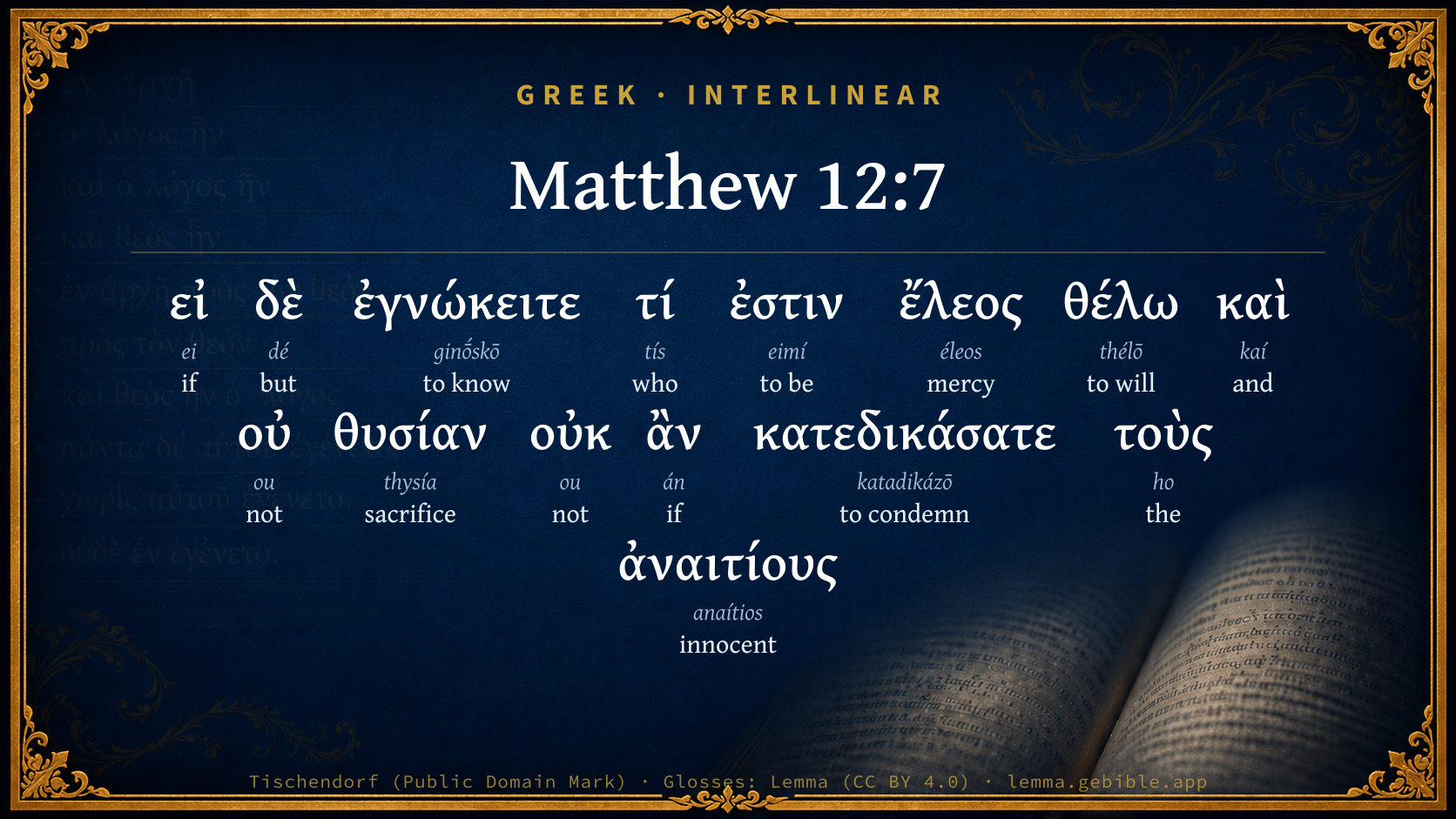
Greek (Tischendorf 8th ed.) Matthew 12:7 appears in the Greek New Testament. The text above is from the Tischendorf 8th edition. Each word links to its Strong’s number and a concise gloss. Click any word for its full Thayer’s Greek Lexicon entry.
Download image
Cite this verse

Matthew 12:7 (World English Bible). Public Domain. Lemma interlinear Bible study tool, https://lemma.gebible.app/v/matthew/12/7.

Show BibTeX & RIS
BibTeX
RIS
English Translation
But if you had known what this means, 'I desire mercy, and not sacrifice,' you would not have condemned the guiltless.
World English Bible · Public Domain
Highlights
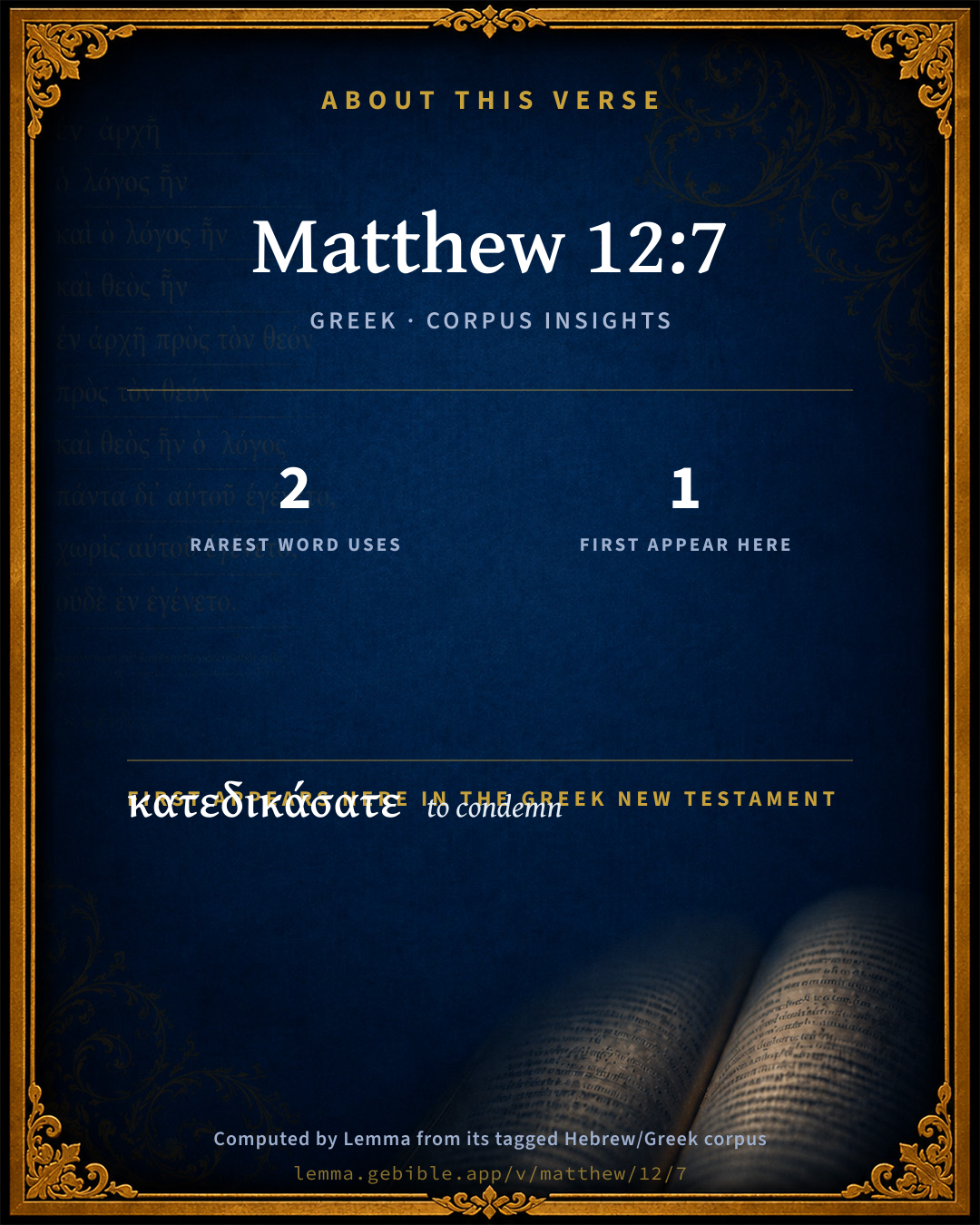
  • 1 first appearance in the Greek New Testament
Full analysis ↓
Download a study sheet

One document with this verse’s original text, its word-by-word gloss line, the meaning frame, cross-references with their text, attributed commentary, and full source and license credits — printable, and it pastes into notes with its structure intact.

This verse Autodidact and up

Study sheet (.html) Plain text (.txt)

A passage Seminary Student

Up to 50 verses in one chapter. A passage sheet keeps up to 6 commentary sources and 12 cross-references per verse, in the order this page ranks them, and says so on the sheet whenever that leaves anything out. Ask for a single verse and you get the Autodidact verse sheet above.

Everything on this page stays free to read, with no account — the sheet is a download of what is already on screen, not access to it.

Want to remove ads? Support Godless Engineer
Compare translations 3

The same verse in 3 English versions, stacked beneath the original-language interlinear above. Click any original word for its lexicon entry.

Each is an independent rendering of the whole verse — the interlinear is not word-aligned to these translations.

Highlighted words mark where these versions differ — a whole-verse word diff, not a word-by-word alignment.

  • World English Bible Public Domain
    But if you had known what this means, 'I desire mercy, and not sacrifice,' you would not have condemned the guiltless.
  • King James Version Public Domain
    But if ye had known what this meaneth, I will have mercy, and not sacrifice, ye would not have condemned the guiltless.
  • unfoldingWord Literal Text CC BY-SA 4.0
    But if you had known what this is, ‘I desire mercy and not sacrifice,’ you would not have condemned the innocent.

unfoldingWord Literal Text — © unfoldingWord, licensed CC BY-SA 4.0. Word-aligned USFM3 via Door43 (git.door43.org/unfoldingWord/en_ult).

Versions to compare (up to 4)

3 of 4 selected

Show all 19 translations

Every available English version of this verse, each an independent rendering of the whole verse.

  • World English Bible Public Domain
    But if you had known what this means, 'I desire mercy, and not sacrifice,' you would not have condemned the guiltless.
  • Berean Standard Bible Public Domain
    If only you had known the meaning of ‘I desire mercy, not sacrifice,’ you would not have condemned the innocent.
  • Majority Standard Bible Public Domain
    If only you had known the meaning of ‘I desire mercy, not sacrifice,’ you would not have condemned the innocent.
  • King James Version Public Domain
    But if ye had known what this meaneth, I will have mercy, and not sacrifice, ye would not have condemned the guiltless.
  • American Standard Version (1901) Public Domain
    But if ye had known what this meaneth, I desire mercy, and not sacrifice, ye would not have condemned the guiltless.
  • Revised Version (1885) Public Domain
    But if ye had known what this meaneth, I desire mercy, and not sacrifice, ye would not have condemned the guiltless.
  • Geneva Bible (1599) Public Domain
    Wherefore if ye knewe what this is, I will haue mercie, and not sacrifice, ye would not haue condemned the innocents.
  • Douay-Rheims (1899) Public Domain
    And if you knew what this meaneth: I will have mercy, and not sacrifice: you would never have condemned the innocent.
  • Young's Literal Translation Public Domain
    and if ye had known what is: Kindness I will, and not sacrifice -- ye had not condemned the blameless,
  • Literal Standard Version CC BY-SA 4.0
    and if you had known what [this] is: Kindness I will, and not sacrifice—you had not condemned the blameless,
  • Unlocked Literal Bible CC BY-SA 4.0
    If you had known what this meant, 'I desire mercy and not sacrifice,' you would not have condemned the guiltless.
  • unfoldingWord Literal Text CC BY-SA 4.0
    But if you had known what this is, ‘I desire mercy and not sacrifice,’ you would not have condemned the innocent.
  • Darby Bible Public Domain
    But if ye had known what is: I will have mercy and not sacrifice, ye would not have condemned the guiltless.
  • World Messianic Bible Public Domain
    But if you had known what this means, ‘I desire mercy, and not sacrifice,’ you wouldn’t have condemned the guiltless.
  • Webster's Bible Public Domain
    But if ye had known what this meaneth, I will have mercy, and not sacrifice, ye would not have condemned the guiltless.
  • Free Bible Version CC BY-SA 4.0
    If you'd known the meaning of this Scripture, ‘I want mercy, and not sacrifice,’ you wouldn't have condemned those who are innocent.
  • Bible in Basic English Public Domain
    But if these words had been in your minds, My desire is for mercy and not for offerings, you would not have been judging those who have done no wrong.
  • Text-Critical English NT CC BY 4.0
    But if you had known what this means: ‘I desire mercy and not sacrifice,’ you would not have condemned the guiltless.
  • Tyndale New Testament (1534) Public Domain
    Wherfore yf ye had wist what this sayinge meneth: I require mercy and not sacrifice: ye wold never have condemned innocetes.

Literal Standard Version (2020), Covenant Press — licensed CC BY-SA 4.0. Text via the HelloAO Bible API (eBible.org). Unlocked Literal Bible (unfoldingWord) — licensed CC BY-SA 4.0. Text via the HelloAO Bible API (eBible.org). unfoldingWord Literal Text — © unfoldingWord, licensed CC BY-SA 4.0. Word-aligned USFM3 via Door43 (git.door43.org/unfoldingWord/en_ult). Free Bible Version, Dr. Jonathan Gallagher — licensed CC BY-SA 4.0. Text via the HelloAO Bible API (eBible.org).

Word by word

More ways to search: Search by grammar → Find every occurrence → Compare this word →

Practice this passage: Drill this verse → Learn its vocabulary →

ἀναιτίους
anaítios
G338
“innocent”
Adjective, Accusative, Plural, Masculine
Part of Speech
Adjective
Case
Accusative
Number
Plural
Gender
Masculine
Full Thayer's Definition

Origin: from G1 (as a negative particle) and G159 (in the sense of G156 )

TDNT: None

1. guiltless, innocent
  1. εἰ ei G1487 “if” Conditional
  2. δὲ dé G1161 “but” Conjunction
  3. ἐγνώκειτε ginṓskō G1097 “to know” Verb, Pluperfect, Active, Indicative, 2nd person, Plural
  4. τί tís G5101 “who” Interrogative pronoun, Nominative, Singular, Neuter
  5. ἐστιν eimí G1510 “to be” Verb, Present, Active, Indicative, 3rd person, Singular
  6. ἔλεος éleos G1656 “mercy” Noun, Accusative, Singular, Neuter
  7. θέλω thélō G2309 “to will” Verb, Present, Active, Indicative, 1st person, Singular
  8. καὶ kaí G2532 “and” Conjunction
  9. οὐ ou G3756 “not” Particle, Negative
  10. θυσίαν thysía G2378 “sacrifice” Noun, Accusative, Singular, Feminine
  11. οὐκ ou G3756 “not” Particle, Negative
  12. ἂν án G302 “if” Particle
  13. κατεδικάσατε katadikázō G2613 “to condemn” Verb, Aorist, Active, Indicative, 2nd person, Plural
  14. τοὺς ho G3588 “the” Article, Accusative, Plural, Masculine

About this verse

These counts appear in no published source. They are computed here, from the morphology-tagged text and Lemma’s own curated glosses. What Lemma adds →

15
words
14
distinct lemmas
Gospels
section

Notable vocabulary

The rarest word here is ἀναιτίους innocent G338 — appearing just 2 times in the whole Greek New Testament.

First appearance in Scripture

This word makes its first canonical appearance in the Greek New Testament here:

  • κατεδικάσατε to condemn G2613

Shared distinctive vocabulary

ἀναιτίους innocent G338 occurs in 2 verses of the Greek New Testament. Also found in:

Repetition

A word recurs within this verse:

Cross-references

11

Topical passages linked to Matthew 12:7 in the Treasury of Scripture Knowledge — connected by theme and wording, ordered by reader-vote popularity; previews shown in the World English Bible.

  • Hosea 6:6 For I desire mercy, and not sacrifice; And the knowledge of God more than burnt offerings.
  • Matthew 9:13 But you go and learn what this means: 'I desire mercy, and not sacrifice,' for I came not to call the righteous, but sinners to repentance."
  • Micah 6:6–8 How shall I come before Yahweh, And bow myself before the exalted God? Shall I come before him with burnt offerings, With calves a year old?
  • Isaiah 1:11–17 "What are the multitude of your sacrifices to me?," says Yahweh. "I have had enough of the burnt offerings of rams, And the fat of fed animals. I don't delight in the blood of bulls, Or of lambs, Or of male goats.
  • Proverbs 17:15 He who justifies the wicked, and he who condemns the righteous, Both of them alike are an abomination to Yahweh.
  • Matthew 22:29 But Jesus answered them, "You are mistaken, not knowing the Scriptures, nor the power of God.
  • Acts 13:27 For those who dwell in Jerusalem, and their rulers, because they didn't know him, nor the voices of the prophets which are read every Sabbath, fulfilled them by condemning him.
  • Psalms 94:21 They gather themselves together against the soul of the righteous, And condemn the innocent blood.
  • Psalms 109:31 For he will stand at the right hand of the needy, To save him from those who judge his soul.
  • James 5:6 You have condemned, you have murdered the righteous one. He doesn't resist you.
  • Job 32:3 Also his wrath was kindled against his three friends, because they had found no answer, and yet had condemned Job.

Cross-references courtesy of OpenBible.info (CC BY 4.0).

Commentary

Notes on Matthew 12:7 from classic Christian and Jewish commentators (each source and its license shown beneath its notes). The classic Christian expositions comment on the surrounding passage and are grouped to its opening verse, so a note may address several verses; the Jewish commentaries on the Tanakh (Rashi and others) are per-verse, so they appear only where the commentator wrote on this verse.

Lemma curates 59 commentaries, every one of them public domain or Creative Commons licensed, each selected and text-cleaned for this edition rather than reprinted as found. About our sources →

The Biblical Illustrator

Joseph S. Exell

Mat_12:7

I will have mercy, and not sacrifice.

Mercy, not sacrifice

When St. Spyridion was about eighty years old, it happened that a traveller came to visit him at one of those periods of the year when it was his custom to fast on alternate days. Seeing that the stranger was very tired, Spyridion told his daughter to wash his feet, and set meat before him. She replied, that as it was fast-time, there was neither bread nor meat ready. On which Spyridion, having prayed and asked forgiveness, desired her to cook some salt pork there chanced to be in the house. When it was prepared, he sat down at table with the stranger, partook of the meat, and told him to follow his example. But the stranger declined, saying he was a Christian, and ought not to eat meat during the great fast. Spyridion answered, It is for that very reason you ought not to refuse to partake of the food; unto the pure all things are pure.

The earthly subservient to the heavenly

Rabbi Tanchum was once asked if it were lawful to extinguish a candle on the Sabbath, when it inconvenienced a sick man. Said he, A candle is an earthly light, mans soul a heavenly light. Is it not better to extinguish an earthly than a heavenly light? (Talmud.)

Obedience has not merely to do with the easy part of religion

They pick and choose out the easiest part in religion, and lay out all their zeal there, but let other things go: in some duties that are of easy digestion, and nourish their disease rather than cure their soul, none so zealous as they, none so partial as they. Now, a partial zeal for small things, with a plain neglect of the rest, is direct pharisaism; all for sacrifice, nothing for mercy. Therefore every one of us should take heed of halving and dividing with God: if we make conscience of piety, let us also make conscience of justice; if of justice, let us also make conscience of mercy. It is harder to renounce one sin wherein we delight, than a greater which we do not equally affect. A man is wedded to some special lusts, and is loth to hear of a divorce from them. We have our tender and sore places in the conscience, which we are loth should be touched. But if we be sincere with God we will keep ourselves from all, even from our own iniquity (Psa_18:23). (T. Manton.)

Morals before rituals. (T. Manton. )

The Biblical Illustrator, edited by Joseph S. Exell (c. 1880s–1900s) — public domain. Text from a community e-Sword module.

Joseph Benson's Commentary

Mat 12:7-8. But if ye had known what that meaneth — If ye had known the intent of that scripture, Hos 6:6, I will have mercy, &c. — That is, I always prefer acts of mercy before matters of positive institution, when in any instance they interfere with each other; and even before all ceremonial institutions whatever; because these being only means of religion, are suspended, of course, if circumstances occur wherein they clash with love, which is the end of it: ye would not have condemned the guiltless — As you have now done, merely for rubbing out a handful of corn to refresh themselves in my service. For the Son of man is Lord even of the sabbath day — The law enjoining the observation of every seventh day as a day of holy rest, as all other laws, is in my power, and may be altered, enforced, or dispensed with, as I see good. My disciples, therefore, are guiltless, were it only on this account, that they act by my authority, and attend on me in my ministry, as the priests attended on God in the temple. This expression, is Lord even of the sabbath, evidently implies, that the sabbath was an institution of great and distinguished importance. It may, perhaps, also refer to that signal act of authority which Christ afterward exerted over it, in changing it from the seventh to the first day of the week. If we suppose here a transposition of the seventh and eighth verses, then the eighth verse is a proof of the sixth.

Joseph Benson's Commentary on the Old and New Testaments (1811–1818) — public domain. Text from a community e-Sword module.

Tyndale Open Study Notes

Tyndale Open Resources

12:7 The Pharisees’ view of the Sabbath was unscriptural since it broke the deeper principle of mercy.

Tyndale Open Study Notes — © Tyndale Open Resources, licensed CC BY-SA 4.0. Text via the HelloAO Bible API.

Bengel's Gnomon

Johann Albrecht Bengel

Mat 12:7. Ἐγνώκειτε, ye would have known) The pluperfect tense.—ἔλεον, mercy) See ch. Mat 9:13. The disciples accorded mercy to themselves,[552] and the Pharisees had violated it by their rash judgment.—θυσίαν, sacrifice) More sacred than the Sabbath. See Mat 12:5.—οὐκ ἄν κατεδικάσατε, ye would not have condemned) Rashly, quickly, cruelly.[553] By this argument an answer would have been given, if any one had doubted whether it were lawful to pluck the ears before the Passover.

[552] Imitating David in this respect.—V. g.

[553] By indulgence in condemning thoughts, one often falls into sin himself unawares, whilst he is arraigning another as guilty of sin.—V. g.

Bengel's Gnomon of the New Testament — English translation (T&T Clark, Edinburgh, 1860) — public domain. Text from a community e-Sword module.

Meyer's Critical & Exegetical Commentary

Heinrich August Wilhelm Meyer

Mat_12:7. After this defence of His disciples, He shows the Pharisees that in judging them as they had done they were animated by a perverse disposition. He shows how they were destitute of the compassionate love which God requires in Hos_6:6, while their thoughts were exclusively directed to sacrifice and ceremonial religion generally. From want of ἔλεος, which would have disposed them to regard the conduct of the hungry ones in a totally different light, they, i.e. those ceremonialists, had condemned the disciples. See, besides, note on Mat_9:13.

Meyer — Critical and Exegetical Commentary on the New Testament — English translation by Peter Christie, edited by Frederick Crombie (T&T Clark, 1880) — public domain. Text from a community e-Sword module.

Expositor's Greek Testament

ed. W. Robertson Nicoll

Mat 12:7 . he principle of human need stated in terms of a favourite prophetic oracle (Mat 9:13 ). εἰ δὲ ἐγνώκειτε … οὐκ ἂν κατεδικάσατε : the form of expression, a past indicative in protasis, with a past indicative with ἂν in apodosis, implies that the supposition is contrary to fact (Burton, N. T. Moods and Tenses, § 248). The Pharisees did not know what the oracle meant; hence on a previous occasion Jesus bade them go and learn (Mat 9:13 ). If their pedantry blinded them to distinctions of higher and lower in institutions, or rather made them reckon the least the greatest command, minutiæ testing obedience, it still more deadened their hearts to the claims of mercy and humanity. Of course this idolatry went on from bad to worse. For the Jews of a later, templeless time, the law was greater than the temple (Holtz., in H.C., quoting Weber). ἀναιτίους : doubly guiltless: as David was through imperious hunger, as the priests were when subordinating Sabbath, to temple, requirements.

The Expositor's Greek Testament, edited by W. Robertson Nicoll (1897–1910) — public domain. Text from a community e-Sword module.

Geneva Bible (1599)

Geneva Bible translators

Hos. 6:6-7; Matt. 9:13

Geneva Bible (1599) marginal notes — public domain. Text via Bolls.life.

Jamieson, Fausset & Brown

Robert Jamieson, A. R. Fausset & David Brown

But if ye had known what this meaneth, I will have mercy, and not sacrifice-- (Hos 6:6; Mic 6:6-8, &c.). See on Mat 9:13.

ye would not have condemned the guiltless--that is, Had ye understood the great principle of all religion, which the Scripture everywhere recognizes--that ceremonial observances must give way before moral duties, and particularly the necessities of nature--ye would have refrained from these captious complaints against men who in this matter are blameless. But our Lord added a specific application of this great principle to the law of the sabbath, preserved only in Mark: "And he said unto them, the sabbath was made for man, and not man for the sabbath" (Mar 2:27). A glorious and far-reaching maxim, alike for the permanent establishment of the sabbath and the true freedom of its observance.

Jamieson, Fausset & Brown — Commentary Critical and Explanatory on the Whole Bible (1871) — public domain (CC PDM 1.0). Text via the HelloAO Bible API.

Adam Clarke's Commentary

Verse 7. I will have mercy, &c.] See this explained, Mt 9:13. There are four ways in which positive laws may cease to oblige.

First, by the natural law of necessity.

Secondly, by a particular law, which is superior.

Thirdly, by the law of charity and mercy.

Fourthly, by the dispensation and authority of the Lawgiver.

These cases are all exemplified from Mt 12:4-8.

Adam Clarke's Commentary on the Bible (1810–1826) — public domain. Text from a community e-Sword/MySword module.

Ellicott's Commentary for English Readers

(7) I will have mercy, and not sacrifice.—Yet a third argument follows from the Old Testament (Hos_6:6). The teachers or interpreters of the Law had failed to catch the meaning of the simplest utterances of the prophets. “Mercy and not sacrifice,” moral and not positive duties, these made up the true life of religion, and were alone acceptable to God. It was because they had inverted the right relation of the two that they had, in this instance, condemned those whom our Lord now declares to have been in this respect absolutely guiltless.

A Bible Commentary for English Readers, edited by Charles John Ellicott (1878–1897) — public domain. Text from a community e-Sword module.

The Cambridge Bible for Schools and Colleges

gen. ed. J. J. S. Perowne

7. I will have mercy, and not sacrifice] Quoted a second time, see ch. Mat_9:13. There is something more binding than the Law, and that is the principle which underlies the Law. The Law rightly understood is the expression of God’s love to man. That love allowed the act of David, and the labour of the priests. “Shall it not permit My disciples to satisfy their hunger?”

The Cambridge Bible for Schools and Colleges (gen. ed. J. J. S. Perowne; Cambridge University Press, 1878–1918) — public domain. Text from a community e-Sword module.

John Gill's Exposition

But if ye had known what this meaneth, The passage of Scripture in Hos 6:6

I will have mercy, and not sacrifice; of the sense of which, see Gill on Mat 9:13.

ye would not have condemned the guiltless. Our Lord taxes the Pharisees both with ignorance of the Scriptures, in which they pretended to be very knowing, and took upon them to be the interpreters of; and with inhumanity, for condemning innocent persons, the apostles, for rubbing a few ears of corn, for the refreshment of nature; which they would never have done, had they understood the word, and will of God; who prefers acts of humanity, compassion, and mercy, to the observance of rites and ceremonies; or had they the common affections of human nature, and those bowels of compassion which one man ought to show to another.

John Gill's Exposition of the Whole Bible (1746–1763) — public domain (CC PDM 1.0). Text via the HelloAO Bible API.

Trapp's Complete Commentary

John Trapp

7 But if ye had known what this meaneth, I will have mercy, and not sacrifice, ye would not have condemned the guiltless.

Ver. 7. But if ye had known] And it was a foul shame for them not to know. "Who is blind as my servant?" &c., Isa 42:19. Varro justly upbraided the Roman priests, that there were many matters in their own rites and religions that they understand not. {a} What kind of men they were, Cicero (2, de Finib.) gives us to know in these words of his, Ut maiores nostri Cincinnatum illum ab aratro abduxerunt, ut Dictator esset, sic vos de Pelasgis omnibus colligitis bonos illos quidem viros, sed certe non pereruditos, good honest men, but not guilty of much learning.

I will have mercy, and not sacrifice] q.d. I prefer the marrow and pith of the second table before the ceremony and surface of the first. {See Trapp on "Mat 9:14"}

Ye would not have condemned the guiltless] Ignorance is the mother of misprision: the wisdom from above is without judging, Jas 3:17. And as any man is more wise, he is more sparing of his censures. Zanchy wonders that Lutherans, who profess to eat Christ corporally, should censure so bitterly. {b}

{a} Aug. Civit. Dei, iv, 1.

{b} Mirabar qui fieret, ut hoc hominum genus qui corpus Christi tam mitis modesti atque humani oraliter comedunt, &c.

John Trapp, A Commentary or Exposition upon All the Books of the Old and New Testament (1647–1656) — public domain. Text from a community e-Sword module.

Haydock's Catholic Bible Commentary

Mercy, and not sacrifice. (Osee vi. 6.) The meaning of this is, if you then approve of the mercy of the high priest, who refreshed the famished fugitive David, why do you condemn my disciples? (St. Jerome)

George Leo Haydock (1774–1849), Haydock's Catholic Family Bible and Commentary, 1859 edition — public domain. Excludes Psalms (Douay-Rheims chapter numbering differs from Protestant) and Deuterocanonical books (Catholic canon only).

Matthew Poole's English Annotations

Neither Mark nor Luke have this argument. Our Lord yet goeth on taxing these great doctors of ignorance. The text he quotes is Hos 6:6; we met with it before quoted by our Saviour, Mat 9:13. The meaning is, that God prefers mercy before sacrifice. Where two laws in respect of some circumstance seem to clash one with another, so as we cannot obey both, our obedience is due to that which is the more excellent law. Now, saith our Saviour, the law of mercy is the more excellent law; God prefers it before sacrifice; which had you well considered, you would never have accused my disciples, who in this point are guiltless.

Matthew Poole's English Annotations on the Holy Bible (1683–1685) — public domain. Text from a community e-Sword/MySword module.

Whedon's Commentary on the Bible

Daniel D. Whedon

7. I will have — I require of men the performance of mercy. And not sacrifice — Not sacrifice, or ceremonial performances, as a substitute for the performance of moral duties. It is useless to profess to be a pious man, without being an honest, just, and good man.

Daniel D. Whedon (gen. ed.), Commentary on the Old and New Testaments (1874–1909) — public domain. Text from a community e-Sword module.

The Pulpit Commentary

Matthew only. But if ye had known what this meaneth, I wilt have mercy, and not sacrifice, ye would not have condemned the guiltless. (on the quotation, see Mat_9:13, note) Had you learned the simple Bible truth that God places the exercise of your moral faculties, particularly those of kindness, above merely external observances, you would not have committed this sin of taking up the position of wrong judges. He traces their error up to its true source, ignorance of the first principles of religion, ignorance of what God really desires. Condemned. Formally and officially (katadikazw). The guiltless. As were the very priests (ver. 5).

The Pulpit Commentary (1880–1919), ed. H.D.M. Spence-Jones & Joseph S. Exell — public domain. Text from a community e-Sword module.

John Wesley's Explanatory Notes

I will have mercy and not sacrifice - That is, when they interfere with each other, I always prefer acts of mercy, before matters of positive institution: yea, before all ceremonial institutions whatever; because these being only means of religion, are suspended of course, if circumstances occur, wherein they clash with love, which is the end of it. Matt. ix, 13.

John Wesley, Explanatory Notes Upon the Whole Bible (1754–1765) — public domain. Text via the GEBible commentary corpus.

Burkitt's Expository Notes on the New Testament

William Burkitt

Learn hence, That the law of mercy is much more excellent than the law of ceremonies; and where both cannot be observed, the less must give place to the greater. God never intended that the ceremonies of his service in the first table, should hinder works of mercy prescribed in the second table. All God’s commands are for man’s good. Where both cannot be obeyed, he will have the moral duty performed, and the ceremonial service omitted: he will have mercy and not sacrifice: that is, he will have mercy rather than sacrifice, where both cannot be had.

William Burkitt's Expository Notes on the New Testament (1700–1703) — public domain. Text from a community e-Sword module.

The People's New Testament

B. W. Johnson

7. But if ye had known what this meaneth. They ought to have known, for they professed to be interpreters of the law. I will have mercy, and not sacrifice. The argument is, that mercy toward these hungering disciples was more acceptable to God than sacrifices at the altar; though sacrifice was the crown of the Jewish rites. The quotation is from Hosea 6:6, and is also quoted in Matt. 9:13. It shows that all our forms, rites and ceremonies are worthless before God unless we have kind and merciful hearts.

B. W. Johnson's The People's New Testament with Notes (1889–1891) — public domain. Electronic text from the Christian Classics Ethereal Library (CCEL) ThML edition.

unfoldingWord translationNotes

Door43 World Missions Community

Connecting Statement:

Jesus continues to respond to the Pharisees.

General Information:

In verse 7, Jesus quotes the prophet Hosea to rebuke the Pharisees.

If you had known what this meant, 'I desire mercy and not sacrifice,' you would not have condemned the guiltless

Here Jesus quotes scripture. AT: "The prophet Hosea wrote this long ago: 'I desire mercy and not sacrifice.' If you had understood what this meant, you would not have condemned the guiltless" (See: Assumed Knowledge and Implicit Information)

I desire mercy and not sacrifice

In the law of Moses, God did command the Israelites to offer sacrifices. This means God considers mercy more important than the sacrifices.

I desire

The pronoun "I" refers to God.

the guiltless

This can be translated as an adjective. AT: "those who are not guilty" (See: Nominal Adjectives)

Son of Man

Jesus is referring to himself. (See: First, Second, or Third Person)

is Lord of the Sabbath

"rules over the Sabbath" or "makes the laws about what people can do on the Sabbath"

translationWords

mercy

sacrifice

condemn

Son of Man

lord

unfoldingWord translationNotes — © Distant Shores Media and the Door43 World Missions Community, licensed CC BY-SA 4.0. Source: git.door43.org/Door43/en_tn.

Cambridge Greek Testament for Schools and Colleges

7. ἔλεος for ἔλεον; in these instances the textus receptus represents an unauthorised change to an easier construction or a more usual grammatical form.

7. εἰ δὲ ἐγνώκειτε. This form of the conditional sentence implies that the action of the protasis did not take place. The Pharisees did not recognise the true meaning of the prophet.

Ἔλεος θέλω καὶ οὐ θυσίαν. Quoted a second time, see ch. Mat 9:13. There is something more binding than the Law, and that is the principle which underlies the Law. The law rightly understood is the expression of God’s love to man. That love allowed the act of David, and the labour of the priests; ‘Shall it not permit my disciples to satisfy their hunger?’

The MSS. vary between ἔλεος and ἔλεον. In the classics ἔλεος is always masc., in Hellenistic Greek generally neuter, similar instances are πλοῦτος neut. 2Co 8:2; Php 4:19 alibi, and ζῆλος neut. Php 3:6 (Lachmann and Tischendorf).

Cambridge Greek Testament for Schools and Colleges (Cambridge University Press, 1896; 21 vols, various authors incl. Carr, Maclear, Plummer, Farrar, Lumby, Moule, M. R. James, Simcox) — public domain. Text from a community e-Sword module.

Alford’s Greek Testament

Henry Alford

7.] The law of this new Temple-service is the law of charity and love:—mercy and not sacrifice, see ch. 9:13:—all for man’s sake and man’s good;—and if their hearts had been ready to receive our Lord, and to take on them this service, they would not have condemned the guiltless.

Henry Alford, The Greek Testament (1849–1861) — public domain. Text from a community e-Sword module.

International Critical Commentary

(L) 7. But if you had known what is “Mercy I wish, and not sacrifice,” ye would not have condemned the guiltless.] See on 9:13. The words are of the nature of a parenthesis. The γάρ of the next verse continues the thought of v. 6.

International Critical Commentary — older volumes (1896–1929), various authors — public domain. Text from a community e-Sword module.

Lesson kit

Teaching starters — assembled from the data on this page, not authored interpretation. Every prompt links to the verse data it draws on. Edit before teaching.

Matthew, in the Gospels, opens this verse with 15 words (14 distinct Greek lemmas). Its most distinctive word is anaítios (“innocent”). A historical commentator’s framing appears above. Read the whole chapter for the surrounding context.

Discussion questions

  1. What does “innocent” (anaítios) contribute to the verse as a whole?
  2. The word “to condemn” first appears here in Scripture. What is being introduced at this debut?
  3. Matthew 12:5 shares the word «innocent» with this verse. How do the two illuminate each other?
  4. “not” occurs 2× in this one verse. What is the effect of the repetition?
  5. These translations render this verse differently; the difference is in the English rendering, not the original. What questions does that raise?
  6. Reading how The Biblical Illustrator and Joseph Benson's Commentary read this verse, where do the two commentators agree and where do they part?

Things to notice

  • 1 word makes its first canonical appearance in Scripture here.
  • These translations choose different wording for 7 words in this verse.
  • “not” occurs 2× in this single verse.
  • 14 distinct Greek lemmas span 15 words in this verse.

Reading settings

Reading text

Shown beneath each verse's original-language words.

Old Testament
Old Testament edition

Read the OT as the Masoretic Hebrew (MT) or the Greek Septuagint (LXX).

English shown for the Greek Septuagint (in the Hebrew ↔ Greek comparison).

Comparing translations? Open the Compare panel on any verse page to stack up to four side by side.