
Matthew 20:28

Greek (Tischendorf 8th ed.) Matthew 20:28 appears in the Greek New Testament. The text above is from the Tischendorf 8th edition. Each word links to its Strong’s number and a concise gloss. Click any word for its full Thayer’s Greek Lexicon entry.
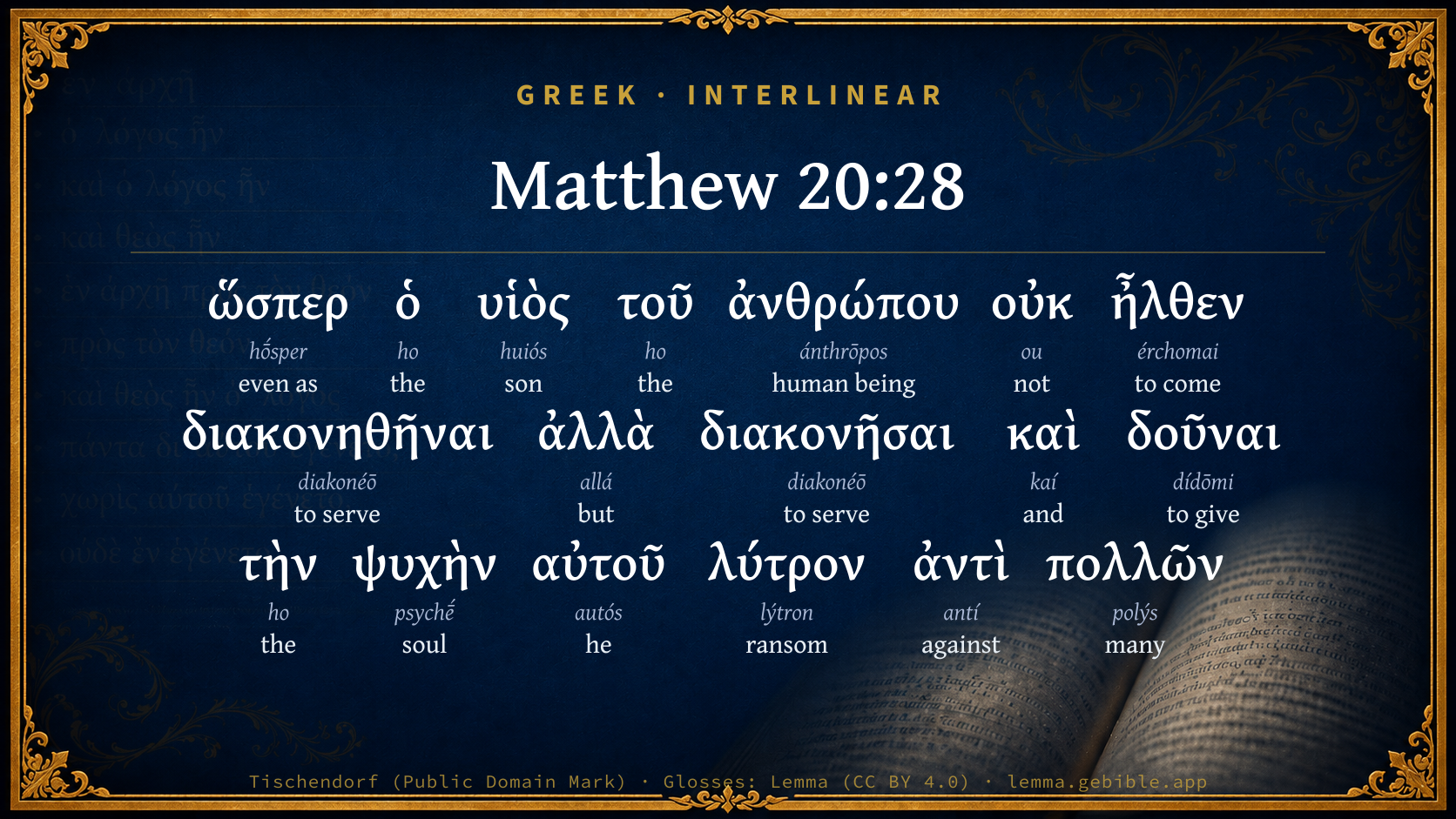
Download image
Cite this verse

Matthew 20:28 (World English Bible). Public Domain. Lemma interlinear Bible study tool, https://lemma.gebible.app/v/matthew/20/28.

Show BibTeX & RIS
BibTeX
RIS
English Translation
even as the Son of Man came not to be served, but to serve, and to give his life as a ransom for many."
World English Bible · Public Domain
Highlights
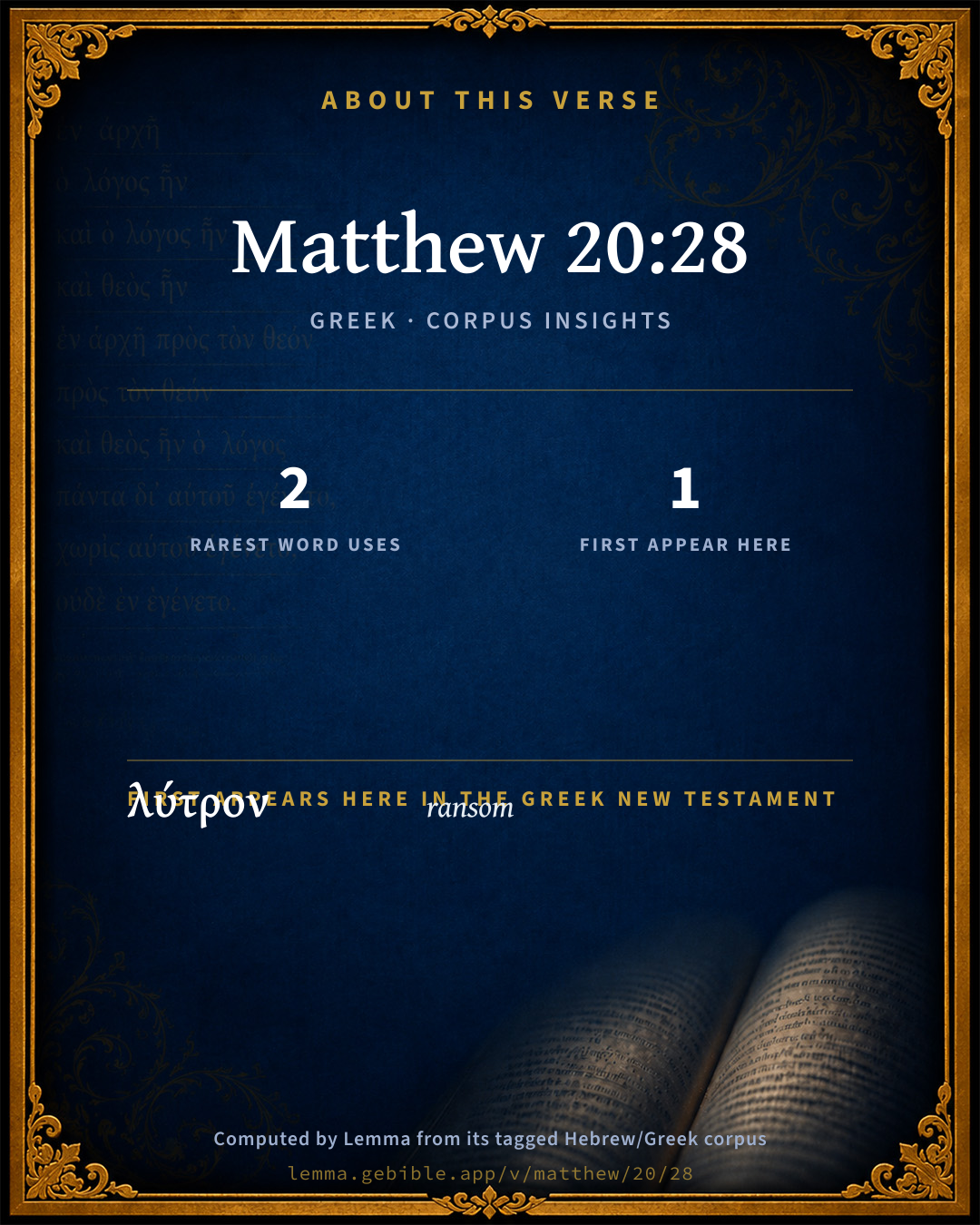
  • 1 first appearance in the Greek New Testament
Full analysis ↓
Download a study sheet

One document with this verse’s original text, its word-by-word gloss line, the meaning frame, cross-references with their text, attributed commentary, and full source and license credits — printable, and it pastes into notes with its structure intact.

This verse Autodidact and up

Study sheet (.html) Plain text (.txt)

A passage Seminary Student

Up to 50 verses in one chapter. A passage sheet keeps up to 6 commentary sources and 12 cross-references per verse, in the order this page ranks them, and says so on the sheet whenever that leaves anything out. Ask for a single verse and you get the Autodidact verse sheet above.

Everything on this page stays free to read, with no account — the sheet is a download of what is already on screen, not access to it.

Want to remove ads? Support Godless Engineer
Compare translations 3

The same verse in 3 English versions, stacked beneath the original-language interlinear above. Click any original word for its lexicon entry.

Each is an independent rendering of the whole verse — the interlinear is not word-aligned to these translations.

Highlighted words mark where these versions differ — a whole-verse word diff, not a word-by-word alignment.

  • World English Bible Public Domain
    even as the Son of Man came not to be served, but to serve, and to give his life as a ransom for many."
  • King James Version Public Domain
    Even as the Son of man came not to be ministered unto, but to minister, and to give his life a ransom for many.
  • unfoldingWord Literal Text CC BY-SA 4.0
    just as the Son of Man did not come to be served, but to serve, and to give his life as a ransom in exchange for many.”

unfoldingWord Literal Text — © unfoldingWord, licensed CC BY-SA 4.0. Word-aligned USFM3 via Door43 (git.door43.org/unfoldingWord/en_ult).

Versions to compare (up to 4)

3 of 4 selected

Show all 19 translations

Every available English version of this verse, each an independent rendering of the whole verse.

  • World English Bible Public Domain
    even as the Son of Man came not to be served, but to serve, and to give his life as a ransom for many."
  • Berean Standard Bible Public Domain
    just as the Son of Man did not come to be served, but to serve, and to give His life as a ransom for many.”
  • Majority Standard Bible Public Domain
    just as the Son of Man did not come to be served, but to serve, and to give His life as a ransom for many.”
  • King James Version Public Domain
    Even as the Son of man came not to be ministered unto, but to minister, and to give his life a ransom for many.
  • American Standard Version (1901) Public Domain
    even as the Son of man came not to be ministered unto, but to minister, and to give his life a ransom for many.
  • Revised Version (1885) Public Domain
    even as the Son of man came not to be ministered unto, but to minister, and to give his life a ransom for many.
  • Geneva Bible (1599) Public Domain
    Euen as the Sonne of man came not to be serued, but to serue, and to giue his life for the ransome of many.
  • Douay-Rheims (1899) Public Domain
    Even as the Son of man is not come to be ministered unto, but to minister, and to give his life a redemption for many.
  • Young's Literal Translation Public Domain
    even as the Son of Man did not come to be ministered to, but to minister, and to give his life a ransom for many.'
  • Literal Standard Version CC BY-SA 4.0
    even as the Son of Man did not come to be ministered to, but to minister, and to give His life [as] a ransom for many.”
  • Unlocked Literal Bible CC BY-SA 4.0
    just as the Son of Man did not come to be served, but to serve, and to give his life as a ransom for many.”
  • unfoldingWord Literal Text CC BY-SA 4.0
    just as the Son of Man did not come to be served, but to serve, and to give his life as a ransom in exchange for many.”
  • Darby Bible Public Domain
    as indeed the Son of man did not come to be served, but to serve, and to give his life a ransom for many.
  • World Messianic Bible Public Domain
    even as the Son of Man came not to be served, but to serve, and to give his life as a ransom for many.”
  • Webster's Bible Public Domain
    Even as the Son of man came not to be ministered to, but to minister, and to give his life a ransom for many.
  • Free Bible Version CC BY-SA 4.0
    In the same way, the Son of man didn't come to be served, but to serve, and to give his life as a ransom for many.”
  • Bible in Basic English Public Domain
    Even as the Son of man did not come to have servants, but to be a servant, and to give his life for the salvation of men.
  • Text-Critical English NT CC BY 4.0
    just as the Son of Man came not to be served but to serve, and to give his life as a ransom for many.”
  • Tyndale New Testament (1534) Public Domain
    even as the sonne of man came not to be ministred vnto but to minister and to geve his lyfe for the redempcion of many.

Literal Standard Version (2020), Covenant Press — licensed CC BY-SA 4.0. Text via the HelloAO Bible API (eBible.org). Unlocked Literal Bible (unfoldingWord) — licensed CC BY-SA 4.0. Text via the HelloAO Bible API (eBible.org). unfoldingWord Literal Text — © unfoldingWord, licensed CC BY-SA 4.0. Word-aligned USFM3 via Door43 (git.door43.org/unfoldingWord/en_ult). Free Bible Version, Dr. Jonathan Gallagher — licensed CC BY-SA 4.0. Text via the HelloAO Bible API (eBible.org).

Word by word

More ways to search: Search by grammar → Find every occurrence → Compare this word →

Practice this passage: Drill this verse → Learn its vocabulary →

λύτρον
lýtron
G3083
“ransom”
Noun, Accusative, Singular, Neuter
Part of Speech
Noun
Case
Accusative
Number
Singular
Gender
Neuter
Full Thayer's Definition

Origin: from G3089

TDNT: 4:328 & 4:340,543

1. the price for redeeming, ransom a. paid for slaves, captives b. for the ransom of life 2. to liberate many from misery and the penalty of their sins
  1. ὥσπερ hṓsper G5618 “even as” Adverb
  2. ὁ ho G3588 “the” Article, Nominative, Singular, Masculine
  3. υἱὸς huiós G5207 “son” Noun, Nominative, Singular, Masculine
  4. τοῦ ho G3588 “the” Article, Genitive, Singular, Masculine
  5. ἀνθρώπου ánthrōpos G444 “human being” Noun, Genitive, Singular, Masculine
  6. οὐκ ou G3756 “not” Particle, Negative
  7. ἦλθεν érchomai G2064 “to come” Verb, Aorist, Active, Indicative, 3rd person, Singular
  8. διακονηθῆναι diakonéō G1247 “to serve” Verb, Aorist, Passive, Infinitive
  9. ἀλλὰ allá G235 “but” Conjunction
  10. διακονῆσαι diakonéō G1247 “to serve” Verb, Aorist, Active, Infinitive
  11. καὶ kaí G2532 “and” Conjunction
  12. δοῦναι dídōmi G1325 “to give” Verb, Aorist, Active, Infinitive
  13. τὴν ho G3588 “the” Article, Accusative, Singular, Feminine
  14. ψυχὴν psychḗ G5590 “soul” Noun, Accusative, Singular, Feminine
  15. αὐτοῦ autós G846 “he” Personal pronoun, Genitive, Singular, Masculine
  16. ἀντὶ antí G473 “against” Preposition
  17. πολλῶν polýs G4183 “many” Adjective, Genitive, Plural, Masculine

About this verse

These counts appear in no published source. They are computed here, from the morphology-tagged text and Lemma’s own curated glosses. What Lemma adds →

18
words
15
distinct lemmas
Gospels
section

Notable vocabulary

The rarest word here is λύτρον ransom G3083 — appearing just 2 times in the whole Greek New Testament.

First appearance in Scripture

This word makes its first canonical appearance in the Greek New Testament here:

  • λύτρον ransom G3083

Shared distinctive vocabulary

λύτρον ransom G3083 occurs in 2 verses of the Greek New Testament. Also found in:
Repetition

Words recur within this verse:

  • διακονηθῆναι to serve G1247 ×2
  • ὁ the G3588 ×3

Cross-references

32

Topical passages linked to Matthew 20:28 in the Treasury of Scripture Knowledge — connected by theme and wording, ordered by reader-vote popularity; previews shown in the World English Bible.

  • Luke 22:27 For who is greater, one who sits at the table, or one who serves? Isn't it he who sits at the table? But I am in the midst of you as one who serves.
  • Hebrews 9:28 so Christ also, having been once offered to bear the sins of many, will appear a second time, without sin, to those who are eagerly waiting for him for salvation.
  • Titus 2:14 who gave himself for us, that he might redeem us from all iniquity, and purify for himself a people for his own possession, zealous for good works.
  • 1 Peter 3:18 Because Christ also suffered for sins once, the righteous for the unrighteous, that he might bring you to God; being put to death in the flesh, but made alive in the spirit;
  • Philippians 2:4–8 each of you not just looking to his own things, but each of you also to the things of others.
  • 1 Timothy 2:6 who gave himself as a ransom for all; the testimony in its own times;
  • 2 Corinthians 8:9 For you know the grace of our Lord Jesus Christ, that, though he was rich, yet for your sakes he became poor, that you through his poverty might become rich.
  • 1 Peter 2:24 who his own self bore our sins in his body on the tree, that we, having died to sins, might live to righteousness; by whose stripes you were healed.
  • Revelation 1:5 and from Jesus Christ, the faithful witness, the firstborn of the dead, and the ruler of the kings of the earth. To him who loves us, and washed us from our sins by his blood;
  • Ephesians 1:7 in whom we have our redemption through his blood, the forgiveness of our trespasses, according to the riches of his grace,
  • 1 Peter 1:18–19 knowing that you were redeemed, not with corruptible things, with silver or gold, from the useless way of life handed down from your fathers,
  • Revelation 5:8–9 Now when he had taken the book, the four living creatures and the twenty-four elders fell down before the Lamb, each one having a harp, and golden bowls full of incense, which are the prayers of the saints.
  • Matthew 26:28 for this is my blood of the new covenant, which is poured out for many for the remission of sins.
  • Mark 14:24 He said to them, "This is my blood of the new covenant, which is poured out for many.
  • John 13:4–17 arose from supper, and laid aside his outer garments. He took a towel, and wrapped a towel around his waist.
  • Hebrews 5:8 though he was a Son, yet learned obedience by the things which he suffered.
  • Romans 4:25 who was delivered up for our trespasses, and was raised for our justification.
  • Romans 5:15–19 But the free gift isn't like the trespass. For if by the trespass of the one the many died, much more did the grace of God, and the gift by the grace of the one man, Jesus Christ, abound to the many.
  • Galatians 3:13 Christ redeemed us from the curse of the law, having become a curse for us. For it is written, "Cursed is everyone who hangs on a tree,"
  • Ephesians 5:2 Walk in love, even as Christ also loved you, and gave himself up for us, an offering and a sacrifice to God for a sweet-smelling fragrance.
  • 1 John 2:2 And he is the atoning sacrifice for our sins, and not for ours only, but also for the whole world.
  • Isaiah 53:5 But he was pierced for our transgressions, he was crushed for our iniquities; the punishment that brought our peace was on him; and by his wounds we are healed.
  • Isaiah 53:10–11 Yet it pleased Yahweh to bruise him; he has put him to grief: when you shall make his soul an offering for sin, he shall see [his] seed, he shall prolong his days, and the pleasure of Yahweh shall prosper in his hand.
  • John 10:15 even as the Father knows me, and I know the Father. I lay down my life for the sheep.
  • John 11:50–52 nor do you consider that it is advantageous for us that one man should die for the people, and that the whole nation not perish."
  • Hebrews 2:10 For it became him, for whom are all things, and through whom are all things, in bringing many children to glory, to make the author of their salvation perfect through sufferings.
  • Psalms 49:7 None of them can by any means redeem his brother, Nor give God a ransom for him.
  • Isaiah 53:8 By oppression and judgment he was taken away; and as for his generation, who [among them] considered that he was cut off out of the land of the living for the disobedience of my people to whom the stroke [was due]?
  • Daniel 9:24–26 Seventy weeks are decreed on your people and on your holy city, to finish disobedience, and to make an end of sins, and to make reconciliation for iniquity, and to bring in everlasting righteousness, and to seal up vision and prophecy, and to anoint the most holy.
  • Job 33:24 Then God is gracious to him, and says, 'Deliver him from going down to the pit, I have found a ransom.'
  • Matthew 8:20 Jesus said to him, "The foxes have holes, and the birds of the sky have nests, but the Son of Man has nowhere to lay his head."
  • Romans 3:24–26 being justified freely by his grace through the redemption that is in Christ Jesus;

Cross-references courtesy of OpenBible.info (CC BY 4.0).

Commentary

Notes on Matthew 20:28 from classic Christian and Jewish commentators (each source and its license shown beneath its notes). The classic Christian expositions comment on the surrounding passage and are grouped to its opening verse, so a note may address several verses; the Jewish commentaries on the Tanakh (Rashi and others) are per-verse, so they appear only where the commentator wrote on this verse.

Lemma curates 59 commentaries, every one of them public domain or Creative Commons licensed, each selected and text-cleaned for this edition rather than reprinted as found. About our sources →

Trapp's Complete Commentary

John Trapp

28 Even as the Son of man came not to be ministered unto, but to minister, and to give his life a ransom for many.

Ver. 28. And to give his life a ransom] A redemptory, a valuable rate, λυτρον, for it was the blood of God wherewith the Church was purchased, Act 20:28; silver and gold could not do it, 1Pe 1:18-19; nor anything else but that ransom given by Christ, αντιλυτρον, 1Ti 2:6.

John Trapp, A Commentary or Exposition upon All the Books of the Old and New Testament (1647–1656) — public domain. Text from a community e-Sword module.

The Biblical Illustrator

Joseph S. Exell

Mat_20:28

Even as the Son of Man came not to be ministered unto.

A Divine mission

I. The son of man. Humility combined with dignity. Man was the offender, man must suffer the penalty. Not a fictitious manhood, but real like our own. This ought to attract us to Him, for He is akin in nature and sympathy.

II. He came. The errand unique as the Person who undertook it. He came voluntarily on an errand of mercy.

III. Not to be ministered unto, but to minister. He had not a selfish thought in His soul. Does He want servants? Thousands of angels are His chariot. He served in the workshop, home, amongst His disciples. As the Son of Man in heaven he continues a kind of service to His people.

IV. And to give his life. We have no lives to give. They are forfeited to Divine justice. His death was voluntary. Christ did not come into the world merely to be an example, or merely to reveal the Godhead. His sacrifice was substitutionary.

V. A ransom. Every male person among the Jews belonged to God, and must be redeemed. The price was the ransom. Jesus redeems us from the curse of the law.

VI. For many. The word for has a vicarious meaning. He gave His life instead of many.

1. Man is not redeemed from the bondage of his sins without a price. -No one goes free by the naked mercy of God.

2. That price must be a life. Not merely a character. The question has been asked, Who receives the ransom? Not Satan. Satan has no rights. It was paid to the Great Judge. This is a mystical way of speaking. The sufferings of Christ vindicate the law and render mercy possible.

3. What is the result of this? Man is redeemed. He is no longer a slave. Did Jesus Christ redeem you? (C. H. Spurgeon.)

The Saviours character, life, and death

I. His character Christ Divine. This being premised we can bring forward two satisfactory reasons why He called Himself the Son of Man.

1. Because He would gradually develop Himself.

2. Because our concern with Him principally lies in His assuming human nature.

II. His life. Came not to be ministered unto, etc. This fills us with astonishment, when we remember the place from which He descended. Our Saviour could derive nothing from external appendages.

1. Admire His condescension.

2. Resemble Him therein,

III. His death.

1. Consider Him as a ransom.

2. It was intentional.

3. It was voluntary.

4. It regards the personal esteem He has for His people.

5. We see here where a poor burdened conscience can alone find relief.

6. Let the love of Christ strike your minds.

7. If He has ransomed you, you are not your own. (W. Jay.)

A ministering Christ

I. The negative object of Christs coming-Not to be ministered unto.

II. The positive object of his coming-To minister, etc.

1. The scenes of His private life. Christ a carpenter.

2. The scenes of His public life. Wearisome toils. Lesson-

(1) Be clothed with humility;

(2) Gratitude to Christ for His love;

(3) Repentance. (H. L. Nicholson, B. A.)

Christ the servant and the Saviour of His people

I. The service he rendered to man by his life.

1. He came not to be ministered unto as regards His external authority. He might have excited the admiration of the world by His outward show; but He was poor.

2. He came to minister as regarded instruction.

II. The blessing he effected for man by his death.

1. The blessing procured.

2. The means by which this blessing was procured. He gave His life, etc.

3. The number for whom this blessing was procured. (J. Sibree.)

True greatness the result of personal service

The patriot is great, but he has served his country. The philosopher by the force of his genius has enlarged the sphere of human knowledge, thus of the greatest use to mankind. The same true in religion. Christ was not introducing a strange precept when He said that the men who are the most eminent in life are the most literally the servants of the public.

1. The greatness thus derived from usefulness may be augmented or decreased by the meanest of those you employ.

2. The touching reference of our Lord to His own case. (H. Melvill, B. D.)

Christian humility

He is the most lovely professor, who is the most lowly professor. As incense smells the sweetest when beaten the smallest, so saints look fairest when they lie lowest. Arrogance in the soul resembles the spleen in the body, which grows most, while other parts are decaying. God will not suffer such a weed to grow in His garden, without taking some course to root it up. (Archbishop Secker.)

Christ stooping to save

The mother, wan and pale with incessant vigils by the bedside of a sick child;-the fireman, maimed for life in bravely rescuing the inmates of a blazing house;-the 300 Spartans at Thermopylae;-Howard, dying of fever caught in dungeons where he was fulfilling his noble purpose of succouring the oppressed and remembering the forgotten;-the Moravian missionaries, who voluntarily incarcerated themselves in an African leper-house (from which regress into the healthy world was impossible, and escape only to be ejected through the gates of death), in order that they might preach the glad tidings to the lepers,-all these, and many other glorious instances of self-devotion, do but faintly shadow forth the love of Him who laid aside Divine glory, and humbled Himself to the death of the cross.

The Biblical Illustrator, edited by Joseph S. Exell (c. 1880s–1900s) — public domain. Text from a community e-Sword module.

Tyndale Open Study Notes

Tyndale Open Resources

20:28 This expression, the Son of Man came, suggests Jesus’ preexistence (see Dan 7:13-14). • Jesus was describing his voluntary offering of himself as a ransom for many, to pay the debt all people owe (see Matt 26:26-29; Isa 53:10-12; Rom 3:24), thereby buying them out of slavery (see Gal 5:1).

Tyndale Open Study Notes — © Tyndale Open Resources, licensed CC BY-SA 4.0. Text via the HelloAO Bible API.

Bengel's Gnomon

Johann Albrecht Bengel

Mat 20:28. Ὤσπερ, κ.τ.λ., even as, etc.) The greatest example which could be adduced or imagined.—διακονῆσαι, to minister, to serve) See Rom 15:8.—καὶ, κ.τ.λ., and, etc.) An ascending climax.—τὴν ψιχὴν Αὐτοῦ, His soul) i.e. Himself; see Gal 1:4; Gal 2:20.—λύτρον, a ransom. ἀντὶ πολλῶν, for many) A great ministry, and one of vast condescension. That for which a price is given, is in some sort more an object of desire to him who gives the price than the price itself. And the Redeemer spends Himself for many, not only taken as a whole, but also as individuals.

Bengel's Gnomon of the New Testament — English translation (T&T Clark, Edinburgh, 1860) — public domain. Text from a community e-Sword module.

Meyer's Critical & Exegetical Commentary

Heinrich August Wilhelm Meyer

Mat_20:28. Ὥσπερ] summum exemplum, Bengel. Comp. Php_2:5; Rom_15:3; Polyc. Phil. 5: ὃς ἐγένετο διάκονος πάντων. Observe here the consciousness, which Jesus had from the very first, that to sacrifice himself was His great divine mission. Comp. Dorner, sündlose Vollk. Jesu, p. 44 ff.

διακονηθῆναι] to be waited upon, as grandees are.

καὶ δοῦναι] intensive; adding on the highest act, the culminating point in the διακονῆσαι; but δοῦναι is made choice of, because the ψυχή (the soul, as the principle of the life of the body) is conceived of as λύτρον (a ransom); for, through the shedding of the blood (Mat_26:28; Eph_1:7), it becomes the τιμή of the redemption, 1Co_6:20; 1Co_7:23. Comp. note on Joh_10:11.

ἀντὶ πολλῶν] ἀντί denotes substitution. That which is given as a ransom takes the place (is given instead) of those who are to be set free in consideration thereof. The λύτρον (Plat. Legg. xi. p. 919 A, Rep. p. 393 D, Thuc. vi. 5. 4) is an ἀντίλυτρον (1Ti_2:6), ἀντάλλαγμα (Mat_16:26). Whether ἀντὶ πολλῶν should be joined to λύτρον, which is the simpler course, or connected with δοῦναι, is a matter of perfect indifference (in answer to Hofmann, Schriftbew. II. 1, p. 300) so far as the meaning of ἀντί is concerned. In any case, that meaning is strictly and specifically defined by λύτρον (בֹּפֶר),[6] according to which ἈΝΤΊ can only be understood in the sense of substitution in the act of which the ransom is presented as an equivalent to secure the deliverance of those on whose behalf it is paid,a view which is only confirmed by the fact that in other parts of the New Testament this ransom is usually spoken of as an expiatory sacrifice, Mat_26:28; Joh_1:29; 1Jn_4:10; Rom_3:25; Isa_53:10; 1Pe_1:18 f., 1Pe_3:18. That which they are redeemed from is the eternal ἈΠΏΛΕΙΑ, in which, as having the wrath of God abiding upon them (Joh_3:36), they would remain imprisoned (Joh_3:16; Gal_3:13; 2Co_5:21; 1Pe_2:24; Col_1:14; Col_2:13 f.) as in a state of hopeless bondage (Heb_2:15), unless the guilt of their sins were expiated.

ΠΟΛΛῶΝ] The vicarious death of Jesus may be described as having taken place for all (Rom_5:18; 1Ti_2:6; 1Jn_2:2), or for many (so also Mat_26:28; Heb_9:28), according as we regard it as an objective fact (that fact being: Jesus has given His life a ransom for all men), or look at it in relation to the subjective appropriation of its results on the part of individuals (which happens only in the case of believers). So in the present case, where, accordingly, πολλῶν is to be understood as meaning all who believe now and will believe hereafter (Joh_17:20).

[6] Ritschl, in the Jahrb. f. D. Theol. 1863, p. 222 ff., defines λύτρον as meaning something given by way of equivalent in order to avert death; this, however, is not sufficient, for, throughout the Sept. also, in which כפר is rendered by λύτρον (Exo_21:30; Exo_30:12; Num_35:31 f.; Pro_6:35; Pro_13:8), pretium redemtionis is found to be the specific meaning given to the word, although the connection may sometimes admit ex adjuncto the additional idea of something given for the purpose of averting death. The Sept. likewise adheres to the same meaning in cases where other expressions are rendered by λύτρον, such as גְּאֻלָּה (Lev_25:24; Lev_25:51), הַפְּדֻיִם (Num_3:51), פִּדְזו (Exo_21:30), מְחִיר (Isa_45:13). Ritschl interprets our present passage as follows: I am come to give away my life to God in sacrifice, that I may become the substitute of those who could never hope to succeed in finding, either for themselves or others, any adequate ransom as a means of securing their exemption from death; but the substitute only of those who, through faith and self-denying devotion to my person, fulfil the condition on which alone the ransom furnished by me can procure the hoped for exemption, p. 238.

Meyer — Critical and Exegetical Commentary on the New Testament — English translation by Peter Christie, edited by Frederick Crombie (T&T Clark, 1880) — public domain. Text from a community e-Sword module.

Expositor's Greek Testament

ed. W. Robertson Nicoll

Mat 20:28 . ὤσπερ , καὶ γὰρ in Mk.; both phrases introducing reference to the summum exemplum (Bengel) in an emphatic way. περ lends force to ὡς = even as, observe. ὁ ὑ . τ . ἀνθρώπου : an important instance of the use of the title. On the principle of defining by discriminating use it means: the man who makes no pretensions, asserts no claims. οὐκ ἦλθε points to the chief end of His mission, the general character of His public life: not that of a Pretender but that of a Servant . δοῦναι τὴν ψυχὴν , to give His life, to that extent does the service go. Cf. Phi 2:8 : μέχρι θανάτου , there also in illustration of the humility of Christ. It is implied that in some way the death of the Son of Man will be serviceable to others. It enters into the life plan of the Great Servant. λύτρον , a ransom, characterises the service, another new term in the evangelic vocabulary, suggesting rather than solving a theological problem as to the significance of Christ’s death, and admitting of great variety of interpretation, from the view of Origen and other Fathers, who regarded Christ’s death as a price paid to the devil to ransom men from bondage to him, to that of Wendt, who finds in the word simply the idea that the example of Jesus in carrying the principle of service as far as to die tends by way of moral influence to deliver men’s minds from every form of spiritual bondage ( Die Lehre Jesu , ii. 510 517). It is an interesting question, What clue can be found in Christ’s own words, as hitherto reported, to the use by Him on this occasion of the term λύτρον , and to the sense in which He uses it? Wendt contends that this is the best method of getting at the meaning, and suggests as the most congenial text Mat 11:28-30 . I agree with him as to method, but think a better clue may be found in Mat 17:27 , the word spoken by Jesus in reference to the Temple Tax . That word began the striking course of instruction on humility, as this word (Mat 20:28 ) ends it, and the end and the beginning touch in thought and language. The didrachmon was a λύτρον (Exo 30:12 ), as the life of the Son of Man is represented to be. The tax was paid ἀυτὶ ἐμοῦ καὶ σοῦ . The life is to be given ἀντὶ πολλῶν . Is it too much to suppose that the Capernaum incident was present to Christ’s mind when He uttered this striking saying, and that in the earlier utterance we have the key to the psychological history of the term λύτρον ? On this subject vide my book The Kingdom of God , pp. 238 241.

The Expositor's Greek Testament, edited by W. Robertson Nicoll (1897–1910) — public domain. Text from a community e-Sword module.

Adam Clarke's Commentary

Verse 28. A ransom for many.] αυτρον αντι πολλων, or a ransom instead of many, - one ransom, or atonement, instead of the many prescribed in the Jewish law. Mr. Wakefield contends for the above translation, and with considerable show of reason and probability.

The word λυτρον is used by the Septuagint for the Hebrew פדיו, pidion, the ransom paid for a man's life: see Ex 21:30; Nu 3:49-51; and λυτρα is used Nu 35:31, where a satisfaction (Hebrew כפר copher, an atonement) for the life of a murderer is refused. The original word is used by Lucian in exactly the same sense, who represents Ganymede promising to sacrifice a ram to Jupiter, λυτρον υπερ εμου, as a ransom for himself, provided he would dismiss him.

The whole Gentile world, as well as the Jews, believed in vicarious sacrifices. Virgil, AEn. v. 85, has nearly the same words as those in the text. "UNUM PRO MULTIS dabitur CAPUT," - One man must be given for many. Jesus Christ laid down his life as a ransom for the lives and souls of the children of men. In the Codex Bezae, and in most of the Itala, the Saxon, and one of the Syriac, Hilary, Leo Magnus, and Juvencus, the following remarkable addition is found; "But seek ye to increase from a little, and to be lessened from that which is great. Moreover, when ye enter into a house, and are invited to sup, do not recline in the most eminent places, lest a more honourable than thou come after, and he who invited thee to supper come up to thee and say, Get down yet lower; and thou be put to confusion. But if thou sit down in the lowest place, and one inferior to thee come after, he who invited thee to supper will say unto thee, Go and sit higher: now this will be advantageous to thee." This is the largest addition found in any of the MSS., and contains not less than sixty words In the original, and eighty-three in the Anglo-Saxon. It may be necessary to remark, that Mr. Marshall, in his edition of the Gothic and Saxon Gospels, does not insert these words in the text, but gives them, p. 496 of his observations. This addition is at least as ancient as the fourth century, for it is quoted by Hilary, who did not die till about A. D. 367.

Adam Clarke's Commentary on the Bible (1810–1826) — public domain. Text from a community e-Sword/MySword module.

Ellicott's Commentary for English Readers

(28) Not to be ministered unto.—The words found a symbolic illustration when our Lord, a few days afterwards, washed the feet of the disciples who were still contending about their claims to greatness (Joh_13:3-4); and the manner in which St. John connects the act with our Lord’s manifested consciousness of His supreme greatness, seems to show that the words which we find here were then present to his thoughts. The Son of Man seemed to the beloved disciple never to have shown Himself so truly king like and divine as when engaged in that menial act. But that act, we must remember, was only an illustration; and the words found their true meaning in His whole life, in His poverty and humiliation, in the obedience of childhood, in service rendered, naturally or super-naturally, to the bodies or the souls of others.

To give his life a ransom for many.—The word rightly rendered “ransom,” is primarily “a price made for deliverance,” and in this sense it is found in the Greek version of the Old Testament for “the ransom” which is accepted instead of a man’s life in Exo_21:30, for the “price of redemption” accepted as an equivalent for an unexpired term of service in Lev_25:50, for riches as the “ransom of a man’s life” in Pro_13:8. No shade of doubt accordingly rests on the meaning of the word. Those who heard could attach no other meaning to it than that He who spake them was about to offer up His life that others might be delivered. Seldom, perhaps, has a truth of such profound import been spoken, as it were, so incidentally. It is as if the words had been drawn from Him by the contrast between the disputes of the disciples and the work which had occupied His own thoughts as He walked on in silent solitude in advance of them. It is the first distinct utterance, we may note, of the plan and method of His work. He had spoken before of “saving” the lost (Mat_18:11): now He declares that the work of “salvation” was to be also one of “redemption.” It could only be accomplished by the payment of a price, and that price was His own life. The language of the Epistles as to the “redemption that is in Christ Jesus,” our being “bought with a price” (Rom_3:24; 1Co_6:20), “redeemed by His precious blood” (1Pe_1:19), the language of all Christendom in speaking of the Christ as our Redeemer, are the natural developments of that one pregnant word. The extent of the redemptive work, “for many,” is here indefinite rather than universal, but “the ransom for all” of 1Ti_2:6 shows in what sense it was received by those whom the Spirit of God was guiding into all truth. Even the preposition in, “for many” has a more distinct import than is given in the English version. It was, strictly speaking, a “ransom” instead of, in the place of, (ἀντὶ not ὑπὲρ) “many.” Without stating a theory of the atonement, it implied that our Lord’s death was, in some way, representative and vicarious; and the same thought is expressed by St. Paul’s choice of the compound substantive ἀντίλυτρον, when, using a different preposition, he speaks of it as a ransom for (ὑπὲρ, i.e., on behalf of) all men (1Ti_2:6).

A Bible Commentary for English Readers, edited by Charles John Ellicott (1878–1897) — public domain. Text from a community e-Sword module.

The Cambridge Bible for Schools and Colleges

gen. ed. J. J. S. Perowne

28. a ransom]=the price paid for the redemption of a captive from slavery. For the thought cp. Rom_3:24; 1Co_6:20; 1Pe_1:19. The English word is derived through the French rançon from Lat. redemptionem.

for many] Cp. 1Ti_2:6, “Who gave himself a ransom for all.”

for] Not ὑπέρ, ‘on behalf of,’ but ἀντί, ‘in the place of.’

The Cambridge Bible for Schools and Colleges (gen. ed. J. J. S. Perowne; Cambridge University Press, 1878–1918) — public domain. Text from a community e-Sword module.

John Gill's Exposition

And as they departed from Jericho,.... Which, was distant about ten parsas, or miles, from Jerusalem (i), through which Christ just passed, and had met with Zacchaeus, and called him, and delivered the parable concerning a nobleman's going into a far country. The Syriac and Persic versions render the words, "when Jesus departed from Jericho"; and the Arabic, "when he went out of Jericho"; not alone, but "with his disciples", as Mark says; and not with them only, for a great multitude followed him out of the city; either to hear him, or be healed by him, or to see him, or behold his miracles, or to accompany him to Jerusalem; whither he was going to keep the feast of the passover, and where they might be in some expectation he would set up his kingdom. The Ethiopic version reads it, "as they went out from Jerusalem", contrary to all copies and versions.

(i) Bartenora in Misn. Taraid, c. 3. sect. 8.

John Gill's Exposition of the Whole Bible (1746–1763) — public domain (CC PDM 1.0). Text via the HelloAO Bible API.

Haydock's Catholic Bible Commentary

A redemption for many; i.e. for all, as it is sometimes the style of the Scriptures. See St. Paul, 1 Timothy ii. 6. (Witham) --- Certain Puritans pretend from this part of holy Scripture, that all superiority is forbidden; but it is merely pride, ambition, and haughtiness, not superiority, that is here proscribed. Jesus Christ himself, as Son of man, was their and our Superior, Lord, and Master, notwithstanding his humility. (Bristow) --- For the divine appointment of both civil and ecclesiastical government, see Romans xiii. 2. and 1 Corinthians xii. 28. Hebrews chap. xiii. 7, 17.

George Leo Haydock (1774–1849), Haydock's Catholic Family Bible and Commentary, 1859 edition — public domain. Excludes Psalms (Douay-Rheims chapter numbering differs from Protestant) and Deuterocanonical books (Catholic canon only).

Matthew Poole's English Annotations

So saith Mark, Mar 10:45. The apostle saith, Phi 2:7 he made himself of no reputation, and took on him the form of a servant. Our Saviour had before taught them, that the disciple is not above his master. Such, saith our Saviour, as is the King in my kingdom, such must the rulers and great persons in it be. See what a kingdom I have; I came not to be ministered unto, but to minister, to serve the necessities of men’s and women’s souls and bodies; and to give my life a ransom for many, lutron, a redemption price. The apostle useth αντιλυτρον, which signifieth a price paid instead of another, 1Ti 2:6. So as there is no further satisfaction or price to be paid for any.

Matthew Poole's English Annotations on the Holy Bible (1683–1685) — public domain. Text from a community e-Sword/MySword module.

Whedon's Commentary on the Bible

Daniel D. Whedon

28. Give his life — Even as the Son of man showed himself greatest of all by the greatest sufferings and sacrifices of all. Give his life a ransom — An atonement — an atonement by death, an atonement by substitution — is here briefly but powerfully expressed. The Saviour will give his life as a ransom for the souls of many. Now a ransom is always a substitute. The price paid is put in the place of the bondage of the ransomed person. If a sum be paid to ransom a slave, the money goes to the master, in the place of the slave’s servitude. If the ransom goes to redeem a captive, the ransom is placed to the conqueror, in the room of the captive. If a Damon gives his life to ransom Pythias from the scaffold, Damon’s death is the substitute for Pythias’s death. And so if Christ’s death be given to ransom sinners from death, his death must be a substitute for their death. He dies in their stead. His death is temporal, and theirs is eternal. So that if they by faith accept his death in place of their own, they may be saved from that impending doom.

Daniel D. Whedon (gen. ed.), Commentary on the Old and New Testaments (1874–1909) — public domain. Text from a community e-Sword module.

The Pulpit Commentary

Even as. Christ adduces his own example as a pattern of profound humility. To minister. By his incarnation Christ assumed the lowliest life of man. He took upon himself the form of a servant, and was ever active in ministering to others" wants, going about doing good, healing the sick, cleansing lepers, casting out demons; always accessible, sympathetic, merciful; never weary of teaching, however fatigued in body; a servant to the race which he came to save. A ransom for many; lutron anti pollwn : instead of many. The crowning example of his humility is that he gave his life as a ransom for the souls of men. This is the atonement, the sacrificial act, which (as the Mosaic sacrifices did in a partial and temporary manner) reconciled God and man. Whatever may be the way in which this atonement acts on the Divine mind, the expression here shows that it was vicarious and propitiatory, energizing, not by example, as an effort of superhuman self-denial, courage, and patience, but by an inherent power, as mysterious as it is efficacious. We can only say that, being the act of one who is God, its effects must necessarily be incomprehensible and infinite. The difficulties that beset this doctrine are increased by the fact that Jesus himself says little about the atoning nature of his sufferings and death a topic which would not at this time have been properly received by friends or enemies, the former refusing to credit his approaching death, the latter being totally unable to conceive how such death could supersede Jewish sacrifices and reconcile the whole world to God (Sadler). Christ certainly died for all, as St. Paul says, "He gave himself a ransom for all (antilutron upentwn)", (1Ti_2:6) but all do not accept the offered salvation; hence arise the two expressions, "all" and "many," referring to the same object; "not," as an old Father says, "that salvation is limited, but men"s efforts to obtain it are limited." The same expression was used by our Lord at the Last Supper, when he said, "This is my blood of the New Testament, which is shed for many for the remission of sins". (Mat_26:28) A comparison of the passages in which the death of Christ is connected with the salvation of men would show a similar interchange of terms, depending on the view which the writer is taking of the doctrine, whether an objective one or a subjective. In the former case we may cite Rom_5:15 2Co_5:14 1Ti_2:6 1Jn_2:2; in the latter, Rom_3:25, 26 Eph_5:2.

Christ the Servant and the Ransom.

The immediate application of these words is to confirm the previous assertion of the nature of true greatness in the kingdom of heaven. But they are so intensely significant that they claim our attention on their own account.

I CHRIST THE SERVANT. This startling conjunction of titles is suggested even in the Old Testament, in the latter part of Isaiah. Jesus realizes the singular prophecy in deeper humility and self-denial. In the prophet the Messiah is the "Servant of the Lord." In the life of Jesus we see him as this, but also as the Servant of man. Consider the negative and Positive aspects of this wonderful fact.

1. Its negative aspect. Christ did not come to be ministered unto. He did not ask for a prince"s courtly rights; he did not expect them. He came in lowly guise. Although a few obscure friends delighted to give him the means of support in their gratitude, the great world"s ministry of honour was never his.

2. Its positive aspect. Jesus came to minister. Service was an object of his life, not an accident that came upon him with surprise. He speaks of his coming into the world as though this had been deliberately fixed and the service of man part of its great purpose. Here we see the humility, the unselfishness, the love, and the practical spirit of our Lord. In this ministry

a. he deserves our adoring gratitude;

b. he invites our trustful confidence, for it is on our behalf; and

c. he is the example for our diligent imitation.

II CHRIST THE RANSOM. Here is a great thought flashing out of the darkness that broods over the cross. Previously, Jesus had spoken of his approaching death; now he suddenly reveals the purpose of it. It was more than a necessity resulting from faithful living, more than a martyrdom. It was the paying of a ransom.

1. The price paid. Jesus gave his life. He came for the express purpose of doing so. One object of his birth was that he might be able to die. It is to be observed that our attention is always directed more to the fact of Christ"s death than to the pain he suffered to his cross rather than to his Passion, though doubtless both were of value in the great redeeming work. "The wages of sin is death." Jesus tasted death for every man. He gave all he could give his very life blood.

2. The liberty effected. Men ransom from captivity. What was the captivity from which Christ brought liberty? Origen and other Fathers regarded it as bondage to Satan, and they thought the ransom was actually paid to the devil. This is a coarse way of regarding a great truth. The ransom could not have been paid to the devil, because Christ fought the prince of evil as a deadly foe; he did not bargain with the Fiend.]but he came to deliver from the power of Satan, i.e. from sin, and that object involved his death. He died to save us from sin. We must not press the analogy of the ransom further.

3. The people freed. The ransom is for "many." It is a harsh, ungenerous criticism that would fix on the apparent limitation of the word "many many rather than all. There is no such antithesis here. The many saved are contrasted with the one Saviour. His life blood is so valuable a ransom that it purchases, not the liberation of one or two captives of sin only, but a large multitude the host of the redeemed. W.F.A.

The Pulpit Commentary (1880–1919), ed. H.D.M. Spence-Jones & Joseph S. Exell — public domain. Text from a community e-Sword module.

Scofield Reference Notes

C. I. Scofield

Son of man (See Scofield "Mat 8:20") Also, Php 2:7

ransom See, Isa 53:10; Isa 53:11.

Mat 20:22 "cup," margin ref: (See Scofield "Mat 20:22"); Exo 14:30; Isa 59:20; Rom 3:24

(See Scofield "Exo 14:30") See Scofield "Isa 59:20" See Scofield "Rom 3:24"

The Scofield Reference Bible (1917 edition), notes by C. I. Scofield — public domain. Text from a community e-Sword module.

Burkitt's Expository Notes on the New Testament

William Burkitt

To encourage his disciples to the forementioned condescending humility one towards another, our Saviour propounds to them his own instructive example, I am not to be ministered unto, says Christ, but to minister to the wants and necessities of others, both for soul and body. "O what a sight will it be, as if our Lord had said, to behold an humble God, and a proud creature; an humble Saviour, and an haughty sinner!"

Yea, our Lord urges his example farther, that as he laid down his life for us, so should we be ready to lay down our lives for one another. Did Christ lay down his life for us, and shall we not lay down a lust for him? our pride, our ambition, our affectation of dignity and superiority over others?

Note here two things; 1. Whereas it is said that Christ gave his life for a ransom for many; it is elsewhere affirmed, that he tasted death for every man, even for them that denied the Lord who brought them. The word many in other places of scripture, is not exclusive of some, but inclusive of all.

Thus Many that sleep in the dust shall arise Dan 12:2 : answer, All that sleep in the grave shall hear his voice Joh 5:28-29. Thus, Through the offence of one many died Rom 1:15; answer, In Adam all died 1Co 15:22.

There is a virtual sufficiency in the death of Christ for the salvation of mankind, and an actual efficacy for the salvation of them that repent, and believe, and obey the gospel.

Note, 2. From these words, He gave his life a ransom. That Christ suffered in our stead, and died in our place, and gave his life instead of ours. It was the constant opinion both of the Jews and Gentiles, that their piacular victims were ransoms for the life of the offender, and that he who gave his life for another, suffered in his stead, to preserve him from death.

And who can reasonably suppose, but that our Lord intended by saying he gave himself a ransom, that he gave his life instead of the lives of those for whom he suffered? Vain are the Socinians, when they say, this price was to be paid to Satan, because he detained us captive.

True; the price is to be paid to him that detains the captive, when he doth this for gain to make money of him, as the Turks detain the Christians captive at Algiers; but when a man is detained in custody for violation of a law, then it is not the gaoler, but the legislator, to whom the price of redemption must be paid, or satisfaction be made.

Accordingly this price was paid to God; for Christ became our ransom, as he offered up his life and blood for us: now he offered himself without spot to God, Heb 9:14. he therefore paid the price of our redemption to God.

William Burkitt's Expository Notes on the New Testament (1700–1703) — public domain. Text from a community e-Sword module.

The People's New Testament

B. W. Johnson

28. Give his life as a ransom. Our Lord came to serve. He even gave his life. He became our ransom; that is, he redeemed us by his blood.

B. W. Johnson's The People's New Testament with Notes (1889–1891) — public domain. Electronic text from the Christian Classics Ethereal Library (CCEL) ThML edition.

Cambridge Greek Testament for Schools and Colleges

28. After this verse an early insertion is found in D and the Curetonian Syriac Version: the first words are ὑμεῖς δὲ ζητεῖτε ἐκ μικροῦ αὐξῆσαι καὶ ἐκ μείζονος ἔλαττον εἶναι, the rest reproduce to a great extent Luk 14:8-10. See Scrivener’s Introduction, pp. 8 and 500.

28. οὐκ ἦλθεν κ.τ.λ. ‘Came not to be ministered unto, but to minister,’ i.e. (as the parallelism shews) came not to be a μέγας, ‘a great one,’ but to be a servant (διάκονος), καὶ δοῦναι τὴν ψυχὴν αὐτοῦ λύτρον ἀντὶ πολλῶν, a still further humiliation—to be a slave and render a slave’s supreme service—to die a slave’s death for others. This view, to which the poetical form of the whole paragraph points, brings the passage into close relation with St Paul’s words: μορφὴν δούλου λαβὼν … ἐταπείνωσεν ἑαυτὸν γενόμενος ὑπήκοος μέχρι θανάτου θανάτου δὲ σταυροῦ (Php 2:7-8). The conception of a redemption from the slavery of sin through Christ is enriched by that of a life sacrificed to win life for us.

The bearing of such passages as this on the alleviation of slavery in the ancient world should be considered. Their influence towards the abolition of slavery in modern times might have been still greater if the translators had used the word ‘slave’ rather than ‘servant’ in the E.V.

λύτρον only here and Mar 10:45 in the N.T., a ransom or price paid for the redemption of a captive from slavery. For the thought cp. Rom 3:24; 1Co 6:20; 1Pe 1:19. The English word is derived through the French rançon from Lat. redemptionem. The act of redeeming is expressed by ἀπολύτρωσις, as δικαιούμενοι δωρεὰν τῇ αὐτοῦ χάριτι διὰ τῆς ἀπολυτρώσεως τῆς ἐν Χριστῷ Ἰησοῦ, Rom 3:24; ἐν ᾧ ἔχομεν τὴν ἀπολύτρωσιν διὰ τοῦ αἵματος αὐτοῦ τὴν ἄφεσιν τῶν ἁμαρτιῶν, Eph 1:7. See also 1Co 6:20; 1Pe 1:19.

ἀντὶ πολλῶν. Cp. 1Ti 2:6, ὁ δοὺς ἑαυτὸν ἀντίλυτρον ὑπὲρ πάντων. The difference between the πολλῶν and the πάντων in these two passages must be explained by the difference between the offer of salvation and the acceptance of it. It is offered to all, accepted by many. The preposition ἀντὶ denotes the vicarious nature of Christ’s death.

Cambridge Greek Testament for Schools and Colleges (Cambridge University Press, 1896; 21 vols, various authors incl. Carr, Maclear, Plummer, Farrar, Lumby, Moule, M. R. James, Simcox) — public domain. Text from a community e-Sword module.

International Critical Commentary

28. Even as the Son of Man did not come to be ministered to but to minister, and to give His life a ransom for many.] So Mk. with καὶ γάρ for ὥσπερ.

This is the first passage in the Gospel where the death which has been foretold is described as intended to have a definite result or effect. For the idea of expiatory self-sacrifice, cf. 2 Mac 7:37, 38, 4 Mac 17:22. “Give his life”: cf. Mechilta (Ugol.) 207. “Moses gave his life for three things, and they were called by his name,” 274.

28. ἀντὶ πολλῶν] S2 adds here: “But seek ye, that from littleness ye may increase, and not from greatness become little. What time ye are bidden to a supper party be not sitting down to meat in an honourable place, that there may not come one more honourable than thou, and the lord of the supper say to thee, ‘Bring thyself down’; and thou be confounded in the eyes of the guests. But if thou sit down to meat in a lesser place, and there come one less than thou, and the lord of the supper say to thee, ‘Bring thyself, and come up and sit down to meat’; then thou shalt have more glory in the eyes of the guests” (Burk.). S1 is wanting here, but did not contain the passage. D a b e ff1 2 g1 h m n and 6 Vulgate MSS have the same insertion, but without the negative in the second clause. The passage is ancient, and finds parallels in the Canonical Gospels. For the first sentence, with the negative to the second clause, cf. Mat 23:12, Luk 14:11, Luk 18:14. For the rest, compare Luk 14:8-11. The negative of S2 looks like an afterthought to bring the originally independent first sentence into harmony with the following passage.

International Critical Commentary — older volumes (1896–1929), various authors — public domain. Text from a community e-Sword module.

Vincent's Word Studies in the New Testament

Marvin R. Vincent

A ransom for many. Compare Sophocles, "Oed. Col.," 488.

"For one soul working in the strength of love Is mightier than ten thousand to atone."

Marvin R. Vincent, Word Studies in the New Testament (1887–1900) — public domain. Text from a community e-Sword/MySword module.

Lesson kit

Teaching starters — assembled from the data on this page, not authored interpretation. Every prompt links to the verse data it draws on. Edit before teaching.

Matthew, in the Gospels, opens this verse with 18 words (15 distinct Greek lemmas). Its most distinctive word is lýtron (“ransom”). A historical commentator’s framing appears above. Read the whole chapter for the surrounding context.

Discussion questions

  1. The word lýtron carries the sense “ransom.” How does it shape the verse?
  2. The word “ransom” first appears here in Scripture. What is being introduced at this debut?
  3. Mark 10:45 shares the word «ransom» with this verse. How do the two illuminate each other?
  4. “to serve” occurs 2× in this one verse. What is the effect of the repetition?
  5. The translations on this page render this verse differently — a whole-verse word diff, not a word-by-word alignment. What might account for the different wordings?
  6. Reading how Trapp's Complete Commentary and The Biblical Illustrator read this verse, where do the two commentators agree and where do they part?

Things to notice

  • 1 word makes its first canonical appearance in Scripture here.
  • These translations choose different wording for 10 words in this verse.
  • “to serve” occurs 2× in this single verse.
  • 15 distinct Greek lemmas span 18 words in this verse.

Reading settings

Reading text

Shown beneath each verse's original-language words.

Old Testament
Old Testament edition

Read the OT as the Masoretic Hebrew (MT) or the Greek Septuagint (LXX).

English shown for the Greek Septuagint (in the Hebrew ↔ Greek comparison).

Comparing translations? Open the Compare panel on any verse page to stack up to four side by side.