
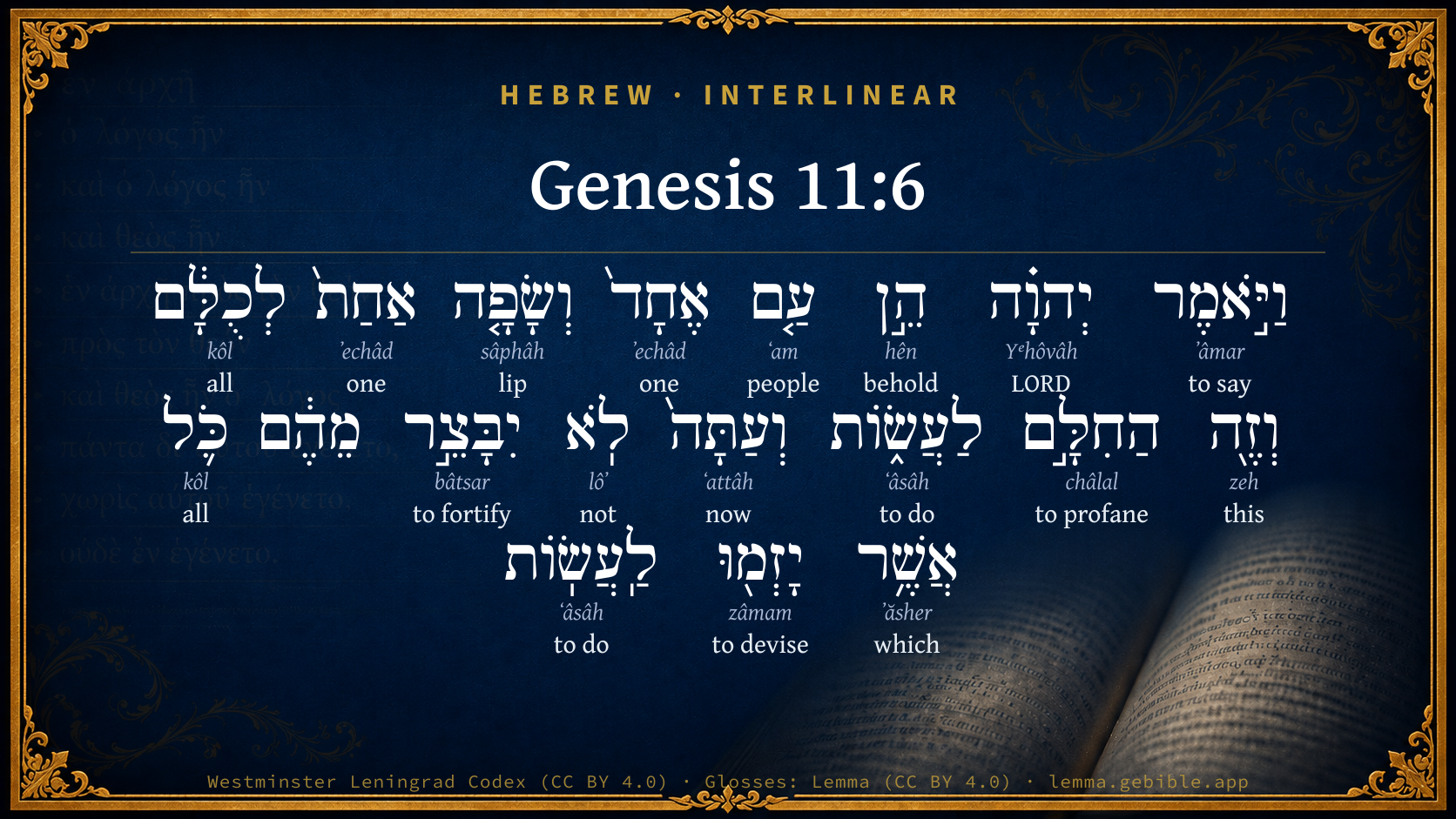
Genesis 11:6

Hebrew (Westminster Leningrad Codex) Genesis 11:6 appears in the Hebrew Old Testament. The text above is from the Westminster Leningrad Codex. Each word links to its Strong’s number, a concise gloss, and parsing drawn from the Open Scriptures Hebrew Bible morphology. Click any word for its full Brown-Driver-Briggs (BDB) entry.
Download image
Cite this verse

Genesis 11:6 (World English Bible). Public Domain. Lemma interlinear Bible study tool, https://lemma.gebible.app/v/genesis/11/6.

Show BibTeX & RIS
BibTeX
RIS
English Translation
Yahweh said, "Behold, they are one people, and they have all one language; and this is what they begin to do. Now nothing will be withheld from them, which they intend to do.
World English Bible · Public Domain
Highlights
  • 3 first appearances in the Hebrew Bible
Full analysis ↓
Download a study sheet

One document with this verse’s original text, its word-by-word gloss line, the meaning frame, cross-references with their text, attributed commentary, and full source and license credits — printable, and it pastes into notes with its structure intact.

This verse Autodidact and up

Study sheet (.html) Plain text (.txt)

A passage Seminary Student

Up to 50 verses in one chapter. A passage sheet keeps up to 6 commentary sources and 12 cross-references per verse, in the order this page ranks them, and says so on the sheet whenever that leaves anything out. Ask for a single verse and you get the Autodidact verse sheet above.

Everything on this page stays free to read, with no account — the sheet is a download of what is already on screen, not access to it.

Want to remove ads? Support Godless Engineer
Compare translations 3

The same verse in 3 English versions, stacked beneath the original-language interlinear above. Click any original word for its lexicon entry.

Each is an independent rendering of the whole verse — the interlinear is not word-aligned to these translations.

Highlighted words mark where these versions differ — a whole-verse word diff, not a word-by-word alignment.

  • World English Bible Public Domain
    Yahweh said, "Behold, they are one people, and they have all one language; and this is what they begin to do. Now nothing will be withheld from them, which they intend to do.
  • King James Version Public Domain
    And the LORD said, Behold, the people is one, and they have all one language; and this they begin to do: and now nothing will be restrained from them, which they have imagined to do.
  • unfoldingWord Literal Text CC BY-SA 4.0
    And Yahweh said, “Behold, one people, and they all have one language. So this what they have begun to do, and now everything that they plan to do will not be impossible for them.

unfoldingWord Literal Text — © unfoldingWord, licensed CC BY-SA 4.0. Word-aligned USFM3 via Door43 (git.door43.org/unfoldingWord/en_ult).

Versions to compare (up to 4)

3 of 4 selected

Show all 18 translations

Every available English version of this verse, each an independent rendering of the whole verse.

  • World English Bible Public Domain
    Yahweh said, "Behold, they are one people, and they have all one language; and this is what they begin to do. Now nothing will be withheld from them, which they intend to do.
  • Berean Standard Bible Public Domain
    And the LORD said, “If they have begun to do this as one people speaking the same language, then nothing they devise will be beyond them.
  • Majority Standard Bible Public Domain
    And the LORD said, “If they have begun to do this as one people speaking the same language, then nothing they devise will be beyond them.
  • King James Version Public Domain
    And the LORD said, Behold, the people is one, and they have all one language; and this they begin to do: and now nothing will be restrained from them, which they have imagined to do.
  • American Standard Version (1901) Public Domain
    And Jehovah said, Behold, they are one people, and they have all one language; and this is what they begin to do: and now nothing will be withholden from them, which they purpose to do.
  • Revised Version (1885) Public Domain
    And the LORD said, Behold, they are one people, and they have all one language; and this is what they begin to do: and now nothing will be withholden from them, which they purpose to do.
  • Geneva Bible (1599) Public Domain
    And the Lord said, Beholde, the people is one, and they all haue one language, and this they begin to doe, neither can they now be stopped from whatsoeuer they haue imagined to do.
  • Douay-Rheims (1899) Public Domain
    And he said: Behold, it is one people, and all have one tongue: and they have begun to do this, neither will they leave off from their designs, till they accomplish them in deed.
  • Young's Literal Translation Public Domain
    and Jehovah saith, `Lo, the people `is' one, and one pronunciation `is' to them all, and this it hath dreamed of doing; and now, nothing is restrained from them of that which they have purposed to do.
  • Literal Standard Version CC BY-SA 4.0
    and YHWH says, “Behold, the people [is] one, and one language [is] to them all, and this it has dreamed of doing; and now, nothing is restrained from them of that which they have purposed to do.
  • Unlocked Literal Bible CC BY-SA 4.0
    Yahweh said, “Look, they are one people with the same language, and they are beginning to do this! Soon nothing that they intend to do will be impossible for them.
  • unfoldingWord Literal Text CC BY-SA 4.0
    And Yahweh said, “Behold, one people, and they all have one language. So this what they have begun to do, and now everything that they plan to do will not be impossible for them.
  • Darby Bible Public Domain
    And Jehovah said, Behold, the people is one, and have all one language; and this have they begun to do. And now will they be hindered in nothing that they meditate doing.
  • World Messianic Bible Public Domain
    The LORD said, “Behold, they are one people, and they all have one language, and this is what they begin to do. Now nothing will be withheld from them, which they intend to do.
  • Webster's Bible Public Domain
    And the LORD said, Behold, the people is one, and they have all one language; and this they begin to do: and now nothing will be restrained from them, which they have imagined to do.
  • Free Bible Version CC BY-SA 4.0
    The Lord said, “Look! These people are united and they all speak one language. If this is what they can do now when they're just getting started, nothing will be impossible for them when they all put their minds to it!
  • Bible in Basic English Public Domain
    And the Lord said, See, they are all one people and have all one language; and this is only the start of what they may do: and now it will not be possible to keep them from any purpose of theirs.
  • JPS Tanakh (1917) Public Domain
    And the LORD said: 'Behold, they are one people, and they have all one language; and this is what they begin to do; and now nothing will be withholden from them, which they purpose to do.

Literal Standard Version (2020), Covenant Press — licensed CC BY-SA 4.0. Text via the HelloAO Bible API (eBible.org). Unlocked Literal Bible (unfoldingWord) — licensed CC BY-SA 4.0. Text via the HelloAO Bible API (eBible.org). unfoldingWord Literal Text — © unfoldingWord, licensed CC BY-SA 4.0. Word-aligned USFM3 via Door43 (git.door43.org/unfoldingWord/en_ult). Free Bible Version, Dr. Jonathan Gallagher — licensed CC BY-SA 4.0. Text via the HelloAO Bible API (eBible.org).

Word by word

More ways to search: Search by grammar → Find every occurrence → Compare this word →

Practice this passage: Drill this verse → Learn its vocabulary →

יָזְמ֖וּ
zâmam
H2161
“to devise”
Verb, Qal, Imperfect, 3rd Person, Masculine, Plural
Part of Speech
Verb
Stem
Qal
Form
Imperfect
Person
3rd Person
Gender
Masculine
Number
Plural
Full BDB Definition

Origin: a primitive root

TWOT: 556

to have a thought, devise, plan, consider, purpose - (Qal) - to consider, fix thought upon - to purpose, devise - to plot (of evil intent)
  1. וַיֹּ֣אמֶר ʼâmar H559 “and · to say” Conjunction + Verb, Qal, Sequential Imperfect, 3rd Person, Masculine, Singular
  2. יְהוָ֗ה Yᵉhôvâh H3068 “LORD” Noun, Proper
  3. הֵ֣ן hên H2005 “behold” Particle, Demonstrative
  4. עַ֤ם ʻam H5971 “people” Noun, Common, Masculine, Singular, Absolute
  5. אֶחָד֙ ʼechâd H259 “one” Adjective, Cardinal number, Masculine, Singular, Absolute
  6. וְשָׂפָ֤ה sâphâh H8193 “and · lip” Conjunction + Noun, Common, Feminine, Singular, Absolute
  7. אַחַת֙ ʼechâd H259 “one” Adjective, Cardinal number, Feminine, Singular, Absolute
  8. לְכֻלָּ֔ם kôl H3605 “to/for · all · their” Preposition + Noun, Common, Masculine, Singular, Construct + Suffix, Personal, 3rd Person, Masculine, Plural
  9. וְזֶ֖ה zeh H2088 “and · this” Conjunction + Pronoun, Demonstrative, Masculine, Singular
  10. הַחִלָּ֣ם châlal H2490 “to profane · them” Verb, Hiphil, Infinitive Construct + Suffix, Personal, 3rd Person, Masculine, Plural
  11. לַעֲשׂ֑וֹת ʻâsâh H6213 “to do” Preposition + Verb, Qal, Infinitive Construct
  12. וְעַתָּה֙ ʻattâh H6258 “and · now” Conjunction + Adverb
  13. לֹֽא lôʼ H3808 “not” Particle, Negative
  14. יִבָּצֵ֣ר bâtsar H1219 “to fortify” Verb, Niphal, Imperfect, 3rd Person, Masculine, Singular
  15. כֹּ֛ל kôl H3605 “all” Noun, Common, Masculine, Singular, Absolute
  16. אֲשֶׁ֥ר ʼăsher H834 “which” Particle, Relative
  17. לַֽעֲשֽׂוֹת ʻâsâh H6213 “to do” Preposition + Verb, Qal, Infinitive Construct

About this verse

These counts appear in no published source. They are computed here, from the morphology-tagged text and Lemma’s own curated glosses. What Lemma adds →

19
words
15
distinct lemmas
Pentateuch
section

Notable vocabulary

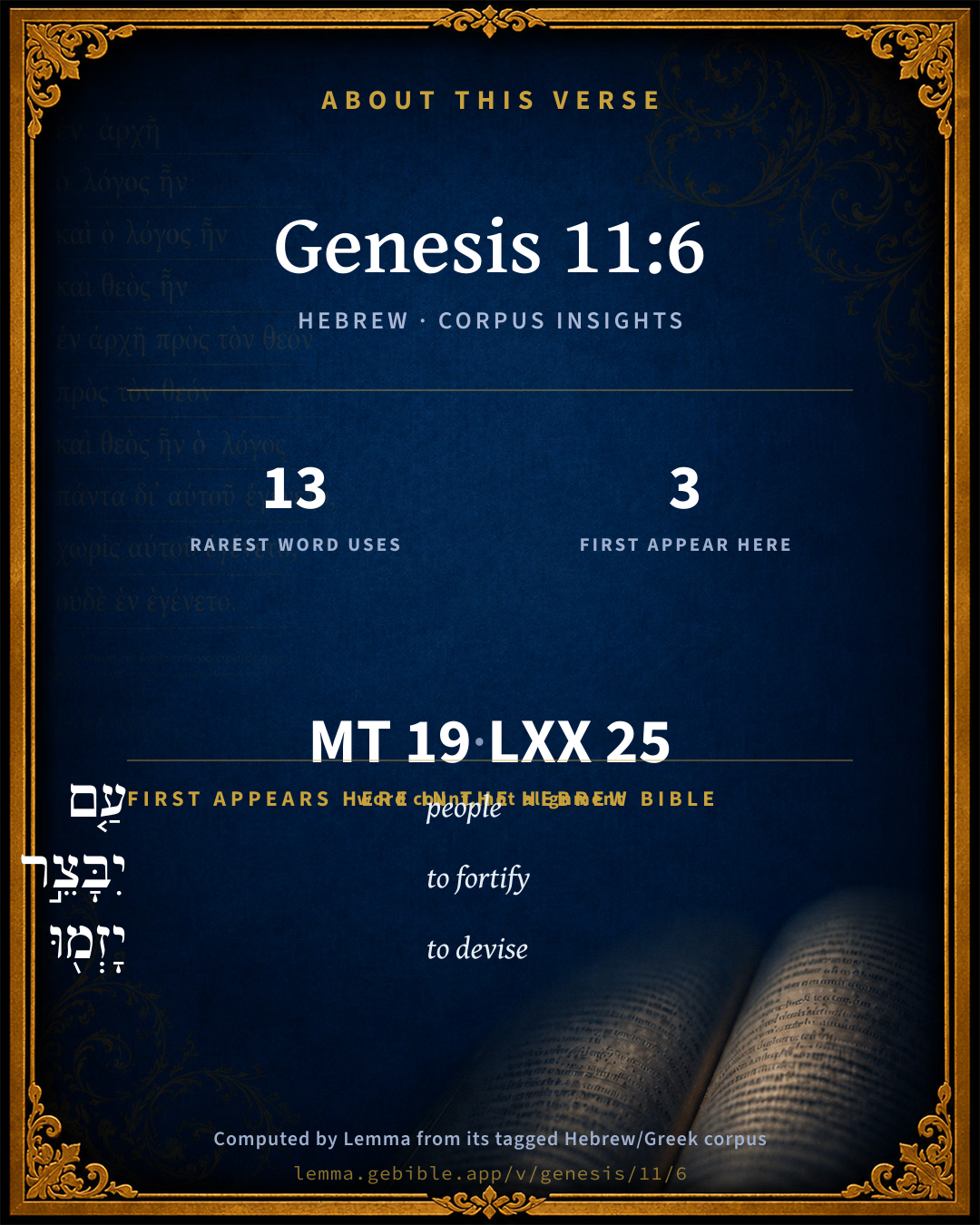
The rarest word here is יָזְמ֖וּ to devise H2161 — appearing just 13 times in the whole Hebrew Bible.

First appearance in Scripture

These words make their first canonical appearance in the Hebrew Bible here:

  • עַ֤ם people H5971
  • יִבָּצֵ֣ר to fortify H1219
  • יָזְמ֖וּ to devise H2161

Shared distinctive vocabulary

יָזְמ֖וּ to devise H2161 occurs in 13 verses of the Hebrew Bible. Also found in:

Grammatical profile

  • 6 verbs
  • 5 nouns
  • 2 adjectives
  • 1 pronoun
  • 1 preposition
  • 1 adverb
  • 3 particles

Verb forms

  • וַיֹּ֣אמֶר Qal · Sequential Imperfect
  • הַחִלָּ֣ם Hiphil · Infinitive Construct
  • לַעֲשׂ֑וֹת Qal · Infinitive Construct
  • יִבָּצֵ֣ר Niphal · Imperfect
  • יָזְמ֖וּ Qal · Imperfect
  • לַֽעֲשֽׂוֹת Qal · Infinitive Construct

Repetition

Words recur within this verse — often emphatic in Hebrew:

  • אֶחָד֙ one H259 ×2
  • לְכֻלָּ֔ם all H3605 ×2
  • לַעֲשׂ֑וֹת to do H6213 ×2

Hebrew & Septuagint length

In English translation the verse runs 33 words from the Hebrew and 37 from the Septuagint (LXX English) — closely comparable.

A rough comparison of the two English renderings, which tokenize alike — not a word-level alignment.

Word counts can differ between the Hebrew and the Greek without any difference in meaning — e.g. the Hebrew direct-object marker אֵת has no separate Greek word, and Greek often adds the article ὁ.

In the original languages it is 19 Hebrew tokens and 25 Greek tokens — but the two are counted differently (Hebrew bundles its prefixes and suffixes into one token; the Greek is in lemma form), so that isn’t a like-for-like length.

Cross-references

10

Topical passages linked to Genesis 11:6 in the Treasury of Scripture Knowledge — connected by theme and wording, ordered by reader-vote popularity; previews shown in the World English Bible.

  • Psalms 2:1–4 Why do the nations rage, And the peoples plot a vain thing?
  • Genesis 3:22 Yahweh God said, "Behold, the man has become like one of us, knowing good and evil. Now, lest he put forth his hand, and also take of the tree of life, and eat, and live forever..."
  • Genesis 11:1 The whole earth was of one language and of one speech.
  • Ecclesiastes 11:9 Rejoice, young man, in your youth, And let your heart cheer you in the days of your youth, And walk in the ways of your heart, And in the sight of your eyes; But know that for all these things God will bring you into judgment.
  • Luke 1:51 He has shown strength with his arm. He has scattered the proud in the imagination of their heart.
  • Genesis 6:5 Yahweh saw that the wickedness of man was great in the earth, and that every imagination of the thoughts of his heart was only evil continually.
  • Genesis 9:19 These three were the sons of Noah, and from these, the whole earth was populated.
  • Genesis 8:21 Yahweh smelled the sweet savor. Yahweh said in his heart, "I will not again curse the ground any more for man's sake, because the imagination of man's heart is evil from his youth; neither will I ever again strike everything living, as I have done.
  • Acts 17:26 He made from one blood every nation of men to dwell on all the surface of the earth, having determined appointed seasons, and the boundaries of their dwellings,
  • Judges 10:14 Go and cry to the gods which you have chosen; let them save you in the time of your distress.

Cross-references courtesy of OpenBible.info (CC BY 4.0).

Hebrew and Greek witnesses Masoretic Hebrew ↔ Greek Septuagint

The same verse in the two great witnesses to the Old Testament, shown verse-for-verse.

These are two independent witnesses, not word-aligned to each other, and the Septuagint is shown in lemma (dictionary) form.

Hebrew Genesis 11:6 Masoretic · Westminster Leningrad Codex

וַיֹּ֣אמֶר יְהוָ֗ה הֵ֣ן עַ֤ם אֶחָד֙ וְשָׂפָ֤ה אַחַת֙ לְכֻלָּ֔ם וְזֶ֖ה הַחִלָּ֣ם לַעֲשׂ֑וֹת וְעַתָּה֙ לֹֽא יִבָּצֵ֣ר מֵהֶ֔ם כֹּ֛ל אֲשֶׁ֥ר יָזְמ֖וּ לַֽעֲשֽׂוֹת

Yahweh said, "Behold, they are one people, and they have all one language; and this is what they begin to do. Now nothing will be withheld from them, which they intend to do.

World English Bible · Public Domain

Greek LXX Genesis 11:6 Septuagint · lemma form

καί εἶπον κύριος ἰδού γένος εἷς καί χεῖλος εἷς πᾶς καί οὗτος ἄρχω ποιέω καί νῦν οὐ ἐκλείπω ἐκ αὐτός πᾶς ὅσος ἄν ἐπιτίθημι ποιέω

And the Lord said, Behold, there is one race, and one lip of all, and they have begun to do this, and now nothing shall fail from them of all that they may have undertaken to do.

LXX2012 (modern English Septuagint) · Public Domain

On this verse, The Pulpit Commentary discusses the Septuagint’s reading. Read the note in Commentary ↓

Hebrew: Westminster Leningrad Codex (CC BY 4.0). Greek: Septuagint (public domain); English from LXX2012 (modern English Septuagint) (Public Domain). How the Septuagint differs from the Hebrew →

Targum (Aramaic paraphrase)

2

The Targum is the ancient Jewish Aramaic paraphrase of the Hebrew Scriptures — an interpretive translation, not the Hebrew text itself. Onkelos (literal) and Pseudo-Jonathan (expansive) render the Torah, and Jonathan the Prophets. Coverage is partial: where no permissively-licensed English translation exists for a verse, only the Aramaic is shown. This is verse-level text, not a word-by-word alignment to the Hebrew.

  1. Targum Onkelos Torah (Genesis–Deuteronomy)
    וַאֲמַר יְיָ הָא עַמָּא חַד וְלִישָׁן חַד לְכֻלְּהוֹן וְדֵין דְּשָׁרִיוּ לְמֶעְבָּד וּכְעַן לָא יִתִּמְנַע מִנְּהוֹן כֹּל דִחַשִּׁיבוּ לְמֶעְבָּד

    And the Lord said, Behold, the people is one and the language one with all of them: and this is what they begin to do. And now nothing will be restrained from them of what they imagine to do.

    Targum Onkelos — Aramaic: “Onkelos Genesis” (public domain); “Onkelos Exodus” (public domain); “Onkelos Leviticus” (public domain); “Onkelos Numbers” (public domain); “Onkelos Deuteronomy” (public domain). English: “Sefaria Community Translation” (CC0 1.0 (public-domain dedication)); “J.W. Etheridge. The Targums of Onkelos and Jonathan Ben Uzziel on the Pentateuch. London: Longmans, Green, 1862” (public domain). Text via Sefaria.

  2. Targum Pseudo-Jonathan Torah (Genesis–Deuteronomy)
    וַאֲמַר יְיָ הָא עַמָא חָד וְלִישָׁן חָד לְכֻלְהוֹם וְדָא אִתְחַשְׁבוּ לְמֶעֱבַד וּכְדוֹן לָא יִתְמְנַע מִנְהוֹן כָּל דַחֲשִׁיבוּ לְמֶעֱבָד

    And the Lord said, Behold, the people is one, and the language of all of them one: and this they have thought to do: and now they will not be restrained from doing whatever they imagine.

    Targum Pseudo-Jonathan — Aramaic: “Targum Jonathan on Genesis” (public domain); “Targum Jonathan on Exodus” (public domain); “Targum Jonathan on Leviticus” (public domain); “Targum Jonathan on Numbers” (public domain); “Targum Jonathan on Deuteronomy” (public domain). English: “The Targum of Jonathan ben Uzziel, trans. J. W. Etheridge, London, 1862” (public domain). Text via Sefaria.

Commentary

Notes on Genesis 11:6 from classic Christian and Jewish commentators (each source and its license shown beneath its notes). The classic Christian expositions comment on the surrounding passage and are grouped to its opening verse, so a note may address several verses; the Jewish commentaries on the Tanakh (Rashi and others) are per-verse, so they appear only where the commentator wrote on this verse.

Lemma curates 59 commentaries, every one of them public domain or Creative Commons licensed, each selected and text-cleaned for this edition rather than reprinted as found. About our sources →

The Cambridge Bible for Schools and Colleges

gen. ed. J. J. S. Perowne

6. And the Lord said] The account, in this and the following verse, is evidently condensed. In Gen_11:5 Jehovah is represented as coming down on earth, in order to see more closely, and on the spot to form a better judgement. This He has done; He has returned to heaven, and now, in Gen_11:6, announces what He has seen. In Gen_11:7 He proposes to descend a second time and inflict punishment.

one people … one language] This is evidently contrary to the intention of the Deity who desires the whole earth to be populated.

nothing will be withholden from them] i.e. they will be baulked in no enterprise. If they mount up to heaven, their arrogance will make them endeavour to rival God Himself. It is the same kind of apprehension as in Gen_3:22.

The Cambridge Bible for Schools and Colleges (gen. ed. J. J. S. Perowne; Cambridge University Press, 1878–1918) — public domain. Text from a community e-Sword module.

Trapp's Complete Commentary

John Trapp

Gen 11:6 And the LORD said, Behold, the people [is] one, and they have all one language; and this they begin to do: and now nothing will be restrained from them, which they have imagined to do.

Ver. 6. Behold the people is one, &c.] This benefit they abused to their pride and ambition, which they should have used to the help of the humane society, and common intercourse. They built, and God bare with them for a time, that he might make fools of them in the end. And this he doth daily.

John Trapp, A Commentary or Exposition upon All the Books of the Old and New Testament (1647–1656) — public domain. Text from a community e-Sword module.

Tyndale Open Study Notes

Tyndale Open Resources

11:6 If left unchecked, the tower builders’ solidarity and ambition would allow human wickedness to flourish in unimaginable ways.

Tyndale Open Study Notes — © Tyndale Open Resources, licensed CC BY-SA 4.0. Text via the HelloAO Bible API.

Geneva Bible (1599)

Geneva Bible translators

God speaketh this in derision, because of their foolish persuasion and enterprise.

Geneva Bible (1599) marginal notes — public domain. Text via Bolls.life.

Jamieson, Fausset & Brown

Robert Jamieson, A. R. Fausset & David Brown

and now nothing will be restrained from them--an apparent admission that the design was practicable, and would have been executed but for the divine interposition.

Jamieson, Fausset & Brown — Commentary Critical and Explanatory on the Whole Bible (1871) — public domain (CC PDM 1.0). Text via the HelloAO Bible API.

Adam Clarke's Commentary

Verse 6. The people is one, c.] From this, as before observed, we may infer, that as the people had the same language, so they had a unity of design and sentiment. It is very likely that the original language was composed of monosyllables, that each had a distinct ideal meaning, and only one meaning as different acceptations of the same word would undoubtedly arise, either from compounding terms, or, when there were but few words in a language, using them by a different mode of pronunciation to express a variety of things. Where this simple monosyllabic language prevailed (and it must have prevailed in the first ages of the world) men would necessarily have simple ideas, and a corresponding simplicity of manners. The Chinese language is exactly such as this; and the Hebrew, if stripped of its vowel points, and its prefixes, suffixes, and postfixes separated from their combinations, so that they might stand by themselves, it would nearly answer to this character even in its present state. In order therefore to remove this unity of sentiment and design, which I suppose to be the necessary consequence of such a language, God confounded their language-caused them to articulate the same word differently, to affix different ideas to the same term, and perhaps, by transposing syllables and interchanging letters, form new terms and compounds, so that the mind of the speaker was apprehended by the hearer in a contrary sense to what was intended. This idea is not iii expressed by an ancient French poet, Du Bartas; and not badly, though rather quaintly, metaphrased by our countryman, Mr. Sylvester.

Some speak between the teeth, some in the nose, Some in the throat their words do ill dispose -

"Bring me," quoth one, "a trowel, quickly, quick!"

One brings him up a hammer. "Hew this brick,"

Another bids; and then they cleave a tree;

"Make fast this rope," and then they let it flee.

One calls for planks, another mortar lacks;

They bear the first a stone, the last an axe.

One would have spikes, and him a spade they give;

Another asks a saw, and gets a sieve.

Thus crossly crost, they prate and point in vain:

What one hath made another mars again.

. . . . . . . . . . . . . . . . . . . . . . . .

These masons then, seeing the storm arrived

Of God's just wrath, all weak and heart-deprived,

Forsake their purpose, and, like frantic fools,

Scatter their stuff and tumble down their tools.

DU BARTAS. - Babylon.

I shall not examine how the different languages of the earth were formed. It certainly was not the work of a moment; different climates must have a considerable share in the formation of tongues, by their influence on the organs of speech. The invention of new arts and trades must give birth to a variety of terms and expressions. Merchandise, commerce, and the cultivation of the sciences, would produce their share; and different forms of government, modes of life, and means of instruction, also contribute their quota. The Arabic, Chaldee, Syriac, and AEthiopic, still bear the most striking resemblance to their parent, the Hebrew. Many others might be reduced to a common source, yet everywhere there is sufficient evidence of this confusion. The anomalies even in the most regular languages sufficiently prove this. Every language is confounded less or more but that of eternal truth. This is ever the same; in all countries, climates, and ages, the language of truth, like that God from whom it sprang, is unchangeable. It speaks in all tongues, to all nations, and in all hearts: "There is one GOD, the fountain of goodness, justice, and truth. MAN, thou art his creature, ignorant, weak, and dependent; but he is all - sufficient - hates nothing that he has made - loves thee - is able and willing to save thee; return to and depend on him, take his revealed will for thy law, submit to his authority, and accept eternal life on the terms proposed in his word, and thou shalt never perish nor be wretched." This language of truth all the ancient and modern Babel builders have not been able to confound, notwithstanding their repeated attempts. How have men toiled to make this language clothe their own ideas; and thus cause God to speak according to the pride, prejudice and worst passions of men! But through a just judgment of God, the language of all those who have attempted to do this has been confounded, and the word of the Lord abideth for ever.

Adam Clarke's Commentary on the Bible (1810–1826) — public domain. Text from a community e-Sword/MySword module.

John Calvin's Commentaries

6. Behold, the people is one. Some thus expound the words, that God complains of a wickedness in men so refractory, that he excites himself by righteous grief to execute vengeance; not that he is swayed by any passions, but to teach us that he is not negligent of human affairs, and that, as he watches for the salvation of the faithful, so he is intent on observing the wickedness of the ungodly; as it is said in Psalm 34:16,

“The face of the Lord is against them that do evil, to cut off the remembrance of them from the earth.”

Others think there is a comparison between the less and the greater, no if it had been said, ‘They are hitherto few and only use one language; what will they not dare, if, on account of their multitude, they should become separated into various nations?’ But there rather seems to me to be a suppressed irony, as if God would propose to himself a difficult work in subduing their audacity: so that the sense may be, ‘This people is compacted together in a firm conspiracy, they communicate with each other in the same language, by what method therefore can they be broken?’ Nevertheless, he ironically smiles at their foolish and hasty confidence; because, while men are calculating upon their own strength, there is nothing which they do not arrogate to themselves.

This they begin to do. In saying that they begin, he intimates that they make a diligent attempts accompanied with violent fervor, in carrying on the work. Thus in the way of concession, God declares, that supposing matters to be so arranged, there would be no interruption of the building.

John Calvin's Commentaries (1540-1563) — public domain. Text from the Calvin Translation Society English edition (1840s-50s) via the Christian Classics Ethereal Library (ccel.org). Calvin's coverage is partial (roughly two-thirds of the Bible); uncommented books and verses are honest gaps, never fabricated. The 19th-century editor's footnotes and remarks are omitted so the notes are faithfully Calvin's own voice.

John Gill's Exposition

And the Lord said,.... Not to the angels, as Aben Ezra, but rather to the Son and Spirit, or within himself:

behold, the people is one, and they have all one language; which some think is spoken ironically; but I see no reason why it may not be understood seriously, that the people who were concerned in this building were unanimous, not only in their religious principles, such as they were, as Aben Ezra, but in their counsel, purpose, and design in building; they went on with great concord, harmony, and vigour, and being of one language, they understood one another, and so could carry on their work with the greater expedition:

and this they begin to do; to build the city and the tower, and had made considerable progress in it:

and now nothing will be restrained from them, which they have imagined to do; they had prepared bricks, and slime or bitumen, a sufficient quantity for their use, or could easily come at more if they wanted; and they were not to be prevailed upon to desist from their work, by any advice that the sons of God could give them; they were obstinate and self-willed, and not to be argued with and persuaded to leave off; and there was no power on earth superior to them, to oblige them to it; they could only be restrained from their enterprise, and hindered from executing it, by divine power; and which was judged necessary to exert, as appears by what follows: and the words may be rendered, "shall they not be restrained? &c." they shall.

John Gill's Exposition of the Whole Bible (1746–1763) — public domain (CC PDM 1.0). Text via the HelloAO Bible API.

Haydock's Catholic Bible Commentary

In deed. This seems to be spoken ironically; though the effects of weak mortals, the sons of Adam, when pursued with vigour and unanimity, will produce great effects. These builders had conceived an idea of raising the tower as high as possible, hyperbolically, to touch heaven. (Haydock)

George Leo Haydock (1774–1849), Haydock's Catholic Family Bible and Commentary, 1859 edition — public domain. Excludes Psalms (Douay-Rheims chapter numbering differs from Protestant) and Deuterocanonical books (Catholic canon only).

Matthew Poole's English Annotations

The Lord said this in way of holy scorn and derision. Compare Gen 3:22.

Matthew Poole's English Annotations on the Holy Bible (1683–1685) — public domain. Text from a community e-Sword/MySword module.

Whedon's Commentary on the Bible

Daniel D. Whedon

6. This they begin to do — This is only the beginning of their deeds, and if this daring act of impiety be not rebuked, and their far-reaching plans of centralized human power be not frustrated, nothing will be restrained from them, (Hebrews, cut off from them;) that is, there will be no bound or limit to their purposes.

Daniel D. Whedon (gen. ed.), Commentary on the Old and New Testaments (1874–1909) — public domain. Text from a community e-Sword module.

The Pulpit Commentary

And the Lord said within himself, and to himself (vide ver. 8); expressive of the formation of a Divine resolution (cf. Gen_6:7) Behold, the people s, from root signifying to bind together, expresses the idea of association; ywOG, from a root signifying to swell (Lange), to flow together (Gesenius), to gather together (Furst), conveys the notion of a confluxus hominum. T. Lewis connects it with the sense of interiority, or exclusion, which is common in the Chaldee and Syriacis one, and they have all one language; and this they begin to do. One race, one tongue, one purpose. The words indicate unity of effort, as well as concentration of design, on the part of the builders, and a certain measure of success in the achievement of their work. And now nothing will be restrained from them. Literally, there will not be cut off from them anything; oujk ejkleiyei ajp aujtwn panta (LXX); non desistent a cogitationibus suis (Vulgate, Luther); i.e. nothing will prove too hard for their dating. It can hardly imply that their impious design was on the eve of completion. Which they have imagined to do.

Vain imaginings

1. Commonly spring from misused blessings. A united people, with a common language, and enjoying a measure of "success in their buildings, the Babelites became vain in their imaginings. So do wicked men generally misinterpret the Divine beneficence and leniency which suffers them to proceed a certain length with their wickedness (cf. Rom_1:21; 2Ti_3:9)

2. Are never unobserved by him against whom they are directed . (Deu_31:21; 1Ch_28:9)

3. Are doomed to certain and complete frustration W. (Psa_2:1; Luk_1:51; 2Co_10:5)

The Pulpit Commentary (1880–1919), ed. H.D.M. Spence-Jones & Joseph S. Exell — public domain. Text from a community e-Sword module.

John Wesley's Explanatory Notes

And the Lord said, Behold the people is one, and they have all one language - And if they continue one, much of the earth will be left uninhabited, and these children of men, if thus incorporated, will swallow up the little remnant of God's children, therefore it is decreed they must not be one. And now nothing will be restrained from them - And this is a reason why they must be crossed, in their design.

John Wesley, Explanatory Notes Upon the Whole Bible (1754–1765) — public domain. Text via the GEBible commentary corpus.

Rashi

Rabbi Shlomo Yitzchaki (Rashi)

הן עם אחד BEHOLD, THEY ARE ONE PEOPLE — They possess all the advantage of being one people and of having one language common to all of them, and this is what they begin to do!

החלם is infinitive, like אמרם “their speaking”. עשותם “their doing” (i.e. “they speak”, “they do”) — so here: “they begin to do”) (Genesis Rabbah 38:9).

לא יבצר מהם וגו' לעשות This is a question (although the ה which introduces an interrogative sentence is absent): SHALL THEY NOT BE RESTRAINED FROM DOING WHAT THEY IMAGINE TO DO? The word יבצר means “restraining”, as the Targum understands it; a similar instance is, (Psalms 76:13) “He restrains (יבצור) the spirit of princes”.

Rashi on the Tanakh — English translations: “The Judaica Press complete Tanach with Rashi, translated by A. J. Rosenberg” (CC BY 4.0); “Pentateuch with Rashi's commentary by M. Rosenbaum and A.M. Silbermann, 1929-1934” (public domain); “The Metsudah Tanach series, Lakewood, N.J” (CC BY 4.0); and “The Book of Joshua, Metsudah Publications, 1997” (CC BY 4.0). Text via Sefaria.

Radak

Rabbi David Kimhi (Radak)

'ויאמר ה, to the angels;

הן עם אחד, they are all of one mind, as in Genesis 34,16 והיינו לעם “let us become a single nation.”

ושפה אחת, they can maintain their unity by speaking the same language.

ולא יבצר, shall it not be denied them?

כל אשר יזמו לעשות, unless we frustrate their plan from being carried out. The verb יזם describes something one plans with one’s mind. The roots זמם and יזם mean the same, and can be used interchangeably.

Radak on the Tanakh — English translations: “Sefaria Community Translation” (CC0 1.0 (public-domain dedication)); “Eliyahu Munk, HaChut Hameshulash” (CC BY 4.0); “Rabbi Mike Feuer, Jerusalem Anthology” (CC BY 4.0); and “R. David Kimhi on the first book of Psalms, Translated by R.G. Finch, London, 1919” (public domain). Text via Sefaria.

Lesson kit

Teaching starters — assembled from the data on this page, not authored interpretation. Every prompt links to the verse data it draws on. Edit before teaching.

Genesis, in the Pentateuch, opens this verse with 19 words (15 distinct Hebrew lemmas). Its most distinctive word is zâmam (“to devise”). A historical commentator’s framing appears above. Read the whole chapter for the surrounding context.

Discussion questions

  1. What does “to devise” (zâmam) contribute to the verse as a whole?
  2. 3 words here appear for the first time in Scripture. What is being introduced at this debut?
  3. Deuteronomy 19:19 shares the word «to devise» with this verse. How do the two illuminate each other?
  4. “one” occurs 2× in this one verse. What is the effect of the repetition?
  5. These translations render this verse differently; the difference is in the English rendering, not the original. What questions does that raise?
  6. The verb «וַיֹּ֣אמֶר» is Qal Sequential Imperfect. How does its form color the action?
  7. Reading how The Cambridge Bible for Schools and Colleges and Trapp's Complete Commentary read this verse, where do the two commentators agree and where do they part?

Things to notice

Reading settings

Reading text

Shown beneath each verse's original-language words.

Old Testament
Old Testament edition

Read the OT as the Masoretic Hebrew (MT) or the Greek Septuagint (LXX).

English shown for the Greek Septuagint (in the Hebrew ↔ Greek comparison).

Comparing translations? Open the Compare panel on any verse page to stack up to four side by side.