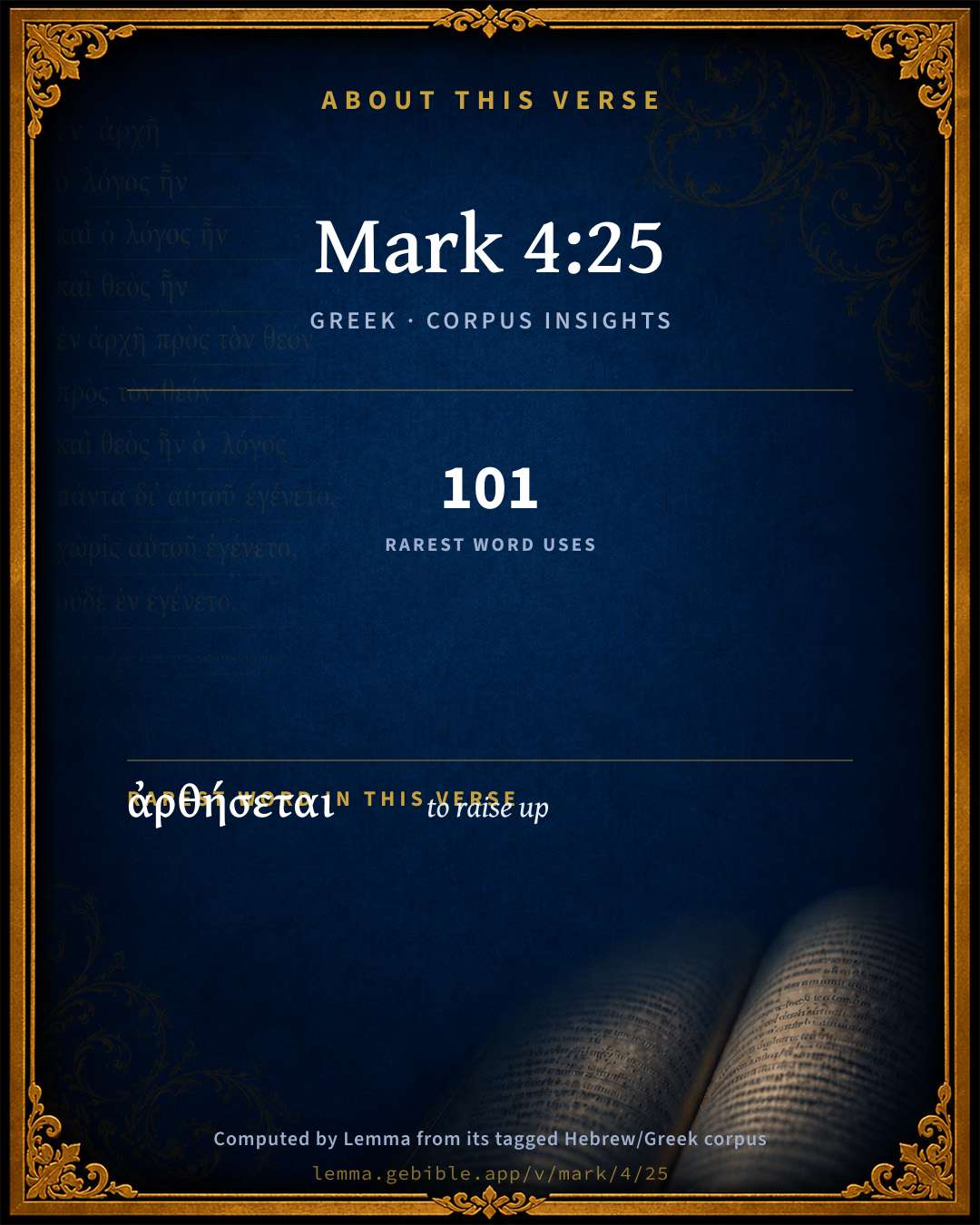
Mark 4:25

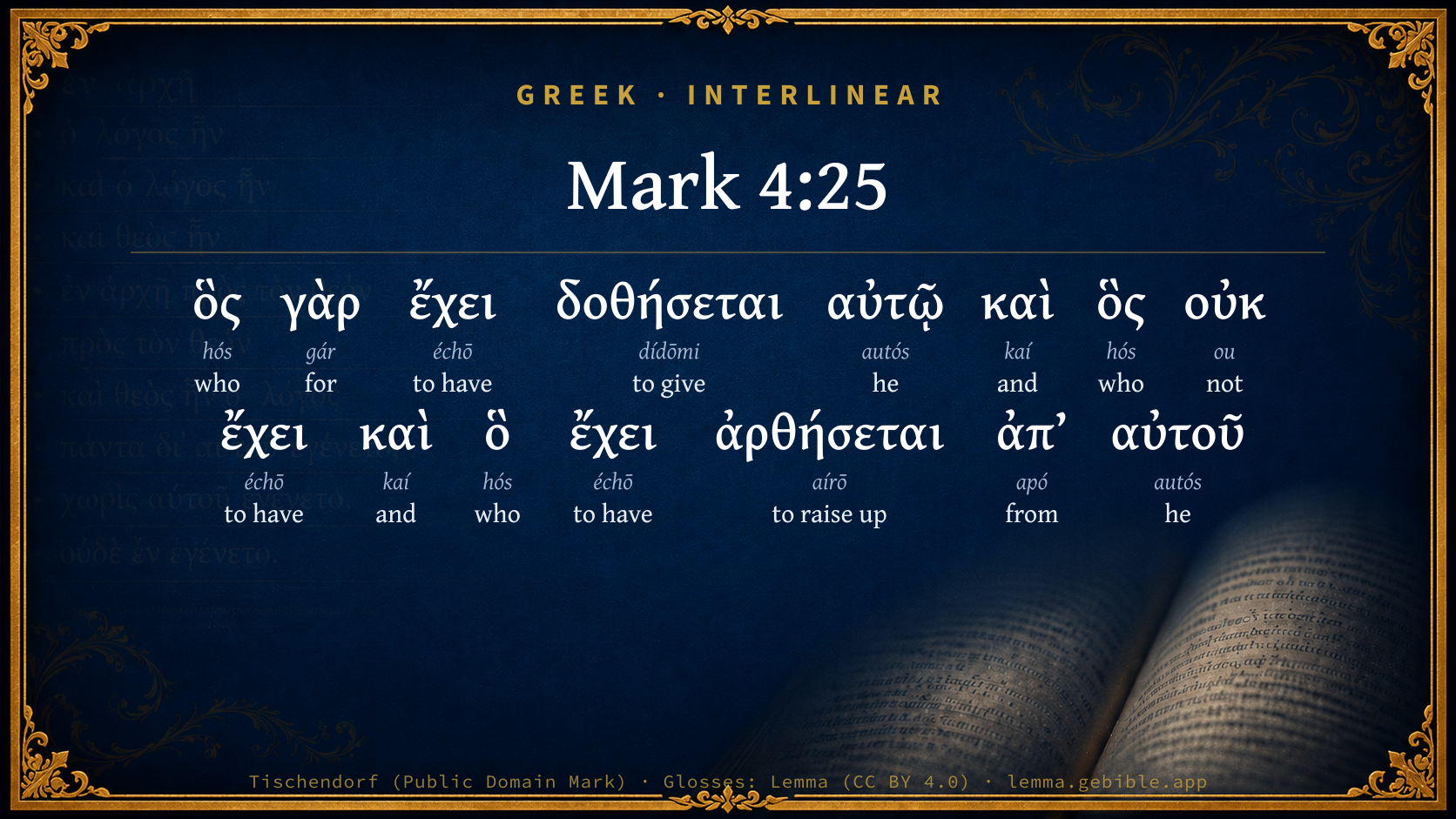
Greek (Tischendorf 8th ed.) Mark 4:25 appears in the Greek New Testament. The text above is from the Tischendorf 8th edition. Each word links to its Strong’s number and a concise gloss. Click any word for its full Thayer’s Greek Lexicon entry.
Download image
Cite this verse

Mark 4:25 (World English Bible). Public Domain. Lemma interlinear Bible study tool, https://lemma.gebible.app/v/mark/4/25.

Show BibTeX & RIS
BibTeX
RIS
English Translation
For whoever has, to him will more be given, and he who doesn't have, from him will be taken away even that which he has."
World English Bible · Public Domain
Download a study sheet

One document with this verse’s original text, its word-by-word gloss line, the meaning frame, cross-references with their text, attributed commentary, and full source and license credits — printable, and it pastes into notes with its structure intact.

This verse Autodidact and up

Study sheet (.html) Plain text (.txt)

A passage Seminary Student

Up to 50 verses in one chapter. A passage sheet keeps up to 6 commentary sources and 12 cross-references per verse, in the order this page ranks them, and says so on the sheet whenever that leaves anything out. Ask for a single verse and you get the Autodidact verse sheet above.

Everything on this page stays free to read, with no account — the sheet is a download of what is already on screen, not access to it.

Want to remove ads? Support Godless Engineer
Compare translations 3

The same verse in 3 English versions, stacked beneath the original-language interlinear above. Click any original word for its lexicon entry.

Each is an independent rendering of the whole verse — the interlinear is not word-aligned to these translations.

Highlighted words mark where these versions differ — a whole-verse word diff, not a word-by-word alignment.

  • World English Bible Public Domain
    For whoever has, to him will more be given, and he who doesn't have, from him will be taken away even that which he has."
  • King James Version Public Domain
    For he that hath, to him shall be given: and he that hath not, from him shall be taken even that which he hath.
  • unfoldingWord Literal Text CC BY-SA 4.0
    For he who has, it will be given to him, and he who does not have, even what he has will be taken away from him.”

unfoldingWord Literal Text — © unfoldingWord, licensed CC BY-SA 4.0. Word-aligned USFM3 via Door43 (git.door43.org/unfoldingWord/en_ult).

Versions to compare (up to 4)

3 of 4 selected

Show all 19 translations

Every available English version of this verse, each an independent rendering of the whole verse.

  • World English Bible Public Domain
    For whoever has, to him will more be given, and he who doesn't have, from him will be taken away even that which he has."
  • Berean Standard Bible Public Domain
    For whoever has will be given more. But whoever does not have, even what he has will be taken away from him.”
  • Majority Standard Bible Public Domain
    For whoever has will be given more. But whoever does not have, even what he has will be taken away from him.”
  • King James Version Public Domain
    For he that hath, to him shall be given: and he that hath not, from him shall be taken even that which he hath.
  • American Standard Version (1901) Public Domain
    For he that hath, to him shall be given: and he that hath not, from him shall be taken away even that which he hath.
  • Revised Version (1885) Public Domain
    For he that hath, to him shall be given: and he that hath not, from him shall be taken away even that which he hath.
  • Geneva Bible (1599) Public Domain
    For vnto him that hath, shall it be giuen, and from him that hath not, shall be taken away, euen that he hath.
  • Douay-Rheims (1899) Public Domain
    For he that hath, to him shall be given: and he that hath not, that also which he hath shall be taken away from him.
  • Young's Literal Translation Public Domain
    for whoever may have, there shall be given to him, and whoever hath not, also that which he hath shall be taken from him.'
  • Literal Standard Version CC BY-SA 4.0
    for whoever may have, there will be given to him, and whoever has not, also that which he has will be taken from him.”
  • Unlocked Literal Bible CC BY-SA 4.0
    Because whoever has, to him will be given more, and whoever does not have, even what he has will be taken.”
  • unfoldingWord Literal Text CC BY-SA 4.0
    For he who has, it will be given to him, and he who does not have, even what he has will be taken away from him.”
  • Darby Bible Public Domain
    For whosoever has, to him shall be given; and he who has not, even what he has shall be taken from him.
  • World Messianic Bible Public Domain
    For whoever has, to him more will be given; and he who doesn’t have, even that which he has will be taken away from him.”
  • Webster's Bible Public Domain
    For he that hath, to him shall be given: and he that hath not, from him shall be taken even that which he hath.
  • Free Bible Version CC BY-SA 4.0
    More will be given to those who already have understanding, but those who don't want to know will have what little understanding they have taken from them.
  • Bible in Basic English Public Domain
    He who has, to him will be given: and he who has not, from him will be taken even that which he has.
  • Text-Critical English NT CC BY 4.0
    For whoever has will be given more, but whoever does not have, even what he has will be taken away from him.”
  • Tyndale New Testament (1534) Public Domain
    For vnto him that hath shall it be geven: and from him that hath not shalbe taken awaye even that he hath.

Literal Standard Version (2020), Covenant Press — licensed CC BY-SA 4.0. Text via the HelloAO Bible API (eBible.org). Unlocked Literal Bible (unfoldingWord) — licensed CC BY-SA 4.0. Text via the HelloAO Bible API (eBible.org). unfoldingWord Literal Text — © unfoldingWord, licensed CC BY-SA 4.0. Word-aligned USFM3 via Door43 (git.door43.org/unfoldingWord/en_ult). Free Bible Version, Dr. Jonathan Gallagher — licensed CC BY-SA 4.0. Text via the HelloAO Bible API (eBible.org).

Word by word

More ways to search: Search by grammar → Find every occurrence → Compare this word →

Practice this passage: Drill this verse → Learn its vocabulary →

ἀρθήσεται
aírō
G142
“to raise up”
Verb, Future, Passive, Indicative, 3rd person, Singular
Part of Speech
Verb
Tense
Future
Voice
Passive
Mood
Indicative
Person
3rd person
Number
Singular
Full Thayer's Definition

Origin: a primary root

TDNT: 04:05,3

1. to raise up, elevate, lift up a. to raise from the ground, take up: stones b. to raise upwards, elevate, lift up: the hand c. to draw up: a fish 2. to take upon one's self and carry what has been raised up, to bear 3. to bear away what has been raised, carry off a. to move from its place b. to take off or away what is attached to anything c. to remove d. to carry off, carry away with one e. to appropriate what is taken f. to take away from another what is his or what is committed to him, to take by force g. to take and apply to any use h. to take from among the living, either by a natural death, or by violence i. cause to cease
  1. ὃς hós G3739 “who” Relative pronoun, Nominative, Singular, Masculine
  2. γὰρ gár G1063 “for” Conjunction
  3. ἔχει échō G2192 “to have” Verb, Present, Active, Indicative, 3rd person, Singular
  4. δοθήσεται dídōmi G1325 “to give” Verb, Future, Passive, Indicative, 3rd person, Singular
  5. αὐτῷ autós G846 “he” Personal pronoun, Dative, Singular, Masculine
  6. καὶ kaí G2532 “and” Conjunction
  7. ὃς hós G3739 “who” Relative pronoun, Nominative, Singular, Masculine
  8. οὐκ ou G3756 “not” Particle, Negative
  9. ἔχει échō G2192 “to have” Verb, Present, Active, Indicative, 3rd person, Singular
  10. καὶ kaí G2532 “and” Conjunction
  11. ὃ hós G3739 “who” Relative pronoun, Accusative, Singular, Neuter
  12. ἔχει échō G2192 “to have” Verb, Present, Active, Indicative, 3rd person, Singular
  13. ἀπ’ apó G575 “from” Preposition
  14. αὐτοῦ autós G846 “he” Personal pronoun, Genitive, Singular, Masculine

About this verse

These counts appear in no published source. They are computed here, from the morphology-tagged text and Lemma’s own curated glosses. What Lemma adds →

15
words
9
distinct lemmas
Gospels
section

Repetition

Words recur within this verse:

Cross-references

6

Topical passages linked to Mark 4:25 in the Treasury of Scripture Knowledge — connected by theme and wording, ordered by reader-vote popularity; previews shown in the World English Bible.

  • Matthew 13:12 For whoever has, to him will be given, and he will have abundance, but whoever doesn't have, from him will be taken away even that which he has.
  • Luke 8:18 Be careful therefore how you hear. For whoever has, to him will be given; and whoever doesn't have, from him will be taken away even that which he thinks he has."
  • Matthew 25:28–29 Take away therefore the talent from him, and give it to him who has the ten talents.
  • John 15:2 Every branch in me that doesn't bear fruit, he takes away. Every branch that bears fruit, he prunes, that it may bear more fruit.
  • Luke 16:9–12 I tell you, make for yourselves friends by means of unrighteous mammon, so that when you fail, they may receive you into the eternal tents.
  • Luke 19:24–26 He said to those who stood by, 'Take the mina away from him, and give it to him who has the ten minas.'

Cross-references courtesy of OpenBible.info (CC BY 4.0).

Commentary

Notes on Mark 4:25 from classic Christian and Jewish commentators (each source and its license shown beneath its notes). The classic Christian expositions comment on the surrounding passage and are grouped to its opening verse, so a note may address several verses; the Jewish commentaries on the Tanakh (Rashi and others) are per-verse, so they appear only where the commentator wrote on this verse.

Lemma curates 59 commentaries, every one of them public domain or Creative Commons licensed, each selected and text-cleaned for this edition rather than reprinted as found. About our sources →

The Biblical Illustrator

Joseph S. Exell

Mar_4:25

For he that hath, to him shall be given.

The law of increase

The good use of knowledge and grace draws down more: the ill use leads to blindness and hardness of heart. The one is an effect of grace itself; the other, an effect of a depraved will. A faithful soul has a great treasure. The riches which it heaps up have scarce any bounds, because it puts none to its fidelity. A base and slothful soul grows poorer every day, until it is stripped of all. Who can tell the prodigious stock which is acquired by an evangelical labourer, a zealous missionary, who crosses the seas on purpose to seek souls whom he may convert, and is intent on nothing but the salvation of sinners! The greater his grace is, the more it increases by labour. O how happy and holy is this usury of a faithful soul! (Quesnel.)

Having helps the getting

Having one language helps the gaining of another. Having mathematics helps the getting of science. Capital tends to gather more wealth. Nothing succeeds like success. One victory leads the way to another. The knowledge of one truth ever opens the mind for perception of another. Grace to do one good act opens the heart to admit grace to do another. If but a beginning is made, it is an immense assistance to attainment. If converted, do not undervalue the infinite importance of the beginning thus made. But remember, at the same time, that none can keep grace except on the condition that he employs it. Whatever knowledge of truth, whatever feeling, whatever power of obedience you possess, you will lose unless you employ it. (R. Glover.)

The duty of faithfully hearing the Word of God

What ye hear heed. Not without purpose our Lord spoke of hearing. All success on the part of the teacher depends upon attention on the part of the hearer. Though Noah, Moses, Paul, or even Jesus speak, no benefit to careless hearer. Whoso has a great truth to impart has a right to claim a hearing-how much more He who is the Truth. Consider-

I. The especial evils against which men must guard in hearing the Word are three:-

1. Losing the Word before faith has made it fruitful (Luk_8:11). The peril is, it may be lost before it is fruitful. It may be taken out of the heart.

2. A merely temporary faith.

3. Fruitlessness of Word through cares, deceit of riches, lust of other things (Mar_4:18-19; Luk_8:14).

II. The reward of faithful hearing (Mar_4:20-25; Luk_8:15). The lot of the seed describes the lot of him who receives it. Let him that hath-as the fruit of his using-this his own increase; shall more be given-this the Lords increase (cf. parable of talents). Every attainment of truth a condition of meetness to gain other and deeper truth. So in all study and acquisition. Truth grows to its perfection in the good honest.

III. Condemnation of him who heareth not to profit. Him that hath not-hath nothing more than was first given to him. From him shall even that be taken. Anyone can have what is given; only the diligent have more.

1. The condemnation assumes the form of a removal of truth (Mat_13:13-15). It is naturally forgotten by him who does not use his understanding upon it. Disregarded truth (and duty) becomes disliked truth.

2. In carelessness he puts it away from him. His measure is small; he metes it to himself. The eye not trained to see beauties and harmonies of form fails to see them: so the ear music, and the hand skilfulness.

3. To hear is a duty; to neglect duty brings Gods condemnation.

4. He who does not receive the kingdom of heaven is ipso facto in the kingdom of evil. Continued departures from truth and duty leave the man farther from God, truth, heaven.

5. All truth is in parables. History the parable of Providence. Ordinances the parables of grace. The attentive see not only the parable, but the things also; the inattentive see only the parable, not the things (Joh_10:6).

6. Even Christ and His work and His gospel may be mere parables, outward things. Men seeing see not, their hearts being gross, their ears dull of hearing, and their eyes closed.

We see-

1. The terrible and to be dreaded consequence of not heeding the Word: it becomes a parable, a dark saying, a riddle.

2. But the mercifulness of Him who would hide truth in a beautiful parable, to tempt if possible the careless to inquire, that they may be saved. (Studies.)

The law and the gospel

The tendency of gifts, powers, possessions to accumulate in some hands and dwindle in others is a common fact of observation. And it often appears, too, that when accumulation begins it goes on by a momentum of its own; that the farther it goes the faster it goes; and on the other hand that losses follow the same law; disaster breeds disaster, and misfortune multiplies by a geometrical law.

I. We see the workings of this law in the conditions of our physical lives. Health and vigour have a tendency to increase. The food we eat builds up the body; active exercise confirms its strength; the cold increases its power of endurance; the summer heat nourishes its vitality. Nature brings constant revenues to the healthy man; all things work together for his good. On the other hand disease and physical feebleness have a tendency to increase. The food that ought to nourish the system irritates and oppresses it; exertion brings to the body fatigue and enervation; cold benumbs it; heat debilitates it; nature seems to be the foe of feebleness; all things work together to prevent the recovery of health when once it is lost; often it is only by the greatest vigilance and patience that it can be regained.

II. The law that we are considering is fulfilled in the facts of the social order. The man who has station or influence or wealth or reputation finds the current flowing in his favour; the man who has none of these things soon learns that he must stem the current. Popularity always follows this law. It is often remarkable how small a saying will awaken the enthusiasm of the crowd when spoken by a man who is a recognized favourite: and how many great and wise utterances fail of producing any effect whatever when he who speaks them is comparatively unknown. It is almost impossible for one who has gained the reputation of being a wit to say anything at which his auditory will not laugh. His most sober and commonplace speeches will often be greeted as great witticisms. On the other hand the purest wit and the choicest humour, if it happen to fall from the lips of a plain, matter-of-fact individual, will often be received with funereal gravity by all who hear it. Men are apt to bestow their help as well as their applause most freely on those who need it least. Those who have gifts to bestow often give them to those who do not want them, passing by those who are suffering for the lack of them. The destruction of the poor, the wise man says, is his poverty. Because he is poor he cannot get the credit, the privilege, the favour that he could get if he were rich. The narrowness of his resources cramps him. The church that has the rich people is likely to attract the rich people; the weak churches are often left to their own destruction, while those that are strong financially are strengthened by constant accessions. What is this law that we are studying? It is nothing else than what some philosophers call the law of natural selection-the law of the survival of the fittest; that is, in most cases, the strongest. When a tree is cut down in the forest a number of sprouts frequently spring up from the stump, and these grow together for a while until they begin to crowd one another. There is not room for a dozen trees on the ground where one tree stood; there is only room for one. But it is generally the case that one of these shoots growing from the root of the old tree is a little larger than the rest, and this one gradually overshadows the rest, takes from the air and the light more nourishment than they can get-takes that which belongs to them, so that they dwindle and die beneath its shadow while its roots reach out for a firmer footing in the soil and its branches stretch forth with loftier pride and ampler shade. Nature selects the strongest shoot for preservation, and destroys the others that it may live. We know that man adopts this method of selection in all his agricultural operations; in the cornfield and in the fruit nursery it is the likeliest growths that are chosen and cultivated; the others are weeded out to make room for them. But some of you are asking, Is this law of natural selection Gods law? To this question there is but one answer. If the law of natural selection is the law of nature, then it is Gods law. This law of natural selection is a natural law, and not a moral law. We speak of it as a law in the sense in which we speak of the law of heredity, or the law of gravitation, or the law of supply and demand. This law is announced by Christ but it is not enjoined by Him. This, He says, is the way things are: this is the course things uniformly take. This law of natural selection is a law of nature, ordained by God. It is the law under which rewards and penalties are administered; it is a retributive law, for the sanctions of the moral law are found in the natural order. But some of you are protesting that this cannot be true. How is it, you ask, that the natural law of the survival of the strongest tends to the rewarding of the good or the punishing of the bad? By this law it is the strong, rather than the good that are rewarded. It is to those that have, rather than to those that deserve, that abundance is given. True; but this is only an illustration of the fact that a dispensation of law always works hardship. Law makes nothing perfect; it hurts some that need help and it helps some that do not deserve it. Law must be uniform and inflexible; it cannot adapt itself to differing conditions and abilities. Gravitation is a good law, but it kills thousands of innocent people every year. Yet it would not do to have it less uniform and inflexible than it is. The universe is built on the basis of universal righteousness and health: its laws are all adapted to that condition of things, and they ought to be. If all men were good and wise and strong, then this law would only tend to increase the virtue and the wisdom and the vigour of all men. It would be seen, then, that this is a good law. But sin has entered to enfeeble and deprave many, and the result is that the law which ought to be a savour of life unto life to them becomes a savour of death unto death. The same forces that ought to build them up tend to destroy them. So it often is that when the law enters offences abound, and hardships are suffered; under its severe and inflexible rule more is given to those who have abundance already, while those who have but little are stripped of what they have. Thus we see that the natural law, which is the instrument of retribution, inflicts suffering and loss not only upon the sinful, but upon the weak, the unfortunate, the helpless; upon those who have fallen behind in the race of life. That is the way the law works. But remember also that there is something better and diviner then law in the tidings that He has brought us. What the law could not do He came to do. It was for the deliverance and the relief of those who are being pushed to the wall by the operation of these retributive forces that He came. His life proves this. He did not fall into that social order that we have seen prevailing. He did not bestow His praise upon the famous, nor His friendship on the popular, nor His benefactions on the rich. His words of applause greeted the saints who in obscurity tried to live virtuously; He was the Friend of publicans and sinners; He was the constant helper of the poor. It was not to those who had abundance that He gave, but to those who had nothing. They that be whole, He says, need not a physician, but they that are sick. I came not to call the righteous, but sinners to repentance. Nature is against them; their own natures are infirm and corrupt; their appetites entice them; their selfish desires mislead them; but He assures them that by faith in Him they may be made partakers of the Divine nature, and thus be reinforced and invigorated for conflict with the evil. And, mark you, in doing all this He does not destroy but fulfils the law. And what Christ does is to give the real good of life, the moral strength and soundness which are the source of all lifes real good, to those who have nothing-who are so reduced in moral vigour that they are practically destitute; to restore to them that which they have lost, so that they shall have; and then this law is a minister of good to them as God meant it to be to all. Here is a vine that has fallen from its trellis, and that is being choked by the weeds that have overgrown it, as it lies prostrate on the earth. The law of nature, the law of vegetable growth, is only operating to destroy it so long as it remains in this condition; for the sun and the showers nourish the weeds, and they overshadow the vine more and more, preventing its growth, and drawing away the strength from the soil. But the gardener lifts up the vine and fastens it to the trellis, and pulls up the weeds that are stealing its nutriment, and than the laws of nature promote the growth of the vine; the same laws under which its life was being destroyed now configure its life and increase its growth. Some such service as this Christ renders to all those who are morally weak and helpless; by the communication to them of His own life He lifts them out of their helplessness into a condition in which all things that were working together against them shall work together for their good. It will be well for us all to remember that if we are Christians, we are co-workers with Christ, and that our business, therefore, is not to add force to the law whose severities bear so heavily upon many of our fellow men, but to counteract the severities of the law by ministries of sympathy and tenderness and help. (W. Gladden.)

Addition easy

And it is always easier to get the addition than it was to get the unit. When the current is fairly turned in our direction, the stream keeps running. It has been said that it is harder for a man to get his first thousand dollars, than any subsequent thousand. The more wealth a man has, the easier it is for him to increase it. So of knowledge; so of influence; so of affection. So also of spiritual gifts.

The Biblical Illustrator, edited by Joseph S. Exell (c. 1880s–1900s) — public domain. Text from a community e-Sword module.

Adam Clarke's Commentary

Verse 25. He that hath] See Clarke on Mt 13:12.

Adam Clarke's Commentary on the Bible (1810–1826) — public domain. Text from a community e-Sword/MySword module.

Ellicott's Commentary for English Readers

(25) For he that hath.—See Note on Mat_13:12.

A Bible Commentary for English Readers, edited by Charles John Ellicott (1878–1897) — public domain. Text from a community e-Sword module.

The Cambridge Bible for Schools and Colleges

gen. ed. J. J. S. Perowne

25. he that hath] Comp. Mat_13:12; Mat_25:29; Luk_8:18; Luk_19:26.

The Cambridge Bible for Schools and Colleges (gen. ed. J. J. S. Perowne; Cambridge University Press, 1878–1918) — public domain. Text from a community e-Sword module.

John Gill's Exposition

And he said,.... Still continuing his discourse on this subject, and in order to convey to the minds of his disciples clearer ideas of the Gospel dispensation, the success of the Gospel, and the usefulness of their ministration of it, for their encouragement, how unpromising soever things might then be:

whereunto shall we liken the kingdom of God, or with what comparison shall we compare it? It was usual with the Jewish doctors, when about to illustrate anything in a parabolical way to begin with such like questions; as, , "to what is this thing like" (d)? when the answer is to such or such thing, as here.

(d) T. Hieros. Bava Bathra, fol. 16. 2. T. Bab. Zebachim, fol. 82. 1. & Sabbat, fol. 108. 1. & passim.

John Gill's Exposition of the Whole Bible (1746–1763) — public domain (CC PDM 1.0). Text via the HelloAO Bible API.

Trapp's Complete Commentary

John Trapp

25 For he that hath, to him shall be given: and he that hath not, from him shall be taken even that which he hath.

Ver. 25. For he that hath, to him shall be given] Grace grows by exercise, and impairs by idleness; as that side of the teeth which is least used in chewing, is apt to have more rheum {a} settle upon it. Though both arms grow, yet that which a man useth is the stronger and bigger: so is it in grace. God gives "grace for grace," and his righteousness is revealed from faith to faith; that is, from a less measure to a greater, Joh 1:16; Rom 1:17. Whereas it is easy to observe an eclipse and decay of God’s gifts in them that use them not, till at last they may say with Zedekiah, "When went the Spirit of God from me?"

{a} Watery matter secreted by the mucous glands or membranes, such as collects in or drops from the nose, eyes, and mouth, etc., and which, when abnormal, was supposed to cause disease; hence, an excessive or morbid ‘defluxion’ of any kind. ŒD

John Trapp, A Commentary or Exposition upon All the Books of the Old and New Testament (1647–1656) — public domain. Text from a community e-Sword module.

Albert Barnes' Notes on the Bible

For he that hath ... - See the notes at Mat 13:12. The meaning here seems to be, he that diligently attends to my words shall increase more and more in the knowledge of the truth; but he that neglects them and is inattentive shall become more ignorant; the few things which he had learned he will forget, and his trifling knowledge will be diminished.

Hath not - Does not improve what he possessed, or does not make proper use of his means of learning.

That which he hath - That which he had already learned. By this we are taught the indispensable necessity of giving attention to the means of instruction. The attention must be “continued.” It is not sufficient that we have learned some things, or appear to have learned much. All will be in vain unless we go forward, and improve every opportunity of learning the will of God and the way of salvation. So what children are taught will be of little use unless they follow it up and endeavor to improve themselves.

Albert Barnes' Notes on the Bible (1834–1885) — public domain. Text from a community e-Sword/MySword module.

Haydock's Catholic Bible Commentary

They who do not profit by the knowledge of the word of God, shall in punishment of their neglect, lose the advantage which they may seem to have, since it will turn in the end to their greater condemnation: and moreover, by trusting to their own judgment, they interpret the word in a perverse sense, and thus also lose what they seem to have. (Nicholas of Lyra) --- Let those who talk so much about Scripture, and interpret it according to their own private spirit or fancy, see lest this also attach to them. (Haydock)

George Leo Haydock (1774–1849), Haydock's Catholic Family Bible and Commentary, 1859 edition — public domain. Excludes Psalms (Douay-Rheims chapter numbering differs from Protestant) and Deuterocanonical books (Catholic canon only).

The Pulpit Commentary

For he that hath, to him shall be given. He that uses his gifts, whether of intellect or of goodness, bestowed upon him by God, to him shall be granted an increase of those gifts. But from him who uses them not, God will gradually take them away. Christ here encourages his apostles and disciples to diligent and earnest preaching of his gospel, by promising them in return yet greater influxes of his wisdom and grace.

The Pulpit Commentary (1880–1919), ed. H.D.M. Spence-Jones & Joseph S. Exell — public domain. Text from a community e-Sword module.

John Wesley's Explanatory Notes

He that hath - That improves whatever he has received, to the good of others, as well as of his own soul. Matt. xiii, 12; Luke viii, 18.

John Wesley, Explanatory Notes Upon the Whole Bible (1754–1765) — public domain. Text via the GEBible commentary corpus.

Cambridge Greek Testament for Schools and Colleges

25. ὃς γὰρ ἔχει. Another proverb-like utterance which is used with different applications (Mat 13:12; Mat 25:29; Luk 19:26). We have a parallel saying, which holds good of spiritual progress, as well as of worldly advancement, “Nothing succeeds like success.” The γάρ introduces a reason for the previous statement about measure for measure.

ὃς οὐκ ἔχει. Christ often utters startling sayings which arrest attention and make people think; e.g. that self-seeking is self-destruction, that the dead must be left to bury their own dead, that those who mourn are blessed, etc. The Beatitudes are paradoxes; they tell us that blessedness begins where man deems that misery begins. And how can a man be deprived of that which he does not possess? The answer is that something is taken from him, which he never used, and therefore never really possessed: or that something is taken, because he does not possess something else. To some extent he can grasp and appreciate the truth; but he has no desire to increase this power, and he has no desire to learn more of the truth. At last he loses the power of grasping and appreciating it. Darwin’s losing the power of appreciating music and poetry illustrates the principle. Cf. Juv. iii. 208,

Nil habuit Codrus, quis enim negat? et tamen illud

Perdidit infelix totum nihil.

Lk. lessens the paradox by substituting δοκεῖ ἔχειν for ἔχει.

Cambridge Greek Testament for Schools and Colleges (Cambridge University Press, 1896; 21 vols, various authors incl. Carr, Maclear, Plummer, Farrar, Lumby, Moule, M. R. James, Simcox) — public domain. Text from a community e-Sword module.

International Critical Commentary

25. ὅς γὰρ ἔχει—for he who hath.

ἔχει, instead of ἂν ἔχῃ (who, instead of whoever), Tisch. Treg. WH. RV. א BCL Δ 13, 28, 69.

This again is a general proverb, applicable to many things, made to do duty in this high and homely discourse. It means in this connection, If a man has a well-stored mind, he will be continually adding to that store, and on the contrary, small knowledge tends to decrease. However, this does not apply to mental ability, but to the use that one makes of his ability, or, as it stands here, to the attentiveness with which he hears. It all depends on the principle that knowledge is a series of successive steps, in which each step depends on the preceding. On the other hand, if a man does not acquire knowledge, the disuse of his faculties implied in that will render them unfit for use.

PARABLE OF THE LAND PRODUCING BY ITSELF

It is significant that this most fundamental of all the parables is given by Mk. alone, who omits so many given by the other evangelists. It is fundamental, because it contains the truth about the adaptation of seed and soil, which underlies all these analogies drawn from the growth of the seed.

International Critical Commentary — older volumes (1896–1929), various authors — public domain. Text from a community e-Sword module.

Lesson kit

Teaching starters — assembled from the data on this page, not authored interpretation. Every prompt links to the verse data it draws on. Edit before teaching.

Mark, in the Gospels, opens this verse with 15 words (9 distinct Greek lemmas). Its most distinctive word is aírō (“to raise up”). A historical commentator’s framing appears above. Read the whole chapter for the surrounding context.

Discussion questions

  1. The word aírō carries the sense “to raise up.” How does it shape the verse?
  2. Matthew 13:12 shares this passage’s theme. How do the two illuminate each other?
  3. “to have” occurs 3× in this one verse. What is the effect of the repetition?
  4. These translations render this verse differently; the difference is in the English rendering, not the original. What questions does that raise?
  5. Reading how The Biblical Illustrator and Adam Clarke's Commentary read this verse, where do the two commentators agree and where do they part?

Things to notice

  • These translations choose different wording for 12 words in this verse.
  • “to have” occurs 3× in this single verse.
  • 9 distinct Greek lemmas span 15 words in this verse.

Reading settings

Reading text

Shown beneath each verse's original-language words.

Old Testament
Old Testament edition

Read the OT as the Masoretic Hebrew (MT) or the Greek Septuagint (LXX).

English shown for the Greek Septuagint (in the Hebrew ↔ Greek comparison).

Comparing translations? Open the Compare panel on any verse page to stack up to four side by side.