
Matthew 23:37

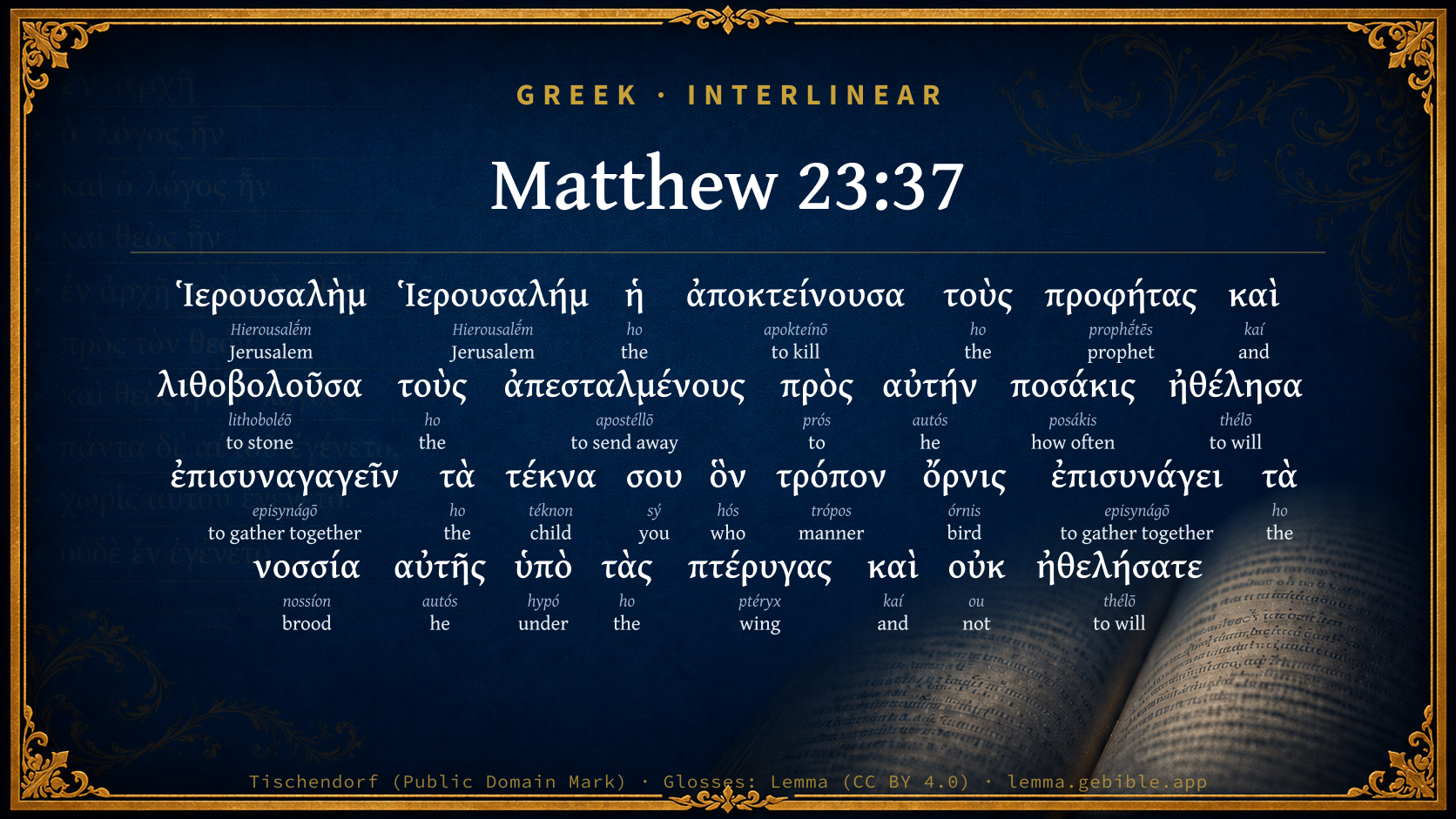
Greek (Tischendorf 8th ed.) Matthew 23:37 appears in the Greek New Testament. The text above is from the Tischendorf 8th edition. Each word links to its Strong’s number and a concise gloss. Click any word for its full Thayer’s Greek Lexicon entry.
Download image
Cite this verse

Matthew 23:37 (World English Bible). Public Domain. Lemma interlinear Bible study tool, https://lemma.gebible.app/v/matthew/23/37.

Show BibTeX & RIS
BibTeX
RIS
English Translation
"Jerusalem, Jerusalem, who kills the prophets, and stones those who are sent to her! How often would I have gathered your children together, even as a hen gathers her chickens under her wings, and you would not!
World English Bible · Public Domain
Highlights
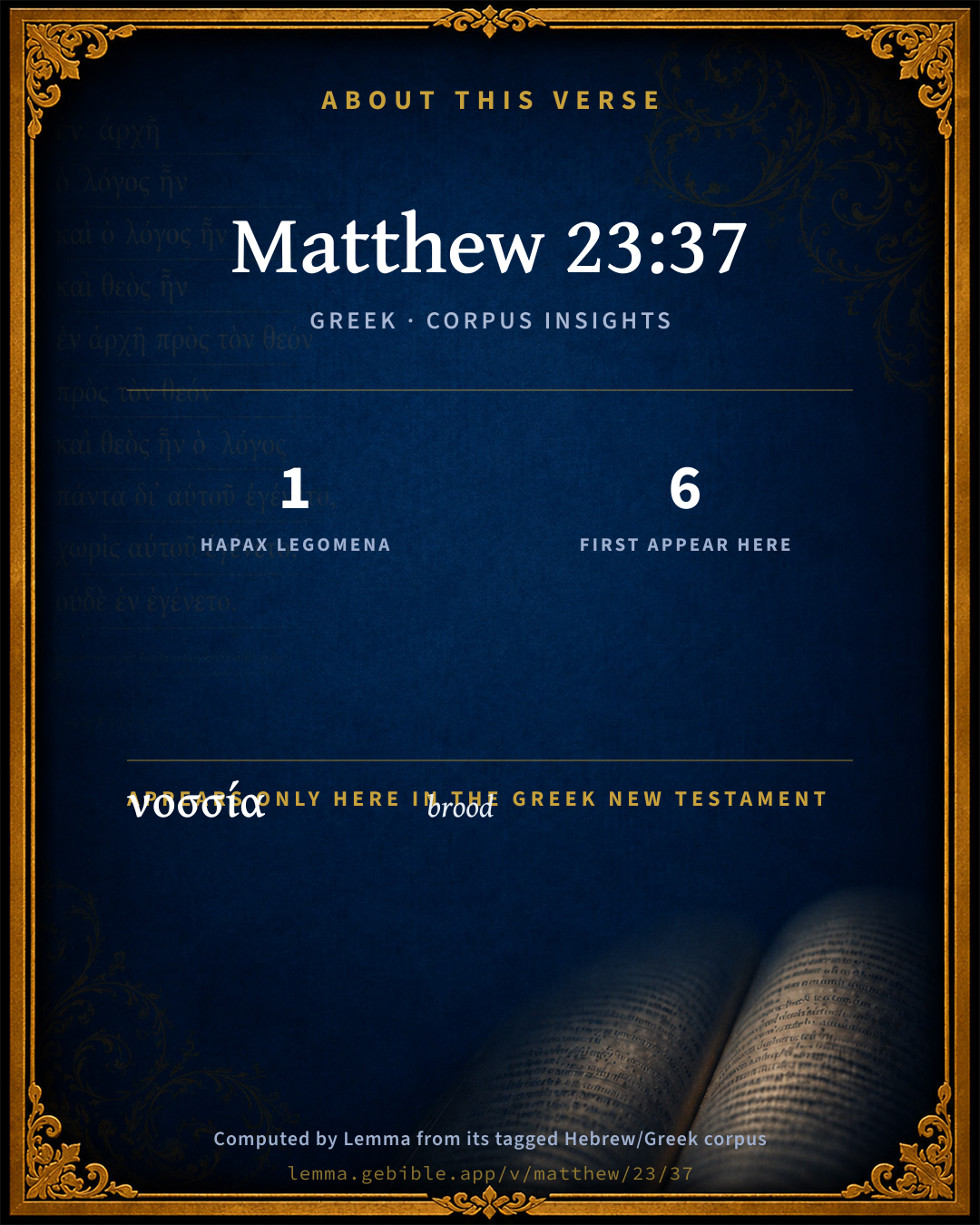
  • 1 hapax legomenon — only here in the Greek New Testament
  • 6 first appearances in the Greek New Testament
Full analysis ↓
Download a study sheet

One document with this verse’s original text, its word-by-word gloss line, the meaning frame, cross-references with their text, attributed commentary, and full source and license credits — printable, and it pastes into notes with its structure intact.

This verse Autodidact and up

Study sheet (.html) Plain text (.txt)

A passage Seminary Student

Up to 50 verses in one chapter. A passage sheet keeps up to 6 commentary sources and 12 cross-references per verse, in the order this page ranks them, and says so on the sheet whenever that leaves anything out. Ask for a single verse and you get the Autodidact verse sheet above.

Everything on this page stays free to read, with no account — the sheet is a download of what is already on screen, not access to it.

Want to remove ads? Support Godless Engineer
Compare translations 3

The same verse in 3 English versions, stacked beneath the original-language interlinear above. Click any original word for its lexicon entry.

Each is an independent rendering of the whole verse — the interlinear is not word-aligned to these translations.

Highlighted words mark where these versions differ — a whole-verse word diff, not a word-by-word alignment.

  • World English Bible Public Domain
    "Jerusalem, Jerusalem, who kills the prophets, and stones those who are sent to her! How often would I have gathered your children together, even as a hen gathers her chickens under her wings, and you would not!
  • King James Version Public Domain
    O Jerusalem, Jerusalem, thou that killest the prophets, and stonest them which are sent unto thee, how often would I have gathered thy children together, even as a hen gathereth her chickens under her wings, and ye would not!
  • unfoldingWord Literal Text CC BY-SA 4.0
    Jerusalem, Jerusalem, the one killing the prophets and stoning the ones having been sent to her! How often I desired to gather your children the way a hen gathers her chicks under her wings, and you were not willing!

unfoldingWord Literal Text — © unfoldingWord, licensed CC BY-SA 4.0. Word-aligned USFM3 via Door43 (git.door43.org/unfoldingWord/en_ult).

Versions to compare (up to 4)

3 of 4 selected

Show all 19 translations

Every available English version of this verse, each an independent rendering of the whole verse.

  • World English Bible Public Domain
    "Jerusalem, Jerusalem, who kills the prophets, and stones those who are sent to her! How often would I have gathered your children together, even as a hen gathers her chickens under her wings, and you would not!
  • Berean Standard Bible Public Domain
    O Jerusalem, Jerusalem, who kills the prophets and stones those sent to her, how often I have longed to gather your children together, as a hen gathers her chicks under her wings, but you were unwilling!
  • Majority Standard Bible Public Domain
    O Jerusalem, Jerusalem, who kills the prophets and stones those sent to her, how often I have longed to gather your children together, as a hen gathers her chicks under her wings, but you were unwilling!
  • King James Version Public Domain
    O Jerusalem, Jerusalem, thou that killest the prophets, and stonest them which are sent unto thee, how often would I have gathered thy children together, even as a hen gathereth her chickens under her wings, and ye would not!
  • American Standard Version (1901) Public Domain
    O Jerusalem, Jerusalem, that killeth the prophets, and stoneth them that are sent unto her! how often would I have gathered thy children together, even as a hen gathereth her chickens under her wings, and ye would not!
  • Revised Version (1885) Public Domain
    O Jerusalem, Jerusalem, which killeth the prophets, and stoneth them that are sent unto her! how often would I have gathered thy children together, even as a hen gathereth her chickens under her wings, and ye would not!
  • Geneva Bible (1599) Public Domain
    Hierusalem, Hierusalem, which killest the Prophets, and stonest them which are sent to thee, how often would I haue gathered thy children together, as the henne gathereth her chickins vnder her wings, and ye would not!
  • Douay-Rheims (1899) Public Domain
    Jerusalem, Jerusalem, thou that killest the prophets, and stonest them that are sent unto thee, how often would I have gathered together thy children, as the hen doth gather her chickens under her wings, and thou wouldest not?
  • Young's Literal Translation Public Domain
    `Jerusalem, Jerusalem, that art killing the prophets, and stoning those sent unto thee, how often did I will to gather thy children together, as a hen doth gather her own chickens under the wings, and ye did not will.
  • Literal Standard Version CC BY-SA 4.0
    Jerusalem, Jerusalem, that are killing the prophets, and stoning those sent to you, how often I willed to gather your children together, as a hen gathers her own chickens under the wings, and you did not will.
  • Unlocked Literal Bible CC BY-SA 4.0
    Jerusalem, Jerusalem, you who kill the prophets and stone those who are sent to you! How often did I long to gather your children together, just as a hen gathers her chicks under her wings, but you were not willing!
  • unfoldingWord Literal Text CC BY-SA 4.0
    Jerusalem, Jerusalem, the one killing the prophets and stoning the ones having been sent to her! How often I desired to gather your children the way a hen gathers her chicks under her wings, and you were not willing!
  • Darby Bible Public Domain
    Jerusalem, Jerusalem, [the city] that kills the prophets and stones those that are sent unto her, how often would I have gathered thy children as a hen gathers her chickens under her wings, and ye would not!
  • World Messianic Bible Public Domain
    “Jerusalem, Jerusalem, who kills the prophets and stones those who are sent to her! How often I would have gathered your children together, even as a hen gathers her chicks under her wings, and you would not!
  • Webster's Bible Public Domain
    O Jerusalem, Jerusalem, thou that killest the prophets, and stonest them who are sent to thee, how often would I have gathered thy children, even as a hen gathereth her chickens under her wings, and ye would not!
  • Free Bible Version CC BY-SA 4.0
    Jerusalem, Jerusalem, you who kill the prophets and stone those who are sent to you! So often I wanted to gather your children as a mother hen gathers her chicks under her wings—but you wouldn't let me.
  • Bible in Basic English Public Domain
    O Jerusalem, Jerusalem, putting to death the prophets, and stoning those who are sent to her! Again and again would I have taken your children to myself as a bird takes her young ones under her wings, and you would not!
  • Text-Critical English NT CC BY 4.0
    “O Jerusalem, Jerusalem, the city that kills the prophets and stones those who are sent to yoʋ! How often I have wanted to gather yoʋr children together as a hen gathers her chicks under her wings, but you were not willing!
  • Tyndale New Testament (1534) Public Domain
    Hierusalem hierusalem which kyllest prophetes and stonest the which are sent to the: how often wolde I have gadered thy chyldren to gether as the henne gadreth her chickes vnder her winges but ye wolde not:

Literal Standard Version (2020), Covenant Press — licensed CC BY-SA 4.0. Text via the HelloAO Bible API (eBible.org). Unlocked Literal Bible (unfoldingWord) — licensed CC BY-SA 4.0. Text via the HelloAO Bible API (eBible.org). unfoldingWord Literal Text — © unfoldingWord, licensed CC BY-SA 4.0. Word-aligned USFM3 via Door43 (git.door43.org/unfoldingWord/en_ult). Free Bible Version, Dr. Jonathan Gallagher — licensed CC BY-SA 4.0. Text via the HelloAO Bible API (eBible.org).

Word by word

More ways to search: Search by grammar → Find every occurrence → Compare this word →

Practice this passage: Drill this verse → Learn its vocabulary →

νοσσία
nossíon
G3556
“brood”
Noun, Accusative, Plural, Neuter
Part of Speech
Noun
Case
Accusative
Number
Plural
Gender
Neuter
Full Thayer's Definition

Origin: dimin. of G3502

TDNT: None

1. a brood of birds
  1. Ἱερουσαλὴμ Hierousalḗm G2419 “Jerusalem” Noun, Proper, indeclinable
  2. Ἱερουσαλήμ Hierousalḗm G2419 “Jerusalem” Noun, Proper, indeclinable
  3. ἡ ho G3588 “the” Article, Nominative, Singular, Feminine
  4. ἀποκτείνουσα apokteínō G615 “to kill” Verb, Present, Active, Participle, Nominative, Singular, Feminine
  5. τοὺς ho G3588 “the” Article, Accusative, Plural, Masculine
  6. προφήτας prophḗtēs G4396 “prophet” Noun, Accusative, Plural, Masculine
  7. καὶ kaí G2532 “and” Conjunction
  8. λιθοβολοῦσα lithoboléō G3036 “to stone” Verb, Present, Active, Participle, Nominative, Singular, Feminine
  9. τοὺς ho G3588 “the” Article, Accusative, Plural, Masculine
  10. ἀπεσταλμένους apostéllō G649 “to send away” Verb, Perfect, Passive, Participle, Accusative, Plural, Masculine
  11. πρὸς prós G4314 “to” Preposition
  12. αὐτήν autós G846 “he” Personal pronoun, Accusative, Singular, Feminine
  13. ποσάκις posákis G4212 “how often” Adverb
  14. ἠθέλησα thélō G2309 “to will” Verb, Aorist, Active, Indicative, 1st person, Singular
  15. ἐπισυναγαγεῖν episynágō G1996 “to gather together” Verb, Aorist, Active, Infinitive
  16. τὰ ho G3588 “the” Article, Accusative, Plural, Neuter
  17. τέκνα téknon G5043 “child” Noun, Accusative, Plural, Neuter
  18. σου sý G4771 “you” Personal pronoun, 2nd person, Genitive, Singular
  19. ὃν hós G3739 “who” Relative pronoun, Accusative, Singular, Masculine
  20. τρόπον trópos G5158 “manner” Noun, Accusative, Singular, Masculine
  21. ὄρνις órnis G3733 “bird” Noun, Nominative, Singular, Feminine
  22. ἐπισυνάγει episynágō G1996 “to gather together” Verb, Present, Active, Indicative, 3rd person, Singular
  23. τὰ ho G3588 “the” Article, Accusative, Plural, Neuter
  24. αὐτῆς autós G846 “he” Personal pronoun, Genitive, Singular, Feminine
  25. ὑπὸ hypó G5259 “under” Preposition
  26. τὰς ho G3588 “the” Article, Accusative, Plural, Feminine
  27. πτέρυγας ptéryx G4420 “wing” Noun, Accusative, Plural, Feminine
  28. καὶ kaí G2532 “and” Conjunction
  29. οὐκ ou G3756 “not” Particle, Negative
  30. ἠθελήσατε thélō G2309 “to will” Verb, Aorist, Active, Indicative, 2nd person, Plural

About this verse

These counts appear in no published source. They are computed here, from the morphology-tagged text and Lemma’s own curated glosses. What Lemma adds →

31
words
21
distinct lemmas
Gospels
section

Notable vocabulary

1 hapax legomenon — a word that appears only here in the entire Greek New Testament:

  • νοσσία brood G3556

First appearance in Scripture

These words make their first canonical appearance in the Greek New Testament here:

  • Ἱερουσαλὴμ Jerusalem G2419
  • ἐπισυναγαγεῖν to gather together G1996
  • τρόπον manner G5158
  • ὄρνις bird G3733
  • νοσσία brood G3556
  • πτέρυγας wing G4420

Shared distinctive vocabulary

ὄρνις bird G3733 occurs in 2 verses of the Greek New Testament. Also found in:
Repetition

Words recur within this verse:

  • Ἱερουσαλὴμ Jerusalem G2419 ×2
  • ἠθέλησα to will G2309 ×2
  • ἐπισυναγαγεῖν to gather together G1996 ×2
  • ἡ the G3588 ×6
  • καὶ and G2532 ×2
  • αὐτήν he G846 ×2

Cross-references

41

Topical passages linked to Matthew 23:37 in the Treasury of Scripture Knowledge — connected by theme and wording, ordered by reader-vote popularity; previews shown in the World English Bible.

  • Luke 13:34–35 "Jerusalem, Jerusalem, that kills the prophets, and stones those who are sent to her! How often I wanted to gather your children together, like a hen gathers her own brood under her wings, and you refused!
  • Psalms 91:4 He will cover you with his feathers. Under his wings you will take refuge. His faithfulness is your shield and rampart.
  • Ruth 2:12 Yahweh recompense your work, and a full reward be given you of Yahweh, the God of Israel, under whose wings you are come to take refuge.
  • Deuteronomy 32:11–12 As an eagle that stirs up her nest, That flutters over her young, He spread abroad his wings, he took them, He bore them on his feathers.
  • Psalms 17:8 Keep me as the apple of your eye; Hide me under the shadow of your wings,
  • Nehemiah 9:26 Nevertheless they were disobedient, and rebelled against you, and cast your law behind their back, and killed your prophets that testified against them to turn them again to you, and they committed awful blasphemies.
  • Proverbs 1:24–31 Because I have called, and you have refused; I have stretched out my hand, and no one has paid attention;
  • Jeremiah 6:16–17 Thus says Yahweh, Stand you in the ways and see, and ask for the old paths, where is the good way; and walk therein, and you shall find rest for your souls: but they said, We will not walk [therein].
  • Psalms 36:7 How precious is your loving kindness, God! The children of men take refuge under the shadow of your wings.
  • Psalms 63:7 For you have been my help. I will rejoice in the shadow of your wings.
  • Psalms 57:1 Be merciful to me, God, be merciful to me, For my soul takes refuge in you. Yes, in the shadow of your wings, I will take refuge, Until disaster has passed.
  • 2 Chronicles 24:21–22 They conspired against him, and stoned him with stones at the commandment of the king in the court of the house of Yahweh.
  • Jeremiah 35:15 I have sent also to you all my servants the prophets, rising up early and sending them, saying, Return you now every man from his evil way, and amend your doings, and don't go after other gods to serve them, and you shall dwell in the land which I have given to you and to your fathers: but you have not inclined your ear, nor listened to me.
  • Hosea 11:2 They called to them, so they went from them. They sacrificed to the Baals, And burned incense to engraved images.
  • Matthew 5:12 Rejoice, and be exceedingly glad, for great is your reward in heaven. For that is how they persecuted the prophets who were before you.
  • Matthew 22:3 and sent out his servants to call those who were invited to the marriage feast, but they would not come.
  • Matthew 23:30 and say, 'If we had lived in the days of our fathers, we wouldn't have been partakers with them in the blood of the prophets.'
  • Luke 14:17–20 He sent out his servant at supper time to tell those who were invited, 'Come, for everything is ready now.'
  • Luke 19:14–44 But his citizens hated him, and sent an envoy after him, saying, 'We don't want this man to reign over us.'
  • Jeremiah 25:3–7 From the thirteenth year of Josiah the son of Amon, king of Judah, even to this day, these twenty-three years, the word of Yahweh has come to me, and I have spoken to you, rising up early and speaking; but you have not listened.
  • Jeremiah 42:9–13 and said to them, Thus says Yahweh, the God of Israel, to whom you sent me to present your supplication before him:
  • Jeremiah 44:4 However I sent to you all my servants the prophets, rising up early and sending them, saying, Oh, don't do this abominable thing that I hate.
  • Matthew 21:35–36 The farmers took his servants, beat one, killed another, and stoned another.
  • Acts 7:51–52 "You stiff-necked and uncircumcised in heart and ears, you always resist the Holy Spirit! As your fathers did, so you do.
  • 1 Thessalonians 2:15 who killed both the Lord Jesus and their own prophets, and drove us out, and didn't please God, and are contrary to all men;
  • Revelation 11:7–8 When they have finished their testimony, the beast that comes up out of the abyss will make war with them, and overcome them, and kill them.
  • 2 Chronicles 36:15–16 Yahweh, the God of their fathers, sent to them by his messengers, rising up early and sending, because he had compassion on his people, and on his dwelling-place:
  • Psalms 81:8–11 "Hear, my people, and I will testify to you, Israel, if you would listen to me!
  • Isaiah 50:2 Why, when I came, was there no man? when I called, was there none to answer? Is my hand shortened at all, that it can't redeem? or have I no power to deliver? Behold, at my rebuke I dry up the sea, I make the rivers a wilderness: their fish stink, because there is no water, and die for thirst.
  • Jeremiah 2:30 In vain have I struck your children; they received no correction: your own sword has devoured your prophets, like a destroying lion.
  • Jeremiah 4:14 Jerusalem, wash your heart from wickedness, that you may be saved. How long shall your evil thoughts lodge within you?
  • Jeremiah 6:8 Be instructed, Jerusalem, lest my soul be alienated from you; lest I make you a desolation, a land not inhabited.
  • Jeremiah 11:7–8 For I earnestly protested to your fathers in the day that I brought them up out of the land of Egypt, even to this day, rising early and protesting, saying, Obey my voice.
  • Jeremiah 26:23 and they fetched forth Uriah out of Egypt, and brought him to Jehoiakim the king, who killed him with the sword, and cast his dead body into the graves of the common people.
  • Hosea 11:7 My people are determined to turn from me. Though they call to the Most High, He certainly won't exalt them.
  • Zechariah 1:4 Don't you be like your fathers, to whom the former prophets proclaimed, saying: Thus says Yahweh of hosts, 'Return now from your evil ways, and from your evil doings;' but they did not hear, nor listen to me, says Yahweh.
  • Matthew 22:6 and the rest grabbed his servants, and treated them shamefully, and killed them.
  • Mark 12:3–6 They took him, beat him, and sent him away empty.
  • Luke 15:28 But he was angry, and would not go in. Therefore his father came out, and begged him.
  • Luke 20:11–14 He sent yet another servant, and they also beat him, and treated him shamefully, and sent him away empty.
  • Revelation 17:6 I saw the woman drunken with the blood of the saints, and with the blood of the martyrs of Jesus. When I saw her, I wondered with great amazement.

Cross-references courtesy of OpenBible.info (CC BY 4.0).

Commentary

Notes on Matthew 23:37 from classic Christian and Jewish commentators (each source and its license shown beneath its notes). The classic Christian expositions comment on the surrounding passage and are grouped to its opening verse, so a note may address several verses; the Jewish commentaries on the Tanakh (Rashi and others) are per-verse, so they appear only where the commentator wrote on this verse.

Lemma curates 59 commentaries, every one of them public domain or Creative Commons licensed, each selected and text-cleaned for this edition rather than reprinted as found. About our sources →

Matthew Poole's English Annotations

We have the same Luk 13:34,35. O Jerusalem, Jerusalem! The doubling of the word showeth the vehemency of our Saviour’s affection.

Thou that killest the prophets, and stonest them which are sent unto thee; that hast killed, and abused, and art yet going on to do the like, not taking notice of the vengeance of God upon thee before for this very sin, 2Ch 36:16,17; Ne 9:26,27. How often would I have gathered thee, giving thee all external means proper to have reformed thee and reconciled thee to God, as a hen gathereth her chickens under her wings! Which if thou hadst accepted and embraced, the chickens are not safer under the wings of the hen from the danger of a kite than thou wouldst have been from enemies. But thou wouldst not; instead of hearkening to my prophets, thou killedst them, and didst stone those sent unto thee, and so didst voluntarily reject me, and all my offers and tenders of grace, mercy, and protection, through the mere obstinacy of thy perverse will.

Behold, your house is left unto you desolate; both the temple, in which you place such a confidence, and your own dwelling houses, shall be destroyed, burnt, and razed down, or at least left without you as inhabitants.

For I say unto you, Ye shall not see me henceforth, till ye shall say, Blessed is he that cometh in the name of the Lord: I will appear no more to you as a public preacher, after two or three days, for ever; and you, that the other day so envied the people’s acclamations to me,

Blessed is he that cometh in the name of the Lord, shall be glad yourselves to see one of the days of the Son of man, and shall say the same thing, Blessed is he, & c. For whereas some interpret the term till, & c. of the day of judgment, or the time when the Jews shall be converted, I take them to be strained interpretations.

Till here certainly is to be interpreted, as Psa 110:1; Mat 1:25; and this comports with the history, for after this time our Saviour appeared in the temple publicly no more. For the disputes raised from Mat 23:37, about God’s secret will, whether he seriously willed the salvation of the Jews, &c., I take the affirmative part to have no foundation in this text, for would I is plainly enough here interpreted by the foregoing word, sending them prophets, and other ministers, to persuade them to repentance and reconciliation with God; as the use of means proper to an end appear to us indications of the will of him that useth them.

Matthew Poole's English Annotations on the Holy Bible (1683–1685) — public domain. Text from a community e-Sword/MySword module.

The Biblical Illustrator

Joseph S. Exell

Mat_23:37-39

O Jerusalem, Jerusalem, thou that killest the prophets.

The invitation refused

Consider some of the different modes in which the rejection of Gods call has been made. Far, all do not reject Him alike.

I. Some will even rise up and say, I Do not consider that i have ever yet been called.

1. Those who wish they could believe they had been called, but cannot think such good news true.

2. Those who are waiting for a louder, more irresistible call, saying, Why does not God, if He would indeed save me, make some great interposition on my behalf? Alas for the guilty unbelief of the one, and the awful, blasphemous presumption of the other!

II. Those who, although conscious of having been called, yet treat the matter with indifference. These are men at ease in Zion; familiarized with stifled convictions; of secular habit of mind; to whom invisible things carry no reality in daily life. Three classes of them depicted in Luk_14:18-20.

III. Those who recognize the importance of the Divine call, but who put off the acceptance of it. Satan decoys them by enticing pictures of their own future. They live in fancies of their own coming holiness, thinking that to-morrows goodness will make up for to-days worldliness. Oh the sin l As if they could command the sovereign working of the Holy Ghost! As if-having refused Him their attention now-they may recall Him when they please.

IV. Those who, at the time, receive, welcome, reciprocate the love of God; and then, when the excitement of the moment is past, their feelings evaporate, and nothing remains. Their religion never becomes a principle.

V. Those who listen to the heavenly call, draw nigh, taste the heavenly gift; and then the old, carnal nature asserts its sway, and they draw back again. (J. Vaughan, M. A.)

Gods continual calls

Oh that how often! Do not let it be a mere impassioned exclamation. Make it what it is, a distinct, definite question put to you this day-how often? And what arithmetic can write the answer? I never yet visited a man upon a sick-bed-I never talked with a single person in any of those moments which unlock the breast, and set it free to speak its secrets-that I did not receive this confession: I have been greatly conscious all my life of the inward striving, and the oft-repeated calls of God in my soul. Sometimes, doubtless, those calls fall louder and deeper upon the spiritual ear than they fall at other times. They lie thickest, I believe, in early life. There are states of mind we can scarcely say how, and there are providential scenes we can scarcely say why, which give an intensity to those many voices, when a verse of Scripture will sometimes roll its meaning like thunder, or when a whisper of the soul will carry an accent tenfold with it. But the call is not confined to those specialities. There is a finger of a mans hand which is always waking the strings of thought. It is when we lie down; it is when we rise up; it is when we sit in the house; it is when we are walking by the way. We can see it on the little face of early childhood, before the date when our utmost memories reach; we can trace it in ourselves back to the utmost dawn of rising reason. Perhaps not a room in which we have ever laid down to sleep; perhaps not a church into which we have ever entered, even with careless foot; perhaps not a sin which we ever deliberately went and did; perhaps not an incident for weal or woe that lies on the chequered path of life, but there was something there which swelled that how often? (J. Vaughan, M. A.)

Why the Divine invitation is refused

Of all the refusals of Gods grace, the real secret is the same. They may cover themselves with various pretexts-just as persons, having made up their mind to decline an invitation, begin to look out for some convenient excuse-but the cause is one. It is not in any outward circumstances; it is not in any particular temperament; it is not in the want of power; it is not in the straitenings of Divine grace: but the Saviour points to it at once with His omniscient mind-ye would not. It is the absence of the will; it is the want of that setting of the mind to Gods mind; that conformity of the affections to Gods promises; that appreciation of unseen things; that spiritual sense, which is the essence and the beginning of a new life. Therefore they cannot come. (J. Vaughan, M. A.)

Compassion of Jesus towards the guilty

Scripture is full of the sublime and pathetic. It opens to us the very heart of the Redeemer. Observe here-

I. The cruelty and wickedness of the Jews. They paid no regard to the character and Divine commission of God s prophets.

1. An act of great injustice and ingratitude.

2. An act of rebellion against God.

II. Christs tenderness and care. The hen an affectionate creature to her young. When justice pursues, Satan assaults, and hosts of enemies compass us round about; if we can but get under the shadow of Christs wings we are safe, and, being safe, may be content. The wings of Christ are so large, they are sufficient to cover the whole Church. They are also strong and impenetrable, and ever stretched out to screen us from danger.

III. Christs earnestness and importunity. Jerusalem, Jerusalem. How often.

IV. Stubbornness and perverseness of those so tenderly regarded. Ye would not. Not a want of power, but of will.

1. None continue the slaves of Satan and sin but with their own consent.

2. Every man may be saved if he wilt.

3. Divine influence necessary to overcome the sinners enmity. (B. Beddome, M. A.)

Relationship between the Lord and His people

I have been raising chickens this year, and have devoted a part of my pear-orchard to the chicken-coops; and I have been accustomed to go out mornings and evenings to see that the boy took care of the chickens. I think I have now about ten or fiften broods. The old hen, when watching them, would cluck; and it was to them a warning of danger, I suppose. They understand it to mean that they are to come in. I could not understand that language; but these little things that had never been to school understood instantly just what she said. She gave her whole self to them; and their instinct was to run under her; and when there to lift themselves close up to her body, and get their warmth from her. I have watched them as they did this again and again. What an idea of the intimate and endearing relationship between the soul and the Lord Jesus Christ is conveyed in that figure. (H. W. Beecher.)

Christ the refuge for the destitute

I remember some few years ago meeting a young woman at a mission, who said that for two years she had been trying to make herself feel her sins, and could not. This was to her a great grief. I had been preaching on the words of Christ in this verse; so I said to her, Suppose a little chick were half frozen in a barn-yard, and could scarcely feel itself alive from numbness, what would be the best thing for it to do? Would it not be to flee at once to the warmth of the hens wing? I think she saw her mistake. I think she learnt that those who would learn more of their sin, and who desire a more contrite spirit, can find it nowhere so surely and fully as in nearness to Jesus, trusting only in His grace, and finding their shelter beneath His merciful wings. (G. Everard, M. A.)

Willingness to save

I. The manifestation of God to Israel which this verse brings before us.

1. Gods sovereignty of Israel. O Jerusalem, Jerusalem. Why should Jerusalem be singled out from all other nations. He had a right to select the depositaries of His truth.

2. Gods grace in the messages which He sent to this people. Them which are sent unto thee.

3. Gods mercy manifested in His dealings towards them.

4. Gods love.

5. Gods unchangeableness-How often.

6. Gods justice Behold your house is left unto you desolate.

7. Gods faithulness in the final issue of His dealings with Israel.

II. The special instruction to ourselves. Learn what we have to do with the purposes, messages, salvation of God. Like Christ, Christians should desire and seek the salvation of men. (W. Cadman, M. A.)

Of Gods free grace and mans free will

In this invective two things are to be considered, the rebellion of Jerusalem, in verse 37; the punishment of this sin, verse 38. Touching the rebellion itself, three things are set down-

(1) the place and persons;

(2) the degree and practice of rebellion;

(3) the manner and form of their rebellion. In this example of Jerusalems rebellion we learn many things.

(a) The vileness of mans nature, and our violent proneness to sin.

(b) To exercise ourselves in the duties of goodness, meekness, peace to all men.

(c) Not to oppose ourselves against the ministers of God. (W. Perkins.)

Gods gracious dealings with sinners

I. God has desired to gather you to Himself. Have you not had gathering mercies, invitations, appeals, providences, seasons?

II. But you have often rejected the overtures of Divine mercy. Your unwillingness is the result of your ignorance of your real state, unbelief, love of the world, dislike to Christs terms.

III. The obstinate rejection of the Divine mercy must involve the sinner in irreparable ruin. Application: In order to salvation your will must harmonize with the will of God. The entire responsibility is with you. (J. Burns, LL. D.)

Privilege and duty

I. Jerusalems privileges. The natural advantages of Jerusalem were very great. Typical of higher spiritual privileges-the goodly fellowship of the prophets; the extraordinary ministrations of special men, raised up and qualified by God, and sent to warn people from their sins, and to bid them repent and live; the personal ministry of the Son of God. The mind involuntarily turns to the privileges of England, and of London.

II. Jerusalems sins. Ingratitude and cruelty. Illustrates the lengths which those will go in sin who cherish affection for forbidden sins, and who harden their hearts against Divine things.

III. Jerusalems doom. Warn against hardness of heart and contempt of the word and doctrine. (J. J. Sargent.)

I. Men, while they are in a state of nature, are exposed to imminent danger. As transgressors of the law of God they are liable to its penalty. They overlook this danger, but it is real, and it is terrific.

II. Our Lord Jesus Christ offers Himself as a shelter against this danger. If He had been a mere man He could not have been the Saviour.

III. He fulfils this function with condescending tenderness.

IV. He delivers His people by the substitution of His own life for theirs.

V. The immediate result of application to Him is safety.

VI. Men are responsible in the matter of their own salvation. (President Davies.)

Judgment in tears

Such is the affecting apostrophe in which our Lords faithful denunciations of Woe, woe! terminate. Like the thunder-cloud, which, having discharged its bolt at the earth, weeps itself away-exhausts itself in a healing shower, which closes the rent it had made-so His pity commiserates, and pours itself forth over those whom, in the same breath, He had felt Himself called to rebuke. (Dr. J. Harris)

Christs protection rejected

As much as to say, as the parent bird, when she sees some bird of prey hovering over her helpless young, gives them the signal, which nature teaches them to understand, and spreads her wings to protect them, resolved to become a prey herself rather than her tender brood; or, as she shelters them from the rain and cold, and cherishes them under her friendly feathers,-so, says the compassionate Redeemer, so, O Jerusalem! I see thy children, like heedless chickens, in the most imminent danger; I see the judgments of God hovering over them; I see the Roman eagle ready to seize them as its prey; I see storms of vengeance ready to fall upon them; and how often have I invited them to fly to me for shelter, and gave them the signal of their danger I how often have I spread the wings of My protection to cover them, and keep them warm and safe as in My bosom! but, O lamentable I O astonishing I ye would not! I was willing, but ye would not! The silly chickens, taught by nature, understand the signal of approaching danger, and immediately fly for shelter; but ye, more silly and presumptuous, would not regard My warnings; would not believe your danger, nor fly to Me for protection, though often-oh, how often-warned and invited! (President Davies.)

O Jerusalem

I. What it is Christ proposed to confer upon his people. Christ not only willing but tenderly anxious to confer the various privileges of light and grace.

1. When our Saviour declares He would have collected them, He means He would bless them with all the privileges common to that Church, of which He was the head, and which He came to construct.

2. The moral state of the people when our Saviour stated His willingness to receive them to Himself. The readiness of Christ to receive any class of sinners. The haughty Pharisee. The infidel Sadducee. They had rejected the ministry of Christ. Divine love goes out towards these.

3. Their danger.

II. The declaration of Christ respecting the means employed for our salvation-I would have gathered you.

1. Tenderness.

2. Long-suffering.

3. A time will come when He will leave us to our sins if we continue to spurn Him from us. (J. Dixon, D. D.)

Christs pity for the sinner

The reasons of this special sympathy.

I. Christ as our Redeemer knows the dreadfulness of sin, and therefore pities those to whom it clings.

II. He pities the sinner, knowing all that is involved in his final doom.

III. Christ is the exponent of Gods infinite love to man.

IV. There is a ground for this compassion of Christ, growing out of His knowledge of the completeness of His salvation and the security of those who accept it.

V. The Saviours compassion is founded upon His knowledge of what the gospel cost Him to achieve. But if Christs power is boundless and His pity so great, why does He not interfere to save us anyhow? God deals with man as a free agent.

1. The loss of the soul is self-caused.

2. How great the sin of refusing the gospel. (B. F. Palmer, D. D,)

The Biblical Illustrator, edited by Joseph S. Exell (c. 1880s–1900s) — public domain. Text from a community e-Sword module.

Joseph Benson's Commentary

Mat 23:37. O Jerusalem, Jerusalem — The Lord Jesus having thus laid before the Pharisees and the Jewish nation their heinous guilt and impending ruin, was exceedingly moved at the thought of the calamities coming upon them. A day or two before he had wept over Jerusalem; now he bewails it in the most mournful accents of pity and commisseration. Jerusalem, the vision of peace, as the word signifies, must now be made the seat of war and confusion: Jerusalem, that had been the joy of the whole earth, must now be a hissing, and an astonishment, and a by-word among all nations: Jerusalem, that had been a city compact together, was now to be shattered and ruined by its own intestine broils: Jerusalem, the place that God had chosen to put his name there, must now be abandoned to spoilers and robbers. For, 1st, As its inhabitants had their hands more deeply imbrued in the blood of the prophets than those of other places, they were to drink more deeply than others in the punishment of such crimes: Thou that killest the prophets, &c. And, 2d, Jerusalem especially had rejected, and would persist in rejecting the Lord’s Christ, and the offers of salvation made through him, and would persecute his servants divinely commissioned to make them these offers. The former was a sin without remedy; this a sin against the remedy. How often would I have gathered thy children, &c. — See the wonderful grace, condescension, and kindness of the Lord Jesus toward those who he foresaw would in two or three days maliciously and cruelly imbrue their hands in his blood! What a strong idea do these tender exclamations of our Lord, which can hardly be read without tears, give us of his unparalleled love to that ungrateful and impenitent nation! He would have taken the whole body of them, if they would have consented to be so taken, into his church, and have gathered them all, (as the Jews used to speak of proselytes,) under the wings of the divine majesty. The words, how often would I have gathered, &c.,mark his unwearied endeavours to protect and cherish them from the time they were first called to be his people, and the following words, declarative of the opposition between his will and theirs, but ye would not, very emphatically show their unconquerable obstinacy in resisting the most winning and most substantial expressions of the divine goodness. Thus does the Lord Jesus still call and invite perishing sinners. But alas! the obstinacy of their own perverse and rebellious wills too generally withstands all the overtures of his grace: so that eternal desolation becomes their portion, and they in vain wish for a repetition of those calls when it is for ever too late.

Joseph Benson's Commentary on the Old and New Testaments (1811–1818) — public domain. Text from a community e-Sword module.

Godbey's Commentary on the New Testament

William B. Godbey

APOSTROPHE TO JERUSALEM

Mat 23:37-39. “O Jerusalem, Jerusalem, thou that killest the prophets, and stonest them that are sent unto thee, how frequently did I wish to gather thy children, in the manner in which a hen doth gather her brood under her wings, and ye were not willing!” What a glorious, sweeping revival would have inundated Jerusalem with the very presence, power, and glory of God under the wonderful ministry of Jesus, if she had only opened wide the door, and bade her own long-expected and prayed-for Messiah a hearty welcome! This was the grand opportunity for which she had waited two thousand years, the glorious Antitype to which all her symbolisms, sacrifices, and oblations conspired. If she had received Him with an appreciative and enthusiastic welcome, she might have enjoyed the most exalted honors beneath the skies, in carrying the glad tidings to the ends of the earth. Then all the world would have hailed Jerusalem as the luminary of the nations, the beauty of the ages, and the glory of the whole earth — fable emblem of heaven.

“Behold, your house is left unto you desolate!” We can not stand still. Those who will not have God’s blessings, must abide in the retributions of the enemy. That whole country, with all of its cities, soon went into utter desolation, falling into the hands of the vilest enemies to Christianity. After Jerusalem was destroyed by the Romans, a heathen temple to Jupiter was built on the very site of Solomon’s Temple, where Jesus was then preaching. The desolation is still on that land, and will remain till the Lord returns. The cheering omens of revival at the present day are auspicious forebodings of our Lord’s near coming.

“For I say unto you, that you can not see Me any more, until you can say, Blessed is He that cometh in the name of the Lord.” What a wonderful leap this utterance gives us into the unseen future! At that time the city was full of Jews, whose awful doom Jesus saw in rivers of blood and mountains of the dead, and actually a million sold into slavery and carried captives into all nations, and the little surviving remnant driven to the ends of the earth, under penalty of death in case of an attempted return. So rigidly was this death penalty enforced against all Jews who attempted to come back, that if a Jew was found in some other country, traveling with his face toward the Holy Land, he was taken up and killed. Yet the omniscient eye of Jesus, looking over seas of blood and fields of desolation, saw the elect remnant

(Romans 11), salamander-like, surviving the fires of persecutionary centuries, and finally, in the good providence of God, coming back to repopulate the desolate fields of Zion, and again clothe the fertile mountains and alluvial plains with vineyards and orchards, and rebuild Jerusalem with unprecedented grandeur; saw this remnant wake up to the awful mistake of their ancestors in rejecting their own Christ, and ultimately find in Jesus, whom their ancestors had crucified, the blessed Shiloh of prophecy and the glorious Redeemer of Israel. Thus the bona fide children of Abraham, happily converted to their own loving Brother Jesus, and gloriously sanctified, filled with the Holy Ghost, cultured, posted and delighted with the glorious prophecies confirmatory of His second coming, and consequently ready to receive Him with open arms, will send forth the joyous shout, “Blessed is He that cometh in the name of the Lord!”

William B. Godbey, Commentary on the New Testament (1896–1900) — public domain. Text from a community e-Sword module.

Tyndale Open Study Notes

Tyndale Open Resources

23:37 Despite the severe judgment Jesus had just leveled against Israel (23:29-36), he truly longed for them to repent and receive God’s grace. • as a hen: An image of protective care (see also Deut 32:11; Ruth 2:12; Pss 17:8; 36:7; 57:1; 61:4; 91:4).

Tyndale Open Study Notes — © Tyndale Open Resources, licensed CC BY-SA 4.0. Text via the HelloAO Bible API.

Bengel's Gnomon

Johann Albrecht Bengel

Mat 23:37. Ἱερουσαλὴμ, Ἱερουσαλὴμ, Jerusalem, Jerusalem!) A most solemn repetition.[1018]—ἡ ἀποκτένουσα, thou that killest) The participle has the force of a noun.[1019]—λιθοβαλοῦσα, that stonest) Such was the fate of Christ’s protomartyr, Stephen, recorded in Act 7:58-59.—τοὺς ἀπεσταλμένους, them that are sent) Although ambassadors are considered inviolable by the law of nations.—πρὸς αὐτὴν, to her) i.e. πρός σε, to thee. Cf. Luk 1:45; Isa 47:10.—ποσάκις, κ.τ.λ., how often, etc.) As often especially as Jesus entered Judea, Jerusalem, or the Temple. See my Harmony of the Four Evangelists, and Gnomon on ch. Mat 21:1.—καὶ οὐκ ἠθελήσατε, and ye would not) although I was willing. Cf. Isa 30:15.

[1018] “Epizeuxis.” See Appendix.—ED.

[1019] i.e. “Thou that art the Murderess of.”—(I. B.)

Full of compassion and horror alike.—V. g.

Bengel's Gnomon of the New Testament — English translation (T&T Clark, Edinburgh, 1860) — public domain. Text from a community e-Sword module.

Meyer's Critical & Exegetical Commentary

Heinrich August Wilhelm Meyer

Mat_23:37 ff. After denouncing all those woes against the scribes and Pharisees, the departing Redeemer, looking with sad eye into the future, sets the holy city alsowhich He sees hastening to its destruction under the false guidance of those leadersin a living connection with the tragic contents of Mat_23:34 ff., but in such a way that his parting words are no longer denunciations of woe, but the deep wail of a heart wounded, because its love has been despised. Thus Mat_23:37 ff. forms an appropriate conclusion to the whole drama of the discourse. Luk_13:34 introduces the words in a historical connection entirely different.

The repetition of the name of Jerusalem is here ἐμφαντικὸς ἐλέος, Euthymius Zigabenus.

ἀποκτείνουσα, κ.τ.λ.] The present participles denote the usual conduct: the murderess, the killer with stones.

πρὸς αὐτήν] to her; because the attributive participial clause from being in the nominative places the subject addressed under the point of view of the third person, and only then proceeds (ποσάκις … τέκνα σου) with the vocative of address in Ἱερουσαλήμ. Comp. Luk_1:45; Job_18:4; Isa_22:16. With Beza and Fritzsche, αὑτήν might be read and taken as equivalent to σεαυτήν; but αὐτήν is to be preferred, for this reason, that there is here no such special emphasis as to call for the use of the reflective pronoun (we should expect simply πρός σε in that case).

ποσάκις, κ.τ.λ.] The literal meaning of which is: How often I have wished to take thy citizens under my loving protection as Messiah! For the metaphor, comp. Eurip. Herc. Fur. 70 f., and the passages in Wetstein, Schoettgen, p. 208 (Rabbinical writers speak of the Shechinah as gathering the proselytes under its wings). Observe ἑαυτῆς: her own chickens. Such was the love that I felt toward you. On the form νοσς. for νεοσς., see Lobeck, ad Phryn. p. 206. οὐκ ἐθελήσατε] sc. ἐπισυναχθῆναι; they refused (Nägelsbach on Il. iii. 289; Baeumlein, Partik. p. 278), namely, to have faith in him as the Messiah, and consequently the blame rested with themselves. This refusal was their actual κρῖμα, Joh_9:39.

Meyer — Critical and Exegetical Commentary on the New Testament — English translation by Peter Christie, edited by Frederick Crombie (T&T Clark, 1880) — public domain. Text from a community e-Sword module.

Expositor's Greek Testament

ed. W. Robertson Nicoll

Mat 23:37-39 . Apostrophe to the Holy City (Luk 13:34 ). Εἶτα πρὸς τὴν πόλιν ἀποστρέφει τὸν λόγον . Chrys., H. lxxiv.

Mat 23:37 . Ἱερουσαλήμ , the Hebrew form of the name, exceptional in Mt., very appropriate to the solemn situation. Twice spoken; why? “It is the fashion of one pitying, bewailing, and greatly loving,” Chrys. ἀποκτείνουσα , λιθοβολοῦσα : present participles, denoting habit and repute, now and always behaving so killing, stoning. πρὸς αὐτήν , to her , not to thee , because the participles are in the nominative, while Ἱερουσαλήμ is vocative: “exemplum compellationis per vocativum ad quam deinceps non amplius spectatur” (Fritzsche). Grotius regards the transition from second to third person as an Orientalism. ποσάκις , how often; on this word has been based the inference of frequent visits to Jerusalem not mentioned in the Synoptics. But the allusion may be to the whole history of Israel (so Orig., Hil., Jer.,) and to the whole people, as the children of the metropolis, the Speaker still continuing to speak in the name of God, as in Mat 23:34 , and including Himself among God’s agents. ὄρνις , a bird or fowl; after Plato, a hen; so here, the emblem of anxious love. θερμὸν τὸ ζῶον περὶ τὰ ἔκγονα , Chrys. She gathers her chickens under her wings for protection against impending danger. This Jesus and all the prophets desired to do; a truth to be set over against the statement in Mat 23:34-35 , which seems to suggest that God’s aim was Israel’s damnation. τὰ νοσσία (Attic, νεοσσία : form disapproved by Phryn., p. 206), her brood of young birds. Cf. Psa 84:4 , where, as here, a pathetic use is made of the emblem. οὐκ ἠθελήσατε , ye would not, though I would ( ἠθέλησα ). Man’s consent necessary.

The Expositor's Greek Testament, edited by W. Robertson Nicoll (1897–1910) — public domain. Text from a community e-Sword module.

Geneva Bible (1599)

Geneva Bible translators

He speaketh of the outward ministry, and as he was promised for the saving of this people, so was he also careful for it, even from the time that the promise was made to Abraham.

Where the mercy of God was greatest, there was greatest wickedness and rebellion, and at length the most sharp judgments of God.

Geneva Bible (1599) marginal notes — public domain. Text via Bolls.life.

Jamieson, Fausset & Brown

Robert Jamieson, A. R. Fausset & David Brown

O Jerusalem, Jerusalem, thou that killest the prophets, and stonest them which are sent unto thee, &c.--How ineffably grand and melting is this apostrophe! It is the very heart of God pouring itself forth through human flesh and speech. It is this incarnation of the innermost life and love of Deity, pleading with men, bleeding for them, and ascending only to open His arms to them and win them back by the power of this story of matchless love, that has conquered the world, that will yet "draw all men unto Him," and beautify and ennoble Humanity itself! "Jerusalem" here does not mean the mere city or its inhabitants; nor is it to be viewed merely as the metropolis of the nation, but as the center of their religious life--"the city of their solemnities, whither the tribes went up, to give thanks unto the name of the Lord"; and at this moment it was full of them. It is the whole family of God, then, which is here apostrophized by a name dear to every Jew, recalling to him all that was distinctive and precious in his religion. The intense feeling that sought vent in this utterance comes out first in the redoubling of the opening word--"Jerusalem, Jerusalem!" but, next, in the picture of it which He draws--"that killest the prophets, and stonest them which are sent unto thee!"--not content with spurning God's messages of mercy, that canst not suffer even the messengers to live! When He adds, "How often would I have gathered thee!" He refers surely to something beyond the six or seven times that He visited and taught in Jerusalem while on earth. No doubt it points to "the prophets," whom they "killed," to "them that were sent unto her," whom they "stoned." But whom would He have gathered so often? "Thee," truth-hating, mercy-spurning, prophet-killing Jerusalem--how often would I have gathered thee! Compare with this that affecting clause in the great ministerial commission, "that repentance and remission of sins should be preached in His name among all nations, beginning at Jerusalem!" (Luk 24:47). What encouragement to the heartbroken at their own long-continued and obstinate rebellion! But we have not yet got at the whole heart of this outburst. I would have gathered thee, He says, "even as a hen gathereth her chickens under her wings." Was ever imagery so homely invested with such grace and such sublimity as this, at our Lord's touch? And yet how exquisite the figure itself--of protection, rest, warmth, and all manner of conscious well-being in those poor, defenseless, dependent little creatures, as they creep under and feel themselves overshadowed by the capacious and kindly wing of the mother bird! If, wandering beyond hearing of her peculiar call, they are overtaken by a storm or attacked by an enemy, what can they do but in the one case droop and die, and in the other submit to be torn in pieces? But if they can reach in time their place of safety, under the mother's wing, in vain will any enemy try to drag them thence. For rising into strength, kindling into fury, and forgetting herself entirely in her young, she will let the last drop of her blood be shed out and perish in defense of her precious charge, rather than yield them to an enemy's talons. How significant all this of what Jesus is and does for men! Under His great Mediatorial wing would He have "gathered" Israel. For the figure, see Deu 32:10-12; Rut 2:12; Psa 17:8; Psa 36:7; Psa 61:4; Psa 63:7; Psa 91:4; Isa 31:5; Mal 4:2. The ancient rabbins had a beautiful expression for proselytes from the heathen--that they had "come under the wings of the Shekinah." For this last word, see on Mat 23:38. But what was the result of all this tender and mighty love? The answer is, "And ye would not." O mysterious word! mysterious the resistance of such patient Love-mysterious the liberty of self-undoing! The awful dignity of the will, as here expressed, might make the ears to tingle.

Jamieson, Fausset & Brown — Commentary Critical and Explanatory on the Whole Bible (1871) — public domain (CC PDM 1.0). Text via the HelloAO Bible API.

Adam Clarke's Commentary

Verse 37. O Jerusalem, Jerusalem]

1. It is evident that our blessed Lord seriously and earnestly wished the salvation of the Jews.

2. That he did every thing that could be done, consistently with his own perfections, and the liberty of his creatures, to effect this.

3. That his tears over the city, Lu 19:41, sufficiently evince his sincerity.

4. That these persons nevertheless perished. And

5. That the reason was, they would not be gathered together under his protection: therefore wrath, i.e. punishment, came upon them to the uttermost.

From this it is evident that there have been persons whom Christ wished to save, and bled to save, who notwithstanding perished, because they would not come unto him, Joh 5:40. The metaphor which our Lord uses here is a very beautiful one. When the hen sees a beast of prey coming, she makes a noise to assemble her chickens, that she may cover them with her wings from the danger. The Roman eagle is about to fall upon the Jewish state - nothing can prevent this but their conversion to God through Christ-Jesus cries throughout the land, publishing the Gospel of reconciliation - they would not assemble, and the Roman eagle came and destroyed them. The hen's affection to her brood is so very strong as to become proverbial. The following beautiful Greek epigram, taken from the Anthologia, affords a very fine illustration of this text.

Χειμεριαις νιφαδεσσι παλυνομενα τιθας ορνις

Τεκνοις ευναιας αμφεχεε πτερυγας

Μεσφα μεν ουρανιον κρυος ωλεσεν η γαρ εμεινεν

Αιθερος ουρανιων αντιπαλος νεφεων.

Προκνη και Μεδεια, κατ' αΐδος αιδεσθητε,

Μητερες, ορνιθων εργα διδασκομεναι

Anthol. lib. i. Tit. 87: edit. Bosch. p. 344.

Beneath her fostering wing the HEN defends

Her darling offspring, while the snow descends;

Throughout the winter's day unmoved defies

The chilling fleeces and inclement skies;

Till, vanquish'd by the cold and piercing blast,

True to her charge, she perishes at last!

O Fame! to hell this fowl's affection bear;

Tell it to Progne and Medea there: -

To mothers such as those the tale unfold,

And let them blush to hear the story told! - T. G.

This epigram contains a happy illustration, not only of our Lord's simile, but also of his own conduct. How long had these thankless and unholy people been the objects of his tenderest cares! For more than 2000 years, they engrossed the most peculiar regards of the most beneficent Providence; and during the three years of our Lord's public ministry, his preaching and miracles had but one object and aim, the instruction and salvation of this thoughtless and disobedient people. For their sakes, he who was rich became poor, that they through his poverty might be rich: - for their sakes, he made himself of no reputation, and took upon him the form of a servant, and became obedient unto death, even the death of the cross! HE died, that THEY might not perish, but have everlasting life. Thus, to save their life, he freely abandoned his own.

Adam Clarke's Commentary on the Bible (1810–1826) — public domain. Text from a community e-Sword/MySword module.

Ellicott's Commentary for English Readers

(37) Jerusalem, Jerusalem.—The lamentation had been uttered once before (Luk_13:34-35), and must, we may believe, have been present to our Lord’s mind when He “beheld the city and wept over it” (Luk_19:41), as He halted on the brow of Olivet.

It should be noted that the Hebrew form of Jerusalem (Ἱερουσαλὴμ instead of Ἱεροσόλυμα) occurs here only in St. Matthew, as though the very syllables had impressed themselves on the minds of men.

Thou that killest the prophets.—The words are in the present tense, as embracing the past and even the future. As with a sad prescience our Lord speaks of the sufferings which were in store for His messengers, and of which the deaths of Stephen (Act_7:60) and of James (Act_12:2) were representative instances. That the persecution in each case took a wider range, was in the nature of the case inevitable. It is distinctly stated, indeed, that it did so in both instances (Act_8:1; Act_12:1), and is implied in 1Th_2:14-15, where the “prophets” who suffered are clearly Christian prophets, and probably in Jas_5:10.

Even as a hen gathereth her chickens.—The words reproduce (if we follow the English version), under an image of singular tenderness, the similitude of Deu_32:11, the care of the hen for her chickens taking the place of that of the eagle for her nestlings. Possibly, however, the contrast between the two images lies in the English rather than the Greek, where we have the generic term, “as a bird gathereth her brood.” The words “how often” may be noted as implying (though they occur in the Gospels that confine themselves to our Lord’s Galilean ministry) a yearning pity for Jerusalem, such as we naturally associate with the thought of His ministry in that city.

Ye would not.—No words could more emphatically state man’s fatal gift of freedom, as shown in the power of his will to frustrate the love and pity, and therefore the will, even of the Almighty.

A Bible Commentary for English Readers, edited by Charles John Ellicott (1878–1897) — public domain. Text from a community e-Sword module.

The Cambridge Bible for Schools and Colleges

gen. ed. J. J. S. Perowne

33–39. The Fate of Jerusalem

37. Jerusalem, Jerusalem] From Luk_13:34, it appears that our Lord spoke these words in a different connection at an earlier period of His ministry. For the pathetic reiteration of the name, cp. ch. Mat_27:46. The Aramaic form for Jerusalem in the text appears here only in Matthew; it is the usual form in Luke. Probably the very form—Aramaic, not Greek—employed by our Lord is retained.

killest … stonest] Recalling the precise expressions of ch. Mat_21:35.

as a hen gathereth her chickens under her wings] Schöttgen ad loc. observes that converts to Judaism were said to come “under the wings of the Shechinah.” That thought may be contained in the words of Christ. Many times by His prophets He called the children of Jerusalem to Himself—the true Shechinah—through whom the glory of the latter house was greater than that of the former.

ye would not] Note the change to the plural.

The Cambridge Bible for Schools and Colleges (gen. ed. J. J. S. Perowne; Cambridge University Press, 1878–1918) — public domain. Text from a community e-Sword module.

John Gill's Exposition

Behold your house is left unto you desolate. Signifying that the city in which they dwelt, where they had their ceiled houses, and stately palaces, would, in a little time, within the space of forty years, be destroyed, and become a desert; and the temple, formerly the house of God, but now only their's, and in which they trusted, would be abandoned by God, he would grant his presence no more in it; and the Messiah, the proprietor of it, and who was now in it, would then take his leave of it, and never more return to it; and that also should share the same fate as the city, and at the same time. Our Lord seems to have in view those passages in Jer 12:7 and which the Jewish (o) writers understood of the temple. The author of the apocryphal the second book of Esdras has much such an expression as this:

"Thus saith the Almighty Lord, Your house is desolate, I will cast you out as the wind doth stubble.'' (2 Esdras 1:33).

(o) Targum & Kimchi in Jer. xii. 7.

John Gill's Exposition of the Whole Bible (1746–1763) — public domain (CC PDM 1.0). Text via the HelloAO Bible API.

Trapp's Complete Commentary

John Trapp

37 O Jerusalem, Jerusalem, thou that killest the prophets, and stonest them which are sent unto thee, how often would I have gathered thy children together, even as a hen gathereth her chickens under her wings, and ye would not!

Ver. 37. How often would I, &c.] How then could they perish whom God would have saved? It is answered, Voluntas Dei alia est praecepti, revelata antecedents, alia beneplaciti, arcana consequens. By the former God willed their conversion, but not by the latter. A king wills the welfare of all his subjects; yet he will not acquit those that are laid up for treason, murder, and the like foul crimes. A father is willing to give his son the inheritance; yet if he prove an unthrift, he will put him beside it, and take another. "How oft would I have gathered?" that is (say some), by the external ministry of the prophets, sent unto thee, Mat 23:34-35. Not by internal regenerating operation of the Spirit.

Even as a hen gathereth her chickens] Columbarum masculus ipse ovis incubat, sicut Christus ipse ecclesiam suam fovet. (Chytraeus in Lev 12:1-8) Of unreasonable creatures, birds, and of birds, the hen excels in kindness to her young; so that she doubts not, in their clarence, to encounter a kite, a dog, &c., Iniquo et impari proelio, though with greatest disadvantage.

And ye would not] Men may nill their conversion, then, though called by God, Quo nihil est verius, sed et nihil turpius, saith one. Men are not damned, because they cannot do better, but because they will do no better. Cesset voluntas propria et non erit infernus, If there were no will, there would be no hell, Joh 12:39. Therefore they could not believe; they could not, that is, they would not, saith Theophylact out of Chrysostom, who yet usually extolleth man’s freewill more than is fit.

John Trapp, A Commentary or Exposition upon All the Books of the Old and New Testament (1647–1656) — public domain. Text from a community e-Sword module.

Albert Barnes' Notes on the Bible

O Jerusalem ... - See the notes at Luk 19:41-42.

Would I have gathered - Would have protected and saved.

Thy children - Thy people.

Albert Barnes' Notes on the Bible (1834–1885) — public domain. Text from a community e-Sword/MySword module.

Haydock's Catholic Bible Commentary

And thou wouldst not. Three truths may be gathered from these words of our Saviour: 1. They, who perish, perish by their own fault, because they refuse to listen to the voice of God calling them to salvation; 2. that man’s will is free, and that it is an error in man to lay all his wickedness to the charge of God, or of blind chance; for God justly attributes the reprobation of man to his own perverse will, which often opposes that of God, and brings destruction on itself; 3. how necessary it is for man to subject his will to that of the Almighty, and ever to say with our Saviour: Nevertheless, not my will, but thine be done. (Salmeron)

George Leo Haydock (1774–1849), Haydock's Catholic Family Bible and Commentary, 1859 edition — public domain. Excludes Psalms (Douay-Rheims chapter numbering differs from Protestant) and Deuterocanonical books (Catholic canon only).

Whedon's Commentary on the Bible

Daniel D. Whedon

37. Thou that killest the prophets — Identifying the Jerusalem of the then present day with the Jerusalem of past ages. How often would I — The beautiful tenderness of this verse shows that the warnings of the previous verses are the language, not of human anger, but of terrible divine justice. Love, deep love, may dwell in the breast of the judge who pronounces the sentence of death. As a hen — A simple and beautiful image of tender protection. His wing would have protected them when the storm hovered or the enemy approached.

Daniel D. Whedon (gen. ed.), Commentary on the Old and New Testaments (1874–1909) — public domain. Text from a community e-Sword module.

The Pulpit Commentary

O Jerusalem, Jerusalem! Pathetic iteration! As he approached the city on another occasion Christ had used the same words; (Luk_13:34, Luk_13:35) he repeats them now as he takes his final farewell He speaks with Divine tenderness, yet with poignant sorrow, knowing that this last appeal will be in vain. It has been remarked that, whereas St. Matthew elsewhere names the capital city, the theocratic centre, Hierosolyma, which is the Greek equivalent, he here calls it Hierousalem, which is Hebrew, as though, while recording the words used by Jesus, he desired to reproduce the actual sound of the Saviour"s affecting address. Killest...stonest. Such is thy wont, thy evil practice. So Christ says elsewhere, "It cannot be that a prophet perish out of Jerusalem". (Luk_13:33) "Stonest" was particularly appropriate after the reference to Zechariah. (2Ch_24:20) Sent unto thee. The received Greek is, sent unto it or her (pron), though some manuscripts and the Vulgate give "thee." But the change of persons is not uncommon. Alford quotes Luk_1:45 Luk_13:34 Rev_18:24. How often! Some would confine Christ"s allusion to his own mission in Judaea, and the efforts made by him to win disciples; but it surely applies to all the doings and visitations of God towards Israel during the whole course of their history, which showed his gracious desire that all should be saved, if they only had willed with him. He hereby asserts himself as one with the God of the Old Testament. Christ"s ministry in Jerusalem and Judaea is mentioned by St. John. Gathered... wings. A tender similitude, which is found in the Old Testament and in classic authors. It implies love, care, and protection. Thus the psalmist prays, "Hide me under the shadow of thy wings;" "In the shadow of thy wings will I take refuge, until these calamities be overpast"; (Psa_17:8 Psa_57:1) comp. Deu_32:11 Isa_31:5, etc. So Euripides, "Herc. Fur.," 72"The children whom I cherish "neath my wings, As a bird cowering o"er her youthful brood.

The metaphor is peculiarly appropriate at the time, when, as Lange puts it, the Roman eagles were hovering near, and there was no hope of safety but under the Lord"s wings. And ye would not. Unmoved by warning and chastisement, impenetrable to long suffering love, ungrateful for mercies, the Jews repulsed all efforts for their amendment, and blindly pursued the course of ruin. It was always in their power to turn if they willed, but they wilfully resisted grace, and must suffer accordingly. (comp. Isa_30:15)

The lament over Jerusalem.

These are among the most touching words ever uttered by our Lord. They reveal his strong patriotism, his deep human affection, the greatness of the salvation he brought, and at the same time the frustration of the hopes which these things naturally raise, owing to the stubborn self-will of the Jews. Here is a lesson for all time.

I THE GUILTY CITY.

1. No city was more privileged. Jerusalem was the favoured city of a favoured land. David, the great singer, celebrated her praises; David, the great king, raised her fortunes. But better than royal fame was her religious glory. Great prophets, such as Isaiah and Jeremiah, taught in her streets. More than once signal Divine providences helped her in direst necessity. Here was the temple of the Divine Presence. Finally the city was honoured by the coming of Christ.

2. No city was more sinful. When account is taken of her privileges, Jerusalem excels in guilt as she excels in favour. The most favoured people prove to be the most ungrateful and rebellious. She murders her best friends. She crowns her guilt by delivering her Christ up to death.

II THE PITYING SAVIOUR. Jesus is grieved and loth to think of the doom of the wicked city.

1. It was his own city. Not his native city, but the capital of his land, and the royal city, to which he came as King (ch. 21:4, 5). Jesus was a patriot.

2. It was the city of God. Its ruin was like the ruin of God"s own daughter. They who have once known God touch the heart of Christ with peculiar compassion when they lose their happy privilege.

3. It was a doomed city. Already with prophetic eye Jesus saw the Roman legions compassing it about. It lay as the prey ready for the eagle. The heart of Jesus grieves over the sinner"s doom.

III THE WONDERFUL SALVATION. By a homely and yet most touching illustration Jesus tells what he has longed to do for the city in its peril.

1. He comes to save. This is his great mission, and his salvation begins with "the house of Israel". (Mat_15:24)

2. He is able to save. Jesus speaks with the utmost confidence. He can save a whole city; nay, we know he can save a whole world. No doubt, if Jerusalem had accepted Christ and his teaching, the mad revolt which called down the vengeance of Rome would have been prevented. But in his deeper work, as our Lord has redeemed many of the worst profligates, he has shown himself able to save all men.

3. He offers to save. The pathos of this wonderful utterance of Jesus lies in his own heartfelt desire and its disappointment. With long suffering patience he repeats his often-rejected offer. He stands at the door, and knocks.

IV THE FINAL DOOM. The house is to be left desolate at last.

1. There is an end to the opportunity for escape. This has lasted long. Many were the occasions when Jesus would have welcomed the people of Jerusalem, and have extended to them his saving grace. But at last the end has come. The day of grace must be followed by the day of judgment.

2. Even Christs desire to save may be frustrated. It is not enough to know that he yearns to save. Men may be lost now, as Jerusalem was lost.

3. Obstinate rejection of Christ will lead to ruin. Man"s will may thus frustrate Christ"s desire. Note: It was not for stoning the prophets, but for rejecting Christ"s salvation, that Jerusalem was ultimately doomed. Christ can save from the worst sin; but none can be saved who wilfully reject him. W.F.A.

Lost opportunities become judgments.

One writer observes that converts to Judaism were said to come "under the wings of the Shechinah." This familiar metaphor may have suggested to our Lord"s mind the figure of the hen and her brood. "Many times by his prophets Christ called the children of Jerusalem to himself the true Shechinah through whom the glory of the latter house was greater than that of the former." Whedon well says, "The beautiful tenderness of this verse shows that the warnings of the previous verses are the language, not of human anger, but of terrible Divine justice." It is quite probable that our Lord"s visits to Jerusalem, and his prolonged labours in that city, are not fully detailed in the Gospels. He may refer to his own efforts to win the people to full allegiance to Jehovah, as represented in his own mission. Jerusalem had its opportunities. They were multiplied until it seemed almost overweighted with privilege. Those opportunities had been neglected and despised again and again, and now they were growing into heavy, overwhelming judgments.

I OUR OPPORTUNITIES ARE PROVISIONS OF THE DIVINE MERCY. We say of those who try us beyond endurance, "Well, we will give him one more chance." And we think this a great sign of our pitifulness and mercy. Then what was God"s mercy in patiently bearing with his wayward people, and renewing their chance, their opportunity, age. after age? Trace the opportunities by following the line of prophets, special Divine messengers, up to the mission of John, and then of the Lord Jesus. The figure of the text is a specially tender one, viewed in the light of Eastern associations. Birds of prey abound, and chickens are in momentary danger, and hens have to be keenly watchful. But what can a hen do, if her chickens are wilful, and will not respond to her call?

II OUR OPPORTUNITIES DESPISED MUST TURN INTO DIVINE JUDGMENTS. God"s dealings with us must have issues. We cannot play with them as we like. If God acts in mercy, he does not forego his claim. But it may be also shown that the treatment of our opportunities becomes a revelation of our character, and it reveals bad things. God"s judgments really come on character, and on acts only because they reveal character. Jerusalem sinners thoroughly needed and deserved their judgment. R.T.

The Pulpit Commentary (1880–1919), ed. H.D.M. Spence-Jones & Joseph S. Exell — public domain. Text from a community e-Sword module.

John Wesley's Explanatory Notes

Luke xiii, 34.

John Wesley, Explanatory Notes Upon the Whole Bible (1754–1765) — public domain. Text via the GEBible commentary corpus.

Kretzmann's Popular Commentary

Paul E. Kretzmann

The lament:

v. 37. O Jerusalem, Jerusalem, thou that killest the prophets, and stonest them which are sent unto thee, how often would I have gathered thy children together, even as a hen gathereth her chickens under her wings, and ye would not!

v. 38. Behold, your house is left unto you desolate.

v. 39. For I say unto you, Ye shall not see Me henceforth till ye shall say, Blessed is He that cometh in the name of the Lord!

A most touching cry of merciful solicitude, wrung from a heart full of the Savior’s sincere love. "It is evident that our blessed Lord seriously and earnestly wished the salvation of the Jews; that He did everything that could be done, consistently with His own perfections and the liberty of His creatures, to perfect this; that His tears over the city, Luk 19:41, sufficiently evince His sincerity; that these persons nevertheless perished; and that the reason was, that they would not be gathered together under His protection; they would not accept His salvation. It is a beautiful picture which the Lord here uses; See Psa 91:1-7. "Now behold how the hen acts; there is hardly an animal that takes such an interest in its young ones; she changes her natural voice and assumes a sorrowful and lamenting call; she seeks, she scratches in the ground, she coaxes the chicks; whenever she finds anything, she does not eat it, but leaves it for the chicks; with all seriousness she fights and calls against the hawk, and extends her wings so willingly, and permits the chicks to crawl under her and upon her; it is a fine, pleasing picture. Thus also Christ assumed a sorrowful voice, has lamented for us and preached repentance, has shown to everyone his sin and woe with all His heart. He opens up the beauties of Scripture, coaxes us in and permits us to eat, and spreads His wings with all His righteousness, merit, and mercy over us, and takes us under Him in such a friendly manner, warms us with His heat, that is, with the Holy Ghost who comes only through Him, and fights for us against the devil in the air. " But they would not, the Lord tells the Jews; that accusation stands. And therefore their house would become desert, desolate, their country be given into the hands of the enemies. For He would now remove His Messianic presence from them. Their day of grace is at an end. They will not see Him again until He comes in His glory, when even His enemies will have to confess that He is the Lord over all, when the great Hallel will be sung, world without end.

Summary.Jesus exposes the inordinate ambition of the Pharisees, rebukes their hypocrisy in a series of eight woes, predicts the coming of the punishment, and laments the stubbornness of the Jewish nation.

Paul E. Kretzmann, Popular Commentary of the Bible (1921–1924) — public domain. Text from a community e-Sword module.

Burkitt's Expository Notes on the New Testament

William Burkitt

Our Lord concludes this chapter with a pathetical lamentation over Jerusalem. His ingemination or doubling of the word, O Jerusalem, Jerusalem, shews the vehemency of Christ’s affection towards them, and the sincerity of his desires for their salvation.

Observe, 1. The great kindness and compassion of Christ to the Jews in general, and Jerusalem in particular, set forth by a lively metaphor and similitude; that of a hen gathering her chickens under her wings. As the hen doth tenderly cherish, and carefully hide and cover her young from the eye of the destroyer; so would Christ have shrouded and sheltered his people from all those birds of prey, and particularly from the Roman eagle, by which they were last devoured.

Again, As the hen continueth her call to her young-ones from morning to night, and holds out here wings for shelter to them all the day long; so did Christ wait for his people’s repentance and conversion for more than forty years after they had killed his prophets, and murdered himself, before they met with a final overthrow.

Observe, 2. The amazing obstinacy and wilfulness of this people, in rejecting this grace and favour, this kindness and condescension of the Lord Jesus Christ; I would have gathered you, but ye would not.

Observe, 3. The fatal issue of this obstinacy, Behold your house is left unto you desolate.

Is left; that is, certainly and suddenly will be so. The present tense put for the paulo post futurum, it denotes both the certainty and nearness of this people’s ruin.

Learn, 1. That the ruin and destruction of sinners is wholly chargeable upon themselves; that is, on their own wilfulness and obstinacy: I would have gathered you, says Christ, but ye would not.

Learn, 2. How deplorably and inexcusably they will perish, who perish by their own wilfulness under the gospel.

3. That there is no desire like unto God’s desire of a people’s repentance; no longing like unto God’s longing for a people’s salvation: O Jerusalem, Jerusalem, how often would I have gathered thee? When shall it once be? Christ did very seriously desire the conversion of the Jews, who continued still in their impenitency and unbelief. And consequently they whom he so seriously desired to convert, might have been converted, but they would not be so: I would have gathered you, but ye would not.

William Burkitt's Expository Notes on the New Testament (1700–1703) — public domain. Text from a community e-Sword module.

The People's New Testament

B. W. Johnson

37. Jerusalem, Jerusalem, thou that killest the prophets. The intense feeling that spoke in this utterance comes out first in the redoubling of the word Jerusalem; next in the picture of the sins of the city which he draws—a city so wicked that it was not content with rejecting the messengers of God, but even slew them. I know of nothing more touching than this apostrophe. How often would I have gathered thy children together. Not only had the city been warned again and again by the prophets, but the Lord had visited it at least six or seven times, and had for months taught in its streets. Nor did his solicitude end with the cross. His long suffering, patience and love are shown by his charge in the commission to the apostles: “To preach repentance and remission in his name among all nations, beginning at Jerusalem.” Ye would not. “Would not” explains the cause of the rejection of the gospel. It is not because God in Christ is not ready: he would gather them. It is not because men cannot come, but because they will not come. Christ wished the salvation of Jerusalem; his will was for them to be saved: he sought to influence their wills to make a choice of salvation, but they would not. So God still “is not willing that any should perish, but that all should come to repentance” (2 Peter 3:9), but there are many “who will not come to Christ that they might have life” (John 5:40). While God wills the salvation of men, he does not destroy free agency by coercing the human will, but says: “Whosoever will, let him come.”

B. W. Johnson's The People's New Testament with Notes (1889–1891) — public domain. Electronic text from the Christian Classics Ethereal Library (CCEL) ThML edition.

unfoldingWord translationNotes

Door43 World Missions Community

Connecting Statement:

Jesus mourns over the people of Jerusalem because they reject every messenger that God sends to them.

Jerusalem, Jerusalem

Jesus speaks to the people of Jerusalem as though they were the city itself. (See: Apostrophe and Metonymy)

those who are sent to you

This can be stated in active form. AT: "those whom God sends to you" (See: Active or Passive)

your children

Jesus is speaking to Jerusalem as if it is a woman and the people are her children. AT: "your people" or "your inhabitants" (See: Metaphor)

just as a hen gathers her chicks under her wings

This is a simile that emphasizes Jesus' love for the people and how he wanted to take care of them. (See: Simile)

hen

a female chicken. You can translate with any bird that protects her children under her wing. (See: Translate Unknowns)

your house is left to you desolate

"God will leave your house, and it will be empty"

your house

Possible meanings are 1) "the city of Jerusalem" or 2) "the temple." (See: Metonymy)

I say to you

This adds emphasis to what Jesus says next.

Blessed is he who comes in the name of the Lord

Here "in the name" means "in the power" or "as a representative." See how you translated this in Matthew 21:9. AT: "He who comes in the power of the Lord is blessed" or "He who comes as the representative of the Lord will be blessed" (See: Metonymy)

translationWords

Jerusalem

prophet

stone

house

bless

lord

unfoldingWord translationNotes — © Distant Shores Media and the Door43 World Missions Community, licensed CC BY-SA 4.0. Source: git.door43.org/Door43/en_tn.

Cambridge Greek Testament for Schools and Colleges

37–39. THE FATE OF JERUSALEM

37. Ἱερουσαλήμ, Ἱερουσαλήμ. From Luk 13:34, it appears that our Lord spoke these words in a different connection at an earlier period of His ministry. For the pathetic reiteration of the name, cp. ch. Mat 27:46.

Ἱερουσαλήμ. See note ch. Mat 2:3. The Aramaic form for Jerusalem appears here only in Matthew; it is the usual form in Luke. The use of the termination -ὴμ in this one passage by St Matthew indicates the exact reproduction of our Lord’s words. Probably the very form—Aramaic, not Greek—employed by our Lord is retained. Cp. the use of the Hebrew form Σαοὺλ rather than Σαῦλε, Act 9:4; Act 26:14, for the same reason.

ἀποκτείνουσα … λιθοβολοῦσα. Recalling the precise expressions of ch. Mat 21:35.

ὑπὸ τὰς πτέρυγας. Schöttgen ad loc. observes that converts to Judaism were said to come ‘under the wings of the Shechinah.’ That thought may be contained in the words of Christ. Many times by His prophets He called the children of Jerusalem to Himself—the true Shechinah—through whom the latter glory of the house was greater than the former.

οὐκ ἠθελήσατε. Note the change to the plural.

Cambridge Greek Testament for Schools and Colleges (Cambridge University Press, 1896; 21 vols, various authors incl. Carr, Maclear, Plummer, Farrar, Lumby, Moule, M. R. James, Simcox) — public domain. Text from a community e-Sword module.

Alford’s Greek Testament

Henry Alford

37.] These words were before spoken by our Lord, Luk 13:34: see notes there. On the construction of αὐτήν, see reff.

Ἱερονσαλήμ, which is Luke’s more usual form, does not occur elsewhere in Matt. This is to be accounted for by these verses being a solemn utterance of our Lord, and the sound yet dwelling on the mind of the narrator; and not by supposing the verses to be spurious and inserted out of Luke, as Wieseler has done, Chronolog. Synops. p. 322. His assertion that ver. 39 has no sense here, is implicitly refuted below.

ποσάκις ἠθ. must be understood of all the messages of repentance and mercy sent by the prophets, for our Lord’s words embrace the whole time comprised in the historic survey of ver. 35, as well as His own ministry. On the similitude, see Deu 32:11: Psa 17:8; Psa 36:7; Psa 57:1; Psa 61:4: Isa 31:5: Mal 4:2, and compare ch. 24:28.

οὐκ ἠθ.] see Isa 28:12; Isa 30:15. The tears of our Lord over the perverseness of Jerusalem are witnesses of the freedom of man’s will to resist the grace of God.

38,

Henry Alford, The Greek Testament (1849–1861) — public domain. Text from a community e-Sword module.

International Critical Commentary

37. O Jerusalem, Jerusalem, which killeth the prophets, and stoneth those sent to her, how often would I have gathered thy children, as a hen gathereth her young ones under her wings, and ye would not!] So Luk 13:34.—ἐπισυναγαεῖν] Cf. 2 Est 1:20.

(L)

37-39. The words seem to be a fragment belonging to an earlier period of the ministry, when Christ was leaving Jerusalem for the last time before His triumphal entry. We must imagine a controversy with the Jews similar to that recorded in S. Joh 10:22-39. As on that occasion, the Jews had perhaps tried to stone Him. He therefore spoke to them these parting words. They had rejected His teaching, and had adopted towards Him a policy which would lead in the near future to His death, and in the further future to the destruction of their State. For the present He would visit their Temple no more. Their house was given up to them. They would see Him no more until they greeted Him with the words of the Psalmist.

The editor seems to have placed the paragraph here because it was suggested to him by the murders of v. 35 (Zachariah was stoned, 2Ch 24:21). Lk. links them to another saying of Christ about Jerusalem, 13:33-35.

International Critical Commentary — older volumes (1896–1929), various authors — public domain. Text from a community e-Sword module.

Vincent's Word Studies in the New Testament

Marvin R. Vincent

Hen [ορνις] . Generic : bird or fowl; but hen is used generically of the mother - bird of all species.

Marvin R. Vincent, Word Studies in the New Testament (1887–1900) — public domain. Text from a community e-Sword/MySword module.

Lesson kit

Teaching starters — assembled from the data on this page, not authored interpretation. Every prompt links to the verse data it draws on. Edit before teaching.

Matthew, in the Gospels, opens this verse with 31 words (21 distinct Greek lemmas). Its most distinctive word is nossíon (“brood”). A historical commentator’s framing appears above. Read the whole chapter for the surrounding context.

Discussion questions

  1. The word nossíon carries the sense “brood.” How does it shape the verse?
  2. 1 word here appears nowhere else in the Greek New Testament. Why might the author reach for such rare wording?
  3. 6 words make their first appearance in Scripture here. What does this debut establish?
  4. How does Luke 13:34, which shares the word «bird», read alongside this verse?
  5. What does the repetition of “Jerusalem” (2× in this one verse) do in this verse?
  6. These translations render this verse differently. What is at stake in choosing one wording over another?
  7. Compare how Matthew Poole's English Annotations and The Biblical Illustrator read this verse. Where do they agree or differ?

Things to notice

  • 1 word in this verse appears nowhere else in the Greek New Testament.
  • 6 words make their first canonical appearance in Scripture here.
  • These translations choose different wording for 27 words in this verse.
  • “Jerusalem” occurs 2× in this single verse.
  • 21 distinct Greek lemmas span 31 words in this verse.

Reading settings

Reading text

Shown beneath each verse's original-language words.

Old Testament
Old Testament edition

Read the OT as the Masoretic Hebrew (MT) or the Greek Septuagint (LXX).

English shown for the Greek Septuagint (in the Hebrew ↔ Greek comparison).

Comparing translations? Open the Compare panel on any verse page to stack up to four side by side.