
Matthew 16:18

Greek (Tischendorf 8th ed.) Matthew 16:18 appears in the Greek New Testament. The text above is from the Tischendorf 8th edition. Each word links to its Strong’s number and a concise gloss. Click any word for its full Thayer’s Greek Lexicon entry.
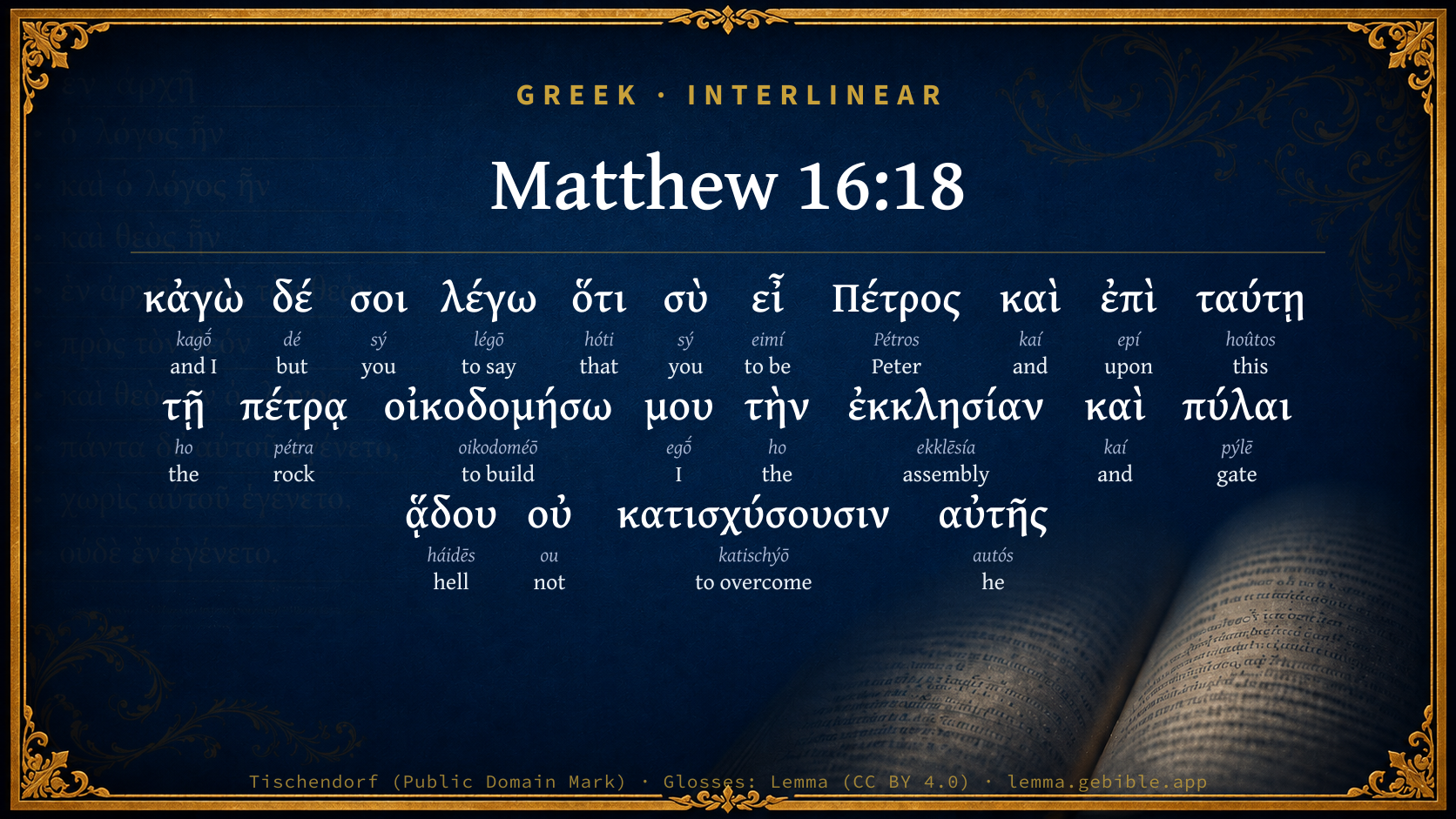
Download image
Cite this verse

Matthew 16:18 (World English Bible). Public Domain. Lemma interlinear Bible study tool, https://lemma.gebible.app/v/matthew/16/18.

Show BibTeX & RIS
BibTeX
RIS
English Translation
I also tell you that you are Peter, and on this rock I will build my assembly, and the gates of Hades will not prevail against it.
World English Bible · Public Domain
Highlights
  • 2 first appearances in the Greek New Testament
Full analysis ↓
Download a study sheet

One document with this verse’s original text, its word-by-word gloss line, the meaning frame, cross-references with their text, attributed commentary, and full source and license credits — printable, and it pastes into notes with its structure intact.

This verse Autodidact and up

Study sheet (.html) Plain text (.txt)

A passage Seminary Student

Up to 50 verses in one chapter. A passage sheet keeps up to 6 commentary sources and 12 cross-references per verse, in the order this page ranks them, and says so on the sheet whenever that leaves anything out. Ask for a single verse and you get the Autodidact verse sheet above.

Everything on this page stays free to read, with no account — the sheet is a download of what is already on screen, not access to it.

Want to remove ads? Support Godless Engineer
Compare translations 3

The same verse in 3 English versions, stacked beneath the original-language interlinear above. Click any original word for its lexicon entry.

Each is an independent rendering of the whole verse — the interlinear is not word-aligned to these translations.

Highlighted words mark where these versions differ — a whole-verse word diff, not a word-by-word alignment.

  • World English Bible Public Domain
    I also tell you that you are Peter, and on this rock I will build my assembly, and the gates of Hades will not prevail against it.
  • King James Version Public Domain
    And I say also unto thee, That thou art Peter, and upon this rock I will build my church; and the gates of hell shall not prevail against it.
  • unfoldingWord Literal Text CC BY-SA 4.0
    And I also say to you that you are Peter, and upon this rock I will build my church, and the gates of Hades will not prevail against it.

unfoldingWord Literal Text — © unfoldingWord, licensed CC BY-SA 4.0. Word-aligned USFM3 via Door43 (git.door43.org/unfoldingWord/en_ult).

Versions to compare (up to 4)

3 of 4 selected

Show all 19 translations

Every available English version of this verse, each an independent rendering of the whole verse.

  • World English Bible Public Domain
    I also tell you that you are Peter, and on this rock I will build my assembly, and the gates of Hades will not prevail against it.
  • Berean Standard Bible Public Domain
    And I tell you that you are Peter, and on this rock I will build My church, and the gates of Hades will not prevail against it.
  • Majority Standard Bible Public Domain
    And I tell you that you are Peter, and on this rock I will build My church, and the gates of Hades will not prevail against it.
  • King James Version Public Domain
    And I say also unto thee, That thou art Peter, and upon this rock I will build my church; and the gates of hell shall not prevail against it.
  • American Standard Version (1901) Public Domain
    And I also say unto thee, that thou art Peter, and upon this rock I will build my church; and the gates of Hades shall not prevail against it.
  • Revised Version (1885) Public Domain
    And I also say unto thee, that thou art Peter, and upon this rock I will build my church; and the gates of Hades shall not prevail against it.
  • Geneva Bible (1599) Public Domain
    And I say also vnto thee, that thou art Peter, and vpon this rocke I will builde my Church: and ye gates of hell shall not ouercome it.
  • Douay-Rheims (1899) Public Domain
    And I say to thee: That thou art Peter; and upon this rock I will build my church, and the gates of hell shall not prevail against it.
  • Young's Literal Translation Public Domain
    `And I also say to thee, that thou art a rock, and upon this rock I will build my assembly, and gates of Hades shall not prevail against it;
  • Literal Standard Version CC BY-SA 4.0
    And I also say to you that you are Peter, and on this rock I will build My Assembly, and [the] gates of Hades will not prevail against it;
  • Unlocked Literal Bible CC BY-SA 4.0
    I also say to you that you are Peter, and upon this rock I will build my church. The gates of Hades will not prevail against it.
  • unfoldingWord Literal Text CC BY-SA 4.0
    And I also say to you that you are Peter, and upon this rock I will build my church, and the gates of Hades will not prevail against it.
  • Darby Bible Public Domain
    And *I* also, I say unto thee that *thou* art Peter, and on this rock I will build my assembly, and hades' gates shall not prevail against it.
  • World Messianic Bible Public Domain
    I also tell you that you are Peter, and on this rock I will build my assembly, and the gates of Sheol will not prevail against it.
  • Webster's Bible Public Domain
    And I say also to thee, that thou art Peter, and upon this rock I will build my church: and the gates of hell shall not prevail against it.
  • Free Bible Version CC BY-SA 4.0
    I also tell you that you are Peter, and on this rock I will build my church and the powers of death won't overcome it.
  • Bible in Basic English Public Domain
    And I say to you that you are Peter, and on this rock will my church be based, and the doors of hell will not overcome it.
  • Text-Critical English NT CC BY 4.0
    And I tell yoʋ that yoʋ are Peter, and on this rock I will build my church, and the gates of Hades shall not prevail against it.
  • Tyndale New Testament (1534) Public Domain
    And I saye also vnto the that thou arte Peter: and apon this rocke I wyll bylde my congregacion. And the gates of hell shall not prevayle ageynst it.

Literal Standard Version (2020), Covenant Press — licensed CC BY-SA 4.0. Text via the HelloAO Bible API (eBible.org). Unlocked Literal Bible (unfoldingWord) — licensed CC BY-SA 4.0. Text via the HelloAO Bible API (eBible.org). unfoldingWord Literal Text — © unfoldingWord, licensed CC BY-SA 4.0. Word-aligned USFM3 via Door43 (git.door43.org/unfoldingWord/en_ult). Free Bible Version, Dr. Jonathan Gallagher — licensed CC BY-SA 4.0. Text via the HelloAO Bible API (eBible.org).

Word by word

More ways to search: Search by grammar → Find every occurrence → Compare this word →

Practice this passage: Drill this verse → Learn its vocabulary →

κατισχύσουσιν
katischýō
G2729
“to overcome”
Verb, Future, Active, Indicative, 3rd person, Plural
Part of Speech
Verb
Tense
Future
Voice
Active
Mood
Indicative
Person
3rd person
Number
Plural
Full Thayer's Definition

Origin: from G2596 and G2480

TDNT: 09:37,4

1. to be strong to another's detriment, to prevail against 2. to be superior in strength 3. to overcome 4. to prevail
  1. κἀγὼ kagṓ G2504 “and I” Personal pronoun, 1st person, Nominative, Singular, Aramaic form
  2. δέ dé G1161 “but” Conjunction
  3. σοι sý G4771 “you” Personal pronoun, 2nd person, Dative, Singular
  4. λέγω légō G3004 “to say” Verb, Present, Active, Indicative, 1st person, Singular
  5. ὅτι hóti G3754 “that” Conjunction
  6. σὺ sý G4771 “you” Personal pronoun, 2nd person, Nominative, Singular
  7. εἶ eimí G1510 “to be” Verb, Present, Active, Indicative, 2nd person, Singular
  8. Πέτρος Pétros G4074 “Peter” Noun, Nominative, Singular, Masculine
  9. καὶ kaí G2532 “and” Conjunction
  10. ἐπὶ epí G1909 “upon” Preposition
  11. ταύτῃ hoûtos G3778 “this” Demonstrative pronoun, Dative, Singular, Feminine
  12. τῇ ho G3588 “the” Article, Dative, Singular, Feminine
  13. πέτρᾳ pétra G4073 “rock” Noun, Dative, Singular, Feminine
  14. οἰκοδομήσω oikodoméō G3618 “to build” Verb, Future, Active, Indicative, 1st person, Singular
  15. μου egṓ G1473 “I” Personal pronoun, 1st person, Genitive, Singular
  16. τὴν ho G3588 “the” Article, Accusative, Singular, Feminine
  17. ἐκκλησίαν ekklēsía G1577 “assembly” Noun, Accusative, Singular, Feminine
  18. καὶ kaí G2532 “and” Conjunction
  19. πύλαι pýlē G4439 “gate” Noun, Nominative, Plural, Feminine
  20. ᾅδου háidēs G86 “hell” Noun, Genitive, Singular, Masculine
  21. οὐ ou G3756 “not” Particle, Negative
  22. αὐτῆς autós G846 “he” Personal pronoun, Genitive, Singular, Feminine

About this verse

These counts appear in no published source. They are computed here, from the morphology-tagged text and Lemma’s own curated glosses. What Lemma adds →

23
words
20
distinct lemmas
Gospels
section

Notable vocabulary

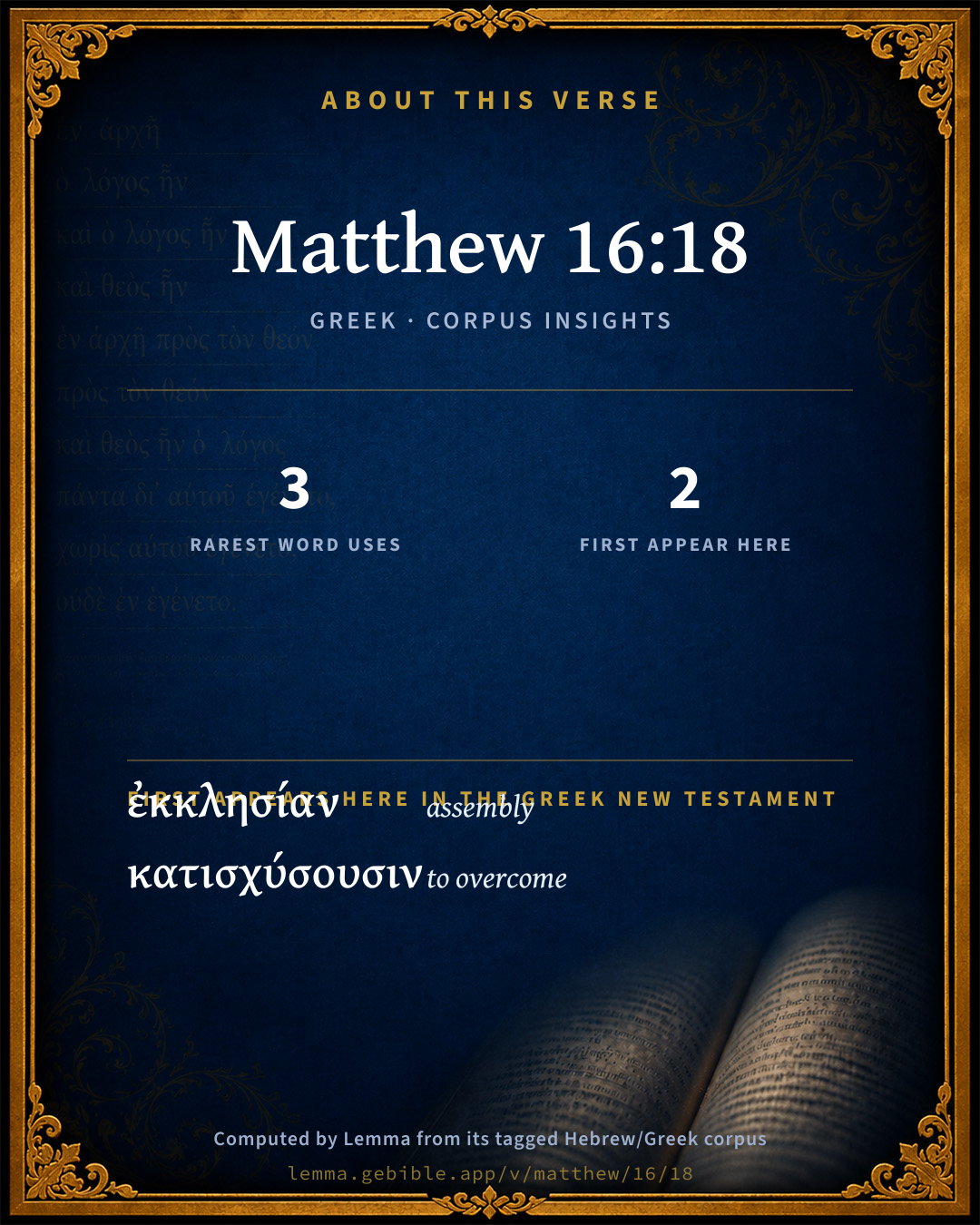
The rarest word here is κατισχύσουσιν to overcome G2729 — appearing just 3 times in the whole Greek New Testament.

First appearance in Scripture

These words make their first canonical appearance in the Greek New Testament here:

  • ἐκκλησίαν assembly G1577
  • κατισχύσουσιν to overcome G2729

Shared distinctive vocabulary

κατισχύσουσιν to overcome G2729 occurs in 3 verses of the Greek New Testament. Also found in:
Repetition

Words recur within this verse:

Cross-references

37

Topical passages linked to Matthew 16:18 in the Treasury of Scripture Knowledge — connected by theme and wording, ordered by reader-vote popularity; previews shown in the World English Bible.

  • Ephesians 2:19–22 So then you are no longer strangers and foreigners, but you are fellow citizens with the saints, and of the household of God,
  • 1 Corinthians 3:9–11 For we are God's fellow workers. You are God's farming, God's building.
  • Isaiah 28:16 therefore thus says the Lord Yahweh, Behold, I lay in Zion for a foundation a stone, a tried stone, a precious corner -[stone] of sure foundation: he who believes shall not be in haste.
  • Colossians 1:18 He is the head of the body, the assembly, who is the beginning, the firstborn from the dead; that in all things he might have the preeminence.
  • Psalms 125:1–2 Those who trust in Yahweh are as Mount Zion, Which can't be moved, but remains forever.
  • John 1:42 He brought him to Jesus. Jesus looked at him, and said, "You are Simon the son of Jonah. You shall be called Cephas" (which is by interpretation, Peter).
  • Acts 2:47 praising God, and having favor with all the people. The Lord added to the assembly day by day those who were being saved.
  • Hebrews 12:28 Therefore, receiving a Kingdom that can't be shaken, let us have grace, through which we serve God acceptably, with reverence and awe,
  • Hebrews 3:3–4 For he has been counted worthy of more glory than Moses, inasmuch as he who built the house has more honor than the house.
  • John 10:27–30 My sheep hear my voice, and I know them, and they follow me.
  • 1 Timothy 3:15 but if I wait long, that you may know how men ought to behave themselves in the house of God, which is the assembly of the living God, the pillar and ground of the truth.
  • Zechariah 6:12–13 and speak to him, saying, 'Thus says Yahweh of Hosts, "Behold, the man whose name is the Branch: and he shall grow up out of his place; and he shall build the temple of Yahweh;
  • Isaiah 54:17 No weapon that is formed against you shall prosper; and every tongue that shall rise against you in judgment you shall condemn. This is the heritage of the servants of Yahweh, and their righteousness which is of me, says Yahweh.
  • Ephesians 5:32 This mystery is great, but I speak concerning Christ and of the assembly.
  • Proverbs 24:7 Wisdom is too high for a fool: He doesn't open his mouth in the gate.
  • Job 38:17 Have the gates of death been revealed to you? Or have you seen the gates of the shadow of death?
  • Romans 8:33–39 Who could bring a charge against God's chosen ones? It is God who justifies.
  • Ephesians 3:10 to the intent that now through the assembly the manifold wisdom of God might be made known to the principalities and the powers in the heavenly places,
  • Psalms 9:13 Have mercy on me, Yahweh. See my affliction by those who hate me, And lift me up from the gates of death;
  • Acts 8:1 Saul was consenting to his death. A great persecution arose against the assembly which was in Jerusalem in that day. They were all scattered abroad throughout the regions of Judea and Samaria, except for the apostles.
  • Revelation 21:14 The wall of the city had twelve foundations, and on them twelve names of the twelve Apostles of the Lamb.
  • Ephesians 5:25–27 Husbands, love your wives, even as Christ also loved the assembly, and gave himself up for it;
  • Matthew 18:17 If he refuses to listen to them, tell it to the assembly. If he refuses to hear the assembly also, let him be to you as a Gentile or a tax collector.
  • Galatians 2:9 and when they perceived the grace that was given to me, James and Cephas and John, they who were reputed to be pillars, gave to me and Barnabas the right hand of fellowship, that we should go to the Gentiles, and they to the circumcision.
  • 1 Timothy 3:5 (but if a man doesn't know how to rule his own house, how will he take care of the assembly of God?)
  • Genesis 22:17 that in blessing I will bless you, and in multiplying I will multiply your seed as the stars of the heavens, and as the sand which is on the seashore. Your seed will possess the gate of his enemies.
  • Psalms 69:12 Those who sit in the gate talk about me. I am the song of the drunkards.
  • Isaiah 28:6 and a spirit of justice to him who sits in judgment, and strength to those who turn back the battle at the gate.
  • Matthew 10:2 Now the names of the twelve apostles are these. The first, Simon, who is called Peter; Andrew, his brother; James the son of Zebedee; John, his brother;
  • Matthew 11:23 You, Capernaum, who are exalted to Heaven, you will go down to Hades. For if the mighty works had been done in Sodom which were done in you, it would have remained until this day.
  • Revelation 11:15 The seventh angel sounded, and great voices in heaven followed, saying, "The kingdom of the world has become the Kingdom of our Lord, and of his Christ. He will reign forever and ever!"
  • Revelation 21:1–4 I saw a new heaven and a new earth: for the first heaven and the first earth have passed away, and the sea is no more.
  • Isaiah 38:10 I said, In the noontide of my days I shall go into the gates of Sheol: I am deprived of the residue of my years.
  • 1 Corinthians 15:55 "Death, where is your sting? Hades, where is your victory?"
  • 2 Samuel 18:4 The king said to them, What seems you best I will do. The king stood by the gate-side, and all the people went out by hundreds and by thousands.
  • Psalms 107:18 Their soul abhors all kinds of food. They draw near to the gates of death.
  • Psalms 127:5 Happy is the man who has his quiver full of them. They won't be disappointed when they speak with their enemies in the gate.

Cross-references courtesy of OpenBible.info (CC BY 4.0).

Commentary

Notes on Matthew 16:18 from classic Christian and Jewish commentators (each source and its license shown beneath its notes). The classic Christian expositions comment on the surrounding passage and are grouped to its opening verse, so a note may address several verses; the Jewish commentaries on the Tanakh (Rashi and others) are per-verse, so they appear only where the commentator wrote on this verse.

Lemma curates 59 commentaries, every one of them public domain or Creative Commons licensed, each selected and text-cleaned for this edition rather than reprinted as found. About our sources →

The Biblical Illustrator

Joseph S. Exell

Mat_16:18

That thou art Peter, and upon this rock I will build My Church.

The true Christian Church

I. Let us dwell on Peters profession of faith. It is not a learned, complicated, or even detailed exposition. Full of depth. It was a rich source of happiness for Peter-Blessed art thou. What is the Church of which the Saviour speaks?

II. The church exercises its power through faith. The power of the Church, as regards its essential features, is expressed in the words, I will give thee the keys of the kingdom of heaven. This power not conferred on Peter exclusively. Our Lord did not connect the exercise of this power with one condition, one external and human position; but with the quality of disciple of the Son of God. When any faithful voice proclaims to you the design of God in regard to your salvation, he has the authority of the voice of God Himself; a Divine sentence is uttered respecting you; if you abhor your sins they will be forgiven; if not they are retained.

III. By faith the church triumphs over its enemies. The gates of hell, etc.

1. What is this hell whose power shall not prevail against the Church? Its enemies-external, internal.

2. How shall it resist these enemies? Not by violence, carnal display; by faith. (The late Pastor Verny.)

The Church which Christ builds

I. A building-My Church. Not a material building; made up of all true believers.

II. The builder-I will build, etc. The true Church is cared for by all the three Persons of the Holy Trinity. Christ uses subordinate agencies in this building.

1. His wisdom. Each in right place.

2. His mercy. He despises no stone.

3. His power. In face of opposition.

4. The children of this world take little or no interest in the building of this Church.

III. The foundation.

1. It was laid at a mighty cost.

2. It is very strong.

IV. Implied trials.

1. Marvel not at the enmity of hell.

2. Be prepared for it.

3. Be patient under it.

4. Be not cast down by it.

V. The security. (Bishop Ryle.)

The foundation and perpetuity of the Church

I. THE foundation on which the church rests.

1. How ancient.

2. How firm.

3. How enduring.

II. The agency by which the church is reared.

1. Christ appoints the means.

2. Christ provides the instruments.

3. Christ communicates the blessing.

III. The perpetuity with which the church shall be honoured and blest.

1. Notwithstanding the ravages of death.

2. Notwithstanding the power and policy of Satan. (G. Brooks.)

The perpetuity and safety of the Church of Christ

1. Presumptive evidence of the safety of the Church. It is dear to God; purchased by Christ.

2. Positive declaration of the safety of the Church.

3. Actual facts and experience.

The Church in Egypt under Joseph.

1. This ministers comfort to believers.

2. If God does prepare affliction for His Church, it is for her good. (J. G. Lorimer.)

Christs Church

I. The edifice of which the Redeemer speaks. Not any material building. It rises through successive generations.

II. The relation in which Jesus Christ stands to this edifice.

1. Its foundation.

2. Its Architect.

(1) As Architect He selected its site. He fixed it on earth.

(2) He drew the plan.

(3) He prepares the materials.

(4) He employs the workmen.

3. Its Proprietor. It is His Church.

4. He is the guarantee of its stability. (T. Raffles, D. D.)

The ultimate defeat of the enemies of the Church

I. Gods church-My Church.

1. The foundation-rock.

2. The superstructure.

3. The Builder-I.

II. The churchs foe. Paganism led the van. Fanaticism. (T. Mortimer, B. D.)

The promise to Peter

I. Peters confession of his own faith in contrast to the report of the other disciples as to who the people said Christ was.

II. Peters confession, contrasted with the delayed speech of the other disciples.

III. Peters confession as contrasted with the less explicit confessions of others that had preceded it.

IV. How the promise to this man of rock was fulfilled. What is there in your character and conduct on which the Lord can build His Church? (John Poster)

The permanence of Christs Church

Our Lord Jesus Christ in His Divine character as the Messiah, the Son of the living God, and the foundation of the Christian Church.

I. The Christian church is, for everything that distinguishes it as such, directly dependent upon Christ as God. The Church is distinguished from all other forms of organized society-

1. By its peculiar origin and history. It comes up out of the past as no other form of organized society ever has or can. It takes root in the garden of mans innocency, immediately after the first sin.

2. By the character of its members. No other organization has ever been found thus constituted.

3. By its system of government and law. Governs from within.

II. The church of Christ, being thus builded upon him, as messiah, the son of the living God, is assured of security and perpetuity.

1. The yawning gates of death, open to receive the Church; the gates into which all human travellers pass. The disciples were dying men; enemies might say that the Church would pass away with the few fanatics who had been deceived by it. Believers have died, but the Church lives.

2. The Churchs security and perpetuity beyond this earthly life. The heavenly Church. (A. J. Kynett, D. D.)

The visibility of the true Church

I. What the church of Christ is.

II. As to the foundation of the church.

1. Negatively. Not Peter.

(1) He was but a man.

(2) Peter was a frail mortal man.

(3) Peter was a sinful man.

(4) Peter determines the point himself, and expounds the prophecy in Isaiah of Christ (1Pe_2:4).

(5) Peter, as mere Peter, could never victoriously grapple with the assaults of Satan.

Some assert that Peter was the foundation in a secondary sense.

(1) This secondary foundation is an absurd distinction, and contrary to the very nature of a foundation.

(2) It would have to be extended to all the apostles.

2. Positively-that Christ is the only true foundation of the Church.

(1) God the Father selected no other.

(2) Christ asserts no other.

(3) The Holy Spirit fits no other.

(4) Only Christ can withstand the gates of hell.

III. The duration of the church, in some state of visibility throughout all ages.

1. The Churchs opposites the gates of hell.

2. Their great undertakings.

IV. Comfort for all true members. Of the church of Christ.

1. Let holy souls be comforted in this-that no weapon formed against Mount Zion shall finally prosper.

2. The Church, after all assaults and conflicts, shall be completely victorious, she shall joyfully survive her enemies, and behold their funerals. (S. Lee, M. A.)

The Church improved by trial

Satan hath emptied his quiver, but hath not hurt the Church. By how much the more the enemies rage against her, by so much the more the true professors of piety and faith increase: not unlike the vine, that grows the more fertile by pruning; or as the palm, that rises the more erect after weights and pressures; gad although in time of trouble like some plants that shut up their flowers upon a storm, yet afterward display their lively and lovely colours more oriently to the face of the shining sun. (S. Lee, M. A.)

The Church upon the Rock

I. To what the Saviour refers as to the foundation of His Church.

II. That the foundation of the church is a truth-Jesus is the Christ, the Son of God.

1. A truth in itself indestructible.

2. A truth never to be invalidated.

3. A living truth.

4. A uniting truth-My Church. (G. S. Green, D. D.)

The Churchs security

Christ assures us here of the constancy of the assaults which Satan will make upon the Church and its members. He does not promise the removal of trial and tribulation, assault and temptation, but Divine strength by which to overcome evil.

1. That the truth which Peter has here confessed shall never be lost to the great body of His faithful ones; that the Church shall never, as a whole, fall from the faith, or lose its hold of the truth.

2. That however corrupt many of the members of the Church shall be, it shall never be wholly depraved, or fall utterly from that sanctity which it has through union with Him.

3. That human councils, and mans devices, and Satans assaults upon the Church, shall never prevail; for, since it is of God, it cannot come to naught. (W. Denton, M. A.)

My Church

Christs Church is

(1) A community of free men. There are no slaves in it, and no criminals; no strangers and foreigners.

(2) A community gathered together for a public purpose.

(3) Gathered together by a call. It is divinely called out from among the mass of those who are determined to be slaves or criminals, or who are wilfully willing to remain foreigners and strangers to Christ and Christianity. (J. Morison, D. D.)

I will build, my Church

Here Christ represents the Church as an edifice, of which He is the Architect and the Builder. The kind of edifice is not specified. And indeed it could not well be, at least exhaustively. It is a house. It is a temple. But it is a city too, gathered around the central temple, and into which, indeed, the temple has expanded. It is Zion. It is Jerusalem. It is the New Jerusalem, the heavenly Jerusalem. It is a place of perfect security. It is a fortress, standing high upon a rock. It is a safe city of refuge. Its defence is the munition of rocks, or of what is far better and stronger than rocks. (J. Morison, D. D.)

The Church of Christ

1. The Architect.

2. The Building.

3. The Foundation.

4. The materials.

5. Its permanence. (Anon.)

Castle of Bahias suggesting the rock figure:

A little way to the left of the village there stands the majestic ruin of the Castle of Banias, built on the rocky crest of a projecting spur of Hermon, which rises a thousand feet above the village, and it is itself several hundred feet higher. Is it possible to doubt that the eye of the Great Master and His disciples was turned, while He spoke, to that castle upon its rocky base, filling up the whole view eastward, and that he doubled the impression of His sayings, as He so often did, by surrounding them with the framework and casting on them the colouring of a natural picture? (A. Thomson.)

The Church a building

The Church of Christ is not a material building, a temple made with hands, of brick, or wood, or stone, or marble. It is no particular visible church on earth; it is made up of all true believers in Christ, of every name and rank and people and tongue. All visible churches on earth are its servants and handmaidens; they are the scaffolding behind which the grand building is going on the husk under which the living kernel grows. The Temple of Solomon in all its glory was mean and contemptible in comparison with this Church, which is built upon a Rock; small and despicable though it may be in this world, it is precious and honourable in the sight of God. Statesmen, rulers, kings, and all the rowers of hell, may scheme and plan against it; they are only the axes and saws in Gods hands, in the erection of Christs spiritual temple, the gathering in of living stones into the one true Church. (Bishop J. C. Ryle.)

The foundation of the Church

I. The church is built on Christ. It is built on Jesus Christ, and not upon any idea or representation of Him.

2. It is built upon the historical Christ.

3. But if it is built on the historical Christ, then it must be built upon the theological Christ-the Christ as represented in the doctrines of the Church.

II. The church is built upon Christ as the God-man.

1. It is built upon the God-man.

2. It is built upon the God-man, and not upon the man-God.

3. It is built upon the God-man, and not upon any theory.

III. The Church is built upon Jesus Christ as the God-man slain.

1. To be the foundation of the Church it was necessary that He should be slain.

2. The idea of the God-man slain seems to be the foundation of all the thoughts of God.

3. And as the Lamb slain was the centre of the Divine thoughts before the creation of the world, so will He become the centre of the myriad thoughts of redeemed humanity after the creation shall have been destroyed.

4. Make sure of your foundation. Build a Church

(1) not on creeds;

(2)but on the Bible. (J. C. Jones.)

Christianity indestructible

There is a picture frontispiece in Wycliffes Bible which, to my mind, is very significant, very prophetic. There is a fire burning and spreading rather rapidly, representing Christianity; and around the spreading fire are congregated a considerable number of significant and most important individuals, all endeavouring to devise methods whereby they can put the fire out. Among the number, I see there one gentleman with horns and a tail, I suppose representing his satanic majesty; and another is the Pope of Rome, with a few red-coated cardinals; Mahomet, I believe, has a representative there too, and there is another representative of infidelity; and they are all devising some means, suggesting some method whereby to extinguish the fire, and after considerable cogitation one of them suggests that they should all make a desperate effort to blow on the fire till they blow it out. The resolution is adopted, and there they are with swollen cheeks and extended lips, blowing upon the fire with all their might, but instead of blowing it out, they are blowing it up, and they blow themselves out of breath before they blow the fire out. It is an unquenchable flame, and no human power can extinguish it. (Richard Roberts.)

The Biblical Illustrator, edited by Joseph S. Exell (c. 1880s–1900s) — public domain. Text from a community e-Sword module.

Godbey's Commentary on the New Testament

William B. Godbey

CHAPTER 36

THE CHURCH

Mat 16:18-19; Mar 8:30; Luk 9:21. Matthew “And I say unto thee, That thou art Peter, and upon this rock I will build My Church, and the gates of hell shall not prevail against it. And I will give unto thee the keys of the kingdom of the heavens; and whatsoever thou mayest bind on earth, shall be bound in the heavens; and whatsoever thou shalt loose on earth, shall be loosed in the heavens. Then He commanded His disciples that they must tell no one that He is the Christ.” It is really indispensable at this date of our Lord’s ministry, that His leading disciples, and especially the apostles, should have clear and positive information as to His Messiahship, only eight months of His earthly ministry still to transpire, with the exception of the forty days intervening between His resurrection and ascension. Now that He is gone away off, out of the circle of His ministry, into this temporary retirement in Sryia, He has an opportune privilege with His disciples alone. As to the multitudes, still let them solve the problem in contemplation of His mighty works, which were certainly calculated to settle the conviction of all the unprejudiced that He was truly the Christ. As He moves on in His ministry, the public proclamation of His Messiahship comes more and more to the front, the matter being in such a shape with the Jews and Romans that such an avowal would cost Him, or any one else, His life. We now reach a grand, salient epoch in our Savior’s ministry, when the gospel Church is conspicuously revealed to the apostles as destined to supersede the politico-ecclesiasticism of the former dispensation. N.B. Peter is a Greek word, and means “rock.” Jesus gave it to Simon, indicative of his firmness. The world, however, never saw the rock in Peter’s character till after the fires of Pentecost had burned out all the trash of depravity, revealing to all the world the solid rock, which caused him to live a hero and die a martyr. When our Savior says to Simon, “Thou art Peter” — i.e., “Thou art rock,” He used the word Petros, which means a broken rock, such as we use in a building — immediately He says, “Upon this rock,” using the word Petra, which means the great unbroken strata, underlying the continents and oceans, and constituting the foundation of the earth. This word He applies to Himself. All Christian character, in this life, is more or less fragmentary, Jesus being the only Integer, whom we all imitate, and to whose perfection and glory we aspire, living in the hope of that coming glorification which shall make us like Him. Now what about the Church? Our Savior’s word is Ekklesia, from Ek, “out,” and kaleo, “to call.” Hence it means the “called out” — no hereditary hierarchy, nor ecclesiasticism, like Judaism; but the individual souls, in every nation, who hear the call of the Holy Ghost (and He calls all), and come out of the world, forsaking all, and identifying themselves with God for time and eternity. These, and only these, constitute the Church of God. Now He said, “On this Rock I will build My Church, and the gates of hell shall not prevail against her.” We must go down through all the sand, mud, soapstone, and slate, till we strike the solid rock, and there build our superstructure, if we want it to stand. The calling out by the Holy Ghost is regeneration; and the building on Christ, sanctification. Hence the instability and vacillation peculiar to unsanctified Christians; while the genuine and thorough sanctification gives you a stability which will not cower in the presence of roaring lions and martyr fires. “Here,” He says, “I will build,” i.e., edify you indefinitely. While the negative side of sanctification, going down to the deep foundation of the earth, and consciously reaching the solid rock, is definite and complete. The erection of the superstructure — i.e., the building of Christian character — will not only continue through this life, beautifully progressive, but through all eternity, towering into loftier heights, and broading into grander dimensions, thus accumulating the Divine similitude and glory, the wonder of redeemed humanity, and the admiration of the unfallen intelligences of the celestial universe through the flight of eternal ages. Comparatively few have any correct conception as to what the Church is. They think the carnal, worldly people, constituting the congregations in the different denominations, are the Church; whereas none but the truly regenerated ever have been or can be members of God’s Church; regeneration bringing you in, and sanctification establishing you, qualifying you for official responsibilities, such as the pastorate, the diaconate, eldership, evangelism, and teaching.

William B. Godbey, Commentary on the New Testament (1896–1900) — public domain. Text from a community e-Sword module.

Tyndale Open Study Notes

Tyndale Open Resources

16:18 The phrase upon this rock is a pun on Peter’s name. Peter was the foundational rock in that he was the first confessor and leader of the apostles—he was the “founding member” of the church (see Eph 2:20-22; Rev 21:14). Some scholars have suggested that Jesus was referring to himself when he said this rock, but it seems clear that Jesus was referring either to Peter or to his confession. However, it is clearly Jesus’ church (my church), not Peter’s, and Jesus himself will build it. So it is not necessary to conclude that later church leaders must derive their authority from Peter. • Matthew is the only Gospel writer who uses the term church (also Matt 18:17). The idea here is more the community of God’s people than an ecclesiastical institution. • will not conquer it: The church will not be defeated by the attacks of Satan (see 11:12; 13:24-30, 36-43).

Tyndale Open Study Notes — © Tyndale Open Resources, licensed CC BY-SA 4.0. Text via the HelloAO Bible API.

Bengel's Gnomon

Johann Albrecht Bengel

Mat 16:18. Σὺ εἶ Πέτρος, thou art Peter) This corresponds with great beauty to the words, Thou art the Christ.[740]—ΠΈΤΡΟς, ΠΈΤΡΑ, Peter—rock) πέτρος elsewhere signifies a stone; but in the case of Simon, a rock. It was not fitting that such a man should be called Πέτρα, with a feminine termination; on the other hand, St Matthew would gladly have written ἘΠῚ ΤΟΎΤῼ Τῷ ΠΈΤΡῼ, if the idiom would have allowed it; wherefore these two, ΠΈΤΡΑ and ΠΈΤΡΟς, stand for one name and thing, as both words are expressed in Syriac by the one noun, Kepha. Peter is here used as a proper name; for it is not said, Thou shalt be, but, Thou art; and yet the appellative is at the same time openly declared to denote a rock. The Church of Christ is certainly[741] (Rev 21:14) built on the apostles, inasmuch as they were the first believers, and the rest have been added through their labours; in which matter a certain especial prerogative was conspicuous in the case of Peter, without damage to the equality of apostolic authority; for he first converted many Jews (Acts 2), he first admitted the Gentiles to the Gospel (Acts 10.[742]) He moreover was especially commanded to strengthen his brethren, and to feed the sheep and lambs of the Lord. Nor can we imagine that this illustrious surname, elsewhere commonly attributed to Christ Himself, who is also called the Rock, could without the most important meaning have been bestowed on Peter, who in the list of the apostles is called first, and always put in the first place; see Mat 10:2; see also 1Pe 2:4-7. All these things are said with safety, for what have they to do with Rome?[743] Let the Roman rock beware, lest it fall under the censure of Mat 16:23.—ΚΑῚ, Κ.Τ.Λ., and, etc.) A most magnificent promise, including, in different ways, the gates of hell, the kingdom of heaven, and the earth.—οἰκοδομήσω, I will build) He does not say, on this rock I WILL FOUND; for Peter, nevertheless, is not the foundation. The wise build on a rock; see ch. Mat 7:24.—Μου τὴν ἐκκλησίαν, My Church) A magnificent expression concerning Jesus, not occurring elsewhere in the Gospels.—πύλαι ᾅδου, the gates of hell) The word πύλαι (gates) occurs here without the article. Heaven is in the next verse put in opposition to τῷ ᾅδη, hell, which occurs here, as in ch. Mat 11:23. Hell has no power against faith; faith has power with reference to heaven.[744] The gates of hell (as elsewhere, the gates of death) are named also in Isa 38:10; Wis 16:13. Hell, ᾅδης, is exceedingly strong (see Son 8:6); how much more its gates? The metaphor in “gates” is of an architectural kind, as in the expressions, “I will build” and “the keys” The Christian Church is like a city without walls, and yet the gates of hell, which assail it, shall never prevail. The defences of hell, and the fortifications of the world, corresponding to them, are here intended; as, for instance, the Otto man Porte, and Rome, where Erasmus Schmidt[745] thinks that the mouth of hell is; that it was opened in the time of Marcus Curtius, and will be opened again hereafter, when the prophecy in Rev 19:20 is fulfilled. “Rome,” he says, “is situated very near those parts of Italy where, before the foundation of Rome, Homer makes his Ulysses descend to hell, and where, after the foundation of Rome, without the intervention of any great distance, Virgil makes his Æneas do the same. But lest I should appear to wish to plead on poetical credit (although these poetical assertions may be regarded like the prediction of Caiaphas), attend to historical testimony:—In the middle of the Roman Forum, once upon a time, if we are to credit Livy and other Roman writers, the hell, which you (Papists) place in the bowels of the earth, opened its mouth, and that chasm could not be filled up with any amount of earth thrown in, until Marcus Curtius, armed, and on horseback, leapt in—in order, forsooth, that as the heaven received Enoch and Elijah alive, so hell might receive this Curtius alive, as the first fruits, by these gates of hell then opened in the middle of the Roman Forum, which will, without doubt, again be opened by Divine power, when the beast and the false prophet shall be cast alive into the lake of fire burning with sulphur, as is foretold in Rev 19:20.”

[740] Christ addresses His own, and Christ’s own address Him most becomingly throughout the whole of Scripture.—V. g.

[741] Eph 2:20.—E. B.

[742] And the same apostle, in this very passage, was superior to the rest of the disciples in the fact of his knowledge and his confession, seeing that it is probable that none of them would have answered at that time with so great alacrity as did Peter.—V. g.

[743] Whether Peter was for any time at Rome, and that too not in imprisonment, is a matter full of doubt. Grant even that he was: he was so certainly in no other way save as an Apostle; and the Church planted there was blessed with its own ordinary ministers. It was, therefore, to the place of these latter, not to his place, that the Bishops of subsequent ages succeeded, who afterwards degenerated into Lords and Popes.—V. g.

[744] In the original, “Contra fidem nil potest infernus: fides potest in cœlum:” where the preposition “in” implies also motion, or progress towards heaven.—(I. B.)

[745] ERASMUS SCHMIDT was a learned Philologist, born in Misnia in 1560. He became eminent for his skill in Greek and in Mathematics, of both of which he was Professor at Wittenberg, where he died in 1637.—(I. B.)

“Even to heaven.”—ED.

Bengel's Gnomon of the New Testament — English translation (T&T Clark, Edinburgh, 1860) — public domain. Text from a community e-Sword module.

Meyer's Critical & Exegetical Commentary

Heinrich August Wilhelm Meyer

Mat_16:18. But I again say to thee. The point of the comparison in κἀγώ is, that Peter having made a certain declaration in reference to Jesus, Jesus also, in His turn, now does the same in reference to Peter.

πέτρος] as an appellative: thou art a rock, Aram. כֵּיפָא. The form ὁ πέτρος[455] is likewise common among classical writers, and that not merely in the sense of a stone, as everywhere in Homer in contradistinction to πέτρα (see Duncan, p. 937, ed. Rost, and Buttmann, Lexil. II. p. 179), but also as meaning a rock (Plat. Ax. p. 371 E: Σισύφου πέτρος; Soph. Phil. 272, O. C. 19, 1591; Pind. Nem. iv. 46, x. 126). Jesus declares Peter to be a rock on account of that strong and stedfast faith in himself to which, under the influence of a special revelation from God, he had just given expression. According to Joh_1:43, however, Jesus conferred the name Cephas upon him at their very first interview (according to Mar_3:16, somewhat later); but our passage is not to be understood as simply recording the giving of the name, or the giving of it for the second time. It is rather intended to be taken as a record of the declaration made by Jesus, to the effect that Simon was in reality all that the name conferred upon him implied. Consequently our passage is in no way inconsistent with that of John just referred to, which could only have been the case if the words used had been σὺ κληθήσῃ Πέτρος.

καὶ ἐπὶ ταύτῃ τῇ πέτρᾳ] The emphasis is on ΤΑΎΤῌ, which points to Peter (not to Jesus, as Augustine would have us suppose), and to be understood thus: on no other than on this rock,hence the feminine form in this instance, because it is not so much a question of the name as of the thing which it indicates, i.e. of that rocky element in the apostles character which furnished so solid a foundation for the superstructure of the church that was to be built upon it.

οἰκοδομήσω μου τὴν ἐκκλησίαν] will I build for myself (μου, as in Mat_8:3, and frequently; see note on Joh_11:32) the church. The ἐκκλησίαin the Old Testament קָהָל, Deu_18:16; Deu_23:1, Jdg_21:8, the whole assembly of the Jewish people (Act_7:38), the theocratic national assembly (comp. Sir_24:1, and Grimms note)is used in the New Testament to denote the community of believers, the Christian church, which, according to a common figure (1Co_3:10 f.; Eph_2:19 ff.; Gal_2:9; 1Pe_2:4 f.), is represented as a building, of which Christ here speaks of Himself as the architect, and of Peter as the foundation on which a building is to be raised (Mat_7:24 f.) that will defy every effort to destroy it. But the term ἘΚΚΛ. was in such current use in its theocratic sense, that it is not necessary to suppose, especially in the case of a saying so prophetic as this, that it has been borrowed from a later order of things and put into Jesus mouth (Weisse, Bleek, Holtzmann). Besides, there can be no doubt whatever that the primacy among the apostles is here assigned to Peter, inasmuch as Christ singles him out as that one in particular whose apostolic labours will, in virtue of the stedfast faith for which he is peculiarly distinguished, be the means of securing, so far as human effort can do so (comp. Rev_21:4; Gal_2:9), the permanence and stability of the church which Jesus is about to found, and to extend more and more in the world. As in accordance with this, we may also mention the precedence given to this disciple in the catalogues of the apostles, and likewise the fact that the New Testament uniformly represents him as being, in point of fact, superior to all the others (Act_15:7; Act_2:14; Gal_1:18; Gal_2:7-8). This primacy must be impartially conceded, though without involving those inferences which Romanists have founded upon it; for Peters successors are not for a moment thought of by Jesus, neither can the popes claim to be his successors, nor was Peter himself ever bishop of Rome, nor had he any more to do with the founding the church at Rome than the Apostle Paul (for the false reasoning on this subject, see Döllinger, Christenth. u. Kirche, p. 315 ff.). The explanation frequently had recourse to in anti-popish controversies, to the effect that the rock does not mean Peter himself, but his stedfast faith and the confession he made of it[456] (Calovius, Ewald, Lange, Wieseler), is incorrect, because the demonstrative expression: ἐπὶ ταύτῃ τῇ πέτρᾳ, coming immediately after the ΣῪ ΕἾ ΠΈΤΡΟς, can only point to the apostle himself, as does also the καὶ δώσω, etc., which follows, it being understood, of course, that it was in consideration of Peters faith that the Lord declared him to be a foundation of rock. It is this circumstance also that underlies the reference to the apostles faith on the part of the Fathers (Ambrose: non de carne Petri, sed de fide; comp. Origen, Cyril, Chrysostom, Augustine).

The expression: πύλαι ᾅδου (which does not require the article, Winer, p. 118 f. [E. T. 147 ff.]), is to be explained by the circumstance that because Hades is a place from which there is no possibility of getting out again (Eustathius, ad Od. xi. 276; Blomfield, Gloss. in Aesch. Pers. p. 164), it is represented under the figure of a palace with strong gates (Son_8:6 f.; Job_38:17; Isa_38:10; Psa_9:14; Psa_107:18; Wis_16:13; 3Ma_5:51; Ev. Nicod. xxi., and Thilos note, p. 718; more frequently also in Homer, as Il. viii. 15; Aesch. Agam. 1291; Eur. Hipp. 56).

οὐ κατισχύσουσιν αὐτῆς] So securely will I build my church upon this rock, that the gates of Hades will not he able to resist it, will not prove stronger than it; indicating, by means of a comparison, the great strength and stability of the edifice of the church, even when confronted with so powerful a structure as that of Hades, the gates of which, strong as they are, will yet not prove to be stronger than the building of the church; for when the latter becomes perfected in the Messianic kingdom at the second coming, then those gates will be burst open, in order that the souls of the dead may come forth from the subterranean world to participate in the resurrection and the glory of the kingdom (comp. note on 1Co_15:54 f.), when death (who takes away the souls of men to imprison them in Hades), the last enemy, has been destroyed (1Co_15:26). So far the victory of the church over Hades is, of course, affirmed, yet not in such a way as to imply that there had been an attack made by the one upon the other, but so as to convey the idea that when the church reaches her perfected condition, then, as a matter of course, the power of the nether world, which snatches away the dead and retains them in its grasp, will also be subdued. This victory presupposes faith on the part of the καταχθονίοι (Php_2:10), and consequently the previous descensus Christi ad inferos. Moreover, had He chosen, Christ might have expressed Himself thus: καὶ πυλῶν ᾅδου κατισχύσει; but, keeping in view the comparative idea which underlies the statement, He prefers to give prominence to the gates of Hades by making them the subject, which circumstance, combined with the use of the negative form of expression (Rev_12:8), tends to produce a somewhat solemn effect. κατισχύειν τινος: praevalere adversus aliquem (Jer_15:18; Ael. N. A. v. 19; comp. ἀντισχύειν τινος, Wis_7:30, and ἸΣΧΎΕΙΝ ΚΑΤΆ ΤΙΝΟς, Act_19:16). If we adopt the no less grammatical interpretation of: to overpower, to subdue (Luther and the majority of commentators), a most incongruous idea emerges in reference to the gates, and that whether we understand the victory as one over the devil (Erasmus, Luther, Beza, Calvin, Calovius, Maldonatus, Michaelis, Keim) or over death (Grotius); for the gates of Hades would thus be represented as the attacking side, which would hardly be appropriate, and we would have to suppose what, on the other hand, would be foreign to the sense, that all the monsters of hell would rush out through the opened gates (Ewald, comp. also Weizsäcker, p. 494). The point of the comparison lies simply in the strength that distinguishes such solid gates as those of Hades, and not also in the Oriental use of the gates as a place of meeting for deliberation (Glöckler, Arnoldi), as though the hostile designs of hell were what was meant. Notwithstanding the progressive nature of the discourse and the immediate subject, Wetstein and Clericus refer αὐτῆς to Peter (ταύτῃ τ. πέτρᾳ), and suppose the meaning to be: eum in discrimen vitae venturum, nec tamen eo absterritum iri, etc.

Notice, besides, the grandeur of the expression: grandes res etiam grandia verba postulant, Dissen, ad Pind. p. 715.

[455] Among the later poets ἡ πέτρος is likewise to be met with. See Jacobs, ad Anthol. XIII. p. 22.The name Πέτρος is also to be found in Greek writers of a, later age (Leont. Schol. 18); more frequently in the form Πετραῖος (Lobeck, Paral. p. 342).

[456] Comp. Luthers gloss: All Christians are Peters on account of the confession here made by Peter, which confession is the rock on which he and all Peters are built. Melanchthon, generalizing the πέτρα, understands it in the sense of the verum ministerium. Comp. Art. Smalc. p. 345.

Meyer — Critical and Exegetical Commentary on the New Testament — English translation by Peter Christie, edited by Frederick Crombie (T&T Clark, 1880) — public domain. Text from a community e-Sword module.

Expositor's Greek Testament

ed. W. Robertson Nicoll

Mat 16:18 . κἀγὼ : emphatic, something very important about to be said to Peter and about him. πέτρος , τέτρᾳ , a happy play of words. Both are appellatives to be translated “thou art a rock and on this rock,” the two being represented by the same word in Aramaean ( כֵיפָא ). Elsewhere in the Gospels Πέτρος is a proper name, and πέτρα only is used in the sense of rock (Mat 7:24 ). What follows is in form a promise to Peter as reward of his faith. It is as personal as the most zealous advocates of Papal supremacy could desire. Yet it is as remote as the poles from what they mean. It is a case of extremes meeting. Christ did not fight to death against one form of spiritual despotism to put another, if possible worse, in its room. Personal in form, the sense of this famous logion can be expressed in abstract terms without reference to Peter’s personality. And that sense, if Christ really spoke the word, must be simple, elementary, suitable to the initial stage; withal religious and ethical rather than ecclesiastical. The more ecclesiastical we make it, the more we play into the hands of those who maintain that the passage is an interpolation. I find in it three ideas: (1) The ἐκκλησύα is to consist of men confessing Jesus to be the Christ. This is the import of ἐπὶ τ . τ . π . οἰκοδομήσω μου τ . ἐκ . Peter, believing that truth, is the foundation, and the building is to be of a piece with the foundation. Observe the emphatic position of μου . The ἐκκλησία is Christ’s; confessing Him as Christ in Peter’s sense and spirit = being Christian. (2) The new society is to be = the kingdom realised on earth. This is the import of Mat 16:19 , clause 1. The keys are the symbol of this identity. They are the keys of the gate without, not of the doors within. Peter is the gate-keeper, not the οἰκονόμος with a bunch of keys that open all doors in his hands (against Weiss) κλειδούχου ἔργον τὸ εἰσάγειν , Euthy. Observe it is not the keys of the church but of the kingdom . The meaning is: Peter-like faith in Jesus as the Christ admits into the Kingdom of Heaven. A society of men so believing = the kingdom realised. (3) In the new society the righteousness of the kingdom will find approximate embodiment. This is the import of Mat 16:19 , second clause. Binding and loosing, in Rabbinical dialect, meant forbidding and permitting to be done. The judgment of the Rabbis was mostly wrong: the reverse of the righteousness of the kingdom. The judgment of the new society as to conduct would be in accordance with the truth of things, therefore valid in heaven. That is what Jesus meant to say. Note the perfect participles δεδεμένον , λελυμένον = shall be a thing bound or loosed once for all. The truth of all three statements is conditional on the Christ spirit continuing to rule in the new society. Only on that condition is the statement about the πύλαι ᾅδου , Mat 16:18 , clause 2, valid. What precisely the verbal meaning of the statement is whether that the gates of Hades shall not prevail in conflict against it, as ordinarily understood; or merely that the gates, etc., shall not be stronger than it, without thought of a conflict (Weiss), is of minor moment; the point is that it is not an absolute promise. The ἐκκλησία will be strong, enduring, only so long as the faith in the Father and in Christ the Son, and the spirit of the Father and the Son, reign in it. When the Christ spirit is weak the Church will be weak, and neither creeds nor governments, nor keys, nor ecclesiastical dignities will be of much help to her.

The Expositor's Greek Testament, edited by W. Robertson Nicoll (1897–1910) — public domain. Text from a community e-Sword module.

Geneva Bible (1599)

Geneva Bible translators

The enemies of the Church are compared to a strong kingdom, and therefore by Gates, are meant cities which are made strong with counsels and fortresses, and this is the meaning, whatsoever Satan can do by counsel or strength. So doth Paul, 2 Cor. 10:4, call them strongholds.

That is true faith, which confesseth Christ, the virtue whereof is invisible.

Christ spoke in the Syrian tongue, and therefore used not this descanting betwixt Petros, which signifieth Peter, and Petra, which signifieth a rock, but in both places used this word Cephas: but his mind was that wrote in Greek, by the divers termination to make a difference between Peter, who is a piece of the building, and Christ the Petra, that is, the rock and foundation: or else he gave his name Peter, because of the confession of his faith, which is the Church’s as well as his, as the old fathers witness: For so saith Theophylact, That confession which thou hast made, shall be the foundation of the believers.

Geneva Bible (1599) marginal notes — public domain. Text via Bolls.life.

Jamieson, Fausset & Brown

Robert Jamieson, A. R. Fausset & David Brown

And I say also unto thee--that is, "As thou hast borne such testimony to Me, even so in return do I to thee."

That thou art Peter--At his first calling, this new name was announced to him as an honor afterwards to be conferred on him (Joh 1:43). Now he gets it, with an explanation of what it was meant to convey.

and upon this rock--As "Peter" and "Rock" are one word in the dialect familiarly spoken by our Lord--the Aramaic or Syro-Chaldaic, which was the mother tongue of the country--this exalted play upon the word can be fully seen only in languages which have one word for both. Even in the Greek it is imperfectly represented. In French, as WEBSTER and WILKINSON remark, it is perfect, Pierre--pierre.

I will build my Church--not on the man Simon-Barjona; but on him as the heavenly-taught confessor of a faith. "My Church," says our Lord, calling the Church His OWN; a magnificent expression regarding Himself, remarks BENGEL--nowhere else occurring in the Gospel.

and the gates of hell--"of Hades," or, the unseen world; meaning, the gates of Death: in other words, "It shall never perish." Some explain it of "the assaults of the powers of darkness"; but though that expresses a glorious truth, probably the former is the sense here.

Jamieson, Fausset & Brown — Commentary Critical and Explanatory on the Whole Bible (1871) — public domain (CC PDM 1.0). Text via the HelloAO Bible API.

Adam Clarke's Commentary

Verse 18. Thou art Peter] This was the same as if he had said, I acknowledge thee for one of my disciples-for this name was given him by our Lord when he first called him to the apostleship. See Joh 1:42.

Peter, πετρος, signifies a stone, or fragment of a rock; and our Lord, whose constant custom it was to rise to heavenly things through the medium of earthly, takes occasion from the name, the metaphorical meaning of which was strength and stability, to point out the solidity of the confession, and the stability of that cause which should be founded on THE CHRIST, the SON of the LIVING GOD. See Clarke on Lu 9:62.

Upon this very rock, επι ταυτη τη πετρα - this true confession of thine - that I am THE MESSIAH, that am come to reveal and communicate THE LIVING GOD, that the dead, lost world may be saved - upon this very rock, myself, thus confessed (alluding probably to Ps 118:22, The STONE which the builders rejected is become the HEAD-STONE of the CORNER: and to Isa 28:16, Behold I lay a STONE in Zion for a FOUNDATION) - will I build my Church, μον την εκκλησιαν, my assembly, or congregation, i.e. of persons who are made partakers of this precious faith. That Peter is not designed in our Lord's words must be evident to all who are not blinded by prejudice. Peter was only one of the builders in this sacred edifice, Eph 2:20 who himself tells us, (with the rest of the believers,) was built on this living foundation stone: 1Pe 2:4-5, therefore Jesus Christ did not say, on thee, Peter, will I build my Church, but changes immediately the expression, and says, upon that very rock, επι ταυτη τη πετρα, to show that he neither addressed Peter, nor any other of the apostles. So, the supremacy of Peter, and the infallibility of the Church of Rome, must be sought in some other scripture, for they certainly are not to be found in this. On the meaning of the word Church, see at the conclusion of this chapter.

The gates of hell, πυλαι αδου i. e, the machinations and powers of the invisible world. In ancient times the gates of fortified cities were used to hold councils in, and were usually places of great strength. Our Lord's expression means, that neither the plots, stratagems, nor strength of Satan and his angels, should ever so far prevail as to destroy the sacred truths in the above confession. Sometimes the gates are taken for the troops which issue out from them: we may firmly believe, that though hell should open her gates, and vomit out her devil and all his angels, to fight against Christ and his saints, ruin and discomfiture must be the consequence on their part; as the arm of the Omnipotent must prevail.

Adam Clarke's Commentary on the Bible (1810–1826) — public domain. Text from a community e-Sword/MySword module.

Ellicott's Commentary for English Readers

(18) Thou art Peter, and upon this rock . . .—It is not easy, in dealing with a text which for many centuries has been the subject-matter of endless controversies, to clear our minds of those “afterthoughts of theology” which have gathered round it, and, in part at least, overlaid its meaning. It is clear, however, that we can only reach the true meaning by putting those controversies aside, at all events till we have endeavoured to realise what thoughts the words at the time actually conveyed to those who heard them, and that when we have grasped that meaning it will be our best preparation for determining what bearing they have upon the later controversies of ancient or modern times. And (1) it would seem clear that the connection between Peter and the rock (the words in the Greek differ in gender, πέτρος and πέτρα, but were identical in the Aramaic, which our Lord probably used) was meant to be brought into special prominence. Now, at last, by this confession of his faith, Peter had risen to the height of his new calling, and was worthy of his new name. (2) Whether he is to be identified with the rock of the next clause is, however, a question on which men may legitimately differ. On the one side there is the probability that in the Aramaic, in which our Lord spoke, there would be no difference between the words in the two clauses; on the other, the possibility that He may have used the Greek words, or that the Evangelist may have intended to mark the distinction which he felt by the use of the two words, which undoubtedly differ in their meaning, πέτρος being a “stone” or fragment of rock, while πέτρα is the rock itself. The Aramaic Cepha, it may be noted, has the former rather than the latter meaning. (3) On the assumption of a distinction there follows the question, What is the rock? Peter’s faith (subjective)? or the truth (objective) which he confessed? or Christ Himself? Taking all the facts of the case, the balance seems to incline in favour of the last view. (1.) Christ and not Peter is the Rock in 1Co_10:4, the Foundation in 1Co_3:11. (2.) The poetry of the Old Testament associated the idea of the Rock with the greatness and steadfastness of God, not with that of a man [Deu_32:4; Deu_32:18; 2Sa_22:3; 2Sa_23:3; Psa_18:2; Psa_18:31; Psa_18:46; Isa_17:10; Hab_1:12 (Hebrew)]. (3.) As with the words, which in their form present a parallel to these, “Destroy this temple” (Joh_2:19), so here, we may believe the meaning to have been indicated by significant look or gesture. The Rock on which the Church was to be built was Himself, in the mystery of that union of the Divine and the Human which had been the subject of St. Peter’s confession. Had Peter himself been meant, we may. add, the simpler form, “Thou art Peter, and on thee will I build My Church,” would have been clearer and more natural. As it is, the collocation suggests an implied contrast: “Thou art the Rock-Apostle; and yet not the Rock on which the Church is to be built. It is enough for thee to have found the Rock, and to have built on the one Foundation.” (Comp. Mat_7:24.)

I will build my church.—It is significant that this is the first occurrence of the word Church (Ecclesia) in the New Testament, the only passage but one (Mat_18:17) in which it is found in the whole cycle of our Lord’s recorded teaching. Its use was every way significant. Partly, doubtless, it came with the associations which it had in the Greek of the Old Testament, as used for the “assembly” or “congregation” of the Lord (Deu_18:16; Deu_23:1; Psa_26:12); but partly also, as soon at least as the word came in its Greek form before Greek readers, it would bring with it the associations of Greek politics. The Ecclesia was the assembly of free citizens, to which belonged judicial and legislative power, and from which aliens and slaves were alike excluded. The mere use of the term was accordingly a momentous step in the education of the disciples. They had been looking for a kingdom with the King, as its visible Head, sitting on an earthly throne. They were told that it was to be realised in a society, an assembly, like those which in earthly polities we call popular or democratic. He, the King, claimed that society as His own. He was its real Head and Founder; but, outwardly, it was to be what the word which He now chose described. And this Church He was about to build. It need hardly be said that the word ecclesia did not lend itself so readily as the English equivalent does to the idea of building. The society and the fabric in which the members of the society meet were not then, as they are now, described by the same term. The similitude was bolder than it seems to us. Like the “city set on a hill” of Mat_5:14, like the “vine” of Joh_15:1, it may well have been suggested by the scenery in the midst of which the words were uttered. For there upon one rock rose the ruins of the old Canaanite city of Hazor; and on another the stately palace built by the Herodian princes, and still, as the Castle of Shubeibeh, covering an extent of ground equal to that occupied by the Castle of Heidelberg (Stanley’s Sinai and Palestine, c. 11). Once started on its way, the similitude became the fruitful source of new thoughts and phrases. The ecclesia was the “house of God” (1Ti_3:15); it was a “holy temple” (Eph_2:21). All gifts were bestowed for the work of “edifying” or building it up (1Co_14:3-4; Eph_4:12). Those who laboured in that work were as “wise architects or master builders” (1Co_3:10). But Christ, we must remember, claims the work of building as His own. Whatever others may do, He is the supreme Master-builder. As in His sacerdotal character, He is at once Priest and Victim, so under the aspect now presented (consistency of metaphors giving way to the necessities of spiritual truth) He is at once the Founder and the Foundation of the new society.

The gates of hell shall not prevail against it.—The gates of Hades (see Note on Mat_11:23), not of Gehenna, the place of torment. Hades as the shadow-world of the dead, the unseen counterpart of the visible grave, all-absorbing, all-destructive, into whose jaws or gates all things human pass, and from which issue all forces that destroy, is half-idealised, half-personified, as a power, or polity of death. The very phrase, “gates of the grave, or of Hades,” meets us in Hezekiah’s elegy (Isa_38:10), and Wis_16:13. In Rev_6:8 the personification is carried still further, and Death rides upon a pale horse, and Hades follows after him, and both are in the end overthrown and cast into the lake of fire (Rev_20:14). And as the gates of the Eastern city were the scene at once of kingly judgment (2Sa_15:2) and of the council of the elders (Pro_31:23), they became the natural symbol of the polity which ruled there. And so the promise declared that all the powers of Hades, all the forces of destruction that attack and in the long run overpower other societies, should attack, but not overpower, the ecclesia of which Christ was the Founder. Nothing in our Lord’s teaching is, as measured by man’s judgment, more wonderful than the utterance of such a prophecy at such a time. It was, as has been said, a time of seeming failure. He was about to announce, with a clearness unknown before, His coming death as a malefactor, and yet it was at this moment that He proclaimed the perpetuity and triumph of the society which as yet, it may be said, existed only in the germs of a half-realised conception. The history of the world offers hardly any serious parallel to such a prediction, and still less to that fulfilment of it which has been witnessed through eighteen centuries of Christendom, and which does not as yet seem drawing to its close.

A Bible Commentary for English Readers, edited by Charles John Ellicott (1878–1897) — public domain. Text from a community e-Sword module.

The Cambridge Bible for Schools and Colleges

gen. ed. J. J. S. Perowne

18. Thou art Peter, and upon this rock I will build my church] Cp. Isa_28:16, from which passage probably the expression is drawn. There is a play on the words “Peter” and “rock” which is lost in the E. V. It may be seen in a French rendering, “Tu es Pierre et sur cette pierre je bâtirai mon Eglise.”

On these words mainly rest the enormous pretensions of the Roman pontiff. It is therefore important (1) To remember that it is to Peter with the great confession on his lips that the words are spoken. The Godhead of Christ is the keystone of the Church, and Peter is for the moment the representative of the belief in that truth among men. (2) To take the words in reference: (a) to other passages of Scripture. The Church is built on the foundation of the Apostles and Prophets, Eph_2:20, on Christ Himself, 2Co_3:11. (b) To history; Peter is not an infallible repository of truth. He is rebuked by Paul for Judaizing. Nor does he hold a chief place among the Apostles afterwards. It is James, not Peter, who presides at the Council at Jerusalem. (c) To reason: for even if Peter had precedence over the other Apostles, and if he was Bishop of Rome, which is not historically certain, there is no proof that he had a right of conferring such precedence on his successors.

my church] The word ecclesia (Church) occurs twice in Matthew and not elsewhere in the Gospels. See note ch. Mat_18:17 where the Jewish ecclesia is meant. From the analogy of the corresponding Hebrew word, ecclesia in a Christian sense may be defined as the congregation of the faithful throughout the world, united under Christ as their Head. The use of the word by Christ implied at least two things: (1) that He was founding an organized society, not merely preaching a doctrine: (2) That the Jewish ecclesia was the point of departure for the Christian ecclesia and in part its prototype. It is one among many links in this gospel between Jewish and Christian thought. The Greek word (ἐκκλησία) has passed into the language of the Latin nations; église (French), chiesa (Italian), iglesia (Spanish). The derivation of the Teutonic Church is very doubtful. That usually given—Kuriakon (the Lord’s house)—is abandoned by many scholars. The word is probably from a Teutonic root and may have been connected with heathen usages. See Bib. Dict. Art. Church.

the gates of hell] Lit. “the gates of Hades.” The Greek Hades is the same as the Hebrew Sheol, the abode of departed spirits, in which were two divisions Gehenna and Paradise. “The gates of Hades” are generally interpreted to mean the power of the unseen world, especially the power of death: cp. Rev_1:18, “the keys of hell (Hades) and of death.”

shall not prevail against it] The gates of Hades prevail over all things human, but the Church shall never die.

The Cambridge Bible for Schools and Colleges (gen. ed. J. J. S. Perowne; Cambridge University Press, 1878–1918) — public domain. Text from a community e-Sword module.

John Gill's Exposition

And I will give unto thee the keys of the kingdom of heaven,.... By the kingdom of heaven is meant the Gospel, which comes from heaven, declares the king Messiah to be come, speaks of things concerning his kingdom, is the means of setting it up, and enlarging it, displays the riches of his grace, and gives an account of the kingdom of heaven, and of persons' right unto it, and meetness for it. "The keys" of it are abilities to open and explain the Gospel truths, and a mission and commission from Christ to make use of them; and being said to be given to Peter particularly, denotes his after qualifications, commission, work, and usefulness in opening the door of faith, or preaching the Gospel first to the Jews, Act 2:1 and then to the Gentiles, Act 10:1 and who was the first that made use of the keys of evangelical knowledge with respect to both, after he, with the rest of the apostles, had received an enlarged commission to preach the Gospel to all nations, beginning at Jerusalem. Otherwise these keys belonged to them all alike; for to the same persons the keys, and the use of them, appertained, on whom the power of binding and loosing was bestowed; and this latter all the disciples had, as is manifest from Mat 18:18 wherefore this does not serve to establish the primacy and power of Peter over the rest of the apostles; nor do keys design any lordly domination or authority; nor did Christ allow of any such among his apostles; nor is it his will that the ministers of his word should lord it over his heritage: he only is king of saints, and head of his church; he has the key of David, with which he opens, and no man shuts, and shuts, and no man opens; and this he keeps in his own hand, and gives it to none. Peter is not the door-keeper of heaven to let in, nor keep out, whom he pleases; nor has his pretended successor the keys of hell and death; these also are only in Christ's hands: though it has been said of the pope of Rome, that if he sends millions of men to hell, none should say to him, what dost thou? but the keys here mentioned are the keys of the kingdom of heaven; or of the Gospel, which was shut up in the Jewish nation, through the ignorance, malice, and calumnies of the Scribes and Pharisees, who would neither embrace it, or enter into the kingdom of God themselves, nor suffer others that were going to enter into it; and through their taking away the key of knowledge, or the right interpretation of the word of God; and through a judicial blindness, which that nation in general was given up to: and this was shut up to the Gentiles through the natural darkness that was spread over them, and through want of a divine revelation, and persons sent of God to instruct them: but now Christ was about, and in a little time he would (for these words, with what follow, are in the future tense) give his apostles both a commission and gifts, qualifying them to open the sealed book of the Gospel, and unlock the mysteries of it, both to Jews and Gentiles, especially the latter. Keys are the ensigns of treasurers, and of stewards, and such the ministers of the Gospel are; they have the rich treasure of the word under their care, put into their earthen vessels to open and lay before others; and they are stewards of the mysteries and manifold grace of God, and of these things they have the keys. So that these words have nothing to do with church power and government in Peter, nor in the pope, nor in any other man, or set of men whatever; nor to be understood of church censures, excommunications, admissions, or exclusions of members: nor indeed are keys of any such similar use; they serve for locking and unlocking doors, and so for keeping out those that are without, and retaining those that are within, but not for the expulsion of any: but here they are used in a figurative sense, for the opening and explaining the truths of the Gospel, for which Peter had excellent gifts and abilities.

And whatsoever thou shalt bind on earth, shall be bound in heaven: and whatsoever thou shalt loose on earth, shall be loosed in heaven. This also is not to be understood of binding, or loosing men's sins, by laying on, or taking off censures, and excommunications; but only of doctrines, or declarations of what is lawful and unlawful, free, or prohibited to be received, or practised; in which sense the words, , "bound and loosed", are used in the Talmudic writings, times without number, for that which is forbidden and declared to be unlawful, and for that which is free of use, and pronounced to be so: in multitudes of places we read of one Rabbi "binding", and of another "loosing"; thousands, and ten thousands of instances of this kind might be produced; a whole volume of extracts on this head might be compiled. Dr. Lightfoot has transcribed a great many, sufficient to satisfy any man, and give him the true sense of these phrases; and after him to mention any other is needless; yet give me leave to produce one, as it is short, and full, and explains these phrases, and points at the persons that had this power, explaining Ecc 12:11 and that clause in it, "masters of the assemblies".

"these (say they (t)) are the disciples of the wise men, who sit in different collections, and study in the law; these pronounce things or persons defiled, and these pronounce things or persons clean, "these bind, and these loose"; these reject, or pronounce persons or things profane, and these declare them right.''

And a little after,

"get thyself an heart to hear the words of them that pronounce unclean, and the words of them that pronounce clean; the words of them that "bind", and the words of them that "loose"; the words of them that reject, and the words of them that declare it right''

But Christ gave a greater power of binding and loosing, to his disciples, than these men had, and which they used to better purpose. The sense of the words is this, that Peter, and so the rest of the apostles, should be empowered with authority from him, and so directed by his Holy Spirit, that whatever they bound, that is, declared to be forbidden, and unlawful, should be so: and that whatever they loosed, that is, declared to be lawful, and free of use, should be so; and accordingly they bound some things which before were loosed, and loosed some things which before were bound; for instance, they bound, that is, prohibited, or declared unlawful, the use of circumcision, which before, and until the death of Christ, was enjoined the natural seed of Abraham; but that, and all ceremonies, being abolished by the death of Christ, they declared it to be nothing, and of no avail, yea, hurtful and pernicious; that whoever was circumcised, Christ profited him nothing, and that he was a debtor to do the whole law: they affirmed, that the believing Gentiles were not to be troubled with it; that it was a yoke not fit to be put upon their necks, which they, and their fathers, were not able to bear, Gal 5:1. They bound, or forbid the observance of days, months, times, and years; the keeping holy days, new moons, and sabbaths, which had been used in the Jewish church for ages past; such as the first day of the new year, and of every month, the day of atonement, the feasts of the passover, pentecost, and tabernacles, the jubilee year, the sabbatical year, and seventh day sabbath, Gal 4:9. They loosed, or declared lawful and free, both civil and religious conversation between Jews and Gentiles; whereas, before, the Jews had no dealings with the Gentiles, nor would not enter into their houses, nor keep company with them, would have no conversation with them; neither eat, nor drink with them; but now it was determined and declared, that no man should be called common, or unclean; and that in Christ Jesus, and in his church, there is no distinction of Jew and Gentile, Act 10:28. They also loosed, or pronounced lawful, the eating of any sort of food, without distinction, even that which was before counted common and unclean, being persuaded by the Lord Jesus Christ, by the words he said, Mat 15:11. They asserted, that there is nothing unclean of itself; and that the kingdom of God is not meat and drink; or that true religion does not lie in the observance of those things; that every creature of God is good, and fit for food, and nothing to be refused, or abstained from, on a religious account, provided it be received with thanksgiving, Rom 14:14. And these things now being by them bound or loosed, pronounced unlawful or lawful, are confirmed as such by the authority of God, and are so to be considered by us.

(t) T. Bab. Chagiga, fol. 3. 2.

John Gill's Exposition of the Whole Bible (1746–1763) — public domain (CC PDM 1.0). Text via the HelloAO Bible API.

Trapp's Complete Commentary

John Trapp

18 And I say also unto thee, That thou art Peter, and upon this rock I will build my church; and the gates of hell shall not prevail against it.

Ver. 18. Thou art Peter] i.e. Thou art a living stone in the spiritual temple, like as Peter saith all other Christians are, 1Pe 2:5. And here Christ tells Peter why at first he gave him that name.

Upon this rock] That is, upon this thy rocky, thy solid and substantial confession of me. Austin saith, the rock is Christ, not Peter. But this, saith Stapleton, is humanus lapsus in Augustino. So the schoolmen say that St Austin stood so much for grace, that he yielded too little to free will. But it was a true saying of learned Dr Whitaker’s, in his answer to Campian, Patres in maximis sunt nostri, in multis varii, in minimis vestri. Not Peter, but Phocas, is the right craggy rock upon which the Popish supremacy is founded.

I will build my Church] Christ calls not the Church βουλην, or ουγκλητον, which is properly a convention of lords and statesmen, but εκκλησιαν, which is an assembly of the common people, even those of the lower rank and condition; {a} according to that 1Co 1:26; Luk 1:48; "he hath regarded the low estate of his handmaiden."

And the gates of hell, &c.] That is, all the power and policy of hell combined. The devil lendeth his instruments, the Church’s enemies, his seven heads to plot, and his ten horns to push. Craft and cruelty go together in them, as the asp never wanders alone; and as the Scripture speaks of those birds of prey, Isa 34:16; "none of them lacks his mate." But yet all this shall not prevail: the devil may shake his chain at the saints, not set his fangs in them. For what reason? they stand upon a Rock that is higher than they, so that the floods of temptations and oppositions cannot come so much as at their feet; or if they reach to the heel, yet they come not at the head; or if they should dash higher upon them, yet they break themselves.

Shall not prevail against it] No, though the devil should discharge at the Church his greatest ordinance; say they were as big as those two cast by Alphonsus, Duke of Ferrara, the one whereof he called the Earthquake, and the other Grandiabolo, or the great devil.

Whether may the Catholic Church err in fundamentals?

It is answered, that though the universal Church of Christ, taken for his mystical body upon earth, and complete number of his elect, cannot err in matters fundamental, yet the external visible part of the Church may err, because the truth of God may be locked up within the hearts of such a company, as in competition of suffrages, cannot make a greater part in a general council; so that the sentence decreed therein may be a fundamental error.

{a} εκκλησιαζειν, est concionari, cum populo agere. Cameron.

John Trapp, A Commentary or Exposition upon All the Books of the Old and New Testament (1647–1656) — public domain. Text from a community e-Sword module.

Haydock's Catholic Bible Commentary

Greek: Kago. And I say to thee, and tell thee why I before declared, (John i. 42.) that thou shouldst be called Peter, for thou art constituted the rock upon which, as a foundation, I will build my Church, and that so firmly, as not to suffer the gates (i.e. the powers) of hell to prevail against its foundation; because if they overturn its foundation, (i.e. thee and thy successors) they will overturn also the Church that rests upon it. Christ therefore here promises to Peter, that he and his successors should be to the end, as long as the Church should last, its supreme pastors and princes. (Tirinus) --- In the Syriac tongue, which is that which Jesus Christ spoke, there is no difference of genders, as there is in Latin, between patra, a rock, and Petrus, Peter; hence, in the original language, the allusion was both more natural and more simple. (Bible de Vence) --Thou art Peter;[2] and upon this (i.e. upon thee, according to the literal and general exposition of the ancient Fathers) I will build my church. It is true St. Augustine, in one or two places, thus expounds these words, and upon this rock, (i.e. upon myself:) or upon this rock, which Peter hath confessed: yet he owns that he had also given the other interpretation, by which Peter himself was the rock. Some Fathers have also expounded it, upon this faith, which Peter confessed; but then they take not faith, as separated from the person of Peter, but on Peter, as holding the true faith. No one questions but that Christ himself is the great foundation-stone, the chief corner-stone, as St. Paul tells the Ephesians; Chap. ii, ver. 20.) but it is also certain, that all the apostles may be called foundation-stones of the Church, as represented Apocalypse xxi. 14. In the mean time, St. Peter (called therefore Cephas, a rock) was the first and chief foundation-stone among the apostles, on whom Christ promised to build his Church. (Witham) --- Thou art Peter, &c. As St. Peter, by divine revelation, here made a solemn profession of his faith of the divinity of Christ, so in recompense of this faith and profession, our Lord here declares to him the dignity to which he is pleased to raise him: viz. that he, to whom he had already given the name of Peter, signifying a rock, (John i. 42.) should be a rock indeed, of invincible strength, for the support of the building of the church; in which building he should be next to Christ himself, the chief foundation-stone, in quality of chief pastor, ruler, and governor; and should have accordingly all fulness of ecclesiastical power, signified by the keys of the kingdom of heaven. --- Upon this rock, &c. The words of Christ to Peter, spoken in the vulgar language of the Jews, which our Lord made use of, were the same as if he had said in English, Thou art a rock, and upon this rock I will build my church. So that, by the plain course of the words, Peter is here declared to be the rock, upon which the church was to be built; Christ himself being both the principal foundation and founder of the same. Where also note, that Christ by building his house, that is, his Church, upon a rock, has thereby secured it against all storms and floods, like the wise builder. (Matthew vii. 24, 25.) --- The gates of hell, &c. That is, the powers of darkness, and whatever Satan can do, either by himself or his agents. For as the Church is here likened to a house, or fortress, the gates of which, i.e. the whole strength, and all the efforts it can make, will never be able to prevail over the city or Church of Christ. By this promise we are fully assured, that neither idolatry, heresy, nor any pernicious error whatsoever shall at any time prevail over the Church of Christ. (Challoner) --- The gates, in the Oriental style, signify the powers; thus, to this day, we designate the Ottoman or Turkish empire by the Ottoman port. The princes were wont to hold their courts at the gates of the city. (Bible de Vence)

===============================

[BIBLIOGRAPHY]

St. Augustine, serm. 13, de Verbis Domini, in the new edit. serm. 76. t. v. p. 415, expounds these words super hanc Petram, i.e. super hanc Petram, quam confessus es, super meipsum. See also tract. 24. in Joan, t. iii. p. 822. But he elsewhere gave the common interpretation, as he says, lib. i. Retrac. and in Psal. lxix. Petrus, qui paulo ante Christum confessus erat filium Dei, & in illa Confessione appellatus erat Petra, super quam fabrificatur Ecclesia, &c. See St. Jerome on this place, lib. iii. p. 97. ædificabo (inquit Christus) super te Ecclesiam meam. (St. John Chrysostom hom. lv. in Matt. &c.)

George Leo Haydock (1774–1849), Haydock's Catholic Family Bible and Commentary, 1859 edition — public domain. Excludes Psalms (Douay-Rheims chapter numbering differs from Protestant) and Deuterocanonical books (Catholic canon only).

Matthew Poole's English Annotations

And I say also unto thee, That thou art Peter: Christ gave him this name, Joh 1:42, when his brother Andrew first brought him to Christ. I did not give thee the name of Cephas, or Peter, for nothing, (for what Cephas signifieth in the Syriac Peter signifieth in the Greek), I called thee Cephas and thou art Peter, a rock. Thou shalt be a rock. This our Lord made good afterward, when he told him, that Satan had desired to winnow him like wheat, but he had prayed that his faith might not fail, Luk 22:32. Thou hast made a confession of faith which is a rock, even such a rock as was mentioned Mat 7:25. And thou thyself art a rock, a steady, firm believer.

And upon this rock I will build my church. Here is a question amongst interpreters, what, or whom, our Saviour here meaneth by this rock.

1. Some think that he meaneth himself, as he saith, Joh 2:19, Destroy this temple (meaning his own body). God is often called a Rock, Deu 32:18; Psa 18:2; Psa 31:3, and it is certain Christ is the foundation of the church, Isa 28:16; 1Co 3:11; 1Pe 2:6. But this sense seemeth a little hard, that our Saviour, speaking to Peter, and telling him he was a stone, or a rock, should with the same breath pass to himself, and not say, Upon myself, but upon this rock I will build my church.

2. The generality of protestant writers, not without the suffrage of divers of the ancients, say Peter’s confession, which he had made, is the rock here spoken of. And indeed the doctrine contained in his confession is the foundation of the gospel; the whole Christian church is built upon it.

3. Others think, in regard that our Saviour directeth his speech not to all the apostles, but to Peter, and doth not say, Blessed are you, but, Blessed art thou, Simon Bar-jona, that here is something promised to Peter in special; but they do not think this is any priority, much less any jurisdiction, more than the rest had, but that Christ would make a more eminent and special use of him, in the building of his church, than of the rest; and they observe, that God did make a more eminent use of Peter in raising his gospel church, both amongst the Jews, Act 2:1-47, and the Gentiles, Act 10:1-48. But yet this soundeth a little harshly, to interpret upon this rock, by this rock. I do therefore rather incline to interpret it in the second sense:

Upon this rock, upon this solid and unmovable foundation of truth, which thou hast publicly made, I will build my church. It is true, Christ is the foundation of the church, and other foundation can no man lay. But though Christ be the foundation in one sense, the apostles are so called in another sense, Eph 2:20; Rev 21:14 not the apostles’ persons, but the doctrine which they preached. They, by their doctrine which they preached, (the sum or great point of which was what Peter here professed), laid the foundation of the Christian church, as they were the first preachers of it to the Gentiles. In which sense soever it be taken, it makes nothing for the papists’ superiority or jurisdiction of St. Peter, or his successors. It follows, I will build my church. By church is here plainly meant the whole body of believers, who all agree in this one faith. It is observable, that Christ calls it his church, not Peter’s, and saith, I will build, not, thou shalt build. The working of faith in souls is God’s work. Men are but ministers, by whom others believe. They have but a ministry towards, not a lordship over the church of God.

And the gates of hell shall not prevail against it; that is, the power of the devil and all his instruments shall never prevail against it utterly to extinguish it, neither to extinguish true faith in the heart of any particular believer, nor to root the gospel out of the world.

The gates is here put for the persons that sit in the gates. It was their custom to have the rulers to sit in the gates, Rth 4:1,11; 2Sa 19:8. Neither doth hell signify here the place of the damned; αδης no where (except in one place, and as to that it is questionable, Luk 16:23) signifies so, but either death, or the graves, or the state of the dead: yet the devil is also understood here, as he that hath the power of death, Heb 2:14. The plain sense is, that our Lord would build the Christian church upon this proposition of truth, that he was the Christ, the Son of God; that Peter should be an eminent instrument in converting men to this faith; and where this faith obtained in the world, he would so far protect it, that though the devil and his instruments should by all means imaginable attempt the extinguishing of it by the total extirpation of it, the professors of it, and might as to particular places prevail; yet they should never so prevail, but to the end of the world he would have a church, a number of people called out by his apostles, and those who should succeed in their ministry, who should uphold this great truth. So as this is a plain promise for the continuance of the gospel church to the end of the world.

Matthew Poole's English Annotations on the Holy Bible (1683–1685) — public domain. Text from a community e-Sword/MySword module.

Whedon's Commentary on the Bible

Daniel D. Whedon

18. Thou art Peter — With thy renewed apostleship (for it is indeed a new one) I give thee a renewed name. As Peter signifies stone, and as thou and thy fellow-disciples are to be the foundation stones of my new Church, I name thee forever by that symbolical title of Peter, that is, stone. Upon this rock — The material of which thou art composed, as the apostolic foundation stone. In the Syriac language, in which our Lord spoke, the word Peter and this word rock were doubtless the same word. But they were all as truly stones, and made of rock, as he. But as he alone spoke the verbal confession, so to him alone was addressed and belonged the verbal title which commemorated it. Indeed, they are expressly called stones, (Eph_2:20; Rev_21:14,) though the word in the original, lithos, is a different without being a less expressive word than Petros.

The expression, this rock upon which I will build my Church, has received very different interpretations from the doctors of the Church in various ages. The first is the construction given by the Church of Rome, and made the basis of the enormous imposture of the papacy. It affirms that the rock is Peter individually, that the commission constituted him supreme apostle, with authority, inherited from him by the bishops of Rome. But — 1. As may be shown, not Peter alone, but each apostle, was a rock and a recipient of the keys, and all were coequal in powers. 2. Were the authority conveyed to Peter alone and personally, it must still be shown that this personal prerogative was among the successional attributes conferred upon him. 3. That Peter was ever bishop of Rome is without historical foundation; and the pretense of a succession from him by the Romish bishop is a fable.

Some have made the word rock designate Christ himself. They hold it to be derogatory to Christ’s dignity for there to be any other foundation stone of his Church than Christ himself. They hold that our Lord said: Thou art Peter, a stone, and upon this rock (pointing perhaps to himself) I will build my Church. But this is inconsistent with the laws of a natural interpretation. Others understand that the confession which Peter made was a rock. Thou art a stone, and upon this rock of truth which thou hast confessed, and upon this faith which thou hast professed, will I build my Church. But Biblical language always holds men, not truths, to be foundation stones. The rock is not the doctrine, nor the confession, but the confessor.

I understand that it is the apostle himself who is the rock; yet not as a man, nor as a private confessor of the Saviour’s Messiahship, nor as Lord of the apostolic twelve, but as a specimen and representative of what all the twelve were. For the Church is said by this same Peter (no doubt in allusion to this celebrated passage) to be built on the foundation of the prophets and apostles, Jesus Christ himself being the chief corner stone. It is plain that the question which Peter answered was put to the whole twelve, and that he confessed for the whole twelve, and that the keys which are given in the nineteenth verse were given to the whole, (xviii, 18.) They were all Peters, or stones of the foundation, as well as he; only he, being the front stone of the pile, bore the inscription of the name of Peter, which essentially belonged to all. This image of a rock, as Stanley remarks, may have been suggested by the rock above the town, upon which stood the temple of Cesar Augustus. It is a limestone cliff, some eighty feet high, and from beneath it the streams of the Jordan issue.

Gates — The warlike habits of ancient nations required that all great cities should be girt with massy walls, able to resist the enginery of assault then in use. And as the gates would be special points of attack, they were fortified so as to be specially impregnable. And as through the gates the whole city went in and out, there were always the concourse and the crowd. There men resorted for news, for marketing, and for proclamations. The gates became structures with chambers, in which courts were held, legislation was performed, and negotiations with foreign nations transacted. Hence the word gate became a symbol of power and of empire. The gates of death, the gates of hell, were the powers of death or hell.

Hell, here, is in the original Hades. The word properly signifies the invisible state or place of departed spirits, both of the righteous and the wicked. In this sense it is opposed or antithetical to the state of the living. But in a stricter or more usual sense it stands opposed to paradise, and signifies the abode of the departed wicked, for which we have no other English word than hell. The gates of hell are therefore the infernal powers, who from their invisible stronghold manifest their visible hostility. The rock-built Church and the gates of hades are thence two opposing potencies. Shall not prevail — Shall not overpower. The battle may waver long and fearfully, but the rock-built fortress shall finally prove victorious.

Daniel D. Whedon (gen. ed.), Commentary on the Old and New Testaments (1874–1909) — public domain. Text from a community e-Sword module.

The Pulpit Commentary

And I say also (I also say) unto thee. As thou hast said unto me, "Thou art the Christ," so I say unto thee, etc. Thou art Peter (Petrov , Petrus), and upon this rock (petra , petra) I will build my Church. In classical Greek, the distinction between petra and petrov is well known the former meaning "a rock," the latter "a piece of rock," or "a stone." But probably no such distinction is intended here, as there would be none in Aramaic. There is plainly a paronomasia here in the Greek; and, if our Lord spoke in Aramaic, the same play of words was exhibited in Kephas or kepha. When Jesus first called Peter to be a disciple, he imposed upon him the name Cephas, which the evangelist explains to be Peter. (Joh_1:42) The name was bestowed in anticipation of Peter"s great confession: "Thou shalt be called." This preannouncement was here fulfilled and confirmed. Upon this passage chiefly the claims of the Roman Church, which for fifteen centuries have been the subject of acrimonious controversy, are founded. It is hence assumed that the Christian Church is founded upon Peter and his successors, and that these successors are the Bishops of Rome. The latter assertion may be left to the decision of history, which fails to prove that Peter was ever at Rome, or that he transmitted his supposed supremacy to the episcopate of that city. We have in this place to deal with the former assertion. Who or what is the rock on which Christ says that he will hereafter build his Church? French Romanists consider it a providential coincidence that they can translate the passage, "Je te disque, Tu es Pierre; et sur cette pierre je batirai," etc.; but persons outside the papal communion are not satisfied to hang their faith on a play of words. The early Fathers are by no means at one in their explanations of the paragraph. Living before Rome had laid claim to the tremendous privileges which it afterwards affected, they did not regard the statement in the light of later controversies; and even those who held Peter to be the rock would have indignantly repelled the assumptions which have been built on that interpretation. The apostolic Fathers seem to have mentioned the passage in none of their writings; and they could scarcely have failed to refer to it had they been aware of the tremendous issues dependent thereon. It was embodied in no Catholic Creed, and never made an article of the Christian faith. We may remark also that of the evangelists St. Matthew alone records the promise to Peter; Mark and Luke give his confession, which was the one point which Christ desired to elicit, and omit that which is considered to concern his privileges. This looks as though, in their view, the chief aim of the passage was not Peter, but Christ; not Peter"s pre-eminence, but Christ"s nature and office. At the same time, to deny all allusion to Peter in the "rock" is quite contrary to the genius of the language and to New Testament usage, and would not have been so pressed in modern times except for polemical purposes. Three views have been held on the interpretation of this passage.

(1) That Christ himself is the Rock on which the Church should be built.

(2) That Peter"s confession of Jesus Christ as Son of God, or God incarnate, is the Rock.

(3) That St. Peter is the rock.

(1) The first explanation is supported by passages where in Christ speaks of himself in the third person, e.g. "Destroy this temple;" "If any man eat of this bread; Whoso falleth on this stone," etc. In the same sense are cited the words of Isaiah, (Isa_28:16) "Behold, I lay in Zion for a foundation a stone, a tried stone, a precious cornerstone, a sure foundation." Almighty God is continually called "a Rock" in the Old Testament, (see 2Sa_22:32 Psa_18:31 Psa_57:2, Psa_57:6, Psa_57:7, etc.) so that it might be deemed natural and intelligible for Christ to call himself "this Rock," in accordance, with the words of St. Paul, (1Co_3:11) "Other foundation can no man lay than that which is laid (keitai), which is Jesus Christ." But then the reference to Peter becomes unmeaning: "Thou art Peter, and upon myself I will build my Church." It is true that some few eminent authorities have taken this view. Thus St. Augustine writes, "It was not said to him, "Thou art a rock (petra)," but, "Thou art Peter," and the Rock was Christ" ("Retract.," 1:21). And commentators have imagined that Christ pointed to himself as he spoke. In such surmises there is an inherent improbability, and they do not explain the commencement of the address. In saying, "Thou art Peter," Christ, if he made any gesture at all, would have touched or turned to that apostle. Immediately after this to have directed attention to himself would have been most unnatural and contradictory. We may safely surrender the interpretation which regards Christ himself as the Rock.

(2) The explanation which finds the rock in Peter"s great confession has been widely adopted by commentators ancient and modern. Thus St. Chrysostom, "Upon this rock, that is, on the faith of his confession. Hereby he signifies that many were now on the point of believing, and raises his spirit, and makes him a shepherd." To the same purport might be quoted Hilary, Ambrose, Jerome, Gregory Nyss., Cyril, and others. It is remarkable that in the Collect from the Gregorian Sacramentary and in the Roman Missal on the Vigil of St. Peter and St. Paul are found the words, "Grant that thou wouldst not suffer us, whom thou hast established on the rock of the apostolic confession (quos in apostolicae confessionis petra solidasti) to be shaken by any commotions." Bishop Wordsworth, as many exegetes virtually do, combines the two interpretations, and we cite his exposition as a specimen of the view thus held: "What he says is this, "I myself, now confessed by thee to be both God and Man, am the Rock of the Church. This is the foundation on which it is built." And because St. Peter had confessed him as such, he says to St. Peter, "Thou hast confessed me, and I will now confess thee; thou hast owned me, I will now own thee. Thou art Peter," i.e. thou art a lively stone, hewn out of and built upon me, the living Rock. Thou art a genuine Petros of me, the Divine Petra. And whosoever would be a lively stone, a Peter, mast imitate thee in this thy true confession of me, the living Rock; for upon this Rock, that is, on myself, believed and confessed to be both God and Man, I will build my Church." As the opinion that Christ means himself by "this rock" is untenable, so we consider that Peter"s confession is equally debarred from being the foundation intended. Who does not see that the Church is to be built, not on confessions or dogmas, but on men men inspired by God to teach the great truth? A confession implies a confessor; it was the person who made the confession that is meant, not the mere statement itself, however momentous and true. Thus elsewhere the Church is said to have been built upon the foundation of the apostles and prophets, (Eph_2:20) "Ye," says St. Peter, (1Pe_2:5) "as living stones are built up a spiritual house." "James and Cephas who were reputed to be pillars". (Gal_2:9) In Revelation (Rev_21:14) the foundation stones of the heavenly temple are "the twelve apostles of the Lamb." Hence we gather that the rock is a person.

(3) So we come to the explanation of the difficulty which naturally is deduced from the language if considered without regard to prejudice or the pernicious use to which it has been put. Looking at the matter in a straightforward way, we come to the conclusion that Christ is wishing to reward Peter for his outspoken profession of faith; and his commendation is couched in a form which was usual in Oriental addresses, and intelligible to his hearers. "Thou hast said to me, "Thou art the Son of God;" I say to thee, "Thou art Peter," a rock man, "and on thee," as a rock, "I will build my Church." "As he was the first to acknowledge Christ"s nature and office, so he was rewarded by being appointed as the apostle who should inaugurate the Christian Church and lay its first foundation. His name and his work were to coincide. This promise was fulfilled in Peter"s acts. He it was who took the lead on the Day of Pentecost, when at his preaching, to the hundred and twenty disciples there were added three thousand souls; (Act_2:41) he it was who admitted the Gentiles to the Christian community; (Ac 10) he it was who in these early days stood forth prominently as a master builder, and was the first to open the kingdom of heaven to Jews and Gentiles. It is objected that, if Peter was a builder, he could not be the rock on which the building was raised. The expression, of course, is metaphorical. Christ builds the Church by employing Peter as the foundation of the spiritual house; Peter"s zeal and activity and stable faith are indeed the living rock which forms the material element, so to speak, of this erection; he, as labouring in the holy cause beyond all others, at any rate in the early days of the gospel, is regarded as that solid basis on which the Church was raised. Christ, in one sense, builds on Peter; Peter builds on Christ. The Church, in so far as it was visible, had Peter for its rocky foundation; in so far as it was spiritual, it was founded on Christ. The distinction thus accorded in the future to Peter was personal, and carried with it none of the consequences which human ambition or mistaken pursuit of unity have elicited therefrom. There was no promise of present supremacy; there was no promise of the privilege being handed down to successors. The other apostles had no conception of any superiority being now conferred on Peter. It was not long after this that there was a strife among them who should be the greatest; James and John claimed the highest places in the heavenly kingdom; Paul resisted Peter to the face "because he stood condemned"; (Gal_2:11) the president of the first council was James, the Bishop of Jerusalem. It is plain that neither Peter himself nor his fellow apostles understood or acknowledged his supremacy; and that he transmitted, or was intended to transmit, such authority to successors, is a figment unknown to primitive Christianity, and which was gradually erected, to serve ambitious designs, on forged decrials and spurious writings. This is not the place for polemics, and these few apologetic hints are introduced merely with the view of showing that no one need be afraid of the obvious and straightforward interpretation of Christ"s words, or suppose that papal claims are necessarily supported thereby. I will build my Church (mou than). My Church, not thine. Plainly, therefore, the Church was not yet builded. Christ speaks of it as a house, temple, or palace, perhaps at the moment gazing on some castle founded securely on a rock, safe from flood and storm and hostile attack. We know how commonly he took his illustrations from objects and scenes around him; and the rocky base of the great castle of Caesarea Philippi may well have supplied the material for the metaphor here introduced. The word translated "church" ( ekklhsia), is found here for the first time in the New Testament. It is derived from a verb meaning "to call out," and in classical Greek denotes the regular legislative assembly of a people. In the Septuagint it represents the Hebrew kahal, the congregation united into one society and forming one polity (see Trench, "Synonyms"). The name kehila in modern times is applied to every Jewish community which has its own synagogue and ministers. From the use of the metaphor of a house, and the word employed to designate the Church, we see that it was not to be a mere loose collection of items, but an organized whole, united, officered, and permanent. Hence the word Ecclesia has been that which designated the Christian society, and has been handed down and recognized in all ages and in all countries. It may be regarded as the personal part of that kingdom of heaven which was to embrace the whole world, when "the kingdom of the world is become the kingdom of our Lord, and of his Christ". (Rev_11:15; see Introduction, The gates of hell (adou) shall not prevail against it. Hades, which our version calls "hell," is the region of the dead, a gloomy and desolate place, according to Jewish tradition, situated in the centre of the earth, a citadel with walls and gates, which admitted the souls of men, but opened not for their egress. There are two ways of explaining these words, though they both come to much the same idea. The gates of Hades represent the entrance thereto; and the Lord affirms that death shall have no power over the members of the Church; they shall be able to rise superior to its attacks, even if for a time they seem to succumb; their triumphant cry shall he, "O death, where is thy victory? O death, where is thy sting?". (1Co_15:55) Through the grave and gate of death they shall pass to a joyful resurrection. The other interpretation is derived from the fact that in Oriental cities the gate is the scene of deliberation and counsel. Hence "the gates" here may represent the evil designs planned by the powers of hell to overthrow the Church, the wiles and machinations of the devil and his angels, Hades being taken, not as the abode of the dead, but as the realm of Satan. Neither malignant spirits nor their allies, such as sin, persecution, heresy, shall be able to wreck the eternal building which Christ was founding. Combining the two expositions, we may say that Christ herein promises that neither the power of death nor the power of the devil shall prevail against it (katiscusousin authv), shall overpower it, keep it in subjection. The pronoun refers doubtless to Church, not rock, the verb being more applicable to the former than the latter, and the pronoun being nearer in position to ekklhsian . To see here an assurance of the infallibility of the pope, as Romanists do, is to force the words of Scripture most unwarrantably in order to support a modern figment which has done infinite harm to the cause of Christ. As Erasmus says, "Proinde miror esse, qui locum hunc detorqueant ad Romanum Pontificem.

The rock on which the Church is built.

This famous sentence, which is emblazoned in great letters of gold round the interior of the dome of St. Peter"s at Rome, has been a centre of controversy in the Church for generations. It would be beside our present need to discuss the history of that controversy. Leaving out of account the angry arguments of polemical theology, let us see what positive truth our Lord is here teaching us; for too often the jewel of truth is lost by both parties in a quarrel while they are contending as to who has a right to the possession of it.

I ST. PETER"S CONFESSION IS THE ROCK ON WHICH THE CHURCH IS BUILT. Accepting this idea as the most probable outcome of a fair exegesis of the passage, let us see what its real significance is.

1. The Church is built on Christ. He is its Author, its original Foundation, (1Co_3:11) and its chief Cornerstone. (Eph_2:20) When we abandon faith in Christ we forsake the grounds of our faith.

2. The Messiahship and Divinity of Christ are essential to the stability of the Church. These two facts were the contents of St. Peter"s confession. The Church cannot rest on vague sentiments concerning Christ. Exact philosophical definitions may not be attainable; the history of theology shows that the effort to form them nearly wrecked the Church. But the great central truths themselves are essential.

3. The confession of these truths is requisite in order that the Church may be firmly planted. It looks as though our Lord spoke of the confession as being itself the foundation. We must have faith in Christ before we can profit by him, and we must have courage to confess him if we would possess a robust Christian life.

II THE CHURCH ON THIS ROCK WILL BE SECURE.

1. It is built by Christ. Therefore the superstructure will be sound as well as the foundation. Our Lord is ever at work on his Church. He can do nothing with those who will neither believe him nor confess him. But wherever he finds the faith and confession, he himself builds up the strong structure of a Christian character.

2. It is assailed by evil. The powers of hell attack the Church because she is their enemy; therefore the question of a sure foundation is of vital importance. The floods are sure to come and try the house.

3. It cannot be overthrown. This is a positive prediction of Christ"s, and it ought to dispel our fear and confirm our faith. Of all he has predicted nothing has failed. He promised that the grain of mustard seed should become a great tree; and his promise has come true. His assurance that nothing shall overthrow the Church built on the true confession of faith in him has proved to be correct for nearly twenty centuries.

4. Its security is shared by those who confess the faith it embodies. St. Peter"s name is justified by his rock like confession. The Christian character is confirmed by a loyal faith and a bold confession. The spirit of St. Peter"s confession is typical of the Christian heroism that can withstand all attacks of doubt or opposition. W.F.A.

The rock truth.

"Upon this rock I will build my Church." There has been grave dispute over this passage. Is the rock foundation of the Church

(1) Peter himself; or

(2) Peter"s faith; or

(3) Peter"s confession; or

(4) Christ himself, the Son of the living God?

Without entering into that discussion, we may simply say that this is true the confession which Peter made expresses the foundation, the rock truth of Christianity, every doctrine of which rests secure on the Divine-human Sonship of our Lord. Peter is taken as representing this rock truth, because he was the first distinctly to give it expression. The figure of rock foundation needs explanation in the light of Eastern modes of building, and ideas of building. Still, we know the importance of sound foundations, though there is no longer more than a poetical interest in foundation stones.

I THIS CONFESSION WAS THE ROCK FOUNDATION OF CHRIST"S REVELATION. For Jesus brought a revelation from God, which was a revelation of God. Search down to the foundation on which all Christ taught of God rests; refuse to be satisfied until you have discovered its primary truth, its absolutely first and essential principle, and you will find it to be the Fatherhood of God the permission to think of God. through the associations of our human fatherhood. But direct revelations of the Divine Fatherhood cannot be made to men; they come as the correlative of Fatherhood, as Sonship. Christ the Son primarily does this reveal the Father-God.

II THIS CONFESSION WAS THE ROCK FOUNDATION OF CHRIST"S MISSION. That mission was, to bring men to God. It included and involved much. Bearing penalty, setting example, teaching truth, offering a self-sacrifice, etc.; but get to the very foundation of it, and we see it was to recover for men their sonship and their proper son relations with God. Then we see how the Divine and perfect Sonship of Christ is the "rock truth" of his mission. Only the Son could hope to undertake and carry through the work of recovering sons.

III THIS CONFESSION IS THE ROCK FOUNDATION ON WHICH CHRIST"S MISSION IS CONTINUED. Thoughtful readers will be struck by the constancy with which Christ used the term "Father," and the apostles use the term "Son." Those apostles clearly apprehended that the gospel they had to preach was the good news of the Divine Fatherhood; and that whoever received their gospel became sons again, linked in obedience, lure, and faith with Jesus, the "Son of the living God. R.T.

The Pulpit Commentary (1880–1919), ed. H.D.M. Spence-Jones & Joseph S. Exell — public domain. Text from a community e-Sword module.

John Wesley's Explanatory Notes

On this rock - Alluding to his name, which signifies a rock, namely, the faith which thou hast now professed; I will build my Church - But perhaps when our Lord uttered these words, he pointed to himself, in like manner as when he said, Destroy this temple, John ii, 19; meaning the temple of his body. And it is certain, that as he is spoken of in Scripture, as the only foundation of the Church, so this is that which the apostles and evangelists laid in their preaching. It is in respect of laying this, that the names of the twelve apostles (not of St. Peter only) were equally inscribed on the twelve foundations of the city of God, Rev. xxi, 14. The gates of hell - As gates and walls were the strength of cities, and as courts of judicature were held in their gates, this phrase properly signifies the power and policy of Satan and his instruments. Shall not prevail against it - Not against the Church universal, so as to destroy it. And they never did. There hath been a small remnant in all ages.

John Wesley, Explanatory Notes Upon the Whole Bible (1754–1765) — public domain. Text via the GEBible commentary corpus.

Scofield Reference Notes

C. I. Scofield

Peter

There is the Greek a play upon the words, "thou art Peter petros-- literally ’a little rock’, and upon this rock Petra I will build my church." He does not promise to build His church upon Peter, but upon Himself, as Peter is careful to tell us (1Pe 2:4-9)

church

2 (Greek - ἀπόλλυμι (ek="out of," kaleo ="to call"), an assembly of called out ones). The word is used of any assembly; the word itself implies no more, as, e.g., the town-meeting at Ephesus Act 19:39 and Israel, called out of Egypt and assembled in the wilderness Act 7:38. Israel was a true "church," but not in any sense the N.T. church--the only point of similarity being that both were "called out" and by the same God. All else is contrast.

(See Scofield "Act 7:38") See Scofield "Heb 12:23"

hell See note, (See Scofield "Luk 16:23")

The Scofield Reference Bible (1917 edition), notes by C. I. Scofield — public domain. Text from a community e-Sword module.

Burkitt's Expository Notes on the New Testament

William Burkitt

Observe here, 1. As Peter confessed Christ, so Christ confesses him; Peter said, Thou art Christ; Christ says, Thou art Peter, alluding to his name, which signifies a rock; he having made good that title, by the strength, stability, and firmness of his faith.

Observe, 2. A double promise made by Christ to Peter.

1. For the building. 2. For the upholding of his church.

For the building of his church;

1. Upon this rock will I build my church.

Upon what rock? Upon Peter, the rock confessing, say the papists; but if so, no more is said of Peter here, than of all the apostles elsewhere. Gal 2:9.

James and John are called pillars as well as Peter. So that Peter’s superiority over the rest of the apostles can with no shew of reason be from hence inferred. "Upon Christ, the rock confessed," says the protestants; for Christ is the foundation-stone upon which his church is built; Eph 2:20.

Ye are built upon the foundation of the apostles and prophets, Jesus Christ himself being the chief corner-stone. So then, not upon Peter the rock confessing, but upon Christ the rock confessed, and upon the rock of Peter’s confession, that fundamental truth, that Christ is the Son of the living God, is the church built.

Upon this rock will I build my church, Super hanc confessionis tua Petxam edificabo Ecclesiam meam.

Yet Christ may here be said to build his church upon Peter, because he used St. Peter’s ministry in laying the foundation of a christian church among the Jews and Gentiles; he being the first preacher of that faith which he here confessed first to the Jews, Act 2:29-37. and then to the Gentiles Act 10:33-43.

And accordingly St. Peter’s conversion of thousand souls by his ministry, Act 2:41 is looked upon by some as a punctual fulfilling of this promise here made upon him. He was stiled the rock, because he laid the foundations of faith among the nations, that is, the first foundations of a christian church in the world.

Whence it appears, that in this matter St. Peter neither had nor can have a successor; but if the pope will pretend to be his successor in this affair, he must not sit a Rome, lording it there over God’s heritage, but must go in person to the unbelieving Jews, and unconverted Heathens, as Peter did; and labour by his preaching to bring over the Turk, the Jew, and the Infidel to christianity.

Observe next, our Saviour’s promise for the upholding, as well as the building of his church; The gates of hell shall not prevail against it; that is, all the policy and power of the devil and his instruments shall neither destroy my church, nor extinguish the light of this divine truth, which thou hast now made confession of; namely, "That I am the true Messias, the Son of the living God."

Note, 1. That Jesus Christ is the builder, and will be the upholder of his church.

2. That the church upheld by Christ’s power and promise, shall never be vanquished by the devil’s policy or strength: upon &c. and the gates, &c.

By the gates of hell, understand, 1. The wisdom of hell, gates being the seat of council.

2. The censures and sentence of hell, gates being the place of judicature.

3. By the gates of hell, understand the arms and powers of hell, gates being a place of strength and guards.

So that when Christ secures against hell, he secures against all that receive their commission from hell; neither hell, nor any envenomed by hell, shall prevail against my church.

William Burkitt's Expository Notes on the New Testament (1700–1703) — public domain. Text from a community e-Sword module.

The People's New Testament

B. W. Johnson

18. And I say also unto thee, That thou art Peter, and upon this rock I will build my church. This is the first time Jesus speaks of his church, and here, as not yet founded. Three terms are to be noted: (1) Peter, in the Greek, Petros, meaning a single stone; (2) Rock, in the Greek, Petra, which means the solid, immovable bed-rock, a great mass like a cliff, and (3) church, Greek, ecclesia, those “called out,” the fellowship of believers, the organized society of Christ, the kingdom of heaven on earth. There is probably no passage in the word of God that has called forth more discussion. The Papal church insists that Peter is the rock upon which Christ founded his church. The Catholic position is based upon the fact that Peter means a stone (see John 1:42), and the Savior's language might be rendered, “Thou art a stone, and upon this rock I will build my church.” The Catholic view is untenable, for 1. The Savior does not say, “Thou art a stone, and upon thee I will build,” etc., or “Thou art a rock, and upon this rock I will build.” He changes the word in the Greek from Petros (Peter, a stone) to Petra, a rock, or ledge of rock—a solid bed-rock. 2. Every saint is a stone (see 1 Pet. 2:5). The Lord declares that Peter is one these living stones, made such by his confession of faith, and ready to be built into the church, the spiritual temple, formed of living stones, and built upon the rock. So is every confessor of Christ. In order to settle what the Savior does mean by the rock, we must consider the 18th and 19th verses together, and keep in mind the entire figure. This figure portrays (1) a Builder, Christ; (2) a temple to be built, composed of lively stones, the church; (3) a foundation for that temple, the rock; (4) the gates of an unfriendly city or power which shall seek its destruction, hell, or more correctly, Hades, the unseen abode of the dead, the grave; (5) a door-keeper of the church, or spiritual temple, with his keys, Peter. Peter's place in the figure is not that of the foundation, but that of the key-holder, or turnkey. The only difficulty is in settling what the Lord means by the rock. Since this rock is the foundation of the church, the central principle, the fundamental idea, we are aided to a correct decision by the teachings of the Word elsewhere. We learn from 1 Cor. 3:11, “That other foundation can no man lay than that is laid, which is Jesus Christ.” This excludes Peter or any human platform. Christ is often called a stone: “the stone that the builders rejected,” “the chief corner stone,” “the stone that is the head of the corner,” “the spiritual rock which is Christ.” Faith in Christ held in the heart, and confessed with the lips is the very foundation of the spiritual life and of the church. This constituted the fundamental difference in apostolic days between Christians and unbelievers, the church and the world. It does still. It is the essence of the teaching of the New Testament that the platform or foundation of the Christian society, the church, is this belief that Jesus is the Christ, the Son of the living God. It is then Peter's grand confession, faith in the Spiritual Rock, the faith that lays hold of Christ, belief that he is the Anointed of God, the Divine Savior, that the Lord pronounces the rock upon which he will found his church. That this view is correct is shown by a correct understanding of the declaration, The gates of hades shall not prevail against it. From the gates of the city always marched forth its armies. The powers of hades are represented by its gates. Hades is not hell (Gehenna), but the unseen abode of the dead that holds the departed within its gates. Just after these words the Lord talks of his death, or entering hades. Six months later the Sanhedrim sent him to death for making the same confession Peter had just made. See Matt. 26:64–67. They expected to demonstrate that the confession of his divinity which he had made was false by sending him to hades, which they supposed would hold him and prevail against the confession of the Rock. He was sent there from the cross, but the gates of hades did not prevail, for they could not hold him, and the living Savior, rising triumphant from the tomb, was the unanswerable argument that his own and Peter's confession was a rock that could never be moved. His resurrection demonstrated that he is the Rock. Hades did not prevail.

B. W. Johnson's The People's New Testament with Notes (1889–1891) — public domain. Electronic text from the Christian Classics Ethereal Library (CCEL) ThML edition.

Cambridge Greek Testament for Schools and Colleges

18. σὺ εἶ Πέτρος κ.τ.λ. The precise meaning of πέτρα in relation to Πέτρος has been keenly disputed. To suppose no connection between Πέτρος and πέτρα is opposed to candid criticism. On the other hand, to view πέτρα as simply equivalent to Πέτρος, and to regard the personal Peter as the rock on which the Church is built, narrows the sense. Πέτρα is the central doctrine of the Christian Church—the Godhead of its Lord. Yet Peter is not named in connection with the πέτρα without cause. To Peter first was granted spiritual insight to discern, and courage to confess this great truth; and therefore it was his privilege to be the first scribe instructed to the kingdom of heaven, and to Peter as such the blessing is addressed. For an illustration of this view of Peter, regarded, not as an individual, but as a representative of a truth, cp. Apol. Soc., p. 23 b., καὶ φαίνεται τοῦτʼ οὐ λέγειν τὸν Σωκράτη, προσκεχρῆσθαι δὲ τῷ ἐμῷ ὀνόματι, ἐμὲ παραδεῖγμα ποιούμενος, ὥσπερ ἂν εἰ εἴποι ὅτι οὗτος ὑμῶν, ὦ ἄνθρωποι, σοφώτατός ἐστιν ὅστις ὥσπερ Σωκράτης ἔγνωκεν ὅτι οὐδενὸς ἄξιός ἐστι τῇ ἀληθείᾳ πρὸς σοφίαν.

On these words mainly rest the enormous pretensions of the Roman pontiff. It is therefore important (1) To remember that it is to Peter with the great confession on his lips that the words are spoken. The Godhead of Christ is the πέτρα—the keystone of the Church, and Peter is for the moment the representative of the belief in that truth among men. (2) To take the words in reference: (a) to other passages of Scripture. The Church is built on the foundation of the Apostles and Prophets, Eph 2:20, on Christ Himself, 2Co 3:11. (b) To history; Peter is not an infallible repository of truth. He is rebuked by Paul for Judaizing. Nor does he hold a chief place among the Apostles afterwards. It is James, not Peter, who presides at the Council at Jerusalem. (c) To reason: for even if Peter had precedence over the other Apostles, and if he was Bishop of Rome, which is not historically certain, there is no proof that he had a right of conferring such precedence on his successors.

μου τὴν ἐκκλησίαν. The word ἐκκλησία occurs twice in Matthew and not elsewhere in the Gospels. See note ch. Mat 18:17 where the Jewish ἐκκλησία is meant. From the analogy of the corresponding Hebrew word, ἐκκλησία in a Christian sense may be defined as the congregation of the faithful throughout the world, united under Christ as their Head. The use of the word by Christ implied at least two things: (1) that He was founding an organized society, not merely preaching a doctrine: (2) That the Jewish ἐκκλησία was the point of departure for the Christian ἐκκλησία and in part its prototype. It is one among many links in this gospel between Jewish and Christian thought. The Greek word (ἐκκλησία) has passed into the language of the Latin nations; église (French), chiesa (Italian), iglesia (Spanish). The derivation of the Teutonic Church is very doubtful. That usually given—Κυριακόν (the Lord’s house)—is abandoned by most scholars. The word is probably from a Teutonic root and may have been connected with heathen usages. See Bib. Dict. Art. Church.

πύλαι ᾅδου. Cp. Eur. Hec. I., ἥκω νεκρῶν κευθμῶνα καὶ σκότου πύλας | λιπὼν ἵν Ἄιδης χωρὶς ᾤκισται θεῶν. Theocr. Idyll. II. 159 (Schol.) τὴν τοῦ ᾄδου κρούει πύλην. τοῦτʼ ἐστιν ἀποθανεῖται. Verg. Aen. VI. 126, Noctes atque dies patet atri janua Ditis. Here the expression symbolises the power of the unseen world, especially the power of death: cp. Rev 1:18, καὶ ἔχω τὰς κλεῖς τοῦ θανάτου καὶ τοῦ ᾄδου. 1Co 15:55, ποῦ σου, θάνατε, τὸ κέντρον, ποῦ σου, ᾄδη (var. lect. θάνατε), τὸ νῖκος. Ἅιδης is used for the Hebrew Sheol, the abode of departed spirits in which were the two divisions, Paradise and Gehenna. The introduction of such Greek religious terms to translate Hebrew religious terms is full of interest. It may be thought to ratify in part, at least, Greek religious ideas, to blend and modify those ideas with Jewish doctrine, and to bring the result of both to be raised and enlightened by the teaching of the Master.

οὐ κατισχύσουσιν αὐτῆς. The gates of Hades prevail over all things human, but the Church shall never die.

Cambridge Greek Testament for Schools and Colleges (Cambridge University Press, 1896; 21 vols, various authors incl. Carr, Maclear, Plummer, Farrar, Lumby, Moule, M. R. James, Simcox) — public domain. Text from a community e-Sword module.

Alford’s Greek Testament

Henry Alford

18.] The name Πέτρος (not now first given, but prophetically bestowed by our Lord on His first interview with Simon, Joh 1:43) or Κηφᾶς, signifying a rock, the termination being only altered to suit the masculine appellation, denotes the personal position of this Apostle in the building of the Church of Christ. He was the first of those foundation-stones (Rev 21:14) on which the living temple of God was built: this building itself beginning on the day of Pentecost by the laying of three thousand living stones on this very foundation. That this is the simple and only interpretation of the words of our Lord the whole usage of the New Testament shews: in which not doctrines nor confessions, but men, are uniformly the pillars and stones of the spiritual building. See 1Pe 2:4-6: 1Ti 3:15 (where the pillar is not Timotheus, but the congregation of the faithful) and note: Gal 2:9: Eph 2:20: Rev 3:12. And it is on Peter, as by divine revelation making this confession, as thus under the influence of the Holy Ghost, as standing out before the Apostles in the strength of this faith, as himself founded on the one foundation, Ἰησοῦς χριστός, 1Co 3:11—that the Jewish portion of the Church was built, Acts 2-5, and the Gentile, Act 10:11Act 10:11Act 10:11. After this we hear little of him; but during this, the first building time, he is never lost sight of: see especially Act 1:15; Act 2:14, Act 2:37; Act 3:12; Act 4:8; Act 5:15, Act 5:29; Act 9:34, Act 9:40; Act 10:25, Act 10:26. We may certainly exclaim with Bengel (Gnomon, p. 117), ‘Tute hæc omnia dicuntur; nam quid hæc ad Romam?’ Nothing can be further from any legitimate interpretation of this promise, than the idea of a perpetual primacy in the successors of Peter; the very notion of succession is precluded by the form of the comparison, which concerns the person, and him only, so far as it involves a direct promise. In its other and general sense, as applying to all those living stones (Peter’s own expression for members of Christ’s Church) of whom the Church should be built, it implies, as Origen (in Matt. tom. xii. 11, vol. iii. p. 525) excellently comments on it, καὶ εἴ τις λέγει τοῦτο πρὸς αὐτόν, οὐ σαρκὸς καὶ αἵματος ἀποκαλυψάντων αὐτῷ, ἀλλὰ τοῦ ἐν τοῖς οὐρανοῖς πατρός, τεύξεται τῶν εἰρημένων, ὡς μὲν τὸ γράμμα τοῦ εὐαγγελίου λέγει, πρὸς ἐκεῖνον τὸν Πέτρον, ὡς δὲ τὸ πνεῦμα αὐτοῦ διδάσκει, πρὸς πάντα τὸν γενόμενον ὁποῖος ὁ Πέτρος ἐκεῖνος. The application of the promise to St. Peter has been elaborately impugned by Wordsw., whose note see. His zeal to appropriate πέτρα to Christ bas somewhat overshot itself. In arguing that the term can apply to none but God, he will find it difficult surely to deny all reference to a rock in the name Πέτρος. To me, it is equally difficult, nay impossible, to deny all reference, in ἐπὶ ταύτῃ τῇ πέτρᾳ, to the preceding πέτρος. Let us keep to the plain straightforward sense of Scripture, however that sense may have been misused by Rome. In this as in so many other cases we may well say, ‘Non tali auxilio, nec defensoribus istis.’

In the prefixing of μου to τὴν ἐκκλησίαν, there is no mystic sense, nor solecism, as Wordsw. fancies (nor even emphasis, which is never expressed by the abbreviated enclitic form μου, but always by ἐμοῦ): it is the very commonest arrangement. Cf. ch. 7:24, ὅστις ἀκούει μου τ. λόγους: ib. 26; ch. 8:8; 17:15: Mar 14:8: Luk 6:47; 12:18 . freq.

ἐκκλησίαν] This word occurs but in one place besides in the Gospels, ch. 18:17 bis, and there in the same sense as here, viz., the congregation of the faithful: only there it is one portion of that congregation, here the whole.

πύλαι ᾅδου] The gates of Hades by a well-known oriental form of speech, = the power of the kingdom of death. The form is still preserved when the Turkish empire is known as ‘the Ottoman Porte.’ This promise received a remarkable literal fulfilment in the person of Peter in Act 12:6-18, see especially ver. 10.

The meaning of the promise is, that over the Church so built upon him who was by the strength of that confession the Rock, no adverse power should ever prevail to extinguish it.

Henry Alford, The Greek Testament (1849–1861) — public domain. Text from a community e-Sword module.

International Critical Commentary

18. And I also say to thee that thou art Peter, and on this rock will I build my church, and the gates of Hades shall not prevail against it.] The πέτρα is equivalent to the object of ἀπεκάλυψε in v. 17 “Flesh and blood did not reveal it,” i.e. the Messiahship and divine Sonship of Christ. “Upon this rock of revealed truth I will build my Church.” The play upon Πέτρος and πέτρα means, “You have given expression to a revealed truth, and your name Πέτρος suggests a metaphorical name for it. It shall be the πέτρα or rock upon which the Church shall stand. In other words, it shall be the central doctrine of the Church’s teaching.” The idea that the divine Christ is the keystone of the new edifice of the Christian Church, finds expression elsewhere in the parallel metaphor of the corner-stone in 1 P 2:4-8, Eph 2:20.—ἐκκλησία] As the Evangelist wrote the word, he, no doubt, had in mind the Christian society for which ἐκκλησία had long been a current title (Acts, S. Paul, Hebrews, S. James, S. John’s Epp., and Rev.). There is no difficulty at all in supposing that Christ used some Aramaic phrase or word which would signify the community or society of His disciples, knit together by their belief in His divine Sonship, and pledged to the work of propagating His teaching.

πύλαι ᾅδου] Against the Church the powers of evil shall not prevail. But just as the Church has been compared to a building, so, too, the powers of evil. These have their metropolis in the fortress of Hades. For Hades symbolised as a strong fort with barred gates, cf: Isa 38:10 “the gates of Sheol” (πύλαις ᾅδου), Job 17:16 “the bars of Sheol,” Job 38:17 “the gates of death,” Psa 9:18, Psa 107:18, Wis 16:13, 3 Mac 5:51, Ps.-Sol. 16:2. “The gates of Hades shall not prevail against the Church” is a pictorial way of saying, “The organised powers of evil shall not prevail against the organised society which represents My teaching.”

(L)

International Critical Commentary — older volumes (1896–1929), various authors — public domain. Text from a community e-Sword module.

Vincent's Word Studies in the New Testament

Marvin R. Vincent

Thou art Peter [ου ει πετρος] . Christ responds to Peter's emphatic thou with another, equally emphatic. Peter says, "Thou art the Christ." Christ replies, "Thou art Peter." Petrov (Peter) is used as a proper name, but without losing its meaning as a common noun. The name was bestowed on Simon at his first interview with Jesus (Joh 1:42) under the form of its Aramaic equivalent, Cephas. In this passage attention is called, not to the giving of the name, but to its meaning. In classical Greek the word means a piece of rock, as in Homer, of Ajax throwing a stone at Hector (" Iliad, "7 270), or of Patroclus grasping and hiding in his hand a jagged stone (" Iliad," 16 734).

On this rock [επι ταυτη τη πετρα] . The word is feminine, and mean a rock, as distinguished from a stone or a fragment of rock (petrov, above).

Used of a ledge of rocks or a rocky peak. In Homer (" Odyssey, "9 243), the rock [πετρην] which Polyphemus places at the door of his cavern, is a mass which two - and - twenty wagons could not remove; and the rock which he hurled at the retreating ships of Ulysses, created by its fall a wave in the sea which drove the ships back toward the land (" Odyssey," 9 484). The word refers neither to Christ as a rock, but to Peter himself, in a sense defined by his previous confession, and as enlightened by the "Father in Heaven."

The reference of petra to Christ is forced and unnatural. The obvious reference of the word is to Peter. The emphatic this naturally refers to the nearest antecedent; and besides, the metaphor is thus weakened, since Christ appears here, not as the foundation, but as the architect : "On this rock will I build." Again, Christ is the great foundation, the "chief corner - stone," but the New Testament writers recognize no impropriety in applying to the members of Christ 's church certain terms which are applied to him. For instance, Peter himself (1Pe 2:4), calls Christ a living stone, and, in ver. 5, addresses the church as living stones. In Rev 21:14, the names of the twelve apostles appear in the twelve foundation - stones of the heavenly city; and in Eph 2:20, it is said, "Ye are built upon the foundation of the apostles and prophets (i. e., laid by the apostles and prophets), Jesus Christ himself being the chief corner - stone."

Equally untenable is the explanation which refers petra to Simon 's confession. Both the play upon the words and the natural reading of the passage are against it, and besides, it does not conform to the fact, since the church is built, not on confessions, but on confessors - living men. "The word petra," says Edersheim, "was used in the same sense in Rabbinic language. According to the Rabbins, when God was about to build his world, he could not rear it on the generation of Enos, nor on that of the flood, who brought destruction upon the world; but when he beheld that Abraham would arise in the future, he said : 'Behold, I have found a rock to build on it, and to found the world, ' whence, also, Abraham is called a rock, as it is said : 'Look unto the rock whence ye are hewn. ' The parallel between Abraham and Peter might be carried even further. If, from a misunderstanding of the Lord 's promise to Peter, later Christian legend represented the apostle as sitting at the gate of heaven, Jewish legend represents Abraham as sitting at the gate of Gehenna, so as to prevent all who had the seal of circumcision from falling into its abyss" (" Life and Times of Jesus ").

The reference to Simon himself is confirmed by the actual relation of Peter to the early church, to the Jewish portion of which he was a foundation - stone. See Act 1:15; Act 2:14, 37; Act 3:13; Act 4:8; Act 5:15, 29; Act 9:34, 40; Act 10:25, 26; Gal 1:18.

Church [εκκλησιαν] , ejk, out, kalew, to call or summon. This is the first occurrence of this word in the New Testament. Originally an assembly of citizens, regularly summoned. So in New Testament, Act 19:39. The Septuagint uses the word for the congregation of Israel, either as summoned for a definite purpose (1Ki 8:65), or for the community of Israel collectively, regarded as a congregation (Gen 28:3), where assembly is given for multitude in margin. In New Testament, of the congregation of Israel (Act 7:38); but for this there is more commonly employed sunagwgh, of which synagogue is a transcription; sun, together, agw, to bring (Act 13:43). In Christ 's words to Peter the word ejkklhsia acquires special emphasis from the opposition implied in it to the synagogue. The Christian community in the midst of Israel would be designated as ejkklhsia, without being confounded with the sunagwgh, the Jewish community. See Act 5:11; Act 8:1; Act 12:1; Act 14:23, 27, etc. Nevertheless sunagwgh is applied to a Christian assembly in Jas 2:2, while ejpisunagwgh (gathering or assembling together) is found in 2Th 2:1; Heb 10:25. Both in Hebrew and in New Testament usage ejkklhsia implies more than a collective or national unity; rather a community based on a special religious idea and established in a special way. In the New Testament the term is used also in the narrower sense of a single church, or a church confined to a particular place. So of the church in the house of Aquila and Priscilla (Rom 16:5); the church at Corinth, the churches in Judea, the church at Jerusalem, etc.

Gates of hell [πυλαι αδου] . Rev., Hades. Hades was originally the name of the God who presided over the realm of the dead - Pluto or Dis. Hence the phrase, house of Hades. It is derived from aj, not, and iJudein, to see; and signifies, therefore, the invisible land, the realm of shadow. It is the place to which all who depart this life descend, without reference to their moral character.

By this word the Septuagint translated the Hebrew Sheol, which has a similar general meaning. The classical Hades embraced both good and bad men, though divided into Elysium, the abode of the virtuous, and Tartarus, the abode of the wicked. In these particulars it corresponds substantially with Sheol; both the godly and the wicked being represented as gathered into the latter. See Gen 42:38; Psa 9:17; Psa 139:8; Isa 14:9; Isa 57:2; Eze 32:27; Hos 13:14. Hades and Sheol were alike conceived as a definite place, lower than the world. The passage of both good and bad into it was regarded as a descent. The Hebrew conception is that of a place of darkness; a cheerless home of a dull, joyless, shadowy life. See Psalms Psa 6:5; Psa 94:17; Psa 115:17; Psa 88:5, 6, 10; Job 10:21; Job 3:17 - 19; Job 14:10, 11; Ecc 4:5. Vagueness is its characteristic. In this the Hebrew's faith appears bare in contrast with that of the Greek and Roman. The pagan poets gave the popular mind definite pictures of Tartarus and Elysium; of Styx and Acheron; of happy plains where dead heroes held high discourse, and of black abysses where offenders underwent strange and ingenious tortures.

There was, indeed, this difference between the Hebrew and the Pagan conceptions; that to the Pagan, Hades was the final home of its tenants, while Sheol was a temporary condition. Hence the patriarchs are described (Heb 11:16) as looking for a better, heavenly country; and the martyrs as enduring in hope of "a better resurrection." Prophecy declared that the dead should arise and sing, when Sheol itself should be destroyed and its inmates brought forth, some to everlasting life, and others to shame and contempt (Isa 26:19; Hos 13:14; Dan 12:2). Paul represents this promise as made to the fathers by God, and as the hope of his countrymen (Act 26:7). God was the God of the dead as well of the living; present in the dark chambers of Sheol as well as in heaven (Psa 139:8; Psa 16:10). This is the underlying thought of that most touching and pathetic utterance of Job (xiv. 13 - 15), in which he breathes the wish that God would him with loving care in Hades, as a place of temporary concealment, where he will wait patiently, standing like a sentinel at his post, awaiting the divine voice calling him to a new and happier life. This, too, is the thought of the familiar and much - disputed passage, Job 19:23 - 27. His Redeemer, vindicator, avenger, shall arise after he shall have passed through the shadowy realm of Sheol. "A judgment in Hades, in which the judge will show himself his friend, in which all the tangled skein of his life will be unravelled by wise and kindly hands, and the insoluble problem of his strange and self - contradicting experience will at last be solved - this is what Job still looks for on that happy day when he shall see God for himself, and find his Goel (vindicator) in that Almighty Deliverer" (Cox, " Commentary on the Book of Job ").

In the New Testament, Hades is the realm of the dead. It cannot be successfully maintained that it is, in particular, the place for sinners (so Cremer, "Biblico - Theological Lexicon "). The words about Capernaum (Mt 11:23), which it is surprising to find Cremer citing in support of this position, are merely a rhetorical expression of a fall from the height of earthly glory to the deepest degradation, and have no more bearing upon the moral character of Hades than the words of Zophar (Job 11:7, 8) about the perfection of the Almighty." It is high as heaven - deeper than Sheol. "Hades is indeed coupled with Death (Rev 1:18; Rev 6:8; Rev 20:13, 14), but the association is natural, and indeed inevitable, apart from all moral distinctions. Death would naturally be followed by Hades in any case. In Rev 20:13, 14, the general judgment is predicted, and not only Death and Hades, but the sea give up their dead, and only those who are not written in the book of life are cast into the lake of fire (ver. 15). The rich man was in Hades (Luk 16:23), and in torments, but Lazarus was also in Hades," in Abraham 's bosom. "The details of this story" evidently represent the views current at the time among the Jews. According to them, the Garden of Eden and the Tree of Life were the abode of the blessed.... We read that the righteous in Eden see the wicked in Gehenna and rejoice; and similarly, that the wicked in Gehenna see the righteous sitting beatified in Eden, and their souls are troubled (Edersheim, " Life and Times of Jesus "). Christ also was in Hades (Act 2:27, 31). Moreover, the word geenna, hell, (see on Mt 5:22), is specially used to denote the place of future punishment.

Hades, then, in the New Testament, is a broad and general conception, with an idea of locality bound up with it. It is the condition following death, which is blessed or the contrary, according to the moral character of the dead, and is therefore divided into different realms, represented by Paradise or Abraham 's bosom, and Gehenna.

The expression Gates of Hades is an orientalism for the court, throne, power, and dignity of the infernal kingdom. Hades is contemplated as a mighty city, with formidable, frowning portals. Some expositors introduce also the idea of the councils of the Satanic powers, with reference to the Eastern custom of holding such deliberations in the gates of cities. Compare the expression Sublime Porte, applied to the Ottoman court. The idea of a building is maintained in both members of the comparison. The kingdom or city of Hades confronts and assaults the church which Christ will build upon the rock. See Job 38:17; Psa 9:13; Psa 107:18; Isa 38:10.

Marvin R. Vincent, Word Studies in the New Testament (1887–1900) — public domain. Text from a community e-Sword/MySword module.

Lesson kit

Teaching starters — assembled from the data on this page, not authored interpretation. Every prompt links to the verse data it draws on. Edit before teaching.

Matthew, in the Gospels, opens this verse with 23 words (20 distinct Greek lemmas). Its most distinctive word is katischýō (“to overcome”). A historical commentator’s framing appears above. Read the whole chapter for the surrounding context.

Discussion questions

  1. How does “to overcome” (katischýō) shape what this verse is saying?
  2. 2 words here appear for the first time in Scripture. What is being introduced at this debut?
  3. Luke 21:36 shares the word «to overcome» with this verse. How do the two illuminate each other?
  4. “you” occurs 2× in this one verse. What is the effect of the repetition?
  5. The translations on this page render this verse differently — a whole-verse word diff, not a word-by-word alignment. What might account for the different wordings?
  6. Reading how The Biblical Illustrator and Godbey's Commentary on the New Testament read this verse, where do the two commentators agree and where do they part?

Things to notice

  • 2 words make their first canonical appearance in Scripture here.
  • These translations choose different wording for 9 words in this verse.
  • “you” occurs 2× in this single verse.
  • 20 distinct Greek lemmas span 23 words in this verse.

Reading settings

Reading text

Shown beneath each verse's original-language words.

Old Testament
Old Testament edition

Read the OT as the Masoretic Hebrew (MT) or the Greek Septuagint (LXX).

English shown for the Greek Septuagint (in the Hebrew ↔ Greek comparison).

Comparing translations? Open the Compare panel on any verse page to stack up to four side by side.